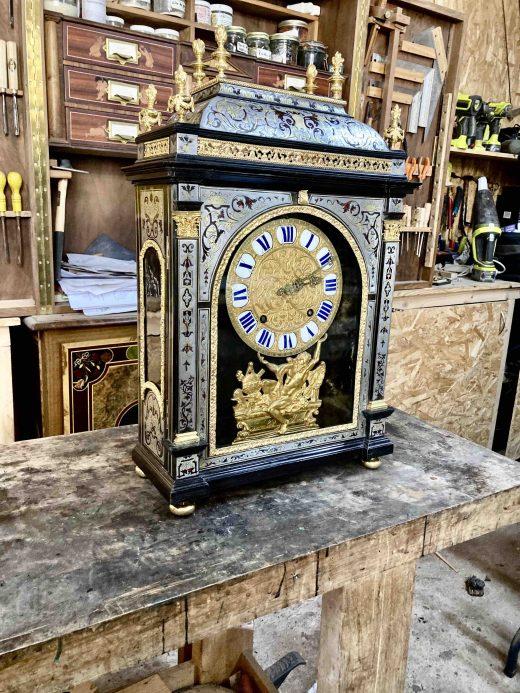
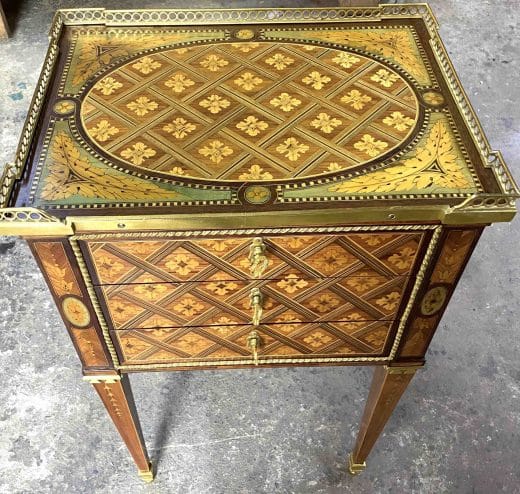
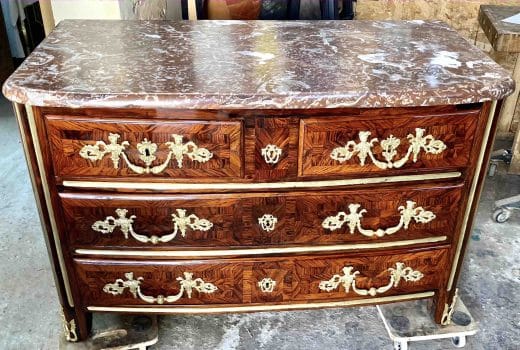
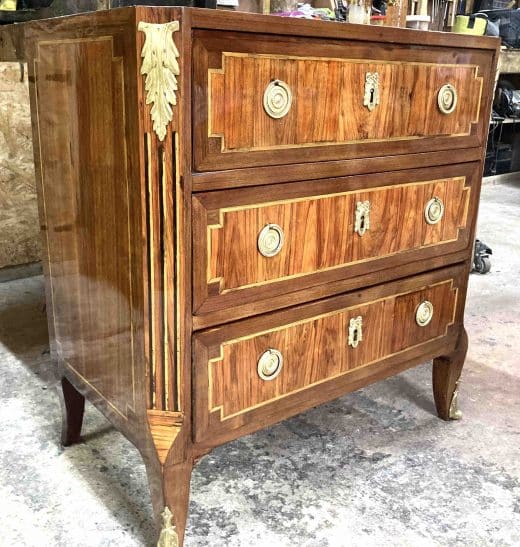
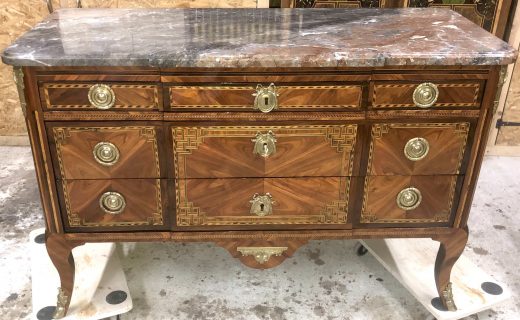
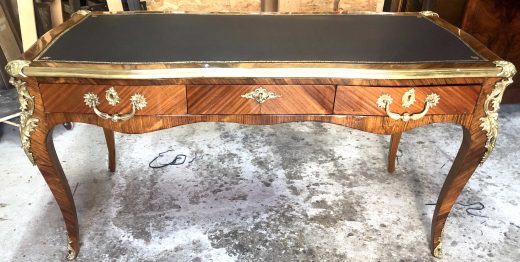
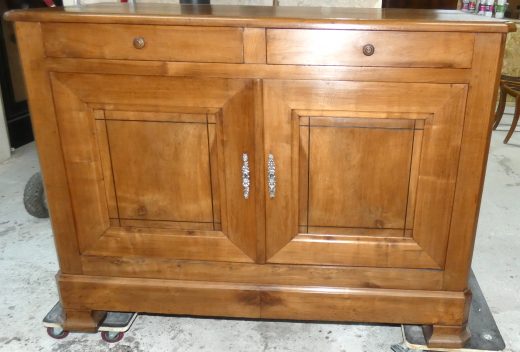
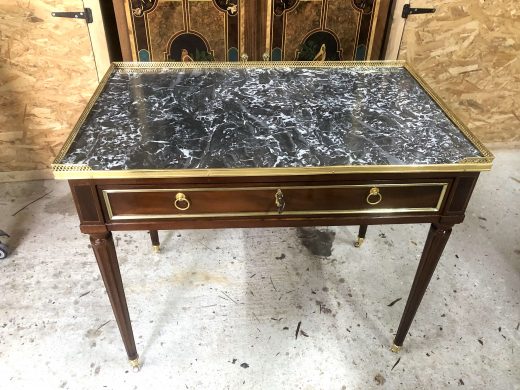
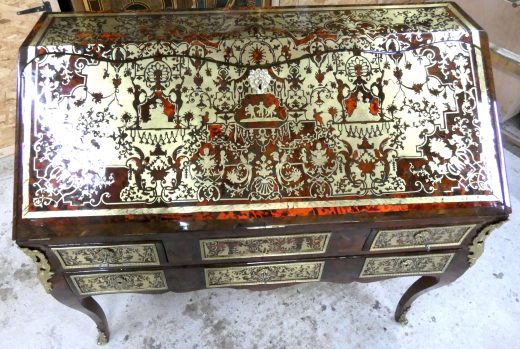
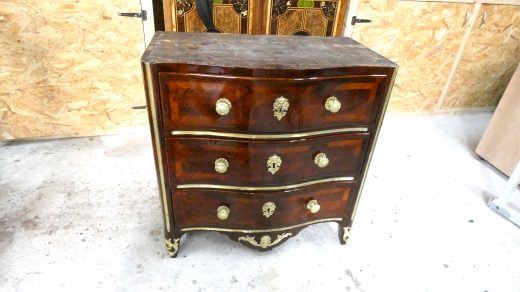
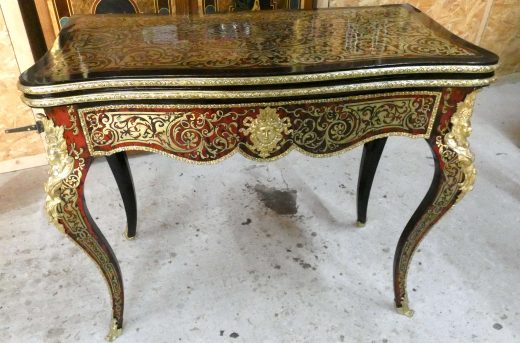
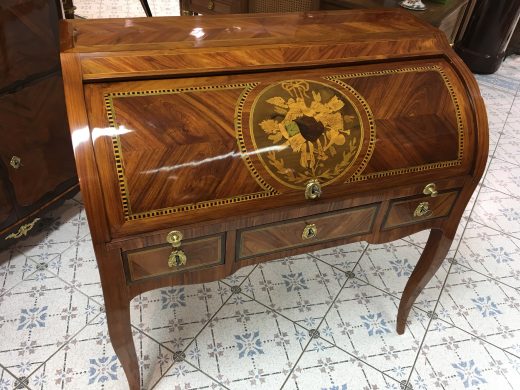
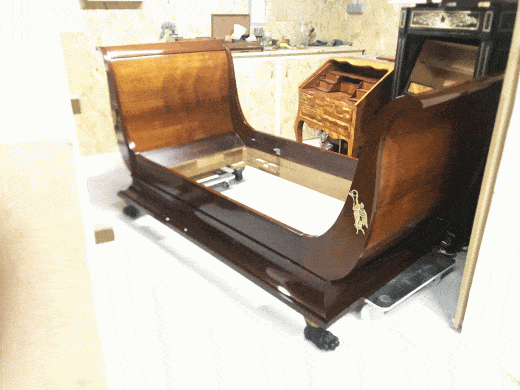
Louis XVI secretary stamped Schlichtig

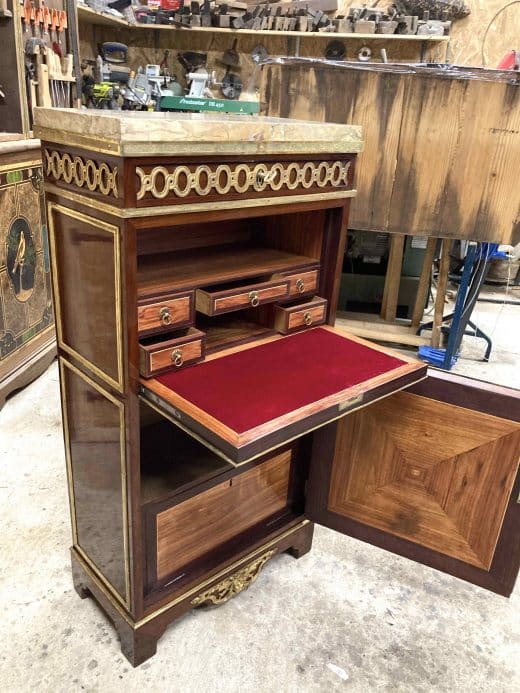
Ebénisterie Mathieu Vath

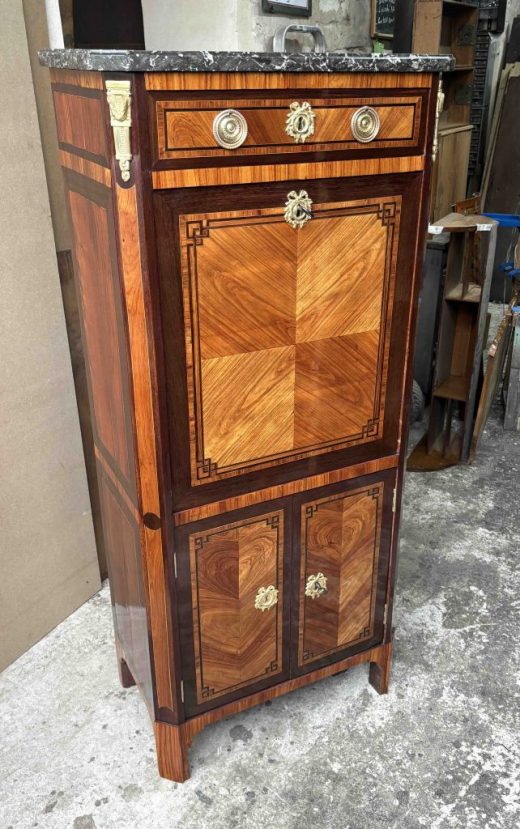
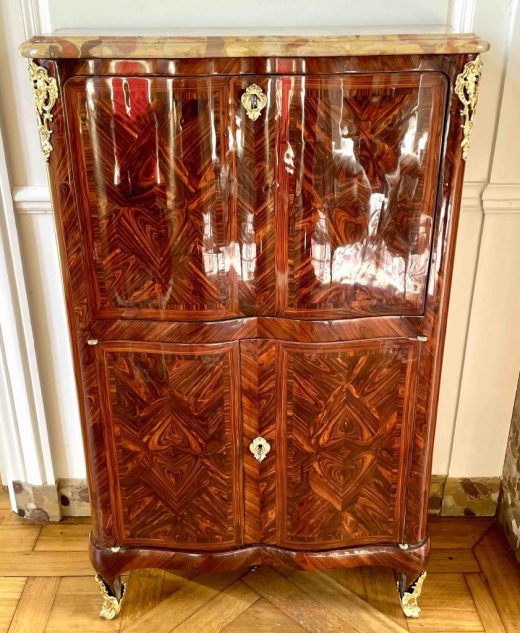
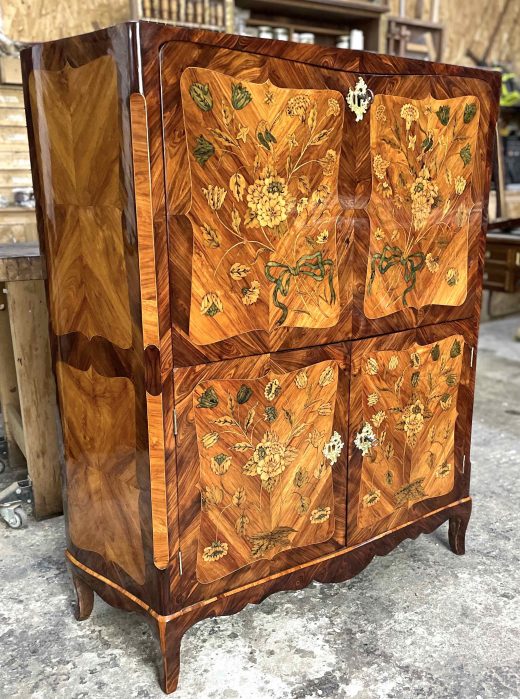
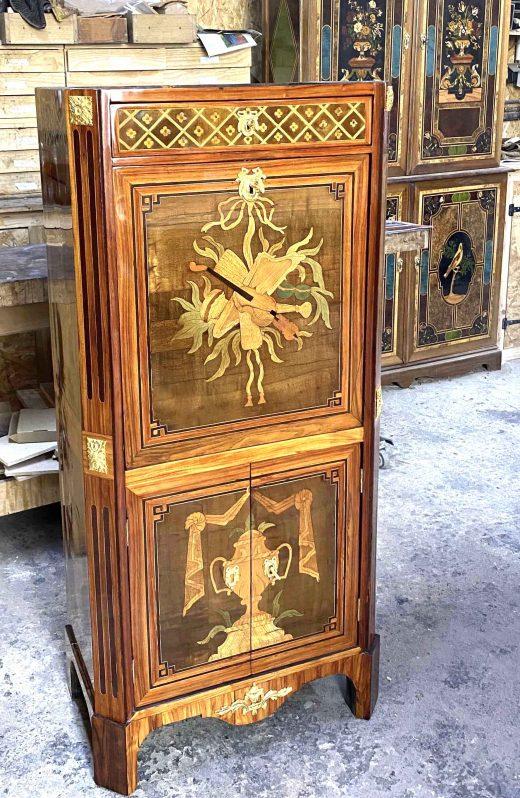
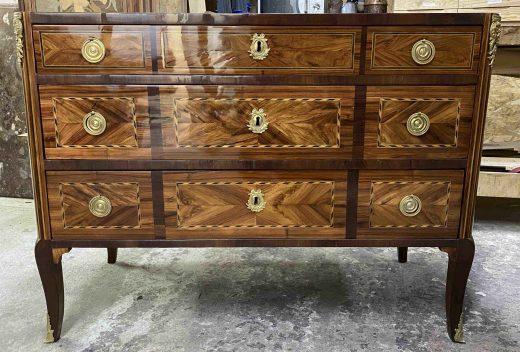
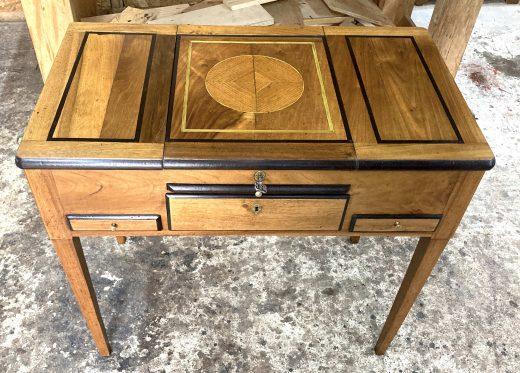
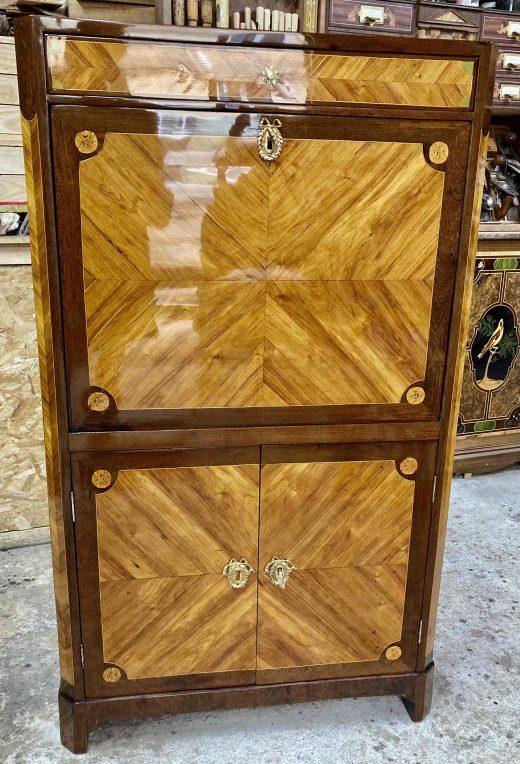
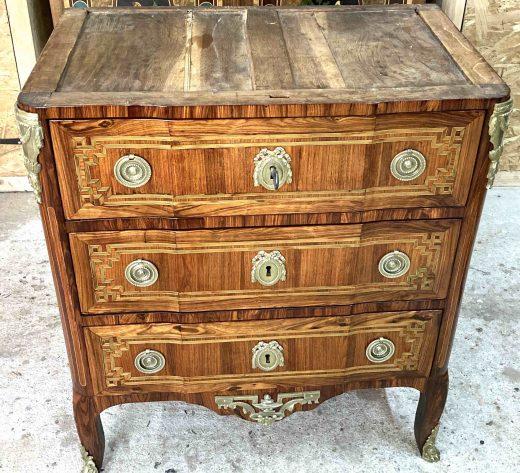
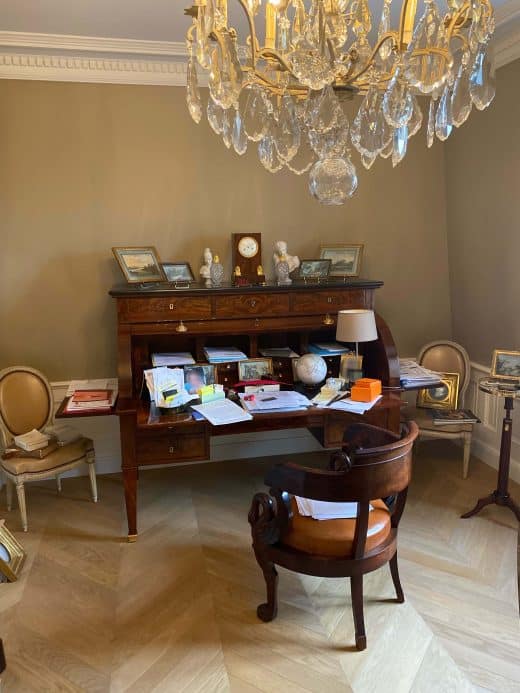
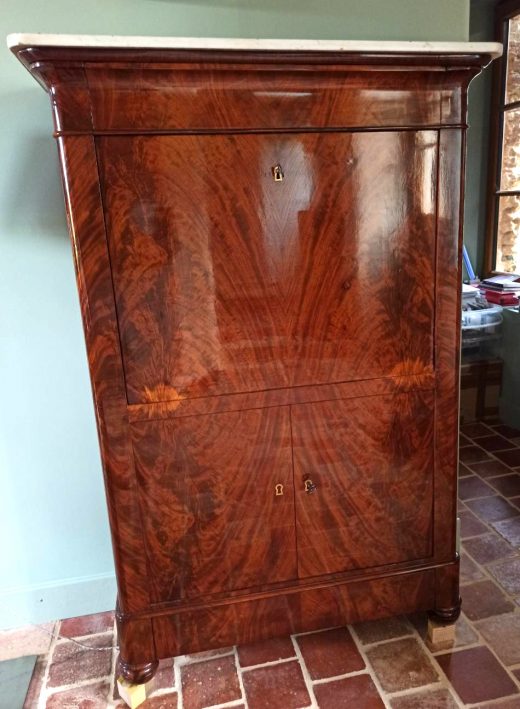
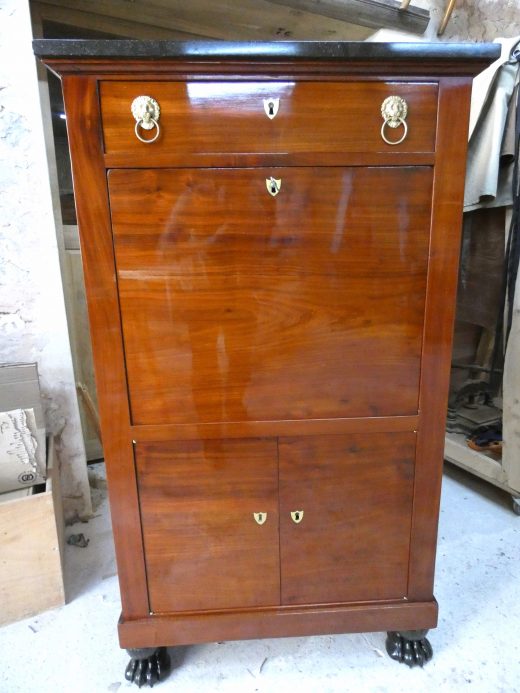
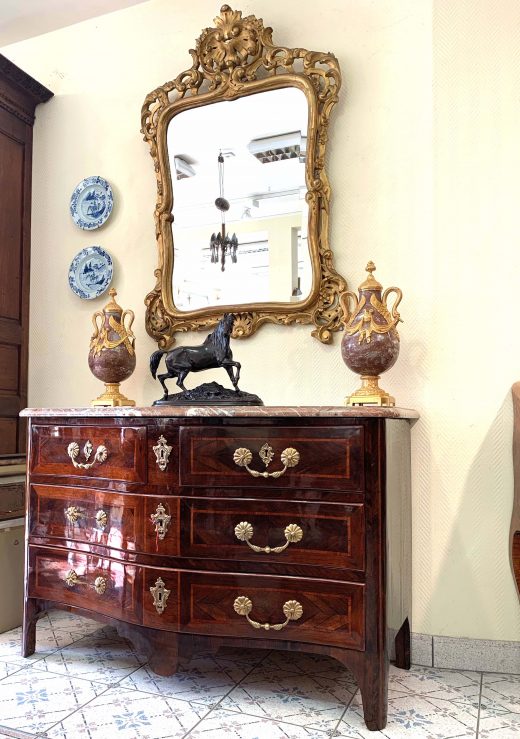
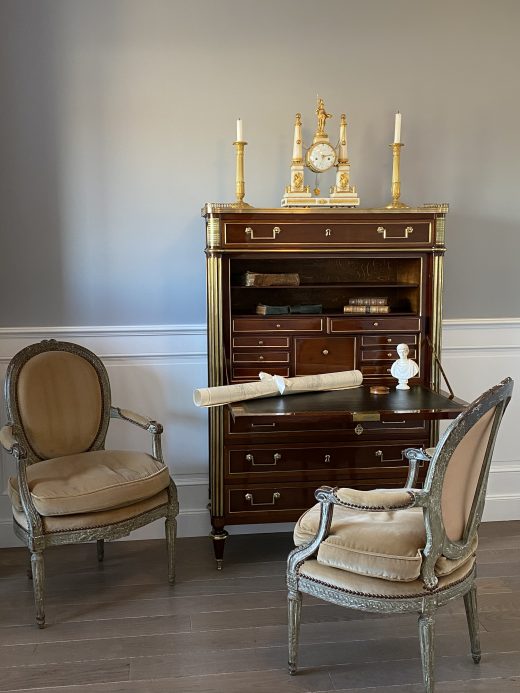
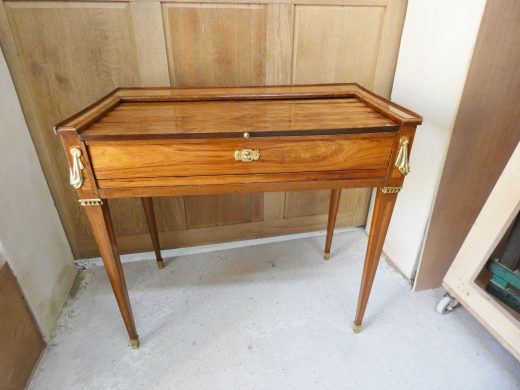
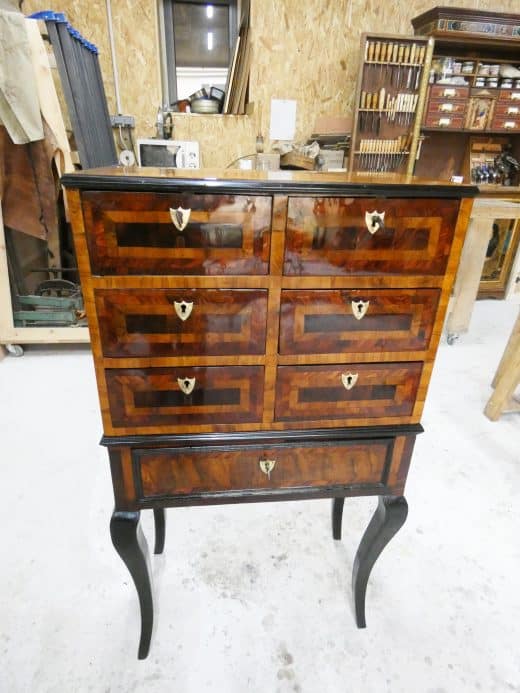
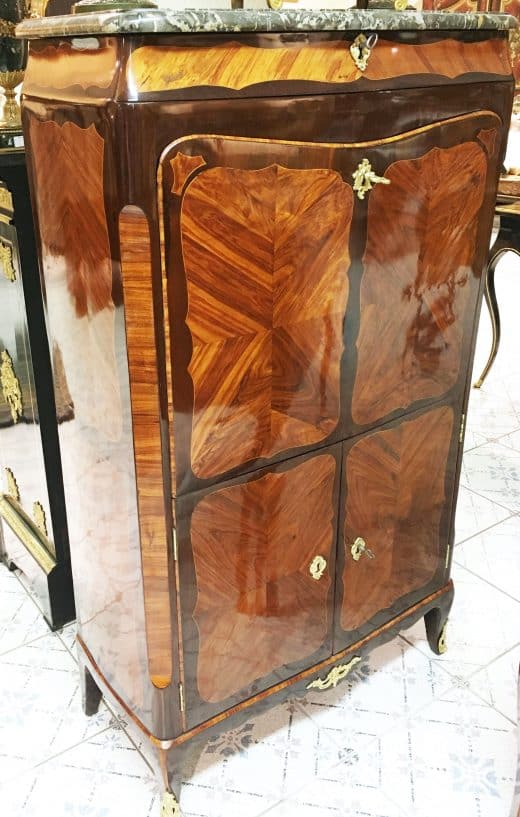
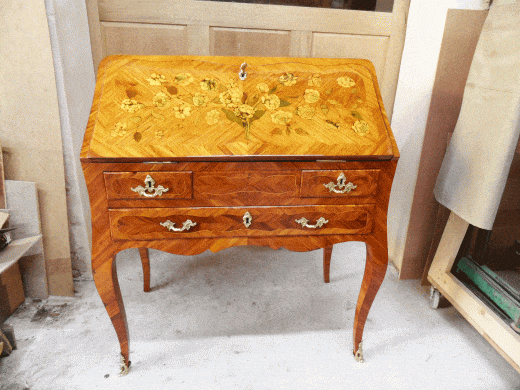
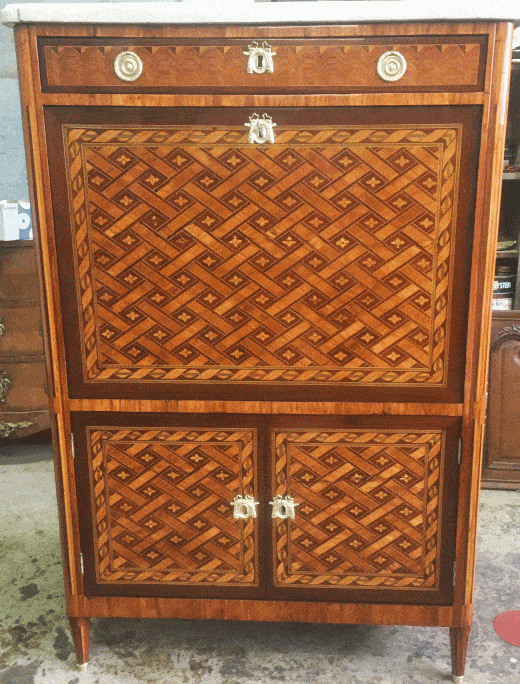
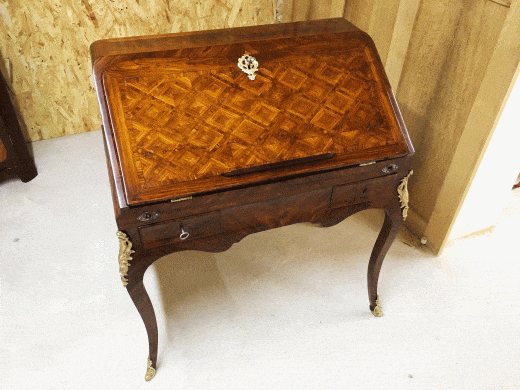
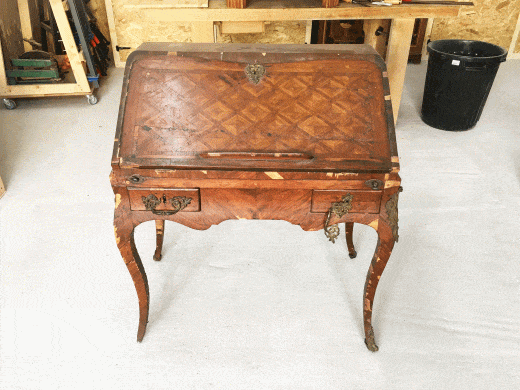
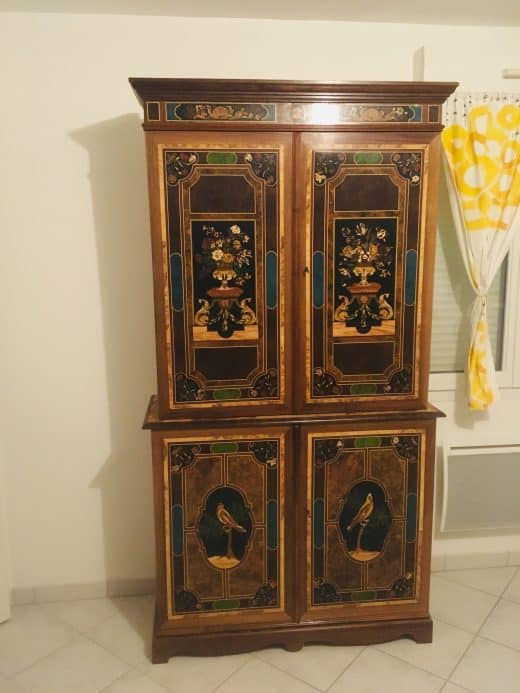
This Louis XVI style secretary desk, stamped JG Schlichtig, is made of rosewood veneer, satinwood (on the sides) and amaranth, on an oak and softwood frame. It opens with two lower doors, a central drop-front, and a top drawer. The interior of the piece includes six drawers and three niches. Given its small size, 1.20 meters, it can be described as a lady's secretary desk. Jean-Georges Schlichtig († February 1782) was a Parisian cabinetmaker of German origin, admitted as a master on October 2, 1765. He established himself successively […]
Louis XV style bookcase

Ebénisterie Mathieu Vath

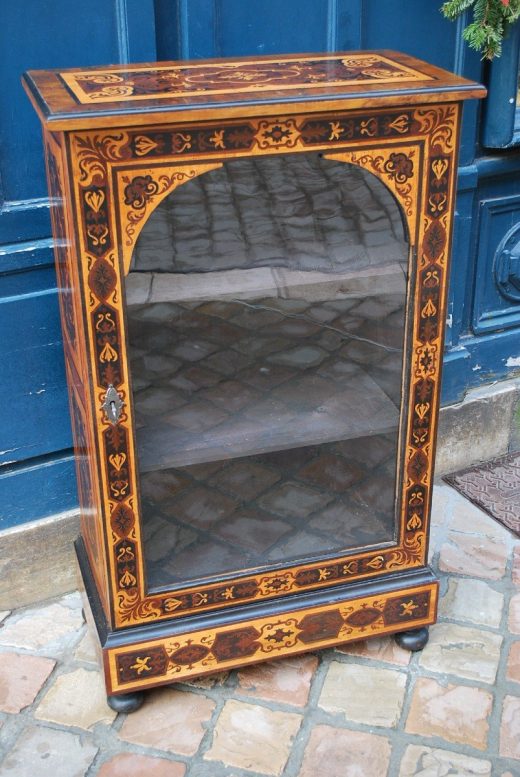
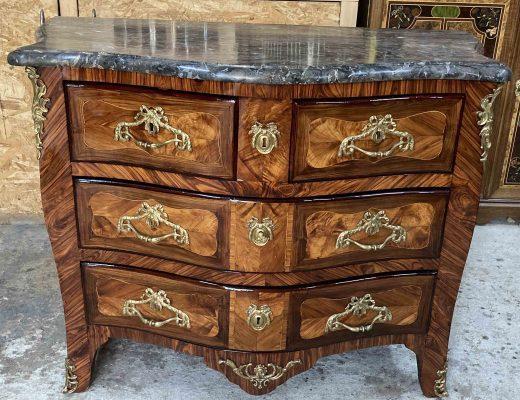
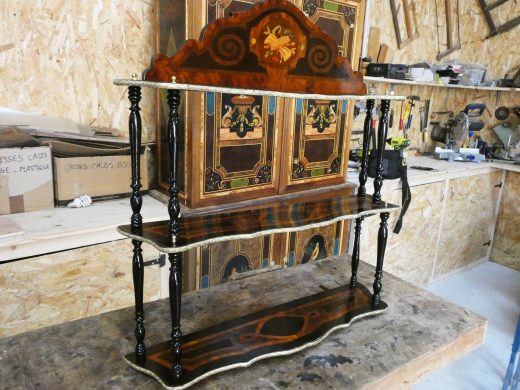
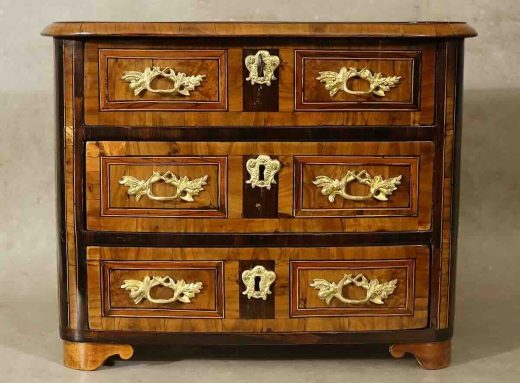
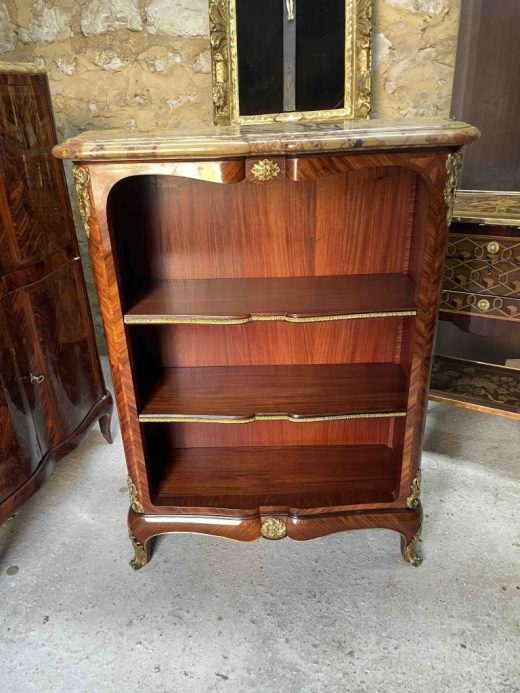
The restoration of this Louis XV style bookcase, dating from the Napoleon III era and stamped by Léon Dromard, is now complete. Its structure is made of oak, covered with a kingwood veneer, displaying a style very close to that produced by the cabinetmaker Pierre IV Migeon in the 18th century. But do you know what a bookcase is? A bookcase is a small, open storage unit that appeared in the 18th century, designed to hold books and decorative objects. Appreciated for its lightness and elegance, it quickly became a staple in refined interiors, […]

Louis XVI psyche mirror Weisweiler

Ebénisterie Mathieu Vath

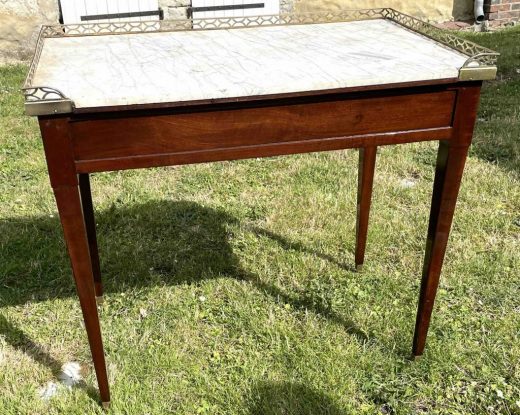
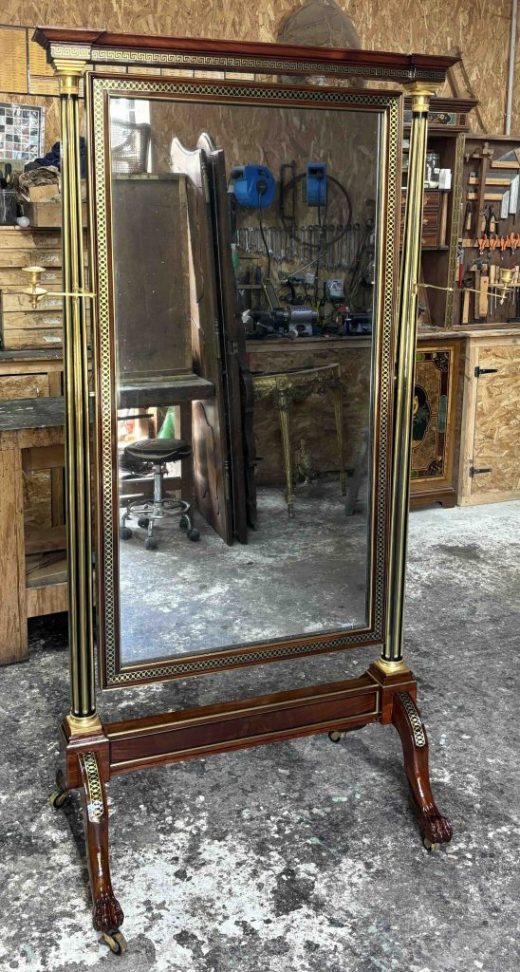
Restoration of a Louis XVI/Directoire period cheval glass stamped by Adam Weisweiler. This piece of furniture represents one of the innovations in late 18th-century furniture design. Far more than a simple dressing table accessory, it represents a significant evolution in the design of furniture intended for private use. Its appearance coincided with changing lifestyles, the development of new domestic spaces, and evolving practices related to self-presentation. For both the furniture historian and the restorer, the cheval glass is a particularly interesting object. It bears witness to both […]

Transition secretary desk in the style of Montigny

Ebénisterie Mathieu Vath

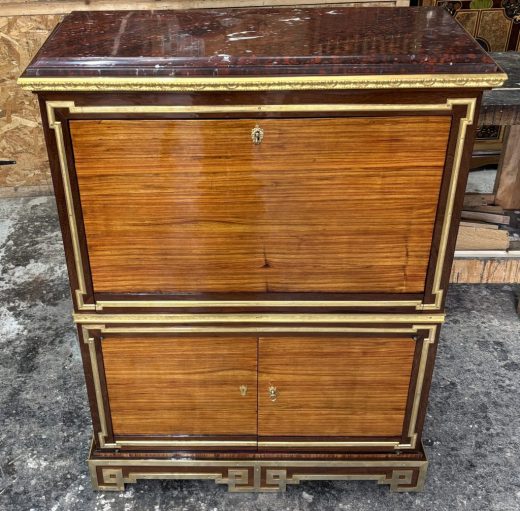
Restoration of a 19th-century Transition-style drop-front secretary, veneered in rosewood and amaranth on an oak frame. This secretary is a learned interpretation of Parisian models from 1765-1775 and is directly inspired by the famous secretary attributed to the cabinetmaker Philippe-Claude Montigny, now in the Musée des Arts Décoratifs. The stylistic similarities with the museum model are immediately apparent in the architectural design of the piece, the treatment of the stepped legs, and the use of bronze ornamentation inspired by the Greek style. The piece adopts […]

Wild herb table

Ebénisterie Mathieu Vath

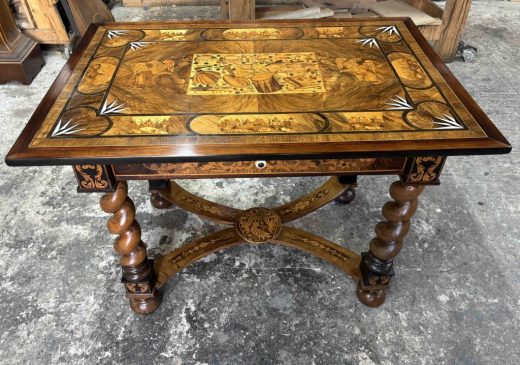
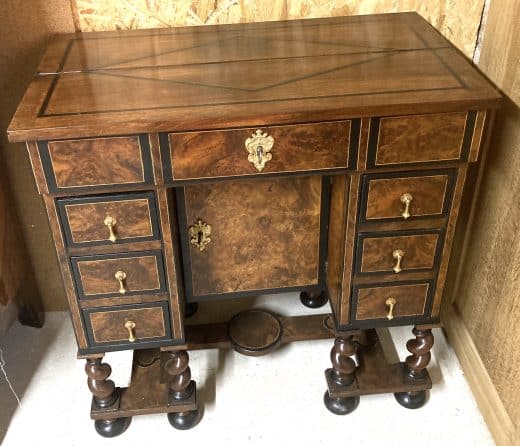
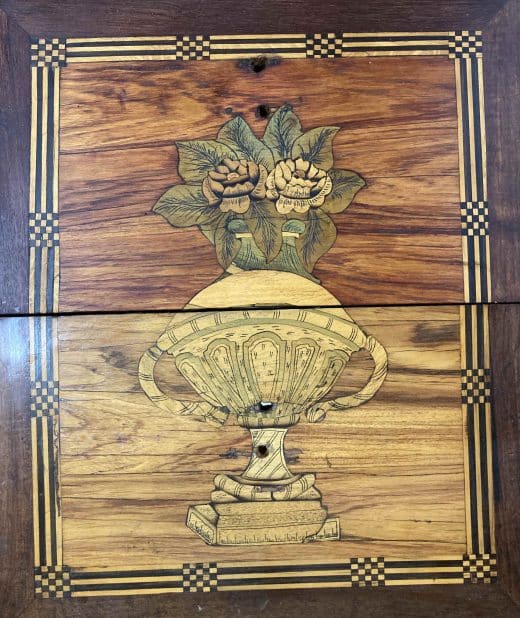
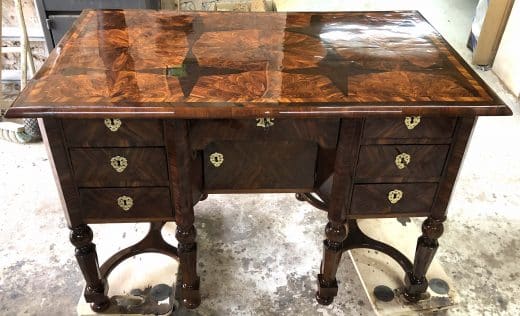
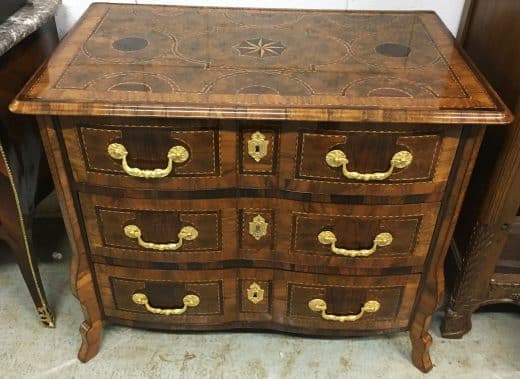
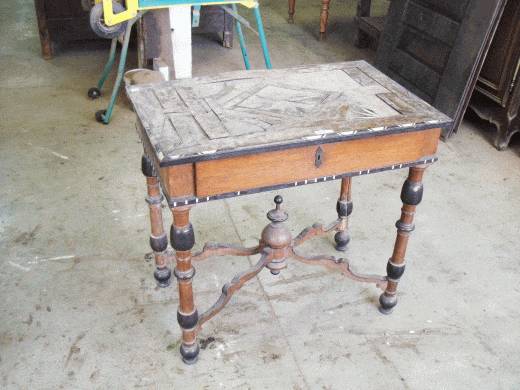
Restoration of a solid walnut marquetry table with "architectural whimsy" and "wild herbs" motifs, originating from the Austrian Tyrol in the mid-17th century. The piece rests on four twisted legs, adorned with flattened ball feet, connected by an X-shaped stretcher. It opens with a wide drawer in the front and is surmounted by a rectangular top. This top is decorated with a rosewood border, followed by bands delimited by wide bog oak fillets, themselves framed with boxwood. These elements […]

Boulle Napoleon III liquor cabinet

Ebénisterie Mathieu Vath

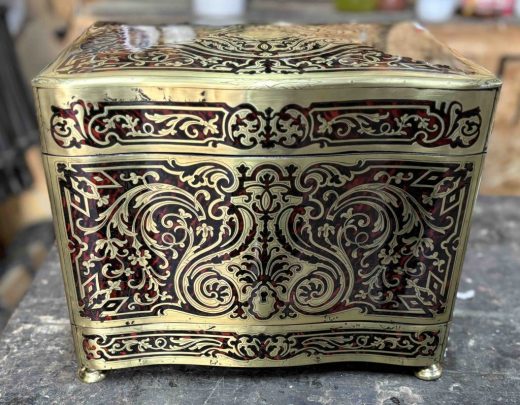
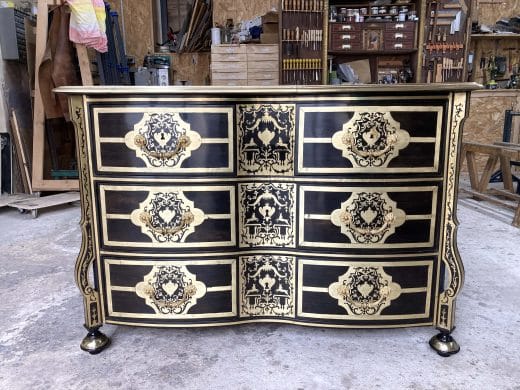
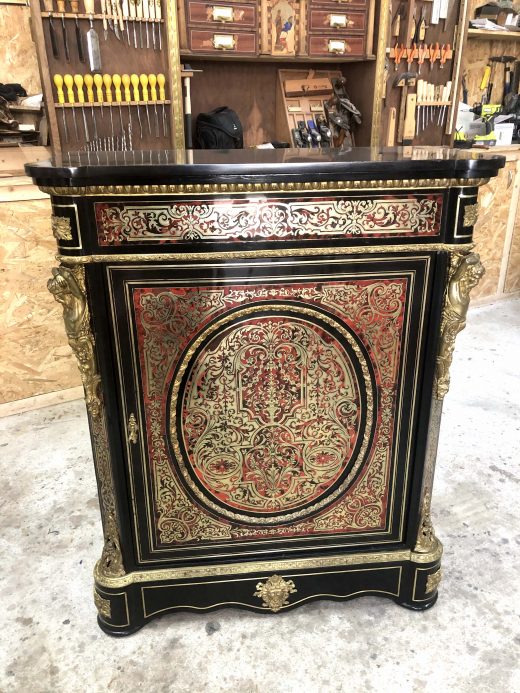
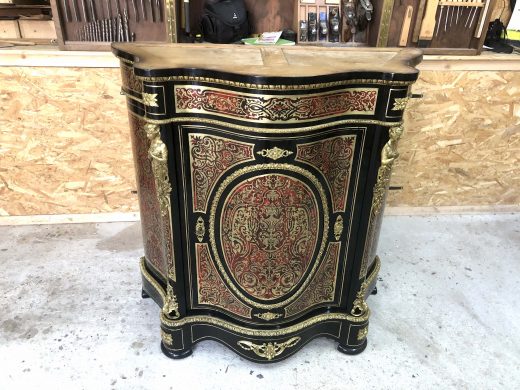
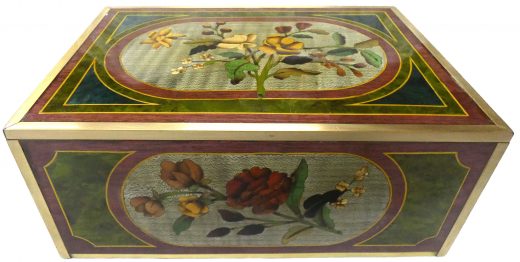
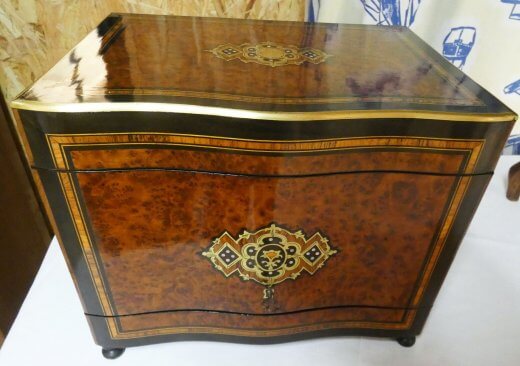
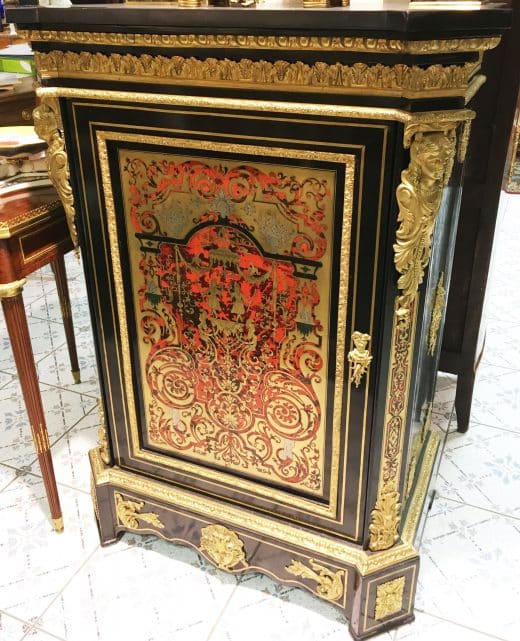
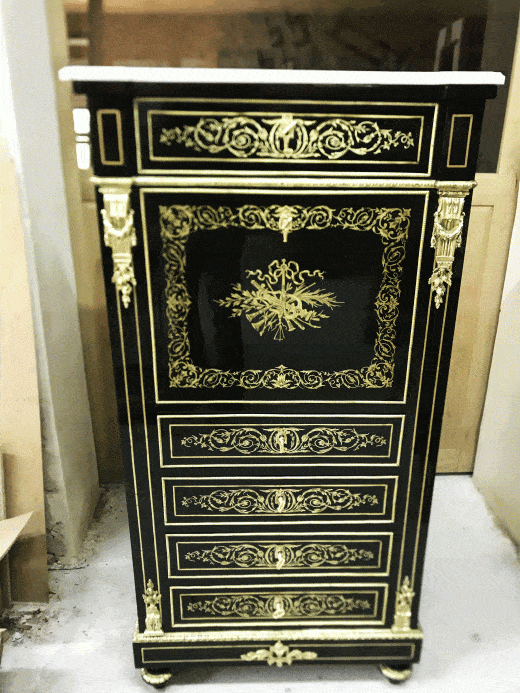
Restoration of a Napoleon III liquor cabinet in tortoiseshell and brass marquetry. The liquor cabinet, an elegant and ingenious piece of furniture, appeared at the end of the 18th century. Initially designed to accompany long carriage journeys, it allowed for the easy transport and consumption of liqueurs. Its true rise in popularity, however, occurred in the 19th century, a period during which it became a symbol of refinement and the French art of living. This piece of furniture takes the form of a box, called a "caisson," […]

Majorelle's Love Letter

Ebénisterie Mathieu Vath

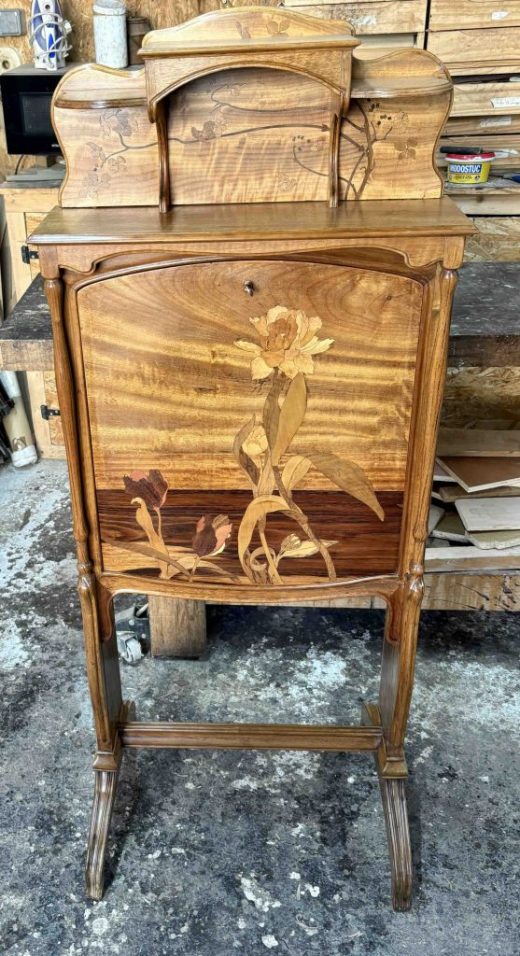
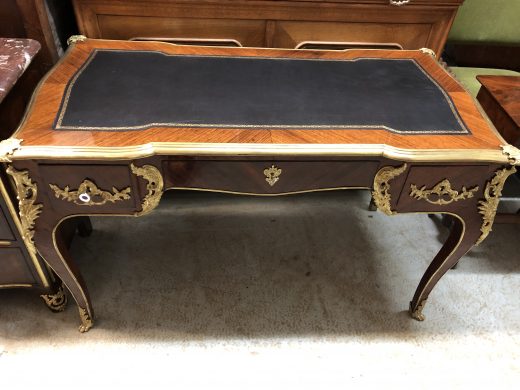
Congratulations to Léo, an intern in our workshop, who completed his first restoration on a lady's writing desk, also known as a "billet doux" (love letter), adorned with the stamps of Louis Majorelle. The "billet doux" originated in France at the end of the 18th century, developing particularly during the reign of Louis XVI and the Restoration period (late 18th – early 19th century). It is an intimate and refined piece of furniture, designed specifically for correspondence, often intended for boudoirs or bedrooms. Louis […]

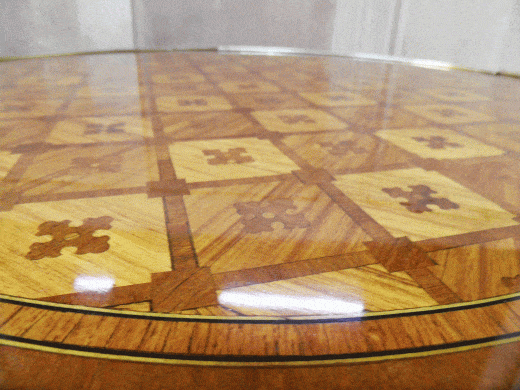
Rochelaise table in rosewood and ebony

Ebénisterie Mathieu Vath

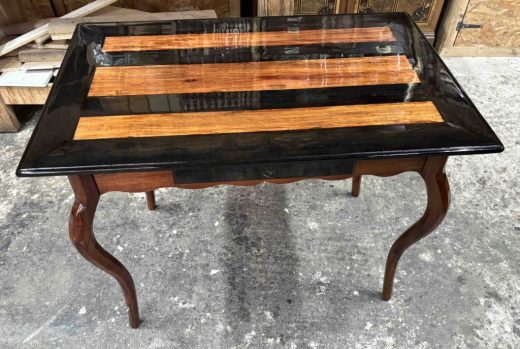
Restoration of a Louis XV salon table, made in La Rochelle in the mid-18th century. This piece is distinguished by its parquet top, alternating rosewood and ebony. It opens with a drawer integrated into the front apron, whose shaped moldings and cabriole legs with octagonal sides testify to exceptional craftsmanship. The table is made exclusively of solid rosewood for the base, the parquet top, and the drawer boxes, while solid ebony is used for the […]

Regency chest of drawers Crossbow

Ebénisterie Mathieu Vath

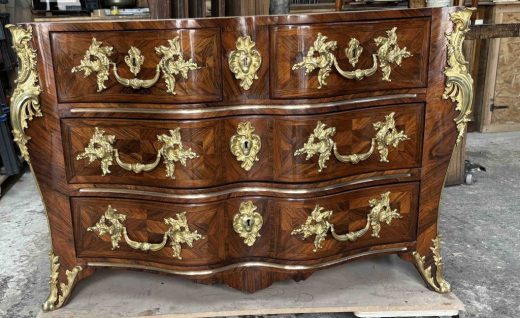
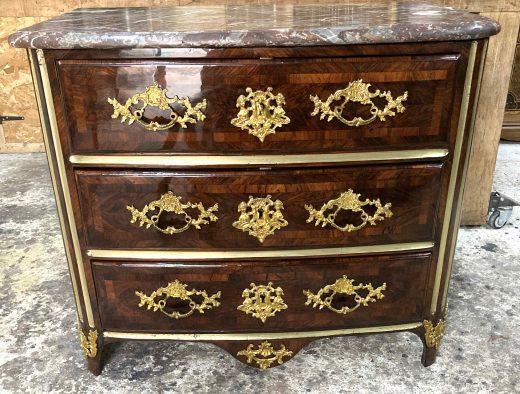
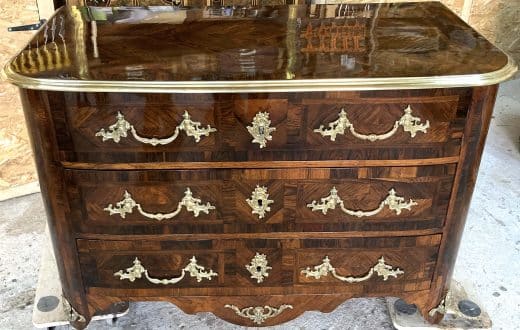
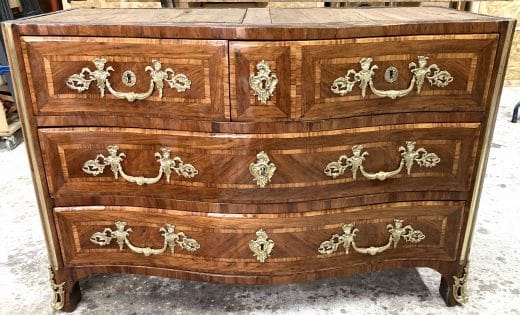
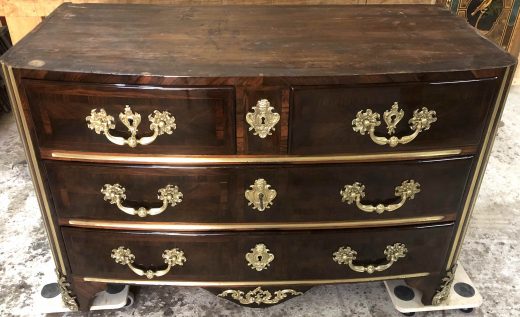
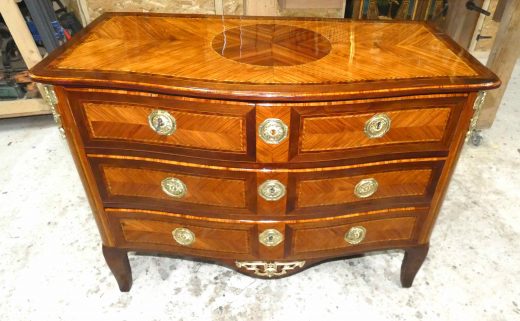
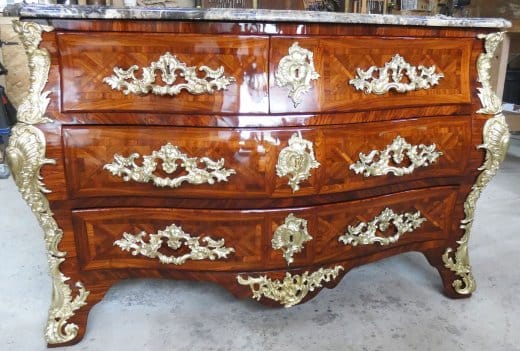
Conservation work on this Regency period commode, characterized by its serpentine shape, rosewood veneer, and gilt bronze mounts, resting on an oak and softwood frame. Our task was to stabilize the veneered surfaces by injecting protein-based adhesive. Veneer gaps were filled with grafts of new rosewood veneer, previously sawn, scraped, and sanded. These grafts were then French polished, naturally oxidized with ultraviolet light, and then applied to the appropriate thickness as a backing before being glued in place with […]

Regency chest of drawers stamped Merchant

Ebénisterie Mathieu Vath

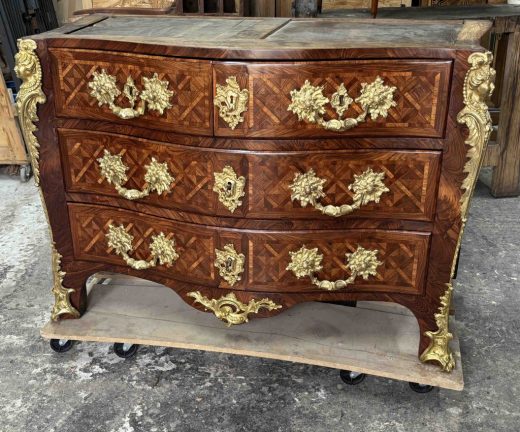
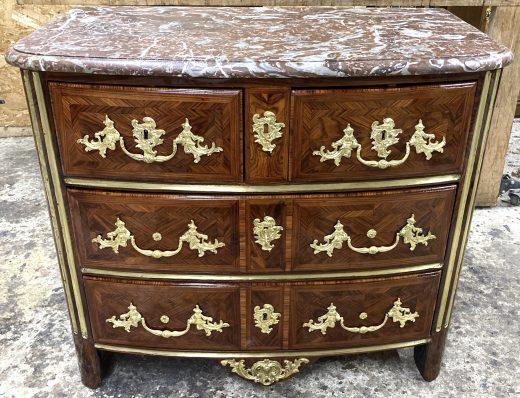
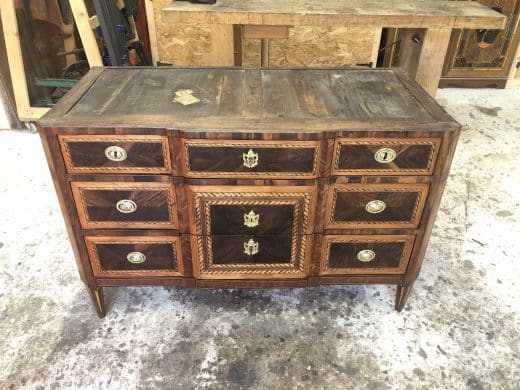
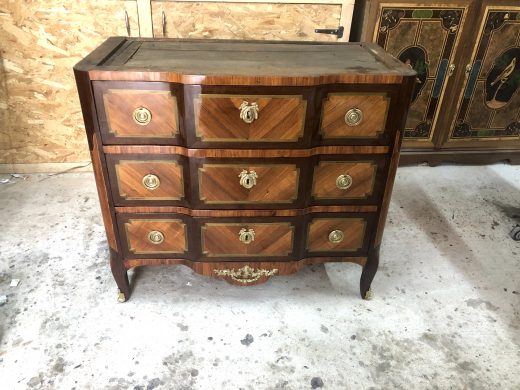
Restoration of a Regency period commode, stamped with the name Nicolas Jean Marchand, veneered in violet wood with a diamond-point pattern on an oak frame. It opens with four drawers. The whole is adorned with chased bronze mounts bearing the crowned C, including thick drop handles, large gadrooned rosettes, cartel-shaped keyhole escutcheons, and espagnolette drops ending in eagle-claw feet. The crowned C: The royal edict of 1745 required bronze workers to affix a distinctive mark, a […]

Pair of Louis XV commodes

Ebénisterie Mathieu Vath

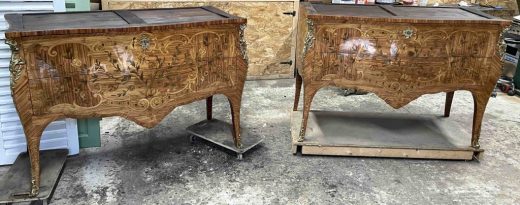
Here is the latest major restoration project undertaken by Raphaël, our apprentice. It involves a pair of Louis XV style commodes bearing an unknown stamp, CCS, which could be attributed to Charles Claude Saunier, an early work by the latter. Please find below the detailed account of the work carried out by Raphaël. Enjoy your reading. Restoration of a Pair of Louis XV Commodes This restoration project was carried out on a set of two commodes, designed according to the aesthetic and technical principles of the Louis XV style. This style […]

Louis XIV low bookcase

Ebénisterie Mathieu Vath

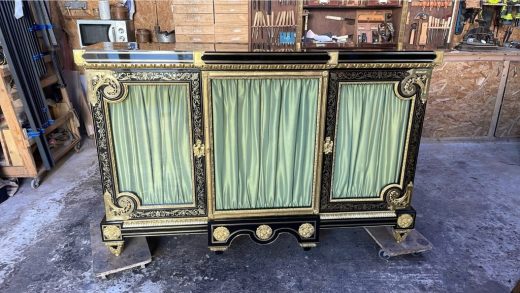
Restoration of a low Louis XIV style bookcase, in Boulle marquetry of brown tortoiseshell and brass, ebony, and chiseled and gilded bronze ornamentation. The central projecting front opens with three glazed doors decorated with scroll and foliage motifs, resting on tapered legs. This type of three-part low cabinet was one of Boulle's great successes, and he himself offered several variations. The Louvre Museum, in fact, owns no fewer than six examples. These pieces of furniture, particularly suited to the display […]

Doll's Head Clock by Baltazard Martinot

Ebénisterie Mathieu Vath

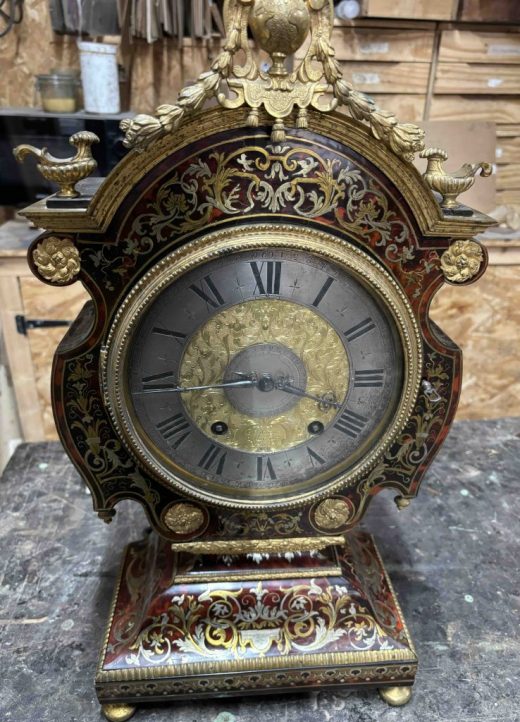
The first project of the year involved stabilizing, consolidating, restoring, preserving the finish, and harmonizing the elements. The main objective was to preserve the history and identity of the project as much as possible without dismantling anything. A masterpiece of Parisian clockmaking from the Grand Siècle, this remarkable clock, known as a "doll's head" clock, is emblematic of Parisian clockmaking at the end of the 17th century, during the reign of Louis XIV. Its architectural form, dominated by a circular body flanked by lateral projections and surmounted by a rich crowning element […]

Louis XVI commode stamped JL Cosson

Ebénisterie Mathieu Vath

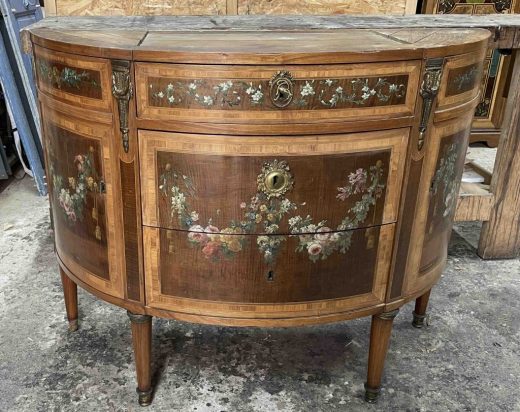
This Louis XVI period half-moon commode, stamped by the cabinetmaker Jacques Laurent Cosson, likely dates from a production between 1780 and 1790. It is an exceptional example of painted furniture from the end of the Ancien Régime, belonging to a very small group of which only seven examples are currently known. This small and highly sought-after group of 18th-century French painted furniture is now recognized as one of the most inventive areas of Parisian cabinetmaking on the eve of the Revolution. This commode, with its curved, half-moon shape, rests […]

Louis XV secretary desk, stamped MIGEON

Ebénisterie Mathieu Vath

Restoration of a secretary desk, commonly called a "drop-front secretary" or "cabinet secretary," bearing the MIGEON stamp. This piece is distinguished by its serpentine front, opening with a pivoting drop-front that reveals nine small, curved drawers. The inside of the drop-front is lined with leather. The "cabinet" itself opens with two doors. The entire front is veneered with four panels of kingwood veneer, obliquely cut into butterfly wings. Each compartment is decorated with a quatrefoil motif of butterfly wings, set within a […]

Directoire armchairs

Ebénisterie Mathieu Vath

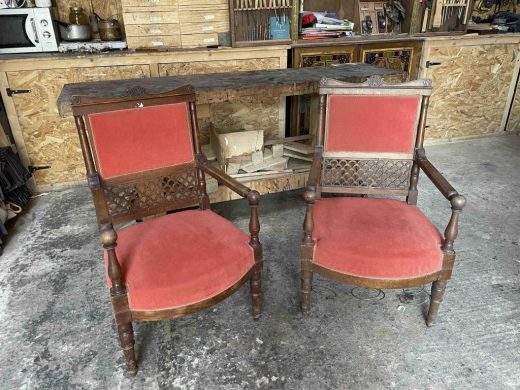
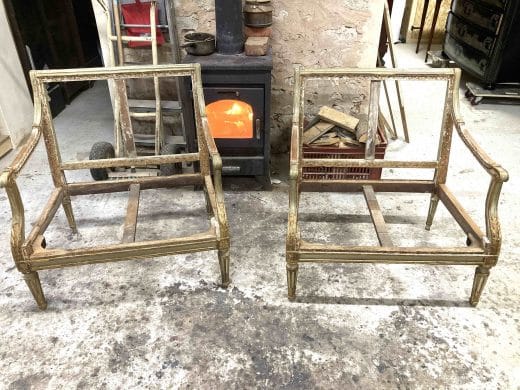
Restoration of a pair of Directoire period armchairs (circa 1795–1805), made of solid mahogany, except for the veneered stretchers. These chairs display the clean, balanced lines characteristic of the Directoire style, a transitional period between the strictures of the Louis XVI style and the codes of the Consulate. Assembled using mortise and tenon joints, they are made of solid mahogany. The straight armrests are extended by turned supports, typical of the late Directoire. The legs are turned in a baluster shape and slightly tapered at the bottom. The rectangular backs are framed with simple molding, […]

Louis XV Cartel

Ebénisterie Mathieu Vath

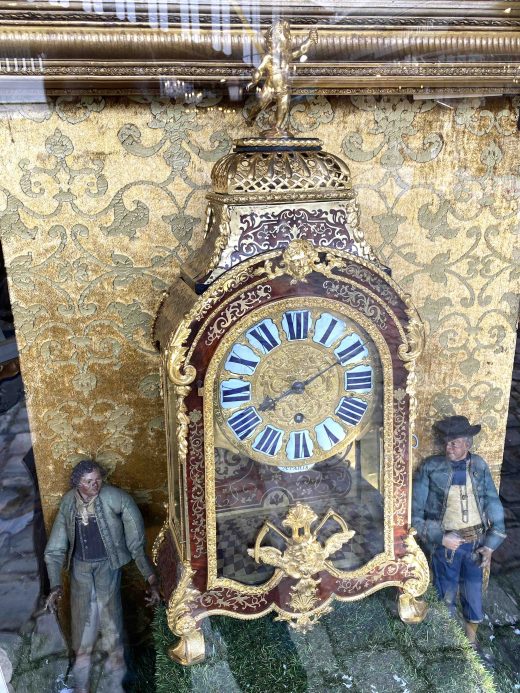
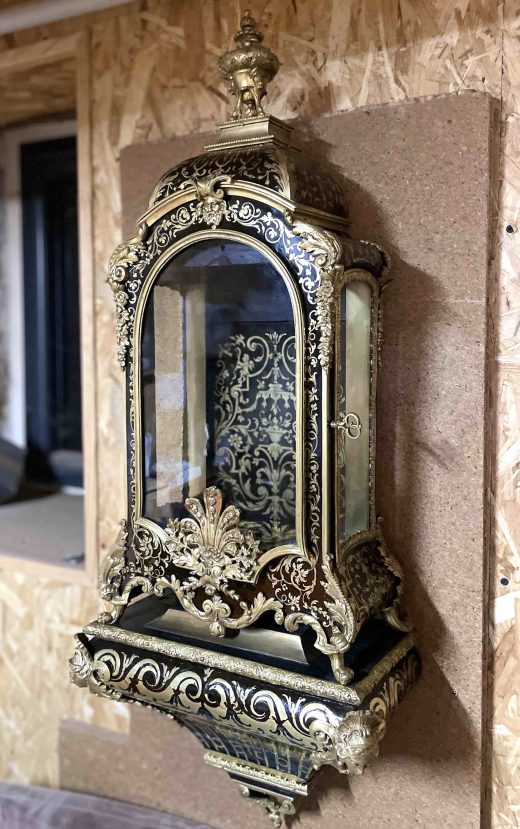
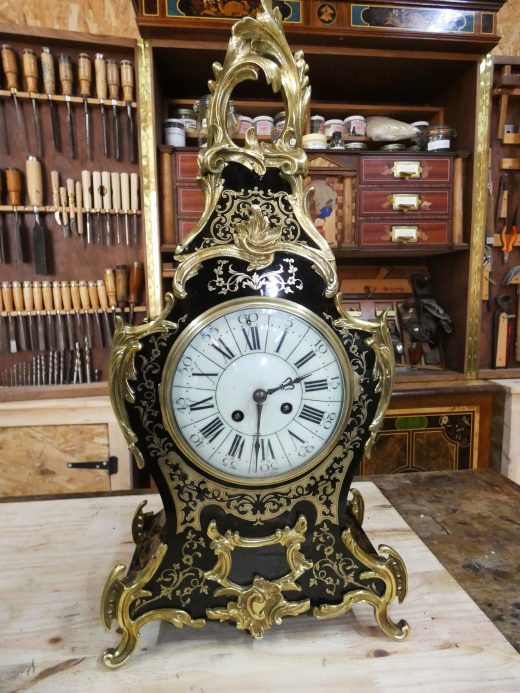
This is the first cartel clock restoration undertaken by Raphael, focusing on this Louis XV cartel clock in Boulle marquetry of brown tortoiseshell and brass. Restoring a cartel clock is a complex task requiring considerable time and meticulous attention to detail. The curved shapes make gluing delicate operations, and it is generally necessary to reattach large sections of the brass elements. Condition report: This cartel clock presented widespread soiling, an oxidized and tarnished varnish, as well as several lifting and missing pieces in the brass and tortoiseshell marquetry. […]

Empire Table

Ebénisterie Mathieu Vath

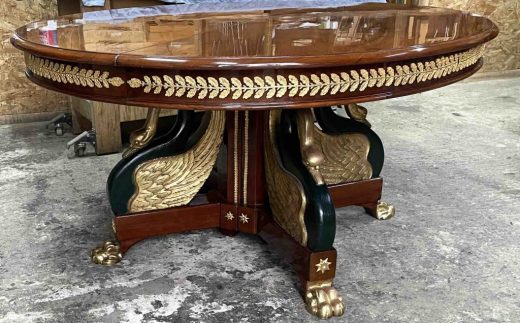
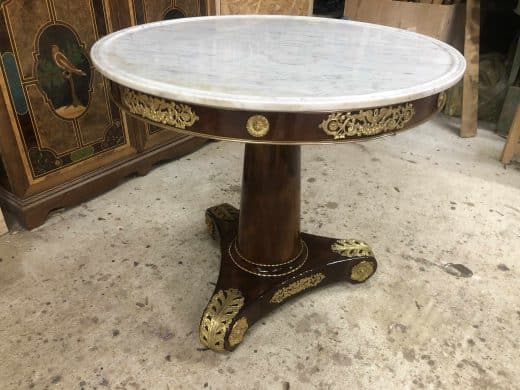
The restoration of this Empire dining table is now complete. The work focused primarily on the finishing touches. We removed the previously applied polyurethane varnish and applied a French polish to the solid mahogany top and its four-legged base decorated with swan neck motifs and lion's paw feet. The apron features an oak frieze. Length x Width = 162 x 140 cm. Length x Width with extensions = 252 cm.

Wedding wardrobe from Bayeux with swans

Ebénisterie Mathieu Vath

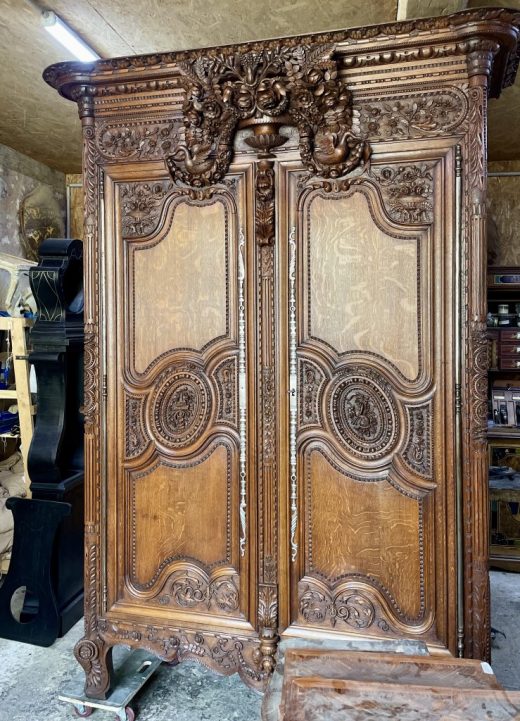
A lightening of the finish was carried out on a Bayeux wedding armoire, distinguished by its motifs of swans, figures, and hunting and musical attributes. The piece is made of quarter-sawn oak, also known as "merrain," and is attributed to the Caen plain, dating from the first half of the 19th century. The restoration work consisted of lightening the waxed finish to remove the multiple layers of tinted wax that darkened the entire piece. This process revealed the beautiful honey-blond hue of the oak […]

Louis XVI chest of drawers by Jean-Francois Leleu

Ebénisterie Mathieu Vath

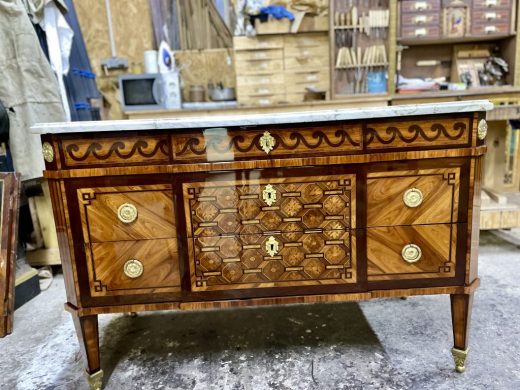
Restoration of a Louis XVI period commode with a projecting central front, stamped JF LELEU. Made entirely of oak, it is veneered with amaranth, rosewood, boxwood, stained maple burl, and tobacco-grey maple. It is decorated with marquetry featuring a frieze of posts on the top drawer, Greek key motifs, and fleurons within a mosaic of hexagons known as "marquetry à la reine" on the central projection. It has three drawers, two of which conceal drawers with crossbars. The front uprights are […]

Regency-style wardrobe stamped MIGEON

Ebénisterie Mathieu Vath

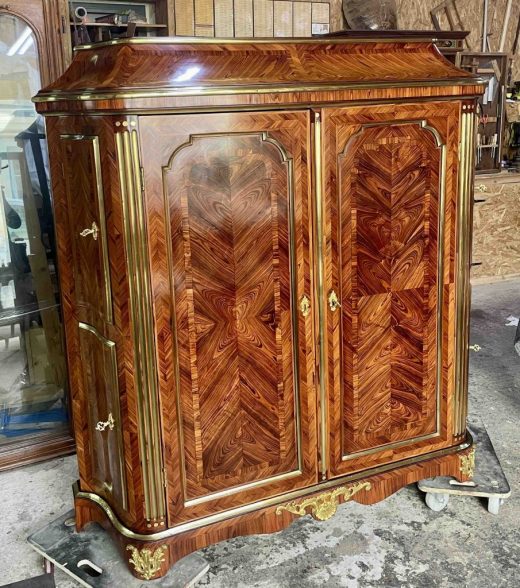
Restoration of a Regency-style cabinet, probably dating from the 1740s, stamped by Pierre IV Migeon. Constructed of oak and softwood, this cabinet, which could also be considered a bookcase, is entirely veneered in kingwood, rosewood for the top, and walnut for the interiors. The doors are veneered with a butterfly-wing pattern, while the side doors feature a square motif, typical of Migeon's decorative vocabulary. The ogee cornice is edged with a half-round brass molding. The uprights […]

Empire Desk

Ebénisterie Mathieu Vath

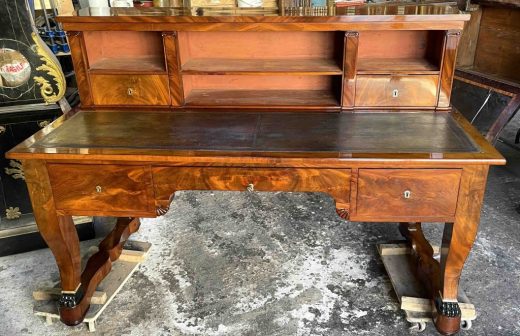
Restoration of an Empire period desk veneered in mahogany burl on an oak frame. The four "chimera thigh" legs are connected by intermediate stretchers and rest on lion's paw feet. The Empire style, which emerged in the early 19th century during the reign of Napoleon I, is an artistic and decorative expression closely linked to the Emperor's desire to create a new, grandiose, and imperial aesthetic, befitting his power. Heir to the Neoclassical movement that began in the 18th century, […]

Provençal table and kitchenware

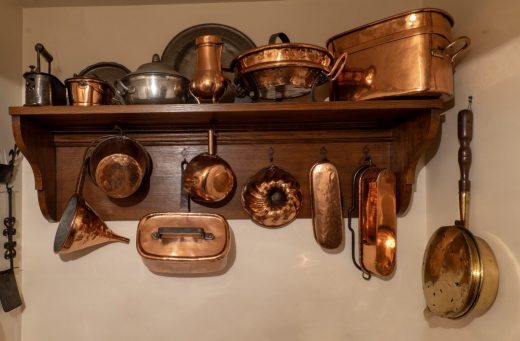
Here is a Provençal table from the Louis XV period and copperware dating partly from the 18th century and partly from the first two-thirds of the 19th century. They have been varnished and are in perfect condition. The pewter pieces are from the 18th century. The metalwork with iron utensils also dates from the 18th century, some utensils being older than others (very rare items). These items are being offered for sale through me. If you are interested, please do not hesitate to contact me. Provençal table, center table with a drawer in the front […]

Augsburg Cabinet, 17th century

EEbénisterie Mathieu Vath

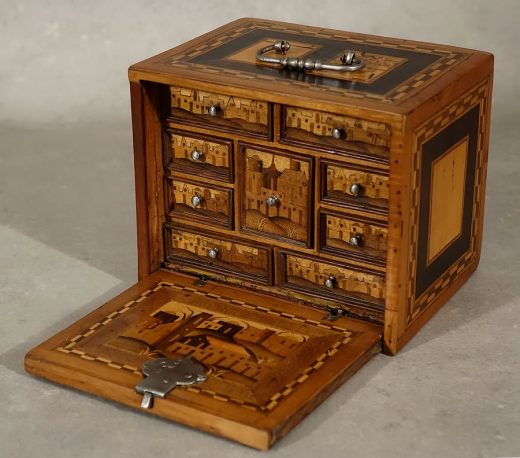
Restoration of a small table cabinet (Height: 14.3 cm – Width: 17.3 cm – Depth: 13 cm), likely a traveling model, made of solid wood with intarsia on all sides, opening with a drop-front concealing eight drawers (the bottom one simulating two drawers). Its composition is particularly rich, incorporating eight different wood species. The frame, made of fir and cherry for the visible parts, is inlaid with large central panels of sycamore maple. These are framed by bands of plum wood, themselves bordered by a double band […]

Regency commode with bridge "with dragons"«

Ebénisterie Mathieu Vath

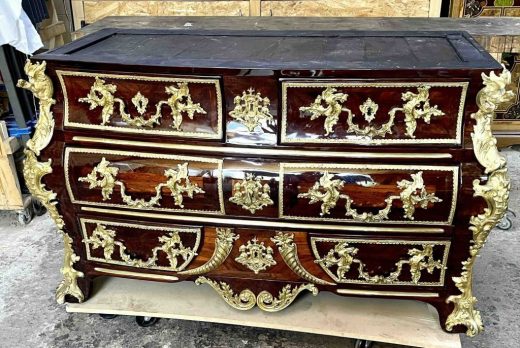
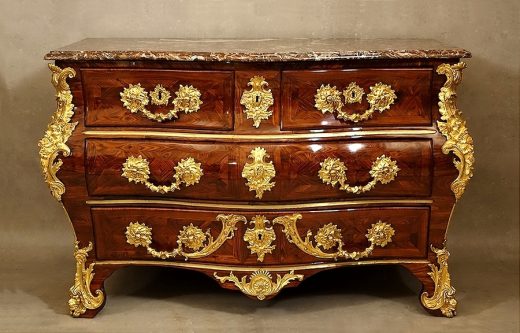
Restoration of a Regency period commode, topped with a 30 mm thick Rance marble slab, molded with a corbelled edge following its contours. This commode, curved in plan and elevation on the front and sides, is veneered with snakewood and satinwood. It has four drawers (simulating six) arranged in three rows. Its voluminous feet evoke the clawed paws of a dragon. The commode is adorned with brass fluting and chased and gilded bronze mounts: chased waterleaf frames framing the drawers, thick drop handles with shell motifs, wide plates […]

Regency Cartel

Ebénisterie Mathieu Vath

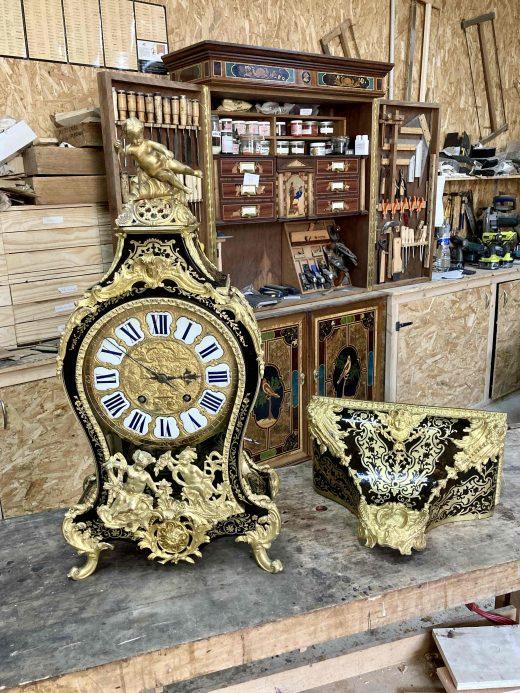
The restoration of five Boulle marquetry clocks, begun a few months ago, is now complete. Here is a Regency clock and its console, inlaid with tortoiseshell and brass on an oak frame. Measuring Time: Since the dawn of time, humankind has strived to measure time. From the gnomon, a simple stick planted in the ground—a precursor to the sundial—to the flow of water in the clepsydra, and then to the hourglass using the same principle, all these methods have allowed people to organize their social lives, […]

Nesting tables by Emilie Gallé

Ebénisterie Mathieu Vath

Restoration of a set of four Art Nouveau nesting tables, crafted and stamped with marquetry on each tabletop by the Gallé workshops. The beechwood bases are adorned with a naturalistic decoration of tree branches, and feature marquetry of daffodils, seascapes, and lapping catkins. The woods used for this marquetry are ash, walnut, sycamore maple, rosewood, mahogany, walnut burl, and elm. Émile Gallé (1846-1904) Émile Gallé is an emblematic figure of Art Nouveau, renowned for his contributions […]

Louis XV Cartel

Ebénisterie Mathieu Vath

We are continuing our series on cartel clocks, which began a few months ago. Here are some images of the restoration of this Louis XV cartel clock in brown tortoiseshell and brass marquetry on an oak frame. Condition report: The structure is in a state of significant deterioration, and re-gluing the joints appears necessary. All the marquetry is detached or shows signs of glue dehydration. Furthermore, the clock has been heavily sanded, which has resulted in the disappearance of all traces of engraving on the brass elements. […]

English Cabinet

Ebénisterie Mathieu Vath

Restoration of a late 17th/early 18th-century English cabinet, veneered in walnut and maple, featuring the distinctive free-flowing arabesque marquetry known as seaweed marquetry because it evokes the seaweed found on the seabed. English "seaweed" marquetry is traditionally associated with Dutch and Flemish cabinetmakers active in the second half of the 17th century, and particularly with Gerrit Jensen. Indeed, when Prince William III of Orange ascended the throne of England in 1689, he was accompanied by his cabinetmakers. Subsequently, religious persecutions on the […]

Regency tabletop sign

Ebénisterie Mathieu Vath

Restoration of a Boulle marquetry mantel clock, composed of brown tortoiseshell and brass, adorned with chased and gilded bronze mounts. The clock features a monumental rooster (royal emblem), a central mascaron with a satyr's head, caryatids, and two doves beneath a draped dome. The movement is signed GRIBELIN. Nicolas Gribelin, son of Abraham Gribelin, Valet de Chambre-Clockmaker to the King, was born in Blois on November 27, 1637. By the end of the 17th century, he had established himself as one of the most renowned clockmakers of his time.

Louis XVI secretary stamped Ohneberg

Ebénisterie Mathieu Vath

This Louis XVI period secretary, stamped by Martin Ohneberg, a masterpiece of sobriety and refinement, features a solid wood frame veneered in rosewood and a sumptuous ribboned satinwood veneer, whose sinuous, golden veins lend brilliance and depth. The ornamentation is understated yet exquisite: delicately floral, chased bronze mounts accentuate the clean lines of the piece, typical of the Neoclassical style. Martin Ohneberg, of German origin, was active in Paris during the last decades of the 18th century, notably during the reign of […]

Regency Cartel

Ebénisterie Mathieu Vath

Restoration of a Regency clock case in brown tortoiseshell and brass marquetry, featuring a bronze Atlas and a clock face. The piece exhibited significant structural and decorative alterations requiring complete intervention according to the principles of conservation-restoration. Condition report: This clock case, probably dating from the early 18th century, showed the marks of time: lifting of the marquetry, detachment of the tortoiseshell, oxidation of the brass, and numerous losses. The bronze depicting Atlas, bent under the weight of the celestial vault, was blackened, its expression frozen by decades of dust […]

Flat Greek-style desk stamped DUBOIS

Ebénisterie Mathieu Vath

One desk, one stamp, three cabinetmakers? The desk we are about to discover, a masterpiece of French cabinetmaking, embodies the culmination of 18th-century Neoclassical taste. The question that immediately arises upon contemplating this exceptional piece is: why three cabinetmakers for a single desk? The answer lies in the complex interplay of succession, talent, collaboration, and opportunism that characterized the craftsmanship of the period. This flat desk, known as a "Greek-style" desk, is a perfect example of the Louis XVI style. Made from a blend of […]

8-foot Regency style pedestal desk with Democritus masks

Ebénisterie Mathieu Vath

Restoration of a Regency period double-sided flat-fronted desk with a drawer unit, veneered entirely in kingwood. The sides feature a diamond-point frieze, and the drawer fronts have an inverted slab pattern. Each side opens with four drawers in the frieze, and a central drawer on one side. The top is edged with a molding and gilt leather tooled in small pieces, resting on eight cabriole legs ending in goat hooves. Most notably, it features two bronze mounts emblematic of the period […]

Regency chest of drawers

Ebénisterie Mathieu Vath

Restoration of a bombé commode with a front veneered in satinwood with double boxwood stringing within amaranth borders, mounted on a fir frame with walnut drawer boxes. It opens with four drawers in three rows and is adorned with finely chased bronze mounts, silvered rather than gilded as is customary. The uprights are veneered with a facsimile of brass fluting, and the sides, decorated with a lozenge within a rectangle, echo the decorative motif of the front veneer. It is […]

Louis XIV double-bodied display case

Ebénisterie Mathieu Vath

Restoration of a Louis XIV period two-part display cabinet veneered in cedar, ferreol, and cherry. The moldings are made of blackened fruitwood. With a flat front and sides, it opens with two doors in the lower section and two grilled doors in the upper section, with a straight cornice, resting on ball feet. This type of marquetry is found on furniture from the second half of the 17th century. Condition report: This piece of furniture showed multiple alterations. Regarding the frame, the nailed back panels, which were intended to maintain proper squareness, and […]

Transition Secretary

Ebénisterie Mathieu Vath

Restoration of a transitional rosewood and amaranth secretary desk with simulated fluting using boxwood and ebony. The frame is made of oak and softwood. As is often the case with secretaries, one of the main areas of damage is the hinges of the fall-front, which have cracked and damaged the frame and veneer. The work involved replacing the solid wood that provides support and proper alignment before replacing the missing amaranth veneer. The […]

Regency corner

Ebénisterie Mathieu Vath

Restoration of a Regency period corner cabinet veneered in Rio rosewood on a softwood frame. The piece had little damage apart from missing fluting and mahogany grafts on the top and bottom rails. The work therefore consisted of replacing the mahogany grafts with rosewood veneer that was sawn, scraped, and sanded before being glued with hot glue. The brass fluting was recreated and adjusted to fit perfectly into its original positions. A French polish finish was applied […]

Small Antwerp cabinet in ebony and tortoiseshell

Ebénisterie Mathieu Vath

Restoration of a cabinet opening with nine drawers arranged in five rows (six small drawers in the top row, one small central drawer, and two wide drawers in the lower section, each simulating two drawers) with turned ivory knobs. It is set into a base, itself opening with a wide drawer in the frieze, with four faceted legs connected by a flat, frame-like stretcher and ending in ball feet. This octagonal base allows us to date this cabinet to around 1660, at the very end of the Louis XIII period or the very beginning […]

Louis XIV clock

Ebénisterie Mathieu Vath

Restoration of a rare late 17th-century clock case in four-color marquetry, also known as "wood painting" or "jasmine painting." It is composed of maple, pear, boxwood, and green-stained maple on an ebony ground. Note that the base was likely added later. Several graphic styles are incorporated into this piece, including scrolling foliage and acanthus leaves, bouquets of flowers, and a bird on the pediment. The frame and moldings are made of walnut and are stained black. A […]

Louis XV cartel clock stamped by Duhamel and Lamy, clockmakers to Monseigneur the Dauphin

Ebénisterie Mathieu Vath

Restoration of an 18th-century Louis XV period clock case made of Martin varnish, with a red lacquer background and polychrome oil-painted decoration. The case of this clock was made by François Duhamel, and the movement is signed by Michel Lamy, clockmaker to Monseigneur the Dauphin. François Duhamel, a Parisian cabinetmaker, born in 1723, became a master on February 3, 1750, and lived until February 2, 1801. He resided on the rue du Faubourg Saint-Antoine and specialized in the manufacture of clock cases. In 1775, he was commissioned to appraise […]

Louis XV commode by JB Fromageau

Ebénisterie Mathieu Vath

Restoration of a Louis XV commode stamped by Jean-Baptiste Fromageau. Constructed of oak and conifer, this commode is inlaid with rosewood within violet wood frames. Curved at the front and flared at the sides, it features four drawers in three rows and is topped with a grey Saint Anne marble slab. Jean-Baptiste Fromageau, son of a master cabinetmaker, was born around 1725. After obtaining his master craftsman's certificate on November 5, 1755, he set up his workshop on Rue Traversière before establishing himself on Rue du Faubourg Saint-Antoine. The Dauphiné Almanac […]

Empire Inkwell

Ebénisterie Mathieu Vath

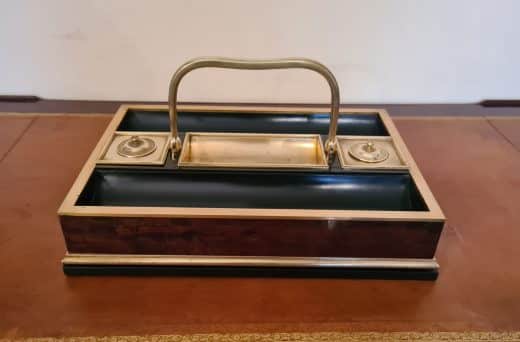
Restoration of a late Empire inkwell, rectangular in shape, surmounted by a central dish with a lid pierced with palmettes and handles in the form of flowering tassels, held by two winged putti with quivers on their backs and volute tails, flanked by two inkwells decorated with trellis patterns and surmounted by a pierced lid with acorn-shaped knob, the body with an inset pen niche, the frieze centered by a mask of Apollo emitting stylized foliate trails, on a molded plinth, on feet. Simply veneered with a […]

Regency style pedestal desk

Ebénisterie Mathieu Vath

Restoration of a desk veneered on all sides with yew burl and amaranth, decorated with geometric boxwood stringing. It opens with five drawers in the front and five simulated drawers in the back. The two lower drawers follow the contour of the front and slide down at a 45-degree angle. The top is veneered in amaranth and edged with a bronze molding. It rests on four cabriole legs and terminates in curious acanthus leaf bronze mounts. The frame is entirely oak, except for the drawers, which are made of […]

Regency-style chest of drawers stamped by Michel Mallerot

Ebénisterie Mathieu Vath

The restoration of a commode from the first half of the 18th century, curved in height and bombé in plan, opening with four drawers in three rows, known as a "tomb-shaped" or "Regency" commode, belongs to a much smaller group of commodes called "bridge" and "moustache" commodes. The frame of this commode is typical of Regency models, with oak uprights, high-quality softwood for the majority of the structure, and walnut for the inset drawers. The veneer consists of only two types: kingwood and satinwood. The […]

Louis XVI Weekly Planner

Ebénisterie Mathieu Vath

Restoration of a Louis XVI chest of drawers veneered in rosewood, satinwood, and amaranth. It opens with a series of seven drawers framed by rounded uprights with simulated fluting made of boxwood and blackened pearwood. A chest of drawers? The chest of drawers is a piece of furniture that appeared in the mid-18th century, primarily intended for women. It is a chiffonier (which appeared during the Regency period, between 1715 and 1723) with seven drawers, one for each day of the week, designed to store the day's clean undergarments. The restoration...

Louis XVI commode stamped J. LAPIE

Ebénisterie Mathieu Vath

Restoration by Lise, during her internship at the workshop, of a Louis XVI commode stamped by Jean Lapie, constructed of oak, fir, and beech, veneered in rosewood with hornbeam and amaranth stringing, and adorned with gilt bronze mounts. And since Lise submitted an excellent internship report, I am publishing it almost in its entirety. Jean Lapie (known as "The Younger"), son of the potter Nicolas Lapie, was born around 1734. Brother of the cabinetmaker Nicolas-Alexandre Lapie (known as "The Elder") and cousin of Jean-François Lapie, he obtained his master's degree in Paris […]

Louis XVI wardrobe

Ebénisterie Mathieu Vath

Restoration by Raphaël of a rosewood veneered cabinet with diamond-pointed doors, framed in amaranth and Greek key stringing. It opens with two large softwood doors veneered with oak. Some regluing and repairs of missing veneer, along with a good coat of clear French polish, have restored this piece of furniture to its former glory.

Regency commode in sarcophagus form

Ebénisterie Mathieu Vath

Minor restoration was required for this Regency commode, known as a sarcophagus commode. A few veneer repairs and a refinishing of the varnish were all it took to restore its former glory. The sarcophagus commode? It was only a few years after the first examples were completed by André Charles Boulle, during the Regent period, that the curved commodes, both in plan and elevation, appeared. These commodes would be called "Regency-style" commodes throughout the 18th century (and similarly, it would be necessary to wait until 1720 to see commodes with two rows of drawers again, often […]

Regency table lamp

Ebénisterie Mathieu Vath

Restoration of a Regency mantel clock in brown tortoiseshell and brass marquetry on an oak frame. Without its bronze mounts, this type of furniture loses its splendor. But when it regains its bronze fittings, knowing that the function of this type of furniture is to tell the time, the symbols that compose them take on their full meaning. Fame on the escapement and the eagle on the door are perfect examples. Fame is originally an allegorical Greek deity personifying public recognition […]

Art Nouveau desk with Primroses by Louis Majorelle

Ebénisterie Mathieu Vath

Restoration of an Art Nouveau desk stamped by Louis Majorelle in Nancy around 1905. It is made of solid walnut and veneered with primrose flower marquetry. The work consisted of replacing missing veneer, cleaning, and restoring the waxed finish. Louis Majorelle was born in September 1859 in Toul and died in January 1926 in Nancy at the age of 66. Son of the renowned furniture designer Auguste Majorelle, he demonstrated a particular interest in craftsmanship and drawing from a very young age. […]

Louis XVI console table stamped Louis Noël Malle

Ebénisterie Mathieu Vath

Restoration of a Louis XVI console table stamped by Louis-Noël Malle, with solid mahogany legs and mottled mahogany veneer on oak frames. Louis-Noël Malle, born in 1734, became a master craftsman on November 18, 1765. He established his shop and workshop on Grande-Rue-du-Faubourg-Saint-Antoine, in collaboration with his wife, Marie-France Le Maître. He was recognized as one of the greatest marquetry craftsmen of his time, as we can see in this entry from the General Almanac of Merchants in 1771 and 1772, where his name was misspelled as "Le […]

Regency style commode stamped Hédouin

Ebénisterie Mathieu Vath

Here is the latest restoration by Raphaël, my apprentice. Although it possesses all the attributes of a Regency commode, it could only have been made much later, after this historical period (around 1715-1723). Indeed, since Hédouin obtained his master craftsman's certificate in 1738, during the height of the Louis XV era, it is more accurately described as a commode "in the Regency style" by cabinetmakers of the time. This commode is entirely constructed of oak, except for the interior panels, and is veneered with amaranth and satinwood. Jean-Baptiste HEDOUIN The life of Jean-Baptiste Hedouin is quite […]

Happiness of the day by Guillaume Cordié

Ebénisterie Mathieu Vath

Minor maintenance restoration for this transitional rosewood veneer bonheur du jour, stamped by the master of this type of desk, Guillaume Cordié. A simple maintenance restoration for this desk. Re-gluing of a few veneer patches, repair of oxidation, color restoration, and reapplication of the French polish. Guillaume Cordié, born around 1733, worked as a freelance craftsman before receiving his master's certificate on June 18, 1766. He established himself on the rue de Charonne and remained there until his death. His works, of fine quality and harmonious proportions, are […]

La Rochelle chest of drawers in "Isles wood"«

Ebénisterie Mathieu Vath

A look back at the restoration of this rare port chest of drawers, crafted from solid woods brought back from both the Orient and the West Indies, combining four precious woods: mahogany, satinwood, Palo Santo, ebony, and, most notably, a fifth wood, Royal ebony. This chest of drawers opens with three wide drawers in three rows of Palo Santo, interspersed with Ceylon ebony crossbars, and is topped with a solid framed top composed of parquet flooring, primarily enlivened by Royal ebony crossbars against a mahogany background (some sections are mottled or […]

Regency commode with faun and lion masks

Ebénisterie Mathieu Vath

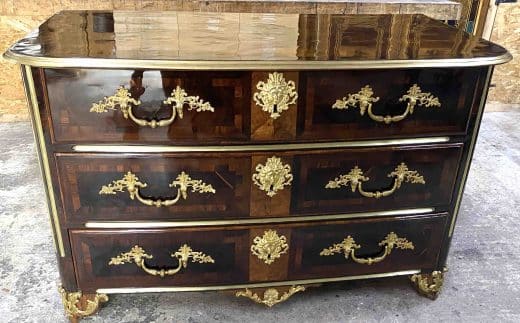
Restoration completes this important and rare commode, known as a "tomb-shaped" or "Regency" commode, also called a "moustache" commode, dating from the Regency period. Curved on all sides, it opens with four drawers in three rows. Topped with a Belgian Vieux Rance marble slab (it's worth noting that Rance was a French village at the beginning of the 18th century), molded with a corbel-like profile following its contours, this wide commode, veneered in a single layer of kingwood, boasts powerful curves, is adorned with brass fluting on the front and sides, and is covered with exceptional finely chased bronze mounts.

Regency Cartel signed Clément Fiacre Paris

Ebénisterie Mathieu Vath

Restoration of a cartel clock in red tortoiseshell and brass marquetry. The movement is stamped by Clément Fiacre in Paris. Clément Fiacre, one of the most important clockmakers of his time, received his master's certificate on January 16, 1714. He settled in Paris and quickly gained renown. Established on Rue Saint-Denis around the mid-1740s, he created his work in the Regency style, where wood was richly worked, notably through tortoiseshell and brass marquetry. He also produced veneers in rosewood, amaranth, and other woods.

Transitional dresser

Ebénisterie Mathieu Vath

Restoration of a transitional commode veneered in rosewood, amaranth, and green-stained Greek key pattern, on an oak frame. Congratulations to Lisa for this first restoration during her internship at the workshop. The work mainly involved the front rails, with the missing amaranth veneer being replaced by sawn, scraped, sanded, and applied to the back of the veneer before being glued with hot glue. The varnish was regenerated using Labovert's GAMMA polar solvent before […]

VASSOU stamped chest of drawers

Ebénisterie Mathieu Vath

Restoration of a Louis XVI period chiffonier table in mahogany veneer and solid mahogany on oak and softwood frames, stamped by Jean-Baptiste VASSOU (1739-1807). A beautifully crafted piece with fine veneer and a lovely blue Turquin marble top. What exactly is a chiffonier table? The first mention of a "chiffonniere table" appears in 1755 in the journal of the haberdasher Lazare Duvaux (1703-1758). Then, in 1763, in the post-December inventory of Jean-François Oeben, we find mention of a "frame of a […]

Small Louis XV style commode

Ebénisterie Mathieu Vath

And here is the latest restoration by Raphaël, my apprentice. It's a Louis XV period commode. It's veneered in rosewood and violet wood on an oak and softwood frame. Condition report: A perfect project for tackling structural and veneer restoration. Almost all the panels are detached and too short, the joints are loose, both sides are detached from the uprights and split right down the middle, and of course there's a lot of detachment and […]

Regency Games Table

Ebénisterie Mathieu Vath

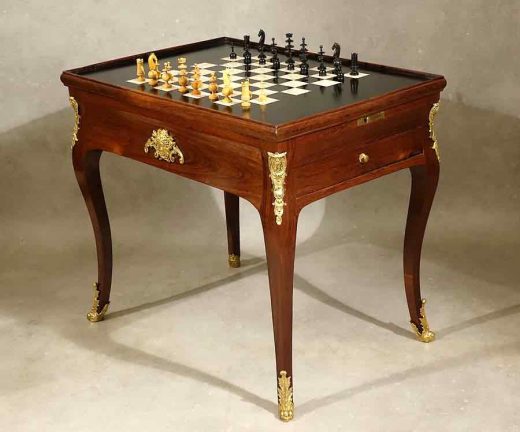
Restoration of a Regency period games table converted into a desk, resting on four cabriole legs. It is veneered with thick amaranth leaves and opens with two drawers (called "chétrons") on the sides and a removable top (locked by a push-button mechanism) covered in dark leather on its facing and a checkerboard veneered in ebony and inlaid with ivory on the reverse. When the top is removed, it reveals a backgammon set in ebony and ivory. The molded astragal surrounding the top is made of solid amaranth wood. The legs and stretchers are made of beech, the […]

Regency Cartel

Ebénisterie Mathieu Vath

Restoration of a Regency clock case in Boulle marquetry on a brown tortoiseshell background. Since Antiquity, humankind has sought to master and create a "timekeeper." Egyptian obelisks, water clocks, sundials, hourglasses. But it was in the 15th century that the first mechanical weight-driven clocks were made, with a single hand, but generally equipped with chimes. Then, in the 16th century, the counting of the day in two parts, 12 hours instead of 24, was adopted almost everywhere, even though each city kept its own meridian time until the advent of railways and […]

Transition sauté pan with Boudin stamp

Ebénisterie Mathieu Vath

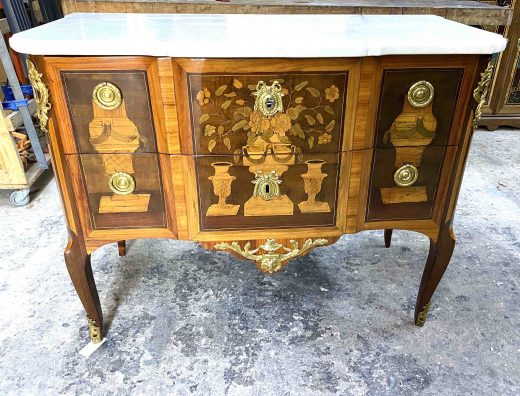
Restoration of a Transitional commode stamped by the master cabinetmaker Léonard Boudin (1735 in Paris – 20/12/1807). It is constructed of solid oak and veneered with amaranth, rosewood, tobacco-stained maple, and marquetry of boxwood, hornbeam, and holly, decorated with panels featuring floral vases and covered pots on the front and sides. With a slight central projection on the front, opening to reveal two drawers without a central divider, its rounded uprights rest on cabriole legs. Many Transitional commodes of this type have […]

Louis XV cartel clock with crowned C

Ebénisterie Mathieu Vath

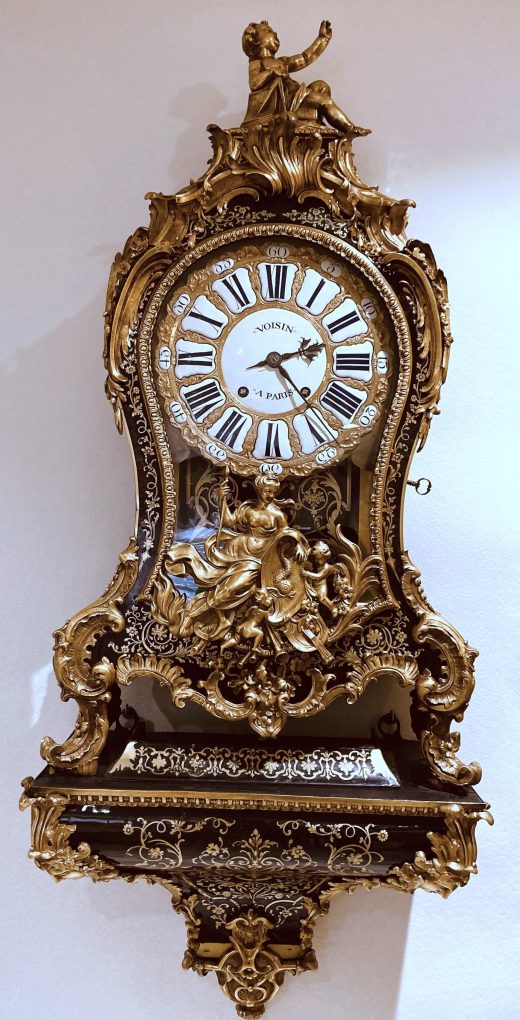
Restoration of a Louis XV cartel clock in tortoiseshell and brass marquetry, the movement of which is signed by Charles Voisin (born 1686-1760), Master Clockmaker in 1710. The distinctive feature of this clock is that the bronze mounts are stamped with the crowned C mark. The crowned C was established by an edict of 1745, which required bronze workers to mark their pieces with a small, distinctive letter, a C surmounted by a crown, thus subjecting them to a tax. This tax applied to both objects and furniture adorned with it. It is a […]

Louis XV secretary stamped C.Chevallier

Ebénisterie Mathieu Vath

Restoration of a Louis XV period drop-front secretary, also known as a cabinet, stamped by Charles Chevalier, with curved sides and a front without an intermediate rail. Constructed of oak and softwood, it is veneered with marquetry of maple, boxwood, blue-stained maple, holly, hornbeam, and barberry on a rosewood ground framed by violet wood. The drop-front opens with its original three-point lock, revealing a compartment containing seven shelves in four rows and four drawers. The whole contains […]

Louis XIV Library Display Case

Ebénisterie Mathieu Vath

Restoration of a small Louis XIV period display cabinet inlaid with foliate scrolls in amaranth, ebony, and maple, framed in olive and cherry wood. The marquetry on this piece is known as the Boulle technique, or superimposed marquetry. The cabinet had a significant number of missing veneers. The restoration work therefore consisted of replacing all these missing veneers with scraped and sanded veneer, prepared to the correct thickness before being glued with hot glue. The most interesting task was the reconstruction of one missing piece […]

Regency commode with crowned R

Ebénisterie Mathieu Vath

Restoration of a Regency commode, probably from southeastern France, veneered with yew, plum, rosewood, walnut, cherry, amaranth, violet wood, boxwood, and green-stained maple on a softwood frame. Besides its highly unusual marquetry decoration, the commode's distinctive feature is its crowned R bronze mounts. The crowned R hallmark should not be confused with the crowned C hallmark, which corresponds to a tax levied from 1745 to 1749 on copper objects and is found on many […]

Cordié Transition-branded chest of drawers

Ebénisterie Mathieu Vath

Restoration of a Transitional period chiffonier stamped by Guillaume Cordié and bearing the guild mark. It is veneered in rosewood and amaranth and framed in oak and softwood. The bronze fittings were added later. Guillaume Cordié, born around 1725, worked as a freelance craftsman before receiving his master's certificate on June 18, 1766. He established himself on the rue de Charonne and remained there until his death. His works, of fine quality and harmonious proportions, are mostly in the Transitional and Louis XV styles. It seems that he […]

Directoire Commode

Ebénisterie Mathieu Vath

Restoration of a curious Directoire commode in solid walnut and walnut, mahogany, and maple veneer, featuring marquetry of a Medici vase and a Louis XIV-inspired ballet dancer, in brass on an ebony ground. The drawers have walnut bottoms with an ebony stringing surmounted by a quarter-round brass and wood molding, surrounded by a mahogany molding. The uprights are three-quarter-fluted columns terminating in toupie feet. The locks are in the shape of trefoils. A conservation project for this […]

Transition work table

Ebénisterie Mathieu Vath

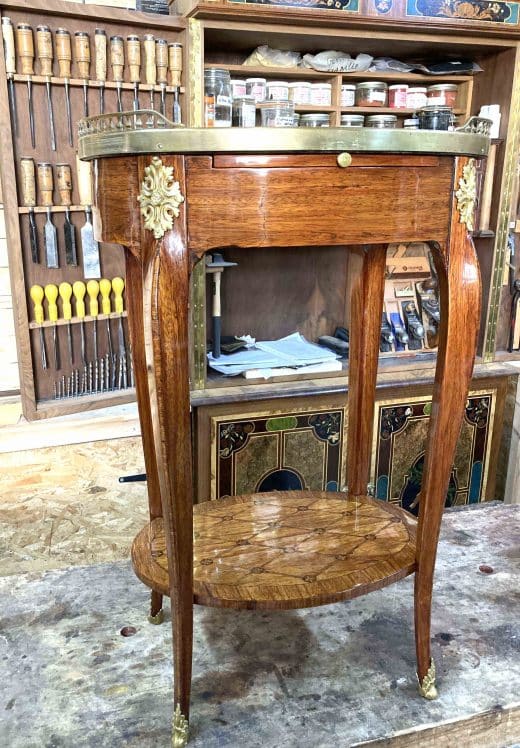
Restoration of a work table with cabriole legs and a stretcher in marquetry of trellis and quatrefoils, known as "à la Reine," veneered in rosewood, inlaid with boxwood, green-stained hornbeam, and boxwood stringing on an oak frame. It opens in the frieze with a drawer forming a writing surface with a leather-lined drop-front and compartments on the sides. The Escallettes marble top is bordered by an openwork brass gallery similar to the one that frames the kidney-shaped stretcher. A minor restoration including some veneer repairs and […]

Transitional chest of drawers stamped SAUNIER

Ebénisterie Mathieu Vath

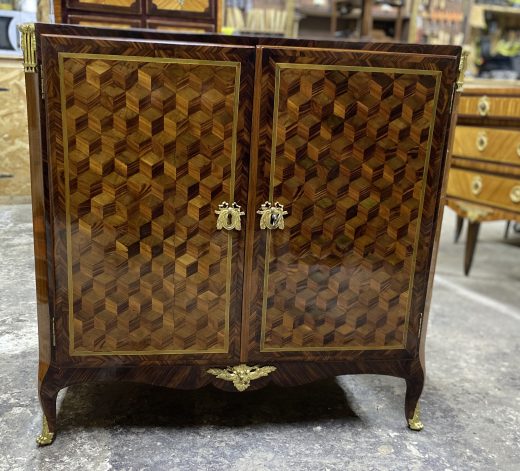
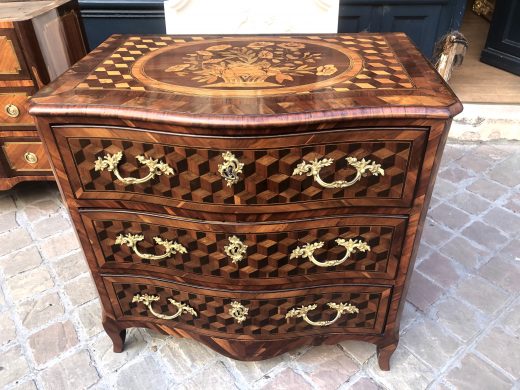
Restoration of a transitional two-door commode veneered with bottomless cube marquetry. The frame is oak for the uprights and rails, the side panels are softwood, and the two doors are walnut. The bottomless cubes are veneered with rosewood, violetwood, and tobacco-stained maple. The entire piece is framed with a stringing of green-stained maple and boxwood. The uprights and door frames are veneered with violetwood and rosewood. The sides […]

Transition chest of drawers stamped Fromageau

Ebénisterie Mathieu Vath

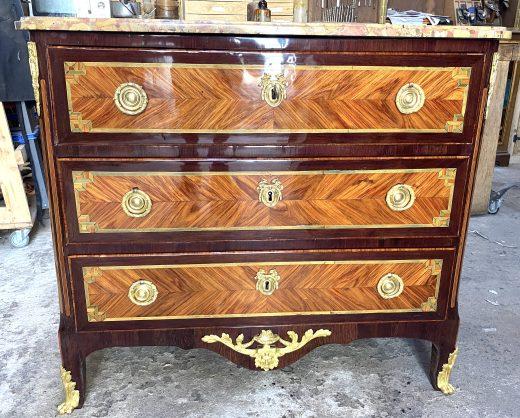
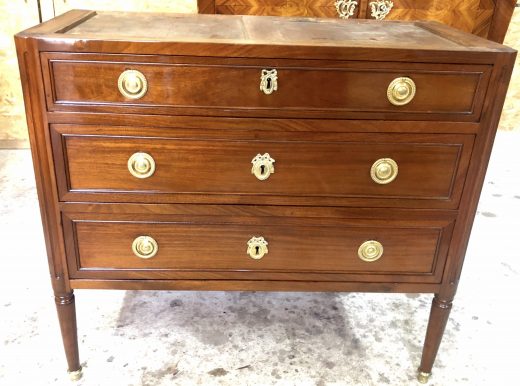
Restoration of a Transitional style commode, stamped by Jean Baptiste Fromageau, veneered in rosewood with an amaranth frieze and faux fluting. It is topped with a Royal red marble slab and features three drawers, one narrower at the top inlaid with a frieze of glyphs, while the two below are inlaid with Greek key patterns and have violet wood corners. The bronze mounts include ring pulls, keyhole escutcheons with knotted ribbons, and a drop-shaped finial.

Louis XV commode stamped NA Lapie

Ebénisterie Mathieu Vath

Restoration of a Louis XV commode, stamped by Nicolas Alexandre Lapie, veneered in amaranth and satinwood on a beautifully crafted oak frame. The sides and drawer fronts are made of softwood, and the marble top is Campan griotte marble. Nicolas Alexandre Lapie, son of Nicolas Lapie, a pottery merchant in the Faubourg Saint-Antoine, and brother of the master cabinetmaker Jean Lapie, Nicolas Alexandre (known as the Elder) appears to have been born around 1730. He registered his master's letters at the Châtelet in Paris on the 17th […]

Louis XV slant-front desk

Ebénisterie Mathieu Vath

Raphaël's first restoration project was this Louis XV period rosewood veneer slant-front secretary. It was a complete restoration involving numerous veneer grafts and a waxed, filled finish. A delicate job, as rosewood is unforgiving. The slightest misstep with the chisel, or excessive sanding, and its beautiful blond patina disappears, revealing the original dark color and causing unsightly stains. Therefore, there was no choice but to scrape and sand the newly sawn veneer and cut it to the correct thickness before gluing it […]

Regency chest of drawers with Spanish-style drawers

Ebénisterie Mathieu Vath

Restoration of a Regency period commode with a serpentine front and espagnolettes, curved on all sides, veneered in violet wood on a walnut frame, opening with four drawers in three rows and topped with a Belgian Griotte Red marble slab with ears and a corbelled edge. The pinched uprights are dark, as are the front rails, with fluting and brass reeding. Its high-quality bronze ornamentation features superb chasing and includes very rare espagnolettes (seen on six commodes: four by Etienne Doirat, one by François Lieutaud […]

Louis XVI secretary stamped TOPINO

Ebénisterie Mathieu Vath

Restoration of a Louis XVI secretary desk stamped by Charles Topino. Typical of Topino's style, this secretary is constructed of oak and softwood. The front opens with a drawer and a drop-front covered in red leather tooled in gilt, revealing two compartments and four drawers veneered in rosewood. The lower section opens with two doors revealing a shelf. These are decorated with marquetry depicting a vase and drapery on a tobacco-colored ground, while the drop-front is inlaid with musical instruments, ribbons, and foliage on […]

Transition chest of drawers stamped LEGRY

Ebénisterie Mathieu Vath

Restoration of a transitional commode stamped by Jean-Louis-François Legry. Its frame is made of oak and softwood, and it is veneered with amaranth, rosewood, satinwood for the sides, and ebony and boxwood stringing. This commode exemplifies the very end of the transition between the Louis XV and Louis XVI styles. The legs remain the only vestige of the Louis XV curves; they would soon give way to the straight legs of the Louis XVI style. Jean-Louis-François Legry, born in 1745, obtained his master's degree in Paris on […]

Transitional cylinder secretary, stamped SCHLICHTIG

Ebénisterie Mathieu Vath

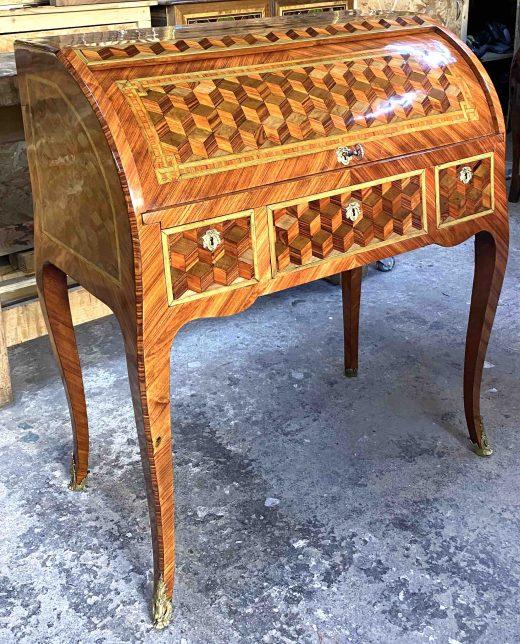
Restoration of a Transitional period roll-top desk stamped by Jean-Georges Schlichtig. The frame is oak for the legs and rails, while the panels and drop-front are softwood. It is veneered in rosewood with marquetry of bottomless cubes in rosewood and tobacco-stained sycamore; the Greek key stringing is composed of hornbeam and holly. The back and interior drawers are veneered in satinwood. This type of roll-top desk was a common production for this cabinetmaker, who produced […]

Louis XV desk stamped SAR

Ebénisterie Mathieu Vath

Restoration of a Louis XV desk stamped by Jean-Girard-Théodore SAR. A magnificent desk of exceptional craftsmanship. The legs, apron, and drawers are made of walnut. The top is softwood. The entire piece is veneered with beautiful Indian ebony. Jean-Girard-Théodore SAR was born in 1724 and became a master craftsman on October 1, 1766. Established on Rue de Lappe in the Faubourg Saint-Antoine, he worked primarily for several colleagues, including Migeon from 1755, Coulon in 1774, and Dubuisson, among others.

Louis XV desk

Ebénisterie Mathieu Vath

Restoration of a Louis XV desk veneered in rosewood and violet wood on an oak and softwood frame. Replacement of missing veneer, cleaning, and refinishing with a French polish. Cleaning and conservation of the leather. Removal and steam cleaning of the gilt bronze mounts. To see previous restorations: https://ebenisterie-mathieuvath.fr/en-ce-moment-a-latelier/

Transitional chest of drawers stamped J.STUMPFF

Ebénisterie Mathieu Vath

Here are some images of the restoration of this commode stamped by Jean-Chrysostôme Stumpff. 1731 - January 17, 1806 – Received Master Craftsman status on August 27, 1766. Framed in oak and softwood, it is veneered with rosewood in a frieze of paillon, amaranth, and boxwood and green-stained maple. J. STUMPFF, originally from Schweigern, Swabia (Germany), married in 1760 in Paris, at the Swedish embassy, like most of his compatriots of the Reformed faith. His fellow cabinetmaker, Ferdinand Scherdfeger, was a witness. […]

Regency commode by François LIEUTAUD

Ebénisterie Mathieu Vath

Restoration of a Louis XIV period commode in rosewood and walnut, inlaid with alternating marquetry in friezes and fillets. The slightly curved front opens with three wide drawers in three rows. The top, encircled by a brass molding, features a geometric design of circles framing a central polylobed motif with figurative designs. The uprights and intermediate rails are inlaid with polished brass fluting. The sides are veneered in walnut with diamond frieze patterns. The legs are tapered with claw feet. The piece is adorned with finely chased and gilded bronze mounts.

Hairdresser E.GOMME G-Plan

Ebénisterie Mathieu Vath

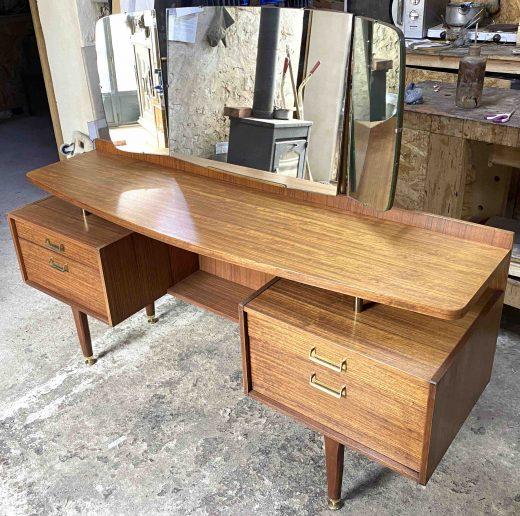
Restoration of a 1960s teak veneer dressing table from the G-Plan company. Ebenezer Gomme. In 1898, Ebenezer Gomme (1858-1931) founded the E. Gomme Ltd. precision joinery workshop in High Wycombe, England. It quickly became one of the most important centers of English furniture manufacturing until 1940. During the Second World War, Great Britain faced a timber shortage, forcing all wood-dependent industries to offer products with a more utilitarian than design focus. In […]

Louis XIV commode

Ebénisterie Mathieu Vath

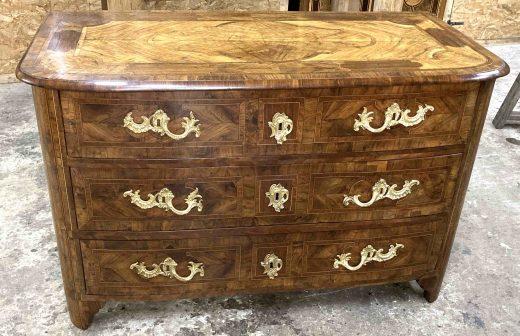
Restoration of a Louis XIV period commode veneered in olive burl, ash, and walnut, likely from the Dauphiné region. This type of commode (D-shaped), along with the Mazarine commode, was among the very first commodes popularized under Louis XIV. Indeed, the appearance of the earliest French furniture resembling the commode dates only from the 1700s; thus, the oldest known and datable Parisian commodes are those delivered by André-Charles Boulle to Versailles around 1708. Their very simple decorations are inspired by Dutch designs, often executed by […]

RELIGIOUS CLOCK, Sarrabat Paris

Ebénisterie Mathieu Vath

Restoration of a 'religious' clock with a striking mechanism on the half-hour, signed (dial and movement) 'Sarrabat à Paris', third quarter of the 17th century. Religious clocks were the earliest form of clocks during the reign of Louis XIV, the Sun King. Their popularity increased from 1660 onwards, thanks to Huygens' discovery of the regulator pendulum. This particular clock features Boulle marquetry of red tortoiseshell, brass, and pewter on a walnut frame, decorated with gilt bronze mounts and ebony moldings. The lower molding is also ebony and rests on […]

Writing table stamped JF LELEU

Ebénisterie Mathieu Vath

Restoration of a Louis XVI writing table stamped by Jean François Leleu. It is entirely constructed of oak and veneered on all sides with gray-stained maple latticework inlaid with amaranth, boxwood, ebonized wood, and boxwood finials on a rosewood ground. The four legs are adorned with an acanthus leaf medallion on a green-stained sycamore ground. Bell-shaped finials embellish the top and bottom of the finial as well as the tops of the legs. On the writing surface, the latticework is concentrated in […]

Regency chest of drawers stamped ID

Ebénisterie Mathieu Vath

Restoration of a Regency commode veneered in rosewood on a conifer frame. It was only after three weeks of work on this commode that I noticed a strange mark. It had been there from the beginning, right in front of me, and I hadn't noticed it. Indeed, it's quite rare to see a stamped Regency commode. But yes, the mark was definitely there. And it's not a modest mark, since this ID stamp is attributed to Jacques Denizot. Jacques Denizot (1684–1760) is […]

Transition chest of drawers stamped Etienne AVRIL

Ebénisterie Mathieu Vath

Restoration of a transitional commode stamped three times E.AVRIL, veneered in amaranth, rosewood, satinwood, and green-stained stringing on an oak and softwood frame. Etienne Avril (1748-1791), admitted as a Master Joiner-Cabinetmaker on November 23, 1774, died prematurely in 1791. Étienne Avril, known as Avril the Elder to avoid confusion with his brother Pierre, would witness the agony of the Ancien Régime and the abolition of the centuries-old guild system. Born in 1748 to a cab driver, Étienne Avril was not destined for […]

Cartel LXV signed Levêque in Paris

Ebénisterie Mathieu Vath

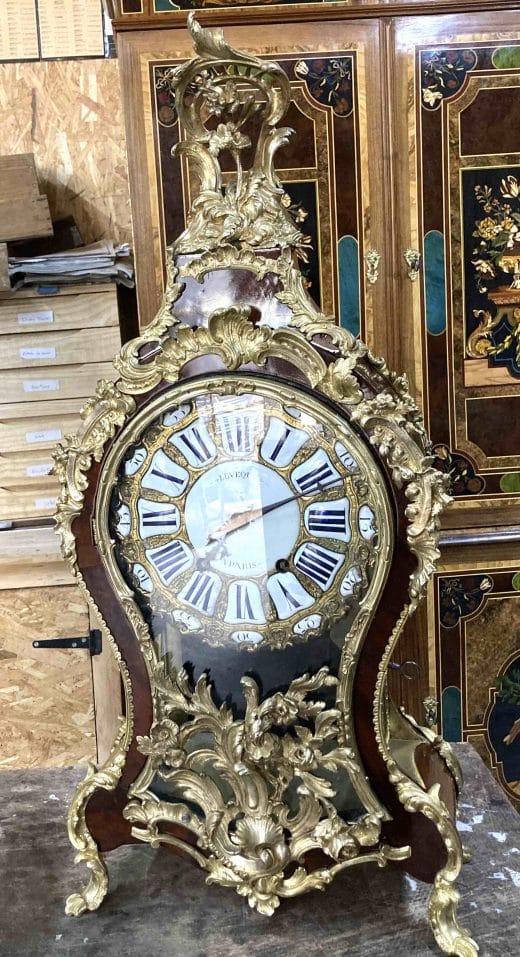
Restoration of a Louis XV period cartel clock signed LEVEQUE A PARIS with its original movement. The surprising thing about this clock is that it is made of mahogany. And as curious as it may seem, despite the tool marks, the quality of the workmanship and the wood appear entirely authentic. With its shape and rocaille bronze mounts typical of the Louis XV style, it could therefore be a clock made from the second half of the 18th century. A precursor, then, to the appearance of mahogany in French furniture. The restoration has […]

Eight-foot desk known as the "Mazarin" desk«

Ebénisterie Mathieu Vath

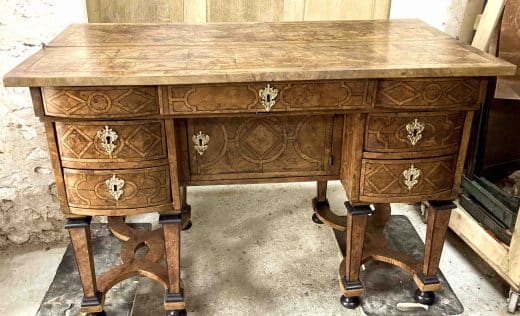
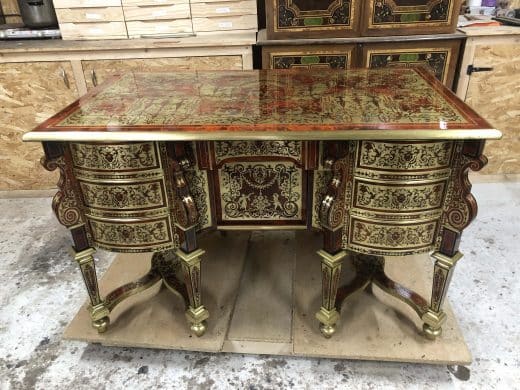
Restoration of an iconic piece of Louis XIV furniture, the Mazarin desk, named after the famous minister who served the king between 1642 and 1661, and who gave his name to this type of eight-legged desk. The stretchers and the narrow space between the two drawer units are a reminder that this type of desk required the user to sit at an angle: one knee below the writing surface and the other outside. This position was dictated by the wearing of the sword, always on the left. This […]

Art Deco games table and pedestal table

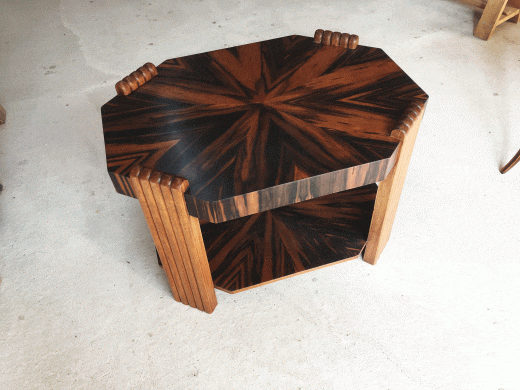
Restoration of a 1930s pedestal table and games table veneered in Macassar ebony and maple. A few veneer grafts and a touch-up of the French polish finish were all it took to restore the luster to this beautiful set. Did you know: Macassar ebony (Dyospyros celebica) is a tree endemic to the island of Sulawesi in Indonesia. Macassar ebony is also called golden ebony or Coromandel. It is also found in Malaysia, where it is known as Kajol marte. It belongs to the Ebenaceae family. It takes its name from the main port […]

Louis XV commode

Ebénisterie Mathieu Vath

Restoration of a Louis XV period commode veneered in rosewood and violet wood. The commode, also known as the commode sauteuse, appeared during the Regency period, between 1705 and 1730, and is attributed to the cabinetmaker Charles Cressent. It consists of two drawers or two rows of drawers. The body is raised on half-height supports, with the body occupying half the height of the piece and the other half the legs. Intended to distinguish itself from the heavy and massive Louis XIV style, it is slender and graceful, almost ethereal. After restoration […]

Transitional chest of drawers stamped Léonard Boudin

Ebénisterie Mathieu Vath

Restoration of a Transition period commode stamped by the master cabinetmaker Léonard Boudin (1735 in Paris – 20/12/1807). It is constructed of solid oak and veneered with amaranth, rosewood, and ribbon satinwood (Brosimum rubescens), which provides a highly decorative appearance due to the pronounced interlocked grain of this South American wood. It should be noted that it belongs to the same family as snakewood (Brosimum guianense). As Boudin was primarily a merchant during the Transition period, it is likely that this commode is actually by his hand (before […]

Louis XV writing table

Ebénisterie Mathieu Vath

Restoration of a Louis XV period drawing table, or more precisely, a writing table, veneered in rosewood, with a satinwood back. Born from the passion for correspondence in the 18th century, fashionable merchants deployed all their ingenuity to create numerous models of utilitarian tables to be placed in the center of a room. These table models differed from ordinary tables; they were generally equipped with a writing surface and drawers for storing ink and quills. It is in […]

Wardrobe of Bretteville the Proud

Ebénisterie Mathieu Vath

It was in the mid-17th century that what we now call the Norman armoire originated. However, it was from the 18th century onward that it acquired the characteristic form we know today: with its two doors, resting on cabriole legs and featuring a wide, sculpted cornice, it combines Louis XV structure and style with Louis XVI motifs. It was during this same period of economic and social stability, allowing for a certain improvement in living standards, that it entered the homes of both the bourgeoisie and the peasantry. The 19th century would be […]

Louis XIV commode from the Dauphiné region

Ebénisterie Mathieu Vath

Restoration of a Louis XIV period commode in olive burl, rosewood, and boxwood, likely from the Dauphiné region. This type of commode (D-shaped), along with the Mazarine commode, was among the very first commodes popularized under Louis XIV. Indeed, the earliest French furniture resembling the commode only appeared in the 1700s; thus, the oldest known and datable Parisian commodes are those delivered by André-Charles Boulle to Versailles around 1708. Their very simple decorations are inspired by Dutch designs, often crafted by Protestant cabinetmakers […]

Regency commode stamped by Michel Mallerot

Ebénisterie Mathieu Vath

Restoration of a commode stamped by Michel Mallerot. With its serpentine front, it is entirely veneered in violet wood. It is built of fir with beech drawer bottoms and walnut drawer fronts. You don't know Michel Mallerot? That's understandable, as Michel Mallerot (1675–1753) is a Parisian cabinetmaker who remains relatively unknown, much like many cabinetmakers of the early 18th century. We owe his identification to the discovery of a handwritten pencil inscription "M. Mallerot" on a commode dating from the Regency period (formerly […]

Regency Cartel

Ebénisterie Mathieu Vath

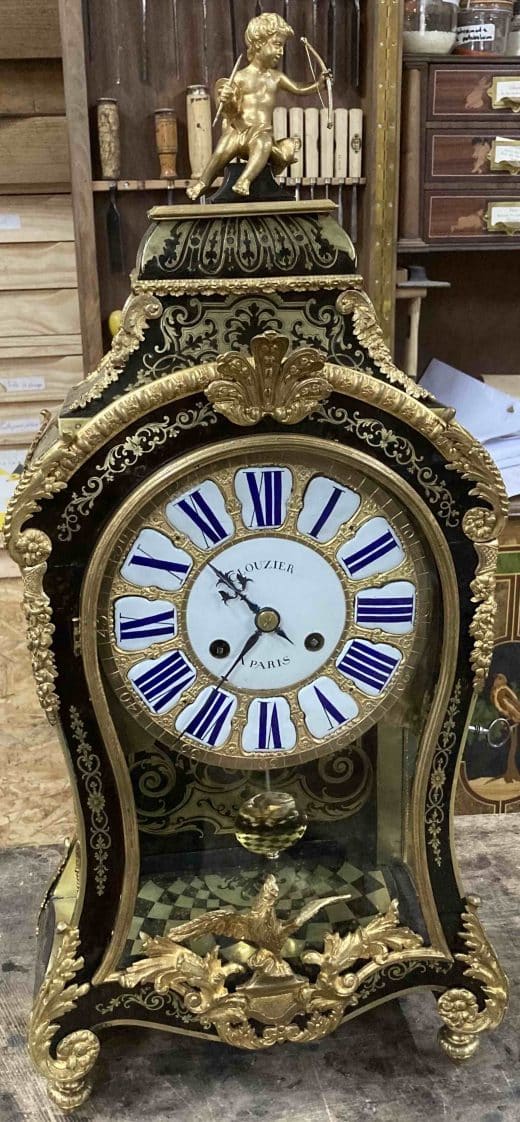
Here are some images of the restoration of a Regency period cartel clock in brown tortoiseshell and brass marquetry on an oak frame. The movement is signed CLOUZIER A PARIS. Jacques Clouzier (1692-1754) was received as a master clockmaker by awarding a masterpiece on July 5, 1692. He was one of the greatest Parisian clockmakers of the Louis XIV and Regency periods. He became a member of the clockmakers' guild in the 1700s, then worked on Rue Saint-Antoine until 1726 and later on Rue des Prêtres Saint-Paul. He remained active until his death […]

Regency chest of drawers

Ebénisterie Mathieu Vath

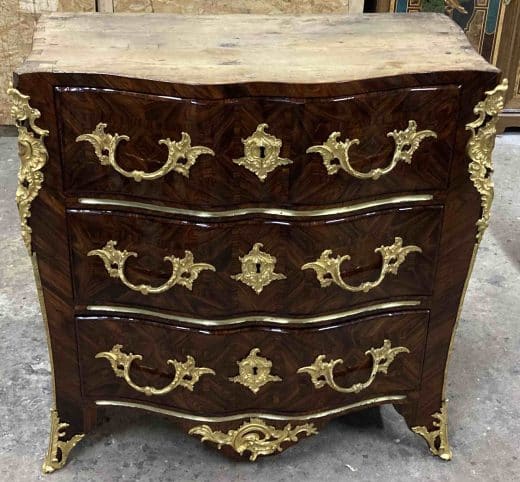
To start the year, here are some photos of the restoration of this Regency commode. It is built entirely of conifer and veneered with kingwood. The uprights and rails are inlaid with brass fluting. The bronze handles, influenced by Asia and the East India Company trade, are known as "Chinese" or "Chinese." The keyhole escutcheons, meanwhile, herald the arrival of the Louis XV style in the first half of the 18th century. Regarding its condition upon arrival, besides […]

8-foot desk stamped Manet

Ebénisterie Mathieu Vath

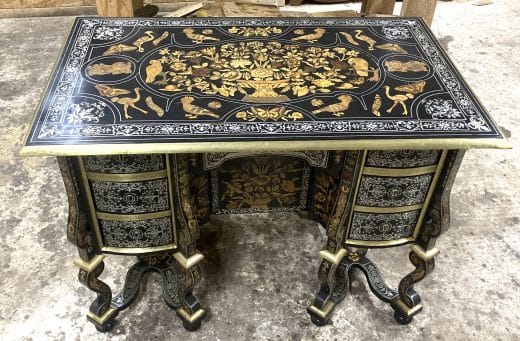
Restoration of an eight-legged desk, commonly known as a "Mazarin" desk, from the Louis XIV period, late/early 17th century. Constructed of pear and solid softwood, the sides and drawer bottoms are also pearwood. It features two side cabinets, each opening with three drawers, a central drawer above a middle cabinet with rounded edges, and console-shaped uprights and eight legs joined by two X-shaped stretchers. The drawers are inlaid with pewter and blackened pearwood, depicting a late 17th-century design. […]

Louis XIV commode

Ebénisterie Mathieu Vath

Restoration of a Louis XIV commode constructed of fir and Rio rosewood veneer. The front is slightly convex, as are the uprights and rails. It features brass fluting. The remarkably crafted varnished bronze mounts have retained their original varnish. The restoration consisted of rehydrating all veneered surfaces by infiltrating glue. Missing areas were filled with rosewood veneers that were sawn, scraped, sanded, cut to the correct thickness as a backing, and UV-oxidized before being glued with hot glue. As you can see on […]

Small chest of drawers from La Rochelle

Ebénisterie Mathieu Vath

Here is the restoration of a small Louis XV commode in solid satinwood and ribboned satinwood. It is curved on all sides, including the back, and opens with three drawers in the front, as well as a pull-out candle holder at the back. La Rochelle, 18th century. Its top, molded with a corbel edge highlighted by a cavetto molding, is made of ribboned satinwood, which is also found on the front and sides, while the base is made of fine satinwood punctuated with so-called "snail" feet ending in split goatskin feet. Note the unusual proportions but especially the curves […]

Louis XVI writing table

Ebénisterie Mathieu Vath

Restoration of a writing table built in oak, with a solid mahogany top and mahogany burl veneer. It features a large drawer in the frieze and rests on four tapered legs ending in gilt bronze sabots. Typical work of the late 18th century. To see previous restorations: https://ebenisterie-mathieuvath.fr/en-ce-moment-a-latelier/ This piece can be found at Antiquités Stéphane Guin.

Roussel Stamped Chest of Drawers

Ebénisterie Mathieu Vath

Restoration of a Louis XV commode stamped by the Parisian cabinetmaker Pierre Roussel. This commode is constructed of oak and softwood panels. It is veneered with rosewood arranged in a herringbone pattern, framed by violet wood. The stringing is boxwood. The Roussel family: Son of Michel Roussel, a journeyman cabinetmaker originally from the Cotentin region, he was the only one to choose cabinetmaking rather than joinery, unlike his younger brothers Jacques, Michel, and Louis. Pierre Roussel obtained his master craftsman's certificate on August 21, 1745, and established himself in the Faubourg Saint-Antoine, on rue […]

Louis XV Cartel

Ebénisterie Mathieu Vath

Restoration of a Louis XV period clock and its lamp base in pure Rococo style. It is constructed of solid oak and veneered with brass and tortoiseshell. Do you know what Rococo style is? Rococo style belongs to the early period of the Louis XV style (1723-1750) and reached its peak around 1730. It is characterized by rich naturalistic decoration. It drew inspiration from artificial grottoes and elements of rock recreated in asymmetrical compositions. This decoration, which marks the beginning of the Baroque, is complemented by seashells, elements […]

Money changer's office

Ebénisterie Mathieu Vath

A few weeks ago, I presented you with a money changer's table. Well, here is its successor, the money changer's desk. Inspired by the eight-legged desks more commonly known as "Mazarin desks," the money changer's desk is a smaller version. Designed to be frequently transported, it must ensure the security of the valuables it contains and showcase the prosperity of its owner through its marquetry and veneer decorations, which vary in richness. For those interested in the origins of these pieces of furniture and the money changer's trade…

Louis XVI secretary stamped Montigny

Ebénisterie Mathieu Vath

A little restoration for this Louis XV period secretary desk stamped by Philippe-Claude Montigny. It is constructed of oak and softwood, and veneered with rosewood, amaranth, and boxwood. It consists of a top drawer, a drop-front, and two doors. The interior compartments contain six drawers. Philippe Claude Montigny (1734-1800) became a master craftsman on January 29, 1766. Son of Louis Montigny, a privileged craftsman of the King, he owned a workshop in the Contrescarpe district of Paris. He was also the brother-in-law of Fidelis Schey, a cabinetmaker […]

Louis XV/Transitional Commode

Ebénisterie Mathieu Vath

A true renaissance for this chest of drawers, which I call Louis XV/Transitional because its form and construction are entirely Louis XV. However, the handles and keyhole escutcheons are typically Louis XVI. And I can attest that these are indeed its original fittings. The nail holes match perfectly, and there are no other holes beneath the bronze mounts. So, even if this piece of furniture doesn't conform to what is commonly called the Transitional style, this chest of drawers is most certainly one of the first […]

Somno Empire

Ebénisterie Mathieu Vath

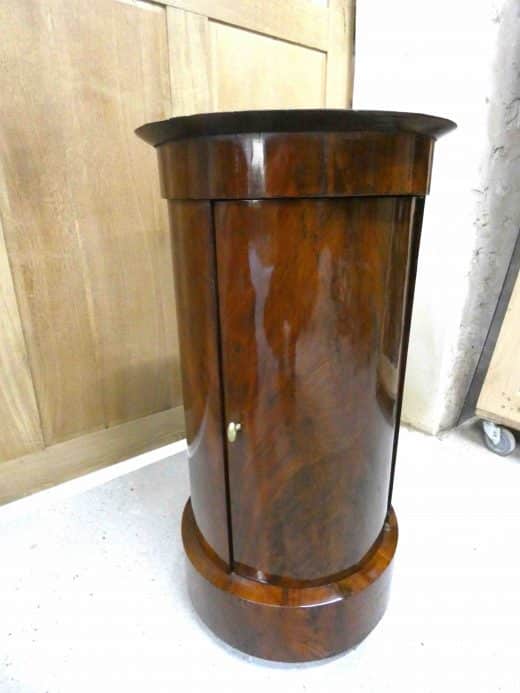
Restoration of an Empire-period somno in mahogany burl veneer. You might be wondering what a somno is? Created during the Consulate, in the early years of Napoleon I's reign, the somno, or somneau, is a small piece of furniture in the shape of a cylindrical or square table, with a closed section providing storage space. It is placed in the bedroom, often next to the bed to serve as a nightstand. It was during the Empire period that this table acquired the name "somno," from the Latin somnus […]

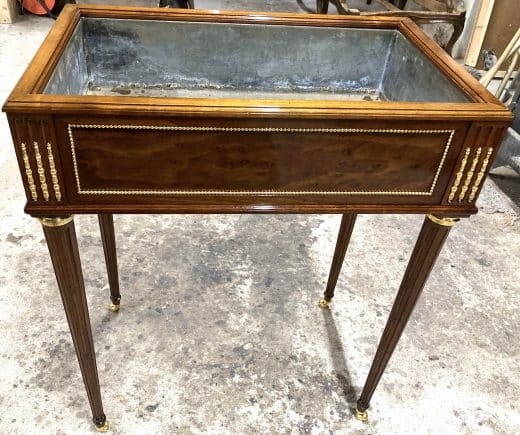
Louis XVI cooler

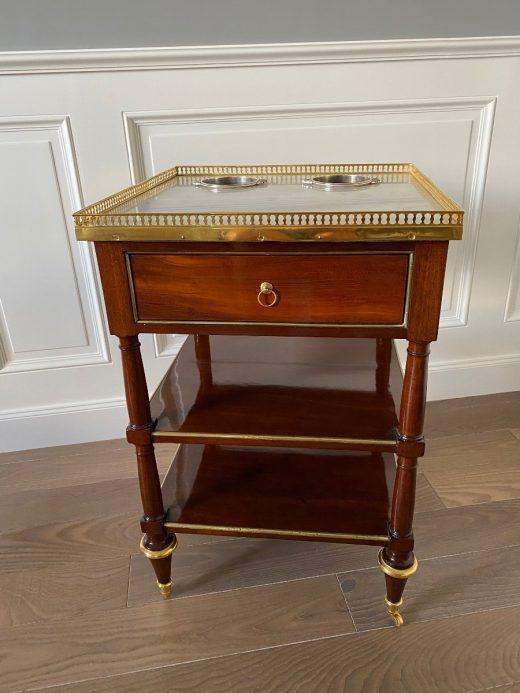
Restoration of a cooling table in solid mahogany for the legs and mahogany burl veneer with brass quarter-round moldings. The cooling table: It was in the 18th century, a century of thought, philosophy, and intimacy, that a fashion emerged among the wealthier classes of society: intimate dinners or suppers, without the intervention of household staff. Whether for romantic trysts or to plan the impending French Revolution, prying ears were not to be allowed. This trend influenced […]

Empire Chest of Drawers

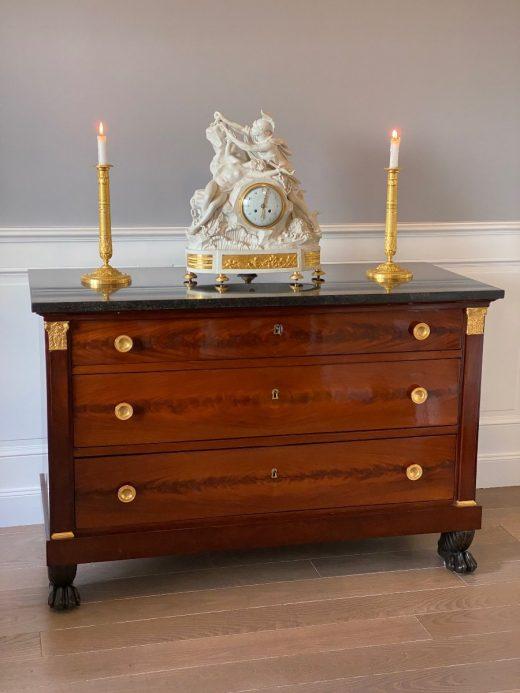
Restoration of a mahogany burl veneer commode with three drawers. The uprights are straight and Corinthian pilasters, the front feet are claw feet, and the rear feet have three decreasing balls, known as a beaded arrangement. It is topped with a Belgian black granite slab and has retained all its original gilt bronze mounts, as well as its trefoil locks and key. Regarding the gilt bronze mounts, the Corinthian capitals are decorated with projecting bird heads, palmettes, acanthus leaves, flowers, and scrolls with a beautiful alternation of […]

Louis XVI commode

Ebénisterie Mathieu Vath

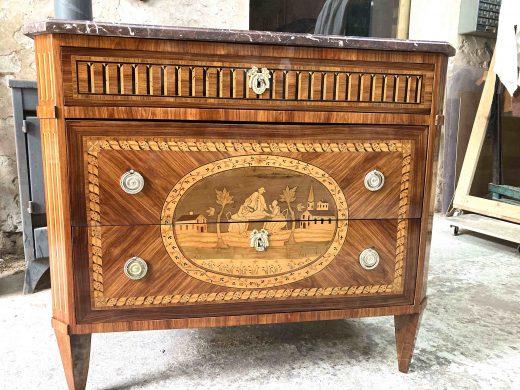
Restoration of a Louis XVI period provincial commode. Constructed of softwood and oak, and veneered with violet wood, rosewood, sycamore maple, boxwood, ebony, and stained maple. At its center is a bucolic scene depicting, between two trees, a card game between two women and a man watching. In the background, a house and a church are visible. The whole is framed by a medallion of flowers engraved and colored with black and red wax. The two lower drawers are framed by a frieze […]

Money changer table

Ebénisterie Mathieu Vath

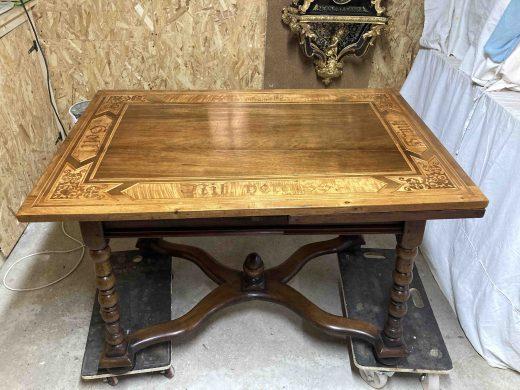
Restoration of a 17th-century money changer's table in solid walnut and walnut and sycamore maple veneer. This table originates from Germany, as indicated by the marquetry inscription on its top: "Trink und iss Gott nit wergiss," which translates as "Drink and eat, but do not forget God." It consists of two drawers, a top, and a sliding extension leaf; the legs are joined by an X-shaped stretcher. What is a money changer's table? The profession of money changer emerged in the 13th century, following the expansion of trade. […]

Coffee table stamped P.GARNIER JME

Ebénisterie Mathieu Vath

Restoration of a Transitional Period (1750-1774) satinwood veneer salon table stamped by Pierre Garnier (circa 1726-1800). Originally from Paris, and the son of master cabinetmaker François Garnier, Pierre Garnier obtained his master's certificate on December 31, 1742. In contrast to his father, François left the Faubourg Saint-Antoine for the rue Neuve-des-Petits-Champs, near the Place Vendôme. His clientele consisted of merchants such as Léonard Boudin and Pierre Migeon, but above all of the kingdom's wealthiest figures, such as Louis Georges Erasme, Marshal of France, the Duchess of Mazarin, and the Marquis de Marigny, […]

P. ROUSSEL Games Table

Ebénisterie Mathieu Vath

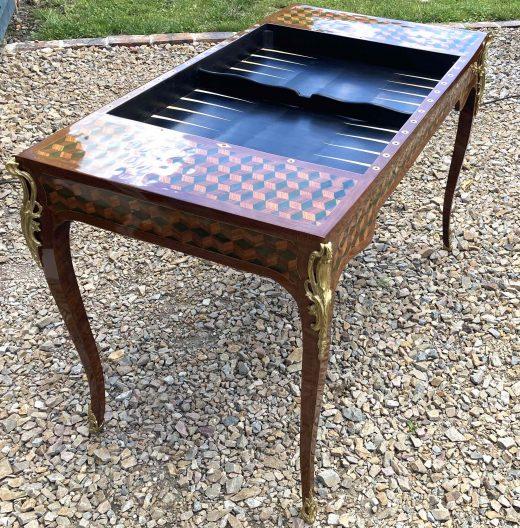
Restoration of a Louis XV period marquetry game table (or backgammon table) with dice (or cubes) veneered in amaranth, rosewood, violet wood, palisander, ebony, and ivory. This table is stamped by the Parisian cabinetmaker Pierre Roussel (September 28, 1723 – June 7, 1782). The Roussel family, sons of Michel Roussel, a journeyman cabinetmaker originally from the Cotentin peninsula, were the only ones to choose cabinetmaking rather than joinery, unlike his younger brothers Jacques, Michel, and Louis. Pierre Roussel obtained his master craftsman's certificate on August 21, 1745, and established himself in the Faubourg Saint-Germain-des-Prés.

Regency Cartel

Ebénisterie Mathieu Vath

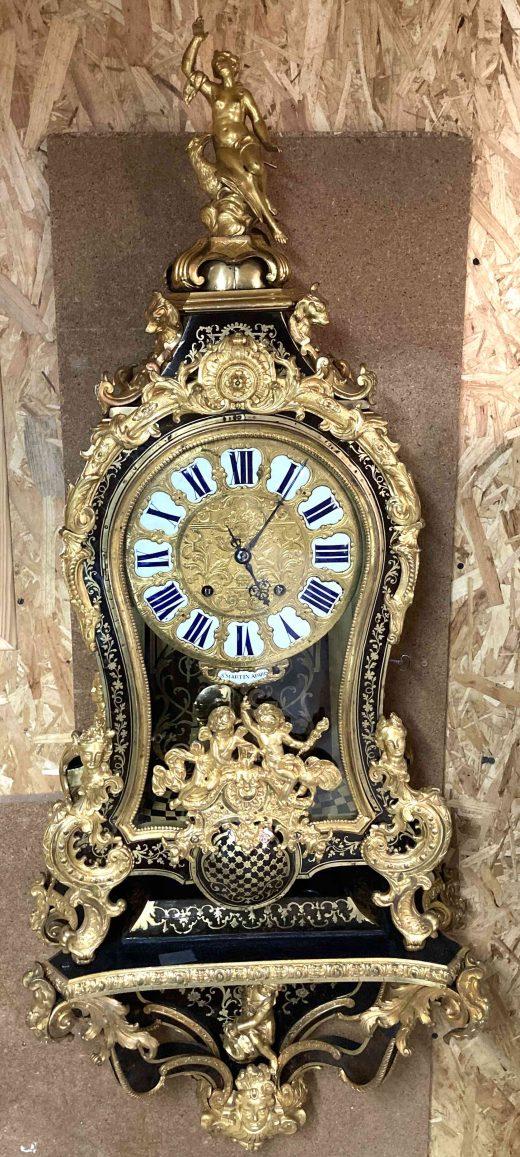
Restoration of a large cartel clock (137cm high) and its console-style bracket from the Regency period. It is made of solid oak veneered with Boulle marquetry of brown tortoiseshell and brass. It is decorated with floral garlands, crosshatching, and foliage. The dial is made of chased and gilded bronze with an interlacing design and birds; the Roman numerals are enameled, and the signature St Martin à Paris is inset. The plate is signed with the same name. It is adorned with chased and gilded bronze mounts depicting on its capital […]

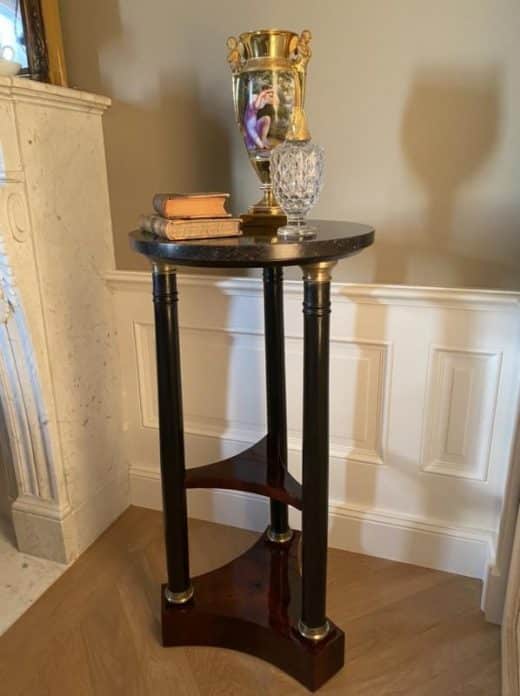
Louis XVI gueridon stamped JH RIESENER JME

Ebénisterie Mathieu Vath

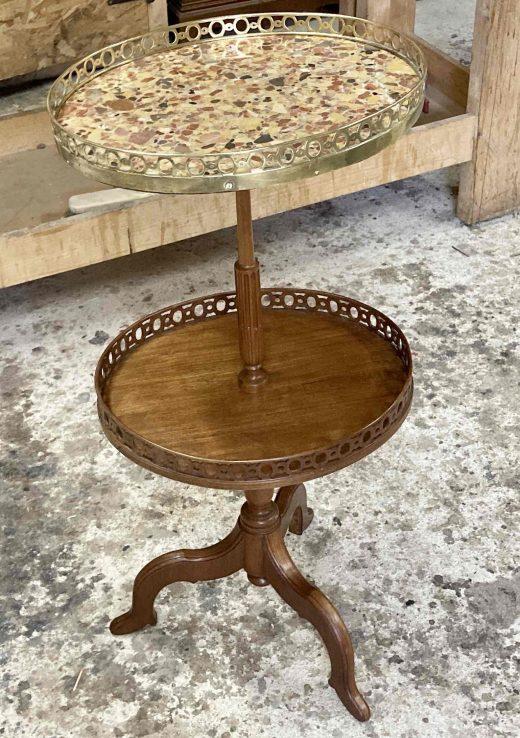
A minor restoration is needed for this "shelf-style" pedestal table, also known as a "dumb servant." It is made of solid mahogany, mahogany veneer, and Aleppo breccia marble. It bears the stamp of the lesser-known cabinetmaker to the Crown Furniture Collection, Jean-Henri Riesener. Does Jean-Henri Riesener (July 4, 1734 – January 6, 1806) really need an introduction? He is the undisputed master of the Louis XVI style, renowned for the breadth and diversity of his work, but above all for the exceptional quality of his furniture and the sumptuousness of the pieces commissioned by the court of […]

Louis XV cartel clock with crowned c

Ebénisterie Mathieu Vath

Here are some images of the restoration of a clock case that some of you may have seen during the work at the Mans'Art fair this year. This Louis XV period clock case is inlaid with tortoiseshell and brass, and the frame is oak. The bronze mounts bear the hallmark of the Crowned C. The Crowned C was established by an edict of 1745, which required bronze workers to mark their pieces with a small distinctive letter, a C surmounted by a crown, thus subjecting them to a tax. This tax applied to […]

Louis XV corner cabinet

Ebénisterie Mathieu Vath

Restoration of a Louis XV corner cabinet in marquetry of various woods (maple, hornbeam, boxwood, and holly). Except for the green leaves, the colors of some flowers and ribbons have faded. This marquetry is executed on a rosewood background framed by a boxwood stringing and a rosewood frieze. The frame of this corner cabinet is made of solid oak assembled with dovetail joints. Condition report: As you can see in the following photos, the surface of the varnish was heavily sun-faded, the glues of the marquetry on the doors were in […]

Louis XVI games table

Ebénisterie Mathieu Vath

Restoration of a late 18th-century games table (circa 1785) veneered in mahogany burl and inlaid with brass stringing, ebony, and Ferréol (a South American wood named after a 17th-century governor of Guyana). The legs are solid mahogany, and the interior is veneered with ebony and bone dyed green and natural. The tabletop is partially covered in leather and partially veneered in mahogany burl. The interior features two niches, each with a drawer […]

LARDIN transitional chest of drawers

Ebénisterie Mathieu Vath

Restoration of a Transitional period commode constructed of fir and oak and veneered with rosewood, violet wood, and a frieze of hornbeam stringing stained green in the Greek key pattern. The sides are veneered with satinwood and violet wood. André-Antoine Lardin (1724 – August 10, 1790) obtained his master craftsman's certificate on July 1, 1750, and established himself on rue de Charenton under the sign "Au Bois de Boulogne." He worked there until 1770, when he moved to rue Saint Nicolas. His production is […]

Mazarine Chest of Drawers

Ebénisterie Mathieu Vath

Restoration of a Louis XIV period commode, known as a Mazarine commode, veneered in brass and ebony on a softwood frame. This commode features bow-shaped drawers, including two full-length drawers surmounted by two half-drawers separated by an intermediate stile. The fronts are made of softwood, while the sides and backs are walnut. The brass decoration supporting the pendant drawer pulls features a finely inlaid motif of scrolls, foliage, foliage, and arabesques, framed by a geometric brass cartouche and simulating keyhole escutcheons. It […]

Chinese chest of drawers

Ebénisterie Mathieu Vath

This week I'm presenting a Louis XIV commode from the first half of the 18th century, veneered in Rio rosewood and adorned with chinoiserie bronze mounts. Height: 85.7 cm, Width: 125 cm, Depth: 60.5 cm. The frame is made of softwood, constructed from planks joined edge-to-edge. The sides, top, and bottom are dovetailed. The back is constructed from several planks nailed into the rebates of the sides. The drawer bottoms and sides are made of planks of […]

Louis XVI commode stamped JB.Tuart

Ebénisterie Mathieu Vath

Here is a very pretty Louis XVI period commode veneered in rosewood and amaranth with marquetry of boxwood, pearwood, maple, hornbeam, walnut, blackened pearwood, lemonwood… It is built of oak and softwood. It is stamped twice with the mark of Jean-Baptiste II TUART. But its maker is probably Jean LAPIE. From a dynasty of Parisian cabinetmakers and merchants, whose father, Jean-Baptiste I, obtained his master's certificate in 1741 and was active until around 1760, Jean-Baptiste II, born around 1720, was not a master cabinetmaker but a master furniture maker and haberdasher […]

Louis XVI planter

Ebénisterie Mathieu Vath

A little restoration for this Louis XVI jardinière in mottled mahogany veneer and solid mahogany for the feet. Simply regluing the joints, which had become slightly loose, restoring the varnish yellowed with age using a French polish, and re-gilding the bronze mounts were enough to give it a new lease on life. To see previous restorations: https://ebenisterie-mathieuvath.fr/en-ce-moment-a-latelier/

Secretary LXVI stamped Martin Carlin

Ebénisterie Mathieu Vath

Restoration of a Louis XVI period lady's writing desk stamped by Martin Carlin JME. The frame is solid oak, with the fall front and lower door made of softwood. The exterior is entirely veneered with Honduran mahogany, except for the upper edge, which is embellished with a thin strip of amaranth. The interiors are veneered with rosewood, amaranth, and stringing of boxwood and ebony. Of particular interest: the upper interior compartment has never been restored and retains its original finish, a magnificent polish that has preserved the […]

Marquises stamped C.SENE

Ebénisterie Mathieu Vath

Conservation work for these two marquise chairs, stamped by Claude I Sené. Claude I Sené (1724-1792), son of Jean Sené, obtained his master craftsman's certificate in 1743 in Paris and worked in the same workshop as his brother-in-law, the cabinetmaker Jean-Etienne Saint-Georges, on the rue de Cléry, under the sign "du Grand Saint-Georges." His output includes numerous Louis XV chairs but very few Louis XVI pieces. Claude Sené ceased practicing his trade in 1780. He was the father of two other illustrious chair makers, Jean-Baptiste Claude and Claude […]

Regency chest of drawers

Ebénisterie Mathieu Vath

Restoration of a Regency commode veneered in rosewood and palisander. The commode arrived in very poor condition; the joints were completely detached, there was significant veneer loss, major structural deformations on the sides, and a patina heavily soiled by multiple layers of dark wax. The bronze mounts and locks had been added during a 19th-century restoration. A standard restoration for this type of furniture was carried out; the sides and joints were re-glued as best as possible, and the missing veneer was […]

Esterházy Chest of Drawers

Ebénisterie Mathieu Vath

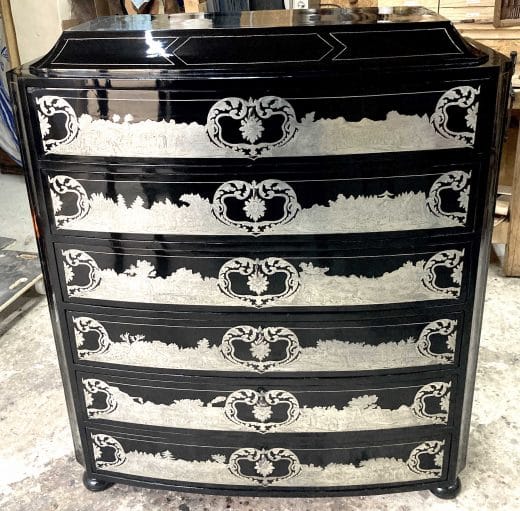
Restoration of this unusual piece of furniture from Austria/Hungary. I must admit I had some difficulty placing it geographically. It was clear that it wasn't from France but rather from Eastern Europe. But where? Fortunately, engravings provide valuable clues; the clothing depicted corresponds well to the late 17th and early 18th centuries. The landscapes consist of mountains and villages; the vegetation is composed of deciduous and coniferous trees, and several medieval castle ruins can be seen. […]

Napoleon III worker

Ebénisterie Mathieu Vath

Restoration of a Napoleon III period sewing table inlaid with mother-of-pearl, brass, and ebony. As you can see from the photos, this sewing table was in very poor condition. Only the affection and sentimental value of its owner saved it. Indeed, the time required for the restoration of this table was far too great compared to the object's value. Almost all of the brass inlay on the base was missing, there was a lot of missing veneer, and there was a […]

Empire Gueridon

Ebénisterie Mathieu Vath

Restoration of an Empire-style mahogany burl veneer pedestal table. It was in rather poor condition upon arrival at the workshop; the bronze mounts were heavily soiled, there was significant structural delamination, and veneer was missing. The restoration therefore consisted of re-gluing the structural elements and the veneer. This operation was carried out under vacuum with the injection of a penetrating adhesive for the upper apron and the central shaft. The few old grafts, which had been done with the grain running in the wrong direction, were removed and replaced with a matching veneer […]

Directoire cylinder desk

Ebénisterie Mathieu Vath

Restoration of a late 18th-century Directoire roll-top desk veneered in mahogany burl on all four sides. It bears the mark CD or GD, a mark unknown to me. Any information regarding it would be greatly appreciated! Constructed entirely of oak (not a single piece of poplar, not even for the drawer pulls or panels), the upper section opens with a cylinder, revealing four small drawers surmounted by a niche, as well as a sliding writing surface covered in gilt tooling and two side pull-outs also covered in gilt tooling […]

Mazarin Boulle Office

Ebénisterie Mathieu Vath

To end the year on a high note, here's a restoration that occupied a large part of my time this year and which reached its owner a few weeks ago. It's the restoration of an eight-legged writing desk, commonly known as a "Mazarin" desk. Constructed of solid oak and softwood, the sides and drawer bottoms are made of light walnut. The marquetry covering it consists of Caret tortoiseshell (Eretmochelys imbricata) on a vermilion red ground, and brass. All of this is framed by delicate ebony stringing. It is […]

Louis XVI commode

Ebénisterie Mathieu Vath

This week, we're restoring a Louis XVI commode with a projecting front, veneered in Rio rosewood, amaranth, and violet wood, with marquetry stringing in boxwood and ebony forming a ribbon wrapped around the wood, the background of the engravings filled with red wax. The tapered legs and canted uprights have faux fluting in ebony and boxwood. There's no maker's mark to attribute this beautiful piece and the high quality of wood chosen for its construction. Regarding the restoration, the work isn't very […]

Eight-foot desk known as the "Mazarin" desk«

Ebénisterie Mathieu Vath

Extensive restoration work has been undertaken on this Mazarin desk, veneered in kingwood and rosewood. It is entirely veneered on fir with a solid rosewood base. The top features a marquetry of rosewood stars surrounded by kingwood butterfly wings in circular patterns. Why the name "Mazarin"? The eight-legged desk is one of the jewels of 17th-century furniture. It only acquired the name "Mazarin" from antique dealers in the 19th century to give it a more prestigious name.

L Cueunieres Writing Desk

Ebénisterie Mathieu Vath

A small restoration for this very pretty Louis XVI style inkwell, stamped L.CUENIERES jne. Louis Cueunières jeune, established at 10 rue Villehardouin in Paris in 1870, specialized in the restoration of antique furniture and the reproduction of period pieces. This inkwell was in fairly good condition. Apart from a few small pieces of missing ebony, it was simply dirty. A few ebony grafts, a good cleaning, and a touch-up of the varnish with a French polish were enough to restore its former luster. To see previous restorations: https://ebenisterie-mathieuvath.fr/en-ce-moment-a-latelier/ You can find this piece at […]

Louis XV style desk

Ebénisterie Mathieu Vath

A major restoration was undertaken for this small Louis XV style desk, richly adorned with bronze mounts and veneered in rosewood. The restoration involved replacing the missing veneer while preserving as much of the remaining material as possible. This was achieved by using veneer that was sliced, scraped, sanded, oxidized, and varnished before being re-glued, thus avoiding the need to sand the piece before finishing. Rosewood is a very dark wood that lightens with age, developing a beautiful reddish patina that cannot be removed by any means.

Regency chest of drawers

Ebénisterie Mathieu Vath

Originating in the late 17th century but only acquiring its name in the early 18th century, this is the first classic model of a commode. Although typically Louis XIV in style, it may not have existed before the Regency period. With rounded corner pilasters with slightly convex faces, deep copper fluting, veneer, and geometric bronze mounts, it features three rows of drawers. It perpetuates the spirit of Louis XIV furniture throughout much of the 18th century. Bibliography: Furniture […]

Transitional dresser

Ebénisterie Mathieu Vath

Restoration of a transitional period commode with a projecting front, veneered in rosewood and palisander. The Greek key-patterned moldings, stained green, are made of hornbeam, and the front features a butterfly wing design. It opens with two large drawers with concealed crossbars, and three drawers in an upper row. The uprights, with simulated fluting, are veneered in ebony and boxwood. It rests on four cabriole legs adorned with hoof-shaped feet. Although it has undergone some alterations […]

Louis XV style flat desk

Ebénisterie Mathieu Vath

A second life for this Louis XV style desk veneered in Rio rosewood (Dabergia niera) and African mahogany (khaya). Besides the construction and visible tool marks, dating this desk is greatly facilitated by the presence of this African mahogany. Indeed, it was from the late 19th century that this type of mahogany began to arrive from the west coast of Africa and became prevalent in all furniture production at the beginning of the 20th century. The restoration consisted of re-gluing the structure […]

Louis Philippe Buffet

Ebénisterie Mathieu Vath

For a change of pace this week, a bit of what's called "rustic" furniture. It's a welcome change from veneer, and to be honest, it's not unpleasant. I'm even quite pleased to have this kind of piece to restore because, unfortunately, many of these pieces, having lost their market value, end up in the landfill or are simply burned. Moreover, these aren't pieces that require a huge amount of work. For this Louis Philippe two-part sideboard, the restoration consisted of replacing the chestnut planks […]

Louis XVI Powder Box/Writing Table

Ebénisterie Mathieu Vath

The dressing table, sometimes called a powder table, can be defined as a vanity unit in the form of a table or a small writing desk with drawers. Around 1730, shortly after the commode, this new type of furniture, often richly inlaid or veneered with precious woods, appeared in French furniture. This rather atypical powder table has the unique feature of also serving as a writing desk, or at least a desk for writing. Its four legs are made of solid mahogany, and the stretchers are also veneered in mahogany. The four surfaces are […]

Louis XVI commode stamped JA LECLERE

Ebénisterie Mathieu Vath

Jacques-Antoine Leclere (1744 – January 30, 1792) obtained his master craftsman's certificate in Paris on September 29, 1779. He worked on the rue du Faubourg-Saint-Antoine, then on the rue des Barres, and finally in the courtyard of the Jewish Quarter, a stone's throw from the Bastille. This cabinetmaker produced well-made Louis XV and Louis XVI pieces. He used rosewood, satinwood, mahogany, and also lacquer panels. His stamp can be found on secretaries, chests of drawers, and various small pieces of furniture. For example, a pair of Louis XVI half-moon commodes veneered […]

Louis XV/Transition Commode by Nicolas Abraham Couleru

Ebénisterie Mathieu Vath

This slightly curved commode, composed of three drawers and veneered with bottomless cubes of walnut, plum, and cherry, has a marquetry top depicting a bouquet of flowers on an amaranth ground. Plum or Quetchier wood is easily recognizable by its sapwood markings, which create a lighter pattern and lend an irregularity to the decoration. The frame is made of fir and walnut. It is difficult to define a precise style for this commode. Although Louis XV, it clearly foreshadows the arrival of the style's more restrained appearance […]

"Cabaret" pedestal table«

Ebénisterie Mathieu Vath

Very fashionable at the end of the 18th century, the cabaret table, or cabaret table, is characterized by a raised, basin-shaped top. Its slightly concave shape with a raised rim all around allows for the safe serving of various beverages such as teas, hot chocolates, and other drinks. This model, similar to those made by the cabinetmaker Canabas, is made of solid mahogany from Saint-Domingue with metal reinforcement under the legs. The biggest problem, in fact, was with the legs; they wobbled in all directions. The […]

Transitional chest of drawers stamped A. HERICOURT

Ebénisterie Mathieu Vath

Congratulations to Arnaud for the restoration of this Transition period commode veneered in rosewood, amaranth, and satinwood for the sides, and green-stained maple for the stringing. The frame is made of oak and softwood. Antoine Héricourt (c. 1730–1792) obtained his master craftsman's certificate on October 20, 1773, after working for several years as a journeyman in the Faubourg Saint-Antoine. After obtaining his certificate, he settled on the rue du Faubourg Saint-Honoré and became a representative of his guild, then a syndic. His extensive production was highly prized by a French clientele and […]

Empire X-Leg Desk

Ebénisterie Mathieu Vath

Here are some images of the restoration of this desk, with a solid mahogany base and mahogany burl veneer for the rest. Note that the recessed top is made from a single 12mm thick plank of solid mahogany burl. Here is the desk before restoration. The bulk of the work is on the legs. They are broken at the middle joint. They have already been repaired and are held together only by additional screws. Two cracks can be seen at the […]

Louis XV writing table

Ebénisterie Mathieu Vath

Before/after the restoration of a Louis XV writing table veneered in kingwood on solid oak. It has two side drawers and a central pull-out shelf beneath the leather-covered top. Besides the significant discoloration of the varnish, there were some small areas of peeling and missing veneer. The missing pieces were replaced with new veneer, which was sawn, scraped, and sanded, then cut to the correct thickness before gluing in order to avoid disturbing the patina beneath the bleached varnish. The […]

Louis XVI Molitor Console

Ebénisterie Mathieu Vath

Restoration of a Louis XVI console table (1790-1795) stamped by Bernard Molitor. The structure is made of oak and solid mahogany for the legs. The panels of the lower shelf are beech. It is veneered with mahogany burl and ebony and brass stringing. Originally from Luxembourg, Bernard Molitor (1755 – November 17, 1833) obtained his master craftsman's certificate in Paris on October 26, 1787. He arrived in Paris in 1776 and worked in a small workshop located in the Arsenal district. It was after obtaining his master's certificate that he established himself on the rue de Bourbon-Saint-Germain. The austerity […]

Prie-Dieu

Ebénisterie Mathieu Vath

A first contact and a truly beautiful job by Rachèle on the restoration of this walnut prie-dieu dating from the late 19th century. The project was quite daunting. Left abandoned for years, it had been ravaged by wood-boring insects. The first task was to treat the piece with anoxic agents for 21 days. Then, as nothing was holding together anymore, each element was disassembled, which wasn't too difficult, and then glued back together […]

Louis XV slant-front secretary

Ebénisterie Mathieu Vath

This week, a curious and very pretty Louis XV period slant-front secretary/desk in Boulle marquetry and rosewood. And yes, it wasn't only under Napoleon III that the reuse of Boulle marquetry was fashionable. In fact, Boulle marquetry continued to have admirers throughout the 18th century. It was from the 1750s onwards that the renewed interest was most pronounced. Prominent merchants, such as Lazare Duvaux, began selling them occasionally at considerable prices to prestigious clients, […]

Regency chest of drawers

Ebénisterie Mathieu Vath

This small chest of drawers has a classic form typical of the Regency period. Still bearing the hallmarks of Louis XIV, the front is curved, the front uprights are rounded, and the sides remain straight. It opens with three drawers. Its uprights and the intermediate rails are decorated with brass fluting. The frame is entirely made of fir; the intermediate panels are dovetailed into the sides, and the back is composed of horizontal planks held in place by rabbeted nails. The drawers are constructed of walnut […]

Napoleon III Boulle marquetry games table

Ebénisterie Mathieu Vath

Congratulations to Damien (intern) for restoring this Boulle marquetry games table. It was quite a task. Almost all the brass veneers were peeling off, there were some missing brass pieces, but most importantly, many missing tortoiseshell pieces. The glues were severely dehydrated, judging by the blistering tortoiseshell. The games table was completely disassembled. All the missing brass pieces were cut out using a marquetry easel and then engraved with a burin. As for the tortoiseshell, we opted for […]

Transition cylinder desk

A few years ago, I had the opportunity to restore this magnificent Transition period (1780) roll-top desk. It is framed in oak and fir. The fall front is primarily veneered with rosewood laid in a paillon pattern, framed by a light stringing of boxwood and green-stained hornbeam, bordered by a thin band of amaranth. The back is veneered in satinwood. The central marquetry, on a tobacco-stained sycamore ground, depicts musical instruments and two doves taking flight, each carrying a musical score in its beak. This […]

Napoleon III side table

Ebénisterie Mathieu Vath

A Napoleon III period side table with a quadrangular structure veneered in blackened pearwood, adorned with rich Boulle marquetry in brass and red tortoiseshell forming an arabesque design composed of foliate scrolls, rocaille motifs, and small flowers. The whole is punctuated by beautiful gilt-bronze mounts featuring atlas figures with clasped hands, acanthus leaves, and an apron. The top is framed by a gadrooned molding supporting a black marble slab with rounded edges. It opens with a door with a lock […]

Napoleon III Boulle marquetry side table

Ebénisterie Mathieu Vath

A console table veneered in ebonized pearwood and inlaid with Boulle marquetry of brass on tortoiseshell in arabesque designs. It opens with a door adorned with an oval medallion, revealing shelves in mahogany and mahogany veneer. Rich ornamentation of chased and gilded bronze: egg-and-dart friezes, caryatids in corner drops, interlaced friezes, acanthus leaf friezes, fruit, and florets. This Boulle piece requires extensive restoration. Some pieces of brass, stringing, and especially a great deal of tortoiseshell are missing. Given its value […]

Restaurant Secretary

Ebénisterie Mathieu Vath

Restoration of a Restoration period (1815–1830) drop-front secretary veneered in burr mahogany and topped with Carrara white marble. The front legs are rounded and the rear legs are square. The frame is made of oak and softwood. An inventory mark (I91) is found inside the lower drawer on the right side. The Restoration style? After Napoleon's defeat at Waterloo on June 18, 1815, power in France was taken over by the two brothers of Louis XVI: the Count of Provence, who would reign under the […]

Transitional chest of drawers stamped LARDIN

Ebénisterie Mathieu Vath

Restoration of a Transition period commode built of fir and oak and veneered with rosewood, framed with stringing of white hornbeam and green-stained wood, with a satinwood band surrounded by amaranth. The central medallion is satinwood veneer assembled in a herringbone pattern. The maker's mark and the JME (Journée des Métiers d'Étranger) are located at the base of the left rear leg. André-Antoine Lardin (1724 – August 10, 1790) obtained his master craftsman's certificate on July 1, 1750, and established himself on the rue de Charenton under the sign "Au Bois de Boulogne." He worked there until 1770, the date […]

Empire Dressing Table

Ebénisterie Mathieu Vath

A beautiful restoration and, above all, conservation effort has been undertaken on this lovely Empire-period dressing table. Its frame is made of oak and poplar, veneered with mahogany burl. The drawer sides and bottoms are solid mahogany. It rests on four column legs ending in casters and joined by an H-shaped stretcher. The frieze opens with a drawer revealing a writing surface lined with blue morocco leather, a pen case, and two compartments for inkwells, as well as two large drawers on either side for essentials […]

Barber shop Louis XVI/Directory

Ebénisterie Mathieu Vath

This elegant mahogany-veneered shaving cabinet from the late 18th century rests on four tapered legs with casters and opens with three drawers in the front. The niche, with its blue Turquin marble top framed by fluted columns, is surmounted by two side drawers and a sliding marble shelf with a recessed panel that reveals a sliding mirror on a rack and pinion mechanism, pivoting and framed with ebony and brass stringing. Appearing during the reign of Louis XVI, this style of shaving cabinet is a toilet unit designed to hold a porcelain pitcher and basin […]

Empire Console

Ebénisterie Mathieu Vath

Here are some images of the restoration of this Empire-era console table. But first, a little history: do you know what a console table is and what its use was? Primarily a decorative piece of furniture placed in the entrance hall of apartments or between two windows, the "console table"—as it was called during the reign of Louis XV—consists of a marble top supported by two scrolled legs and placed against the wall. During the reign of Louis XV, console tables were often elaborately crafted and adorned with highly detailed motifs. Sculptures and reliefs, arched legs […]

Louis XV commode

Ebénisterie Mathieu Vath

This is a significant restoration project for this Louis XV commode, originally veneered in rosewood and violet wood. It took me some time to determine if it was indeed violet wood, as the commode had undergone so much restoration that there was almost as much rosewood as violet wood. Fortunately, the drawers are still in fairly good condition and are indeed made of violet wood, so I conclude that the commode was […]

compass rose

Ebénisterie Mathieu Vath

Creation of a compass rose in 8mm solid wood, veneered onto 8mm plywood. It is composed of maple, dark walnut, and sipo for the rose itself; cherry for the background; and sapele, light walnut, and maple for the frieze and cardinal points. It will be integrated into a solid walnut parquet floor; unfortunately, I am not doing the installation… I hope to be able to see and show you the final result soon.

Sleep

Ebénisterie Mathieu Vath

Restoration of an early 19th-century somno veneered in Cuban mahogany burl. It's fair to say it has already suffered considerably from previous restorations. The missing veneer and the dimensional shrinkage of the wood have been filled with wood filler and then disguised. The problem is, that's all you can see! You might be wondering what a somno is? Created during the Consulate, in the early years of Napoleon I's reign, the somno, or somneau, is a small piece of furniture made of […]

Louis XVI commode

Ebénisterie Mathieu Vath

Restoration of a Louis XVI period commode from eastern France, made of solid oak and fir and veneered with end-grain laburnum, walnut, plum, amaranth, rosewood, palisander, boxwood, and green-stained hornbeam. The handles and keyholes were added at a later date. The original fittings are missing; only the holes for the handles remain. This is a piece of furniture that has never been restored. The veneer is almost 4 mm thick in some places, and […]

Table à la Tronchin

Ebénisterie Mathieu Vath

A little refresh for this lovely Tronchin-style table. Apart from a missing molding and a few small veneer chips on the legs, nothing too serious. A touch-up of the varnish was enough to give it a new lease on life. But do you know where this type of table comes from, and what it was used for? Although today attributed to Théodore Tronchin, a Genevan physician (1709-1781), who at the time published works on bone diseases linked to poor posture at one's desk, he cites the advantages that […]

Mahogany games table, late 18th - early 19th century

Ebénisterie Mathieu Vath

96 x W 47.5 x H 74 cm. Open: 96 x 95.5 cm. Restoration of a games table with a folding top veneered in burr mahogany, commonly known as Cuban mahogany. In fact, according to the recent book "L'essence du bois" (The Essence of Wood) by Patrick George, Emmanuel Maurin, and Marie-Christine Troujy-Jaquemet, it seems more accurate to call this type of mahogany Saint-Domingue mahogany. The base is veneered in solid oak, and the top in poplar. The moldings are solid mahogany. The table rests on legs […]

Secret box

Ebénisterie Mathieu Vath

The brief was to create a multi-movement secret box inspired by Japanese boxes but with French-style marquetry. This box comprises three movements to access the secret drawer and a spring-loaded button concealed beneath the veneer that allows the drawer to be ejected. For the form and marquetry, I drew inspiration from the traveling secretary attributed to Jean-François Oeben. The geometric shapes and colors closely correspond to what this cabinetmaker […]

Majorelle table and rosewood

Ebénisterie Mathieu Vath

This is the second time I've had the opportunity to work on this type of table, made by Louis Majorelle's workshop in the 1920s and 30s. You can find all the information about this type of table at the following link: https://ebenisterie-mathieuvath.fr/2019/08/29/table-majorelle/ As for the restoration, it's more of a preventative measure. Indeed, there's no major damage; a few veneer grafts and re-gluing a large portion of the edge veneer were enough to restore this lovely Rio rosewood-veneered table. An opportunity for me […]

Secretary of the Board of Directors

Ebénisterie Mathieu VATH

Here is a secretary desk in the most understated style of the Directoire period. Its frame is made of solid beech and conifer, and it is veneered with mahogany and mottled mahogany. It is very simply adorned with bronze handles in the form of a lion's head holding a ring in its mouth. The keyhole escutcheons are in the shape of a shield. The interior comprises seven drawers, the middle one of which opens with a key. The drop-front opens with a period three-point lock. The lower section consists of three drawers, or has been transferred […]

Empire Pedestal

Restoration of a walnut (for the legs and frame) and flame mahogany veneer pedestal table. It rests on three column-shaped uprights, surmounted by a circular black veined marble top adorned with bronze rings. The restoration involved tightening the cracked base, re-gluing the edge veneers, and adding some veneer grafts. The columns, which were heavily infested with wood-boring insects, were stripped and then treated with static anoxia. Static anoxia is an insecticidal treatment that works by depriving the body of oxygen, having […]

Regency commode stamped J.BIRCKLE

Ebénisterie Mathieu VATH

Restoration of a chest of drawers veneered in Rio rosewood and satinwood stringing. It has two large drawers and two small ones in the upper section. Its frame is made of oak and fir. It is stamped J.BIRKLE on the left upright and also bears the mark JME. It shows some signs of restoration and an ink mark on one side of a drawer. Jacques Bircklé (1734-1803) – Cabinetmaker – master craftsman obtained on July 30, 1764. One of the suppliers to the Royal Furniture Repository under Louis XVI. Freelance craftsman before […]

Louis XV commode

Ebénisterie Mathieu VATH

The commode with a jumping habit seems to have been invented during the Regency period, between 1705 and 1730, by the cabinetmaker Charles Cressent, and subsequently became widespread in the Louis XV style. It consists of only two drawers or two rows of drawers. The body must be raised on cabriole legs of about half height, with the body occupying half the height of the piece and the other half the legs. The observer thus has the impression that the piece has legs allowing it to jump like a frog. The width offers straight, curved, or […]

Louis XVI/Directory Secretary

Antiquités Guin

Restoration of a drop-front secretary desk built in oak and veneered with mottled mahogany and mahogany from Saint-Domingue. Its design dates from the late 18th century. Its white Carrara marble top is surrounded by a partially openwork brass gallery. It opens with a drawer at the top, a drop-front in the middle, and three drawers at the bottom; all the original locks are secured with a clover-shaped key. All the panels on the front and sides are framed with brass quarter-round moldings. The drop-front is veneered in mahogany […]

Empire secretary with quiver

Ebénisterie Mathieu VATH

You remember the Empire chest of drawers with the quivers. Well, here is the secretary desk with the quivers. It is built in exactly the same way as the chest: same construction, same solid woods used, and same mahogany veneers. As for the restoration, it is identical to that of the chest of drawers. The aim is to preserve as much as possible and restore the piece of furniture to its original function without altering its history. The work therefore consisted of reattaching the structure and the few detached veneer elements. And to […]

Louis XV style desk in yellow Saint Martin veneer

Ebénisterie Mathieu VATH

The restorer's trade holds many surprises. There are over 60,000 species of trees in the world. Suffice it to say that even though the same types of wood are often found in French furniture, sometimes you stumble upon something completely new. I must say, I found this wood odd. Violet wood? No. Rosewood? Perhaps, but a variety I don't recognize. Okay, I stripped a section to reveal the wood's true color. Hey, the varnish was very red, and finally this…

Jacob Frères bench and armchairs on rue Meslée

Ebénisterie Mathieu VATH

Extensive restoration and conservation work has been undertaken on this bench and its four armchairs from the Consulate period, stamped Jacob Frères, rue Meslée. The front and back legs are made of solid Cuban mahogany, while the crossbars are veneered. The armrests, supported by Egyptian heads, are made of light Saint-Domingue mahogany to create a contrast with the uprights. They are adorned with carved palmettes and rosettes in Cuban mahogany. They rest on tapered front legs ending in claw feet, and the rear legs are arched. […]

Empire Chest of Drawers with Quivers

Ebénisterie Mathieu VATH

This week, here are some photos of the restoration of this Empire-style chest of drawers veneered in mahogany burl. This chest is truly unique due to the quality and originality of its bronze mounts. Indeed, they form quivers along with the side columns. The keyhole escutcheons are composed of two crossed laurel branches held together by a ribbon. Originally, they were mercury-gilded, as can be seen from the gilding stains on the back. Unfortunately, only a few partial traces remain on the front […]

Small Boulle marquetry cartel clock

Ebénisterie Mathieu VATH

Restoration of a Napoleon III period marquetry clock in brown tortoiseshell on a black ground and brass. Despite dust, oxidation, and years spent in the depths of an attic, this small clock is in very good condition. Except for a missing piece of brass on the right side of the capital, it is complete. The gilding is still clearly visible beneath the layer of grime, and the structure is in perfect condition. The restoration was therefore straightforward: re-gluing all the marquetry under vacuum, then a light cleaning, and a varnishing with […]

Napoleon III wall shelf

Ebénisterie Mathieu VATH

Restoration of a Napoleon III period wall shelf veneered in blackened pearwood, rosewood, amaranth, amboyna burl, and marquetry with a music theme. Underneath the dust, aside from small losses in the blackened pearwood and rosewood, and slight dehydration, there was nothing too serious. A few veneer grafts, a vacuum-sealed glue application, a thorough cleaning, a coat of clear French polish, and voilà! All this without using sandpaper. Except for lightly sanding the varnish […]

Hedouin commode with crowned C

Ebénisterie Mathieu VATH

Extensive restoration of this superb Louis XV period commode, stamped on all four uprights by Jean-Baptiste Hedouin. The frame and drawers are constructed of solid oak, fir, and walnut. The edges of the frieze and geometric marquetry in violet wood are veneered with satinwood. Two types of violet wood are visible: one with a very tight grain and veining for the lozenges, and a second, more intricate type for the marquetry edges, uprights, and rails. The […]

Napoleon III liquor cabinet

Ebénisterie Mathieu VATH

It would seem that the first liquor cellars appeared at the very end of the 18th century. But it was in the 19th century that the fashion for liquor cellars truly took off. The revolution transformed social classes and ways of socializing, leading to increased consumption of liquor, which contributed to the rise of this new social object. The emergence of liquor cellars is, of course, directly linked to the evolution of alcohol consumption in France, such as sweet Mediterranean wines, brandies, cognac, liqueurs, and more.

Louis XVI half-moon table

Ebénisterie Mathieu VATH

Here is a three-tiered half-moon table. This style of table, originating in England, is a classic of the Louis XVI style. It opens to reveal two circular tiers, one lined with felt, the other veneered in mahogany. The mahogany burl veneer apron is adorned with a brass frame. It rests on five tapered legs with brass-filled fluting and ending in sabots. The fifth leg is attached to a drawer that opens to serve as a support once the flap is unfolded. A very attractive piece, probably dating from the end of the […]

Louis XVI style desk stamped KRIEGER

Ebénisterie Mathieu VATH

Exquisitely crafted with its mahogany-veneered oak frame and solid mahogany legs, this desk is a perfect example of high-quality 19th-century furniture. The cabinetmaking is flawlessly executed, and the bronze mounts are in pristine condition. Everything is there; nothing is missing. The Krieger firm began its cabinetmaking business in the mid-19th century with Antoine Krieger (1804-1869) before adding a significant decorative department, which ensured the prestige of its business until around 1945. The Krieger firm produced all the […]

N. PETIT Roll-Top Desk

Ebénisterie Mathieu VATH

DIMENSIONS: H.71 W.104 D.52 This roll-top desk perfectly matches those made by Nicolas Petit's workshop between 1770 and 1791, the year of his death. Indeed, with a few exceptions, Nicolas Petit primarily produced this type of secretary in molded mahogany, resting on fluted legs and topped with white marble. Simple in style, they reflected the taste of the period. It comprises two drawers in the frieze, two side pull-out shelves, and a central pull-out shelf that locks when the drop-front is closed. The interior consists of […]

Transitional dresser

Ebénisterie Mathieu VATH

Here is a very simple chest of drawers from eastern France, probably dating from the late 18th century. The front is slightly curved and the uprights are chamfered. It should be noted that the bronze mounts are probably not original. The frame is made of solid softwood, and the uprights are oak. The drawer bottoms are set in rebates and slide on the drawer fronts, which is typical of provincial work. A small peculiarity: this chest of drawers does not have top panels, the […]

J.STUMPFF Roll-Top Desk

Ebénisterie Mathieu VATH

Restoration and conservation work on this rare Louis XVI period roll-top desk stamped by Jean-Chrysostôme Stumpff. 1731 - January 17, 1806 – Master craftsman on August 27, 1766. Originally from Schweigern, Swabia (Germany), he married in 1760 in Paris, at the Swedish embassy, like most of his compatriots of the Reformed faith. His fellow cabinetmaker Ferdinand Scherdfeger was a witness at the wedding. It was in his workshop on Rue Saint-Nicolas that he produced some Louis XV style furniture, but primarily a large number of transitional and Louis XVI pieces. The large […]

Napoleon III style Louis XVI work table

Ebénisterie Mathieu VATH

A few photos of the restoration of a small Louis XVI style work table from the late 19th century. The legs are solid mahogany, and it is veneered with rosewood, sapele, blackened pearwood, and boxwood for the fluting and stringing. Nothing too serious for this pretty little piece of furniture, which only had a few missing veneers and a small chip on the side of the oak drawer. A simple restoration: a few veneer grafts glued with hot glue, a light cleaning of […]

Napoleon III Boulle marquetry side table

Ebénisterie Mathieu VATH

Restoring this piece of furniture is a classic. The door was warped and almost all the brass inlay was missing. Its main advantage was that the marquetry on the door was fairly well preserved, apart from a small amount of missing brass and a few pieces of dyed horn. Nothing too serious. So I started by removing the bronze mounts, then I remade and glued all the missing inlays, reattaching those that were still there in the process. Next, I tackled the door. After removing the veneer […]

Cabinet from the late 17th century

Ebénisterie Mathieu VATH

Don't be fooled by the Directoire-style keyhole escutcheons on this cabinet, as it dates from the late 17th or early 18th century. The keyhole escutcheons are clearly not original. In fact, very few elements remain original to this piece of furniture apart from the drawers, the frame, and the base. The veneer on the front, sides, and top has been altered. It's quite clear that the locks have been changed and the escutcheons filled in. This piece is entirely made of […]

Chest of drawers in the style of the Axe

Ebénisterie Mathieu VATH

Here are some photos of the restoration of a solid walnut commode, veneered with thuya burl inlay and Greek key stringing in amaranth and boxwood. The drawers and the interior and back panels are made of fir. Despite the curved stretcher, its shape, and its feet, this commode is indeed in the transitional style but from the Louis XVI period. In the title, I wrote "in the style of the Hache family" because it is certain that this commode originated in the Dauphiné region. But whether it is a product of the famous […]

Louis XVI commode stamped JA BRUNS

Ebénisterie Mathieu VATH

This week marks the completion of the restoration of a Louis XVI commode stamped JA BRUNS. It is made of oak for all the structural elements, except for the side panels, drawer backs, drawer fronts, and the two drawer bottoms, which are made of softwood. It is veneered with rosewood in a butterfly pattern and amaranth for the edges. The false fluting is made of boxwood and ebony, and there is a green-stained maple stringing forming the corners at […]

Label signed "Louis David Carré in Paris"«

Ebénisterie Mathieu VATH

After several weeks of work, the restoration of this clock is finally complete. It is a Louis XV period clock in brown tortoiseshell and brass marquetry, with rosewood restorations. The dial is by Louis David Carré, nephew of Jullien le Roy, who became a master craftsman on December 31, 1748. Lodged at the Louvre from 1744, he was elected a juror in 1775. The greatest treasure of this clock lies in its bronze mounts. They are truly magnificent, and above all, they are in very good condition. There is only […]
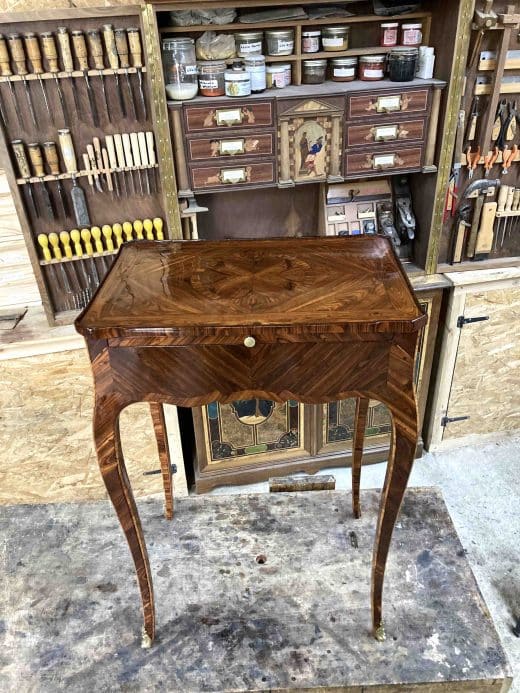
Secretary stamped P.ROUSSEL JME

Ebénisterie Matheu VATH

Here are some images of the restoration of a secretary desk stamped by Pierre Roussel (1723-1782). Having become a Master Cabinetmaker in 1745, Pierre Roussel set up shop on Rue de Charonne, in the Faubourg Saint-Antoine, under the sign "L'Image de Saint Pierre" (The Image of Saint Peter). Thanks to his skills as a cabinetmaker and especially as an exceptional marquetry artist, he quickly gained a great reputation. In 1762, he became a sworn member of his guild. By 1767, he was considered one of the best cabinetmakers of his time. Highly regarded by his colleagues, he became a representative of the cabinetmakers' guild in 1777 and then syndic two […]

Mazarine Chest of Drawers

Ebénisterie Mathieu VATH

Here is a charming Mazarine commode from the Louis XIV period. With a serpentine front and three drawers in three rows, it is topped with a marquetry top featuring a compass rose on an end-grain wood background. Constructed on a fir frame, it is covered with a beautiful olive veneer, with both end-grain and grain-grained veneer, rosewood, ash on the sides, and boxwood for the stringing and compass rose. The crossbeams are joined with straight dovetail joints on the sides, which has caused some minor imperfections.

Louis XVI style sewing box

Ebénisterie Mathieu VATH

This sewing box dates from the Napoleon III period. The frame is made of softwood. The veneer is composed of Rio rosewood, mahogany for the interior, and a green-stained boxwood and maple inlay. The great quality of this box is that the lid hasn't warped. This is often the major problem with this type of furniture, as people forget to lock them, causing the wood to warp. It then becomes very difficult to find the "trick" to ensure the box stays closed.

Boulle box

Ebénisterie Mathieu VATH

To kick off the new year, I'm excited to present my latest project. I'm embarking on a replica of this box attributed to André Charles Boulle. You'll be able to follow its progress and even come see it in person, as it will be my main subject for marquetry work at various exhibitions and events over the next few years. And yes, I'm talking about several years, as it's an extremely time-consuming project. But first, I had to find and select the different types of wood that make up the […]

Louis XVI style table

Ebénisterie Mathieu VATH

Here is a Louis XVI style table, which is probably an early 20th-century piece. It was likely made in the Faubourg Saint-Antoine, or perhaps at the École Boulle. I have seen apprentice furniture of this quality made by students during their training. Its frame is oak, while the veneer is rosewood and mahogany with a black inlay. The restoration was straightforward, apart from a lack of rosewood in the marquetry […]
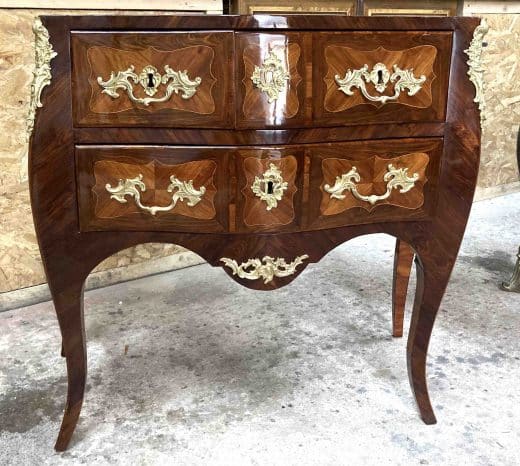
Empire bed

Ebénisterie Mathieu VATH

The "boat" bed, with its characteristic curve, is a French invention that appeared during the Directory and was very fashionable during the Empire and the Restoration. It is easily recognizable here by its lion's paw feet. The varnish on this bed had worn away, making it impossible to distinguish between the two mahogany pieces. The mahogany is known as Cuban mahogany (Swietenia mahogani), from Cuba, a Spanish colony. Evidence of its importation into Spain, specifically Seville, dates back to 1519-1520. It was used by Philip II between 1563 and 1584 during the construction of the Palace […]
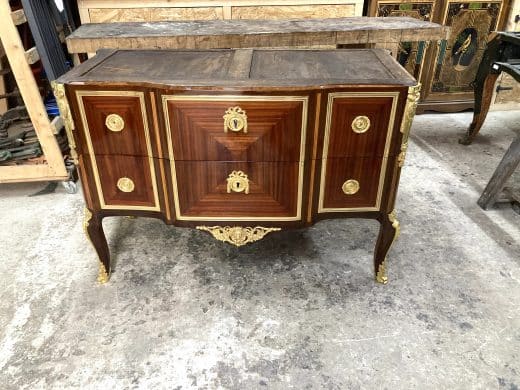
Secretary Napoleon III

Ebénisterie Mathieu VATH

On the restoration side, there wasn't much to do: the brass fittings were reattached with fish glue and by infiltration, then stripped and varnished. The most difficult part of this type of furniture is the black stain. Over time, pear wood darkens, loses its color, and turns gray. It then needs to be stained, without, of course, obscuring the brass. To do this, I fill and polish the piece until the brass becomes a true mirror. Then, I apply a hot logwood stain, and then […]
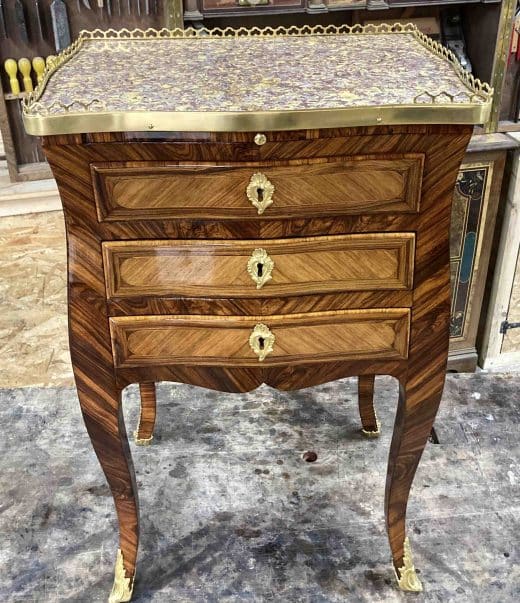
Louis XV slant-front desk (After restoration)

Ebénisterie Mathieu VATH

A while ago I told you about this desk that was being restored. Well, here it is finished. The varnishing process took three weeks. This allowed enough time for the varnish to set properly, in order to achieve the best possible result. https://ebenisterie-mathieuvath.fr/en-ce-moment-a-latelier/ So here are some before and after photos.

Louis XV slant-front desk

Ebénisterie Mathieu VATH

The restoration of a lovely slant-front desk, or as Riesener calls it in his memoirs, a "tomb-shaped secretary," began two weeks ago. With the restoration phase complete and the varnishing underway, I'm taking a moment to provide a brief summary of the project. The desk's frame is made of oak and fir, veneered with rosewood and violet wood, and the drop-front features floral marquetry of boxwood, natural and stained maple, and hornbeam. It includes a large drawer […]
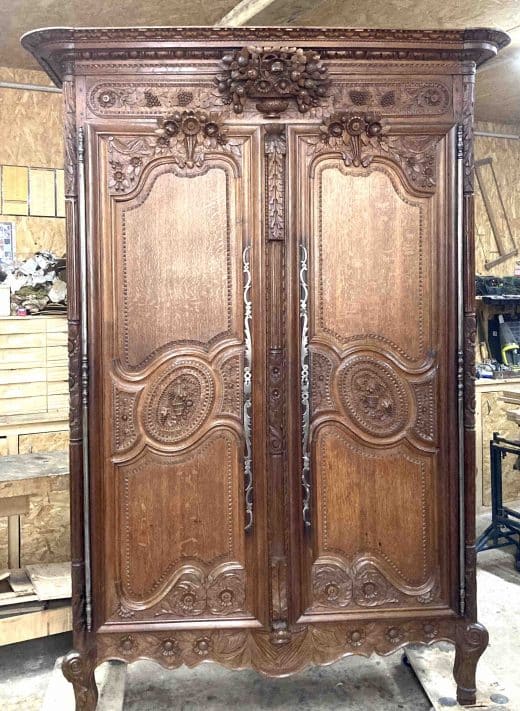
Corner cabinet in Boulle marquetry from the Napoleon III period

Ebénisterie Mathieu VATH

A classic restoration of Boulle marquetry. This involved rehydrating the old glue through infiltration, crafting and gluing the missing brass pieces, and reconstructing the base, which was in poor condition but not beyond repair. The bronze mounts were cleaned and finished with a clear French polish. Proof that appearances can be deceiving. Even a piece of furniture in a severely deteriorated state can regain its former beauty.

Commode returning from Egypt

Ebénisterie Mathieu VATH

During the turbulent period of the French Revolution, furniture production was considerably diminished, and most artisans experienced very difficult times. Overall, from the Consulate to the Directory, furniture and seating had little time to evolve. However, even though some decorative motifs inspired by Egypt had already appeared, it was after the Egyptian expedition (1798-1801) that they evolved into a unique style. The so-called "Return from Egypt" style, however, lasted only a short time: a decade at most, as it would […]
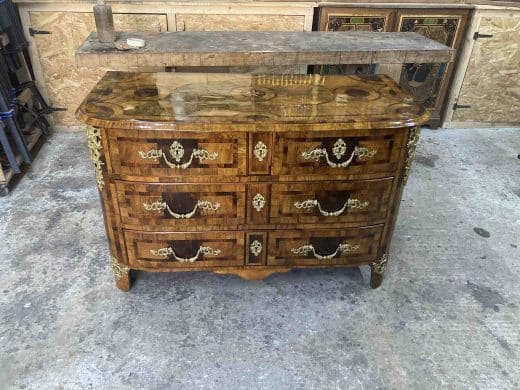
Secretary stamped Martin Ohneberg

Ebénisterie Mathieu VATH

This week marks the completion of the restoration of a Louis XVI period secretary. Martin Ohneberg (Master in 1773), the cabinetmaker who crafted this piece, was an excellent marquetry artist and used very high-quality rosewood. He produced numerous pieces of furniture with very simple lines but exquisite marquetry, including an endless variety of drop-front secretaries. This particular one is veneered with rosewood and amaranth, and features a mosaic marquetry of maple blossoms on a red satinwood ground. The framing bands […]

Louis XIII style desk

Ebénisterie Mathieu VATH

A look back at the restoration of a 17th-century Louis XIII table. It is made of solid walnut and veneered with walnut, ebony, ivory, and boxwood. This table had spent a long time in an attic, and unfortunately, the tabletop suffered considerably. Many sections of veneer were missing. The restoration therefore began by removing what little veneer remained. It was very easy; it was completely detached. I simply had to lift it with a thin blade, and it came right off. After having […]

The chest of drawers of ingratitude

Ebénisterie Mathieu VATH

This year, during Heritage Days, it was possible, for the second year in a row, to visit part of the reserves and the restoration workshops of the national furniture collection. For this 2019 edition, the commode known as "The Ingratitude Commode" was on display. This commode has a very particular history: commissioned for the crown, it was delivered on July 13, 1789, the day before the storming of the Bastille. Its creator, the cabinetmaker Pierre François Guignard, who became a master on January 21, 1767, received payment from the furniture repository on the 13th […]

Pedestal table with cube marquetry

Ebénisterie Mathieu VATH

This week, I restored a lovely pedestal table, made locally with a solid ash base and marquetry of maple, walnut, and plum wood for the bottomless cubes. The restoration wasn't too difficult: I re-glued the loose marquetry pieces, stripped the old finish, and applied a French polish. I used a very interesting new recipe that I'll share in a future post. It's a recipe from 1861 by Dessaignes.

Louis XIII Cabinet

Ebénisterie Mathieu VATH

A look back at a fascinating restoration project (at least for me). So fascinating, in fact, that I forgot to take photos at the beginning! This cabinet dates from the 17th century and features two drawers in the cornice and two doors in the upper section. The base consists of two drawers in the frieze supported by eight turned feet and a top resting on ball feet. Inside are twelve drawers and two doors concealing an interior theater, as well as eleven more drawers. The feet, along with […]

Majorelle Table

Ebénisterie Mathieu VATH

Here is a table in pure Art Deco style. It is veneered with Macassar ebony and the legs are mahogany. This table was probably created around the 1920s. Indeed, Louis Majorelle is best known as one of the great cabinetmakers of the Art Nouveau style, but it is too often forgotten that he was one of the forerunners of the Art Deco style, this table being a perfect example. In terms of restoration, as always, the veneer requires the most work; there […]

Transitional dresser in the style of Topino

Ebénisterie Mathieu VATH

A month ago, a lovely transitional commode arrived, which reminds me of the work of the cabinetmaker Charles Topino (circa 1742-1803) – he received his master craftsman's certificate on July 4, 1773. However, this commode does not bear his stamp, nor any stamp for that matter. This confirms that a stamp is not necessary to possess a piece of high-quality furniture. Furthermore, the marquetry could very well have come from Topino's workshop, as he sold panels of his marquetry to the haberdashers and his colleagues […]

Louis XV slant-front desk stamped HEDOUIN (Restoration complete)

Ebénisterie Mathieu VATH

Remember that slant-front desk? Well, it's finished. It was quite a task, but now it's regained its former glory. Only the drawer keyholes and the leather upholstery remain to be fitted before it's returned to its owner. A large part of the legs has been remade from sawn violet wood. This was cut to the correct thickness, scraped and sanded, then oxidized before being glued, so as not to have to sand the entire piece of furniture […]

Louis XV slant-front desk stamped HEDOUIN

Ebénisterie Mathieu VATH

Thanks to its stamp, it is possible to date this slant-front desk, or cantilevered desk, between 1738 and 1783. The life of Jean-Baptiste Hedouin is relatively unknown. After becoming a master craftsman, he set up his workshop on Rue Traversière-Saint-Antoine. All the furniture he produced was of high quality. His pieces, primarily in the Regency and Louis XV styles, almost all veneered in sheets or with grid patterns, were varied: wardrobes, flat and slant-front desks, bookcases… but it was the commodes that constituted the largest part of his output.

Louis XV corner cabinet, stamped JM CHEVALLIER

Ebénisterie Mathieu VATH

Here is a corner cabinet stamped by Jean-Mathieu Chevallier. It is made of solid oak and veneered with rosewood and violet wood with a boxwood inlay. Jean-Mathieu Chevallier was already established on the rue de Grenelle under the sign "à la Croix Chevallier" when he obtained his master craftsman's certificate in 1743. He subsequently expanded his business considerably, had business dealings with André-Charles Boulle, one of the sons of the famous cabinetmaker, and contributed to furnishing the Hôtel du Duc de Talmont, as well as the Château de Villegénis, which he had purchased […]

Napoleon III planter and Louis XVI chest of drawers

Ebénisterie Mathieu VATH

This week, two pieces of furniture left the workshop: a Napoleon III jardinière in rosewood veneer and a Louis XVI chiffonier in rosewood and violet wood veneer. If this piece had seven drawers, it would have been called a "semainier" (weekly chest of drawers). Here are some photos of their restoration.

Mazarine Chest of Drawers

Ebénisterie Mathieu VATH

This week, we're revisiting the restoration of a Louis XIV period commode, a commode known as a Mazarine commode. But where does the name "Mazarine" come from? Well, it seems that the first example was made for the famous Mazarine Library, quite simply. Moreover, the illustrious creator of the commode was none other than André Charles Boulle himself. For Louis XIV's bedroom at Trianon, he revolutionized a type of furniture in 1708: the commode, which takes its name from its "practical" aspect compared to the chests that were widely used at the time. Today, we're presenting […]

Alexandre Morell's Cartel Boulle – The End

Ebénisterie Mathieu VATH

After a few hours of cutting, gluing, re-gluing, and cleaning the surfaces, we finally reach the finishing stage. For this cartel clock, we chose to French polish it because it's a finish that highlights the marquetry, protects it, and is easily reversible (like all my work). I always use a clear shellac varnish, whether on wood or other materials. The varnishing process is difficult to explain; it simply takes hours and hours […]

Alexandre Morell's Boulle Cartel – Marquetry

Ebénisterie Mathieu VATH

After reattaching the structure, removing the brass, cleaning up any remaining animal glue, and removing any residue of superglue and neoprene adhesive, the next step is cutting out the new pieces of brass and tortoiseshell to fill the gaps. So, as usual, I take an impression of the missing piece. Then I glue this piece of paper onto a brass plate, which is itself glued with fish glue to a piece of 4mm plywood. This makes the brass plate easier to cut. To retrieve […]

Alexandre Morell's Cartel Boulle – Continued

Ebénisterie Mathieu VATH

Once the various structural elements were glued back together, I tackled the tortoiseshell and brass marquetry. As you'll see, on this clock it's in very, very bad condition; practically nothing is holding. So, all the brass has to be removed. The tortoiseshell, however, is holding well; it's only partially detached. The first step in restoring this marquetry is therefore to remove and set aside each brass element. The second is to clean off the old glue, […]

Alexandre Morell's Boulle Cartel

Ebénisterie Mathieu VATH

Here is my first client, patient… well, whatever you want to call him. It's a Boulle marquetry cartel clock in brown tortoiseshell, ebony, and brass. As you can see in the following photos, it's not in very good condition. There are many missing brass pieces, and the remaining brass is peeling off everywhere. At first glance, it's always difficult to precisely date a Boulle cartel clock: this one doesn't have a maker's mark. However, it does have corkscrew screws (typical of the 18th century […]

The carpenter's household

A drawing by Nicolas Bernard Lépicié, which you can admire at the Museum of Fine Arts in Orléans. Surely a future marquetry project. One can sense the living and working conditions of the men who created these pieces, imbuing them with their expertise and a part of themselves. In this way, they inscribed their lives and their stories within the larger narrative of history. This is the very essence of the restorer's craft. The furniture restorer is merely a custodian of memory. They ensure that the soul of the piece is preserved […]

Tool cabinet – End

Ebénisterie Mathieu Vath

And there you have it, it's finished and ready to use. All the tools are in their proper place. All that's left is to find bronze fittings for the handles and keyhole escutcheons. For the finishing technique, I used the same one applied to furniture of that period: polishing. I first scraped the surface, then sanded it with 150-grit sandpaper. Next, I applied Venetian tripoli mixed with olive oil using a piece […]

Tool cabinet – The top doors

Ebénisterie Mathieu Vath

For these marquetry designs, I drew inspiration from Pierre Ramond's book, "André-Charles Boulle, Cabinetmaker, Chaser, and Marquetry Maker to the King." I used the marquetry drawings from the Boulle workshop cabinet (circa 1715–1720). I simply modified them by removing the birds and the butterfly to simplify the design. Then, I partially employed the "Boulle" method for the acanthus leaves and the vase. Finally, I used the wood painting technique for the flower bouquets.

Tool cabinet – Continued

Ebénisterie Mathieu Vath

Here are some photos of the marquetry on the tool cabinet. For the corner pieces, I was inspired by those on a table by Pierre Gole, a predecessor and major influence of André-Charles Boulle. For this cabinet, I needed to make 16 corner pieces. So, to save time, I decided to use the Boulle marquetry technique. I made four bundles of different colored woods to obtain four different marquetry designs from a single cut. Therefore, there are four identical designs, but with different flower colors. Then, […]

Tool cabinet – Michelangelo's The Creation of Adam

Ebénisterie Mathieu Vath

I indulged myself with this marquetry project; I had always wanted to recreate this famous marquetry fresco. This allowed me to revisit David Roentgen's "mosaic marquetry" technique. I created a pack with a hornbeam leaf, a sycamore maple leaf, and a pear leaf to make the figures, as pear wood is the best for reproducing skin tones. To tint the background, I dipped it in different baths to produce this effect of […]

Tool cabinet – The sculptor

Mathieu Vath

The idea behind this tool cabinet was to explore and implement the various projects I was researching. One of these ideas was to tackle the marquetry technique of a famous 18th-century cabinetmaker, David Roentgen. This technique, known as "mosaic marquetry," involves cutting a single sheet of veneer using a conical saw and then coloring it by dipping each piece in a pre-defined dye. However, there were two problems to overcome: Conical sawing, which is difficult to […]

Tool cabinet

Armoire à outils par Mathieu Vath

Since the workshop is under renovation, today I'll begin describing the various stages involved in making this tool cabinet. The idea came to me while looking for a way to store all my tools in a single piece of furniture. For the style, I had recently restored a Masarine commode in the style of the HACHE family in Grenoble. When I embark on a personal furniture project, I like to explore new techniques. And I had never before tackled the Louis XIV/Regency style.

Louis XIV style commode – Grenoble, first third of the 18th century

Ebénisterie Mathieu Vath

Restoration of a Louis XIV Dauphiné commode, veneered in geometric Alpine wood, with a bombé front and three drawers in three rows. The model's proportions and construction are similar to those of a full-size commode (dovetail joints, intermediate shelves, etc.). The cabinetmaker skillfully played with contrasts through the juxtaposition of wood species, and the quality and variety of the woods used on this small piece of furniture are remarkable: primarily olive and olive burl, walnut, and rosewood for the framing bands highlighted with […]

Louis XVI powder compact stamped Jacob

Ebénisterie Mathieu Vath

Restoration of a powder table, also called a dressing table, from the last quarter of the 18th century and stamped G.JACOB and JME. Opening with two drawers in the frieze, it is surmounted by a white Carrara marble top surrounded by an openwork brass gallery. The whole rests on four tapered legs of solid mahogany ending in sabots with integrated casters. The solid oak stretchers are veneered in mahogany. Georges Jacob (1739-1814) Georges Jacob, born on July 6, 1739, in Cheny, Yonne, came from a family of peasants. From a very young age, […]

8-foot Boulle desk

Ebénisterie Mathieu Vath

Here is a restoration carried out earlier this year by Raphaël. A long but successful undertaking. I had the opportunity to revisit this desk recently, and it has responded perfectly to the significant variations in temperature and humidity. The remainder of this restoration report was written by Raphaël. A "Mazarin" Desk. This desk dates from the Louis XIV period and is covered with Boulle marquetry composed of brass on a red tortoiseshell ground. The case is supported by eight console legs, each paired by an X-shaped stretcher. It opens […]