
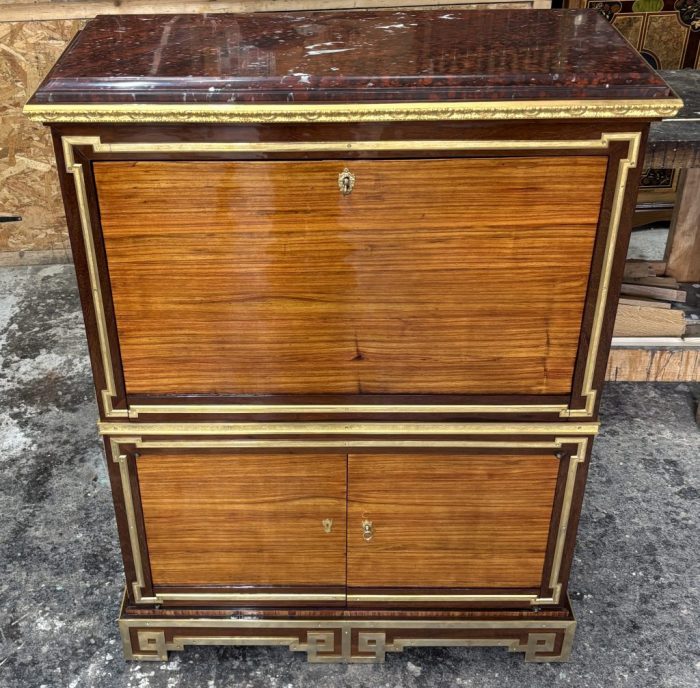
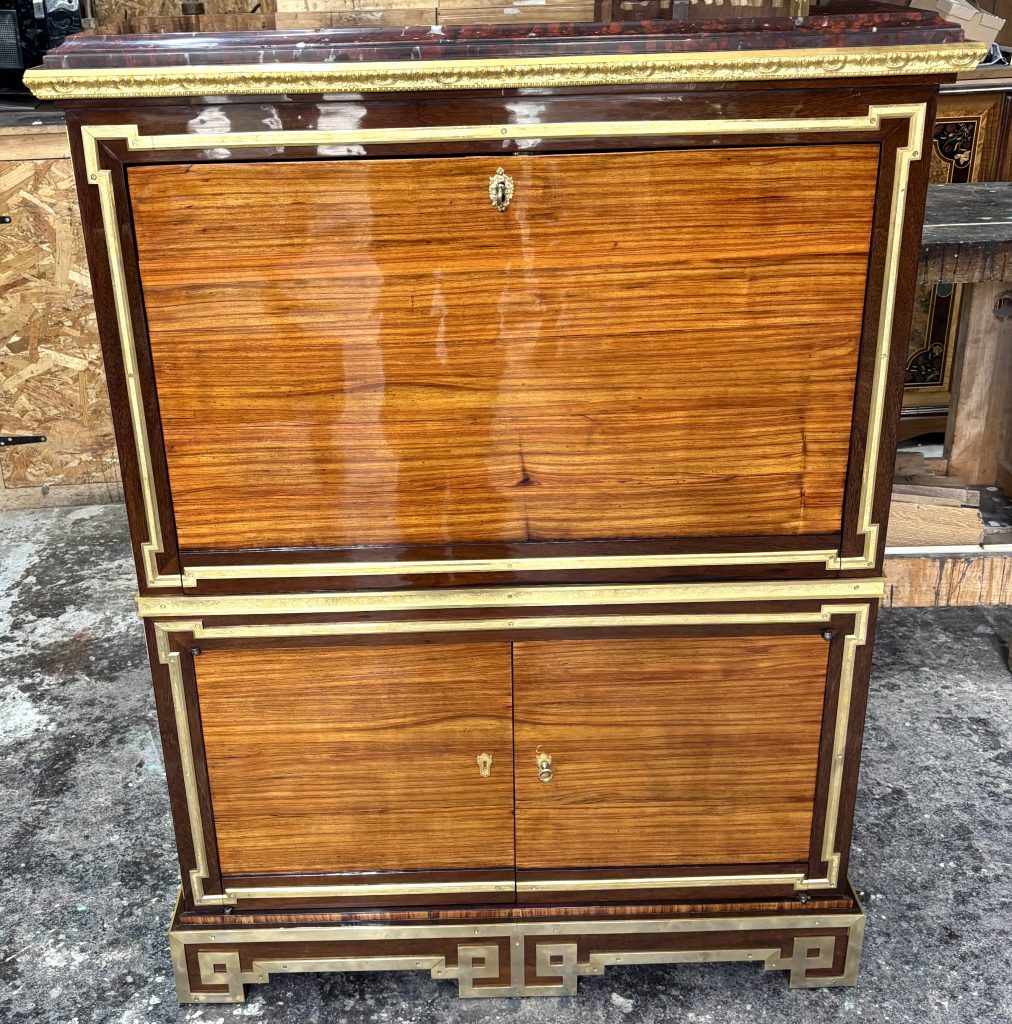
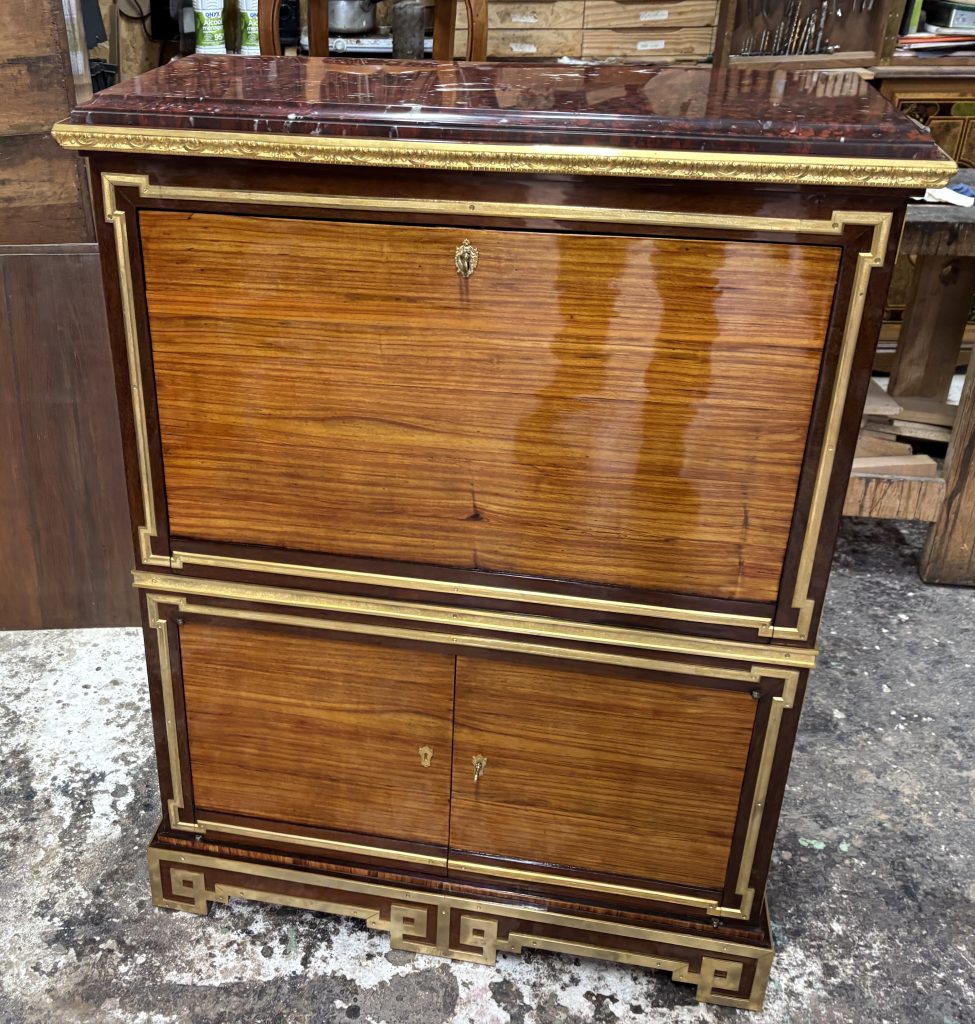
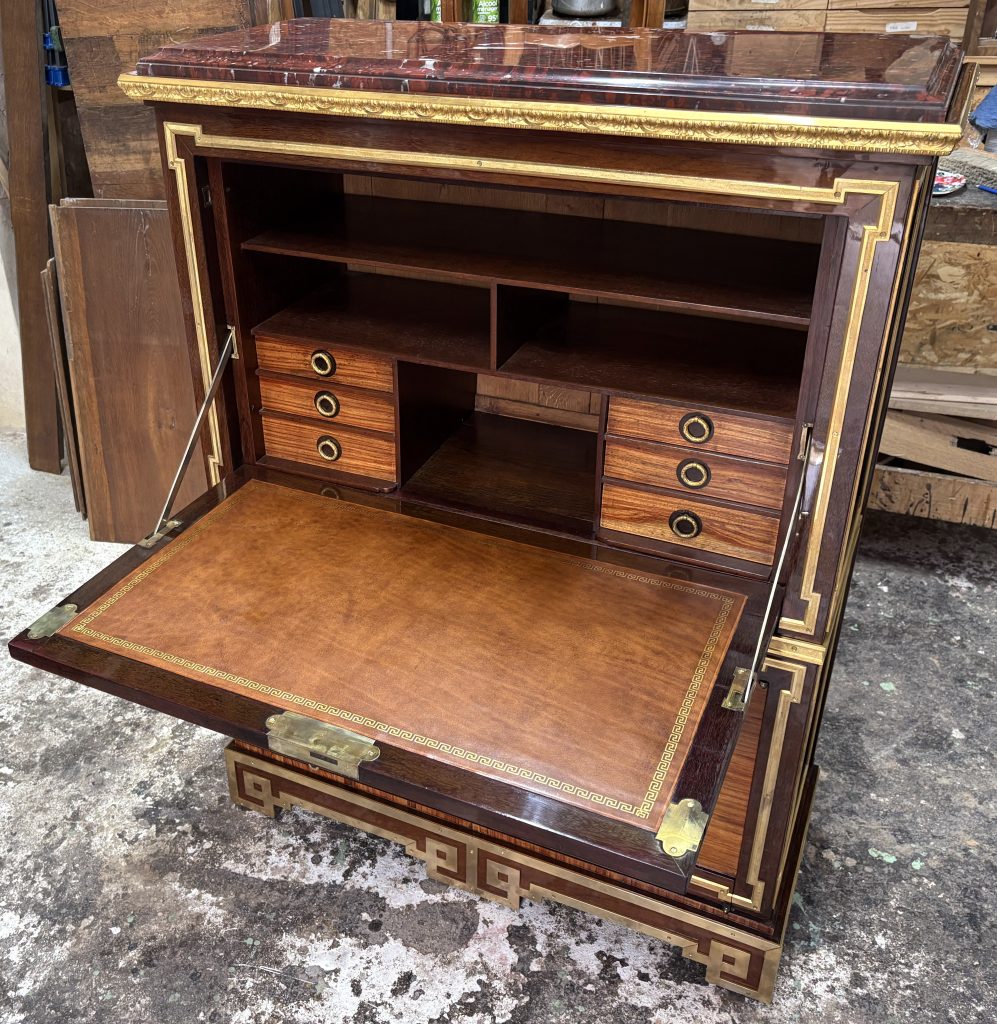
Restoration of a 19th-century Transition-style drop-front secretary, veneered in rosewood and amaranth on an oak frame. This secretary is a learned interpretation of Parisian models from 1765-1775 and is directly inspired by the famous secretary attributed to the cabinetmaker Philippe-Claude Montigny, now in the collection of the Musée de l'Art Moderne. Museum of Decorative Arts. The stylistic similarity to the museum model is immediately apparent in the architectural design of the furniture, in the treatment of the stepped base, and in the use of bronze ornamentation inspired by "Greek taste".
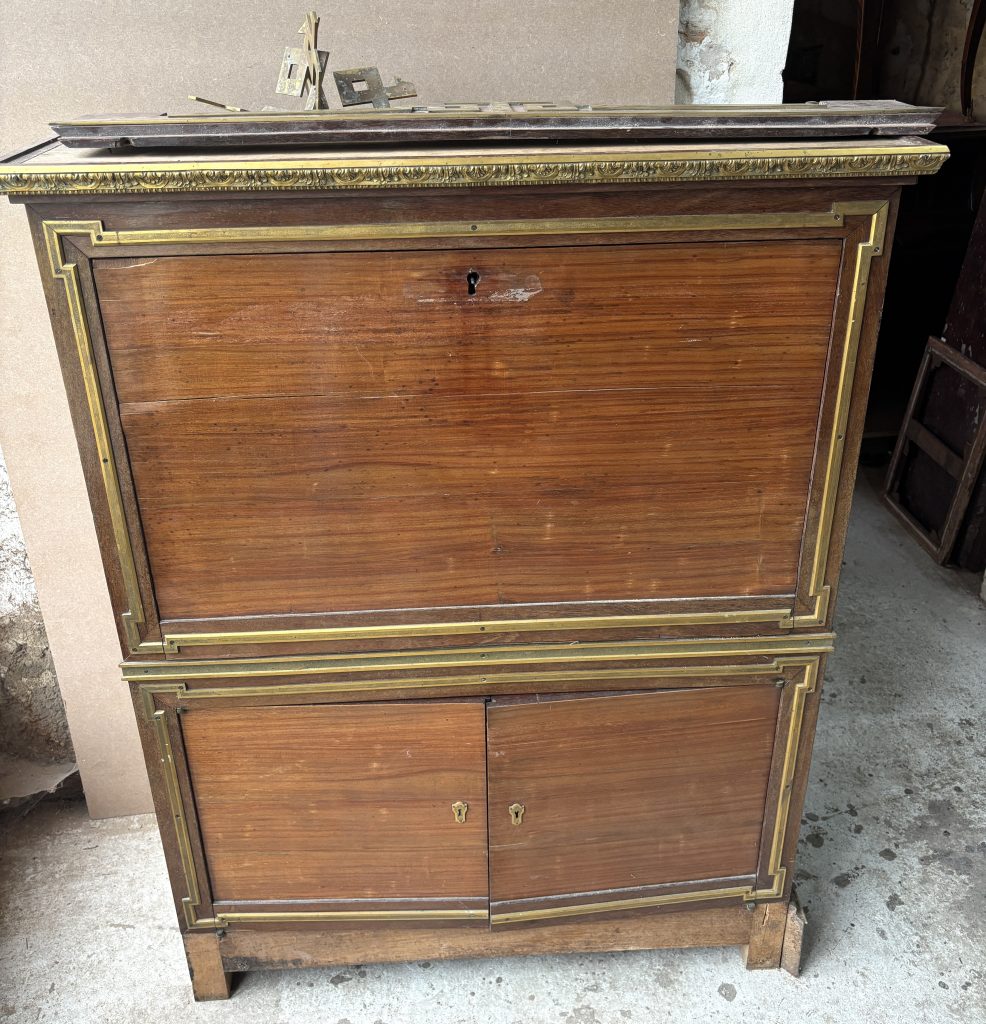
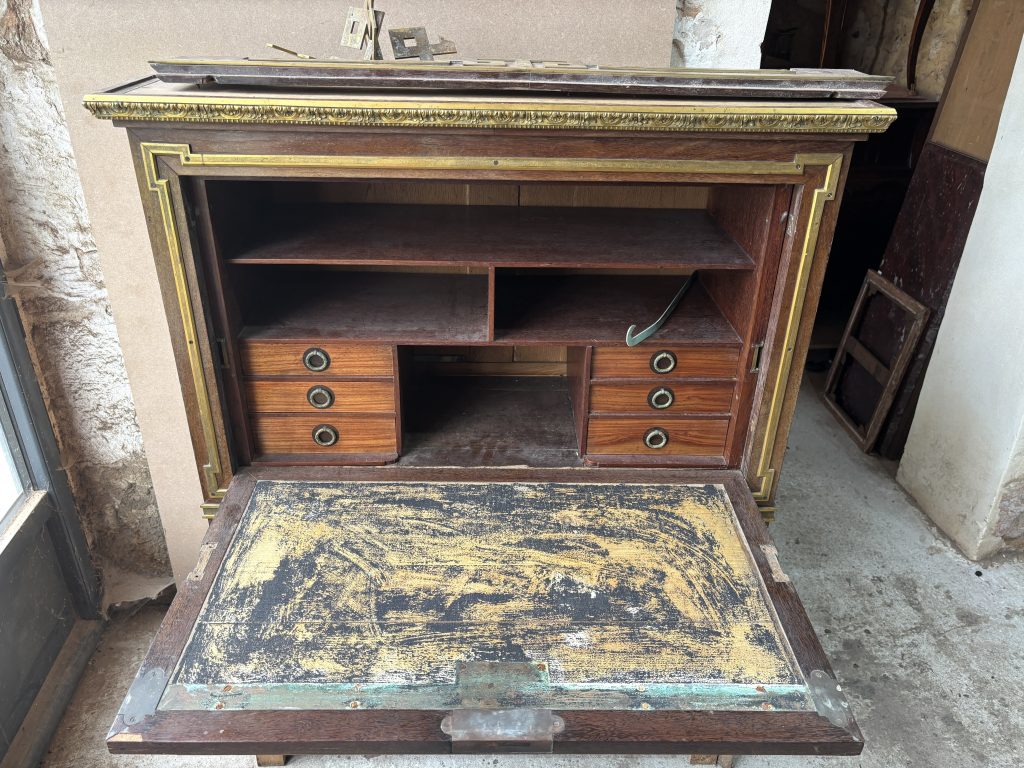
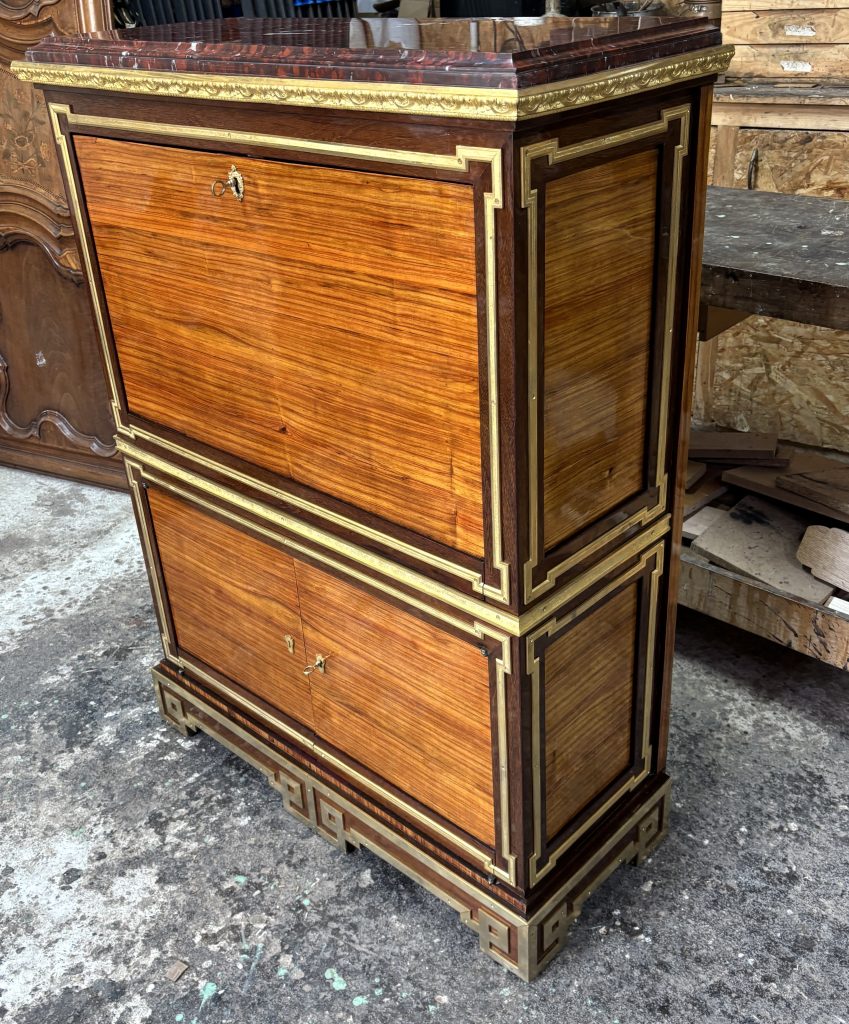
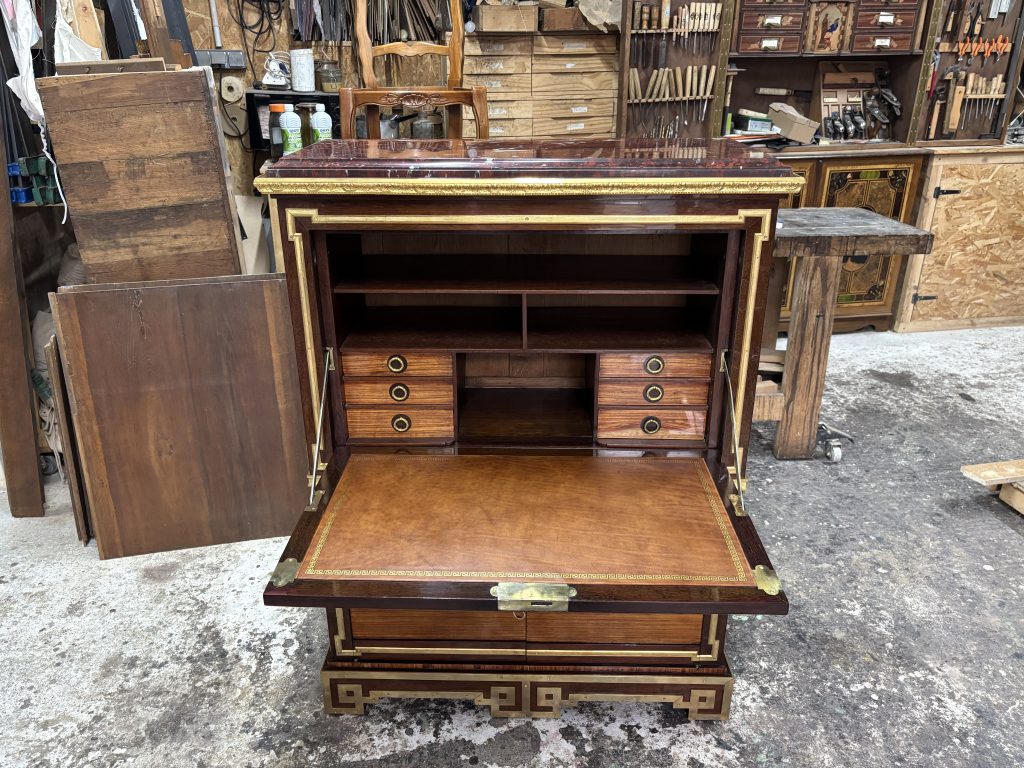
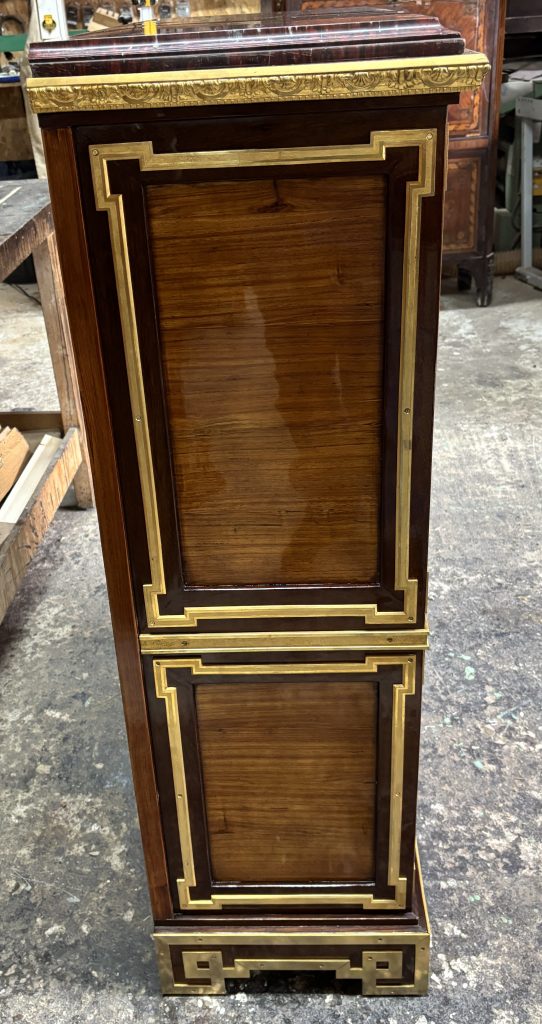
The piece of furniture adopts a rigorous rectangular structure, opening with a wide drop-front and two doors at the bottom. This perfectly symmetrical design illustrates the gradual abandonment of the flowing lines of the Louis XV rococo style in favor of a more geometric and monumental aesthetic characteristic of the Transition style. The 19th century then rediscovered with passion the great models of 18th-century Parisian cabinetmaking and produced furniture inspired by the creations of Montigny, Levasseur, and Garnier, particularly prized for their neoclassical vocabulary.
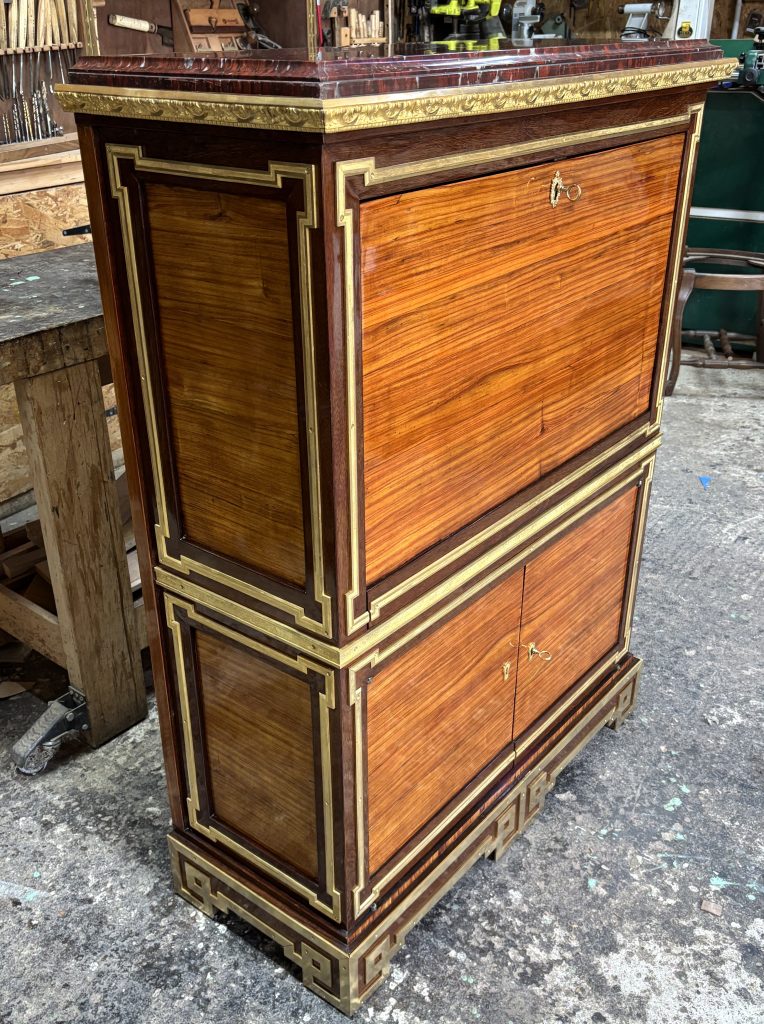
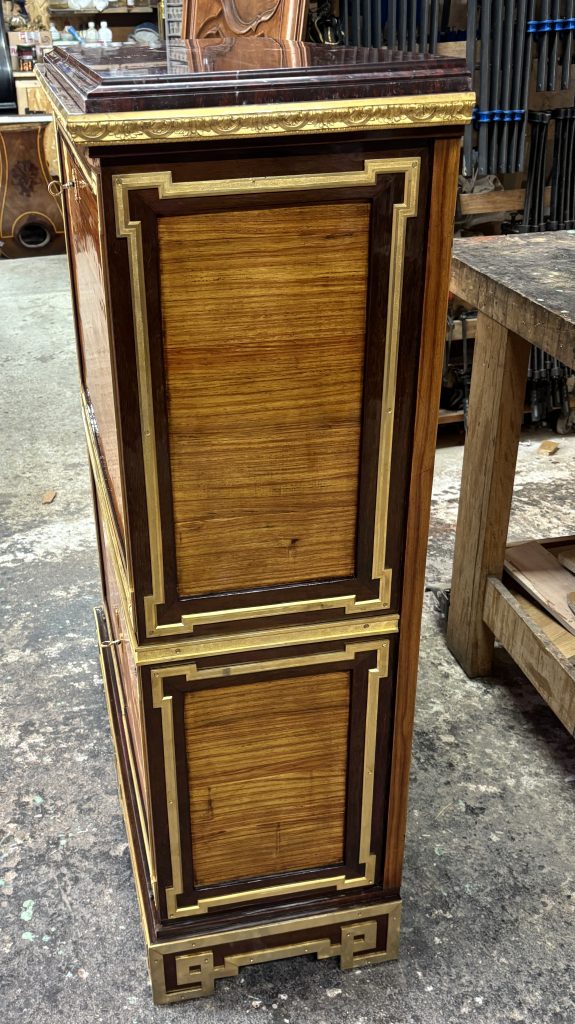
The veneer here features striking contrasts in warm rosewood tones, framed by amaranth and gilt bronze reserves that accentuate the architectural lines of the volumes. This composition of large framed panels corresponds precisely to the formal explorations of the "return to antiquity" developed in Paris from the mid-1760s. Cabinetmakers gradually abandoned the asymmetrical Rococo compositions in favor of flat surfaces, symmetry, and references to classical architecture.
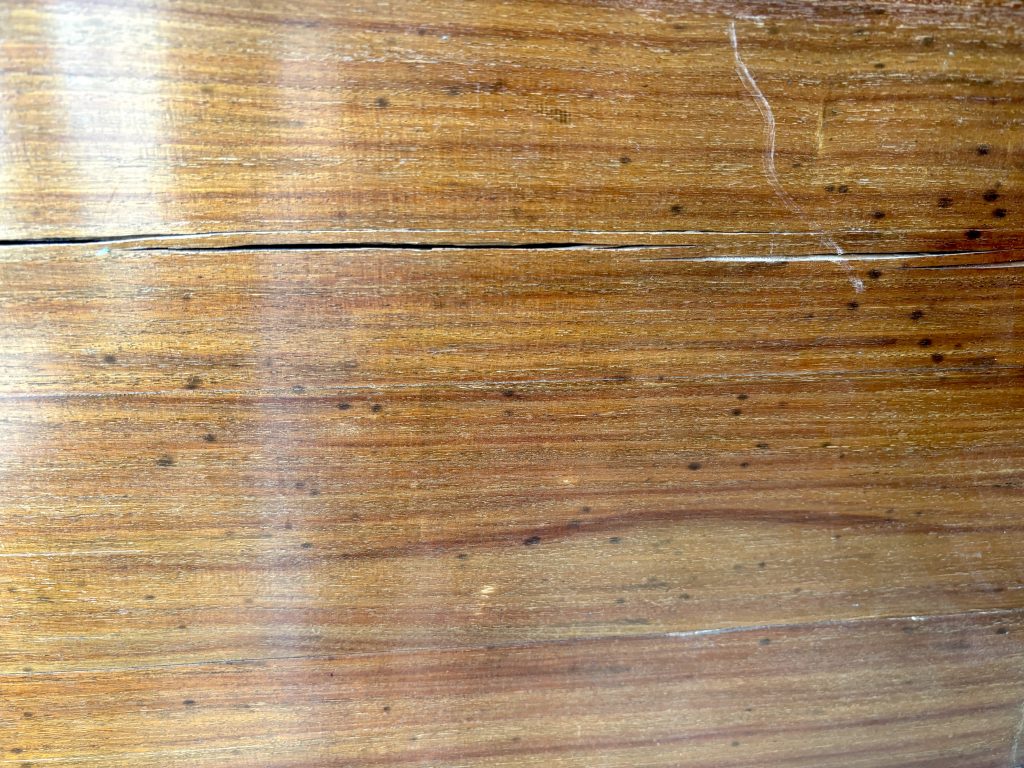
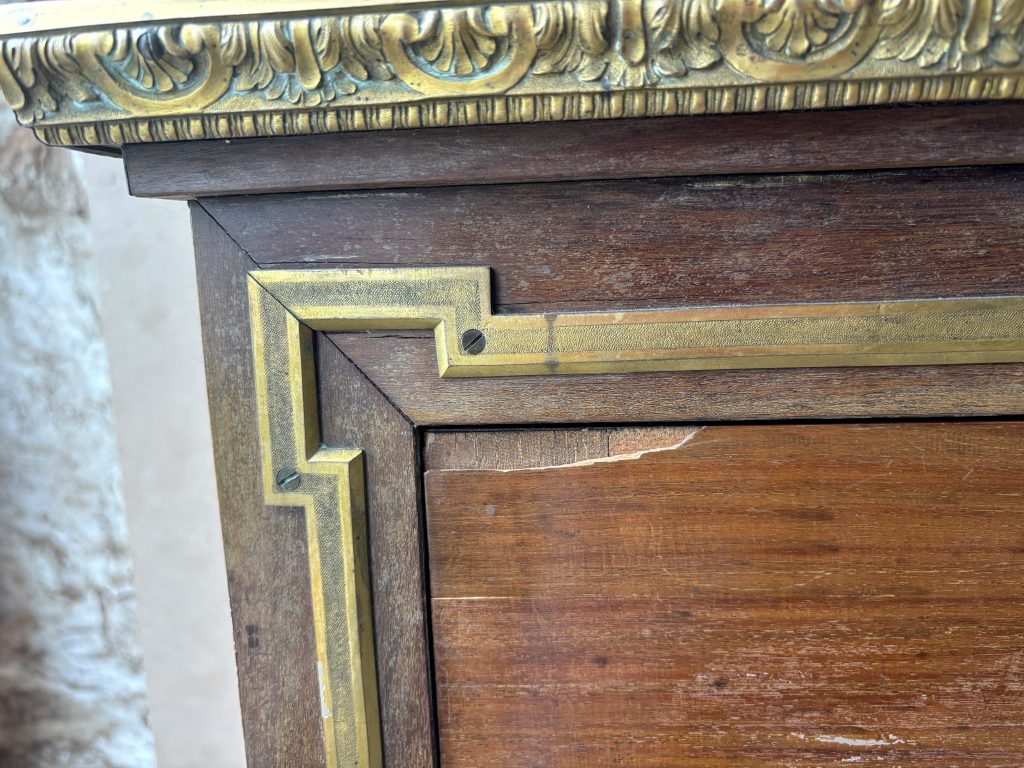
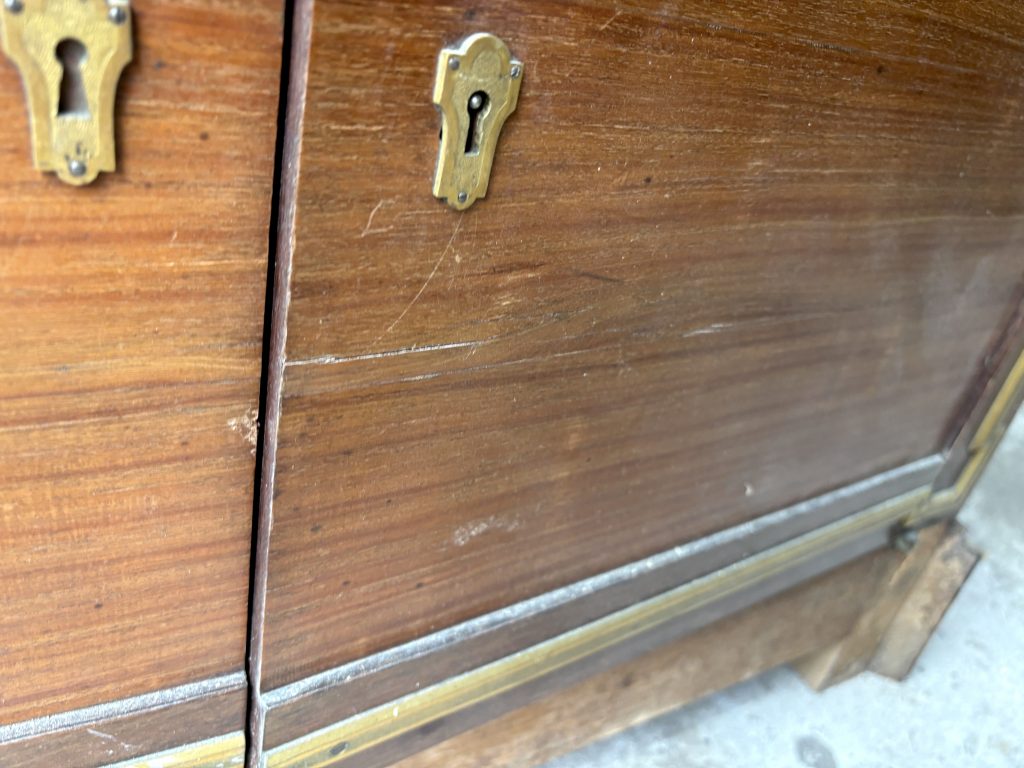
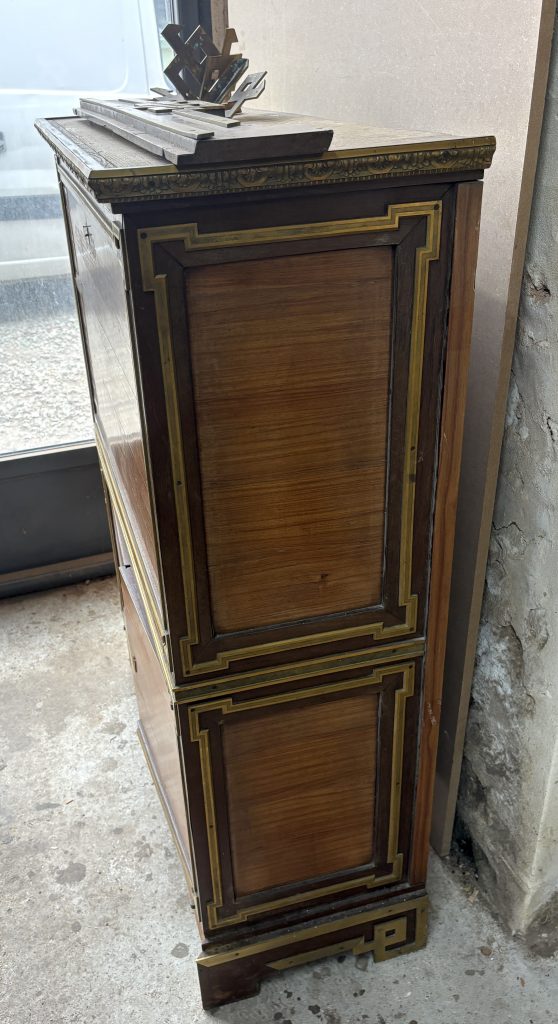
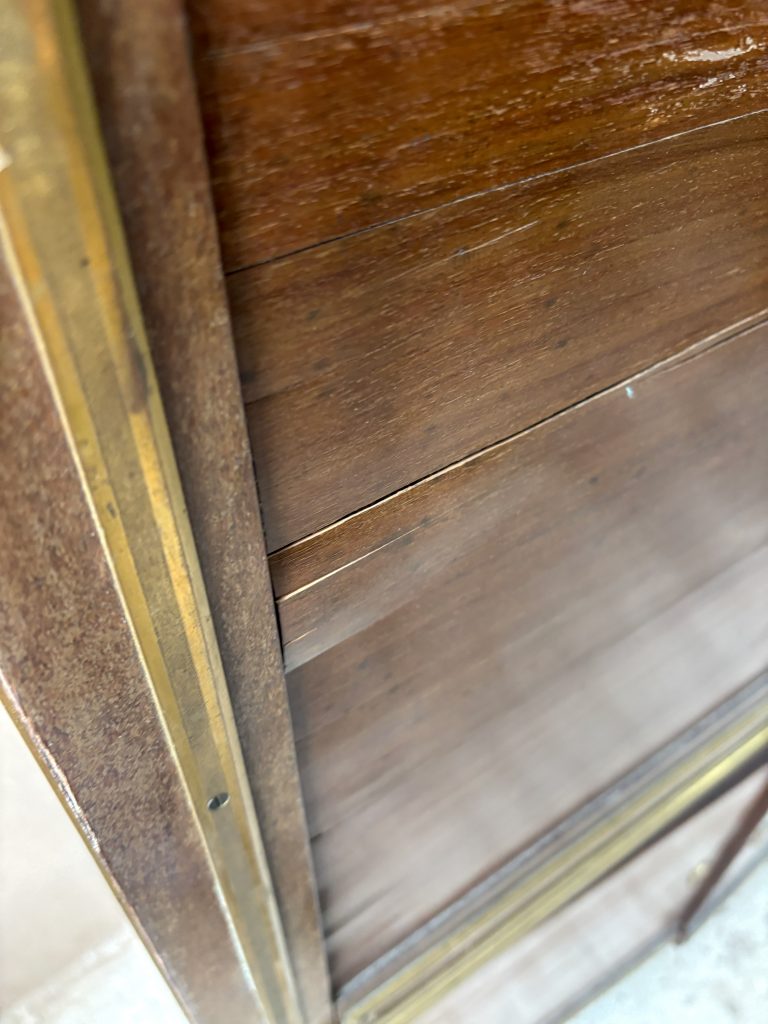
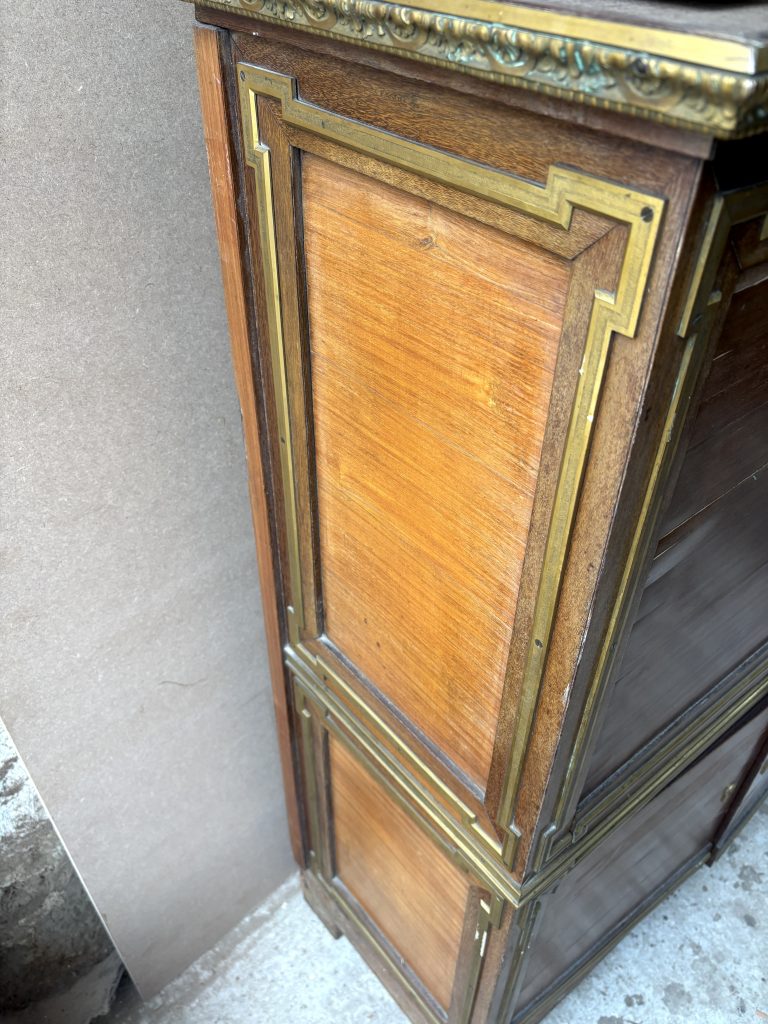
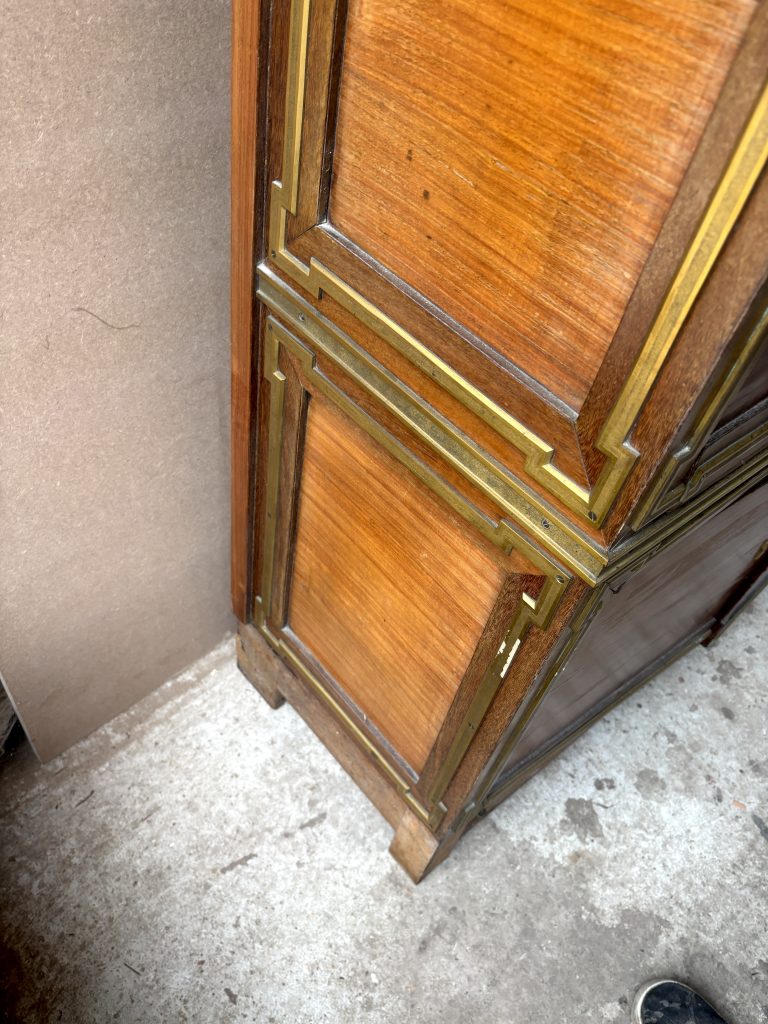
The influence of the secretary desk in the Musée des Arts Décoratifs in Paris is particularly evident in the treatment of the base and legs. The plinth, decorated with cut-out Greek key patterns, echoes the ornamental vocabulary characteristic of Montigny's creations: a massive base, punctuated by rectilinear setbacks and accented with geometric bronze mounts inspired by Louis XIV and Boulle models, which were revived during the reign of Louis XVI. This type of architecturally structured base is one of the hallmarks of workshops working in the Neoclassical Transition style.
The bronze ornamentation also fully contributes to this stylistic lineage. The applied rectilinear frames, the emphasized angles, and the Greek key patterns directly recall the bronzes described on the original Montigny secretary. Eighteenth-century models already reused forms inherited from André-Charles Boulle and Charles Cressent in a spirit of classical revival; this nineteenth-century reinterpretation precisely preserves this same historical reference.
The piece of furniture perfectly illustrates the so-called "Neoclassical Transition" aesthetic: a synthesis between the monumentality inherited from the Grand Siècle and the geometric purity inspired by Antiquity. Its strictly symmetrical design, the construction of the base, the prominence given to the bronze frames, and the decorative restraint of the veneered surfaces all testify to an explicit desire to emulate Parisian models from the years 1765-1770.
Philippe-Claude Montigny
Philippe-Claude Montigny
Philippe-Claude Montigny (1734–1800) was an 18th-century Parisian cabinetmaker, admitted as a master in 1766, who was active in the production of luxury furniture during the reign of Louis XVI. Based in Paris, he worked primarily in the Faubourg Saint-Antoine district and was part of the professional networks of cabinetmakers and merchants. His known work consists of prestigious furniture, notably commodes, desks, and secretaries, crafted from precious wood veneers (rosewood, amaranth, ebony) and embellished with gilt bronze mounts. His production reflects a neoclassical stylistic orientation, with references to the "Greek" style and the Boulle tradition, characterized by the use of contrasting materials and structured decorative compositions. He thus contributed to the dissemination of the forms and ornamentation characteristic of Parisian furniture from the late Ancien Régime, intended for an aristocratic and institutional clientele. He died in Paris in 1800.
BIBLIOGRAPHY
- French Furniture of the 18th Century – Pierre Kjellberg – Les Editions de l'Amateur – 1989
- The workshops Parisian cabinetmakers and joiners in the 17th and 18th centuries – Guillaume Janneau – Serg Editions – 1975
- French Cabinetmakers from Louis XIV to the Revolution – Editions du Chêne – 1989 – Alexandre Pradere
It's magnificent, well done!