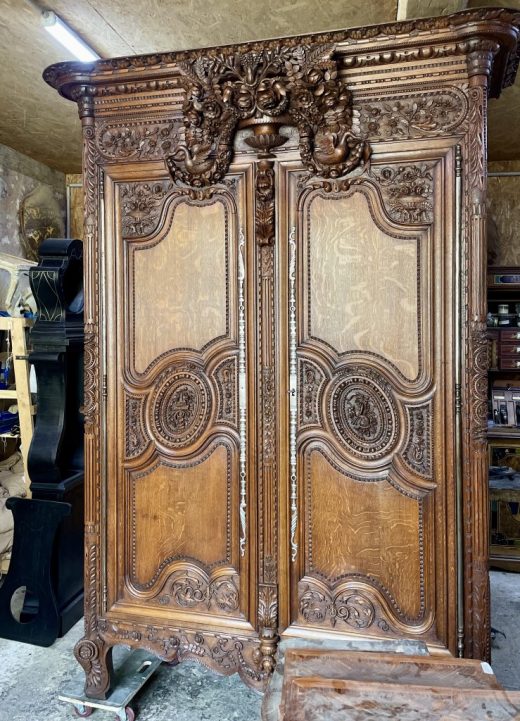
Wedding wardrobe from Bayeux with swans
Ebénisterie Mathieu Vath

A lightening of the finish was carried out on a Bayeux wedding armoire, distinguished by its motifs of swans, figures, and hunting and musical attributes. The piece is made of quarter-sawn oak, also known as "merrain," and is attributed to the Caen plain, dating from the first half of the 19th century. The restoration work consisted of lightening the waxed finish to remove the multiple layers of tinted wax that darkened the entire piece. This process revealed the beautiful honey-blond hue of the oak […]
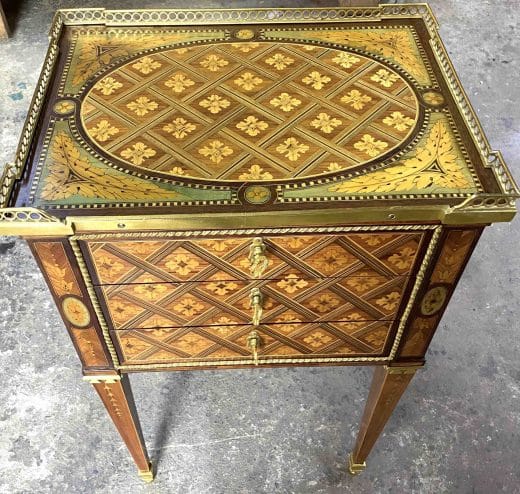
Writing table stamped JF LELEU

Ebénisterie Mathieu Vath

Restoration of a Louis XVI writing table stamped by Jean François Leleu. It is entirely constructed of oak and veneered on all sides with gray-stained maple latticework inlaid with amaranth, boxwood, ebonized wood, and boxwood finials on a rosewood ground. The four legs are adorned with an acanthus leaf medallion on a green-stained sycamore ground. Bell-shaped finials embellish the top and bottom of the finial as well as the tops of the legs. On the writing surface, the latticework is concentrated in […]

Louis XVI commode

Ebénisterie Mathieu Vath

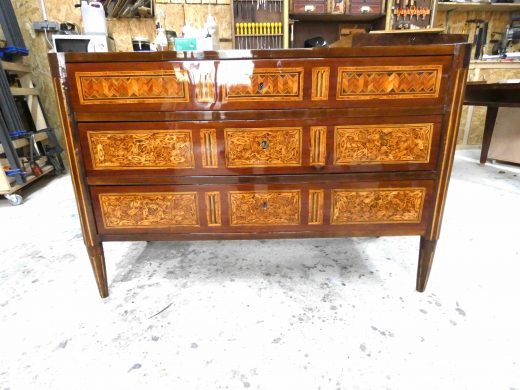
Restoration of a Louis XVI period commode from eastern France, made of solid oak and fir and veneered with end-grain laburnum, walnut, plum, amaranth, rosewood, palisander, boxwood, and green-stained hornbeam. The handles and keyholes were added at a later date. The original fittings are missing; only the holes for the handles remain. This is a piece of furniture that has never been restored. The veneer is almost 4 mm thick in some places, and […]

Hedouin commode with crowned C

Ebénisterie Mathieu VATH

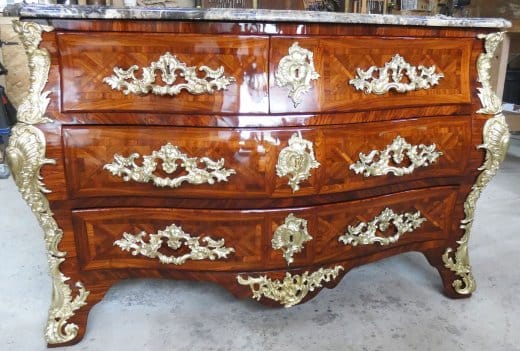
Extensive restoration of this superb Louis XV period commode, stamped on all four uprights by Jean-Baptiste Hedouin. The frame and drawers are constructed of solid oak, fir, and walnut. The edges of the frieze and geometric marquetry in violet wood are veneered with satinwood. Two types of violet wood are visible: one with a very tight grain and veining for the lozenges, and a second, more intricate type for the marquetry edges, uprights, and rails. The […]

Louis XVI commode stamped JA BRUNS

Ebénisterie Mathieu VATH

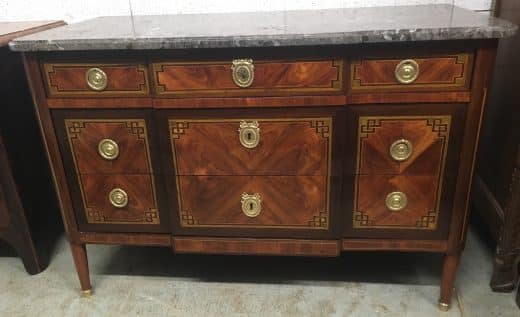
This week marks the completion of the restoration of a Louis XVI commode stamped JA BRUNS. It is made of oak for all the structural elements, except for the side panels, drawer backs, drawer fronts, and the two drawer bottoms, which are made of softwood. It is veneered with rosewood in a butterfly pattern and amaranth for the edges. The false fluting is made of boxwood and ebony, and there is a green-stained maple stringing forming the corners at […]

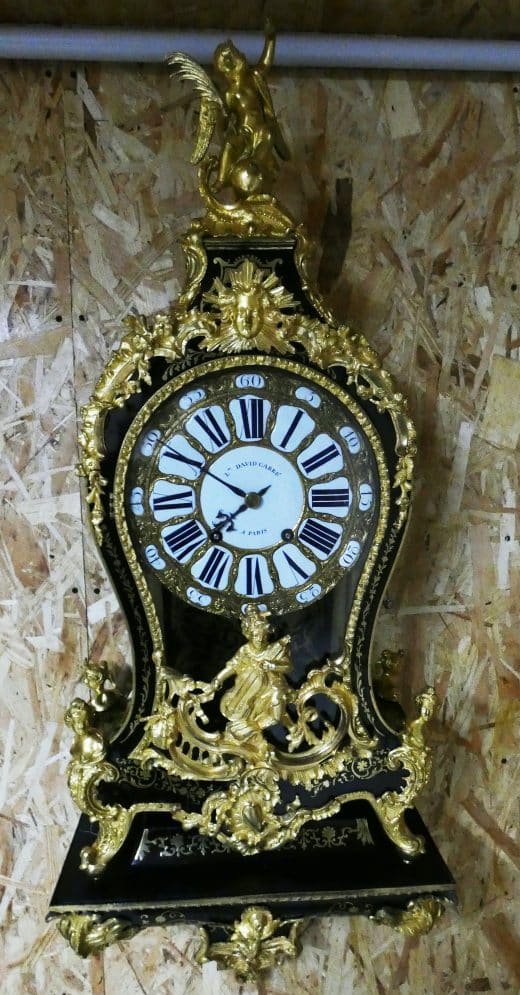
Label signed "Louis David Carré in Paris"«

Ebénisterie Mathieu VATH

After several weeks of work, the restoration of this clock is finally complete. It is a Louis XV period clock in brown tortoiseshell and brass marquetry, with rosewood restorations. The dial is by Louis David Carré, nephew of Jullien le Roy, who became a master craftsman on December 31, 1748. Lodged at the Louvre from 1744, he was elected a juror in 1775. The greatest treasure of this clock lies in its bronze mounts. They are truly magnificent, and above all, they are in very good condition. There is only […]

Louis XV slant-front desk

Ebénisterie Mathieu VATH

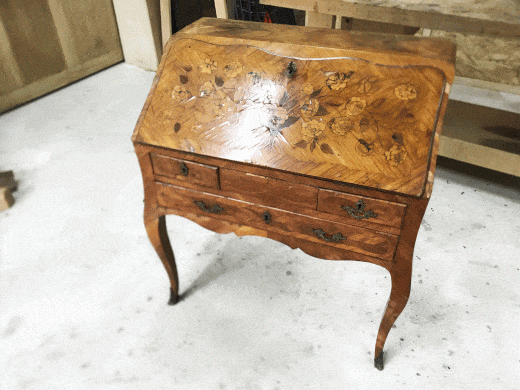
The restoration of a lovely slant-front desk, or as Riesener calls it in his memoirs, a "tomb-shaped secretary," began two weeks ago. With the restoration phase complete and the varnishing underway, I'm taking a moment to provide a brief summary of the project. The desk's frame is made of oak and fir, veneered with rosewood and violet wood, and the drop-front features floral marquetry of boxwood, natural and stained maple, and hornbeam. It includes a large drawer […]

Louis XV corner cabinet, stamped JM CHEVALLIER

Ebénisterie Mathieu VATH

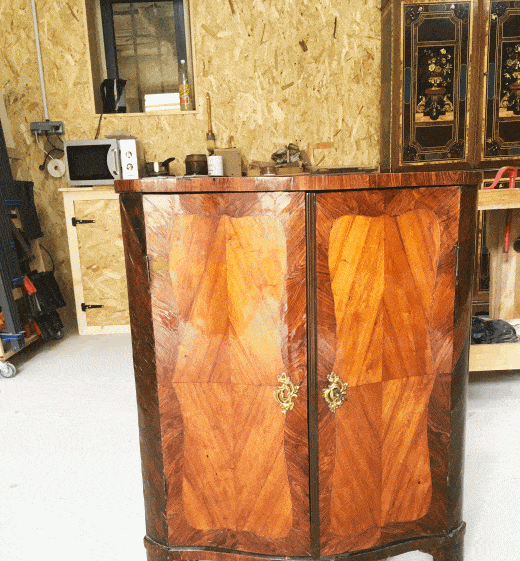
Here is a corner cabinet stamped by Jean-Mathieu Chevallier. It is made of solid oak and veneered with rosewood and violet wood with a boxwood inlay. Jean-Mathieu Chevallier was already established on the rue de Grenelle under the sign "à la Croix Chevallier" when he obtained his master craftsman's certificate in 1743. He subsequently expanded his business considerably, had business dealings with André-Charles Boulle, one of the sons of the famous cabinetmaker, and contributed to furnishing the Hôtel du Duc de Talmont, as well as the Château de Villegénis, which he had purchased […]