Restaurant Secretary

Ebénisterie Mathieu Vath

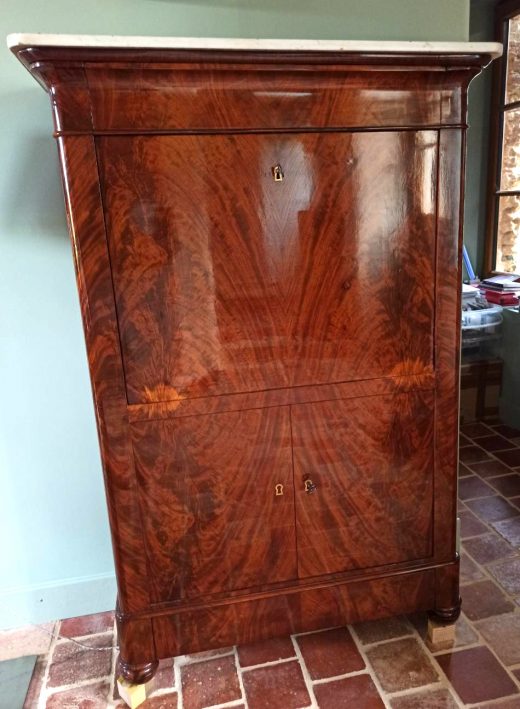
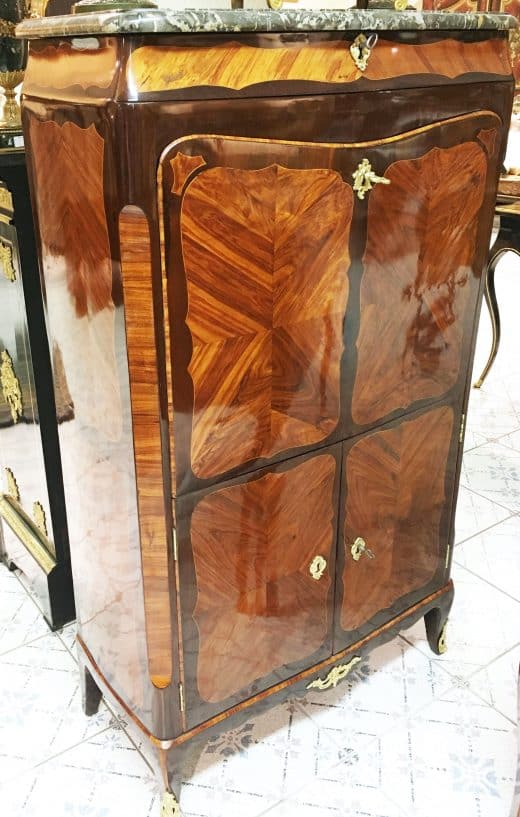
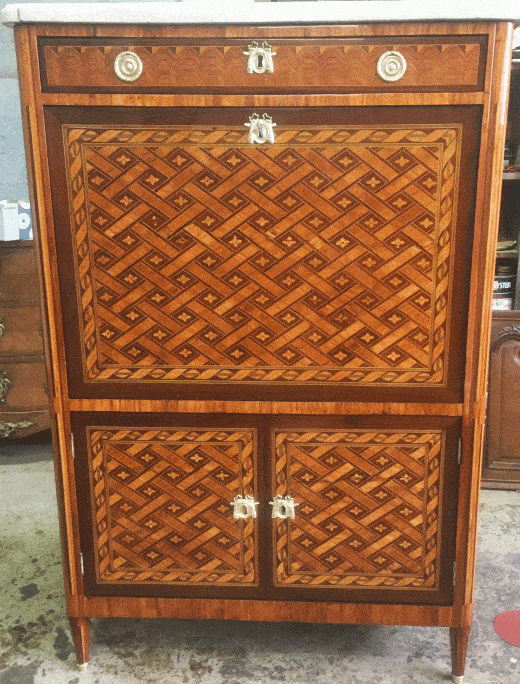
Restoration of a Restoration period (1815–1830) drop-front secretary veneered in burr mahogany and topped with Carrara white marble. The front legs are rounded and the rear legs are square. The frame is made of oak and softwood. An inventory mark (I91) is found inside the lower drawer on the right side. The Restoration style? After Napoleon's defeat at Waterloo on June 18, 1815, power in France was taken over by the two brothers of Louis XVI: the Count of Provence, who would reign under the […]
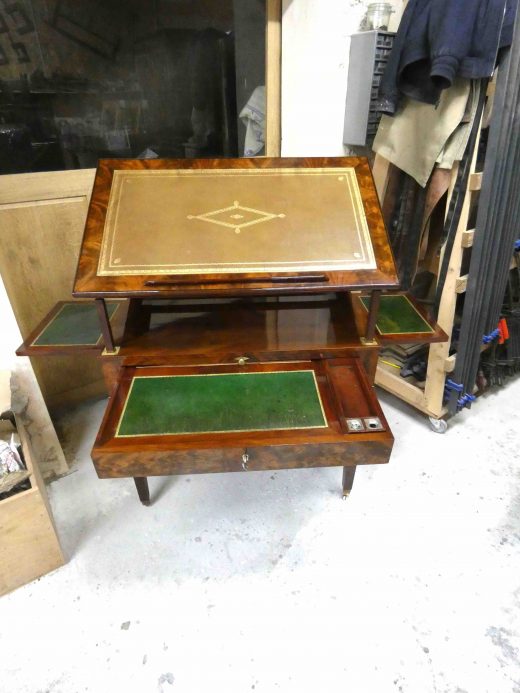
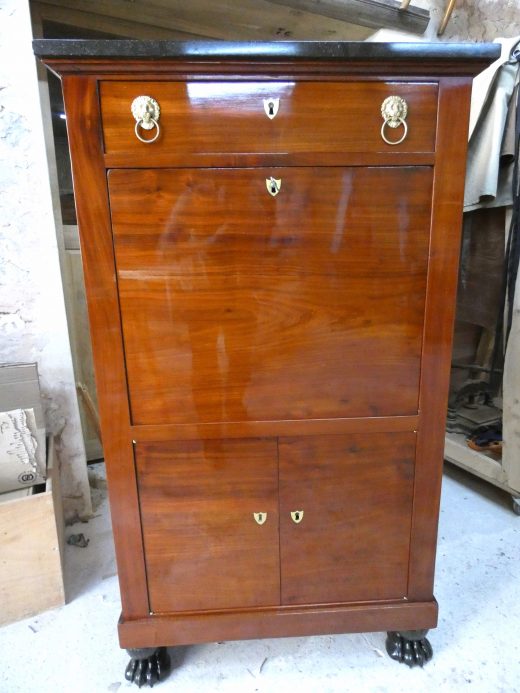
Table à la Tronchin

Ebénisterie Mathieu Vath

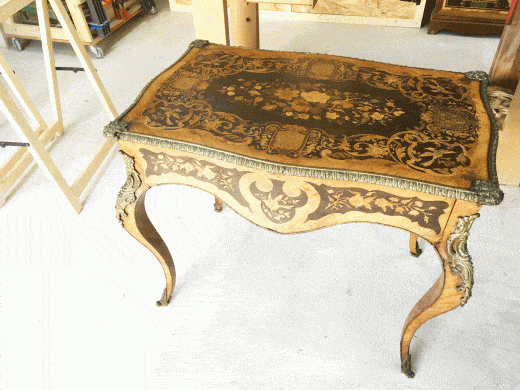
A little refresh for this lovely Tronchin-style table. Apart from a missing molding and a few small veneer chips on the legs, nothing too serious. A touch-up of the varnish was enough to give it a new lease on life. But do you know where this type of table comes from, and what it was used for? Although today attributed to Théodore Tronchin, a Genevan physician (1709-1781), who at the time published works on bone diseases linked to poor posture at one's desk, he cites the advantages that […]

Secretary of the Board of Directors

Ebénisterie Mathieu VATH

Here is a secretary desk in the most understated style of the Directoire period. Its frame is made of solid beech and conifer, and it is veneered with mahogany and mottled mahogany. It is very simply adorned with bronze handles in the form of a lion's head holding a ring in its mouth. The keyhole escutcheons are in the shape of a shield. The interior comprises seven drawers, the middle one of which opens with a key. The drop-front opens with a period three-point lock. The lower section consists of three drawers, or has been transferred […]

Empire Pedestal

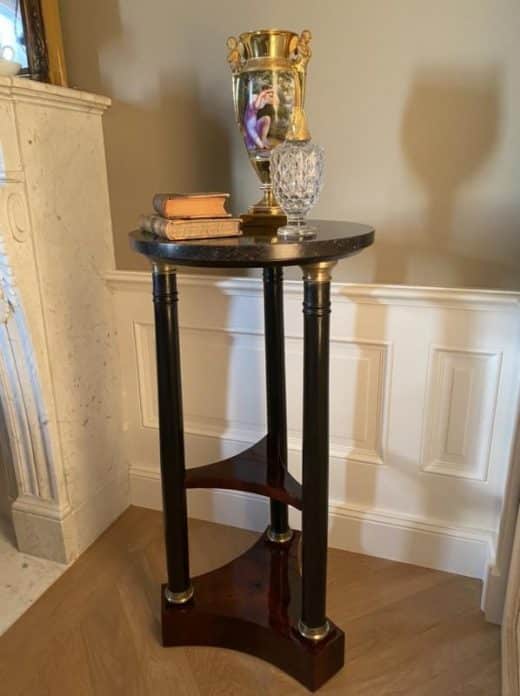
Restoration of a walnut (for the legs and frame) and flame mahogany veneer pedestal table. It rests on three column-shaped uprights, surmounted by a circular black veined marble top adorned with bronze rings. The restoration involved tightening the cracked base, re-gluing the edge veneers, and adding some veneer grafts. The columns, which were heavily infested with wood-boring insects, were stripped and then treated with static anoxia. Static anoxia is an insecticidal treatment that works by depriving the body of oxygen, having […]

Regency commode stamped J.BIRCKLE

Ebénisterie Mathieu VATH

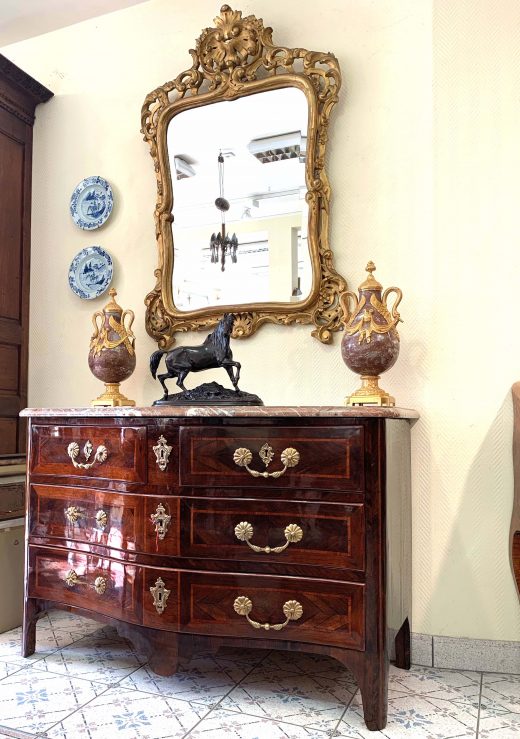
Restoration of a chest of drawers veneered in Rio rosewood and satinwood stringing. It has two large drawers and two small ones in the upper section. Its frame is made of oak and fir. It is stamped J.BIRKLE on the left upright and also bears the mark JME. It shows some signs of restoration and an ink mark on one side of a drawer. Jacques Bircklé (1734-1803) – Cabinetmaker – master craftsman obtained on July 30, 1764. One of the suppliers to the Royal Furniture Repository under Louis XVI. Freelance craftsman before […]

Empire Chest of Drawers with Quivers

Ebénisterie Mathieu VATH

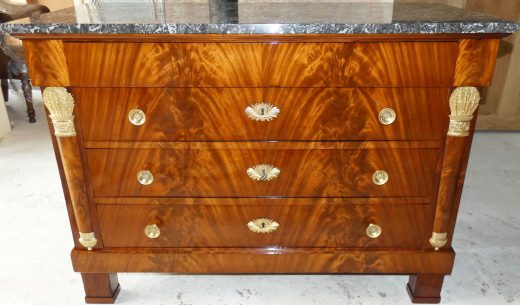
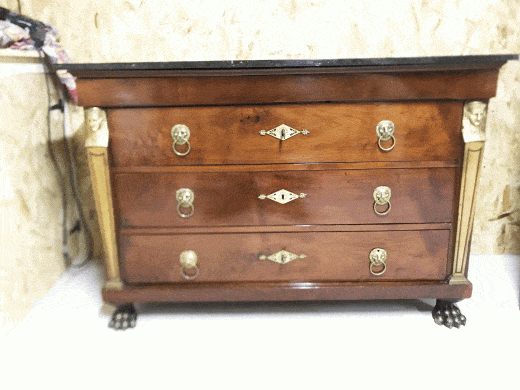
This week, here are some photos of the restoration of this Empire-style chest of drawers veneered in mahogany burl. This chest is truly unique due to the quality and originality of its bronze mounts. Indeed, they form quivers along with the side columns. The keyhole escutcheons are composed of two crossed laurel branches held together by a ribbon. Originally, they were mercury-gilded, as can be seen from the gilding stains on the back. Unfortunately, only a few partial traces remain on the front […]

Napoleon III wall shelf

Ebénisterie Mathieu VATH

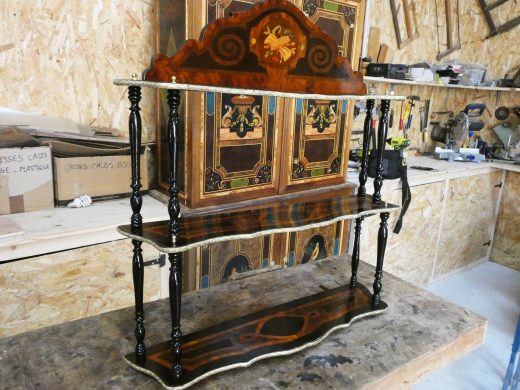
Restoration of a Napoleon III period wall shelf veneered in blackened pearwood, rosewood, amaranth, amboyna burl, and marquetry with a music theme. Underneath the dust, aside from small losses in the blackened pearwood and rosewood, and slight dehydration, there was nothing too serious. A few veneer grafts, a vacuum-sealed glue application, a thorough cleaning, a coat of clear French polish, and voilà! All this without using sandpaper. Except for lightly sanding the varnish […]

Hedouin commode with crowned C

Ebénisterie Mathieu VATH

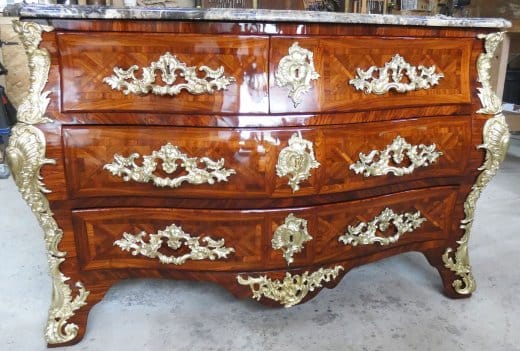
Extensive restoration of this superb Louis XV period commode, stamped on all four uprights by Jean-Baptiste Hedouin. The frame and drawers are constructed of solid oak, fir, and walnut. The edges of the frieze and geometric marquetry in violet wood are veneered with satinwood. Two types of violet wood are visible: one with a very tight grain and veining for the lozenges, and a second, more intricate type for the marquetry edges, uprights, and rails. The […]

Napoleon III liquor cabinet

Ebénisterie Mathieu VATH

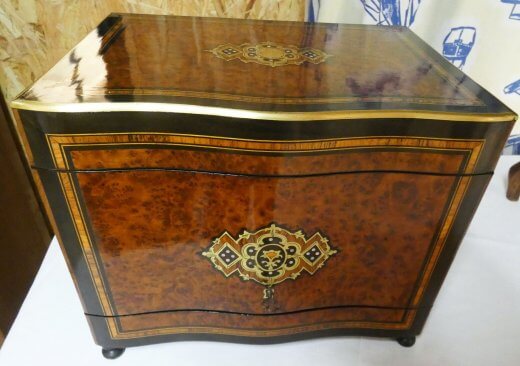
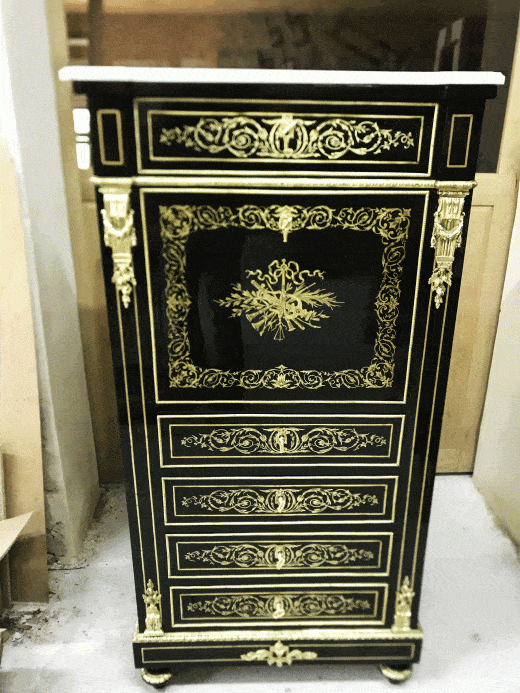
It would seem that the first liquor cellars appeared at the very end of the 18th century. But it was in the 19th century that the fashion for liquor cellars truly took off. The revolution transformed social classes and ways of socializing, leading to increased consumption of liquor, which contributed to the rise of this new social object. The emergence of liquor cellars is, of course, directly linked to the evolution of alcohol consumption in France, such as sweet Mediterranean wines, brandies, cognac, liqueurs, and more.

Louis XVI style desk stamped KRIEGER

Ebénisterie Mathieu VATH

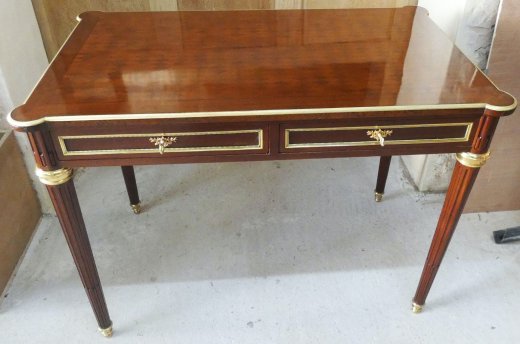
Exquisitely crafted with its mahogany-veneered oak frame and solid mahogany legs, this desk is a perfect example of high-quality 19th-century furniture. The cabinetmaking is flawlessly executed, and the bronze mounts are in pristine condition. Everything is there; nothing is missing. The Krieger firm began its cabinetmaking business in the mid-19th century with Antoine Krieger (1804-1869) before adding a significant decorative department, which ensured the prestige of its business until around 1945. The Krieger firm produced all the […]
Transitional dresser

Ebénisterie Mathieu VATH

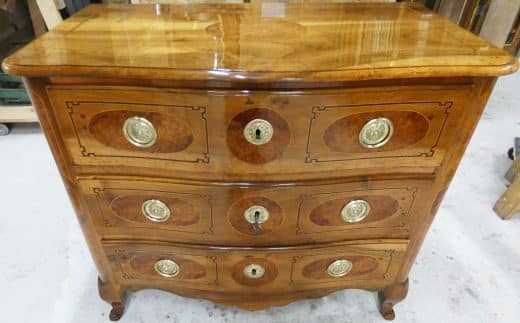
Here is a very simple chest of drawers from eastern France, probably dating from the late 18th century. The front is slightly curved and the uprights are chamfered. It should be noted that the bronze mounts are probably not original. The frame is made of solid softwood, and the uprights are oak. The drawer bottoms are set in rebates and slide on the drawer fronts, which is typical of provincial work. A small peculiarity: this chest of drawers does not have top panels, the […]

Napoleon III style Louis XVI work table

Ebénisterie Mathieu VATH

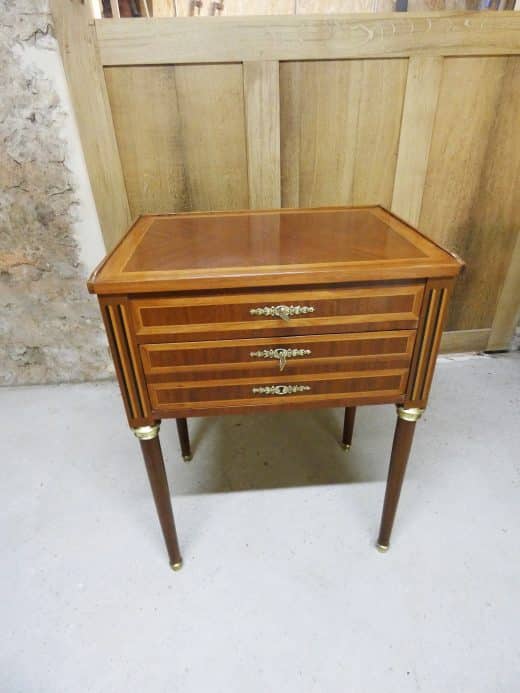
A few photos of the restoration of a small Louis XVI style work table from the late 19th century. The legs are solid mahogany, and it is veneered with rosewood, sapele, blackened pearwood, and boxwood for the fluting and stringing. Nothing too serious for this pretty little piece of furniture, which only had a few missing veneers and a small chip on the side of the oak drawer. A simple restoration: a few veneer grafts glued with hot glue, a light cleaning of […]

Chest of drawers in the style of the Axe

Ebénisterie Mathieu VATH

Here are some photos of the restoration of a solid walnut commode, veneered with thuya burl inlay and Greek key stringing in amaranth and boxwood. The drawers and the interior and back panels are made of fir. Despite the curved stretcher, its shape, and its feet, this commode is indeed in the transitional style but from the Louis XVI period. In the title, I wrote "in the style of the Hache family" because it is certain that this commode originated in the Dauphiné region. But whether it is a product of the famous […]

Secretary stamped P.ROUSSEL JME

Ebénisterie Matheu VATH

Here are some images of the restoration of a secretary desk stamped by Pierre Roussel (1723-1782). Having become a Master Cabinetmaker in 1745, Pierre Roussel set up shop on Rue de Charonne, in the Faubourg Saint-Antoine, under the sign "L'Image de Saint Pierre" (The Image of Saint Peter). Thanks to his skills as a cabinetmaker and especially as an exceptional marquetry artist, he quickly gained a great reputation. In 1762, he became a sworn member of his guild. By 1767, he was considered one of the best cabinetmakers of his time. Highly regarded by his colleagues, he became a representative of the cabinetmakers' guild in 1777 and then syndic two […]

Mazarine Chest of Drawers

Ebénisterie Mathieu VATH

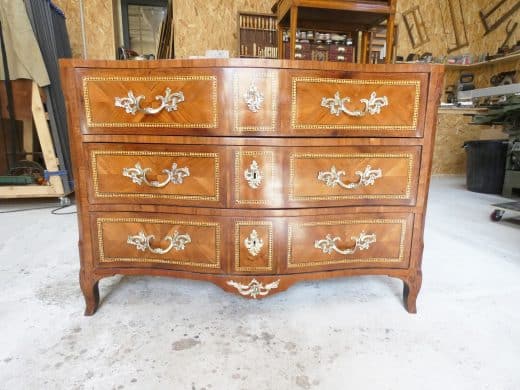
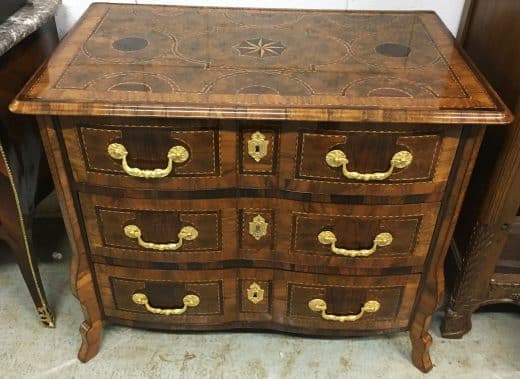
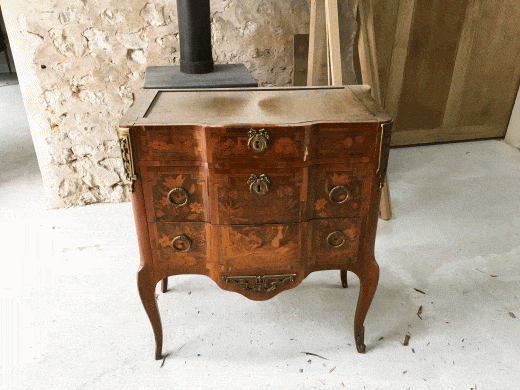
Here is a charming Mazarine commode from the Louis XIV period. With a serpentine front and three drawers in three rows, it is topped with a marquetry top featuring a compass rose on an end-grain wood background. Constructed on a fir frame, it is covered with a beautiful olive veneer, with both end-grain and grain-grained veneer, rosewood, ash on the sides, and boxwood for the stringing and compass rose. The crossbeams are joined with straight dovetail joints on the sides, which has caused some minor imperfections.

Louis XVI style sewing box

Ebénisterie Mathieu VATH

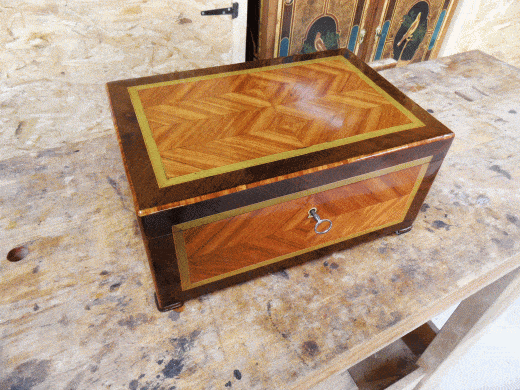
This sewing box dates from the Napoleon III period. The frame is made of softwood. The veneer is composed of Rio rosewood, mahogany for the interior, and a green-stained boxwood and maple inlay. The great quality of this box is that the lid hasn't warped. This is often the major problem with this type of furniture, as people forget to lock them, causing the wood to warp. It then becomes very difficult to find the "trick" to ensure the box stays closed.

Louis XVI style table

Ebénisterie Mathieu VATH

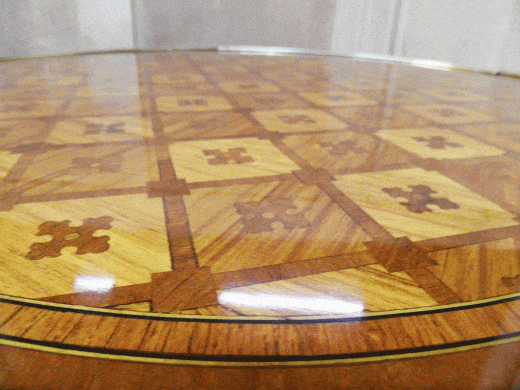
Here is a Louis XVI style table, which is probably an early 20th-century piece. It was likely made in the Faubourg Saint-Antoine, or perhaps at the École Boulle. I have seen apprentice furniture of this quality made by students during their training. Its frame is oak, while the veneer is rosewood and mahogany with a black inlay. The restoration was straightforward, apart from a lack of rosewood in the marquetry […]

Empire bed

Ebénisterie Mathieu VATH

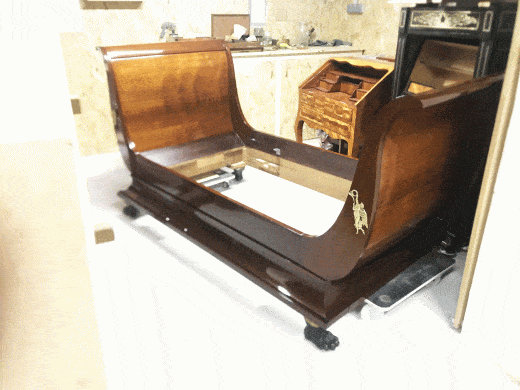
The "boat" bed, with its characteristic curve, is a French invention that appeared during the Directory and was very fashionable during the Empire and the Restoration. It is easily recognizable here by its lion's paw feet. The varnish on this bed had worn away, making it impossible to distinguish between the two mahogany pieces. The mahogany is known as Cuban mahogany (Swietenia mahogani), from Cuba, a Spanish colony. Evidence of its importation into Spain, specifically Seville, dates back to 1519-1520. It was used by Philip II between 1563 and 1584 during the construction of the Palace […]

Secretary Napoleon III

Ebénisterie Mathieu VATH

On the restoration side, there wasn't much to do: the brass fittings were reattached with fish glue and by infiltration, then stripped and varnished. The most difficult part of this type of furniture is the black stain. Over time, pear wood darkens, loses its color, and turns gray. It then needs to be stained, without, of course, obscuring the brass. To do this, I fill and polish the piece until the brass becomes a true mirror. Then, I apply a hot logwood stain, and then […]

Louis XV slant-front desk (After restoration)

Ebénisterie Mathieu VATH

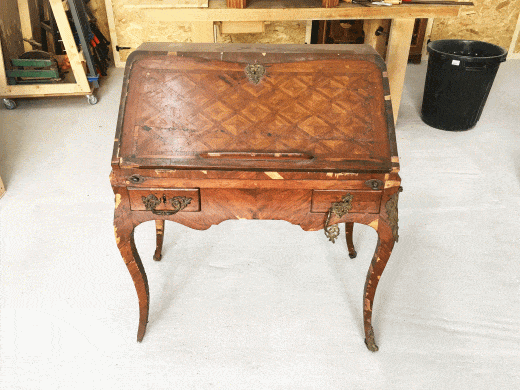
A while ago I told you about this desk that was being restored. Well, here it is finished. The varnishing process took three weeks. This allowed enough time for the varnish to set properly, in order to achieve the best possible result. https://ebenisterie-mathieuvath.fr/en-ce-moment-a-latelier/ So here are some before and after photos.

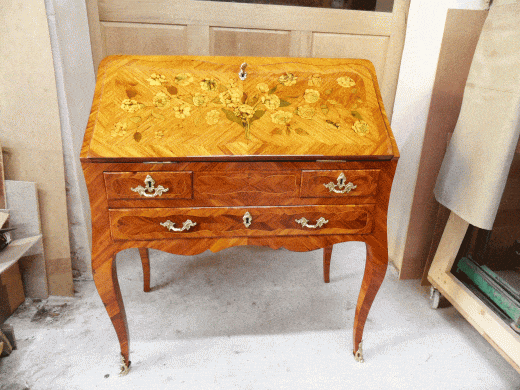
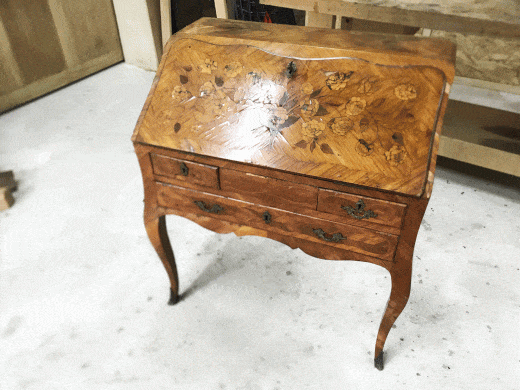
Louis XV slant-front desk

Ebénisterie Mathieu VATH

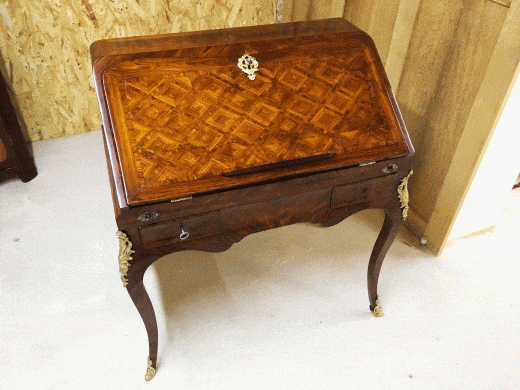
The restoration of a lovely slant-front desk, or as Riesener calls it in his memoirs, a "tomb-shaped secretary," began two weeks ago. With the restoration phase complete and the varnishing underway, I'm taking a moment to provide a brief summary of the project. The desk's frame is made of oak and fir, veneered with rosewood and violet wood, and the drop-front features floral marquetry of boxwood, natural and stained maple, and hornbeam. It includes a large drawer […]

Commode returning from Egypt

Ebénisterie Mathieu VATH

During the turbulent period of the French Revolution, furniture production was considerably diminished, and most artisans experienced very difficult times. Overall, from the Consulate to the Directory, furniture and seating had little time to evolve. However, even though some decorative motifs inspired by Egypt had already appeared, it was after the Egyptian expedition (1798-1801) that they evolved into a unique style. The so-called "Return from Egypt" style, however, lasted only a short time: a decade at most, as it would […]

Secretary stamped Martin Ohneberg

Ebénisterie Mathieu VATH

This week marks the completion of the restoration of a Louis XVI period secretary. Martin Ohneberg (Master in 1773), the cabinetmaker who crafted this piece, was an excellent marquetry artist and used very high-quality rosewood. He produced numerous pieces of furniture with very simple lines but exquisite marquetry, including an endless variety of drop-front secretaries. This particular one is veneered with rosewood and amaranth, and features a mosaic marquetry of maple blossoms on a red satinwood ground. The framing bands […]

Louis XIII style desk

Ebénisterie Mathieu VATH

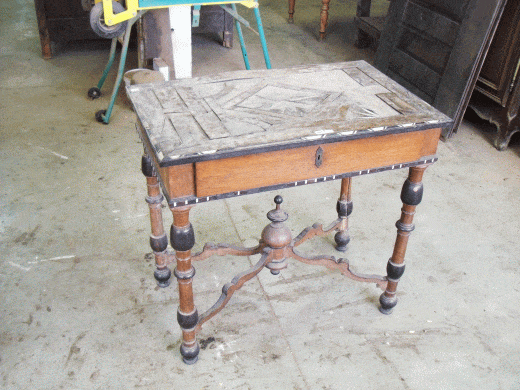
A look back at the restoration of a 17th-century Louis XIII table. It is made of solid walnut and veneered with walnut, ebony, ivory, and boxwood. This table had spent a long time in an attic, and unfortunately, the tabletop suffered considerably. Many sections of veneer were missing. The restoration therefore began by removing what little veneer remained. It was very easy; it was completely detached. I simply had to lift it with a thin blade, and it came right off. After having […]

Louis XIII Cabinet

Ebénisterie Mathieu VATH

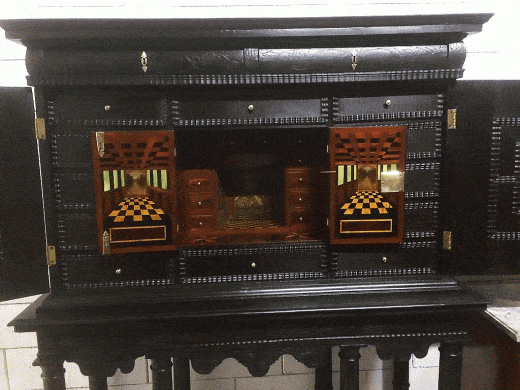
A look back at a fascinating restoration project (at least for me). So fascinating, in fact, that I forgot to take photos at the beginning! This cabinet dates from the 17th century and features two drawers in the cornice and two doors in the upper section. The base consists of two drawers in the frieze supported by eight turned feet and a top resting on ball feet. Inside are twelve drawers and two doors concealing an interior theater, as well as eleven more drawers. The feet, along with […]

Majorelle Table

Ebénisterie Mathieu VATH

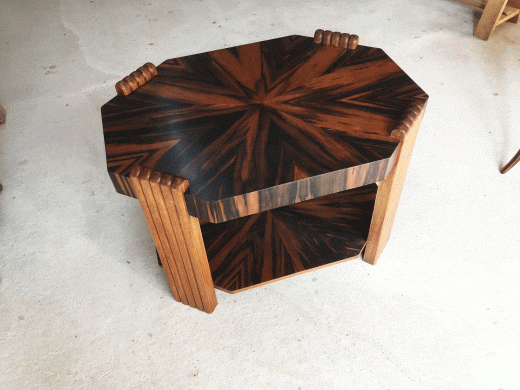
Here is a table in pure Art Deco style. It is veneered with Macassar ebony and the legs are mahogany. This table was probably created around the 1920s. Indeed, Louis Majorelle is best known as one of the great cabinetmakers of the Art Nouveau style, but it is too often forgotten that he was one of the forerunners of the Art Deco style, this table being a perfect example. In terms of restoration, as always, the veneer requires the most work; there […]

Transitional dresser in the style of Topino

Ebénisterie Mathieu VATH

A month ago, a lovely transitional commode arrived, which reminds me of the work of the cabinetmaker Charles Topino (circa 1742-1803) – he received his master craftsman's certificate on July 4, 1773. However, this commode does not bear his stamp, nor any stamp for that matter. This confirms that a stamp is not necessary to possess a piece of high-quality furniture. Furthermore, the marquetry could very well have come from Topino's workshop, as he sold panels of his marquetry to the haberdashers and his colleagues […]

Louis XV slant-front desk stamped HEDOUIN (Restoration complete)

Ebénisterie Mathieu VATH

Remember that slant-front desk? Well, it's finished. It was quite a task, but now it's regained its former glory. Only the drawer keyholes and the leather upholstery remain to be fitted before it's returned to its owner. A large part of the legs has been remade from sawn violet wood. This was cut to the correct thickness, scraped and sanded, then oxidized before being glued, so as not to have to sand the entire piece of furniture […]

Louis XV slant-front desk stamped HEDOUIN

Ebénisterie Mathieu VATH

Thanks to its stamp, it is possible to date this slant-front desk, or cantilevered desk, between 1738 and 1783. The life of Jean-Baptiste Hedouin is relatively unknown. After becoming a master craftsman, he set up his workshop on Rue Traversière-Saint-Antoine. All the furniture he produced was of high quality. His pieces, primarily in the Regency and Louis XV styles, almost all veneered in sheets or with grid patterns, were varied: wardrobes, flat and slant-front desks, bookcases… but it was the commodes that constituted the largest part of his output.

Louis XV corner cabinet, stamped JM CHEVALLIER

Ebénisterie Mathieu VATH

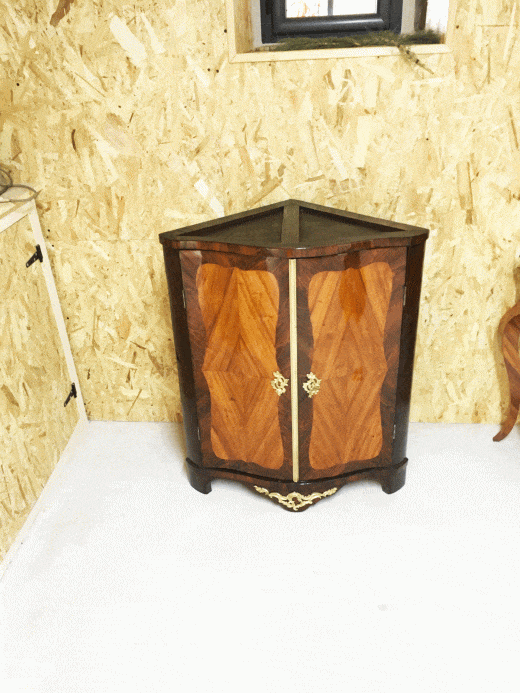
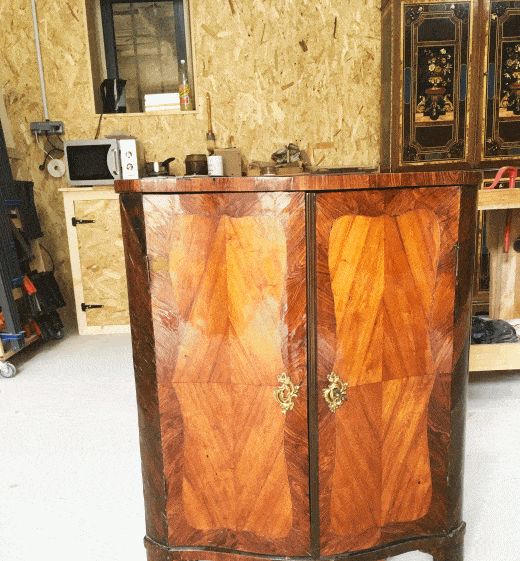
Here is a corner cabinet stamped by Jean-Mathieu Chevallier. It is made of solid oak and veneered with rosewood and violet wood with a boxwood inlay. Jean-Mathieu Chevallier was already established on the rue de Grenelle under the sign "à la Croix Chevallier" when he obtained his master craftsman's certificate in 1743. He subsequently expanded his business considerably, had business dealings with André-Charles Boulle, one of the sons of the famous cabinetmaker, and contributed to furnishing the Hôtel du Duc de Talmont, as well as the Château de Villegénis, which he had purchased […]