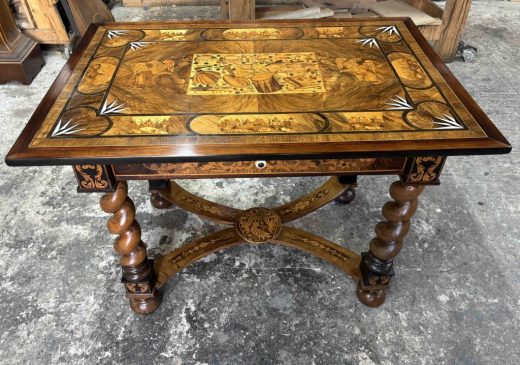
Wild herb table

Ebénisterie Mathieu Vath

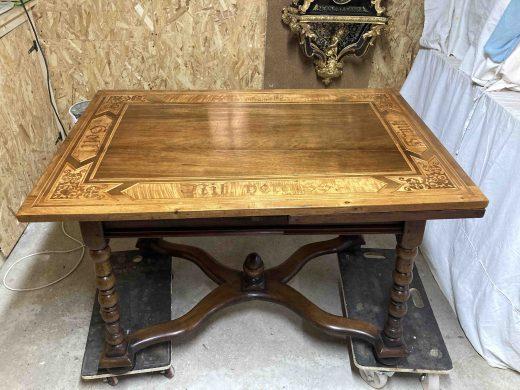
Restoration of a solid walnut marquetry table with "architectural whimsy" and "wild herbs" motifs, originating from the Austrian Tyrol in the mid-17th century. The piece rests on four twisted legs, adorned with flattened ball feet, connected by an X-shaped stretcher. It opens with a wide drawer in the front and is surmounted by a rectangular top. This top is decorated with a rosewood border, followed by bands delimited by wide bog oak fillets, themselves framed with boxwood. These elements […]
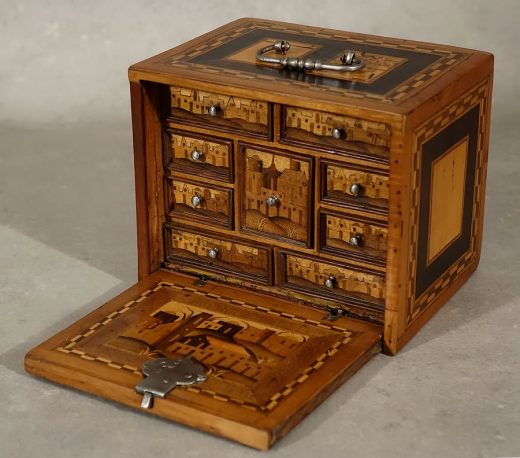
Augsburg Cabinet, 17th century

EEbénisterie Mathieu Vath

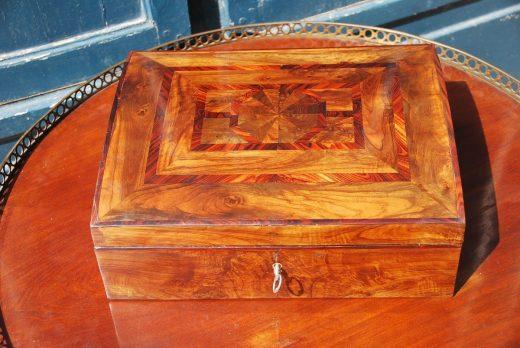
Restoration of a small table cabinet (Height: 14.3 cm – Width: 17.3 cm – Depth: 13 cm), likely a traveling model, made of solid wood with intarsia on all sides, opening with a drop-front concealing eight drawers (the bottom one simulating two drawers). Its composition is particularly rich, incorporating eight different wood species. The frame, made of fir and cherry for the visible parts, is inlaid with large central panels of sycamore maple. These are framed by bands of plum wood, themselves bordered by a double band […]

English Cabinet

Ebénisterie Mathieu Vath

Restoration of a late 17th/early 18th-century English cabinet, veneered in walnut and maple, featuring the distinctive free-flowing arabesque marquetry known as seaweed marquetry because it evokes the seaweed found on the seabed. English "seaweed" marquetry is traditionally associated with Dutch and Flemish cabinetmakers active in the second half of the 17th century, and particularly with Gerrit Jensen. Indeed, when Prince William III of Orange ascended the throne of England in 1689, he was accompanied by his cabinetmakers. Subsequently, religious persecutions on the […]

Louis XIV double-bodied display case

Ebénisterie Mathieu Vath

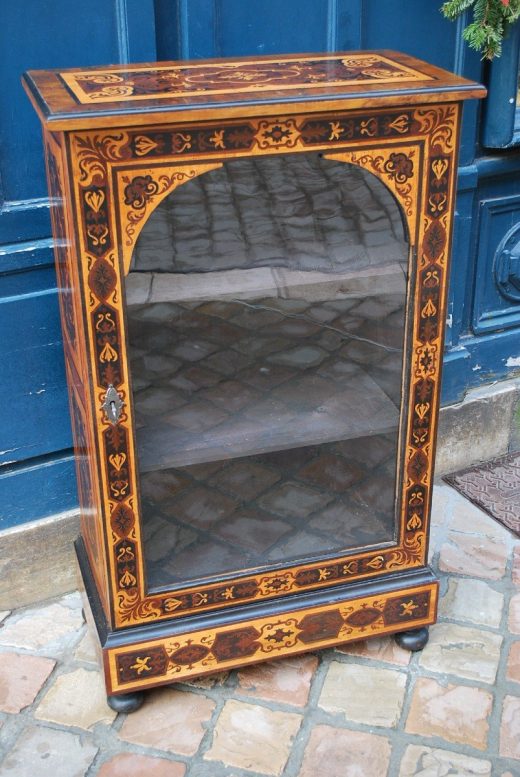
Restoration of a Louis XIV period two-part display cabinet veneered in cedar, ferreol, and cherry. The moldings are made of blackened fruitwood. With a flat front and sides, it opens with two doors in the lower section and two grilled doors in the upper section, with a straight cornice, resting on ball feet. This type of marquetry is found on furniture from the second half of the 17th century. Condition report: This piece of furniture showed multiple alterations. Regarding the frame, the nailed back panels, which were intended to maintain proper squareness, and […]

Louis XIV clock

Ebénisterie Mathieu Vath

Restoration of a rare late 17th-century clock case in four-color marquetry, also known as "wood painting" or "jasmine painting." It is composed of maple, pear, boxwood, and green-stained maple on an ebony ground. Note that the base was likely added later. Several graphic styles are incorporated into this piece, including scrolling foliage and acanthus leaves, bouquets of flowers, and a bird on the pediment. The frame and moldings are made of walnut and are stained black. A […]

Louis XIV Library Display Case

Ebénisterie Mathieu Vath

Restoration of a small Louis XIV period display cabinet inlaid with foliate scrolls in amaranth, ebony, and maple, framed in olive and cherry wood. The marquetry on this piece is known as the Boulle technique, or superimposed marquetry. The cabinet had a significant number of missing veneers. The restoration work therefore consisted of replacing all these missing veneers with scraped and sanded veneer, prepared to the correct thickness before being glued with hot glue. The most interesting task was the reconstruction of one missing piece […]

8-foot desk stamped Manet

Ebénisterie Mathieu Vath

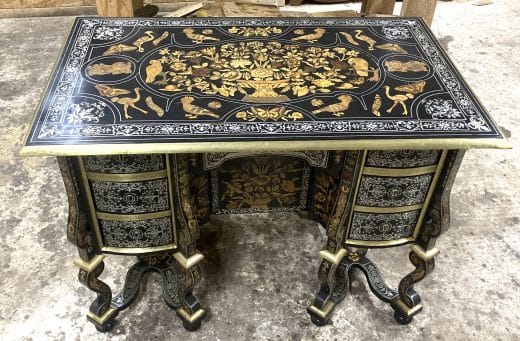
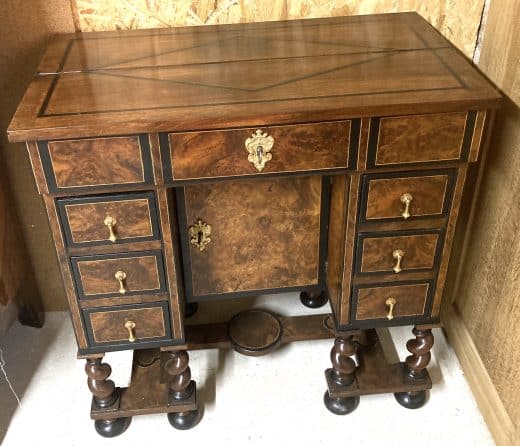
Restoration of an eight-legged desk, commonly known as a "Mazarin" desk, from the Louis XIV period, late/early 17th century. Constructed of pear and solid softwood, the sides and drawer bottoms are also pearwood. It features two side cabinets, each opening with three drawers, a central drawer above a middle cabinet with rounded edges, and console-shaped uprights and eight legs joined by two X-shaped stretchers. The drawers are inlaid with pewter and blackened pearwood, depicting a late 17th-century design. […]

Money changer's office

Ebénisterie Mathieu Vath

A few weeks ago, I presented you with a money changer's table. Well, here is its successor, the money changer's desk. Inspired by the eight-legged desks more commonly known as "Mazarin desks," the money changer's desk is a smaller version. Designed to be frequently transported, it must ensure the security of the valuables it contains and showcase the prosperity of its owner through its marquetry and veneer decorations, which vary in richness. For those interested in the origins of these pieces of furniture and the money changer's trade…

Money changer table

Ebénisterie Mathieu Vath

Restoration of a 17th-century money changer's table in solid walnut and walnut and sycamore maple veneer. This table originates from Germany, as indicated by the marquetry inscription on its top: "Trink und iss Gott nit wergiss," which translates as "Drink and eat, but do not forget God." It consists of two drawers, a top, and a sliding extension leaf; the legs are joined by an X-shaped stretcher. What is a money changer's table? The profession of money changer emerged in the 13th century, following the expansion of trade. […]

Mazarine Chest of Drawers

Ebénisterie Mathieu Vath

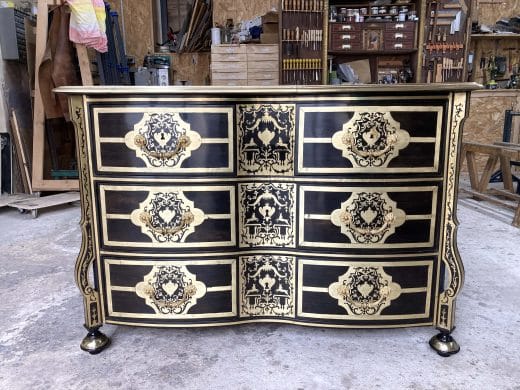
Restoration of a Louis XIV period commode, known as a Mazarine commode, veneered in brass and ebony on a softwood frame. This commode features bow-shaped drawers, including two full-length drawers surmounted by two half-drawers separated by an intermediate stile. The fronts are made of softwood, while the sides and backs are walnut. The brass decoration supporting the pendant drawer pulls features a finely inlaid motif of scrolls, foliage, foliage, and arabesques, framed by a geometric brass cartouche and simulating keyhole escutcheons. It […]

Esterházy Chest of Drawers

Ebénisterie Mathieu Vath

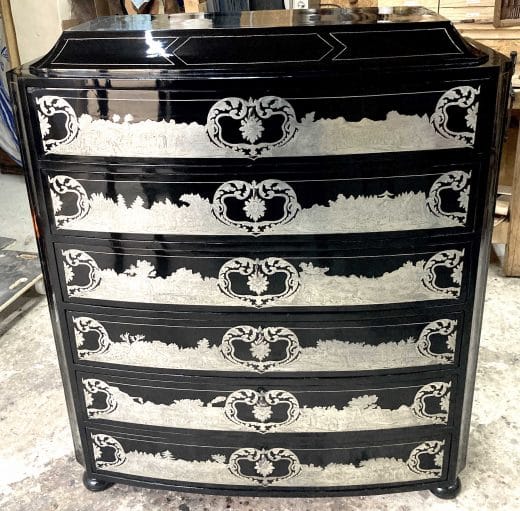
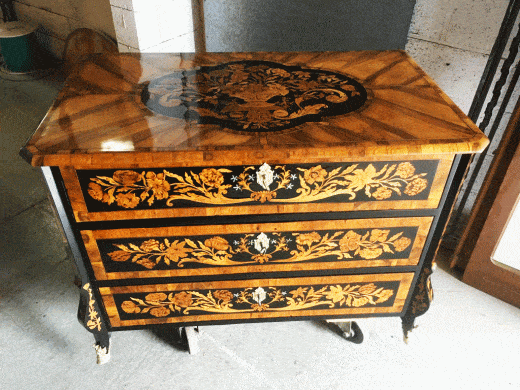
Restoration of this unusual piece of furniture from Austria/Hungary. I must admit I had some difficulty placing it geographically. It was clear that it wasn't from France but rather from Eastern Europe. But where? Fortunately, engravings provide valuable clues; the clothing depicted corresponds well to the late 17th and early 18th centuries. The landscapes consist of mountains and villages; the vegetation is composed of deciduous and coniferous trees, and several medieval castle ruins can be seen. […]

Mazarin Boulle Office

Ebénisterie Mathieu Vath

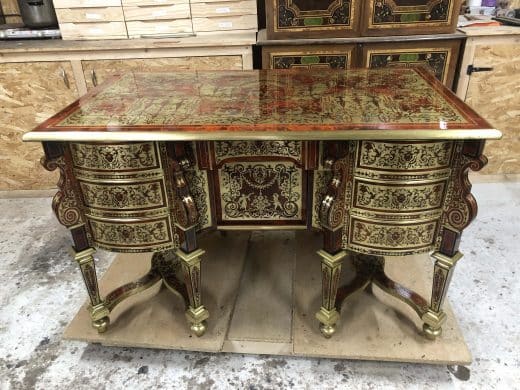
To end the year on a high note, here's a restoration that occupied a large part of my time this year and which reached its owner a few weeks ago. It's the restoration of an eight-legged writing desk, commonly known as a "Mazarin" desk. Constructed of solid oak and softwood, the sides and drawer bottoms are made of light walnut. The marquetry covering it consists of Caret tortoiseshell (Eretmochelys imbricata) on a vermilion red ground, and brass. All of this is framed by delicate ebony stringing. It is […]

Eight-foot desk known as the "Mazarin" desk«

Ebénisterie Mathieu Vath

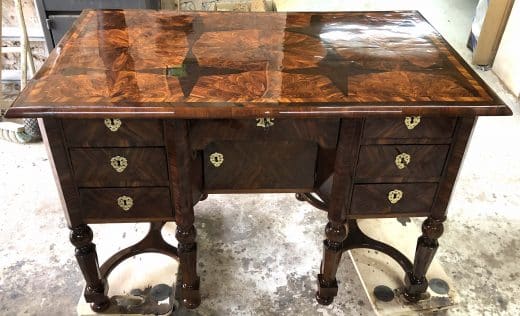
Extensive restoration work has been undertaken on this Mazarin desk, veneered in kingwood and rosewood. It is entirely veneered on fir with a solid rosewood base. The top features a marquetry of rosewood stars surrounded by kingwood butterfly wings in circular patterns. Why the name "Mazarin"? The eight-legged desk is one of the jewels of 17th-century furniture. It only acquired the name "Mazarin" from antique dealers in the 19th century to give it a more prestigious name.

Table à la Tronchin

Ebénisterie Mathieu Vath

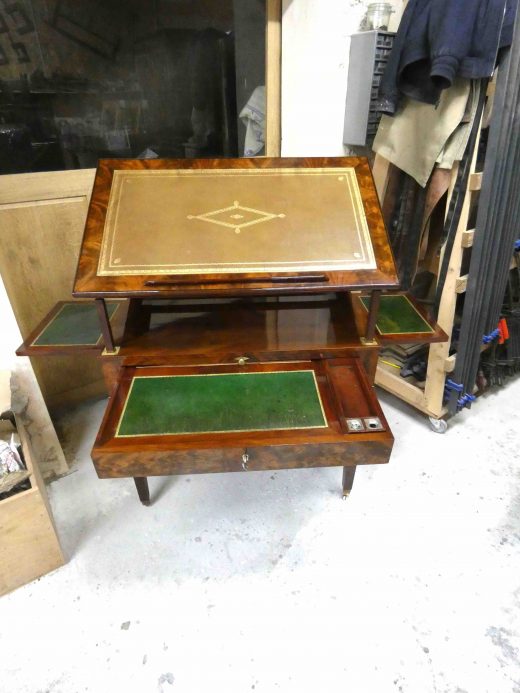
A little refresh for this lovely Tronchin-style table. Apart from a missing molding and a few small veneer chips on the legs, nothing too serious. A touch-up of the varnish was enough to give it a new lease on life. But do you know where this type of table comes from, and what it was used for? Although today attributed to Théodore Tronchin, a Genevan physician (1709-1781), who at the time published works on bone diseases linked to poor posture at one's desk, he cites the advantages that […]

Louis XV slant-front desk

Ebénisterie Mathieu VATH

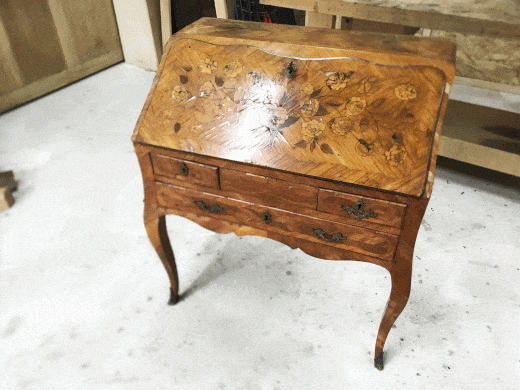
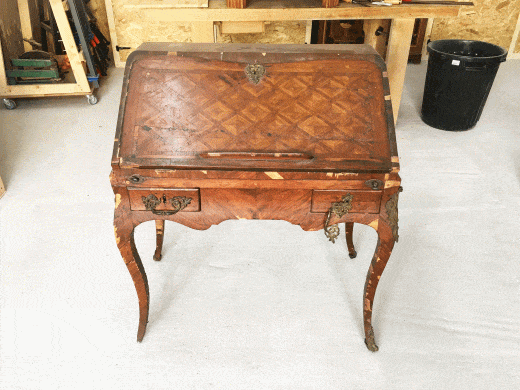
The restoration of a lovely slant-front desk, or as Riesener calls it in his memoirs, a "tomb-shaped secretary," began two weeks ago. With the restoration phase complete and the varnishing underway, I'm taking a moment to provide a brief summary of the project. The desk's frame is made of oak and fir, veneered with rosewood and violet wood, and the drop-front features floral marquetry of boxwood, natural and stained maple, and hornbeam. It includes a large drawer […]

Louis XV slant-front desk stamped HEDOUIN

Ebénisterie Mathieu VATH

Thanks to its stamp, it is possible to date this slant-front desk, or cantilevered desk, between 1738 and 1783. The life of Jean-Baptiste Hedouin is relatively unknown. After becoming a master craftsman, he set up his workshop on Rue Traversière-Saint-Antoine. All the furniture he produced was of high quality. His pieces, primarily in the Regency and Louis XV styles, almost all veneered in sheets or with grid patterns, were varied: wardrobes, flat and slant-front desks, bookcases… but it was the commodes that constituted the largest part of his output.

Mazarine Chest of Drawers

Ebénisterie Mathieu VATH

This week, we're revisiting the restoration of a Louis XIV period commode, a commode known as a Mazarine commode. But where does the name "Mazarine" come from? Well, it seems that the first example was made for the famous Mazarine Library, quite simply. Moreover, the illustrious creator of the commode was none other than André Charles Boulle himself. For Louis XIV's bedroom at Trianon, he revolutionized a type of furniture in 1708: the commode, which takes its name from its "practical" aspect compared to the chests that were widely used at the time. Today, we're presenting […]