Boulle Dubois Cartel

Restoration of a Louis XV period brown tortoiseshell Boulle Dubois cartel clock, the dial of which bears an engraving with the monogram of Louis XV.
Restoration. Conservation. Creation

Restoration of a Louis XV period brown tortoiseshell Boulle Dubois cartel clock, the dial of which bears an engraving with the monogram of Louis XV.
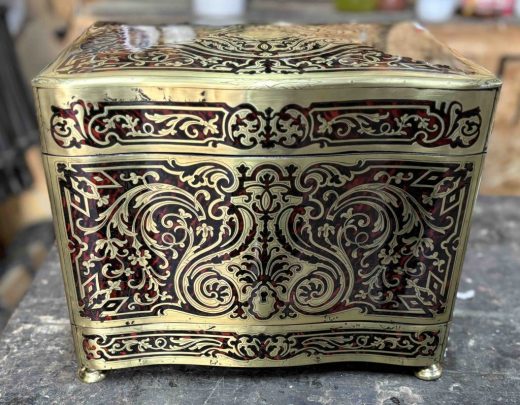
Restoration of a Napoleon III liquor cabinet in tortoiseshell and brass marquetry. The liquor cabinet, an elegant and ingenious piece of furniture, appeared at the end of the 18th century. Initially designed to accompany long carriage journeys, it allowed for the easy transport and consumption of liqueurs. Its true rise in popularity, however, occurred in the 19th century, a period during which it became a symbol of refinement and the French art of living. This piece of furniture takes the form of a box, called a "caisson," […]
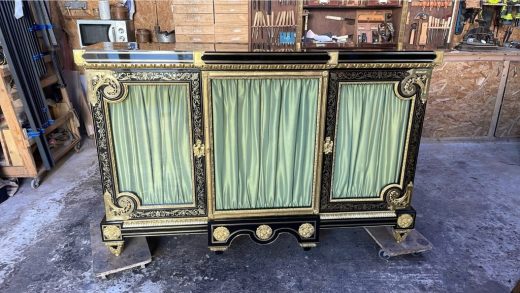
Restoration of a low Louis XIV style bookcase, in Boulle marquetry of brown tortoiseshell and brass, ebony, and chiseled and gilded bronze ornamentation. The central projecting front opens with three glazed doors decorated with scroll and foliage motifs, resting on tapered legs. This type of three-part low cabinet was one of Boulle's great successes, and he himself offered several variations. The Louvre Museum, in fact, owns no fewer than six examples. These pieces of furniture, particularly suited to the display […]
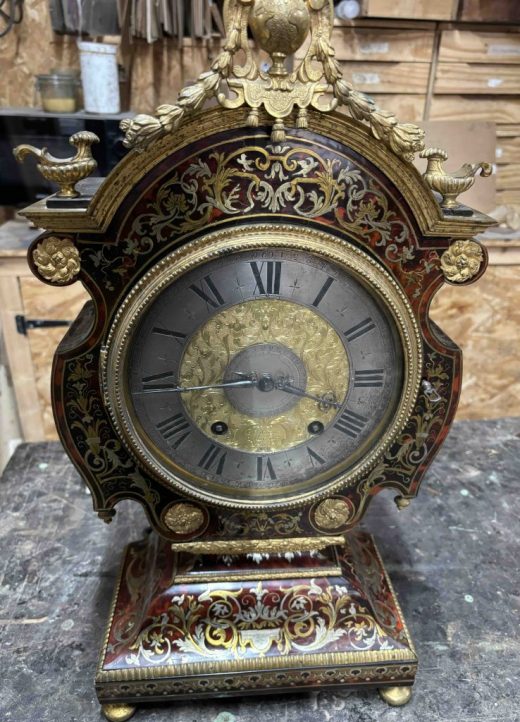
The first project of the year involved stabilizing, consolidating, restoring, preserving the finish, and harmonizing the elements. The main objective was to preserve the history and identity of the project as much as possible without dismantling anything. A masterpiece of Parisian clockmaking from the Grand Siècle, this remarkable clock, known as a "doll's head" clock, is emblematic of Parisian clockmaking at the end of the 17th century, during the reign of Louis XIV. Its architectural form, dominated by a circular body flanked by lateral projections and surmounted by a rich crowning element […]

This is the first cartel clock restoration undertaken by Raphael, focusing on this Louis XV cartel clock in Boulle marquetry of brown tortoiseshell and brass. Restoring a cartel clock is a complex task requiring considerable time and meticulous attention to detail. The curved shapes make gluing delicate operations, and it is generally necessary to reattach large sections of the brass elements. Condition report: This cartel clock presented widespread soiling, an oxidized and tarnished varnish, as well as several lifting and missing pieces in the brass and tortoiseshell marquetry. […]

Here is a restoration carried out earlier this year by Raphaël. A long but successful undertaking. I had the opportunity to revisit this desk recently, and it has responded perfectly to the significant variations in temperature and humidity. The remainder of this restoration report was written by Raphaël. A "Mazarin" Desk. This desk dates from the Louis XIV period and is covered with Boulle marquetry composed of brass on a red tortoiseshell ground. The case is supported by eight console legs, each paired by an X-shaped stretcher. It opens […]

The restoration of five Boulle marquetry clocks, begun a few months ago, is now complete. Here is a Regency clock and its console, inlaid with tortoiseshell and brass on an oak frame. Measuring Time: Since the dawn of time, humankind has strived to measure time. From the gnomon, a simple stick planted in the ground—a precursor to the sundial—to the flow of water in the clepsydra, and then to the hourglass using the same principle, all these methods have allowed people to organize their social lives, […]

We are continuing our series on cartel clocks, which began a few months ago. Here are some images of the restoration of this Louis XV cartel clock in brown tortoiseshell and brass marquetry on an oak frame. Condition report: The structure is in a state of significant deterioration, and re-gluing the joints appears necessary. All the marquetry is detached or shows signs of glue dehydration. Furthermore, the clock has been heavily sanded, which has resulted in the disappearance of all traces of engraving on the brass elements. […]

Restoration of a Boulle marquetry mantel clock, composed of brown tortoiseshell and brass, adorned with chased and gilded bronze mounts. The clock features a monumental rooster (royal emblem), a central mascaron with a satyr's head, caryatids, and two doves beneath a draped dome. The movement is signed GRIBELIN. Nicolas Gribelin, son of Abraham Gribelin, Valet de Chambre-Clockmaker to the King, was born in Blois on November 27, 1637. By the end of the 17th century, he had established himself as one of the most renowned clockmakers of his time.

Restoration of a Regency clock case in brown tortoiseshell and brass marquetry, featuring a bronze Atlas and a clock face. The piece exhibited significant structural and decorative alterations requiring complete intervention according to the principles of conservation-restoration. Condition report: This clock case, probably dating from the early 18th century, showed the marks of time: lifting of the marquetry, detachment of the tortoiseshell, oxidation of the brass, and numerous losses. The bronze depicting Atlas, bent under the weight of the celestial vault, was blackened, its expression frozen by decades of dust […]

Minor restoration/conservation work was carried out on this lovely Regency clock signed by the Dumont brothers in Besançon. Some minor repairs and replacements of missing brass and flakes were performed before the shellac finish was applied. The bronze mounts were removed and steam cleaned before being reattached.

Restoration of a Regency mantel clock in brown tortoiseshell and brass marquetry on an oak frame. Without its bronze mounts, this type of furniture loses its splendor. But when it regains its bronze fittings, knowing that the function of this type of furniture is to tell the time, the symbols that compose them take on their full meaning. Fame on the escapement and the eagle on the door are perfect examples. Fame is originally an allegorical Greek deity personifying public recognition […]
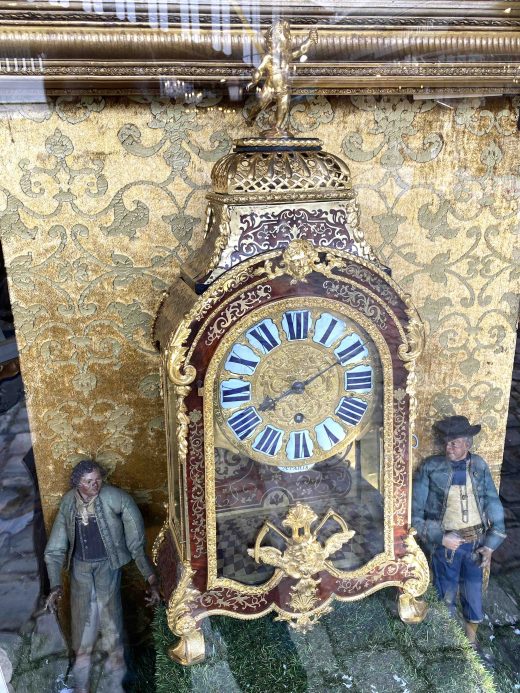
Restoration of a cartel clock in red tortoiseshell and brass marquetry. The movement is stamped by Clément Fiacre in Paris. Clément Fiacre, one of the most important clockmakers of his time, received his master's certificate on January 16, 1714. He settled in Paris and quickly gained renown. Established on Rue Saint-Denis around the mid-1740s, he created his work in the Regency style, where wood was richly worked, notably through tortoiseshell and brass marquetry. He also produced veneers in rosewood, amaranth, and other woods.
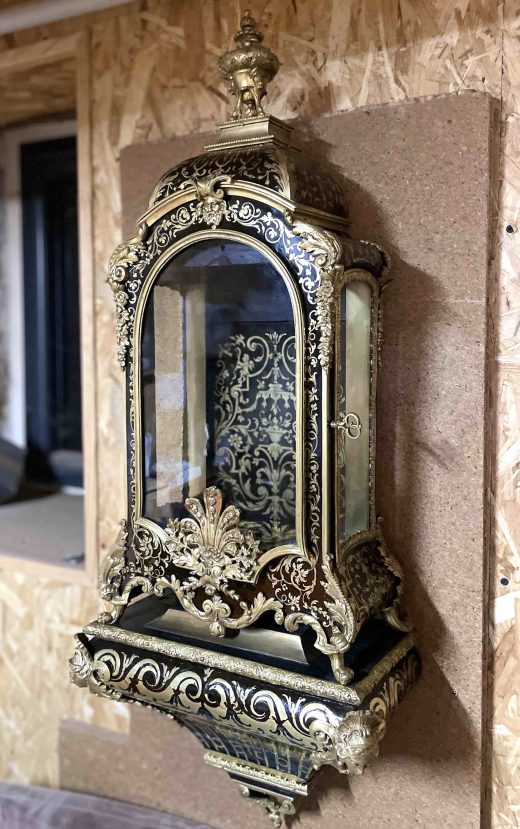
Restoration of a Regency clock case in Boulle marquetry on a brown tortoiseshell background. Since Antiquity, humankind has sought to master and create a "timekeeper." Egyptian obelisks, water clocks, sundials, hourglasses. But it was in the 15th century that the first mechanical weight-driven clocks were made, with a single hand, but generally equipped with chimes. Then, in the 16th century, the counting of the day in two parts, 12 hours instead of 24, was adopted almost everywhere, even though each city kept its own meridian time until the advent of railways and […]
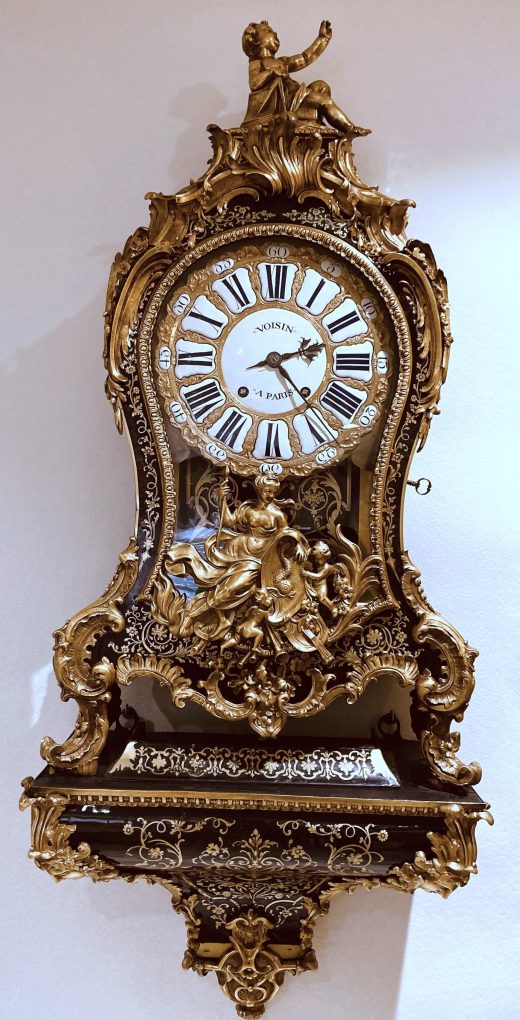
Restoration of a Louis XV cartel clock in tortoiseshell and brass marquetry, the movement of which is signed by Charles Voisin (born 1686-1760), Master Clockmaker in 1710. The distinctive feature of this clock is that the bronze mounts are stamped with the crowned C mark. The crowned C was established by an edict of 1745, which required bronze workers to mark their pieces with a small, distinctive letter, a C surmounted by a crown, thus subjecting them to a tax. This tax applied to both objects and furniture adorned with it. It is a […]
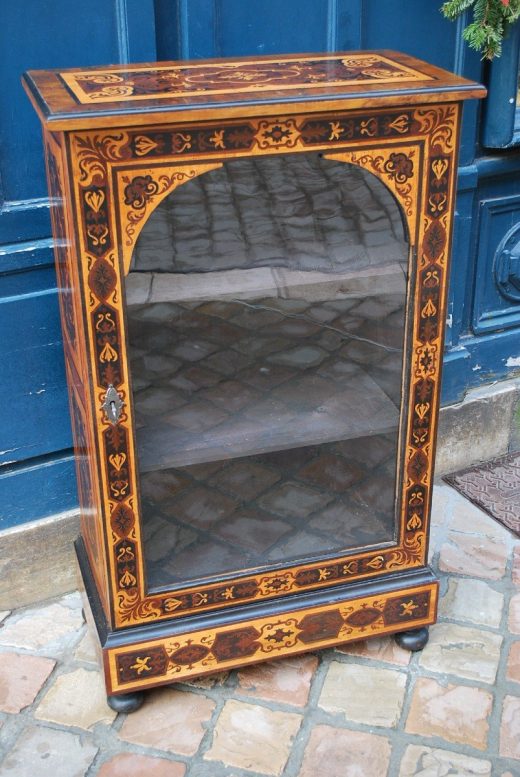
Restoration of a small Louis XIV period display cabinet inlaid with foliate scrolls in amaranth, ebony, and maple, framed in olive and cherry wood. The marquetry on this piece is known as the Boulle technique, or superimposed marquetry. The cabinet had a significant number of missing veneers. The restoration work therefore consisted of replacing all these missing veneers with scraped and sanded veneer, prepared to the correct thickness before being glued with hot glue. The most interesting task was the reconstruction of one missing piece […]
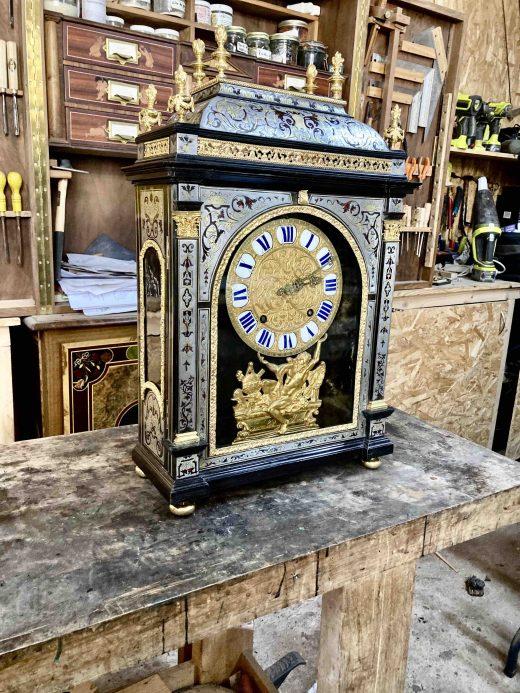
Restoration of a 'religious' clock with a striking mechanism on the half-hour, signed (dial and movement) 'Sarrabat à Paris', third quarter of the 17th century. Religious clocks were the earliest form of clocks during the reign of Louis XIV, the Sun King. Their popularity increased from 1660 onwards, thanks to Huygens' discovery of the regulator pendulum. This particular clock features Boulle marquetry of red tortoiseshell, brass, and pewter on a walnut frame, decorated with gilt bronze mounts and ebony moldings. The lower molding is also ebony and rests on […]
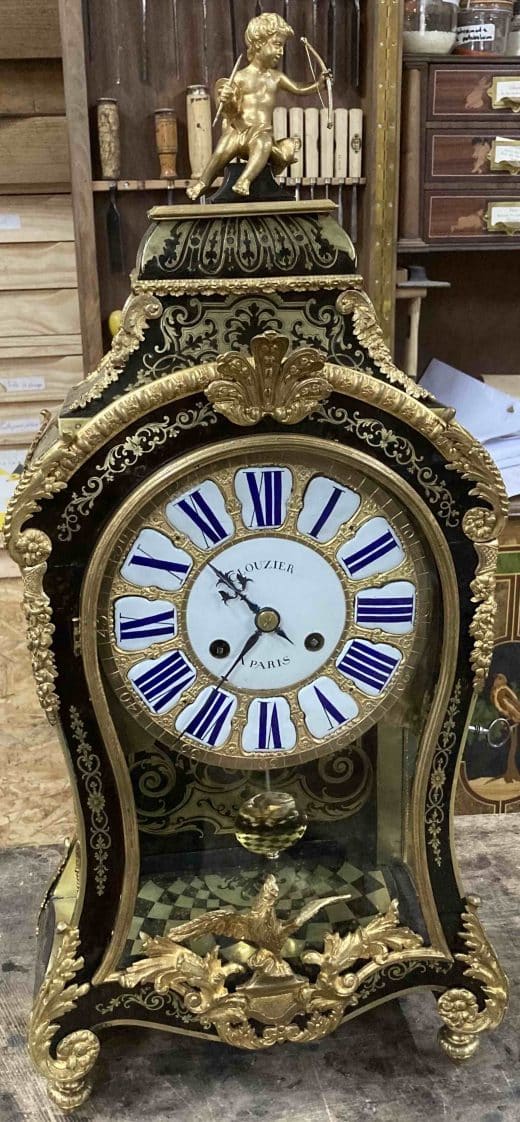
Here are some images of the restoration of a Regency period cartel clock in brown tortoiseshell and brass marquetry on an oak frame. The movement is signed CLOUZIER A PARIS. Jacques Clouzier (1692-1754) was received as a master clockmaker by awarding a masterpiece on July 5, 1692. He was one of the greatest Parisian clockmakers of the Louis XIV and Regency periods. He became a member of the clockmakers' guild in the 1700s, then worked on Rue Saint-Antoine until 1726 and later on Rue des Prêtres Saint-Paul. He remained active until his death […]
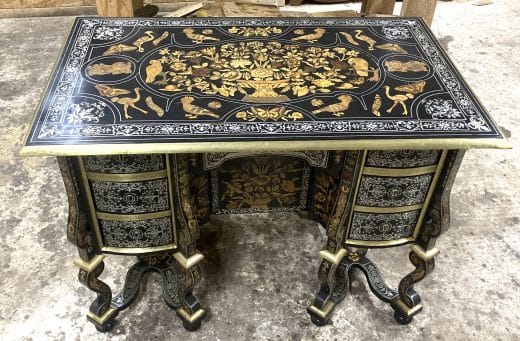
Restoration of an eight-legged desk, commonly known as a "Mazarin" desk, from the Louis XIV period, late/early 17th century. Constructed of pear and solid softwood, the sides and drawer bottoms are also pearwood. It features two side cabinets, each opening with three drawers, a central drawer above a middle cabinet with rounded edges, and console-shaped uprights and eight legs joined by two X-shaped stretchers. The drawers are inlaid with pewter and blackened pearwood, depicting a late 17th-century design. […]
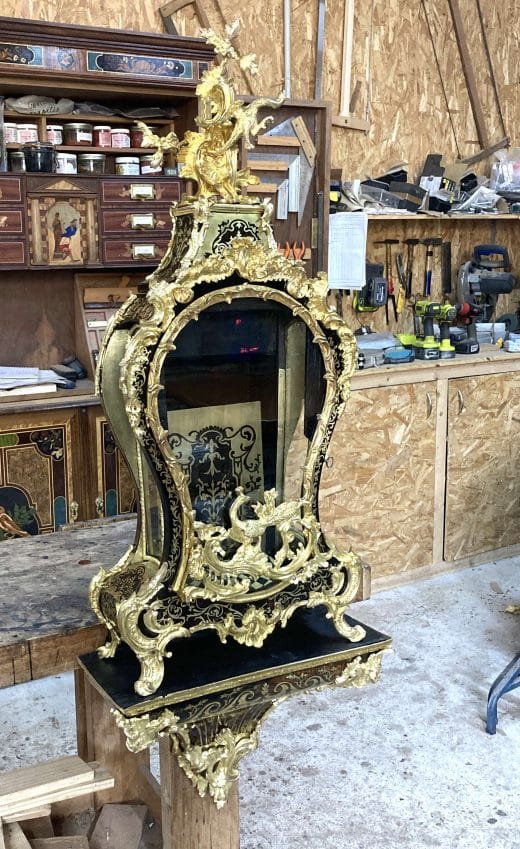
Restoration of a Louis XV period clock and its lamp base in pure Rococo style. It is constructed of solid oak and veneered with brass and tortoiseshell. Do you know what Rococo style is? Rococo style belongs to the early period of the Louis XV style (1723-1750) and reached its peak around 1730. It is characterized by rich naturalistic decoration. It drew inspiration from artificial grottoes and elements of rock recreated in asymmetrical compositions. This decoration, which marks the beginning of the Baroque, is complemented by seashells, elements […]
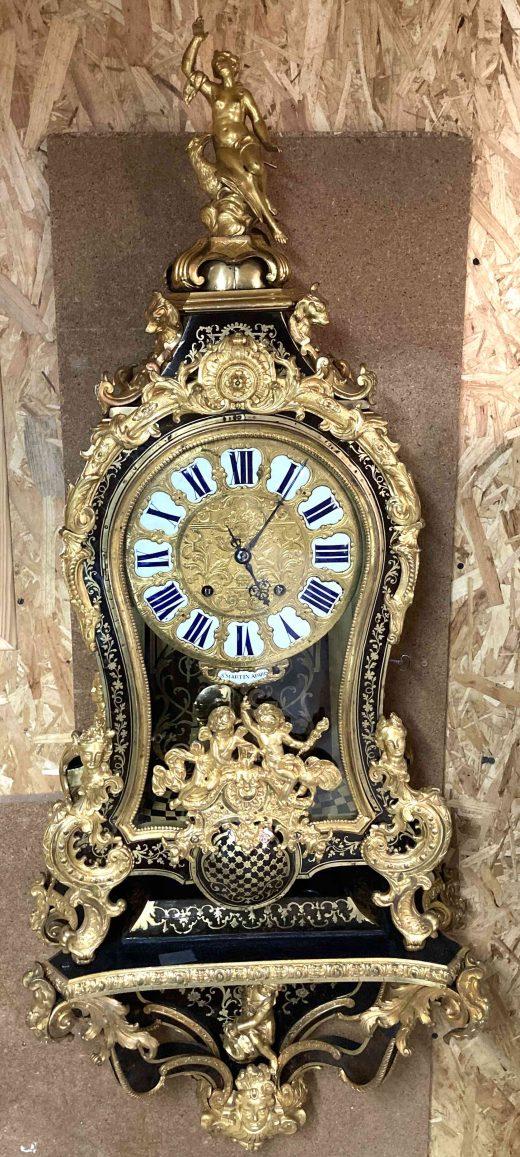
Restoration of a large cartel clock (137cm high) and its console-style bracket from the Regency period. It is made of solid oak veneered with Boulle marquetry of brown tortoiseshell and brass. It is decorated with floral garlands, crosshatching, and foliage. The dial is made of chased and gilded bronze with an interlacing design and birds; the Roman numerals are enameled, and the signature St Martin à Paris is inset. The plate is signed with the same name. It is adorned with chased and gilded bronze mounts depicting on its capital […]
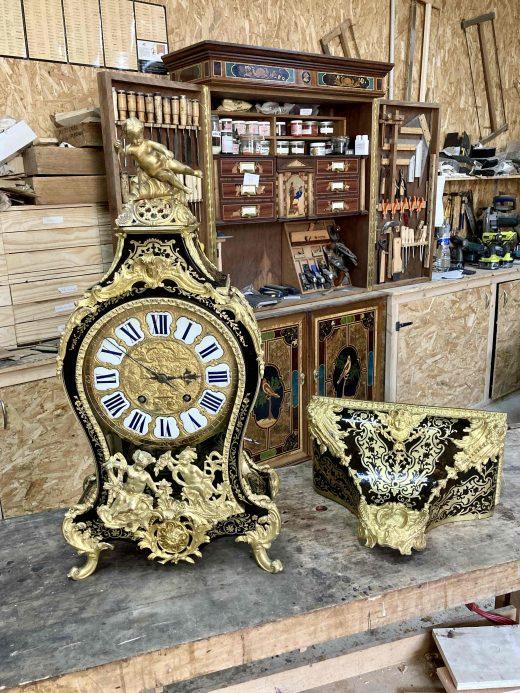
Here are some images of the restoration of a clock case that some of you may have seen during the work at the Mans'Art fair this year. This Louis XV period clock case is inlaid with tortoiseshell and brass, and the frame is oak. The bronze mounts bear the hallmark of the Crowned C. The Crowned C was established by an edict of 1745, which required bronze workers to mark their pieces with a small distinctive letter, a C surmounted by a crown, thus subjecting them to a tax. This tax applied to […]
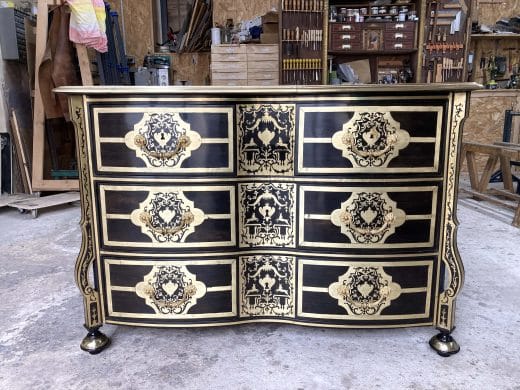
Restoration of a Louis XIV period commode, known as a Mazarine commode, veneered in brass and ebony on a softwood frame. This commode features bow-shaped drawers, including two full-length drawers surmounted by two half-drawers separated by an intermediate stile. The fronts are made of softwood, while the sides and backs are walnut. The brass decoration supporting the pendant drawer pulls features a finely inlaid motif of scrolls, foliage, foliage, and arabesques, framed by a geometric brass cartouche and simulating keyhole escutcheons. It […]
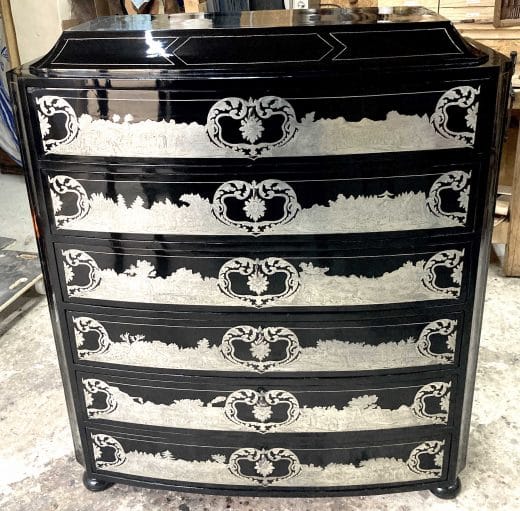
Restoration of this unusual piece of furniture from Austria/Hungary. I must admit I had some difficulty placing it geographically. It was clear that it wasn't from France but rather from Eastern Europe. But where? Fortunately, engravings provide valuable clues; the clothing depicted corresponds well to the late 17th and early 18th centuries. The landscapes consist of mountains and villages; the vegetation is composed of deciduous and coniferous trees, and several medieval castle ruins can be seen. […]

Restoration of a Napoleon III period sewing table inlaid with mother-of-pearl, brass, and ebony. As you can see from the photos, this sewing table was in very poor condition. Only the affection and sentimental value of its owner saved it. Indeed, the time required for the restoration of this table was far too great compared to the object's value. Almost all of the brass inlay on the base was missing, there was a lot of missing veneer, and there was a […]
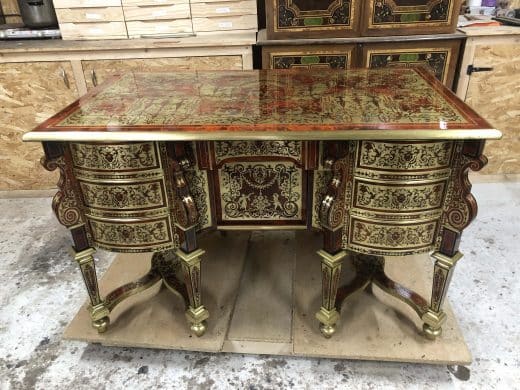
To end the year on a high note, here's a restoration that occupied a large part of my time this year and which reached its owner a few weeks ago. It's the restoration of an eight-legged writing desk, commonly known as a "Mazarin" desk. Constructed of solid oak and softwood, the sides and drawer bottoms are made of light walnut. The marquetry covering it consists of Caret tortoiseshell (Eretmochelys imbricata) on a vermilion red ground, and brass. All of this is framed by delicate ebony stringing. It is […]
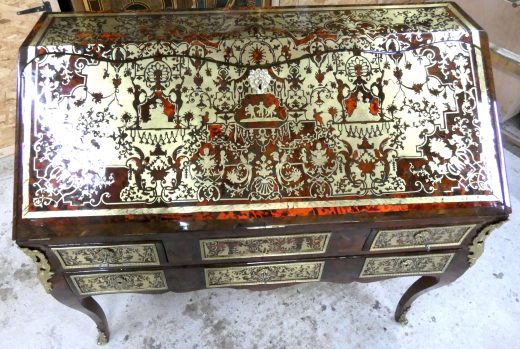
This week, a curious and very pretty Louis XV period slant-front secretary/desk in Boulle marquetry and rosewood. And yes, it wasn't only under Napoleon III that the reuse of Boulle marquetry was fashionable. In fact, Boulle marquetry continued to have admirers throughout the 18th century. It was from the 1750s onwards that the renewed interest was most pronounced. Prominent merchants, such as Lazare Duvaux, began selling them occasionally at considerable prices to prestigious clients, […]
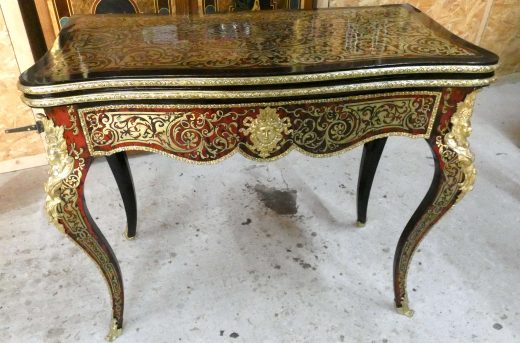
Congratulations to Damien (intern) for restoring this Boulle marquetry games table. It was quite a task. Almost all the brass veneers were peeling off, there were some missing brass pieces, but most importantly, many missing tortoiseshell pieces. The glues were severely dehydrated, judging by the blistering tortoiseshell. The games table was completely disassembled. All the missing brass pieces were cut out using a marquetry easel and then engraved with a burin. As for the tortoiseshell, we opted for […]
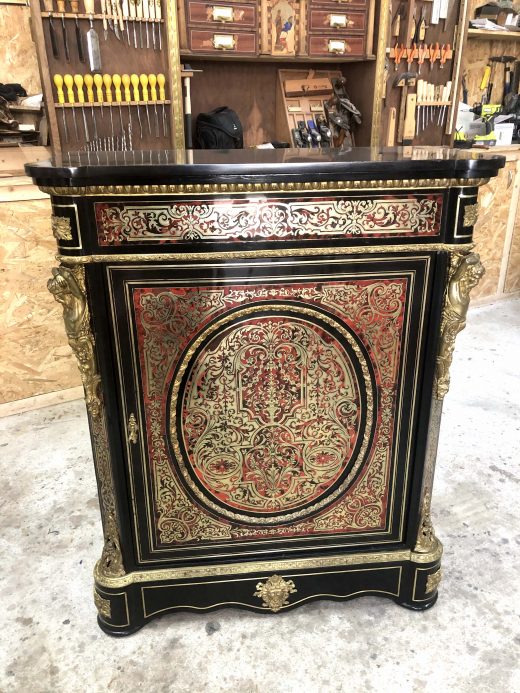
A Napoleon III period side table with a quadrangular structure veneered in blackened pearwood, adorned with rich Boulle marquetry in brass and red tortoiseshell forming an arabesque design composed of foliate scrolls, rocaille motifs, and small flowers. The whole is punctuated by beautiful gilt-bronze mounts featuring atlas figures with clasped hands, acanthus leaves, and an apron. The top is framed by a gadrooned molding supporting a black marble slab with rounded edges. It opens with a door with a lock […]
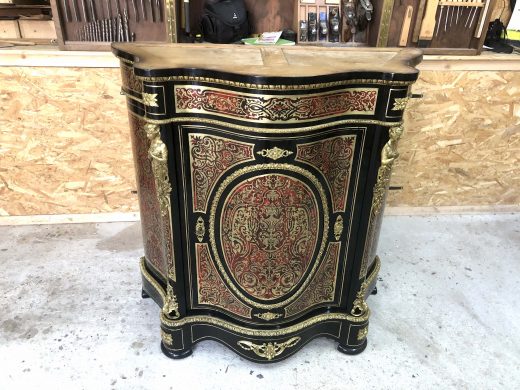
A console table veneered in ebonized pearwood and inlaid with Boulle marquetry of brass on tortoiseshell in arabesque designs. It opens with a door adorned with an oval medallion, revealing shelves in mahogany and mahogany veneer. Rich ornamentation of chased and gilded bronze: egg-and-dart friezes, caryatids in corner drops, interlaced friezes, acanthus leaf friezes, fruit, and florets. This Boulle piece requires extensive restoration. Some pieces of brass, stringing, and especially a great deal of tortoiseshell are missing. Given its value […]
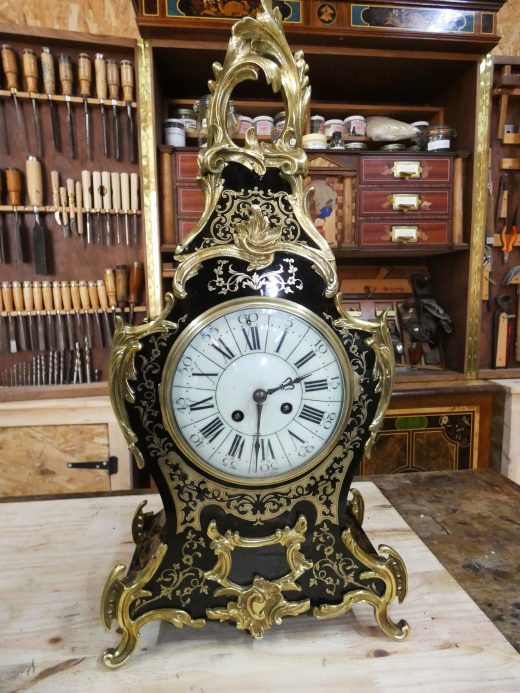
Restoration of a Napoleon III period marquetry clock in brown tortoiseshell on a black ground and brass. Despite dust, oxidation, and years spent in the depths of an attic, this small clock is in very good condition. Except for a missing piece of brass on the right side of the capital, it is complete. The gilding is still clearly visible beneath the layer of grime, and the structure is in perfect condition. The restoration was therefore straightforward: re-gluing all the marquetry under vacuum, then a light cleaning, and a varnishing with […]
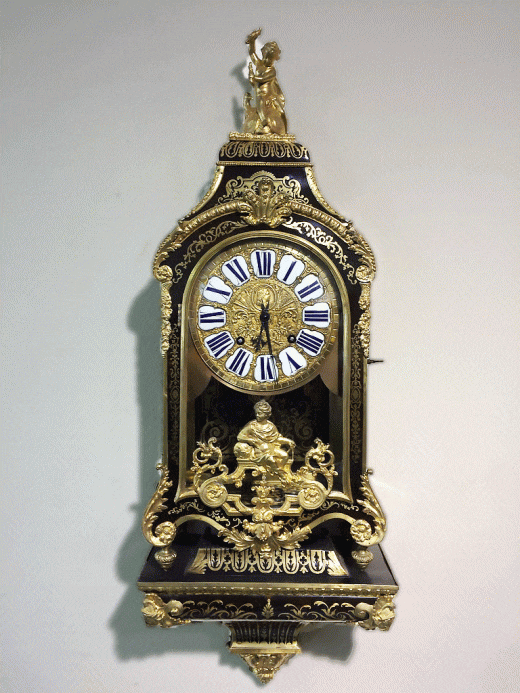
A classic restoration was carried out on this Regency-era Boulle marquetry cartel clock in tortoiseshell. The missing brass pieces were replaced, and all the marquetry was re-glued using fish glue and vacuum infiltration. The entire piece was then varnished with a clear French polish, and the bronze mounts were cleaned with Panama wood.
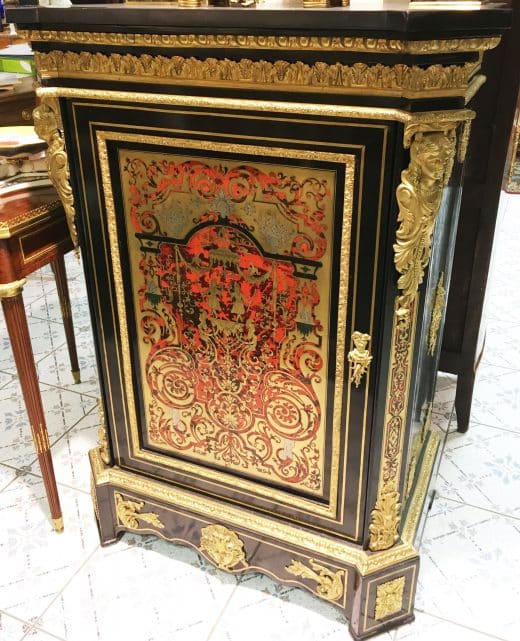
Restoring this piece of furniture is a classic. The door was warped and almost all the brass inlay was missing. Its main advantage was that the marquetry on the door was fairly well preserved, apart from a small amount of missing brass and a few pieces of dyed horn. Nothing too serious. So I started by removing the bronze mounts, then I remade and glued all the missing inlays, reattaching those that were still there in the process. Next, I tackled the door. After removing the veneer […]
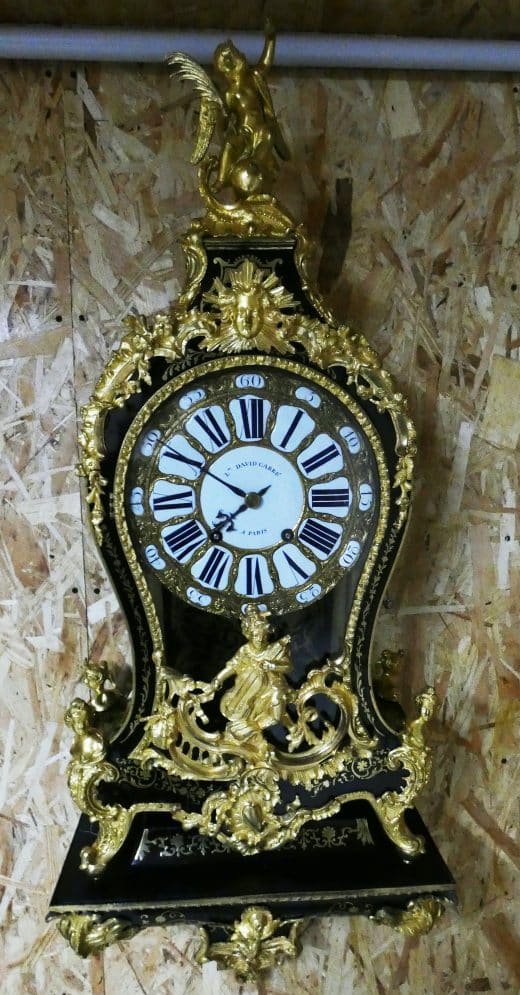
After several weeks of work, the restoration of this clock is finally complete. It is a Louis XV period clock in brown tortoiseshell and brass marquetry, with rosewood restorations. The dial is by Louis David Carré, nephew of Jullien le Roy, who became a master craftsman on December 31, 1748. Lodged at the Louvre from 1744, he was elected a juror in 1775. The greatest treasure of this clock lies in its bronze mounts. They are truly magnificent, and above all, they are in very good condition. There is only […]
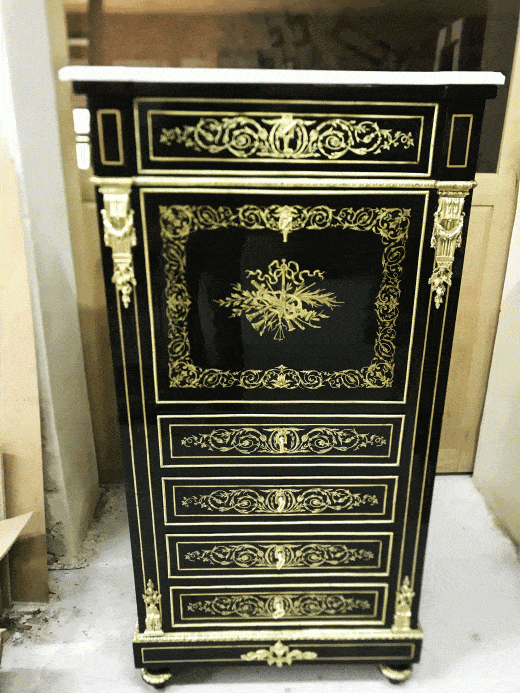
On the restoration side, there wasn't much to do: the brass fittings were reattached with fish glue and by infiltration, then stripped and varnished. The most difficult part of this type of furniture is the black stain. Over time, pear wood darkens, loses its color, and turns gray. It then needs to be stained, without, of course, obscuring the brass. To do this, I fill and polish the piece until the brass becomes a true mirror. Then, I apply a hot logwood stain, and then […]
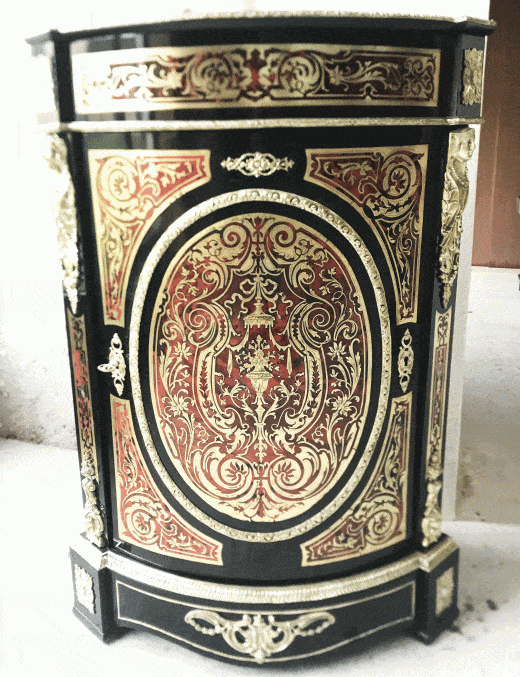
A classic restoration of Boulle marquetry. This involved rehydrating the old glue through infiltration, crafting and gluing the missing brass pieces, and reconstructing the base, which was in poor condition but not beyond repair. The bronze mounts were cleaned and finished with a clear French polish. Proof that appearances can be deceiving. Even a piece of furniture in a severely deteriorated state can regain its former beauty.
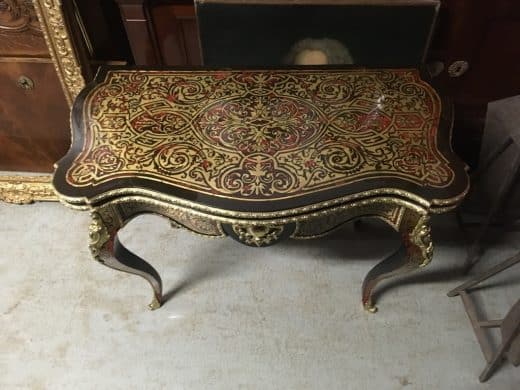
Restoration of a Napoleon III period games table in Boulle marquetry of red tortoiseshell and brass. On this piece of furniture, approximately 45% of the marquetry from the tabletop has been reproduced.
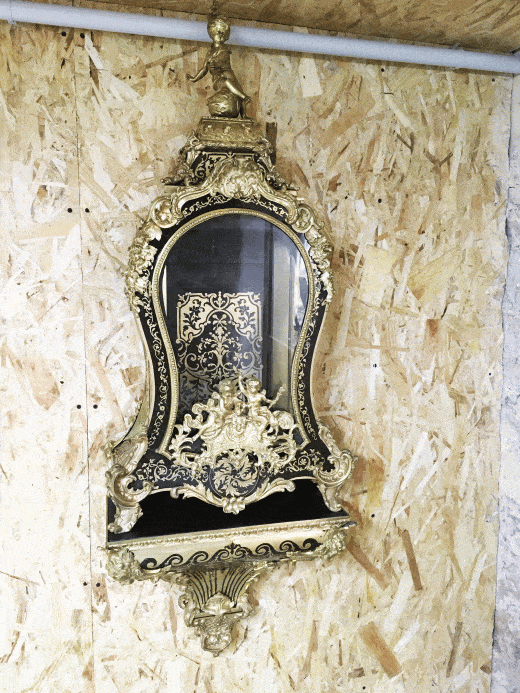
After a few hours of cutting, gluing, re-gluing, and cleaning the surfaces, we finally reach the finishing stage. For this cartel clock, we chose to French polish it because it's a finish that highlights the marquetry, protects it, and is easily reversible (like all my work). I always use a clear shellac varnish, whether on wood or other materials. The varnishing process is difficult to explain; it simply takes hours and hours […]
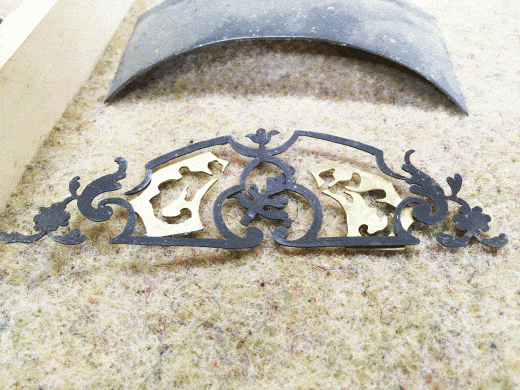
After reattaching the structure, removing the brass, cleaning up any remaining animal glue, and removing any residue of superglue and neoprene adhesive, the next step is cutting out the new pieces of brass and tortoiseshell to fill the gaps. So, as usual, I take an impression of the missing piece. Then I glue this piece of paper onto a brass plate, which is itself glued with fish glue to a piece of 4mm plywood. This makes the brass plate easier to cut. To retrieve […]
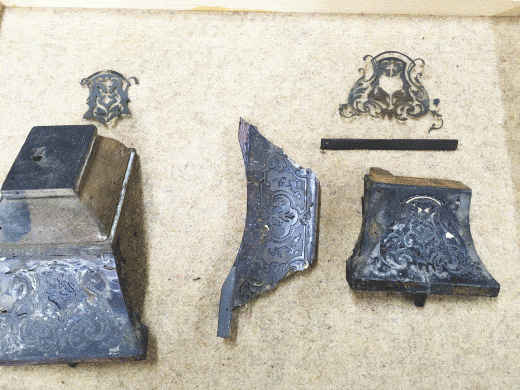
Once the various structural elements were glued back together, I tackled the tortoiseshell and brass marquetry. As you'll see, on this clock it's in very, very bad condition; practically nothing is holding. So, all the brass has to be removed. The tortoiseshell, however, is holding well; it's only partially detached. The first step in restoring this marquetry is therefore to remove and set aside each brass element. The second is to clean off the old glue, […]
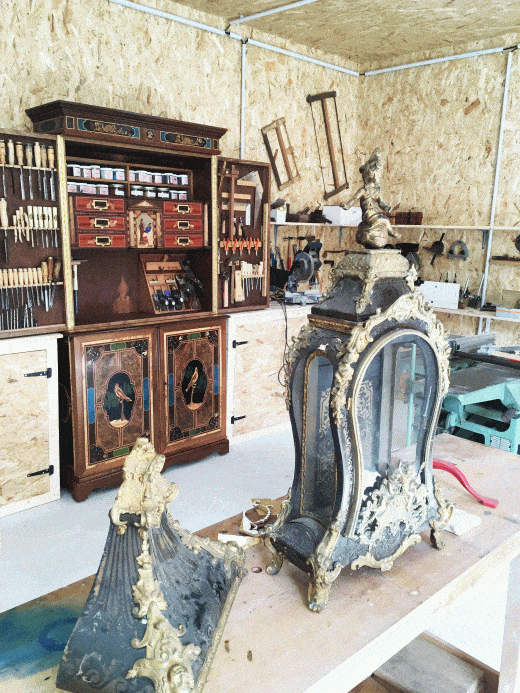
Here is my first client, patient… well, whatever you want to call him. It's a Boulle marquetry cartel clock in brown tortoiseshell, ebony, and brass. As you can see in the following photos, it's not in very good condition. There are many missing brass pieces, and the remaining brass is peeling off everywhere. At first glance, it's always difficult to precisely date a Boulle cartel clock: this one doesn't have a maker's mark. However, it does have corkscrew screws (typical of the 18th century […]