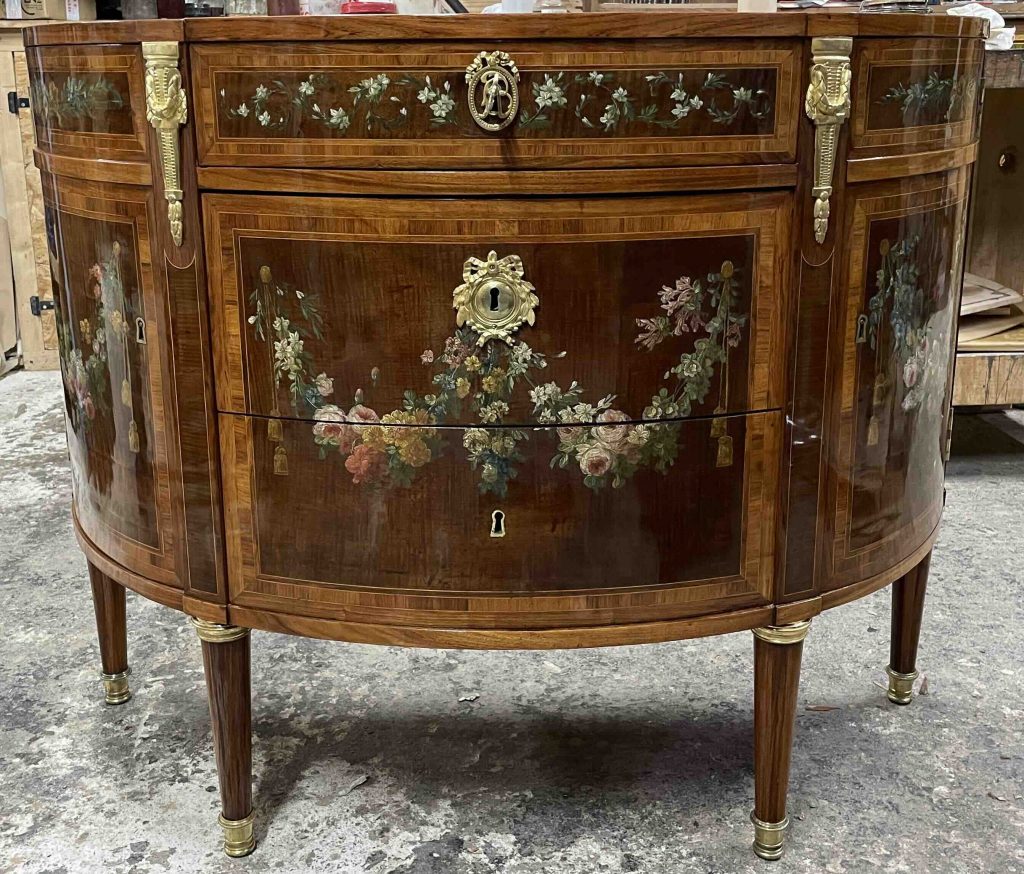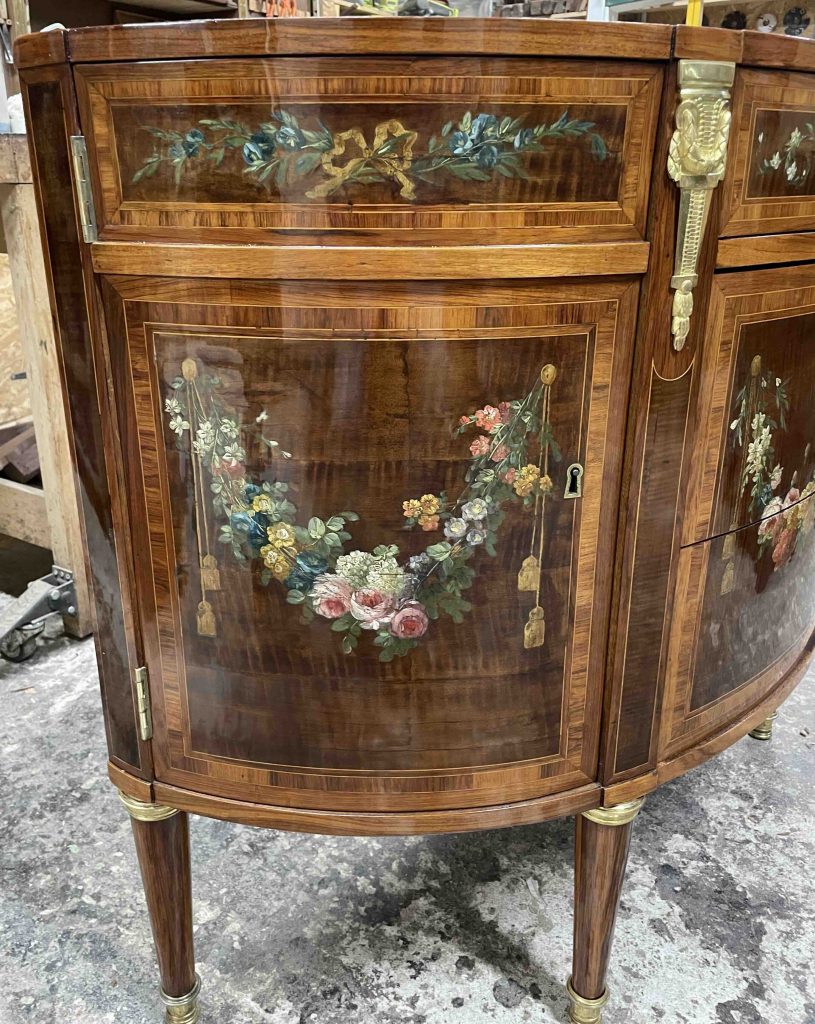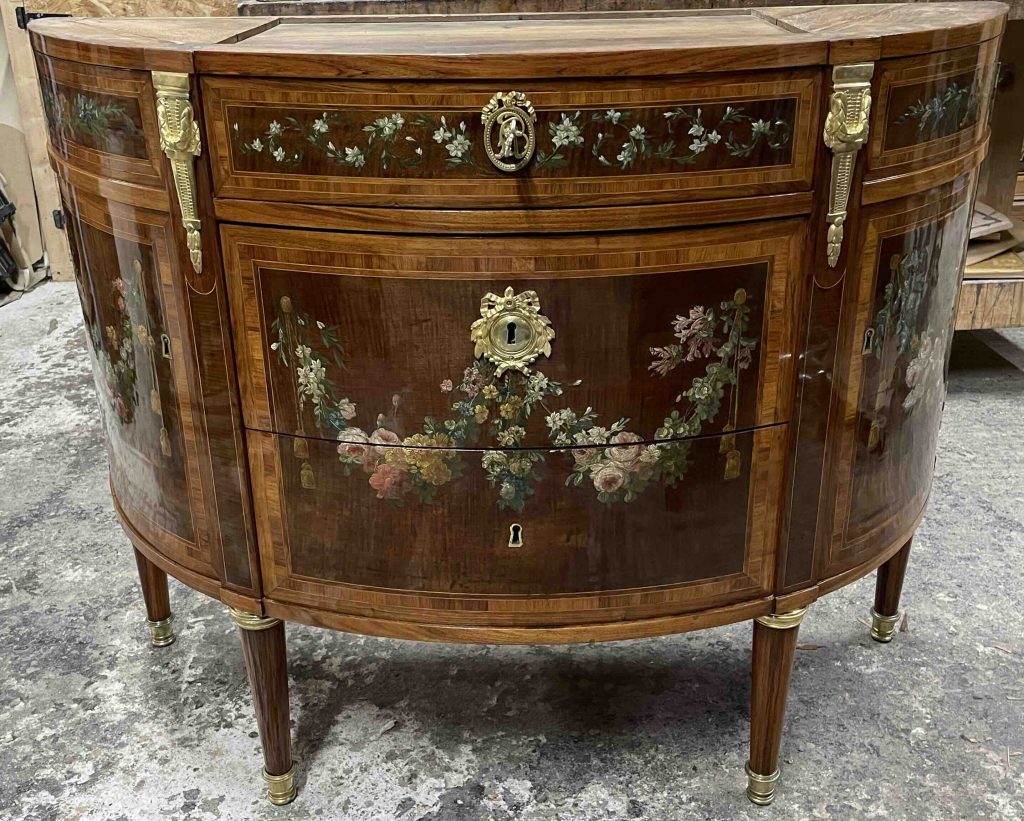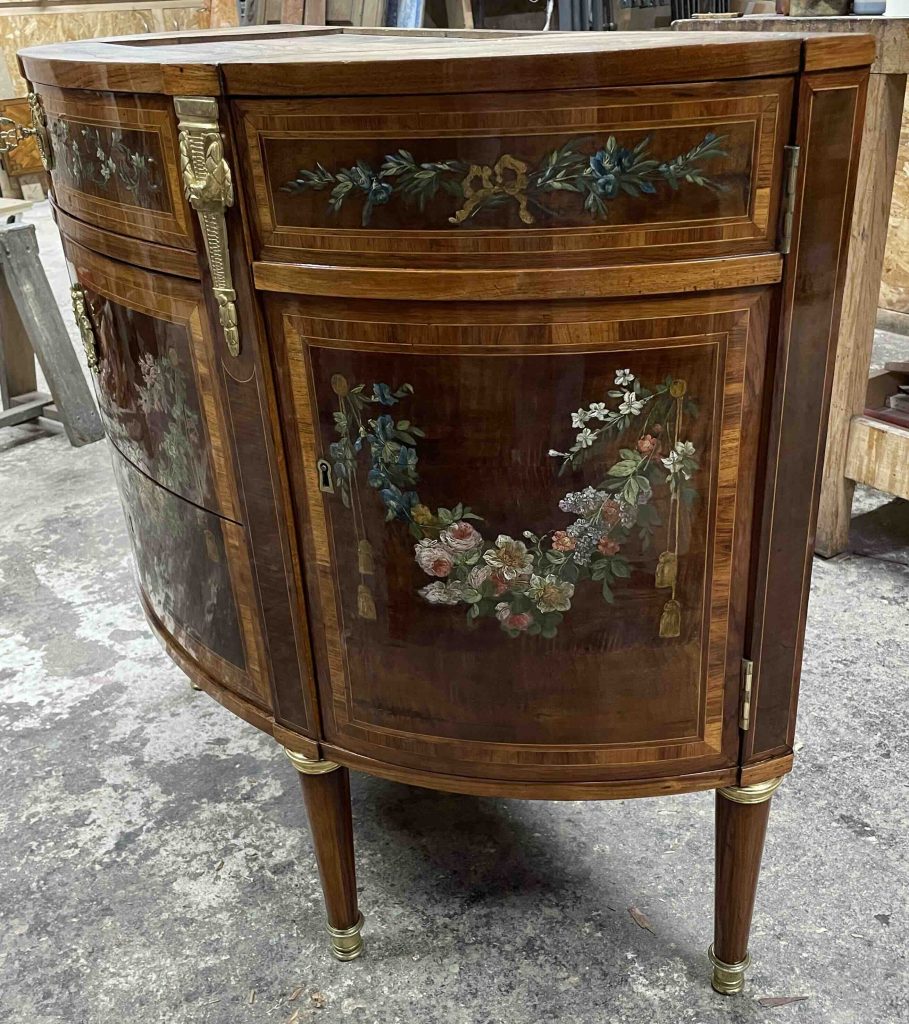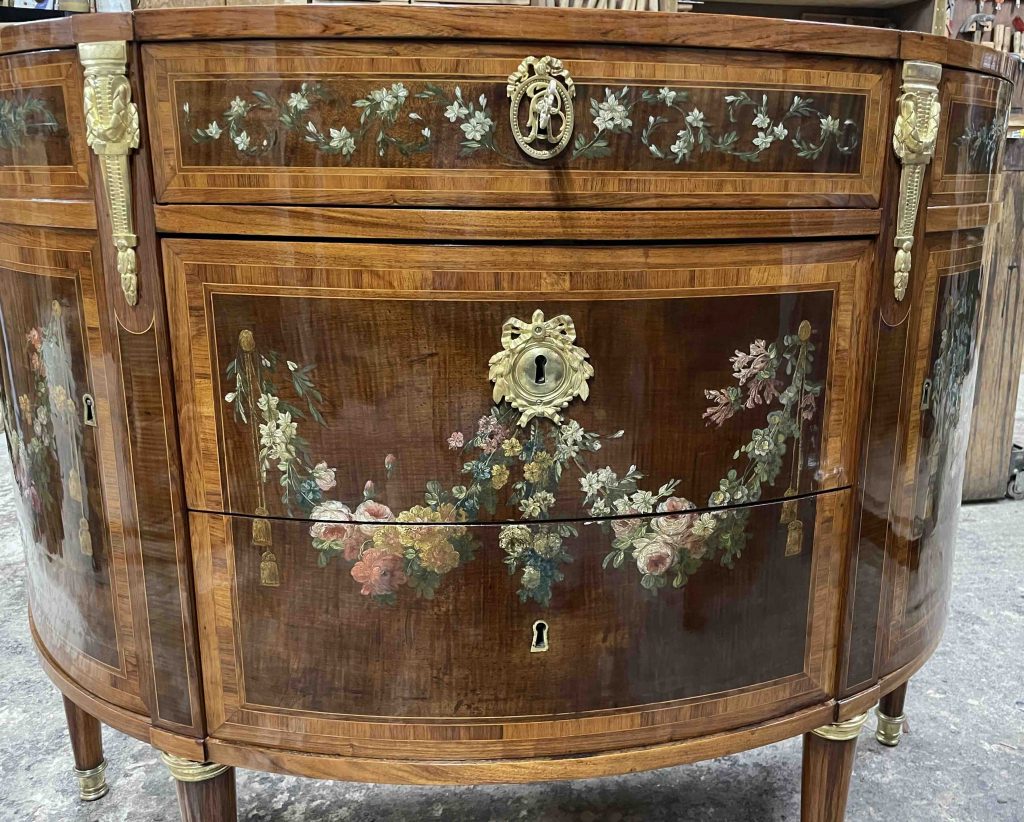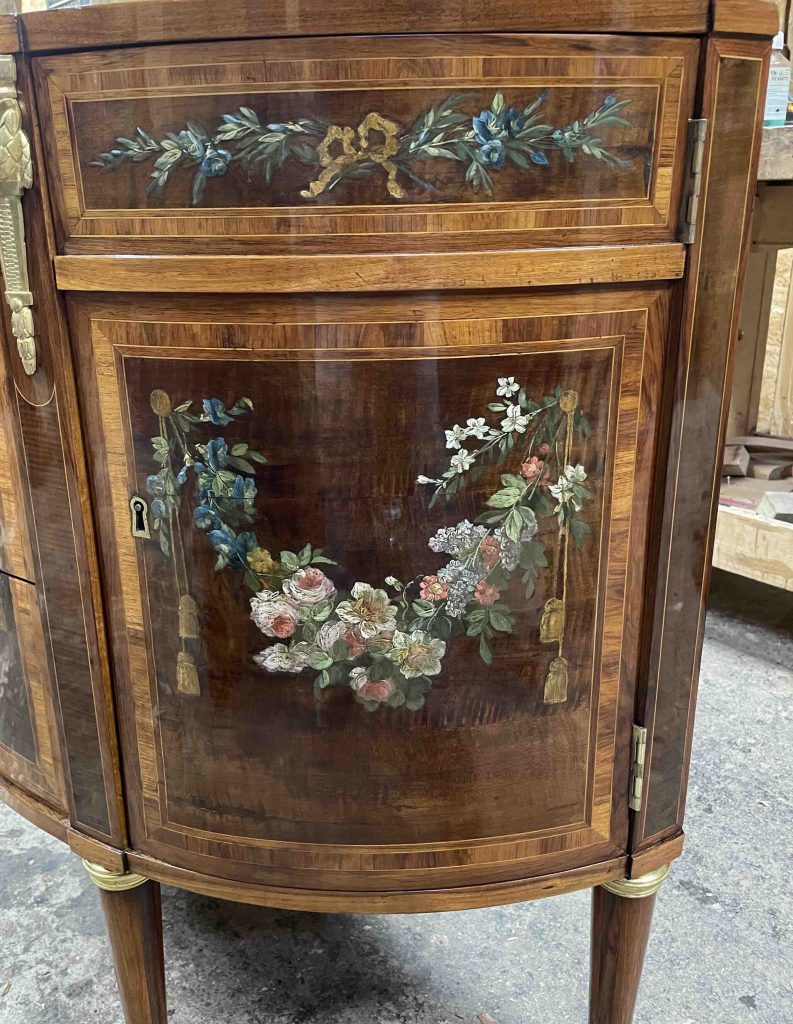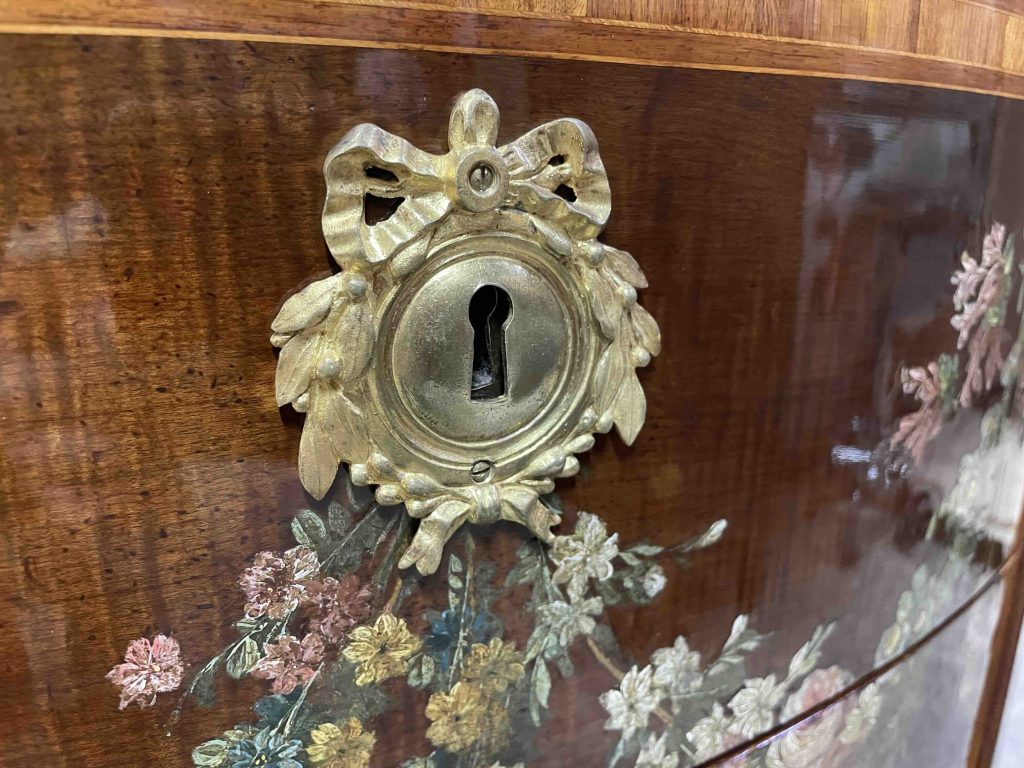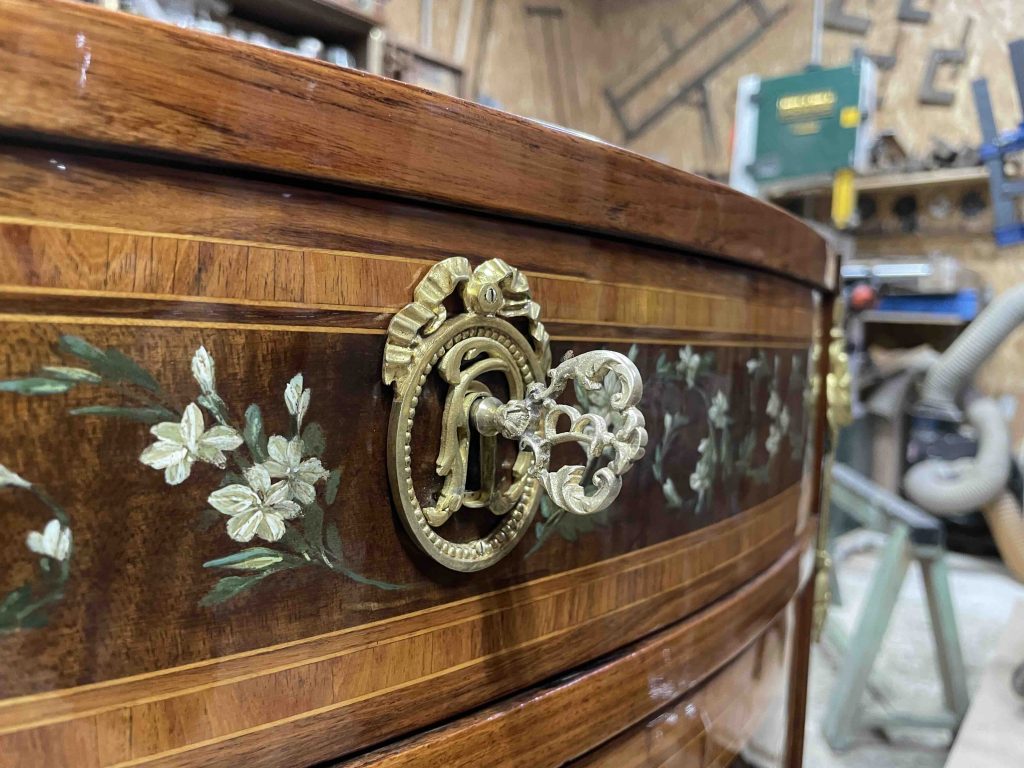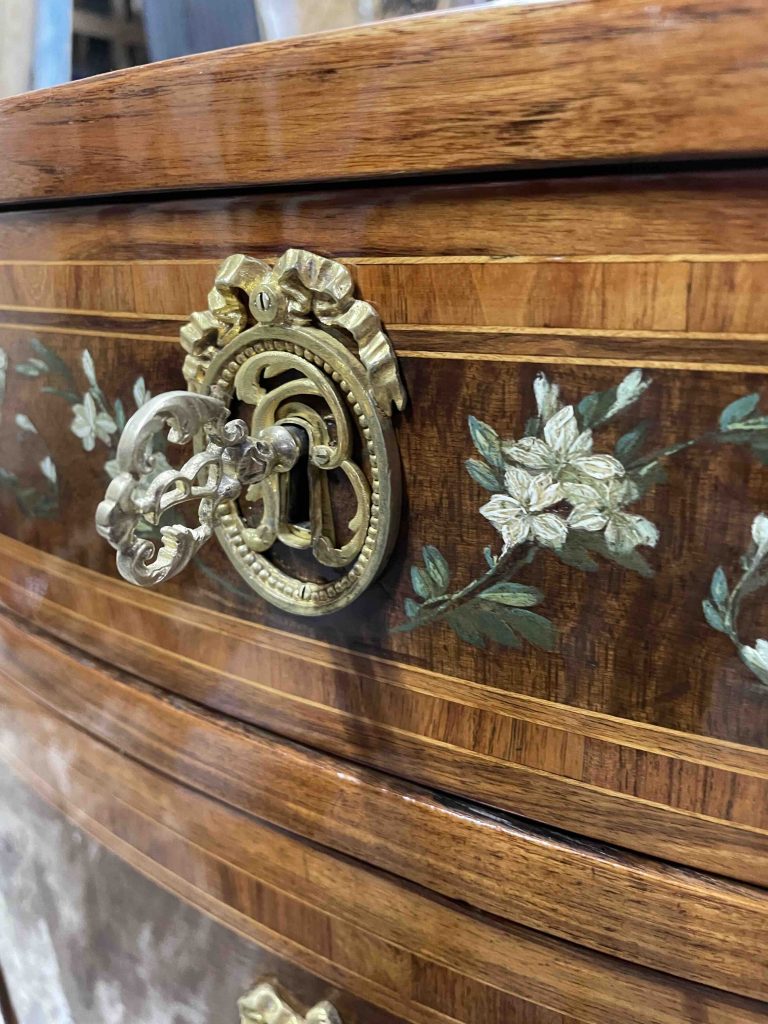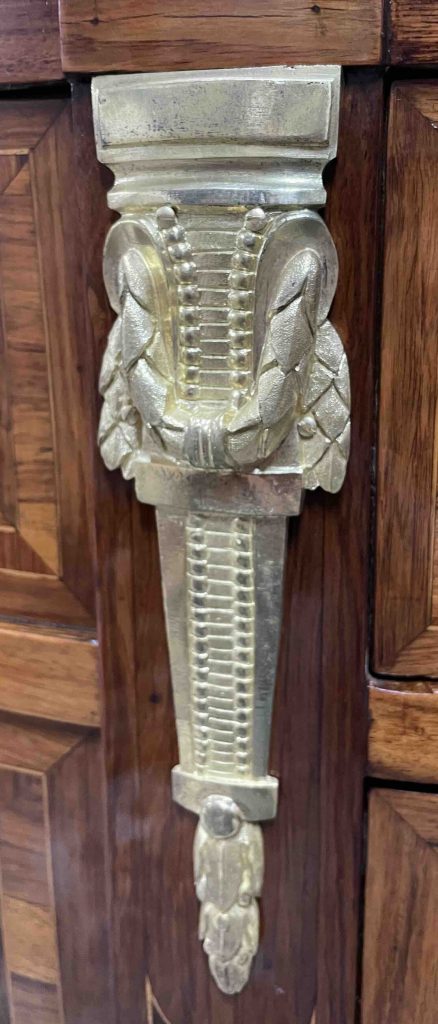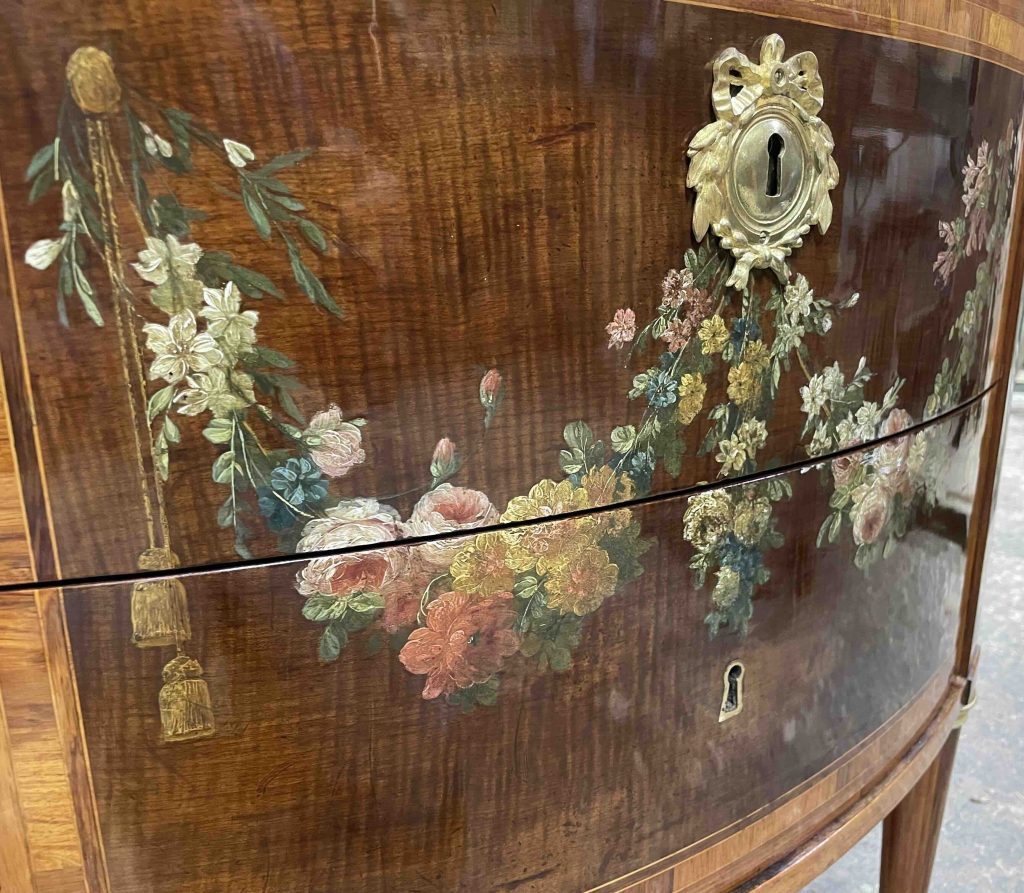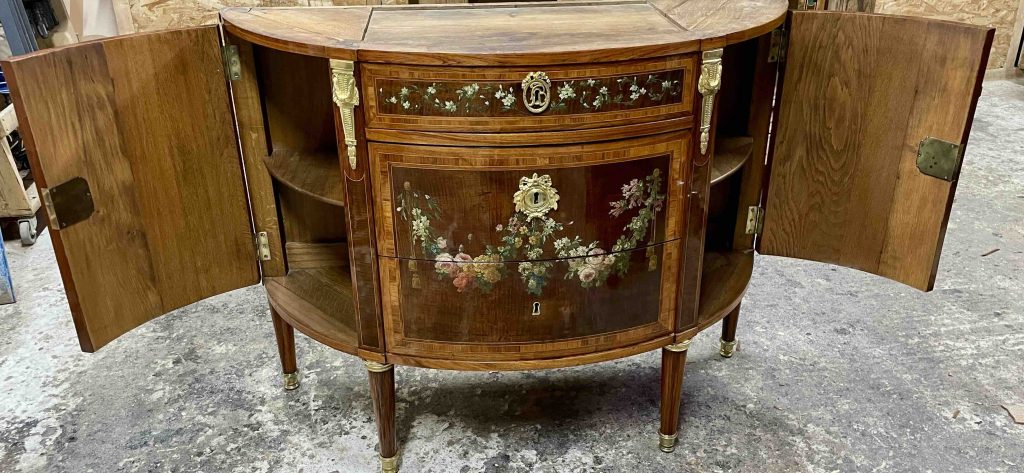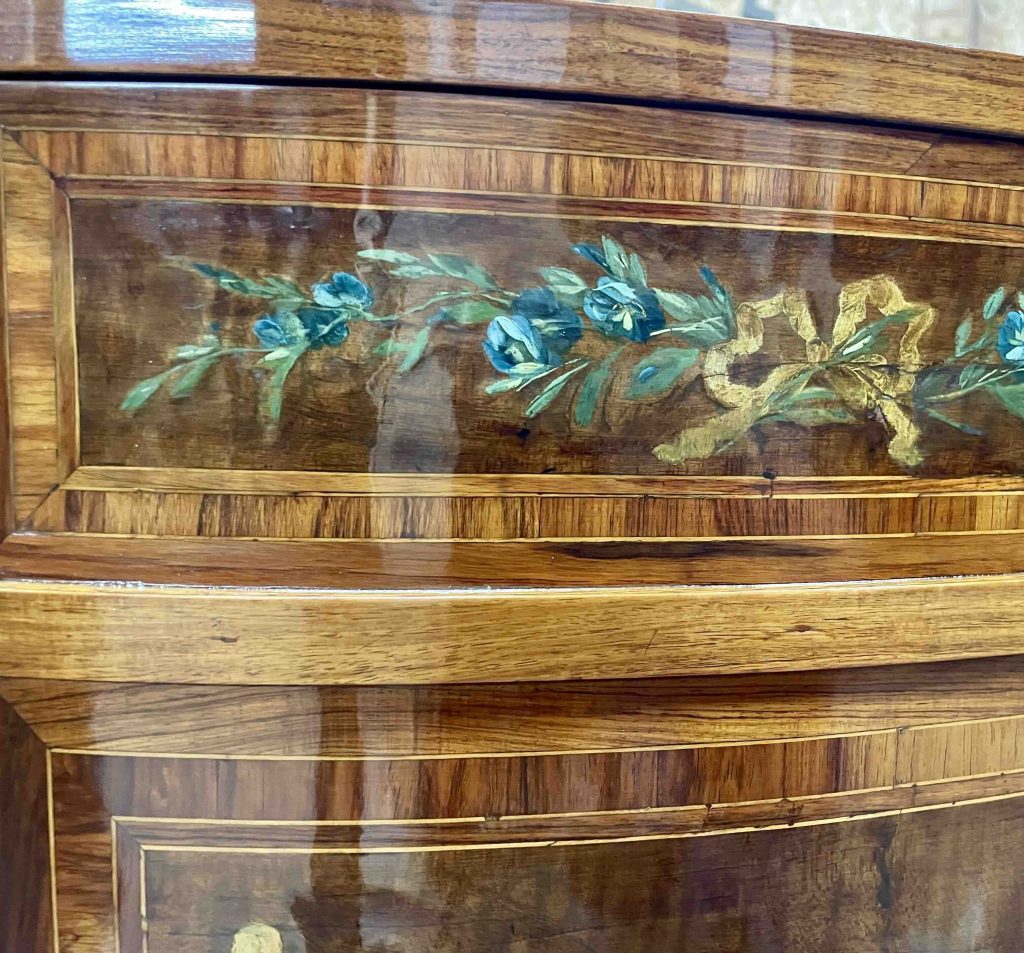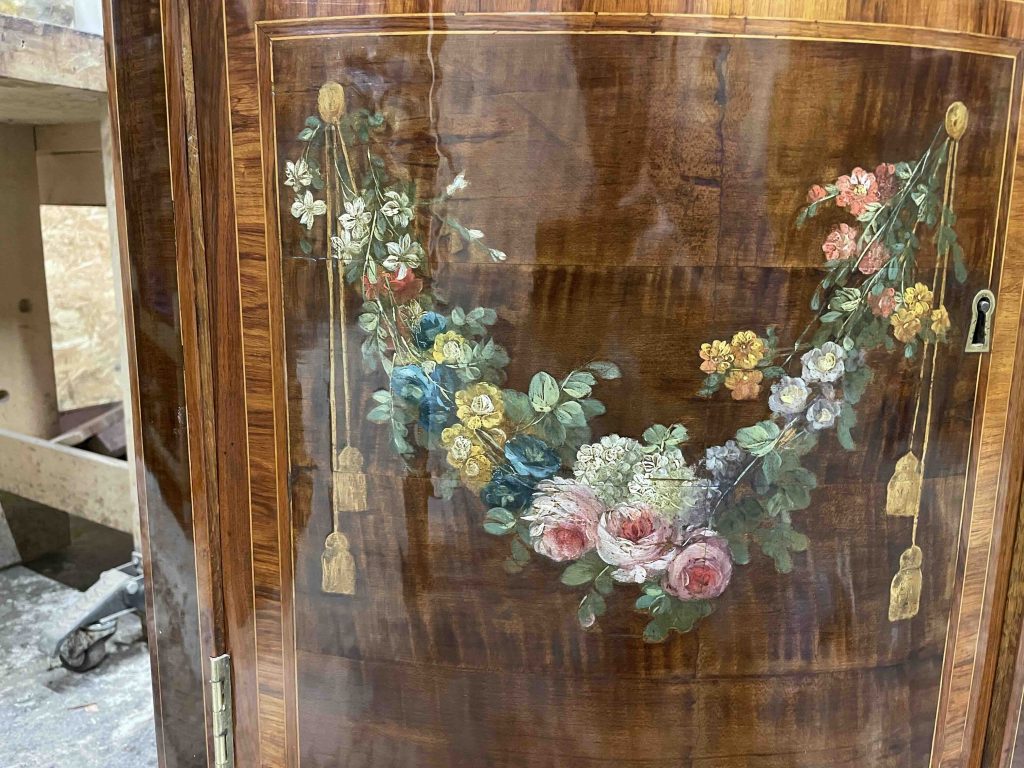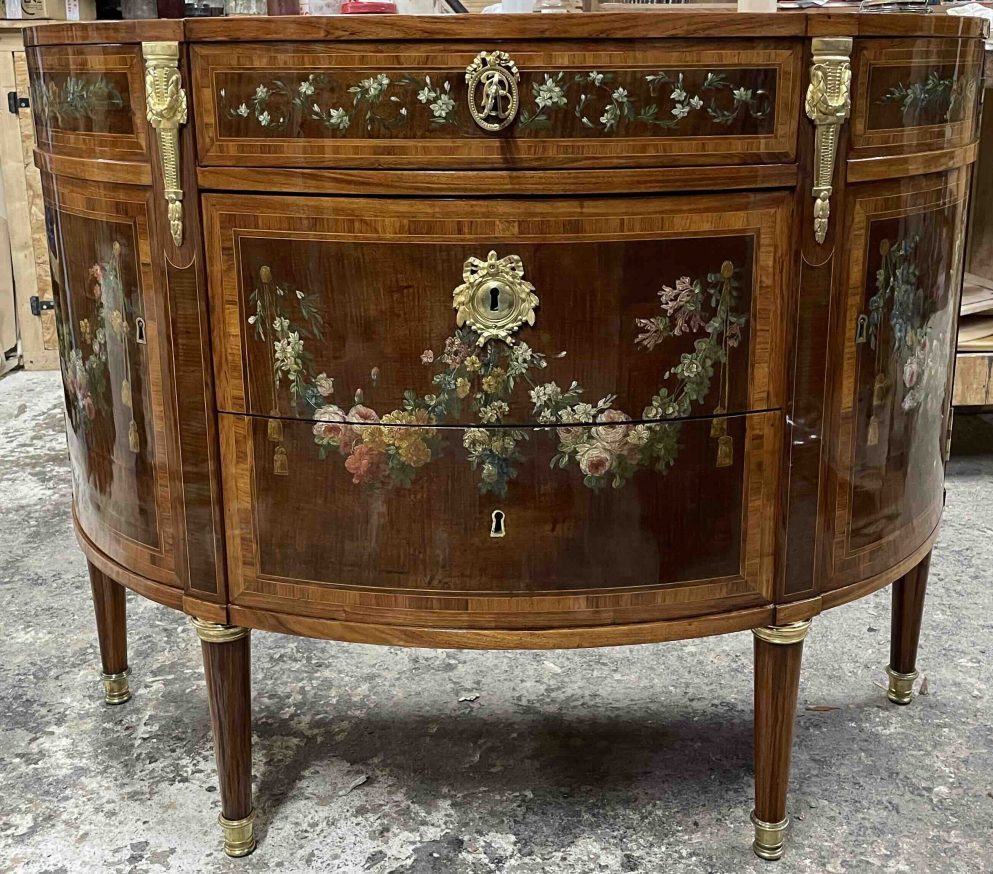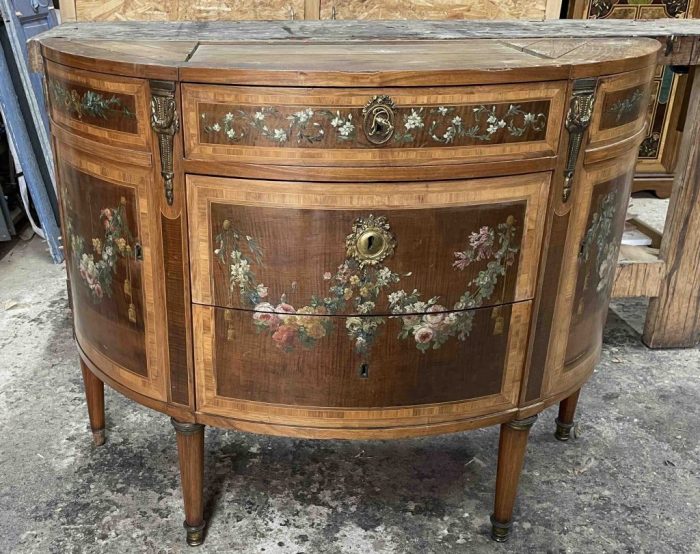
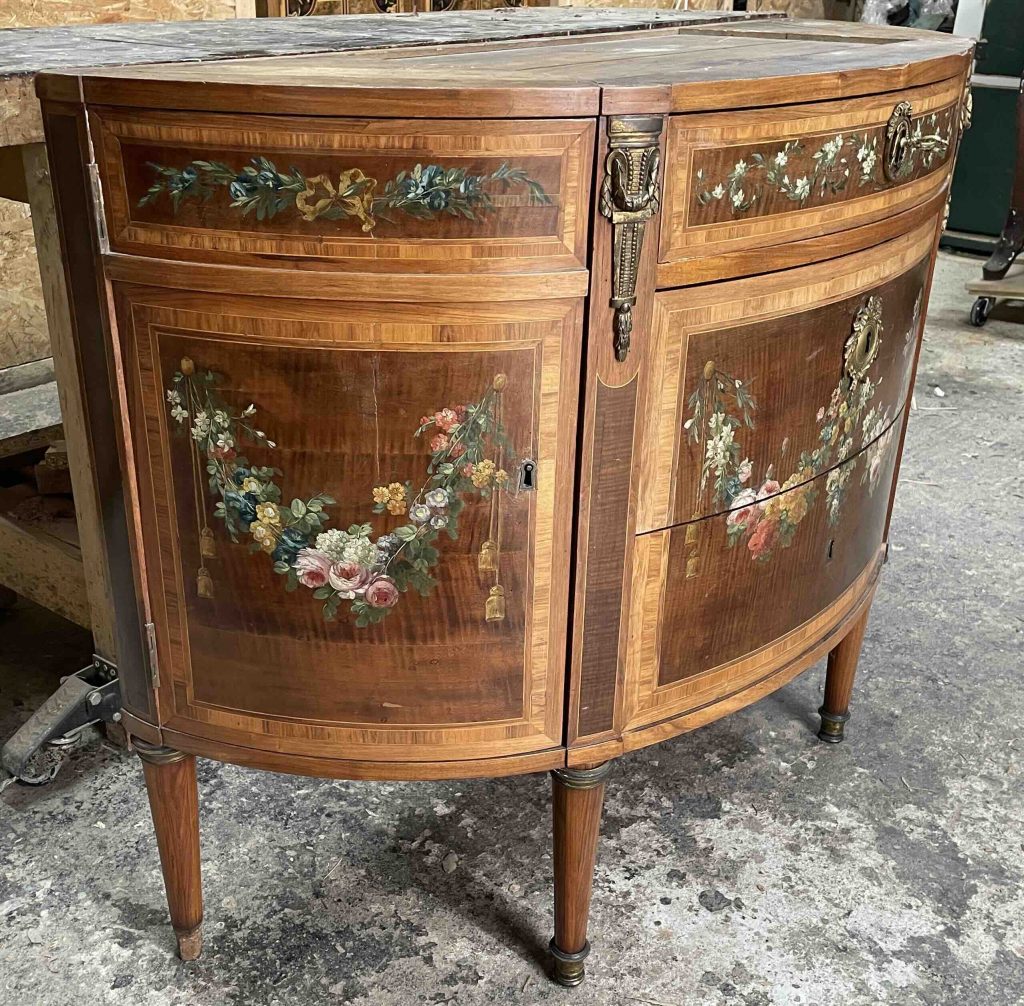
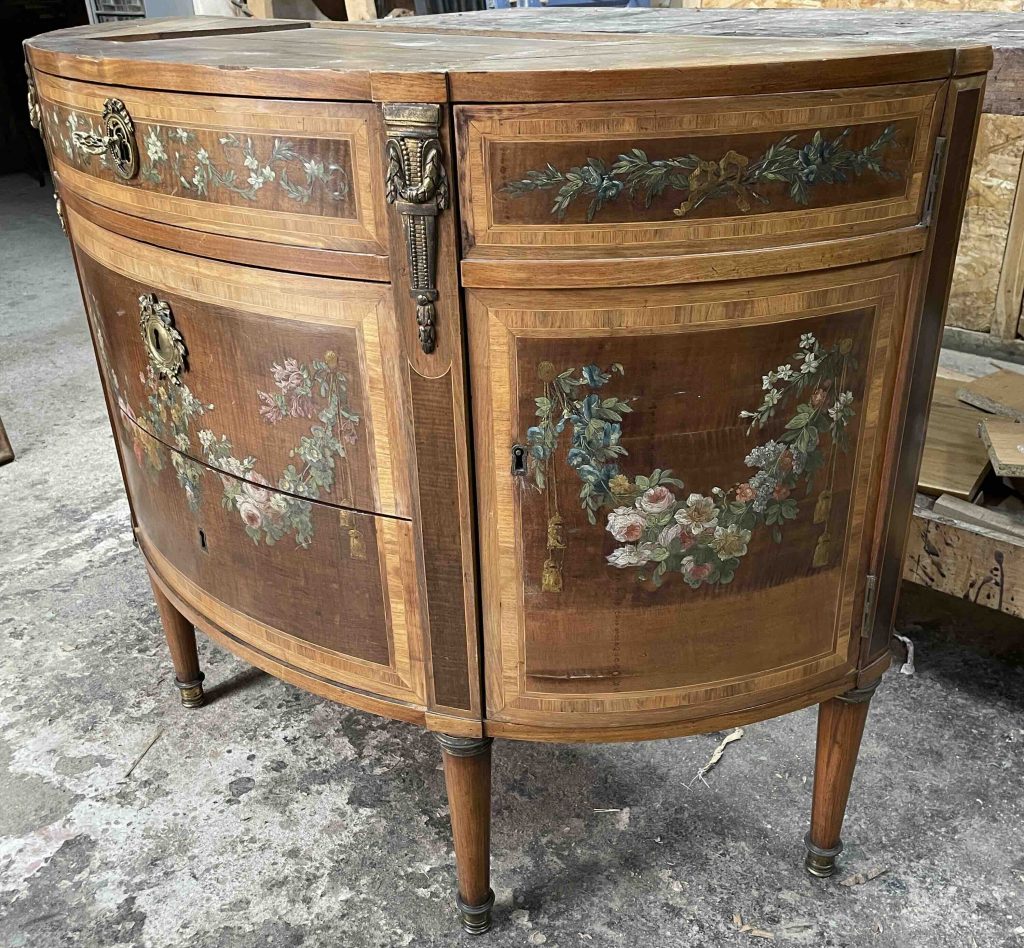
This Louis XVI period half-moon commode, stamped by the cabinetmaker Jacques Laurent Cosson, likely dates from a production between 1780 and 1790. It is an exceptional example of painted furniture from the end of the Ancien Régime, belonging to a very small group of which only seven examples are currently known. This small and highly sought-after group of 18th-century French painted furniture is now recognized as one of the most inventive areas of Parisian cabinetmaking on the eve of the Revolution. This commode, with its curved, half-moon shape, rests on four tapered legs ending in gilt-bronze sabots and is veneered with rosewood and tobacco-stained sycamore.
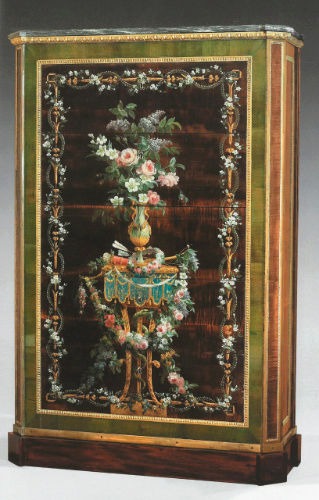
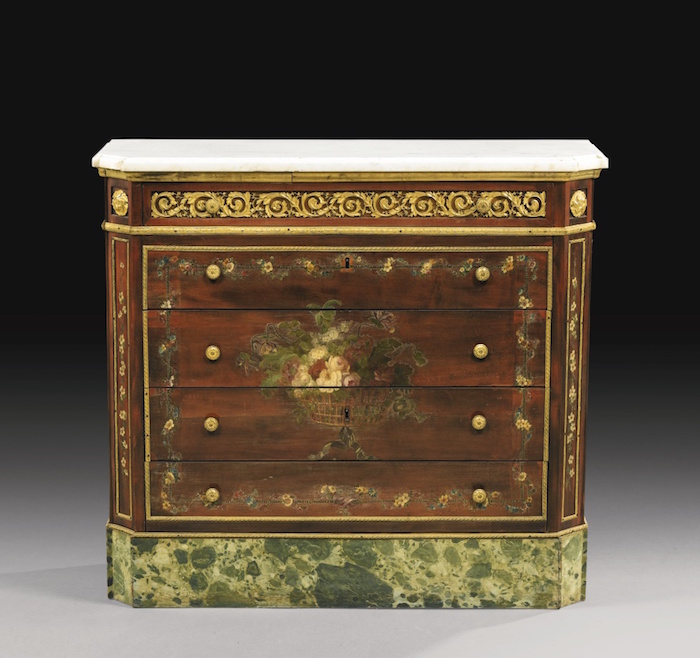

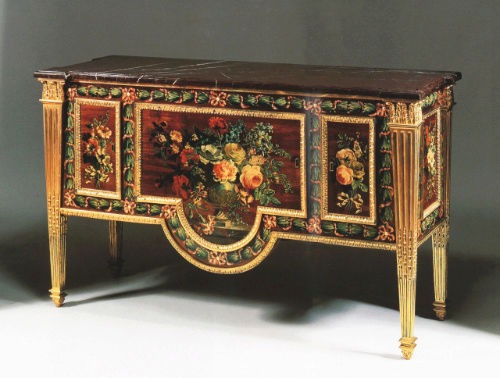
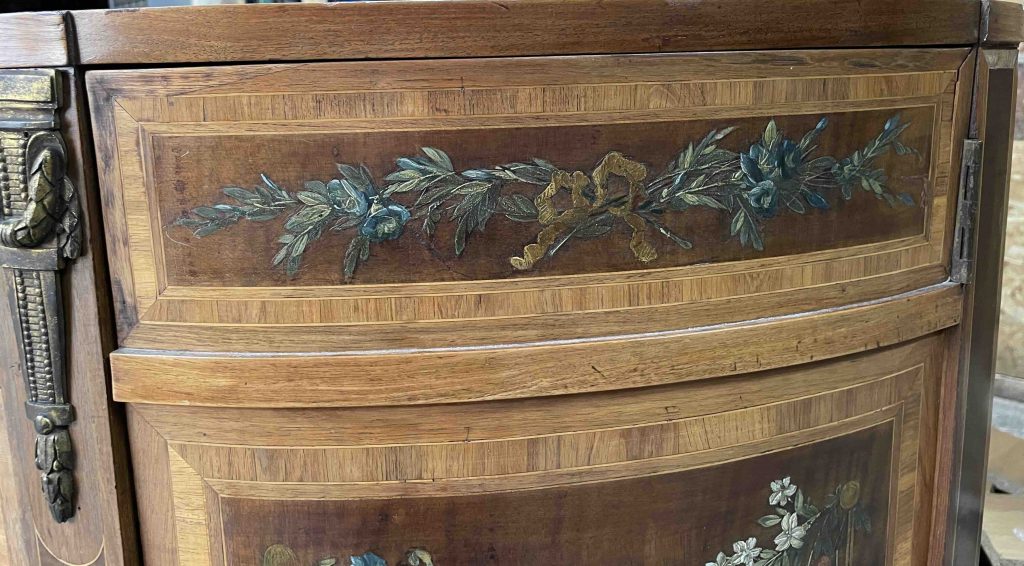
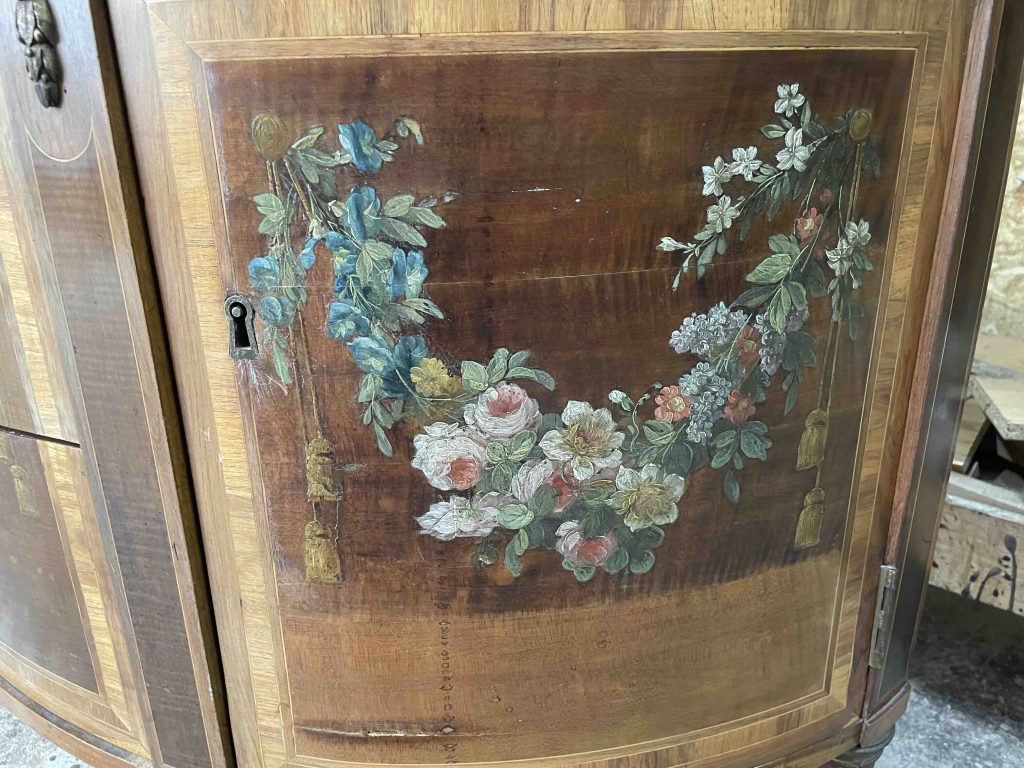
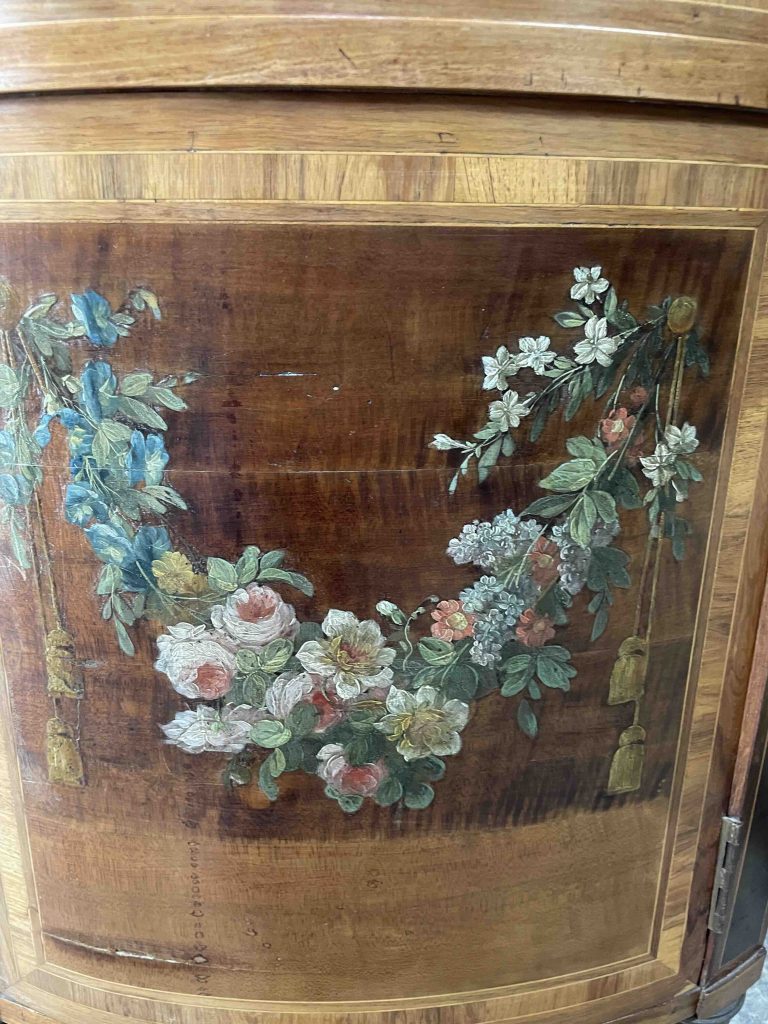
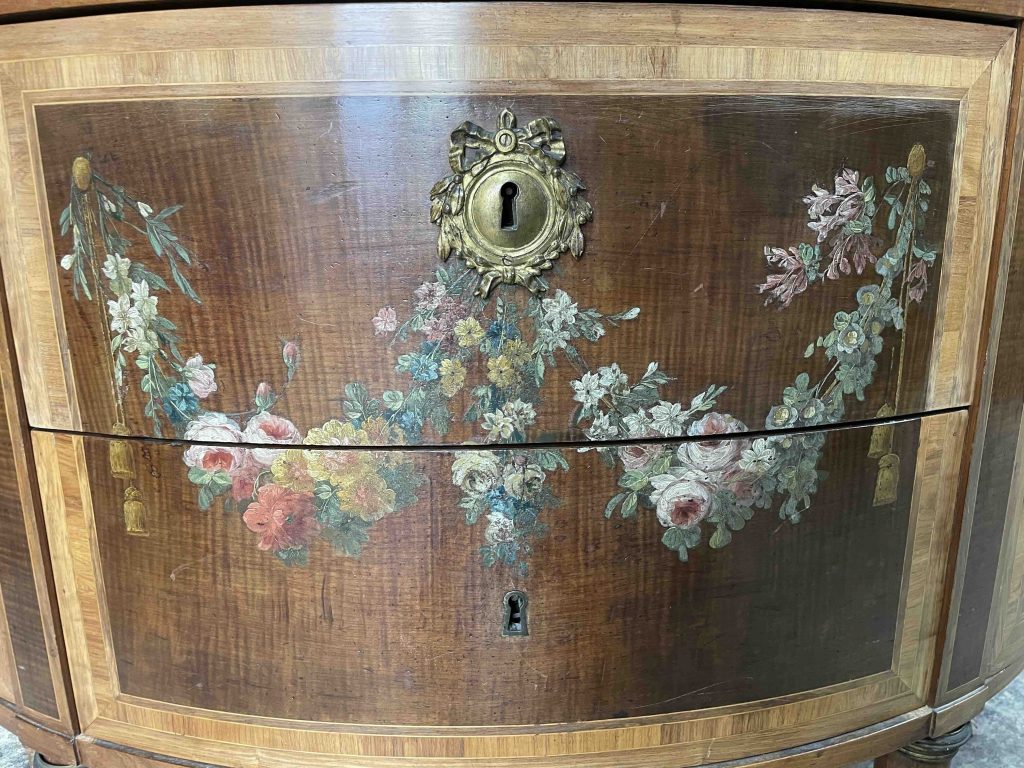
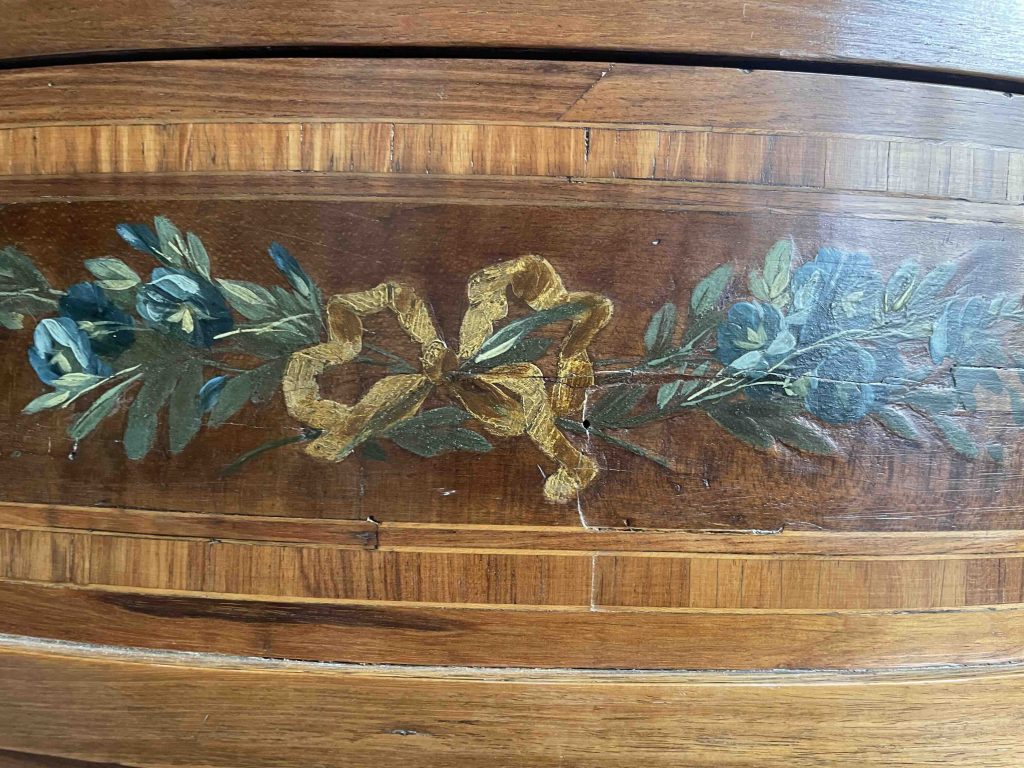
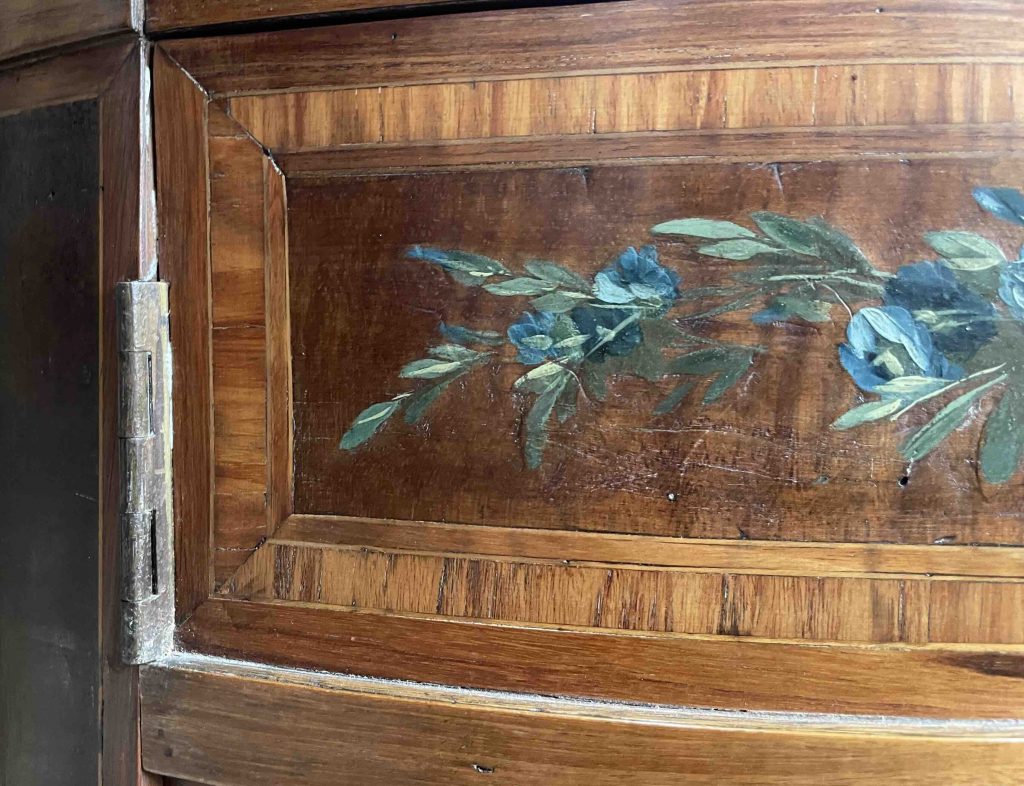
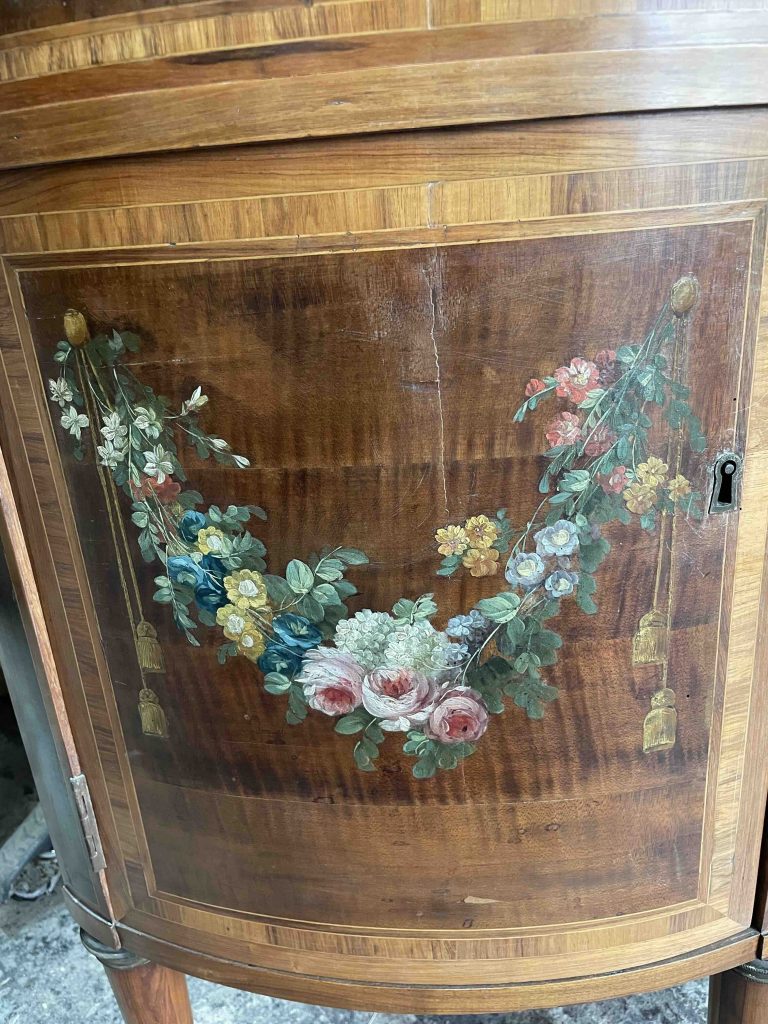
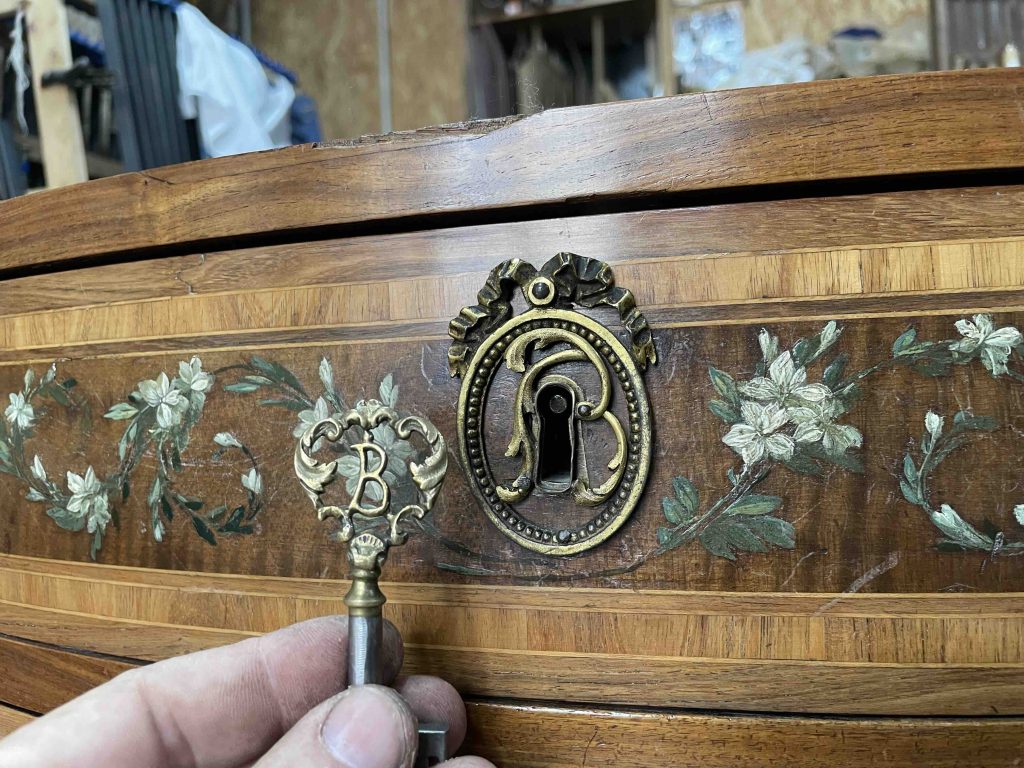
The painted decoration constitutes the central element of this work. The facade and side panels are adorned with naturalistic floral garlands, treated with great chromatic finesse, directly evoking the pictorial repertoire of flower and trophy designs in vogue, such as those popularized by contemporary artists.
This technique, mentioned in contemporary sources and extensively discussed in reference works such as "« The Renaissance of French Art», This style differs from Far Eastern lacquer. It is European painting, often executed by specialized artists such as Leriche or Prévos, in comparable works, working closely with the cabinetmaker. The furniture thus becomes a true pictorial support, blurring the line between decorative arts and easel painting. Sources indicate that these pieces were often intended for refined interiors, such as cabinets or small apartments, belonging to a high-ranking clientele.
Archives and stylistic comparisons allow us to link this type of commode to prestigious ensembles, sometimes associated with major figures at court, such as Madame du Barry.For the latter, a chest of drawers stamped Cosson, decorated with flowers painted by Leriche, is expressly mentioned in the literature.
A PRESTIGIOUS PROVENANCE
Our commode boasts a prestigious provenance, having belonged to the renowned antique dealer Arnold Seligmann. It is notably featured in one of the sumptuous salons of his private mansion located on Place Vendôme, as evidenced by the publication "« The Renaissance of French Art and Luxury Industries » of June 1926 (pages 356-359). This publication attributes the creation of the chest of drawers to Madame Du Barry.
It is highly probable that Alfred Loewenstein, a Belgian collector, acquired the chest of drawers directly from Arnold Seligmann. Between 1919 and 1920, he commissioned the Belgian architect Armand Sigwalt to design the Hôtel Loewenstein, his private residence located at 35, rue de la Science in Brussels, intended to house his extensive art collection.
Before his tragic death in 1928, this businessman ranked third among the world's wealthiest people, just behind Henry Ford and John Rockefeller. The chest of drawers has remained in his direct descendants' possession to this day.
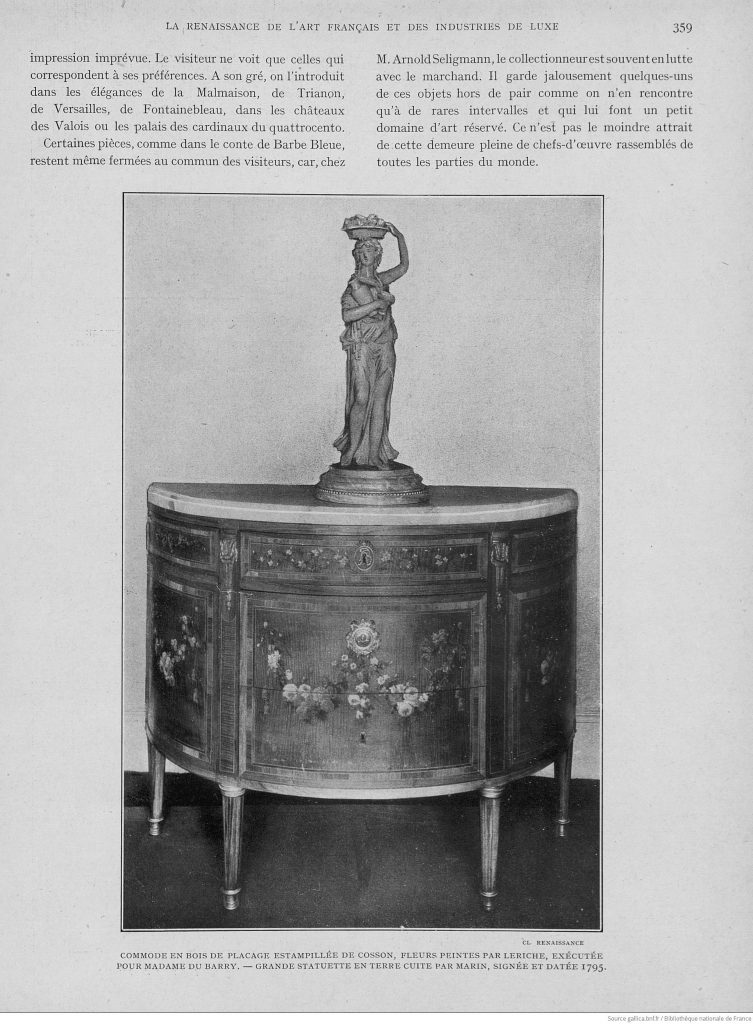
Through the quality of its craftsmanship, the richness of its painted decoration, and the presence of the Cosson stamp, this commode stands out as a major example of Parisian painted furniture from the late Ancien Régime. It illustrates a pivotal moment when French cabinetmaking explored new aesthetic avenues, already foreshadowing the decorative explorations of Neoclassicism while retaining the elegance and sensuality inherited from the 18th century.
Bibliography
- BGB Pallot, The furniture is painted against a maple and sycamore background., Connaissance des Arts, February 1987, p. 102
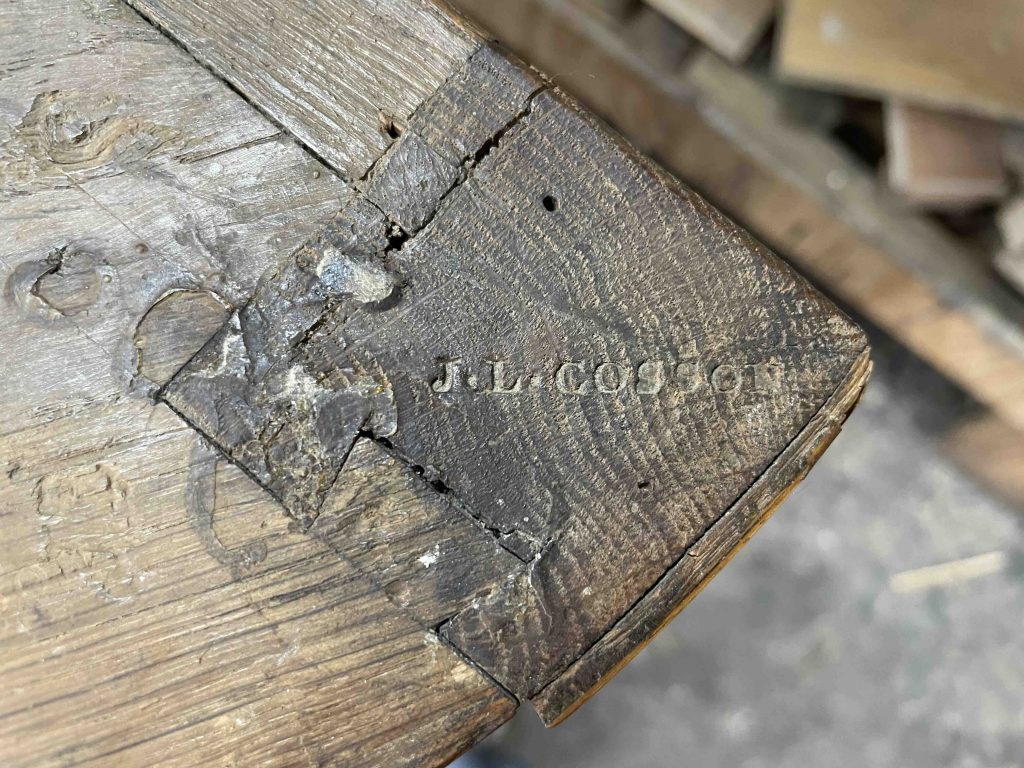
Jacques-Laurent Cosson
Having received his master craftsman's certificate in Paris on September 4, 1765, he practiced his trade on the rue de Charonne under the sign of Louis XIV or the Grand-Monarque. As early as 1772, the Almanach des Marchands du Royaume (Almanac of the Merchants of the Kingdom) mentioned him as a renowned cabinetmaker. After collaborating with the shops of his colleagues Moreau and Migeon, he supplied renowned upholsterers with a significant number of pieces in mahogany and other woods, notably desks with paperweights, secretaries in the form of stepped commodes, bedside tables with cylinders, and troughs mounted on casters. In 1784, Mr. Cosson was elected deputy or councilor of his guild. During the Reign of Terror, he married his daughter Françoise to Citizen J.-F. Laurent, former vicar of the parish of Sainte-Marguerite, who had become a member of the Paris Commune. He was still alive in 1805.
Bibliography
State of affairs report
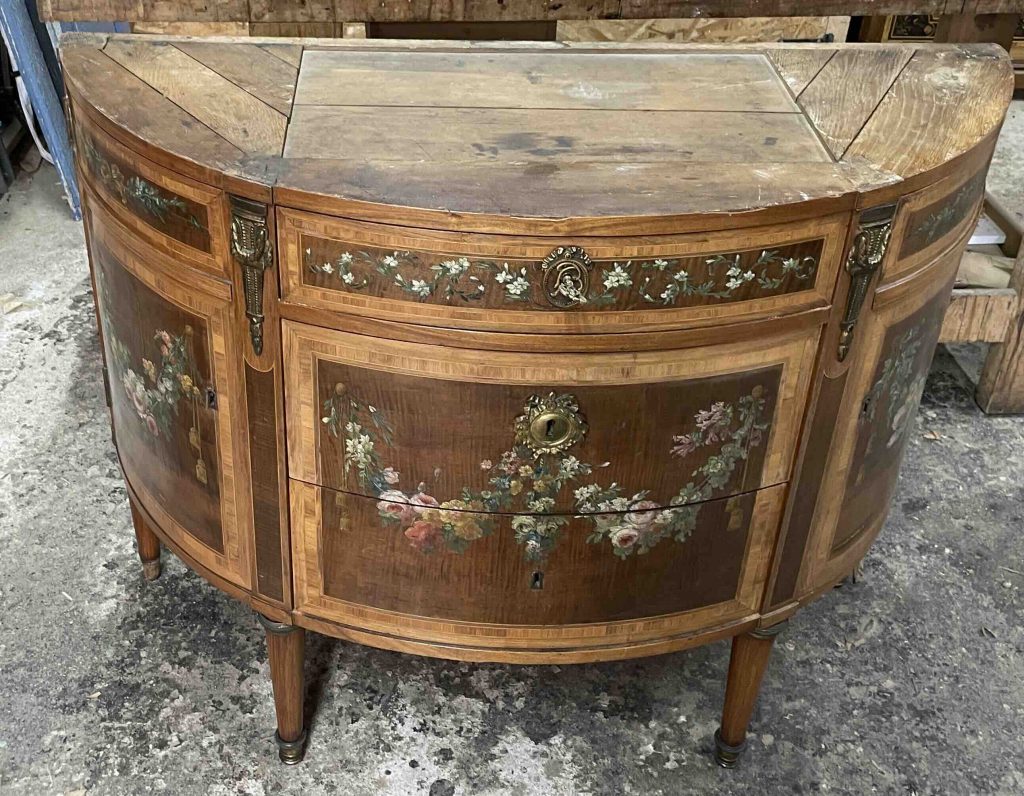
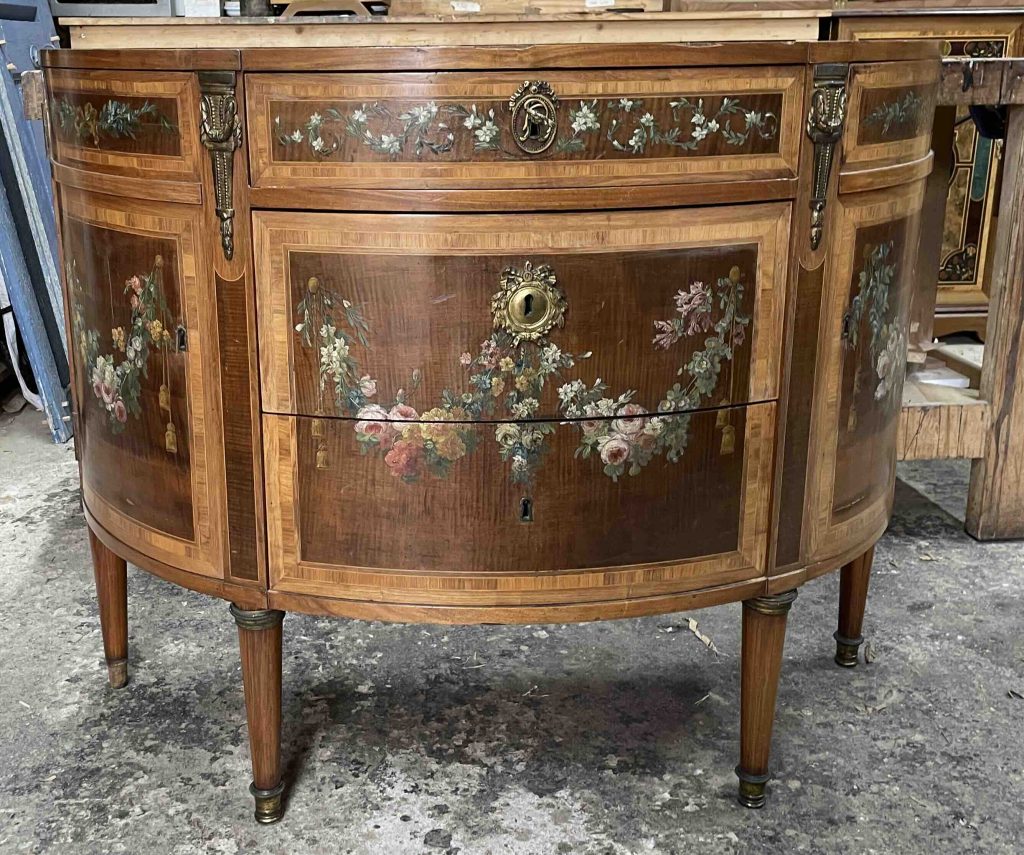
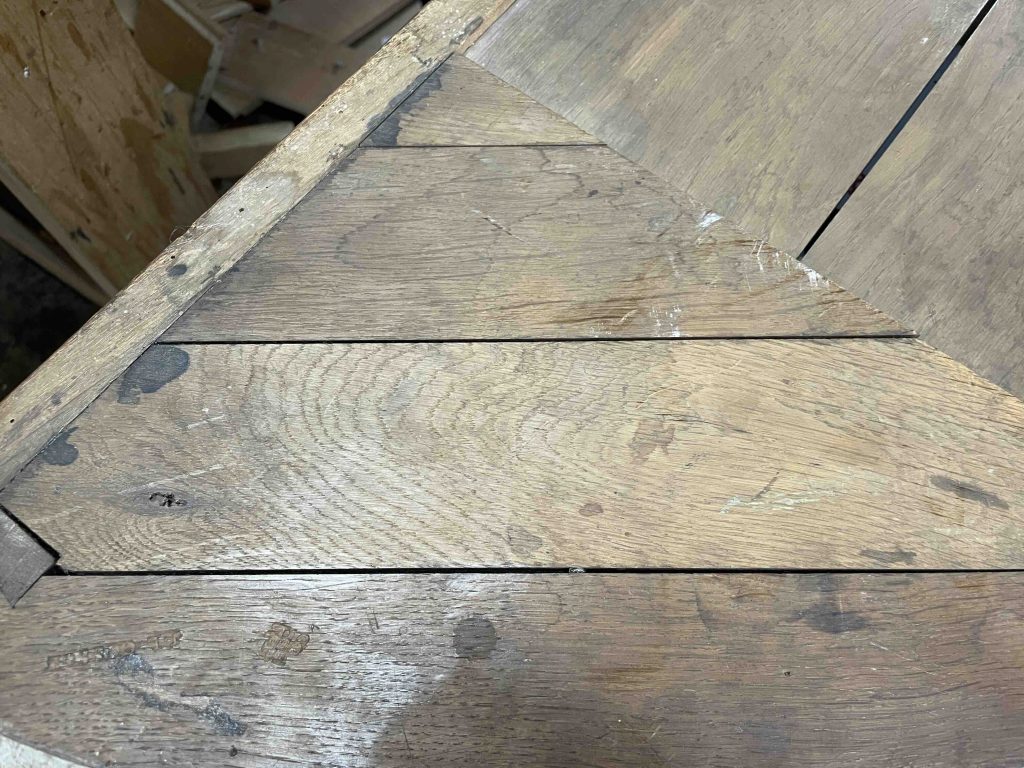
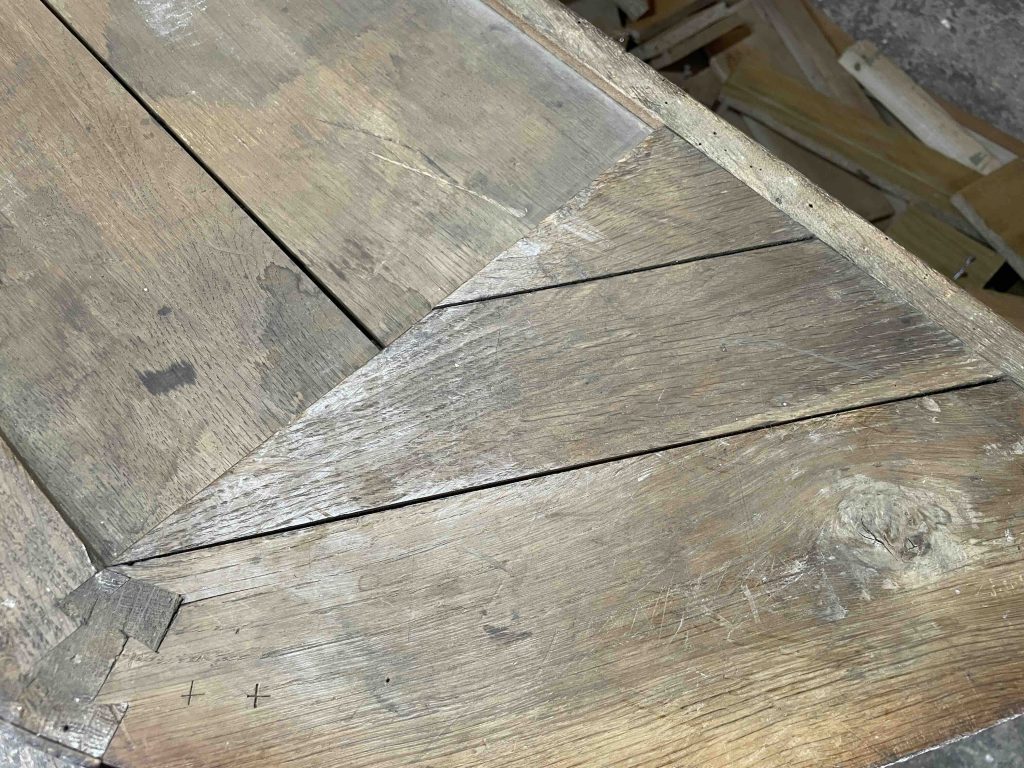
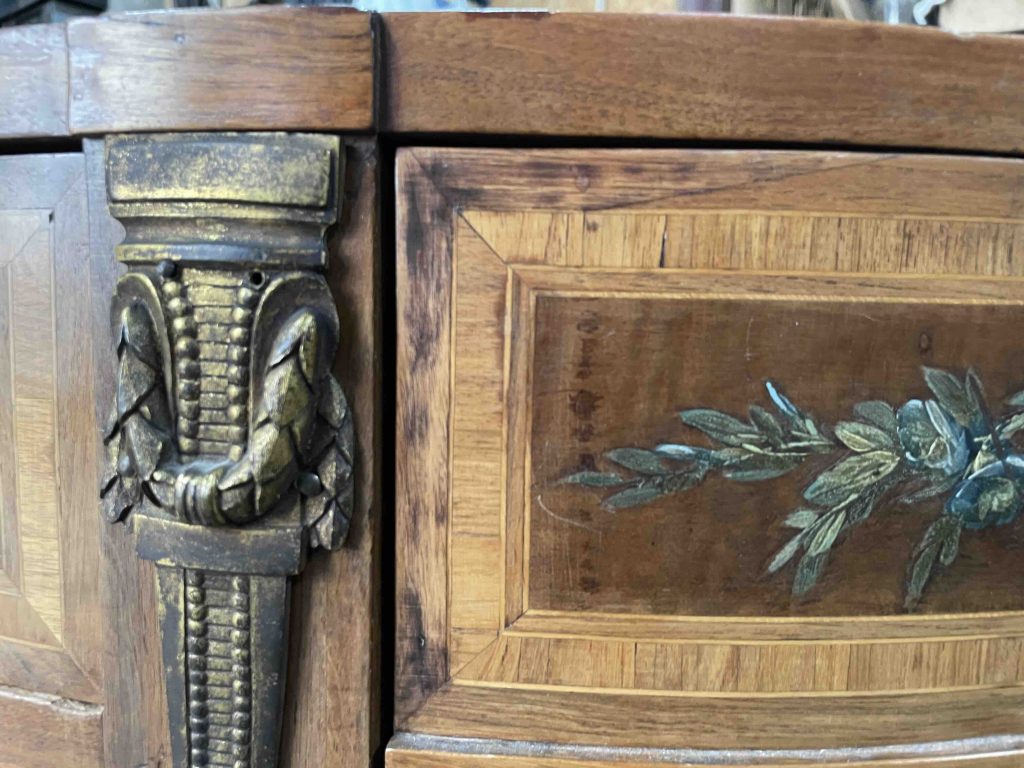
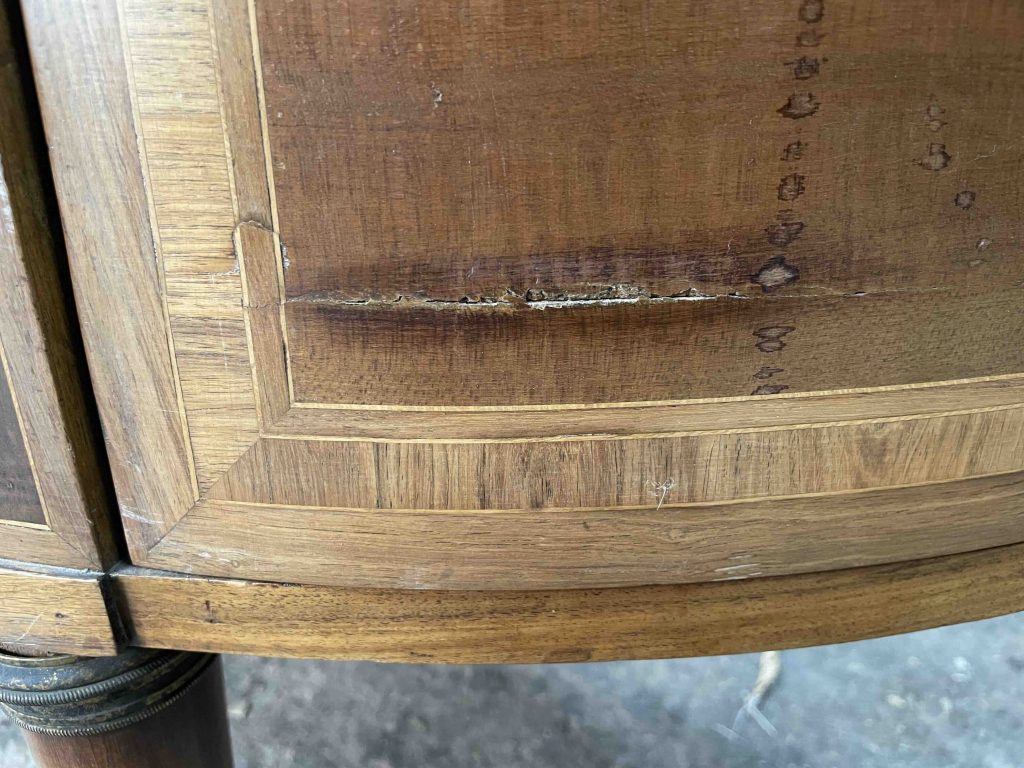
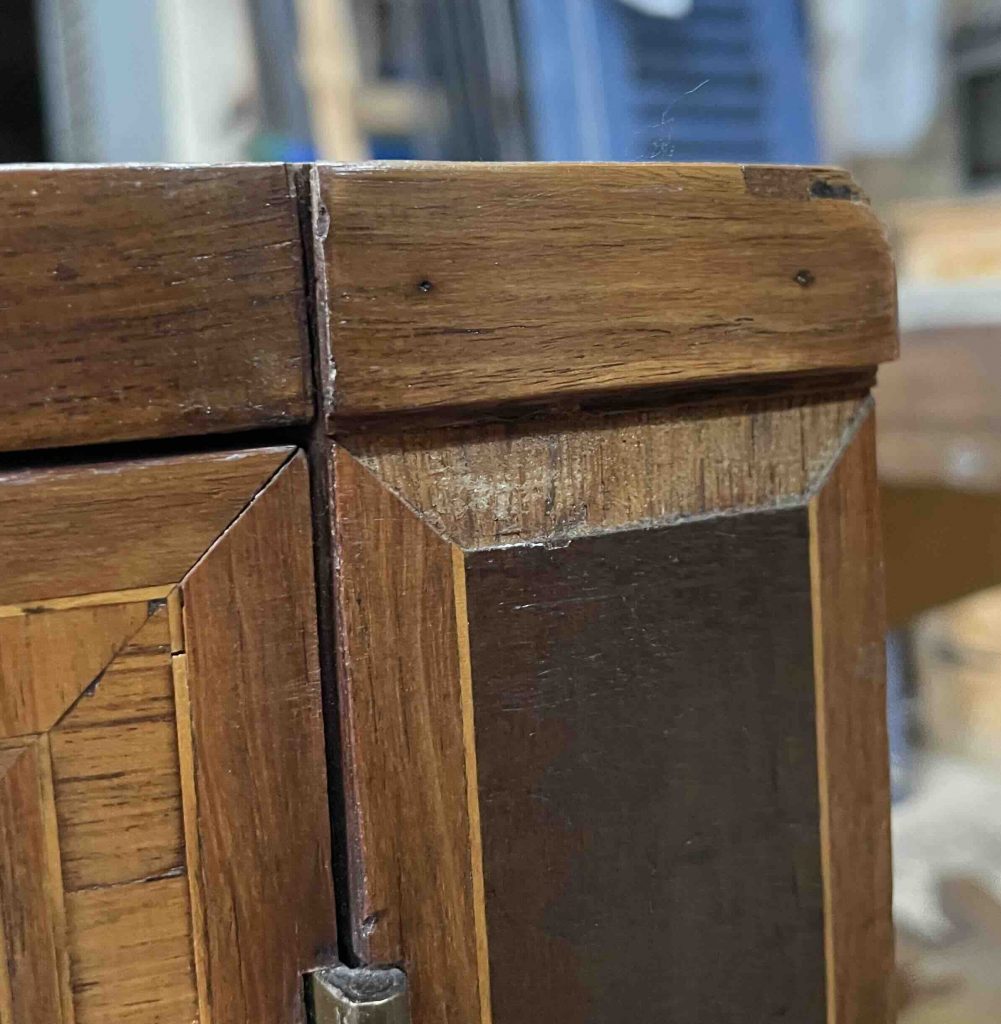
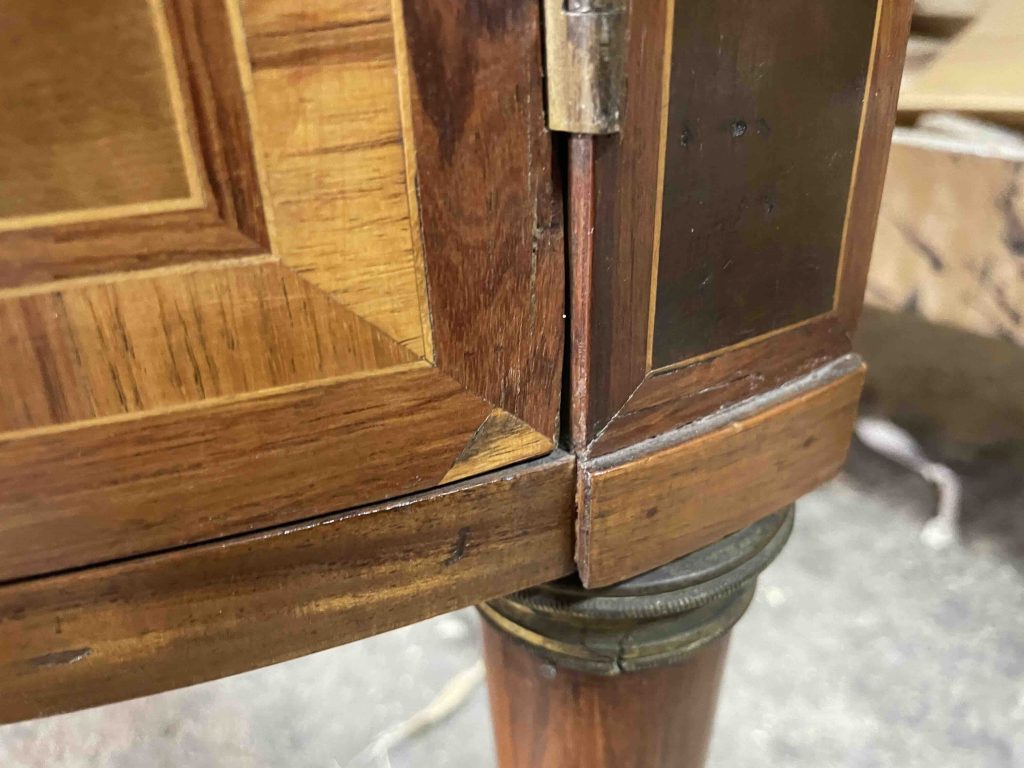
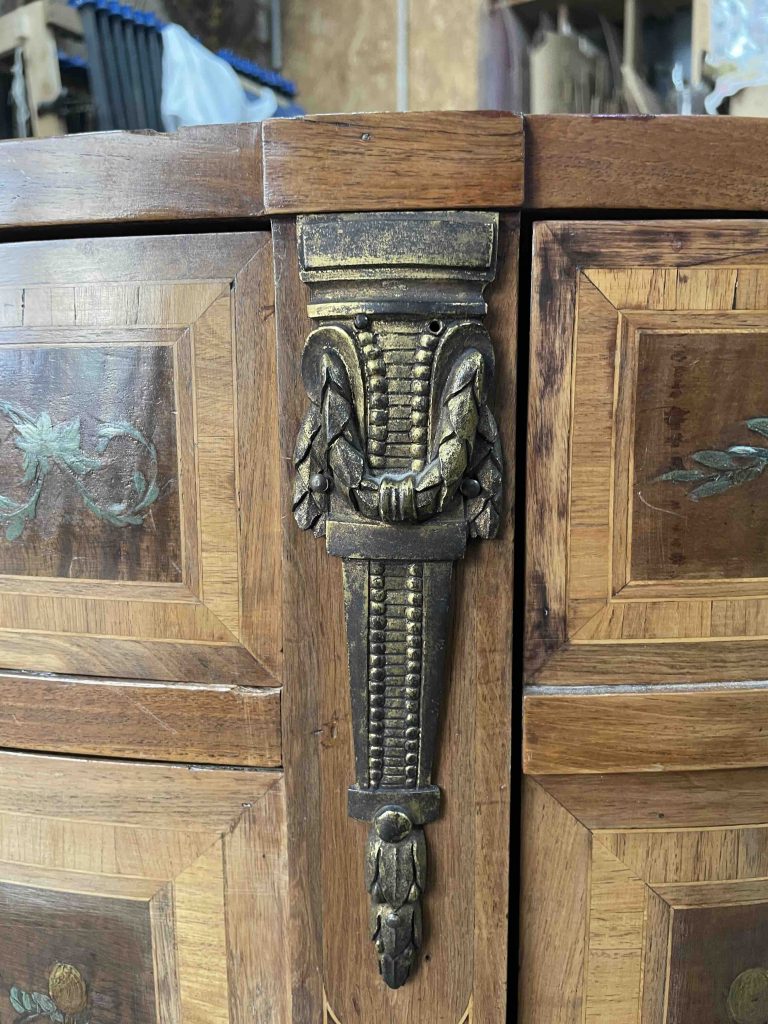
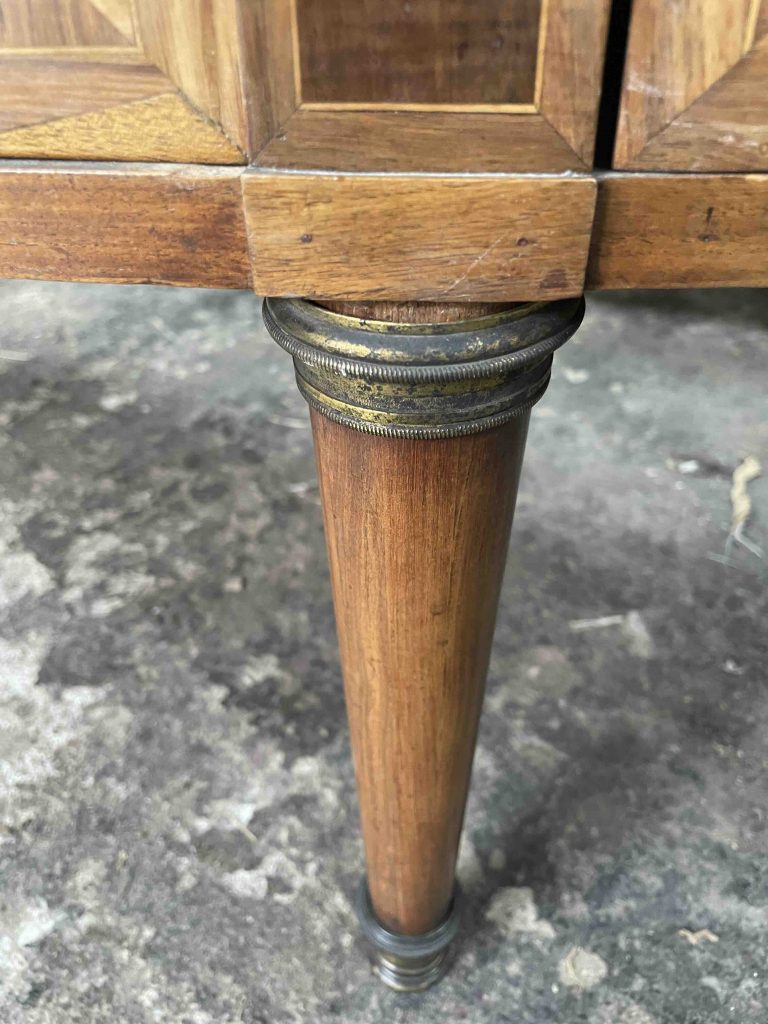
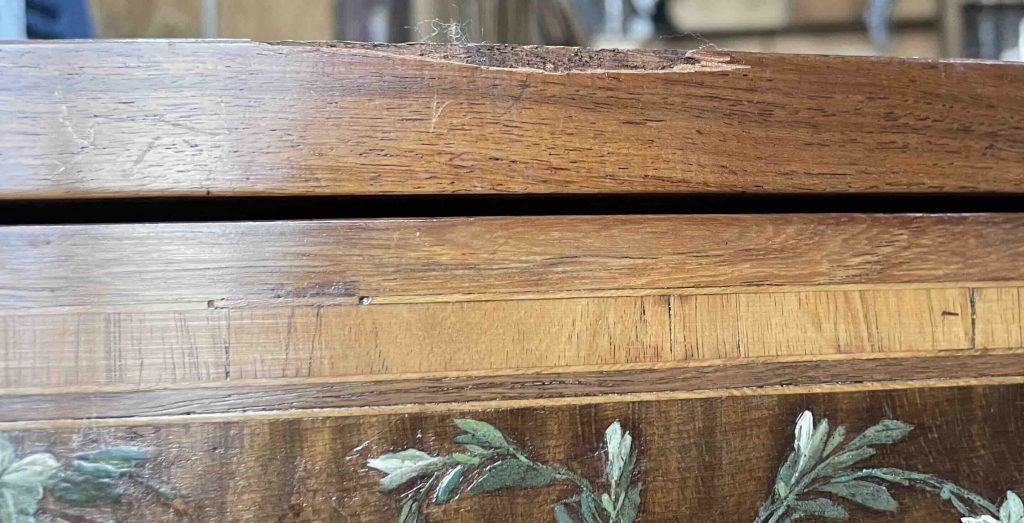
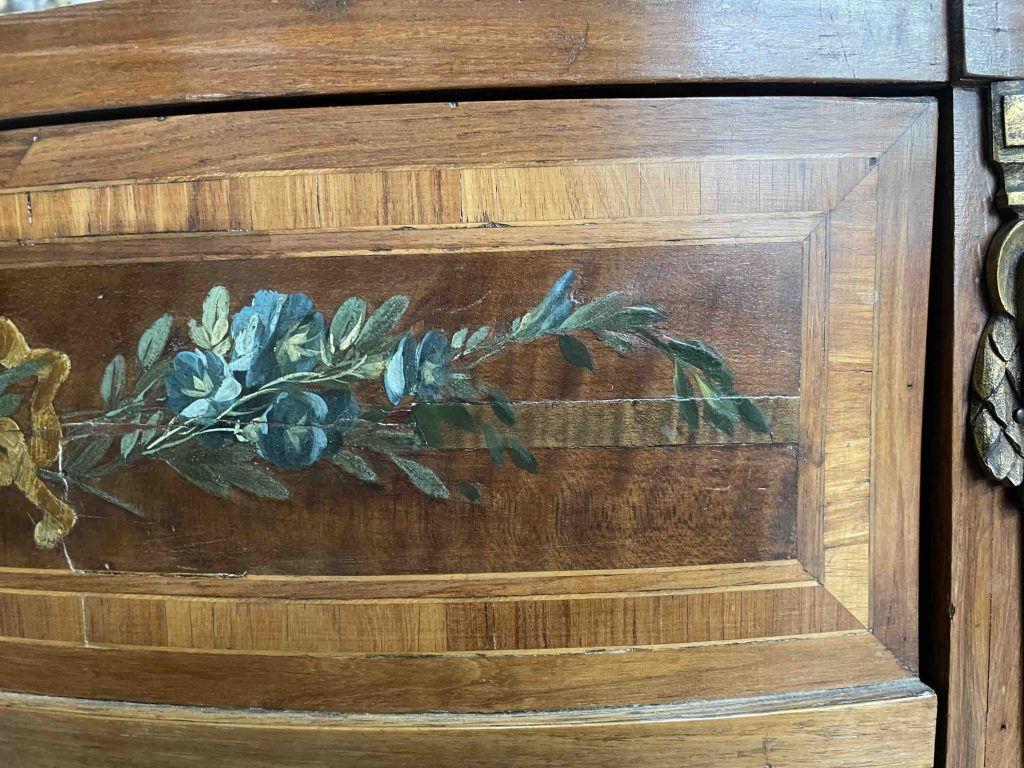
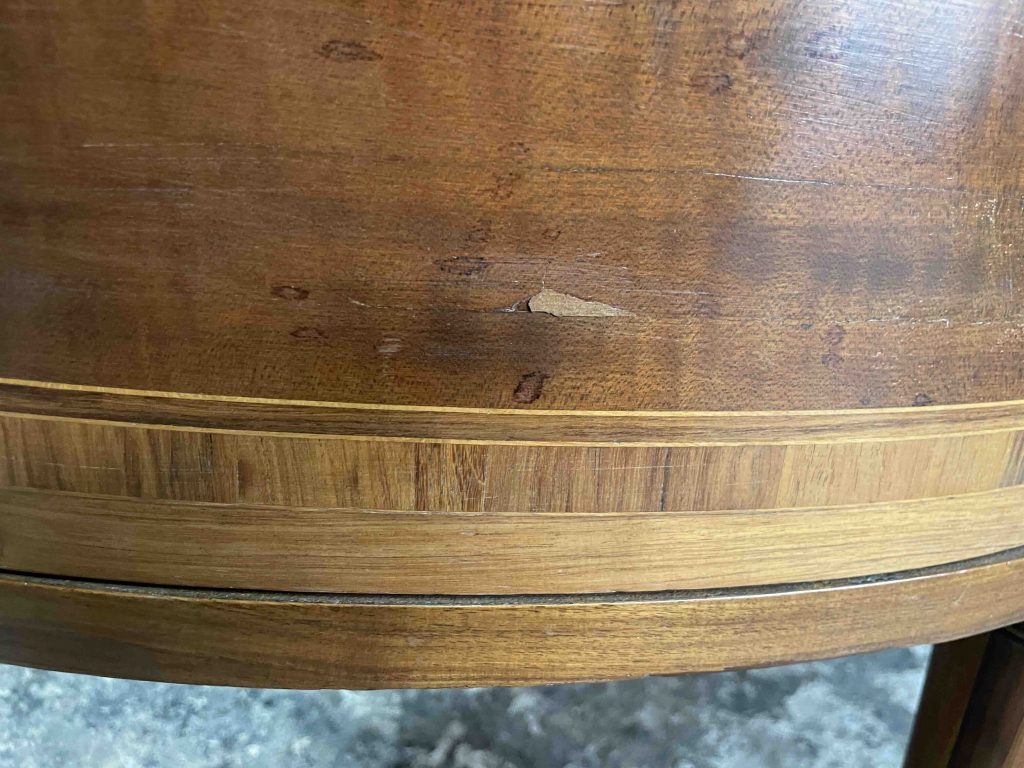
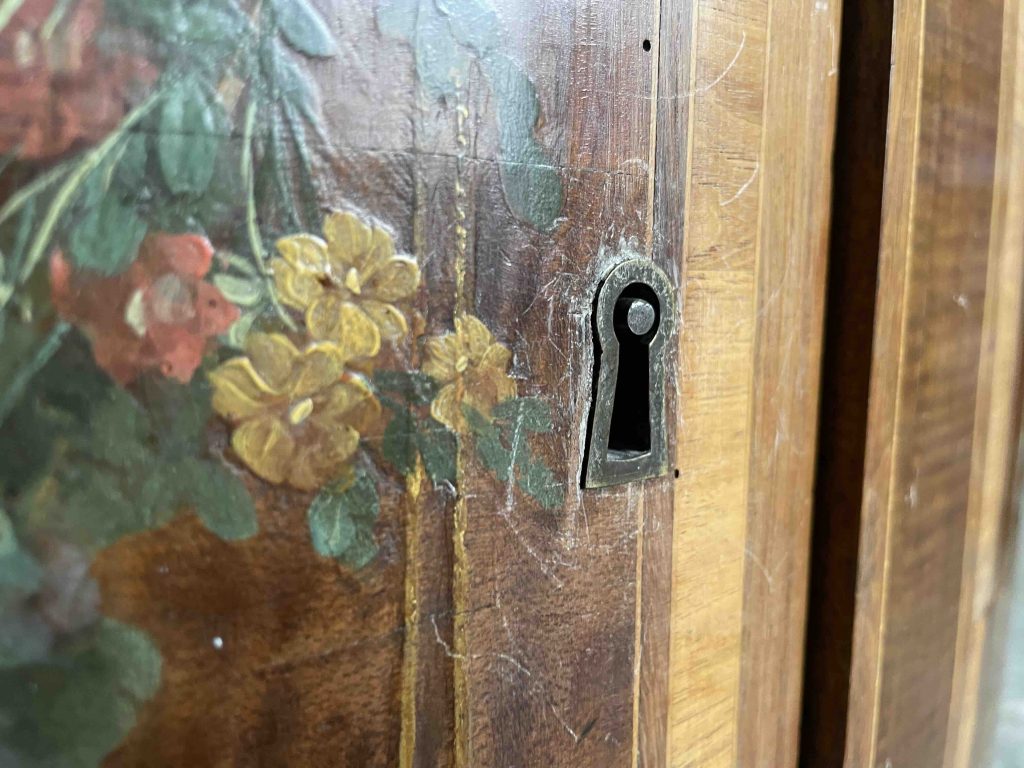
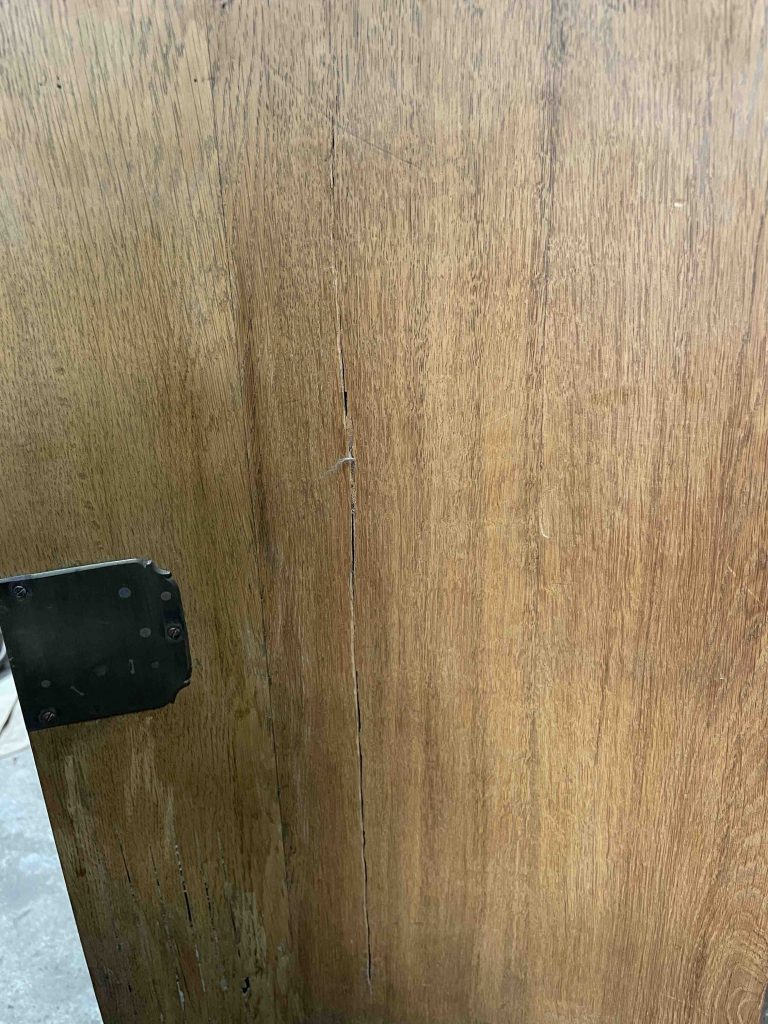
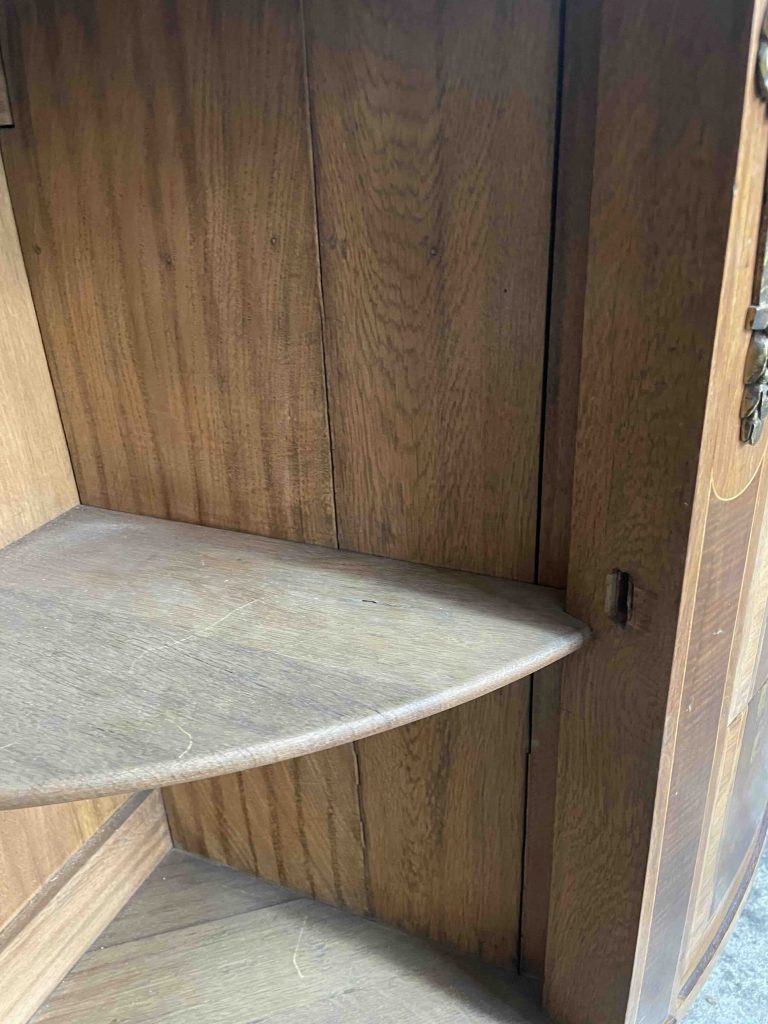
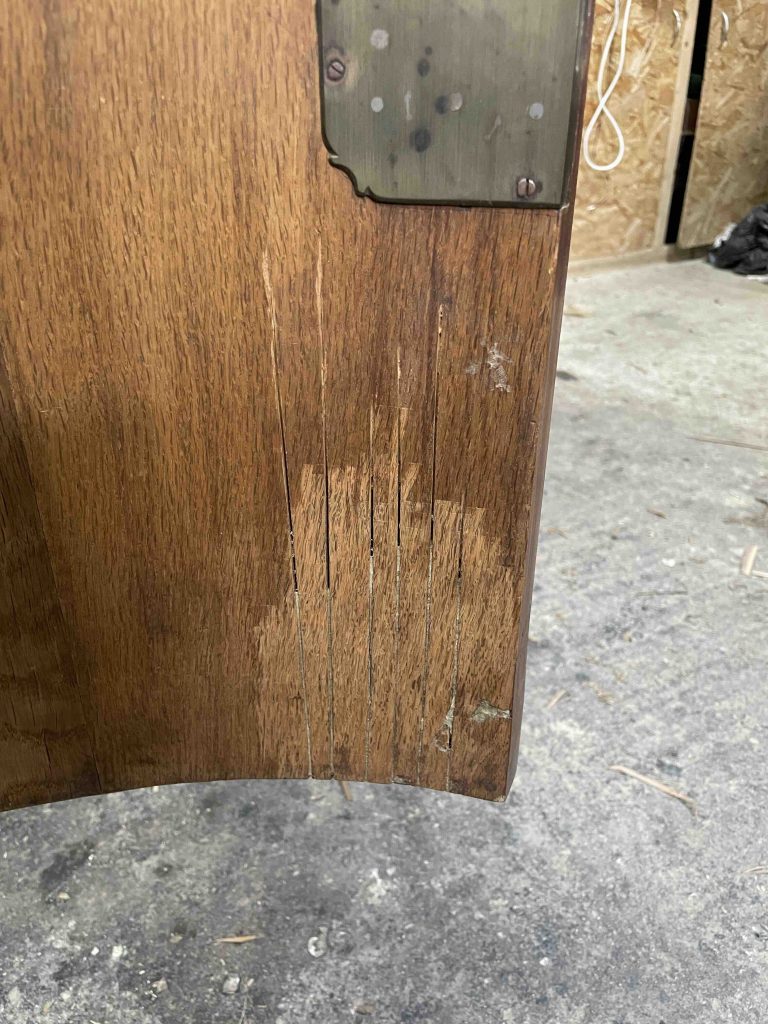
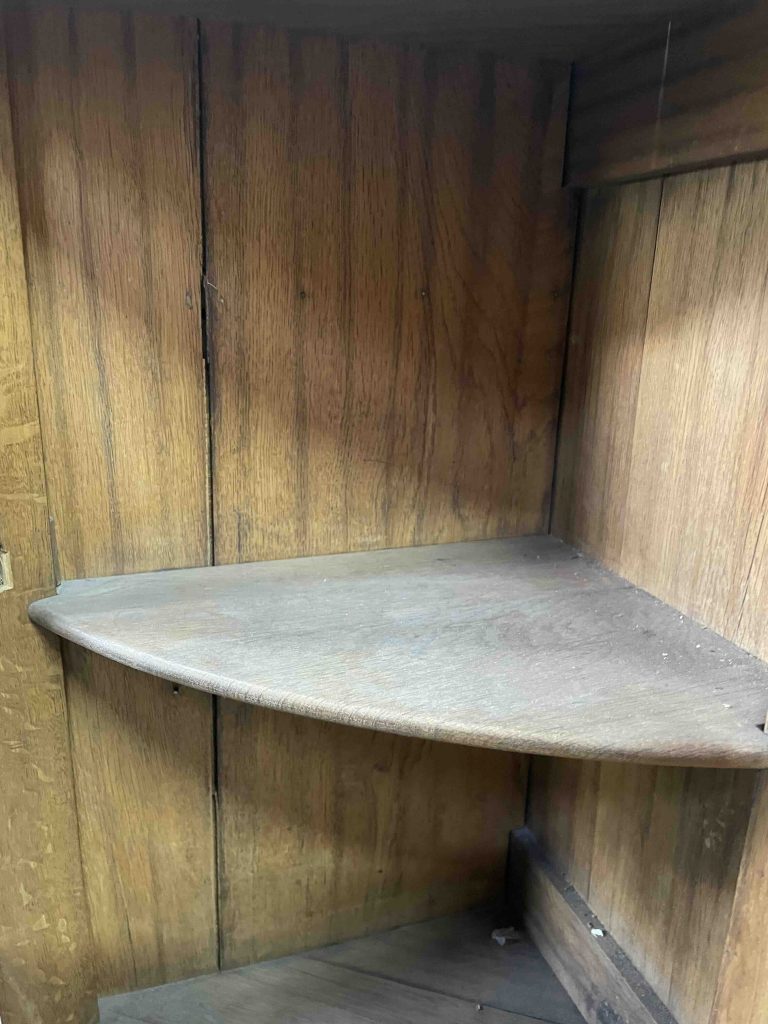
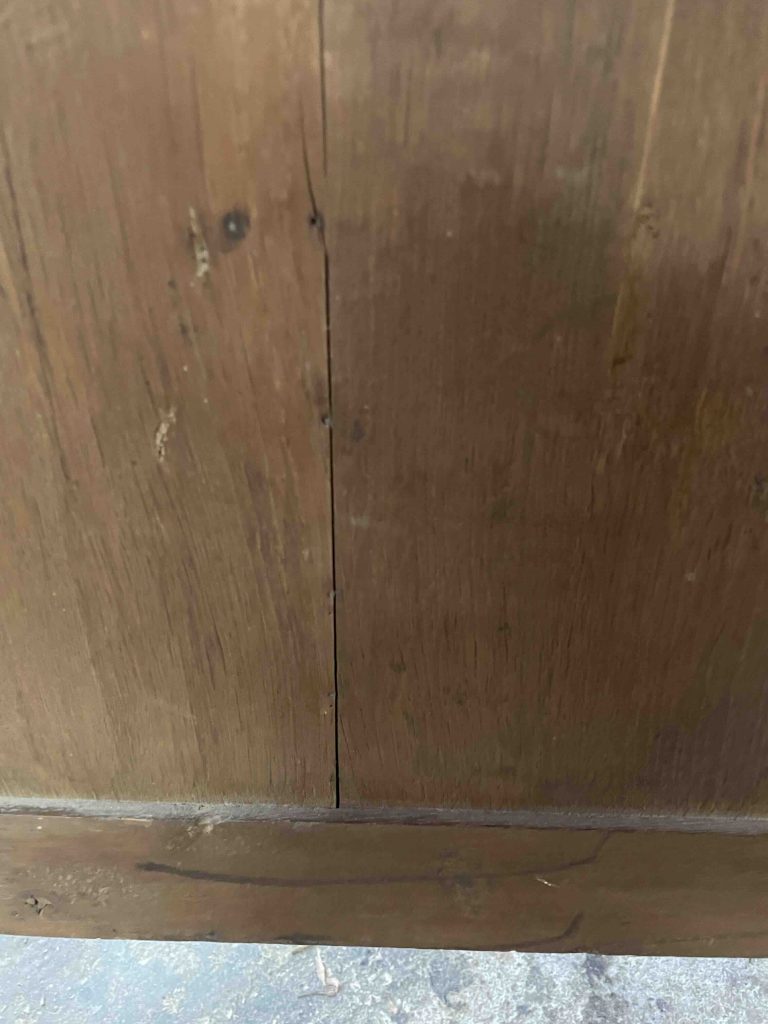
Upon its arrival at the workshop, this piece of furniture presented numerous significant challenges. A large portion of the frame panels had detached and no longer provided adequate structural support. Multiple small areas of missing rosewood veneer were present, along with unsightly previous repairs. Both side door panels were split lengthwise, and a poorly executed repair had been carried out on the back. The varnish finish exhibited significant mold growth, and the paintwork, like the bronze mounts, was heavily soiled.
The Restoration
For the restoration of this commode, we collaborated with Marianne Chopin, a painting restorer. The work began with the removal and deoxidation of the bronze elements using a gel. Cracks in the door panels were stabilized to ensure their structural integrity. The frame's joints and panels were then carefully re-glued. Lifting veneers were stabilized, and gaps were filled with wood, which was scraped, sanded, and naturally oxidized under ultraviolet light before being fixed with protein glue. The varnish finish was thinned with the utmost care using a gel to preserve the integrity of the painted motifs. Visual harmonization was achieved through chromatic reintegration to correct previous overpainting and some veneer imperfections. Finally, a shellac finish was applied before the bronze fittings were reattached.