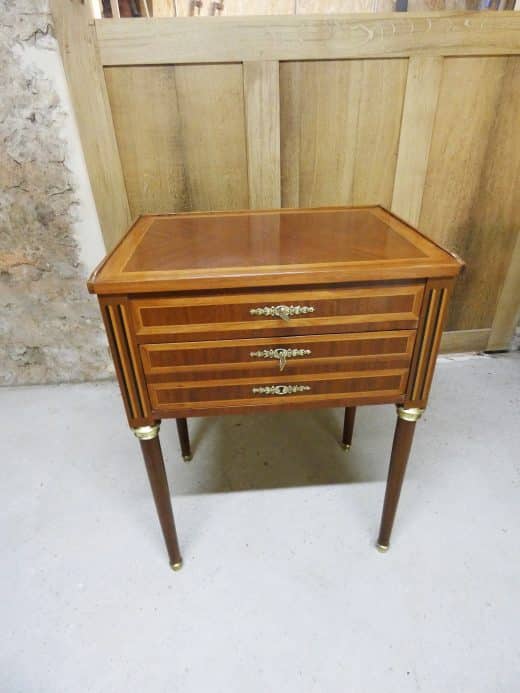
Regency chest of drawers Crossbow

Ebénisterie Mathieu Vath

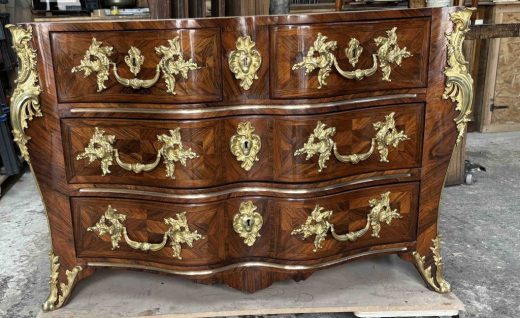
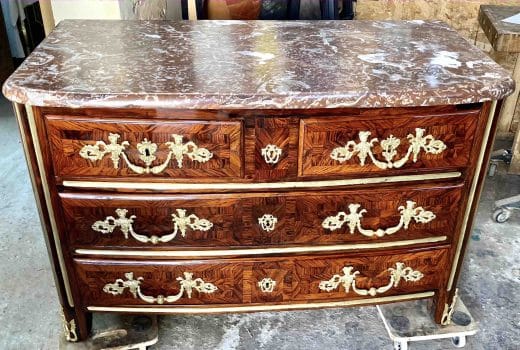
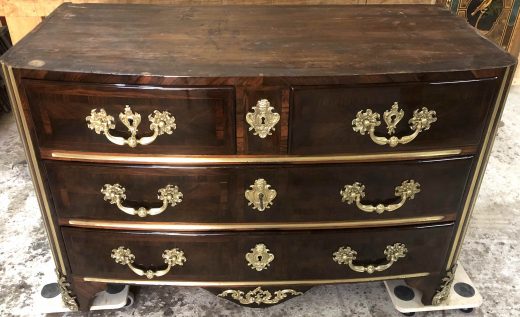
Conservation work on this Regency period commode, characterized by its serpentine shape, rosewood veneer, and gilt bronze mounts, resting on an oak and softwood frame. Our task was to stabilize the veneered surfaces by injecting protein-based adhesive. Veneer gaps were filled with grafts of new rosewood veneer, previously sawn, scraped, and sanded. These grafts were then French polished, naturally oxidized with ultraviolet light, and then applied to the appropriate thickness as a backing before being glued in place with […]
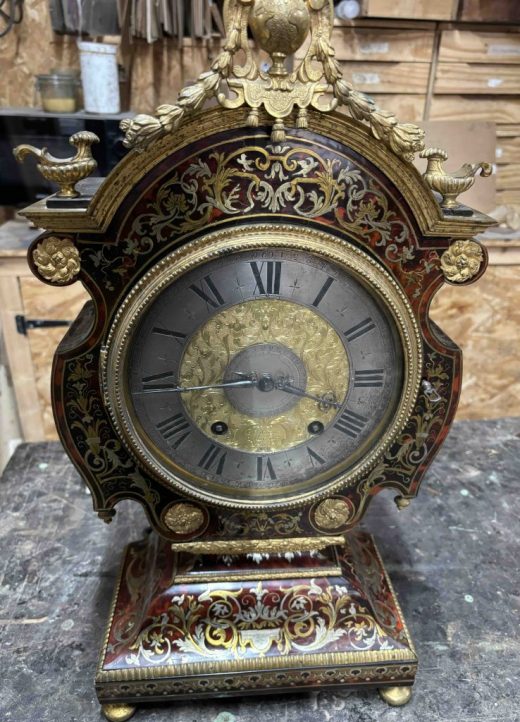
Doll's Head Clock by Baltazard Martinot

Ebénisterie Mathieu Vath

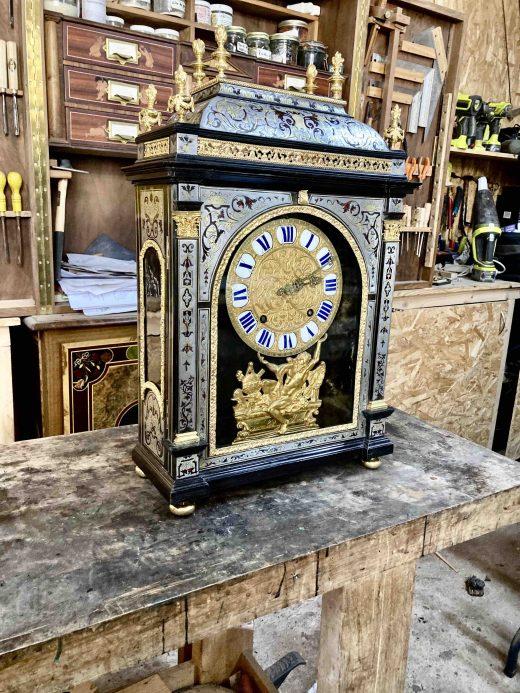
The first project of the year involved stabilizing, consolidating, restoring, preserving the finish, and harmonizing the elements. The main objective was to preserve the history and identity of the project as much as possible without dismantling anything. A masterpiece of Parisian clockmaking from the Grand Siècle, this remarkable clock, known as a "doll's head" clock, is emblematic of Parisian clockmaking at the end of the 17th century, during the reign of Louis XIV. Its architectural form, dominated by a circular body flanked by lateral projections and surmounted by a rich crowning element […]

Regency commode in sarcophagus form

Ebénisterie Mathieu Vath

Minor restoration was required for this Regency commode, known as a sarcophagus commode. A few veneer repairs and a refinishing of the varnish were all it took to restore its former glory. The sarcophagus commode? It was only a few years after the first examples were completed by André Charles Boulle, during the Regent period, that the curved commodes, both in plan and elevation, appeared. These commodes would be called "Regency-style" commodes throughout the 18th century (and similarly, it would be necessary to wait until 1720 to see commodes with two rows of drawers again, often […]

Regency commode with faun and lion masks

Ebénisterie Mathieu Vath

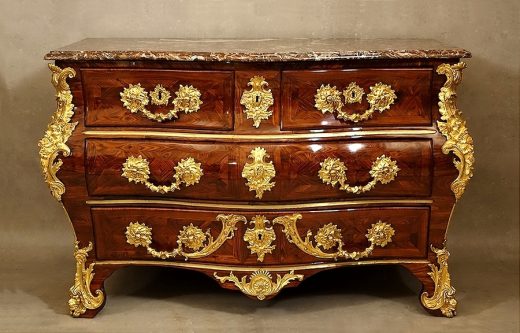
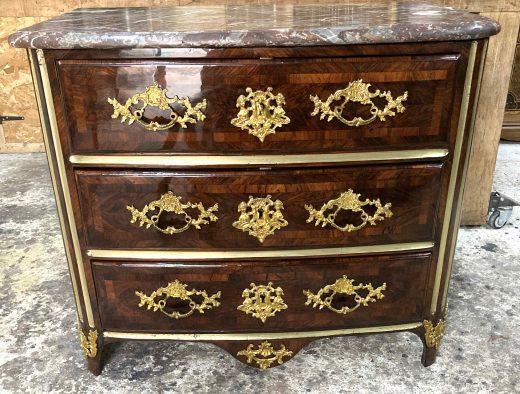
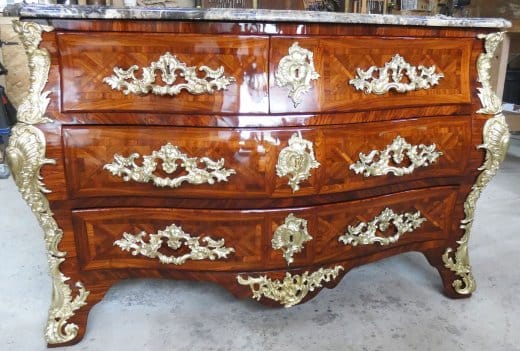
Restoration completes this important and rare commode, known as a "tomb-shaped" or "Regency" commode, also called a "moustache" commode, dating from the Regency period. Curved on all sides, it opens with four drawers in three rows. Topped with a Belgian Vieux Rance marble slab (it's worth noting that Rance was a French village at the beginning of the 18th century), molded with a corbel-like profile following its contours, this wide commode, veneered in a single layer of kingwood, boasts powerful curves, is adorned with brass fluting on the front and sides, and is covered with exceptional finely chased bronze mounts.

Regency Cartel

Ebénisterie Mathieu Vath

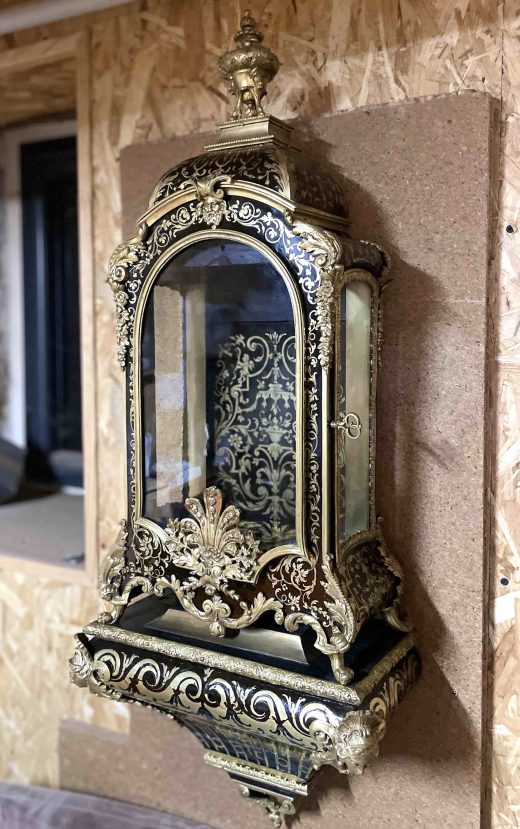
Restoration of a Regency clock case in Boulle marquetry on a brown tortoiseshell background. Since Antiquity, humankind has sought to master and create a "timekeeper." Egyptian obelisks, water clocks, sundials, hourglasses. But it was in the 15th century that the first mechanical weight-driven clocks were made, with a single hand, but generally equipped with chimes. Then, in the 16th century, the counting of the day in two parts, 12 hours instead of 24, was adopted almost everywhere, even though each city kept its own meridian time until the advent of railways and […]

Louis XV secretary stamped C.Chevallier

Ebénisterie Mathieu Vath

Restoration of a Louis XV period drop-front secretary, also known as a cabinet, stamped by Charles Chevalier, with curved sides and a front without an intermediate rail. Constructed of oak and softwood, it is veneered with marquetry of maple, boxwood, blue-stained maple, holly, hornbeam, and barberry on a rosewood ground framed by violet wood. The drop-front opens with its original three-point lock, revealing a compartment containing seven shelves in four rows and four drawers. The whole contains […]

Directoire Commode

Ebénisterie Mathieu Vath

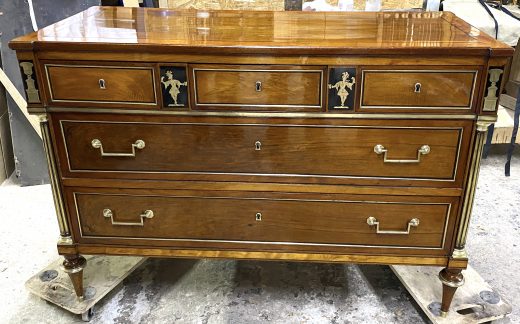
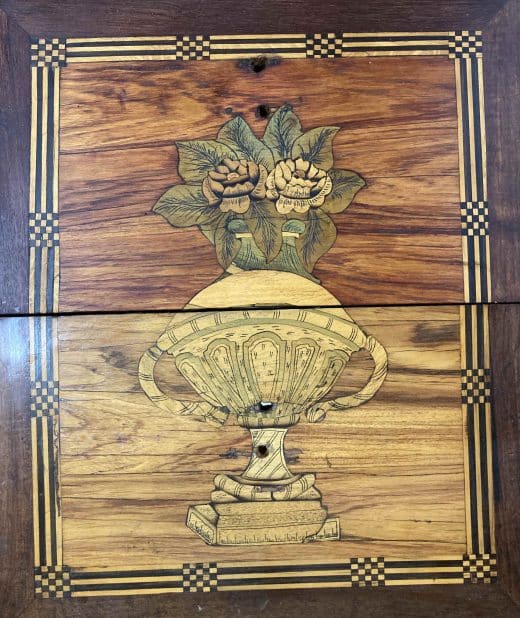
Restoration of a curious Directoire commode in solid walnut and walnut, mahogany, and maple veneer, featuring marquetry of a Medici vase and a Louis XIV-inspired ballet dancer, in brass on an ebony ground. The drawers have walnut bottoms with an ebony stringing surmounted by a quarter-round brass and wood molding, surrounded by a mahogany molding. The uprights are three-quarter-fluted columns terminating in toupie feet. The locks are in the shape of trefoils. A conservation project for this […]

Transitional chest of drawers stamped SAUNIER

Ebénisterie Mathieu Vath

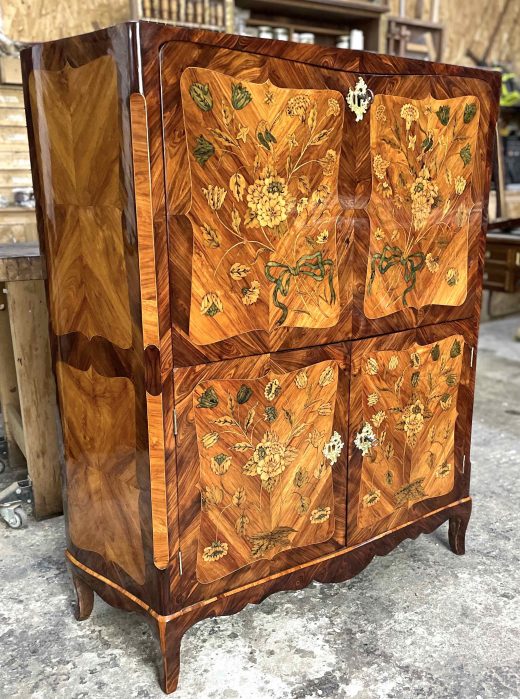
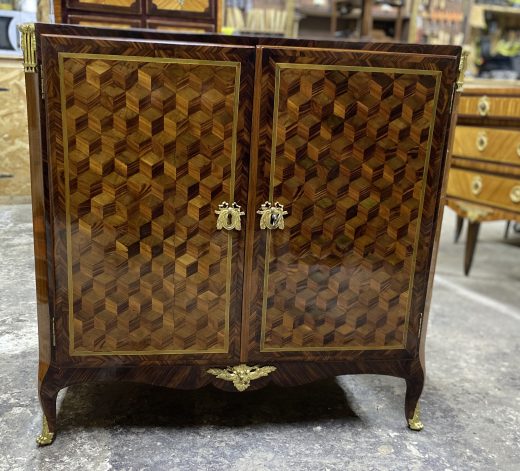
Restoration of a transitional two-door commode veneered with bottomless cube marquetry. The frame is oak for the uprights and rails, the side panels are softwood, and the two doors are walnut. The bottomless cubes are veneered with rosewood, violetwood, and tobacco-stained maple. The entire piece is framed with a stringing of green-stained maple and boxwood. The uprights and door frames are veneered with violetwood and rosewood. The sides […]

Louis XIV commode

Ebénisterie Mathieu Vath

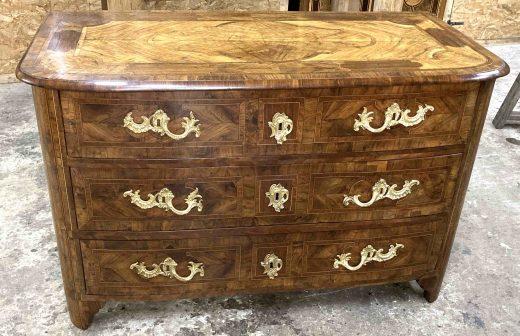
Restoration of a Louis XIV period commode veneered in olive burl, ash, and walnut, likely from the Dauphiné region. This type of commode (D-shaped), along with the Mazarine commode, was among the very first commodes popularized under Louis XIV. Indeed, the appearance of the earliest French furniture resembling the commode dates only from the 1700s; thus, the oldest known and datable Parisian commodes are those delivered by André-Charles Boulle to Versailles around 1708. Their very simple decorations are inspired by Dutch designs, often executed by […]

RELIGIOUS CLOCK, Sarrabat Paris

Ebénisterie Mathieu Vath

Restoration of a 'religious' clock with a striking mechanism on the half-hour, signed (dial and movement) 'Sarrabat à Paris', third quarter of the 17th century. Religious clocks were the earliest form of clocks during the reign of Louis XIV, the Sun King. Their popularity increased from 1660 onwards, thanks to Huygens' discovery of the regulator pendulum. This particular clock features Boulle marquetry of red tortoiseshell, brass, and pewter on a walnut frame, decorated with gilt bronze mounts and ebony moldings. The lower molding is also ebony and rests on […]

Regency chest of drawers stamped ID

Ebénisterie Mathieu Vath

Restoration of a Regency commode veneered in rosewood on a conifer frame. It was only after three weeks of work on this commode that I noticed a strange mark. It had been there from the beginning, right in front of me, and I hadn't noticed it. Indeed, it's quite rare to see a stamped Regency commode. But yes, the mark was definitely there. And it's not a modest mark, since this ID stamp is attributed to Jacques Denizot. Jacques Denizot (1684–1760) is […]

Louis XIV commode

Ebénisterie Mathieu Vath

Restoration of a Louis XIV commode constructed of fir and Rio rosewood veneer. The front is slightly convex, as are the uprights and rails. It features brass fluting. The remarkably crafted varnished bronze mounts have retained their original varnish. The restoration consisted of rehydrating all veneered surfaces by infiltrating glue. Missing areas were filled with rosewood veneers that were sawn, scraped, sanded, cut to the correct thickness as a backing, and UV-oxidized before being glued with hot glue. As you can see on […]

Mazarine Chest of Drawers

Ebénisterie Mathieu Vath

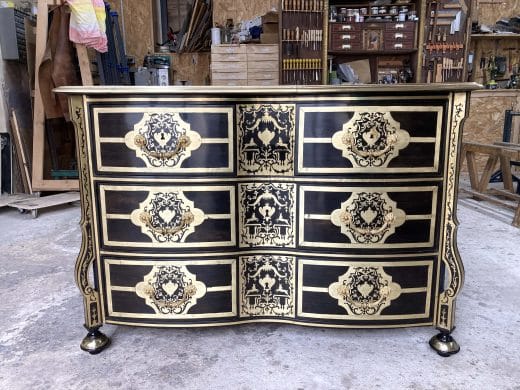
Restoration of a Louis XIV period commode, known as a Mazarine commode, veneered in brass and ebony on a softwood frame. This commode features bow-shaped drawers, including two full-length drawers surmounted by two half-drawers separated by an intermediate stile. The fronts are made of softwood, while the sides and backs are walnut. The brass decoration supporting the pendant drawer pulls features a finely inlaid motif of scrolls, foliage, foliage, and arabesques, framed by a geometric brass cartouche and simulating keyhole escutcheons. It […]

Louis XVI commode stamped JB.Tuart

Ebénisterie Mathieu Vath

Here is a very pretty Louis XVI period commode veneered in rosewood and amaranth with marquetry of boxwood, pearwood, maple, hornbeam, walnut, blackened pearwood, lemonwood… It is built of oak and softwood. It is stamped twice with the mark of Jean-Baptiste II TUART. But its maker is probably Jean LAPIE. From a dynasty of Parisian cabinetmakers and merchants, whose father, Jean-Baptiste I, obtained his master's certificate in 1741 and was active until around 1760, Jean-Baptiste II, born around 1720, was not a master cabinetmaker but a master furniture maker and haberdasher […]

Regency chest of drawers

Ebénisterie Mathieu Vath

Originating in the late 17th century but only acquiring its name in the early 18th century, this is the first classic model of a commode. Although typically Louis XIV in style, it may not have existed before the Regency period. With rounded corner pilasters with slightly convex faces, deep copper fluting, veneer, and geometric bronze mounts, it features three rows of drawers. It perpetuates the spirit of Louis XIV furniture throughout much of the 18th century. Bibliography: Furniture […]

Transitional dresser

Ebénisterie Mathieu Vath

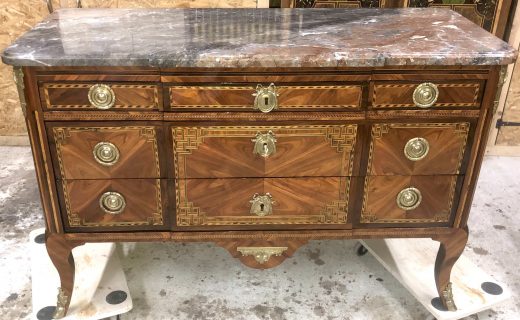
Restoration of a transitional period commode with a projecting front, veneered in rosewood and palisander. The Greek key-patterned moldings, stained green, are made of hornbeam, and the front features a butterfly wing design. It opens with two large drawers with concealed crossbars, and three drawers in an upper row. The uprights, with simulated fluting, are veneered in ebony and boxwood. It rests on four cabriole legs adorned with hoof-shaped feet. Although it has undergone some alterations […]

Transition cylinder desk

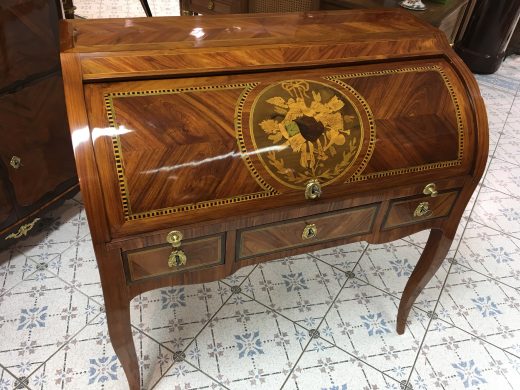
A few years ago, I had the opportunity to restore this magnificent Transition period (1780) roll-top desk. It is framed in oak and fir. The fall front is primarily veneered with rosewood laid in a paillon pattern, framed by a light stringing of boxwood and green-stained hornbeam, bordered by a thin band of amaranth. The back is veneered in satinwood. The central marquetry, on a tobacco-stained sycamore ground, depicts musical instruments and two doves taking flight, each carrying a musical score in its beak. This […]

Transitional chest of drawers stamped LARDIN

Ebénisterie Mathieu Vath

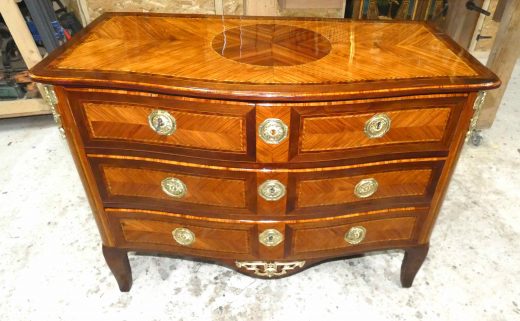
Restoration of a Transition period commode built of fir and oak and veneered with rosewood, framed with stringing of white hornbeam and green-stained wood, with a satinwood band surrounded by amaranth. The central medallion is satinwood veneer assembled in a herringbone pattern. The maker's mark and the JME (Journée des Métiers d'Étranger) are located at the base of the left rear leg. André-Antoine Lardin (1724 – August 10, 1790) obtained his master craftsman's certificate on July 1, 1750, and established himself on the rue de Charenton under the sign "Au Bois de Boulogne." He worked there until 1770, the date […]

Empire Dressing Table

Ebénisterie Mathieu Vath

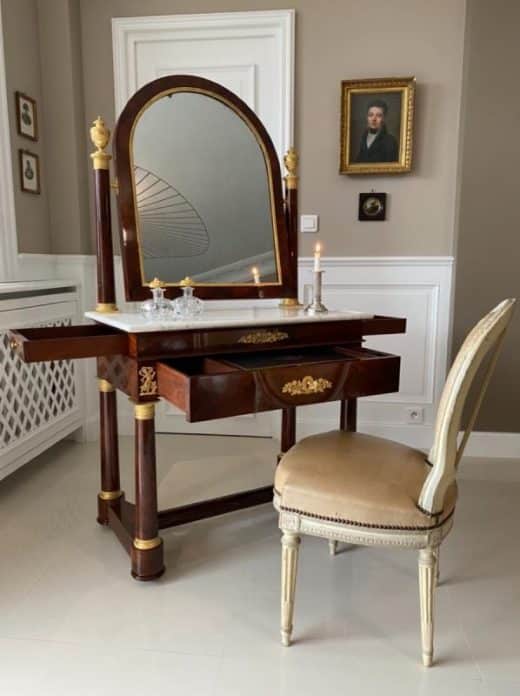
A beautiful restoration and, above all, conservation effort has been undertaken on this lovely Empire-period dressing table. Its frame is made of oak and poplar, veneered with mahogany burl. The drawer sides and bottoms are solid mahogany. It rests on four column legs ending in casters and joined by an H-shaped stretcher. The frieze opens with a drawer revealing a writing surface lined with blue morocco leather, a pen case, and two compartments for inkwells, as well as two large drawers on either side for essentials […]

Table à la Tronchin

Ebénisterie Mathieu Vath

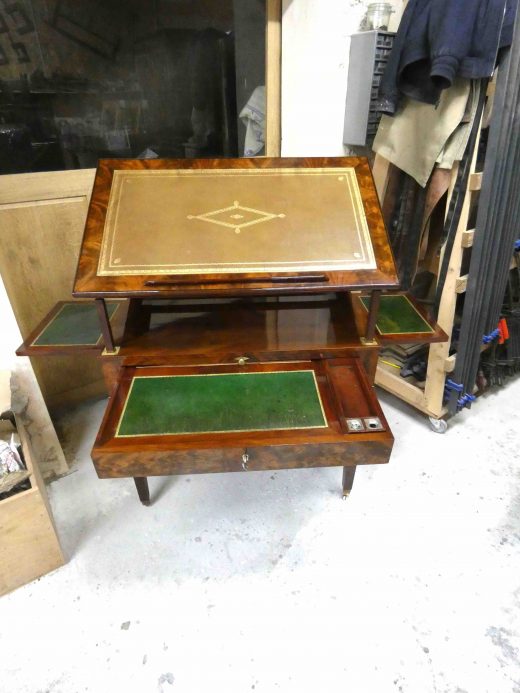
A little refresh for this lovely Tronchin-style table. Apart from a missing molding and a few small veneer chips on the legs, nothing too serious. A touch-up of the varnish was enough to give it a new lease on life. But do you know where this type of table comes from, and what it was used for? Although today attributed to Théodore Tronchin, a Genevan physician (1709-1781), who at the time published works on bone diseases linked to poor posture at one's desk, he cites the advantages that […]

Majorelle table and rosewood

Ebénisterie Mathieu Vath

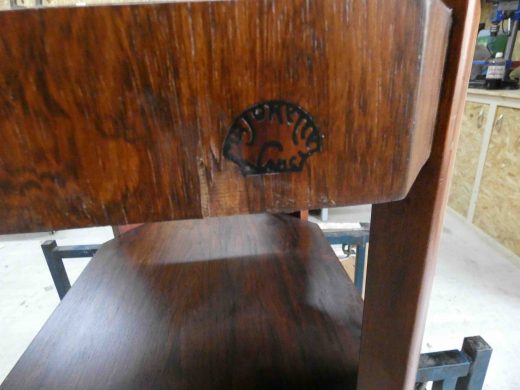
This is the second time I've had the opportunity to work on this type of table, made by Louis Majorelle's workshop in the 1920s and 30s. You can find all the information about this type of table at the following link: https://ebenisterie-mathieuvath.fr/2019/08/29/table-majorelle/ As for the restoration, it's more of a preventative measure. Indeed, there's no major damage; a few veneer grafts and re-gluing a large portion of the edge veneer were enough to restore this lovely Rio rosewood-veneered table. An opportunity for me […]

Louis XVI/Directory Secretary

Antiquités Guin

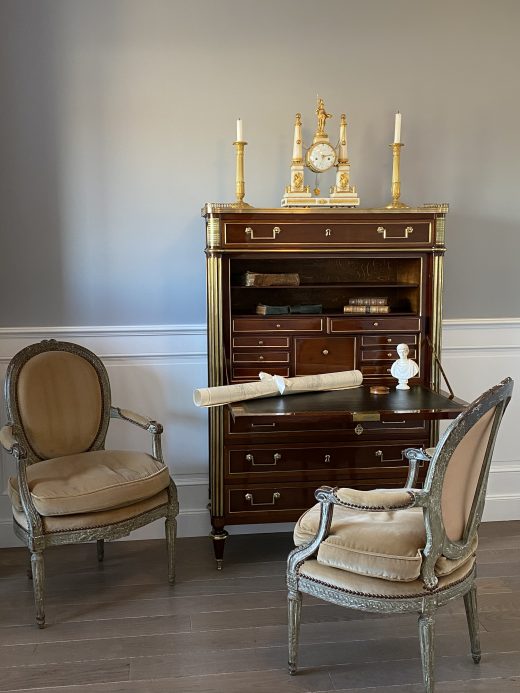
Restoration of a drop-front secretary desk built in oak and veneered with mottled mahogany and mahogany from Saint-Domingue. Its design dates from the late 18th century. Its white Carrara marble top is surrounded by a partially openwork brass gallery. It opens with a drawer at the top, a drop-front in the middle, and three drawers at the bottom; all the original locks are secured with a clover-shaped key. All the panels on the front and sides are framed with brass quarter-round moldings. The drop-front is veneered in mahogany […]

Empire Chest of Drawers with Quivers

Ebénisterie Mathieu VATH

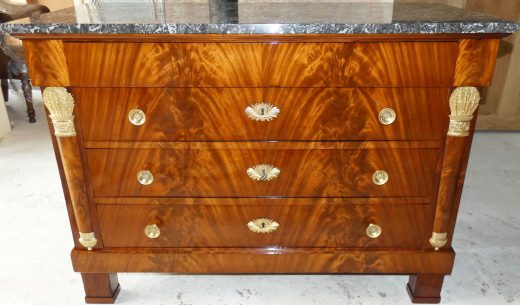
This week, here are some photos of the restoration of this Empire-style chest of drawers veneered in mahogany burl. This chest is truly unique due to the quality and originality of its bronze mounts. Indeed, they form quivers along with the side columns. The keyhole escutcheons are composed of two crossed laurel branches held together by a ribbon. Originally, they were mercury-gilded, as can be seen from the gilding stains on the back. Unfortunately, only a few partial traces remain on the front […]

Napoleon III wall shelf

Ebénisterie Mathieu VATH

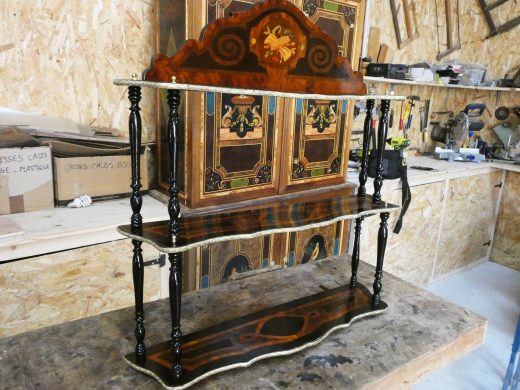
Restoration of a Napoleon III period wall shelf veneered in blackened pearwood, rosewood, amaranth, amboyna burl, and marquetry with a music theme. Underneath the dust, aside from small losses in the blackened pearwood and rosewood, and slight dehydration, there was nothing too serious. A few veneer grafts, a vacuum-sealed glue application, a thorough cleaning, a coat of clear French polish, and voilà! All this without using sandpaper. Except for lightly sanding the varnish […]

Hedouin commode with crowned C

Ebénisterie Mathieu VATH

Extensive restoration of this superb Louis XV period commode, stamped on all four uprights by Jean-Baptiste Hedouin. The frame and drawers are constructed of solid oak, fir, and walnut. The edges of the frieze and geometric marquetry in violet wood are veneered with satinwood. Two types of violet wood are visible: one with a very tight grain and veining for the lozenges, and a second, more intricate type for the marquetry edges, uprights, and rails. The […]

Transitional dresser

Ebénisterie Mathieu VATH

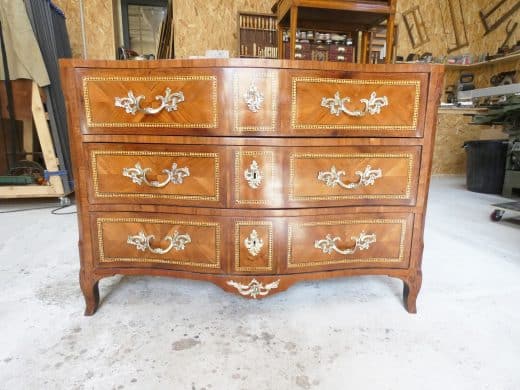
Here is a very simple chest of drawers from eastern France, probably dating from the late 18th century. The front is slightly curved and the uprights are chamfered. It should be noted that the bronze mounts are probably not original. The frame is made of solid softwood, and the uprights are oak. The drawer bottoms are set in rebates and slide on the drawer fronts, which is typical of provincial work. A small peculiarity: this chest of drawers does not have top panels, the […]

Napoleon III style Louis XVI work table

Ebénisterie Mathieu VATH

A few photos of the restoration of a small Louis XVI style work table from the late 19th century. The legs are solid mahogany, and it is veneered with rosewood, sapele, blackened pearwood, and boxwood for the fluting and stringing. Nothing too serious for this pretty little piece of furniture, which only had a few missing veneers and a small chip on the side of the oak drawer. A simple restoration: a few veneer grafts glued with hot glue, a light cleaning of […]