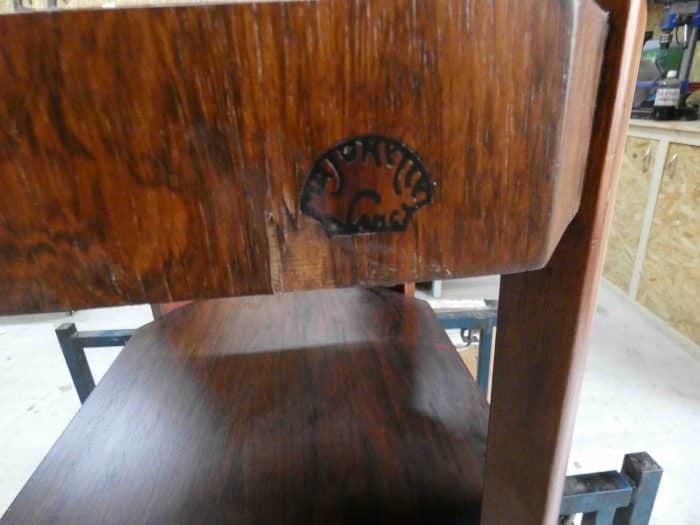
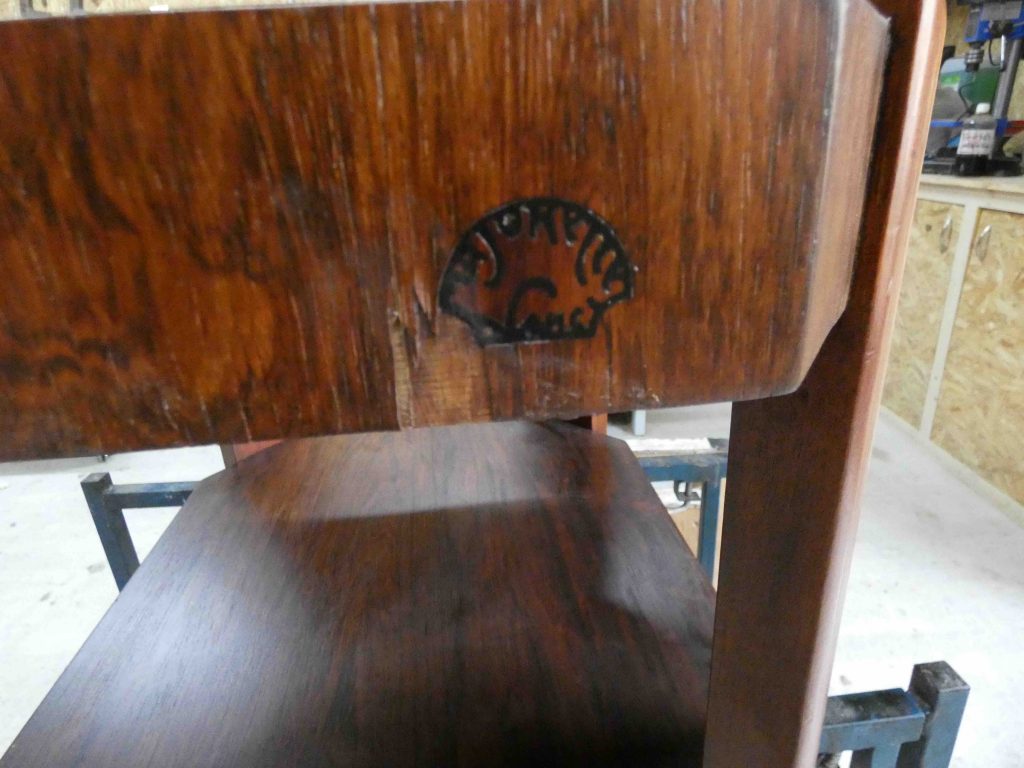
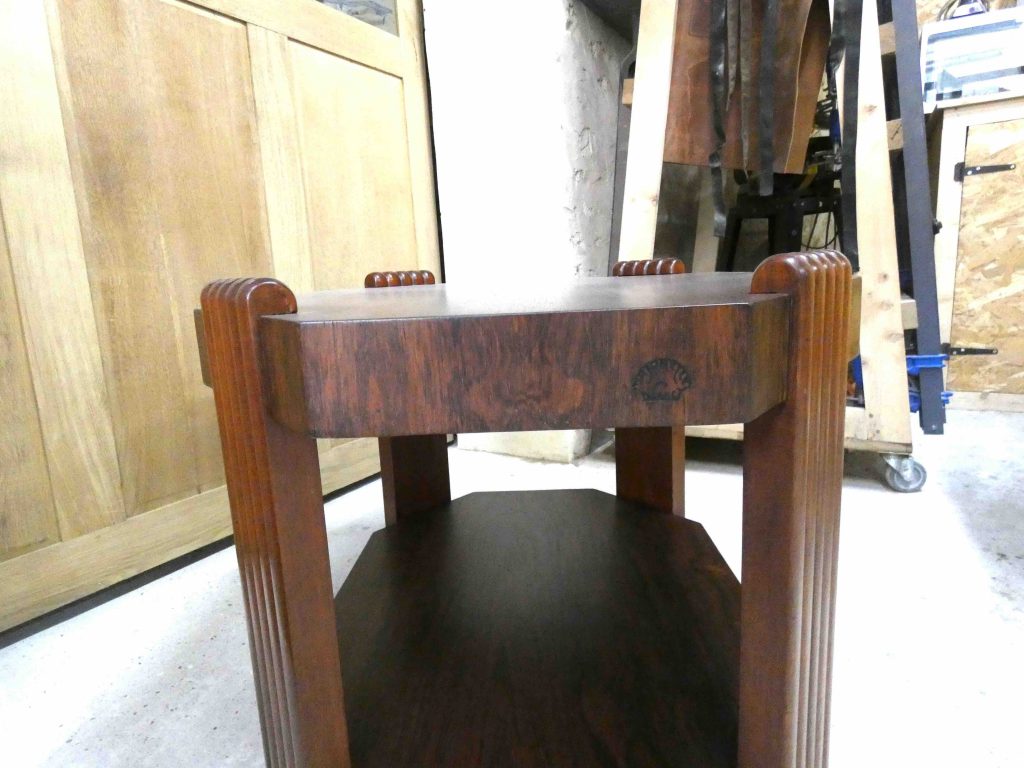
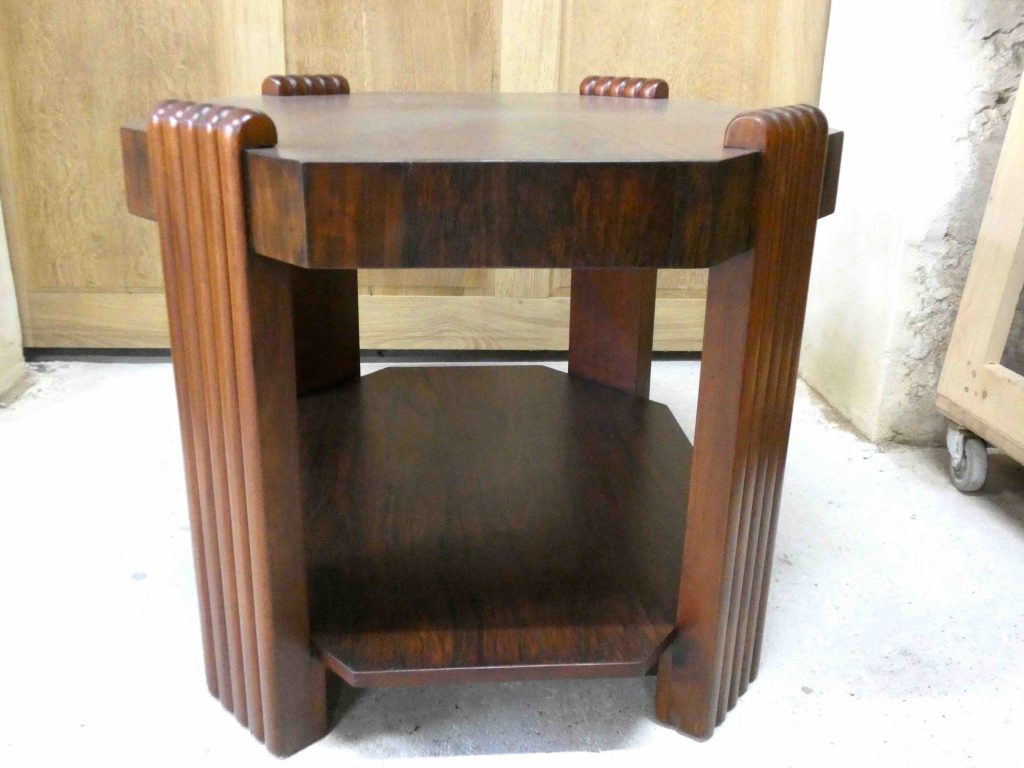
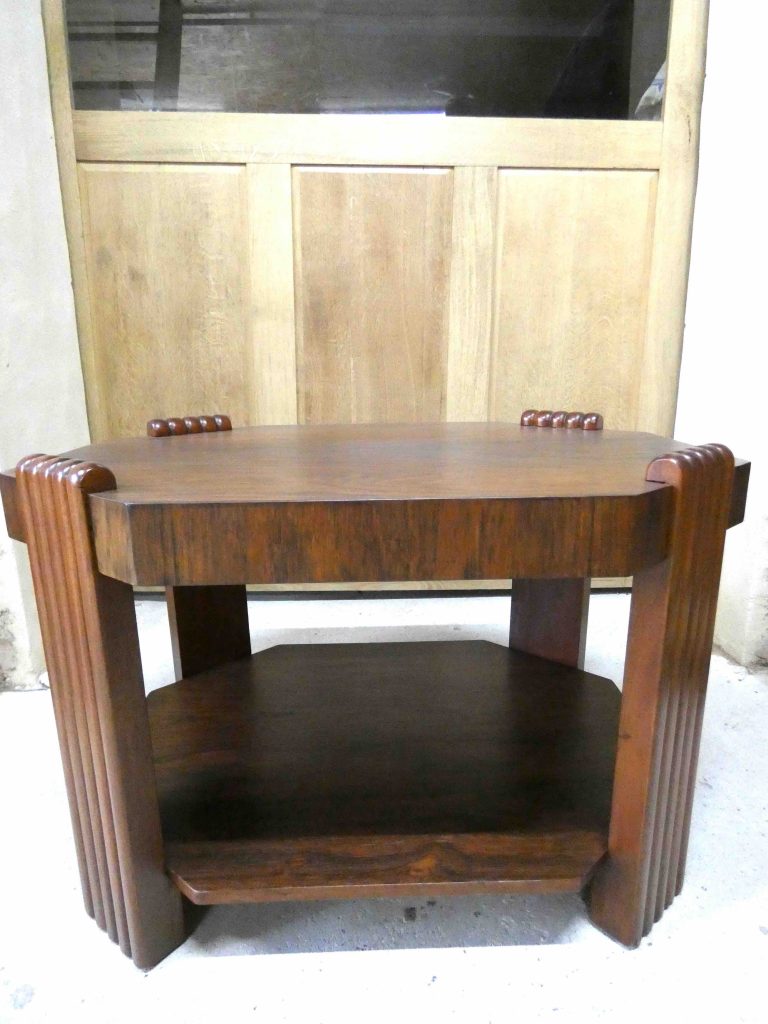
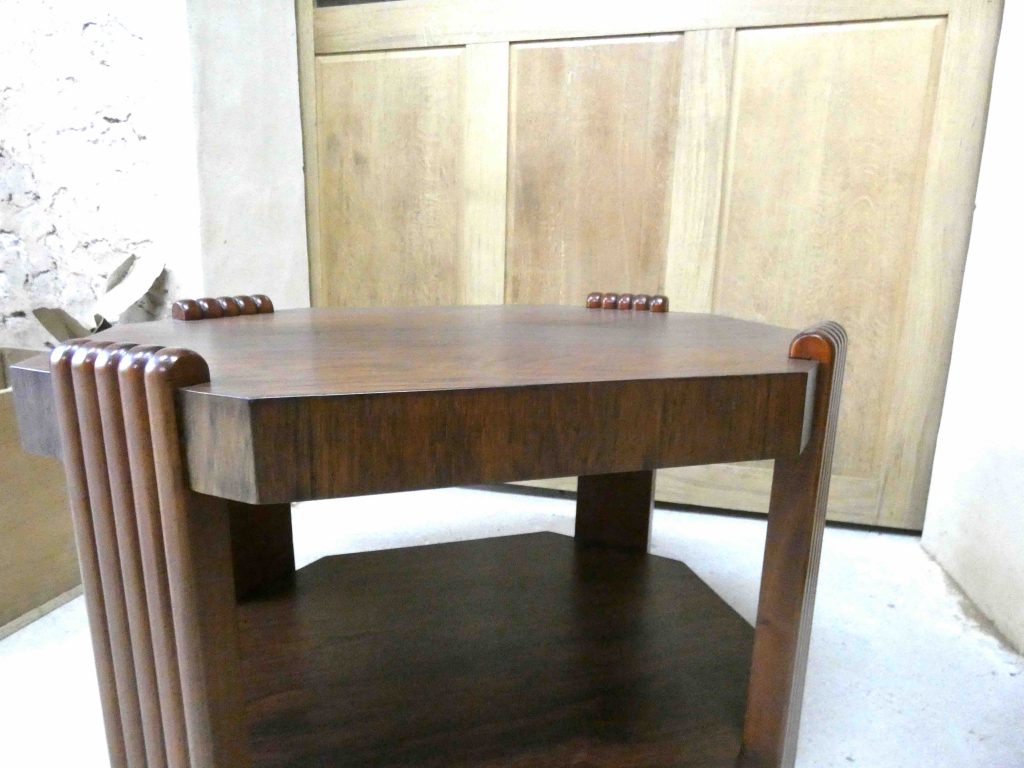
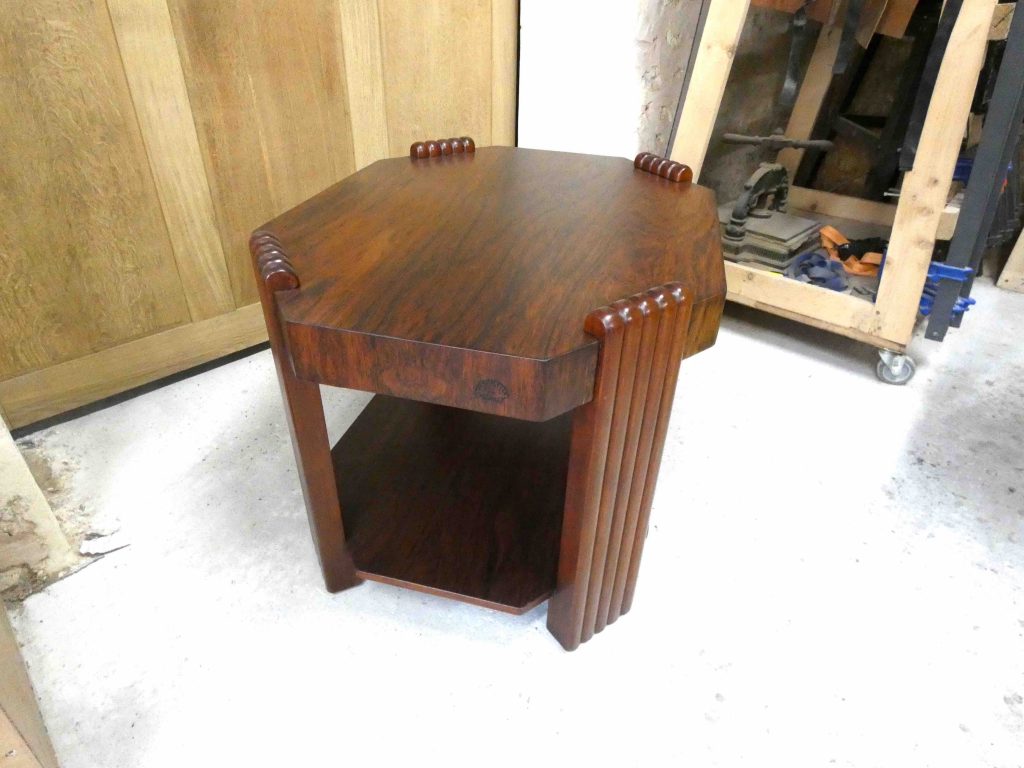
This is the second time I have had the opportunity to work on this type of table made by Louis Majorelle's workshop in the 1920s-1930s.
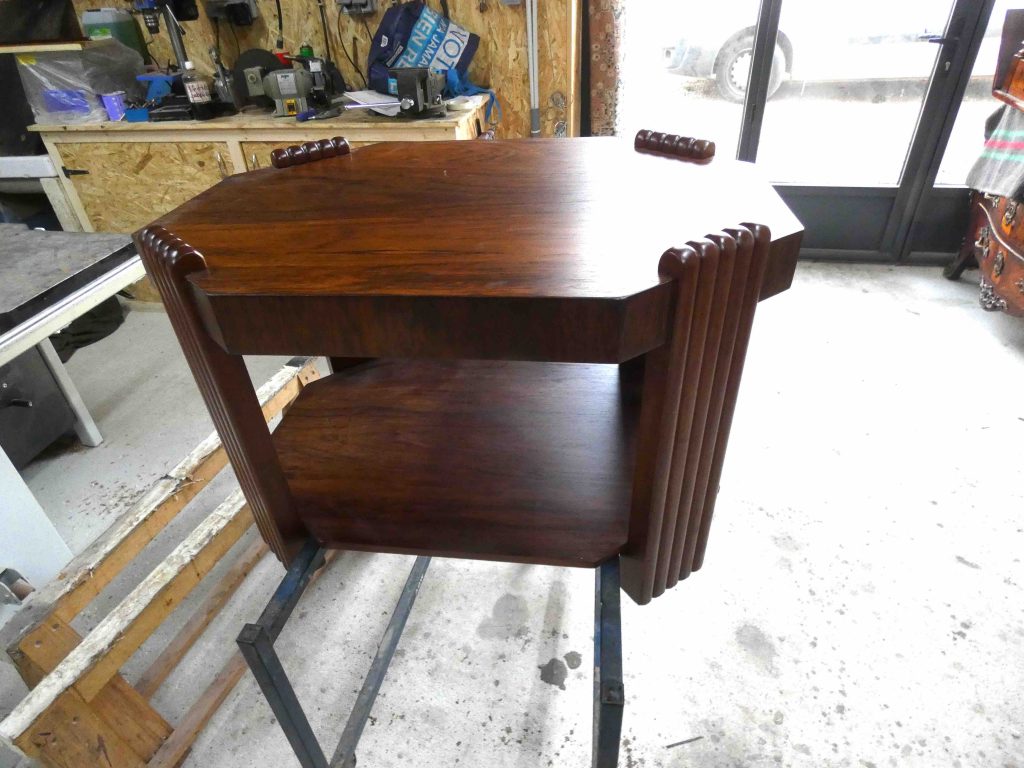
You can find all the information about this type of table at the following link: https://ebenisterie-mathieuvath.fr/2019/08/29/table-majorelle/
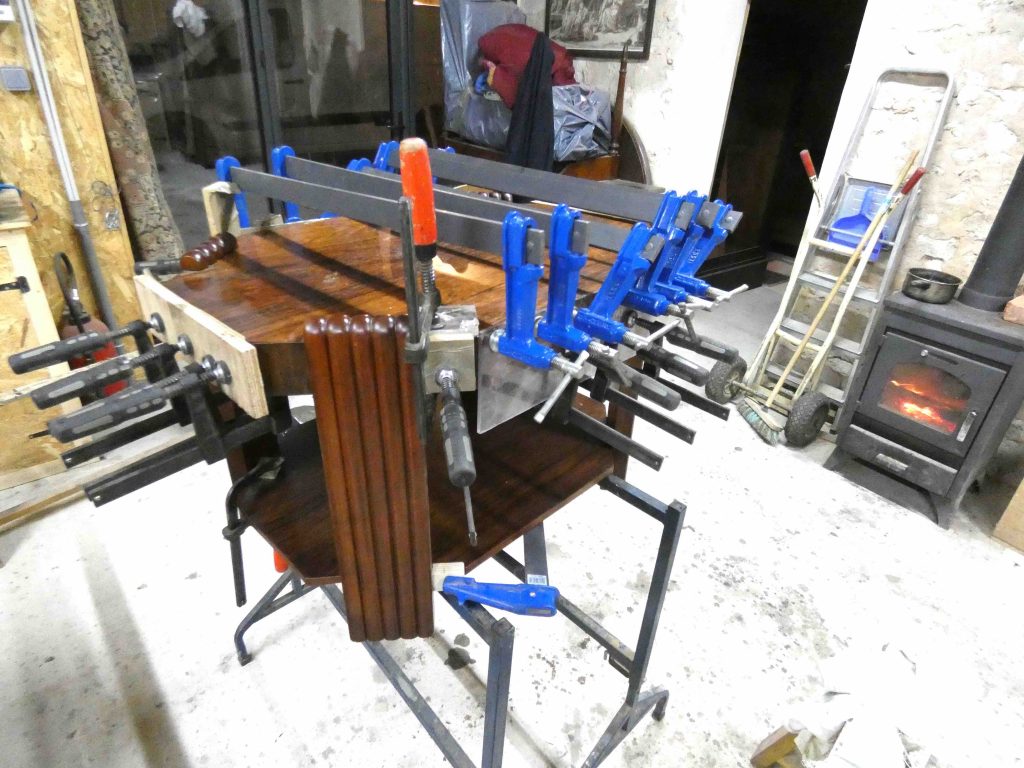
As for the restoration, it was more of a preventative measure. Indeed, there was no major damage; a few veneer grafts and the re-gluing of a large part of the edge veneer were enough to restore this lovely Rio rosewood veneered table.
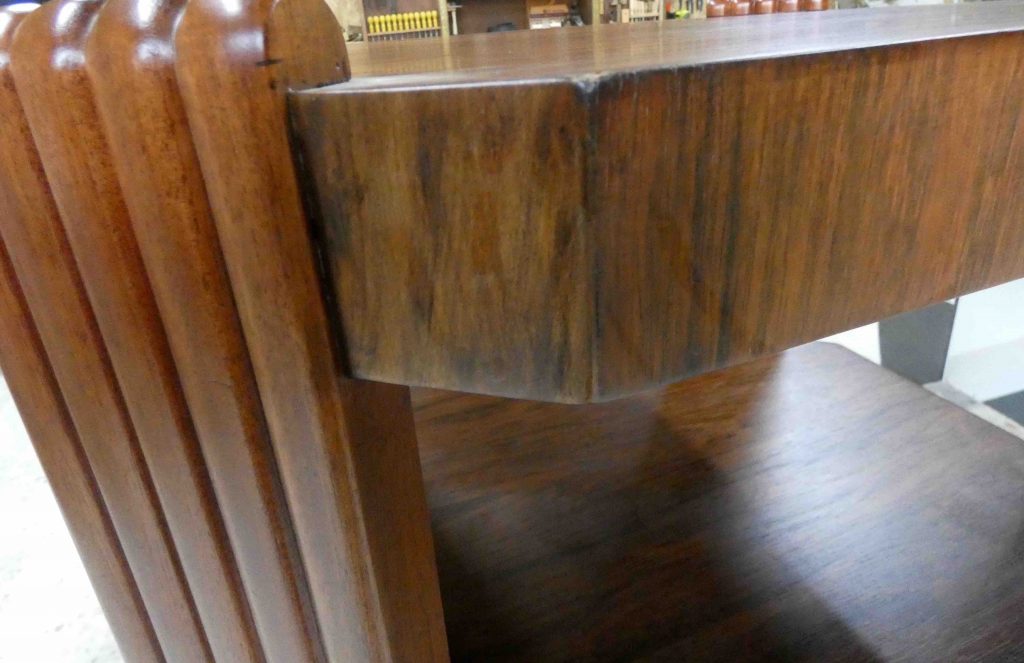
Tinted walnut graft 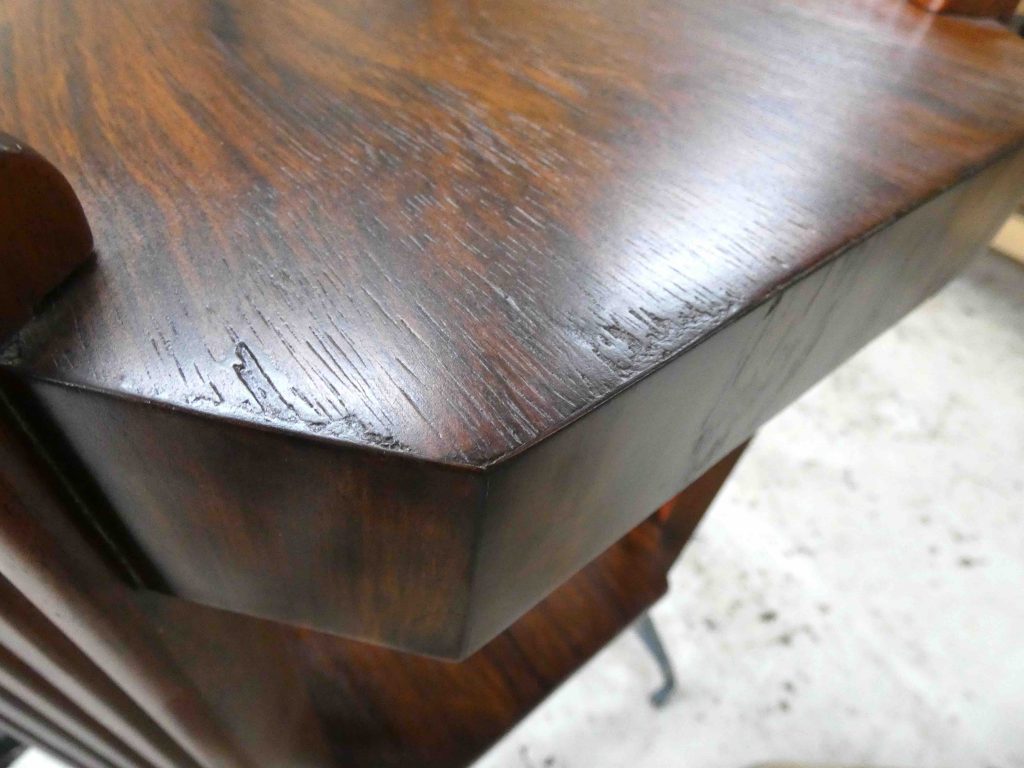
Pierces 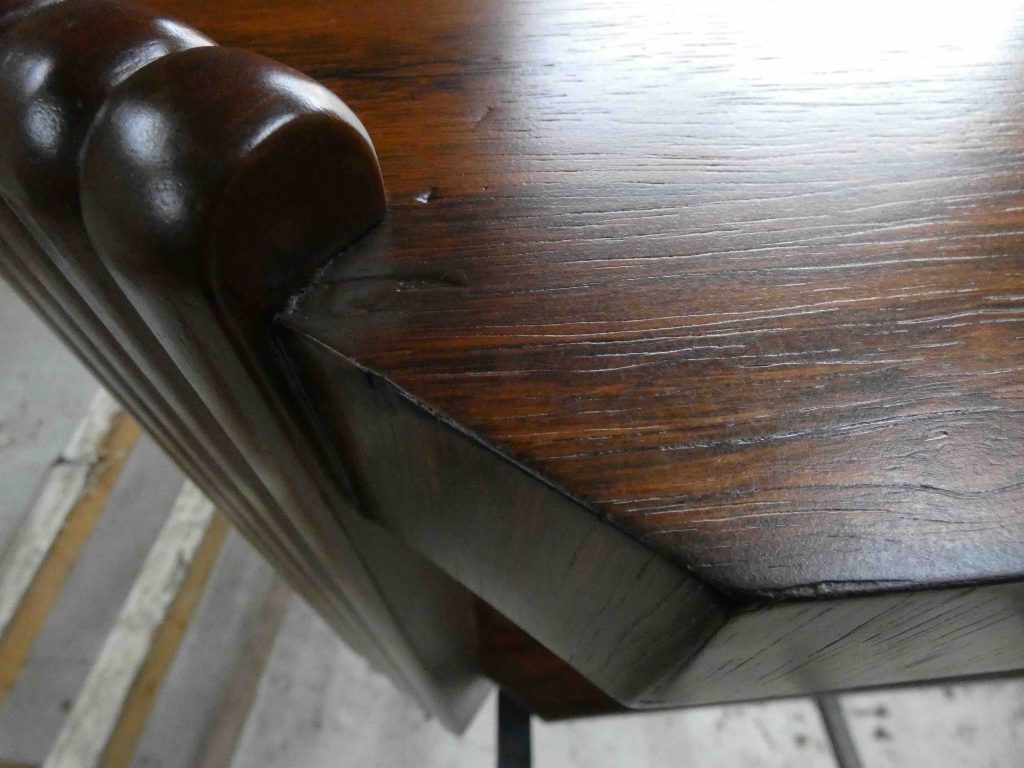
Soft wax sealing 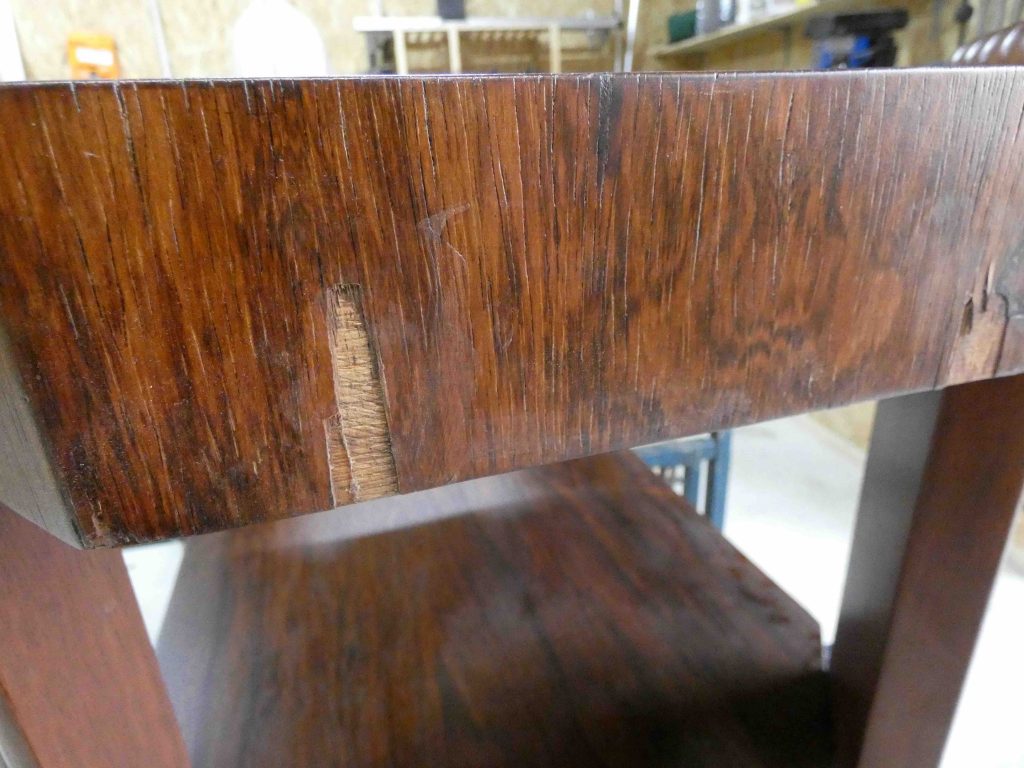
Chips and missing veneers
This gives me the opportunity to talk to you about this precious wood, rosewood.
Rosewood is a species that grows in the tropics on several continents: America, Asia, and Africa. These are vines, shrubs, or trees. They all belong to the genus Dalbergia, but in cabinetmaking some of them are known by other names: rosewood (Dalbergia decipulares), violet wood (Dalbergia caerensis), Mozambique ebony (Dalbergia menaloxylon). There are between 150 and 600 species according to the various existing sources.
The wood of these trees is very dense (0.85-1), so it barely floats; it is also very hard, resistant to vermin and moisture. The most sought-after species is the Dalbergia Nigra better known as Rio Rosewood.
Due to its renown, Rio rosewood has virtually disappeared from the market; its sale is prohibited for all specimens cut after 1992. Since January 2017, all species of the genus Dalbergia has been added to the’Annex II of the CITES legislation (Convention on International Trade in Endangered Species of Wild Fauna and Flora, also known as the Washington Convention).
Definition of Annex II: Species under intense international pressure, which may in the future be threatened with extinction, and whose international trade must be regulated to prevent the risk of overexploitation.
Rosewood throughout history in cabinetmaking
At the end of the 17th century in Brazil, rosewood was the most sought-after wood for luxury furniture, both secular and religious. Imports to France, which initially passed through Holland, were by the end of the century being routed through Le Havre and Rouen, coming from Lisbon.
Prized in almost every era since its introduction into Parisian cabinetmaking during the Regency, rosewood was used by cabinetmakers as early as 1700. However, rosewood was not found in royal furniture as frequently as common rosewood. Roubo found this wood "dreary and unpleasant." But he must have used it for marquetry or decorative details.
During the Revolution and the Empire, rosewood was rarely used. The Restoration brought back native woods such as violet wood, amaranth, and rosewood for baguettes and inlays.
From the time of Charles X, there was a renewed interest in dark woods, and under Louis Philippe, the trend was confirmed.
At the 1834 Exhibition, Flachat and Moléon praised rosewood, "which is taking the place of mahogany in our luxury furnishings." From then on, rosewood was commonly used for all kinds of furniture: chairs, armchairs, and writing desks. Its role was no longer the same; it served as a background, like ebony and mahogany, to highlight inlaid decoration in light colors (ivory, holly, lemonwood, and even white wood).
Under the Second Empire, wood was often only a support that disappeared under the abundance of decoration: colored woods, metals, porcelain, hard stone.
At the 1855 exhibition, rosewood held an important place in the furniture on display. Until the end of the century, rosewood was the most used and sought-after wood.
Art Nouveau rarely uses rosewood. However, some artists do use this wood for exceptional pieces.
During the Art Deco period, rosewood was a highly sought-after wood. It was rarely used in its solid form, but rather as a component in furniture. Furthermore, it was often combined with other woods such as mahogany, lambine, and snakewood. Its dark color was contrasted with mother-of-pearl, ivory, brass, and other materials.
The different types of rosewood most commonly used in cabinetmaking, according to continent:
American Rosewoods
- Rio rosewood (Dalbergia nigra)
- Origin: Brazil.
- Description : This is the most commonly used rosewood in cabinetmaking. It was found from the late 16th century until the 1970s. Its widespread use led to its classification as an endangered species, and its trade is therefore prohibited.
- Note – Santos rosewood (similar in color to Rio rosewood, increasingly used as a substitute for Rio rosewood) is not a true rosewood, as it belongs to the species Caesalpinia ferrea.
- Honduran rosewood (Dalbergia Stevensonii)
- Origin: Central America, South America
- Description : It is a hardwood (density 0.96), identifiable by its specific pinkish-brown to reddish colors. It is used primarily in the manufacture of musical instruments.
- Cocobolo (Dalbergia Retusa)
- Origin: Central America. Costa Rica. Nicaragua. Mexico. Honduras
- Description : This rosewood, with its shimmering colors, was used on Spanish furniture from the early 16th century. From the early 17th and 18th centuries, it can be found on Dutch, French, and English furniture. It is particularly sought after by marquetry artists due to its highly decorative appearance.
- Rosewood (Dalbergia variabilis)
- Origin: Guyana. Brazil.
- Description : There are two types of rosewood: the female rosewood used for distillation into perfumes, which has no aesthetic value in marquetry, and the male rosewood, used in the 18th century to create flowers in marquetry bouquets, hence the English name "Tulipwood." Its French name, however, derives from its color and fragrance.
- Wood: Violet wood (Dalbergia cearensis)
- Origin: Brazil
- Description : It was initially called "purple wood" because of its color and became "violet" during the 19th century due to confusion with amaranth, which is also purple. It was used as early as the 17th century, and its preciousness earned it the nickname "kingwood" from the English.
Asian Rosewood
- Indian rosewood (Dalbergia latifolia)
- Origin: South India. Burma. Indonesia.
- Description : It has only been used in French cabinetmaking since the second half of the 19th century. It reached its peak during the Art Deco period. It reappeared in the 1950s and 1960s. Today it is mainly used for decorative panels and in furniture.
- Vietnamese rosewood (Dalbergia bariensis)
- Origin: Southeast Asia
- Description : It is reddish-brown/purplish-brown in color and has been used mainly since the 20th century.
African Rosewood
- Madagascar rosewood (Dalbergia Voamboana)
- Origin: Madagascar.
- Description : It was widely used in the late 19th and early 21st centuries for making copies of 18th-century furniture. Today, it is a highly sought-after wood for cabinetmaking, marquetry, fine joinery, and luxury parquet flooring. It is also used for outdoor applications: garden furniture, swimming pools, gates, pergolas, and decking. However, its primary use remains in luxury furniture.
- Mozambique ebony (Dalbergia melanoxylon)
- Origin: Mozambique. Senegal.
- Description : It is also called "Blackwood" or "African Grenadilla." This wood is called ebony, but it is indeed a rosewood since it is a Dalbergia and not a Diospyros (Ebony). It has been widely used since antiquity in sculpture, both solid and veneered. It can be found on pieces of Egyptian furniture. In Europe, it was used from the Middle Ages onwards. It is primarily used in instrument making, serving to turn most wind instruments: clarinet, oboe, bassoon, etc.
Sources:
http://www.george-veneers.com/recup_donnees_bois.php
- Cabinetmaking woods in French furniture by Jacqueline Viaux-Locquin