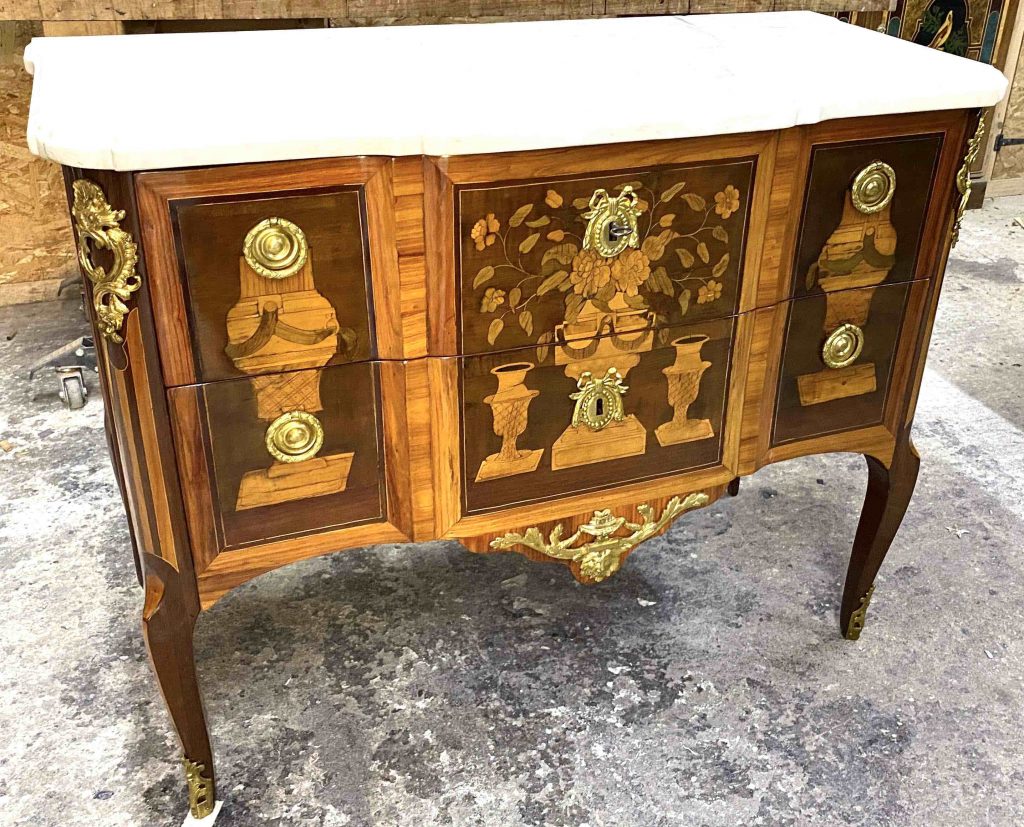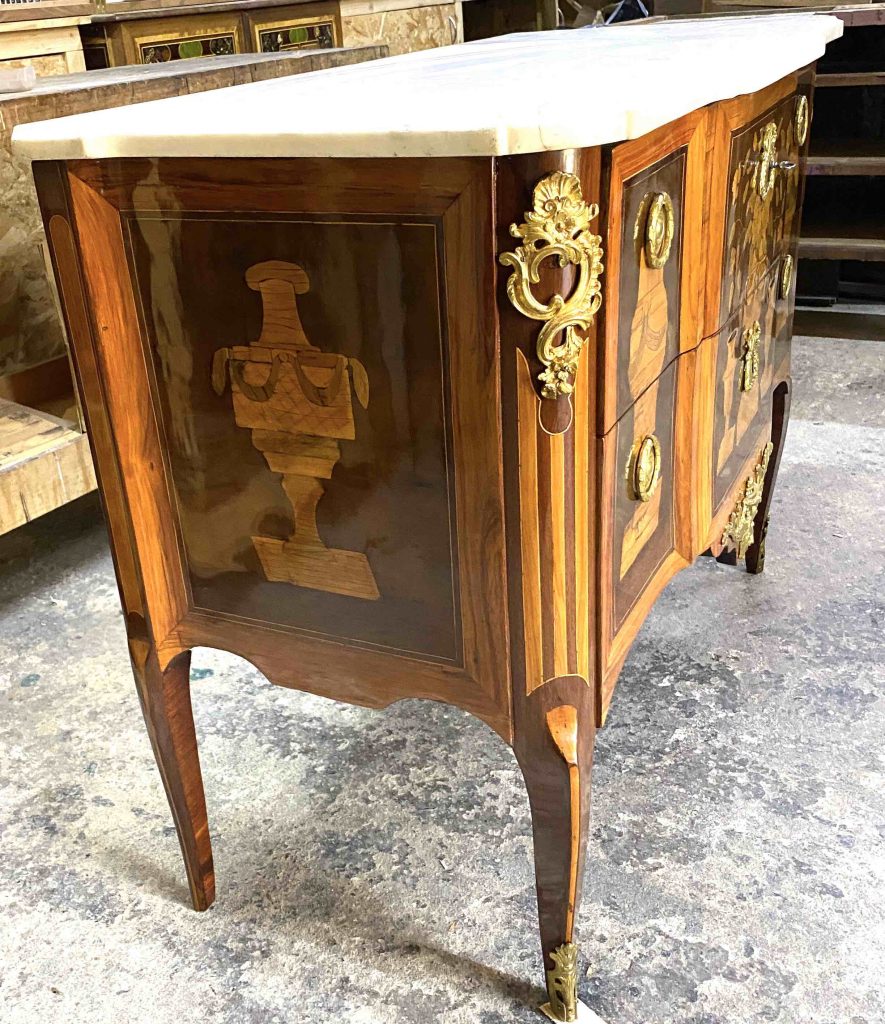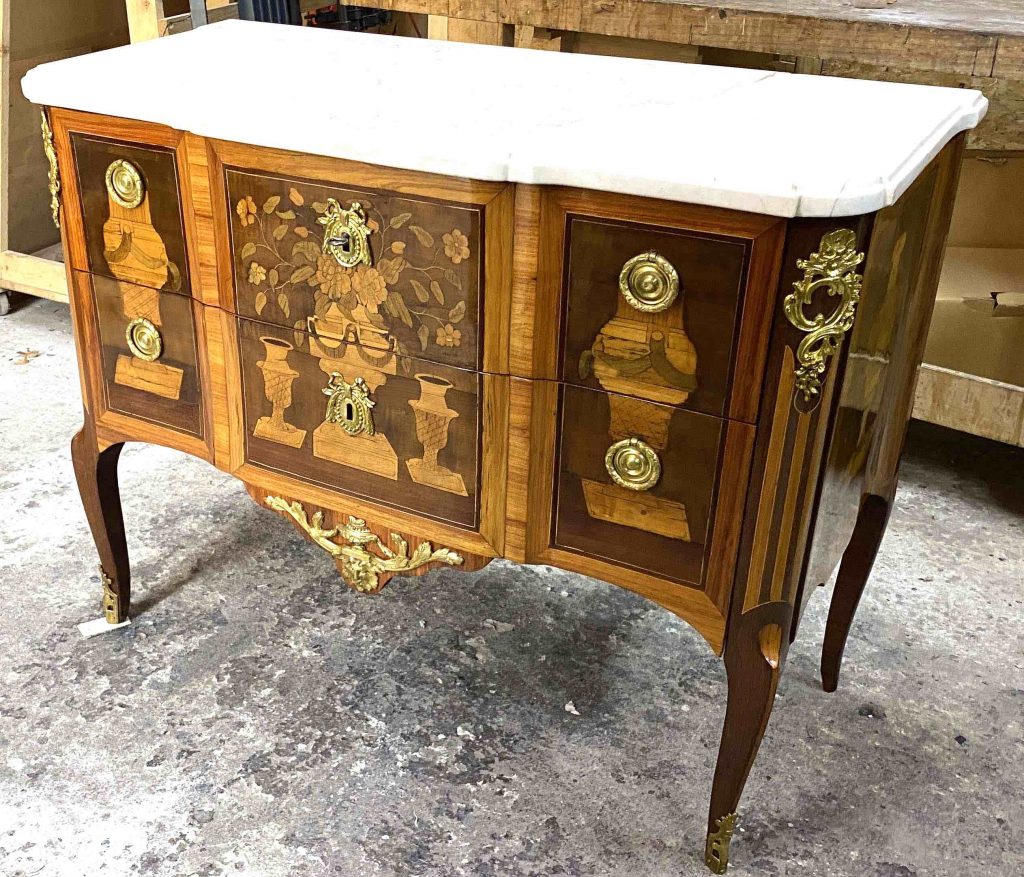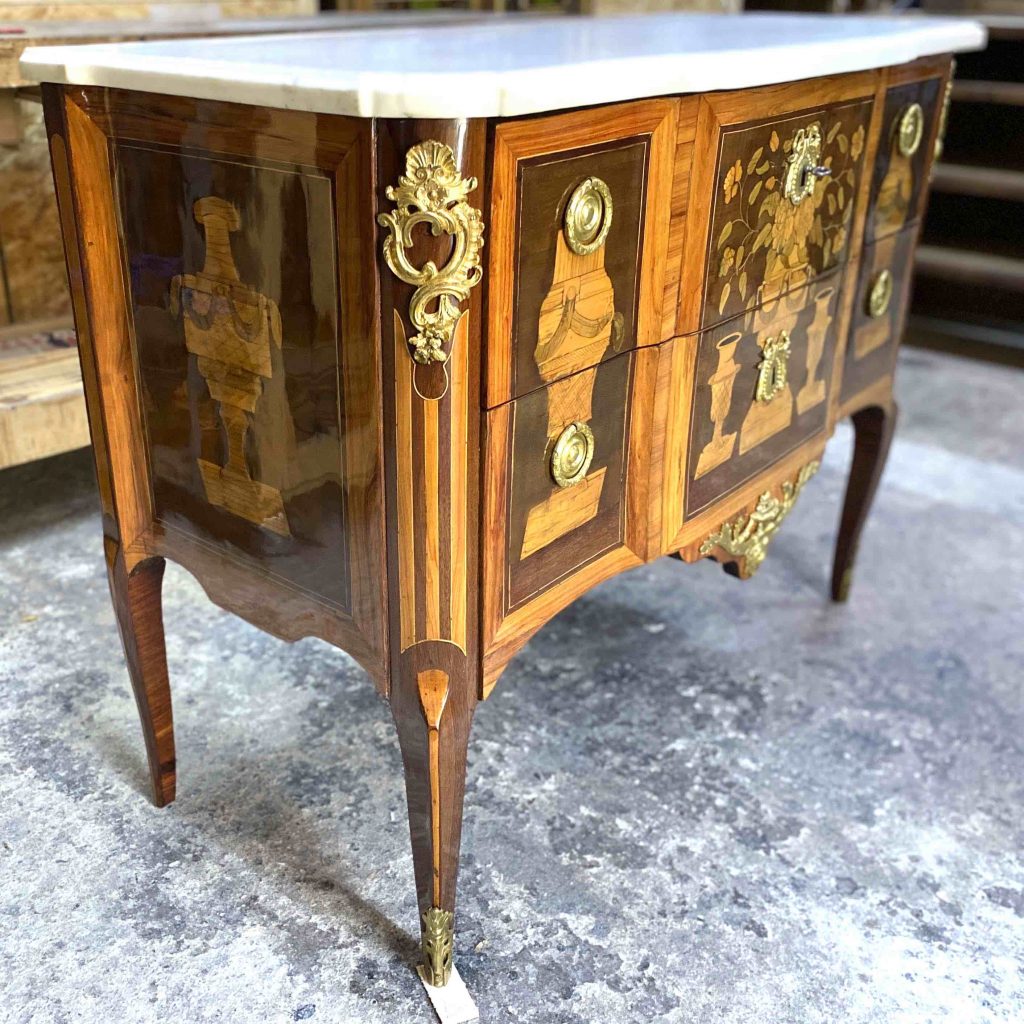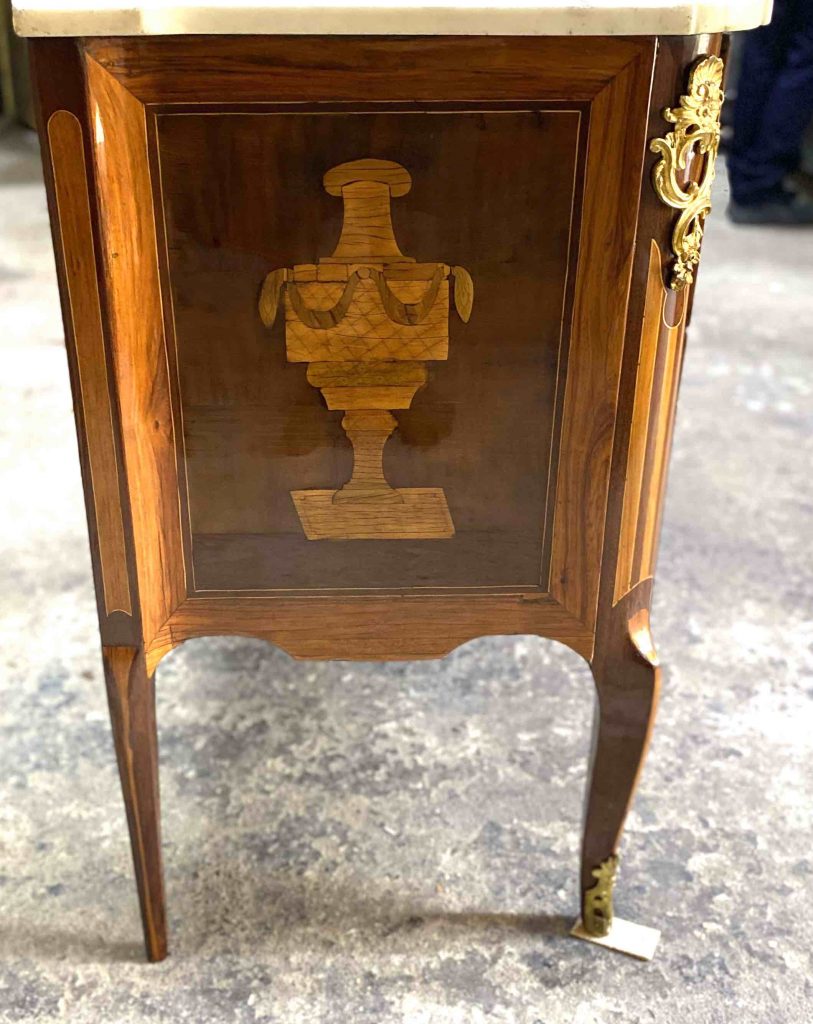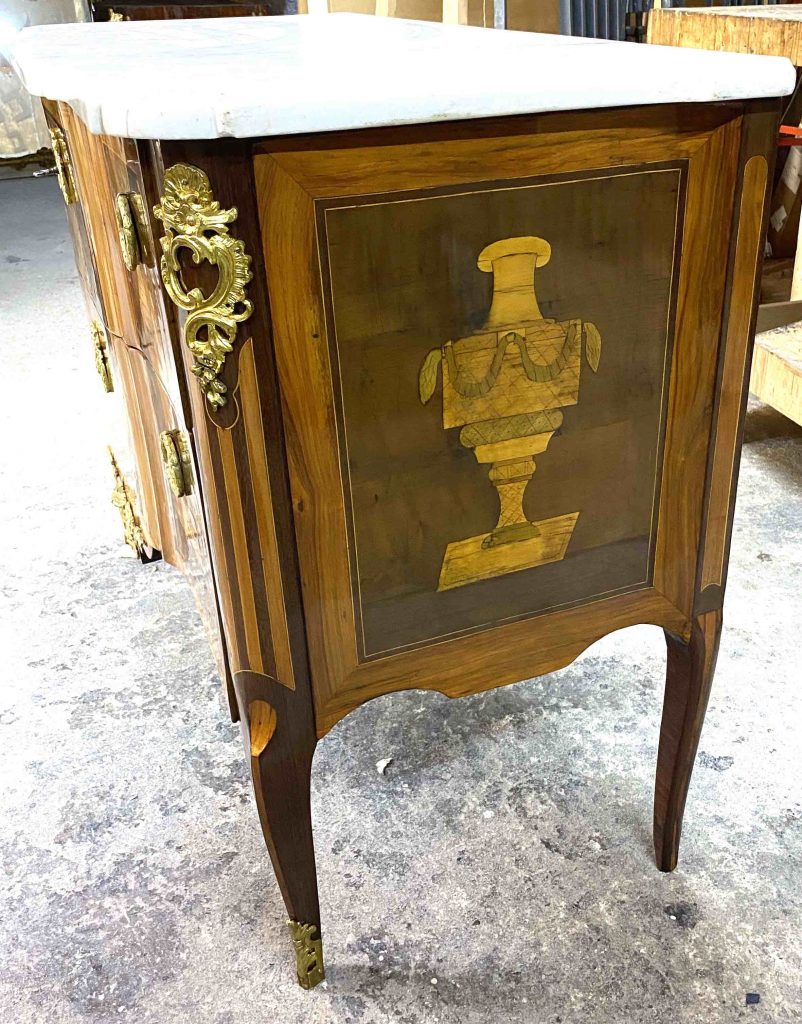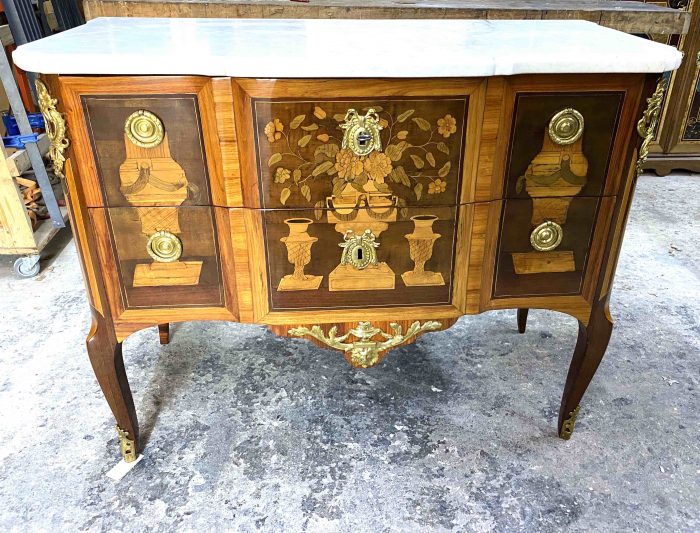
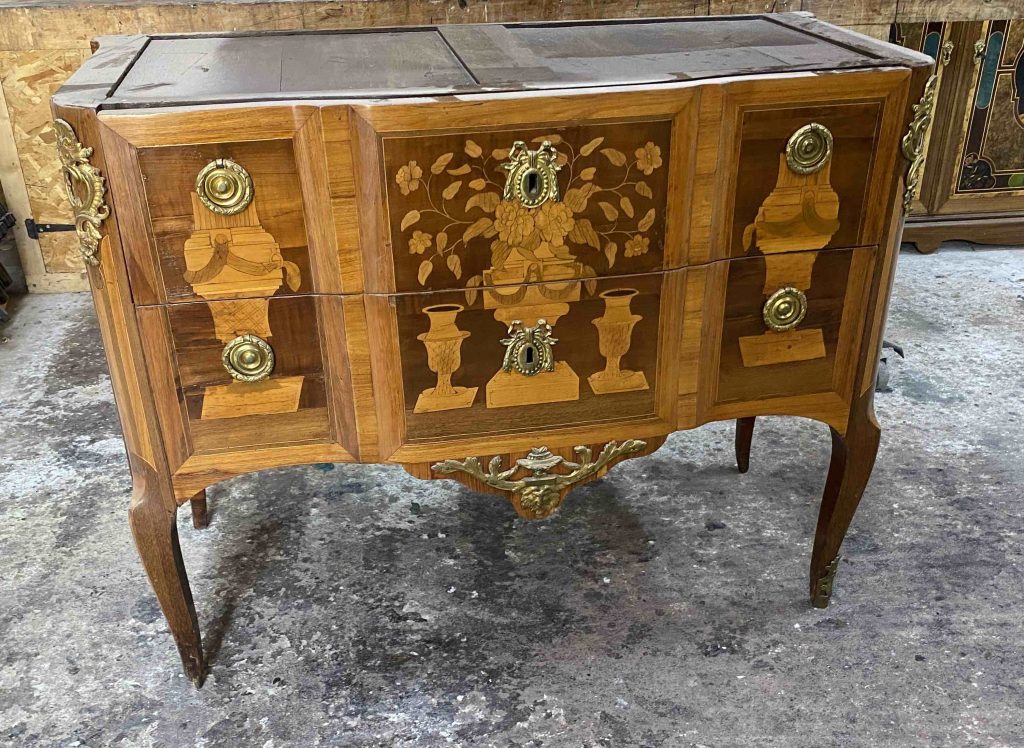
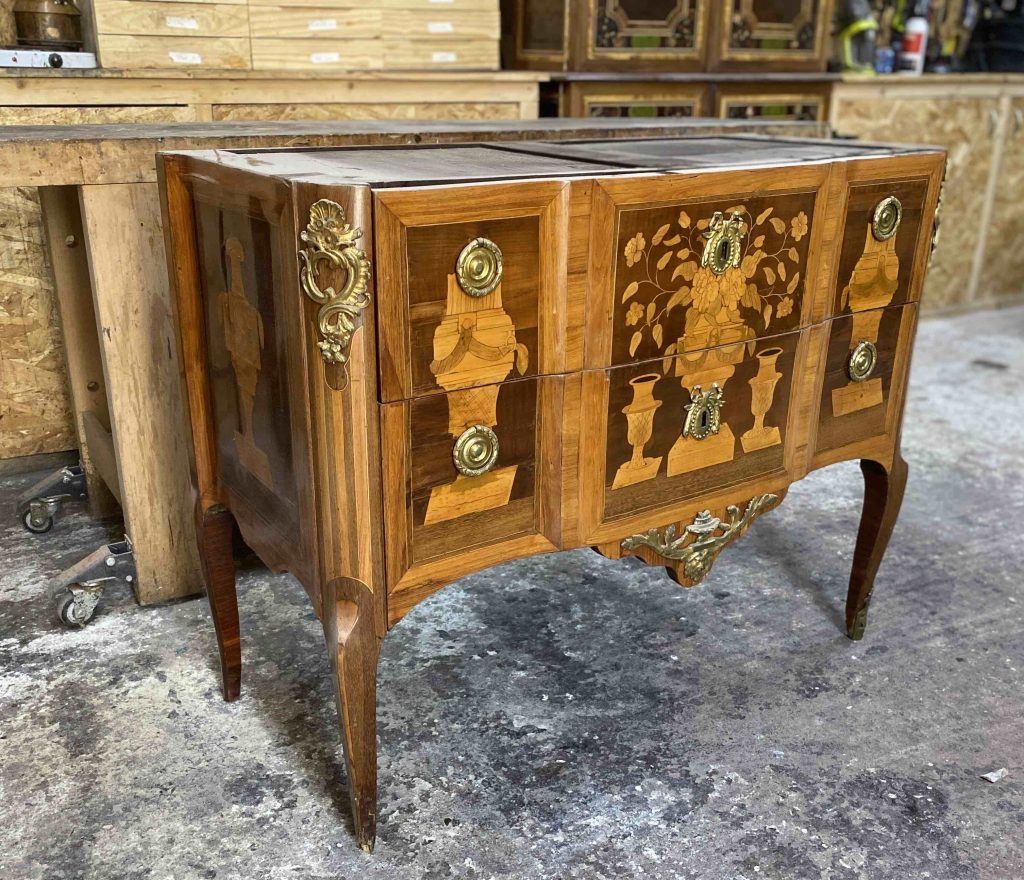
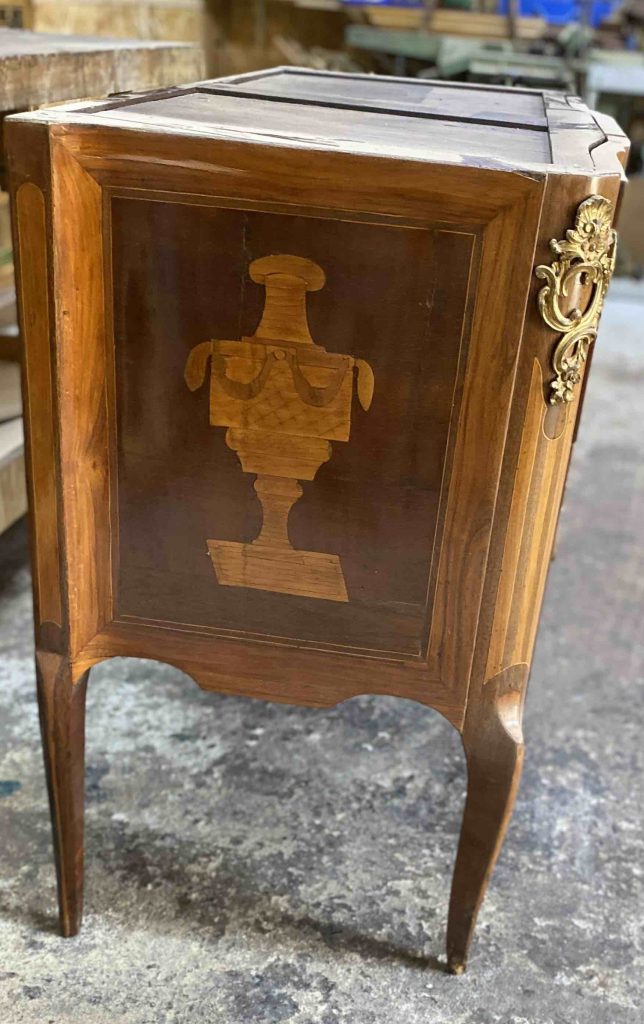
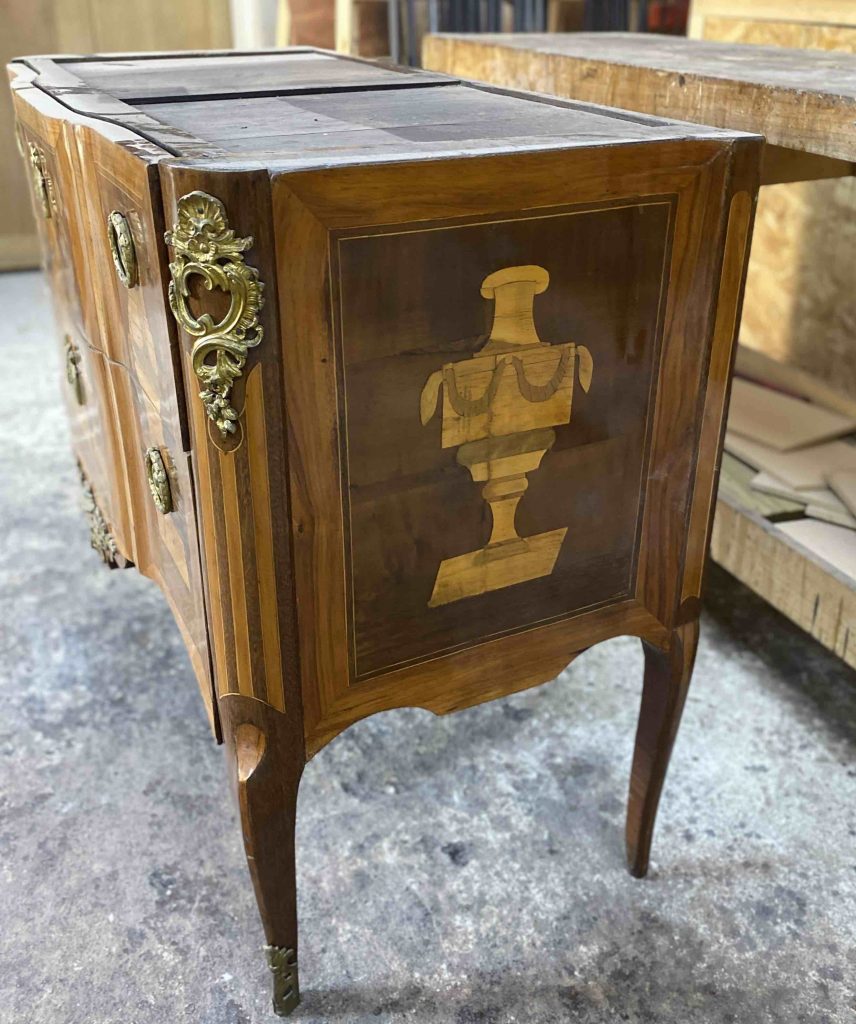
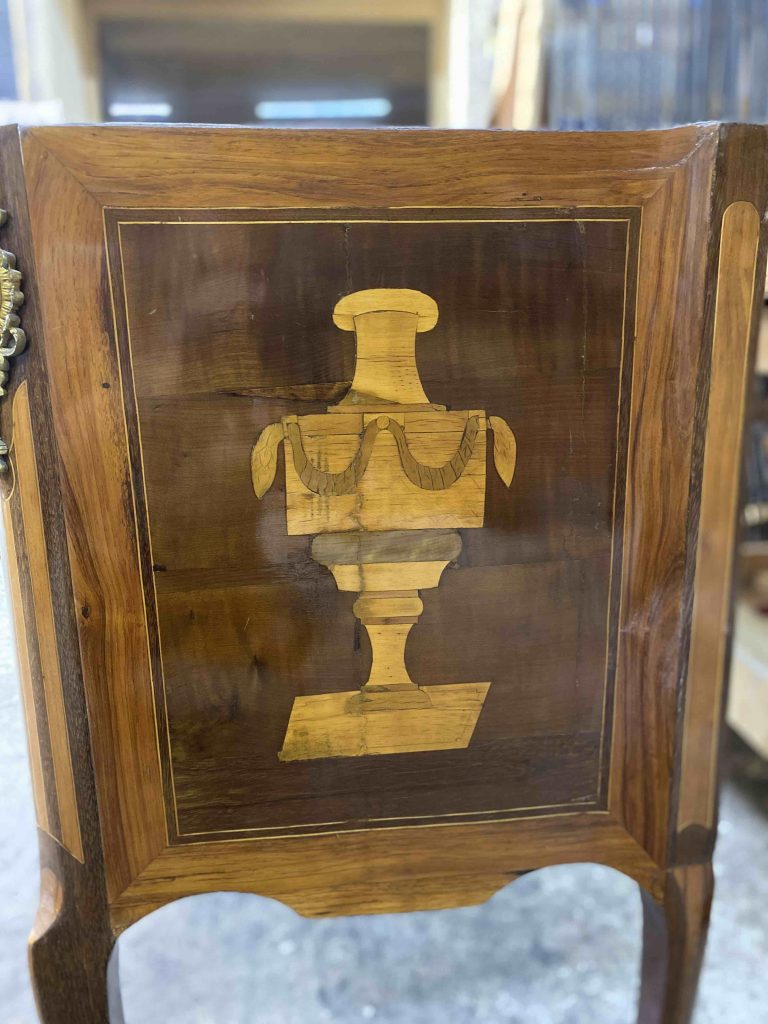
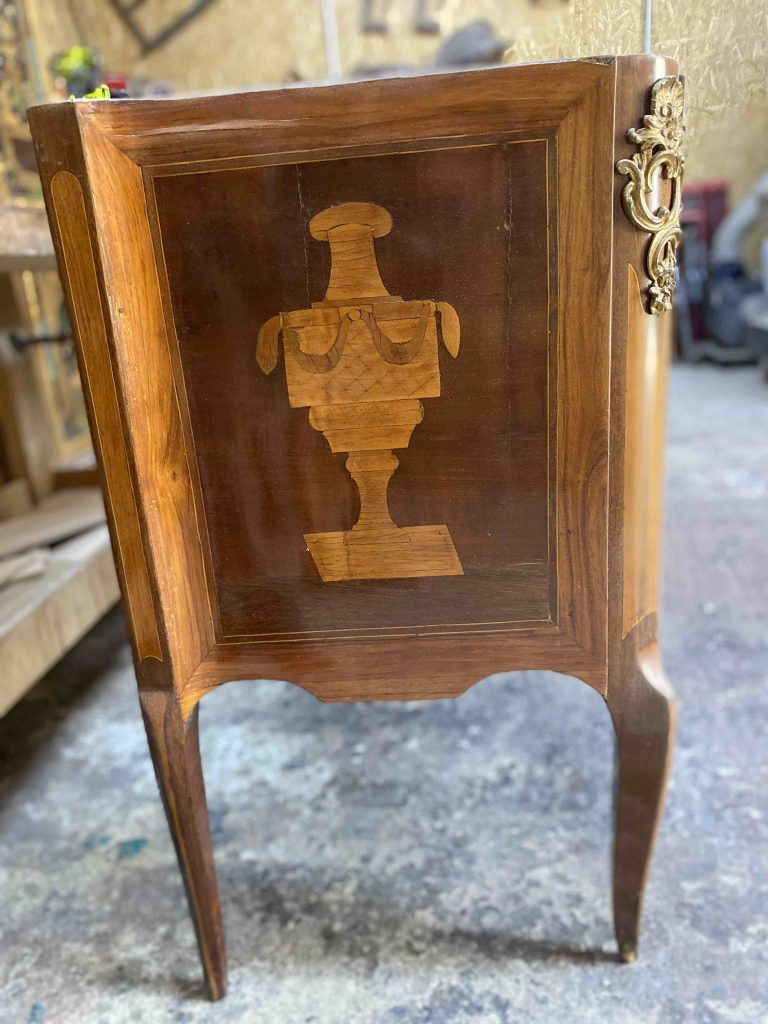
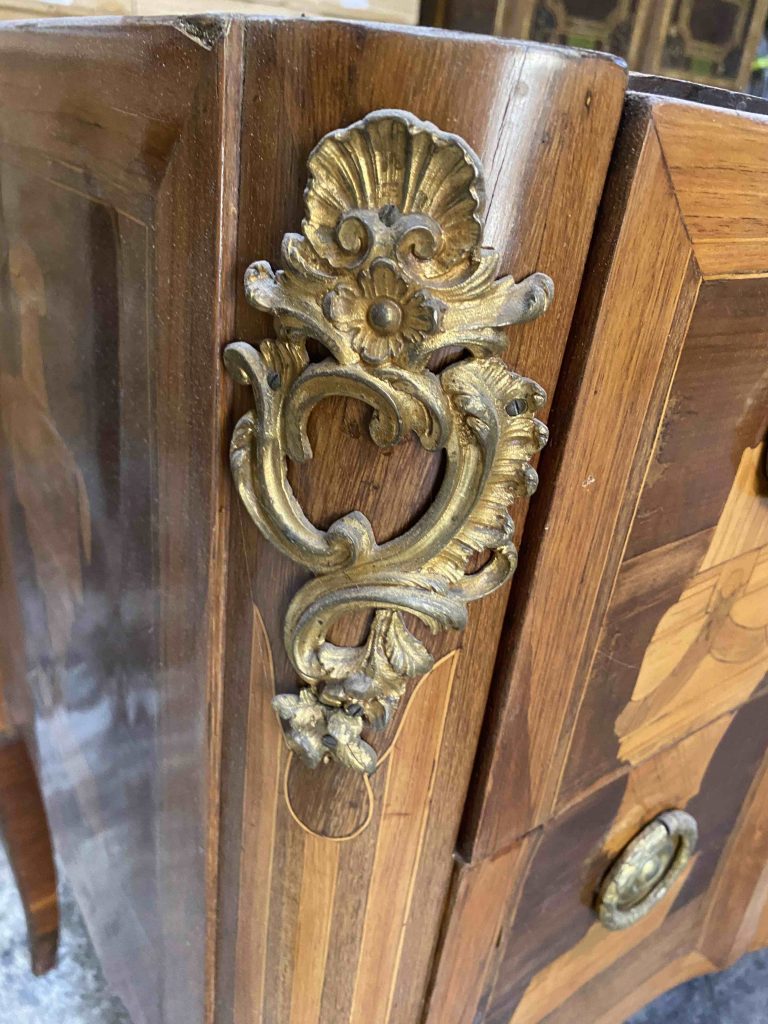
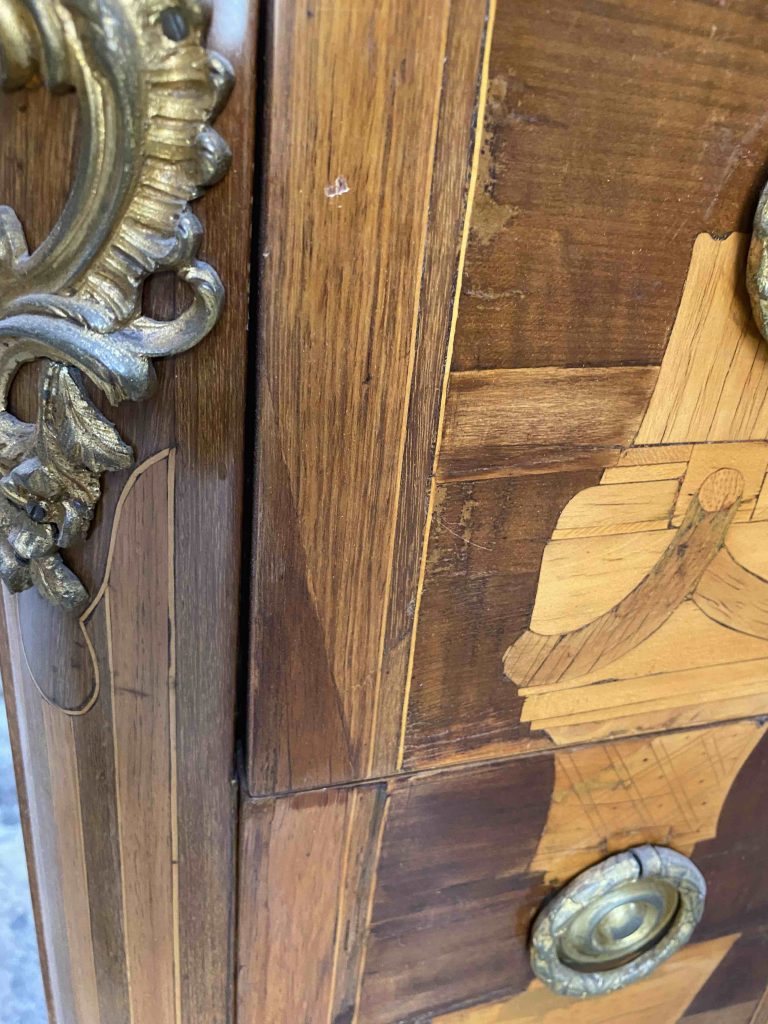
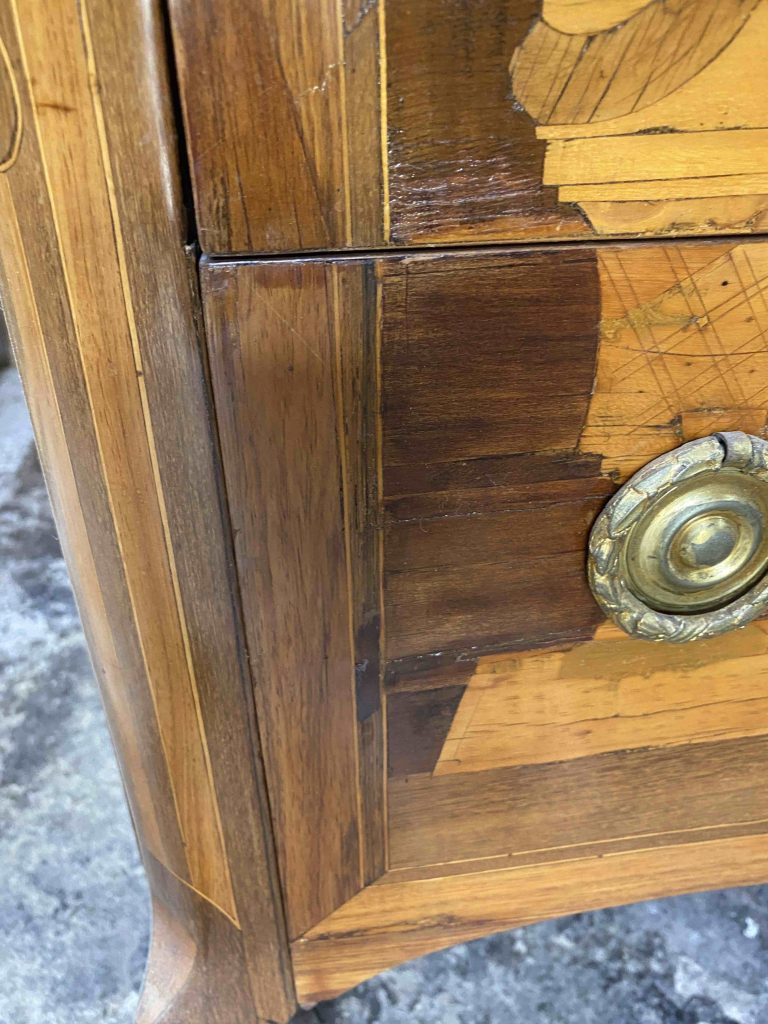
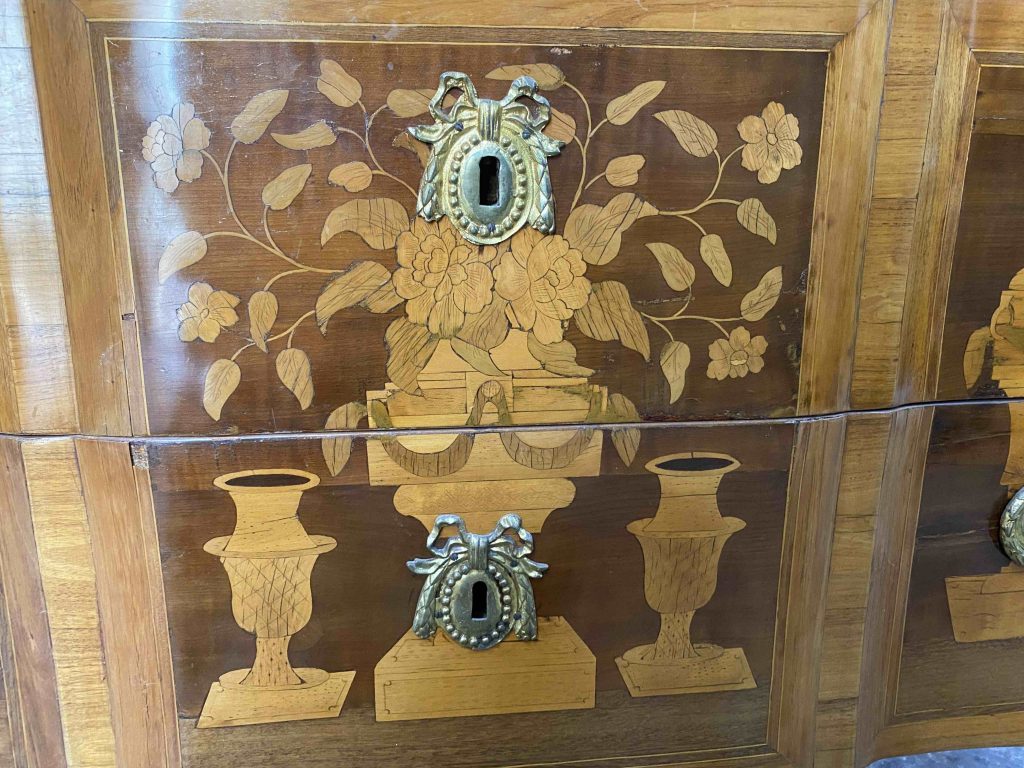
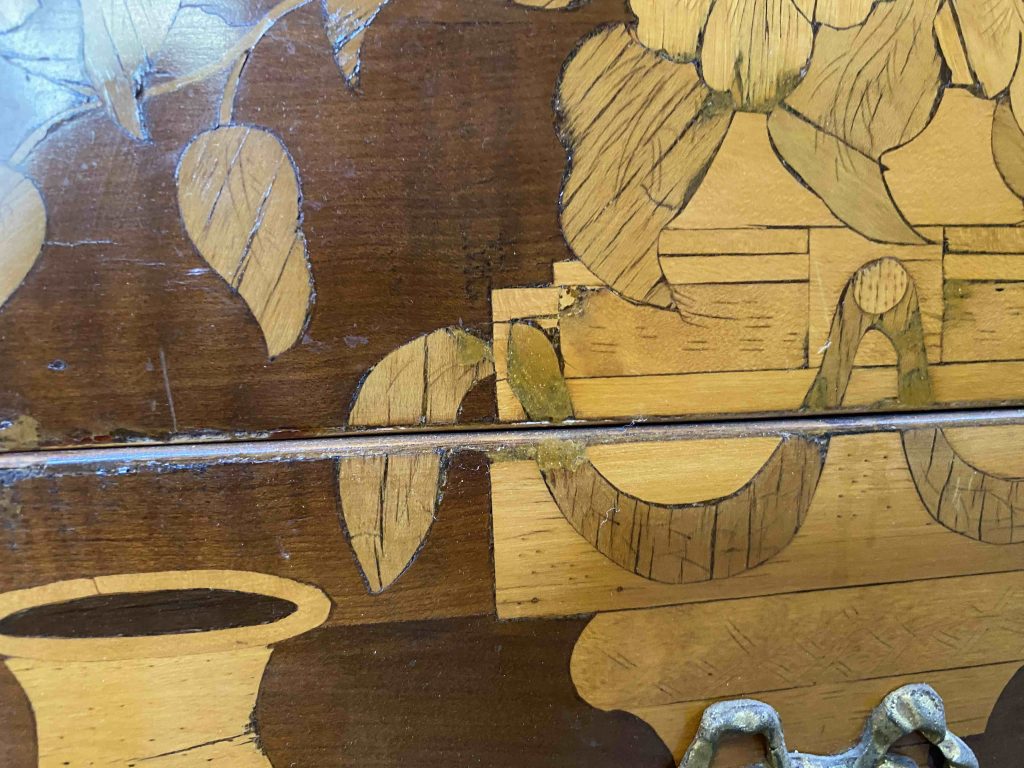
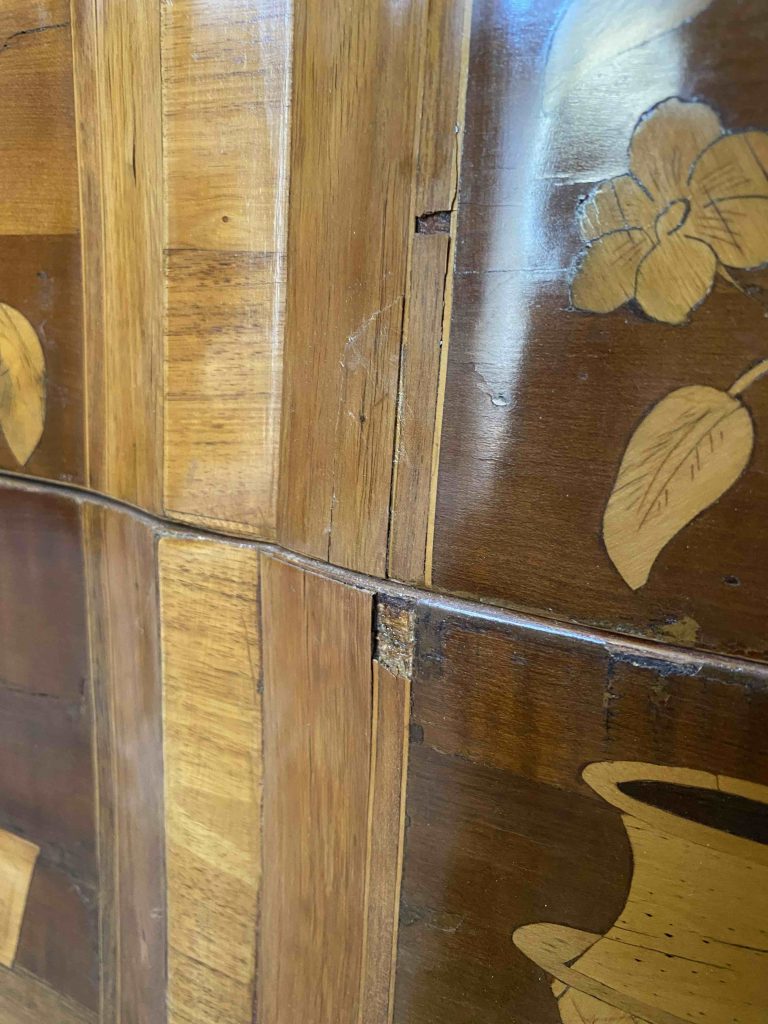
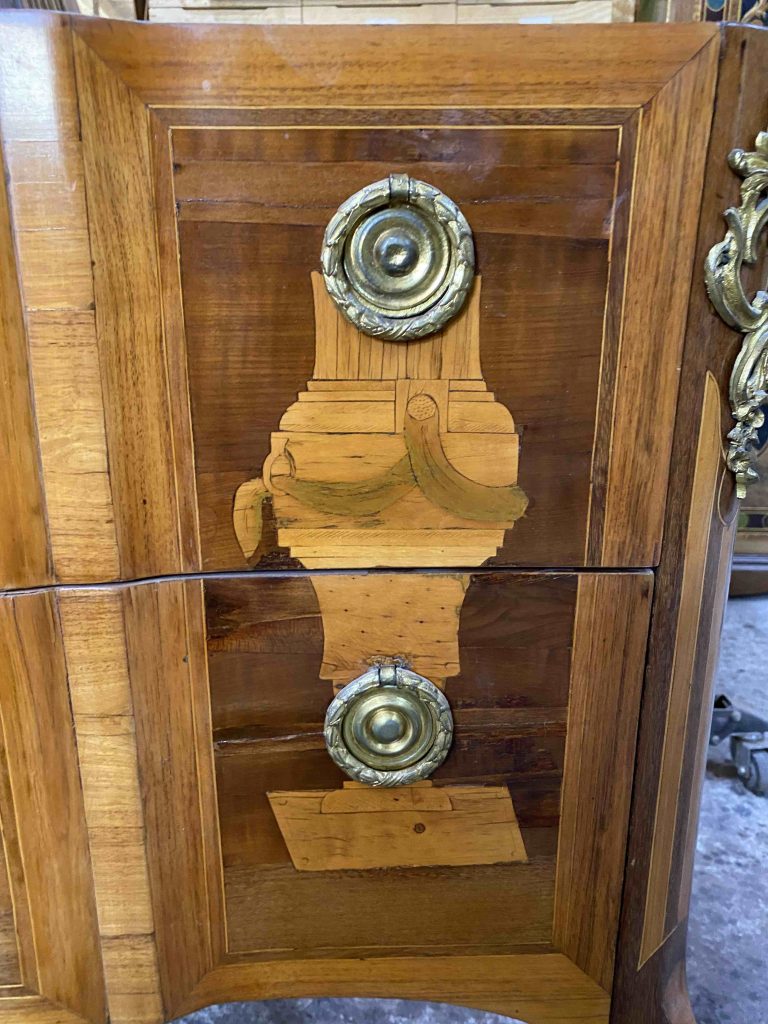
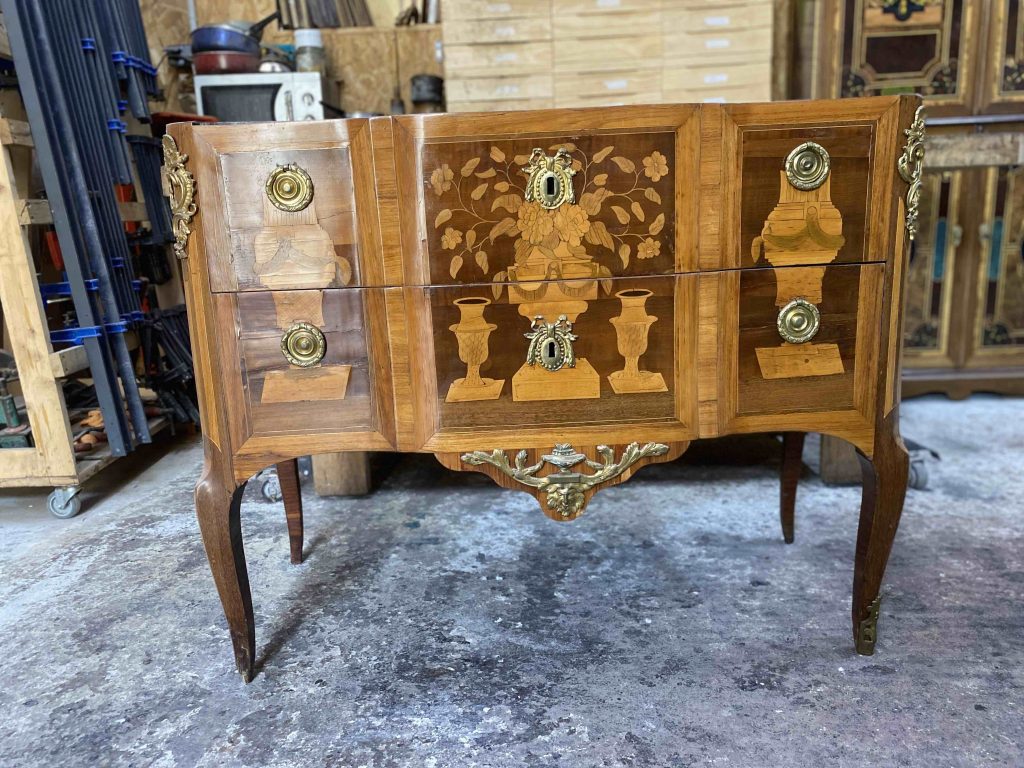
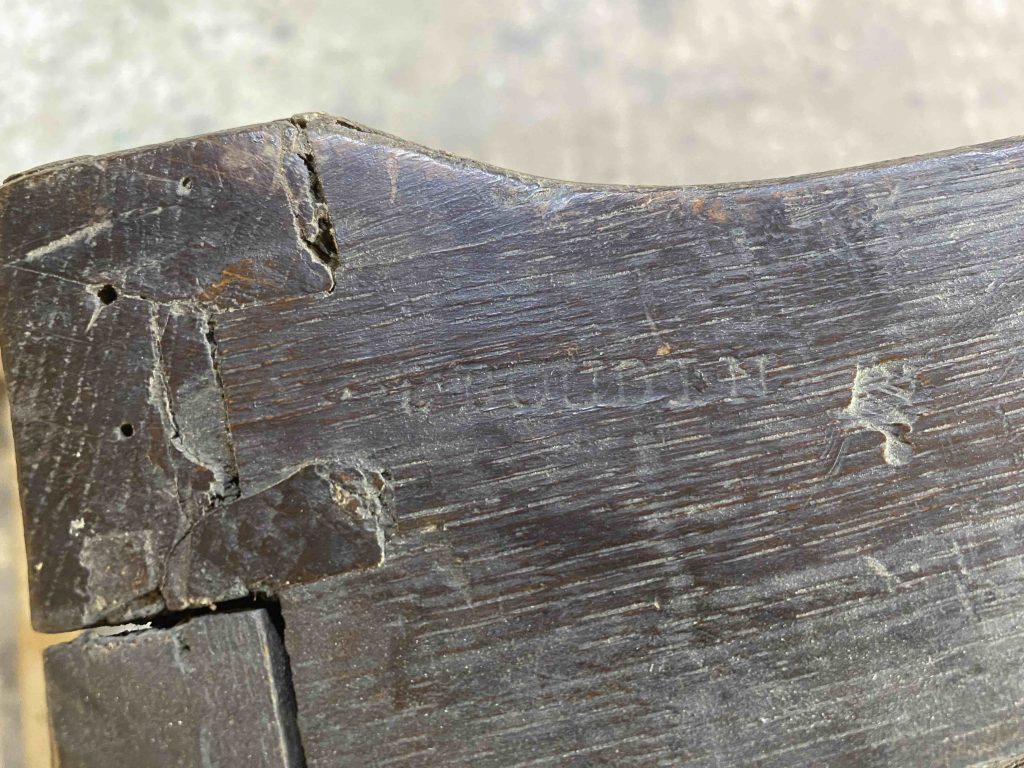
Restoration of a Transition-style commode stamped by the master cabinetmaker Leonard Boudin (1735 in Paris – 20/12/1807). Constructed of solid oak, it is veneered with amaranth, rosewood, and tobacco-stained maple. Its marquetry of boxwood, hornbeam, and holly forms panels on the front and sides depicting floral vases and covered pots. The front features a slight central projection and opens with two drawers without a central divider. Its rounded uprights rest on cabriole legs.
Boudin, in fact, produced many Transition-style commodes of this type. They all share the same shape, but their decoration varies. For example, the bronze mounts remain very Louis XV. However, the feet are straightened and lose their crowbar-like feet. Furthermore, the keyhole escutcheons and handles are typically Louis XVI.

Leonard Boudin
Born in 1735 in Paris to a very modest family, he began his career as a simple craftsman. He was quickly taken on by Pierre Migeon, a renowned cabinetmaker and merchant. After receiving his master craftsman's certificate on March 4, 1761, he established his own workshop on Rue Traversière. He continued, however, to work for Migeon and other cabinetmakers. From 1770 onward, numerous prominent merchants sought his services, such as Louis Moreau and Gérard Péridiez. He thus acquired a great reputation for his varied and exquisitely crafted marquetry. In 1772, while maintaining his workshop, he opened a shop on Rue Fromenteau. Finally, in 1777, he moved it to the cloister of Saint-Germain-l'Auxerrois.
Advertisement by Léonard Boudin – December 1777 – in «"The Journal of Small Posters"»
- Mr. Boudin, cabinetmaker and upholsterer of the cloister of Saint-Germain-l'Auxerrois, of a very well-stocked store of furniture of all kinds in the new style, chests of drawers, secretaries and other works of cabinetmaking, fires, arms and clocks gilded with ground gold, clocks with bases of white marble, mirrors, chandeliers and works of China, in vessel and castles of mother-of-pearl.
Faced with a surge in orders, he in turn enlisted the help of other cabinetmakers, including Topino, Evalde, and Denizot. He thus became one of the leading dealers in Paris. Gradually, Boudin abandoned his own creations, offering only the works of his colleagues. Hence the double stamp found on numerous pieces (Tuart, Letellier, Dubois, Gilbert, Vié, Topino, Cordié, Birklé, Macret, Latz, Chevallier, Evalde, Fléchy, Péridiez). Furthermore, some pieces of furniture bear only Boudin's stamp, even though they are not by his hand.
Finally, Salverte describes Boudin as "greedy for gain." He cites several instances where the cabinetmaker tried to force some of his colleagues to repay debts that were sometimes minimal.
BIBLIOGRAPHY
- French Furniture of the 18th Century – Pierre Kjellberg – Les Editions de l'Amateur – 2002
- Cabinetmakers of the 18th Century – Count François de Salverte – Art and History Publishers – 1923
- The stamp "The Art Object" – Patricia Lemonnier – Faton – June 1989
- The Essence of Wood – A Macroscopic Identification Manual for Woods Used in French Furniture – 16th-20th Centuries – Hardcover – Patrick Georges – Emmanuel Maurin – Marie-Christine Trouy-Jacquemet – Dominique Bouchardon – Editions du Patrimoine – 2020