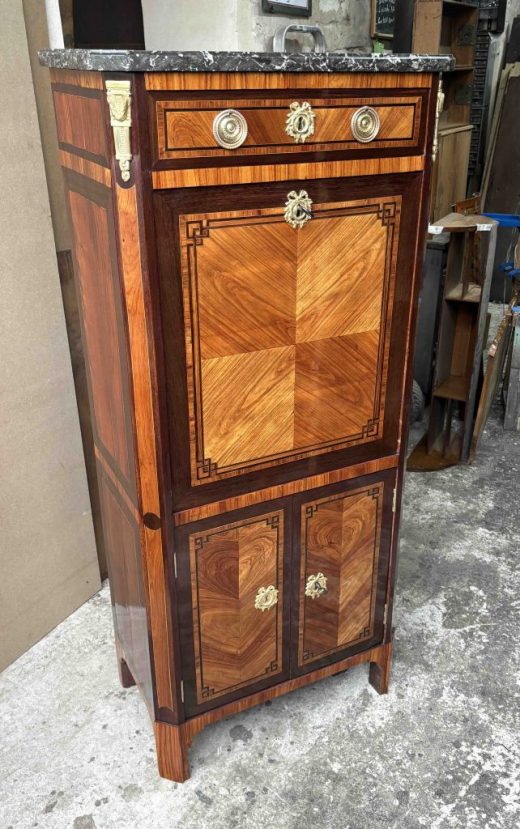
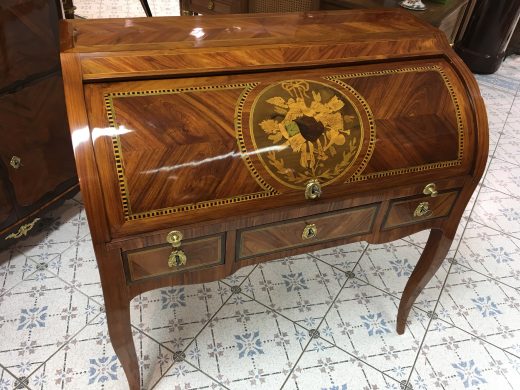
Louis XVI secretary stamped Schlichtig

Ebénisterie Mathieu Vath

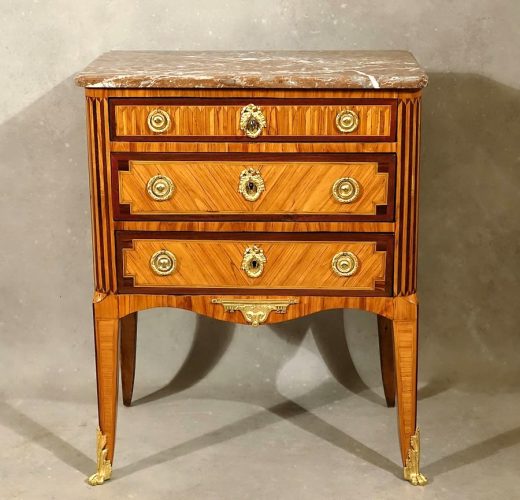
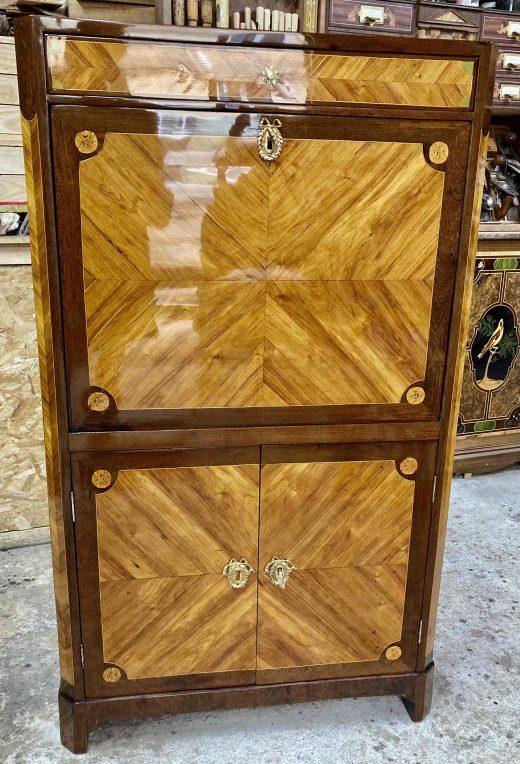
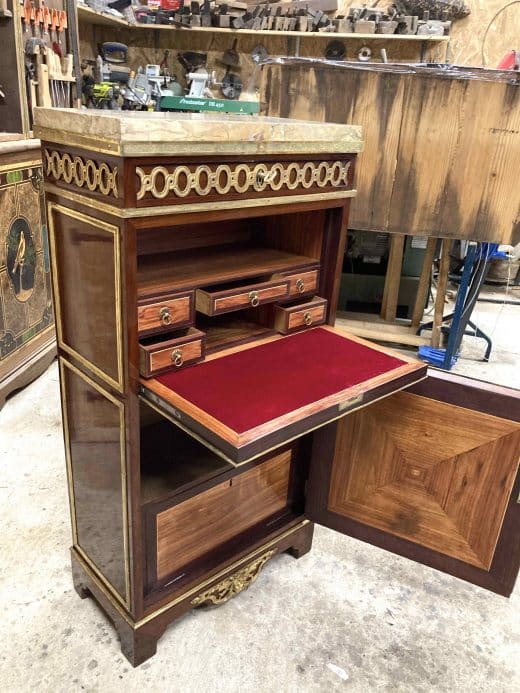
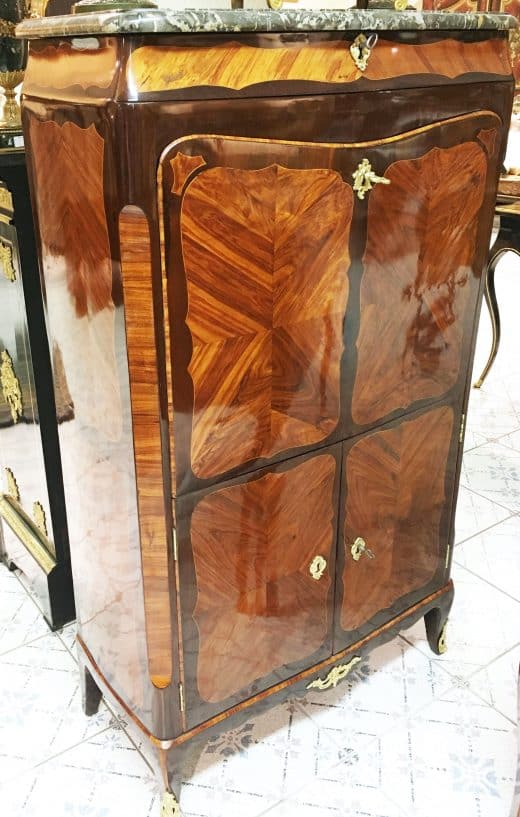
This Louis XVI style secretary desk, stamped JG Schlichtig, is made of rosewood veneer, satinwood (on the sides) and amaranth, on an oak and softwood frame. It opens with two lower doors, a central drop-front, and a top drawer. The interior of the piece includes six drawers and three niches. Given its small size, 1.20 meters, it can be described as a lady's secretary desk. Jean-Georges Schlichtig († February 1782) was a Parisian cabinetmaker of German origin, admitted as a master on October 2, 1765. He established himself successively […]
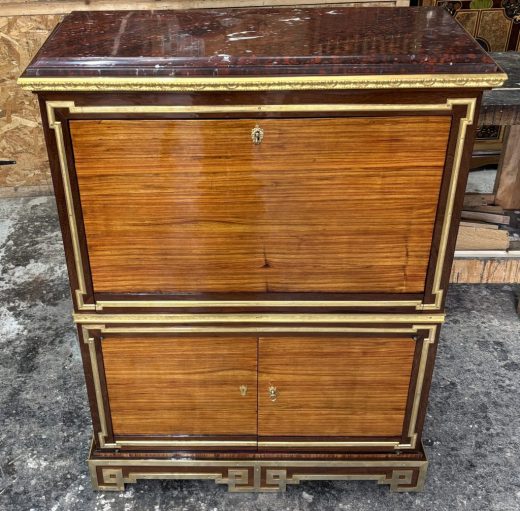
Transition secretary desk in the style of Montigny

Ebénisterie Mathieu Vath

Restoration of a 19th-century Transition-style drop-front secretary, veneered in rosewood and amaranth on an oak frame. This secretary is a learned interpretation of Parisian models from 1765-1775 and is directly inspired by the famous secretary attributed to the cabinetmaker Philippe-Claude Montigny, now in the Musée des Arts Décoratifs. The stylistic similarities with the museum model are immediately apparent in the architectural design of the piece, the treatment of the stepped legs, and the use of bronze ornamentation inspired by the Greek style. The piece adopts […]

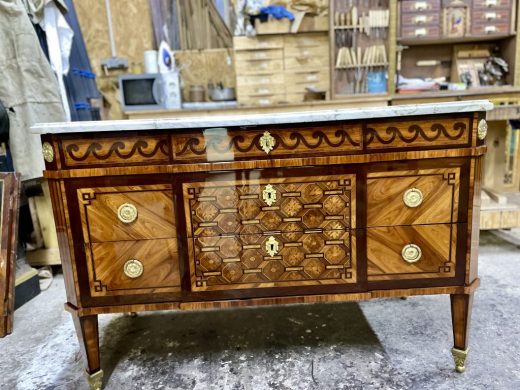
Louis XVI chest of drawers by Jean-Francois Leleu

Ebénisterie Mathieu Vath

Restoration of a Louis XVI period commode with a projecting central front, stamped JF LELEU. Made entirely of oak, it is veneered with amaranth, rosewood, boxwood, stained maple burl, and tobacco-grey maple. It is decorated with marquetry featuring a frieze of posts on the top drawer, Greek key motifs, and fleurons within a mosaic of hexagons known as "marquetry à la reine" on the central projection. It has three drawers, two of which conceal drawers with crossbars. The front uprights are […]

Flat Greek-style desk stamped DUBOIS

Ebénisterie Mathieu Vath

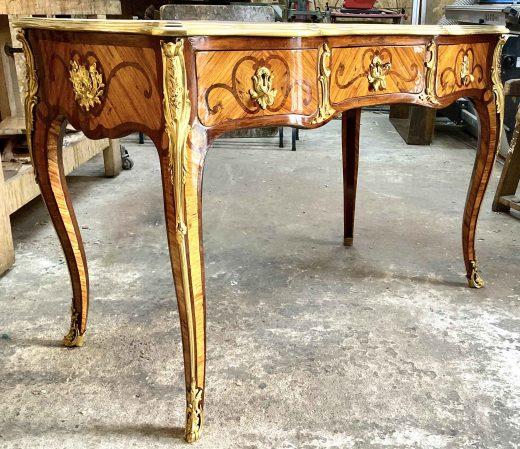
One desk, one stamp, three cabinetmakers? The desk we are about to discover, a masterpiece of French cabinetmaking, embodies the culmination of 18th-century Neoclassical taste. The question that immediately arises upon contemplating this exceptional piece is: why three cabinetmakers for a single desk? The answer lies in the complex interplay of succession, talent, collaboration, and opportunism that characterized the craftsmanship of the period. This flat desk, known as a "Greek-style" desk, is a perfect example of the Louis XVI style. Made from a blend of […]

Regency chest of drawers

Ebénisterie Mathieu Vath

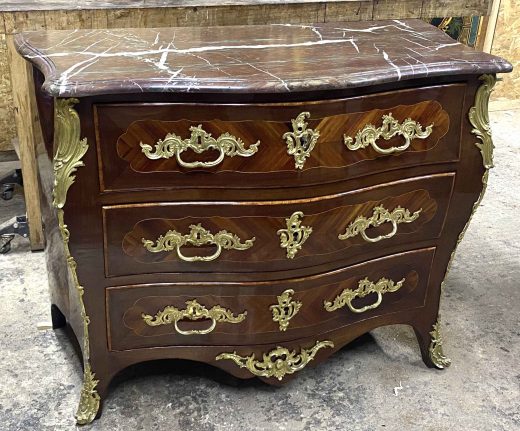
Restoration of a bombé commode with a front veneered in satinwood with double boxwood stringing within amaranth borders, mounted on a fir frame with walnut drawer boxes. It opens with four drawers in three rows and is adorned with finely chased bronze mounts, silvered rather than gilded as is customary. The uprights are veneered with a facsimile of brass fluting, and the sides, decorated with a lozenge within a rectangle, echo the decorative motif of the front veneer. It is […]

Transition Secretary

Ebénisterie Mathieu Vath

Restoration of a transitional rosewood and amaranth secretary desk with simulated fluting using boxwood and ebony. The frame is made of oak and softwood. As is often the case with secretaries, one of the main areas of damage is the hinges of the fall-front, which have cracked and damaged the frame and veneer. The work involved replacing the solid wood that provides support and proper alignment before replacing the missing amaranth veneer. The […]

Regency style pedestal desk

Ebénisterie Mathieu Vath

Restoration of a desk veneered on all sides with yew burl and amaranth, decorated with geometric boxwood stringing. It opens with five drawers in the front and five simulated drawers in the back. The two lower drawers follow the contour of the front and slide down at a 45-degree angle. The top is veneered in amaranth and edged with a bronze molding. It rests on four cabriole legs and terminates in curious acanthus leaf bronze mounts. The frame is entirely oak, except for the drawers, which are made of […]

Louis XVI Weekly Planner

Ebénisterie Mathieu Vath

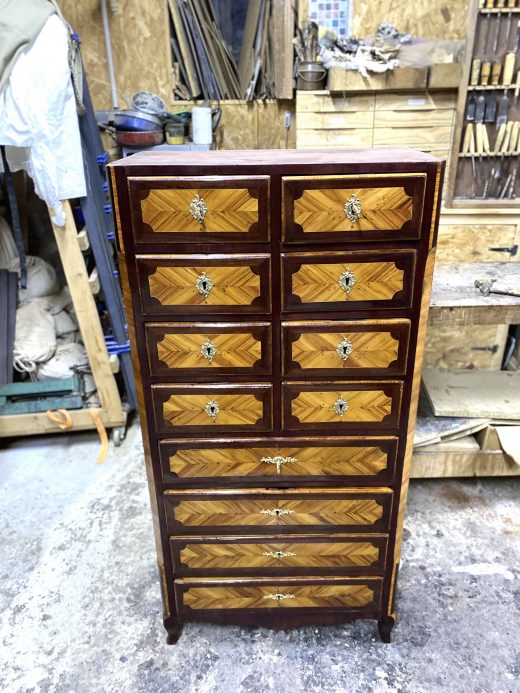
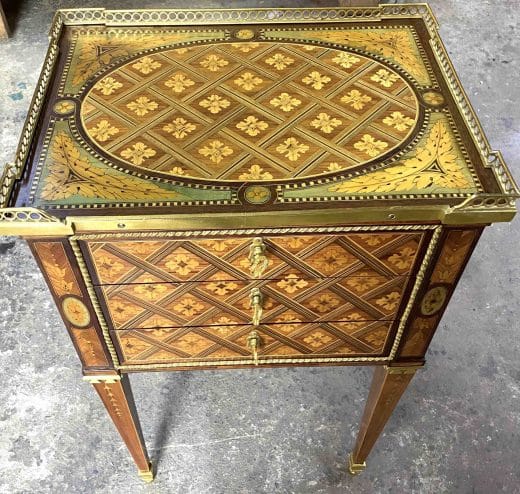
Restoration of a Louis XVI chest of drawers veneered in rosewood, satinwood, and amaranth. It opens with a series of seven drawers framed by rounded uprights with simulated fluting made of boxwood and blackened pearwood. A chest of drawers? The chest of drawers is a piece of furniture that appeared in the mid-18th century, primarily intended for women. It is a chiffonier (which appeared during the Regency period, between 1715 and 1723) with seven drawers, one for each day of the week, designed to store the day's clean undergarments. The restoration...

Louis XVI commode stamped J. LAPIE

Ebénisterie Mathieu Vath

Restoration by Lise, during her internship at the workshop, of a Louis XVI commode stamped by Jean Lapie, constructed of oak, fir, and beech, veneered in rosewood with hornbeam and amaranth stringing, and adorned with gilt bronze mounts. And since Lise submitted an excellent internship report, I am publishing it almost in its entirety. Jean Lapie (known as "The Younger"), son of the potter Nicolas Lapie, was born around 1734. Brother of the cabinetmaker Nicolas-Alexandre Lapie (known as "The Elder") and cousin of Jean-François Lapie, he obtained his master's degree in Paris […]

Louis XVI wardrobe

Ebénisterie Mathieu Vath

Restoration by Raphaël of a rosewood veneered cabinet with diamond-pointed doors, framed in amaranth and Greek key stringing. It opens with two large softwood doors veneered with oak. Some regluing and repairs of missing veneer, along with a good coat of clear French polish, have restored this piece of furniture to its former glory.

Regency style commode stamped Hédouin

Ebénisterie Mathieu Vath

Here is the latest restoration by Raphaël, my apprentice. Although it possesses all the attributes of a Regency commode, it could only have been made much later, after this historical period (around 1715-1723). Indeed, since Hédouin obtained his master craftsman's certificate in 1738, during the height of the Louis XV era, it is more accurately described as a commode "in the Regency style" by cabinetmakers of the time. This commode is entirely constructed of oak, except for the interior panels, and is veneered with amaranth and satinwood. Jean-Baptiste HEDOUIN The life of Jean-Baptiste Hedouin is quite […]

Transitional dresser

Ebénisterie Mathieu Vath

Restoration of a transitional commode veneered in rosewood, amaranth, and green-stained Greek key pattern, on an oak frame. Congratulations to Lisa for this first restoration during her internship at the workshop. The work mainly involved the front rails, with the missing amaranth veneer being replaced by sawn, scraped, sanded, and applied to the back of the veneer before being glued with hot glue. The varnish was regenerated using Labovert's GAMMA polar solvent before […]

Regency Games Table

Ebénisterie Mathieu Vath

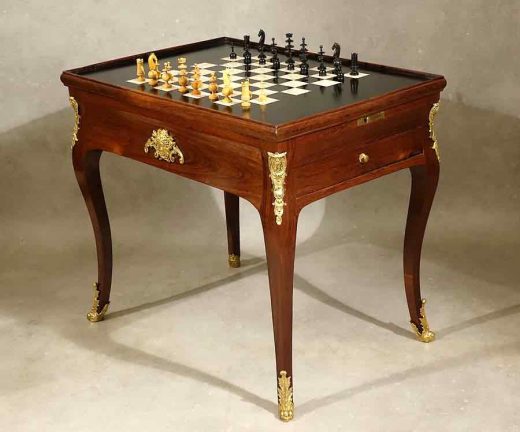
Restoration of a Regency period games table converted into a desk, resting on four cabriole legs. It is veneered with thick amaranth leaves and opens with two drawers (called "chétrons") on the sides and a removable top (locked by a push-button mechanism) covered in dark leather on its facing and a checkerboard veneered in ebony and inlaid with ivory on the reverse. When the top is removed, it reveals a backgammon set in ebony and ivory. The molded astragal surrounding the top is made of solid amaranth wood. The legs and stretchers are made of beech, the […]

Transition sauté pan with Boudin stamp

Ebénisterie Mathieu Vath

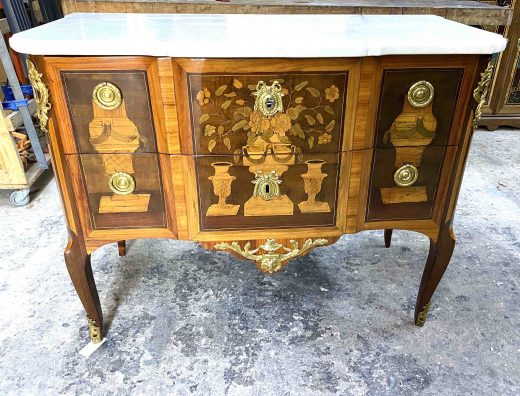
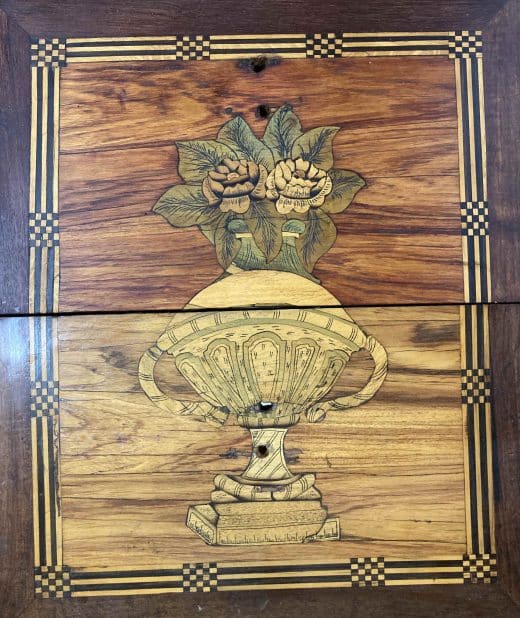
Restoration of a Transitional commode stamped by the master cabinetmaker Léonard Boudin (1735 in Paris – 20/12/1807). It is constructed of solid oak and veneered with amaranth, rosewood, tobacco-stained maple, and marquetry of boxwood, hornbeam, and holly, decorated with panels featuring floral vases and covered pots on the front and sides. With a slight central projection on the front, opening to reveal two drawers without a central divider, its rounded uprights rest on cabriole legs. Many Transitional commodes of this type have […]

Louis XIV Library Display Case

Ebénisterie Mathieu Vath

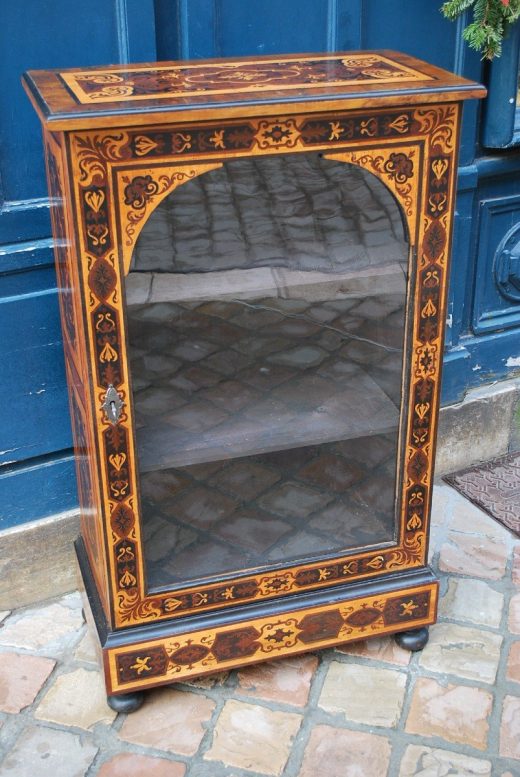
Restoration of a small Louis XIV period display cabinet inlaid with foliate scrolls in amaranth, ebony, and maple, framed in olive and cherry wood. The marquetry on this piece is known as the Boulle technique, or superimposed marquetry. The cabinet had a significant number of missing veneers. The restoration work therefore consisted of replacing all these missing veneers with scraped and sanded veneer, prepared to the correct thickness before being glued with hot glue. The most interesting task was the reconstruction of one missing piece […]

Regency commode with crowned R

Ebénisterie Mathieu Vath

Restoration of a Regency commode, probably from southeastern France, veneered with yew, plum, rosewood, walnut, cherry, amaranth, violet wood, boxwood, and green-stained maple on a softwood frame. Besides its highly unusual marquetry decoration, the commode's distinctive feature is its crowned R bronze mounts. The crowned R hallmark should not be confused with the crowned C hallmark, which corresponds to a tax levied from 1745 to 1749 on copper objects and is found on many […]
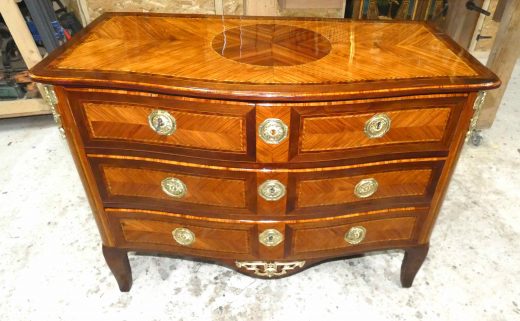
Cordié Transition-branded chest of drawers

Ebénisterie Mathieu Vath

Restoration of a Transitional period chiffonier stamped by Guillaume Cordié and bearing the guild mark. It is veneered in rosewood and amaranth and framed in oak and softwood. The bronze fittings were added later. Guillaume Cordié, born around 1725, worked as a freelance craftsman before receiving his master's certificate on June 18, 1766. He established himself on the rue de Charonne and remained there until his death. His works, of fine quality and harmonious proportions, are mostly in the Transitional and Louis XV styles. It seems that he […]
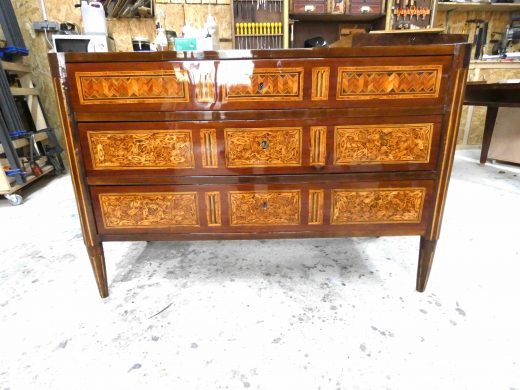
Transitional chest of drawers stamped SAUNIER

Ebénisterie Mathieu Vath

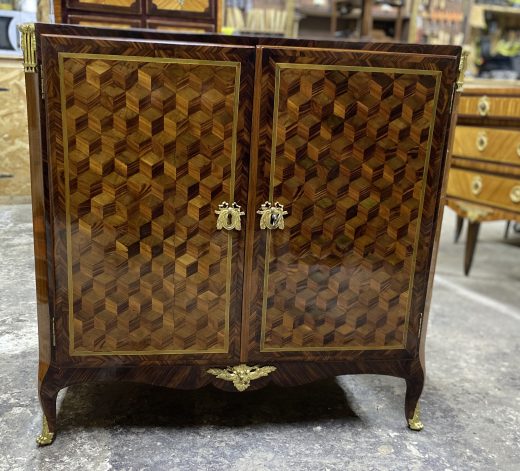
Restoration of a transitional two-door commode veneered with bottomless cube marquetry. The frame is oak for the uprights and rails, the side panels are softwood, and the two doors are walnut. The bottomless cubes are veneered with rosewood, violetwood, and tobacco-stained maple. The entire piece is framed with a stringing of green-stained maple and boxwood. The uprights and door frames are veneered with violetwood and rosewood. The sides […]
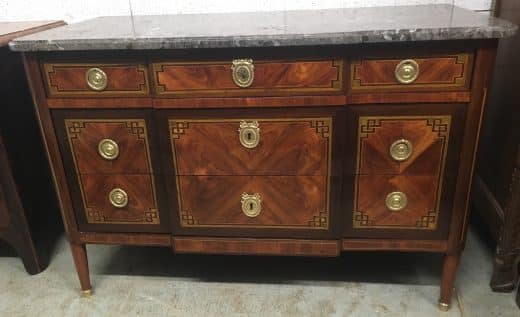
Transition chest of drawers stamped Fromageau

Ebénisterie Mathieu Vath

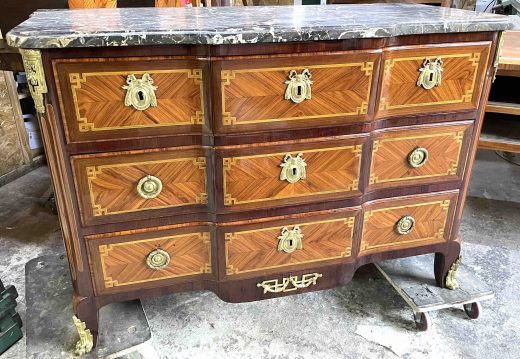
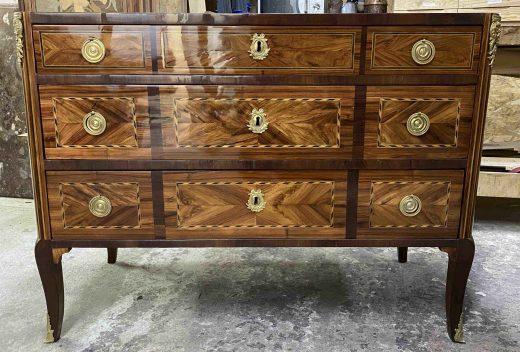
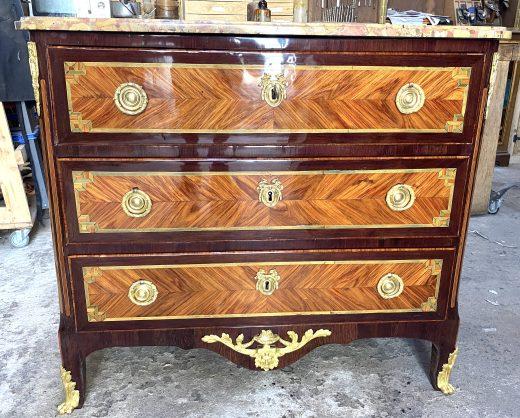
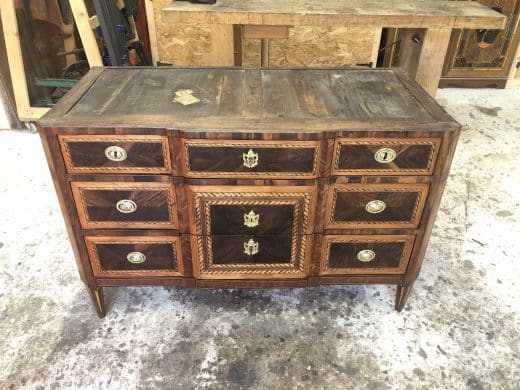
Restoration of a Transitional style commode, stamped by Jean Baptiste Fromageau, veneered in rosewood with an amaranth frieze and faux fluting. It is topped with a Royal red marble slab and features three drawers, one narrower at the top inlaid with a frieze of glyphs, while the two below are inlaid with Greek key patterns and have violet wood corners. The bronze mounts include ring pulls, keyhole escutcheons with knotted ribbons, and a drop-shaped finial.

Louis XV commode stamped NA Lapie

Ebénisterie Mathieu Vath

Restoration of a Louis XV commode, stamped by Nicolas Alexandre Lapie, veneered in amaranth and satinwood on a beautifully crafted oak frame. The sides and drawer fronts are made of softwood, and the marble top is Campan griotte marble. Nicolas Alexandre Lapie, son of Nicolas Lapie, a pottery merchant in the Faubourg Saint-Antoine, and brother of the master cabinetmaker Jean Lapie, Nicolas Alexandre (known as the Elder) appears to have been born around 1730. He registered his master's letters at the Châtelet in Paris on the 17th […]
Louis XVI secretary stamped TOPINO

Ebénisterie Mathieu Vath

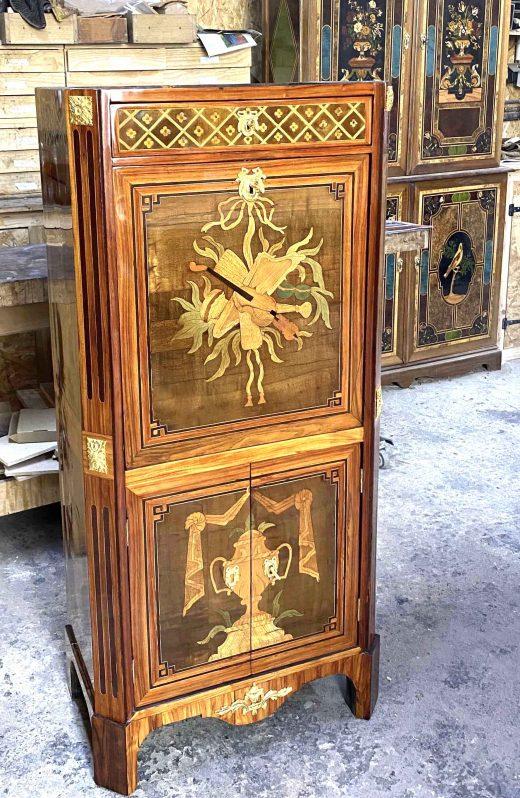
Restoration of a Louis XVI secretary desk stamped by Charles Topino. Typical of Topino's style, this secretary is constructed of oak and softwood. The front opens with a drawer and a drop-front covered in red leather tooled in gilt, revealing two compartments and four drawers veneered in rosewood. The lower section opens with two doors revealing a shelf. These are decorated with marquetry depicting a vase and drapery on a tobacco-colored ground, while the drop-front is inlaid with musical instruments, ribbons, and foliage on […]
Transition chest of drawers stamped LEGRY

Ebénisterie Mathieu Vath

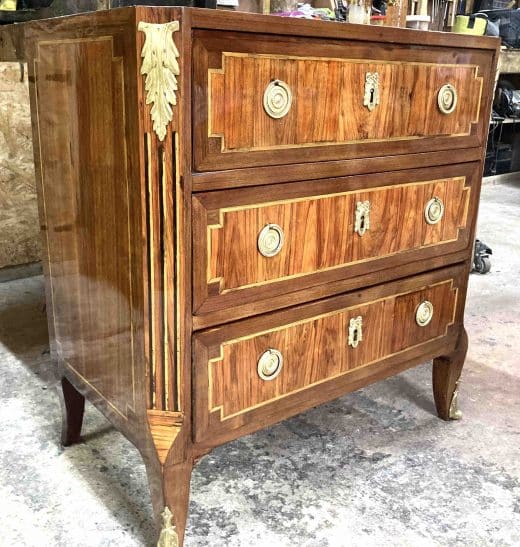
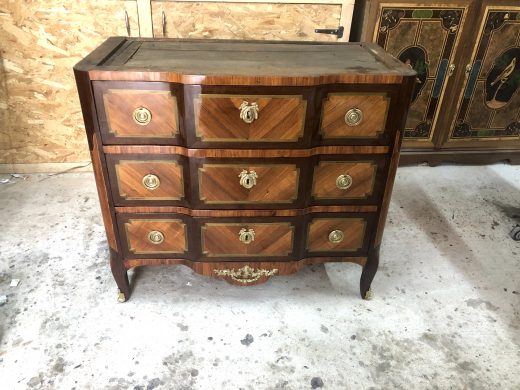
Restoration of a transitional commode stamped by Jean-Louis-François Legry. Its frame is made of oak and softwood, and it is veneered with amaranth, rosewood, satinwood for the sides, and ebony and boxwood stringing. This commode exemplifies the very end of the transition between the Louis XV and Louis XVI styles. The legs remain the only vestige of the Louis XV curves; they would soon give way to the straight legs of the Louis XVI style. Jean-Louis-François Legry, born in 1745, obtained his master's degree in Paris on […]

Louis XV desk

Ebénisterie Mathieu Vath

Restoration of a Louis XV desk veneered in rosewood and violet wood on an oak and softwood frame. Replacement of missing veneer, cleaning, and refinishing with a French polish. Cleaning and conservation of the leather. Removal and steam cleaning of the gilt bronze mounts. To see previous restorations: https://ebenisterie-mathieuvath.fr/en-ce-moment-a-latelier/

Transitional chest of drawers stamped J.STUMPFF

Ebénisterie Mathieu Vath

Here are some images of the restoration of this commode stamped by Jean-Chrysostôme Stumpff. 1731 - January 17, 1806 – Received Master Craftsman status on August 27, 1766. Framed in oak and softwood, it is veneered with rosewood in a frieze of paillon, amaranth, and boxwood and green-stained maple. J. STUMPFF, originally from Schweigern, Swabia (Germany), married in 1760 in Paris, at the Swedish embassy, like most of his compatriots of the Reformed faith. His fellow cabinetmaker, Ferdinand Scherdfeger, was a witness. […]

Writing table stamped JF LELEU

Ebénisterie Mathieu Vath

Restoration of a Louis XVI writing table stamped by Jean François Leleu. It is entirely constructed of oak and veneered on all sides with gray-stained maple latticework inlaid with amaranth, boxwood, ebonized wood, and boxwood finials on a rosewood ground. The four legs are adorned with an acanthus leaf medallion on a green-stained sycamore ground. Bell-shaped finials embellish the top and bottom of the finial as well as the tops of the legs. On the writing surface, the latticework is concentrated in […]

Transition chest of drawers stamped Etienne AVRIL

Ebénisterie Mathieu Vath

Restoration of a transitional commode stamped three times E.AVRIL, veneered in amaranth, rosewood, satinwood, and green-stained stringing on an oak and softwood frame. Etienne Avril (1748-1791), admitted as a Master Joiner-Cabinetmaker on November 23, 1774, died prematurely in 1791. Étienne Avril, known as Avril the Elder to avoid confusion with his brother Pierre, would witness the agony of the Ancien Régime and the abolition of the centuries-old guild system. Born in 1748 to a cab driver, Étienne Avril was not destined for […]

8-foot desk stamped Manet

Ebénisterie Mathieu Vath

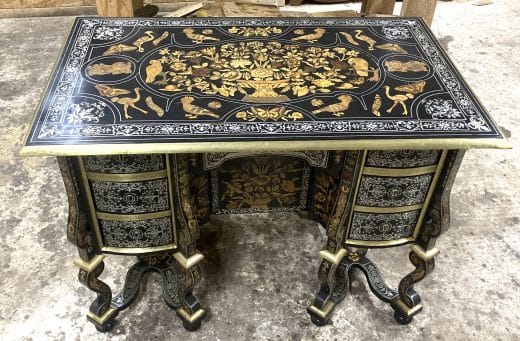
Restoration of an eight-legged desk, commonly known as a "Mazarin" desk, from the Louis XIV period, late/early 17th century. Constructed of pear and solid softwood, the sides and drawer bottoms are also pearwood. It features two side cabinets, each opening with three drawers, a central drawer above a middle cabinet with rounded edges, and console-shaped uprights and eight legs joined by two X-shaped stretchers. The drawers are inlaid with pewter and blackened pearwood, depicting a late 17th-century design. […]

Louis XVI secretary stamped Montigny

Ebénisterie Mathieu Vath

A little restoration for this Louis XV period secretary desk stamped by Philippe-Claude Montigny. It is constructed of oak and softwood, and veneered with rosewood, amaranth, and boxwood. It consists of a top drawer, a drop-front, and two doors. The interior compartments contain six drawers. Philippe Claude Montigny (1734-1800) became a master craftsman on January 29, 1766. Son of Louis Montigny, a privileged craftsman of the King, he owned a workshop in the Contrescarpe district of Paris. He was also the brother-in-law of Fidelis Schey, a cabinetmaker […]

P. ROUSSEL Games Table

Ebénisterie Mathieu Vath

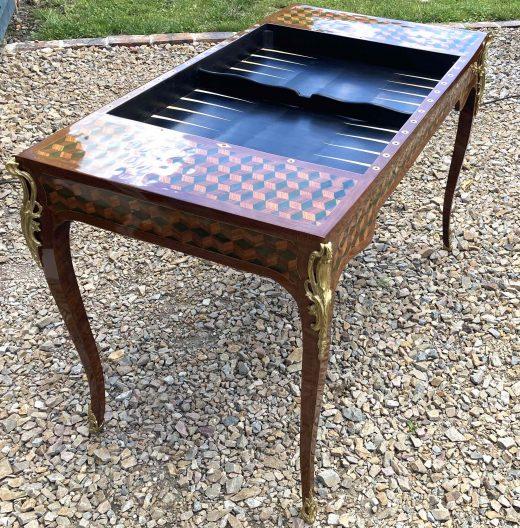
Restoration of a Louis XV period marquetry game table (or backgammon table) with dice (or cubes) veneered in amaranth, rosewood, violet wood, palisander, ebony, and ivory. This table is stamped by the Parisian cabinetmaker Pierre Roussel (September 28, 1723 – June 7, 1782). The Roussel family, sons of Michel Roussel, a journeyman cabinetmaker originally from the Cotentin peninsula, were the only ones to choose cabinetmaking rather than joinery, unlike his younger brothers Jacques, Michel, and Louis. Pierre Roussel obtained his master craftsman's certificate on August 21, 1745, and established himself in the Faubourg Saint-Germain-des-Prés.

Louis XVI commode stamped JB.Tuart

Ebénisterie Mathieu Vath

Here is a very pretty Louis XVI period commode veneered in rosewood and amaranth with marquetry of boxwood, pearwood, maple, hornbeam, walnut, blackened pearwood, lemonwood… It is built of oak and softwood. It is stamped twice with the mark of Jean-Baptiste II TUART. But its maker is probably Jean LAPIE. From a dynasty of Parisian cabinetmakers and merchants, whose father, Jean-Baptiste I, obtained his master's certificate in 1741 and was active until around 1760, Jean-Baptiste II, born around 1720, was not a master cabinetmaker but a master furniture maker and haberdasher […]

Secretary LXVI stamped Martin Carlin

Ebénisterie Mathieu Vath

Restoration of a Louis XVI period lady's writing desk stamped by Martin Carlin JME. The frame is solid oak, with the fall front and lower door made of softwood. The exterior is entirely veneered with Honduran mahogany, except for the upper edge, which is embellished with a thin strip of amaranth. The interiors are veneered with rosewood, amaranth, and stringing of boxwood and ebony. Of particular interest: the upper interior compartment has never been restored and retains its original finish, a magnificent polish that has preserved the […]

Louis XVI commode

Ebénisterie Mathieu Vath

This week, we're restoring a Louis XVI commode with a projecting front, veneered in Rio rosewood, amaranth, and violet wood, with marquetry stringing in boxwood and ebony forming a ribbon wrapped around the wood, the background of the engravings filled with red wax. The tapered legs and canted uprights have faux fluting in ebony and boxwood. There's no maker's mark to attribute this beautiful piece and the high quality of wood chosen for its construction. Regarding the restoration, the work isn't very […]

Louis XV/Transition Commode by Nicolas Abraham Couleru

Ebénisterie Mathieu Vath

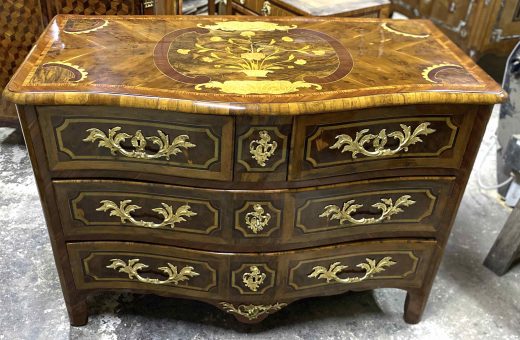
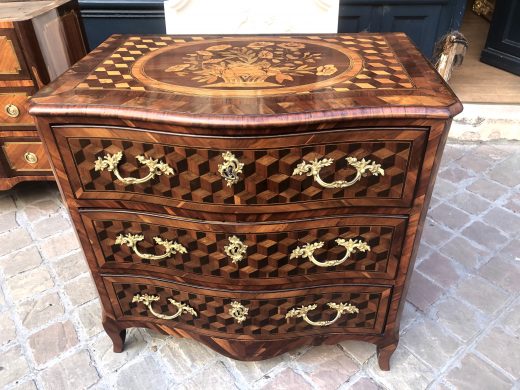
This slightly curved commode, composed of three drawers and veneered with bottomless cubes of walnut, plum, and cherry, has a marquetry top depicting a bouquet of flowers on an amaranth ground. Plum or Quetchier wood is easily recognizable by its sapwood markings, which create a lighter pattern and lend an irregularity to the decoration. The frame is made of fir and walnut. It is difficult to define a precise style for this commode. Although Louis XV, it clearly foreshadows the arrival of the style's more restrained appearance […]

Transitional chest of drawers stamped A. HERICOURT

Ebénisterie Mathieu Vath

Congratulations to Arnaud for the restoration of this Transition period commode veneered in rosewood, amaranth, and satinwood for the sides, and green-stained maple for the stringing. The frame is made of oak and softwood. Antoine Héricourt (c. 1730–1792) obtained his master craftsman's certificate on October 20, 1773, after working for several years as a journeyman in the Faubourg Saint-Antoine. After obtaining his certificate, he settled on the rue du Faubourg Saint-Honoré and became a representative of his guild, then a syndic. His extensive production was highly prized by a French clientele and […]

Transition cylinder desk

A few years ago, I had the opportunity to restore this magnificent Transition period (1780) roll-top desk. It is framed in oak and fir. The fall front is primarily veneered with rosewood laid in a paillon pattern, framed by a light stringing of boxwood and green-stained hornbeam, bordered by a thin band of amaranth. The back is veneered in satinwood. The central marquetry, on a tobacco-stained sycamore ground, depicts musical instruments and two doves taking flight, each carrying a musical score in its beak. This […]

Transitional chest of drawers stamped LARDIN

Ebénisterie Mathieu Vath

Restoration of a Transition period commode built of fir and oak and veneered with rosewood, framed with stringing of white hornbeam and green-stained wood, with a satinwood band surrounded by amaranth. The central medallion is satinwood veneer assembled in a herringbone pattern. The maker's mark and the JME (Journée des Métiers d'Étranger) are located at the base of the left rear leg. André-Antoine Lardin (1724 – August 10, 1790) obtained his master craftsman's certificate on July 1, 1750, and established himself on the rue de Charenton under the sign "Au Bois de Boulogne." He worked there until 1770, the date […]

Louis XVI commode

Ebénisterie Mathieu Vath

Restoration of a Louis XVI period commode from eastern France, made of solid oak and fir and veneered with end-grain laburnum, walnut, plum, amaranth, rosewood, palisander, boxwood, and green-stained hornbeam. The handles and keyholes were added at a later date. The original fittings are missing; only the holes for the handles remain. This is a piece of furniture that has never been restored. The veneer is almost 4 mm thick in some places, and […]

J.STUMPFF Roll-Top Desk

Ebénisterie Mathieu VATH

Restoration and conservation work on this rare Louis XVI period roll-top desk stamped by Jean-Chrysostôme Stumpff. 1731 - January 17, 1806 – Master craftsman on August 27, 1766. Originally from Schweigern, Swabia (Germany), he married in 1760 in Paris, at the Swedish embassy, like most of his compatriots of the Reformed faith. His fellow cabinetmaker Ferdinand Scherdfeger was a witness at the wedding. It was in his workshop on Rue Saint-Nicolas that he produced some Louis XV style furniture, but primarily a large number of transitional and Louis XVI pieces. The large […]

Louis XVI commode stamped JA BRUNS

Ebénisterie Mathieu VATH

This week marks the completion of the restoration of a Louis XVI commode stamped JA BRUNS. It is made of oak for all the structural elements, except for the side panels, drawer backs, drawer fronts, and the two drawer bottoms, which are made of softwood. It is veneered with rosewood in a butterfly pattern and amaranth for the edges. The false fluting is made of boxwood and ebony, and there is a green-stained maple stringing forming the corners at […]

Secretary stamped P.ROUSSEL JME

Ebénisterie Matheu VATH

Here are some images of the restoration of a secretary desk stamped by Pierre Roussel (1723-1782). Having become a Master Cabinetmaker in 1745, Pierre Roussel set up shop on Rue de Charonne, in the Faubourg Saint-Antoine, under the sign "L'Image de Saint Pierre" (The Image of Saint Peter). Thanks to his skills as a cabinetmaker and especially as an exceptional marquetry artist, he quickly gained a great reputation. In 1762, he became a sworn member of his guild. By 1767, he was considered one of the best cabinetmakers of his time. Highly regarded by his colleagues, he became a representative of the cabinetmakers' guild in 1777 and then syndic two […]