

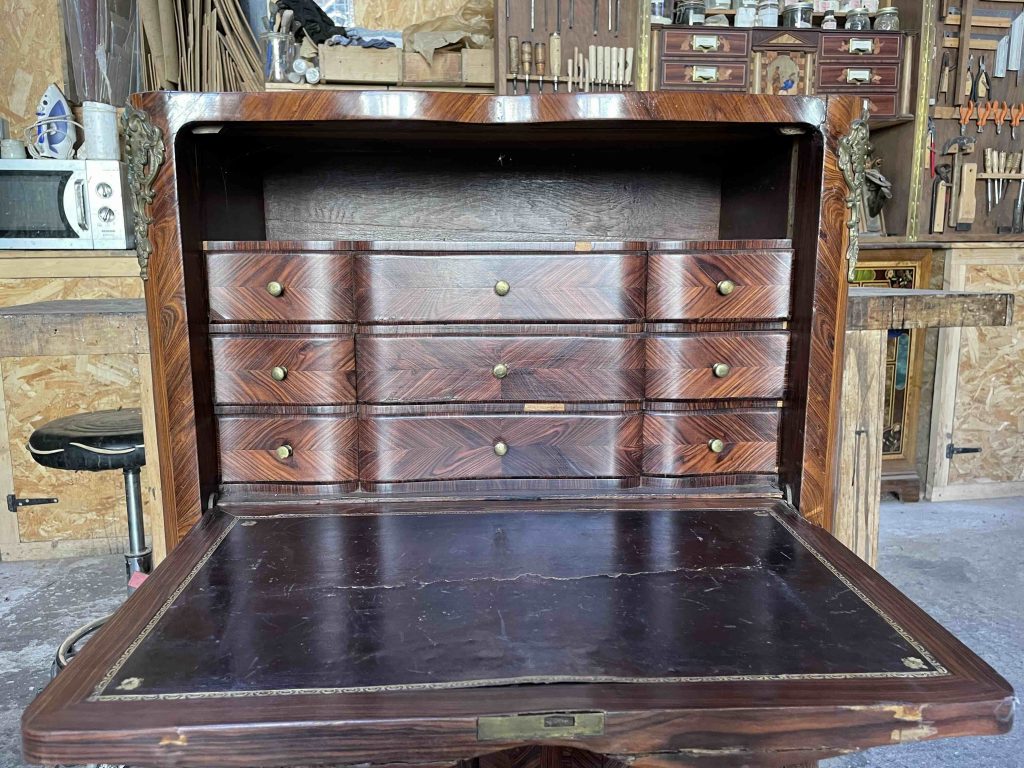
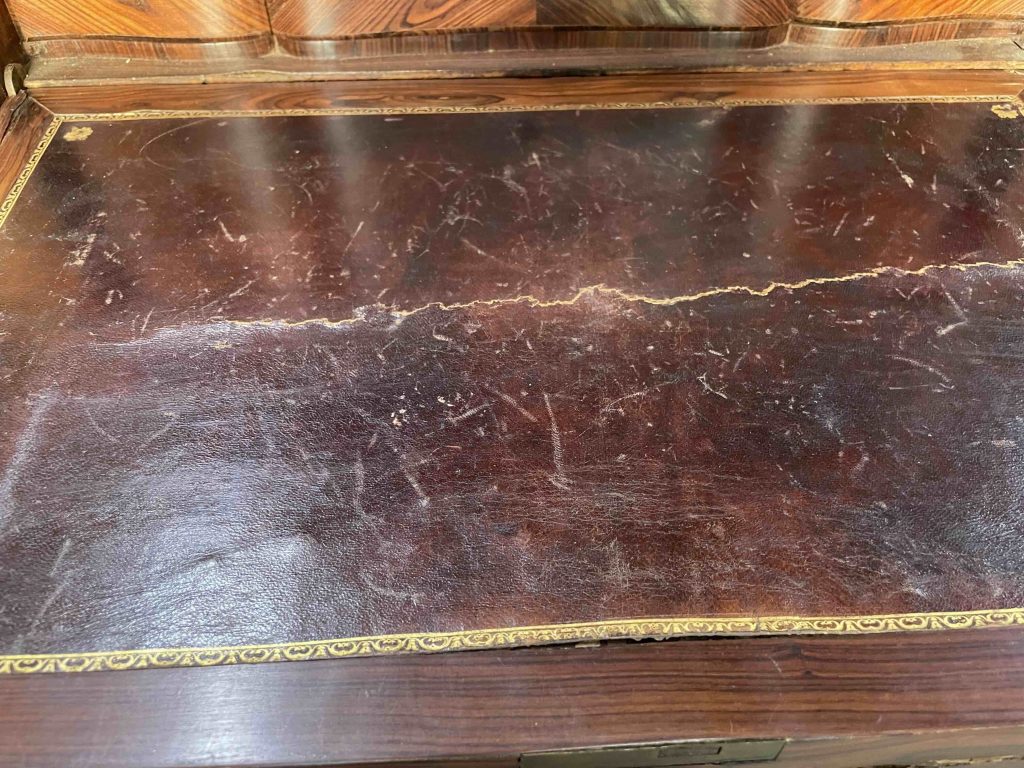
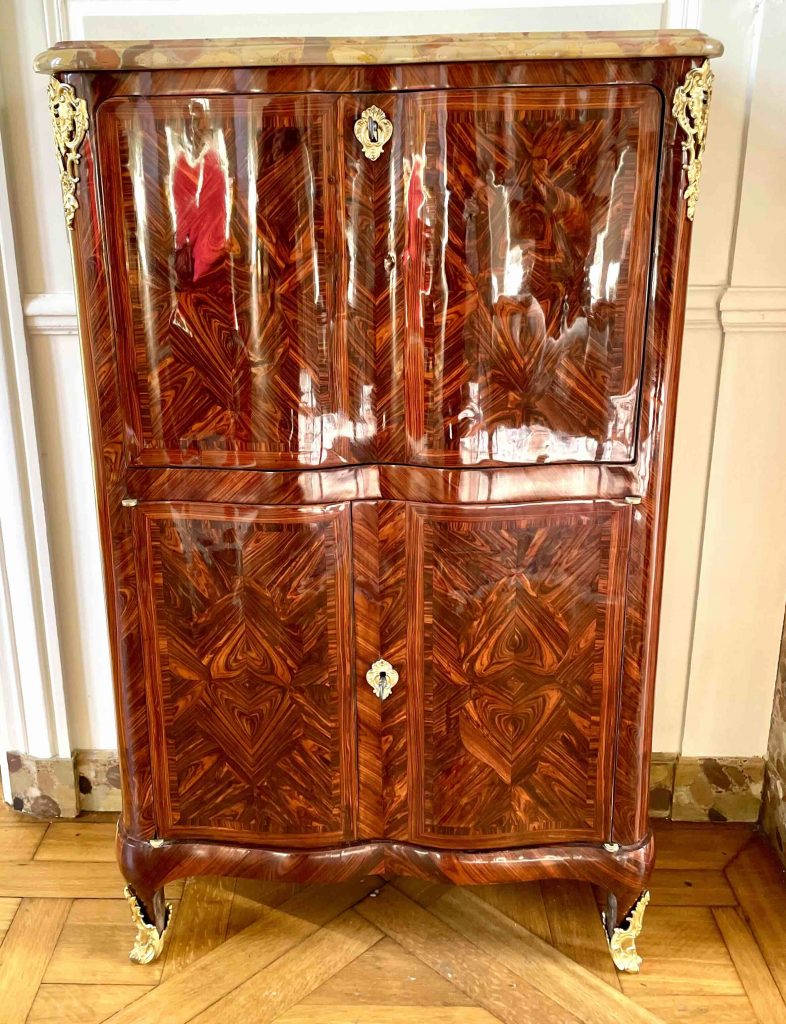
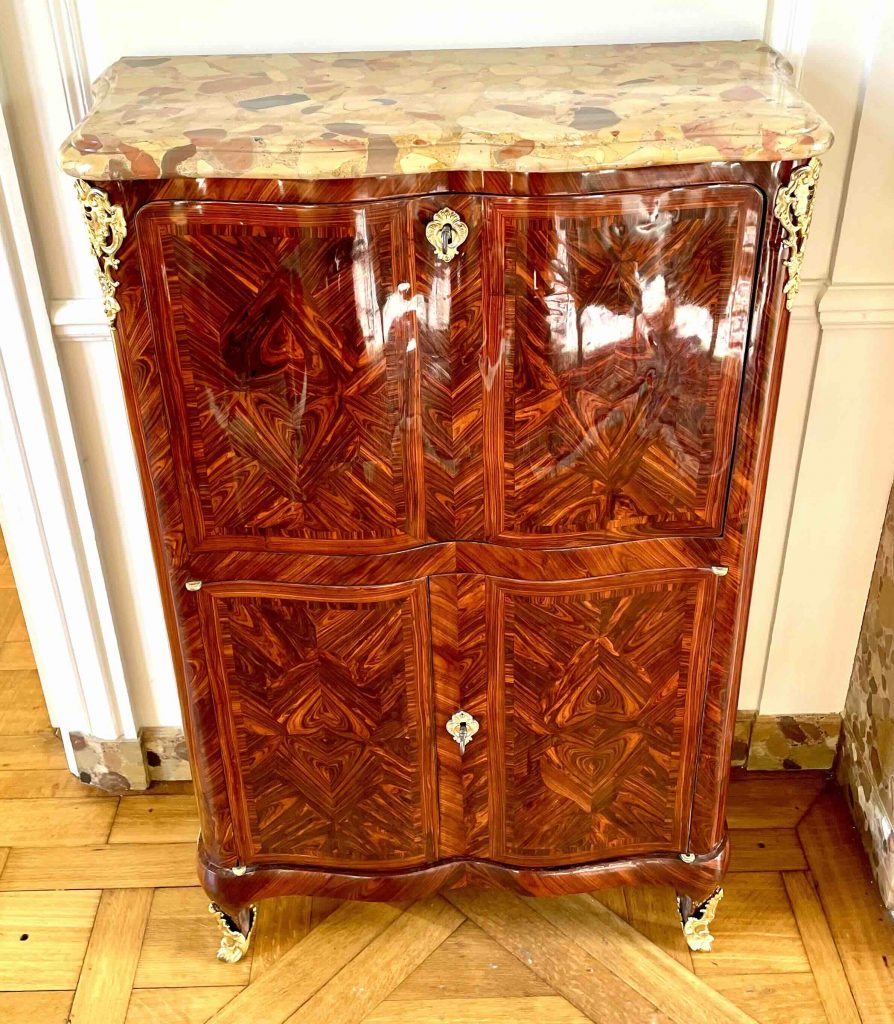
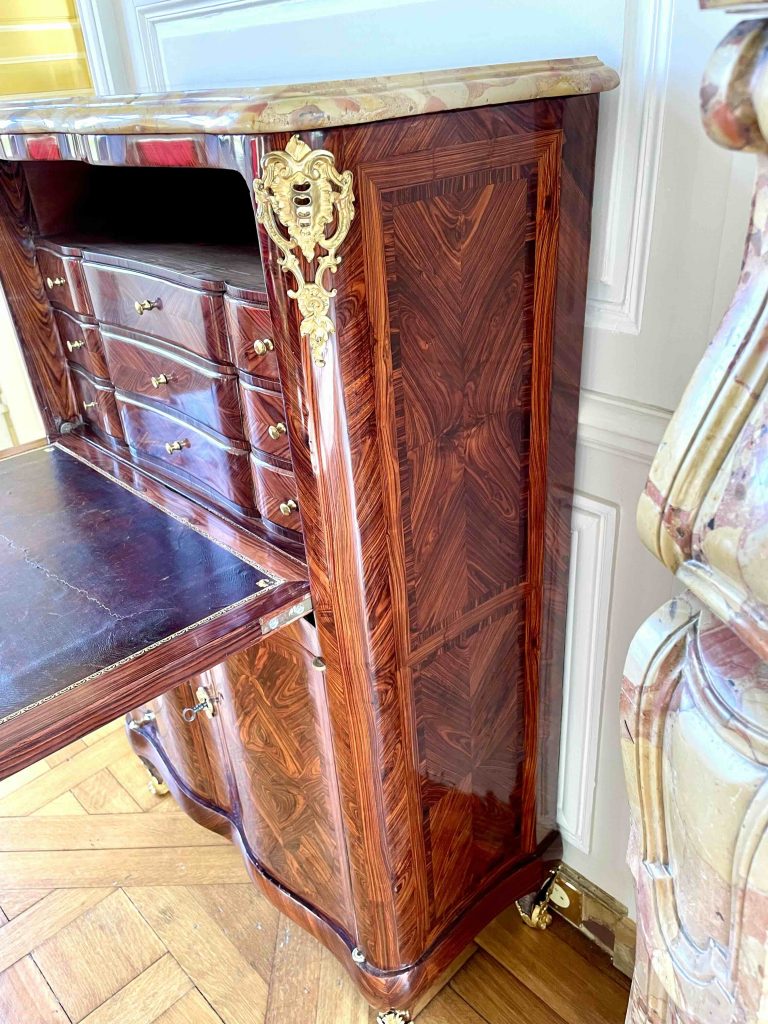
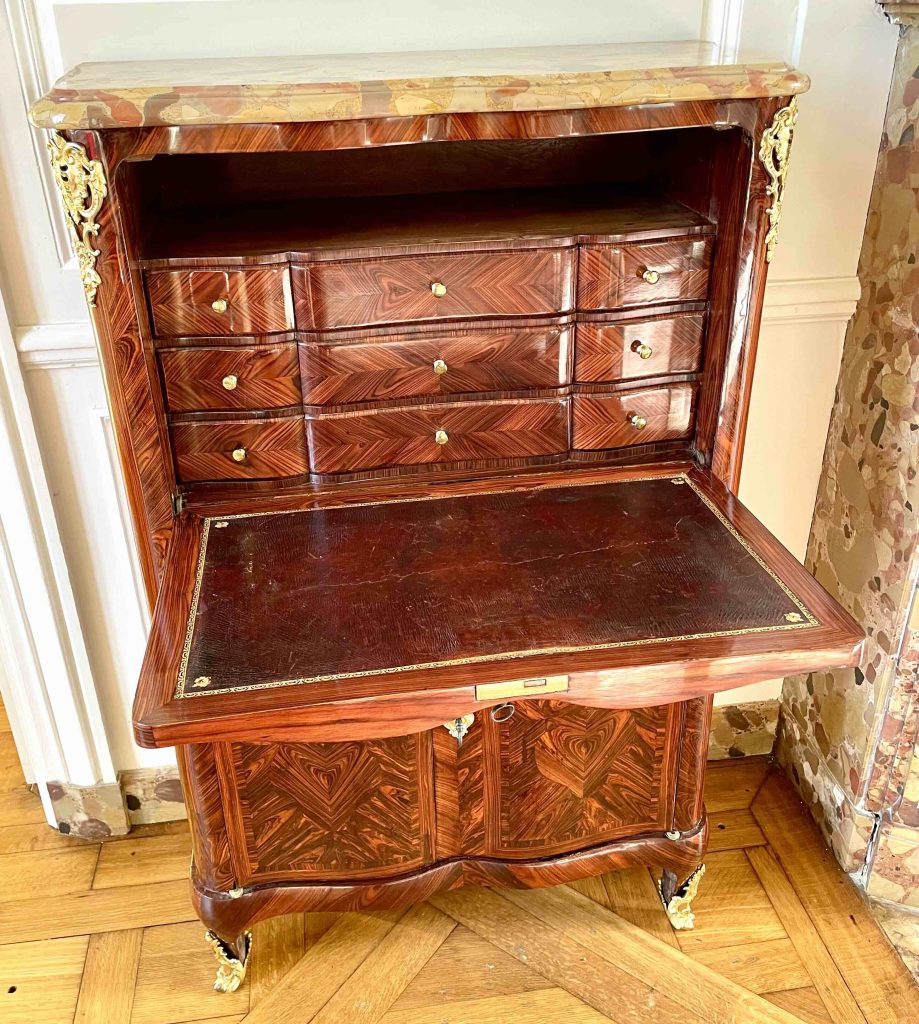
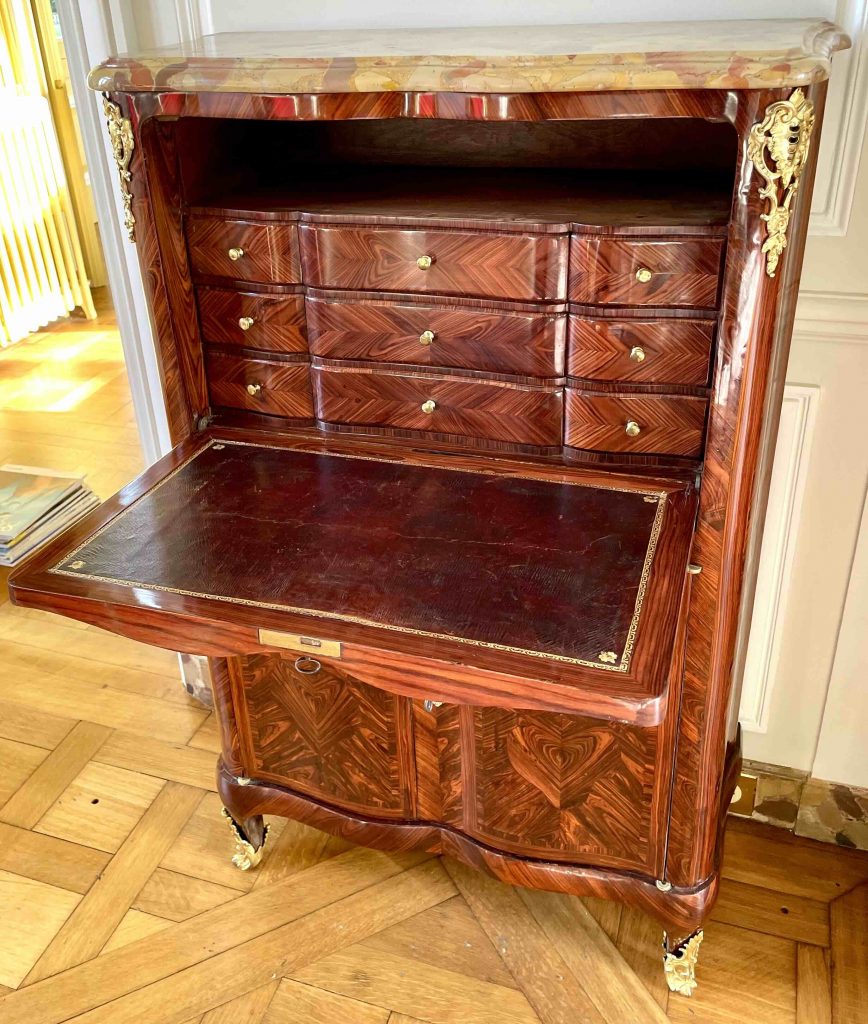
Restoration of a secretary desk, commonly known as a "drop-front secretary" or "cabinet secretary," bearing the MIGEON stamp. This piece is distinguished by its serpentine front, which opens with a pivoting drop-front revealing nine small, curved drawers. The inside of the drop-front is lined with leather.
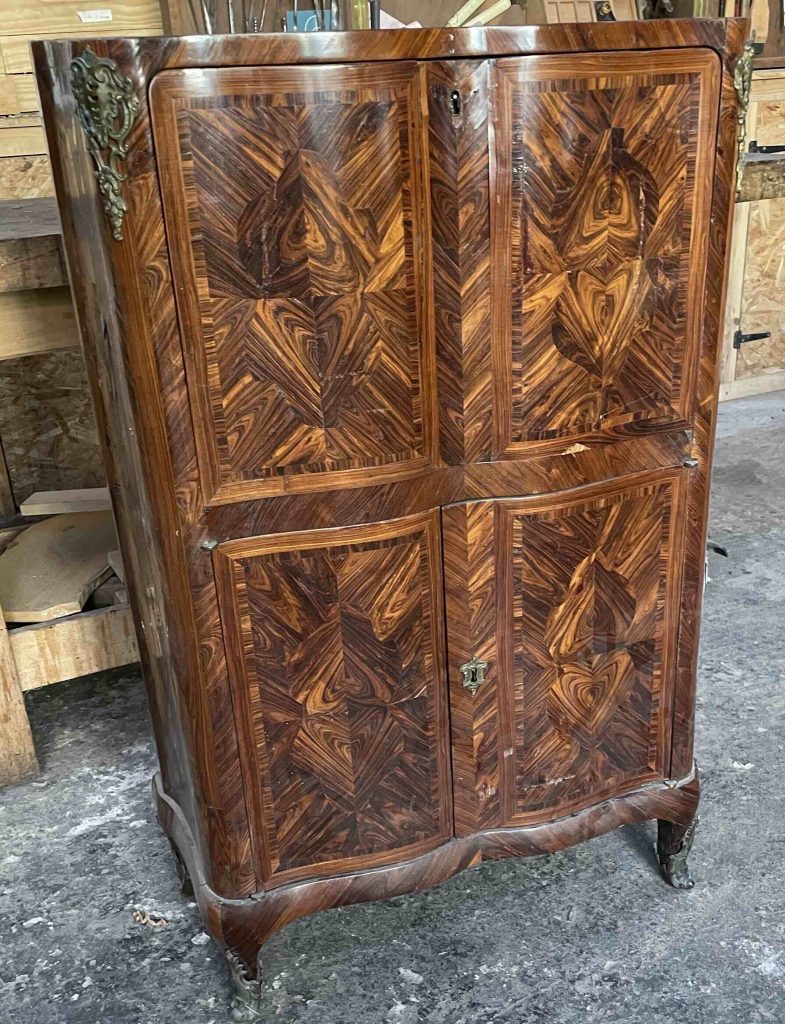
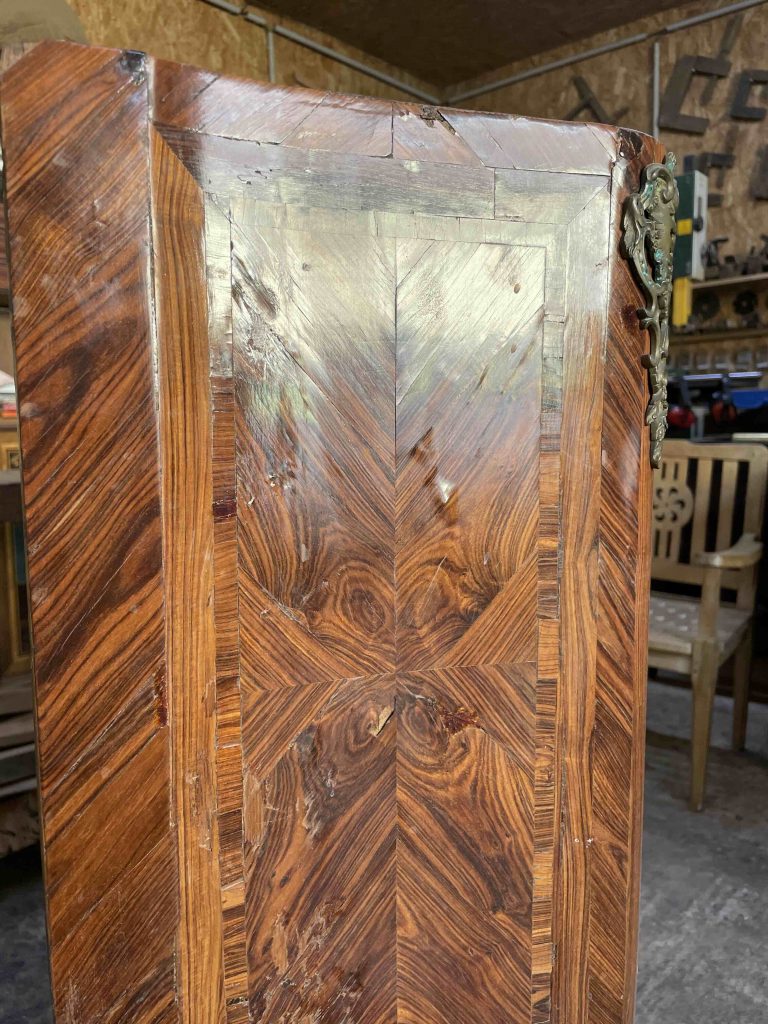
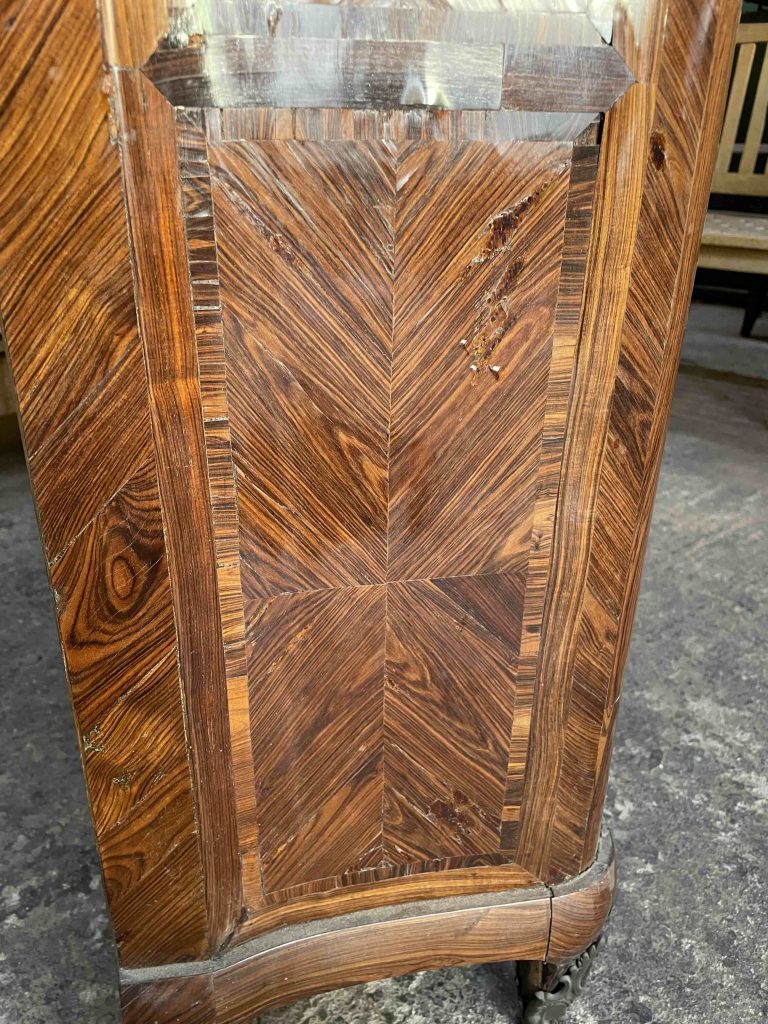
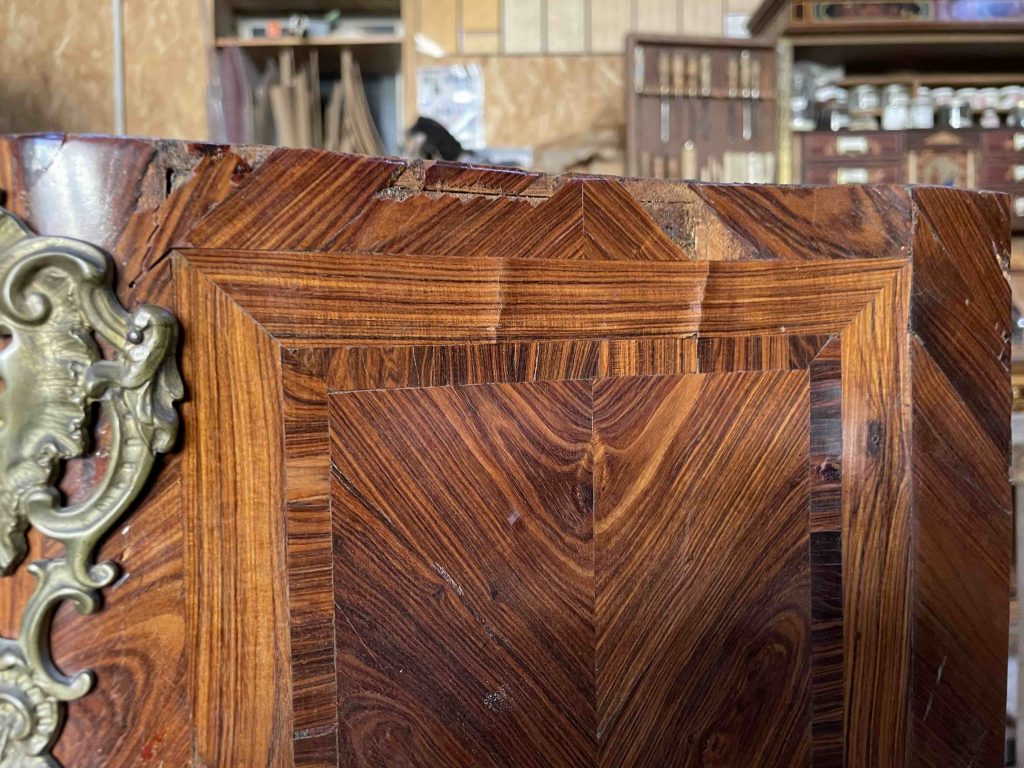
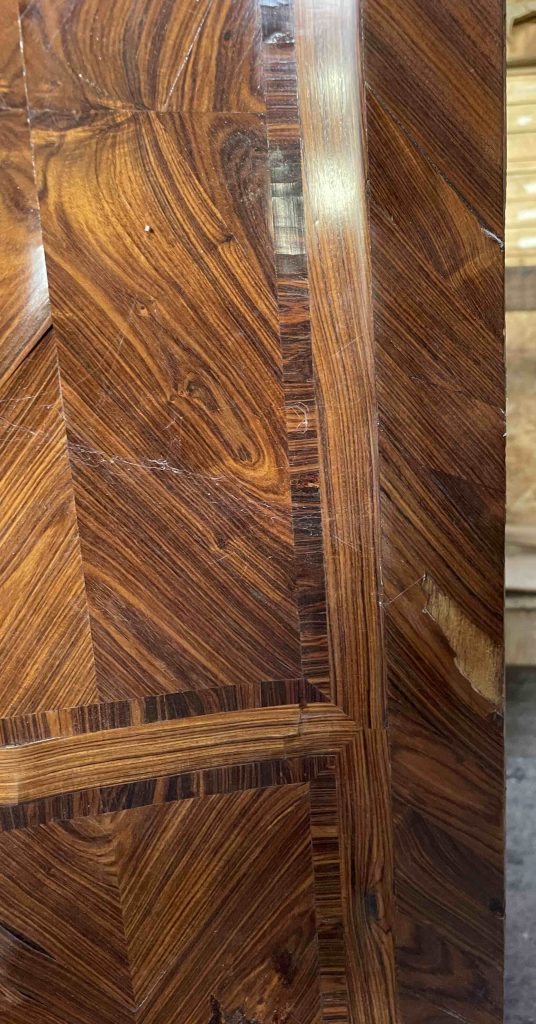
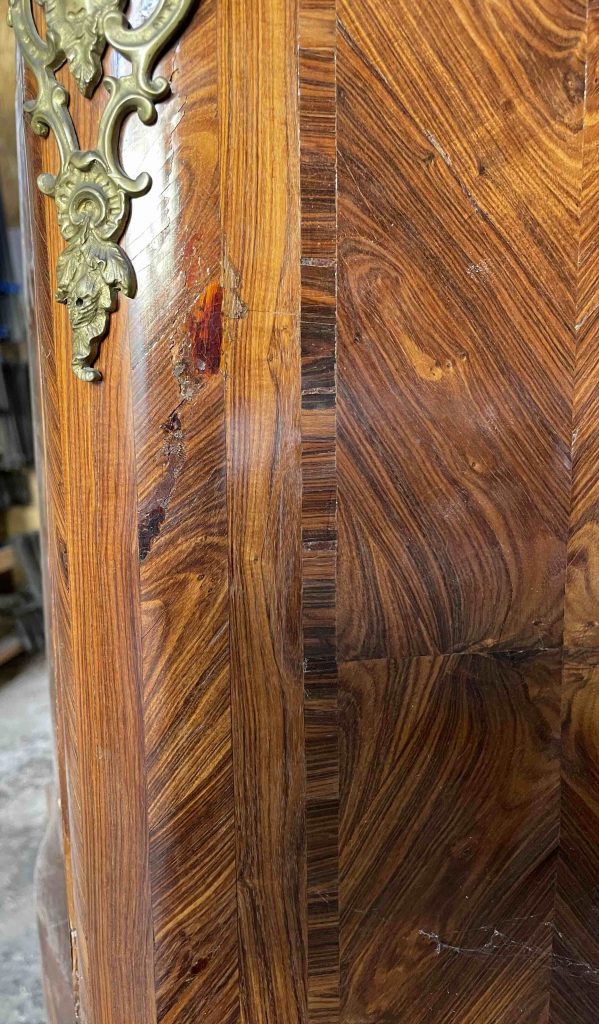
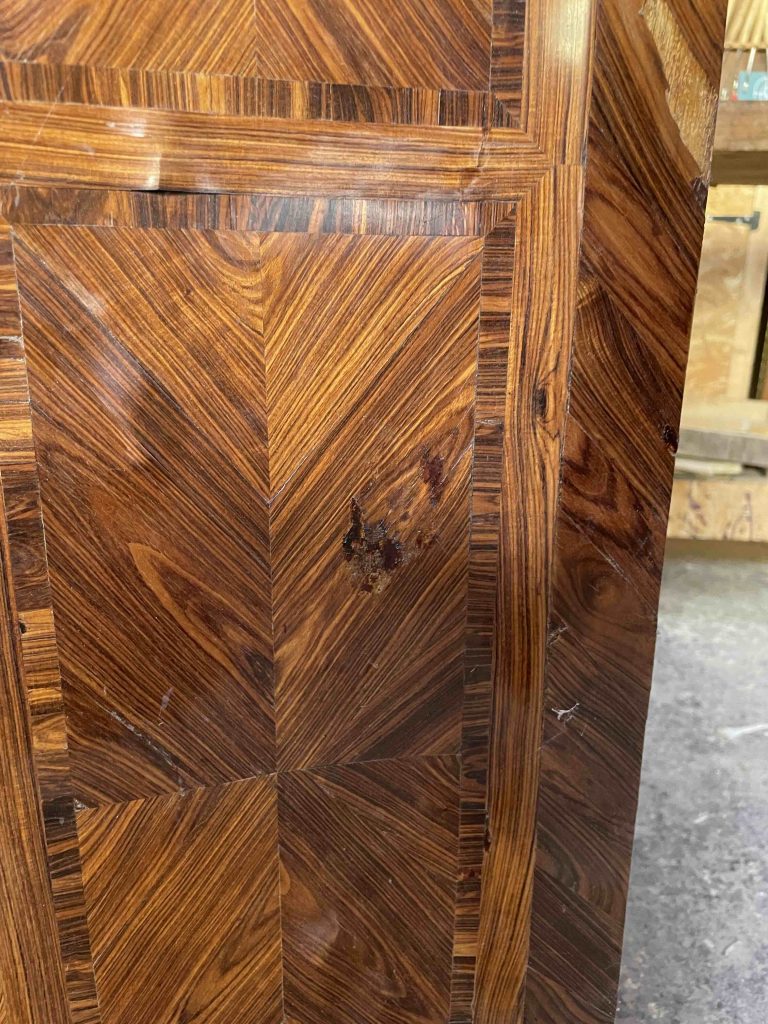
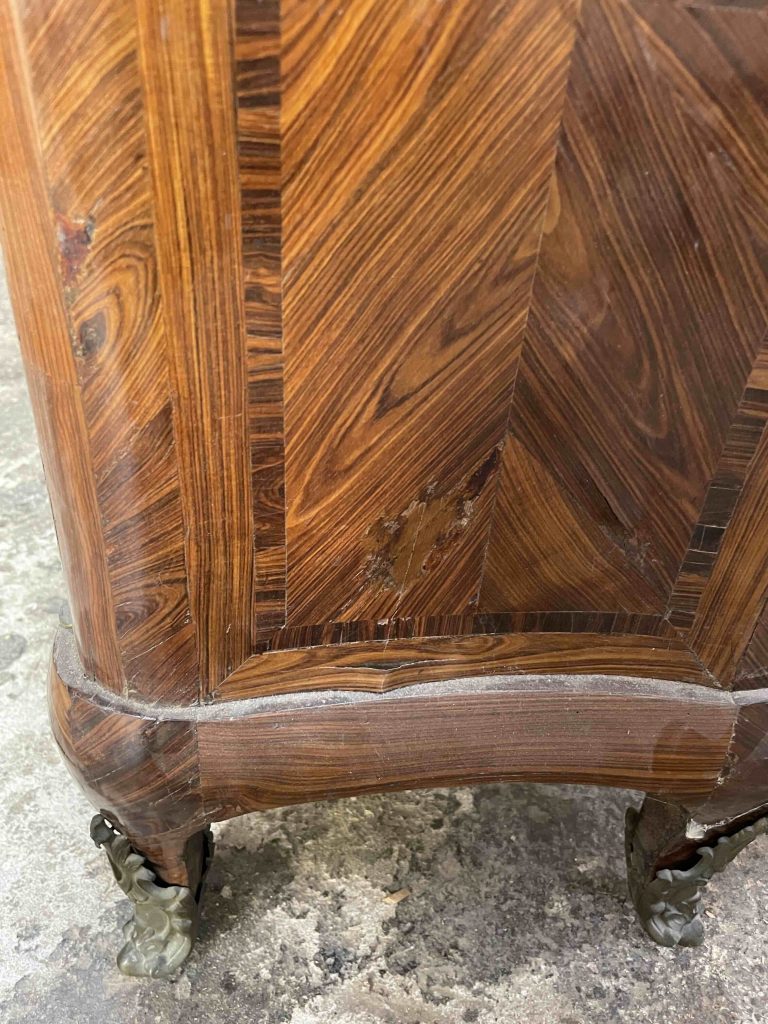
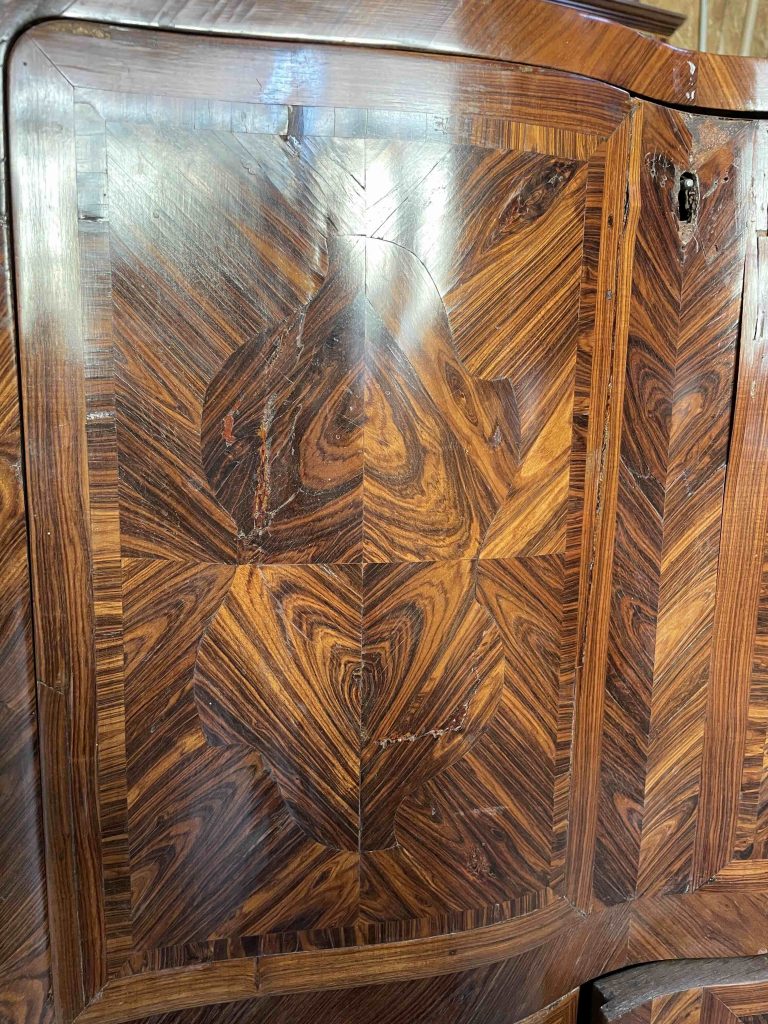
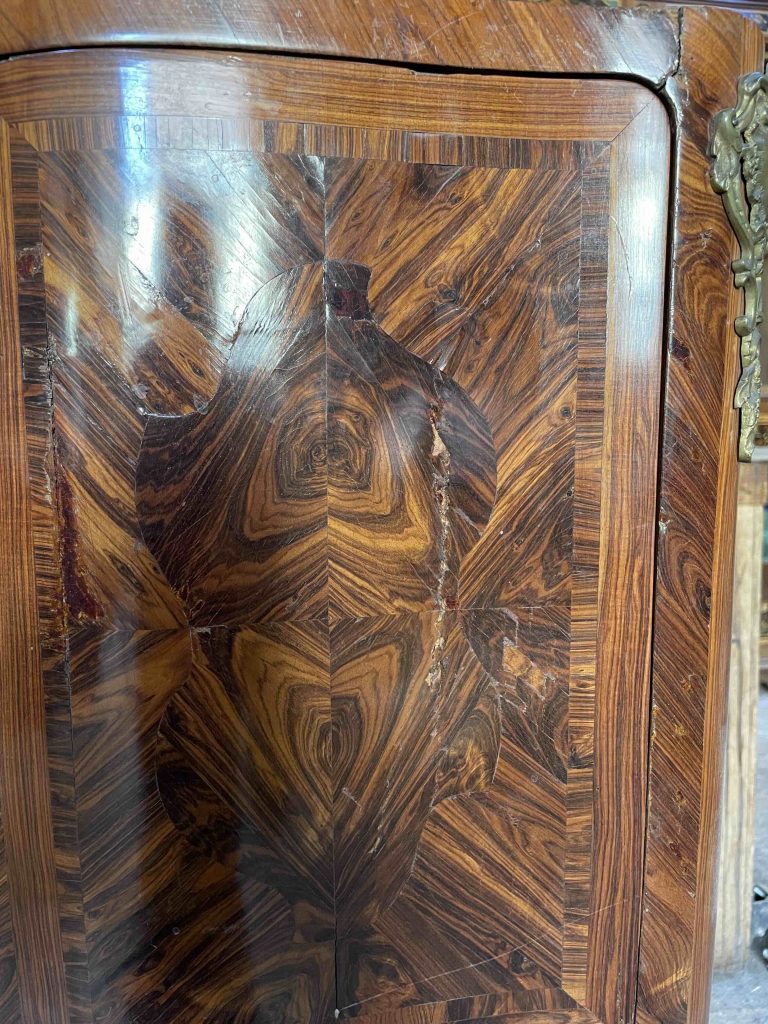
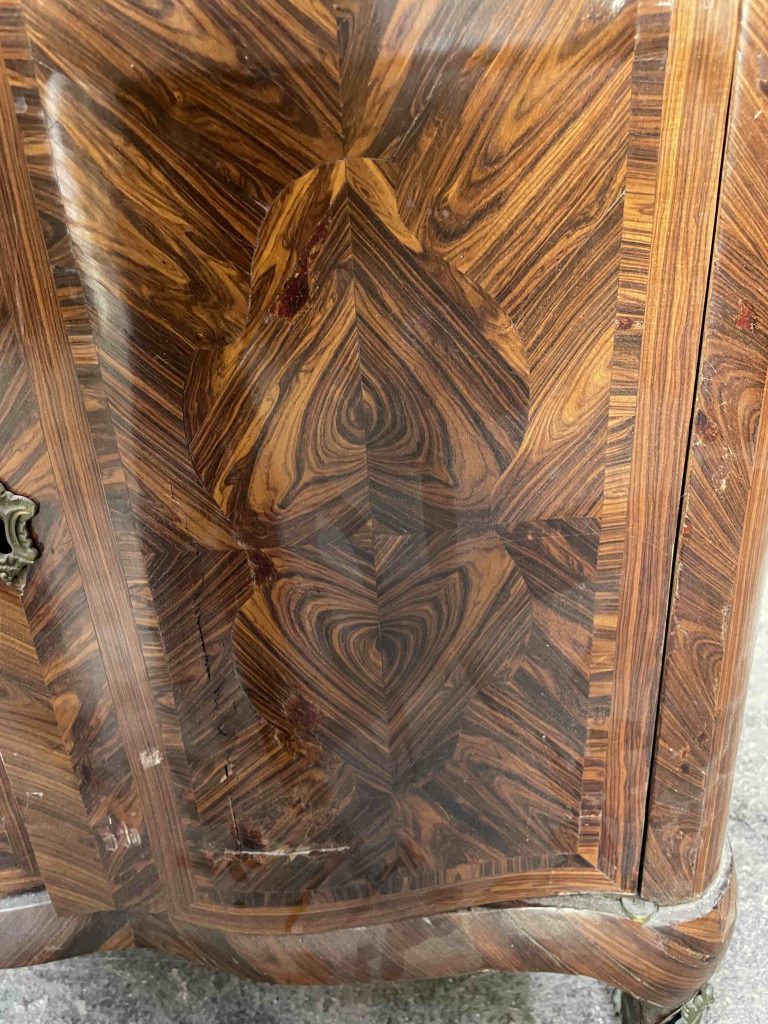
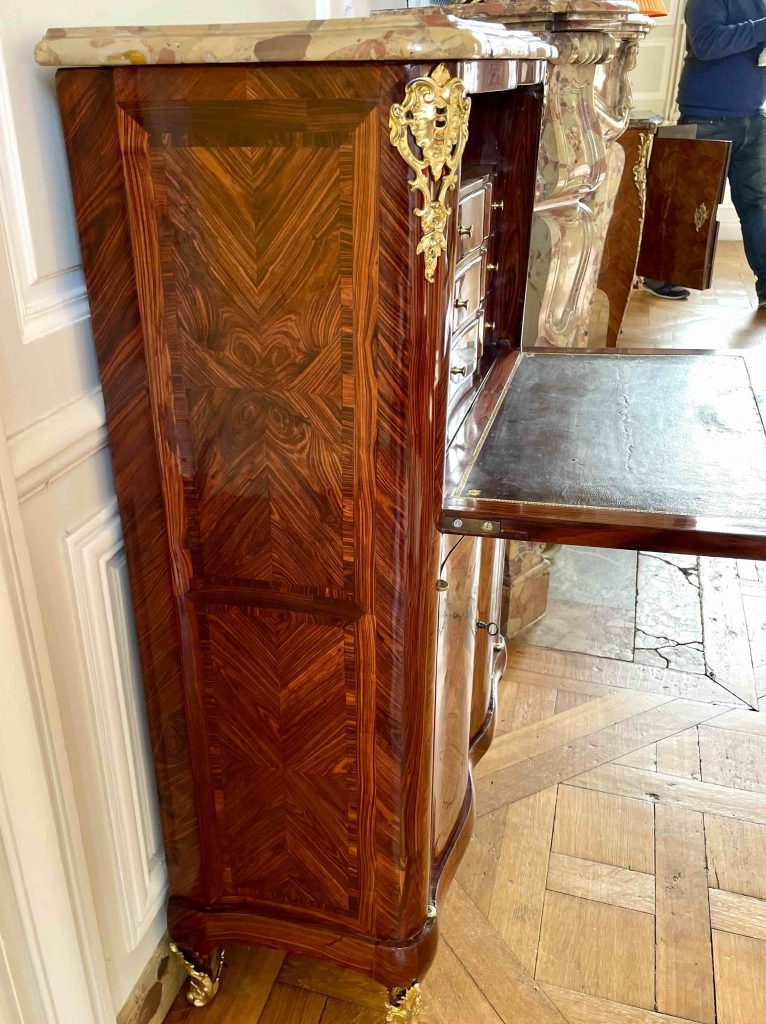
The cabinet itself opens with two doors. The entire front is veneered with four panels of kingwood veneer, obliquely cut into butterfly wings. Each compartment is decorated with a quatrefoil butterfly wing motif, set within a reserved lozenge, inside a frame of contrasting marquetry composed of fillet, a band, and a wide frieze of straight-grained wood. The center of the crossbow, in a wide false frame, is also inlaid with chevrons within a band. The rounded, stepped uprights are veneered with chevrons. The slightly projecting and curved base is fitted with chased and gilded bronze mounts. The top is made of Aleppo breccia marble, with a molded, corbelled edge.
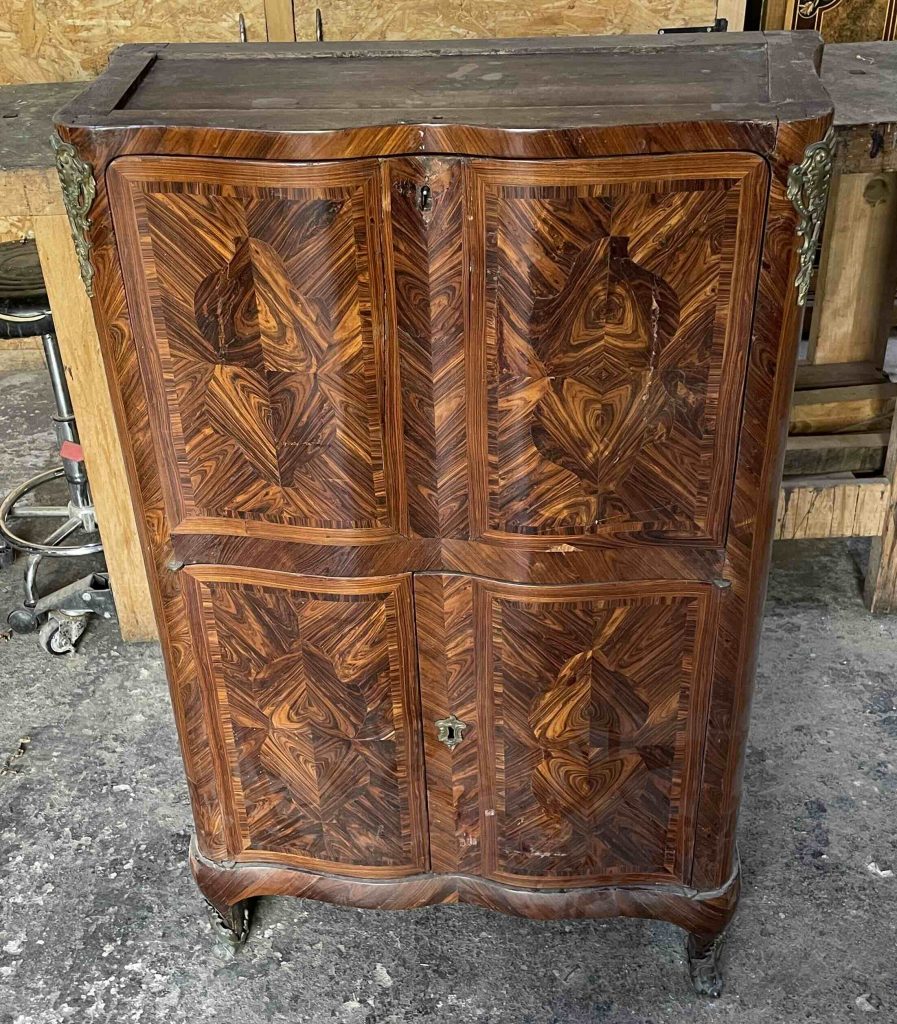
Pierre IV Migeon (1696-1758)
The name Migeon is associated with a line of cabinetmakers active in Paris from the 17th to the 18th century. Several generations of masters bear the first name Pierre, hence some confusion in the attribution of their works.
- Pierre I Migeon (circa 1620 – after 1680): master chair maker, he laid the foundations of the family's craft activity.
- Pierre II Migeon (circa 1650 – active at the end of the 17th century): he continued the trade in chair making.
- Pierre III Migeon (1661-1722): he expanded the family business and moved closer to the cabinetmaking trade.
- Pierre IV Migeon (1696-1758): the most famous, a Parisian cabinetmaker of great renown.
- Pierre V Migeon (1723- after 1775): son of Pierre IV, he took over the workshop and perpetuated the father's style.
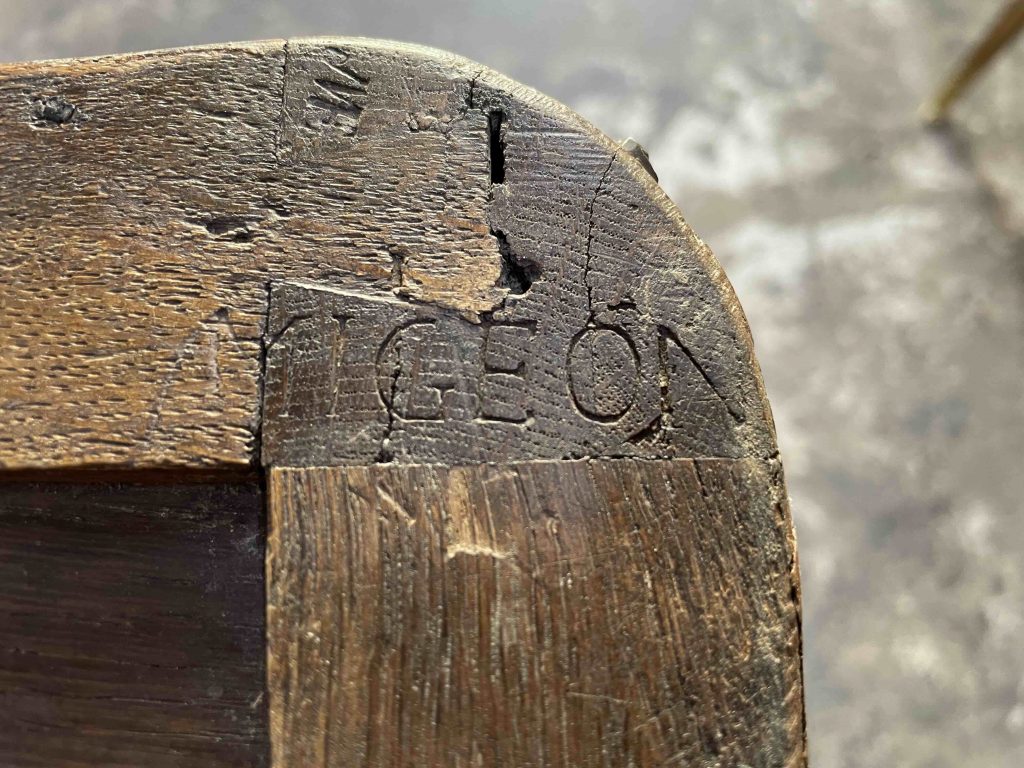
Born in 1696, Pierre IV Migeon was introduced to the trade at a very young age by his father, Pierre III. He became master cabinetmaker in 1729, at which point he officially opened his own workshop on rue de Charenton. The establishment quickly grew in importance, employing several journeymen and workers.
Unlike some of his contemporaries who focused on producing luxury goods exclusively for the high aristocracy, Migeon developed a versatile workshop capable of supplying a bourgeois, aristocratic, and even royal clientele. Among his most illustrious clients were the Duke of Orléans, the Duchess of Rohan, the Duchess of Epernon, Marshal de Noailles, as well as several bishops and ambassadors., Marquise de Pompadour, favorite of Louis XV, great patron of the arts and protector of the best craftsmen. The privileged relationship he maintained with her testifies to the reputation of his work and his integration into the circles of power.
Although Migeon's profession was that of cabinetmaker, he also worked as a merchant. He collaborated with many cabinetmakers – among the most renowned of his time – such as Bircklé, Canabas, Criaerd, Jacques Dubois, Lacroix, Saunier, and Topino.
Migeon's activity is documented for nearly thirty years, from his becoming a master craftsman in 1729 until his death in 1758. His workshop thrived during a pivotal period: the transition from style Regency (simple shapes, a transition towards greater lightness) in the style Louis XV (curved lines, rocaille ornamentation).
Its furniture is distinguished by:
- frequent use of geometric marquetry in exotic wood veneers (including violet wood, amaranth, rosewood); ;
- an ornamentation in gilded bronzes, elegant but measured; ;
- of the balanced proportions, marking a desire for refinement without exuberance.
After his death in 1758, his son, Pierre V, took over the workshop and perpetuated the family tradition into the second half of the 18th century
Bibliography
- Sophie Mouquin — Pierre IV Migeon, 1696-1758: at the heart of a dynasty of Parisian cabinetmakers. Paris: Les Éditions de l'Amateur, 2001.
Pierre Kjellberg — French furniture of the 18th century: a dictionary of cabinetmakers and joiners. Paris: Éditions de l'Amateur, 1989.
State of affairs report
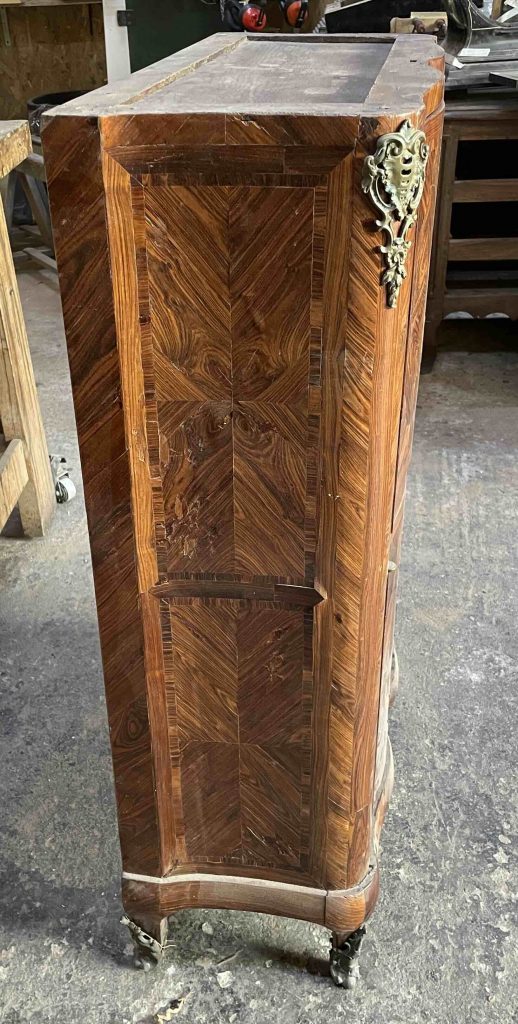
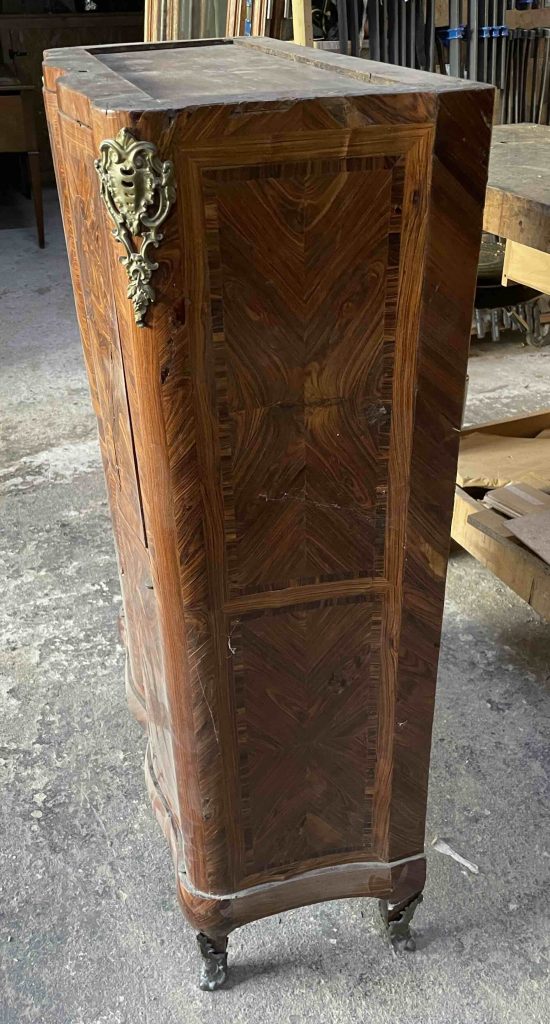
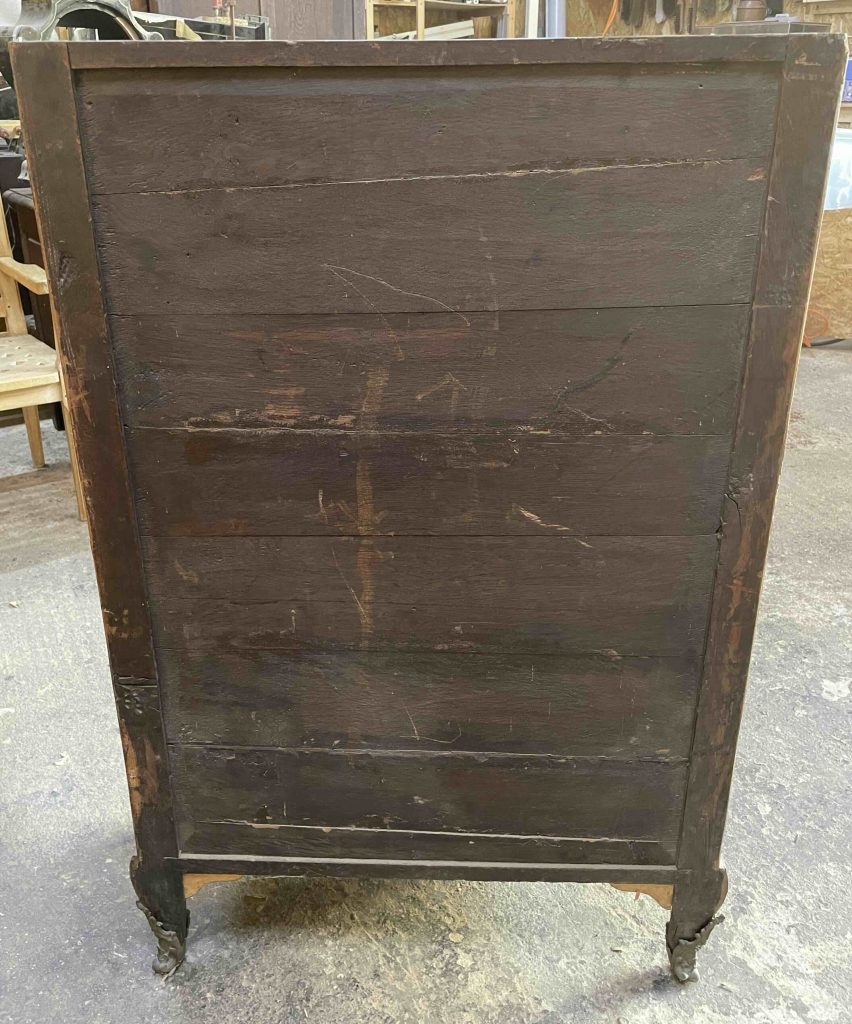
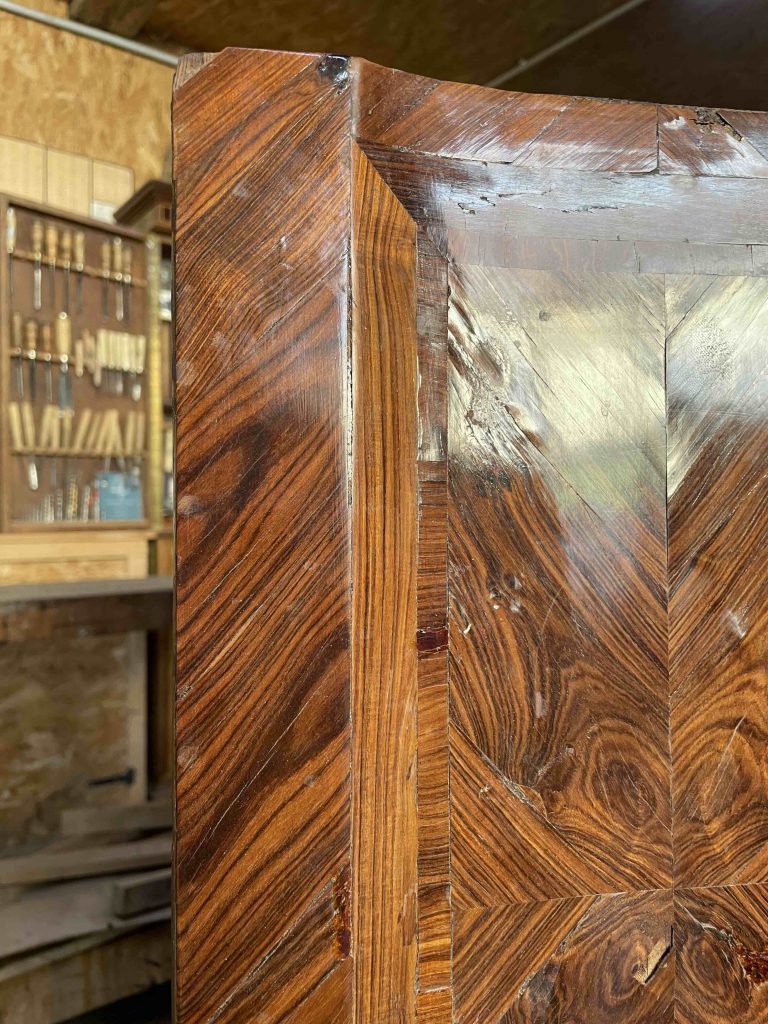
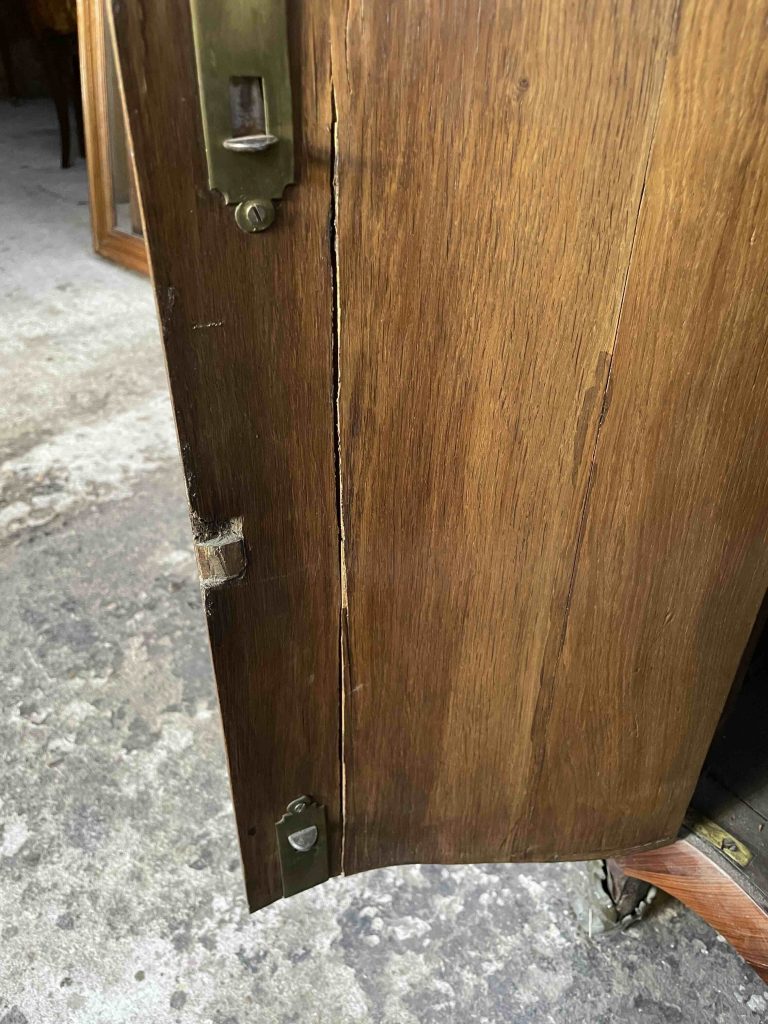
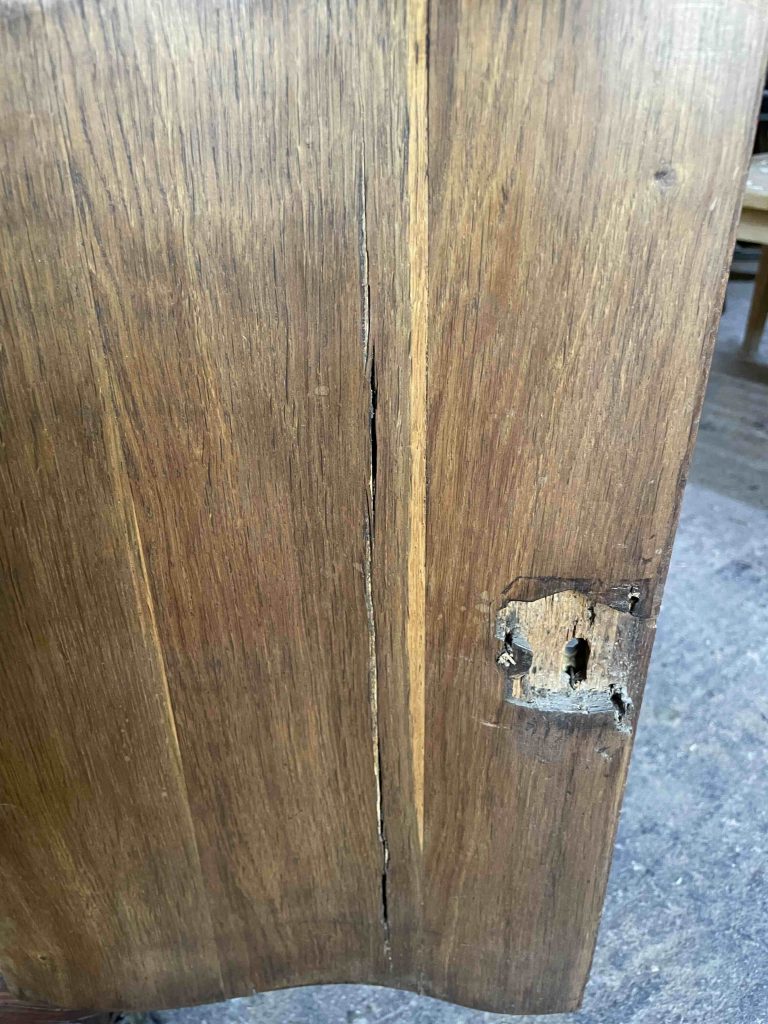
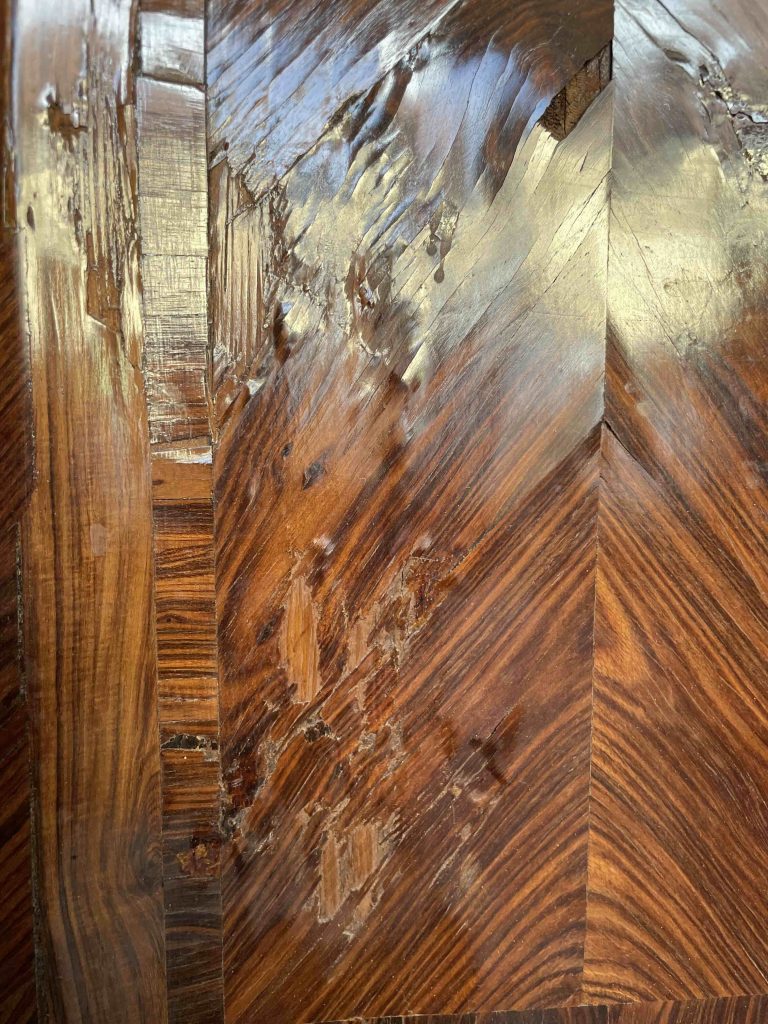
Upon its arrival at the workshop, we immediately noticed that this secretary desk had undergone multiple restorations, including excessive sanding. A considerable number of holes were visible, and the veneer had a texture closer to paper than to a sheet of veneer. Furthermore, the panels of the doors and the drop-front were cracked along their entire length. Fortunately, the sides retained good structural integrity. Although some veneer loss was observed, it was not as concerning as the holes. Moreover, the glue was severely dehydrated, and numerous areas of veneer detachment were visible.
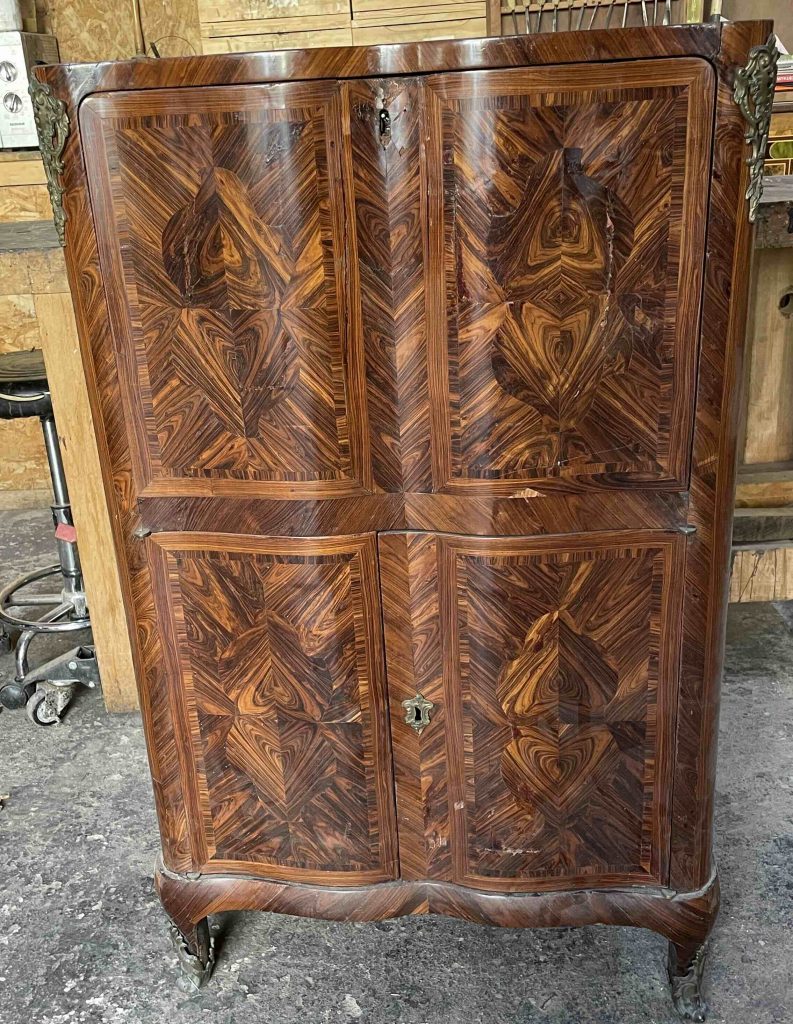
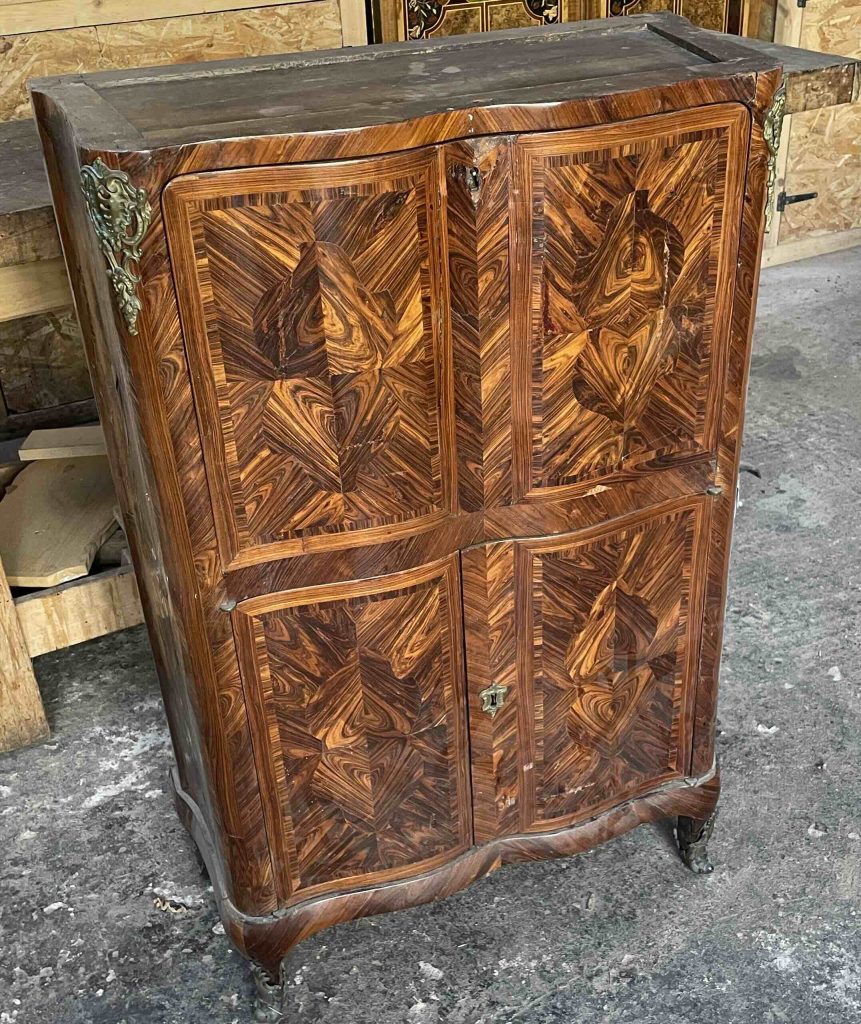
The Restoration
This piece of furniture, though modest in size, required a considerable investment of time and expertise. Many hours were devoted to reducing, re-gluing, and stabilizing all the veneers. The process began with the removal of the leather and the backing veneers from the doors to stabilize and hold the gaps in place. Once this was done, the veneered surfaces were re-glued and rehydrated by vacuum infiltration. The holes were then filled with sheets of veneer that had been scraped, sanded, oxidized, and then mechanically thinned to an extremely thin thickness, comparable to that of a wood chip, to ensure optimal bonding with minimal unevenness. This unevenness will be compensated for by the thickness of the varnish applied.
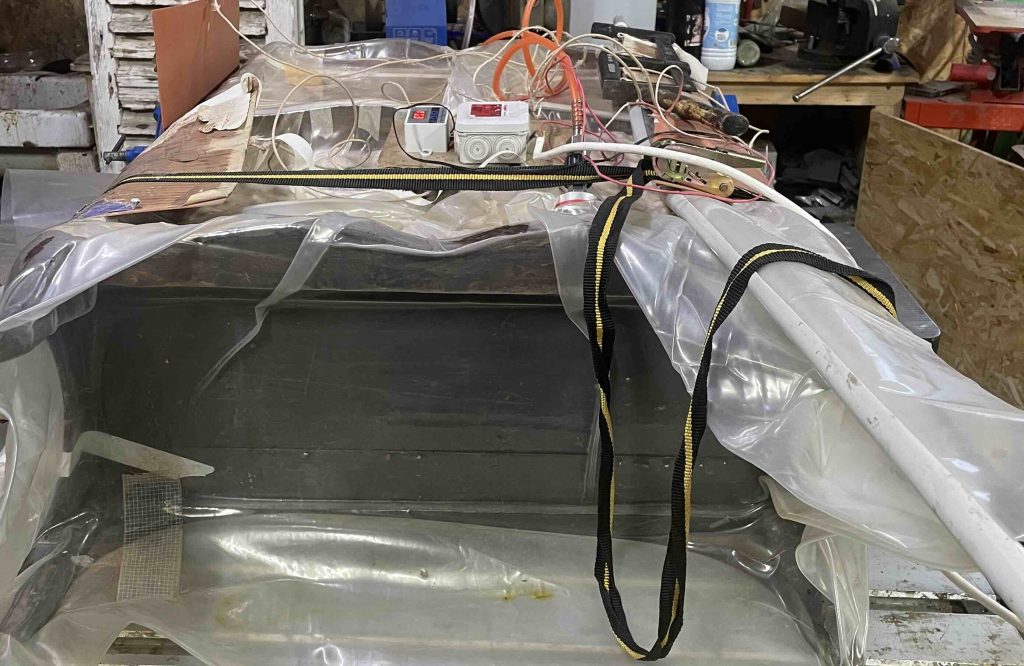
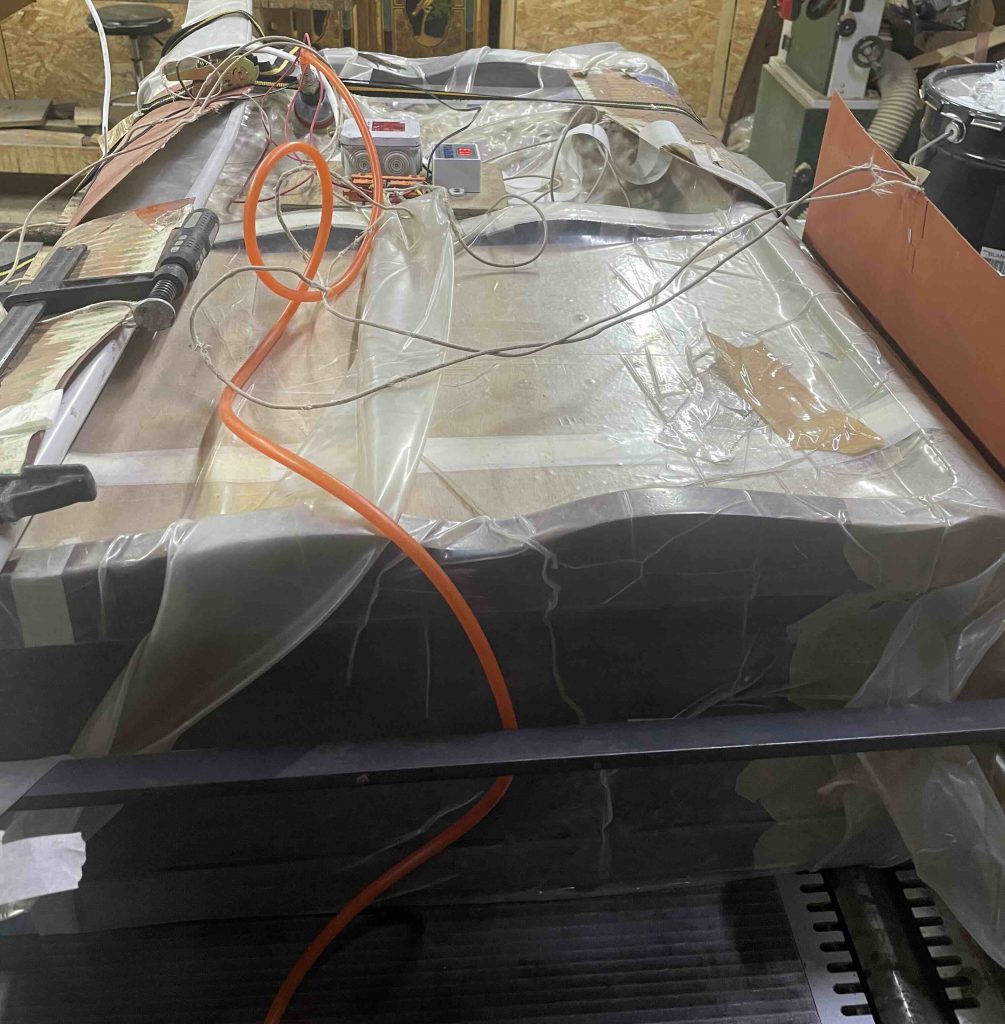
The entire piece was then filled with pumice, sealing the numerous micro-holes. A shellac varnish was applied in multiple layers to compensate for the varying thicknesses of the veneers. Naturally, extensive color touch-ups were carried out between the varnish layers. The bronze mounts, meanwhile, were entrusted to a bronze specialist for complete restoration. This secretary desk has finally been returned to its original place, near the Aleppo breccia fireplace.
A fascinating read.
The work done is impressive.