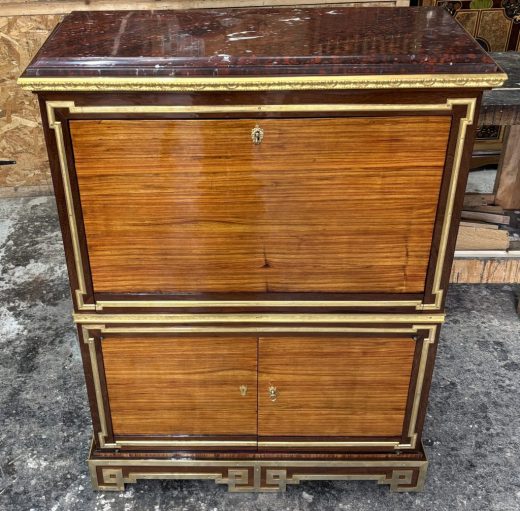
Transition secretary desk in the style of Montigny
Ebénisterie Mathieu Vath

Restoration of a 19th-century Transition-style drop-front secretary, veneered in rosewood and amaranth on an oak frame. This secretary is a learned interpretation of Parisian models from 1765-1775 and is directly inspired by the famous secretary attributed to the cabinetmaker Philippe-Claude Montigny, now in the Musée des Arts Décoratifs. The stylistic similarities with the museum model are immediately apparent in the architectural design of the piece, the treatment of the stepped legs, and the use of bronze ornamentation inspired by the Greek style. The piece adopts […]

Flat Greek-style desk stamped DUBOIS

Ebénisterie Mathieu Vath

One desk, one stamp, three cabinetmakers? The desk we are about to discover, a masterpiece of French cabinetmaking, embodies the culmination of 18th-century Neoclassical taste. The question that immediately arises upon contemplating this exceptional piece is: why three cabinetmakers for a single desk? The answer lies in the complex interplay of succession, talent, collaboration, and opportunism that characterized the craftsmanship of the period. This flat desk, known as a "Greek-style" desk, is a perfect example of the Louis XVI style. Made from a blend of […]

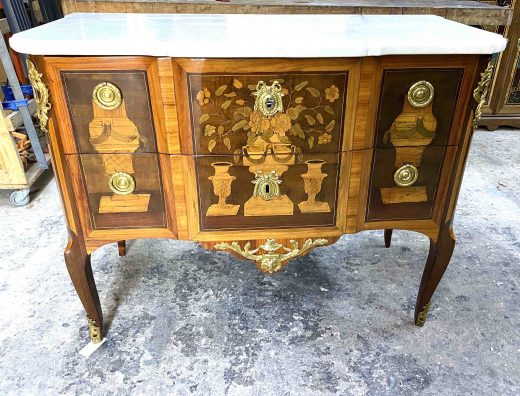
Transition sauté pan with Boudin stamp

Ebénisterie Mathieu Vath

Restoration of a Transitional commode stamped by the master cabinetmaker Léonard Boudin (1735 in Paris – 20/12/1807). It is constructed of solid oak and veneered with amaranth, rosewood, tobacco-stained maple, and marquetry of boxwood, hornbeam, and holly, decorated with panels featuring floral vases and covered pots on the front and sides. With a slight central projection on the front, opening to reveal two drawers without a central divider, its rounded uprights rest on cabriole legs. Many Transitional commodes of this type have […]

Transitional chest of drawers stamped SAUNIER

Ebénisterie Mathieu Vath

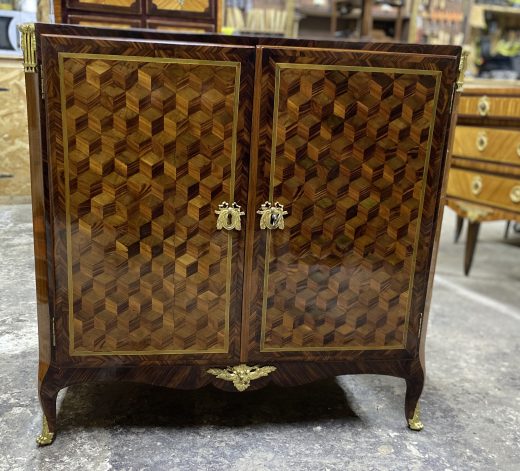
Restoration of a transitional two-door commode veneered with bottomless cube marquetry. The frame is oak for the uprights and rails, the side panels are softwood, and the two doors are walnut. The bottomless cubes are veneered with rosewood, violetwood, and tobacco-stained maple. The entire piece is framed with a stringing of green-stained maple and boxwood. The uprights and door frames are veneered with violetwood and rosewood. The sides […]

Transition chest of drawers stamped Fromageau

Ebénisterie Mathieu Vath

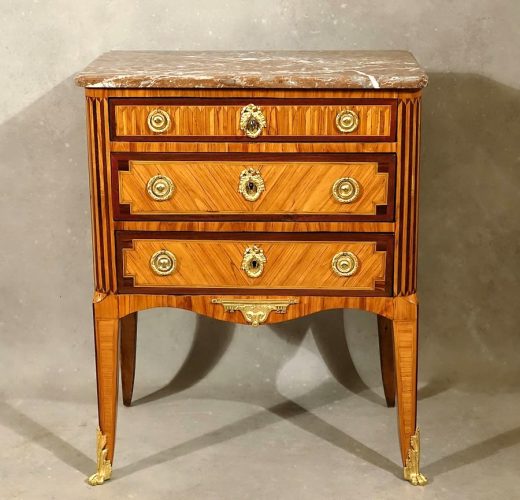
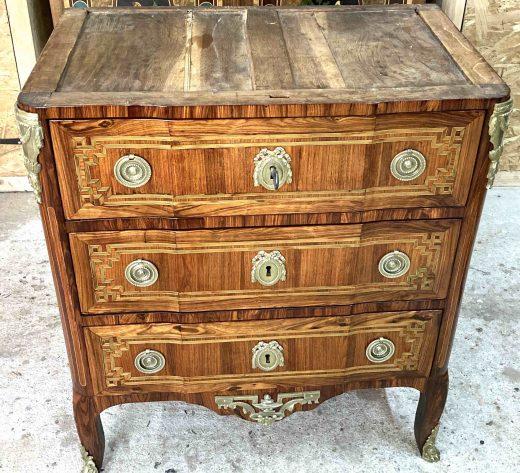
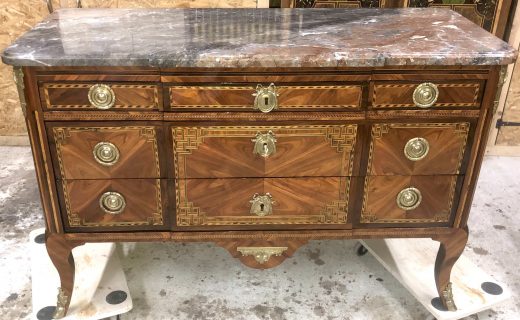
Restoration of a Transitional style commode, stamped by Jean Baptiste Fromageau, veneered in rosewood with an amaranth frieze and faux fluting. It is topped with a Royal red marble slab and features three drawers, one narrower at the top inlaid with a frieze of glyphs, while the two below are inlaid with Greek key patterns and have violet wood corners. The bronze mounts include ring pulls, keyhole escutcheons with knotted ribbons, and a drop-shaped finial.

Transitional cylinder secretary, stamped SCHLICHTIG

Ebénisterie Mathieu Vath

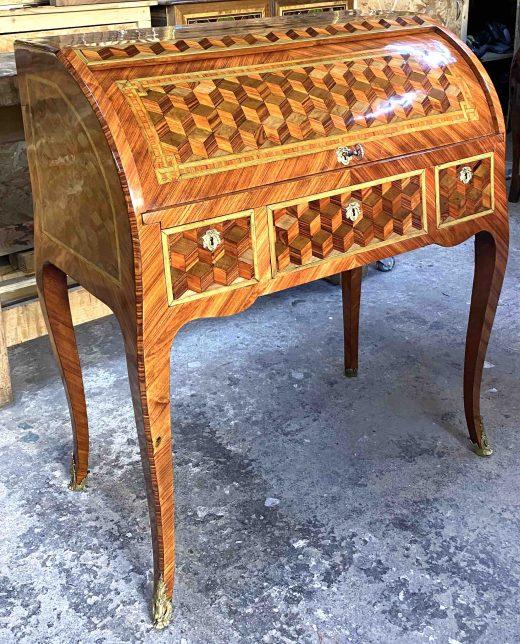
Restoration of a Transitional period roll-top desk stamped by Jean-Georges Schlichtig. The frame is oak for the legs and rails, while the panels and drop-front are softwood. It is veneered in rosewood with marquetry of bottomless cubes in rosewood and tobacco-stained sycamore; the Greek key stringing is composed of hornbeam and holly. The back and interior drawers are veneered in satinwood. This type of roll-top desk was a common production for this cabinetmaker, who produced […]

Coffee table stamped P.GARNIER JME

Ebénisterie Mathieu Vath

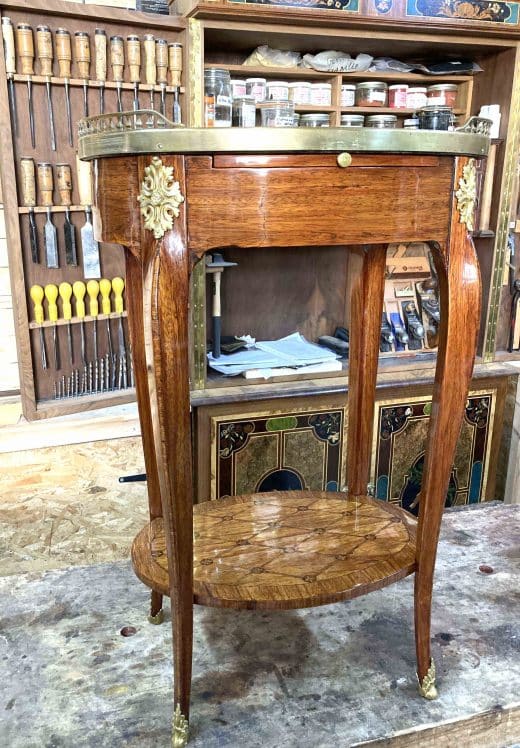
Restoration of a Transitional Period (1750-1774) satinwood veneer salon table stamped by Pierre Garnier (circa 1726-1800). Originally from Paris, and the son of master cabinetmaker François Garnier, Pierre Garnier obtained his master's certificate on December 31, 1742. In contrast to his father, François left the Faubourg Saint-Antoine for the rue Neuve-des-Petits-Champs, near the Place Vendôme. His clientele consisted of merchants such as Léonard Boudin and Pierre Migeon, but above all of the kingdom's wealthiest figures, such as Louis Georges Erasme, Marshal of France, the Duchess of Mazarin, and the Marquis de Marigny, […]

LARDIN transitional chest of drawers

Ebénisterie Mathieu Vath

Restoration of a Transitional period commode constructed of fir and oak and veneered with rosewood, violet wood, and a frieze of hornbeam stringing stained green in the Greek key pattern. The sides are veneered with satinwood and violet wood. André-Antoine Lardin (1724 – August 10, 1790) obtained his master craftsman's certificate on July 1, 1750, and established himself on rue de Charenton under the sign "Au Bois de Boulogne." He worked there until 1770, when he moved to rue Saint Nicolas. His production is […]

Transitional dresser

Ebénisterie Mathieu Vath

Restoration of a transitional period commode with a projecting front, veneered in rosewood and palisander. The Greek key-patterned moldings, stained green, are made of hornbeam, and the front features a butterfly wing design. It opens with two large drawers with concealed crossbars, and three drawers in an upper row. The uprights, with simulated fluting, are veneered in ebony and boxwood. It rests on four cabriole legs adorned with hoof-shaped feet. Although it has undergone some alterations […]

Transitional dresser

Ebénisterie Mathieu VATH

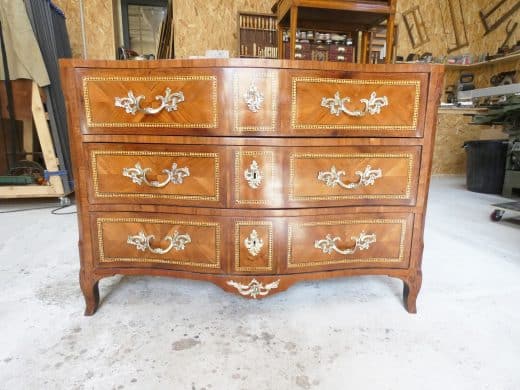
Here is a very simple chest of drawers from eastern France, probably dating from the late 18th century. The front is slightly curved and the uprights are chamfered. It should be noted that the bronze mounts are probably not original. The frame is made of solid softwood, and the uprights are oak. The drawer bottoms are set in rebates and slide on the drawer fronts, which is typical of provincial work. A small peculiarity: this chest of drawers does not have top panels, the […]

Transitional dresser in the style of Topino

Ebénisterie Mathieu VATH

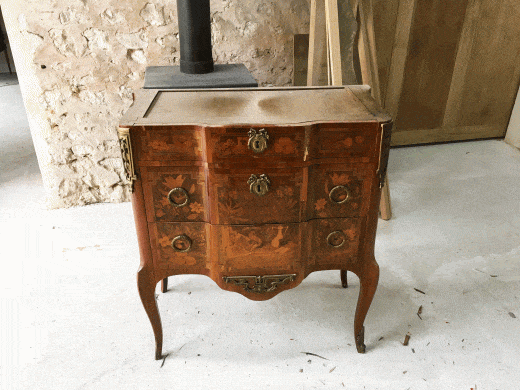
A month ago, a lovely transitional commode arrived, which reminds me of the work of the cabinetmaker Charles Topino (circa 1742-1803) – he received his master craftsman's certificate on July 4, 1773. However, this commode does not bear his stamp, nor any stamp for that matter. This confirms that a stamp is not necessary to possess a piece of high-quality furniture. Furthermore, the marquetry could very well have come from Topino's workshop, as he sold panels of his marquetry to the haberdashers and his colleagues […]