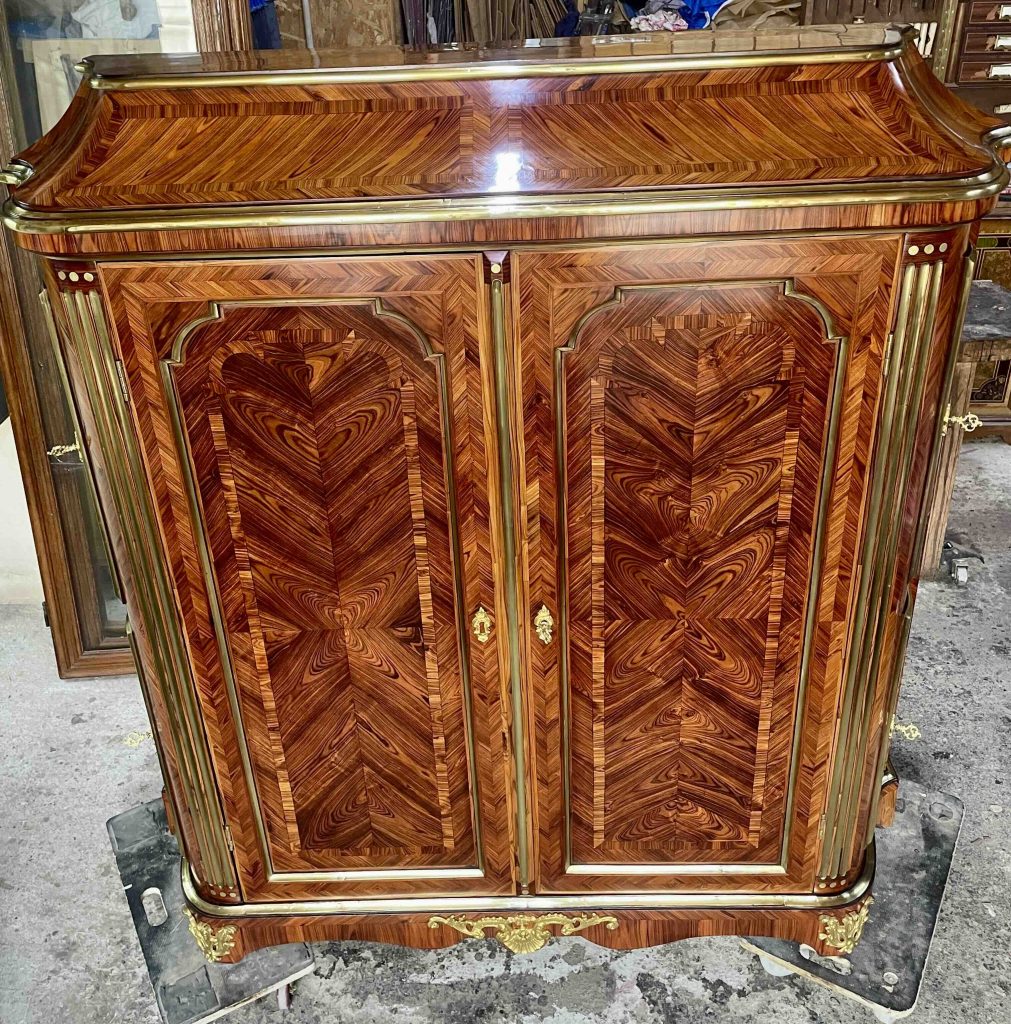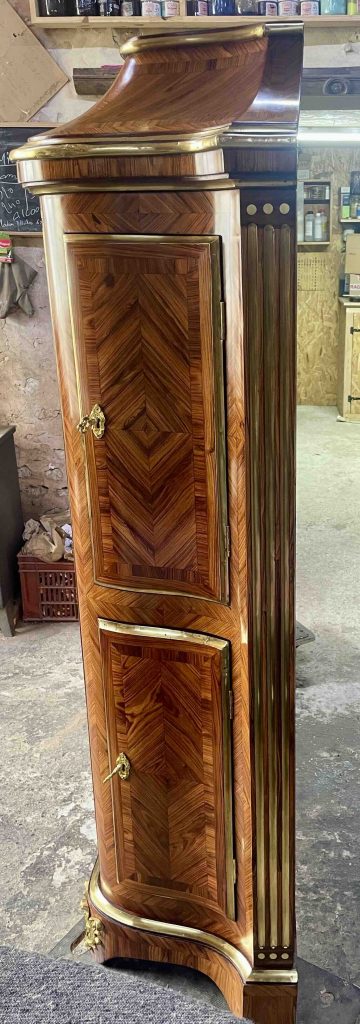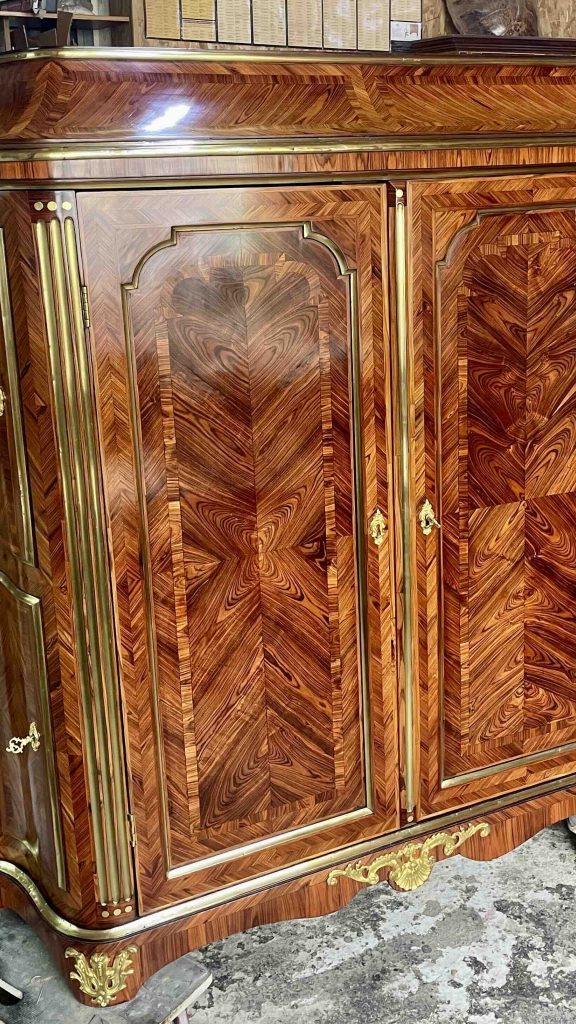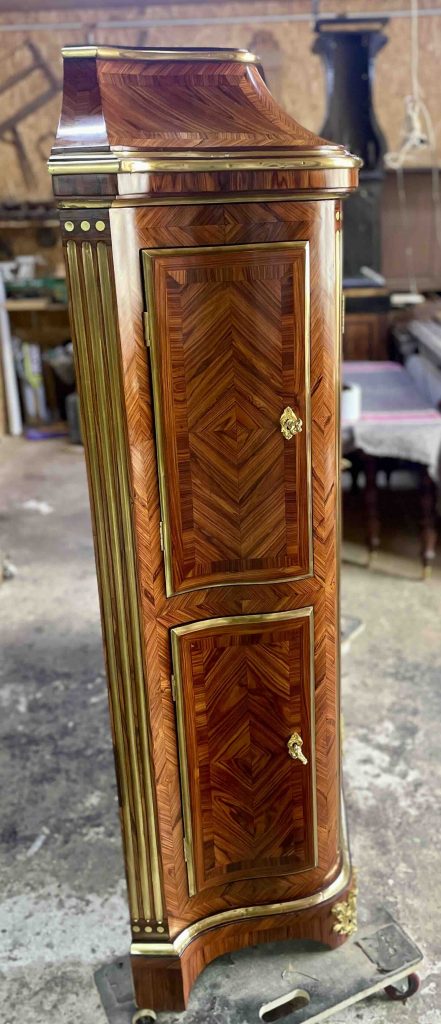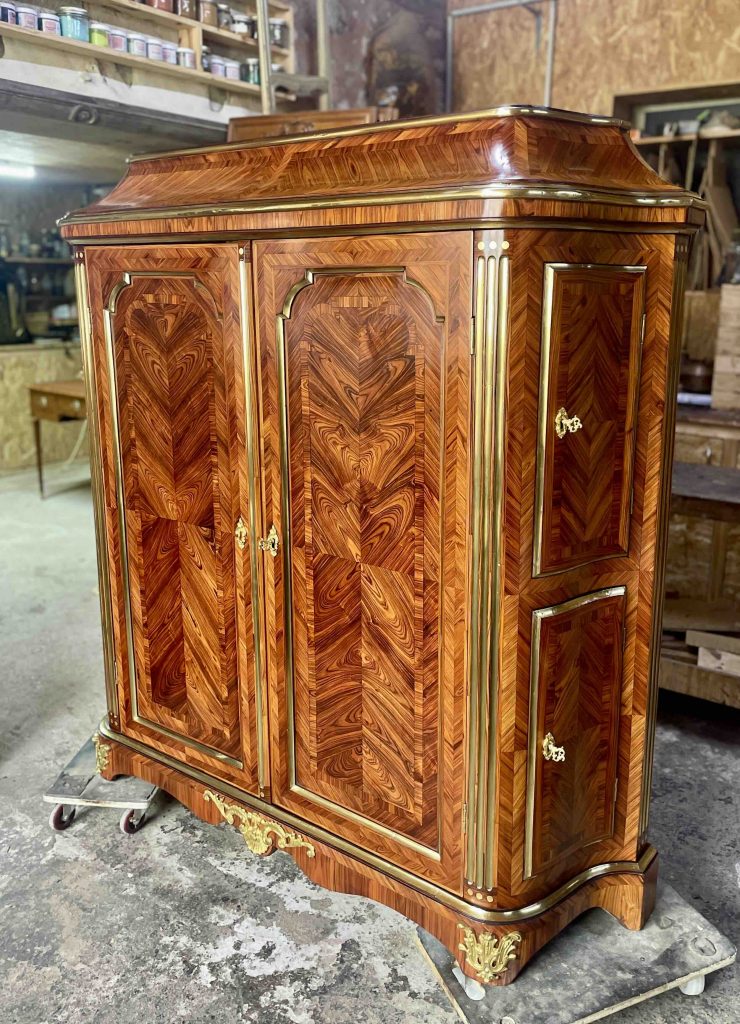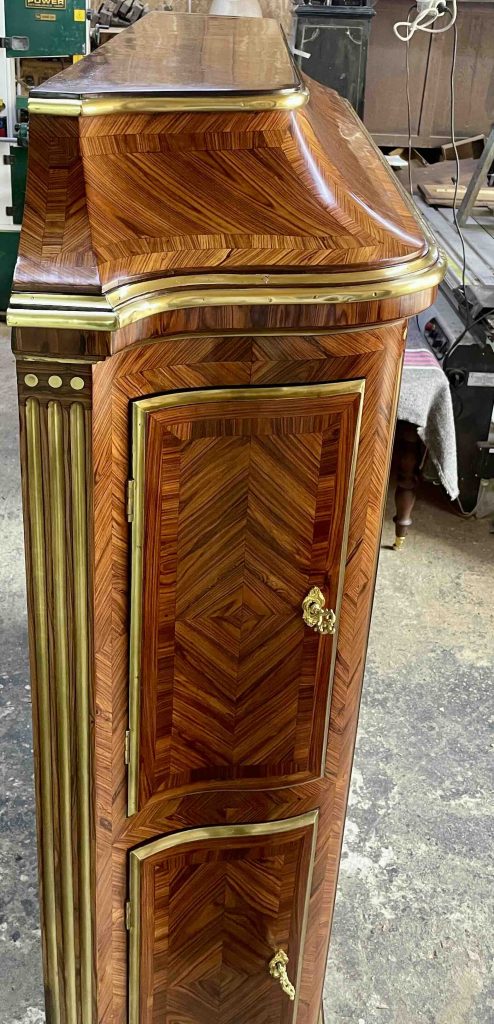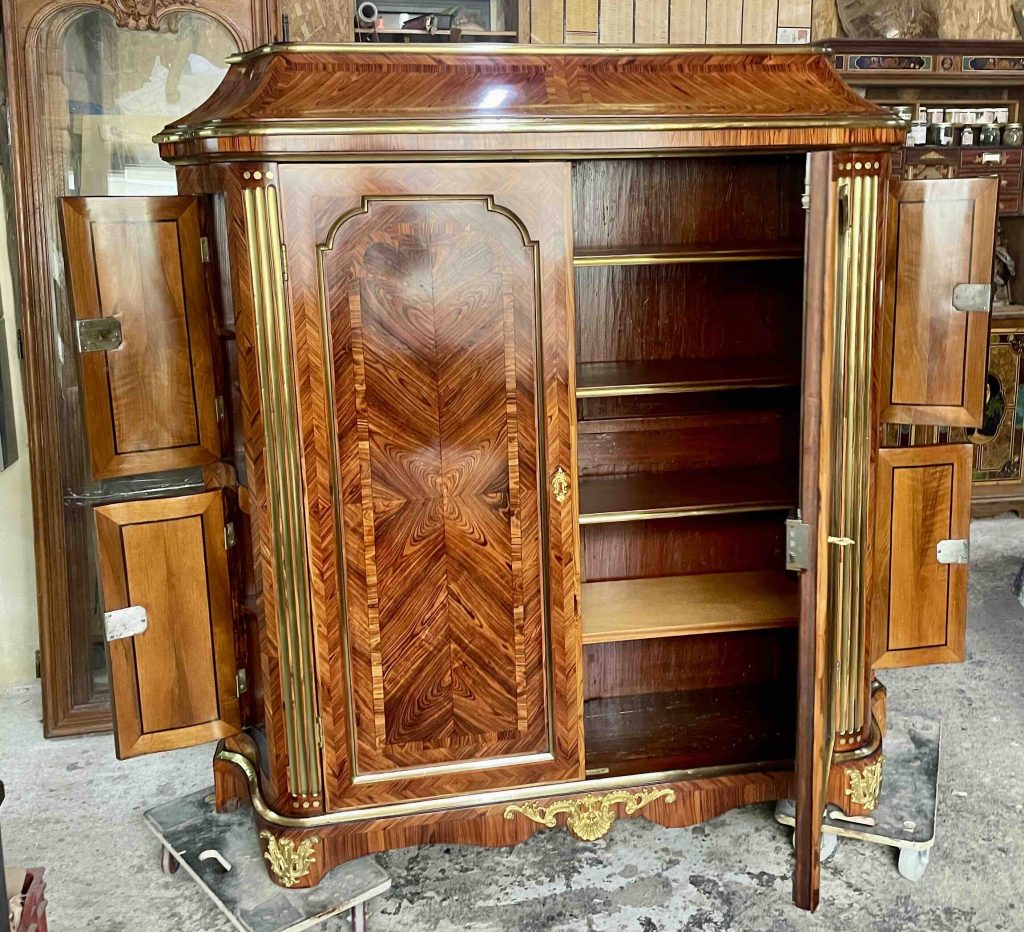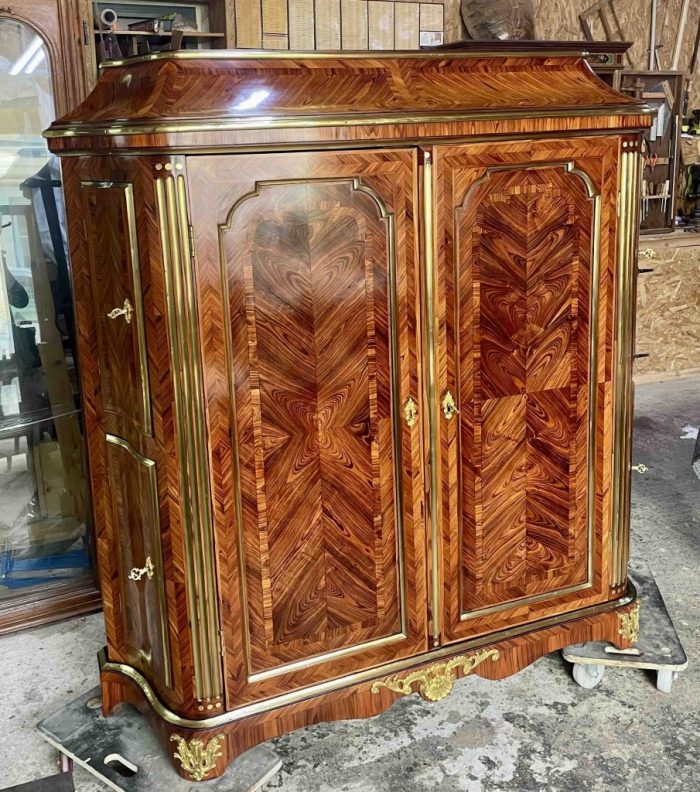
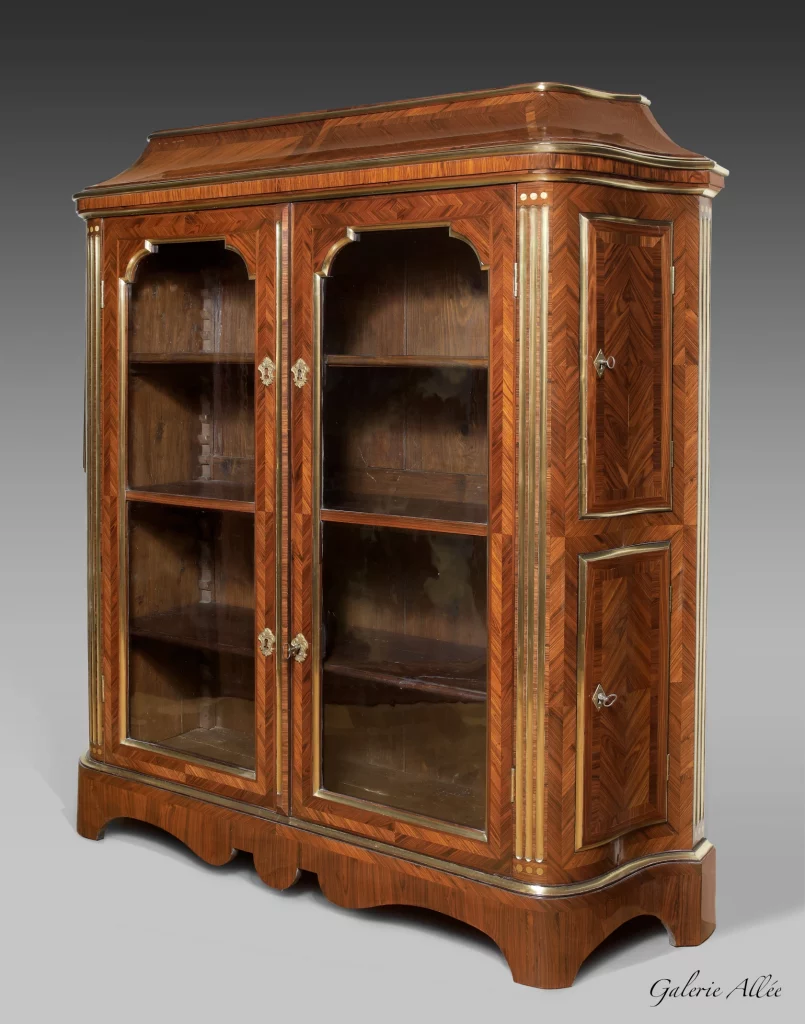
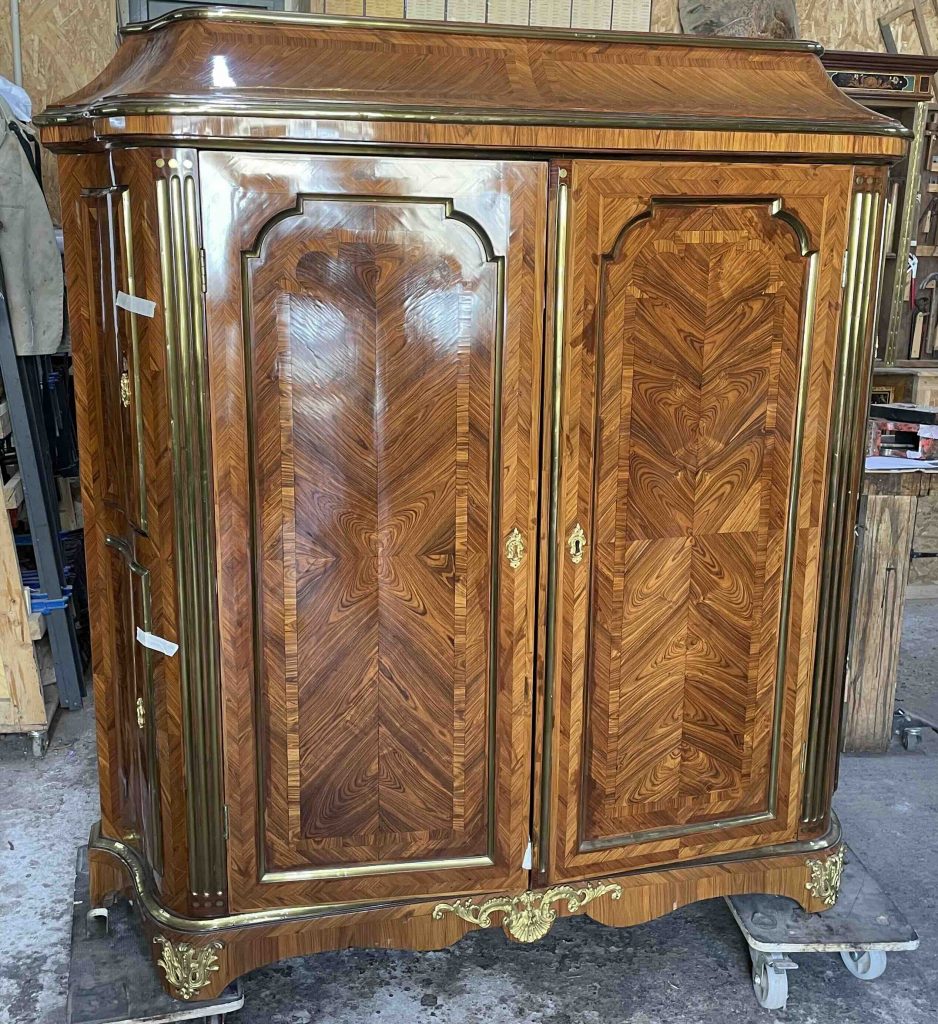
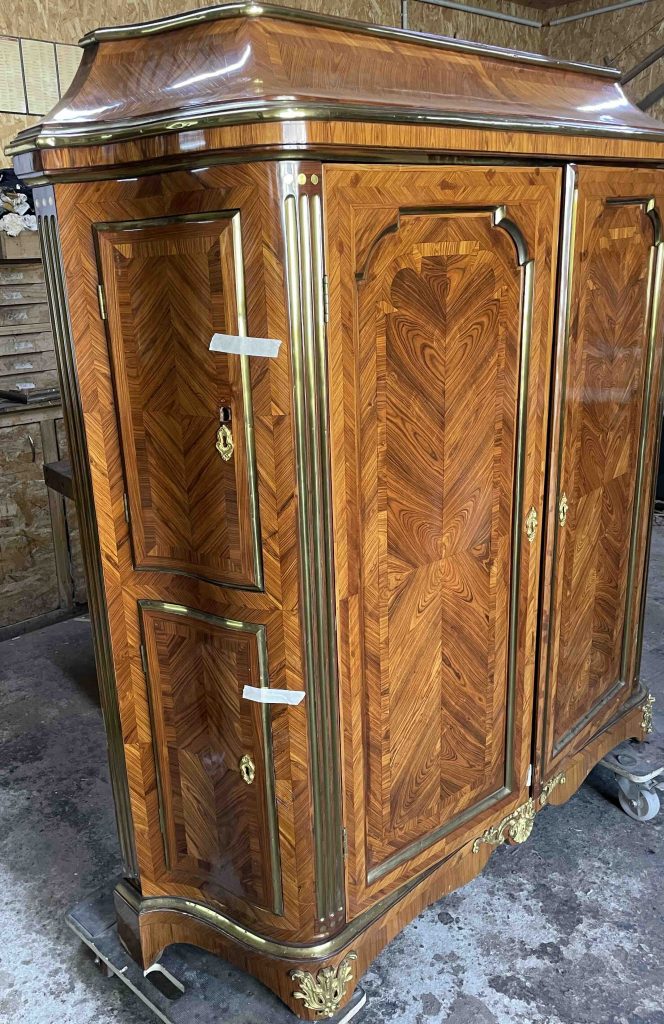
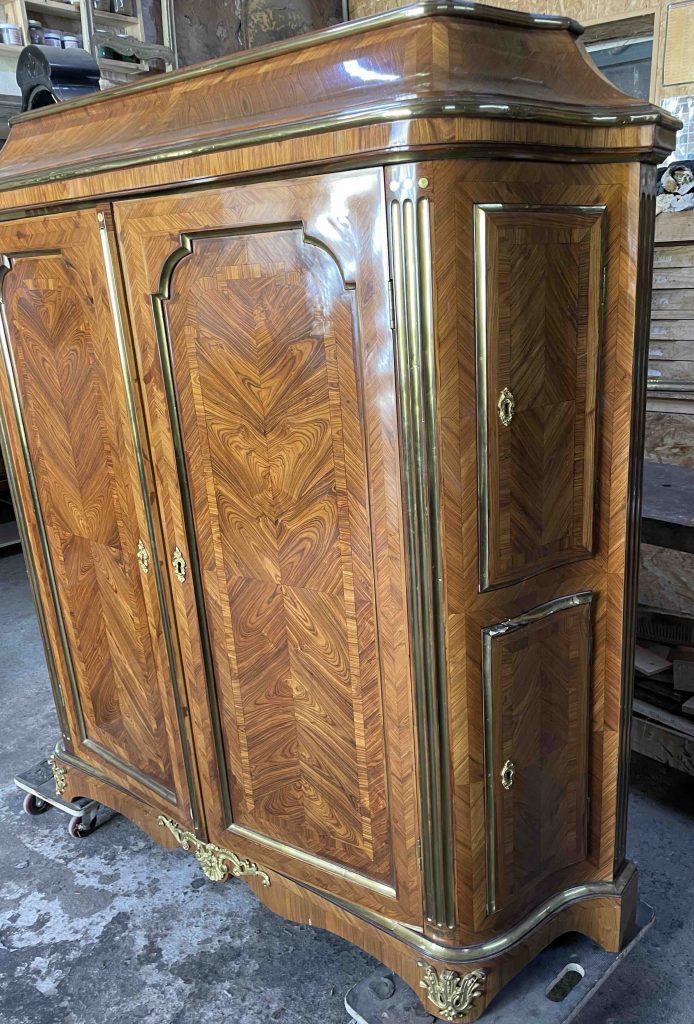
Restoration of a Regency-style cabinet, probably dating from the 1740s, stamped by Pierre IV Migeon. Constructed of oak and softwood, this cabinet, which could also be considered a bookcase, is entirely veneered in kingwood, rosewood for the top, and walnut for the interiors. The doors are veneered with a butterfly-wing pattern, while the side doors feature a square motif, typical of Migeon's decorative vocabulary. The ogee cornice is edged with a half-round brass molding. The uprights are embellished with brass fluting highlighted by roundels at the ends.
It would appear that this piece of furniture is not unique since we found the same one in a library.
Pierre IV Migeon (1696-1758)
The name Migeon is associated with a line of cabinetmakers active in Paris from the 17th to the 18th century. Several generations of masters bear the first name Pierre, hence some confusion in the attribution of their works.
- Pierre I Migeon (circa 1620 – after 1680): master chair maker, he laid the foundations of the family's craft activity.
- Pierre II Migeon (circa 1650 – active at the end of the 17th century): he continued the trade in chair making.
- Pierre III Migeon (1661-1722): he expanded the family business and moved closer to the cabinetmaking trade.
- Pierre IV Migeon (1696-1758): the most famous, a Parisian cabinetmaker of great renown.
- Pierre V Migeon (1723- after 1775): son of Pierre IV, he took over the workshop and perpetuated the father's style.
Born in 1696, Pierre IV Migeon was introduced to the trade at a very young age by his father, Pierre III. He became master cabinetmaker in 1729, at which point he officially opened his own workshop on rue de Charenton. The establishment quickly grew in importance, employing several journeymen and workers.
Unlike some of his contemporaries who focused on producing luxury goods exclusively for the high aristocracy, Migeon developed a versatile workshop capable of supplying a bourgeois, aristocratic, and even royal clientele. Among his most illustrious clients were the Duke of Orléans, the Duchess of Rohan, the Duchess of Epernon, Marshal de Noailles, as well as several bishops and ambassadors., Marquise de Pompadour, favorite of Louis XV, great patron of the arts and protector of the best craftsmen. The privileged relationship he maintained with her testifies to the reputation of his work and his integration into the circles of power.
Although Migeon's profession was that of cabinetmaker, he also worked as a merchant. He collaborated with many cabinetmakers – among the most renowned of his time – such as Bircklé, Canabas, Criaerd, Jacques Dubois, Lacroix, Saunier, and Topino.
Migeon's activity is documented for nearly thirty years, from his becoming a master craftsman in 1729 until his death in 1758. His workshop thrived during a pivotal period: the transition from style Regency (simple shapes, a transition towards greater lightness) in the style Louis XV (curved lines, rocaille ornamentation).
Its furniture is distinguished by:
- frequent use of geometric marquetry in exotic wood veneers (including violet wood, amaranth, rosewood); ;
- an ornamentation in gilded bronzes, elegant but measured; ;
- of the balanced proportions, marking a desire for refinement without exuberance.
After his death in 1758, his son, Pierre V, took over the workshop and perpetuated the family tradition into the second half of the 18th century
Bibliography
- Sophie Mouquin — Pierre IV Migeon, 1696-1758: at the heart of a dynasty of Parisian cabinetmakers. Paris: Les Éditions de l'Amateur, 2001.
- Pierre Kjellberg — French furniture of the 18th century: a dictionary of cabinetmakers and joiners. Paris: Éditions de l'Amateur, 1989.
State of affairs report
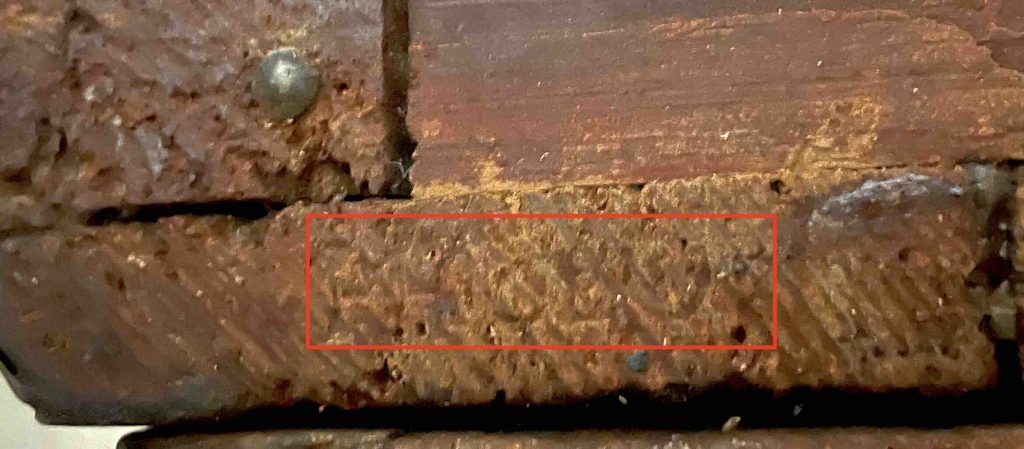
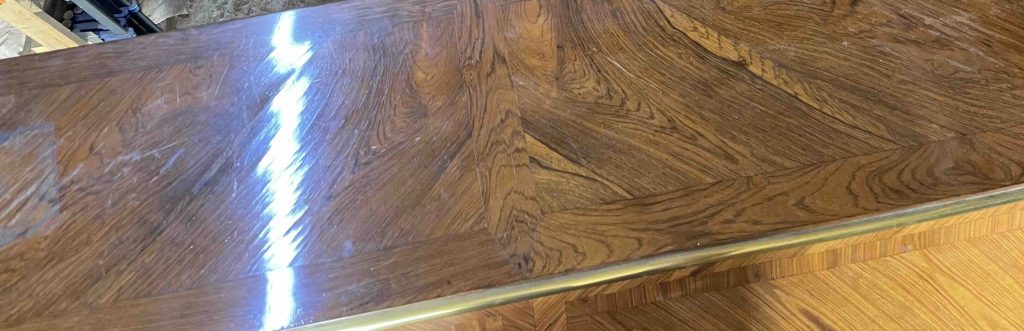
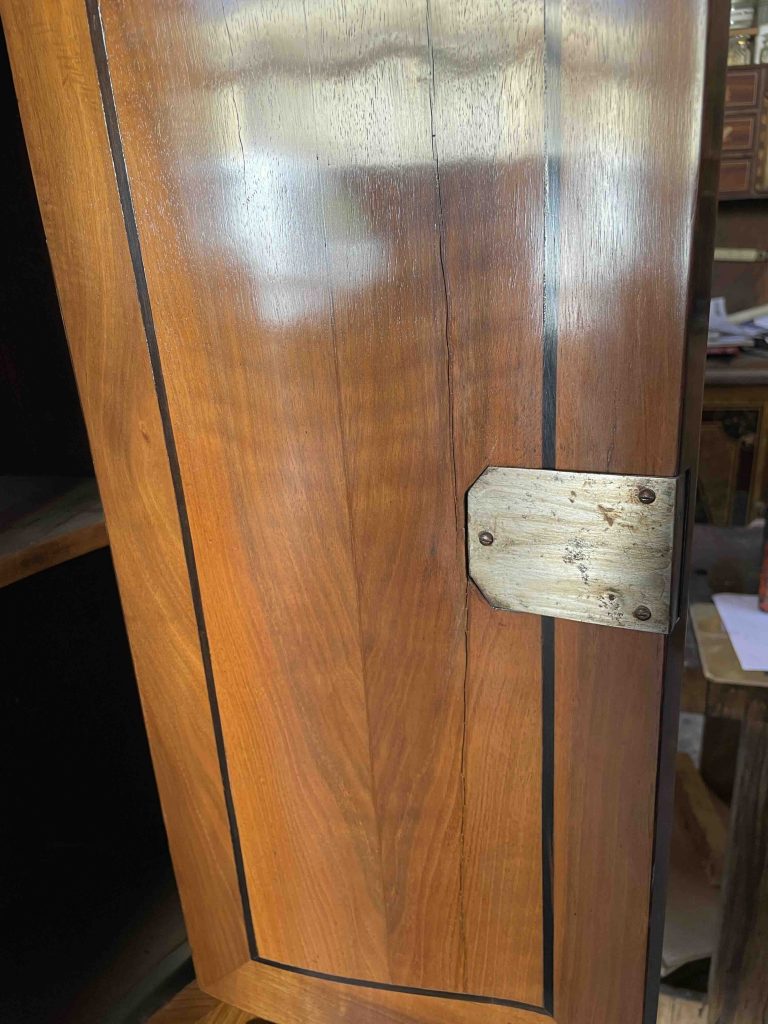
Upon arrival at the workshop, this piece of furniture presented no structural defects, apart from slight cracks on some panels. The majority of the damage was to the veneer. The piece exhibited significant dehydration of the glue beneath the veneer, characterized by numerous cracks, fissures, and areas of delamination. There were also some gaps and slightly visible traces of previous restorations, resulting from the use of a violet wood that was too pale and derived from sliced veneer. The French polish finish was in good condition, but traces of brass cleaning products were visible beneath the varnish. These acidic products had created dark stains on the wood next to the brass, as well as probable drips and even fingerprints. A large portion of the brass elements were now only mechanically held in place by the wood veneer and had detached.
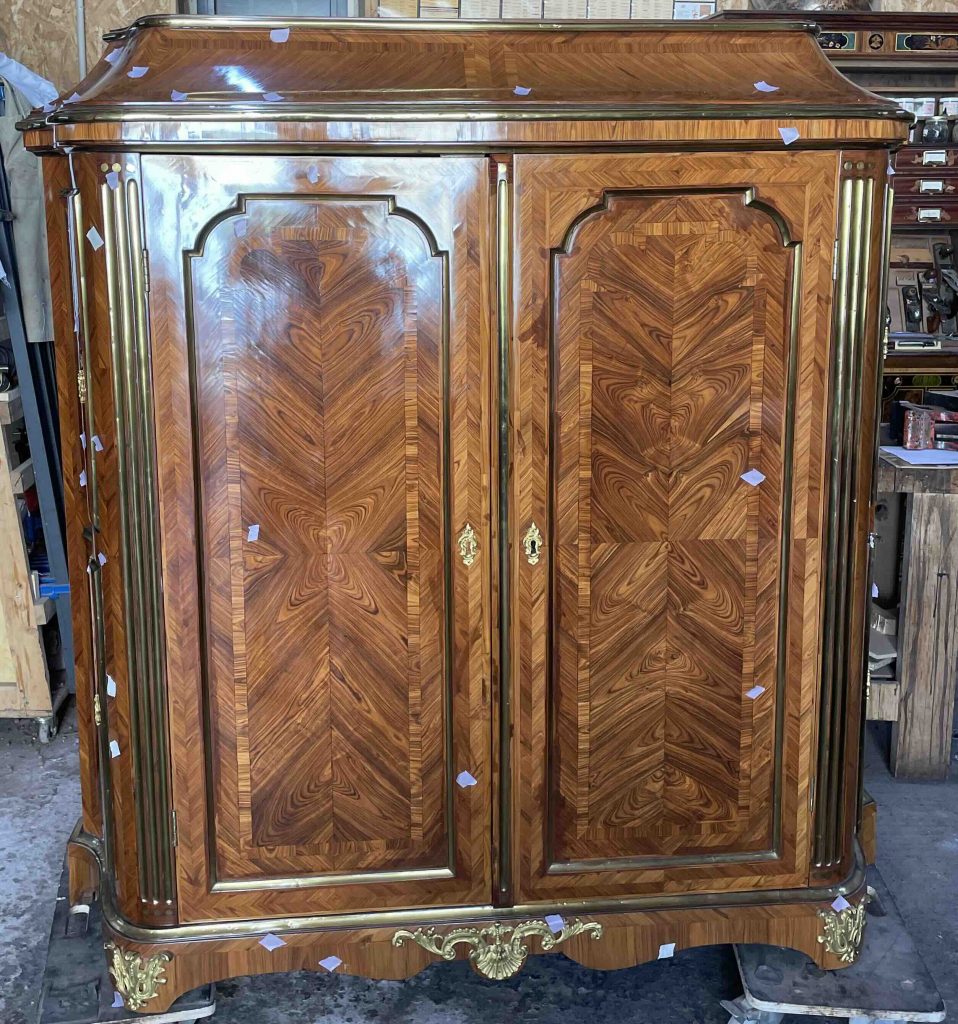
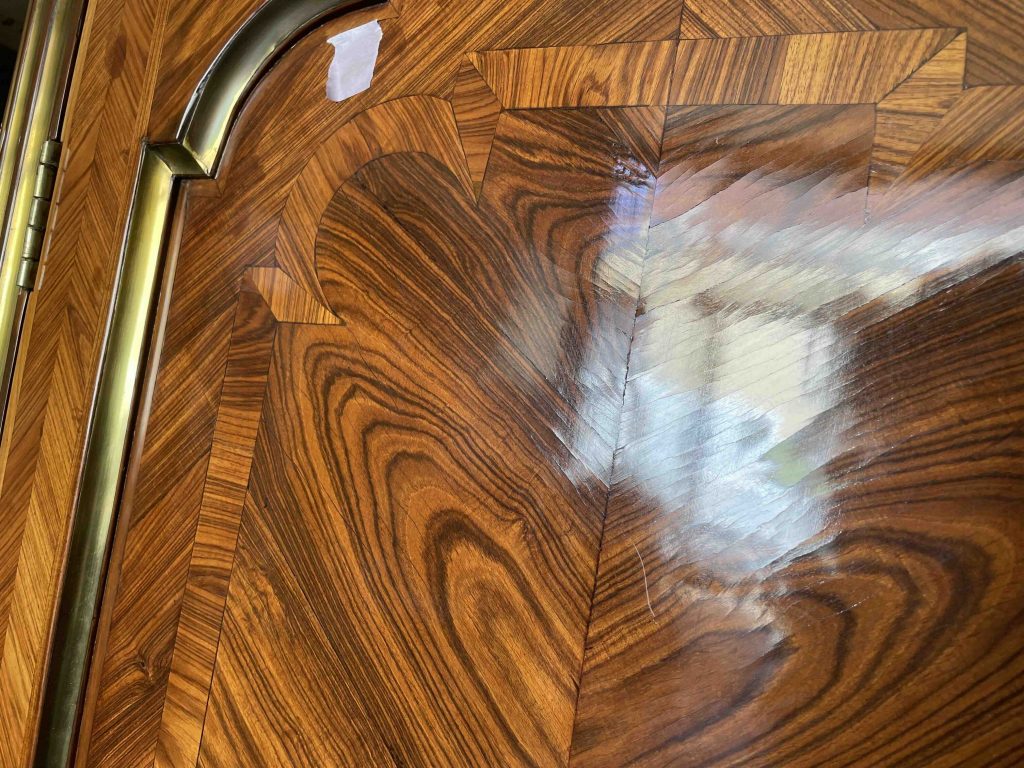
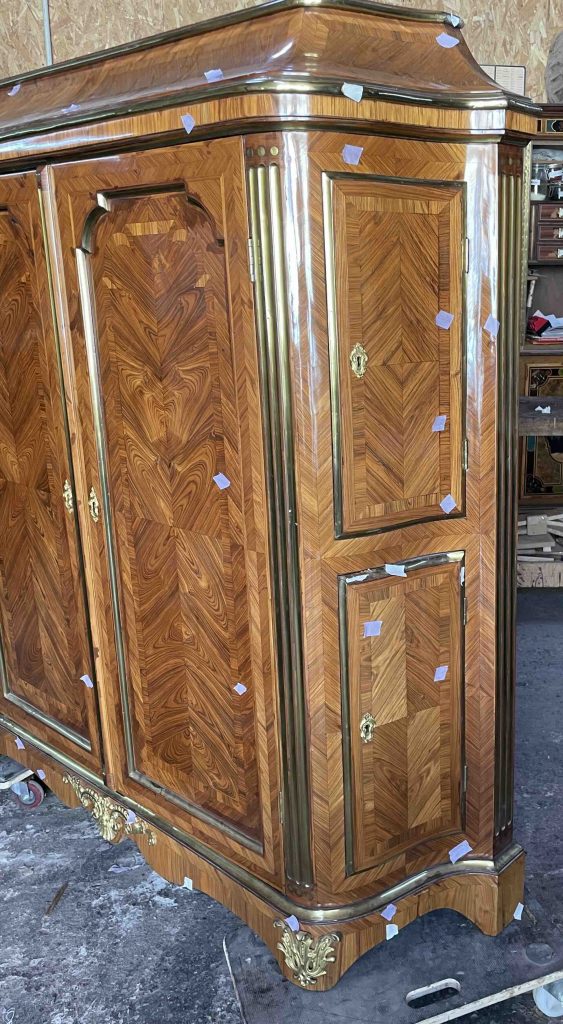
The Restoration
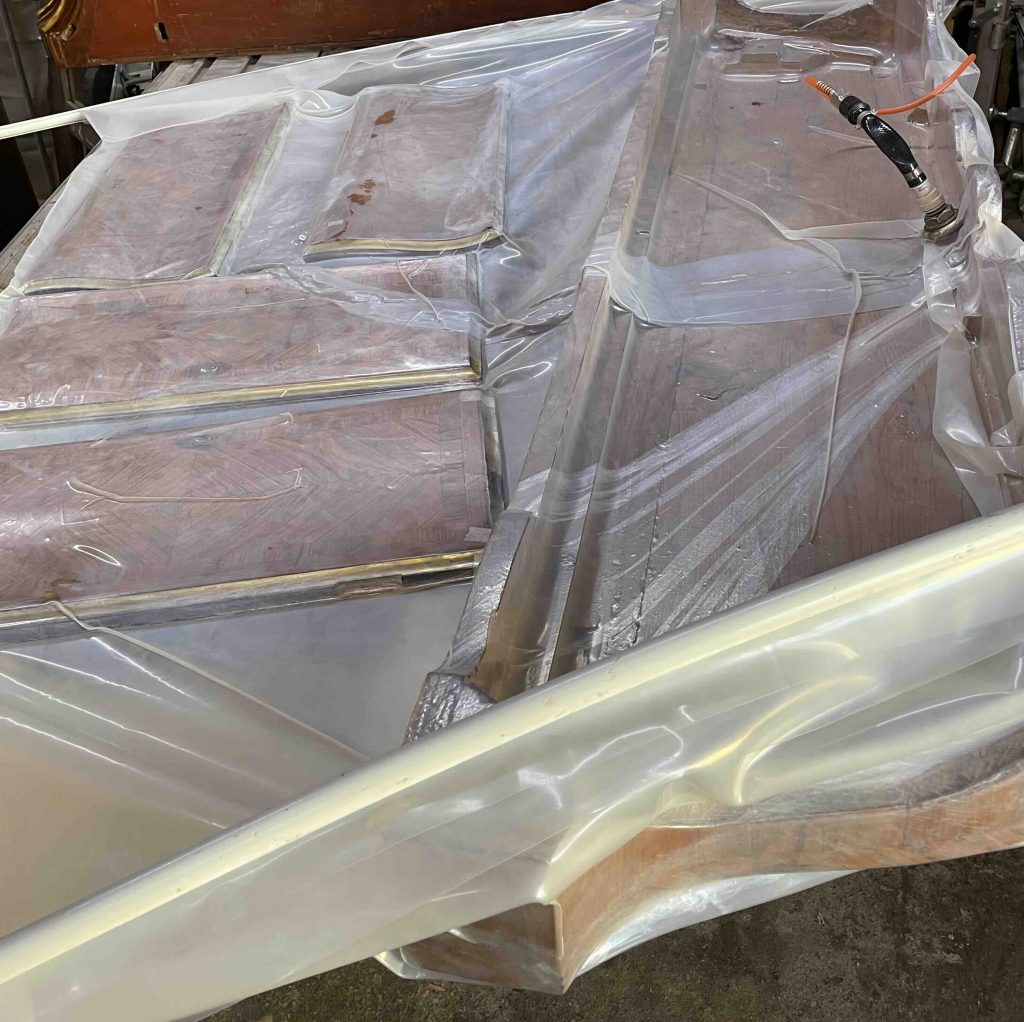
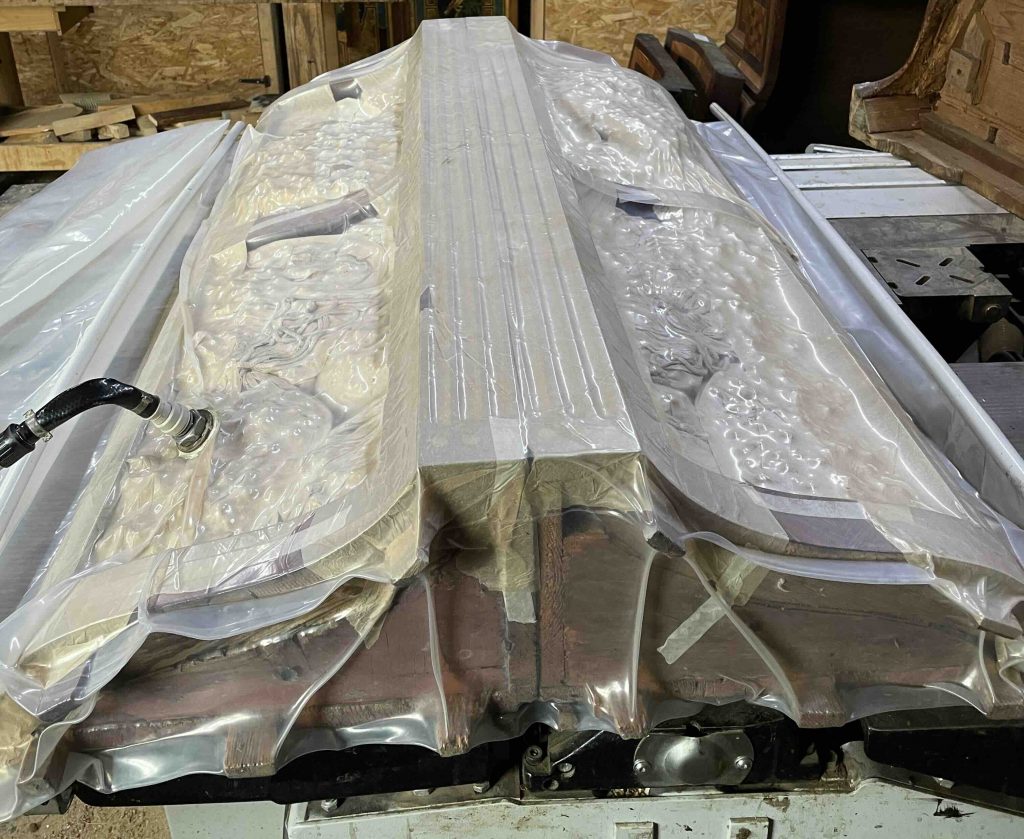
Fortunately, this chest of drawers can be disassembled. This allowed us to treat each element under vacuum, regenerating the old glues through infiltration. The old veneer grafts were replaced with kingwood veneer that was sawn, scraped, sanded, and applied to the correct thickness as a backing.
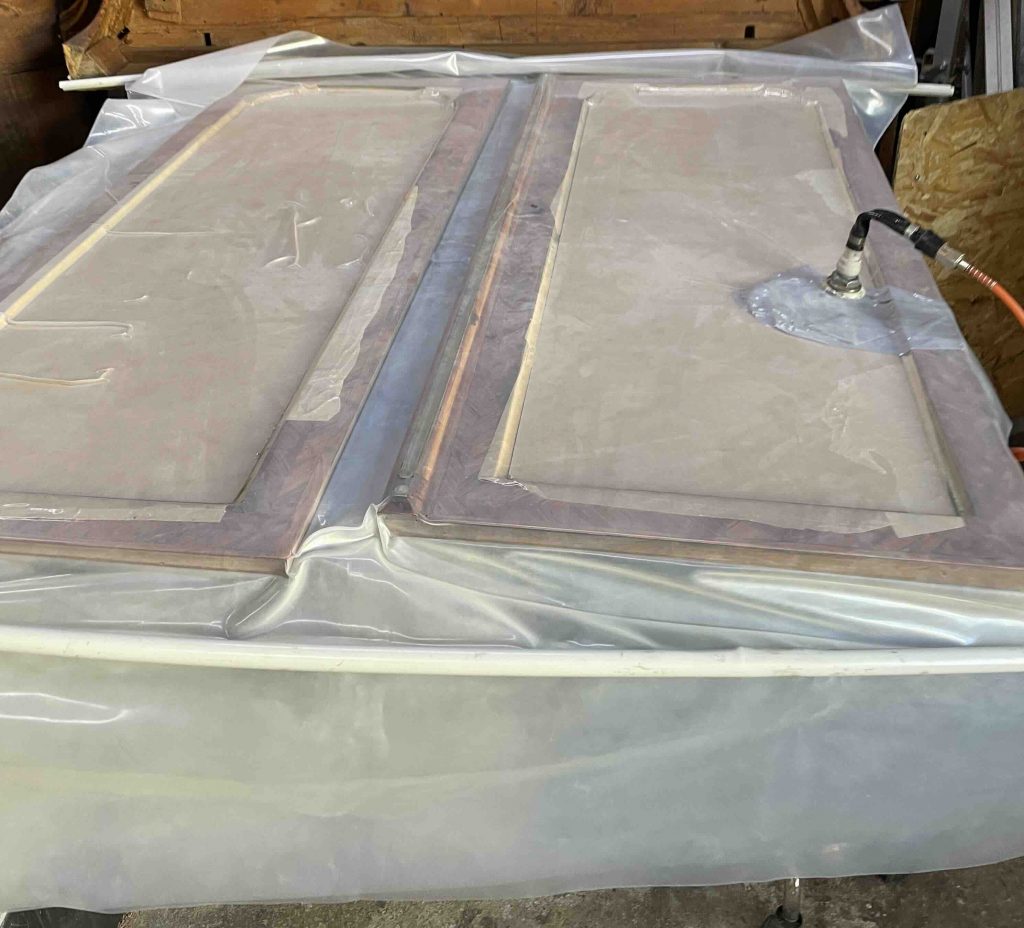
To address the cooking stains, the old finish was removed using a solvent suitable for furniture restoration. A Roubo wax polish was then applied to closely match the original finish of the piece. The brass fittings were protected with a layer of urea-aldehyde resin (ketonic resin). The locks were serviced, and new keys, which were missing, were made.