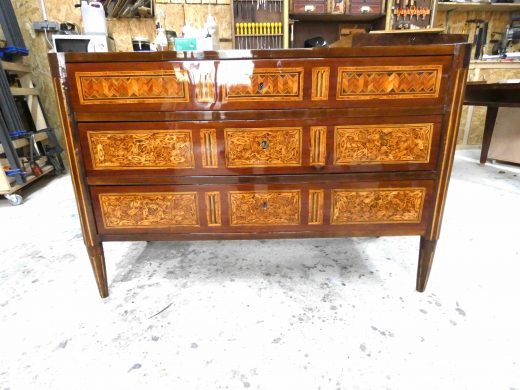
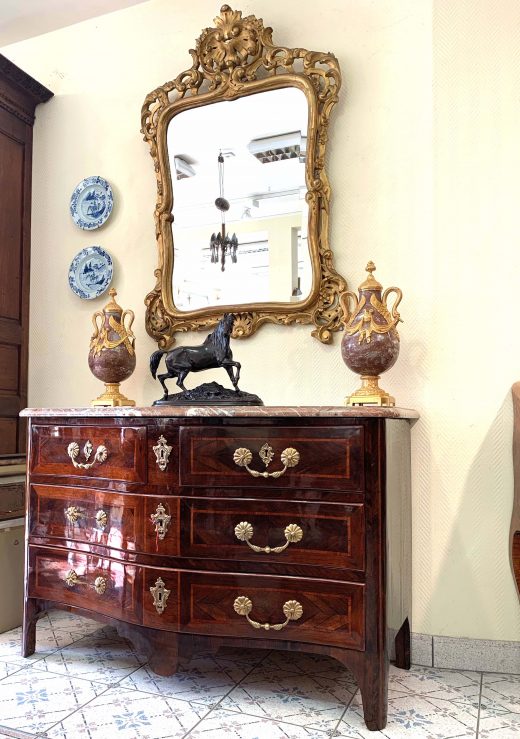
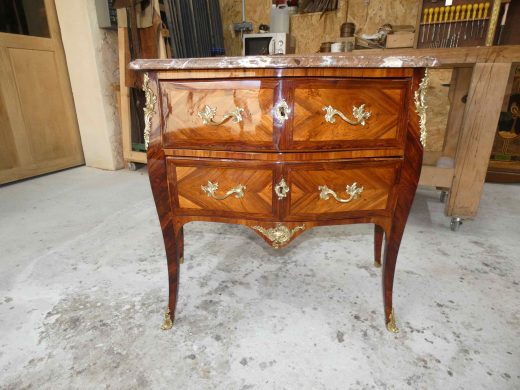
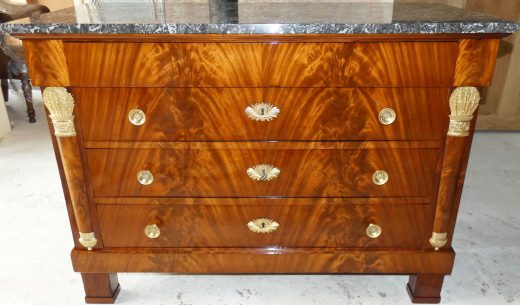
Regency chest of drawers Crossbow

Ebénisterie Mathieu Vath

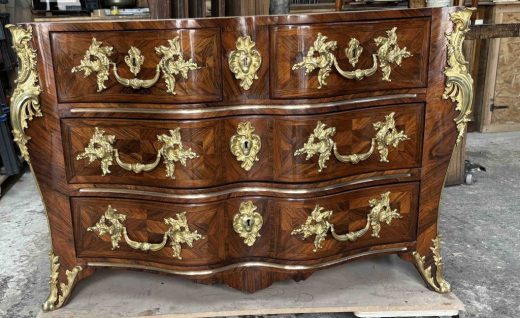
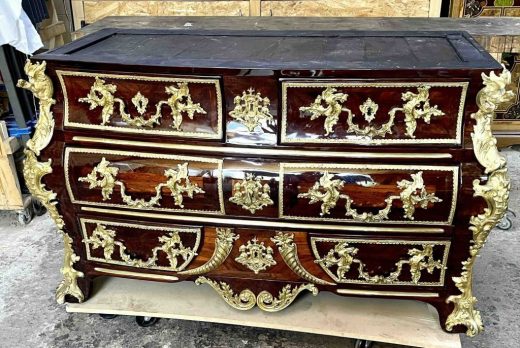
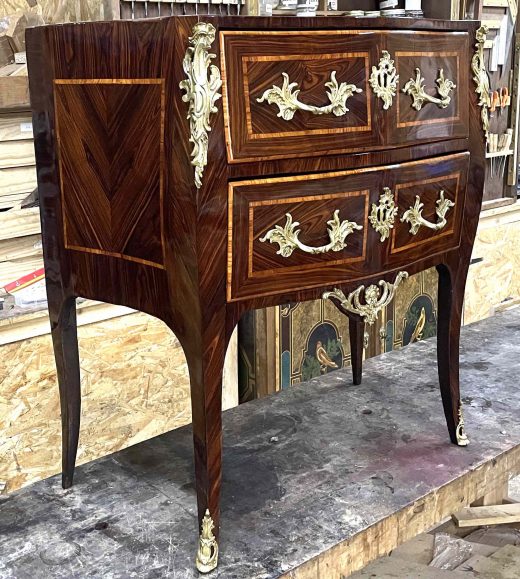
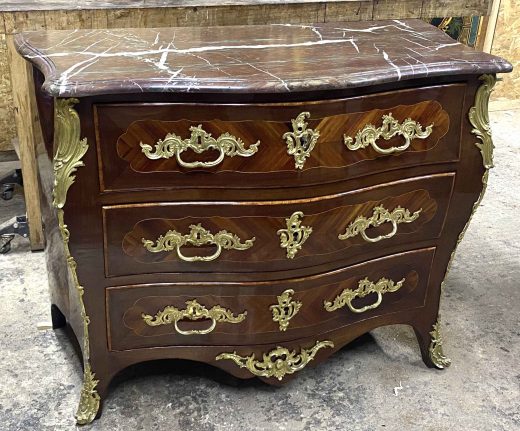
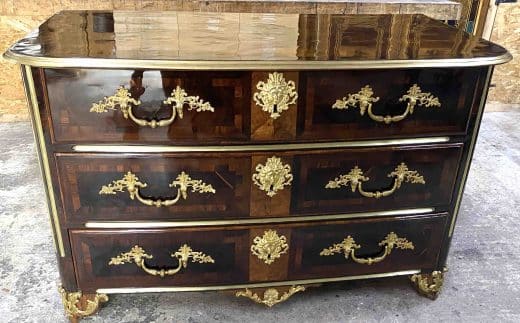
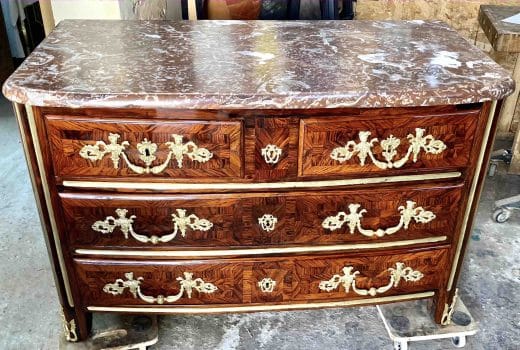
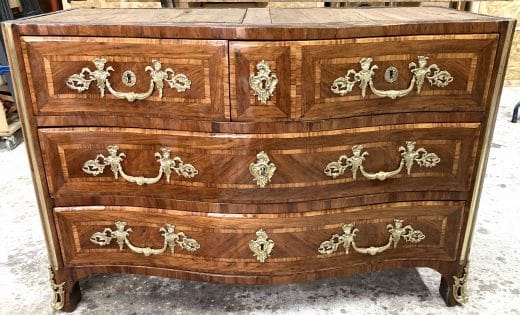
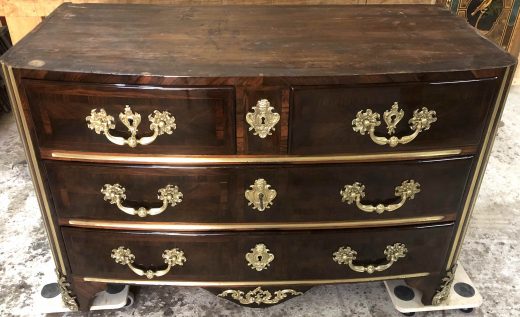
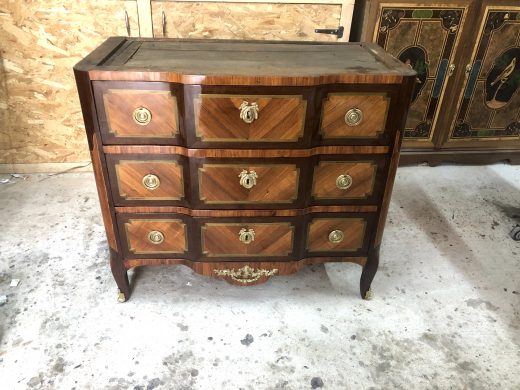
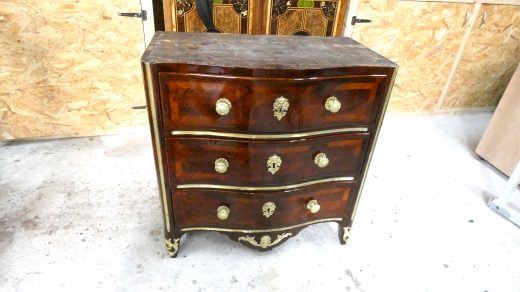
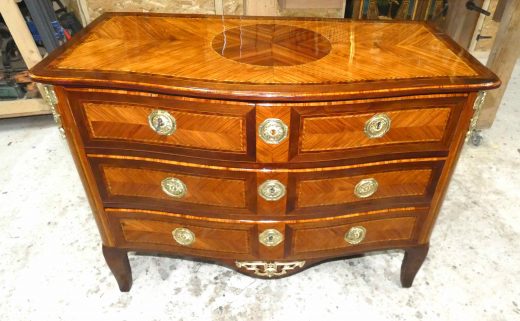
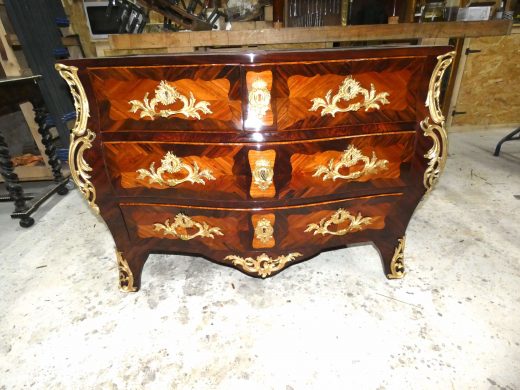
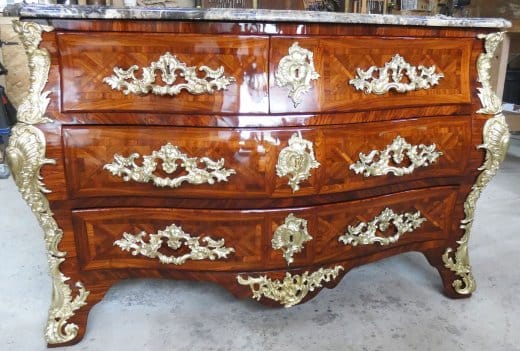
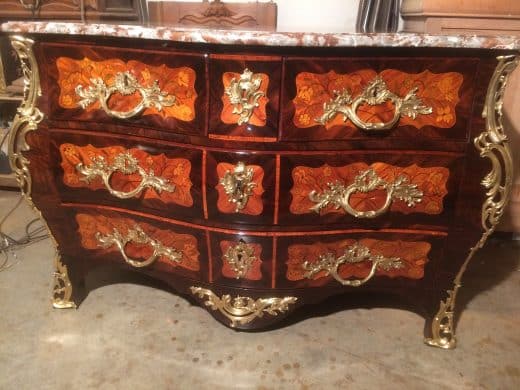
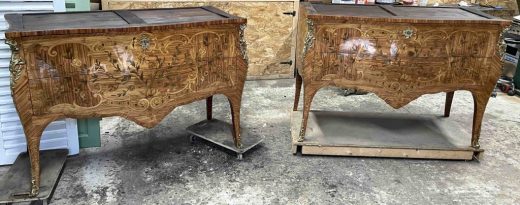
Conservation work on this Regency period commode, characterized by its serpentine shape, rosewood veneer, and gilt bronze mounts, resting on an oak and softwood frame. Our task was to stabilize the veneered surfaces by injecting protein-based adhesive. Veneer gaps were filled with grafts of new rosewood veneer, previously sawn, scraped, and sanded. These grafts were then French polished, naturally oxidized with ultraviolet light, and then applied to the appropriate thickness as a backing before being glued in place with […]
Regency chest of drawers stamped Merchant

Ebénisterie Mathieu Vath

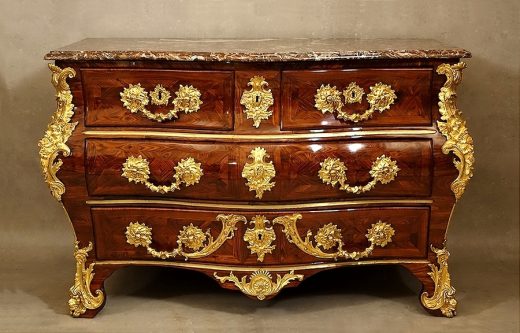
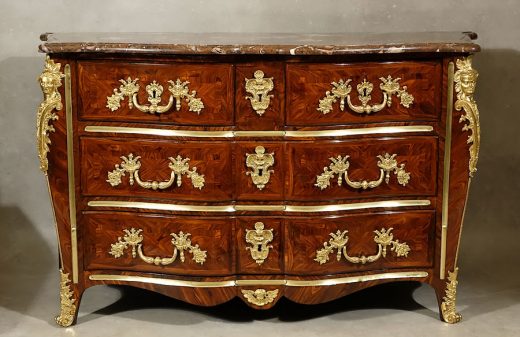
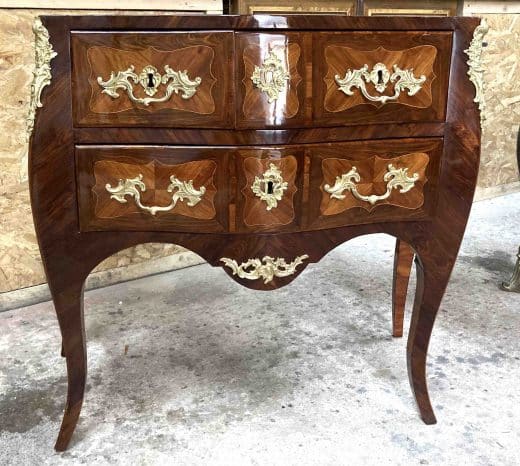
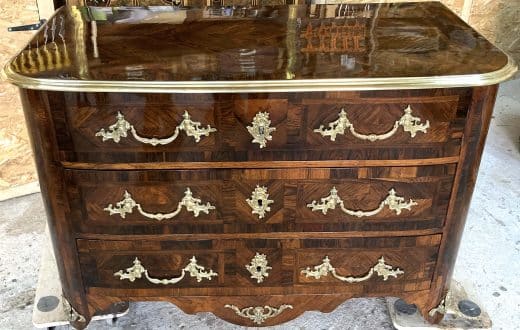
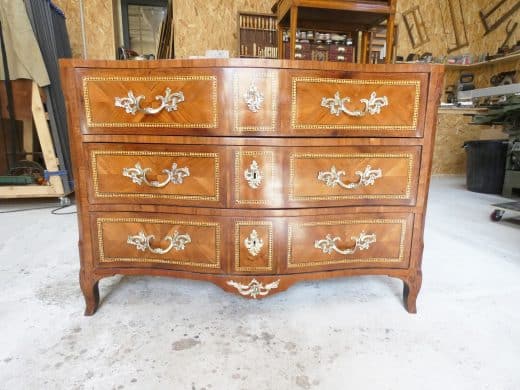
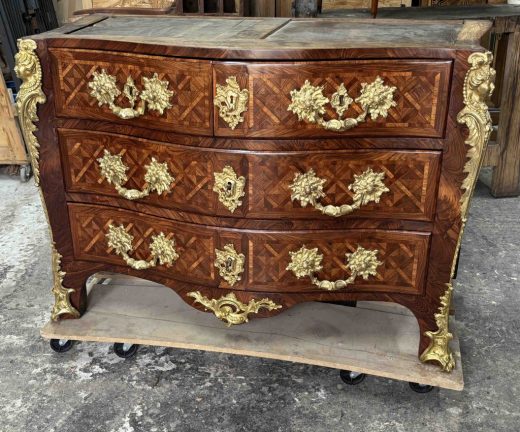
Restoration of a Regency period commode, stamped with the name Nicolas Jean Marchand, veneered in violet wood with a diamond-point pattern on an oak frame. It opens with four drawers. The whole is adorned with chased bronze mounts bearing the crowned C, including thick drop handles, large gadrooned rosettes, cartel-shaped keyhole escutcheons, and espagnolette drops ending in eagle-claw feet. The crowned C: The royal edict of 1745 required bronze workers to affix a distinctive mark, a […]

Pair of Louis XV commodes

Ebénisterie Mathieu Vath

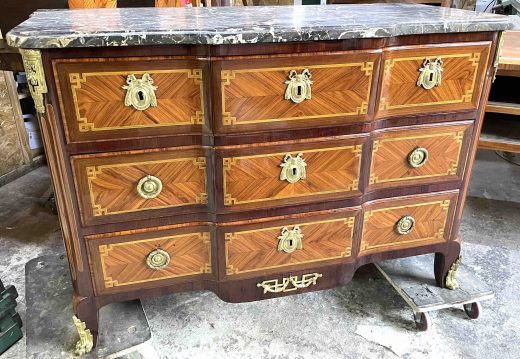
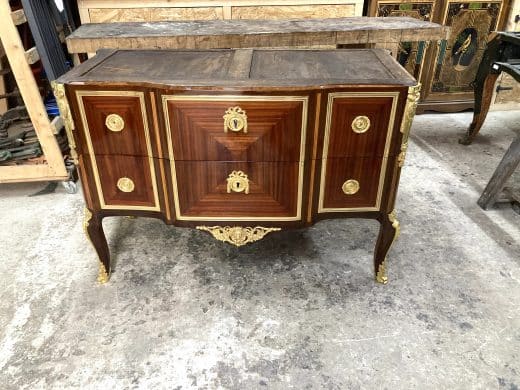
Here is the latest major restoration project undertaken by Raphaël, our apprentice. It involves a pair of Louis XV style commodes bearing an unknown stamp, CCS, which could be attributed to Charles Claude Saunier, an early work by the latter. Please find below the detailed account of the work carried out by Raphaël. Enjoy your reading. Restoration of a Pair of Louis XV Commodes This restoration project was carried out on a set of two commodes, designed according to the aesthetic and technical principles of the Louis XV style. This style […]

Louis XVI commode stamped JL Cosson

Ebénisterie Mathieu Vath

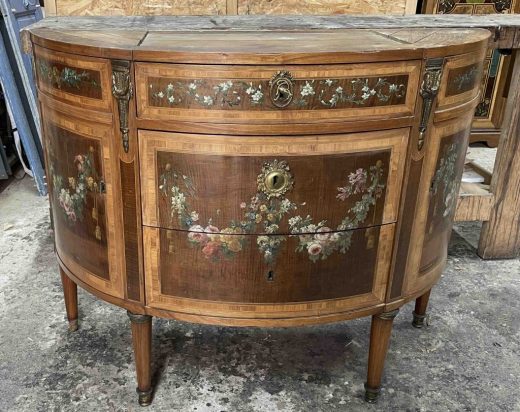
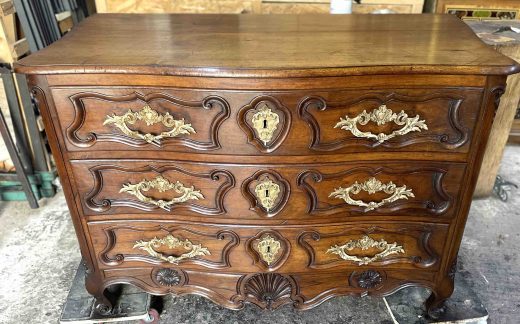
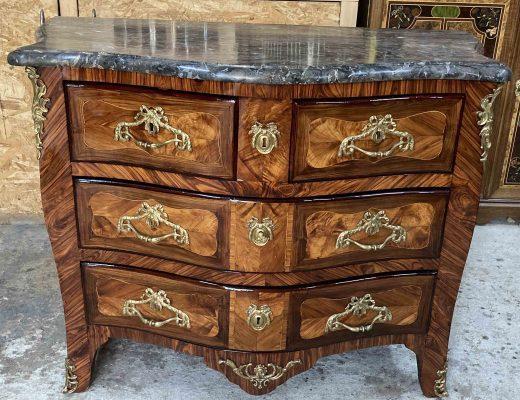
This Louis XVI period half-moon commode, stamped by the cabinetmaker Jacques Laurent Cosson, likely dates from a production between 1780 and 1790. It is an exceptional example of painted furniture from the end of the Ancien Régime, belonging to a very small group of which only seven examples are currently known. This small and highly sought-after group of 18th-century French painted furniture is now recognized as one of the most inventive areas of Parisian cabinetmaking on the eve of the Revolution. This commode, with its curved, half-moon shape, rests […]

Louis XIV style commode – Grenoble, first third of the 18th century

Ebénisterie Mathieu Vath

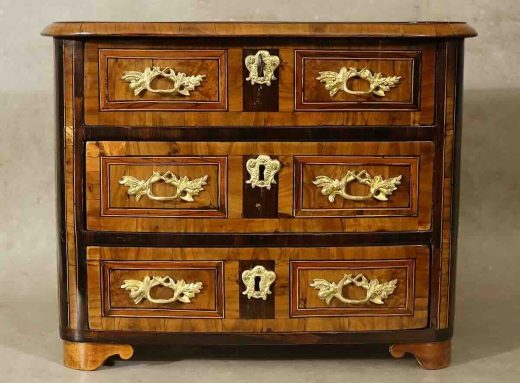
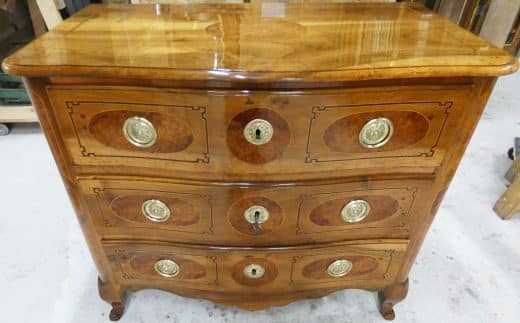
Restoration of a Louis XIV Dauphiné commode, veneered in geometric Alpine wood, with a bombé front and three drawers in three rows. The model's proportions and construction are similar to those of a full-size commode (dovetail joints, intermediate shelves, etc.). The cabinetmaker skillfully played with contrasts through the juxtaposition of wood species, and the quality and variety of the woods used on this small piece of furniture are remarkable: primarily olive and olive burl, walnut, and rosewood for the framing bands highlighted with […]
Louis XVI chest of drawers by Jean-Francois Leleu

Ebénisterie Mathieu Vath

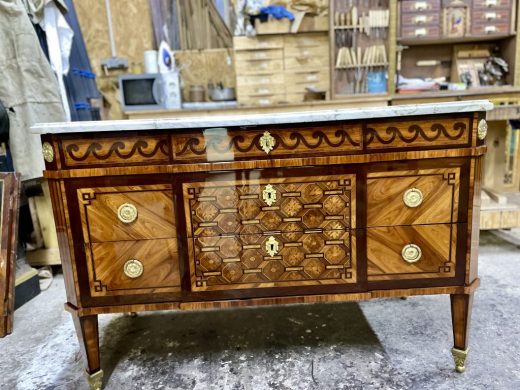
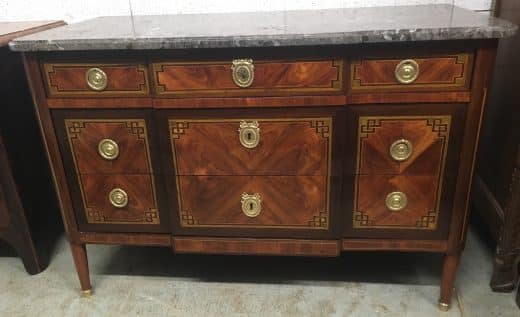
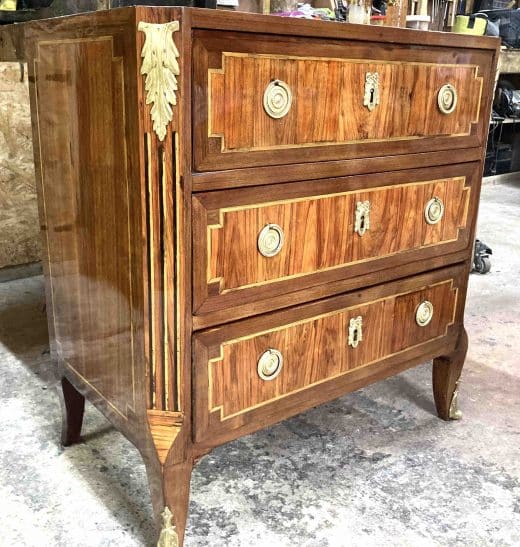
Restoration of a Louis XVI period commode with a projecting central front, stamped JF LELEU. Made entirely of oak, it is veneered with amaranth, rosewood, boxwood, stained maple burl, and tobacco-grey maple. It is decorated with marquetry featuring a frieze of posts on the top drawer, Greek key motifs, and fleurons within a mosaic of hexagons known as "marquetry à la reine" on the central projection. It has three drawers, two of which conceal drawers with crossbars. The front uprights are […]

Regency commode with bridge "with dragons"«

Ebénisterie Mathieu Vath

Restoration of a Regency period commode, topped with a 30 mm thick Rance marble slab, molded with a corbelled edge following its contours. This commode, curved in plan and elevation on the front and sides, is veneered with snakewood and satinwood. It has four drawers (simulating six) arranged in three rows. Its voluminous feet evoke the clawed paws of a dragon. The commode is adorned with brass fluting and chased and gilded bronze mounts: chased waterleaf frames framing the drawers, thick drop handles with shell motifs, wide plates […]

Regency chest of drawers

Ebénisterie Mathieu Vath

Restoration of a bombé commode with a front veneered in satinwood with double boxwood stringing within amaranth borders, mounted on a fir frame with walnut drawer boxes. It opens with four drawers in three rows and is adorned with finely chased bronze mounts, silvered rather than gilded as is customary. The uprights are veneered with a facsimile of brass fluting, and the sides, decorated with a lozenge within a rectangle, echo the decorative motif of the front veneer. It is […]

Louis XV commode by JB Fromageau

Ebénisterie Mathieu Vath

Restoration of a Louis XV commode stamped by Jean-Baptiste Fromageau. Constructed of oak and conifer, this commode is inlaid with rosewood within violet wood frames. Curved at the front and flared at the sides, it features four drawers in three rows and is topped with a grey Saint Anne marble slab. Jean-Baptiste Fromageau, son of a master cabinetmaker, was born around 1725. After obtaining his master craftsman's certificate on November 5, 1755, he set up his workshop on Rue Traversière before establishing himself on Rue du Faubourg Saint-Antoine. The Dauphiné Almanac […]

Regency-style chest of drawers stamped by Michel Mallerot

Ebénisterie Mathieu Vath

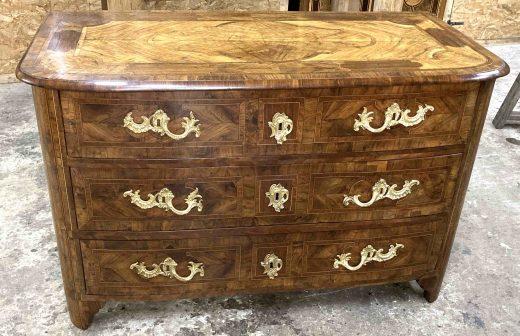
The restoration of a commode from the first half of the 18th century, curved in height and bombé in plan, opening with four drawers in three rows, known as a "tomb-shaped" or "Regency" commode, belongs to a much smaller group of commodes called "bridge" and "moustache" commodes. The frame of this commode is typical of Regency models, with oak uprights, high-quality softwood for the majority of the structure, and walnut for the inset drawers. The veneer consists of only two types: kingwood and satinwood. The […]

Louis XVI commode stamped J. LAPIE

Ebénisterie Mathieu Vath

Restoration by Lise, during her internship at the workshop, of a Louis XVI commode stamped by Jean Lapie, constructed of oak, fir, and beech, veneered in rosewood with hornbeam and amaranth stringing, and adorned with gilt bronze mounts. And since Lise submitted an excellent internship report, I am publishing it almost in its entirety. Jean Lapie (known as "The Younger"), son of the potter Nicolas Lapie, was born around 1734. Brother of the cabinetmaker Nicolas-Alexandre Lapie (known as "The Elder") and cousin of Jean-François Lapie, he obtained his master's degree in Paris […]

Regency commode in sarcophagus form

Ebénisterie Mathieu Vath

Minor restoration was required for this Regency commode, known as a sarcophagus commode. A few veneer repairs and a refinishing of the varnish were all it took to restore its former glory. The sarcophagus commode? It was only a few years after the first examples were completed by André Charles Boulle, during the Regent period, that the curved commodes, both in plan and elevation, appeared. These commodes would be called "Regency-style" commodes throughout the 18th century (and similarly, it would be necessary to wait until 1720 to see commodes with two rows of drawers again, often […]

Regency style commode stamped Hédouin

Ebénisterie Mathieu Vath

Here is the latest restoration by Raphaël, my apprentice. Although it possesses all the attributes of a Regency commode, it could only have been made much later, after this historical period (around 1715-1723). Indeed, since Hédouin obtained his master craftsman's certificate in 1738, during the height of the Louis XV era, it is more accurately described as a commode "in the Regency style" by cabinetmakers of the time. This commode is entirely constructed of oak, except for the interior panels, and is veneered with amaranth and satinwood. Jean-Baptiste HEDOUIN The life of Jean-Baptiste Hedouin is quite […]

La Rochelle chest of drawers in "Isles wood"«

Ebénisterie Mathieu Vath

A look back at the restoration of this rare port chest of drawers, crafted from solid woods brought back from both the Orient and the West Indies, combining four precious woods: mahogany, satinwood, Palo Santo, ebony, and, most notably, a fifth wood, Royal ebony. This chest of drawers opens with three wide drawers in three rows of Palo Santo, interspersed with Ceylon ebony crossbars, and is topped with a solid framed top composed of parquet flooring, primarily enlivened by Royal ebony crossbars against a mahogany background (some sections are mottled or […]

Regency commode with faun and lion masks

Ebénisterie Mathieu Vath

Restoration completes this important and rare commode, known as a "tomb-shaped" or "Regency" commode, also called a "moustache" commode, dating from the Regency period. Curved on all sides, it opens with four drawers in three rows. Topped with a Belgian Vieux Rance marble slab (it's worth noting that Rance was a French village at the beginning of the 18th century), molded with a corbel-like profile following its contours, this wide commode, veneered in a single layer of kingwood, boasts powerful curves, is adorned with brass fluting on the front and sides, and is covered with exceptional finely chased bronze mounts.

Transitional dresser

Ebénisterie Mathieu Vath

Restoration of a transitional commode veneered in rosewood, amaranth, and green-stained Greek key pattern, on an oak frame. Congratulations to Lisa for this first restoration during her internship at the workshop. The work mainly involved the front rails, with the missing amaranth veneer being replaced by sawn, scraped, sanded, and applied to the back of the veneer before being glued with hot glue. The varnish was regenerated using Labovert's GAMMA polar solvent before […]

Small Louis XV style commode

Ebénisterie Mathieu Vath

And here is the latest restoration by Raphaël, my apprentice. It's a Louis XV period commode. It's veneered in rosewood and violet wood on an oak and softwood frame. Condition report: A perfect project for tackling structural and veneer restoration. Almost all the panels are detached and too short, the joints are loose, both sides are detached from the uprights and split right down the middle, and of course there's a lot of detachment and […]

Transition sauté pan with Boudin stamp

Ebénisterie Mathieu Vath

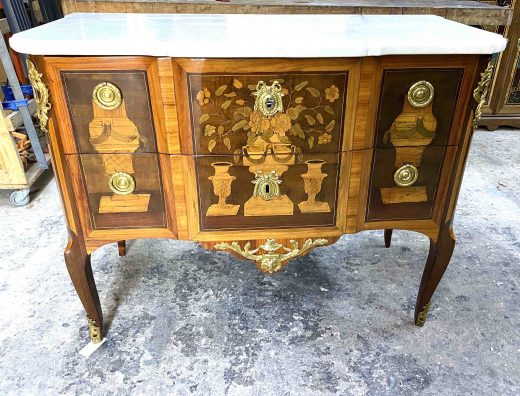
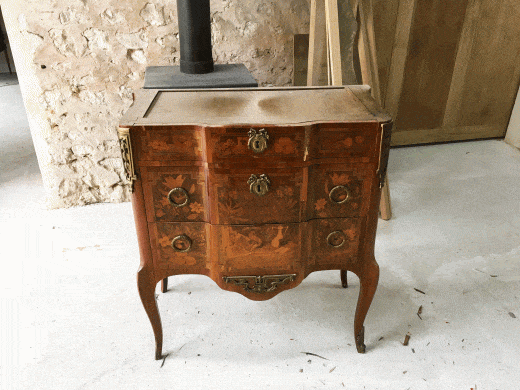
Restoration of a Transitional commode stamped by the master cabinetmaker Léonard Boudin (1735 in Paris – 20/12/1807). It is constructed of solid oak and veneered with amaranth, rosewood, tobacco-stained maple, and marquetry of boxwood, hornbeam, and holly, decorated with panels featuring floral vases and covered pots on the front and sides. With a slight central projection on the front, opening to reveal two drawers without a central divider, its rounded uprights rest on cabriole legs. Many Transitional commodes of this type have […]

Regency commode with crowned R

Ebénisterie Mathieu Vath

Restoration of a Regency commode, probably from southeastern France, veneered with yew, plum, rosewood, walnut, cherry, amaranth, violet wood, boxwood, and green-stained maple on a softwood frame. Besides its highly unusual marquetry decoration, the commode's distinctive feature is its crowned R bronze mounts. The crowned R hallmark should not be confused with the crowned C hallmark, which corresponds to a tax levied from 1745 to 1749 on copper objects and is found on many […]

Directoire Commode

Ebénisterie Mathieu Vath

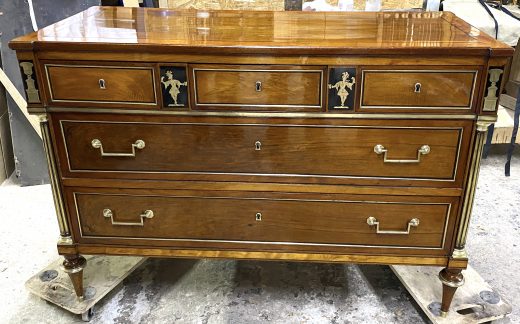
Restoration of a curious Directoire commode in solid walnut and walnut, mahogany, and maple veneer, featuring marquetry of a Medici vase and a Louis XIV-inspired ballet dancer, in brass on an ebony ground. The drawers have walnut bottoms with an ebony stringing surmounted by a quarter-round brass and wood molding, surrounded by a mahogany molding. The uprights are three-quarter-fluted columns terminating in toupie feet. The locks are in the shape of trefoils. A conservation project for this […]

Transitional chest of drawers stamped SAUNIER

Ebénisterie Mathieu Vath

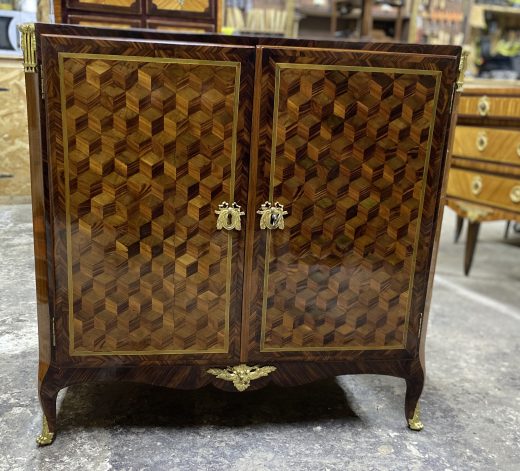
Restoration of a transitional two-door commode veneered with bottomless cube marquetry. The frame is oak for the uprights and rails, the side panels are softwood, and the two doors are walnut. The bottomless cubes are veneered with rosewood, violetwood, and tobacco-stained maple. The entire piece is framed with a stringing of green-stained maple and boxwood. The uprights and door frames are veneered with violetwood and rosewood. The sides […]

Transition chest of drawers stamped Fromageau

Ebénisterie Mathieu Vath

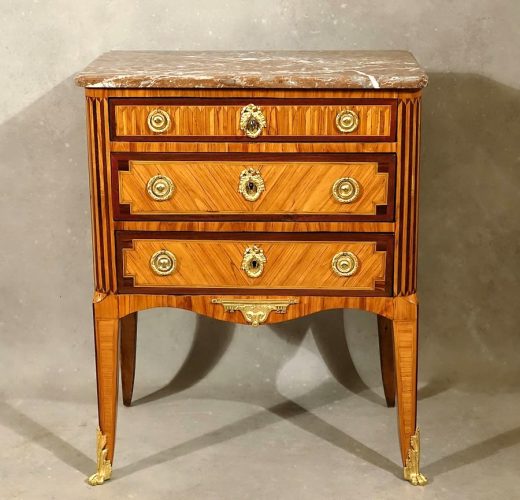
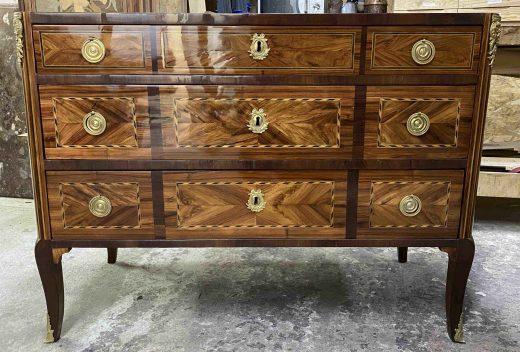
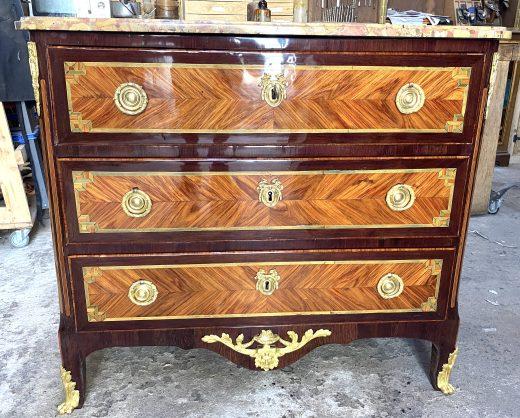
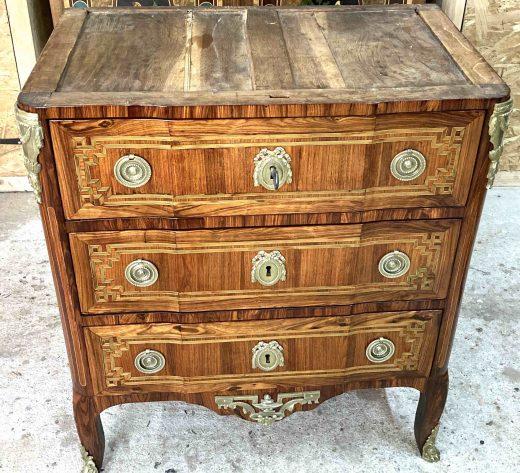
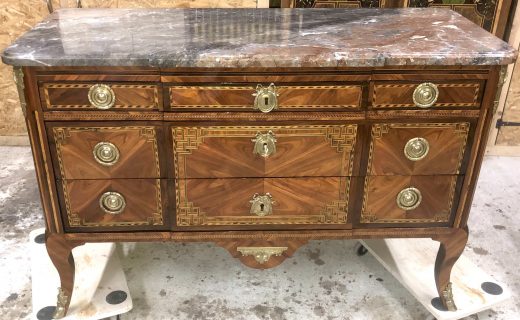
Restoration of a Transitional style commode, stamped by Jean Baptiste Fromageau, veneered in rosewood with an amaranth frieze and faux fluting. It is topped with a Royal red marble slab and features three drawers, one narrower at the top inlaid with a frieze of glyphs, while the two below are inlaid with Greek key patterns and have violet wood corners. The bronze mounts include ring pulls, keyhole escutcheons with knotted ribbons, and a drop-shaped finial.

Louis XV commode stamped NA Lapie

Ebénisterie Mathieu Vath

Restoration of a Louis XV commode, stamped by Nicolas Alexandre Lapie, veneered in amaranth and satinwood on a beautifully crafted oak frame. The sides and drawer fronts are made of softwood, and the marble top is Campan griotte marble. Nicolas Alexandre Lapie, son of Nicolas Lapie, a pottery merchant in the Faubourg Saint-Antoine, and brother of the master cabinetmaker Jean Lapie, Nicolas Alexandre (known as the Elder) appears to have been born around 1730. He registered his master's letters at the Châtelet in Paris on the 17th […]
Regency chest of drawers with Spanish-style drawers

Ebénisterie Mathieu Vath

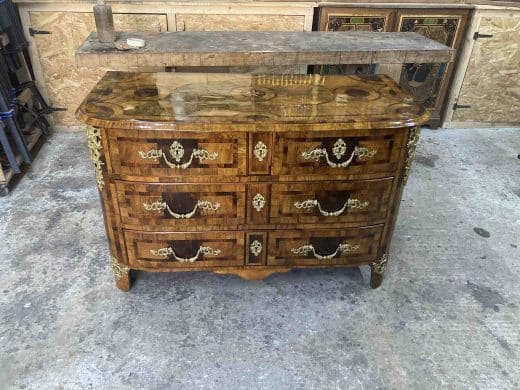
Restoration of a Regency period commode with a serpentine front and espagnolettes, curved on all sides, veneered in violet wood on a walnut frame, opening with four drawers in three rows and topped with a Belgian Griotte Red marble slab with ears and a corbelled edge. The pinched uprights are dark, as are the front rails, with fluting and brass reeding. Its high-quality bronze ornamentation features superb chasing and includes very rare espagnolettes (seen on six commodes: four by Etienne Doirat, one by François Lieutaud […]

Transition chest of drawers stamped LEGRY

Ebénisterie Mathieu Vath

Restoration of a transitional commode stamped by Jean-Louis-François Legry. Its frame is made of oak and softwood, and it is veneered with amaranth, rosewood, satinwood for the sides, and ebony and boxwood stringing. This commode exemplifies the very end of the transition between the Louis XV and Louis XVI styles. The legs remain the only vestige of the Louis XV curves; they would soon give way to the straight legs of the Louis XVI style. Jean-Louis-François Legry, born in 1745, obtained his master's degree in Paris on […]

Transitional chest of drawers stamped J.STUMPFF

Ebénisterie Mathieu Vath

Here are some images of the restoration of this commode stamped by Jean-Chrysostôme Stumpff. 1731 - January 17, 1806 – Received Master Craftsman status on August 27, 1766. Framed in oak and softwood, it is veneered with rosewood in a frieze of paillon, amaranth, and boxwood and green-stained maple. J. STUMPFF, originally from Schweigern, Swabia (Germany), married in 1760 in Paris, at the Swedish embassy, like most of his compatriots of the Reformed faith. His fellow cabinetmaker, Ferdinand Scherdfeger, was a witness. […]

Regency commode by François LIEUTAUD

Ebénisterie Mathieu Vath

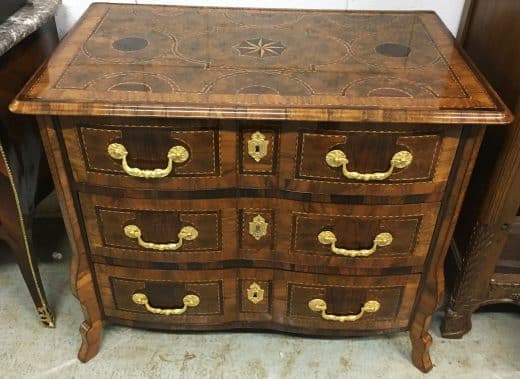
Restoration of a Louis XIV period commode in rosewood and walnut, inlaid with alternating marquetry in friezes and fillets. The slightly curved front opens with three wide drawers in three rows. The top, encircled by a brass molding, features a geometric design of circles framing a central polylobed motif with figurative designs. The uprights and intermediate rails are inlaid with polished brass fluting. The sides are veneered in walnut with diamond frieze patterns. The legs are tapered with claw feet. The piece is adorned with finely chased and gilded bronze mounts.

Louis XIV commode

Ebénisterie Mathieu Vath

Restoration of a Louis XIV period commode veneered in olive burl, ash, and walnut, likely from the Dauphiné region. This type of commode (D-shaped), along with the Mazarine commode, was among the very first commodes popularized under Louis XIV. Indeed, the appearance of the earliest French furniture resembling the commode dates only from the 1700s; thus, the oldest known and datable Parisian commodes are those delivered by André-Charles Boulle to Versailles around 1708. Their very simple decorations are inspired by Dutch designs, often executed by […]

Regency chest of drawers stamped ID

Ebénisterie Mathieu Vath

Restoration of a Regency commode veneered in rosewood on a conifer frame. It was only after three weeks of work on this commode that I noticed a strange mark. It had been there from the beginning, right in front of me, and I hadn't noticed it. Indeed, it's quite rare to see a stamped Regency commode. But yes, the mark was definitely there. And it's not a modest mark, since this ID stamp is attributed to Jacques Denizot. Jacques Denizot (1684–1760) is […]

Transition chest of drawers stamped Etienne AVRIL

Ebénisterie Mathieu Vath

Restoration of a transitional commode stamped three times E.AVRIL, veneered in amaranth, rosewood, satinwood, and green-stained stringing on an oak and softwood frame. Etienne Avril (1748-1791), admitted as a Master Joiner-Cabinetmaker on November 23, 1774, died prematurely in 1791. Étienne Avril, known as Avril the Elder to avoid confusion with his brother Pierre, would witness the agony of the Ancien Régime and the abolition of the centuries-old guild system. Born in 1748 to a cab driver, Étienne Avril was not destined for […]

Louis XV commode

Ebénisterie Mathieu Vath

Restoration of a Louis XV period commode veneered in rosewood and violet wood. The commode, also known as the commode sauteuse, appeared during the Regency period, between 1705 and 1730, and is attributed to the cabinetmaker Charles Cressent. It consists of two drawers or two rows of drawers. The body is raised on half-height supports, with the body occupying half the height of the piece and the other half the legs. Intended to distinguish itself from the heavy and massive Louis XIV style, it is slender and graceful, almost ethereal. After restoration […]

Transitional chest of drawers stamped Léonard Boudin

Ebénisterie Mathieu Vath

Restoration of a Transition period commode stamped by the master cabinetmaker Léonard Boudin (1735 in Paris – 20/12/1807). It is constructed of solid oak and veneered with amaranth, rosewood, and ribbon satinwood (Brosimum rubescens), which provides a highly decorative appearance due to the pronounced interlocked grain of this South American wood. It should be noted that it belongs to the same family as snakewood (Brosimum guianense). As Boudin was primarily a merchant during the Transition period, it is likely that this commode is actually by his hand (before […]

Louis XIV commode from the Dauphiné region

Ebénisterie Mathieu Vath

Restoration of a Louis XIV period commode in olive burl, rosewood, and boxwood, likely from the Dauphiné region. This type of commode (D-shaped), along with the Mazarine commode, was among the very first commodes popularized under Louis XIV. Indeed, the earliest French furniture resembling the commode only appeared in the 1700s; thus, the oldest known and datable Parisian commodes are those delivered by André-Charles Boulle to Versailles around 1708. Their very simple decorations are inspired by Dutch designs, often crafted by Protestant cabinetmakers […]

Regency commode stamped by Michel Mallerot

Ebénisterie Mathieu Vath

Restoration of a commode stamped by Michel Mallerot. With its serpentine front, it is entirely veneered in violet wood. It is built of fir with beech drawer bottoms and walnut drawer fronts. You don't know Michel Mallerot? That's understandable, as Michel Mallerot (1675–1753) is a Parisian cabinetmaker who remains relatively unknown, much like many cabinetmakers of the early 18th century. We owe his identification to the discovery of a handwritten pencil inscription "M. Mallerot" on a commode dating from the Regency period (formerly […]

Regency chest of drawers

Ebénisterie Mathieu Vath

To start the year, here are some photos of the restoration of this Regency commode. It is built entirely of conifer and veneered with kingwood. The uprights and rails are inlaid with brass fluting. The bronze handles, influenced by Asia and the East India Company trade, are known as "Chinese" or "Chinese." The keyhole escutcheons, meanwhile, herald the arrival of the Louis XV style in the first half of the 18th century. Regarding its condition upon arrival, besides […]

Small chest of drawers from La Rochelle

Ebénisterie Mathieu Vath

Here is the restoration of a small Louis XV commode in solid satinwood and ribboned satinwood. It is curved on all sides, including the back, and opens with three drawers in the front, as well as a pull-out candle holder at the back. La Rochelle, 18th century. Its top, molded with a corbel edge highlighted by a cavetto molding, is made of ribboned satinwood, which is also found on the front and sides, while the base is made of fine satinwood punctuated with so-called "snail" feet ending in split goatskin feet. Note the unusual proportions but especially the curves […]

Louis XV/Transitional Commode

Ebénisterie Mathieu Vath

A true renaissance for this chest of drawers, which I call Louis XV/Transitional because its form and construction are entirely Louis XV. However, the handles and keyhole escutcheons are typically Louis XVI. And I can attest that these are indeed its original fittings. The nail holes match perfectly, and there are no other holes beneath the bronze mounts. So, even if this piece of furniture doesn't conform to what is commonly called the Transitional style, this chest of drawers is most certainly one of the first […]

Louis XVI commode

Ebénisterie Mathieu Vath

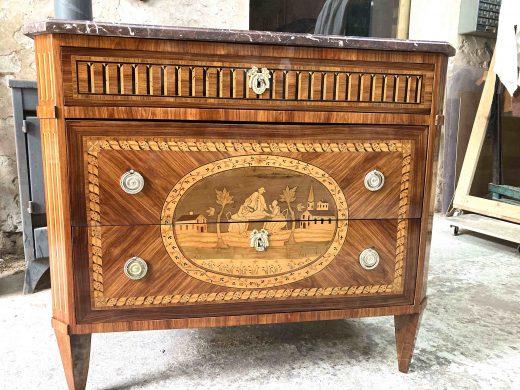
Restoration of a Louis XVI period provincial commode. Constructed of softwood and oak, and veneered with violet wood, rosewood, sycamore maple, boxwood, ebony, and stained maple. At its center is a bucolic scene depicting, between two trees, a card game between two women and a man watching. In the background, a house and a church are visible. The whole is framed by a medallion of flowers engraved and colored with black and red wax. The two lower drawers are framed by a frieze […]

LARDIN transitional chest of drawers

Ebénisterie Mathieu Vath

Restoration of a Transitional period commode constructed of fir and oak and veneered with rosewood, violet wood, and a frieze of hornbeam stringing stained green in the Greek key pattern. The sides are veneered with satinwood and violet wood. André-Antoine Lardin (1724 – August 10, 1790) obtained his master craftsman's certificate on July 1, 1750, and established himself on rue de Charenton under the sign "Au Bois de Boulogne." He worked there until 1770, when he moved to rue Saint Nicolas. His production is […]

Mazarine Chest of Drawers

Ebénisterie Mathieu Vath

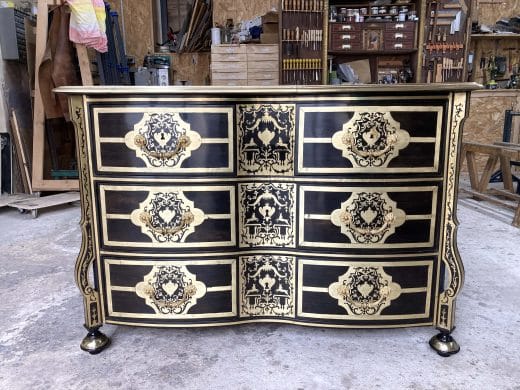
Restoration of a Louis XIV period commode, known as a Mazarine commode, veneered in brass and ebony on a softwood frame. This commode features bow-shaped drawers, including two full-length drawers surmounted by two half-drawers separated by an intermediate stile. The fronts are made of softwood, while the sides and backs are walnut. The brass decoration supporting the pendant drawer pulls features a finely inlaid motif of scrolls, foliage, foliage, and arabesques, framed by a geometric brass cartouche and simulating keyhole escutcheons. It […]

Chinese chest of drawers

Ebénisterie Mathieu Vath

This week I'm presenting a Louis XIV commode from the first half of the 18th century, veneered in Rio rosewood and adorned with chinoiserie bronze mounts. Height: 85.7 cm, Width: 125 cm, Depth: 60.5 cm. The frame is made of softwood, constructed from planks joined edge-to-edge. The sides, top, and bottom are dovetailed. The back is constructed from several planks nailed into the rebates of the sides. The drawer bottoms and sides are made of planks of […]

Louis XVI commode stamped JB.Tuart

Ebénisterie Mathieu Vath

Here is a very pretty Louis XVI period commode veneered in rosewood and amaranth with marquetry of boxwood, pearwood, maple, hornbeam, walnut, blackened pearwood, lemonwood… It is built of oak and softwood. It is stamped twice with the mark of Jean-Baptiste II TUART. But its maker is probably Jean LAPIE. From a dynasty of Parisian cabinetmakers and merchants, whose father, Jean-Baptiste I, obtained his master's certificate in 1741 and was active until around 1760, Jean-Baptiste II, born around 1720, was not a master cabinetmaker but a master furniture maker and haberdasher […]

Regency chest of drawers

Ebénisterie Mathieu Vath

Restoration of a Regency commode veneered in rosewood and palisander. The commode arrived in very poor condition; the joints were completely detached, there was significant veneer loss, major structural deformations on the sides, and a patina heavily soiled by multiple layers of dark wax. The bronze mounts and locks had been added during a 19th-century restoration. A standard restoration for this type of furniture was carried out; the sides and joints were re-glued as best as possible, and the missing veneer was […]

Esterházy Chest of Drawers

Ebénisterie Mathieu Vath

Restoration of this unusual piece of furniture from Austria/Hungary. I must admit I had some difficulty placing it geographically. It was clear that it wasn't from France but rather from Eastern Europe. But where? Fortunately, engravings provide valuable clues; the clothing depicted corresponds well to the late 17th and early 18th centuries. The landscapes consist of mountains and villages; the vegetation is composed of deciduous and coniferous trees, and several medieval castle ruins can be seen. […]

Louis XVI commode

Ebénisterie Mathieu Vath

This week, we're restoring a Louis XVI commode with a projecting front, veneered in Rio rosewood, amaranth, and violet wood, with marquetry stringing in boxwood and ebony forming a ribbon wrapped around the wood, the background of the engravings filled with red wax. The tapered legs and canted uprights have faux fluting in ebony and boxwood. There's no maker's mark to attribute this beautiful piece and the high quality of wood chosen for its construction. Regarding the restoration, the work isn't very […]

Regency chest of drawers

Ebénisterie Mathieu Vath

Originating in the late 17th century but only acquiring its name in the early 18th century, this is the first classic model of a commode. Although typically Louis XIV in style, it may not have existed before the Regency period. With rounded corner pilasters with slightly convex faces, deep copper fluting, veneer, and geometric bronze mounts, it features three rows of drawers. It perpetuates the spirit of Louis XIV furniture throughout much of the 18th century. Bibliography: Furniture […]

Transitional dresser

Ebénisterie Mathieu Vath

Restoration of a transitional period commode with a projecting front, veneered in rosewood and palisander. The Greek key-patterned moldings, stained green, are made of hornbeam, and the front features a butterfly wing design. It opens with two large drawers with concealed crossbars, and three drawers in an upper row. The uprights, with simulated fluting, are veneered in ebony and boxwood. It rests on four cabriole legs adorned with hoof-shaped feet. Although it has undergone some alterations […]

Louis XVI commode stamped JA LECLERE

Ebénisterie Mathieu Vath

Jacques-Antoine Leclere (1744 – January 30, 1792) obtained his master craftsman's certificate in Paris on September 29, 1779. He worked on the rue du Faubourg-Saint-Antoine, then on the rue des Barres, and finally in the courtyard of the Jewish Quarter, a stone's throw from the Bastille. This cabinetmaker produced well-made Louis XV and Louis XVI pieces. He used rosewood, satinwood, mahogany, and also lacquer panels. His stamp can be found on secretaries, chests of drawers, and various small pieces of furniture. For example, a pair of Louis XVI half-moon commodes veneered […]

Louis XV/Transition Commode by Nicolas Abraham Couleru

Ebénisterie Mathieu Vath

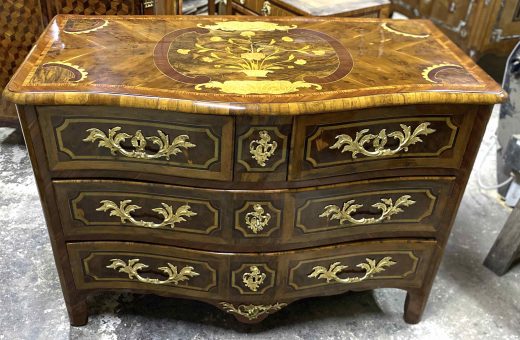
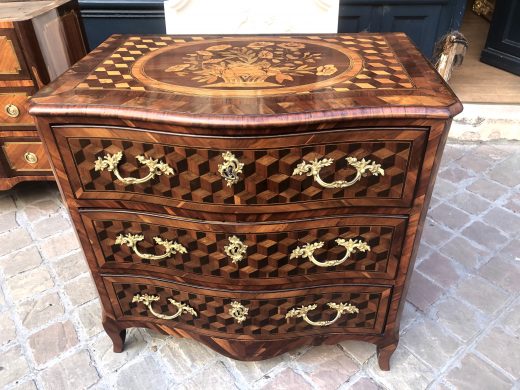
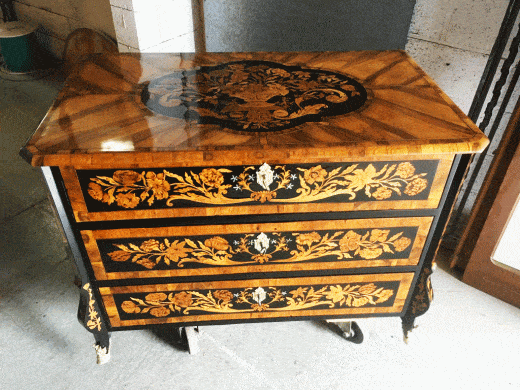
This slightly curved commode, composed of three drawers and veneered with bottomless cubes of walnut, plum, and cherry, has a marquetry top depicting a bouquet of flowers on an amaranth ground. Plum or Quetchier wood is easily recognizable by its sapwood markings, which create a lighter pattern and lend an irregularity to the decoration. The frame is made of fir and walnut. It is difficult to define a precise style for this commode. Although Louis XV, it clearly foreshadows the arrival of the style's more restrained appearance […]

Transitional chest of drawers stamped A. HERICOURT

Ebénisterie Mathieu Vath

Congratulations to Arnaud for the restoration of this Transition period commode veneered in rosewood, amaranth, and satinwood for the sides, and green-stained maple for the stringing. The frame is made of oak and softwood. Antoine Héricourt (c. 1730–1792) obtained his master craftsman's certificate on October 20, 1773, after working for several years as a journeyman in the Faubourg Saint-Antoine. After obtaining his certificate, he settled on the rue du Faubourg Saint-Honoré and became a representative of his guild, then a syndic. His extensive production was highly prized by a French clientele and […]

Regency chest of drawers

Ebénisterie Mathieu Vath

This small chest of drawers has a classic form typical of the Regency period. Still bearing the hallmarks of Louis XIV, the front is curved, the front uprights are rounded, and the sides remain straight. It opens with three drawers. Its uprights and the intermediate rails are decorated with brass fluting. The frame is entirely made of fir; the intermediate panels are dovetailed into the sides, and the back is composed of horizontal planks held in place by rabbeted nails. The drawers are constructed of walnut […]

Transitional chest of drawers stamped LARDIN

Ebénisterie Mathieu Vath

Restoration of a Transition period commode built of fir and oak and veneered with rosewood, framed with stringing of white hornbeam and green-stained wood, with a satinwood band surrounded by amaranth. The central medallion is satinwood veneer assembled in a herringbone pattern. The maker's mark and the JME (Journée des Métiers d'Étranger) are located at the base of the left rear leg. André-Antoine Lardin (1724 – August 10, 1790) obtained his master craftsman's certificate on July 1, 1750, and established himself on the rue de Charenton under the sign "Au Bois de Boulogne." He worked there until 1770, the date […]

Louis XV commode

Ebénisterie Mathieu Vath

This is a significant restoration project for this Louis XV commode, originally veneered in rosewood and violet wood. It took me some time to determine if it was indeed violet wood, as the commode had undergone so much restoration that there was almost as much rosewood as violet wood. Fortunately, the drawers are still in fairly good condition and are indeed made of violet wood, so I conclude that the commode was […]

Louis XVI commode

Ebénisterie Mathieu Vath

Restoration of a Louis XVI period commode from eastern France, made of solid oak and fir and veneered with end-grain laburnum, walnut, plum, amaranth, rosewood, palisander, boxwood, and green-stained hornbeam. The handles and keyholes were added at a later date. The original fittings are missing; only the holes for the handles remain. This is a piece of furniture that has never been restored. The veneer is almost 4 mm thick in some places, and […]

Regency commode stamped J.BIRCKLE

Ebénisterie Mathieu VATH

Restoration of a chest of drawers veneered in Rio rosewood and satinwood stringing. It has two large drawers and two small ones in the upper section. Its frame is made of oak and fir. It is stamped J.BIRKLE on the left upright and also bears the mark JME. It shows some signs of restoration and an ink mark on one side of a drawer. Jacques Bircklé (1734-1803) – Cabinetmaker – master craftsman obtained on July 30, 1764. One of the suppliers to the Royal Furniture Repository under Louis XVI. Freelance craftsman before […]

Louis XV commode

Ebénisterie Mathieu VATH

The commode with a jumping habit seems to have been invented during the Regency period, between 1705 and 1730, by the cabinetmaker Charles Cressent, and subsequently became widespread in the Louis XV style. It consists of only two drawers or two rows of drawers. The body must be raised on cabriole legs of about half height, with the body occupying half the height of the piece and the other half the legs. The observer thus has the impression that the piece has legs allowing it to jump like a frog. The width offers straight, curved, or […]

Empire Chest of Drawers with Quivers

Ebénisterie Mathieu VATH

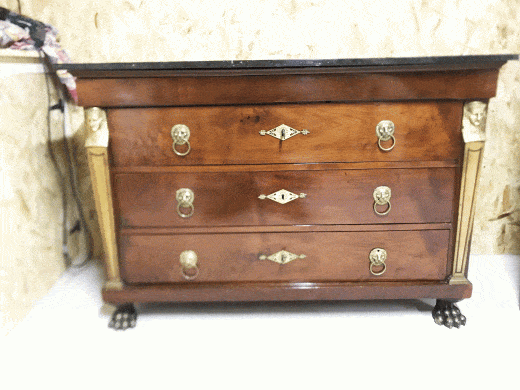
This week, here are some photos of the restoration of this Empire-style chest of drawers veneered in mahogany burl. This chest is truly unique due to the quality and originality of its bronze mounts. Indeed, they form quivers along with the side columns. The keyhole escutcheons are composed of two crossed laurel branches held together by a ribbon. Originally, they were mercury-gilded, as can be seen from the gilding stains on the back. Unfortunately, only a few partial traces remain on the front […]

Hedouin commode with crowned C

Ebénisterie Mathieu VATH

Extensive restoration of this superb Louis XV period commode, stamped on all four uprights by Jean-Baptiste Hedouin. The frame and drawers are constructed of solid oak, fir, and walnut. The edges of the frieze and geometric marquetry in violet wood are veneered with satinwood. Two types of violet wood are visible: one with a very tight grain and veining for the lozenges, and a second, more intricate type for the marquetry edges, uprights, and rails. The […]

Transitional dresser

Ebénisterie Mathieu VATH

Here is a very simple chest of drawers from eastern France, probably dating from the late 18th century. The front is slightly curved and the uprights are chamfered. It should be noted that the bronze mounts are probably not original. The frame is made of solid softwood, and the uprights are oak. The drawer bottoms are set in rebates and slide on the drawer fronts, which is typical of provincial work. A small peculiarity: this chest of drawers does not have top panels, the […]

Chest of drawers in the style of the Axe

Ebénisterie Mathieu VATH

Here are some photos of the restoration of a solid walnut commode, veneered with thuya burl inlay and Greek key stringing in amaranth and boxwood. The drawers and the interior and back panels are made of fir. Despite the curved stretcher, its shape, and its feet, this commode is indeed in the transitional style but from the Louis XVI period. In the title, I wrote "in the style of the Hache family" because it is certain that this commode originated in the Dauphiné region. But whether it is a product of the famous […]

Louis XVI commode stamped JA BRUNS

Ebénisterie Mathieu VATH

This week marks the completion of the restoration of a Louis XVI commode stamped JA BRUNS. It is made of oak for all the structural elements, except for the side panels, drawer backs, drawer fronts, and the two drawer bottoms, which are made of softwood. It is veneered with rosewood in a butterfly pattern and amaranth for the edges. The false fluting is made of boxwood and ebony, and there is a green-stained maple stringing forming the corners at […]

Mazarine Chest of Drawers

Ebénisterie Mathieu VATH

Here is a charming Mazarine commode from the Louis XIV period. With a serpentine front and three drawers in three rows, it is topped with a marquetry top featuring a compass rose on an end-grain wood background. Constructed on a fir frame, it is covered with a beautiful olive veneer, with both end-grain and grain-grained veneer, rosewood, ash on the sides, and boxwood for the stringing and compass rose. The crossbeams are joined with straight dovetail joints on the sides, which has caused some minor imperfections.

Commode returning from Egypt

Ebénisterie Mathieu VATH

During the turbulent period of the French Revolution, furniture production was considerably diminished, and most artisans experienced very difficult times. Overall, from the Consulate to the Directory, furniture and seating had little time to evolve. However, even though some decorative motifs inspired by Egypt had already appeared, it was after the Egyptian expedition (1798-1801) that they evolved into a unique style. The so-called "Return from Egypt" style, however, lasted only a short time: a decade at most, as it would […]

The chest of drawers of ingratitude

Ebénisterie Mathieu VATH

This year, during Heritage Days, it was possible, for the second year in a row, to visit part of the reserves and the restoration workshops of the national furniture collection. For this 2019 edition, the commode known as "The Ingratitude Commode" was on display. This commode has a very particular history: commissioned for the crown, it was delivered on July 13, 1789, the day before the storming of the Bastille. Its creator, the cabinetmaker Pierre François Guignard, who became a master on January 21, 1767, received payment from the furniture repository on the 13th […]
Transitional dresser in the style of Topino

Ebénisterie Mathieu VATH

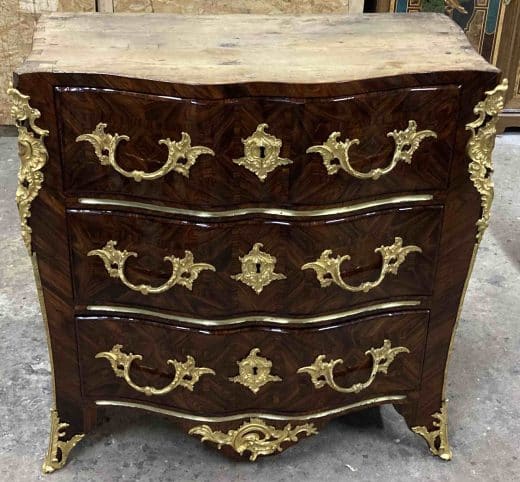
A month ago, a lovely transitional commode arrived, which reminds me of the work of the cabinetmaker Charles Topino (circa 1742-1803) – he received his master craftsman's certificate on July 4, 1773. However, this commode does not bear his stamp, nor any stamp for that matter. This confirms that a stamp is not necessary to possess a piece of high-quality furniture. Furthermore, the marquetry could very well have come from Topino's workshop, as he sold panels of his marquetry to the haberdashers and his colleagues […]
Louis XV commode stamped JC Ellaume

restauration de mobilier

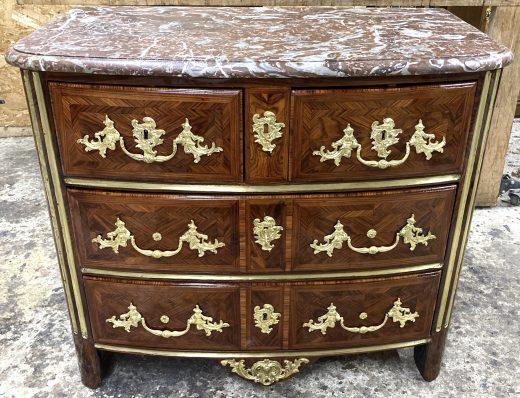
Restauration d’une commode d’époque Louis XV estampillée J.C Ellaume. Cette commode est plaquée de bois de rose et de palissandre avec des marqueteries florales sur les tiroirs de façade. Le bâti est en chêne et conifère. Jean-Charles Ellaume que l’on retrouve aussi écrit Allaume a reçu sa maitrise à Paris le 6 novembre 1754. On connaît beaucoup de meubles marqués de son estampille. Ce sont pour la plupart des commodes Louis XV. C’est dans son atelier rue Traversière qu’il produisit pendant plus de trente ans de nombreux meubles de qualité, […]
Mazarine Chest of Drawers

Ebénisterie Mathieu VATH

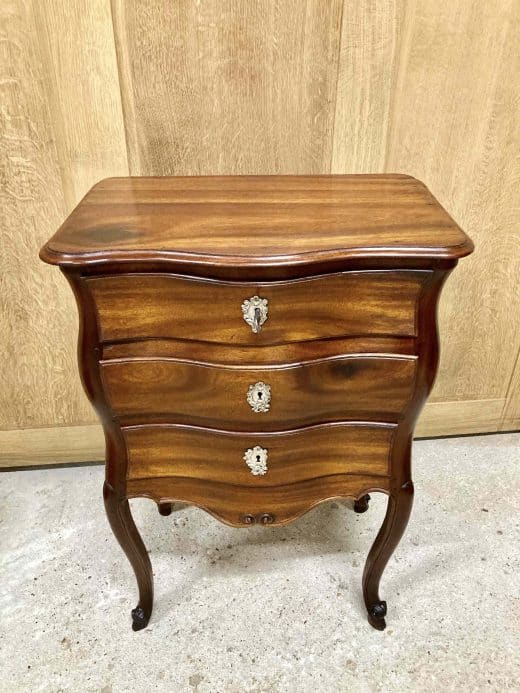
This week, we're revisiting the restoration of a Louis XIV period commode, a commode known as a Mazarine commode. But where does the name "Mazarine" come from? Well, it seems that the first example was made for the famous Mazarine Library, quite simply. Moreover, the illustrious creator of the commode was none other than André Charles Boulle himself. For Louis XIV's bedroom at Trianon, he revolutionized a type of furniture in 1708: the commode, which takes its name from its "practical" aspect compared to the chests that were widely used at the time. Today, we're presenting […]