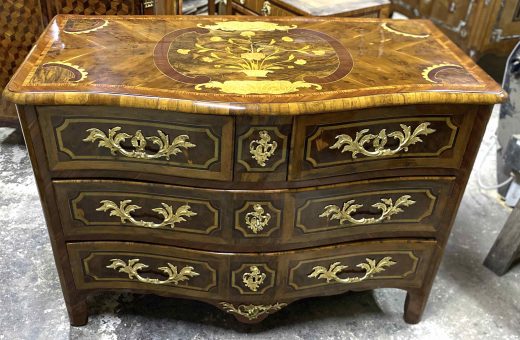
Louis XVI commode stamped J. LAPIE

Ebénisterie Mathieu Vath

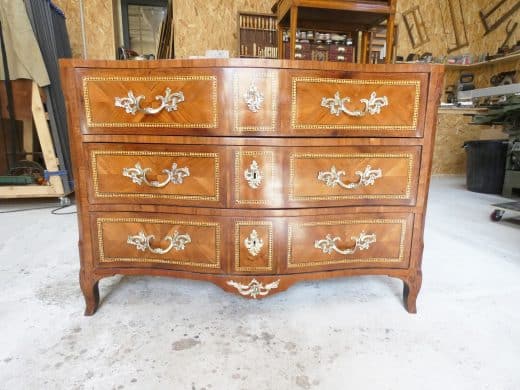
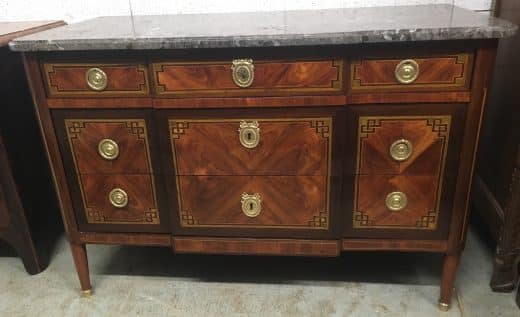
Restoration by Lise, during her internship at the workshop, of a Louis XVI commode stamped by Jean Lapie, constructed of oak, fir, and beech, veneered in rosewood with hornbeam and amaranth stringing, and adorned with gilt bronze mounts. And since Lise submitted an excellent internship report, I am publishing it almost in its entirety. Jean Lapie (known as "The Younger"), son of the potter Nicolas Lapie, was born around 1734. Brother of the cabinetmaker Nicolas-Alexandre Lapie (known as "The Elder") and cousin of Jean-François Lapie, he obtained his master's degree in Paris […]

Regency style commode stamped Hédouin

Ebénisterie Mathieu Vath

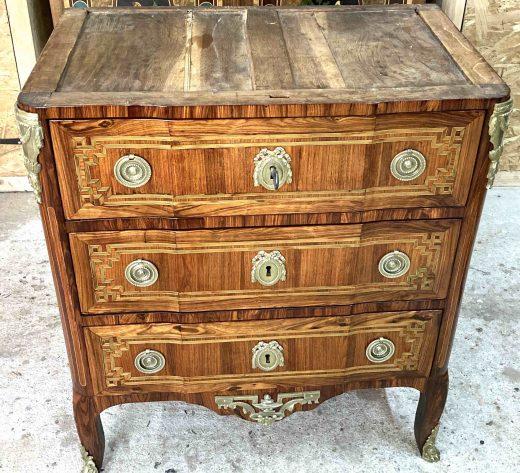
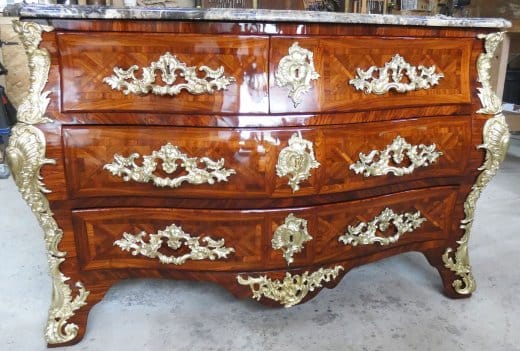
Here is the latest restoration by Raphaël, my apprentice. Although it possesses all the attributes of a Regency commode, it could only have been made much later, after this historical period (around 1715-1723). Indeed, since Hédouin obtained his master craftsman's certificate in 1738, during the height of the Louis XV era, it is more accurately described as a commode "in the Regency style" by cabinetmakers of the time. This commode is entirely constructed of oak, except for the interior panels, and is veneered with amaranth and satinwood. Jean-Baptiste HEDOUIN The life of Jean-Baptiste Hedouin is quite […]

Regency commode with crowned R

Ebénisterie Mathieu Vath

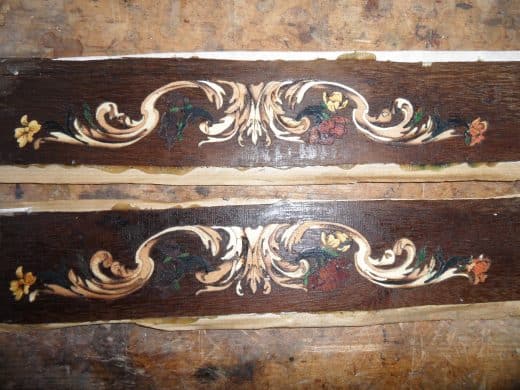
Restoration of a Regency commode, probably from southeastern France, veneered with yew, plum, rosewood, walnut, cherry, amaranth, violet wood, boxwood, and green-stained maple on a softwood frame. Besides its highly unusual marquetry decoration, the commode's distinctive feature is its crowned R bronze mounts. The crowned R hallmark should not be confused with the crowned C hallmark, which corresponds to a tax levied from 1745 to 1749 on copper objects and is found on many […]

Louis XV slant-front desk

Ebénisterie Mathieu Vath

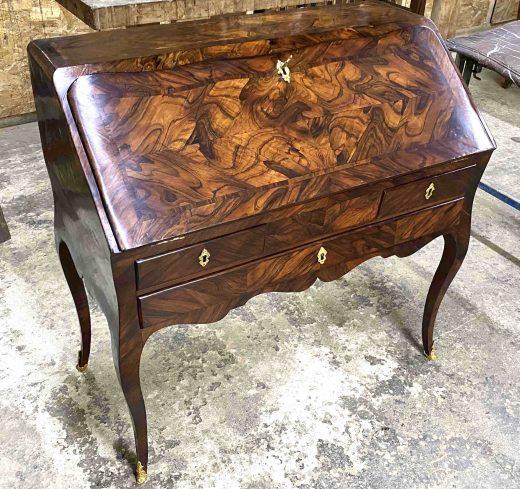
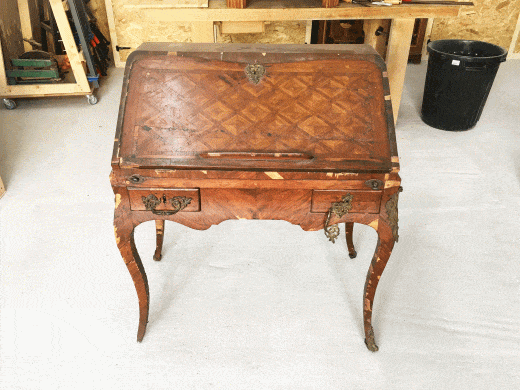
Raphaël's first restoration project was this Louis XV period rosewood veneer slant-front secretary. It was a complete restoration involving numerous veneer grafts and a waxed, filled finish. A delicate job, as rosewood is unforgiving. The slightest misstep with the chisel, or excessive sanding, and its beautiful blond patina disappears, revealing the original dark color and causing unsightly stains. Therefore, there was no choice but to scrape and sand the newly sawn veneer and cut it to the correct thickness before gluing it […]

Louis XVI secretary stamped TOPINO

Ebénisterie Mathieu Vath

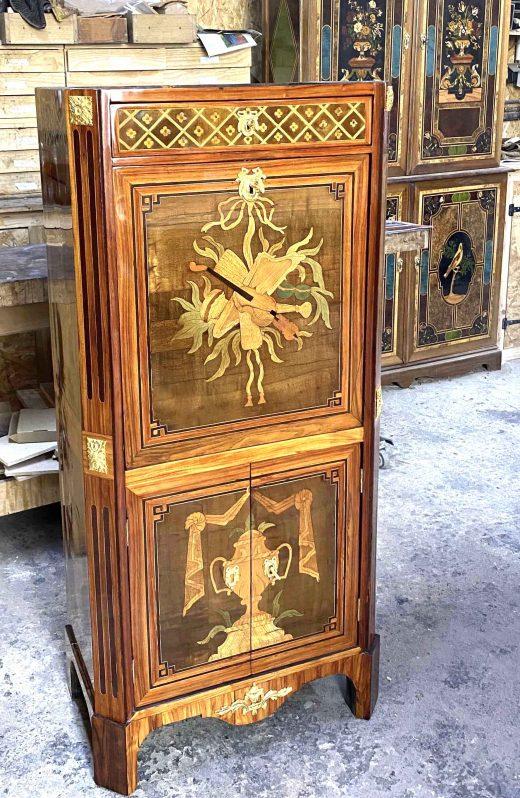
Restoration of a Louis XVI secretary desk stamped by Charles Topino. Typical of Topino's style, this secretary is constructed of oak and softwood. The front opens with a drawer and a drop-front covered in red leather tooled in gilt, revealing two compartments and four drawers veneered in rosewood. The lower section opens with two doors revealing a shelf. These are decorated with marquetry depicting a vase and drapery on a tobacco-colored ground, while the drop-front is inlaid with musical instruments, ribbons, and foliage on […]

Louis XV corner cabinet

Ebénisterie Mathieu Vath

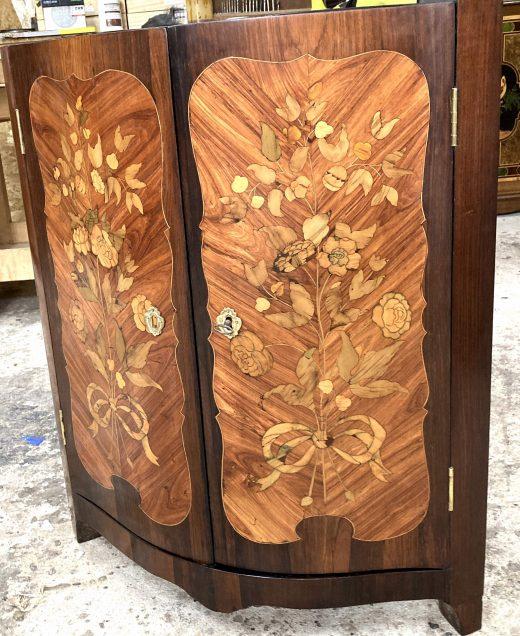
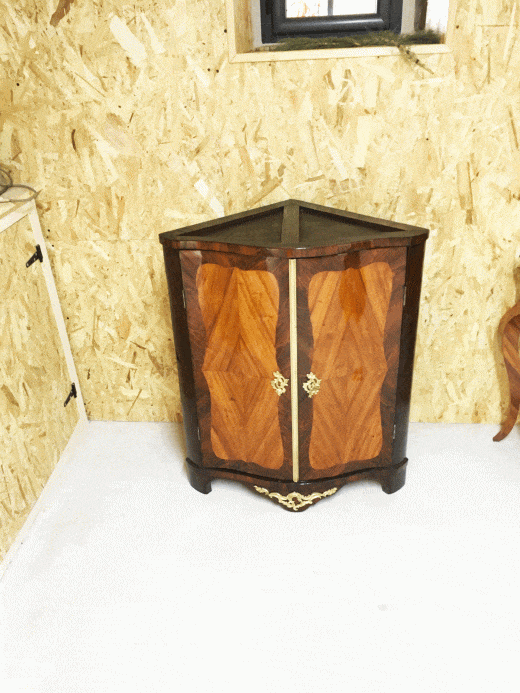
Restoration of a Louis XV corner cabinet in marquetry of various woods (maple, hornbeam, boxwood, and holly). Except for the green leaves, the colors of some flowers and ribbons have faded. This marquetry is executed on a rosewood background framed by a boxwood stringing and a rosewood frieze. The frame of this corner cabinet is made of solid oak assembled with dovetail joints. Condition report: As you can see in the following photos, the surface of the varnish was heavily sun-faded, the glues of the marquetry on the doors were in […]

LARDIN transitional chest of drawers

Ebénisterie Mathieu Vath

Restoration of a Transitional period commode constructed of fir and oak and veneered with rosewood, violet wood, and a frieze of hornbeam stringing stained green in the Greek key pattern. The sides are veneered with satinwood and violet wood. André-Antoine Lardin (1724 – August 10, 1790) obtained his master craftsman's certificate on July 1, 1750, and established himself on rue de Charenton under the sign "Au Bois de Boulogne." He worked there until 1770, when he moved to rue Saint Nicolas. His production is […]

Louis XV/Transition Commode by Nicolas Abraham Couleru

Ebénisterie Mathieu Vath

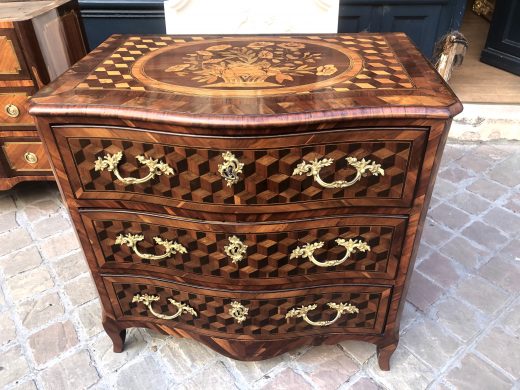
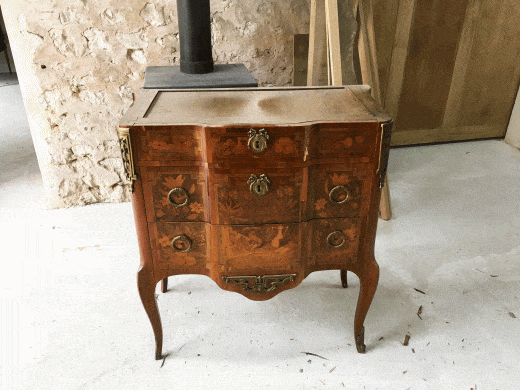
This slightly curved commode, composed of three drawers and veneered with bottomless cubes of walnut, plum, and cherry, has a marquetry top depicting a bouquet of flowers on an amaranth ground. Plum or Quetchier wood is easily recognizable by its sapwood markings, which create a lighter pattern and lend an irregularity to the decoration. The frame is made of fir and walnut. It is difficult to define a precise style for this commode. Although Louis XV, it clearly foreshadows the arrival of the style's more restrained appearance […]

Transitional chest of drawers stamped LARDIN

Ebénisterie Mathieu Vath

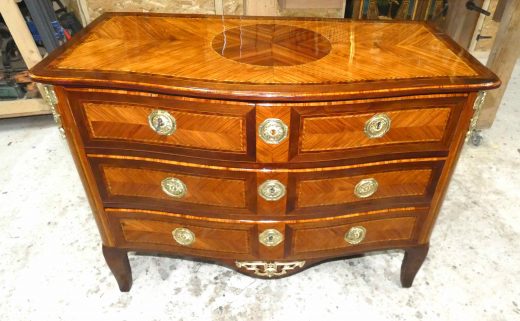
Restoration of a Transition period commode built of fir and oak and veneered with rosewood, framed with stringing of white hornbeam and green-stained wood, with a satinwood band surrounded by amaranth. The central medallion is satinwood veneer assembled in a herringbone pattern. The maker's mark and the JME (Journée des Métiers d'Étranger) are located at the base of the left rear leg. André-Antoine Lardin (1724 – August 10, 1790) obtained his master craftsman's certificate on July 1, 1750, and established himself on the rue de Charenton under the sign "Au Bois de Boulogne." He worked there until 1770, the date […]

Louis XVI commode

Ebénisterie Mathieu Vath

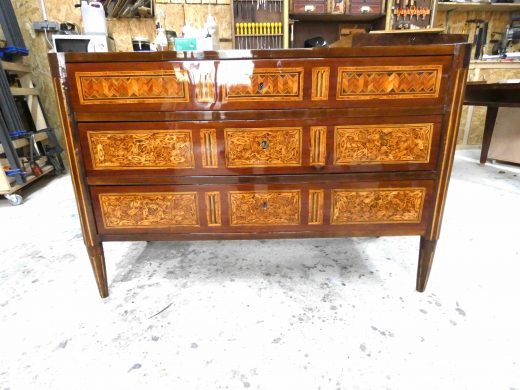
Restoration of a Louis XVI period commode from eastern France, made of solid oak and fir and veneered with end-grain laburnum, walnut, plum, amaranth, rosewood, palisander, boxwood, and green-stained hornbeam. The handles and keyholes were added at a later date. The original fittings are missing; only the holes for the handles remain. This is a piece of furniture that has never been restored. The veneer is almost 4 mm thick in some places, and […]

Empire Chest of Drawers with Quivers

Ebénisterie Mathieu VATH

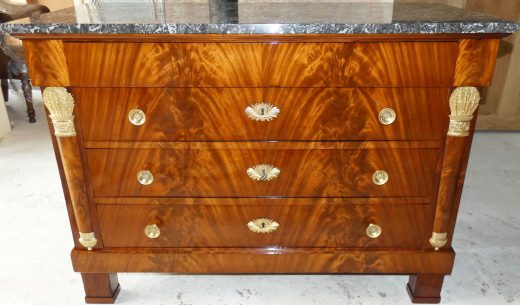
This week, here are some photos of the restoration of this Empire-style chest of drawers veneered in mahogany burl. This chest is truly unique due to the quality and originality of its bronze mounts. Indeed, they form quivers along with the side columns. The keyhole escutcheons are composed of two crossed laurel branches held together by a ribbon. Originally, they were mercury-gilded, as can be seen from the gilding stains on the back. Unfortunately, only a few partial traces remain on the front […]

Hedouin commode with crowned C

Ebénisterie Mathieu VATH

Extensive restoration of this superb Louis XV period commode, stamped on all four uprights by Jean-Baptiste Hedouin. The frame and drawers are constructed of solid oak, fir, and walnut. The edges of the frieze and geometric marquetry in violet wood are veneered with satinwood. Two types of violet wood are visible: one with a very tight grain and veining for the lozenges, and a second, more intricate type for the marquetry edges, uprights, and rails. The […]

Transitional dresser

Ebénisterie Mathieu VATH

Here is a very simple chest of drawers from eastern France, probably dating from the late 18th century. The front is slightly curved and the uprights are chamfered. It should be noted that the bronze mounts are probably not original. The frame is made of solid softwood, and the uprights are oak. The drawer bottoms are set in rebates and slide on the drawer fronts, which is typical of provincial work. A small peculiarity: this chest of drawers does not have top panels, the […]

Louis XVI commode stamped JA BRUNS

Ebénisterie Mathieu VATH

This week marks the completion of the restoration of a Louis XVI commode stamped JA BRUNS. It is made of oak for all the structural elements, except for the side panels, drawer backs, drawer fronts, and the two drawer bottoms, which are made of softwood. It is veneered with rosewood in a butterfly pattern and amaranth for the edges. The false fluting is made of boxwood and ebony, and there is a green-stained maple stringing forming the corners at […]

Boulle box

Ebénisterie Mathieu VATH

To kick off the new year, I'm excited to present my latest project. I'm embarking on a replica of this box attributed to André Charles Boulle. You'll be able to follow its progress and even come see it in person, as it will be my main subject for marquetry work at various exhibitions and events over the next few years. And yes, I'm talking about several years, as it's an extremely time-consuming project. But first, I had to find and select the different types of wood that make up the […]

Louis XV slant-front desk

Ebénisterie Mathieu VATH

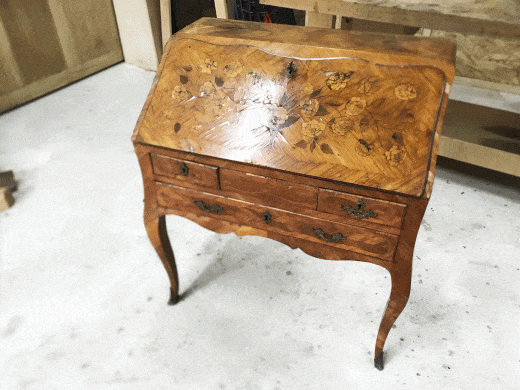
The restoration of a lovely slant-front desk, or as Riesener calls it in his memoirs, a "tomb-shaped secretary," began two weeks ago. With the restoration phase complete and the varnishing underway, I'm taking a moment to provide a brief summary of the project. The desk's frame is made of oak and fir, veneered with rosewood and violet wood, and the drop-front features floral marquetry of boxwood, natural and stained maple, and hornbeam. It includes a large drawer […]

Transitional dresser in the style of Topino

Ebénisterie Mathieu VATH

A month ago, a lovely transitional commode arrived, which reminds me of the work of the cabinetmaker Charles Topino (circa 1742-1803) – he received his master craftsman's certificate on July 4, 1773. However, this commode does not bear his stamp, nor any stamp for that matter. This confirms that a stamp is not necessary to possess a piece of high-quality furniture. Furthermore, the marquetry could very well have come from Topino's workshop, as he sold panels of his marquetry to the haberdashers and his colleagues […]

Louis XV slant-front desk stamped HEDOUIN

Ebénisterie Mathieu VATH

Thanks to its stamp, it is possible to date this slant-front desk, or cantilevered desk, between 1738 and 1783. The life of Jean-Baptiste Hedouin is relatively unknown. After becoming a master craftsman, he set up his workshop on Rue Traversière-Saint-Antoine. All the furniture he produced was of high quality. His pieces, primarily in the Regency and Louis XV styles, almost all veneered in sheets or with grid patterns, were varied: wardrobes, flat and slant-front desks, bookcases… but it was the commodes that constituted the largest part of his output.