
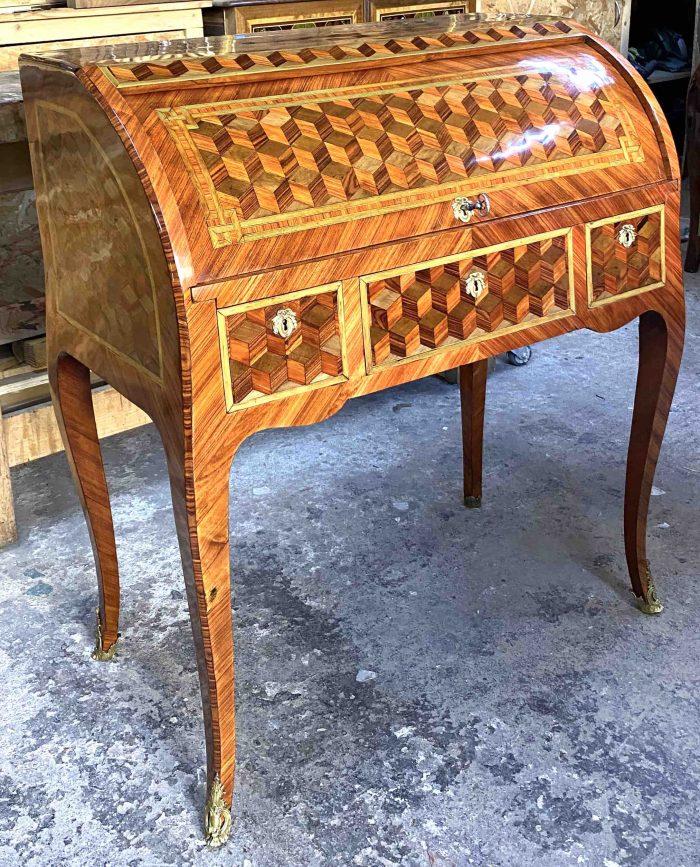
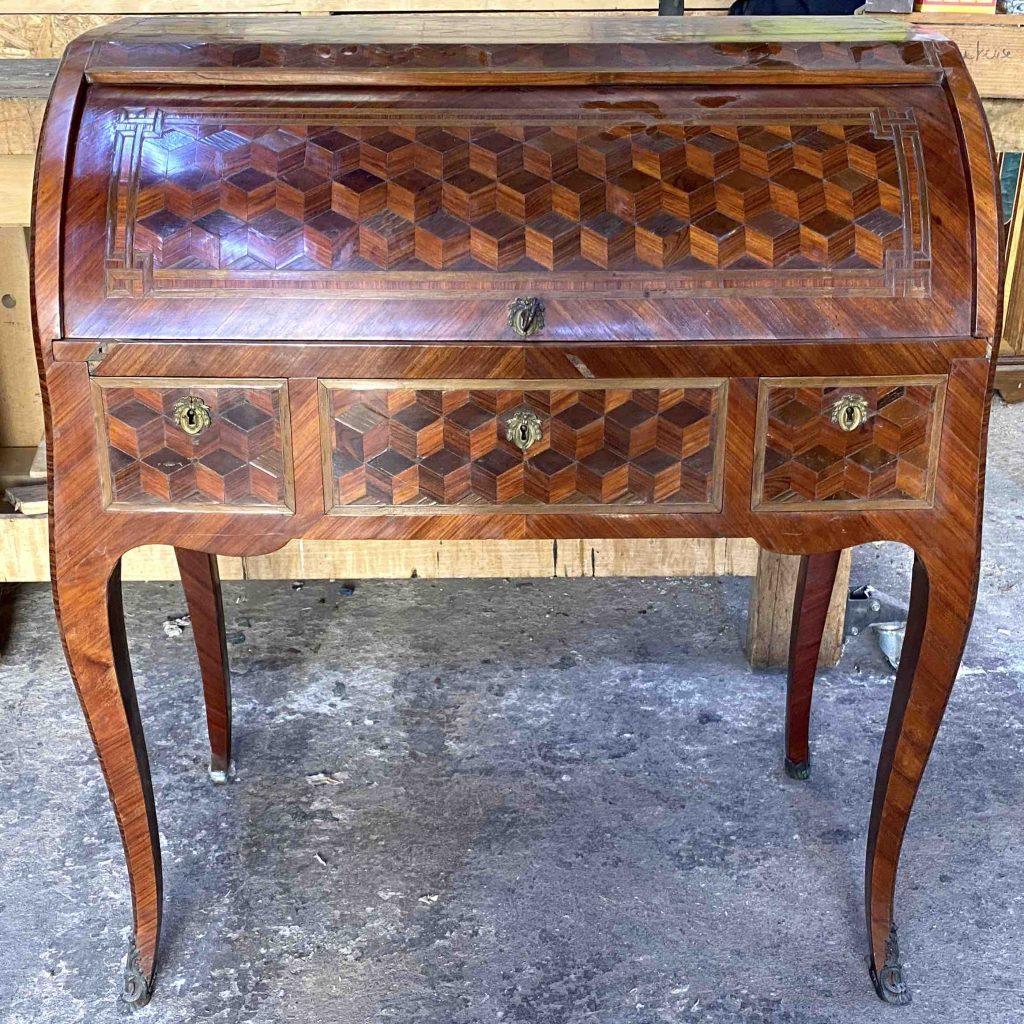
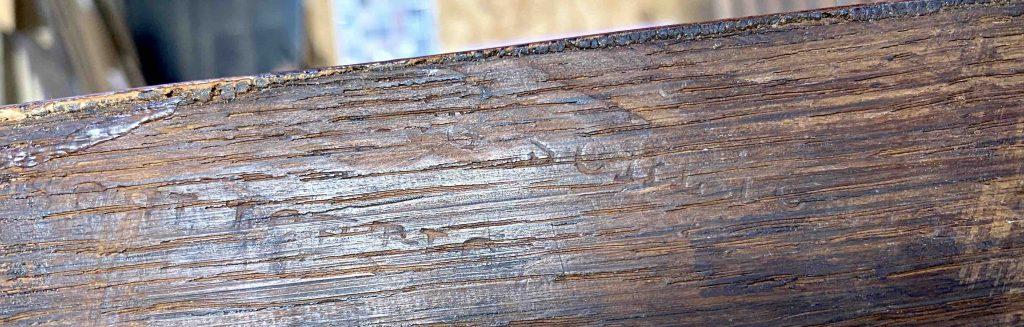
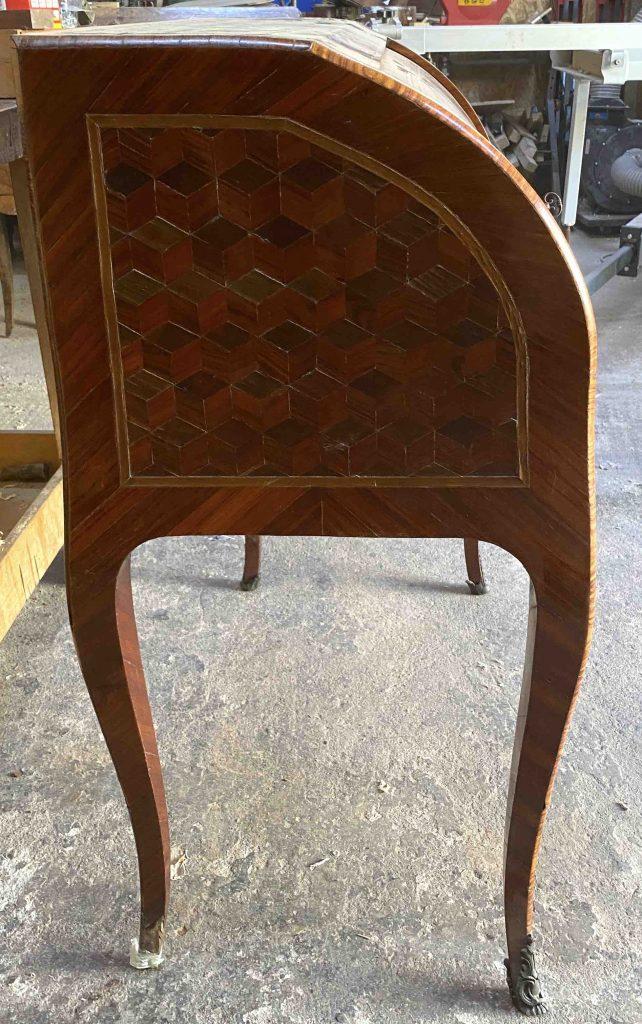
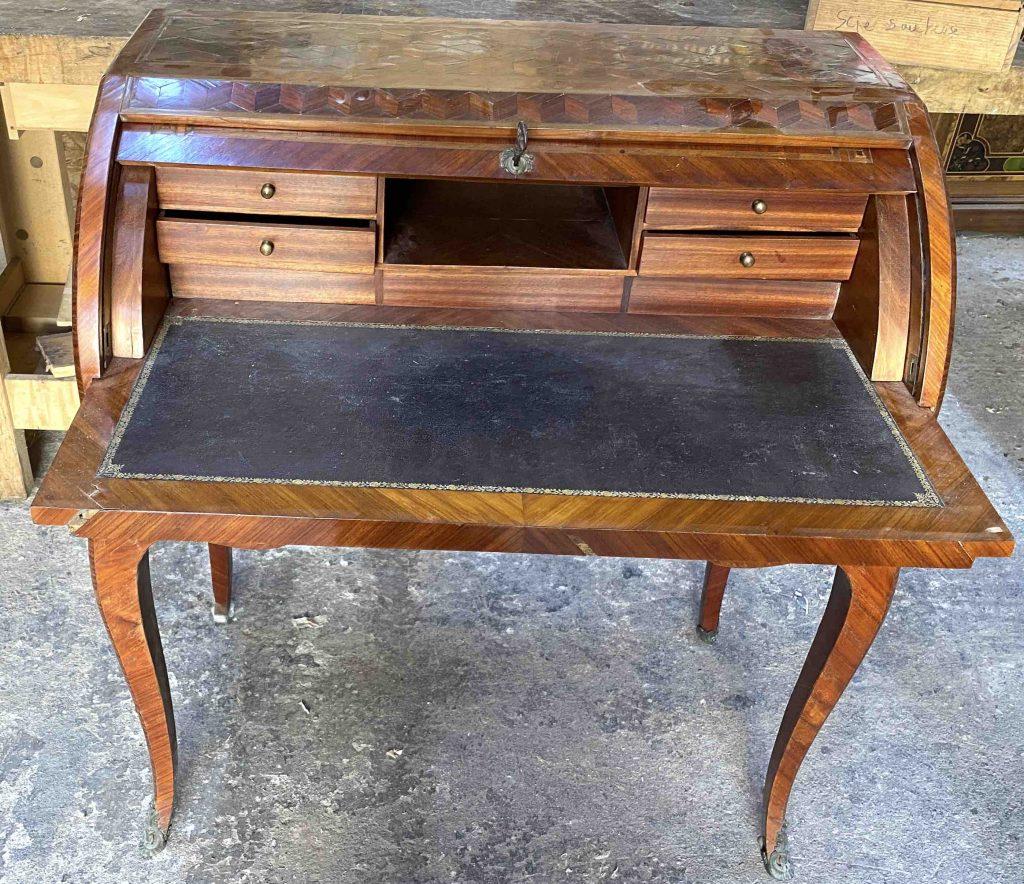
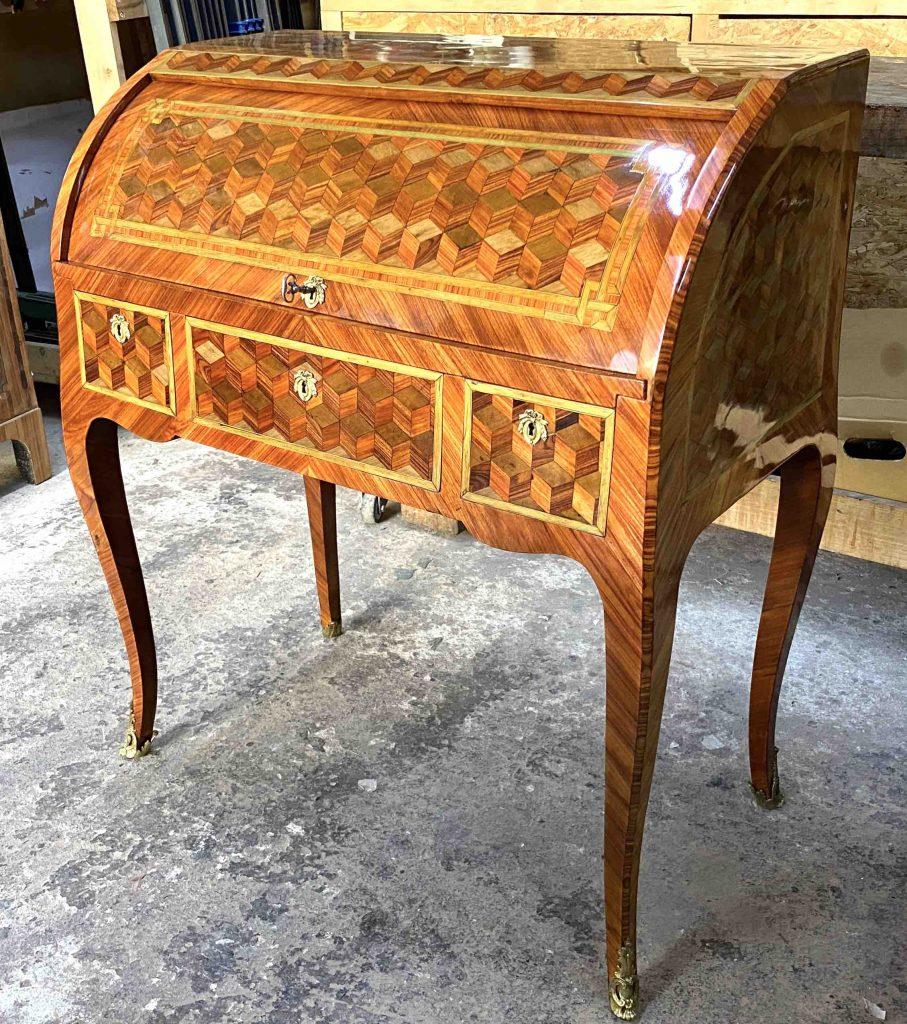
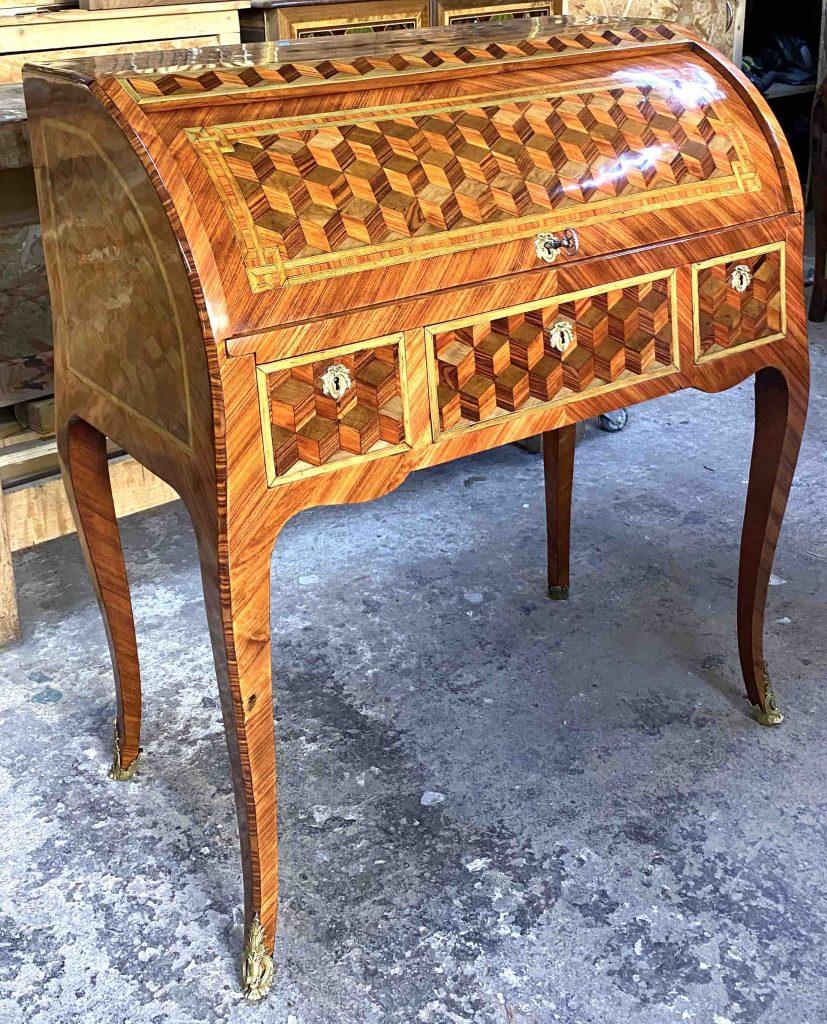
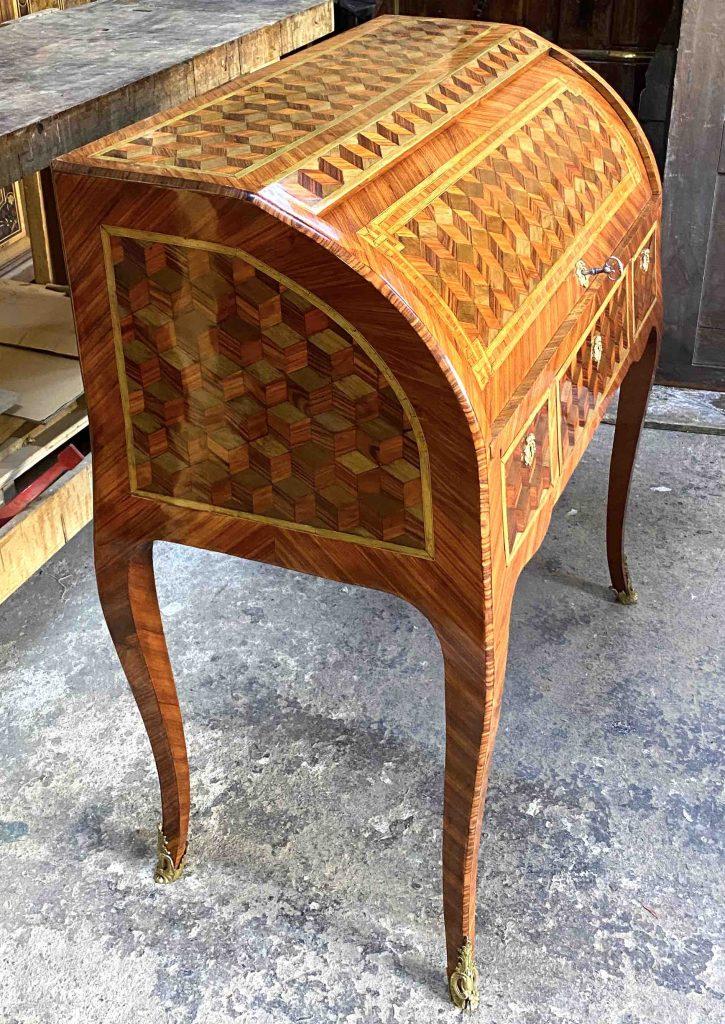
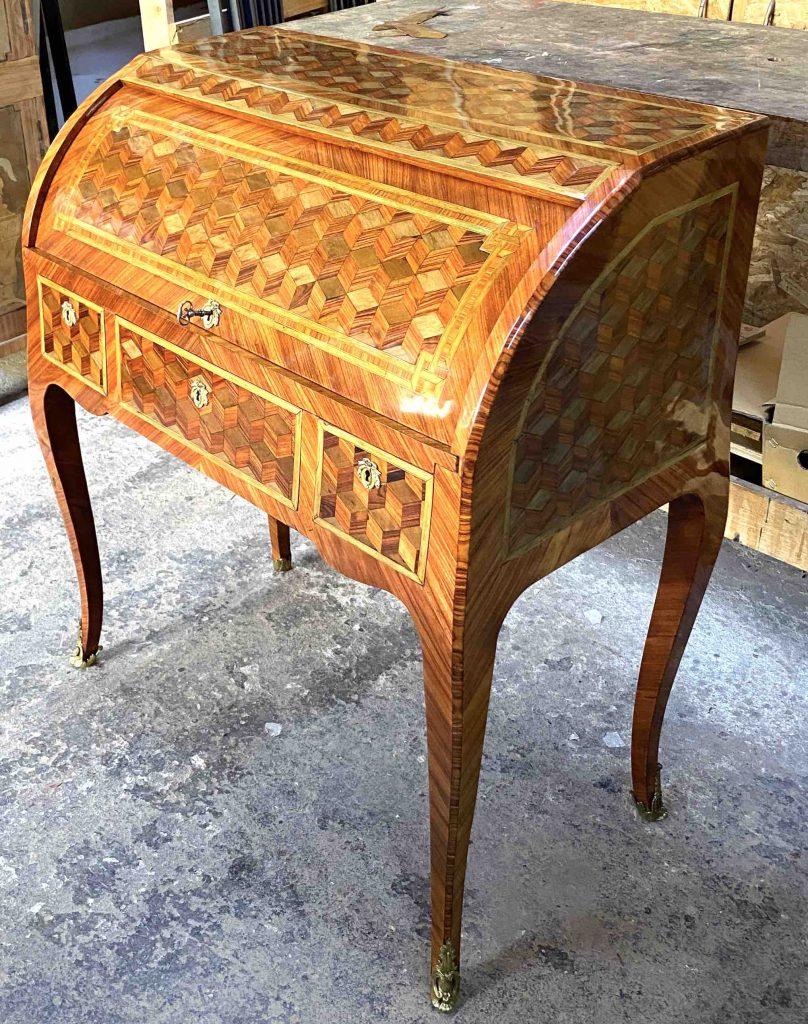
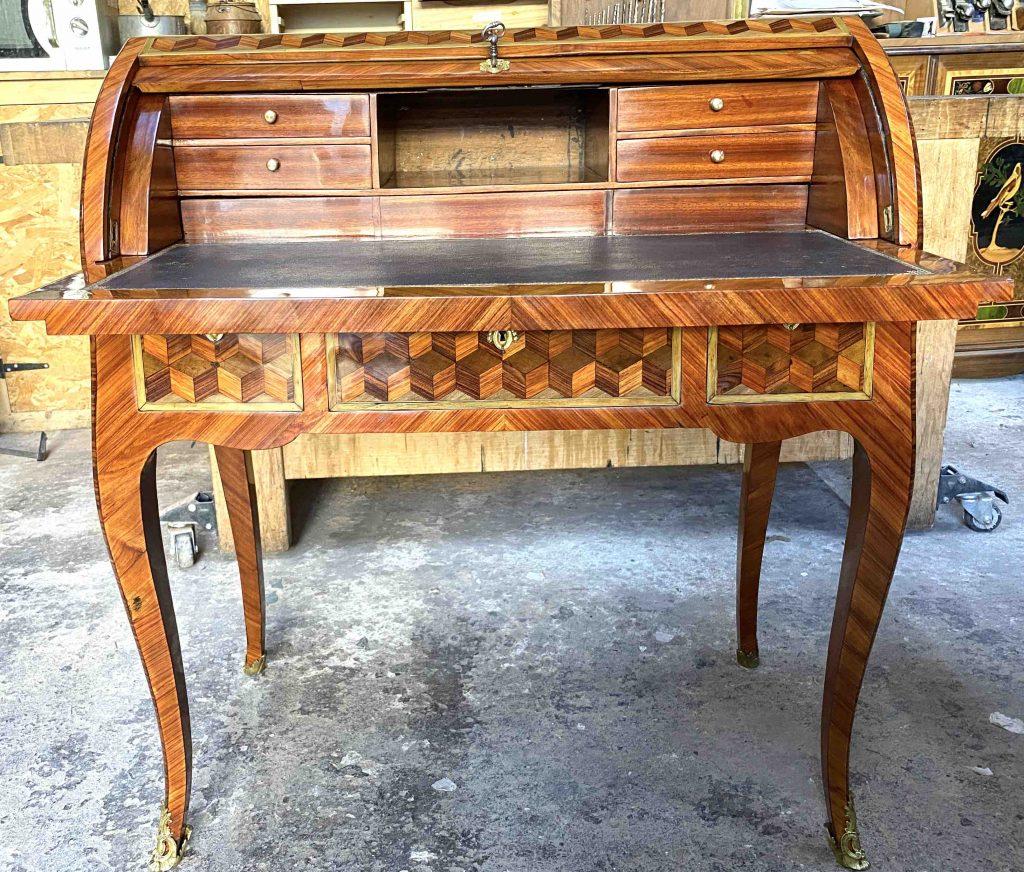
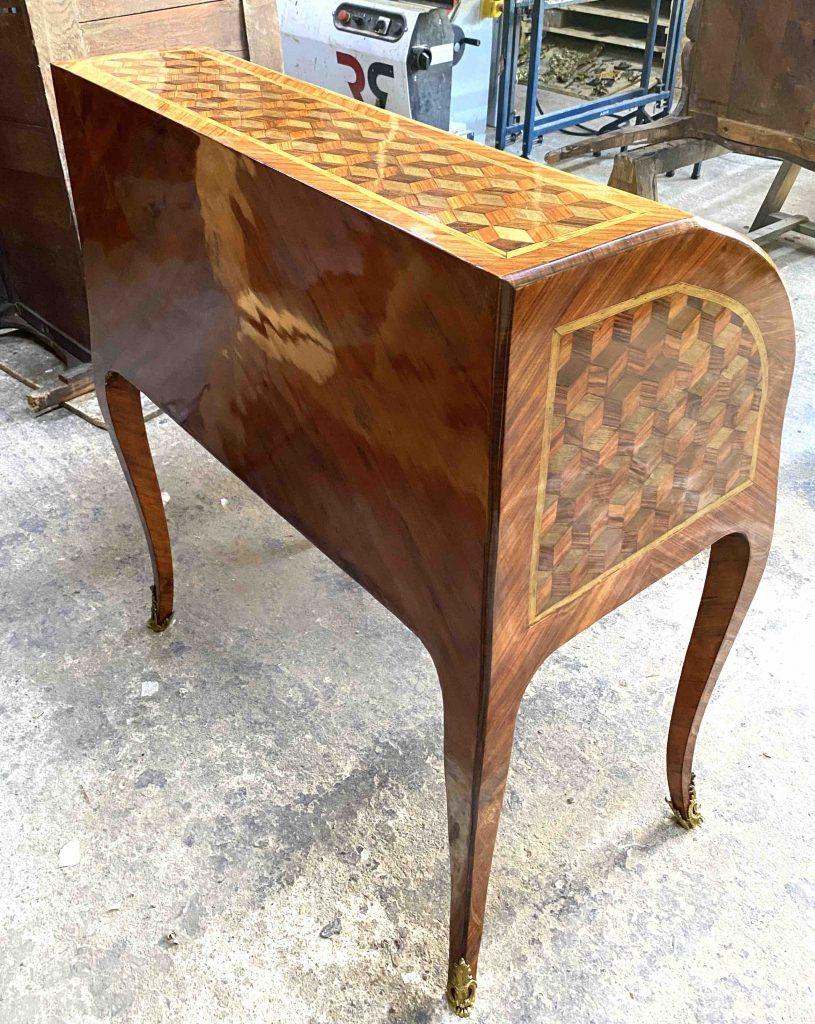
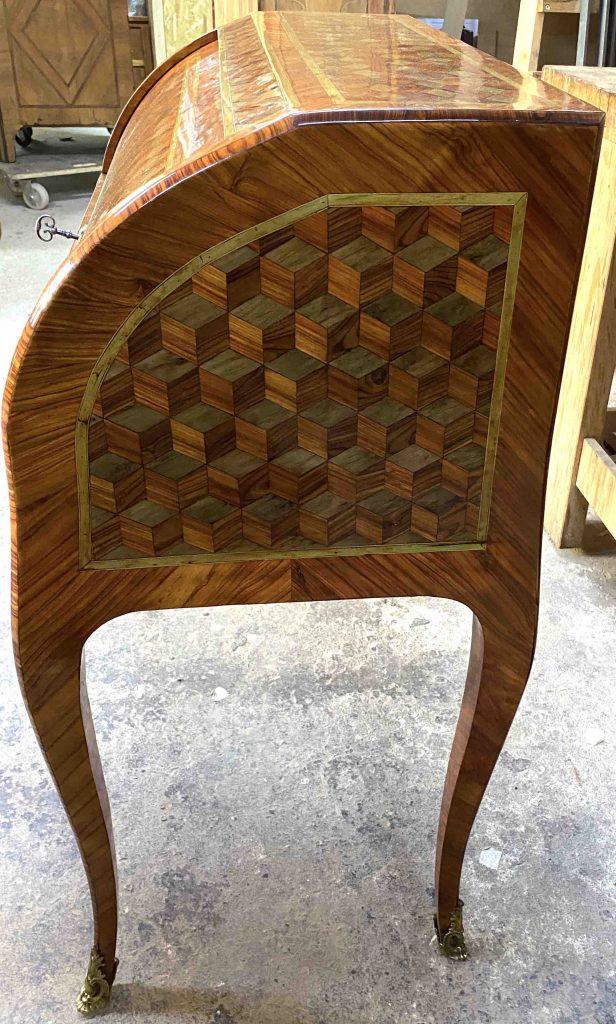
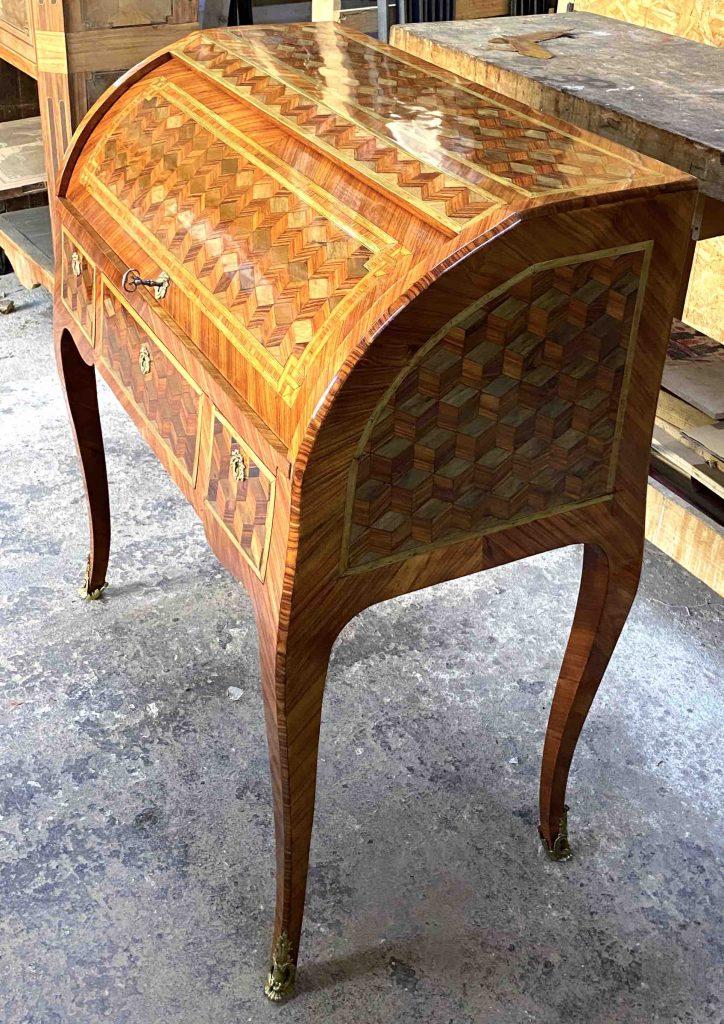
Restoration of a Transition period cylinder desk stamped by Jean-Georges Schlichtig. The frame is oak for the legs and rails, while the panels and drop-front are softwood. It is veneered in rosewood with marquetry of bottomless cubes in rosewood and tobacco-stained sycamore; the Greek key stringing is composed of hornbeam and holly. The back and interior drawers are veneered in satinwood. This type of cylinder desk was a common production for this cabinetmaker, who produced several variations of this model with bottomless cubes.
Bottomless cubes
Popularized by Jean-François Oeben, Cabinetmaker to the King from 1761 to 1763, he worked and specialized in geometric patterns, such as the creation of his famous "bottomless cubes," which required exceptional skill from the craftsman. This repetitive motif is particularly impressive. by the three-dimensional effect it creates. Composed of three rhombuses forming a cube in perspective within a hexagonal shape, it is indeed difficult to master because the slightest misalignment would be visible in the event of a slight mistake. Oeben's cubes will undoubtedly leave their mark on Louis XV and Transition style furniture.
SCHLICHTIG Jean-Georges
Of German origin, Jean-Georges Schlichtig obtained his master's degree October 2nd 1765 and settled on rue du Faubourg Saint-Antoine then rue Saint Nicolas. A talented marquetry craftsman, he distinguished himself in fine cabinetmaking and notably worked for Queen Marie Antoinette (A commode, circa 1775, stamped by Jean-Georges Schlichtig, bequeathed to the Louvre Museum by Count Isaac de Camondo, from the famous collection of Baron Double, bearing the monogram of Marie Antoinette at the corners).
His furniture, primarily in the Transition and Louis XVI styles, was classically styled and veneered with rosewood arranged in butterfly wings, generally framed with violet wood or amaranth. A few more elaborate pieces were inlaid with floral bouquets or trophies. Overall, the creations left by this skilled cabinetmaker remain original and of high quality. After his death in February 1782, his wife continued to run his workshop and business until 1787.
BIBLIOGRAPHY
- French Furniture of the 18th Century – Pierre Kjellberg – Les Éditions de l'Amateur – 2008
- The workshops Parisian cabinetmakers and joiners in the 17th and 18th centuries – Guillaume Janneau – Serg Editions – 1975
The cylinder secretary, a new piece of furniture
The originality of this piece of furniture, created during the reign of Louis XV and first mentioned in 1760 in the inventory of the crown furniture for the King's office, begun by Oeben and completed by Riesener, lies in its closing mechanism. A cylinder, a movable flap that folds down or lifts over a series of compartments and drawers, closes the upper compartment of the desk, designed to protect personal documents. On the earliest models, this cylinder is composed of articulated strips that wind around an axis housed in the rear part of the chest; «"The closures of these offices," Roubo indicates in The Art of the Carpenter, "are made by a number of small strips joined together and held in place by a strong canvas glued behind."».
This relatively fragile system of slatted curtains was quickly replaced by a rigid, quarter-circle-shaped panel that slid into grooves specially designed for this purpose on the interior sides of the chest. In the interest of improvement, a process was also developed to extend the work surface. Occupied by numerous compartments and drawers that ensured the model's considerable success, the desk was indeed cluttered with various objects: a writing surface, a small clock, etc. Therefore, on some models, the release of a small, leather-covered writing tablet was synchronized with the click of the cylinder's opening, thus increasing the workspace. These various improvements and other complications brought great renown to certain cabinetmakers.
The Restoration
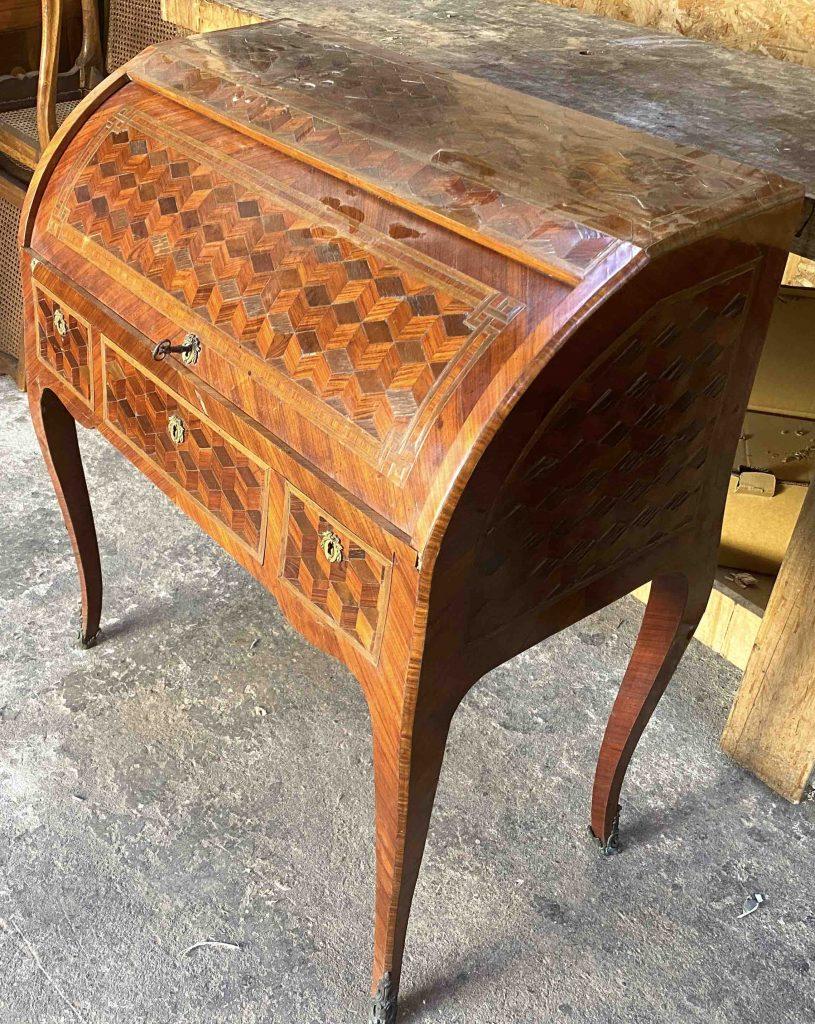
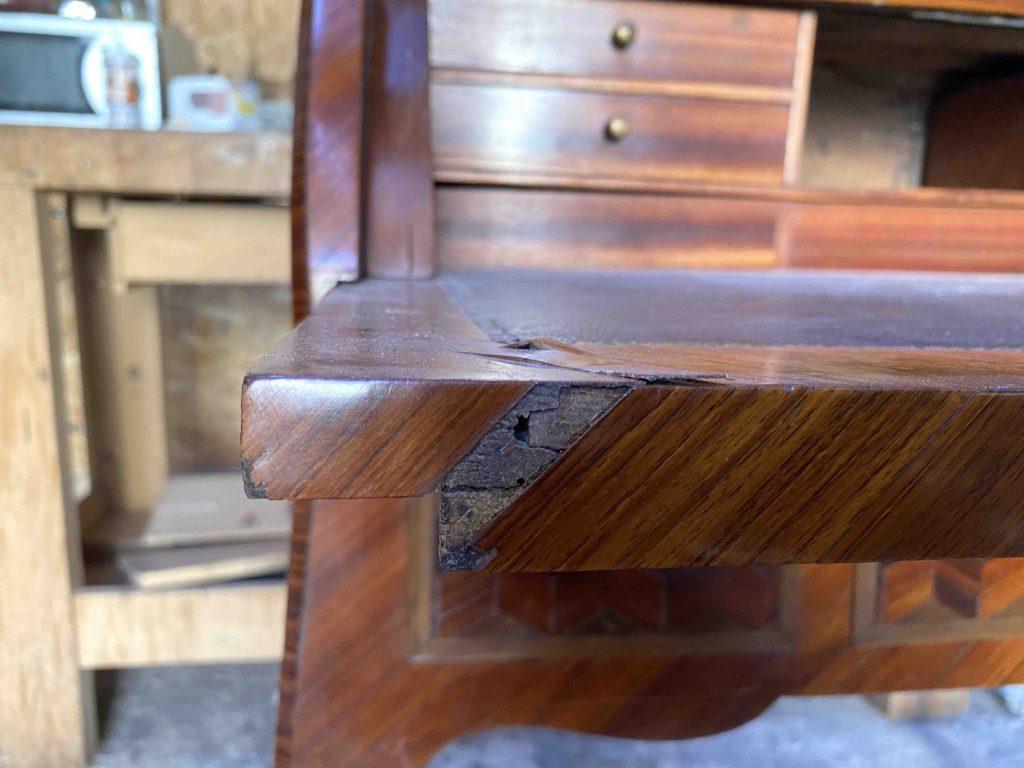
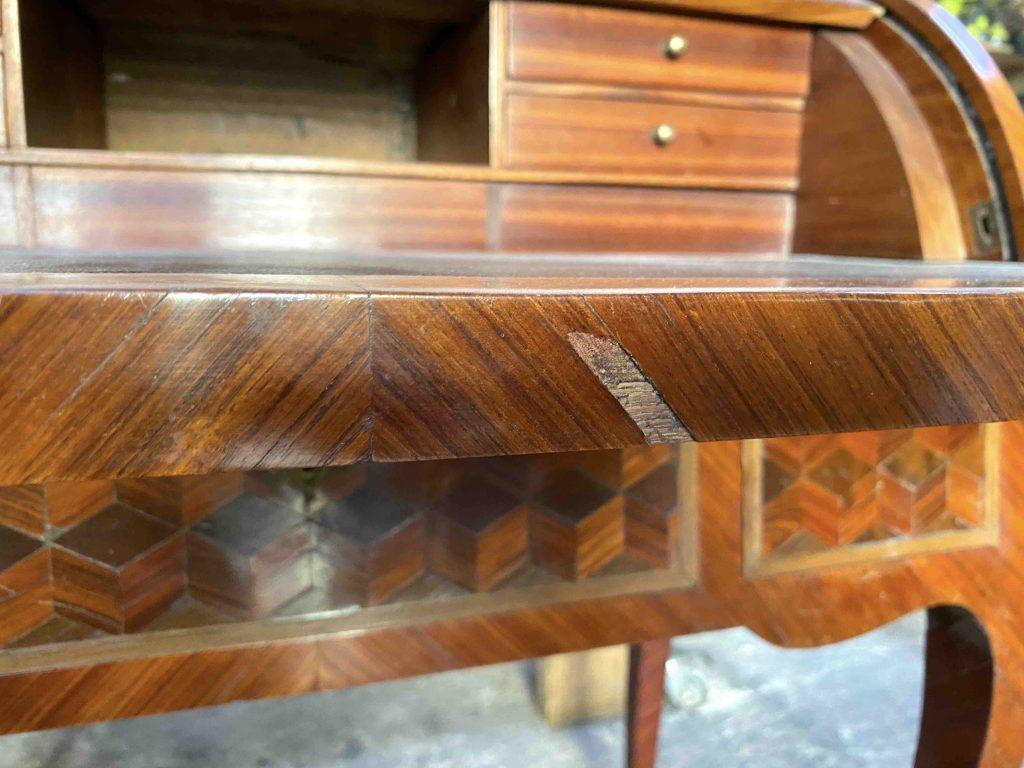
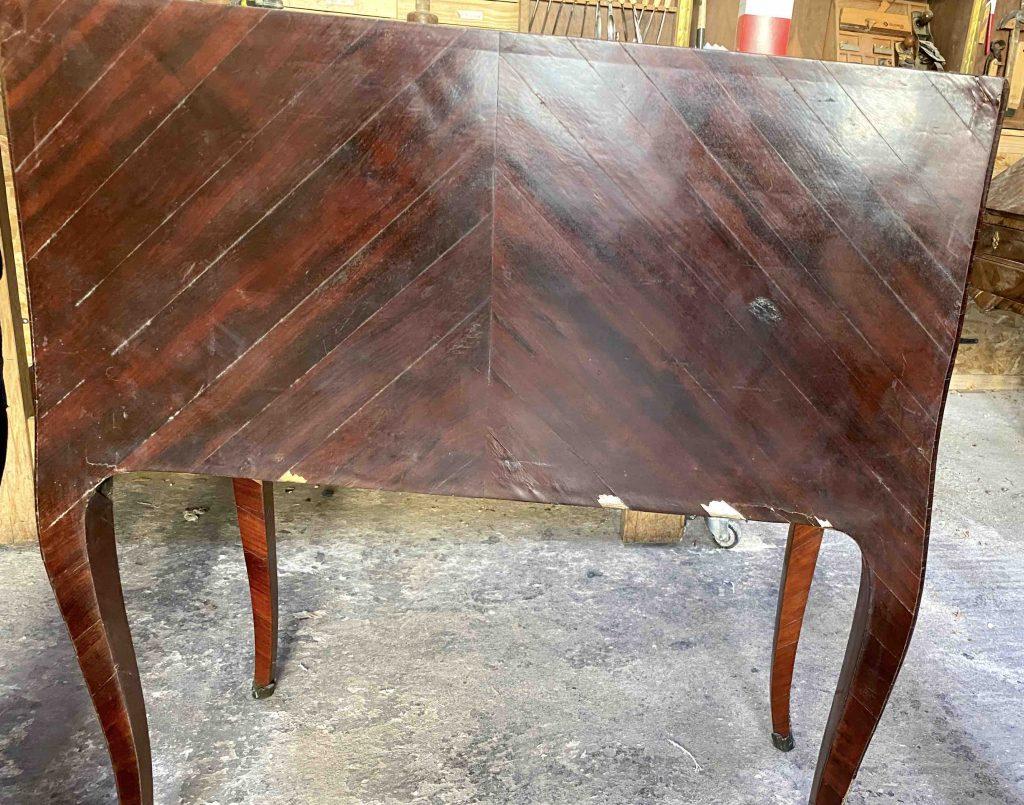
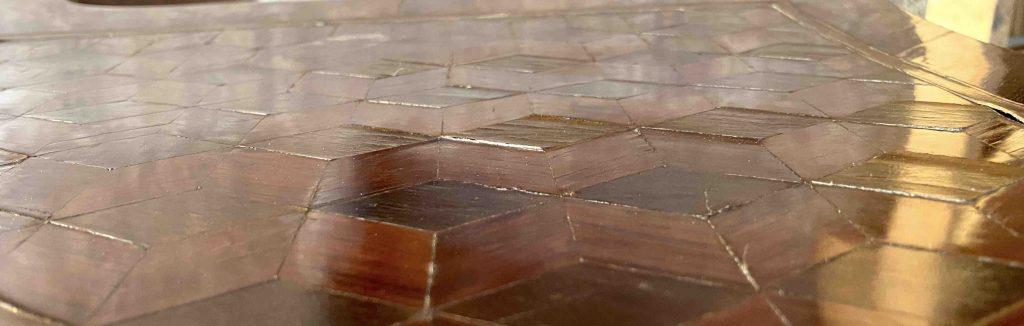
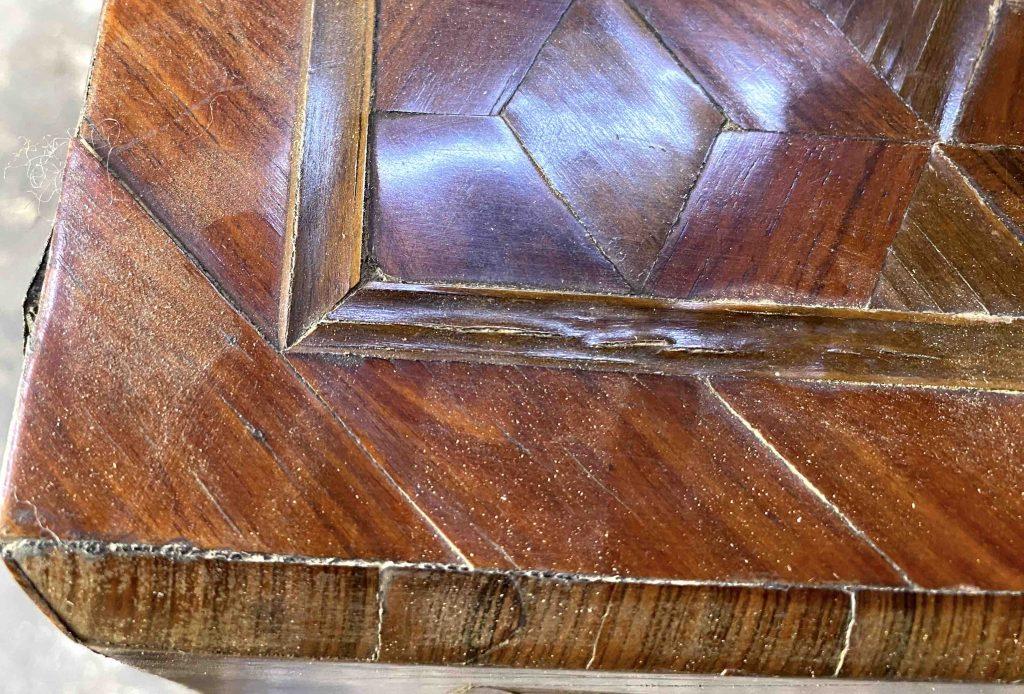
Besides heavy soiling, varnish discoloration, and some small veneer defects, the major and recurring problem on cube marquetry was a multitude of small peelings and lifting of veneer at the glue joints.
All the cube marquetry veneered surfaces were rehydrated by vacuum glue injection and then pressed with a slight heat input to varnish and "glaze" the veneer surface, thus obtaining a perfectly flat surface without any roughness.
A colorless French polish finish was then applied.
Hello and congratulations on this magnificent work. But how do you apply a French polish to smaller or more difficult surfaces, such as sculptures or feet? Sincerely,
Hello, for small areas you can make a mini stamp and hold it with your fingertips. For moldings or carvings, you should apply a coat of copal varnish with a brush, for example, then finish with a stamp using the same varnish as the rest of the piece.
Best regards