Louis XVI secretary stamped Ohneberg

Ebénisterie Mathieu Vath

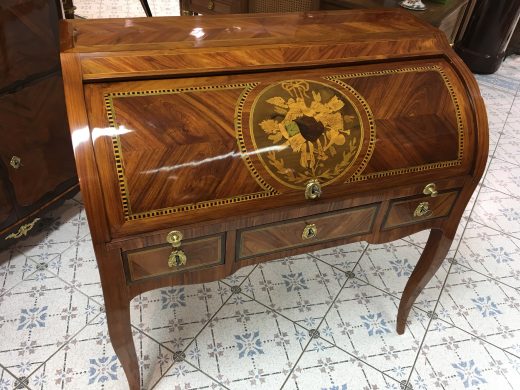
This Louis XVI period secretary, stamped by Martin Ohneberg, a masterpiece of sobriety and refinement, features a solid wood frame veneered in rosewood and a sumptuous ribboned satinwood veneer, whose sinuous, golden veins lend brilliance and depth. The ornamentation is understated yet exquisite: delicately floral, chased bronze mounts accentuate the clean lines of the piece, typical of the Neoclassical style. Martin Ohneberg, of German origin, was active in Paris during the last decades of the 18th century, notably during the reign of […]

Flat Greek-style desk stamped DUBOIS

Ebénisterie Mathieu Vath

One desk, one stamp, three cabinetmakers? The desk we are about to discover, a masterpiece of French cabinetmaking, embodies the culmination of 18th-century Neoclassical taste. The question that immediately arises upon contemplating this exceptional piece is: why three cabinetmakers for a single desk? The answer lies in the complex interplay of succession, talent, collaboration, and opportunism that characterized the craftsmanship of the period. This flat desk, known as a "Greek-style" desk, is a perfect example of the Louis XVI style. Made from a blend of […]

Regency chest of drawers

Ebénisterie Mathieu Vath

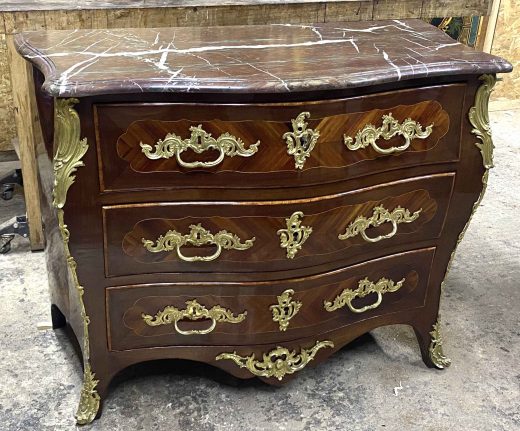
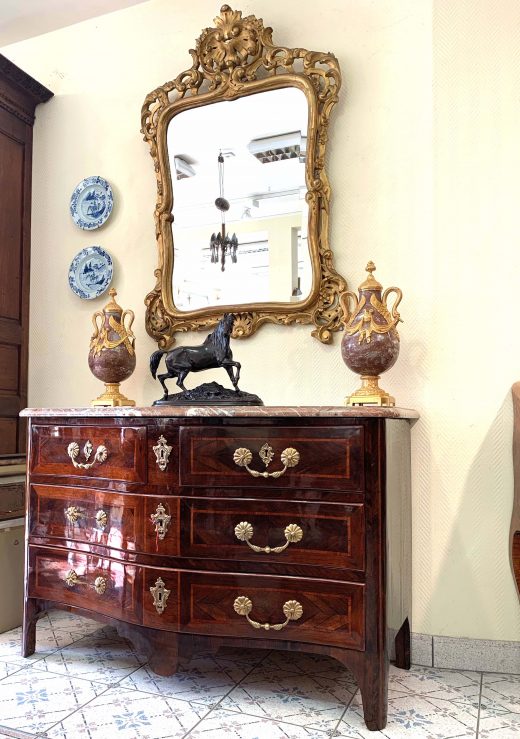
Restoration of a bombé commode with a front veneered in satinwood with double boxwood stringing within amaranth borders, mounted on a fir frame with walnut drawer boxes. It opens with four drawers in three rows and is adorned with finely chased bronze mounts, silvered rather than gilded as is customary. The uprights are veneered with a facsimile of brass fluting, and the sides, decorated with a lozenge within a rectangle, echo the decorative motif of the front veneer. It is […]

Louis XVI Weekly Planner

Ebénisterie Mathieu Vath

Restoration of a Louis XVI chest of drawers veneered in rosewood, satinwood, and amaranth. It opens with a series of seven drawers framed by rounded uprights with simulated fluting made of boxwood and blackened pearwood. A chest of drawers? The chest of drawers is a piece of furniture that appeared in the mid-18th century, primarily intended for women. It is a chiffonier (which appeared during the Regency period, between 1715 and 1723) with seven drawers, one for each day of the week, designed to store the day's clean undergarments. The restoration...

Regency style commode stamped Hédouin

Ebénisterie Mathieu Vath

Here is the latest restoration by Raphaël, my apprentice. Although it possesses all the attributes of a Regency commode, it could only have been made much later, after this historical period (around 1715-1723). Indeed, since Hédouin obtained his master craftsman's certificate in 1738, during the height of the Louis XV era, it is more accurately described as a commode "in the Regency style" by cabinetmakers of the time. This commode is entirely constructed of oak, except for the interior panels, and is veneered with amaranth and satinwood. Jean-Baptiste HEDOUIN The life of Jean-Baptiste Hedouin is quite […]

Louis XV commode stamped NA Lapie

Ebénisterie Mathieu Vath

Restoration of a Louis XV commode, stamped by Nicolas Alexandre Lapie, veneered in amaranth and satinwood on a beautifully crafted oak frame. The sides and drawer fronts are made of softwood, and the marble top is Campan griotte marble. Nicolas Alexandre Lapie, son of Nicolas Lapie, a pottery merchant in the Faubourg Saint-Antoine, and brother of the master cabinetmaker Jean Lapie, Nicolas Alexandre (known as the Elder) appears to have been born around 1730. He registered his master's letters at the Châtelet in Paris on the 17th […]

Transitional cylinder secretary, stamped SCHLICHTIG

Ebénisterie Mathieu Vath

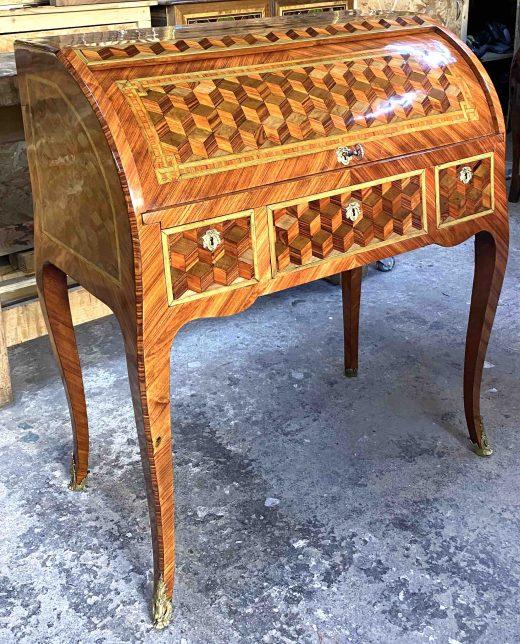
Restoration of a Transitional period roll-top desk stamped by Jean-Georges Schlichtig. The frame is oak for the legs and rails, while the panels and drop-front are softwood. It is veneered in rosewood with marquetry of bottomless cubes in rosewood and tobacco-stained sycamore; the Greek key stringing is composed of hornbeam and holly. The back and interior drawers are veneered in satinwood. This type of roll-top desk was a common production for this cabinetmaker, who produced […]

Transitional chest of drawers stamped Léonard Boudin

Ebénisterie Mathieu Vath

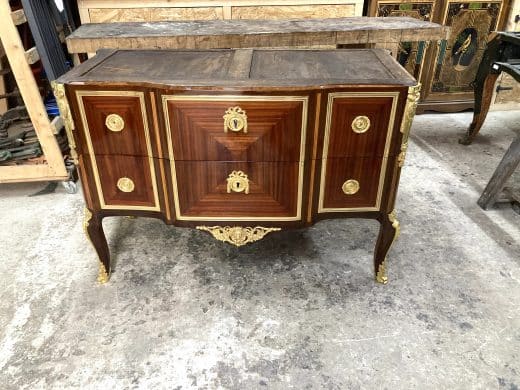
Restoration of a Transition period commode stamped by the master cabinetmaker Léonard Boudin (1735 in Paris – 20/12/1807). It is constructed of solid oak and veneered with amaranth, rosewood, and ribbon satinwood (Brosimum rubescens), which provides a highly decorative appearance due to the pronounced interlocked grain of this South American wood. It should be noted that it belongs to the same family as snakewood (Brosimum guianense). As Boudin was primarily a merchant during the Transition period, it is likely that this commode is actually by his hand (before […]

Small chest of drawers from La Rochelle

Ebénisterie Mathieu Vath

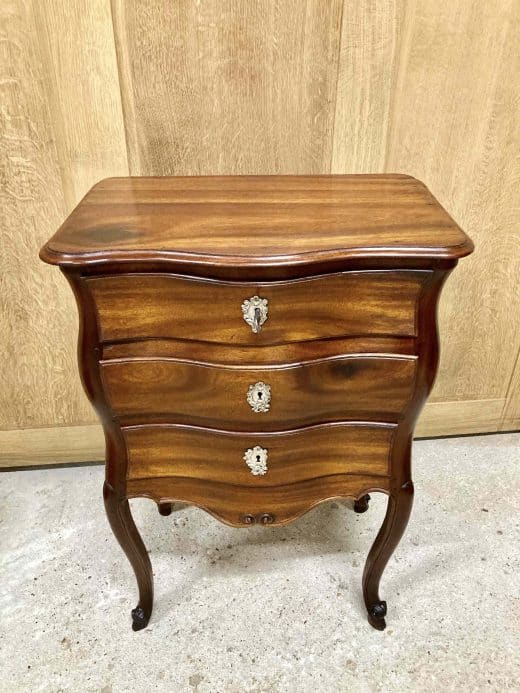
Here is the restoration of a small Louis XV commode in solid satinwood and ribboned satinwood. It is curved on all sides, including the back, and opens with three drawers in the front, as well as a pull-out candle holder at the back. La Rochelle, 18th century. Its top, molded with a corbel edge highlighted by a cavetto molding, is made of ribboned satinwood, which is also found on the front and sides, while the base is made of fine satinwood punctuated with so-called "snail" feet ending in split goatskin feet. Note the unusual proportions but especially the curves […]

Coffee table stamped P.GARNIER JME

Ebénisterie Mathieu Vath

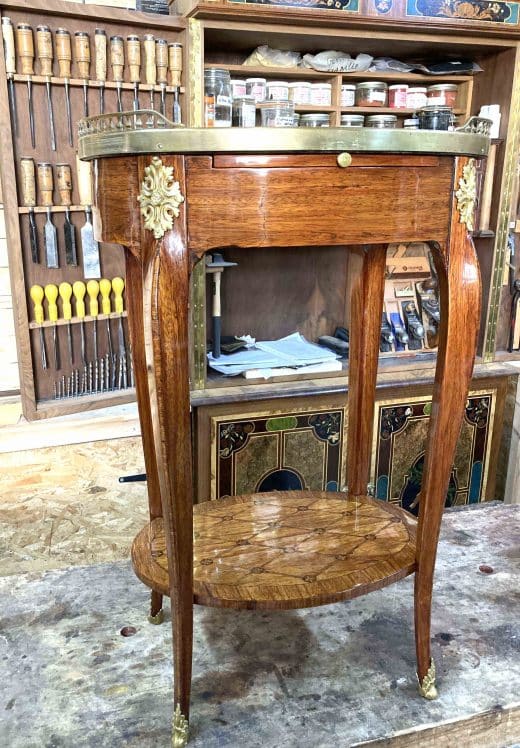
Restoration of a Transitional Period (1750-1774) satinwood veneer salon table stamped by Pierre Garnier (circa 1726-1800). Originally from Paris, and the son of master cabinetmaker François Garnier, Pierre Garnier obtained his master's certificate on December 31, 1742. In contrast to his father, François left the Faubourg Saint-Antoine for the rue Neuve-des-Petits-Champs, near the Place Vendôme. His clientele consisted of merchants such as Léonard Boudin and Pierre Migeon, but above all of the kingdom's wealthiest figures, such as Louis Georges Erasme, Marshal of France, the Duchess of Mazarin, and the Marquis de Marigny, […]

Transition cylinder desk

A few years ago, I had the opportunity to restore this magnificent Transition period (1780) roll-top desk. It is framed in oak and fir. The fall front is primarily veneered with rosewood laid in a paillon pattern, framed by a light stringing of boxwood and green-stained hornbeam, bordered by a thin band of amaranth. The back is veneered in satinwood. The central marquetry, on a tobacco-stained sycamore ground, depicts musical instruments and two doves taking flight, each carrying a musical score in its beak. This […]

Transitional chest of drawers stamped LARDIN

Ebénisterie Mathieu Vath

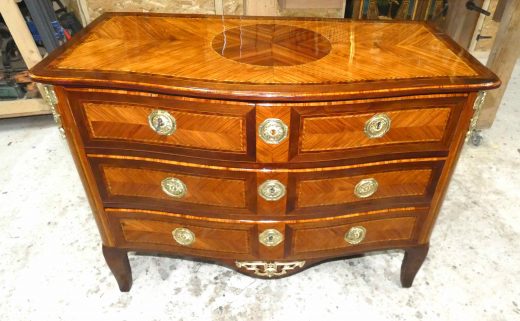
Restoration of a Transition period commode built of fir and oak and veneered with rosewood, framed with stringing of white hornbeam and green-stained wood, with a satinwood band surrounded by amaranth. The central medallion is satinwood veneer assembled in a herringbone pattern. The maker's mark and the JME (Journée des Métiers d'Étranger) are located at the base of the left rear leg. André-Antoine Lardin (1724 – August 10, 1790) obtained his master craftsman's certificate on July 1, 1750, and established himself on the rue de Charenton under the sign "Au Bois de Boulogne." He worked there until 1770, the date […]

Regency commode stamped J.BIRCKLE

Ebénisterie Mathieu VATH

Restoration of a chest of drawers veneered in Rio rosewood and satinwood stringing. It has two large drawers and two small ones in the upper section. Its frame is made of oak and fir. It is stamped J.BIRKLE on the left upright and also bears the mark JME. It shows some signs of restoration and an ink mark on one side of a drawer. Jacques Bircklé (1734-1803) – Cabinetmaker – master craftsman obtained on July 30, 1764. One of the suppliers to the Royal Furniture Repository under Louis XVI. Freelance craftsman before […]