Louis XV style bookcase

Ebénisterie Mathieu Vath

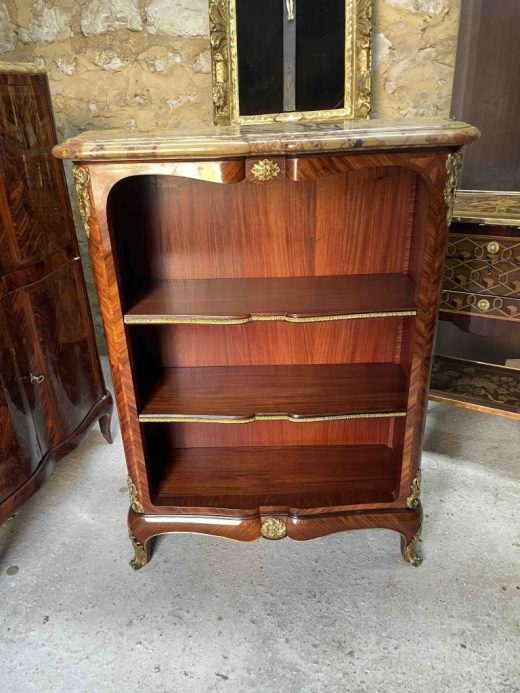
The restoration of this Louis XV style bookcase, dating from the Napoleon III era and stamped by Léon Dromard, is now complete. Its structure is made of oak, covered with a kingwood veneer, displaying a style very close to that produced by the cabinetmaker Pierre IV Migeon in the 18th century. But do you know what a bookcase is? A bookcase is a small, open storage unit that appeared in the 18th century, designed to hold books and decorative objects. Appreciated for its lightness and elegance, it quickly became a staple in refined interiors, […]
Transition secretary desk in the style of Montigny

Ebénisterie Mathieu Vath

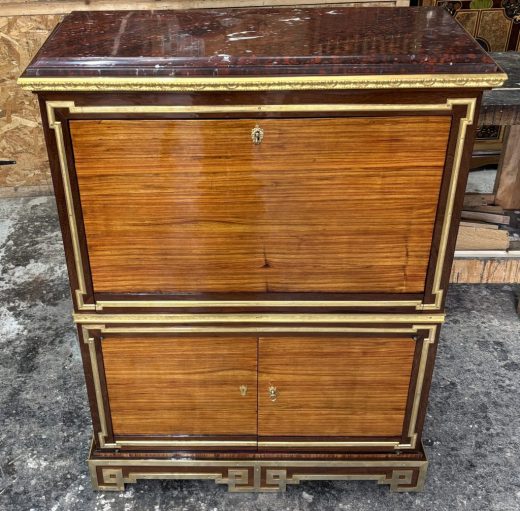
Restoration of a 19th-century Transition-style drop-front secretary, veneered in rosewood and amaranth on an oak frame. This secretary is a learned interpretation of Parisian models from 1765-1775 and is directly inspired by the famous secretary attributed to the cabinetmaker Philippe-Claude Montigny, now in the Musée des Arts Décoratifs. The stylistic similarities with the museum model are immediately apparent in the architectural design of the piece, the treatment of the stepped legs, and the use of bronze ornamentation inspired by the Greek style. The piece adopts […]

Boulle Napoleon III liquor cabinet

Ebénisterie Mathieu Vath

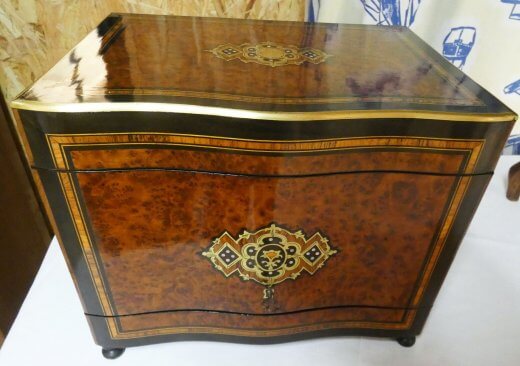
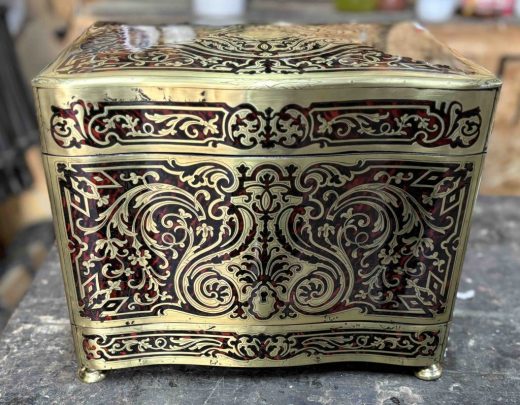
Restoration of a Napoleon III liquor cabinet in tortoiseshell and brass marquetry. The liquor cabinet, an elegant and ingenious piece of furniture, appeared at the end of the 18th century. Initially designed to accompany long carriage journeys, it allowed for the easy transport and consumption of liqueurs. Its true rise in popularity, however, occurred in the 19th century, a period during which it became a symbol of refinement and the French art of living. This piece of furniture takes the form of a box, called a "caisson," […]

Louis XIV low bookcase

Ebénisterie Mathieu Vath

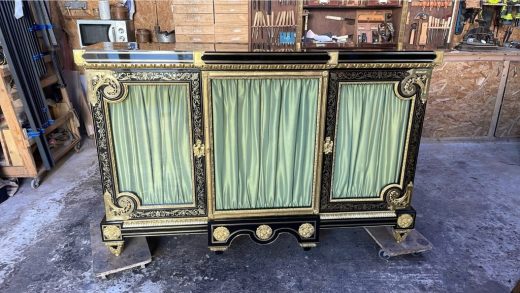
Restoration of a low Louis XIV style bookcase, in Boulle marquetry of brown tortoiseshell and brass, ebony, and chiseled and gilded bronze ornamentation. The central projecting front opens with three glazed doors decorated with scroll and foliage motifs, resting on tapered legs. This type of three-part low cabinet was one of Boulle's great successes, and he himself offered several variations. The Louvre Museum, in fact, owns no fewer than six examples. These pieces of furniture, particularly suited to the display […]

Empire Table

Ebénisterie Mathieu Vath

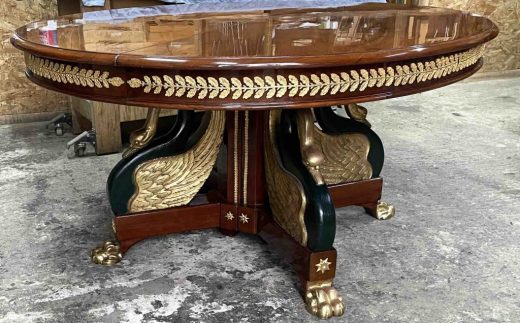
The restoration of this Empire dining table is now complete. The work focused primarily on the finishing touches. We removed the previously applied polyurethane varnish and applied a French polish to the solid mahogany top and its four-legged base decorated with swan neck motifs and lion's paw feet. The apron features an oak frieze. Length x Width = 162 x 140 cm. Length x Width with extensions = 252 cm.

Empire Desk

Ebénisterie Mathieu Vath

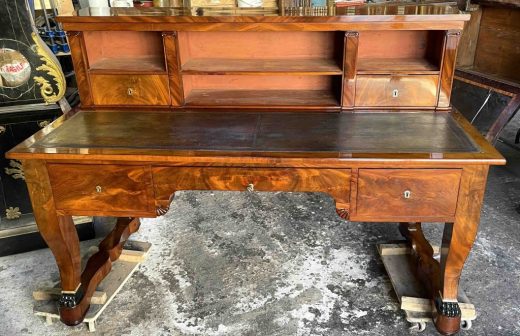
Restoration of an Empire period desk veneered in mahogany burl on an oak frame. The four "chimera thigh" legs are connected by intermediate stretchers and rest on lion's paw feet. The Empire style, which emerged in the early 19th century during the reign of Napoleon I, is an artistic and decorative expression closely linked to the Emperor's desire to create a new, grandiose, and imperial aesthetic, befitting his power. Heir to the Neoclassical movement that began in the 18th century, […]

Nesting tables by Emilie Gallé

Ebénisterie Mathieu Vath

Restoration of a set of four Art Nouveau nesting tables, crafted and stamped with marquetry on each tabletop by the Gallé workshops. The beechwood bases are adorned with a naturalistic decoration of tree branches, and feature marquetry of daffodils, seascapes, and lapping catkins. The woods used for this marquetry are ash, walnut, sycamore maple, rosewood, mahogany, walnut burl, and elm. Émile Gallé (1846-1904) Émile Gallé is an emblematic figure of Art Nouveau, renowned for his contributions […]

Empire Inkwell

Ebénisterie Mathieu Vath

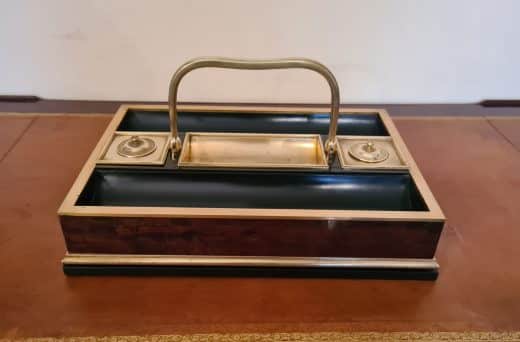
Restoration of a late Empire inkwell, rectangular in shape, surmounted by a central dish with a lid pierced with palmettes and handles in the form of flowering tassels, held by two winged putti with quivers on their backs and volute tails, flanked by two inkwells decorated with trellis patterns and surmounted by a pierced lid with acorn-shaped knob, the body with an inset pen niche, the frieze centered by a mask of Apollo emitting stylized foliate trails, on a molded plinth, on feet. Simply veneered with a […]

L Cueunieres Writing Desk

Ebénisterie Mathieu Vath

A small restoration for this very pretty Louis XVI style inkwell, stamped L.CUENIERES jne. Louis Cueunières jeune, established at 10 rue Villehardouin in Paris in 1870, specialized in the restoration of antique furniture and the reproduction of period pieces. This inkwell was in fairly good condition. Apart from a few small pieces of missing ebony, it was simply dirty. A few ebony grafts, a good cleaning, and a touch-up of the varnish with a French polish were enough to restore its former luster. To see previous restorations: https://ebenisterie-mathieuvath.fr/en-ce-moment-a-latelier/ You can find this piece at […]

Louis XV style flat desk

Ebénisterie Mathieu Vath

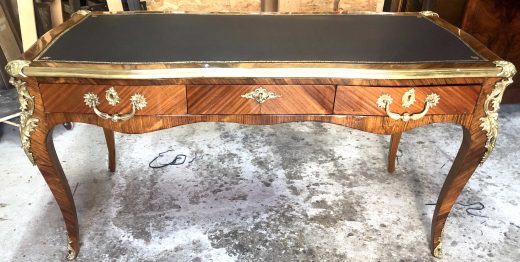
A second life for this Louis XV style desk veneered in Rio rosewood (Dabergia niera) and African mahogany (khaya). Besides the construction and visible tool marks, dating this desk is greatly facilitated by the presence of this African mahogany. Indeed, it was from the late 19th century that this type of mahogany began to arrive from the west coast of Africa and became prevalent in all furniture production at the beginning of the 20th century. The restoration consisted of re-gluing the structure […]

Prie-Dieu

Ebénisterie Mathieu Vath

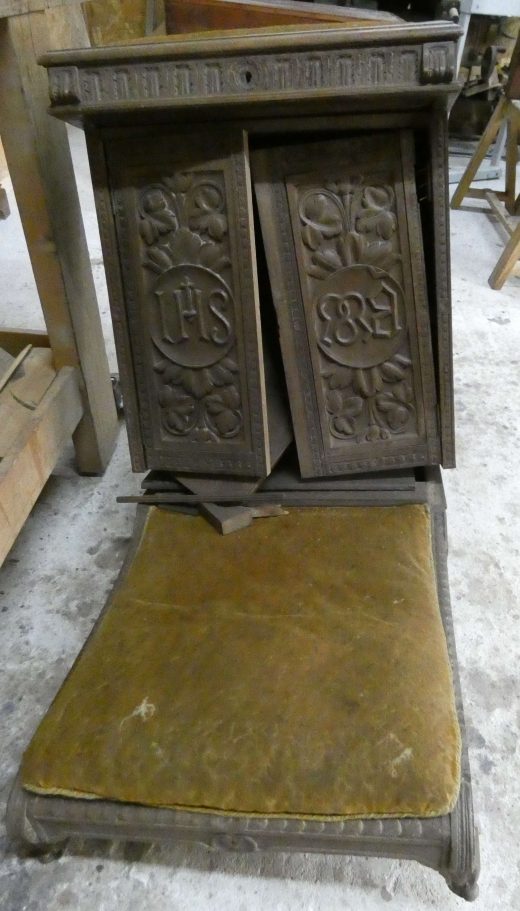
A first contact and a truly beautiful job by Rachèle on the restoration of this walnut prie-dieu dating from the late 19th century. The project was quite daunting. Left abandoned for years, it had been ravaged by wood-boring insects. The first task was to treat the piece with anoxic agents for 21 days. Then, as nothing was holding together anymore, each element was disassembled, which wasn't too difficult, and then glued back together […]

Napoleon III side table

Ebénisterie Mathieu Vath

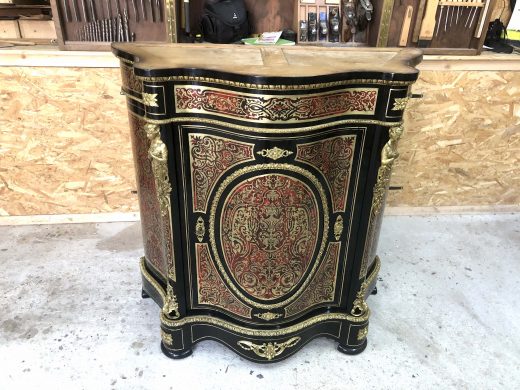
A Napoleon III period side table with a quadrangular structure veneered in blackened pearwood, adorned with rich Boulle marquetry in brass and red tortoiseshell forming an arabesque design composed of foliate scrolls, rocaille motifs, and small flowers. The whole is punctuated by beautiful gilt-bronze mounts featuring atlas figures with clasped hands, acanthus leaves, and an apron. The top is framed by a gadrooned molding supporting a black marble slab with rounded edges. It opens with a door with a lock […]

Napoleon III Boulle marquetry side table

Ebénisterie Mathieu Vath

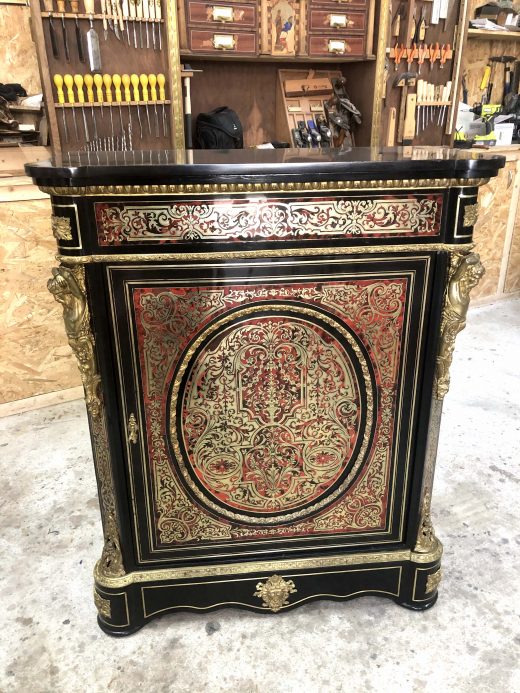
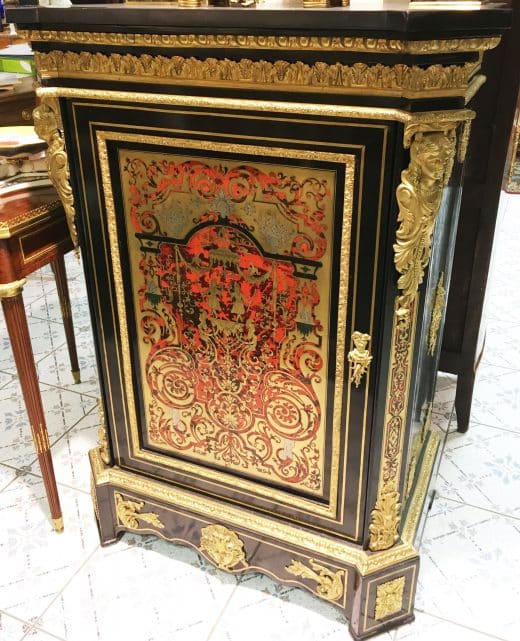
A console table veneered in ebonized pearwood and inlaid with Boulle marquetry of brass on tortoiseshell in arabesque designs. It opens with a door adorned with an oval medallion, revealing shelves in mahogany and mahogany veneer. Rich ornamentation of chased and gilded bronze: egg-and-dart friezes, caryatids in corner drops, interlaced friezes, acanthus leaf friezes, fruit, and florets. This Boulle piece requires extensive restoration. Some pieces of brass, stringing, and especially a great deal of tortoiseshell are missing. Given its value […]

Restaurant Secretary

Ebénisterie Mathieu Vath

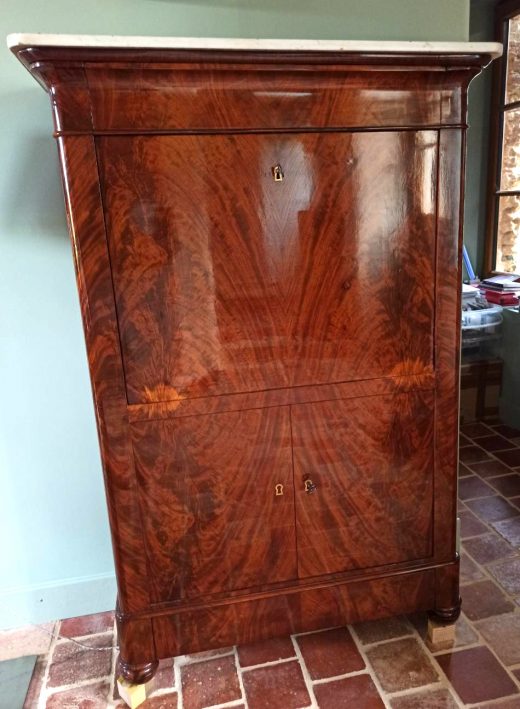
Restoration of a Restoration period (1815–1830) drop-front secretary veneered in burr mahogany and topped with Carrara white marble. The front legs are rounded and the rear legs are square. The frame is made of oak and softwood. An inventory mark (I91) is found inside the lower drawer on the right side. The Restoration style? After Napoleon's defeat at Waterloo on June 18, 1815, power in France was taken over by the two brothers of Louis XVI: the Count of Provence, who would reign under the […]

Empire Dressing Table

Ebénisterie Mathieu Vath

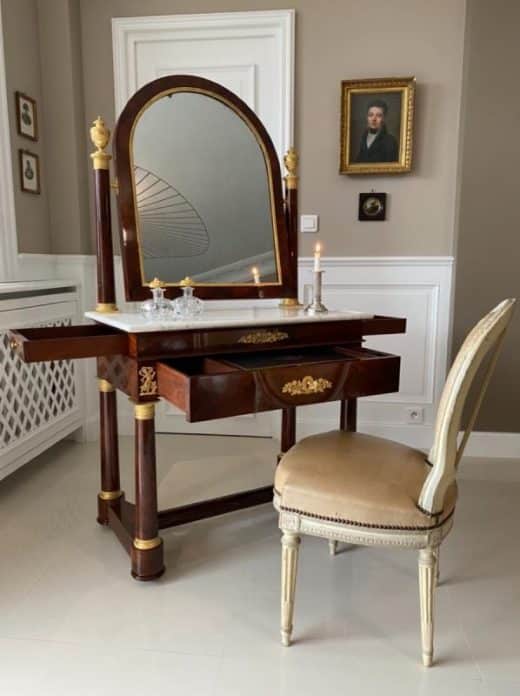
A beautiful restoration and, above all, conservation effort has been undertaken on this lovely Empire-period dressing table. Its frame is made of oak and poplar, veneered with mahogany burl. The drawer sides and bottoms are solid mahogany. It rests on four column legs ending in casters and joined by an H-shaped stretcher. The frieze opens with a drawer revealing a writing surface lined with blue morocco leather, a pen case, and two compartments for inkwells, as well as two large drawers on either side for essentials […]

Table à la Tronchin

Ebénisterie Mathieu Vath

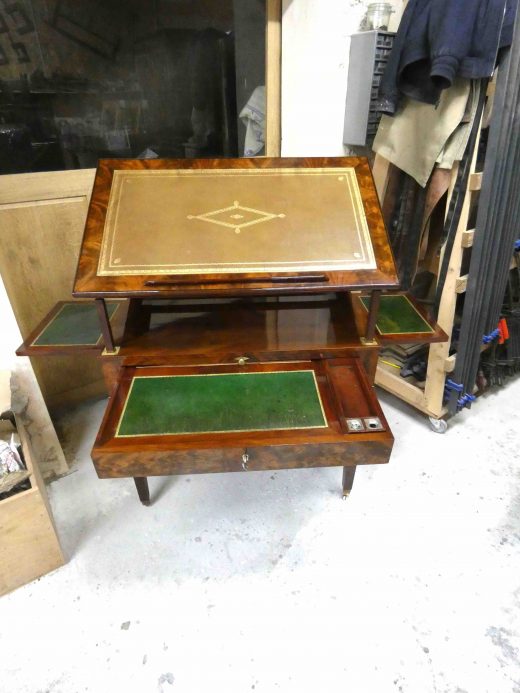
A little refresh for this lovely Tronchin-style table. Apart from a missing molding and a few small veneer chips on the legs, nothing too serious. A touch-up of the varnish was enough to give it a new lease on life. But do you know where this type of table comes from, and what it was used for? Although today attributed to Théodore Tronchin, a Genevan physician (1709-1781), who at the time published works on bone diseases linked to poor posture at one's desk, he cites the advantages that […]

Mahogany games table, late 18th - early 19th century

Ebénisterie Mathieu Vath

96 x W 47.5 x H 74 cm. Open: 96 x 95.5 cm. Restoration of a games table with a folding top veneered in burr mahogany, commonly known as Cuban mahogany. In fact, according to the recent book "L'essence du bois" (The Essence of Wood) by Patrick George, Emmanuel Maurin, and Marie-Christine Troujy-Jaquemet, it seems more accurate to call this type of mahogany Saint-Domingue mahogany. The base is veneered in solid oak, and the top in poplar. The moldings are solid mahogany. The table rests on legs […]

Empire secretary with quiver

Ebénisterie Mathieu VATH

You remember the Empire chest of drawers with the quivers. Well, here is the secretary desk with the quivers. It is built in exactly the same way as the chest: same construction, same solid woods used, and same mahogany veneers. As for the restoration, it is identical to that of the chest of drawers. The aim is to preserve as much as possible and restore the piece of furniture to its original function without altering its history. The work therefore consisted of reattaching the structure and the few detached veneer elements. And to […]

Empire Chest of Drawers with Quivers

Ebénisterie Mathieu VATH

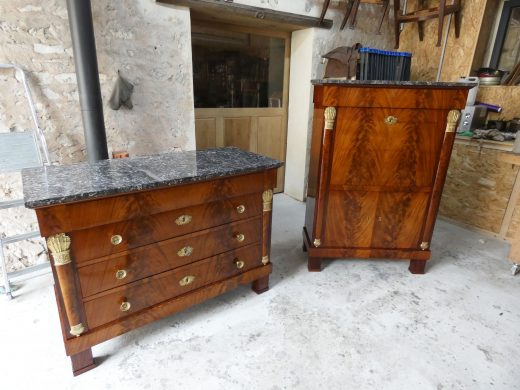
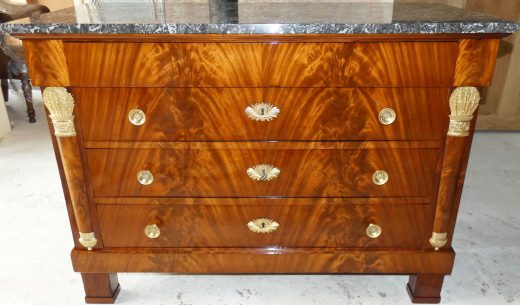
This week, here are some photos of the restoration of this Empire-style chest of drawers veneered in mahogany burl. This chest is truly unique due to the quality and originality of its bronze mounts. Indeed, they form quivers along with the side columns. The keyhole escutcheons are composed of two crossed laurel branches held together by a ribbon. Originally, they were mercury-gilded, as can be seen from the gilding stains on the back. Unfortunately, only a few partial traces remain on the front […]

Small Boulle marquetry cartel clock

Ebénisterie Mathieu VATH

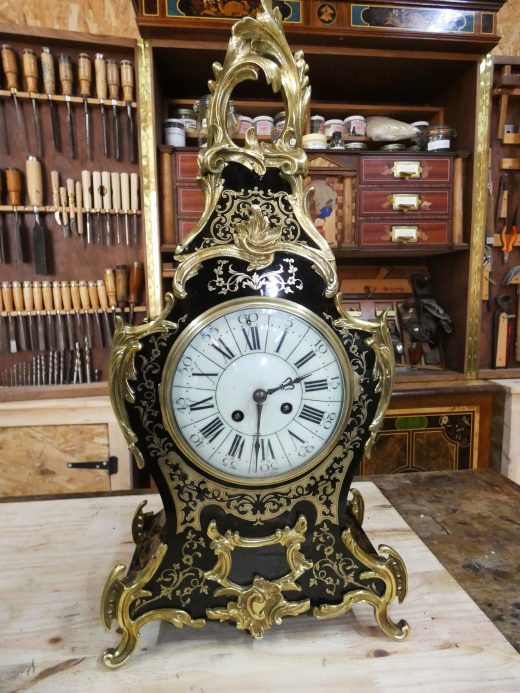
Restoration of a Napoleon III period marquetry clock in brown tortoiseshell on a black ground and brass. Despite dust, oxidation, and years spent in the depths of an attic, this small clock is in very good condition. Except for a missing piece of brass on the right side of the capital, it is complete. The gilding is still clearly visible beneath the layer of grime, and the structure is in perfect condition. The restoration was therefore straightforward: re-gluing all the marquetry under vacuum, then a light cleaning, and a varnishing with […]

Napoleon III wall shelf

Ebénisterie Mathieu VATH

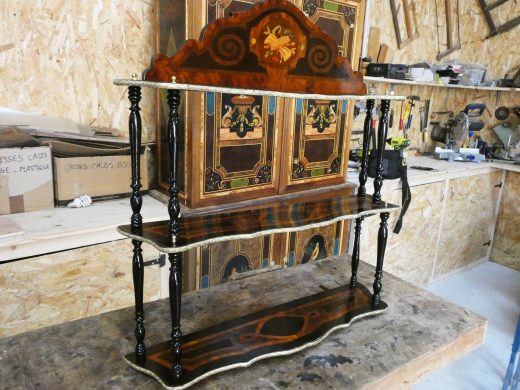
Restoration of a Napoleon III period wall shelf veneered in blackened pearwood, rosewood, amaranth, amboyna burl, and marquetry with a music theme. Underneath the dust, aside from small losses in the blackened pearwood and rosewood, and slight dehydration, there was nothing too serious. A few veneer grafts, a vacuum-sealed glue application, a thorough cleaning, a coat of clear French polish, and voilà! All this without using sandpaper. Except for lightly sanding the varnish […]

Napoleon III liquor cabinet

Ebénisterie Mathieu VATH

It would seem that the first liquor cellars appeared at the very end of the 18th century. But it was in the 19th century that the fashion for liquor cellars truly took off. The revolution transformed social classes and ways of socializing, leading to increased consumption of liquor, which contributed to the rise of this new social object. The emergence of liquor cellars is, of course, directly linked to the evolution of alcohol consumption in France, such as sweet Mediterranean wines, brandies, cognac, liqueurs, and more.

Louis XVI style desk stamped KRIEGER

Ebénisterie Mathieu VATH

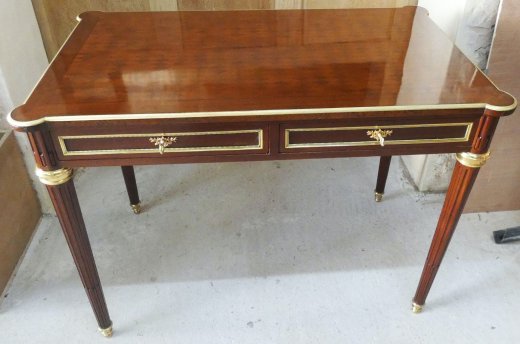
Exquisitely crafted with its mahogany-veneered oak frame and solid mahogany legs, this desk is a perfect example of high-quality 19th-century furniture. The cabinetmaking is flawlessly executed, and the bronze mounts are in pristine condition. Everything is there; nothing is missing. The Krieger firm began its cabinetmaking business in the mid-19th century with Antoine Krieger (1804-1869) before adding a significant decorative department, which ensured the prestige of its business until around 1945. The Krieger firm produced all the […]

Napoleon III Boulle marquetry side table

Ebénisterie Mathieu VATH

Restoring this piece of furniture is a classic. The door was warped and almost all the brass inlay was missing. Its main advantage was that the marquetry on the door was fairly well preserved, apart from a small amount of missing brass and a few pieces of dyed horn. Nothing too serious. So I started by removing the bronze mounts, then I remade and glued all the missing inlays, reattaching those that were still there in the process. Next, I tackled the door. After removing the veneer […]

Louis XVI style sewing box

Ebénisterie Mathieu VATH

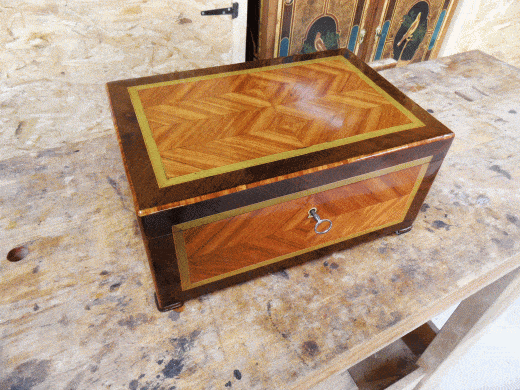
This sewing box dates from the Napoleon III period. The frame is made of softwood. The veneer is composed of Rio rosewood, mahogany for the interior, and a green-stained boxwood and maple inlay. The great quality of this box is that the lid hasn't warped. This is often the major problem with this type of furniture, as people forget to lock them, causing the wood to warp. It then becomes very difficult to find the "trick" to ensure the box stays closed.

Empire bed

Ebénisterie Mathieu VATH

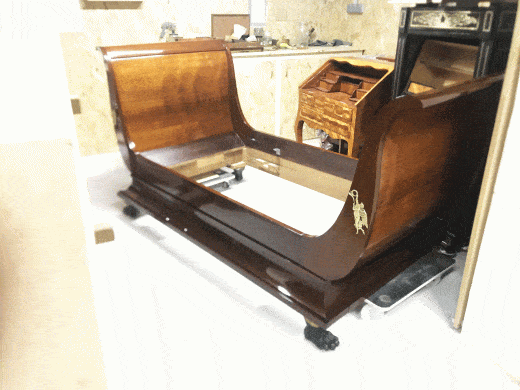
The "boat" bed, with its characteristic curve, is a French invention that appeared during the Directory and was very fashionable during the Empire and the Restoration. It is easily recognizable here by its lion's paw feet. The varnish on this bed had worn away, making it impossible to distinguish between the two mahogany pieces. The mahogany is known as Cuban mahogany (Swietenia mahogani), from Cuba, a Spanish colony. Evidence of its importation into Spain, specifically Seville, dates back to 1519-1520. It was used by Philip II between 1563 and 1584 during the construction of the Palace […]

Commode returning from Egypt

Ebénisterie Mathieu VATH

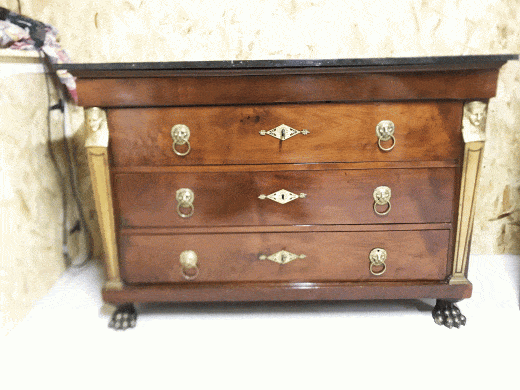
During the turbulent period of the French Revolution, furniture production was considerably diminished, and most artisans experienced very difficult times. Overall, from the Consulate to the Directory, furniture and seating had little time to evolve. However, even though some decorative motifs inspired by Egypt had already appeared, it was after the Egyptian expedition (1798-1801) that they evolved into a unique style. The so-called "Return from Egypt" style, however, lasted only a short time: a decade at most, as it would […]