
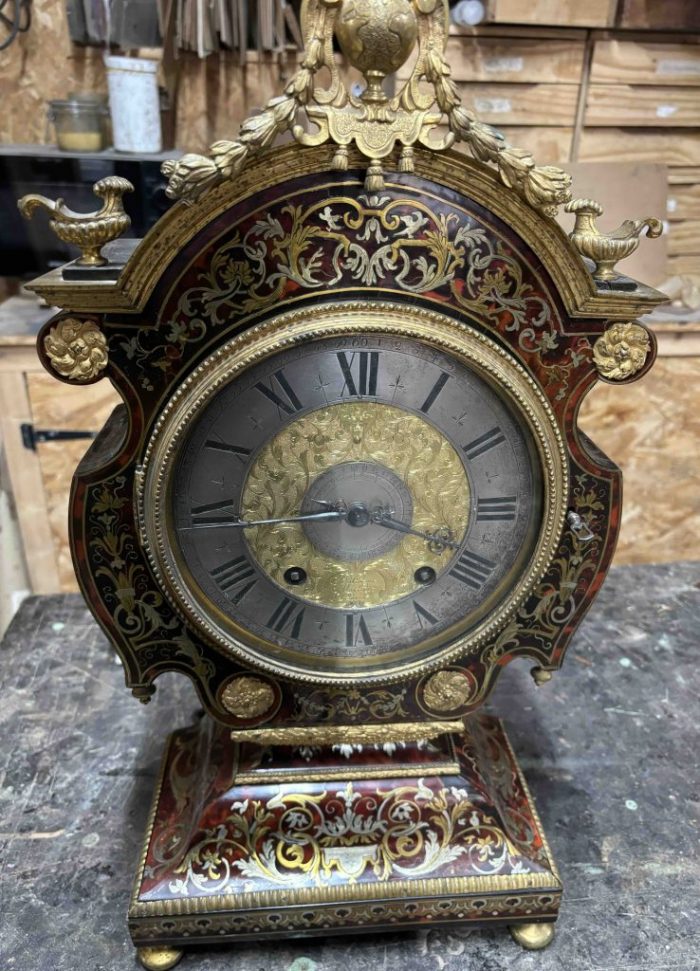
The first project of the year consisted of stabilizing, consolidating, restoring, preserving the finish, and harmonizing the elements. The main objective was to preserve the history and identity of the project as much as possible without dismantling anything.
A masterpiece of Parisian watchmaking from the Grand Siècle
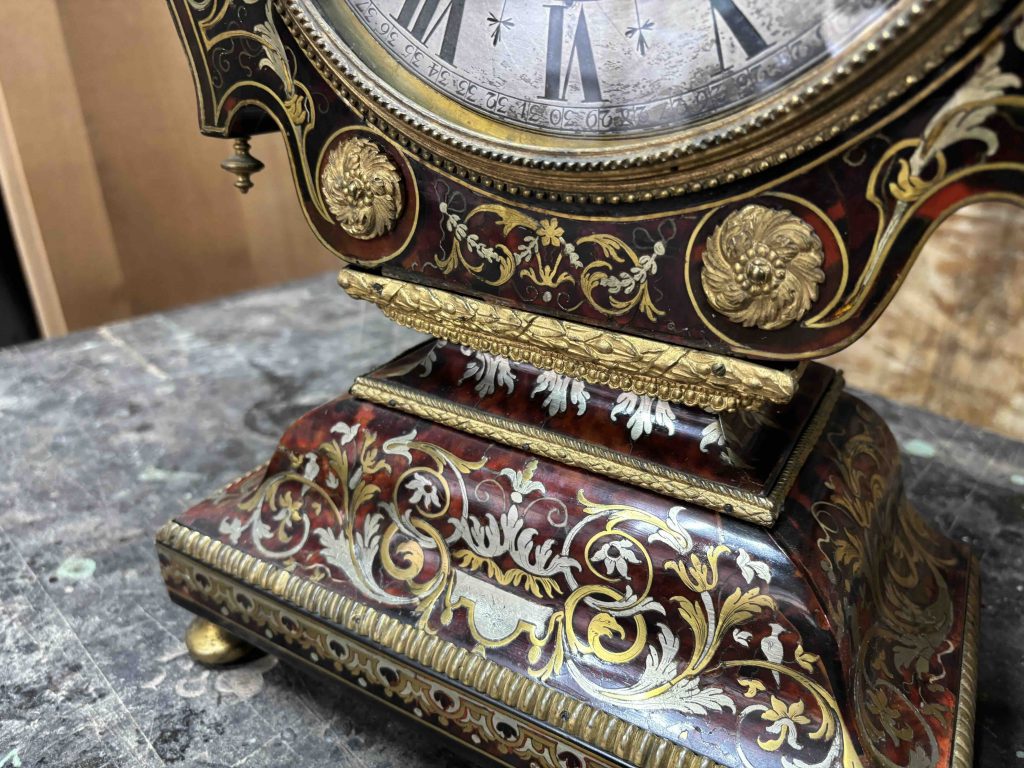
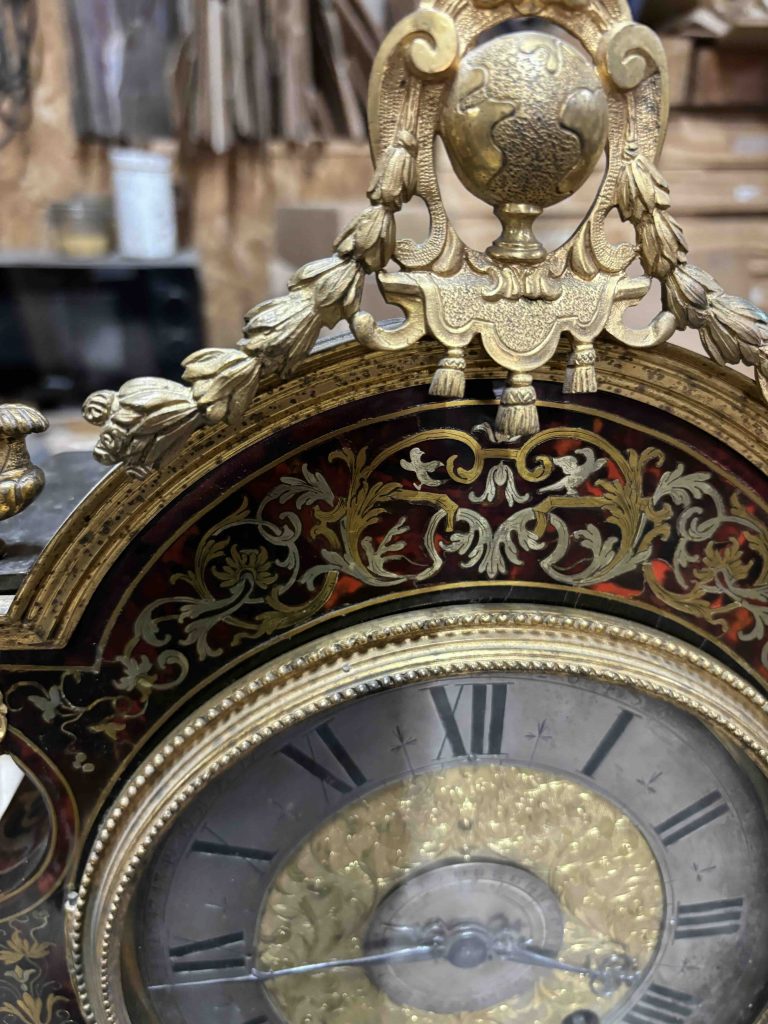
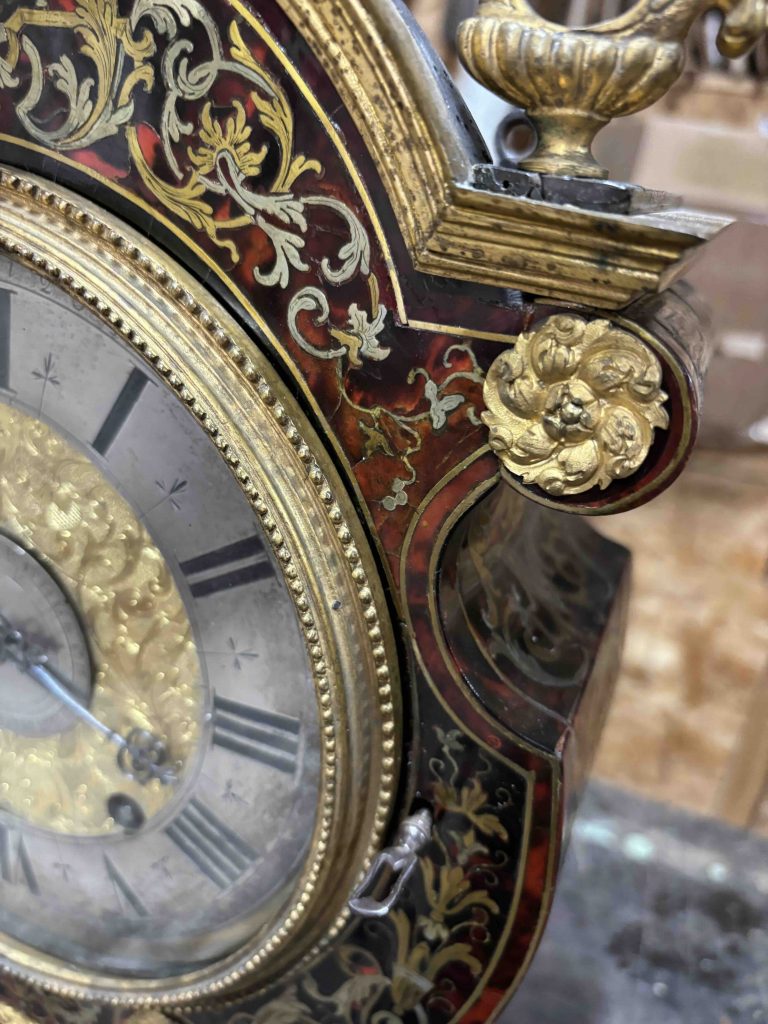
This remarkable clock, known as doll's head is emblematic of Parisian watchmaking production at the end of the 17th century, at the heart of the reign of Louis XIV. Its architectural form, dominated by a circular body flanked by lateral projections and surmounted by a rich crown of gilded bronzes, corresponds to a typology that appeared around 1670–1680 and was reserved for the most prestigious commissions.
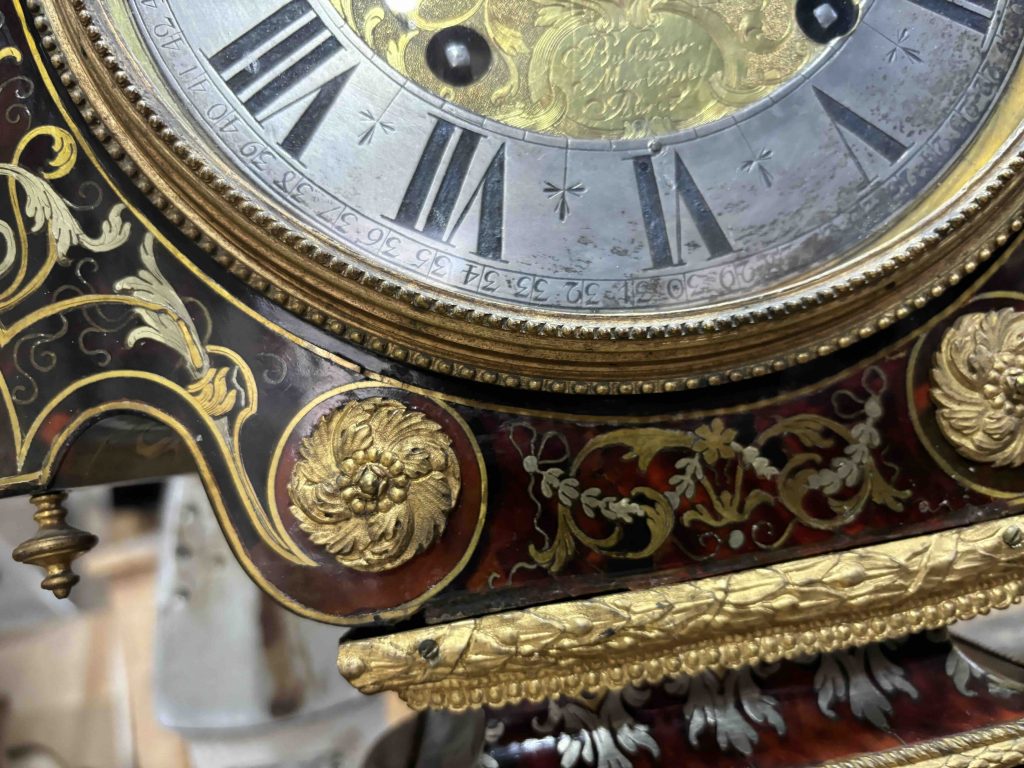
The case is crafted using the Boulle marquetry technique, combining red tortoiseshell, engraved brass, and pewter, displaying a highly virtuosic decoration of scrolls, foliage, and arabesques. This technique, then at the height of its refinement, was closely linked to workshops working for the Court and for leading Parisian collectors.
The silvered and gilded brass dial, with Roman numerals, is centered with a radiating engraved design. The elegant and well-balanced openwork hands are characteristic of the high-quality pieces of the period. The whole piece testifies to a perfect collaboration between watchmaker, cabinetmaker, and bronze worker.
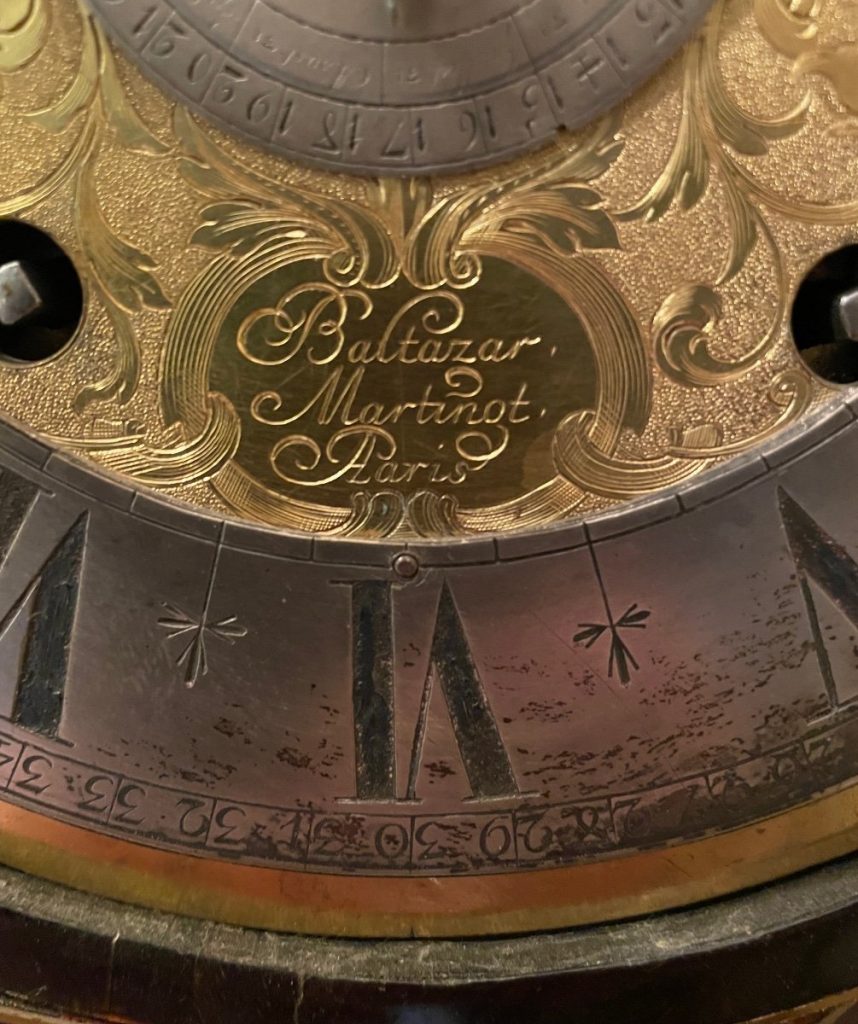
Balthazar Martinot (1636–1714)
Clockmaker to the King and master of time
Balthazar Martinot was born in Paris in 1636, a period marked by the emergence of a more rigorous timekeeping system. While the city still retained traces of the Middle Ages, a modernity characterized by order, symmetry, and rationality was gradually taking hold. Within the Martinot family, watchmakers established for several generations, time transcended the simple notion of an abstraction or a utilitarian tool: it constituted a true vocation. Valentin Martinot, Balthazar's father, instilled in his sons a demanding knowledge based on patience, attentive listening, and precision of hand.
The family workshop provided a secluded and protected environment. The days unfolded there in a repetitive, almost monastic rhythm: filing, adjusting, dismantling, and starting again. Balthazar quickly grasped that the beauty of a clock lay not in its stated function, but in the mechanisms it concealed. The precise workings of a clock movement were a subtle whisper, perceptible only to the trained ear.
As Balthazar Martinot perfected his watchmaking skills, the city of Paris underwent a significant transformation. Under the reign of Louis XIV, the measurement of time became a major political issue. At Versailles, every hour dictated the actions of the King, his ministers, and the Court. Time was no longer simply counted; it was meticulously orchestrated. It was in this context that Balthazar Martinot was appointed Ordinary Watchmaker to the King, a distinction that testified not only to his exceptional talent but also to his impeccable reliability.
Martinot was not a man of ostentation. He readily left the task of captivating the eye to cabinetmakers and bronze workers. His focus was instead on durability. His creations were designed to withstand the test of time, climatic variations, and repeated use. He favored regularity over spectacular ingenuity, consistency over risky innovation. In an era hungry for grandeur, he opted for rigor. These objects did not simply measure time; they stage it. The clock became a symbol of order, permanence, and mastery. It affirmed that the world, while not static, could be precisely regulated. Martinot fully embraced this vision. His works did not seek to impress with their complexity, but rather to reassure with their stability and reliability.

At the end of his life, the world to which he had dedicated himself began to fade away. His majestic reign was drawing to a close, taking with it the monumental aesthetic of the Louis XIV style. Balthazar Martinot died in 1714, at the dawn of the stylistic transformations of the Regency, almost simultaneously with the death of the Sun King. His era ended with him.
He left neither memoirs nor treatises. His legacy lies elsewhere: in these clocks that continue to tick, century after century, indifferent to changing tastes and the upheavals of history. They bear witness to an era when science, art, and power progressed in tandem, and when the clockmaker, discreet yet indispensable, offered the world his measure. In the steady silence of their ticking, one can still perceive today the exacting standards of Balthazar Martinot: those of a man who knew that time, to be mastered, must first be respected.
Bibliography
- Tardy, Dictionary of French Watchmakers — Paris, 1971
- Augarde, Jean-Dominique, The Workers of Time — Anticorum, Geneva, 1996
- Loomes, Watchmakers and Clockmakers of the World — NAG Press, London, 2006
- Bulletin of the Commission of Antiquities of Seine-Inférieure, volume 10 (1894-1896) — p. 425
Good morning,
Do you have a photo of the movement of this clock?
Sincerely
Hello, no unfortunately I don't have any. Sorry