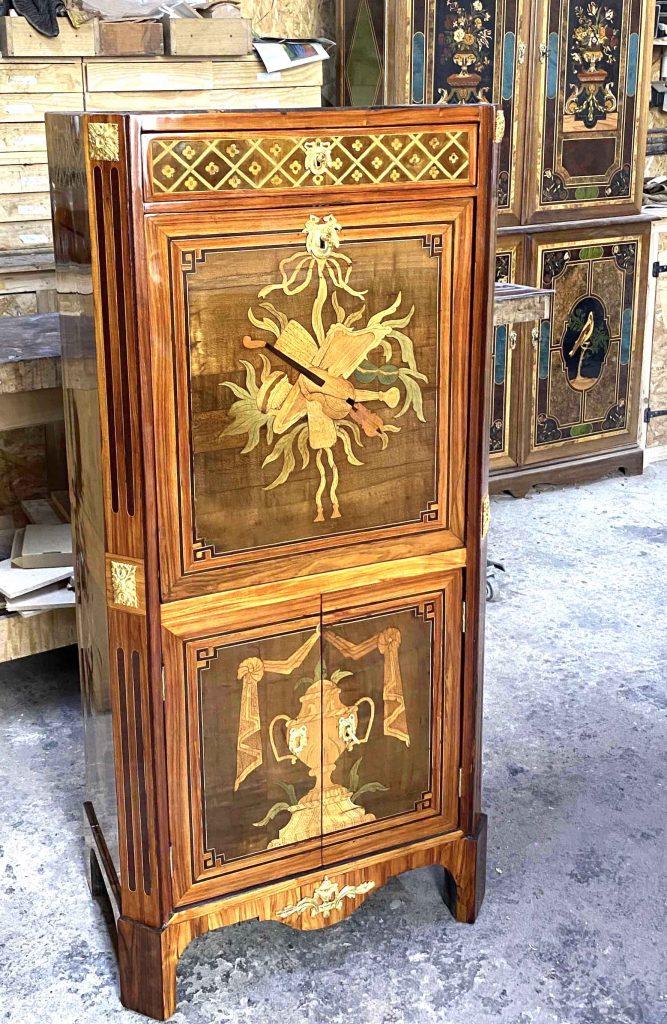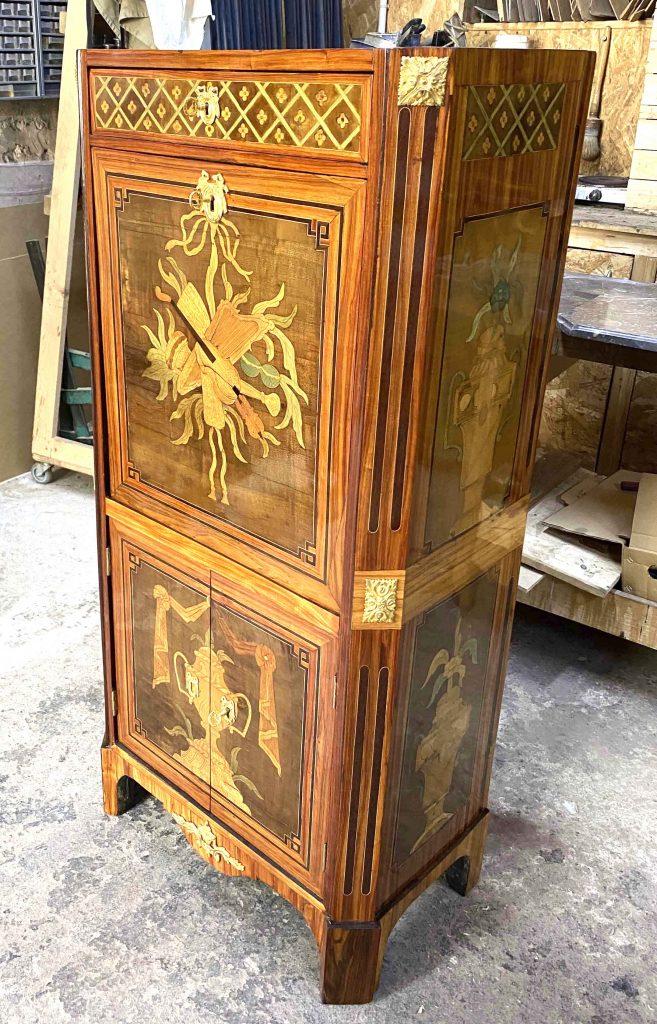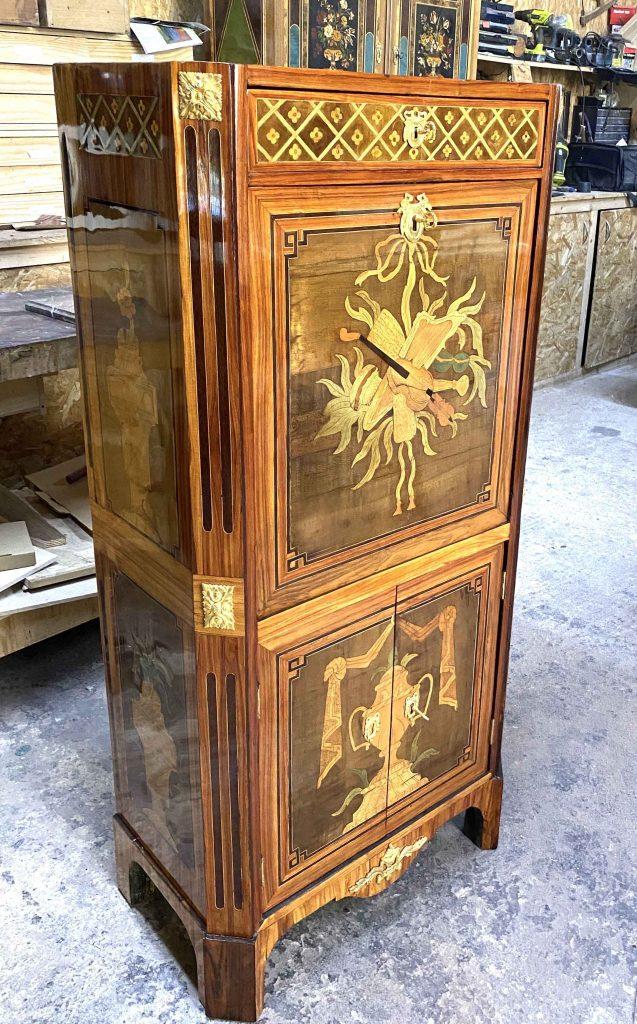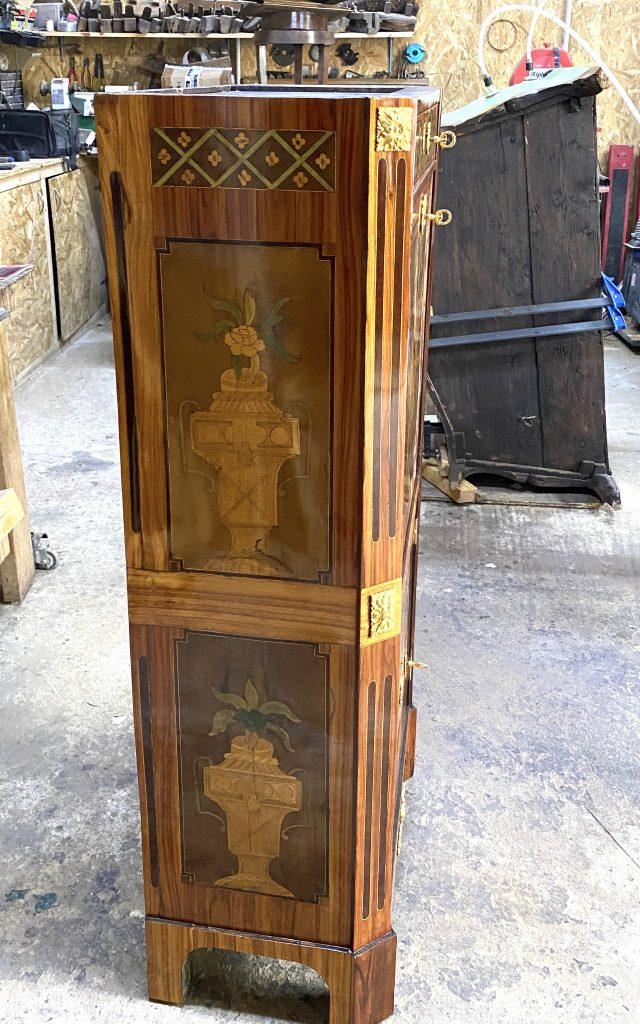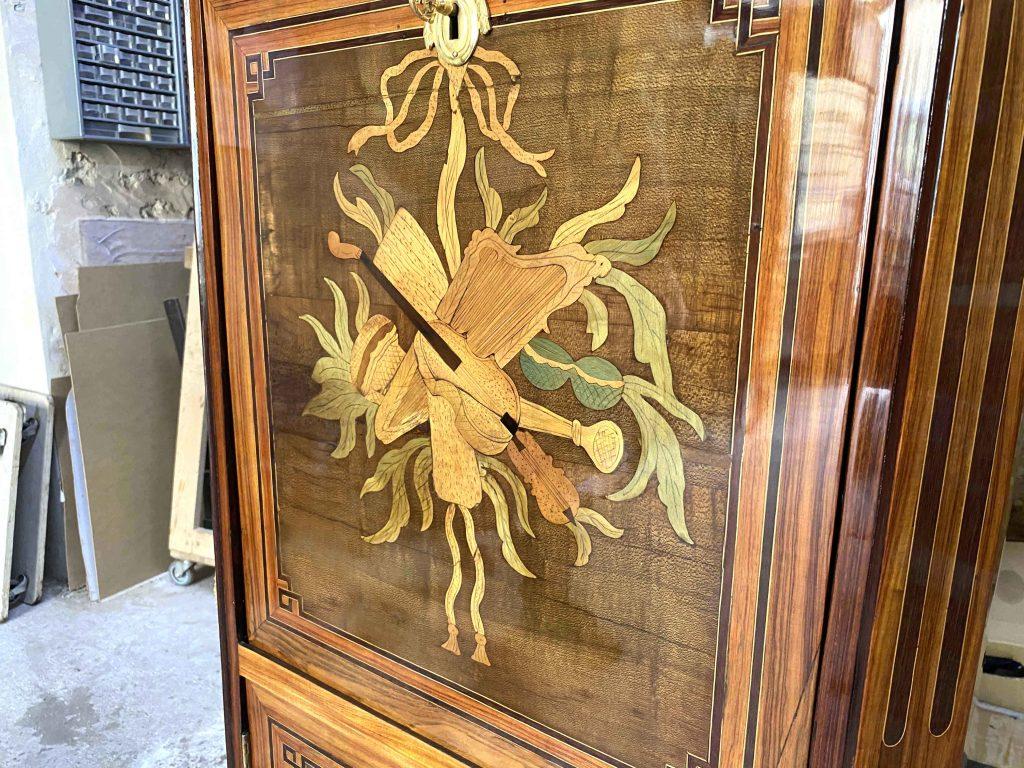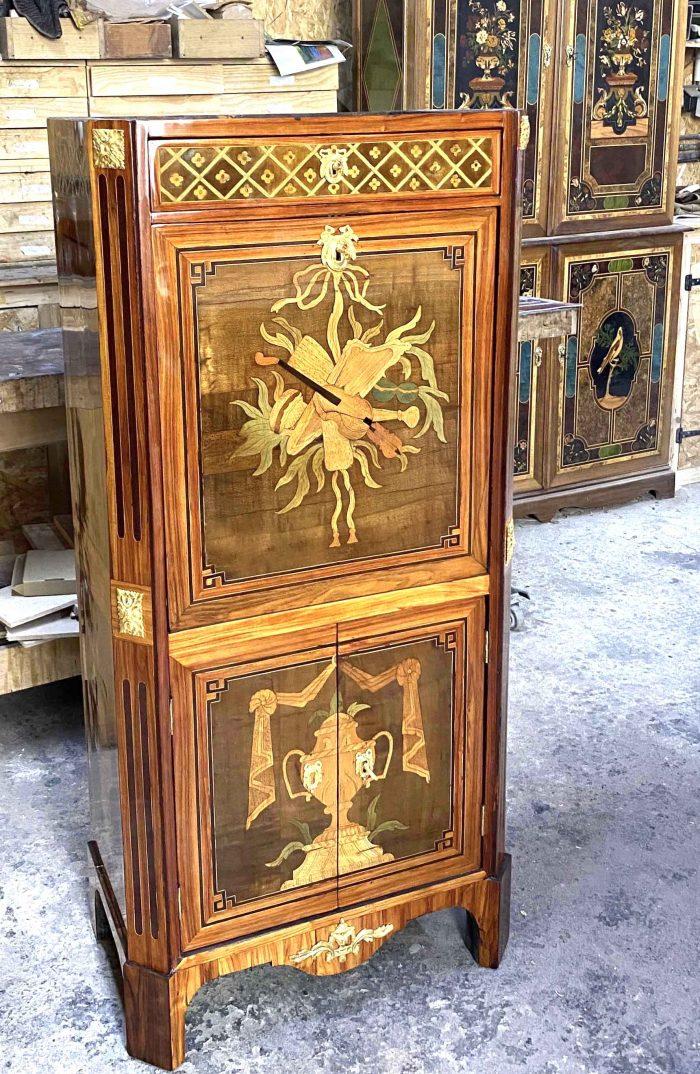
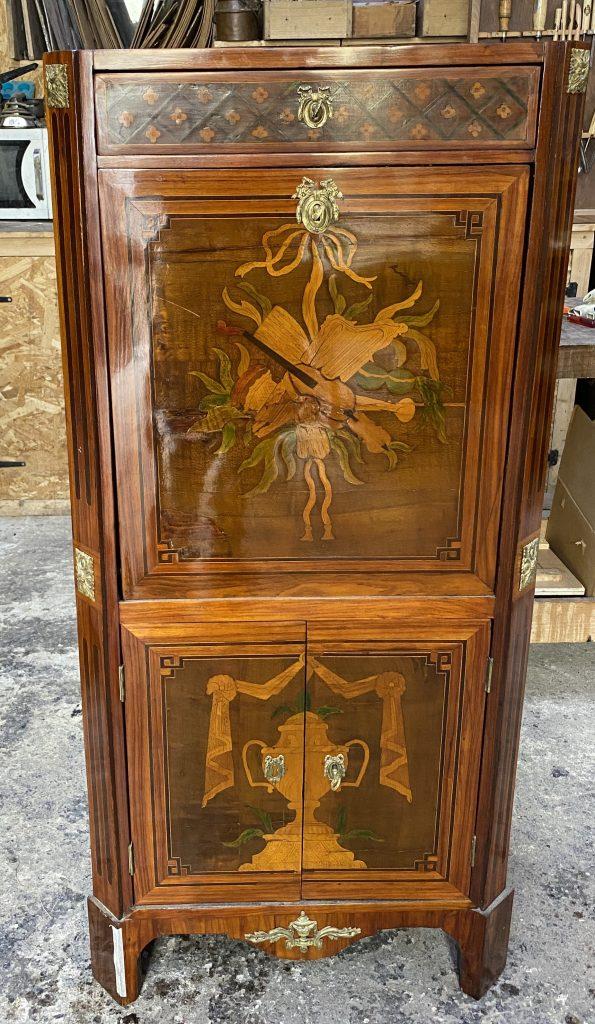
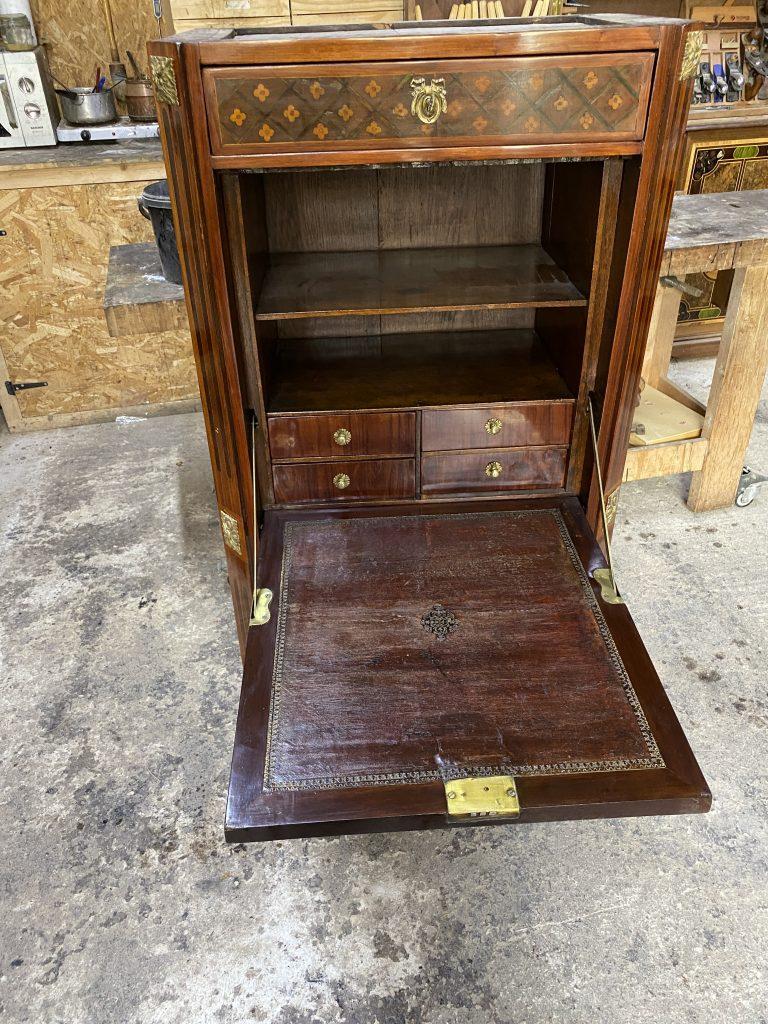
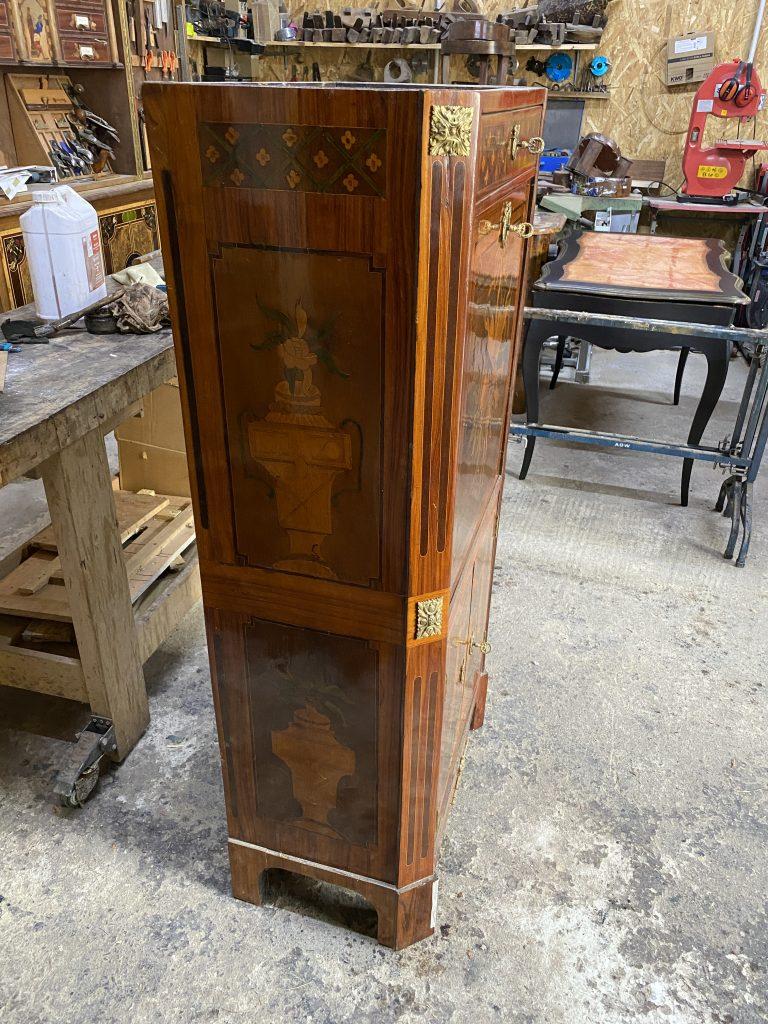
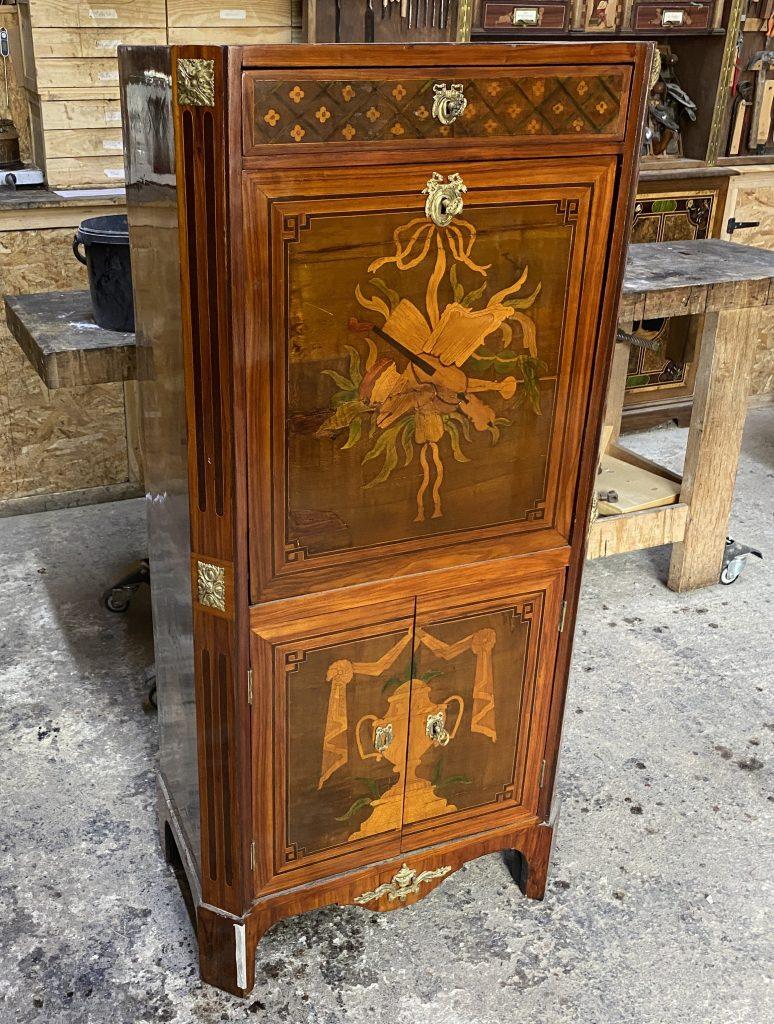
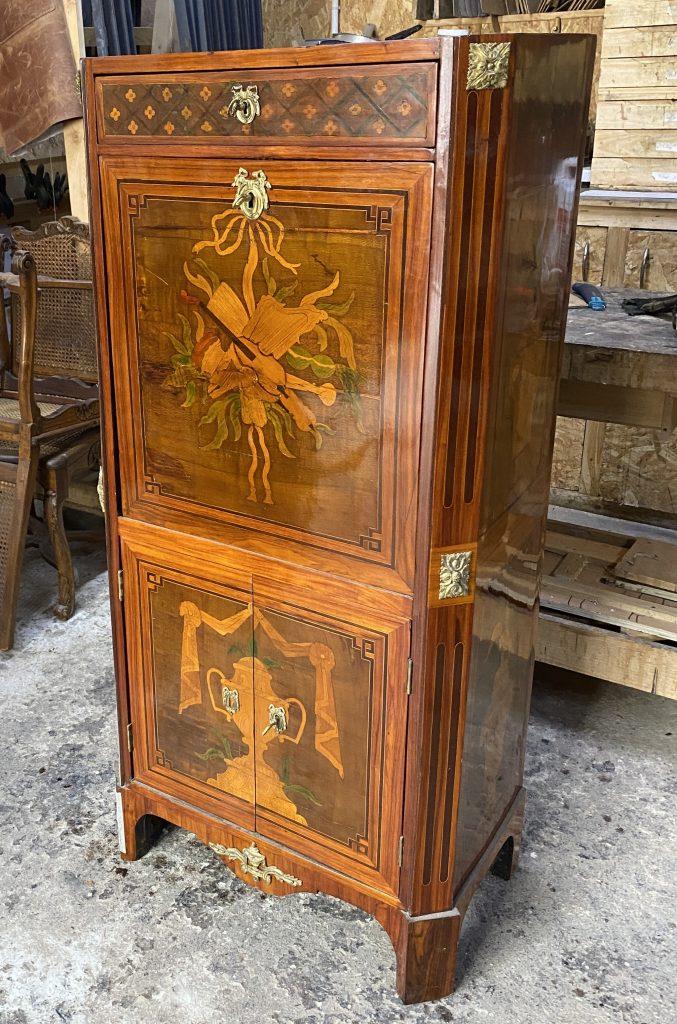
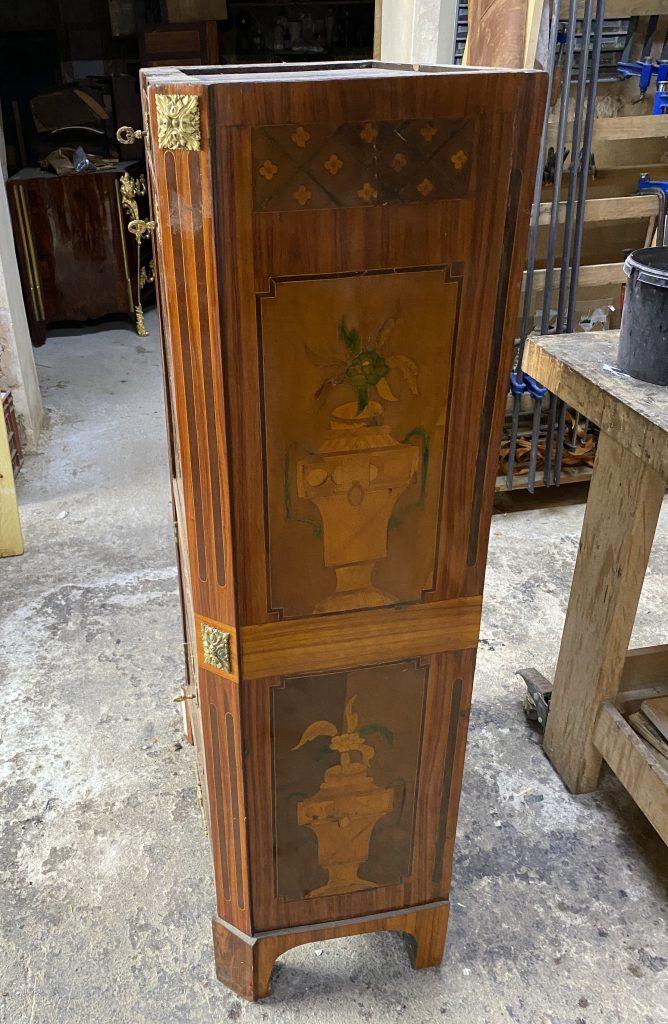
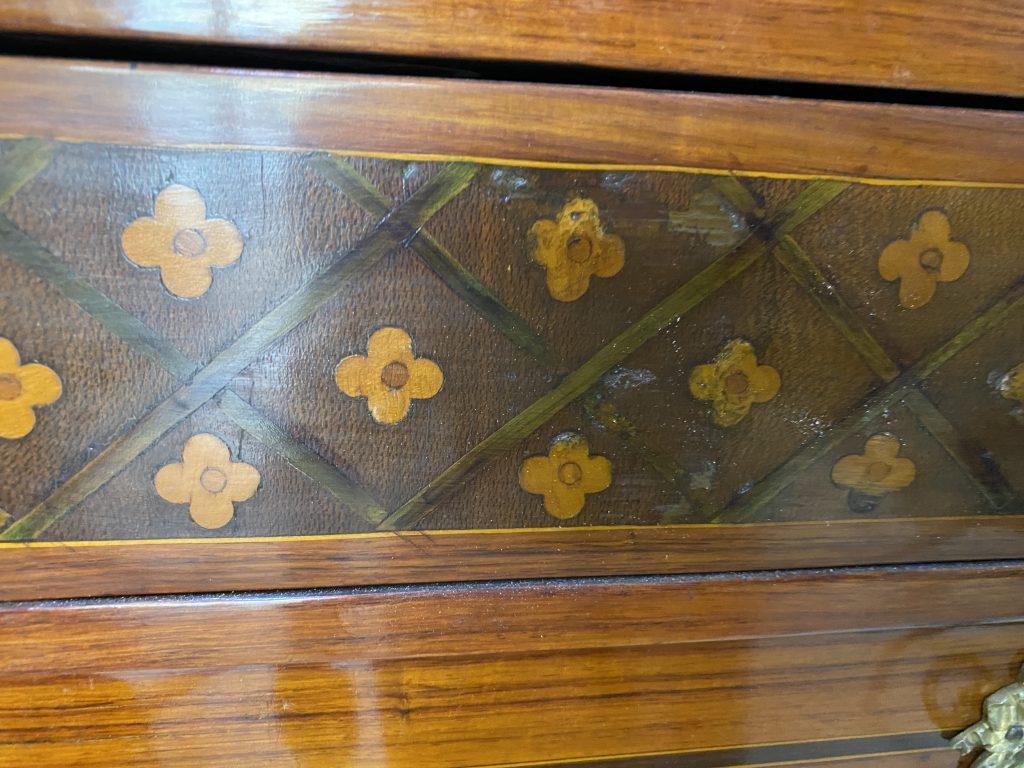
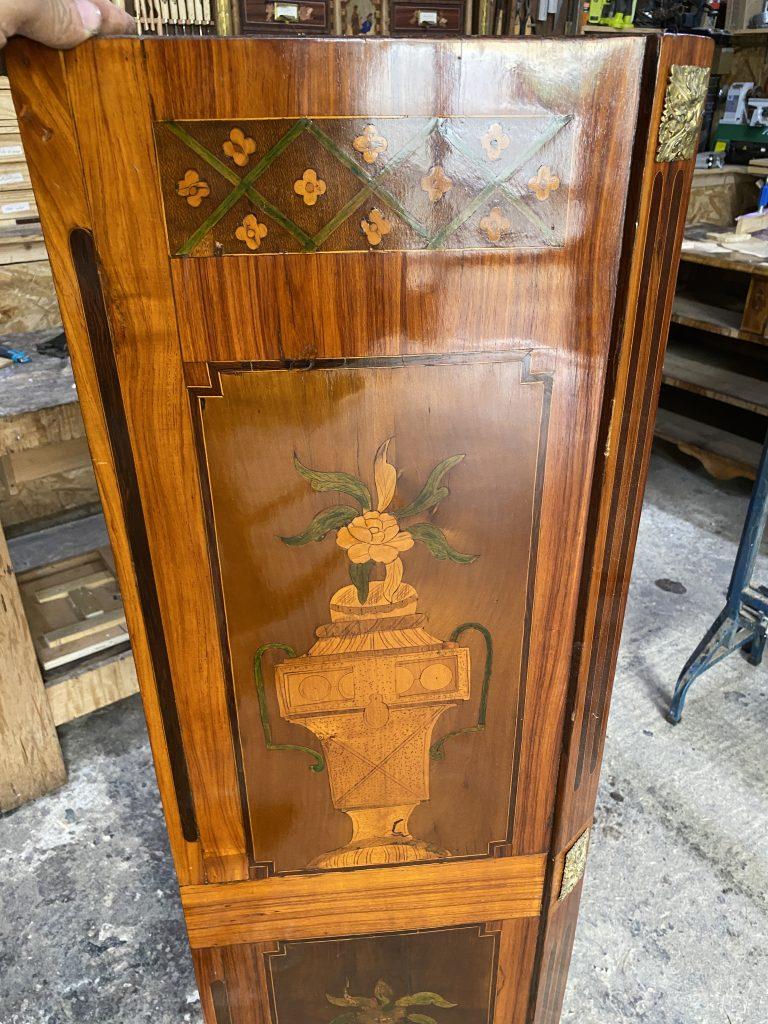
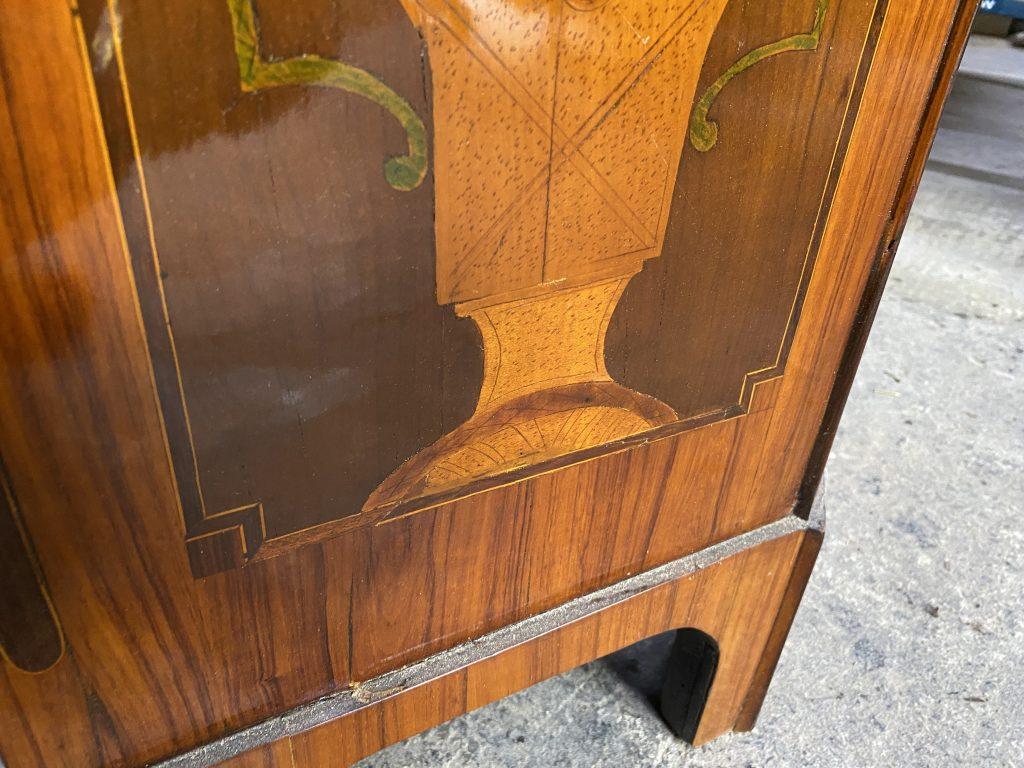
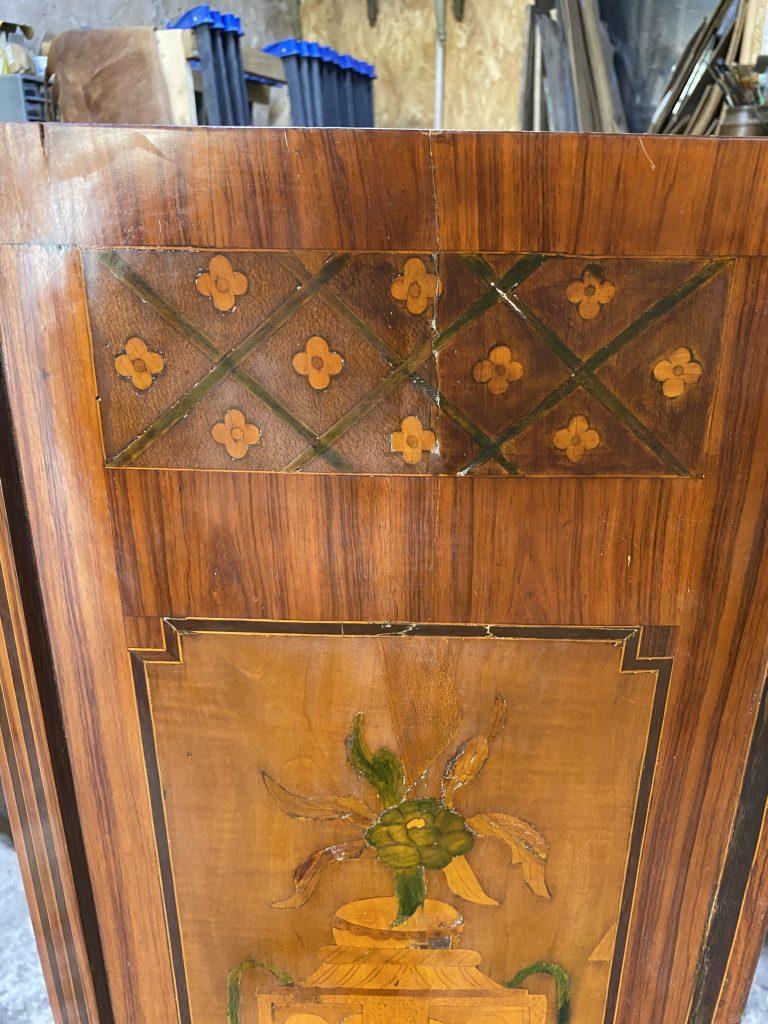
Restoration of a Louis XVI secretary desk stamped by Charles Topino. Typical of Topino's style, this secretary is constructed of oak and softwood. The front opens with a drawer and a drop-front covered in red leather tooled in gold, revealing two compartments and four drawers veneered in rosewood. The lower section opens with two doors revealing a shelf. These doors are decorated with marquetry depicting vases and drapery on a tobacco-colored ground. The drop-front itself is inlaid with musical instruments, ribbons, and foliage on a tobacco-colored ground, all surrounded by a Greek key border and simple stringing in amaranth and sycamore. The sides are veneered with a double composition of vases of flowers. The canted corners have simulated fluting, and the drawer is composed of a latticework of green-stained maple stringing and boxwood finials.
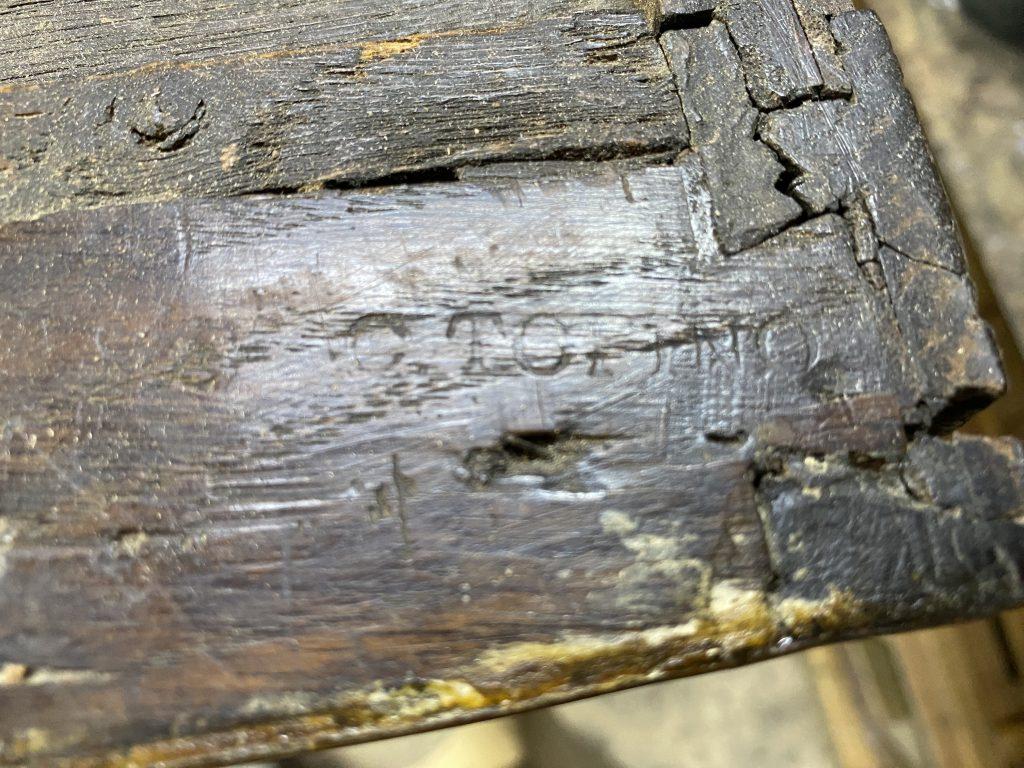
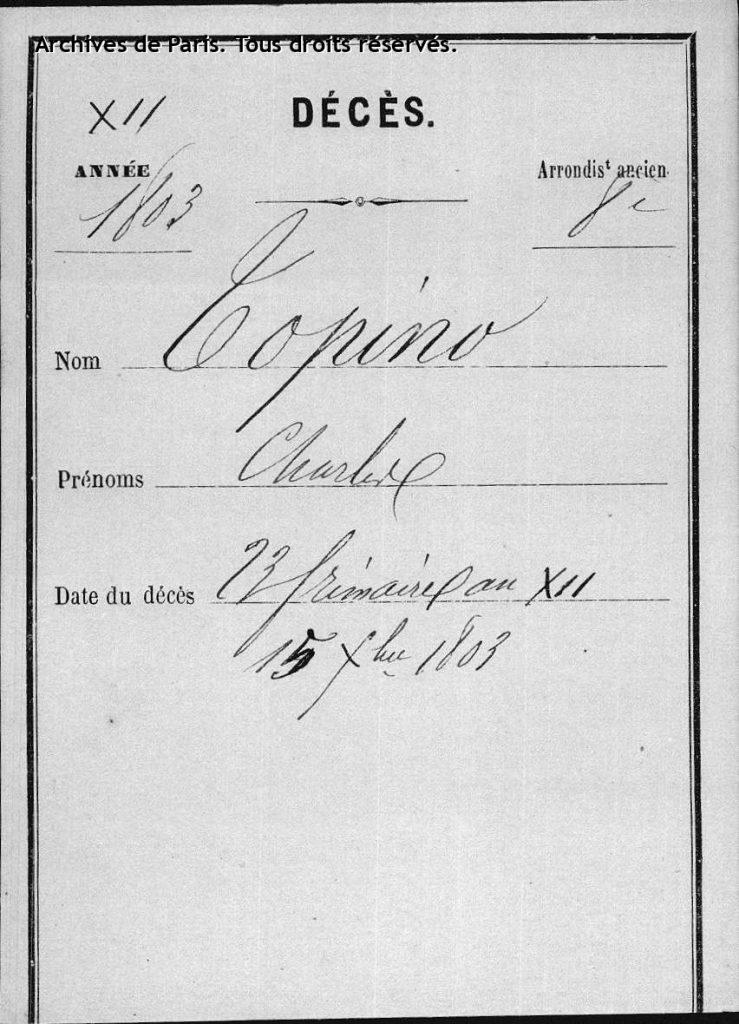
Charles Topino (1742-1803)
Son of the cabinetmaker Henry-Nicolas Topino (son of Nicolas Topino, master hatter)Located on the Grande rue du Faubourg Saint-Antoine in 1731, Charles was born in 1742 in Paris. After working as a journeyman in the Faubourg Saint-Antoine, Charles Topino obtained his master craftsman's certificate on November 17, 1773, based on a masterpiece from the previous November 4. In 1782, in recognition of his individual qualities and his work, he was appointed deputy of the guild of joiners and cabinetmakers.
A multifaceted craftsman
Recognized in France and abroad, Topino attracted a large clientele of merchants and cabinetmakers such as Boudin, Migeon, Jean-Baptiste Tuart, Pierre Denizot, Nicolas Héricourt, or even Delorme, but also French lords such as the Marquis de Gravelle, for whom he designed and delivered furniture.
Besides his furniture manufacturing business, he was also an important supplier of wood for his colleagues such as: Roger Vandercruse, known as RVLC, Mathieu-Guillaume Cramer, Denis-Louis Ancellet, Fouge, Gober, and Louise Moreau… He was also a buyer of furniture from his colleagues (Virrig, Messeclé, Jaques, Simon Guillaume, Jean-Baptiste Tuant, Ohneberg, Pierre, Rocle, Kohl)
A unique feature of Charles Topino's diary reveals the sale and export of ready-made marquetry. It records the sale of numerous batches of marquetry pieces ready to be glued to his brother Jean-Baptiste, known by the pseudonym Lebrund. These marquetry pieces are typical of Topino's style, featuring designs of birds, dogs, pottery, watering cans, tokens, playing cards, and so on.
An innovative and varied production
Known for leaving his mark on the history of 18th-century French cabinetmaking by producing Chinese-style marquetry utensils, it would be a gross oversimplification to limit his work to this single contribution. Topino's extensive output encompasses a wide range of creations, revealing numerous decorative cycles dictated by a highly personal aesthetic.
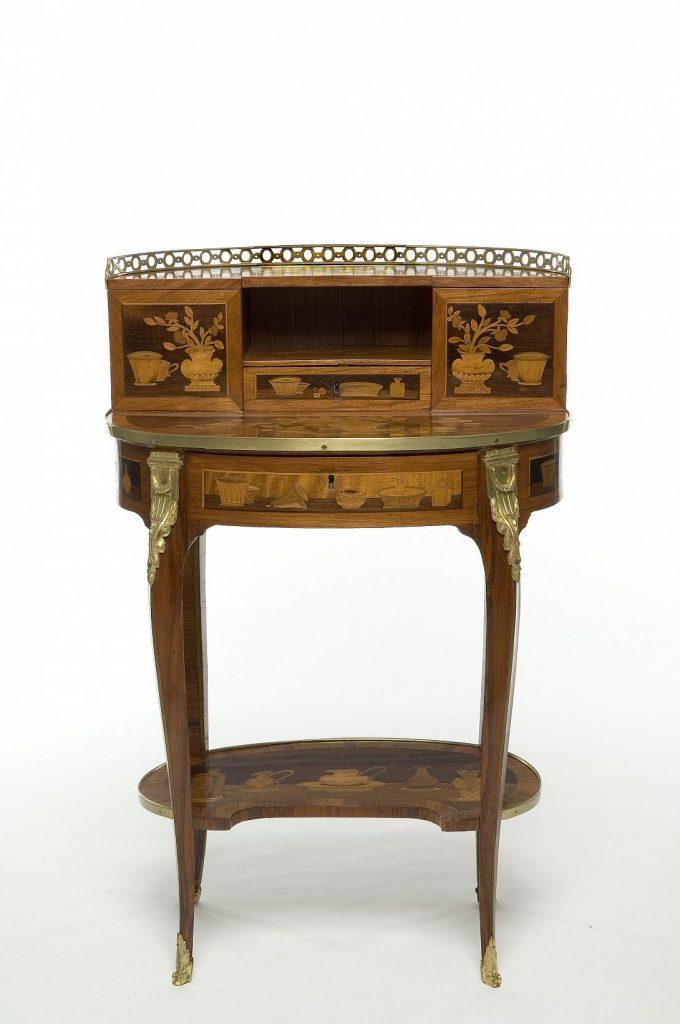
Bonheur du jour, Paris, circa 1770-1775
Built from oak and poplar ; marquetry of sycamore, rosewood, boxwood, holly ; gilt bronze wall lights
H. 89 ; L. 59.5 ; length 38 cm
Bequest by holographic will of Marguerite Jenny Anna Paradis
Inv. 32125
© Les Arts Décoratifs / photo: Jean Tholance
His marquetry, decorated with vases of flowers, writing desks, and various utensils such as cups, teapots, and bowls—presented like still-life paintings—as well as playing cards and books, are the most characteristic elements of his furniture. They are most often inspired by the borders of Coromandel lacquer Chinese screens, which employ the same motifs. Gathered in oval, round, or square compartments, or arranged in a frieze, the decorations are generally viewed in profile, and their very simple carving requires only a small number of pieces of wood, which are then chiseled for the details. Among the tiered tables, also known as bonheur-du-jour tables, he primarily created his models in a classic rectangular shape, but also produced some oval models, a new addition to the style he particularly favored. Often oval in shape, the marquetry tables featuring everyday objects typically include a drawer in the center of the apron and, on the sides, two small drawers that pivot.
Table in chiffonier
Poplar and walnut veneered with rosewood, amaranth, holly, serviceberry, chiseled and gilded bronzes.
Inv. CAM 349
© Les Arts Décoratifs / photo: Jean Tholance
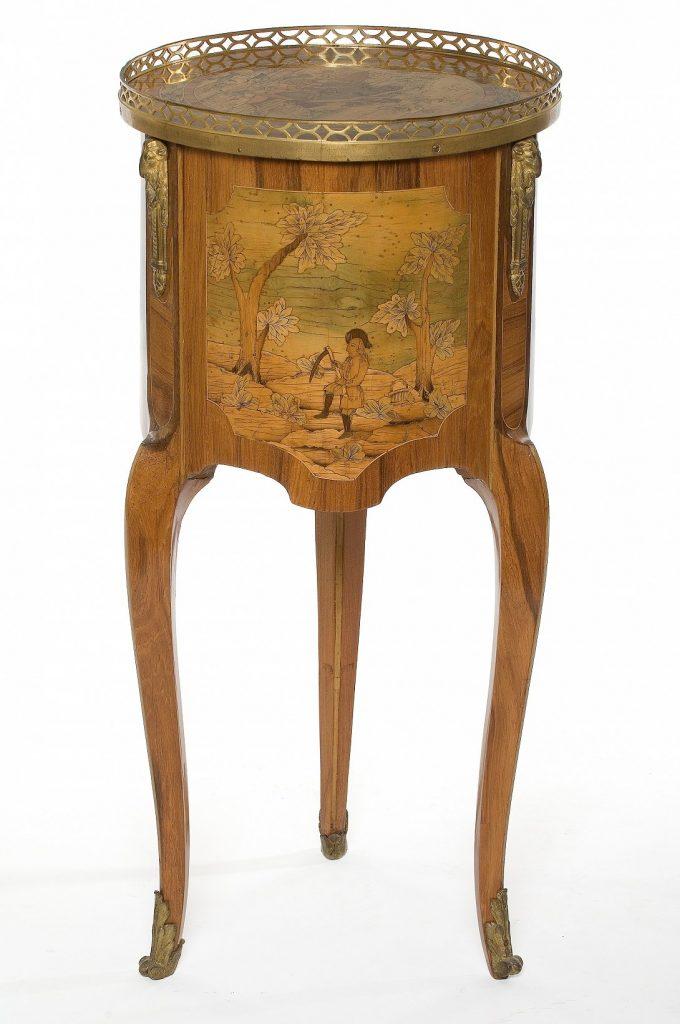
Alongside these original designs, Charles Topino also practiced marquetry of flowers and landscapes. The former appear more frequently on Louis XVI furniture. The latter, depicting pastoral scenes, in the Chinese style, or architectural motifs, more often adorn small, round drum-shaped tables with three cabriole legs.
Despite a successful career, poor management resulting from the poor keeping of his accounts and the Revolution forced Charles Topino to close down on December 21, 1789.
BIBLIOGRAPHY
- Charles Topino – Furniture Notebooks – Sylvain Barbier Sainte Marie – Amateur Editions – 2005
- French Furniture of the 18th Century – Pierre Kjellberg – Les Editions de l'Amateur – 1989
- The workshops Parisian cabinetmakers and joiners in the 17th and 18th centuries – Guillaume Janneau – Serg Editions – 1975
–
State of affairs report
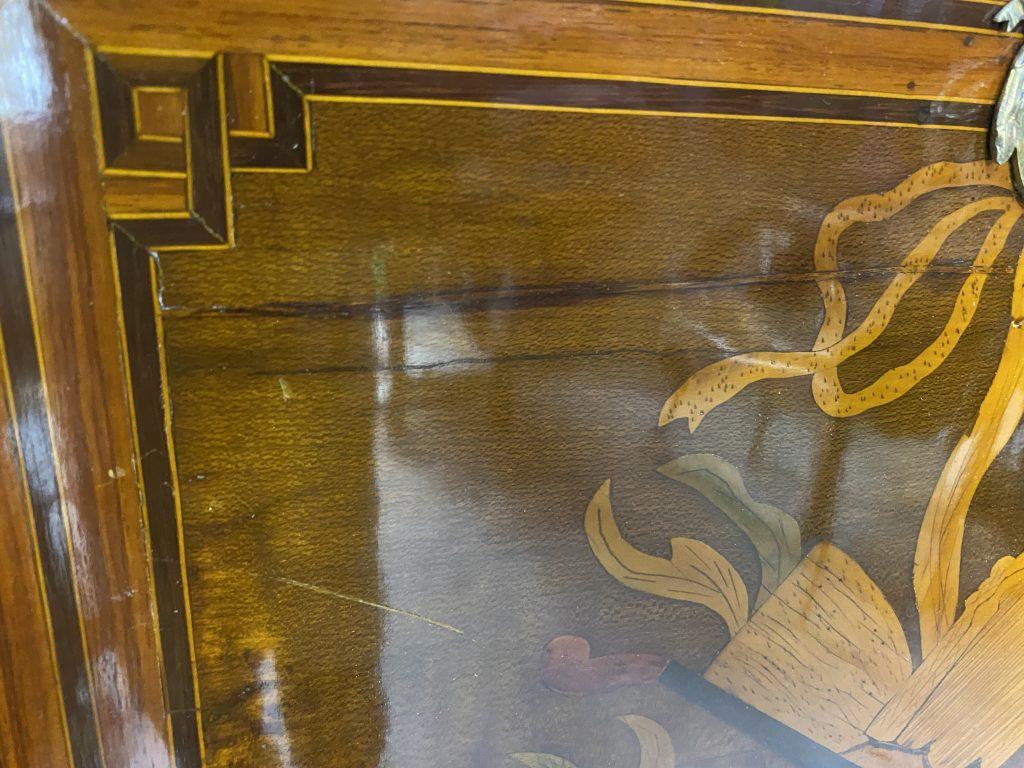
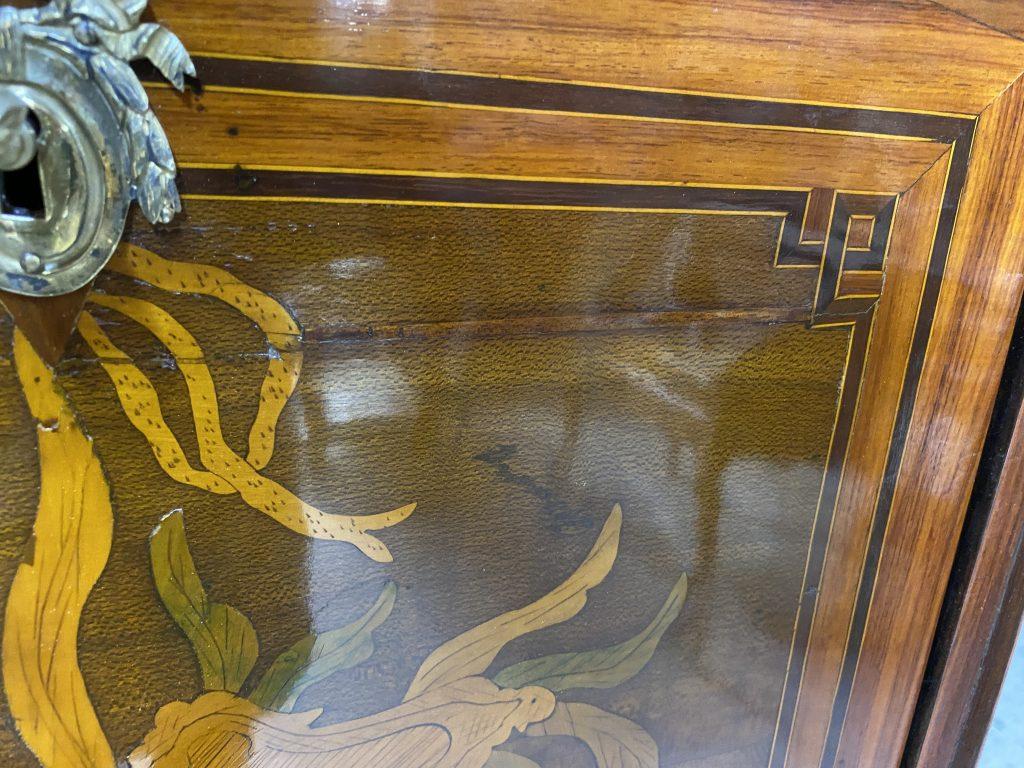
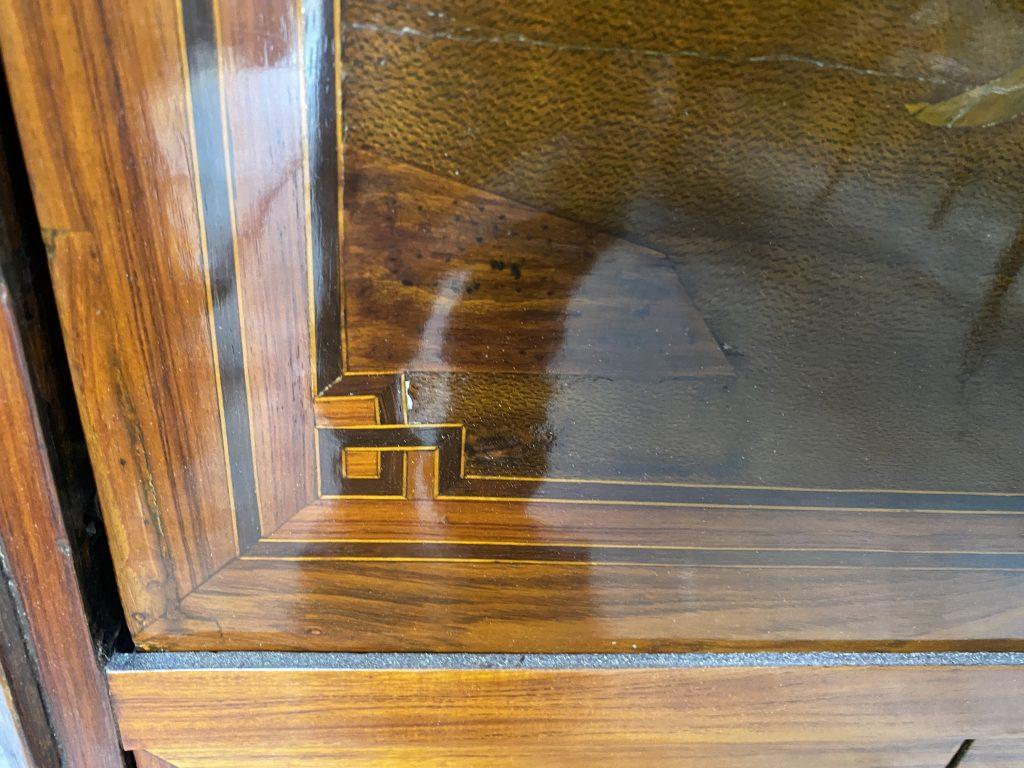
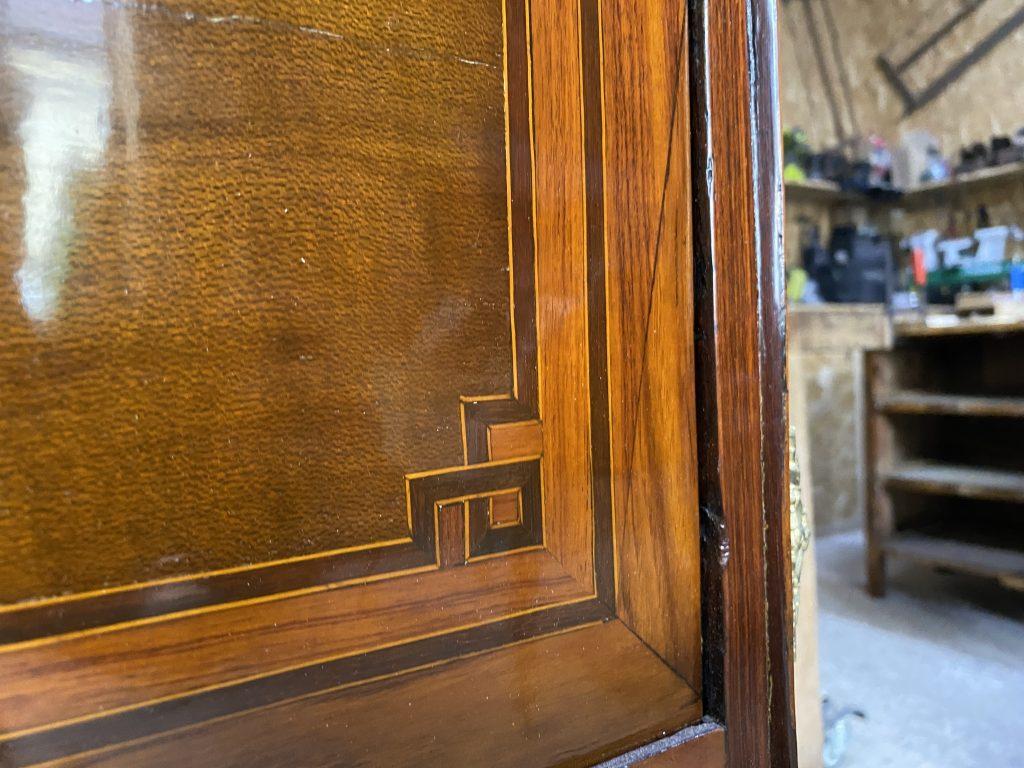
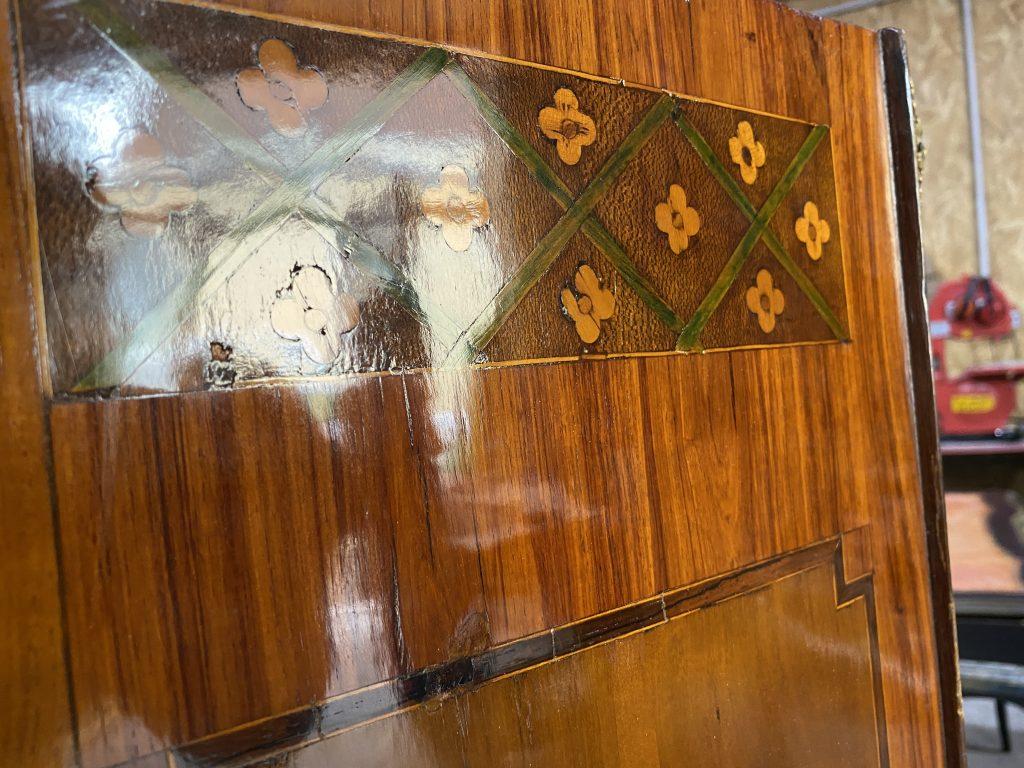
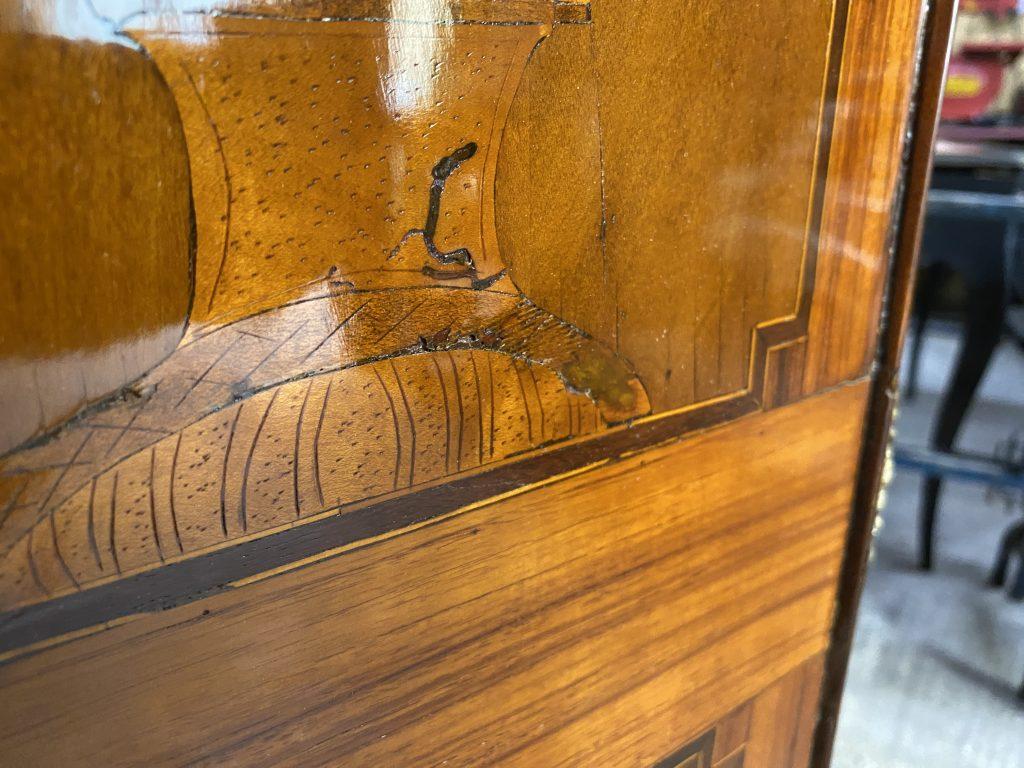
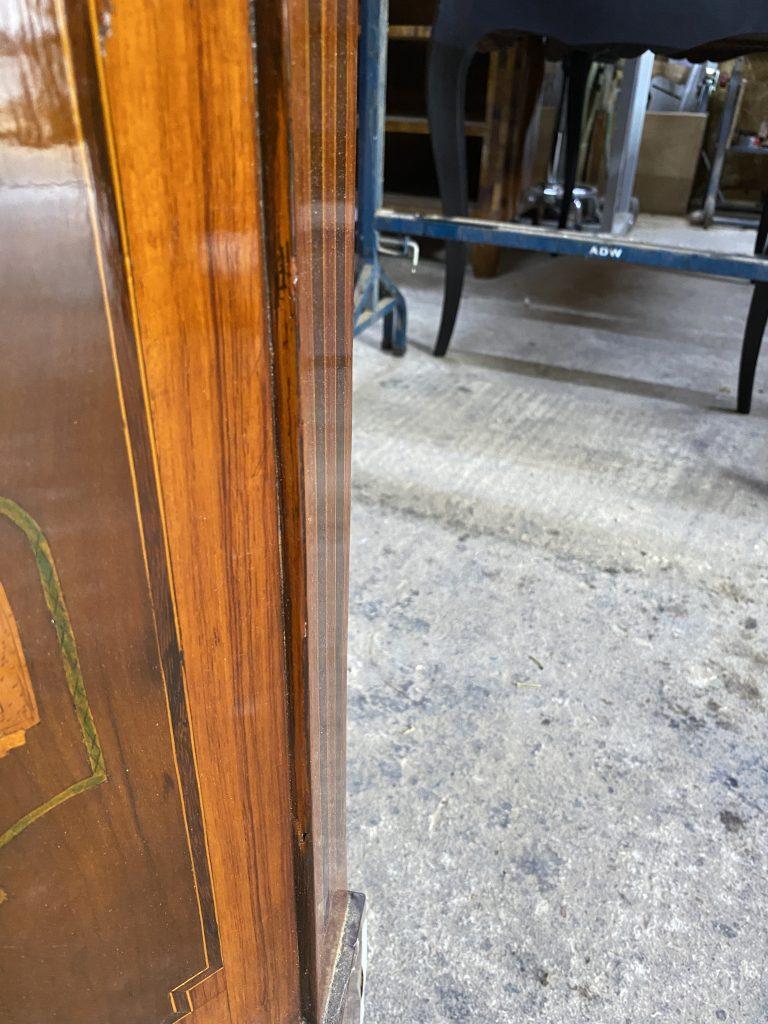
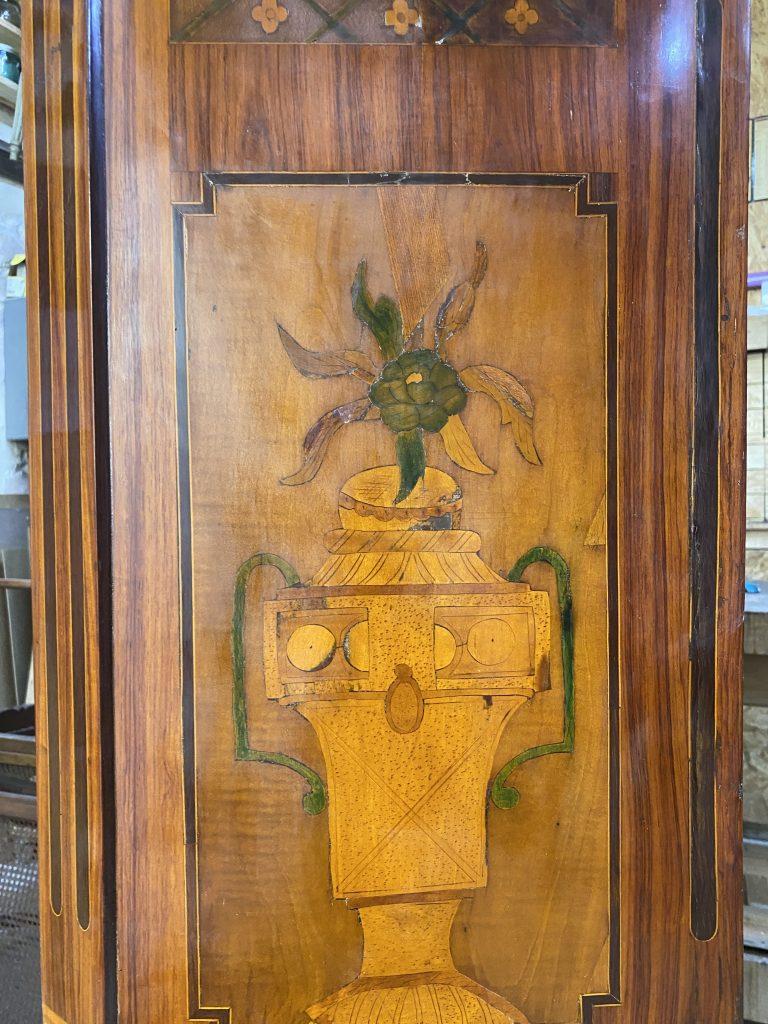
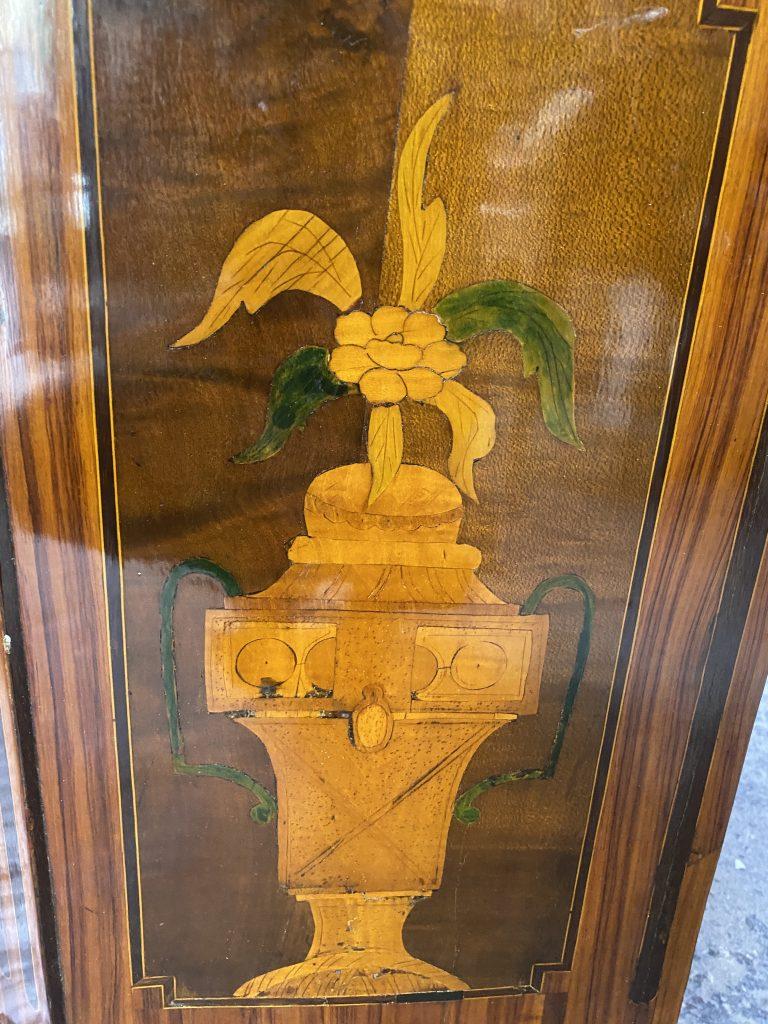
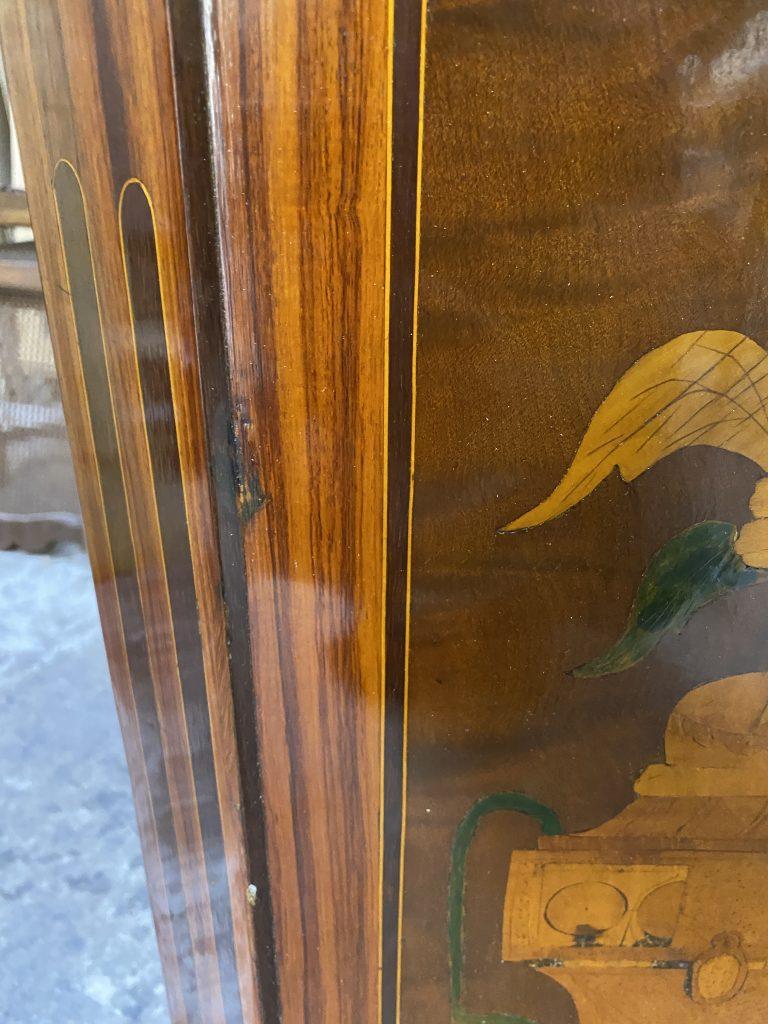
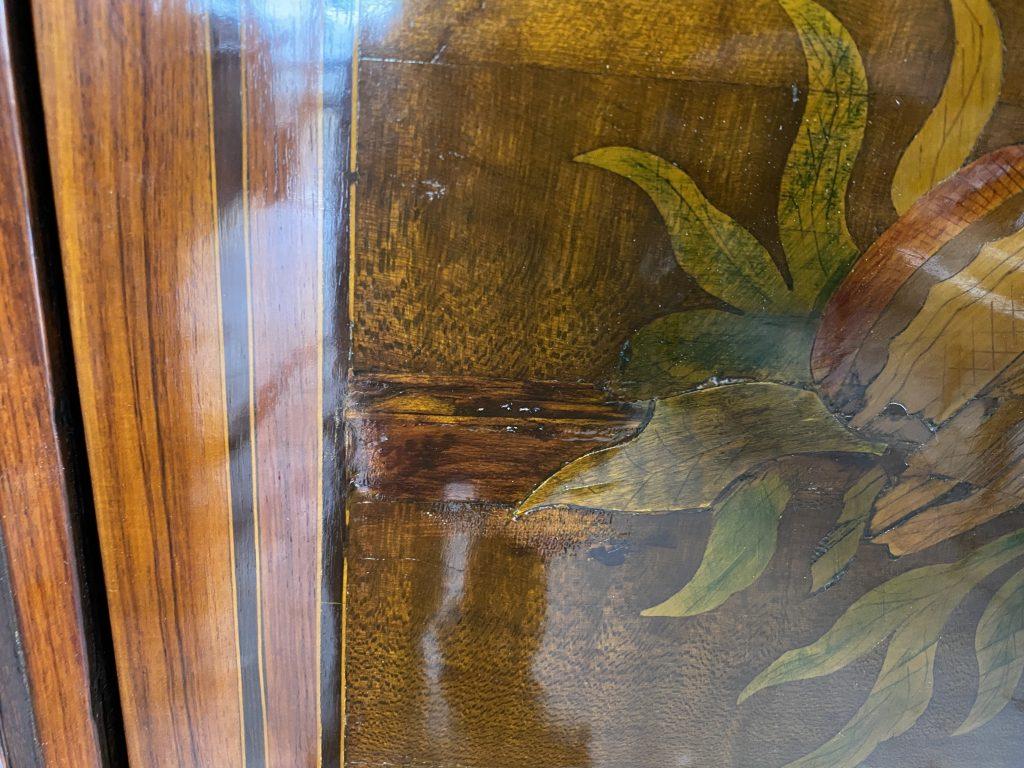
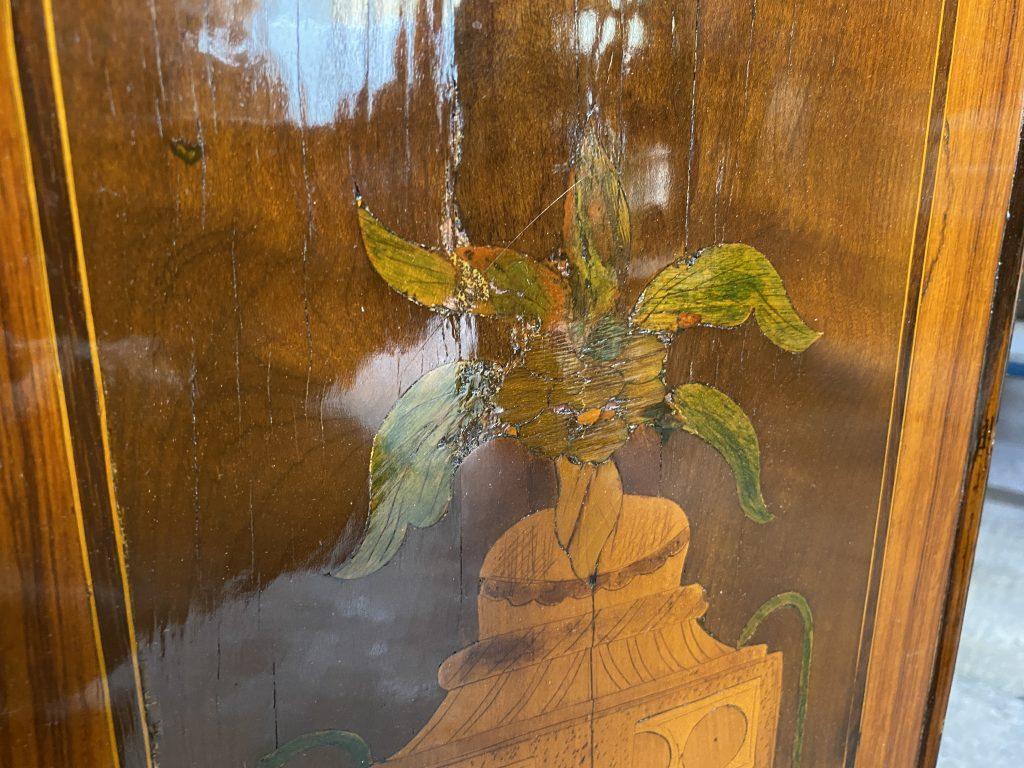
This secretary desk had a few minor but significant problems. The cellulose varnish applied to the piece had become heavily faded and yellowed. Overlaid with fuchsine, green, brown, and reddish-brown stains, along with old veneer grafts, obscured the marquetry. Structurally, several cracks were visible on the drop-front, and the side panels were separating from the back uprights, resulting in poor stability and further visible cracks.
The Restoration
It's always awkward to undo restoration, but it's true that sometimes it seems obvious. Especially when you find double-sided tape on the backing of an old veneer graft.
The restoration therefore consisted first of removing the old cellulose varnish, which obscured the extent of the work required on this secretary. After stripping, we discovered that a large portion of the grafts from a previous restoration had been done with beech veneer instead of sycamore, both for the tobacco-colored backgrounds and the marquetry pieces.
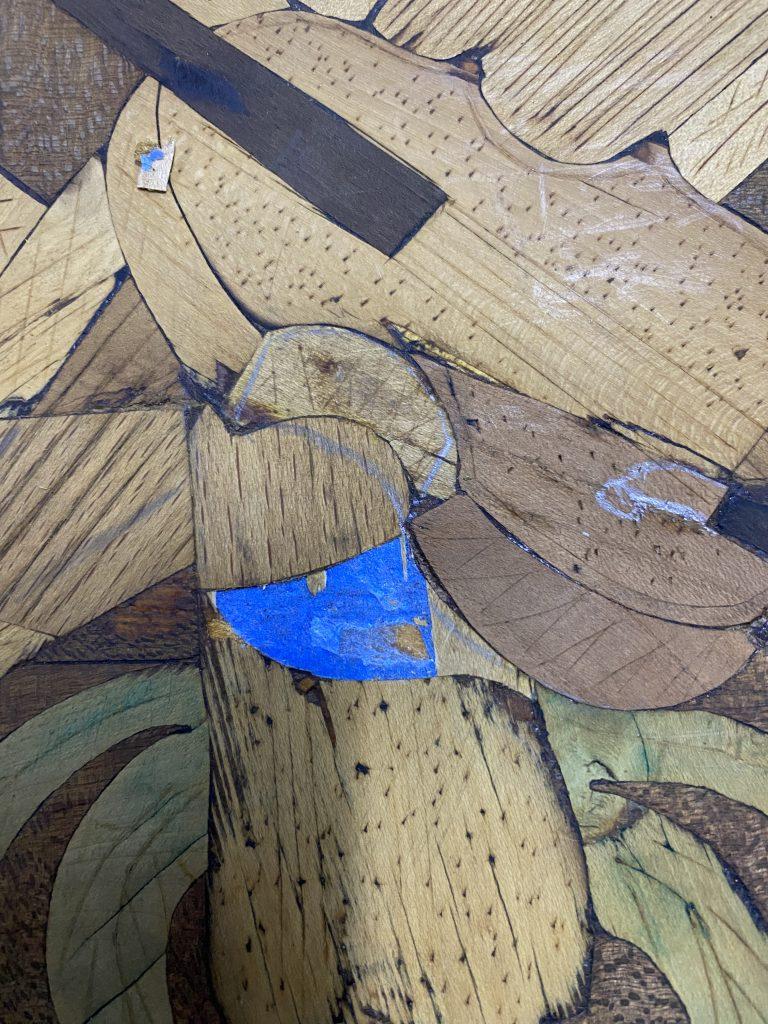
But the pleasant surprise was discovering beautiful green colours for the foliage and even a very pretty blue for the flowers.
It was therefore decided to redo the old veneer grafts with sawn, scraped and sanded veneer wood before gluing and then put to the correct thickness on the back face so as not to have to touch the patina of the furniture.
It was unfortunately evident that some of the tobacco-based grafts, like the one at the bottom left of the flap, would be extremely difficult to remove because of their location and the difficulty of finding wood with the same grain and thread.
For the drawers and the upper right side, the beech trellis base was removed without touching the green nets and beech florets before being replaced with a new tobacco sycamore base, and this without any slicing or sanding of course.
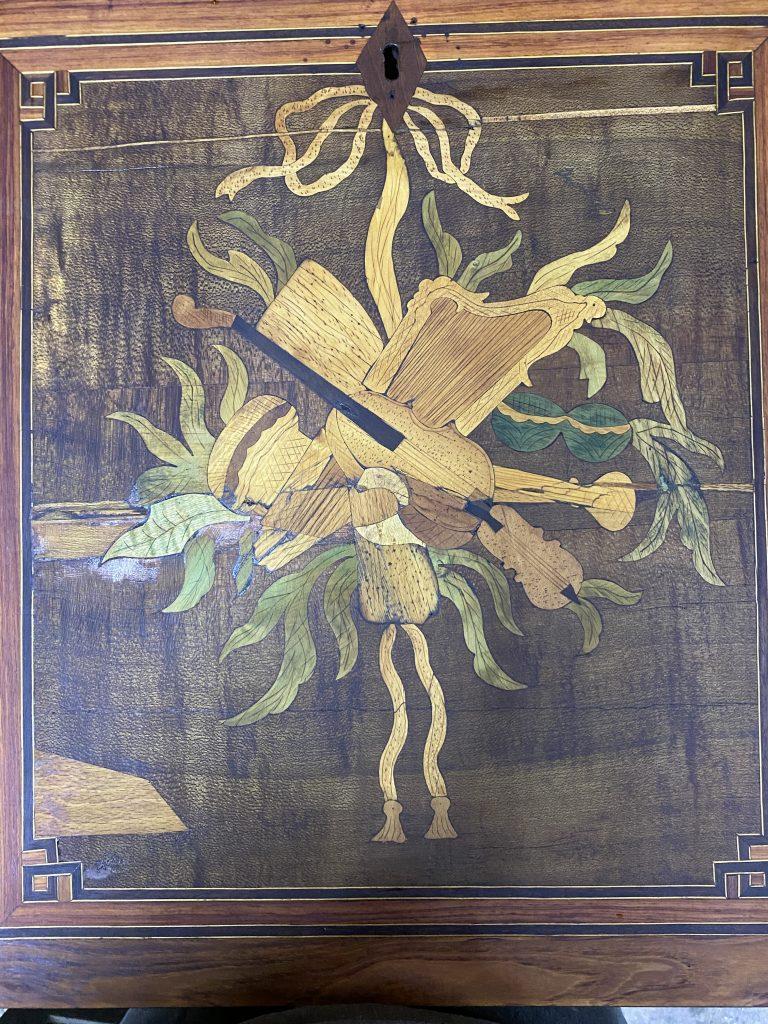
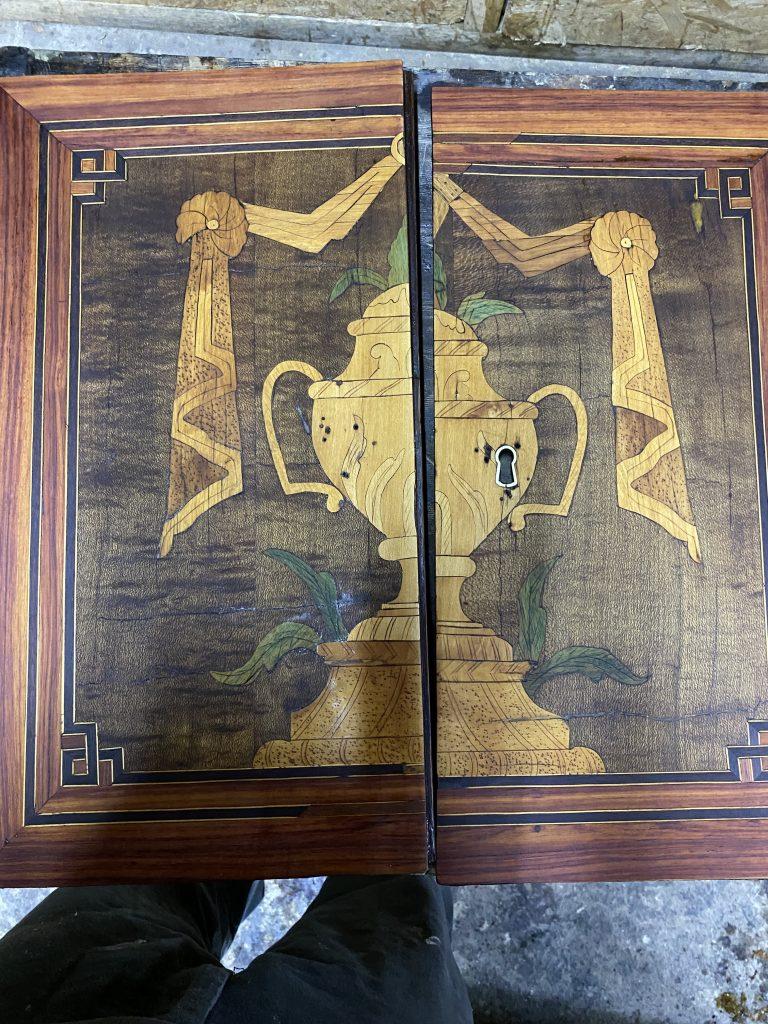
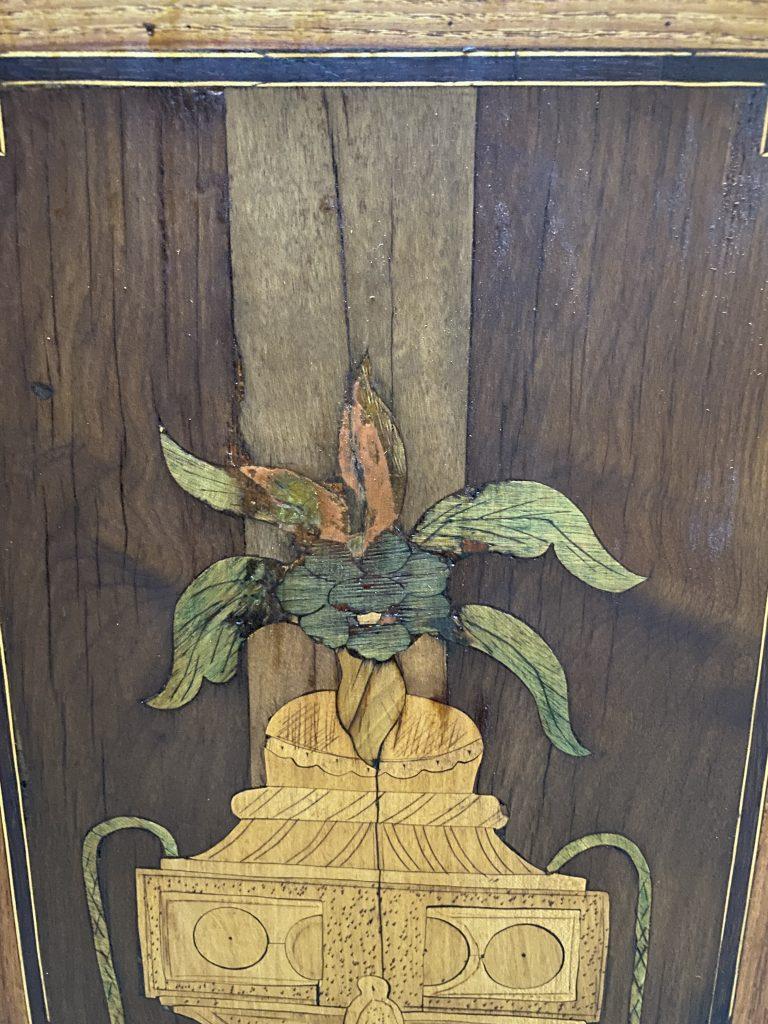
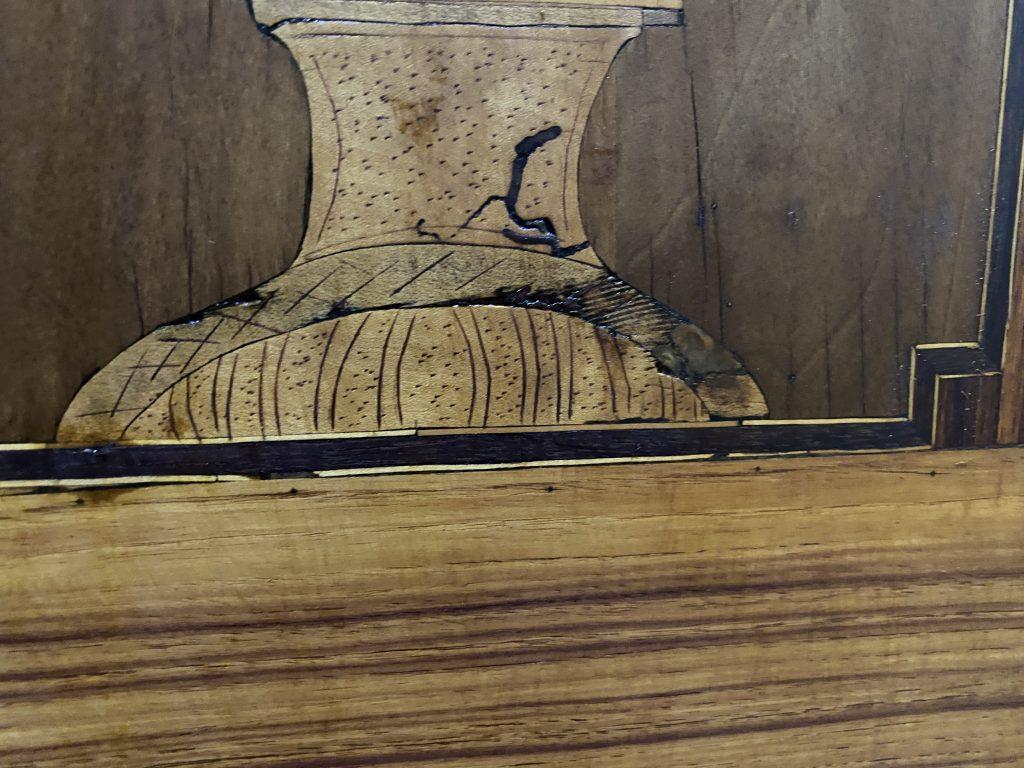
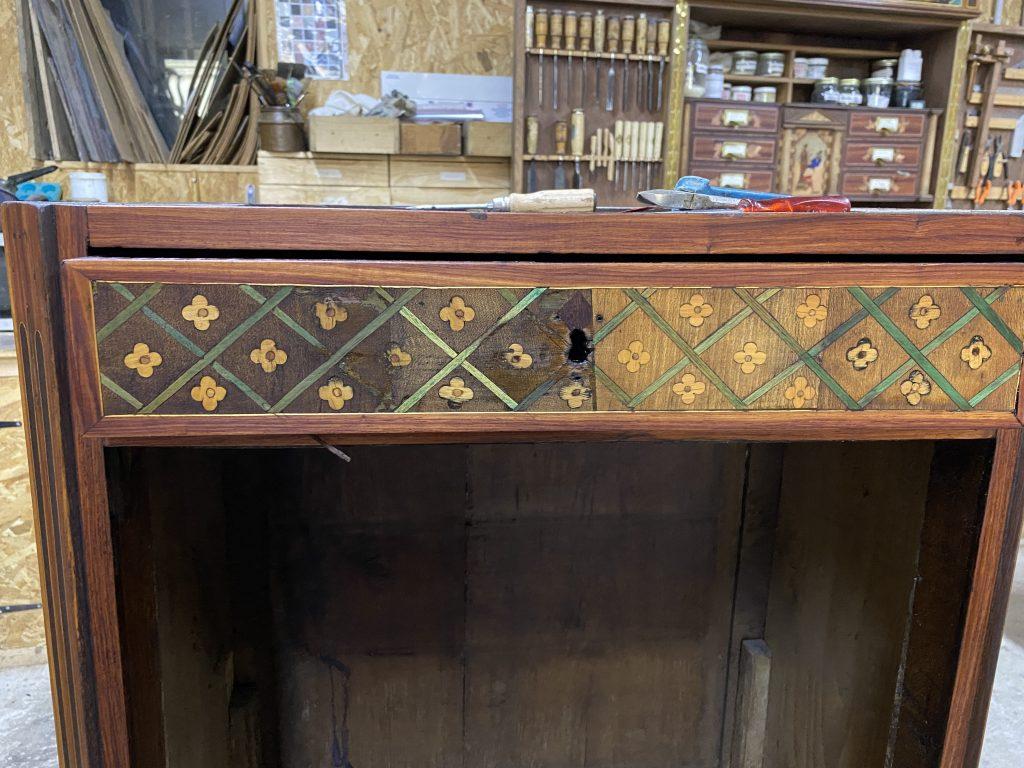
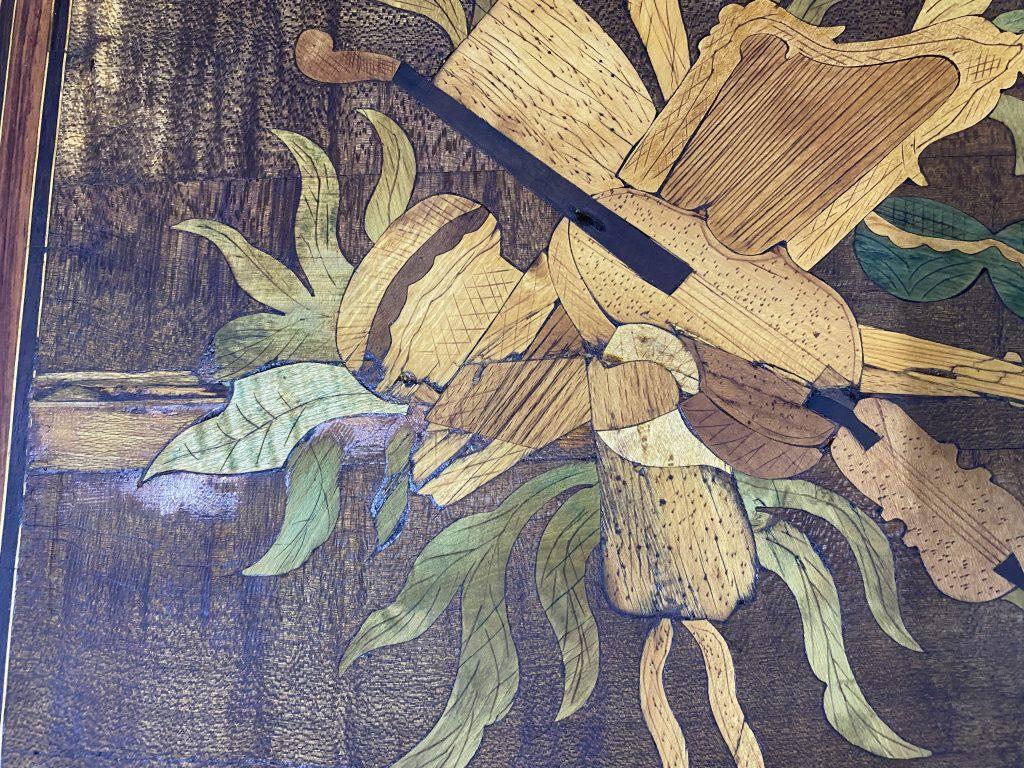
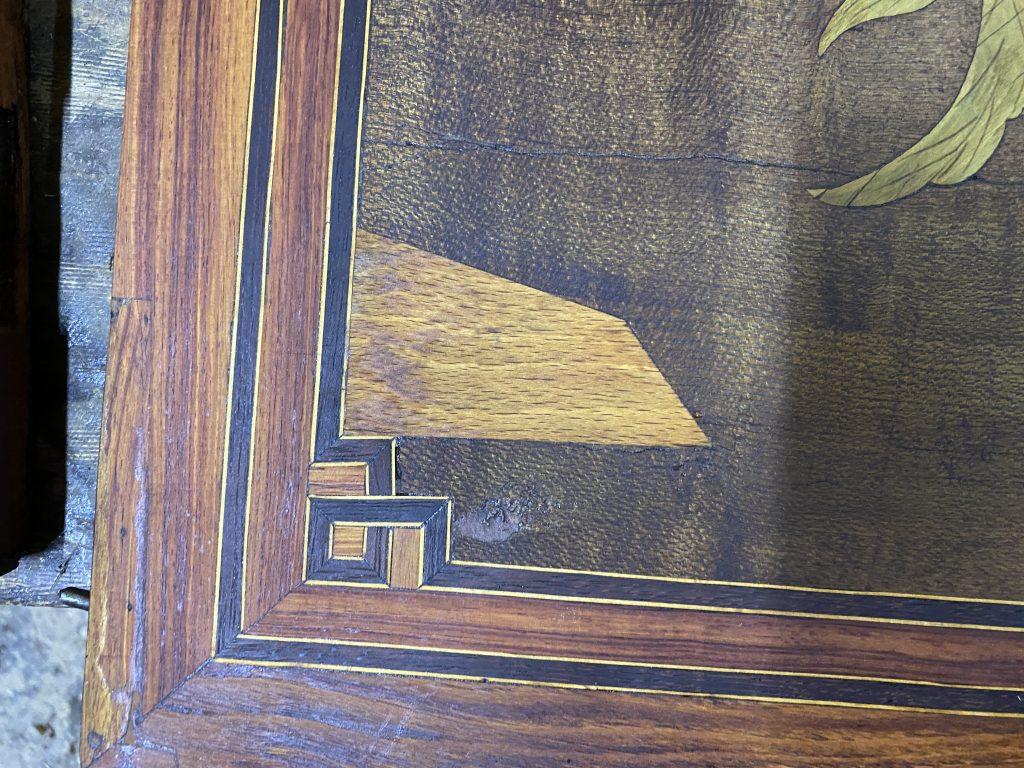
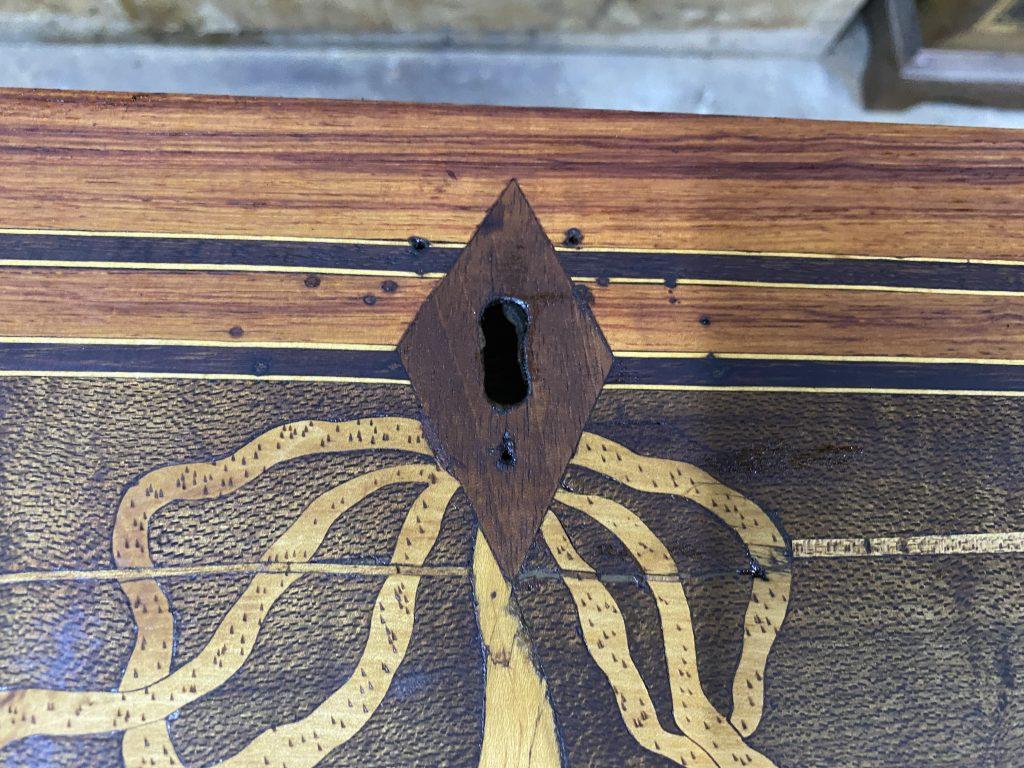
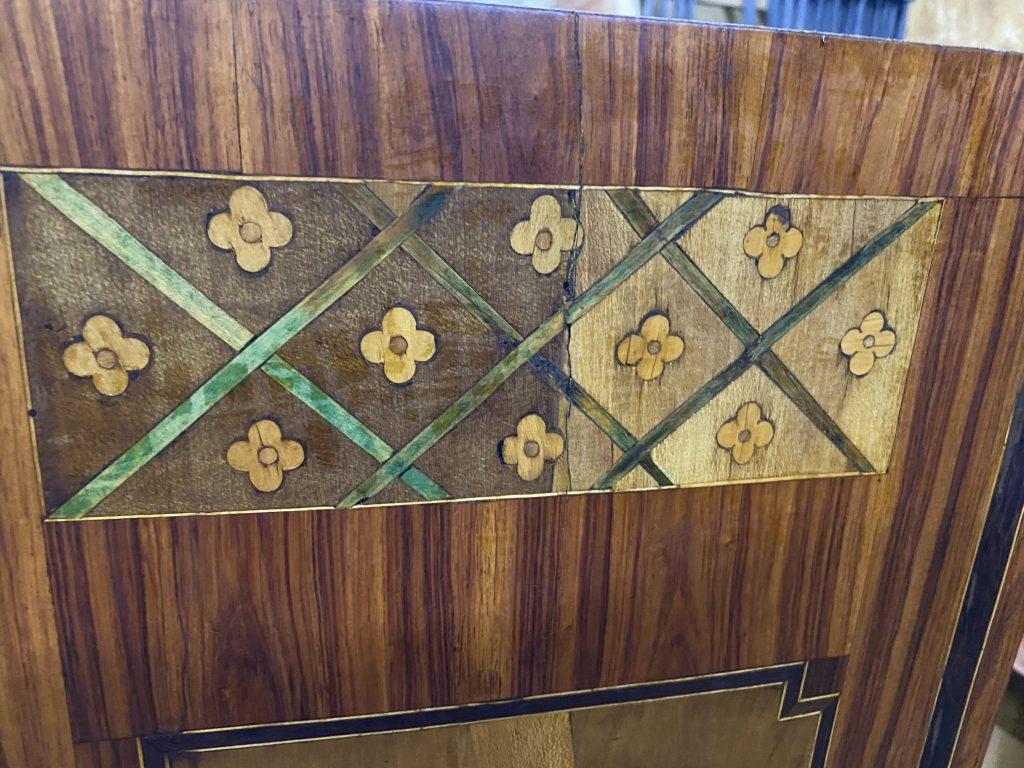
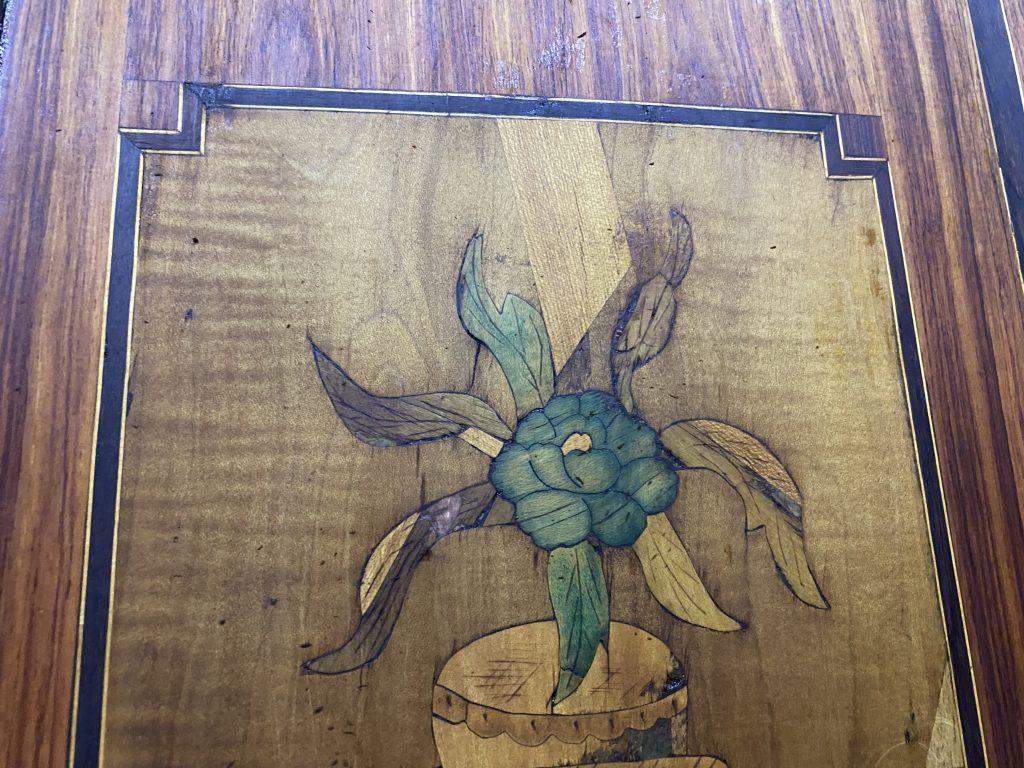
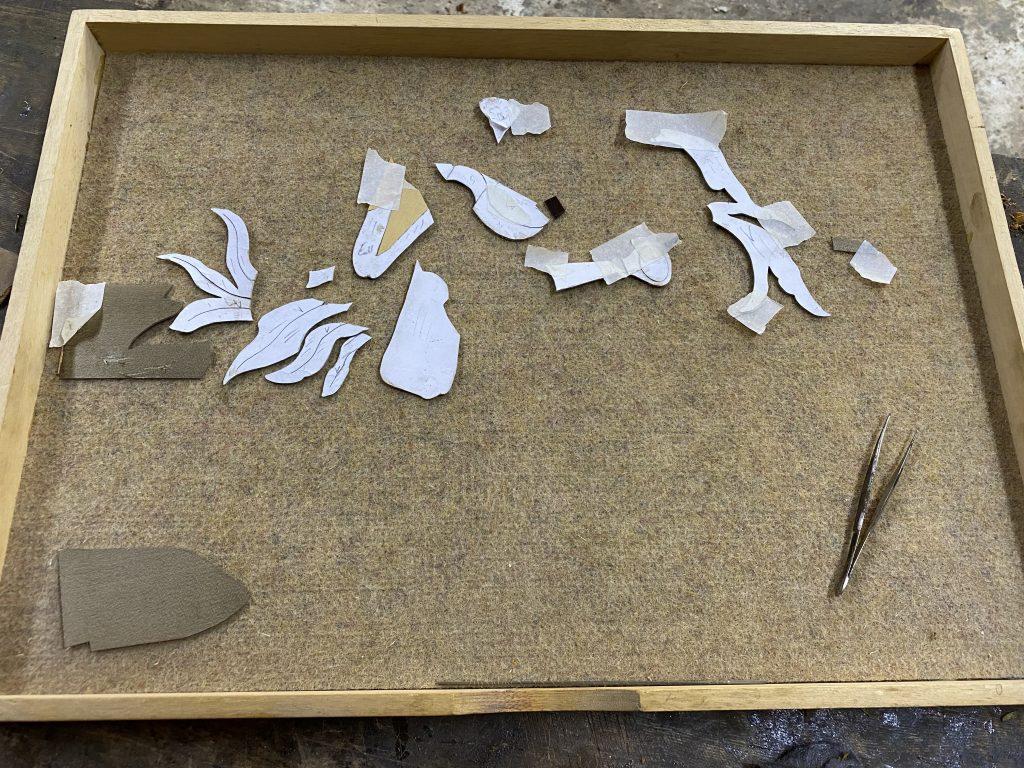
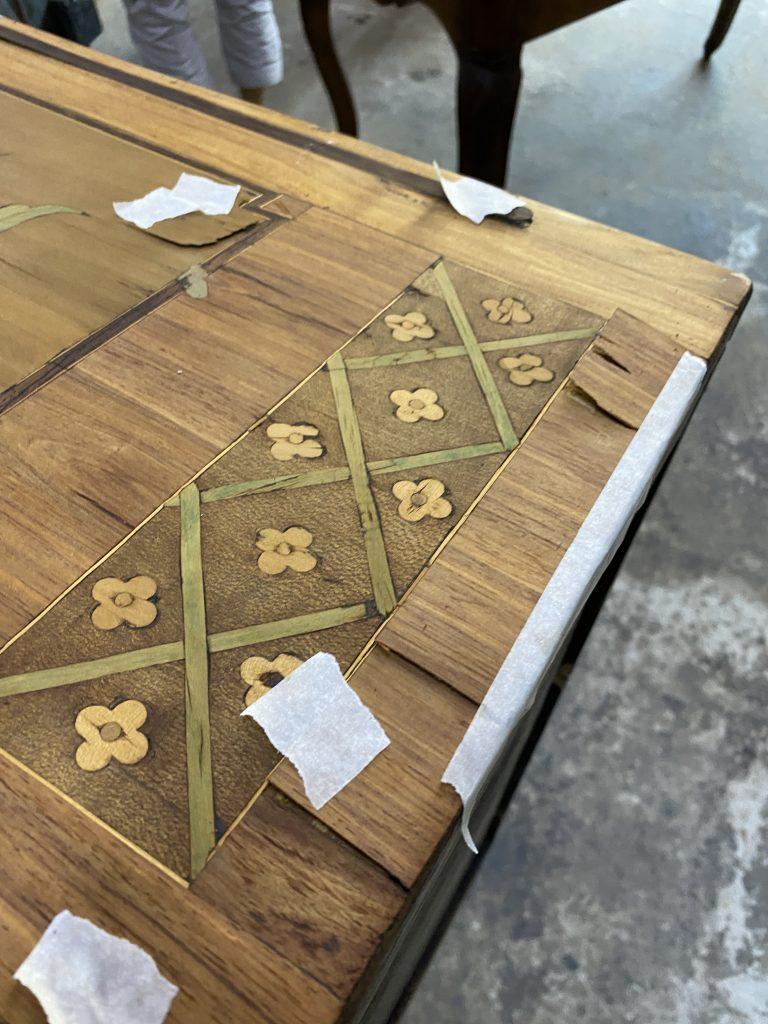
After being filled with pumice, the grafts were oxidized. Then, after the first coat of clear French polish, the engravings were highlighted with a marker to recreate their decorative appearance without affecting the veneer. A large portion of the inset grafts was created using chromatic reintegration (or dramatic reintegration, as my colleague Hugues would say!) to blend them in as seamlessly as possible. A few holes were also treated in the same way.
The bronzes, meanwhile, were gilded by the ARTE company in Paris.