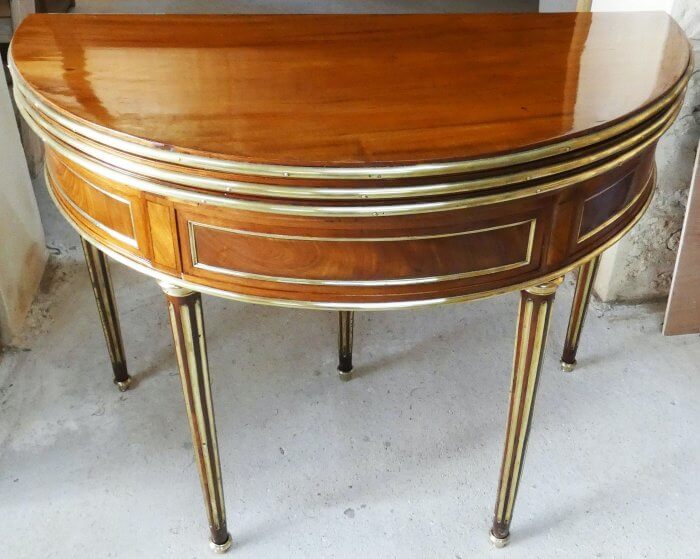
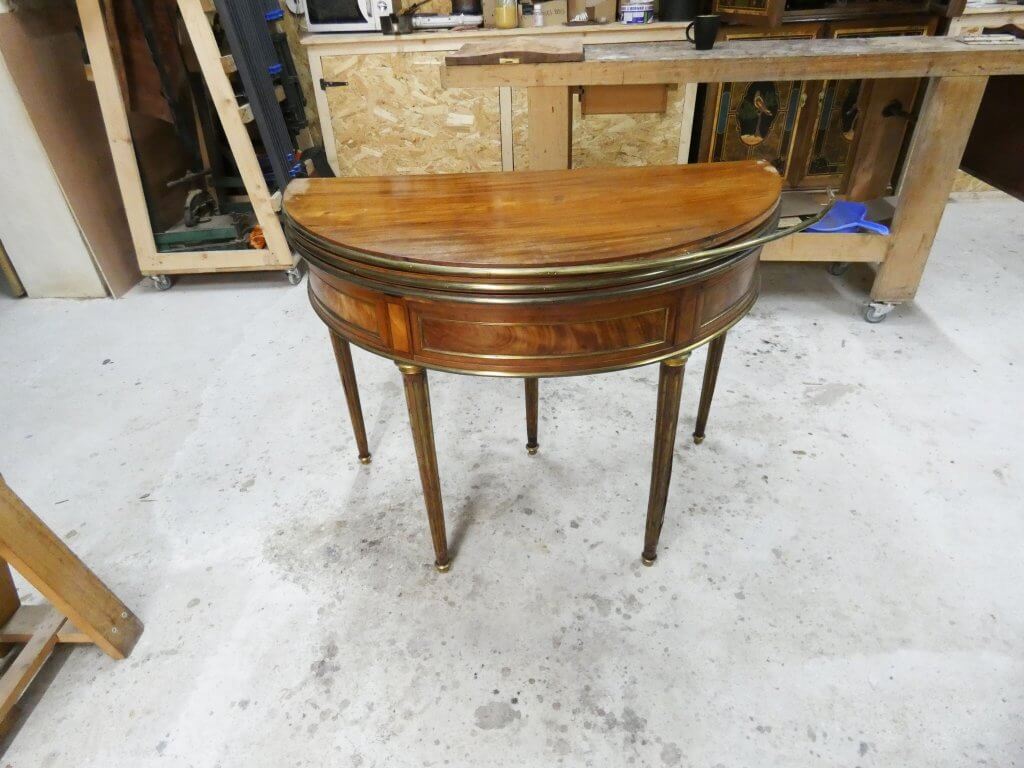
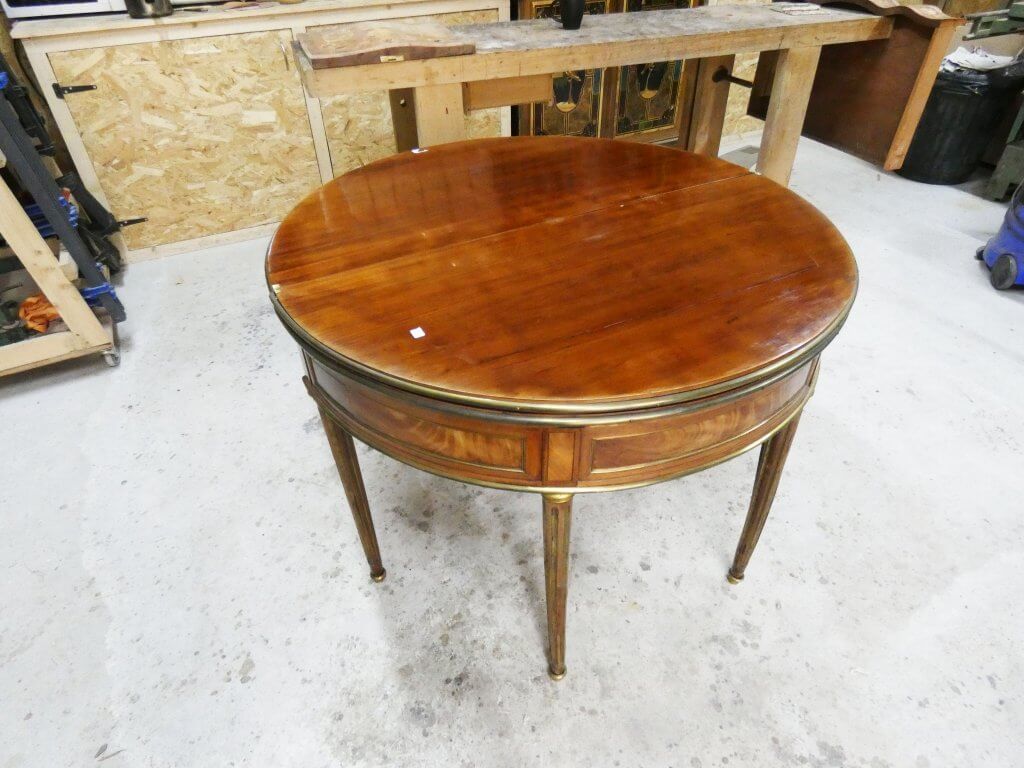
Here is a three-tiered half-moon table. This style of table, originating in England, is a classic of the Louis XVI style. It opens to reveal two circular tiers, one lined with felt, the other veneered in mahogany. The mahogany burl veneer apron is adorned with a brass frame. It rests on five tapered legs with brass-filled fluting and ending in sabots. The fifth leg is attached to a drawer that opens to serve as a support once the drop leaf is unfolded. A very attractive piece, probably dating from the late 18th century.
By the way, do you know what people played on this type of table at the end of the 18th century?
Here are a few examples:
- The shadow Originating in Spain around 1660, this three-player game enjoyed great success among the educated classes. It is a trump card game with bidding, whose rules are extremely complex and employ terminology as refined as that of modern bridge.
- The stake The first game to have printed rules. A type of trick-taking game without trumps for two players, it takes its name from one of its winning combinations: "pic" and "repic". The first major national game in the 17th century, it was initially played with 36 cards. It was only after 1690 that the 32-card "petit piquet" became the classic game we know today (its practice in France continued until the Second World War).
- The reversis : The trick-taking game "in reverse" - hence its name - was very popular at the court of Versailles.
And of course the famous one: Pharaoh
Of Italian origin, the Pharaoh, like the Landsknecht, was considered dangerous in the 18th century due to the large sums of money involved. "The Bastille archives attest to the efforts made by the police to enforce the ordinances that, in principle, prohibited them." The era of the Pharaoh was the golden age of gambling. Europe and America shared this passion in the 19th century.
« Paris has always been more or less what it is, the center of luxury and misery; it's a grand game of Pharaoh, where all those who cut corners are lining the pockets of the powerful," wrote Voltaire to Madame de Florian in March 1769. Voltaire had observed this milieu well. (Candide follows the Marquise de Parolignac to play Pharaoh, on the rue du Faubourg-Saint-Honoré.)
During the reign of Louis XV, the Venetian Ambassador entertained at his gaming tables in the basement of his private mansion near the Place des Vosges. He employed very young and pretty girls to serve the Pharaon. Intrigued, the First Secretary of the British Embassy felt it his duty to inform his government: "It would be opportune to place agents at the Pharaon's tables, for nowhere else are such a number of foreign ladies and gentlemen found revealing so much about the fortunes of their countries.".
It is said that it was in front of a Pharaoh's table that Napoleon met Pauline Foures, whom he wanted to marry.
In Lyon, a coachbuilder named M. Chabrier built a car he called the "dormeuse" (sleeping car), which became very popular. Designed specifically for Pharaoh players exhausted by the game, it was equipped with a bed, thus saving the players from having to go home. Would Casanova, a fanatic of Pharaoh, have used it?
Despite being banned under the Directory, Pharaoh remained the fashionable game until the advent of casino games and the popularity of Poker.
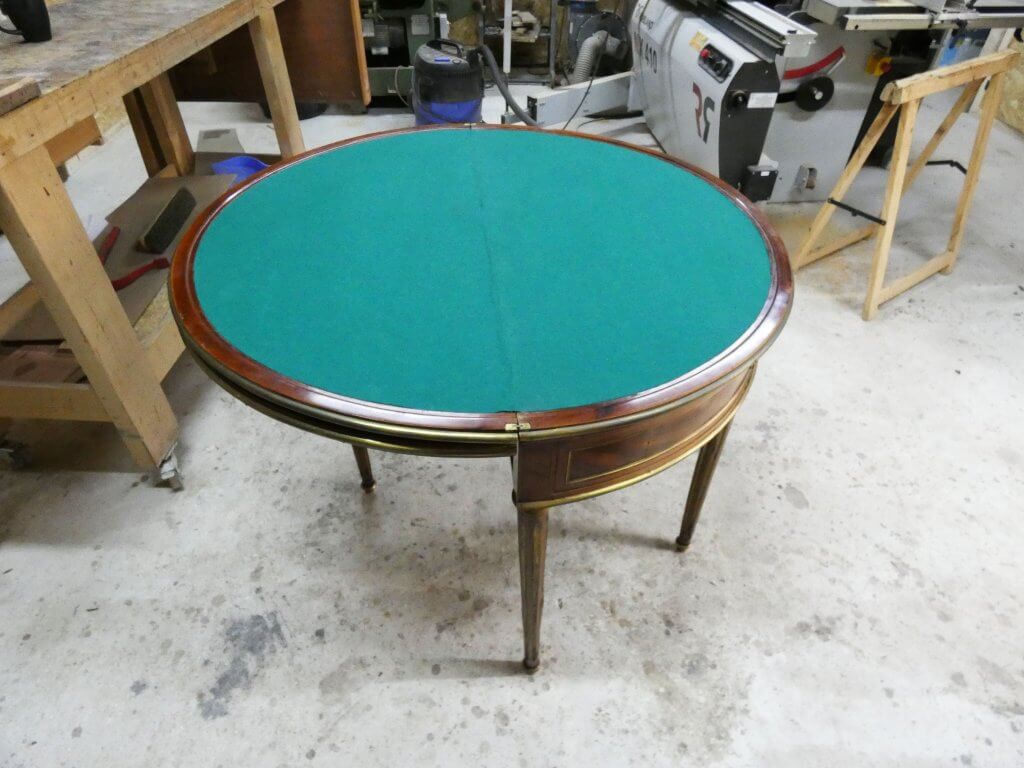
When it comes to restoration, the same problem always arises when wood and brass are involved. These two materials don't mix well. Each reacts differently to humidity and heat, causing them to react in opposite ways, resulting in everything coming apart. And of course, the brass fluting had been glued back on. So I had no choice but to remove everything, scrape off the glue, and then reattach it all with fish glue.
Then, nothing too serious for this table, the old varnish is preserved, the brass is cleaned and a few dabs of varnish are enough to restore its former shine.
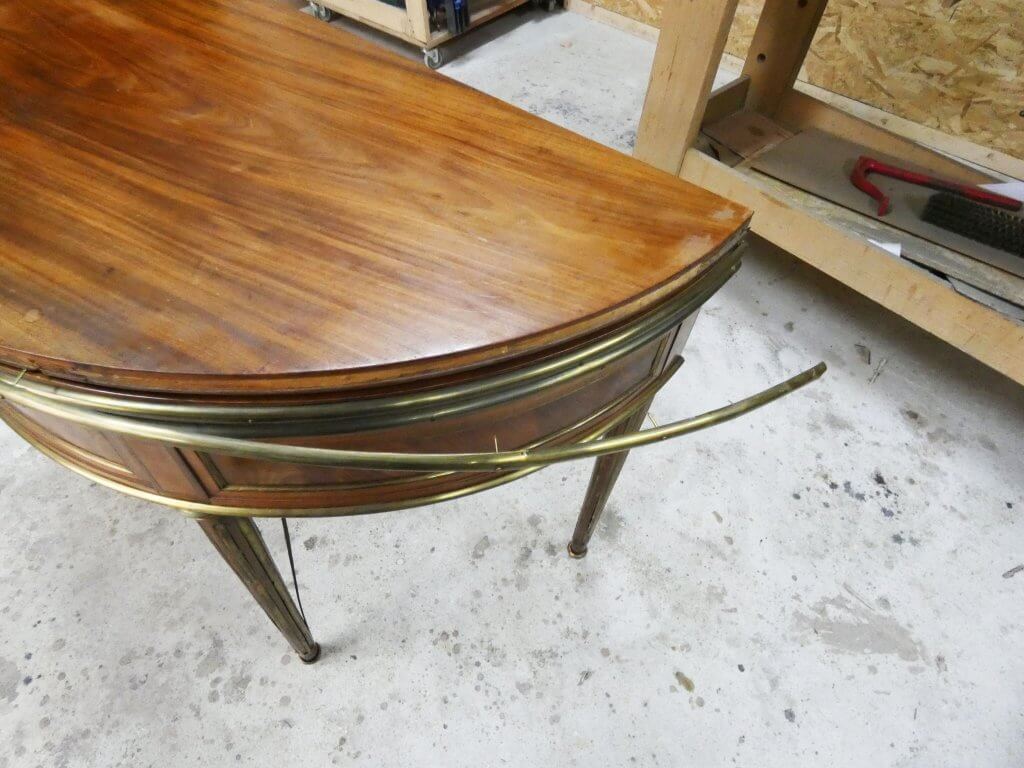
The moldings are coming unglued. 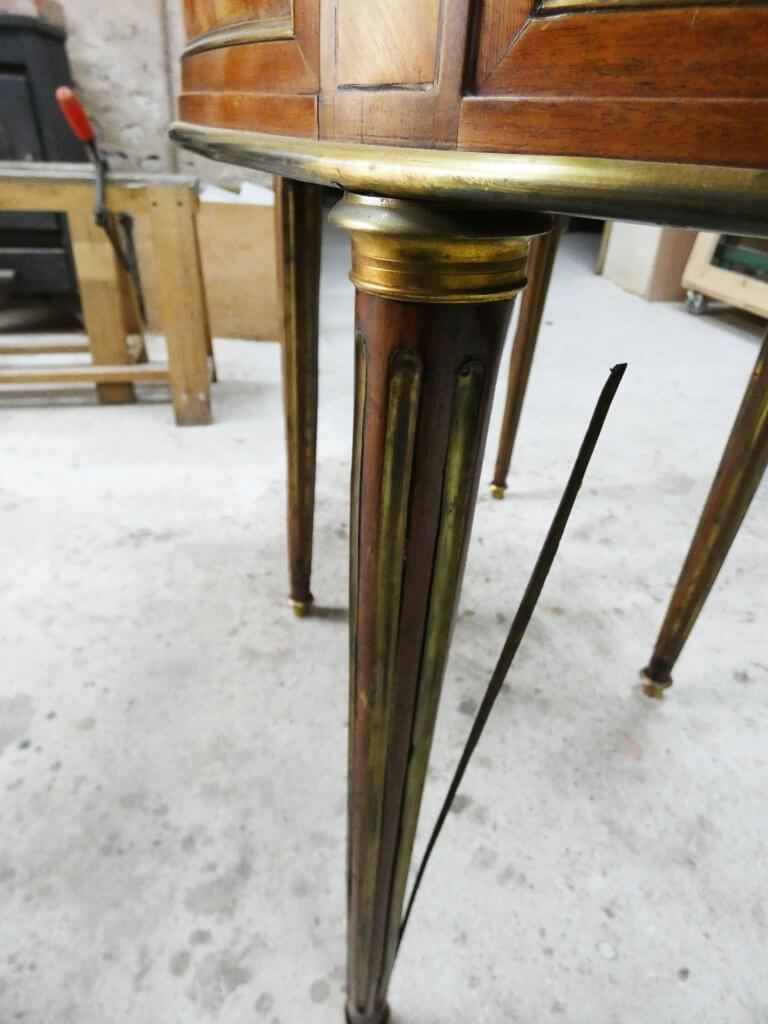
Nothing holds together anymore 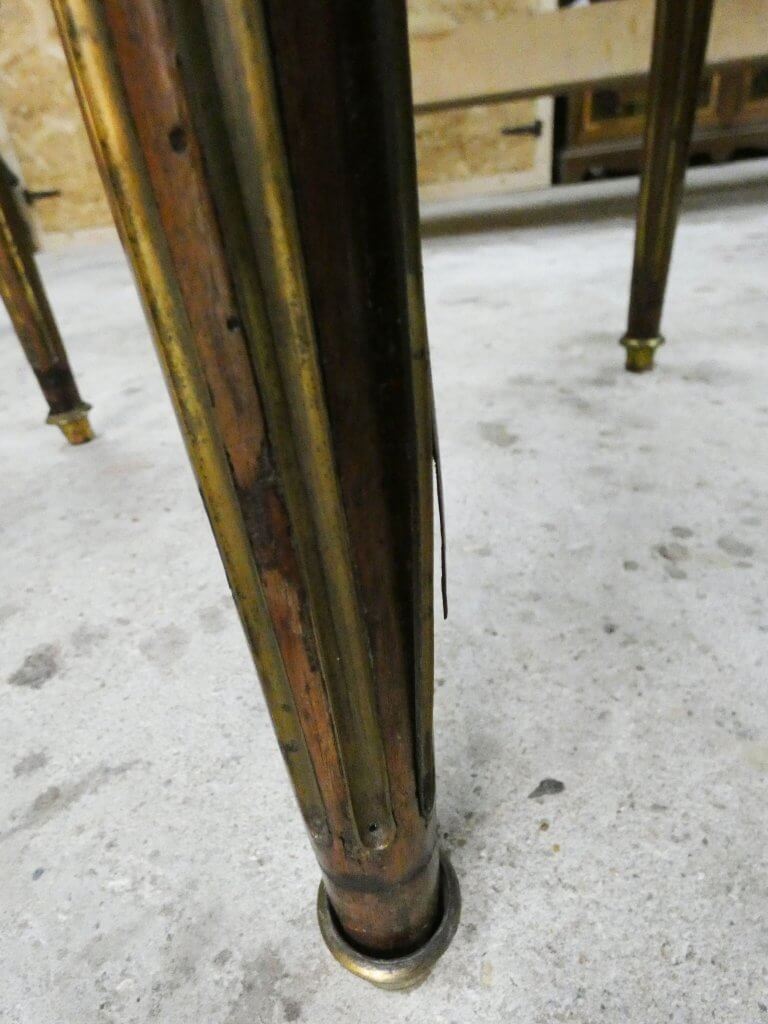
Brass detached 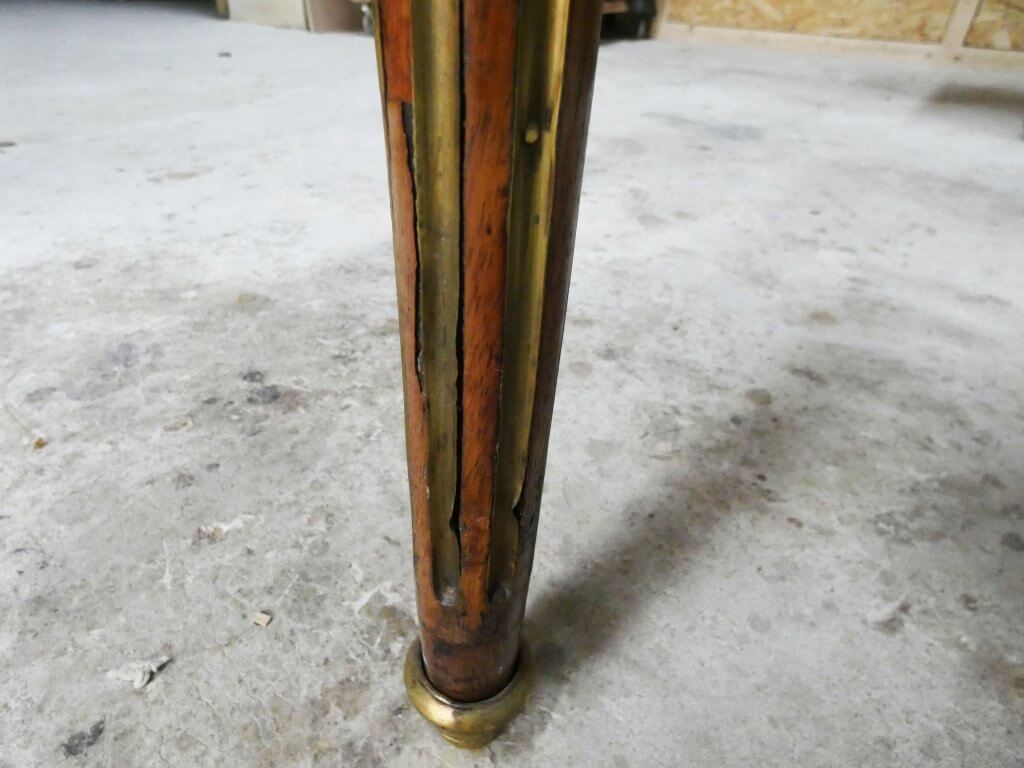
Brass and plating in poor condition 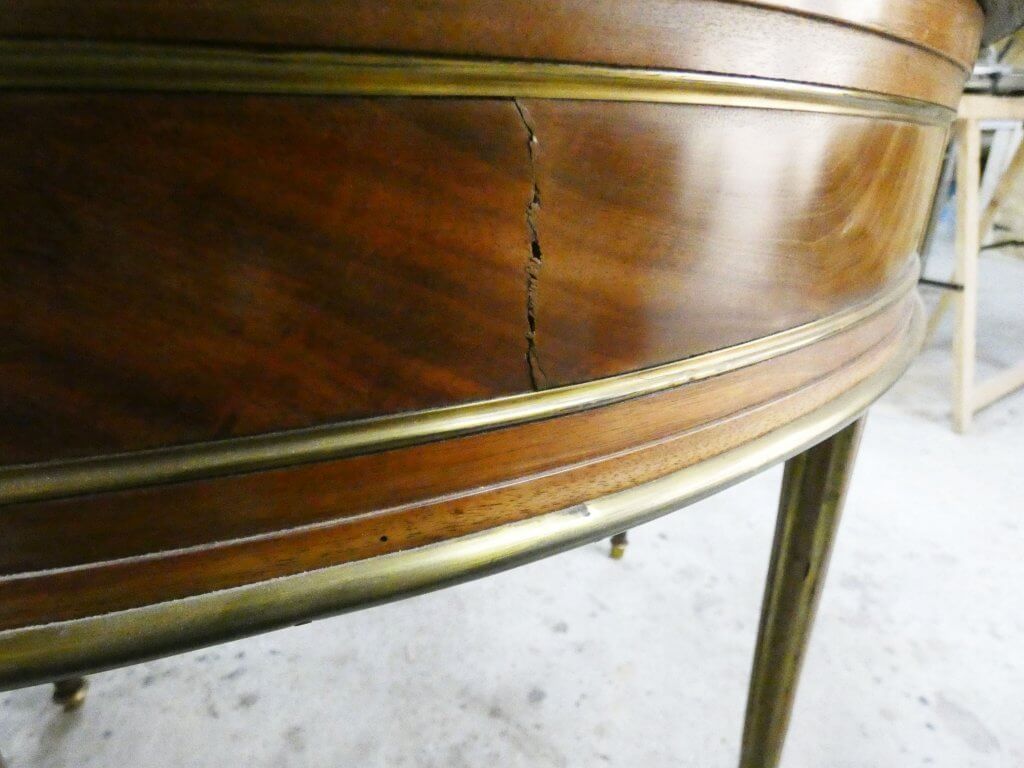
Split soul
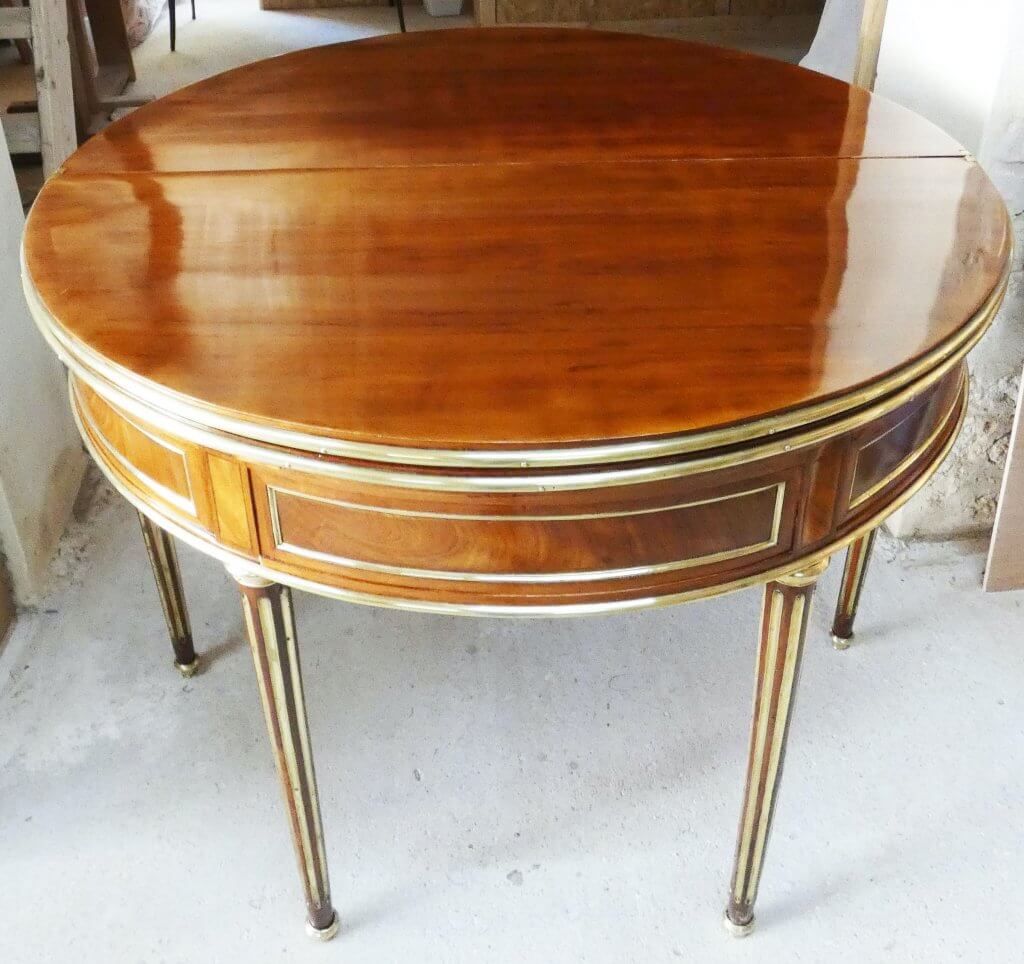
This piece of furniture is for sale at the Galerie Dagault – Tel – 0603490255