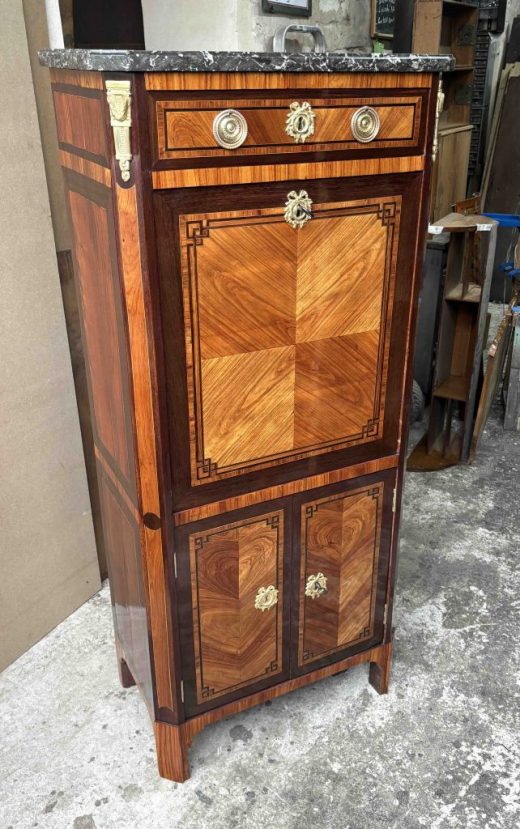
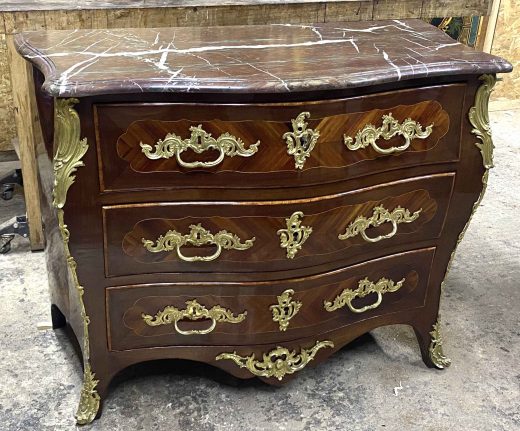
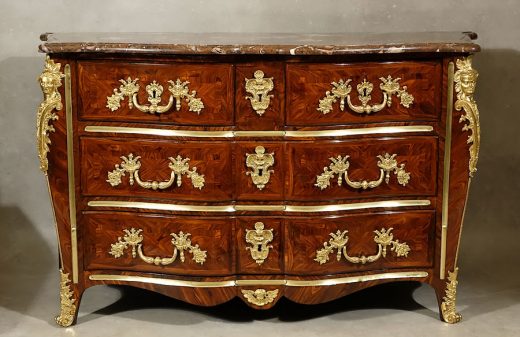
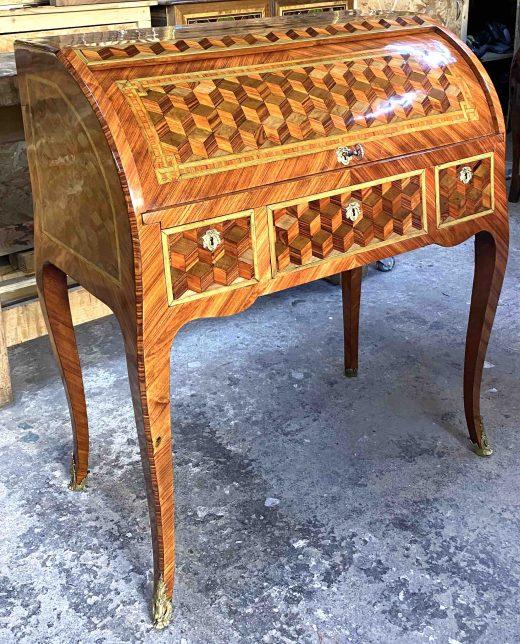
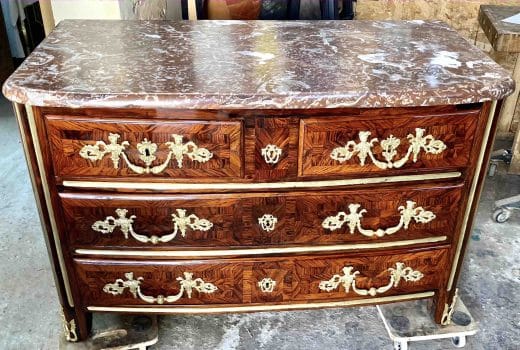
Louis XVI secretary stamped Schlichtig

Ebénisterie Mathieu Vath

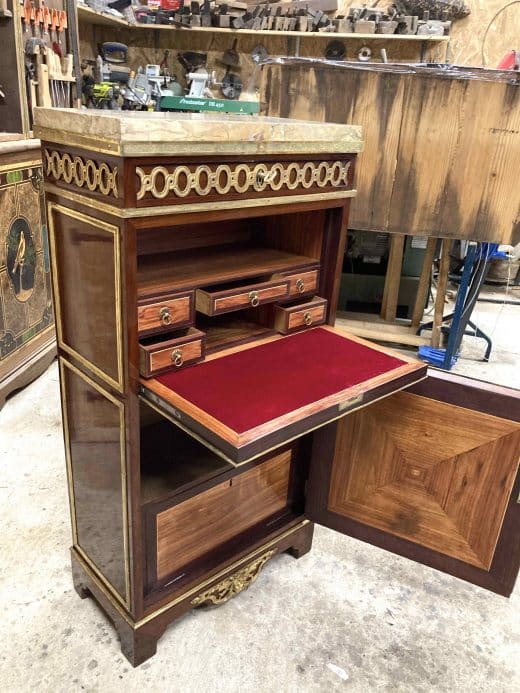
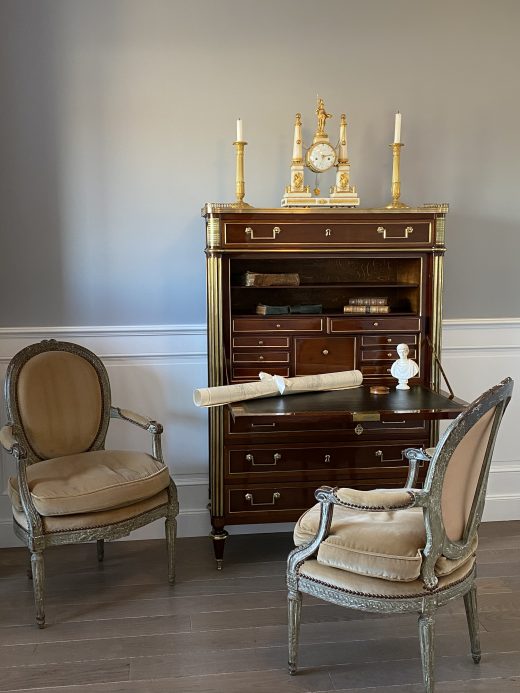
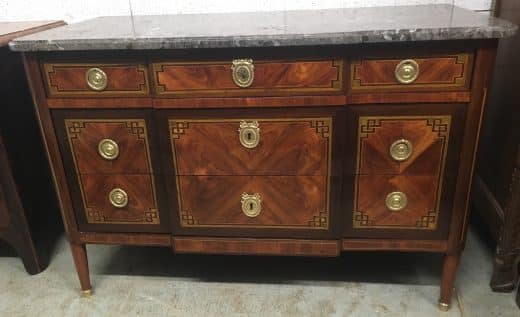
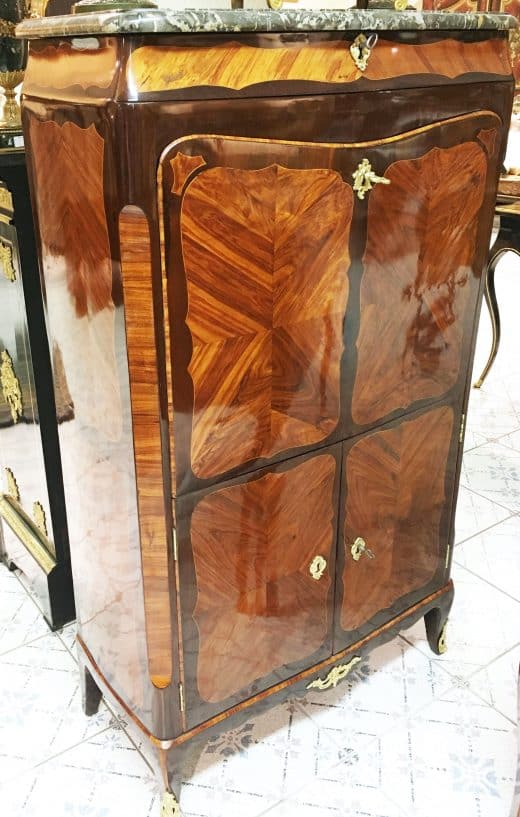
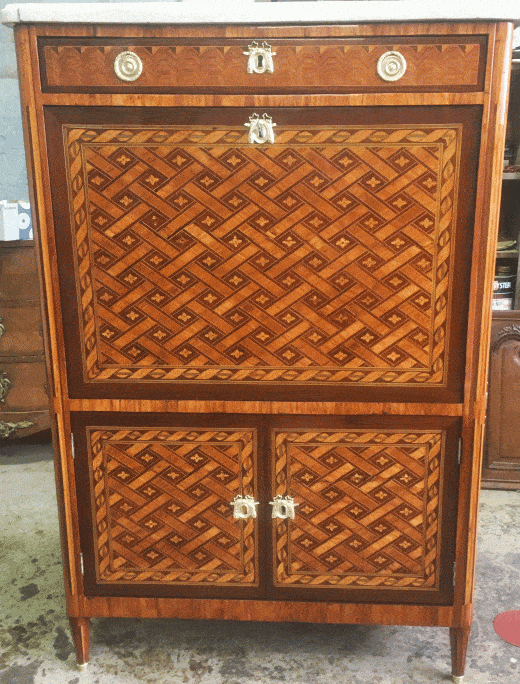
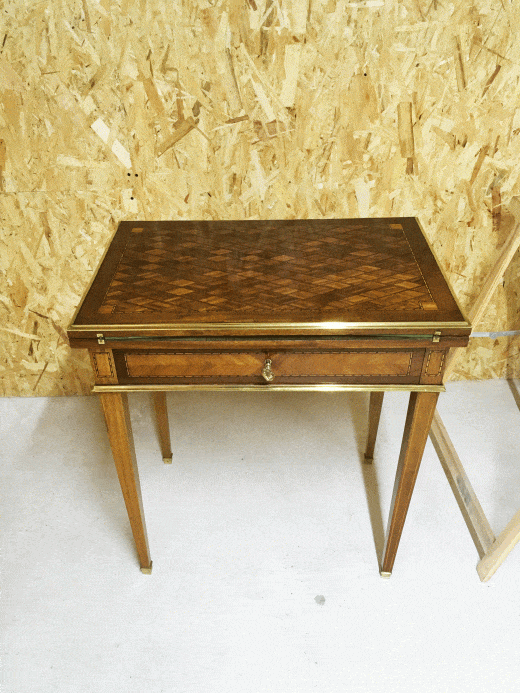
This Louis XVI style secretary desk, stamped JG Schlichtig, is made of rosewood veneer, satinwood (on the sides) and amaranth, on an oak and softwood frame. It opens with two lower doors, a central drop-front, and a top drawer. The interior of the piece includes six drawers and three niches. Given its small size, 1.20 meters, it can be described as a lady's secretary desk. Jean-Georges Schlichtig († February 1782) was a Parisian cabinetmaker of German origin, admitted as a master on October 2, 1765. He established himself successively […]
Louis XIV low bookcase

Ebénisterie Mathieu Vath

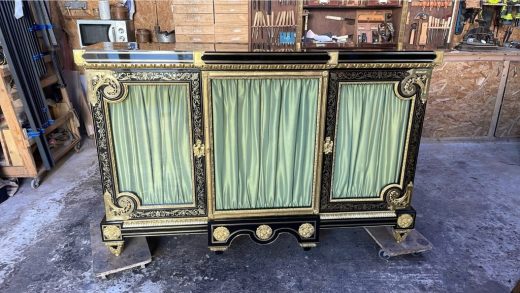
Restoration of a low Louis XIV style bookcase, in Boulle marquetry of brown tortoiseshell and brass, ebony, and chiseled and gilded bronze ornamentation. The central projecting front opens with three glazed doors decorated with scroll and foliage motifs, resting on tapered legs. This type of three-part low cabinet was one of Boulle's great successes, and he himself offered several variations. The Louvre Museum, in fact, owns no fewer than six examples. These pieces of furniture, particularly suited to the display […]

Louis XIV style commode – Grenoble, first third of the 18th century

Ebénisterie Mathieu Vath

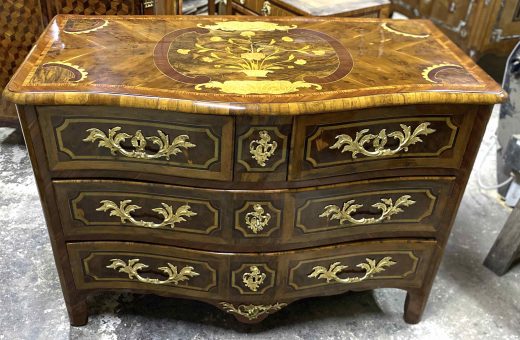
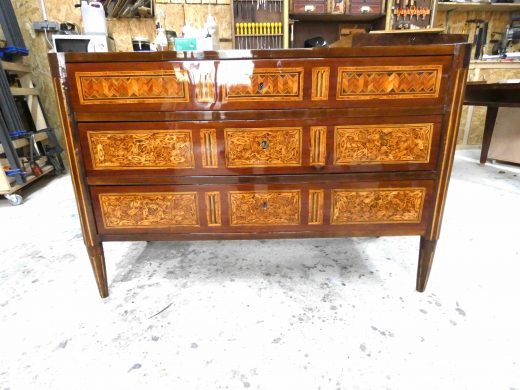
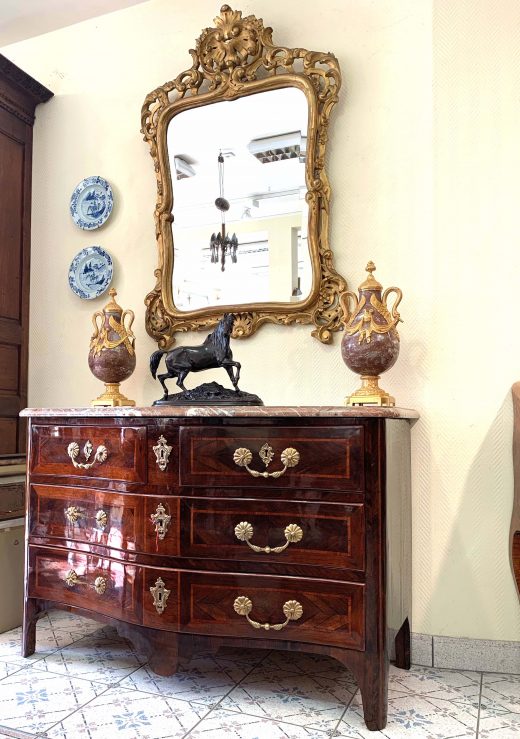
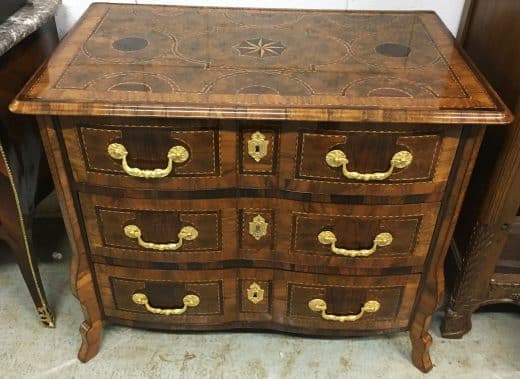
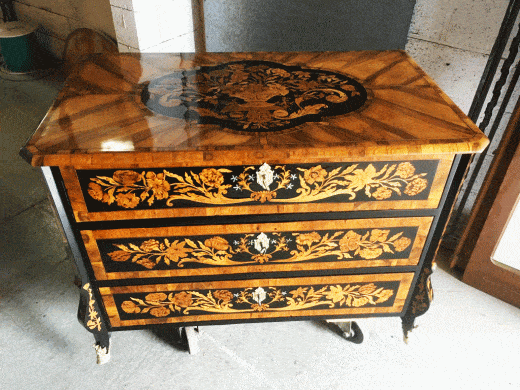
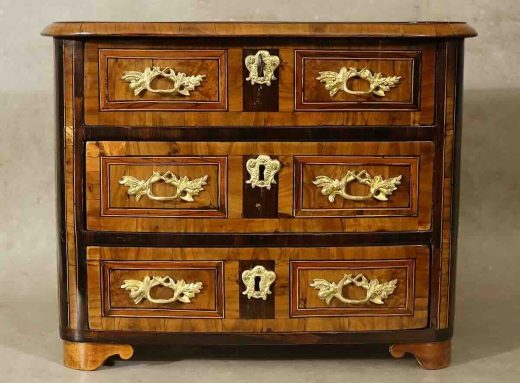
Restoration of a Louis XIV Dauphiné commode, veneered in geometric Alpine wood, with a bombé front and three drawers in three rows. The model's proportions and construction are similar to those of a full-size commode (dovetail joints, intermediate shelves, etc.). The cabinetmaker skillfully played with contrasts through the juxtaposition of wood species, and the quality and variety of the woods used on this small piece of furniture are remarkable: primarily olive and olive burl, walnut, and rosewood for the framing bands highlighted with […]

Louis XIV double-bodied display case

Ebénisterie Mathieu Vath

Restoration of a Louis XIV period two-part display cabinet veneered in cedar, ferreol, and cherry. The moldings are made of blackened fruitwood. With a flat front and sides, it opens with two doors in the lower section and two grilled doors in the upper section, with a straight cornice, resting on ball feet. This type of marquetry is found on furniture from the second half of the 17th century. Condition report: This piece of furniture showed multiple alterations. Regarding the frame, the nailed back panels, which were intended to maintain proper squareness, and […]

Regency corner

Ebénisterie Mathieu Vath

Restoration of a Regency period corner cabinet veneered in Rio rosewood on a softwood frame. The piece had little damage apart from missing fluting and mahogany grafts on the top and bottom rails. The work therefore consisted of replacing the mahogany grafts with rosewood veneer that was sawn, scraped, and sanded before being glued with hot glue. The brass fluting was recreated and adjusted to fit perfectly into its original positions. A French polish finish was applied […]

Empire Inkwell

Ebénisterie Mathieu Vath

Restoration of a late Empire inkwell, rectangular in shape, surmounted by a central dish with a lid pierced with palmettes and handles in the form of flowering tassels, held by two winged putti with quivers on their backs and volute tails, flanked by two inkwells decorated with trellis patterns and surmounted by a pierced lid with acorn-shaped knob, the body with an inset pen niche, the frieze centered by a mask of Apollo emitting stylized foliate trails, on a molded plinth, on feet. Simply veneered with a […]

Regency commode with crowned R

Ebénisterie Mathieu Vath

Restoration of a Regency commode, probably from southeastern France, veneered with yew, plum, rosewood, walnut, cherry, amaranth, violet wood, boxwood, and green-stained maple on a softwood frame. Besides its highly unusual marquetry decoration, the commode's distinctive feature is its crowned R bronze mounts. The crowned R hallmark should not be confused with the crowned C hallmark, which corresponds to a tax levied from 1745 to 1749 on copper objects and is found on many […]

Transition work table

Ebénisterie Mathieu Vath

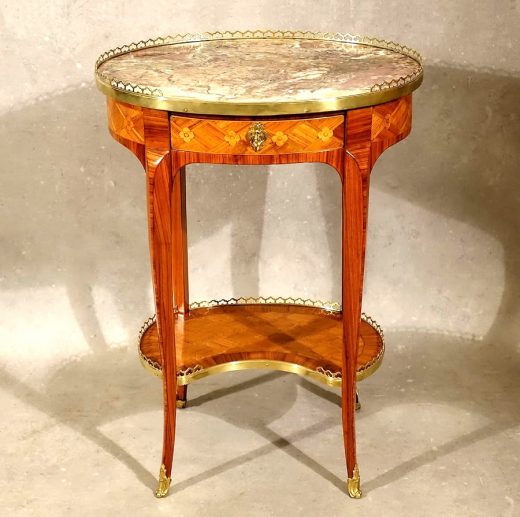
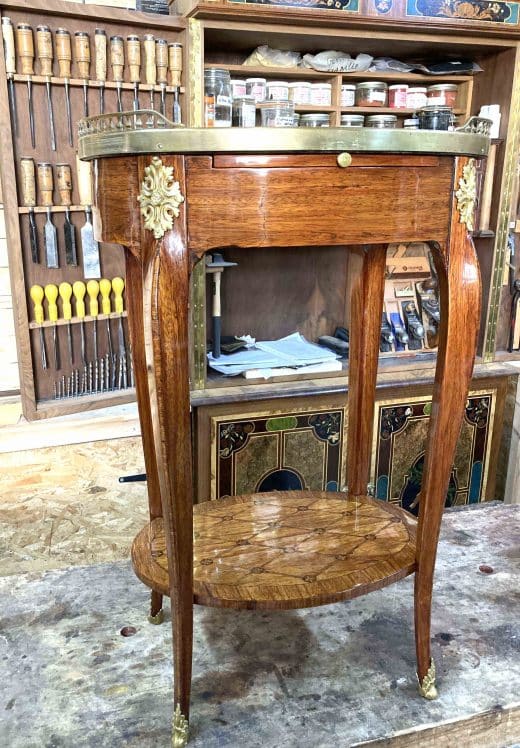
Restoration of a work table with cabriole legs and a stretcher in marquetry of trellis and quatrefoils, known as "à la Reine," veneered in rosewood, inlaid with boxwood, green-stained hornbeam, and boxwood stringing on an oak frame. It opens in the frieze with a drawer forming a writing surface with a leather-lined drop-front and compartments on the sides. The Escallettes marble top is bordered by an openwork brass gallery similar to the one that frames the kidney-shaped stretcher. A minor restoration including some veneer repairs and […]

Transitional chest of drawers stamped SAUNIER

Ebénisterie Mathieu Vath

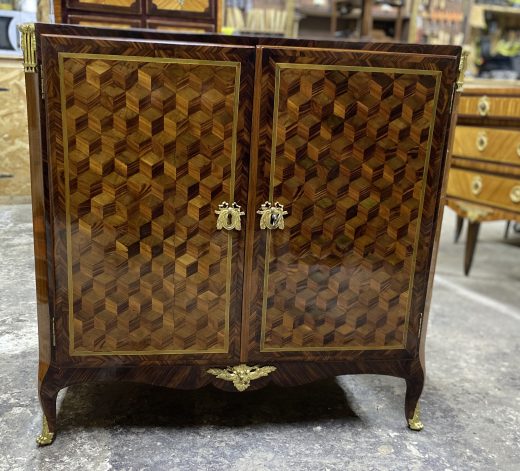
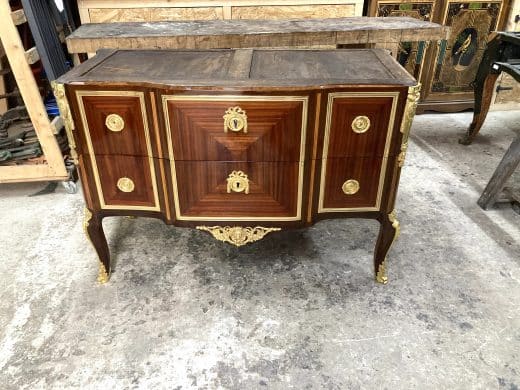
Restoration of a transitional two-door commode veneered with bottomless cube marquetry. The frame is oak for the uprights and rails, the side panels are softwood, and the two doors are walnut. The bottomless cubes are veneered with rosewood, violetwood, and tobacco-stained maple. The entire piece is framed with a stringing of green-stained maple and boxwood. The uprights and door frames are veneered with violetwood and rosewood. The sides […]

Louis XV commode stamped NA Lapie

Ebénisterie Mathieu Vath

Restoration of a Louis XV commode, stamped by Nicolas Alexandre Lapie, veneered in amaranth and satinwood on a beautifully crafted oak frame. The sides and drawer fronts are made of softwood, and the marble top is Campan griotte marble. Nicolas Alexandre Lapie, son of Nicolas Lapie, a pottery merchant in the Faubourg Saint-Antoine, and brother of the master cabinetmaker Jean Lapie, Nicolas Alexandre (known as the Elder) appears to have been born around 1730. He registered his master's letters at the Châtelet in Paris on the 17th […]

Regency chest of drawers with Spanish-style drawers

Ebénisterie Mathieu Vath

Restoration of a Regency period commode with a serpentine front and espagnolettes, curved on all sides, veneered in violet wood on a walnut frame, opening with four drawers in three rows and topped with a Belgian Griotte Red marble slab with ears and a corbelled edge. The pinched uprights are dark, as are the front rails, with fluting and brass reeding. Its high-quality bronze ornamentation features superb chasing and includes very rare espagnolettes (seen on six commodes: four by Etienne Doirat, one by François Lieutaud […]

Transitional cylinder secretary, stamped SCHLICHTIG

Ebénisterie Mathieu Vath

Restoration of a Transitional period roll-top desk stamped by Jean-Georges Schlichtig. The frame is oak for the legs and rails, while the panels and drop-front are softwood. It is veneered in rosewood with marquetry of bottomless cubes in rosewood and tobacco-stained sycamore; the Greek key stringing is composed of hornbeam and holly. The back and interior drawers are veneered in satinwood. This type of roll-top desk was a common production for this cabinetmaker, who produced […]

Regency chest of drawers stamped ID

Ebénisterie Mathieu Vath

Restoration of a Regency commode veneered in rosewood on a conifer frame. It was only after three weeks of work on this commode that I noticed a strange mark. It had been there from the beginning, right in front of me, and I hadn't noticed it. Indeed, it's quite rare to see a stamped Regency commode. But yes, the mark was definitely there. And it's not a modest mark, since this ID stamp is attributed to Jacques Denizot. Jacques Denizot (1684–1760) is […]

Transition chest of drawers stamped Etienne AVRIL

Ebénisterie Mathieu Vath

Restoration of a transitional commode stamped three times E.AVRIL, veneered in amaranth, rosewood, satinwood, and green-stained stringing on an oak and softwood frame. Etienne Avril (1748-1791), admitted as a Master Joiner-Cabinetmaker on November 23, 1774, died prematurely in 1791. Étienne Avril, known as Avril the Elder to avoid confusion with his brother Pierre, would witness the agony of the Ancien Régime and the abolition of the centuries-old guild system. Born in 1748 to a cab driver, Étienne Avril was not destined for […]

Transitional chest of drawers stamped Léonard Boudin

Ebénisterie Mathieu Vath

Restoration of a Transition period commode stamped by the master cabinetmaker Léonard Boudin (1735 in Paris – 20/12/1807). It is constructed of solid oak and veneered with amaranth, rosewood, and ribbon satinwood (Brosimum rubescens), which provides a highly decorative appearance due to the pronounced interlocked grain of this South American wood. It should be noted that it belongs to the same family as snakewood (Brosimum guianense). As Boudin was primarily a merchant during the Transition period, it is likely that this commode is actually by his hand (before […]

Coffee table stamped P.GARNIER JME

Ebénisterie Mathieu Vath

Restoration of a Transitional Period (1750-1774) satinwood veneer salon table stamped by Pierre Garnier (circa 1726-1800). Originally from Paris, and the son of master cabinetmaker François Garnier, Pierre Garnier obtained his master's certificate on December 31, 1742. In contrast to his father, François left the Faubourg Saint-Antoine for the rue Neuve-des-Petits-Champs, near the Place Vendôme. His clientele consisted of merchants such as Léonard Boudin and Pierre Migeon, but above all of the kingdom's wealthiest figures, such as Louis Georges Erasme, Marshal of France, the Duchess of Mazarin, and the Marquis de Marigny, […]

Secretary LXVI stamped Martin Carlin

Ebénisterie Mathieu Vath

Restoration of a Louis XVI period lady's writing desk stamped by Martin Carlin JME. The frame is solid oak, with the fall front and lower door made of softwood. The exterior is entirely veneered with Honduran mahogany, except for the upper edge, which is embellished with a thin strip of amaranth. The interiors are veneered with rosewood, amaranth, and stringing of boxwood and ebony. Of particular interest: the upper interior compartment has never been restored and retains its original finish, a magnificent polish that has preserved the […]

Mazarin Boulle Office

Ebénisterie Mathieu Vath

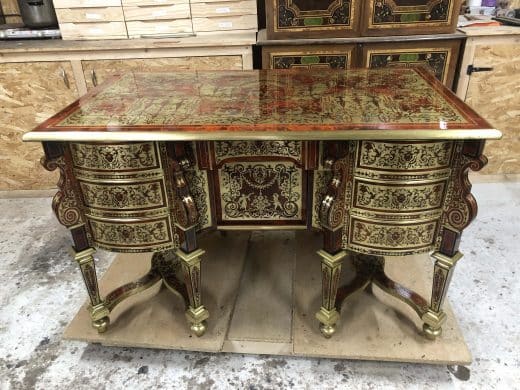
To end the year on a high note, here's a restoration that occupied a large part of my time this year and which reached its owner a few weeks ago. It's the restoration of an eight-legged writing desk, commonly known as a "Mazarin" desk. Constructed of solid oak and softwood, the sides and drawer bottoms are made of light walnut. The marquetry covering it consists of Caret tortoiseshell (Eretmochelys imbricata) on a vermilion red ground, and brass. All of this is framed by delicate ebony stringing. It is […]

Eight-foot desk known as the "Mazarin" desk«

Ebénisterie Mathieu Vath

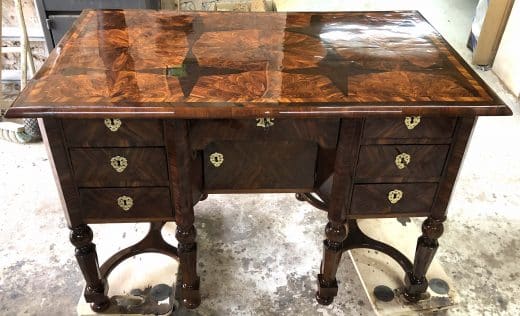
Extensive restoration work has been undertaken on this Mazarin desk, veneered in kingwood and rosewood. It is entirely veneered on fir with a solid rosewood base. The top features a marquetry of rosewood stars surrounded by kingwood butterfly wings in circular patterns. Why the name "Mazarin"? The eight-legged desk is one of the jewels of 17th-century furniture. It only acquired the name "Mazarin" from antique dealers in the 19th century to give it a more prestigious name.

L Cueunieres Writing Desk

Ebénisterie Mathieu Vath

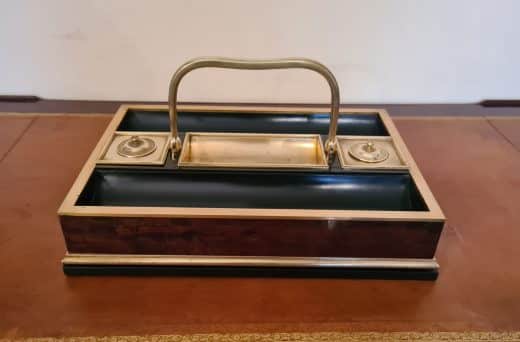
A small restoration for this very pretty Louis XVI style inkwell, stamped L.CUENIERES jne. Louis Cueunières jeune, established at 10 rue Villehardouin in Paris in 1870, specialized in the restoration of antique furniture and the reproduction of period pieces. This inkwell was in fairly good condition. Apart from a few small pieces of missing ebony, it was simply dirty. A few ebony grafts, a good cleaning, and a touch-up of the varnish with a French polish were enough to restore its former luster. To see previous restorations: https://ebenisterie-mathieuvath.fr/en-ce-moment-a-latelier/ You can find this piece at […]

Louis XVI Powder Box/Writing Table

Ebénisterie Mathieu Vath

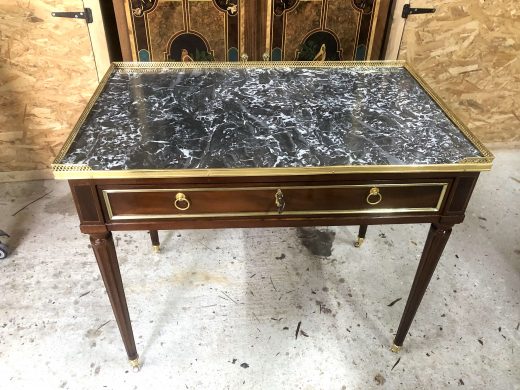
The dressing table, sometimes called a powder table, can be defined as a vanity unit in the form of a table or a small writing desk with drawers. Around 1730, shortly after the commode, this new type of furniture, often richly inlaid or veneered with precious woods, appeared in French furniture. This rather atypical powder table has the unique feature of also serving as a writing desk, or at least a desk for writing. Its four legs are made of solid mahogany, and the stretchers are also veneered in mahogany. The four surfaces are […]

"Cabaret" pedestal table«

Ebénisterie Mathieu Vath

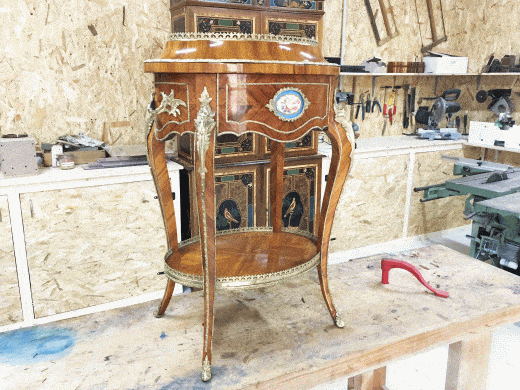
Very fashionable at the end of the 18th century, the cabaret table, or cabaret table, is characterized by a raised, basin-shaped top. Its slightly concave shape with a raised rim all around allows for the safe serving of various beverages such as teas, hot chocolates, and other drinks. This model, similar to those made by the cabinetmaker Canabas, is made of solid mahogany from Saint-Domingue with metal reinforcement under the legs. The biggest problem, in fact, was with the legs; they wobbled in all directions. The […]

Napoleon III side table

Ebénisterie Mathieu Vath

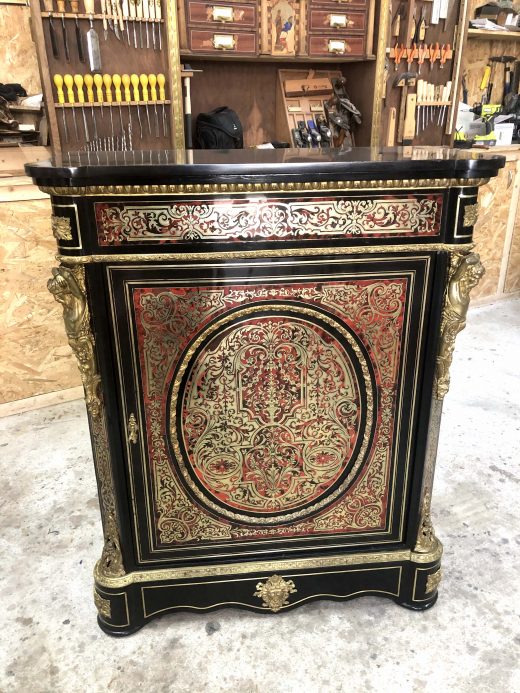
A Napoleon III period side table with a quadrangular structure veneered in blackened pearwood, adorned with rich Boulle marquetry in brass and red tortoiseshell forming an arabesque design composed of foliate scrolls, rocaille motifs, and small flowers. The whole is punctuated by beautiful gilt-bronze mounts featuring atlas figures with clasped hands, acanthus leaves, and an apron. The top is framed by a gadrooned molding supporting a black marble slab with rounded edges. It opens with a door with a lock […]

Napoleon III Boulle marquetry side table

Ebénisterie Mathieu Vath

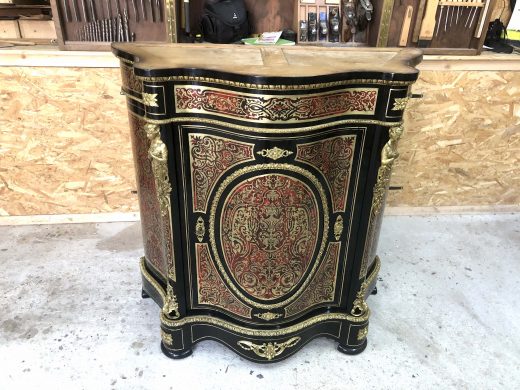
A console table veneered in ebonized pearwood and inlaid with Boulle marquetry of brass on tortoiseshell in arabesque designs. It opens with a door adorned with an oval medallion, revealing shelves in mahogany and mahogany veneer. Rich ornamentation of chased and gilded bronze: egg-and-dart friezes, caryatids in corner drops, interlaced friezes, acanthus leaf friezes, fruit, and florets. This Boulle piece requires extensive restoration. Some pieces of brass, stringing, and especially a great deal of tortoiseshell are missing. Given its value […]

Restaurant Secretary

Ebénisterie Mathieu Vath

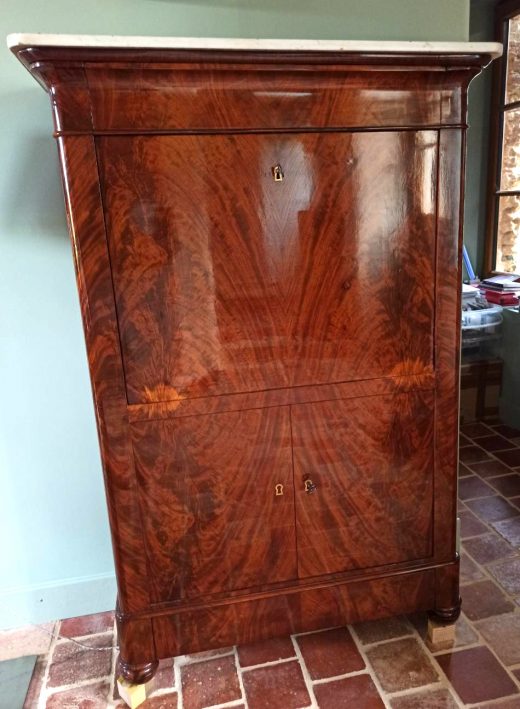
Restoration of a Restoration period (1815–1830) drop-front secretary veneered in burr mahogany and topped with Carrara white marble. The front legs are rounded and the rear legs are square. The frame is made of oak and softwood. An inventory mark (I91) is found inside the lower drawer on the right side. The Restoration style? After Napoleon's defeat at Waterloo on June 18, 1815, power in France was taken over by the two brothers of Louis XVI: the Count of Provence, who would reign under the […]

Barber shop Louis XVI/Directory

Ebénisterie Mathieu Vath

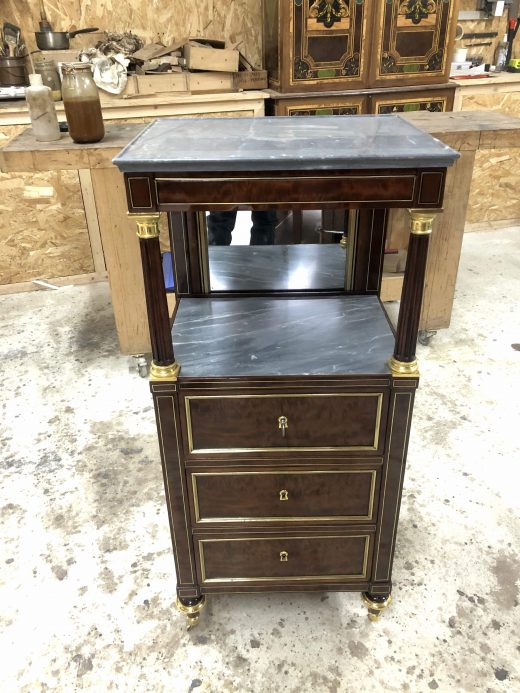
This elegant mahogany-veneered shaving cabinet from the late 18th century rests on four tapered legs with casters and opens with three drawers in the front. The niche, with its blue Turquin marble top framed by fluted columns, is surmounted by two side drawers and a sliding marble shelf with a recessed panel that reveals a sliding mirror on a rack and pinion mechanism, pivoting and framed with ebony and brass stringing. Appearing during the reign of Louis XVI, this style of shaving cabinet is a toilet unit designed to hold a porcelain pitcher and basin […]

Louis XVI commode

Ebénisterie Mathieu Vath

Restoration of a Louis XVI period commode from eastern France, made of solid oak and fir and veneered with end-grain laburnum, walnut, plum, amaranth, rosewood, palisander, boxwood, and green-stained hornbeam. The handles and keyholes were added at a later date. The original fittings are missing; only the holes for the handles remain. This is a piece of furniture that has never been restored. The veneer is almost 4 mm thick in some places, and […]

Mahogany games table, late 18th - early 19th century

Ebénisterie Mathieu Vath

96 x W 47.5 x H 74 cm. Open: 96 x 95.5 cm. Restoration of a games table with a folding top veneered in burr mahogany, commonly known as Cuban mahogany. In fact, according to the recent book "L'essence du bois" (The Essence of Wood) by Patrick George, Emmanuel Maurin, and Marie-Christine Troujy-Jaquemet, it seems more accurate to call this type of mahogany Saint-Domingue mahogany. The base is veneered in solid oak, and the top in poplar. The moldings are solid mahogany. The table rests on legs […]

Secret box

Ebénisterie Mathieu Vath

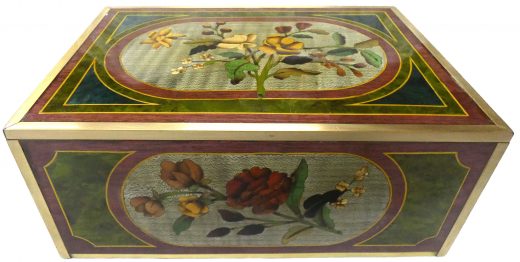
The brief was to create a multi-movement secret box inspired by Japanese boxes but with French-style marquetry. This box comprises three movements to access the secret drawer and a spring-loaded button concealed beneath the veneer that allows the drawer to be ejected. For the form and marquetry, I drew inspiration from the traveling secretary attributed to Jean-François Oeben. The geometric shapes and colors closely correspond to what this cabinetmaker […]

Empire Pedestal

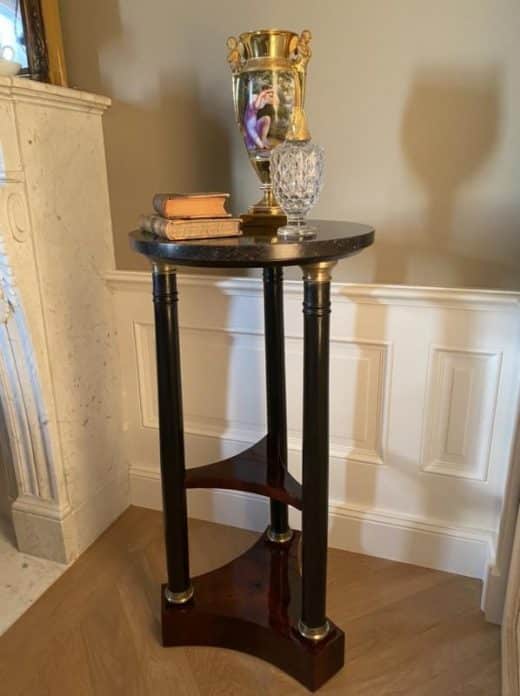
Restoration of a walnut (for the legs and frame) and flame mahogany veneer pedestal table. It rests on three column-shaped uprights, surmounted by a circular black veined marble top adorned with bronze rings. The restoration involved tightening the cracked base, re-gluing the edge veneers, and adding some veneer grafts. The columns, which were heavily infested with wood-boring insects, were stripped and then treated with static anoxia. Static anoxia is an insecticidal treatment that works by depriving the body of oxygen, having […]

Regency commode stamped J.BIRCKLE

Ebénisterie Mathieu VATH

Restoration of a chest of drawers veneered in Rio rosewood and satinwood stringing. It has two large drawers and two small ones in the upper section. Its frame is made of oak and fir. It is stamped J.BIRKLE on the left upright and also bears the mark JME. It shows some signs of restoration and an ink mark on one side of a drawer. Jacques Bircklé (1734-1803) – Cabinetmaker – master craftsman obtained on July 30, 1764. One of the suppliers to the Royal Furniture Repository under Louis XVI. Freelance craftsman before […]

Louis XVI/Directory Secretary

Antiquités Guin

Restoration of a drop-front secretary desk built in oak and veneered with mottled mahogany and mahogany from Saint-Domingue. Its design dates from the late 18th century. Its white Carrara marble top is surrounded by a partially openwork brass gallery. It opens with a drawer at the top, a drop-front in the middle, and three drawers at the bottom; all the original locks are secured with a clover-shaped key. All the panels on the front and sides are framed with brass quarter-round moldings. The drop-front is veneered in mahogany […]

Empire secretary with quiver

Ebénisterie Mathieu VATH

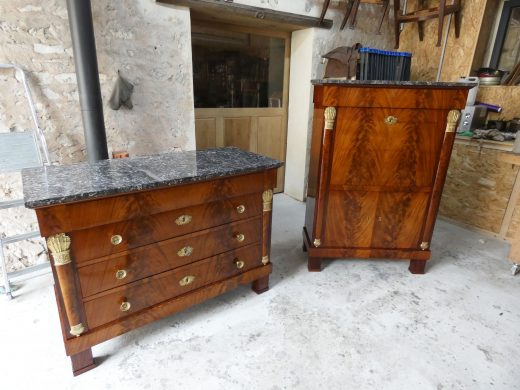
You remember the Empire chest of drawers with the quivers. Well, here is the secretary desk with the quivers. It is built in exactly the same way as the chest: same construction, same solid woods used, and same mahogany veneers. As for the restoration, it is identical to that of the chest of drawers. The aim is to preserve as much as possible and restore the piece of furniture to its original function without altering its history. The work therefore consisted of reattaching the structure and the few detached veneer elements. And to […]

Empire Chest of Drawers with Quivers

Ebénisterie Mathieu VATH

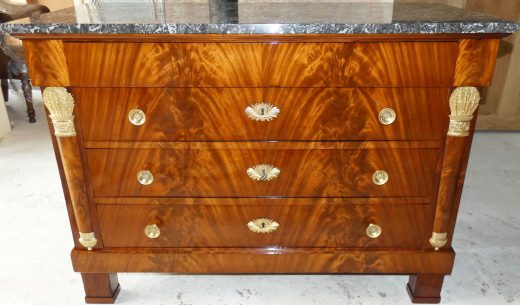
This week, here are some photos of the restoration of this Empire-style chest of drawers veneered in mahogany burl. This chest is truly unique due to the quality and originality of its bronze mounts. Indeed, they form quivers along with the side columns. The keyhole escutcheons are composed of two crossed laurel branches held together by a ribbon. Originally, they were mercury-gilded, as can be seen from the gilding stains on the back. Unfortunately, only a few partial traces remain on the front […]

Small Boulle marquetry cartel clock

Ebénisterie Mathieu VATH

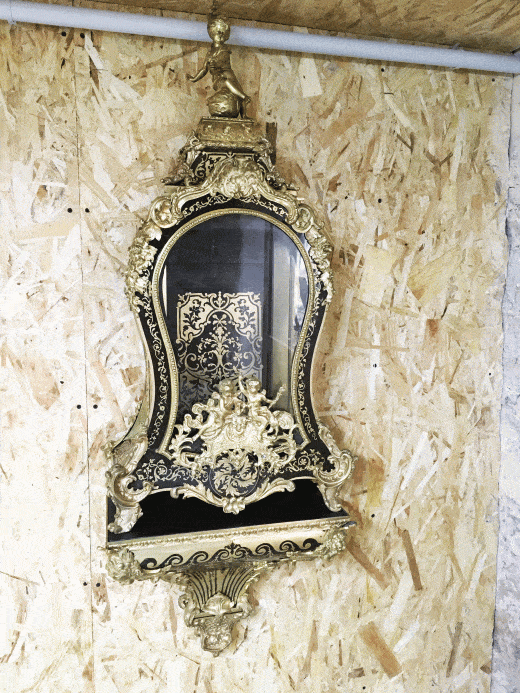
Restoration of a Napoleon III period marquetry clock in brown tortoiseshell on a black ground and brass. Despite dust, oxidation, and years spent in the depths of an attic, this small clock is in very good condition. Except for a missing piece of brass on the right side of the capital, it is complete. The gilding is still clearly visible beneath the layer of grime, and the structure is in perfect condition. The restoration was therefore straightforward: re-gluing all the marquetry under vacuum, then a light cleaning, and a varnishing with […]

Napoleon III wall shelf

Ebénisterie Mathieu VATH

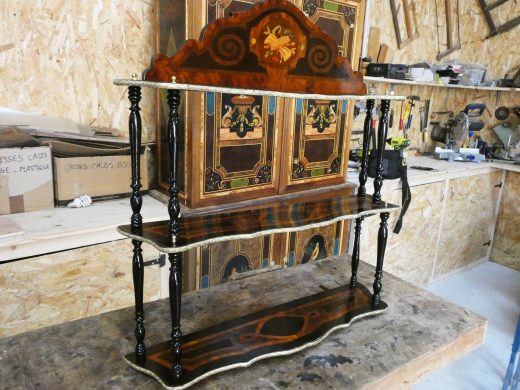
Restoration of a Napoleon III period wall shelf veneered in blackened pearwood, rosewood, amaranth, amboyna burl, and marquetry with a music theme. Underneath the dust, aside from small losses in the blackened pearwood and rosewood, and slight dehydration, there was nothing too serious. A few veneer grafts, a vacuum-sealed glue application, a thorough cleaning, a coat of clear French polish, and voilà! All this without using sandpaper. Except for lightly sanding the varnish […]

Hedouin commode with crowned C

Ebénisterie Mathieu VATH

Extensive restoration of this superb Louis XV period commode, stamped on all four uprights by Jean-Baptiste Hedouin. The frame and drawers are constructed of solid oak, fir, and walnut. The edges of the frieze and geometric marquetry in violet wood are veneered with satinwood. Two types of violet wood are visible: one with a very tight grain and veining for the lozenges, and a second, more intricate type for the marquetry edges, uprights, and rails. The […]

Napoleon III liquor cabinet

Ebénisterie Mathieu VATH

It would seem that the first liquor cellars appeared at the very end of the 18th century. But it was in the 19th century that the fashion for liquor cellars truly took off. The revolution transformed social classes and ways of socializing, leading to increased consumption of liquor, which contributed to the rise of this new social object. The emergence of liquor cellars is, of course, directly linked to the evolution of alcohol consumption in France, such as sweet Mediterranean wines, brandies, cognac, liqueurs, and more.

Louis XVI half-moon table

Ebénisterie Mathieu VATH

Here is a three-tiered half-moon table. This style of table, originating in England, is a classic of the Louis XVI style. It opens to reveal two circular tiers, one lined with felt, the other veneered in mahogany. The mahogany burl veneer apron is adorned with a brass frame. It rests on five tapered legs with brass-filled fluting and ending in sabots. The fifth leg is attached to a drawer that opens to serve as a support once the flap is unfolded. A very attractive piece, probably dating from the end of the […]

Louis XVI style desk stamped KRIEGER

Ebénisterie Mathieu VATH

Exquisitely crafted with its mahogany-veneered oak frame and solid mahogany legs, this desk is a perfect example of high-quality 19th-century furniture. The cabinetmaking is flawlessly executed, and the bronze mounts are in pristine condition. Everything is there; nothing is missing. The Krieger firm began its cabinetmaking business in the mid-19th century with Antoine Krieger (1804-1869) before adding a significant decorative department, which ensured the prestige of its business until around 1945. The Krieger firm produced all the […]

Louis XVI commode stamped JA BRUNS

Ebénisterie Mathieu VATH

This week marks the completion of the restoration of a Louis XVI commode stamped JA BRUNS. It is made of oak for all the structural elements, except for the side panels, drawer backs, drawer fronts, and the two drawer bottoms, which are made of softwood. It is veneered with rosewood in a butterfly pattern and amaranth for the edges. The false fluting is made of boxwood and ebony, and there is a green-stained maple stringing forming the corners at […]

Label signed "Louis David Carré in Paris"«

Ebénisterie Mathieu VATH

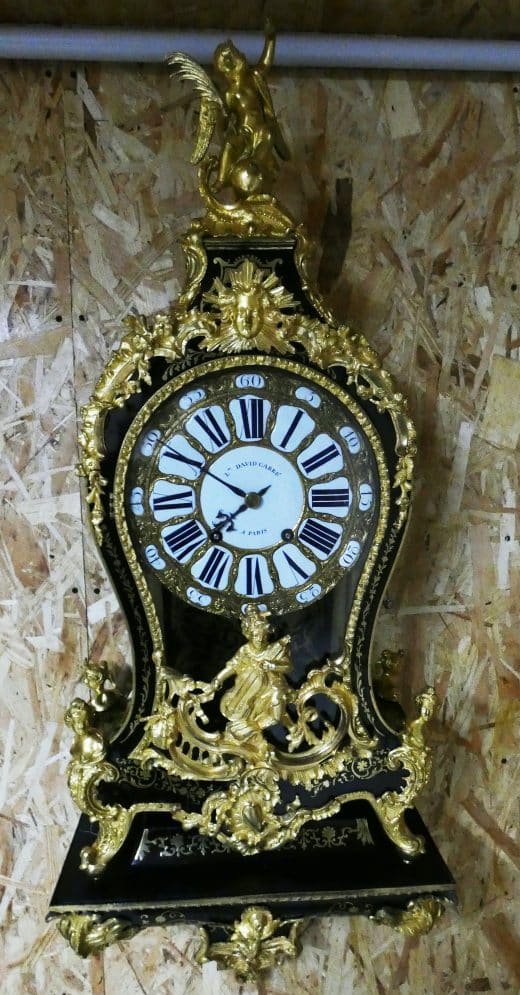
After several weeks of work, the restoration of this clock is finally complete. It is a Louis XV period clock in brown tortoiseshell and brass marquetry, with rosewood restorations. The dial is by Louis David Carré, nephew of Jullien le Roy, who became a master craftsman on December 31, 1748. Lodged at the Louvre from 1744, he was elected a juror in 1775. The greatest treasure of this clock lies in its bronze mounts. They are truly magnificent, and above all, they are in very good condition. There is only […]
Secretary stamped P.ROUSSEL JME

Ebénisterie Matheu VATH

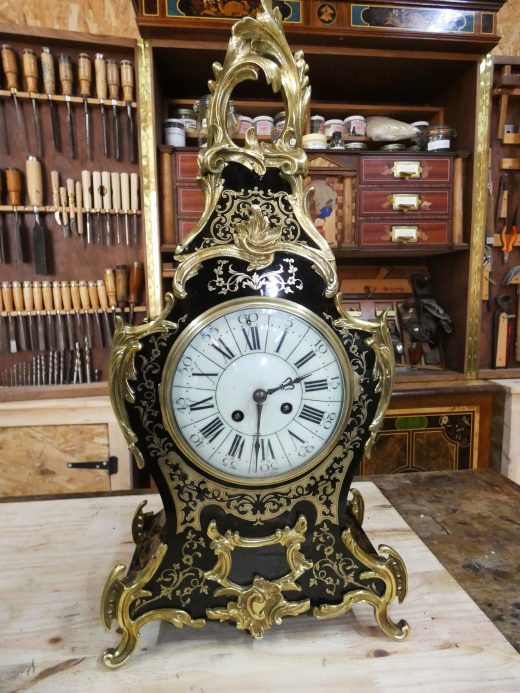
Here are some images of the restoration of a secretary desk stamped by Pierre Roussel (1723-1782). Having become a Master Cabinetmaker in 1745, Pierre Roussel set up shop on Rue de Charonne, in the Faubourg Saint-Antoine, under the sign "L'Image de Saint Pierre" (The Image of Saint Peter). Thanks to his skills as a cabinetmaker and especially as an exceptional marquetry artist, he quickly gained a great reputation. In 1762, he became a sworn member of his guild. By 1767, he was considered one of the best cabinetmakers of his time. Highly regarded by his colleagues, he became a representative of the cabinetmakers' guild in 1777 and then syndic two […]
Mazarine Chest of Drawers

Ebénisterie Mathieu VATH

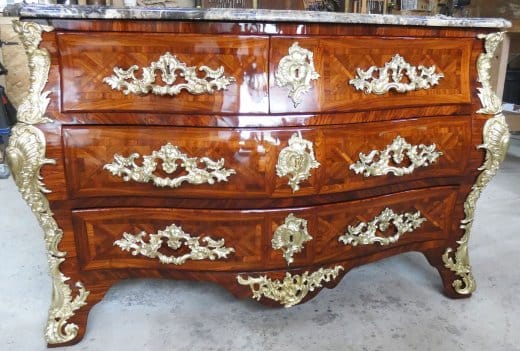
Here is a charming Mazarine commode from the Louis XIV period. With a serpentine front and three drawers in three rows, it is topped with a marquetry top featuring a compass rose on an end-grain wood background. Constructed on a fir frame, it is covered with a beautiful olive veneer, with both end-grain and grain-grained veneer, rosewood, ash on the sides, and boxwood for the stringing and compass rose. The crossbeams are joined with straight dovetail joints on the sides, which has caused some minor imperfections.

Empire bed

Ebénisterie Mathieu VATH

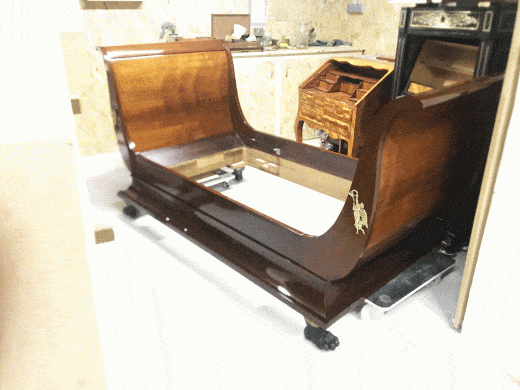
The "boat" bed, with its characteristic curve, is a French invention that appeared during the Directory and was very fashionable during the Empire and the Restoration. It is easily recognizable here by its lion's paw feet. The varnish on this bed had worn away, making it impossible to distinguish between the two mahogany pieces. The mahogany is known as Cuban mahogany (Swietenia mahogani), from Cuba, a Spanish colony. Evidence of its importation into Spain, specifically Seville, dates back to 1519-1520. It was used by Philip II between 1563 and 1584 during the construction of the Palace […]
Louis XV slant-front desk (After restoration)

Ebénisterie Mathieu VATH

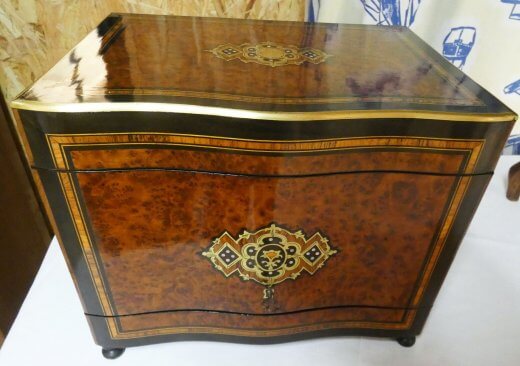
A while ago I told you about this desk that was being restored. Well, here it is finished. The varnishing process took three weeks. This allowed enough time for the varnish to set properly, in order to achieve the best possible result. https://ebenisterie-mathieuvath.fr/en-ce-moment-a-latelier/ So here are some before and after photos.

Corner cabinet in Boulle marquetry from the Napoleon III period

Ebénisterie Mathieu VATH

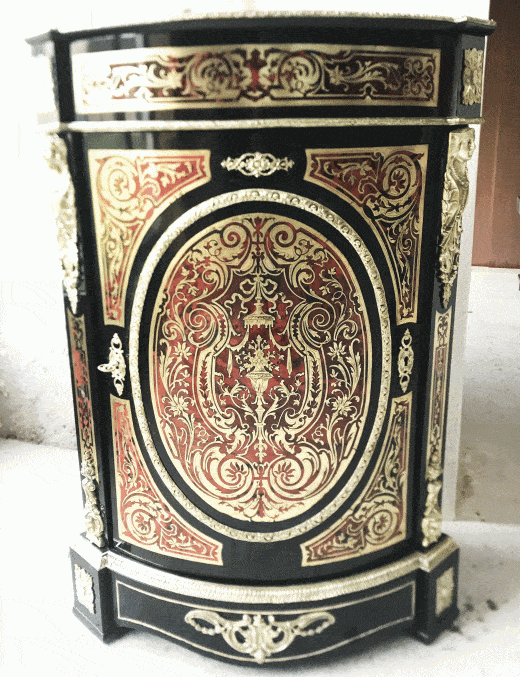
A classic restoration of Boulle marquetry. This involved rehydrating the old glue through infiltration, crafting and gluing the missing brass pieces, and reconstructing the base, which was in poor condition but not beyond repair. The bronze mounts were cleaned and finished with a clear French polish. Proof that appearances can be deceiving. Even a piece of furniture in a severely deteriorated state can regain its former beauty.

Secretary stamped Martin Ohneberg

Ebénisterie Mathieu VATH

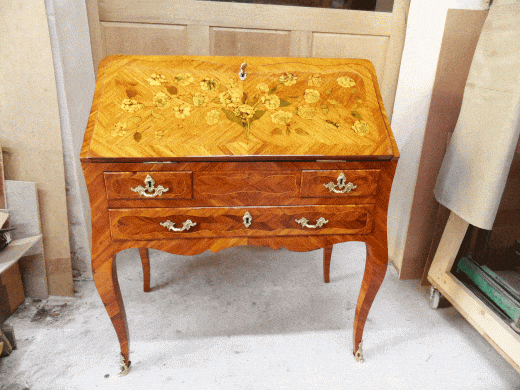
This week marks the completion of the restoration of a Louis XVI period secretary. Martin Ohneberg (Master in 1773), the cabinetmaker who crafted this piece, was an excellent marquetry artist and used very high-quality rosewood. He produced numerous pieces of furniture with very simple lines but exquisite marquetry, including an endless variety of drop-front secretaries. This particular one is veneered with rosewood and amaranth, and features a mosaic marquetry of maple blossoms on a red satinwood ground. The framing bands […]
Louis XV slant-front desk stamped HEDOUIN (Restoration complete)

Ebénisterie Mathieu VATH

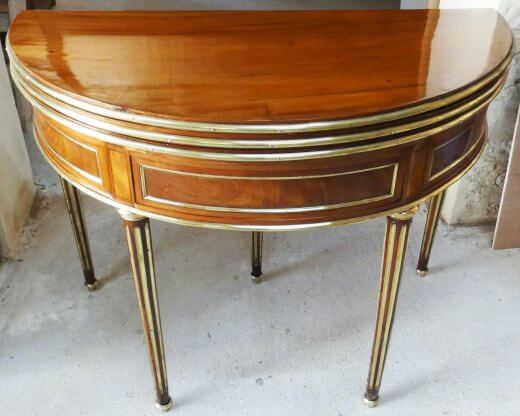
Remember that slant-front desk? Well, it's finished. It was quite a task, but now it's regained its former glory. Only the drawer keyholes and the leather upholstery remain to be fitted before it's returned to its owner. A large part of the legs has been remade from sawn violet wood. This was cut to the correct thickness, scraped and sanded, then oxidized before being glued, so as not to have to sand the entire piece of furniture […]
Napoleon III planter and Louis XVI chest of drawers

Ebénisterie Mathieu VATH

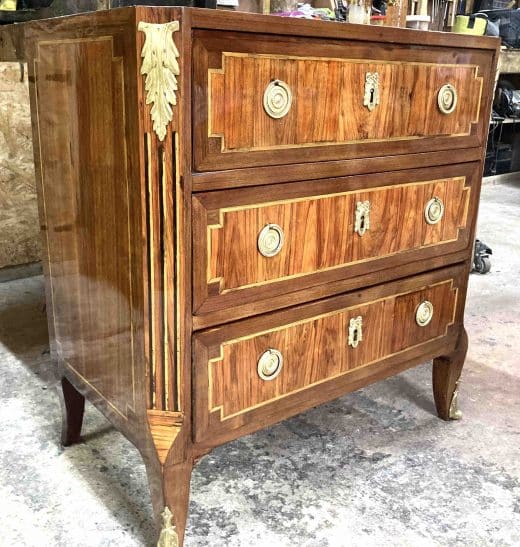
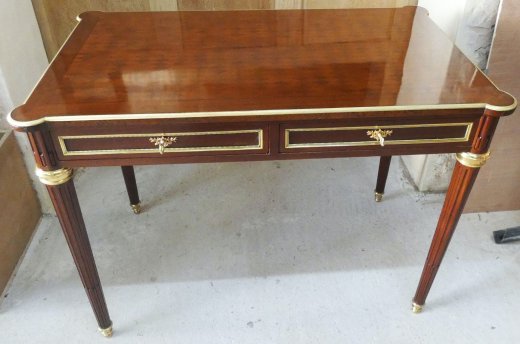
This week, two pieces of furniture left the workshop: a Napoleon III jardinière in rosewood veneer and a Louis XVI chiffonier in rosewood and violet wood veneer. If this piece had seven drawers, it would have been called a "semainier" (weekly chest of drawers). Here are some photos of their restoration.

Mazarine Chest of Drawers

Ebénisterie Mathieu VATH

This week, we're revisiting the restoration of a Louis XIV period commode, a commode known as a Mazarine commode. But where does the name "Mazarine" come from? Well, it seems that the first example was made for the famous Mazarine Library, quite simply. Moreover, the illustrious creator of the commode was none other than André Charles Boulle himself. For Louis XIV's bedroom at Trianon, he revolutionized a type of furniture in 1708: the commode, which takes its name from its "practical" aspect compared to the chests that were widely used at the time. Today, we're presenting […]

Alexandre Morell's Cartel Boulle – The End

Ebénisterie Mathieu VATH

After a few hours of cutting, gluing, re-gluing, and cleaning the surfaces, we finally reach the finishing stage. For this cartel clock, we chose to French polish it because it's a finish that highlights the marquetry, protects it, and is easily reversible (like all my work). I always use a clear shellac varnish, whether on wood or other materials. The varnishing process is difficult to explain; it simply takes hours and hours […]