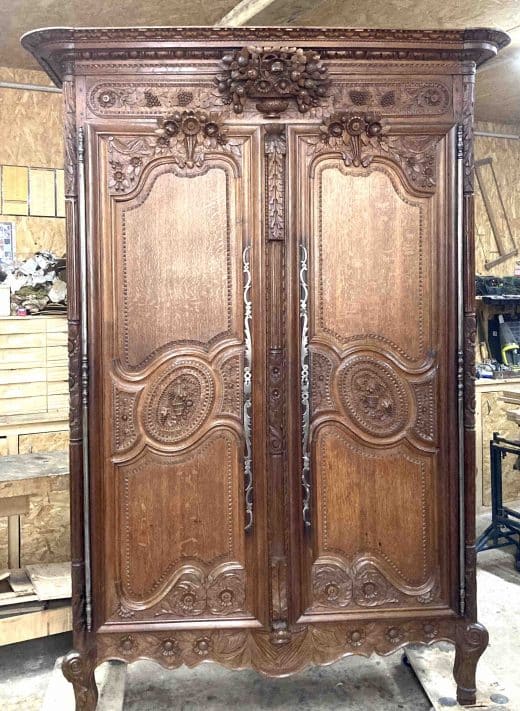
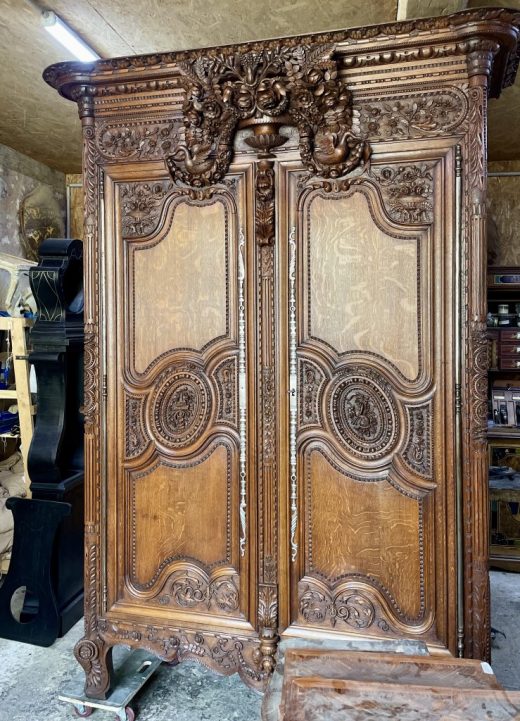
Wedding wardrobe from Bayeux with swans
Ebénisterie Mathieu Vath

A lightening of the finish was carried out on a Bayeux wedding armoire, distinguished by its motifs of swans, figures, and hunting and musical attributes. The piece is made of quarter-sawn oak, also known as "merrain," and is attributed to the Caen plain, dating from the first half of the 19th century. The restoration work consisted of lightening the waxed finish to remove the multiple layers of tinted wax that darkened the entire piece. This process revealed the beautiful honey-blond hue of the oak […]
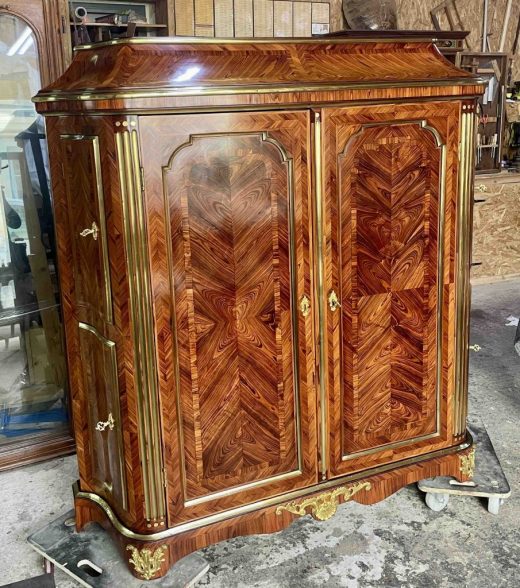
Regency-style wardrobe stamped MIGEON

Ebénisterie Mathieu Vath

Restoration of a Regency-style cabinet, probably dating from the 1740s, stamped by Pierre IV Migeon. Constructed of oak and softwood, this cabinet, which could also be considered a bookcase, is entirely veneered in kingwood, rosewood for the top, and walnut for the interiors. The doors are veneered with a butterfly-wing pattern, while the side doors feature a square motif, typical of Migeon's decorative vocabulary. The ogee cornice is edged with a half-round brass molding. The uprights […]

Louis XVI wardrobe

Ebénisterie Mathieu Vath

Restoration by Raphaël of a rosewood veneered cabinet with diamond-pointed doors, framed in amaranth and Greek key stringing. It opens with two large softwood doors veneered with oak. Some regluing and repairs of missing veneer, along with a good coat of clear French polish, have restored this piece of furniture to its former glory.

Wardrobe of Bretteville the Proud

Ebénisterie Mathieu Vath

It was in the mid-17th century that what we now call the Norman armoire originated. However, it was from the 18th century onward that it acquired the characteristic form we know today: with its two doors, resting on cabriole legs and featuring a wide, sculpted cornice, it combines Louis XV structure and style with Louis XVI motifs. It was during this same period of economic and social stability, allowing for a certain improvement in living standards, that it entered the homes of both the bourgeoisie and the peasantry. The 19th century would be […]