Boulle Dubois Cartel

Restoration of a Louis XV period brown tortoiseshell Boulle Dubois cartel clock, the dial of which bears an engraving with the monogram of Louis XV.
Restoration. Conservation. Creation

Restoration of a Louis XV period brown tortoiseshell Boulle Dubois cartel clock, the dial of which bears an engraving with the monogram of Louis XV.
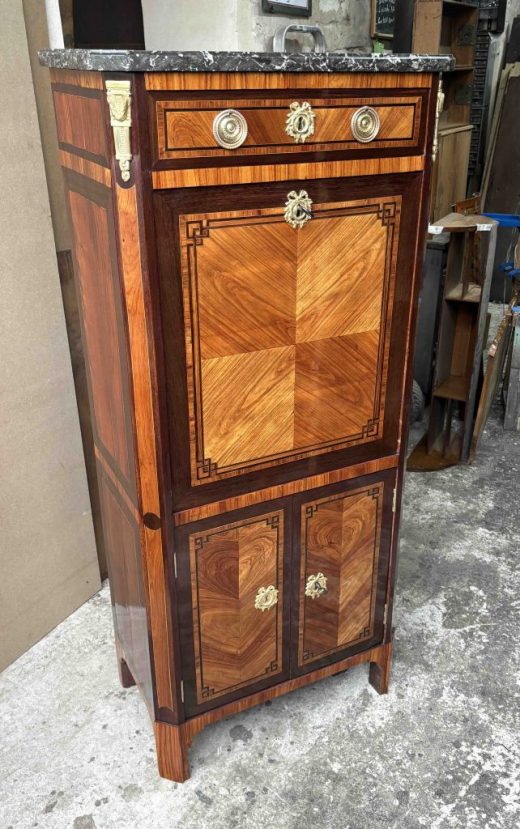
This Louis XVI style secretary desk, stamped JG Schlichtig, is made of rosewood veneer, satinwood (on the sides) and amaranth, on an oak and softwood frame. It opens with two lower doors, a central drop-front, and a top drawer. The interior of the piece includes six drawers and three niches. Given its small size, 1.20 meters, it can be described as a lady's secretary desk. Jean-Georges Schlichtig († February 1782) was a Parisian cabinetmaker of German origin, admitted as a master on October 2, 1765. He established himself successively […]
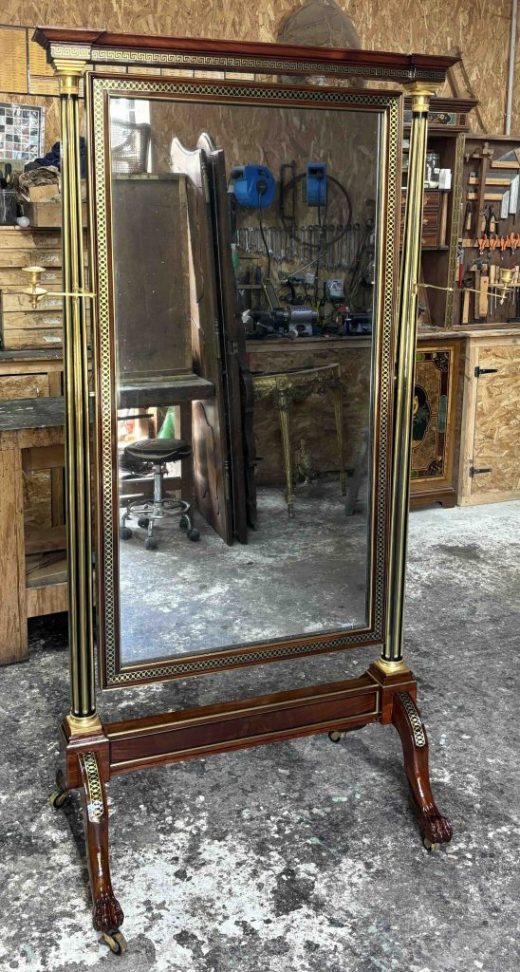
Restoration of a Louis XVI/Directoire period cheval glass stamped by Adam Weisweiler. This piece of furniture represents one of the innovations in late 18th-century furniture design. Far more than a simple dressing table accessory, it represents a significant evolution in the design of furniture intended for private use. Its appearance coincided with changing lifestyles, the development of new domestic spaces, and evolving practices related to self-presentation. For both the furniture historian and the restorer, the cheval glass is a particularly interesting object. It bears witness to both […]
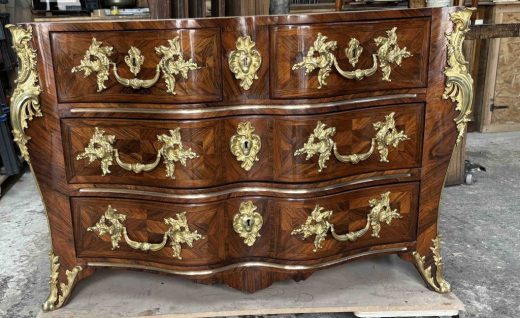
Conservation work on this Regency period commode, characterized by its serpentine shape, rosewood veneer, and gilt bronze mounts, resting on an oak and softwood frame. Our task was to stabilize the veneered surfaces by injecting protein-based adhesive. Veneer gaps were filled with grafts of new rosewood veneer, previously sawn, scraped, and sanded. These grafts were then French polished, naturally oxidized with ultraviolet light, and then applied to the appropriate thickness as a backing before being glued in place with […]
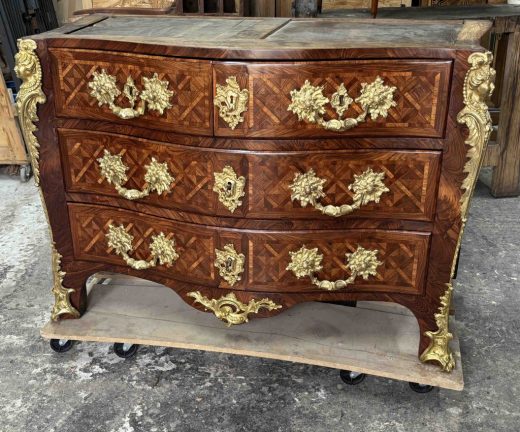
Restoration of a Regency period commode, stamped with the name Nicolas Jean Marchand, veneered in violet wood with a diamond-point pattern on an oak frame. It opens with four drawers. The whole is adorned with chased bronze mounts bearing the crowned C, including thick drop handles, large gadrooned rosettes, cartel-shaped keyhole escutcheons, and espagnolette drops ending in eagle-claw feet. The crowned C: The royal edict of 1745 required bronze workers to affix a distinctive mark, a […]
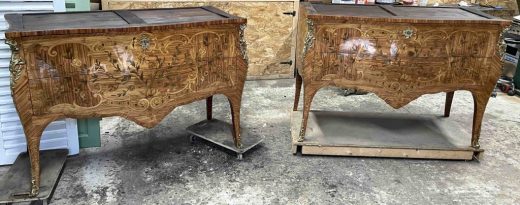
Here is the latest major restoration project undertaken by Raphaël, our apprentice. It involves a pair of Louis XV style commodes bearing an unknown stamp, CCS, which could be attributed to Charles Claude Saunier, an early work by the latter. Please find below the detailed account of the work carried out by Raphaël. Enjoy your reading. Restoration of a Pair of Louis XV Commodes This restoration project was carried out on a set of two commodes, designed according to the aesthetic and technical principles of the Louis XV style. This style […]
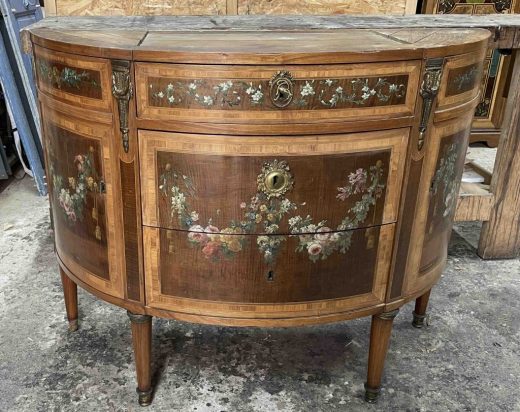
This Louis XVI period half-moon commode, stamped by the cabinetmaker Jacques Laurent Cosson, likely dates from a production between 1780 and 1790. It is an exceptional example of painted furniture from the end of the Ancien Régime, belonging to a very small group of which only seven examples are currently known. This small and highly sought-after group of 18th-century French painted furniture is now recognized as one of the most inventive areas of Parisian cabinetmaking on the eve of the Revolution. This commode, with its curved, half-moon shape, rests […]
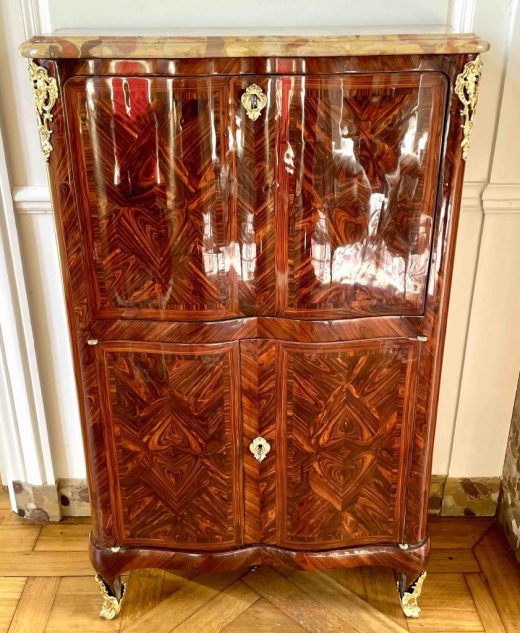
Restoration of a secretary desk, commonly called a "drop-front secretary" or "cabinet secretary," bearing the MIGEON stamp. This piece is distinguished by its serpentine front, opening with a pivoting drop-front that reveals nine small, curved drawers. The inside of the drop-front is lined with leather. The "cabinet" itself opens with two doors. The entire front is veneered with four panels of kingwood veneer, obliquely cut into butterfly wings. Each compartment is decorated with a quatrefoil motif of butterfly wings, set within a […]
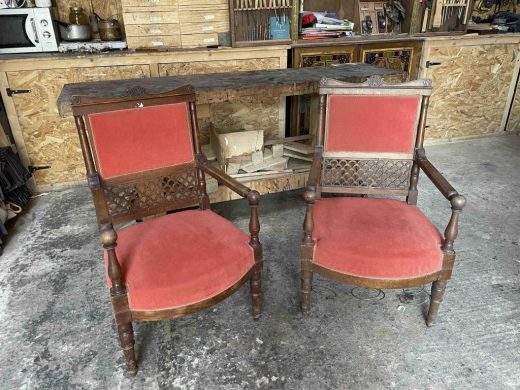
Restoration of a pair of Directoire period armchairs (circa 1795–1805), made of solid mahogany, except for the veneered stretchers. These chairs display the clean, balanced lines characteristic of the Directoire style, a transitional period between the strictures of the Louis XVI style and the codes of the Consulate. Assembled using mortise and tenon joints, they are made of solid mahogany. The straight armrests are extended by turned supports, typical of the late Directoire. The legs are turned in a baluster shape and slightly tapered at the bottom. The rectangular backs are framed with simple molding, […]

This is the first cartel clock restoration undertaken by Raphael, focusing on this Louis XV cartel clock in Boulle marquetry of brown tortoiseshell and brass. Restoring a cartel clock is a complex task requiring considerable time and meticulous attention to detail. The curved shapes make gluing delicate operations, and it is generally necessary to reattach large sections of the brass elements. Condition report: This cartel clock presented widespread soiling, an oxidized and tarnished varnish, as well as several lifting and missing pieces in the brass and tortoiseshell marquetry. […]
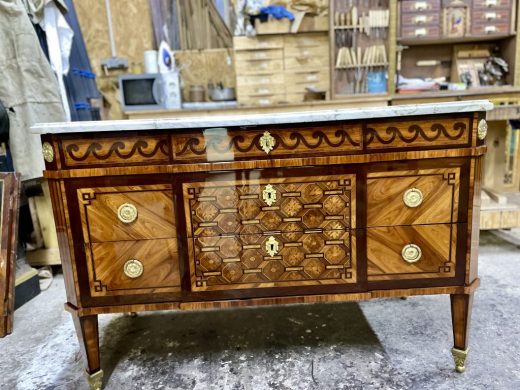
Restoration of a Louis XVI period commode with a projecting central front, stamped JF LELEU. Made entirely of oak, it is veneered with amaranth, rosewood, boxwood, stained maple burl, and tobacco-grey maple. It is decorated with marquetry featuring a frieze of posts on the top drawer, Greek key motifs, and fleurons within a mosaic of hexagons known as "marquetry à la reine" on the central projection. It has three drawers, two of which conceal drawers with crossbars. The front uprights are […]
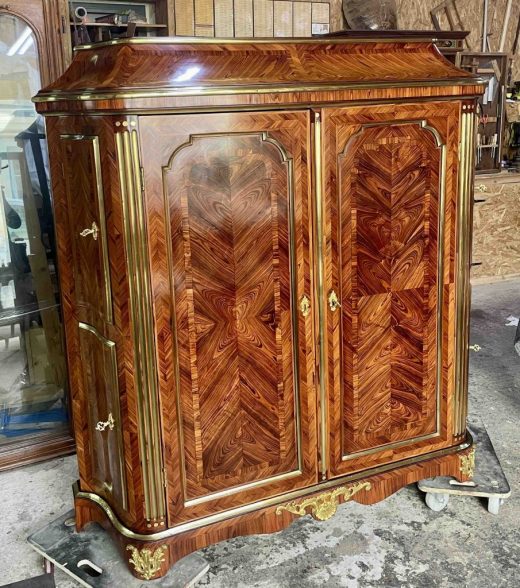
Restoration of a Regency-style cabinet, probably dating from the 1740s, stamped by Pierre IV Migeon. Constructed of oak and softwood, this cabinet, which could also be considered a bookcase, is entirely veneered in kingwood, rosewood for the top, and walnut for the interiors. The doors are veneered with a butterfly-wing pattern, while the side doors feature a square motif, typical of Migeon's decorative vocabulary. The ogee cornice is edged with a half-round brass molding. The uprights […]
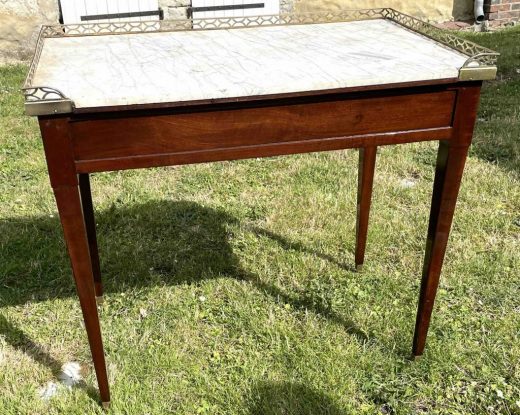
Restoration of a powder table, also called a dressing table, from the last quarter of the 18th century and stamped G.JACOB and JME. Opening with two drawers in the frieze, it is surmounted by a white Carrara marble top surrounded by an openwork brass gallery. The whole rests on four tapered legs of solid mahogany ending in sabots with integrated casters. The solid oak stretchers are veneered in mahogany. Georges Jacob (1739-1814) Georges Jacob, born on July 6, 1739, in Cheny, Yonne, came from a family of peasants. From a very young age, […]
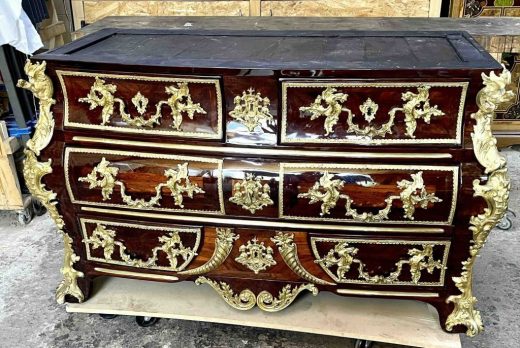
Restoration of a Regency period commode, topped with a 30 mm thick Rance marble slab, molded with a corbelled edge following its contours. This commode, curved in plan and elevation on the front and sides, is veneered with snakewood and satinwood. It has four drawers (simulating six) arranged in three rows. Its voluminous feet evoke the clawed paws of a dragon. The commode is adorned with brass fluting and chased and gilded bronze mounts: chased waterleaf frames framing the drawers, thick drop handles with shell motifs, wide plates […]

Here is a restoration carried out earlier this year by Raphaël. A long but successful undertaking. I had the opportunity to revisit this desk recently, and it has responded perfectly to the significant variations in temperature and humidity. The remainder of this restoration report was written by Raphaël. A "Mazarin" Desk. This desk dates from the Louis XIV period and is covered with Boulle marquetry composed of brass on a red tortoiseshell ground. The case is supported by eight console legs, each paired by an X-shaped stretcher. It opens […]

The restoration of five Boulle marquetry clocks, begun a few months ago, is now complete. Here is a Regency clock and its console, inlaid with tortoiseshell and brass on an oak frame. Measuring Time: Since the dawn of time, humankind has strived to measure time. From the gnomon, a simple stick planted in the ground—a precursor to the sundial—to the flow of water in the clepsydra, and then to the hourglass using the same principle, all these methods have allowed people to organize their social lives, […]

We are continuing our series on cartel clocks, which began a few months ago. Here are some images of the restoration of this Louis XV cartel clock in brown tortoiseshell and brass marquetry on an oak frame. Condition report: The structure is in a state of significant deterioration, and re-gluing the joints appears necessary. All the marquetry is detached or shows signs of glue dehydration. Furthermore, the clock has been heavily sanded, which has resulted in the disappearance of all traces of engraving on the brass elements. […]

Restoration of a late 17th/early 18th-century English cabinet, veneered in walnut and maple, featuring the distinctive free-flowing arabesque marquetry known as seaweed marquetry because it evokes the seaweed found on the seabed. English "seaweed" marquetry is traditionally associated with Dutch and Flemish cabinetmakers active in the second half of the 17th century, and particularly with Gerrit Jensen. Indeed, when Prince William III of Orange ascended the throne of England in 1689, he was accompanied by his cabinetmakers. Subsequently, religious persecutions on the […]

Restoration of a Boulle marquetry mantel clock, composed of brown tortoiseshell and brass, adorned with chased and gilded bronze mounts. The clock features a monumental rooster (royal emblem), a central mascaron with a satyr's head, caryatids, and two doves beneath a draped dome. The movement is signed GRIBELIN. Nicolas Gribelin, son of Abraham Gribelin, Valet de Chambre-Clockmaker to the King, was born in Blois on November 27, 1637. By the end of the 17th century, he had established himself as one of the most renowned clockmakers of his time.

This Louis XVI period secretary, stamped by Martin Ohneberg, a masterpiece of sobriety and refinement, features a solid wood frame veneered in rosewood and a sumptuous ribboned satinwood veneer, whose sinuous, golden veins lend brilliance and depth. The ornamentation is understated yet exquisite: delicately floral, chased bronze mounts accentuate the clean lines of the piece, typical of the Neoclassical style. Martin Ohneberg, of German origin, was active in Paris during the last decades of the 18th century, notably during the reign of […]

Restoration of a Regency clock case in brown tortoiseshell and brass marquetry, featuring a bronze Atlas and a clock face. The piece exhibited significant structural and decorative alterations requiring complete intervention according to the principles of conservation-restoration. Condition report: This clock case, probably dating from the early 18th century, showed the marks of time: lifting of the marquetry, detachment of the tortoiseshell, oxidation of the brass, and numerous losses. The bronze depicting Atlas, bent under the weight of the celestial vault, was blackened, its expression frozen by decades of dust […]

One desk, one stamp, three cabinetmakers? The desk we are about to discover, a masterpiece of French cabinetmaking, embodies the culmination of 18th-century Neoclassical taste. The question that immediately arises upon contemplating this exceptional piece is: why three cabinetmakers for a single desk? The answer lies in the complex interplay of succession, talent, collaboration, and opportunism that characterized the craftsmanship of the period. This flat desk, known as a "Greek-style" desk, is a perfect example of the Louis XVI style. Made from a blend of […]

Minor restoration/conservation work was carried out on this lovely Regency clock signed by the Dumont brothers in Besançon. Some minor repairs and replacements of missing brass and flakes were performed before the shellac finish was applied. The bronze mounts were removed and steam cleaned before being reattached.

Restoration of a Regency period double-sided flat-fronted desk with a drawer unit, veneered entirely in kingwood. The sides feature a diamond-point frieze, and the drawer fronts have an inverted slab pattern. Each side opens with four drawers in the frieze, and a central drawer on one side. The top is edged with a molding and gilt leather tooled in small pieces, resting on eight cabriole legs ending in goat hooves. Most notably, it features two bronze mounts emblematic of the period […]

Restoration of a transitional rosewood and amaranth secretary desk with simulated fluting using boxwood and ebony. The frame is made of oak and softwood. As is often the case with secretaries, one of the main areas of damage is the hinges of the fall-front, which have cracked and damaged the frame and veneer. The work involved replacing the solid wood that provides support and proper alignment before replacing the missing amaranth veneer. The […]

Restoration of a Regency period corner cabinet veneered in Rio rosewood on a softwood frame. The piece had little damage apart from missing fluting and mahogany grafts on the top and bottom rails. The work therefore consisted of replacing the mahogany grafts with rosewood veneer that was sawn, scraped, and sanded before being glued with hot glue. The brass fluting was recreated and adjusted to fit perfectly into its original positions. A French polish finish was applied […]

Restoration of a Louis XV commode stamped by Jean-Baptiste Fromageau. Constructed of oak and conifer, this commode is inlaid with rosewood within violet wood frames. Curved at the front and flared at the sides, it features four drawers in three rows and is topped with a grey Sainte-Anne marble slab. Jean-Baptiste Fromageau, son of a master cabinetmaker, was born around 1725. After obtaining his master craftsman's certificate on November 5, 1755, he set up his workshop on Rue Traversière before establishing himself on Rue du Faubourg Saint-Antoine. The Dauphin almanac mentions […]

The restoration of a commode from the first half of the 18th century, curved in height and bombé in plan, opening with four drawers in three rows, known as a "tomb-shaped" or "Regency" commode, belongs to a much smaller group of commodes called "bridge" and "moustache" commodes. The frame of this commode is typical of Regency models, with oak uprights, high-quality softwood for the majority of the structure, and walnut for the inset drawers. The veneer consists of only two types: kingwood and satinwood. The […]

Restoration by Raphaël of a rosewood veneered cabinet with diamond-pointed doors, framed in amaranth and Greek key stringing. It opens with two large softwood doors veneered with oak. Some regluing and repairs of missing veneer, along with a good coat of clear French polish, have restored this piece of furniture to its former glory.

Restoration of a Regency mantel clock in brown tortoiseshell and brass marquetry on an oak frame. Without its bronze mounts, this type of furniture loses its splendor. But when it regains its bronze fittings, knowing that the function of this type of furniture is to tell the time, the symbols that compose them take on their full meaning. Fame on the escapement and the eagle on the door are perfect examples. Fame is originally an allegorical Greek deity personifying public recognition […]

Restoration of a Louis XVI console table stamped by Louis-Noël Malle, with solid mahogany legs and mottled mahogany veneer on oak frames. Louis-Noël Malle, born in 1734, became a master craftsman on November 18, 1765. He established his shop and workshop on Grande-Rue-du-Faubourg-Saint-Antoine, in collaboration with his wife, Marie-France Le Maître. He was recognized as one of the greatest marquetry craftsmen of his time, as we can see in this entry from the General Almanac of Merchants in 1771 and 1772, where his name was misspelled as "Le […]

Minor maintenance restoration for this transitional rosewood veneer bonheur du jour, stamped by the master of this type of desk, Guillaume Cordié. A simple maintenance restoration for this desk. Re-gluing of a few veneer patches, repair of oxidation, color restoration, and reapplication of the French polish. Guillaume Cordié, born around 1733, worked as a freelance craftsman before receiving his master's certificate on June 18, 1766. He established himself on the rue de Charonne and remained there until his death. His works, of fine quality and harmonious proportions, are […]

A look back at the restoration of this rare port chest of drawers, crafted from solid woods brought back from both the Orient and the West Indies, combining four precious woods: mahogany, satinwood, Palo Santo, ebony, and, most notably, a fifth wood, Royal ebony. This chest of drawers opens with three wide drawers in three rows of Palo Santo, interspersed with Ceylon ebony crossbars, and is topped with a solid framed top composed of parquet flooring, primarily enlivened by Royal ebony crossbars against a mahogany background (some sections are mottled or […]
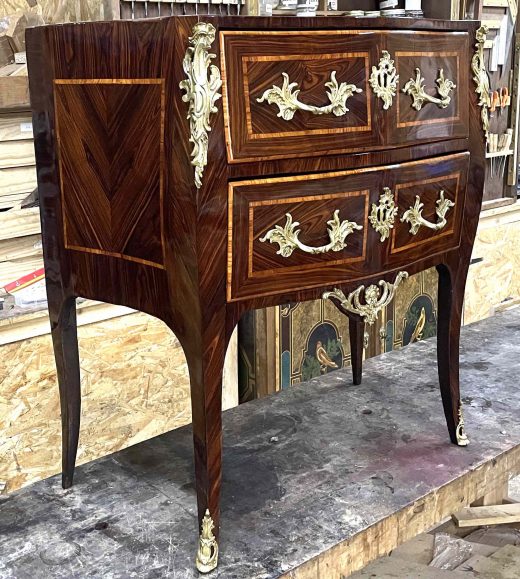
And here is the latest restoration by Raphaël, my apprentice. It's a Louis XV period commode. It's veneered in rosewood and violet wood on an oak and softwood frame. Condition report: A perfect project for tackling structural and veneer restoration. Almost all the panels are detached and too short, the joints are loose, both sides are detached from the uprights and split right down the middle, and of course there's a lot of detachment and […]
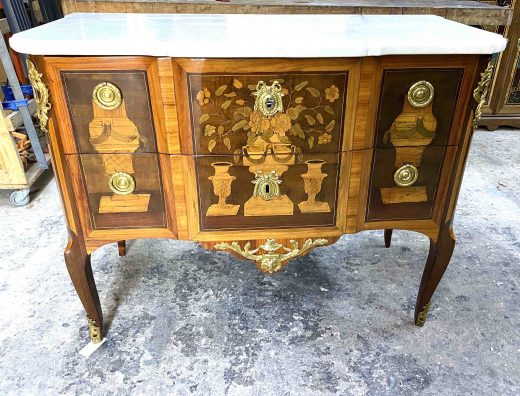
Restoration of a Transition period commode stamped by the master cabinetmaker Léonard Boudin (1735 in Paris – 20/12/1807). It is constructed of solid oak and veneered with amaranth, rosewood, tobacco-stained maple, and marquetry of boxwood, hornbeam, and holly, decorated with panels featuring floral vases and covered pots on the front and sides. With a slight central projection on the front, it opens to reveal two drawers without a central divider. Its rounded uprights rest on cabriole legs. Many Transition period commodes of this type have […]
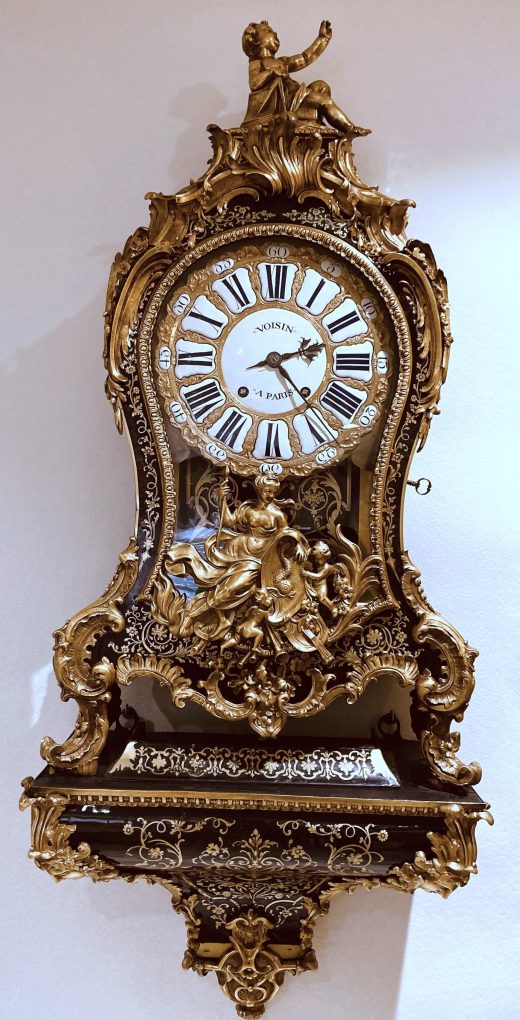
Restoration of a Louis XV cartel clock in tortoiseshell and brass marquetry, the movement of which is signed by Charles Voisin (born 1686-1760), Master Clockmaker in 1710. The distinctive feature of this clock is that the bronze mounts are stamped with the crowned C mark. The crowned C was established by an edict of 1745, which required bronze workers to mark their pieces with a small, distinctive letter, a C surmounted by a crown, thus subjecting them to a tax. This tax applied to both objects and furniture adorned with it. It is a […]
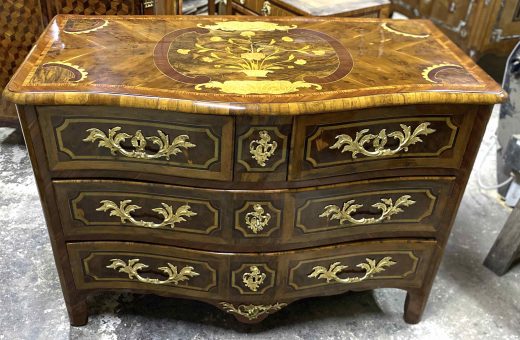
Restoration of a Regency commode, probably from southeastern France, veneered with yew, plum, rosewood, walnut, cherry, amaranth, violet wood, boxwood, and green-stained maple on a softwood frame. Besides its highly unusual marquetry decoration, the commode's distinctive feature is its crowned R bronze mounts. The crowned R hallmark should not be confused with the crowned C hallmark, which corresponds to a tax levied from 1745 to 1749 on copper objects and is found on many […]
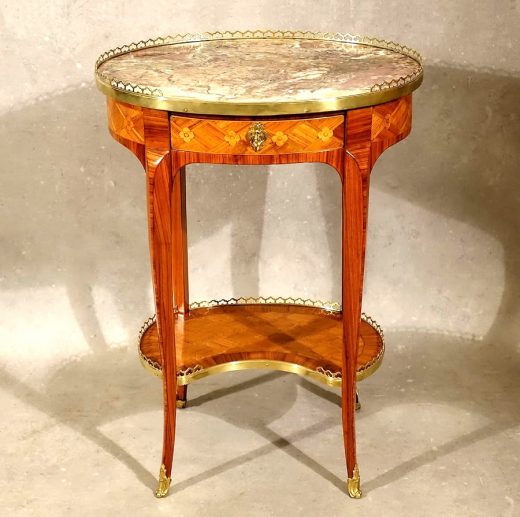
Restoration of a work table with cabriole legs and a stretcher in marquetry of trellis and quatrefoils, known as "à la Reine," veneered in rosewood, inlaid with boxwood, green-stained hornbeam, and boxwood stringing on an oak frame. It opens in the frieze with a drawer forming a writing surface with a leather-lined drop-front and compartments on the sides. The Escallettes marble top is bordered by an openwork brass gallery similar to the one that frames the kidney-shaped stretcher. A minor restoration including some veneer repairs and […]
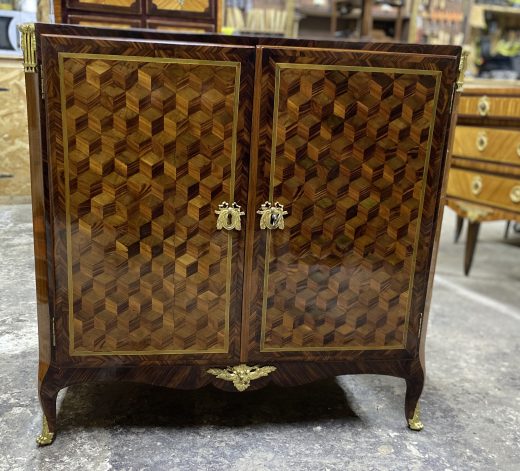
Restoration of a transitional two-door commode veneered with bottomless cube marquetry. The frame is oak for the uprights and rails, the side panels are softwood, and the two doors are walnut. The bottomless cubes are veneered with rosewood, violetwood, and tobacco-stained maple. The entire piece is framed with a stringing of green-stained maple and boxwood. The uprights and door frames are veneered with violetwood and rosewood. The sides […]
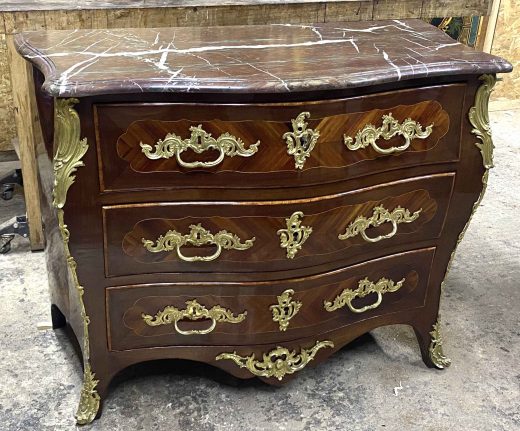
Restoration of a Louis XV commode, stamped by Nicolas Alexandre Lapie, veneered in amaranth and satinwood on a beautifully crafted oak frame. The sides and drawer fronts are made of softwood, and the marble top is Campan griotte marble. Nicolas Alexandre Lapie, son of Nicolas Lapie, a pottery merchant in the Faubourg Saint-Antoine, and brother of the master cabinetmaker Jean Lapie, Nicolas Alexandre (known as the Elder) appears to have been born around 1730. He registered his master's letters at the Châtelet in Paris on the 17th […]
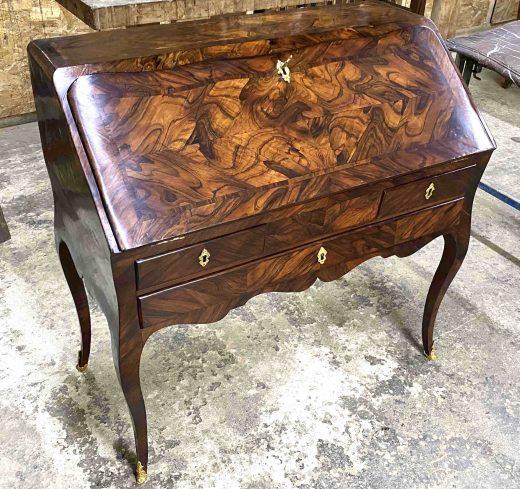
Raphaël's first restoration project was this Louis XV period rosewood veneer slant-front secretary. It was a complete restoration involving numerous veneer grafts and a waxed, filled finish. A delicate job, as rosewood is unforgiving. The slightest misstep with the chisel, or excessive sanding, and its beautiful blond patina disappears, revealing the original dark color and causing unsightly stains. Therefore, there was no choice but to scrape and sand the newly sawn veneer and cut it to the correct thickness before gluing it […]
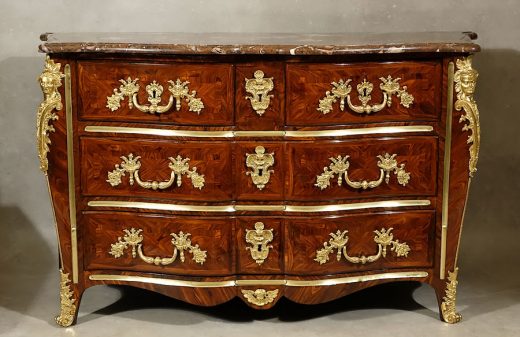
Restoration of a Regency period commode with a serpentine front and espagnolettes, curved on all sides, veneered in violet wood on a walnut frame, opening with four drawers in three rows and topped with a Belgian Griotte Red marble slab with ears and a corbelled edge. The pinched uprights are dark, as are the front rails, with fluting and brass reeding. Its high-quality bronze ornamentation features superb chasing and includes very rare espagnolettes (seen on six commodes: four by Etienne Doirat, one by François Lieutaud […]
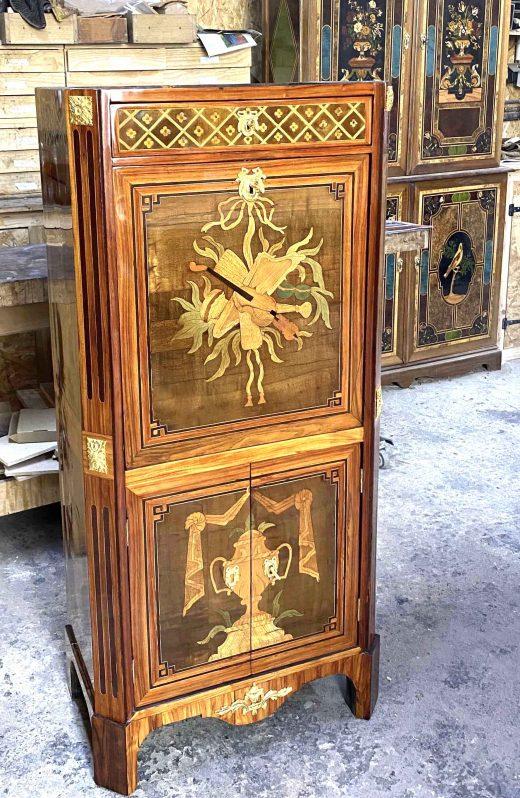
Restoration of a Louis XVI secretary desk stamped by Charles Topino. Typical of Topino's style, this secretary is constructed of oak and softwood. The front opens with a drawer and a drop-front covered in red leather tooled in gilt, revealing two compartments and four drawers veneered in rosewood. The lower section opens with two doors revealing a shelf. These are decorated with marquetry depicting a vase and drapery on a tobacco-colored ground, while the drop-front is inlaid with musical instruments, ribbons, and foliage on […]
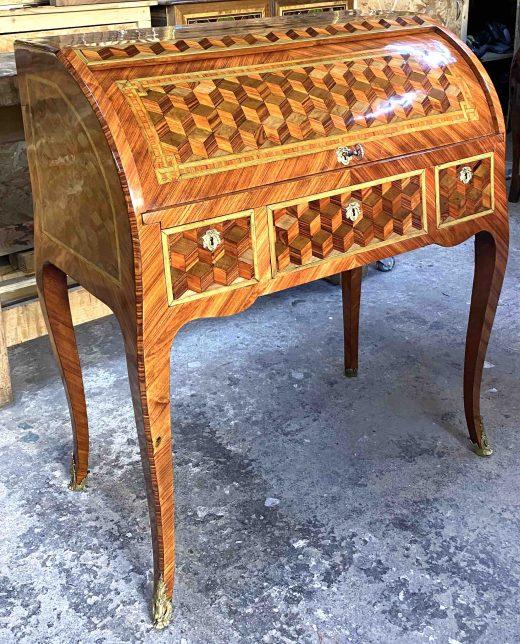
Restoration of a Transitional period roll-top desk stamped by Jean-Georges Schlichtig. The frame is oak for the legs and rails, while the panels and drop-front are softwood. It is veneered in rosewood with marquetry of bottomless cubes in rosewood and tobacco-stained sycamore; the Greek key stringing is composed of hornbeam and holly. The back and interior drawers are veneered in satinwood. This type of roll-top desk was a common production for this cabinetmaker, who produced […]
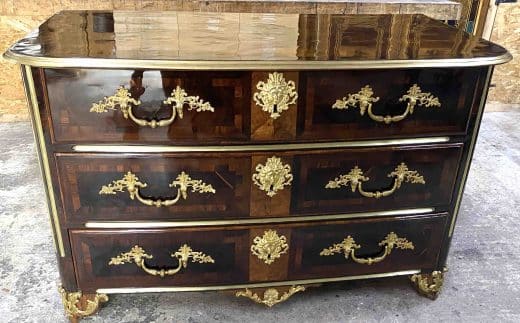
Restoration of a Louis XIV period commode in rosewood and walnut, inlaid with alternating marquetry in friezes and fillets. The slightly curved front opens with three wide drawers in three rows. The top, encircled by a brass molding, features a geometric design of circles framing a central polylobed motif with figurative designs. The uprights and intermediate rails are inlaid with polished brass fluting. The sides are veneered in walnut with diamond frieze patterns. The legs are tapered with claw feet. The piece is adorned with finely chased and gilded bronze mounts.
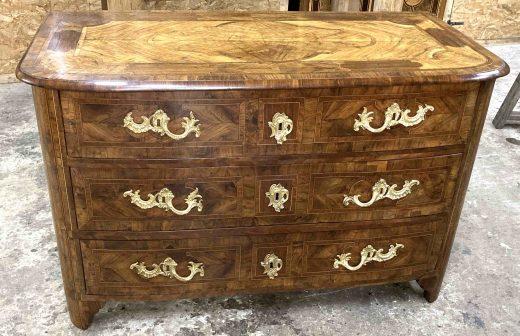
Restoration of a Louis XIV period commode veneered in olive burl, ash, and walnut, likely from the Dauphiné region. This type of commode (D-shaped), along with the Mazarine commode, was among the very first commodes popularized under Louis XIV. Indeed, the appearance of the earliest French furniture resembling the commode dates only from the 1700s; thus, the oldest known and datable Parisian commodes are those delivered by André-Charles Boulle to Versailles around 1708. Their very simple decorations are inspired by Dutch designs, often executed by […]
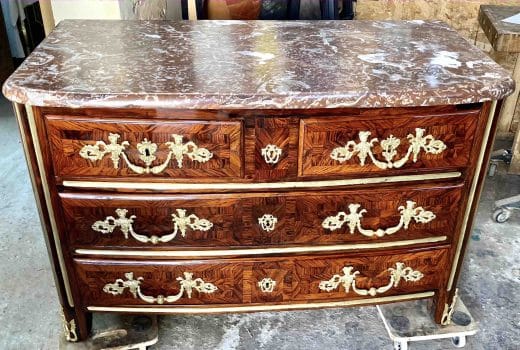
Restoration of a Regency commode veneered in rosewood on a conifer frame. It was only after three weeks of work on this commode that I noticed a strange mark. It had been there from the beginning, right in front of me, and I hadn't noticed it. Indeed, it's quite rare to see a stamped Regency commode. But yes, the mark was definitely there. And it's not a modest mark, since this ID stamp is attributed to Jacques Denizot. Jacques Denizot (1684–1760) is […]
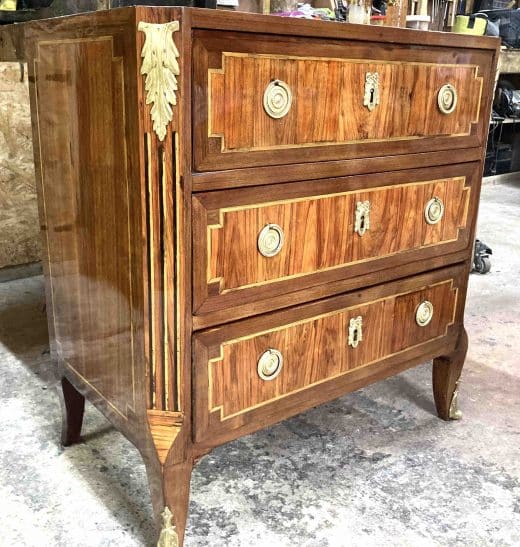
Restoration of a transitional commode stamped three times E.AVRIL, veneered in amaranth, rosewood, satinwood, and green-stained stringing on an oak and softwood frame. Etienne Avril (1748-1791), admitted as a Master Joiner-Cabinetmaker on November 23, 1774, died prematurely in 1791. Étienne Avril, known as Avril the Elder to avoid confusion with his brother Pierre, would witness the agony of the Ancien Régime and the abolition of the centuries-old guild system. Born in 1748 to a cab driver, Étienne Avril was not destined for […]
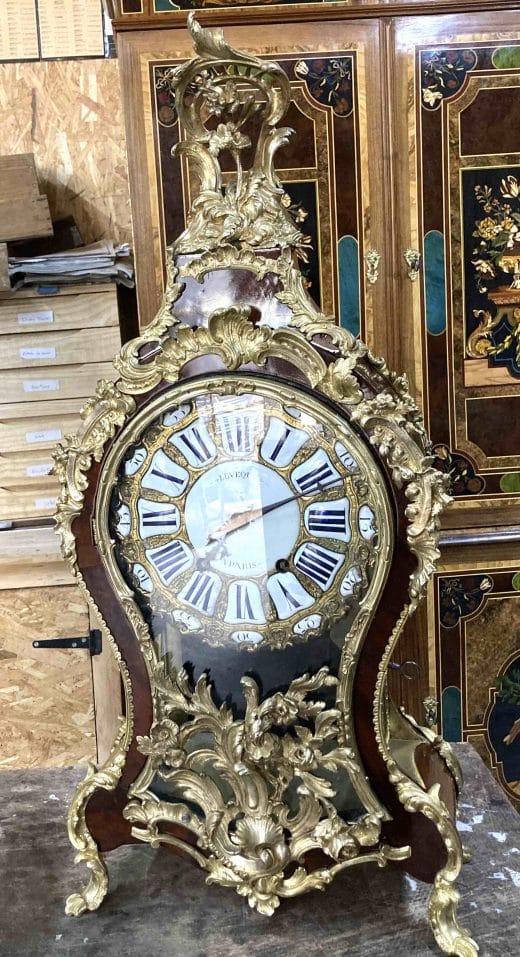
Restoration of a Louis XV period cartel clock signed LEVEQUE A PARIS with its original movement. The surprising thing about this clock is that it is made of mahogany. And as curious as it may seem, despite the tool marks, the quality of the workmanship and the wood appear entirely authentic. With its shape and rocaille bronze mounts typical of the Louis XV style, it could therefore be a clock made from the second half of the 18th century. A precursor, then, to the appearance of mahogany in French furniture. The restoration has […]
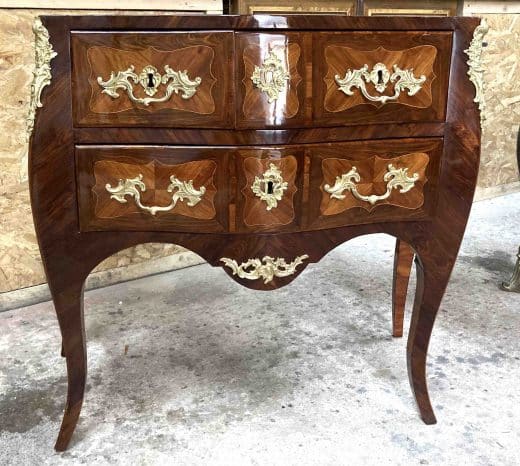
Restoration of a Louis XV period commode veneered in rosewood and violet wood. The commode, also known as the commode sauteuse, appeared during the Regency period, between 1705 and 1730, and is attributed to the cabinetmaker Charles Cressent. It consists of two drawers or two rows of drawers. The body is raised on half-height supports, with the body occupying half the height of the piece and the other half the legs. Intended to distinguish itself from the heavy and massive Louis XIV style, it is slender and graceful, almost ethereal. After restoration […]
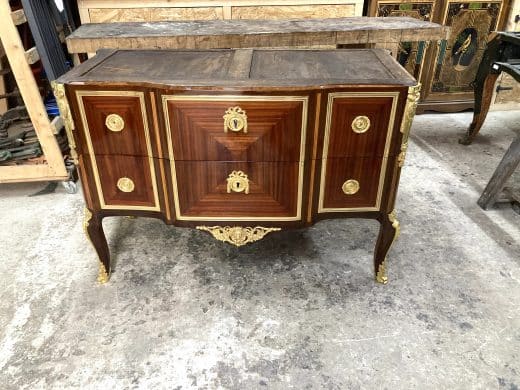
Restoration of a Transition period commode stamped by the master cabinetmaker Léonard Boudin (1735 in Paris – 20/12/1807). It is constructed of solid oak and veneered with amaranth, rosewood, and ribbon satinwood (Brosimum rubescens), which provides a highly decorative appearance due to the pronounced interlocked grain of this South American wood. It should be noted that it belongs to the same family as snakewood (Brosimum guianense). As Boudin was primarily a merchant during the Transition period, it is likely that this commode is actually by his hand (before […]
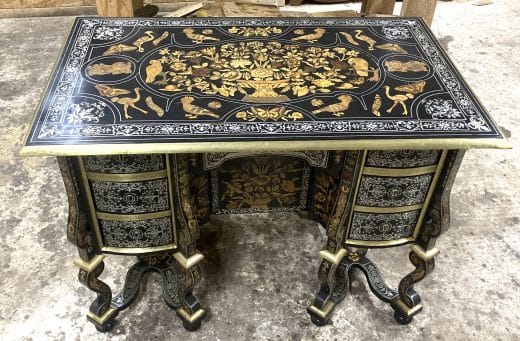
Restoration of an eight-legged desk, commonly known as a "Mazarin" desk, from the Louis XIV period, late/early 17th century. Constructed of pear and solid softwood, the sides and drawer bottoms are also pearwood. It features two side cabinets, each opening with three drawers, a central drawer above a middle cabinet with rounded edges, and console-shaped uprights and eight legs joined by two X-shaped stretchers. The drawers are inlaid with pewter and blackened pearwood, depicting a late 17th-century design. […]
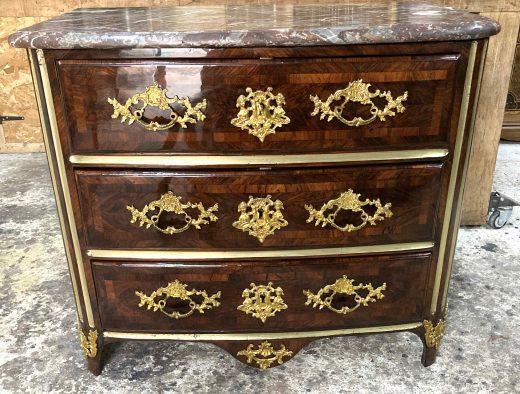
Restoration of a Louis XIV commode constructed of fir and Rio rosewood veneer. The front is slightly convex, as are the uprights and rails. It features brass fluting. The remarkably crafted varnished bronze mounts have retained their original varnish. The restoration consisted of rehydrating all veneered surfaces by infiltrating glue. Missing areas were filled with rosewood veneers that were sawn, scraped, sanded, cut to the correct thickness as a backing, and UV-oxidized before being glued with hot glue. As you can see on […]
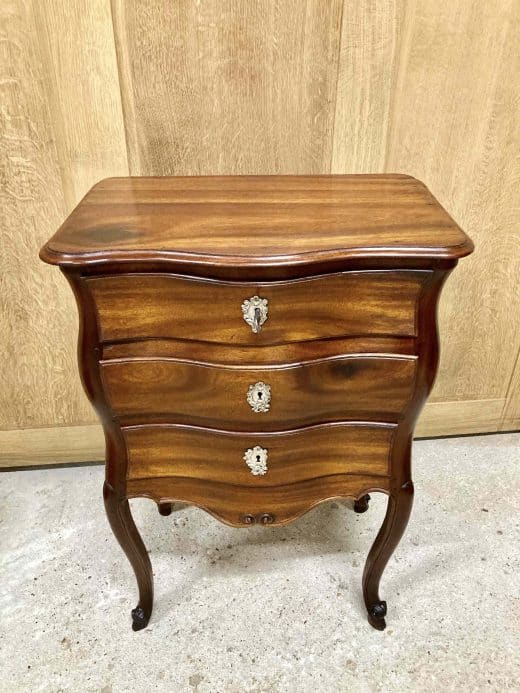
Here is the restoration of a small Louis XV commode in solid satinwood and ribboned satinwood. It is curved on all sides, including the back, and opens with three drawers in the front, as well as a pull-out candle holder at the back. La Rochelle, 18th century. Its top, molded with a corbel edge highlighted by a cavetto molding, is made of ribboned satinwood, which is also found on the front and sides, while the base is made of fine satinwood punctuated with so-called "snail" feet ending in split goatskin feet. Note the unusual proportions but especially the curves […]
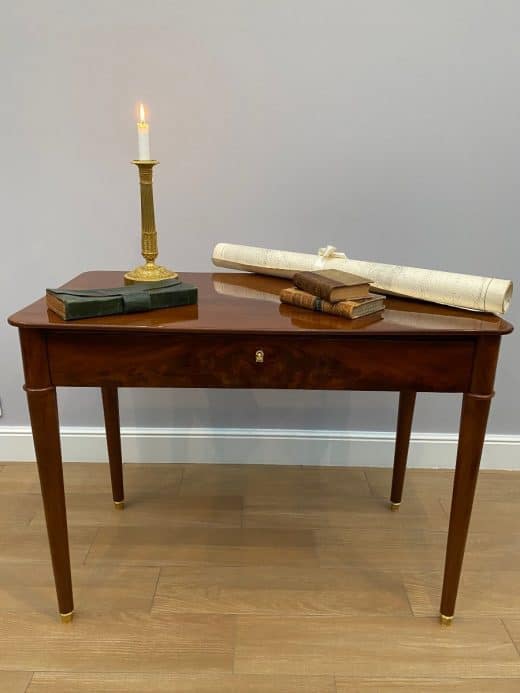
Restoration of a writing table built in oak, with a solid mahogany top and mahogany burl veneer. It features a large drawer in the frieze and rests on four tapered legs ending in gilt bronze sabots. Typical work of the late 18th century. To see previous restorations: https://ebenisterie-mathieuvath.fr/en-ce-moment-a-latelier/ This piece can be found at Antiquités Stéphane Guin.
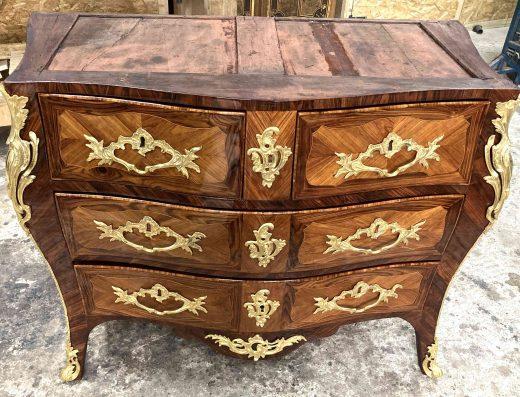
Restoration of a Louis XV commode stamped by the Parisian cabinetmaker Pierre Roussel. This commode is constructed of oak and softwood panels. It is veneered with rosewood arranged in a herringbone pattern, framed by violet wood. The stringing is boxwood. The Roussel family: Son of Michel Roussel, a journeyman cabinetmaker originally from the Cotentin region, he was the only one to choose cabinetmaking rather than joinery, unlike his younger brothers Jacques, Michel, and Louis. Pierre Roussel obtained his master craftsman's certificate on August 21, 1745, and established himself in the Faubourg Saint-Antoine, on rue […]
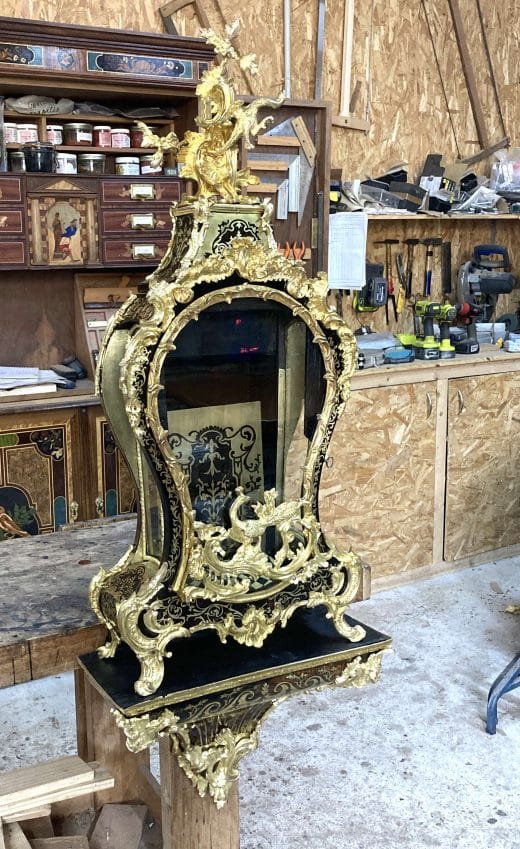
Restoration of a Louis XV period clock and its lamp base in pure Rococo style. It is constructed of solid oak and veneered with brass and tortoiseshell. Do you know what Rococo style is? Rococo style belongs to the early period of the Louis XV style (1723-1750) and reached its peak around 1730. It is characterized by rich naturalistic decoration. It drew inspiration from artificial grottoes and elements of rock recreated in asymmetrical compositions. This decoration, which marks the beginning of the Baroque, is complemented by seashells, elements […]
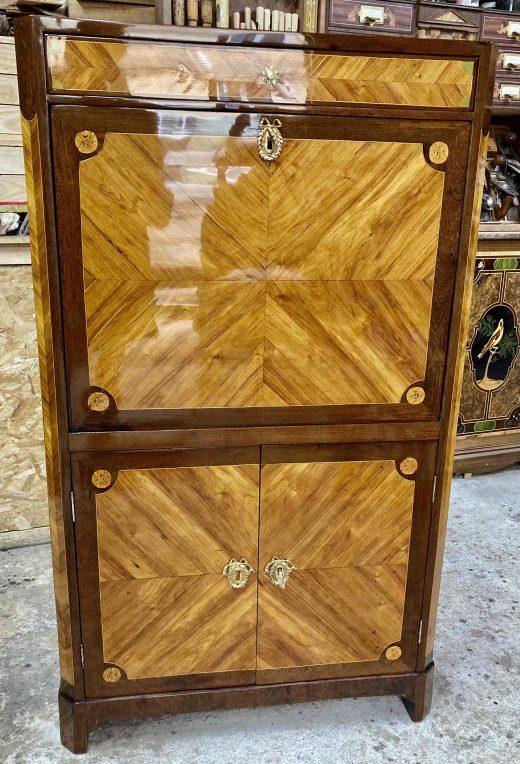
A little restoration for this Louis XV period secretary desk stamped by Philippe-Claude Montigny. It is constructed of oak and softwood, and veneered with rosewood, amaranth, and boxwood. It consists of a top drawer, a drop-front, and two doors. The interior compartments contain six drawers. Philippe Claude Montigny (1734-1800) became a master craftsman on January 29, 1766. Son of Louis Montigny, a privileged craftsman of the King, he owned a workshop in the Contrescarpe district of Paris. He was also the brother-in-law of Fidelis Schey, a cabinetmaker […]
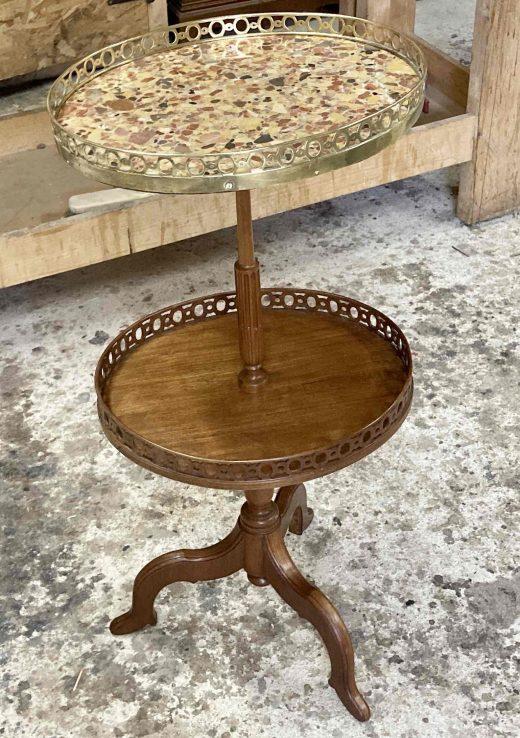
A minor restoration is needed for this "shelf-style" pedestal table, also known as a "dumb servant." It is made of solid mahogany, mahogany veneer, and Aleppo breccia marble. It bears the stamp of the lesser-known cabinetmaker to the Crown Furniture Collection, Jean-Henri Riesener. Does Jean-Henri Riesener (July 4, 1734 – January 6, 1806) really need an introduction? He is the undisputed master of the Louis XVI style, renowned for the breadth and diversity of his work, but above all for the exceptional quality of his furniture and the sumptuousness of the pieces commissioned by the court of […]
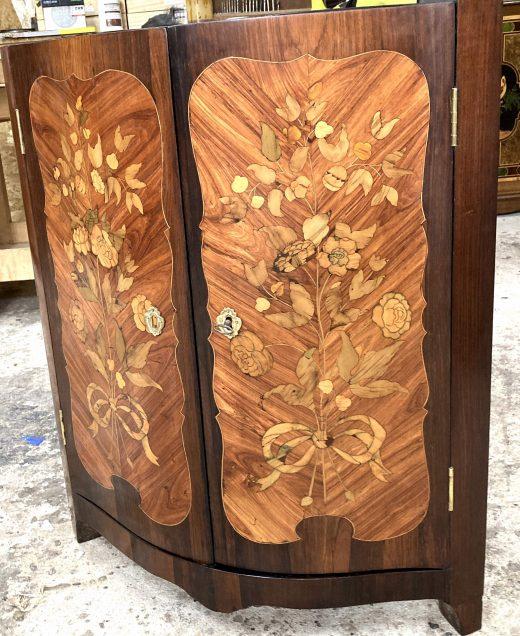
Restoration of a Louis XV corner cabinet in marquetry of various woods (maple, hornbeam, boxwood, and holly). Except for the green leaves, the colors of some flowers and ribbons have faded. This marquetry is executed on a rosewood background framed by a boxwood stringing and a rosewood frieze. The frame of this corner cabinet is made of solid oak assembled with dovetail joints. Condition report: As you can see in the following photos, the surface of the varnish was heavily sun-faded, the glues of the marquetry on the doors were in […]
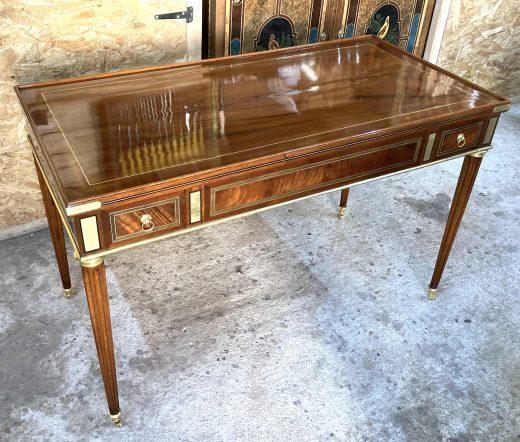
Restoration of a late 18th-century games table (circa 1785) veneered in mahogany burl and inlaid with brass stringing, ebony, and Ferréol (a South American wood named after a 17th-century governor of Guyana). The legs are solid mahogany, and the interior is veneered with ebony and bone dyed green and natural. The tabletop is partially covered in leather and partially veneered in mahogany burl. The interior features two niches, each with a drawer […]
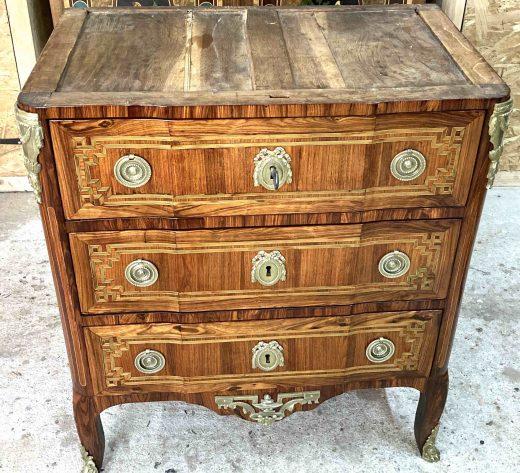
Restoration of a Transitional period commode constructed of fir and oak and veneered with rosewood, violet wood, and a frieze of hornbeam stringing stained green in the Greek key pattern. The sides are veneered with satinwood and violet wood. André-Antoine Lardin (1724 – August 10, 1790) obtained his master craftsman's certificate on July 1, 1750, and established himself on rue de Charenton under the sign "Au Bois de Boulogne." He worked there until 1770, when he moved to rue Saint Nicolas. His production is […]
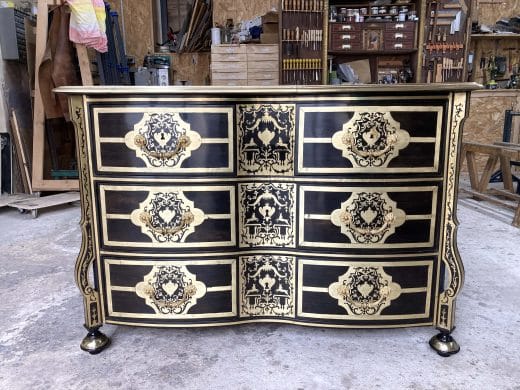
Restoration of a Louis XIV period commode, known as a Mazarine commode, veneered in brass and ebony on a softwood frame. This commode features bow-shaped drawers, including two full-length drawers surmounted by two half-drawers separated by an intermediate stile. The fronts are made of softwood, while the sides and backs are walnut. The brass decoration supporting the pendant drawer pulls features a finely inlaid motif of scrolls, foliage, foliage, and arabesques, framed by a geometric brass cartouche and simulating keyhole escutcheons. It […]
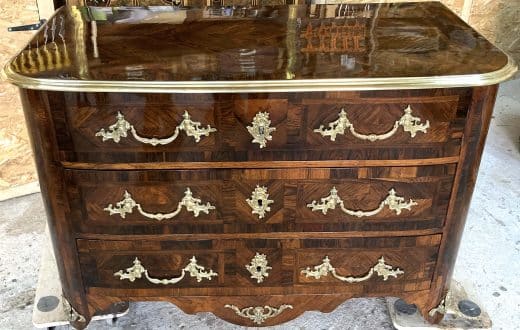
This week I'm presenting a Louis XIV commode from the first half of the 18th century, veneered in Rio rosewood and adorned with chinoiserie bronze mounts. Height: 85.7 cm, Width: 125 cm, Depth: 60.5 cm. The frame is made of softwood, constructed from planks joined edge-to-edge. The sides, top, and bottom are dovetailed. The back is constructed from several planks nailed into the rebates of the sides. The drawer bottoms and sides are made of planks of […]
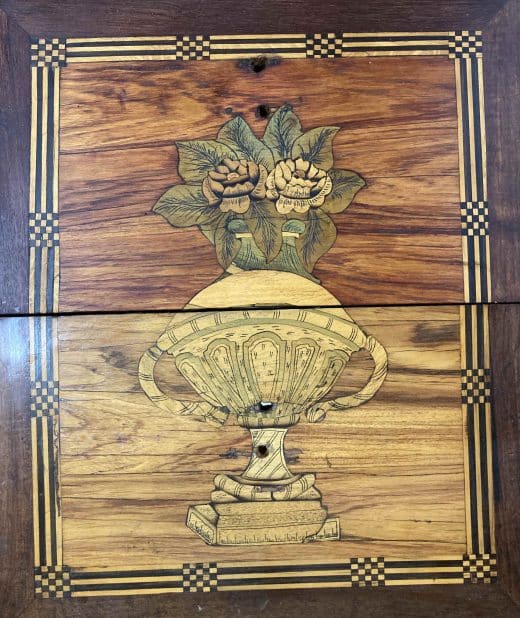
Here is a very pretty Louis XVI period commode veneered in rosewood and amaranth with marquetry of boxwood, pearwood, maple, hornbeam, walnut, blackened pearwood, lemonwood… It is built of oak and softwood. It is stamped twice with the mark of Jean-Baptiste II TUART. But its maker is probably Jean LAPIE. From a dynasty of Parisian cabinetmakers and merchants, whose father, Jean-Baptiste I, obtained his master's certificate in 1741 and was active until around 1760, Jean-Baptiste II, born around 1720, was not a master cabinetmaker but a master furniture maker and haberdasher […]
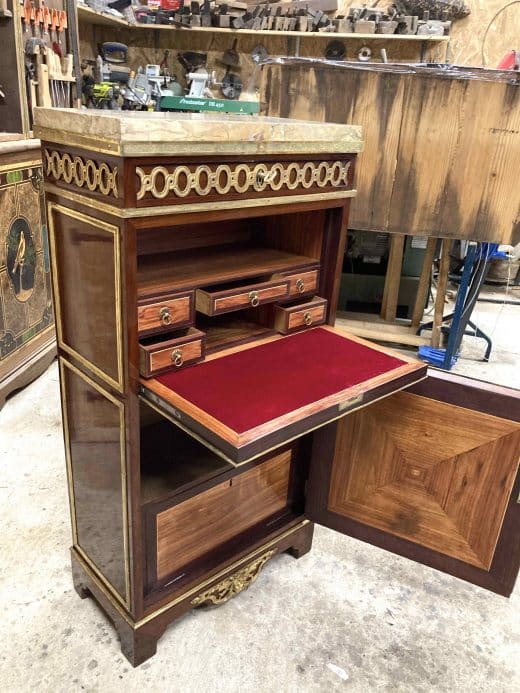
Restoration of a Louis XVI period lady's writing desk stamped by Martin Carlin JME. The frame is solid oak, with the fall front and lower door made of softwood. The exterior is entirely veneered with Honduran mahogany, except for the upper edge, which is embellished with a thin strip of amaranth. The interiors are veneered with rosewood, amaranth, and stringing of boxwood and ebony. Of particular interest: the upper interior compartment has never been restored and retains its original finish, a magnificent polish that has preserved the […]
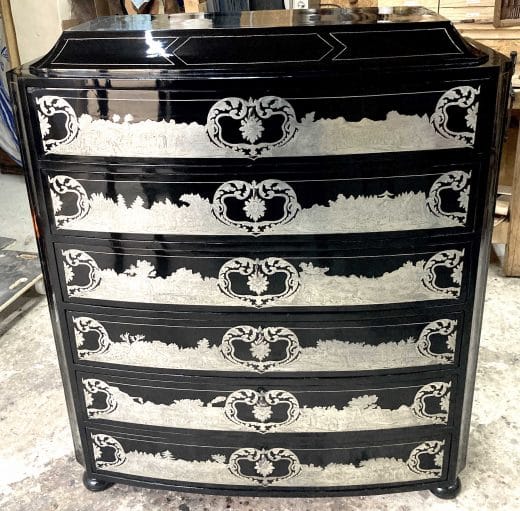
Restoration of this unusual piece of furniture from Austria/Hungary. I must admit I had some difficulty placing it geographically. It was clear that it wasn't from France but rather from Eastern Europe. But where? Fortunately, engravings provide valuable clues; the clothing depicted corresponds well to the late 17th and early 18th centuries. The landscapes consist of mountains and villages; the vegetation is composed of deciduous and coniferous trees, and several medieval castle ruins can be seen. […]
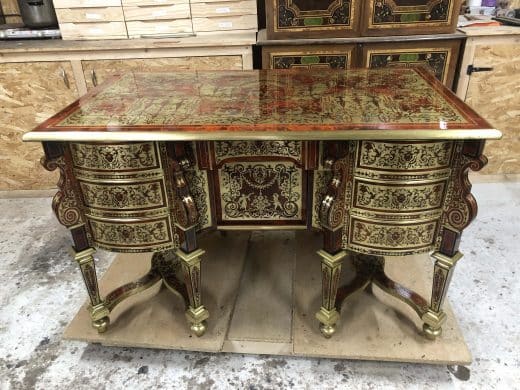
To end the year on a high note, here's a restoration that occupied a large part of my time this year and which reached its owner a few weeks ago. It's the restoration of an eight-legged writing desk, commonly known as a "Mazarin" desk. Constructed of solid oak and softwood, the sides and drawer bottoms are made of light walnut. The marquetry covering it consists of Caret tortoiseshell (Eretmochelys imbricata) on a vermilion red ground, and brass. All of this is framed by delicate ebony stringing. It is […]
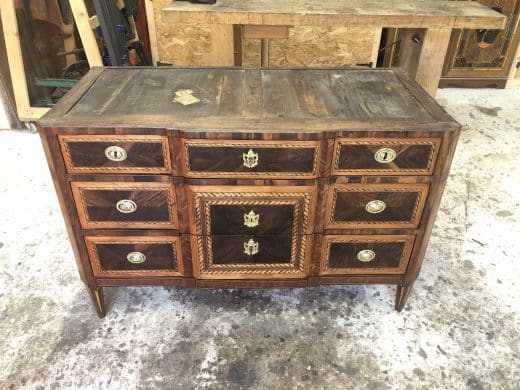
This week, we're restoring a Louis XVI commode with a projecting front, veneered in Rio rosewood, amaranth, and violet wood, with marquetry stringing in boxwood and ebony forming a ribbon wrapped around the wood, the background of the engravings filled with red wax. The tapered legs and canted uprights have faux fluting in ebony and boxwood. There's no maker's mark to attribute this beautiful piece and the high quality of wood chosen for its construction. Regarding the restoration, the work isn't very […]
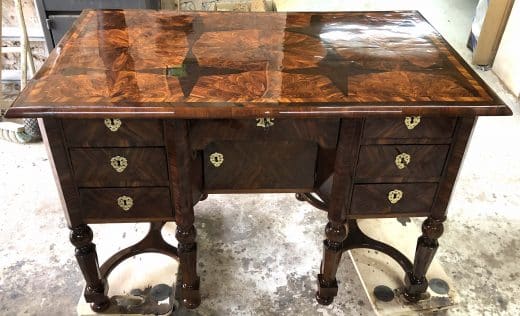
Extensive restoration work has been undertaken on this Mazarin desk, veneered in kingwood and rosewood. It is entirely veneered on fir with a solid rosewood base. The top features a marquetry of rosewood stars surrounded by kingwood butterfly wings in circular patterns. Why the name "Mazarin"? The eight-legged desk is one of the jewels of 17th-century furniture. It only acquired the name "Mazarin" from antique dealers in the 19th century to give it a more prestigious name.
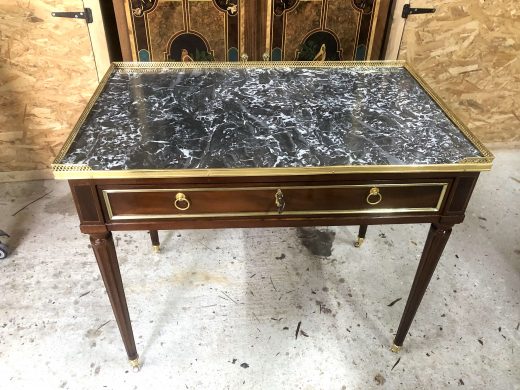
The dressing table, sometimes called a powder table, can be defined as a vanity unit in the form of a table or a small writing desk with drawers. Around 1730, shortly after the commode, this new type of furniture, often richly inlaid or veneered with precious woods, appeared in French furniture. This rather atypical powder table has the unique feature of also serving as a writing desk, or at least a desk for writing. Its four legs are made of solid mahogany, and the stretchers are also veneered in mahogany. The four surfaces are […]
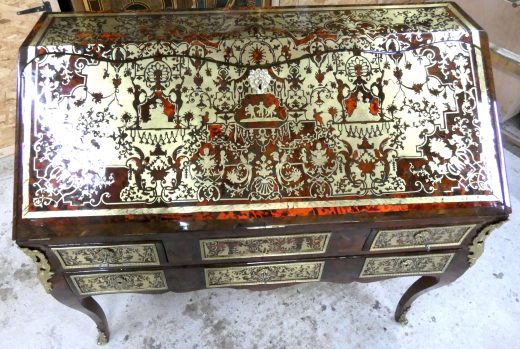
This week, a curious and very pretty Louis XV period slant-front secretary/desk in Boulle marquetry and rosewood. And yes, it wasn't only under Napoleon III that the reuse of Boulle marquetry was fashionable. In fact, Boulle marquetry continued to have admirers throughout the 18th century. It was from the 1750s onwards that the renewed interest was most pronounced. Prominent merchants, such as Lazare Duvaux, began selling them occasionally at considerable prices to prestigious clients, […]
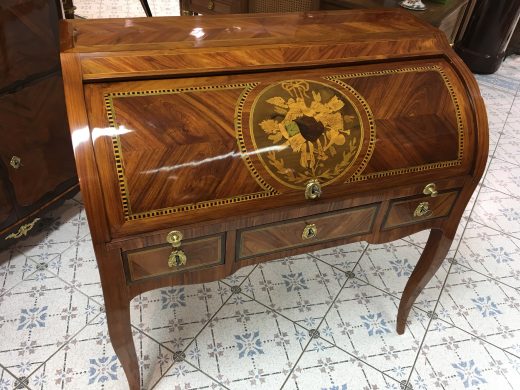
A few years ago, I had the opportunity to restore this magnificent Transition period (1780) roll-top desk. It is framed in oak and fir. The fall front is primarily veneered with rosewood laid in a paillon pattern, framed by a light stringing of boxwood and green-stained hornbeam, bordered by a thin band of amaranth. The back is veneered in satinwood. The central marquetry, on a tobacco-stained sycamore ground, depicts musical instruments and two doves taking flight, each carrying a musical score in its beak. This […]
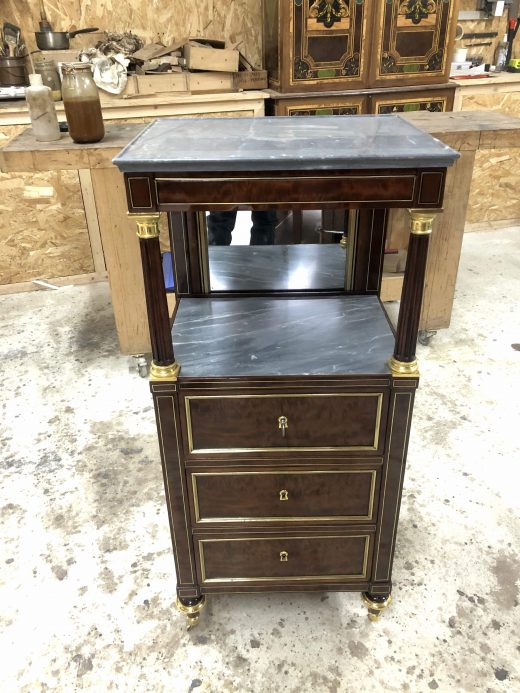
This elegant mahogany-veneered shaving cabinet from the late 18th century rests on four tapered legs with casters and opens with three drawers in the front. The niche, with its blue Turquin marble top framed by fluted columns, is surmounted by two side drawers and a sliding marble shelf with a recessed panel that reveals a sliding mirror on a rack and pinion mechanism, pivoting and framed with ebony and brass stringing. Appearing during the reign of Louis XVI, this style of shaving cabinet is a toilet unit designed to hold a porcelain pitcher and basin […]
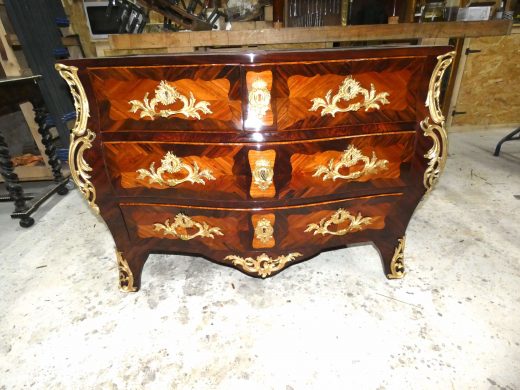
This is a significant restoration project for this Louis XV commode, originally veneered in rosewood and violet wood. It took me some time to determine if it was indeed violet wood, as the commode had undergone so much restoration that there was almost as much rosewood as violet wood. Fortunately, the drawers are still in fairly good condition and are indeed made of violet wood, so I conclude that the commode was […]
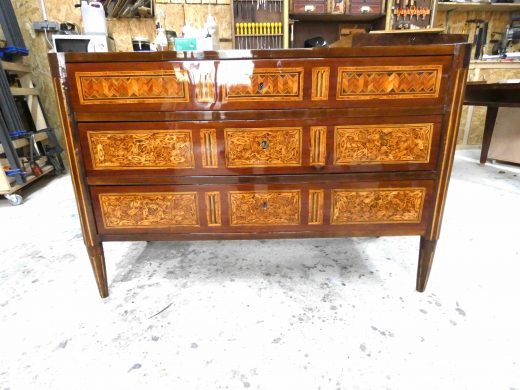
Restoration of a Louis XVI period commode from eastern France, made of solid oak and fir and veneered with end-grain laburnum, walnut, plum, amaranth, rosewood, palisander, boxwood, and green-stained hornbeam. The handles and keyholes were added at a later date. The original fittings are missing; only the holes for the handles remain. This is a piece of furniture that has never been restored. The veneer is almost 4 mm thick in some places, and […]
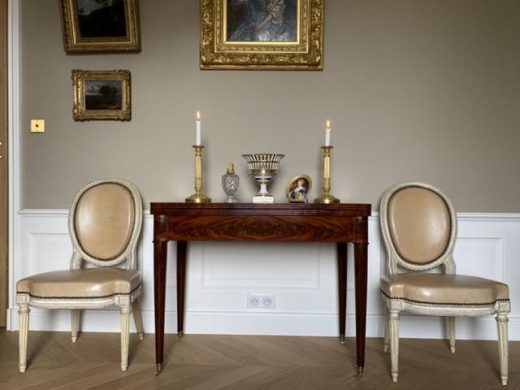
96 x W 47.5 x H 74 cm. Open: 96 x 95.5 cm. Restoration of a games table with a folding top veneered in burr mahogany, commonly known as Cuban mahogany. In fact, according to the recent book "L'essence du bois" (The Essence of Wood) by Patrick George, Emmanuel Maurin, and Marie-Christine Troujy-Jaquemet, it seems more accurate to call this type of mahogany Saint-Domingue mahogany. The base is veneered in solid oak, and the top in poplar. The moldings are solid mahogany. The table rests on legs […]
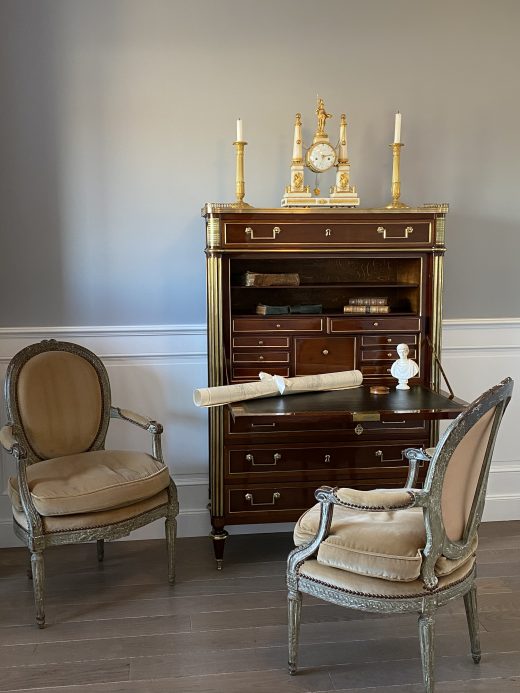
Restoration of a drop-front secretary desk built in oak and veneered with mottled mahogany and mahogany from Saint-Domingue. Its design dates from the late 18th century. Its white Carrara marble top is surrounded by a partially openwork brass gallery. It opens with a drawer at the top, a drop-front in the middle, and three drawers at the bottom; all the original locks are secured with a clover-shaped key. All the panels on the front and sides are framed with brass quarter-round moldings. The drop-front is veneered in mahogany […]
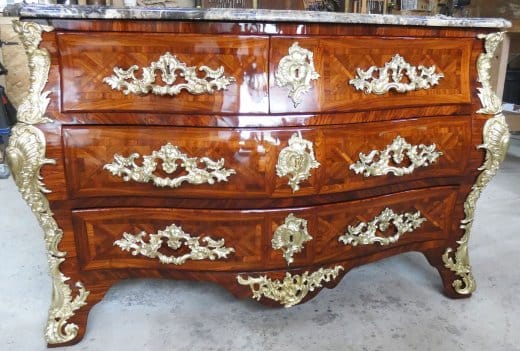
Extensive restoration of this superb Louis XV period commode, stamped on all four uprights by Jean-Baptiste Hedouin. The frame and drawers are constructed of solid oak, fir, and walnut. The edges of the frieze and geometric marquetry in violet wood are veneered with satinwood. Two types of violet wood are visible: one with a very tight grain and veining for the lozenges, and a second, more intricate type for the marquetry edges, uprights, and rails. The […]
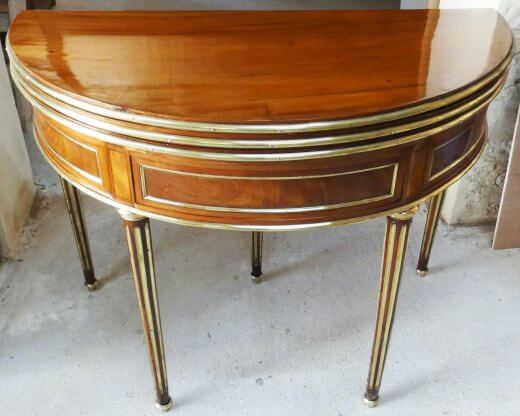
Here is a three-tiered half-moon table. This style of table, originating in England, is a classic of the Louis XVI style. It opens to reveal two circular tiers, one lined with felt, the other veneered in mahogany. The mahogany burl veneer apron is adorned with a brass frame. It rests on five tapered legs with brass-filled fluting and ending in sabots. The fifth leg is attached to a drawer that opens to serve as a support once the flap is unfolded. A very attractive piece, probably dating from the end of the […]