English Cabinet

Ebénisterie Mathieu Vath

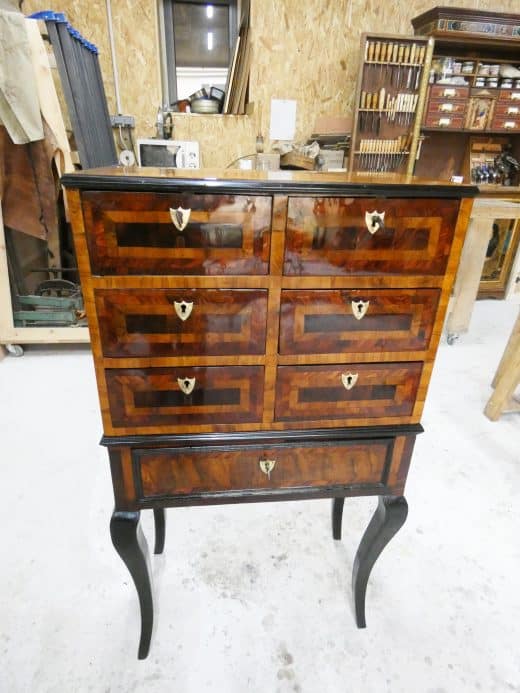
Restoration of a late 17th/early 18th-century English cabinet, veneered in walnut and maple, featuring the distinctive free-flowing arabesque marquetry known as seaweed marquetry because it evokes the seaweed found on the seabed. English "seaweed" marquetry is traditionally associated with Dutch and Flemish cabinetmakers active in the second half of the 17th century, and particularly with Gerrit Jensen. Indeed, when Prince William III of Orange ascended the throne of England in 1689, he was accompanied by his cabinetmakers. Subsequently, religious persecutions on the […]
Louis XIV Library Display Case

Ebénisterie Mathieu Vath

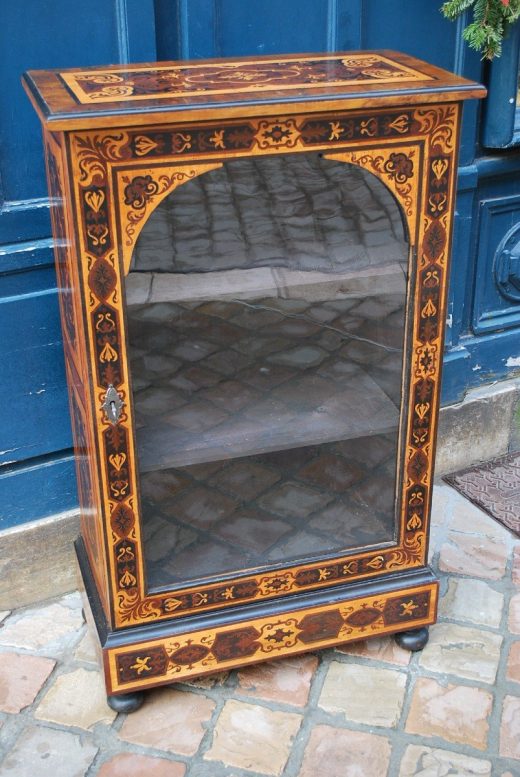
Restoration of a small Louis XIV period display cabinet inlaid with foliate scrolls in amaranth, ebony, and maple, framed in olive and cherry wood. The marquetry on this piece is known as the Boulle technique, or superimposed marquetry. The cabinet had a significant number of missing veneers. The restoration work therefore consisted of replacing all these missing veneers with scraped and sanded veneer, prepared to the correct thickness before being glued with hot glue. The most interesting task was the reconstruction of one missing piece […]

Regency commode with crowned R

Ebénisterie Mathieu Vath

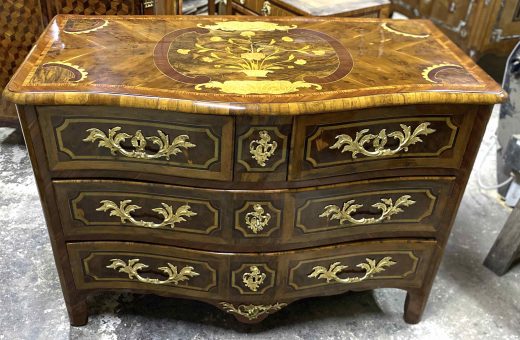
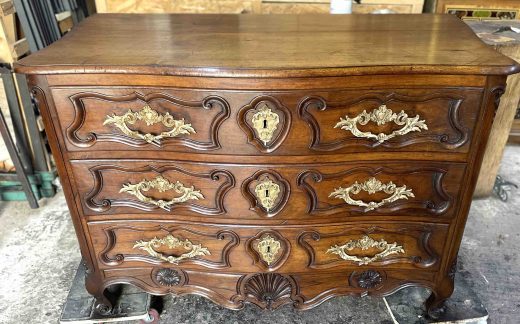
Restoration of a Regency commode, probably from southeastern France, veneered with yew, plum, rosewood, walnut, cherry, amaranth, violet wood, boxwood, and green-stained maple on a softwood frame. Besides its highly unusual marquetry decoration, the commode's distinctive feature is its crowned R bronze mounts. The crowned R hallmark should not be confused with the crowned C hallmark, which corresponds to a tax levied from 1745 to 1749 on copper objects and is found on many […]

Directoire Commode

Ebénisterie Mathieu Vath

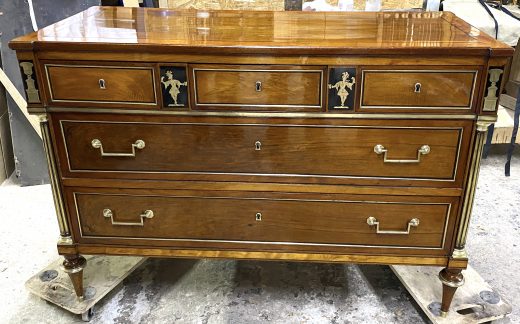
Restoration of a curious Directoire commode in solid walnut and walnut, mahogany, and maple veneer, featuring marquetry of a Medici vase and a Louis XIV-inspired ballet dancer, in brass on an ebony ground. The drawers have walnut bottoms with an ebony stringing surmounted by a quarter-round brass and wood molding, surrounded by a mahogany molding. The uprights are three-quarter-fluted columns terminating in toupie feet. The locks are in the shape of trefoils. A conservation project for this […]

Louis XIV commode

Ebénisterie Mathieu Vath

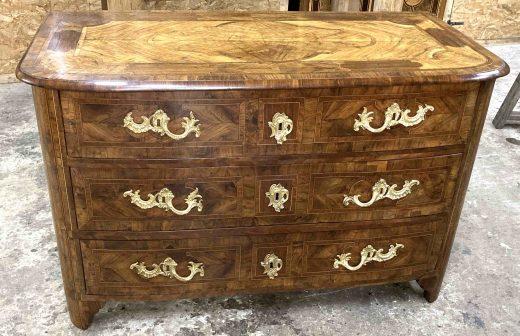
Restoration of a Louis XIV period commode veneered in olive burl, ash, and walnut, likely from the Dauphiné region. This type of commode (D-shaped), along with the Mazarine commode, was among the very first commodes popularized under Louis XIV. Indeed, the appearance of the earliest French furniture resembling the commode dates only from the 1700s; thus, the oldest known and datable Parisian commodes are those delivered by André-Charles Boulle to Versailles around 1708. Their very simple decorations are inspired by Dutch designs, often executed by […]

Money changer table

Ebénisterie Mathieu Vath

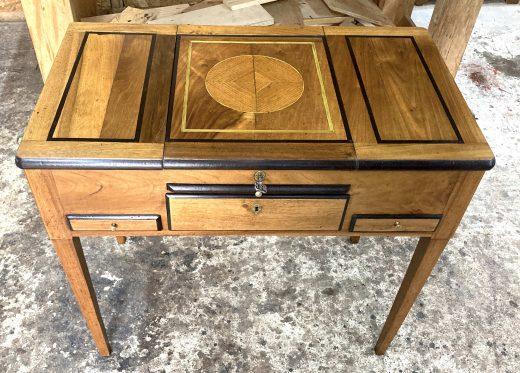
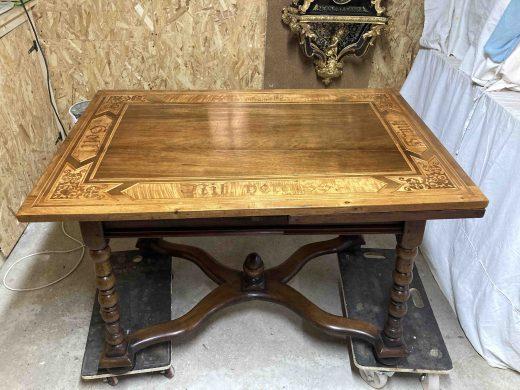
Restoration of a 17th-century money changer's table in solid walnut and walnut and sycamore maple veneer. This table originates from Germany, as indicated by the marquetry inscription on its top: "Trink und iss Gott nit wergiss," which translates as "Drink and eat, but do not forget God." It consists of two drawers, a top, and a sliding extension leaf; the legs are joined by an X-shaped stretcher. What is a money changer's table? The profession of money changer emerged in the 13th century, following the expansion of trade. […]

Prie-Dieu

Ebénisterie Mathieu Vath

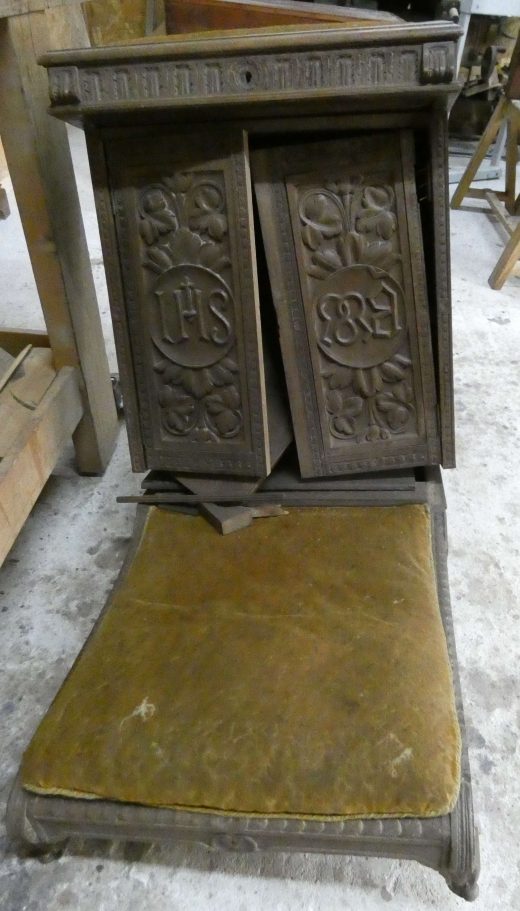
A first contact and a truly beautiful job by Rachèle on the restoration of this walnut prie-dieu dating from the late 19th century. The project was quite daunting. Left abandoned for years, it had been ravaged by wood-boring insects. The first task was to treat the piece with anoxic agents for 21 days. Then, as nothing was holding together anymore, each element was disassembled, which wasn't too difficult, and then glued back together […]

Regency chest of drawers

Ebénisterie Mathieu Vath

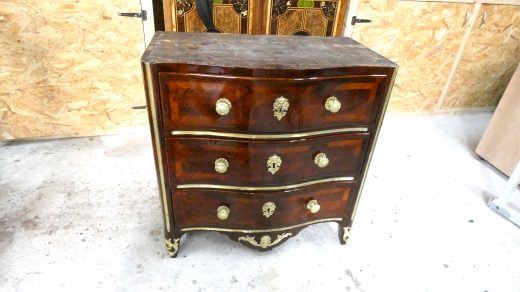
This small chest of drawers has a classic form typical of the Regency period. Still bearing the hallmarks of Louis XIV, the front is curved, the front uprights are rounded, and the sides remain straight. It opens with three drawers. Its uprights and the intermediate rails are decorated with brass fluting. The frame is entirely made of fir; the intermediate panels are dovetailed into the sides, and the back is composed of horizontal planks held in place by rabbeted nails. The drawers are constructed of walnut […]

Cabinet from the late 17th century

Ebénisterie Mathieu VATH

Don't be fooled by the Directoire-style keyhole escutcheons on this cabinet, as it dates from the late 17th or early 18th century. The keyhole escutcheons are clearly not original. In fact, very few elements remain original to this piece of furniture apart from the drawers, the frame, and the base. The veneer on the front, sides, and top has been altered. It's quite clear that the locks have been changed and the escutcheons filled in. This piece is entirely made of […]