Regency chest of drawers with crossbow

Ebénisterie Mathieu Vath

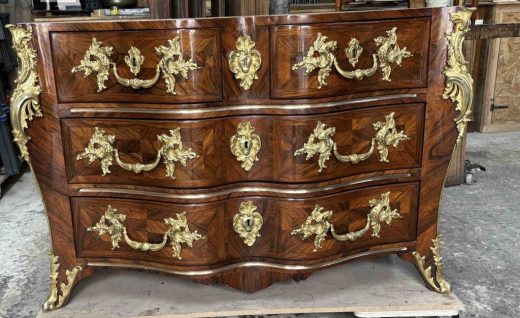
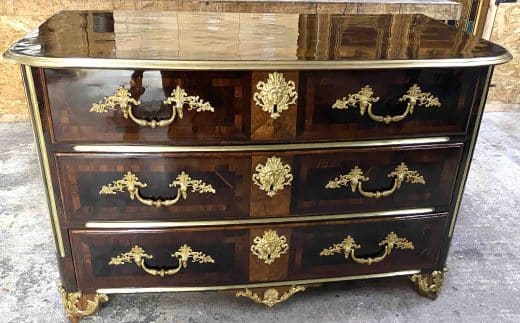
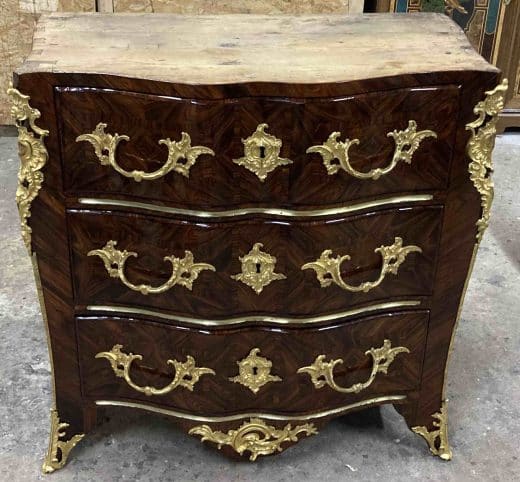
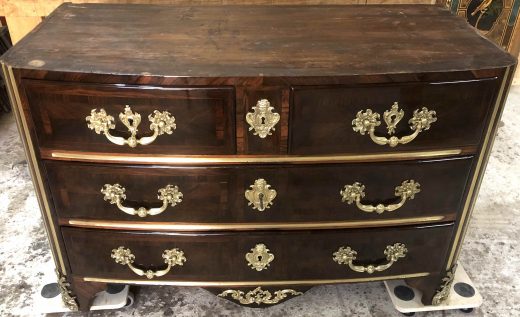
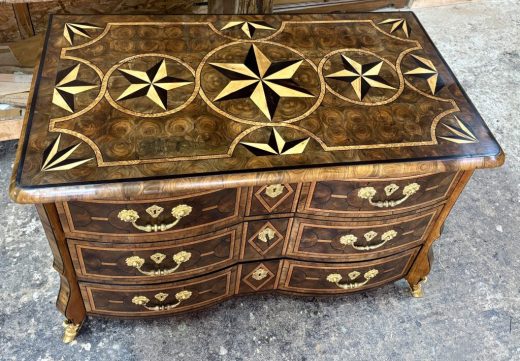
Conservation work on this Regency period commode. It is distinguished by its serpentine shape and its rosewood veneer, adorned with gilt bronze mounts, on an oak and softwood frame. Our first task was to stabilize the veneered surfaces by injecting protein-based adhesive. Next, the gaps were filled with grafts of new rosewood, sawn, scraped, and sanded. These grafts, then French polished, were allowed to oxidize naturally under UV light. Finally, we prepared them to the correct thickness on the backing and then glued them in place with hot glue. […]

Regency chest of drawers stamped Merchant

Ebénisterie Mathieu Vath

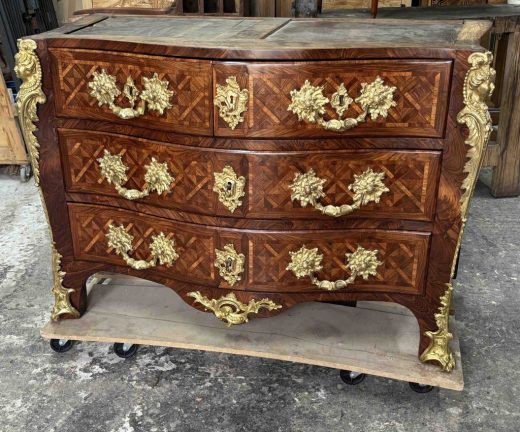
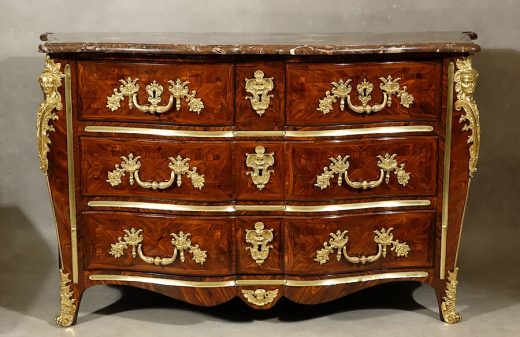
Restoration of a Regency period commode, stamped Nicolas-Jean Marchand. It is veneered in kingwood with a diamond-point pattern, on an oak frame. It opens with four drawers. Furthermore, a set of chased bronze mounts bearing the crowned C adorns the whole. These include thick drop handles and large gadrooned rosettes. In addition, there are cartel-shaped keyhole escutcheons and espagnolette drops, terminating in eagle-claw feet. The crowned C: The royal edict of 1745 imposed a distinctive mark on bronze workers: a "C" […]

Regency Cartel

Ebénisterie Mathieu Vath

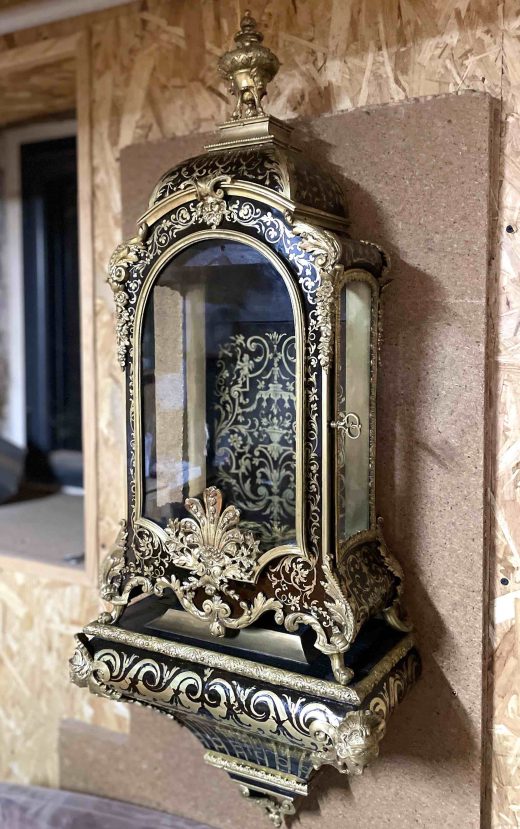
Restoration of a Regency clock in brown tortoiseshell and brass marquetry, with a bronze Atlas bearing the dial. The clock exhibited significant structural and decorative alterations, necessitating a complete intervention according to the principles of conservation-restoration. Condition report: This clock, probably dating from the early 18th century, showed the marks of time: lifting marquetry, detachment of the tortoiseshell, oxidation of the brass, and numerous losses. Furthermore, the bronze Atlas, leaning under the weight of the celestial vault, was blackened. Indeed, decades of dust […]

8-foot Regency style pedestal desk with Democritus masks

Ebénisterie Mathieu Vath

Restoration of a Regency period double-sided flat-fronted desk with a drawer unit, veneered entirely in kingwood. Its sides feature a diamond-point frieze, while the drawer fronts form an inverted slab pattern. Each side opens with four drawers in the frieze, with a central drawer on one side. Furthermore, a molding encircles the top, which is covered in gilt leather tooled in small pieces. The desk rests on eight cabriole legs ending in goat hooves. Most notably, it bears two emblematic bronzes from the oeuvre of André Charles Boulle: […]

Regency chest of drawers

Ebénisterie Mathieu Vath

Restoration of a bombé commode, veneered in satinwood with double boxwood stringing within amaranth borders. The frame is fir and the drawer units are walnut. It opens with four drawers in three rows. Its finely chased bronze mounts are silvered, not gilded as is customary. The uprights are veneered with a facsimile of brass fluting. The sides, decorated with a lozenge inscribed within a rectangle, echo the decorative motif of the front veneer. It is topped with a green Campan marble slab […]

Regency corner

Ebénisterie Mathieu Vath

Restoration of a Regency period corner cabinet veneered in Rio rosewood on a softwood frame. The piece had little damage apart from missing fluting and mahogany grafts on the top and bottom rails. The work therefore consisted of replacing the mahogany grafts with rosewood veneer that was sawn, scraped, and sanded before being glued with hot glue. The brass fluting was recreated and adjusted to fit perfectly into its original positions. A French polish finish was applied […]

Regency style pedestal desk

Ebénisterie Mathieu Vath

Restoration of a desk veneered on all sides with yew burl and amaranth, decorated with geometric boxwood stringing. It opens with five drawers in the front and five simulated drawers in the back. Furthermore, the two lower drawers follow the contour of the edge and slide at a 45-degree angle. In addition, a bronze molding encircles the amaranth-veneered top. The desk rests on four cabriole legs, terminating in curious acanthus leaf bronzes. Finally, the frame is entirely oak, except for the drawers, which are walnut, with […]

Regency-style chest of drawers stamped by Michel Mallerot

Ebénisterie Mathieu Vath

Restoration of a commode from the first half of the 18th century, curved in height and bombé in plan. It opens with four drawers in three rows. Known as a tomb-shaped or Regency commode, it belongs to a much smaller group: that of commodes with a bridge and mustache-shaped finials. Its frame is typical of the Regency period. The uprights are made of oak, and the rest is primarily a high-quality softwood. The drawers, fitted with mortise and tenon joints, are made of walnut. The veneer uses only two types of wood, […]

Regency commode in sarcophagus form

Ebénisterie Mathieu Vath

Minor restoration was required for this Regency commode, known as a "sarcophagus commode." Indeed, a few veneer repairs and a refinishing of the varnish were enough to restore its former glory. The sarcophagus commode? The first commodes were designed by André-Charles Boulle. Then, a few years later, during the Regency period, commodes with curved sides and tops appeared. Throughout the 18th century, they were known as "Regency-style" commodes. Similarly, it wasn't until 1720 that commodes with two rows of drawers reappeared.

Regency tabletop sign

Ebénisterie Mathieu Vath

Restoration of a Regency mantel clock in brown tortoiseshell and brass marquetry on an oak frame. Without its bronze mounts, this type of furniture loses its splendor. When it is restored to its original fittings, its symbols take on their full meaning, as its function is to tell the time. The Fame on the escapement and the eagle on the door are perfect examples. Originally, Fame was a Greek goddess who personified public reputation. The Greeks called her Pheme (Φήμη), the Romans Fama. Daughter of Gaia, this […]

Regency style commode stamped Hédouin

Ebénisterie Mathieu Vath

Here is the latest restoration by Raphaël, my apprentice. This commode has all the attributes of a Regency commode. Yet, Hédouin could only have made it well after this period (around 1715-1723). Indeed, he obtained his master craftsman's certificate in 1738, right in the middle of the Louis XV era. It is therefore more accurately described as a commode "in the Regency style," as cabinetmakers of the time called it. Moreover, its frame is entirely oak, except for the back panels, and its veneer combines amaranth and satinwood. Jean-Baptiste HEDOUIN The life of Jean-Baptiste Hédouin remains […]

Regency commode with faun and lion masks

Ebénisterie Mathieu Vath

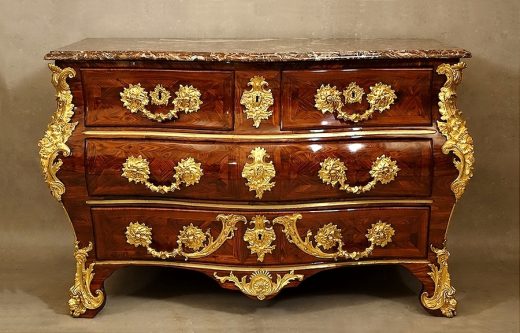
Restoration is complete for this important and rare Regency period commode, known as a "tomb-shaped" commode, a "Regency-style" commode, or a "moustache" commode. Curved on all sides, it features four drawers in three rows. It is topped with Vieux Rance marble from Belgium. It's worth noting that at the beginning of the 18th century, Rance was a French village. Molded in a corbel shape, the marble follows its contours. Veneered entirely in kingwood, this wide commode is enlivened by its powerful curves. Furthermore, brass fluting adorns the front and sides. Most notably, it bears […]

Regency Games Table

Ebénisterie Mathieu Vath

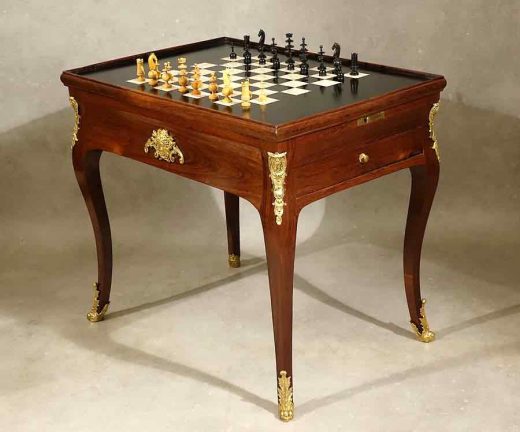
Restoration of a Regency period games table converted into a desk, resting on four cabriole legs. It is veneered with thick amaranth leaves. It opens with two side drawers, known as "chétrons," and a removable top, secured by a push-button mechanism. This top is lined with leather on its facing and, on the reverse, with a checkerboard veneered in ebony and inlaid with ivory. When the top is removed, it reveals a backgammon set in ebony and ivory. The molded astragal surrounding the top is made of solid amaranth wood. The legs and stretchers are made of beech, the […]

Regency Cartel

Ebénisterie Mathieu Vath

Restoration of a Regency clock case in Boulle marquetry on a brown tortoiseshell background. Since Antiquity, humankind has sought to master time and create a "timekeeper." Egyptian obelisks, water clocks, sundials, hourglasses. But it was in the 15th century that the first mechanical weight-driven clocks were made, with a single hand, but generally equipped with striking mechanisms. In the 16th century, the two-hour day, instead of 24, was adopted almost everywhere. Each city, however, retained its own meridian time until the advent of railways and […]

Regency commode with crowned R

Ebénisterie Mathieu Vath

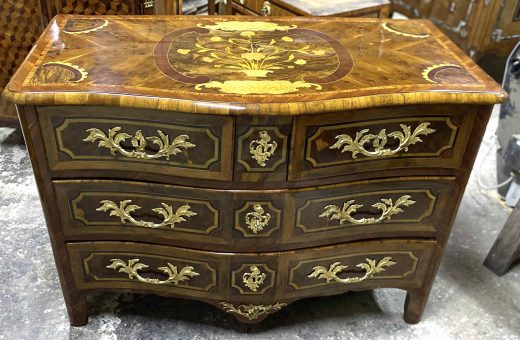
Restoration of a Regency commode, probably from southeastern France, on a softwood frame. Its veneer combines yew, plum, rosewood, walnut, cherry, amaranth, violet wood, boxwood, and green-stained maple. Besides its highly unusual marquetry decoration, this commode is also distinguished by its crowned R bronze mounts. The crowned R hallmark should not be confused with the crowned C hallmark. The latter corresponds to a tax levied from 1745 to 1749 on objects made of […]

Regency chest of drawers with Spanish-style drawers

Ebénisterie Mathieu Vath

Restoration of a Regency period serpentine commode, known as a "spanielette" commode. Curved on all sides, it is veneered in violet wood over a walnut frame. It opens with four drawers in three rows. A Belgian griotte red marble top, with ears and a corbel edge, crowns it. Like the front rails, its pinched uprights feature brass fluting. Its high-quality bronze mounts are superbly chased. Indeed, it features very rare espagnolettes, seen on only six commodes. Four […]

Regency commode by François LIEUTAUD

Ebénisterie Mathieu Vath

Restoration of a Regency period commode in alternating rosewood and walnut, inlaid with friezes and fillets. Its slightly curved front opens with three wide drawers. A brass molding encircles the top, which features a geometric design of circles around a central polylobed motif adorned with figures. Polished brass fluting embellishes the uprights and rails. The sides are veneered with walnut in a diamond pattern. Finally, the tapered feet terminate in claw feet. The commode also features large, chased and gilded bronze mounts.

Regency chest of drawers stamped ID

Ebénisterie Mathieu Vath

Restoration of a Regency commode, veneered in rosewood on a conifer frame. It was only after three weeks of work that I noticed a strange mark. It had been right in front of me from the start, and I hadn't seen it. It is indeed quite rare to see a stamped Regency commode. But yes, the mark was definitely there. And it's not a modest one: this ID stamp is attributed to Jacques Denizot. Jacques Denizot (1684–1760) was a Parisian cabinetmaker who remains relatively unknown. […]

Regency commode stamped by Michel Mallerot

Ebénisterie Mathieu Vath

Restoration of a commode stamped Michel Mallerot. With its serpentine front, it is entirely veneered in kingwood. Its frame is made of fir. As for the drawers, their sides are beech and their bottoms are walnut. You don't know Michel Mallerot? That's understandable! Indeed, Michel Mallerot (1675-1753) remains little known, like many Parisian cabinetmakers of the early 18th century. He was identified thanks to a pencil inscription, "M. Mallerot," on a Regency commode bearing this abbreviated stamp (formerly in the Philippe Glédel collection). The […]

Regency chest of drawers

Ebénisterie Mathieu Vath

To start the year, here are some photos of the restoration of this Regency commode. Made entirely of softwood, it is veneered with kingwood. Its uprights and rails are adorned with brass fluting. The bronze handles, influenced by Asia and the East India Company trade, are commonly referred to as "Chinese." The keyhole escutcheons, meanwhile, herald the arrival of the Louis XV style in the first half of the 18th century. Upon its arrival, in addition to some missing and peeling veneer, the commode presented a problem […]

Regency Cartel

Ebénisterie Mathieu Vath

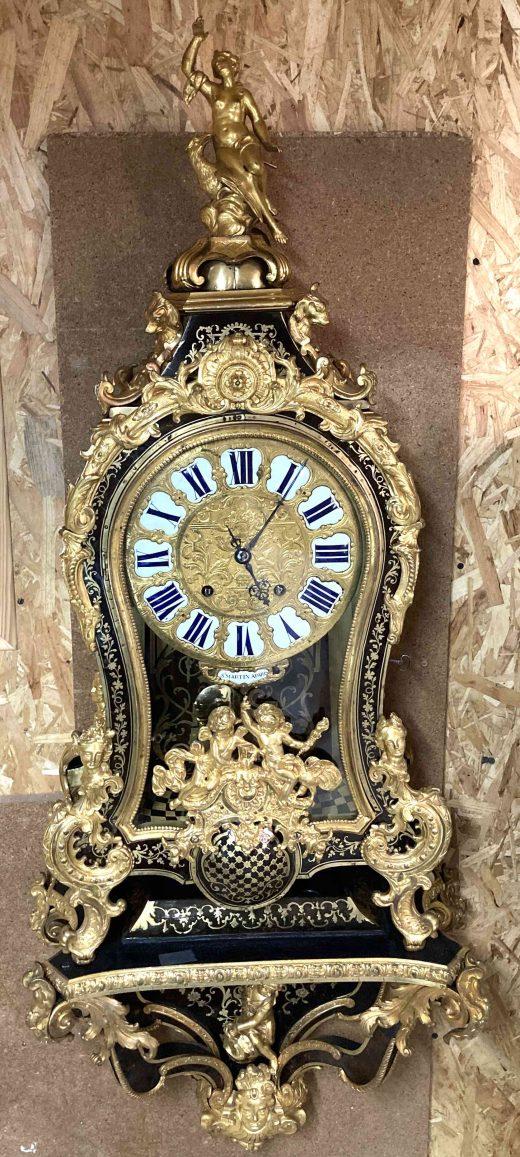
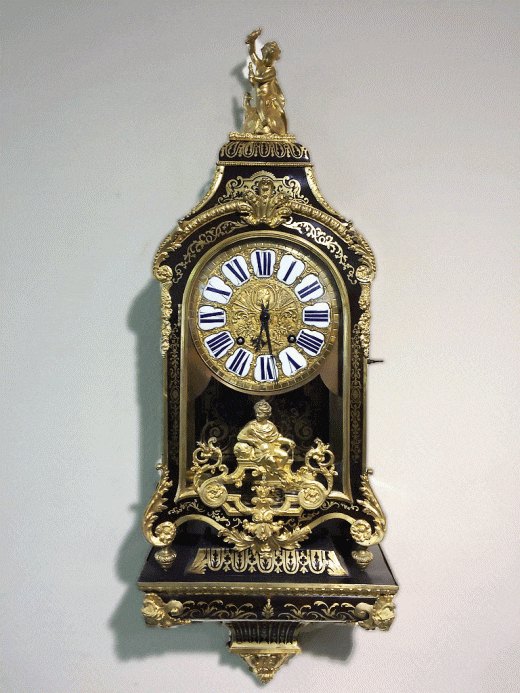
Restoration of a large cartel clock (137 cm high) and its bracketed base, from the Regency period. Made of solid oak, it is veneered with Boulle marquetry of brown tortoiseshell and brass. It is further adorned with floral garlands, crosshatching, and foliage. Its chased and gilded bronze dial features interlacing patterns and birds. The Roman numerals are enameled, and a reserve bears the signature St Martin à Paris. The clock plate also bears the same name. Finally, on the capital, chased and gilded bronzes depict […]

Regency chest of drawers

Ebénisterie Mathieu Vath

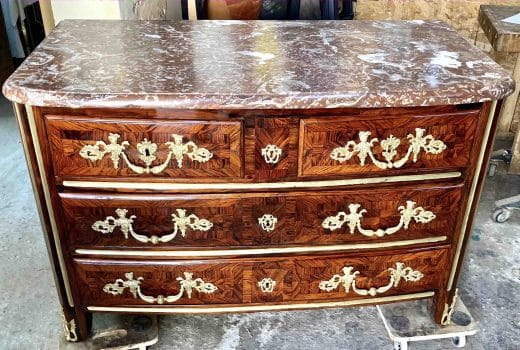
Originating in the late 17th century but only acquiring its name in the early 18th century, this is the first classic model of a commode. Although typically Louis XIV in style, it may not have existed before the Regency period. With rounded corner pilasters with slightly convex faces, deep copper fluting, veneer, and geometric bronze mounts, it features three rows of drawers. It perpetuates the spirit of Louis XIV furniture throughout much of the 18th century. Bibliography: Furniture […]

Regency chest of drawers

Ebénisterie Mathieu Vath

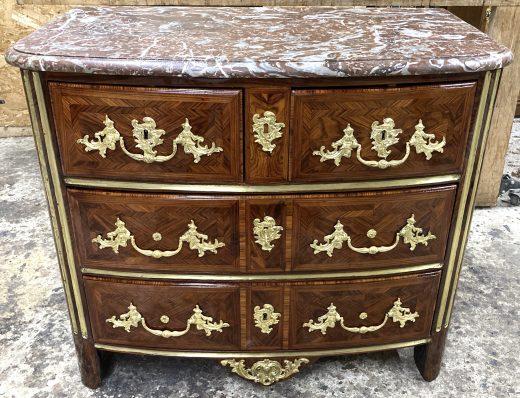
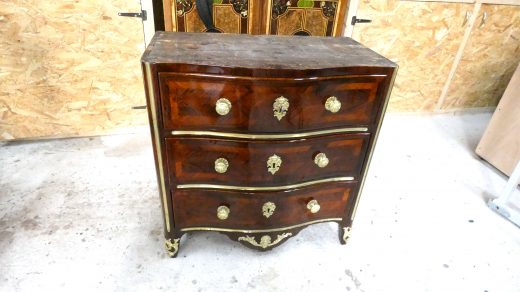
This small chest of drawers has a classic form typical of the Regency period. It still retains the rigor of the Louis XIV style: the front is curved, the front uprights are rounded, and the sides remain straight. It opens with three drawers. Its uprights and intermediate rails are decorated with brass fluting. The frame is entirely made of fir. The intermediate panels are dovetailed into the sides. The back is made of horizontal planks, nailed with rebates. The drawers are walnut, except for their wooden fronts […]