Louis XVI secretary stamped Schlichtig

Ebénisterie Mathieu Vath

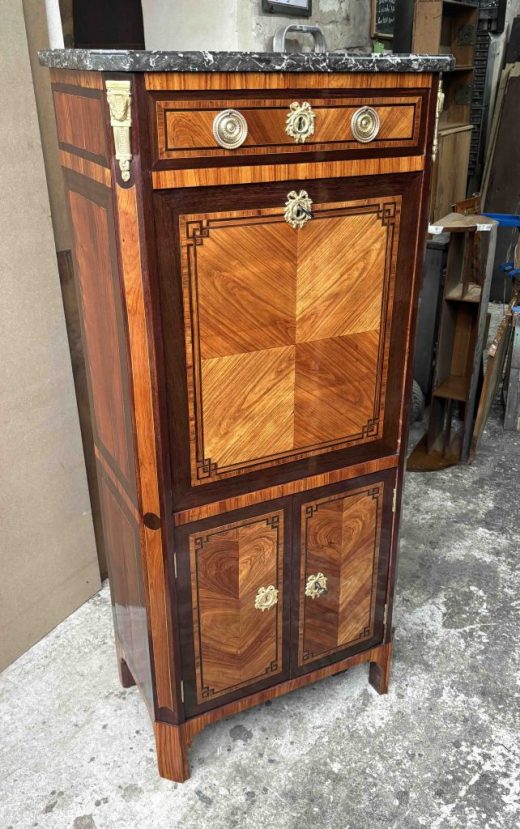
This Louis XVI style secretary desk bears the stamp of JG Schlichtig. It combines rosewood, satinwood (on the sides), and amaranth veneers on an oak and softwood frame. It opens with two lower doors, a central drop-front, and a top drawer. The interior includes six drawers and three niches. At 1.20 meters long, it is a lady's secretary desk. Jean-Georges Schlichtig († February 1782) was a Parisian cabinetmaker of German origin, admitted as a master on October 2, 1765. He initially established himself […]

Louis XVI secretary stamped Ohneberg

Ebénisterie Mathieu Vath

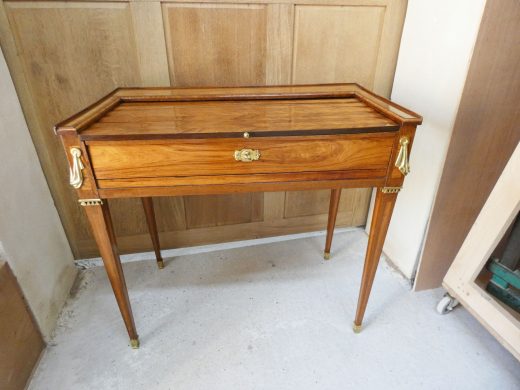
This Louis XVI period secretary bears the stamp of Martin Ohneberg. A masterpiece of sobriety and refinement, it combines a solid wood frame with rosewood and a sumptuous satinwood veneer. Its sinuous, golden veins lend brilliance and depth. Furthermore, the ornamentation remains understated yet exquisite. Indeed, delicately floral, chased bronze frames accentuate the clean lines of the piece, typical of the Neoclassical style. Martin Ohneberg, of German origin, was active in Paris during the last decades of the […]

Flat Greek-style desk stamped DUBOIS

Ebénisterie Mathieu Vath

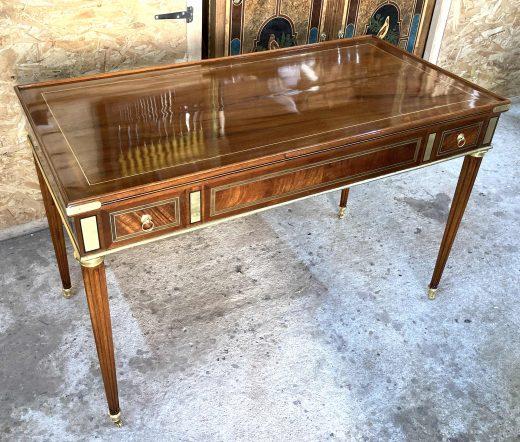
One desk, one stamp, three cabinetmakers? This desk is a masterpiece of French cabinetmaking. It alone embodies the culmination of 18th-century Neoclassical taste. Yet, a question immediately arises: why three cabinetmakers for a single desk? In fact, the answer lies in a mixture of succession, talent, collaboration, and opportunism, typical of the craftsmanship of the period. This flat desk, known as a "Greek-style" desk, is a perfect example of the Louis XVI style. It combines marquetry of amaranth, satinwood, and other woods.

Louis XVI wardrobe

Ebénisterie Mathieu Vath

Restoration by Raphaël of a rosewood veneered cabinet with diamond-pointed doors, framed in amaranth and Greek key stringing. It opens with two large softwood doors veneered with oak. Some regluing and repairs of missing veneer, along with a good coat of clear French polish, have restored this piece of furniture to its former glory.

Louis XVI console table stamped Louis Noël Malle

Ebénisterie Mathieu Vath

Restoration of a Louis XVI console table stamped by Louis-Noël Malle, with solid mahogany legs and mottled mahogany veneer on an oak frame. Louis-Noël Malle, born in 1734, became a master craftsman on November 18, 1765. With his wife, Marie-France Le Maître, he established his shop and workshop on the Grande-Rue-du-Faubourg-Saint-Antoine. He is recognized as one of the greatest marquetry craftsmen of his time. The 1771 and 1772 editions of the Almanach Général des Marchands mention him, misspelling his name as "Le Mille." His "works related to […]" are particularly praised.

Louis XVI gueridon stamped JH RIESENER JME

Ebénisterie Mathieu Vath

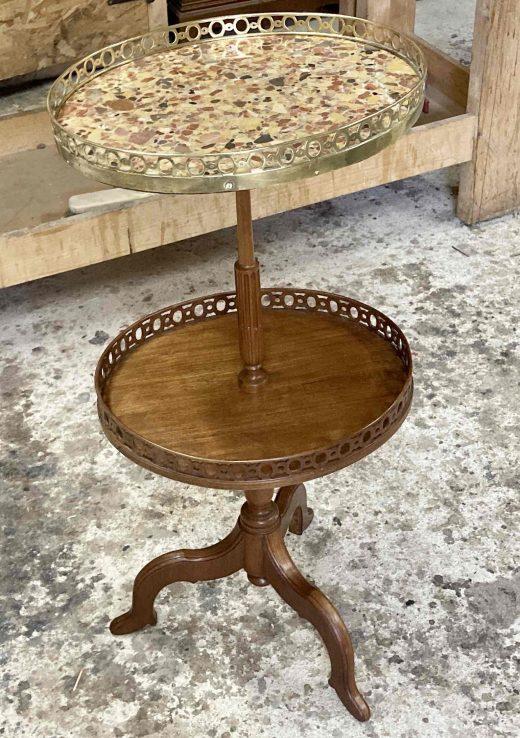
A minor restoration for this "shelf-sized" pedestal table, also known as a "dumb servant." It is made of solid and veneered mahogany, with an Aleppo breccia marble top. Furthermore, it bears the stamp of the equally renowned cabinetmaker to the Crown Furniture Repository, Jean-Henri Riesener. Jean-Henri Riesener: Does Jean-Henri Riesener (July 4, 1734 – January 6, 1806) even need an introduction? Indeed, he is the undisputed master of the Louis XVI style, due to the breadth and variety of his work. Above all, he is renowned for the quality and splendor of his furniture […]

Louis XVI games table

Ebénisterie Mathieu Vath

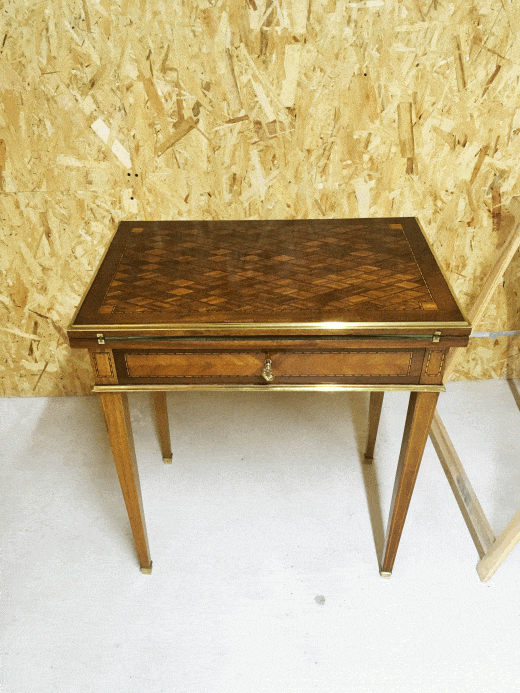
Restoration of a late 18th-century games table (circa 1785). It is veneered in mahogany burl, with inlaid stringing of brass, ebony, and ferreol. This South American wood is named after a 17th-century governor of Guyana. The legs are solid mahogany, and the interior is veneered with ebony and bone dyed green and natural. Its reversible top is leather-covered on one side and mahogany burl veneer on the other. The interior has two niches, a drawer on each side, and […]

Louis XVI planter

Ebénisterie Mathieu Vath

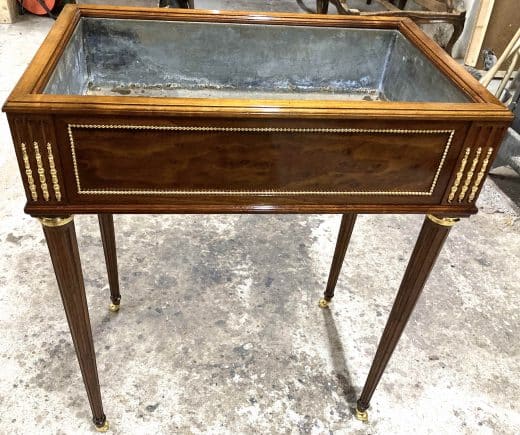
A little restoration for this Louis XVI jardinière in mottled mahogany veneer and solid mahogany for the feet. Simply regluing the joints, which had become slightly loose, restoring the varnish yellowed with age using a French polish, and re-gilding the bronze mounts were enough to give it a new lease on life. To see previous restorations: https://ebenisterie-mathieuvath.fr/en-ce-moment-a-latelier/

Marquises stamped C.SENE

Ebénisterie Mathieu Vath

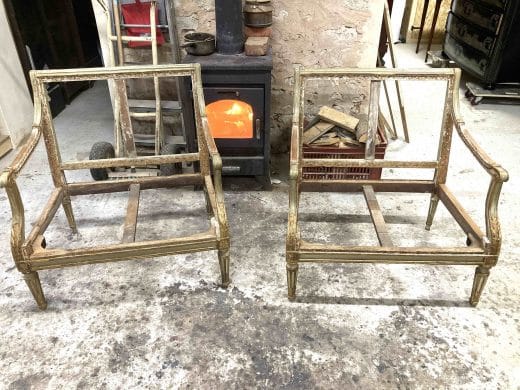
Conservation work on these two marquise chairs stamped by Claude I Sené. Claude I Sené (1724-1792), son of Jean Sené, obtained his master craftsman's certificate in Paris in 1743. He worked in the same workshop as his brother-in-law, the cabinetmaker Jean-Étienne Saint-Georges, on the rue de Cléry, under the sign "du Grand Saint-Georges." His output included numerous Louis XV chairs, but very few Louis XVI pieces. He ceased working in 1780. He was the father of two other illustrious chair makers: Jean-Baptiste Claude and Claude II. BIBLIOGRAPHY: Le Mobilier Français […]

Louis XVI commode

Ebénisterie Mathieu Vath

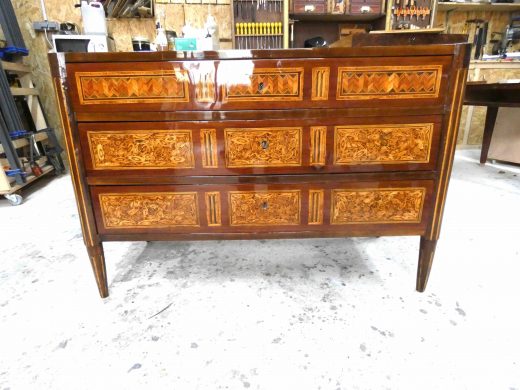
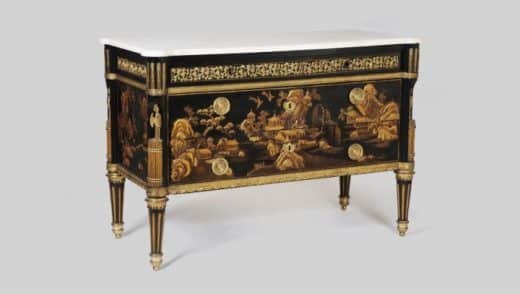
Restoration of a Louis XVI period commode from eastern France. It is made of solid oak and fir, veneered with end-grain laburnum, walnut, plum, amaranth, rosewood, palisander, boxwood, and green-stained hornbeam. The handles and keyhole escutcheons were added later. Indeed, the original fittings have disappeared: only the handle holes remain. This is a piece of furniture that has never been restored. Moreover, the veneer is almost 4 mm thick in places. Furthermore, one can see […]

Secret box

Ebénisterie Mathieu Vath

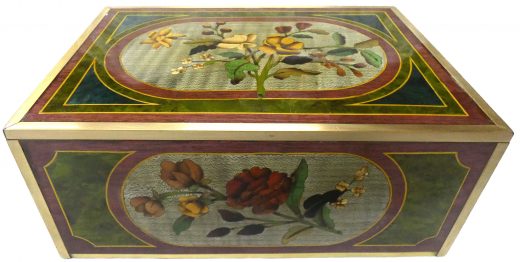
The brief: to create a multi-moving secret box, inspired by Japanese boxes, but with French-style marquetry. Three movements reveal the secret drawer. A spring-loaded button, hidden beneath the veneer, then ejects it. For the shape and marquetry, I drew inspiration from the traveling secretary attributed to Jean-François Oeben. The geometric forms and colors closely resemble what this cabinetmaker might have used. The box's structure is made of solid beech, with ash wood joints. […]

Louis XVI/Directory Secretary

Antiquités Guin

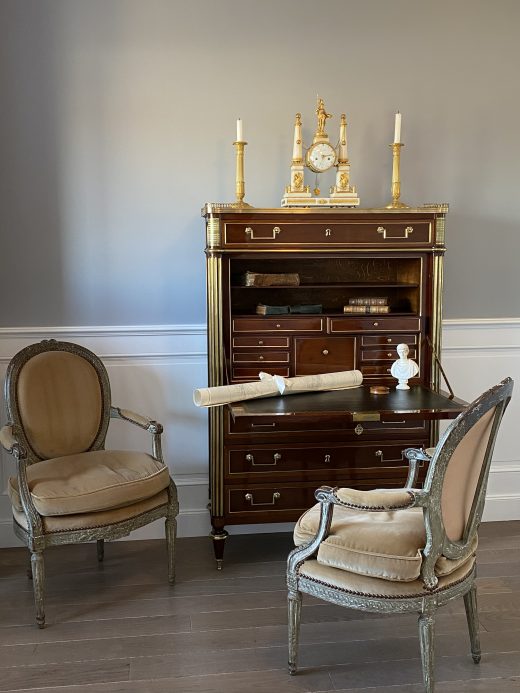
Restoration of a drop-front secretary desk with an oak frame, veneered in mottled mahogany and Santo Domingo mahogany. It likely dates from the late 18th century. Its white Carrara marble top is surrounded by a partially openwork brass gallery. It opens with a drawer at the top, a drop-front in the middle, and three drawers at the bottom. All the original locks are secured with a cloverleaf key. Furthermore, brass quarter-round moldings frame all the panels, both on the front and sides. The drop-front is veneered in mottled mahogany […]

Louis XVI half-moon table

Ebénisterie Mathieu VATH

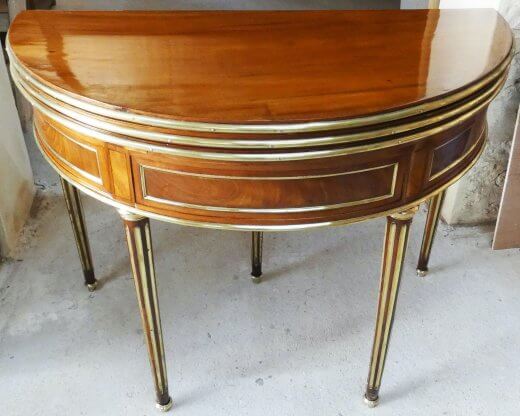
Here is a three-tiered half-moon table. This style of table, originating in England, is a classic of the Louis XVI style. It opens to reveal two circular tiers, one lined with felt, the other veneered in mahogany. Its apron, veneered in mahogany burl, is adorned with brass frames. It rests on five tapered legs, fluted and trimmed in brass, ending in sabots. The fifth leg is attached to a drawer: it is pulled out to support the drop leaf when unfolded. A very attractive piece, probably dating from the late 18th century. […]

J.STUMPFF Roll-Top Desk

Ebénisterie Mathieu VATH

Restoration and conservation work on this rare Louis XVI period roll-top desk stamped by Jean-Chrysostôme Stumpff (1731 – January 17, 1806), who became a master craftsman on August 27, 1766. Originally from Schweigern, Swabia (Germany), he married in 1760 in Paris, at the Swedish embassy, like most of his compatriots of the Reformed faith. His witness was his fellow cabinetmaker Ferdinand Schwerdfeger. In his workshop on Rue Saint-Nicolas, he produced some Louis XV furniture, but primarily a large number of Transition and Louis XVI pieces. Stumpff's production […]

Chest of drawers in the style of the Axe

Ebénisterie Mathieu VATH

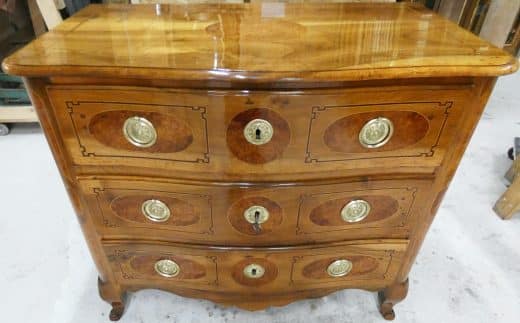
Here are some photos of the restoration of a solid walnut commode, veneered with thuya burl inlay, with Greek key stringing in amaranth and boxwood. The drawers and the interior and back panels are made of fir. Despite the curved stretcher, its shape, and its feet, this commode is indeed in the Transition style, but from the Louis XVI period. In the title, I wrote "in the style of the Hache family": this commode certainly comes from the Dauphiné region. But that it came from the workshop of the famous family of cabinetmakers […]

Louis XVI commode stamped JA BRUNS

Ebénisterie Mathieu VATH

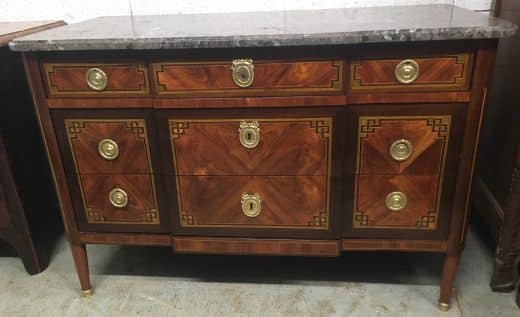
This week marks the completion of the restoration of a Louis XVI commode stamped JA BRUNS. Its frame is oak, except for the side panels, backs, drawer fronts, and two drawer bottoms, which are made of softwood. It is veneered with rosewood in a butterfly pattern and amaranth for the edges. The false fluting is in boxwood and ebony. A green-stained maple fillet outlines the Greek key corners. A few satinwood additions from previous restorations are visible. The marble top is Sainte-Anne gray. This commode […]

Mazarine Chest of Drawers

Ebénisterie Mathieu VATH

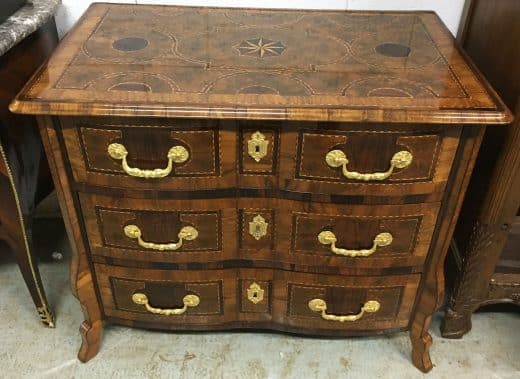
Here is a charming Louis XIV period Mazarine commode. With a serpentine front, it opens with three drawers in three rows. Furthermore, a marquetry top featuring a compass rose on an end-grain wood background crowns it. Its fir frame is also veneered with a very fine olive wood veneer, both end-grain and straight-grain, and rosewood. The sides are made of ash, while the stringing and compass rose are boxwood. Finally, the rails are joined with straight dovetail joints on the sides, which has […]

Louis XVI style sewing box

Ebénisterie Mathieu VATH

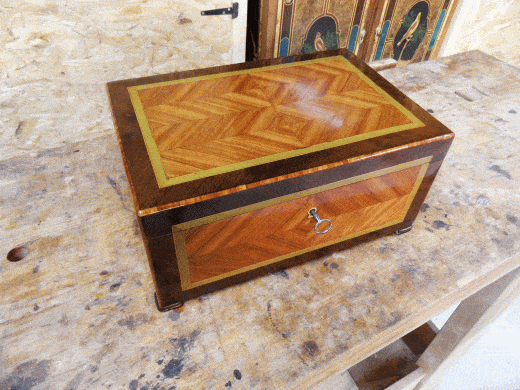
This sewing box dates from the Napoleon III period. Its frame is made of conifer. It is veneered with Rio rosewood, mahogany for the interior, and bound with boxwood and green-stained maple. A great quality of this box is that its lid has not warped. This is often the major problem with this type of object. People forget to lock them, and the wood warps. It then becomes very difficult to find the "trick" to make the box close properly without extensive restoration. Restoration work […]

Louis XVI style table

Ebénisterie Mathieu VATH

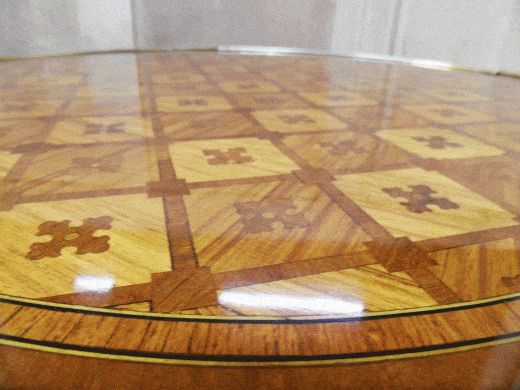
Here is a Louis XVI style table, which is probably an early 20th-century piece. It was likely made in the Faubourg Saint-Antoine, or perhaps at the École Boulle. I have seen apprentice furniture of this quality made by students during their training. Its frame is oak, while the veneer is rosewood and mahogany with a black inlay. The restoration was straightforward, apart from a lack of rosewood in the marquetry […]

Secretary stamped Martin Ohneberg

Ebénisterie Mathieu VATH

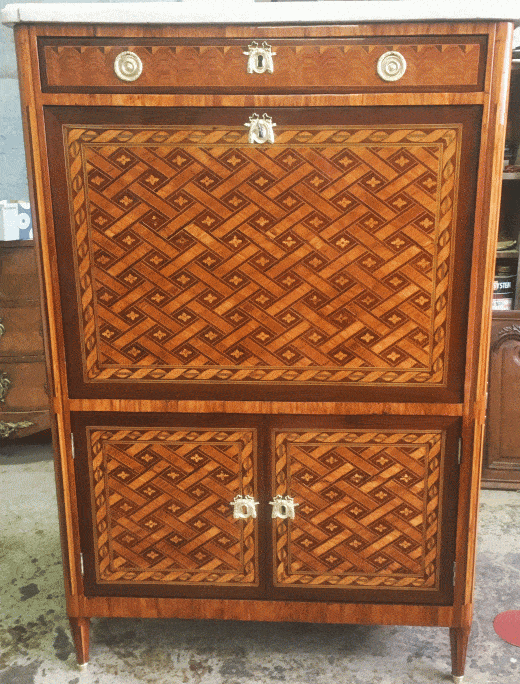
This week marks the completion of the restoration of a Louis XVI period secretary. Martin Ohneberg (master craftsman in 1773), who created this piece, was an excellent marquetry craftsman. Indeed, he used very high-quality rosewood. Furthermore, he produced numerous pieces of furniture with very simple lines but exquisite marquetry, including an infinite variety of drop-front secretaries. This particular one is veneered in rosewood and amaranth, with a mosaic marquetry of maple florets on a red satinwood ground. Moreover, the framing bands are made of […]

The chest of drawers of ingratitude

Ebénisterie Mathieu VATH

Cette année, pour la deuxième année consécutive, les Journées du patrimoine permettaient de visiter une partie des réserves et les ateliers de restauration du mobilier national. Ainsi, l’édition 2019 exposait la commode de « l’ingratitude ». Cette commode a d’ailleurs une histoire bien particulière. La Couronne la commande, et elle est livrée le 13 juillet 1789, veille de la prise de la Bastille. Son créateur est l’ébéniste Pierre-François Guignard, reçu maître le 21 janvier 1767. Or, payé par le Garde-Meuble le 13 juillet, il prend dès le lendemain une part […]