Louis XVI psyche mirror Weisweiler

Ebénisterie Mathieu Vath

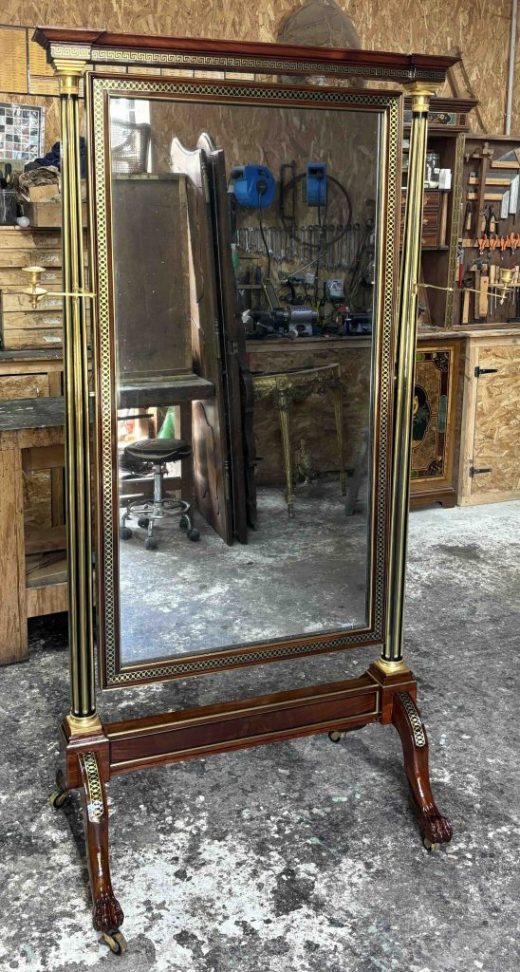
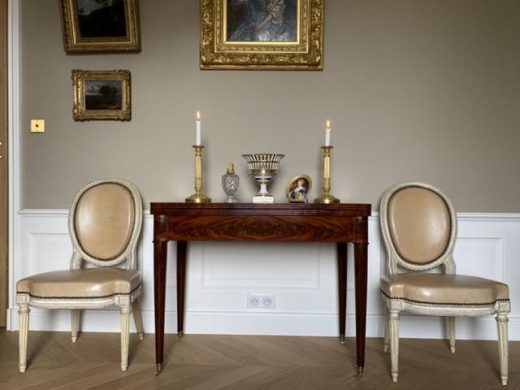
Restoration of a Louis XVI/Directoire period cheval glass stamped by Adam Weisweiler. This piece of furniture represents one of the innovations in late 18th-century furniture design. Far more than a simple dressing table accessory, it represents a significant evolution in the design of furniture intended for private use. Its appearance coincided with changing lifestyles, the development of new domestic spaces, and evolving practices related to self-presentation. For both the furniture historian and the restorer, the cheval glass is a particularly interesting object. It bears witness to both […]
Louis XVI commode stamped JL Cosson

Ebénisterie Mathieu Vath

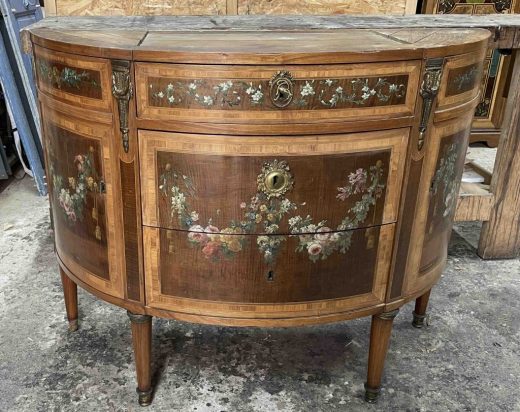
This Louis XVI period half-moon commode, stamped by the cabinetmaker Jacques Laurent Cosson, likely dates from a production between 1780 and 1790. It is an exceptional example of painted furniture from the end of the Ancien Régime, belonging to a very small group of which only seven examples are currently known. This small and highly sought-after group of 18th-century French painted furniture is now recognized as one of the most inventive areas of Parisian cabinetmaking on the eve of the Revolution. This commode, with its curved, half-moon shape, rests […]

Louis XVI powder compact stamped Jacob

Ebénisterie Mathieu Vath

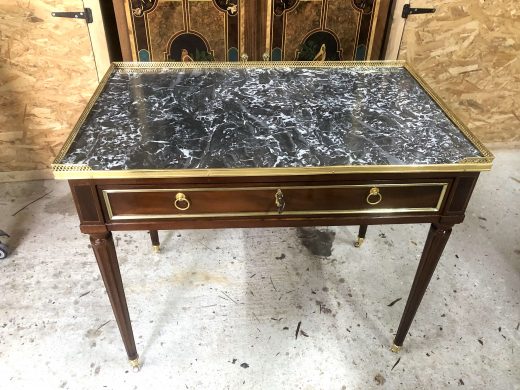
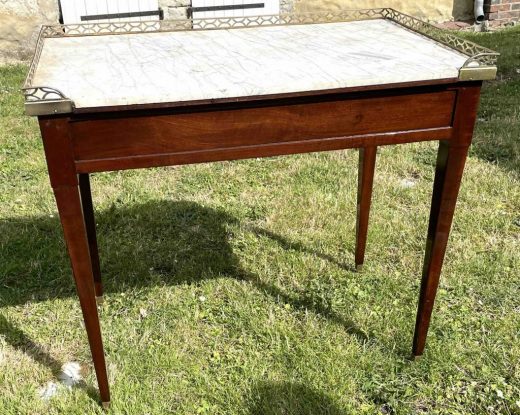
Restoration of a powder table, also called a dressing table, from the last quarter of the 18th century and stamped G.JACOB and JME. Opening with two drawers in the frieze, it is surmounted by a white Carrara marble top surrounded by an openwork brass gallery. The whole rests on four tapered legs of solid mahogany ending in sabots with integrated casters. The solid oak stretchers are veneered in mahogany. Georges Jacob (1739-1814) Georges Jacob, born on July 6, 1739, in Cheny, Yonne, came from a family of peasants. From a very young age, […]

Louis XVI Weekly Planner

Ebénisterie Mathieu Vath

Restoration of a Louis XVI chest of drawers veneered in rosewood, satinwood, and amaranth. It opens with a series of seven drawers framed by rounded uprights with simulated fluting made of boxwood and blackened pearwood. A chest of drawers? The chest of drawers is a piece of furniture that appeared in the mid-18th century, primarily intended for women. It is a chiffonier (which appeared during the Regency period, between 1715 and 1723) with seven drawers, one for each day of the week, designed to store the day's clean undergarments. The restoration...

Louis XVI commode stamped J. LAPIE

Ebénisterie Mathieu Vath

Restoration by Lise, during her internship at the workshop, of a Louis XVI commode stamped by Jean Lapie, constructed of oak, fir, and beech, veneered in rosewood with hornbeam and amaranth stringing, and adorned with gilt bronze mounts. And since Lise submitted an excellent internship report, I am publishing it almost in its entirety. Jean Lapie (known as "The Younger"), son of the potter Nicolas Lapie, was born around 1734. Brother of the cabinetmaker Nicolas-Alexandre Lapie (known as "The Elder") and cousin of Jean-François Lapie, he obtained his master's degree in Paris […]

Louis XVI wardrobe

Ebénisterie Mathieu Vath

Restoration by Raphaël of a rosewood veneered cabinet with diamond-pointed doors, framed in amaranth and Greek key stringing. It opens with two large softwood doors veneered with oak. Some regluing and repairs of missing veneer, along with a good coat of clear French polish, have restored this piece of furniture to its former glory.

VASSOU stamped chest of drawers

Ebénisterie Mathieu Vath

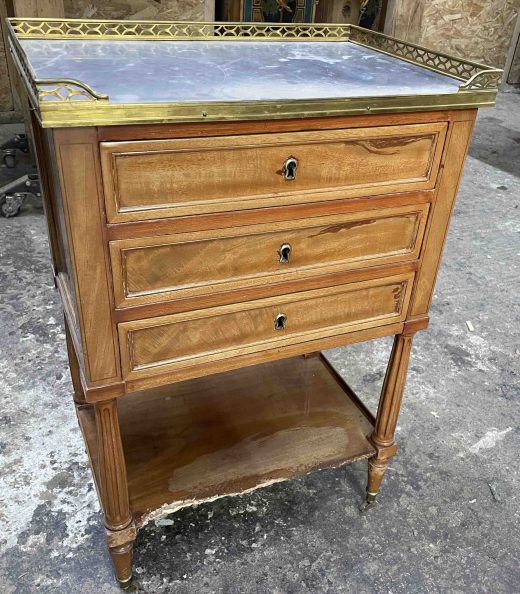
Restoration of a Louis XVI period chiffonier table in mahogany veneer and solid mahogany on oak and softwood frames, stamped by Jean-Baptiste VASSOU (1739-1807). A beautifully crafted piece with fine veneer and a lovely blue Turquin marble top. What exactly is a chiffonier table? The first mention of a "chiffonniere table" appears in 1755 in the journal of the haberdasher Lazare Duvaux (1703-1758). Then, in 1763, in the post-December inventory of Jean-François Oeben, we find mention of a "frame of a […]

Louis XVI secretary stamped TOPINO

Ebénisterie Mathieu Vath

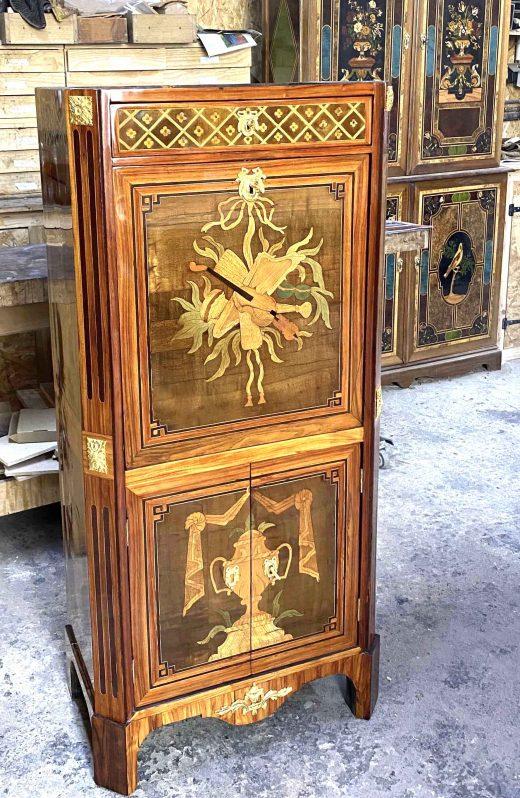
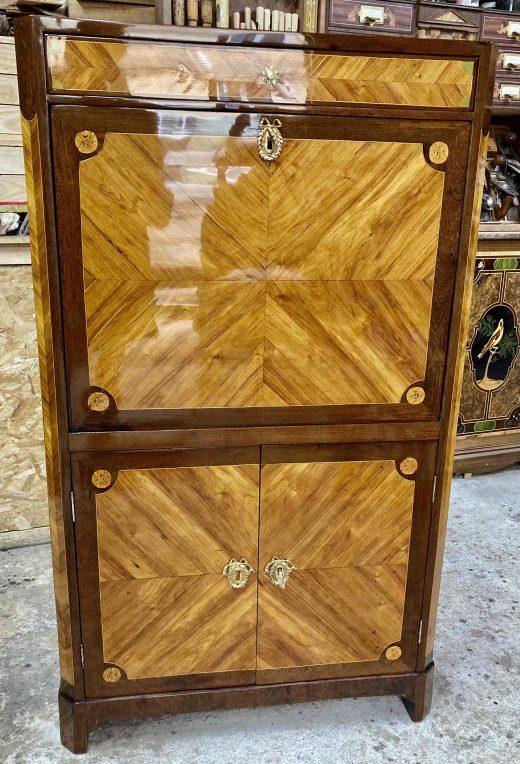
Restoration of a Louis XVI secretary desk stamped by Charles Topino. Typical of Topino's style, this secretary is constructed of oak and softwood. The front opens with a drawer and a drop-front covered in red leather tooled in gilt, revealing two compartments and four drawers veneered in rosewood. The lower section opens with two doors revealing a shelf. These are decorated with marquetry depicting a vase and drapery on a tobacco-colored ground, while the drop-front is inlaid with musical instruments, ribbons, and foliage on […]

Louis XVI writing table

Ebénisterie Mathieu Vath

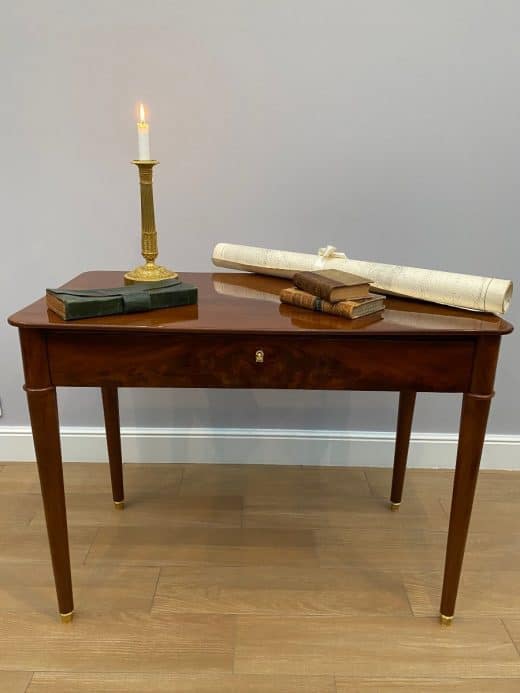
Restoration of a writing table built in oak, with a solid mahogany top and mahogany burl veneer. It features a large drawer in the frieze and rests on four tapered legs ending in gilt bronze sabots. Typical work of the late 18th century. To see previous restorations: https://ebenisterie-mathieuvath.fr/en-ce-moment-a-latelier/ This piece can be found at Antiquités Stéphane Guin.

Louis XVI secretary stamped Montigny

Ebénisterie Mathieu Vath

A little restoration for this Louis XV period secretary desk stamped by Philippe-Claude Montigny. It is constructed of oak and softwood, and veneered with rosewood, amaranth, and boxwood. It consists of a top drawer, a drop-front, and two doors. The interior compartments contain six drawers. Philippe Claude Montigny (1734-1800) became a master craftsman on January 29, 1766. Son of Louis Montigny, a privileged craftsman of the King, he owned a workshop in the Contrescarpe district of Paris. He was also the brother-in-law of Fidelis Schey, a cabinetmaker […]

Louis XVI cooler

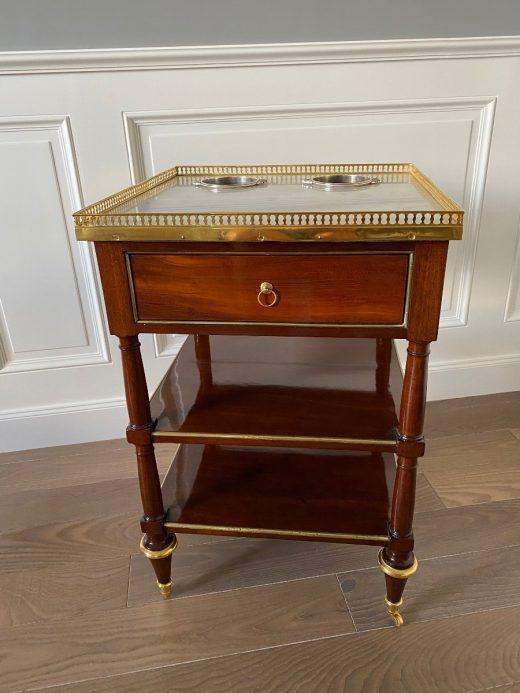
Restoration of a cooling table in solid mahogany for the legs and mahogany burl veneer with brass quarter-round moldings. The cooling table: It was in the 18th century, a century of thought, philosophy, and intimacy, that a fashion emerged among the wealthier classes of society: intimate dinners or suppers, without the intervention of household staff. Whether for romantic trysts or to plan the impending French Revolution, prying ears were not to be allowed. This trend influenced […]

Louis XVI commode stamped JB.Tuart

Ebénisterie Mathieu Vath

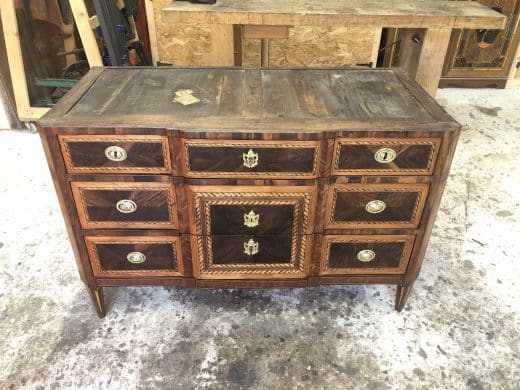
Here is a very pretty Louis XVI period commode veneered in rosewood and amaranth with marquetry of boxwood, pearwood, maple, hornbeam, walnut, blackened pearwood, lemonwood… It is built of oak and softwood. It is stamped twice with the mark of Jean-Baptiste II TUART. But its maker is probably Jean LAPIE. From a dynasty of Parisian cabinetmakers and merchants, whose father, Jean-Baptiste I, obtained his master's certificate in 1741 and was active until around 1760, Jean-Baptiste II, born around 1720, was not a master cabinetmaker but a master furniture maker and haberdasher […]

Louis XVI commode

Ebénisterie Mathieu Vath

This week, we're restoring a Louis XVI commode with a projecting front, veneered in Rio rosewood, amaranth, and violet wood, with marquetry stringing in boxwood and ebony forming a ribbon wrapped around the wood, the background of the engravings filled with red wax. The tapered legs and canted uprights have faux fluting in ebony and boxwood. There's no maker's mark to attribute this beautiful piece and the high quality of wood chosen for its construction. Regarding the restoration, the work isn't very […]

Louis XVI Powder Box/Writing Table

Ebénisterie Mathieu Vath

The dressing table, sometimes called a powder table, can be defined as a vanity unit in the form of a table or a small writing desk with drawers. Around 1730, shortly after the commode, this new type of furniture, often richly inlaid or veneered with precious woods, appeared in French furniture. This rather atypical powder table has the unique feature of also serving as a writing desk, or at least a desk for writing. Its four legs are made of solid mahogany, and the stretchers are also veneered in mahogany. The four surfaces are […]

Louis XV/Transition Commode by Nicolas Abraham Couleru

Ebénisterie Mathieu Vath

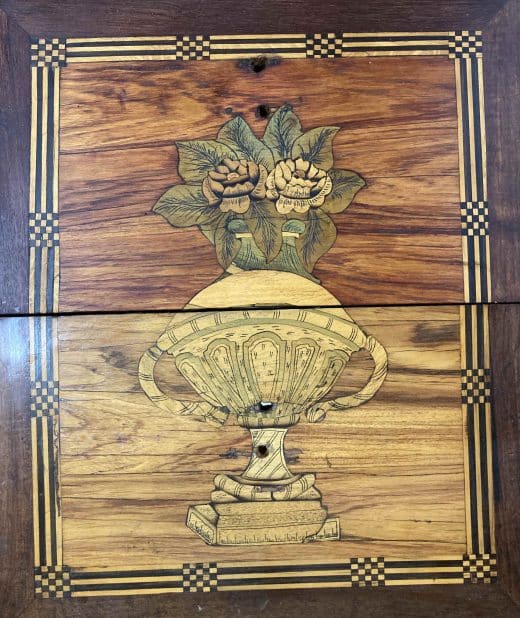
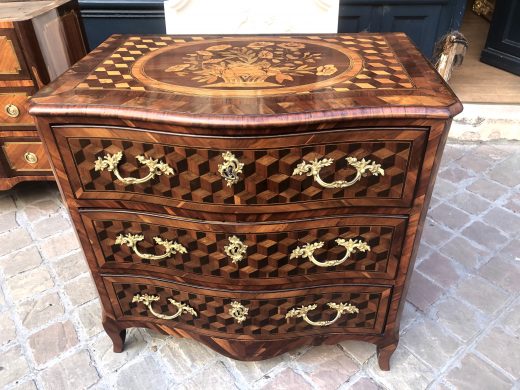
This slightly curved commode, composed of three drawers and veneered with bottomless cubes of walnut, plum, and cherry, has a marquetry top depicting a bouquet of flowers on an amaranth ground. Plum or Quetchier wood is easily recognizable by its sapwood markings, which create a lighter pattern and lend an irregularity to the decoration. The frame is made of fir and walnut. It is difficult to define a precise style for this commode. Although Louis XV, it clearly foreshadows the arrival of the style's more restrained appearance […]

Louis XVI Molitor Console

Ebénisterie Mathieu Vath

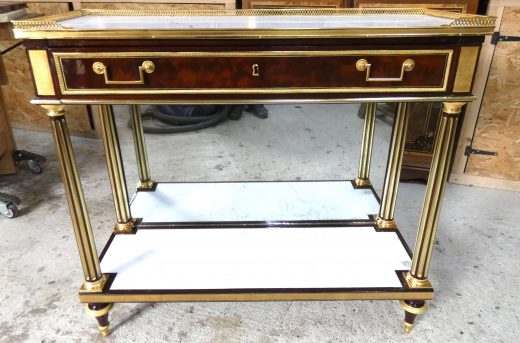
Restoration of a Louis XVI console table (1790-1795) stamped by Bernard Molitor. The structure is made of oak and solid mahogany for the legs. The panels of the lower shelf are beech. It is veneered with mahogany burl and ebony and brass stringing. Originally from Luxembourg, Bernard Molitor (1755 – November 17, 1833) obtained his master craftsman's certificate in Paris on October 26, 1787. He arrived in Paris in 1776 and worked in a small workshop located in the Arsenal district. It was after obtaining his master's certificate that he established himself on the rue de Bourbon-Saint-Germain. The austerity […]

Barber shop Louis XVI/Directory

Ebénisterie Mathieu Vath

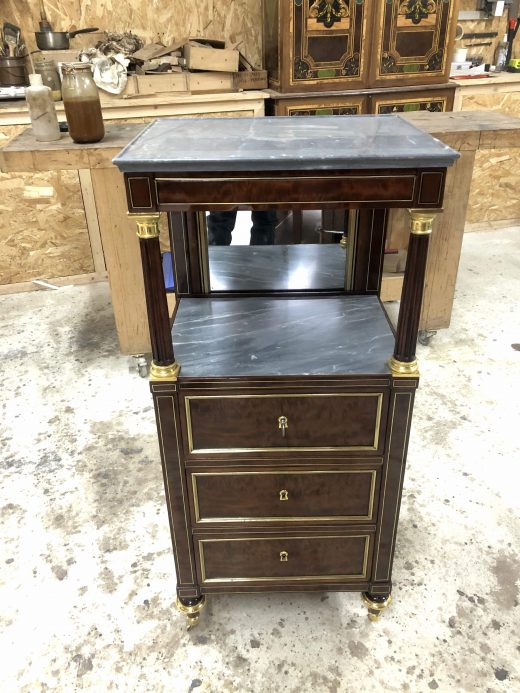
This elegant mahogany-veneered shaving cabinet from the late 18th century rests on four tapered legs with casters and opens with three drawers in the front. The niche, with its blue Turquin marble top framed by fluted columns, is surmounted by two side drawers and a sliding marble shelf with a recessed panel that reveals a sliding mirror on a rack and pinion mechanism, pivoting and framed with ebony and brass stringing. Appearing during the reign of Louis XVI, this style of shaving cabinet is a toilet unit designed to hold a porcelain pitcher and basin […]

Mahogany games table, late 18th - early 19th century

Ebénisterie Mathieu Vath

96 x W 47.5 x H 74 cm. Open: 96 x 95.5 cm. Restoration of a games table with a folding top veneered in burr mahogany, commonly known as Cuban mahogany. In fact, according to the recent book "L'essence du bois" (The Essence of Wood) by Patrick George, Emmanuel Maurin, and Marie-Christine Troujy-Jaquemet, it seems more accurate to call this type of mahogany Saint-Domingue mahogany. The base is veneered in solid oak, and the top in poplar. The moldings are solid mahogany. The table rests on legs […]

Secret box

Ebénisterie Mathieu Vath

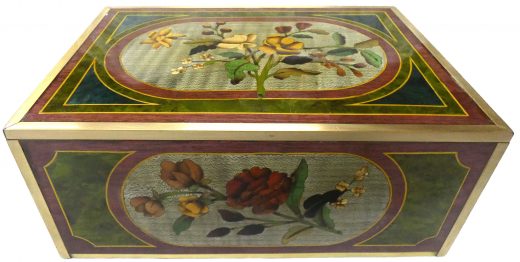
The brief was to create a multi-movement secret box inspired by Japanese boxes but with French-style marquetry. This box comprises three movements to access the secret drawer and a spring-loaded button concealed beneath the veneer that allows the drawer to be ejected. For the form and marquetry, I drew inspiration from the traveling secretary attributed to Jean-François Oeben. The geometric shapes and colors closely correspond to what this cabinetmaker […]