Wild herb table

Ebénisterie Mathieu Vath

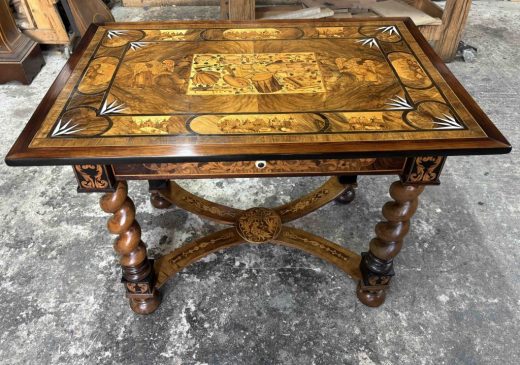
Restoration of a solid walnut table with marquetry decoration in the "architectural whims" and "wild grass" styles. It comes from the Austrian Tyrol and dates from the mid-17th century. It rests on four twisted legs adorned with flattened balls. An X-shaped stretcher connects these legs. A wide drawer opens in the front, beneath a rectangular top. The richly inlaid top is framed by a rosewood border. This is followed by bands delimited by wide oak stringing...

Augsburg Cabinet, 17th century

EEbénisterie Mathieu Vath

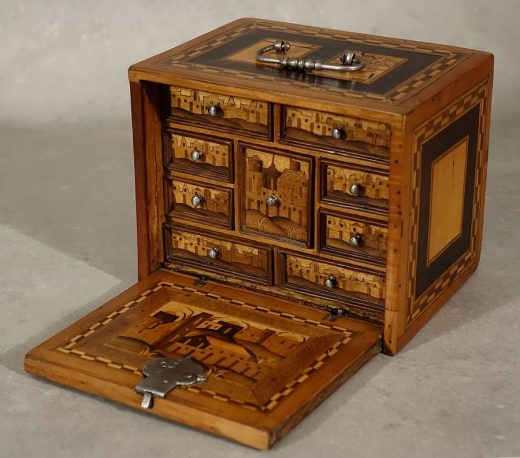
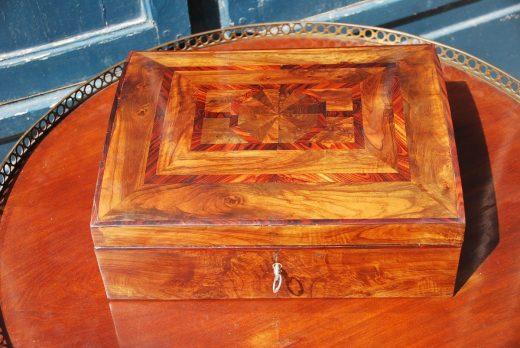
Restoration of a small table cabinet (height 14.3 cm, width 17.3 cm, depth 13 cm), likely a traveling model. It is made of solid wood, with intarsia decoration on all sides. A drop-front conceals eight drawers; in fact, the bottom drawer simulates two. Its composition is very rich, combining eight different wood species. The frame is made of fir, and cherry for the visible parts. Large central panels of sycamore maple are inlaid. Around these, bands of plum wood frame them, then a fillet of […]

Flat Greek-style desk stamped DUBOIS

Ebénisterie Mathieu Vath

One desk, one stamp, three cabinetmakers? This desk is a masterpiece of French cabinetmaking. It alone embodies the culmination of 18th-century Neoclassical taste. Yet, a question immediately arises: why three cabinetmakers for a single desk? In fact, the answer lies in a mixture of succession, talent, collaboration, and opportunism, typical of the craftsmanship of the period. This flat desk, known as a "Greek-style" desk, is a perfect example of the Louis XVI style. It combines marquetry of amaranth, satinwood, and other woods.

La Rochelle chest of drawers in "Isles wood"«

Ebénisterie Mathieu Vath

A look back at the restoration of this rare port chest of drawers. It is made of solid woods brought back from the Orient and the West Indies. Indeed, it combines four precious woods: mahogany, satinwood, palo santo, and ebony. Most notably, it features a fifth: royal ebony. This chest of drawers opens with three wide palo santo drawers, arranged in three rows, separated by Ceylon ebony crossbars. A solid, framed top covers it. Its parquet flooring combines royal ebony crossbars and a mahogany back, partly mottled or pommeled. […]

Louis XIV commode

Ebénisterie Mathieu Vath

Restoration of a Louis XIV period commode veneered in olive burl, ash, and walnut, likely from the Dauphiné region. This type of D-shaped commode, along with the Mazarine commode, is among the very first commodes popularized under Louis XIV. The first French furniture resembling the commode did not appear until around 1700. The oldest known and datable Parisian commodes are those delivered by André-Charles Boulle to Versailles around 1708. Their very simple decorations are inspired by Dutch designs. They are often the work of Protestant cabinetmakers, who were very fond of […]

RELIGIOUS CLOCK, Sarrabat Paris

Ebénisterie Mathieu Vath

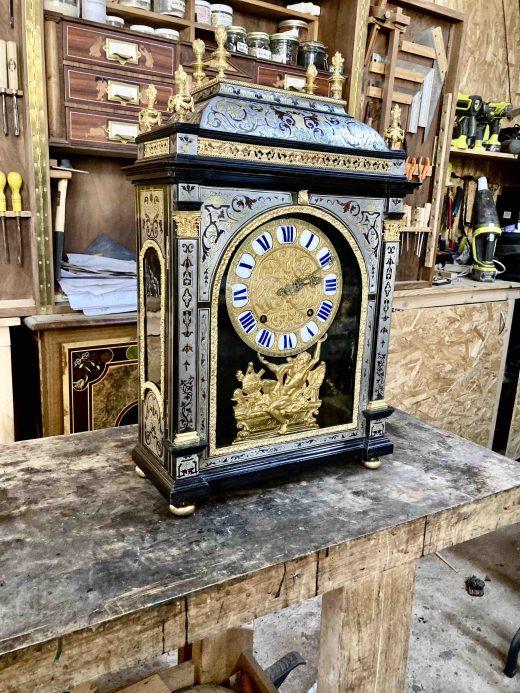
Restoration of a "religious" clock from the third quarter of the 17th century, which chimes on the hours and half-hours. The dial and movement are signed "Sarrabat à Paris." Religious clocks were among the first clocks produced during the reign of the Sun King. Indeed, their use developed from 1660 onwards, thanks to the regulator pendulum developed by Huygens. This particular clock features Boulle marquetry of red tortoiseshell, brass, and pewter, set on a walnut frame. It is further adorned with gilt bronze mounts and ebony moldings. Thus, […]

Louis XV corner cabinet

Ebénisterie Mathieu Vath

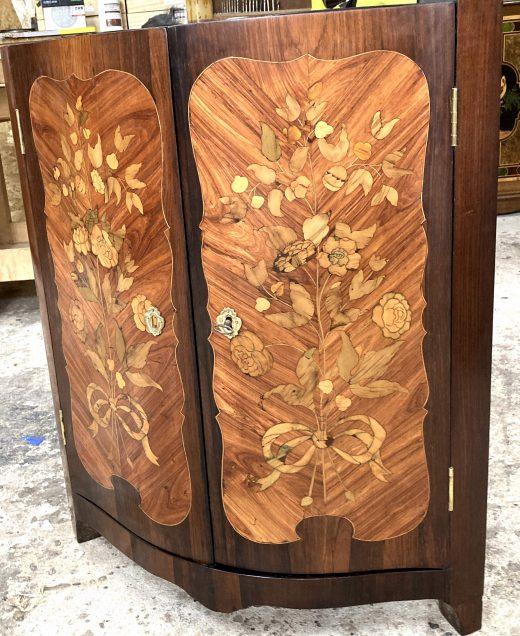
Restoration of a Louis XV corner cabinet in marquetry of various woods: maple, hornbeam, boxwood, and holly. Apart from the green of the leaves, the colors of some of the flowers and ribbons have faded. The marquetry stands out against a rosewood background, framed by a boxwood border and a rosewood frieze. Finally, the solid oak frame is assembled with dovetail joints. Condition report: As the photos show, the varnish was heavily sun-faded. Furthermore, the glues used for the marquetry on the doors were severely dehydrated, and one piece was missing.

Louis XV/Transition Commode by Nicolas Abraham Couleru

Ebénisterie Mathieu Vath

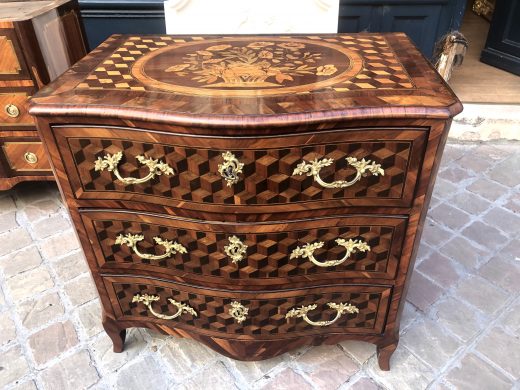
This slightly curved commode opens with three drawers. It is veneered with bottomless cubes of walnut, plum, and cherry wood. Its top is inlaid with a bouquet of flowers on an amaranth ground. Plum, or damson, is easily recognizable by its sapwood demarcations: these create a lighter pattern and give the decoration an irregular appearance. The frame is made of fir and walnut. It is difficult to assign this commode to a specific style. It is Louis XV, but the simplicity of its stringing and the marquetry framing clearly suggests […]

Transitional dresser

Ebénisterie Mathieu VATH

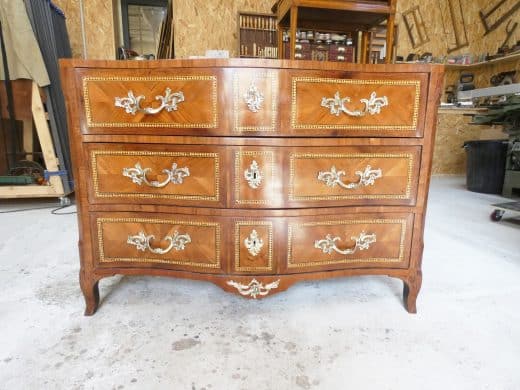
Here is a very simple commode from eastern France, probably dating from the late 18th century. Its front is slightly curved and its uprights are chamfered. The bronze mounts are probably not original. The frame is made of solid softwood, the uprights of oak. The drawer bottoms are set in a rebate and slide on the drawer fronts, which is typical of provincial work. A small unusual feature: the commode has no top panel; the marble slab rests directly on the frame. At the level of […]