Louis XVI psyche mirror Weisweiler

Ebénisterie Mathieu Vath

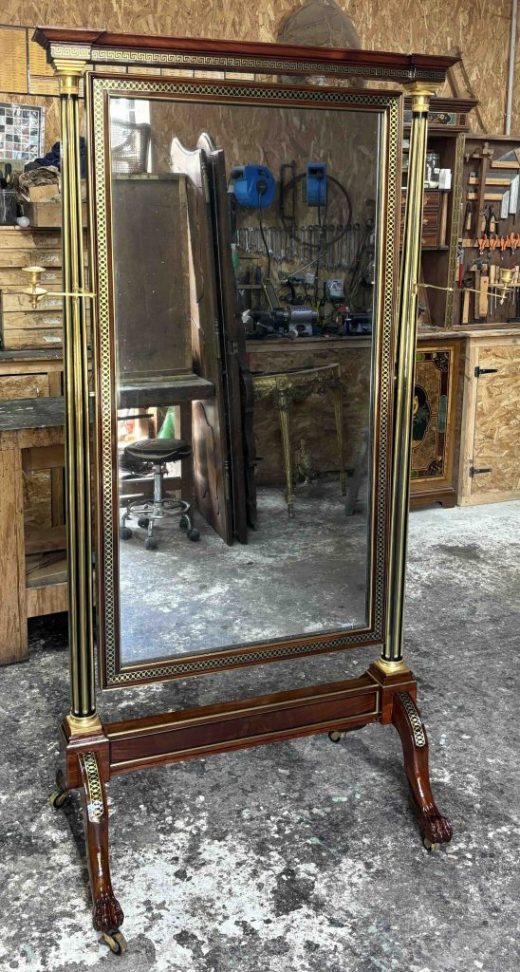
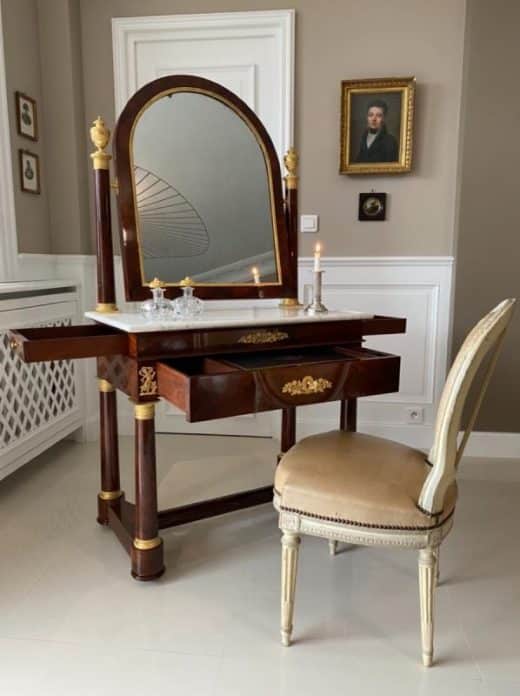
Restoration of a Louis XVI/Directoire period cheval glass stamped by Adam Weisweiler. This piece of furniture represents one of the innovations in late 18th-century furniture design. Far more than a simple dressing table accessory, it represents a significant evolution in the design of furniture intended for private use. Its appearance coincided with changing lifestyles, the development of new domestic spaces, and evolving practices related to self-presentation. For both the furniture historian and the restorer, the cheval glass is a particularly interesting object. It bears witness to both […]
Directoire armchairs

Ebénisterie Mathieu Vath

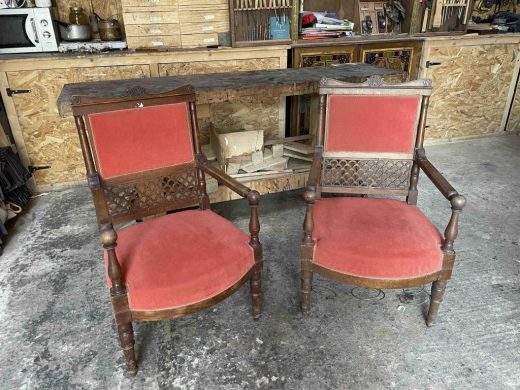
Restoration of a pair of Directoire period armchairs (circa 1795–1805), made of solid mahogany, except for the veneered stretchers. These chairs display the clean, balanced lines characteristic of the Directoire style, a transitional period between the strictures of the Louis XVI style and the codes of the Consulate. Assembled using mortise and tenon joints, they are made of solid mahogany. The straight armrests are extended by turned supports, typical of the late Directoire. The legs are turned in a baluster shape and slightly tapered at the bottom. The rectangular backs are framed with simple molding, […]
Empire Table

Ebénisterie Mathieu Vath

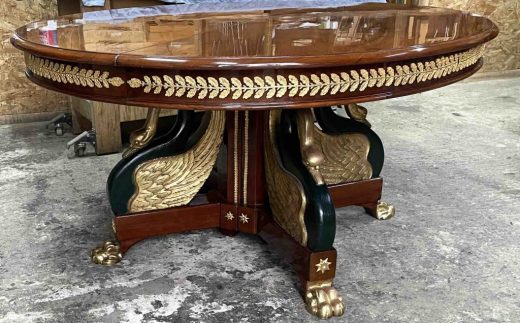
The restoration of this Empire dining table is now complete. The work focused primarily on the finishing touches. We removed the previously applied polyurethane varnish and applied a French polish to the solid mahogany top and its four-legged base decorated with swan neck motifs and lion's paw feet. The apron features an oak frieze. Length x Width = 162 x 140 cm. Length x Width with extensions = 252 cm.

Louis XVI powder compact stamped Jacob

Ebénisterie Mathieu Vath

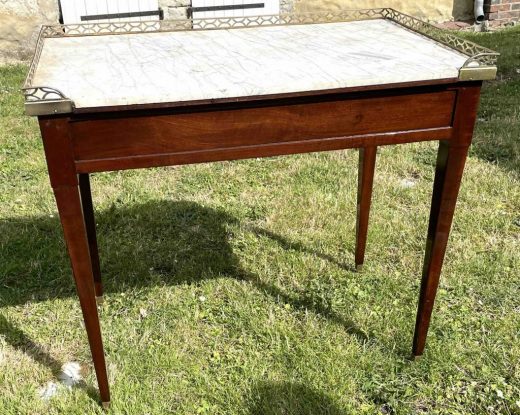
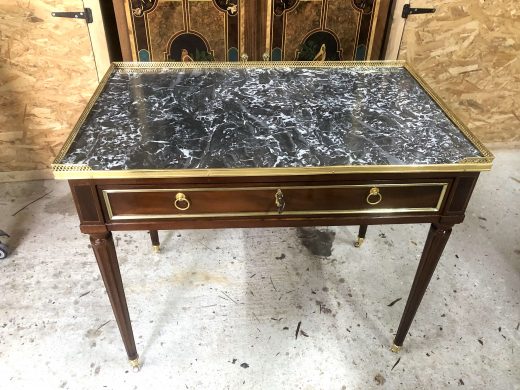
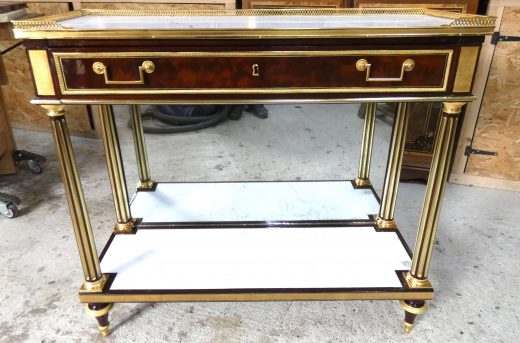
Restoration of a powder table, also called a dressing table, from the last quarter of the 18th century and stamped G.JACOB and JME. Opening with two drawers in the frieze, it is surmounted by a white Carrara marble top surrounded by an openwork brass gallery. The whole rests on four tapered legs of solid mahogany ending in sabots with integrated casters. The solid oak stretchers are veneered in mahogany. Georges Jacob (1739-1814) Georges Jacob, born on July 6, 1739, in Cheny, Yonne, came from a family of peasants. From a very young age, […]
Empire Desk

Ebénisterie Mathieu Vath

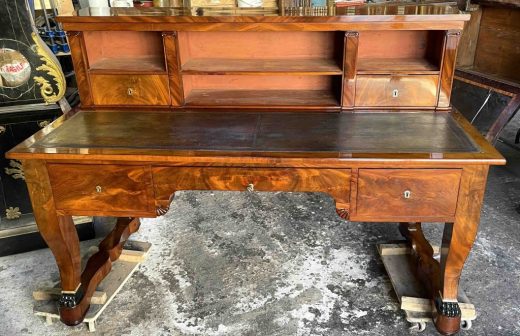
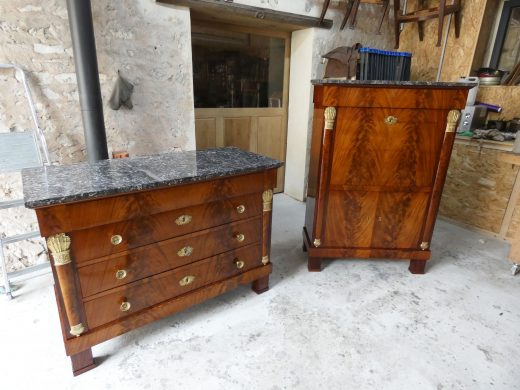
Restoration of an Empire period desk veneered in mahogany burl on an oak frame. The four "chimera thigh" legs are connected by intermediate stretchers and rest on lion's paw feet. The Empire style, which emerged in the early 19th century during the reign of Napoleon I, is an artistic and decorative expression closely linked to the Emperor's desire to create a new, grandiose, and imperial aesthetic, befitting his power. Heir to the Neoclassical movement that began in the 18th century, […]
Louis XVI console table stamped Louis Noël Malle

Ebénisterie Mathieu Vath

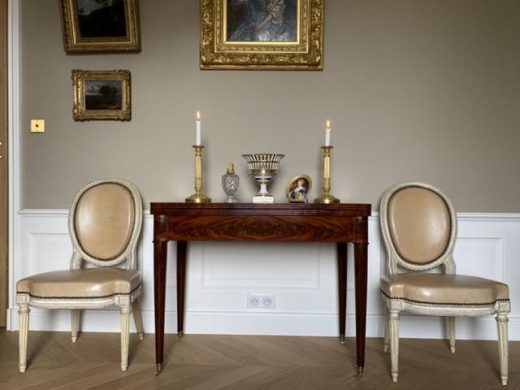
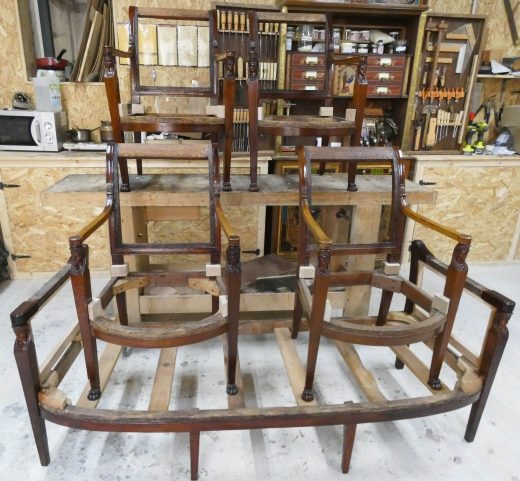
Restoration of a Louis XVI console table stamped by Louis-Noël Malle, with solid mahogany legs and mottled mahogany veneer on oak frames. Louis-Noël Malle, born in 1734, became a master craftsman on November 18, 1765. He established his shop and workshop on Grande-Rue-du-Faubourg-Saint-Antoine, in collaboration with his wife, Marie-France Le Maître. He was recognized as one of the greatest marquetry craftsmen of his time, as we can see in this entry from the General Almanac of Merchants in 1771 and 1772, where his name was misspelled as "Le […]
La Rochelle chest of drawers in "Isles wood"«

Ebénisterie Mathieu Vath

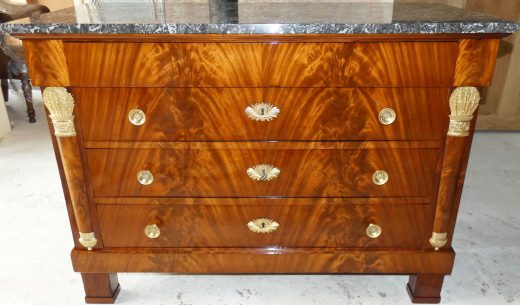
A look back at the restoration of this rare port chest of drawers, crafted from solid woods brought back from both the Orient and the West Indies, combining four precious woods: mahogany, satinwood, Palo Santo, ebony, and, most notably, a fifth wood, Royal ebony. This chest of drawers opens with three wide drawers in three rows of Palo Santo, interspersed with Ceylon ebony crossbars, and is topped with a solid framed top composed of parquet flooring, primarily enlivened by Royal ebony crossbars against a mahogany background (some sections are mottled or […]

VASSOU stamped chest of drawers

Ebénisterie Mathieu Vath

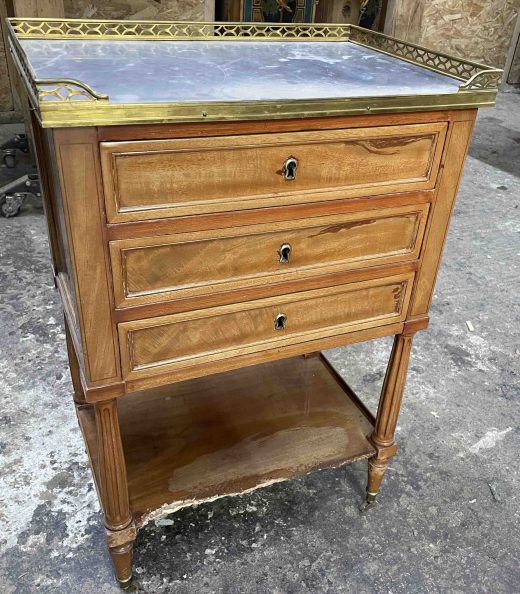
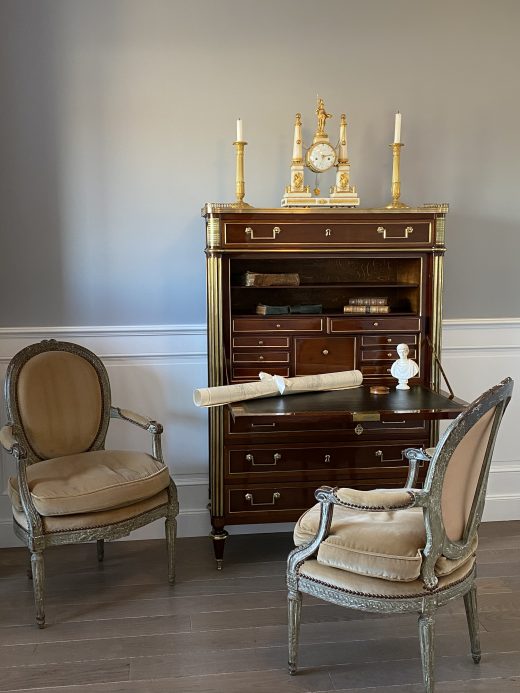
Restoration of a Louis XVI period chiffonier table in mahogany veneer and solid mahogany on oak and softwood frames, stamped by Jean-Baptiste VASSOU (1739-1807). A beautifully crafted piece with fine veneer and a lovely blue Turquin marble top. What exactly is a chiffonier table? The first mention of a "chiffonniere table" appears in 1755 in the journal of the haberdasher Lazare Duvaux (1703-1758). Then, in 1763, in the post-December inventory of Jean-François Oeben, we find mention of a "frame of a […]

Directoire Commode

Ebénisterie Mathieu Vath

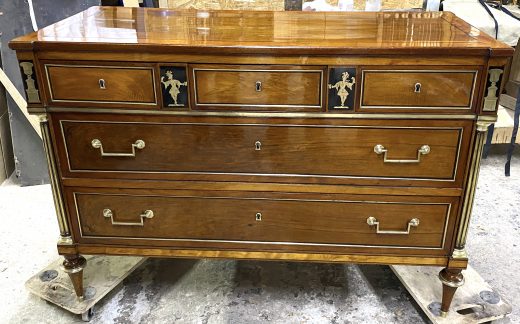
Restoration of a curious Directoire commode in solid walnut and walnut, mahogany, and maple veneer, featuring marquetry of a Medici vase and a Louis XIV-inspired ballet dancer, in brass on an ebony ground. The drawers have walnut bottoms with an ebony stringing surmounted by a quarter-round brass and wood molding, surrounded by a mahogany molding. The uprights are three-quarter-fluted columns terminating in toupie feet. The locks are in the shape of trefoils. A conservation project for this […]

Cartel LXV signed Levêque in Paris

Ebénisterie Mathieu Vath

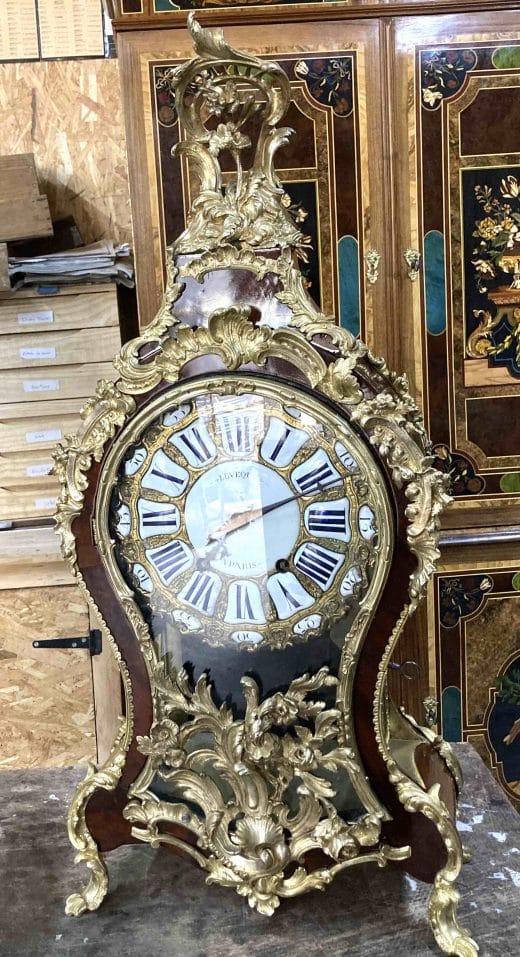
Restoration of a Louis XV period cartel clock signed LEVEQUE A PARIS with its original movement. The surprising thing about this clock is that it is made of mahogany. And as curious as it may seem, despite the tool marks, the quality of the workmanship and the wood appear entirely authentic. With its shape and rocaille bronze mounts typical of the Louis XV style, it could therefore be a clock made from the second half of the 18th century. A precursor, then, to the appearance of mahogany in French furniture. The restoration has […]

Louis XVI writing table

Ebénisterie Mathieu Vath

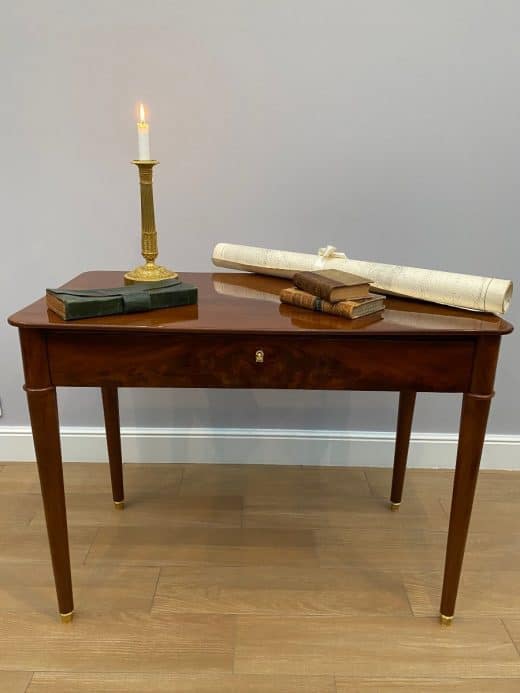
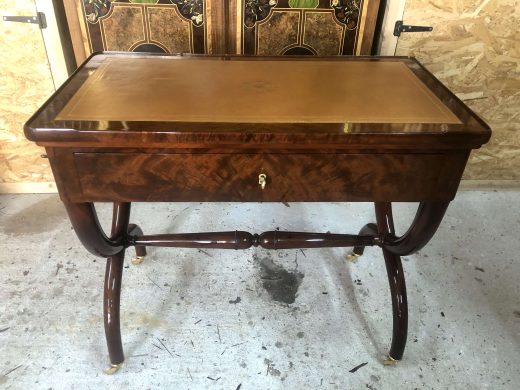
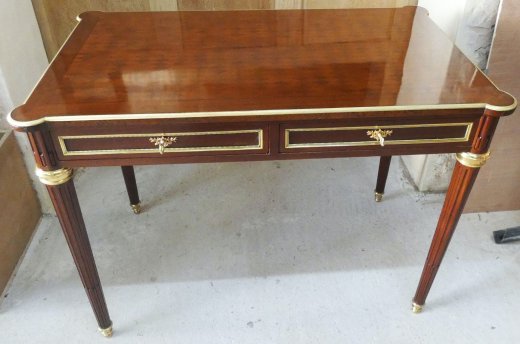
Restoration of a writing table built in oak, with a solid mahogany top and mahogany burl veneer. It features a large drawer in the frieze and rests on four tapered legs ending in gilt bronze sabots. Typical work of the late 18th century. To see previous restorations: https://ebenisterie-mathieuvath.fr/en-ce-moment-a-latelier/ This piece can be found at Antiquités Stéphane Guin.

Somno Empire

Ebénisterie Mathieu Vath

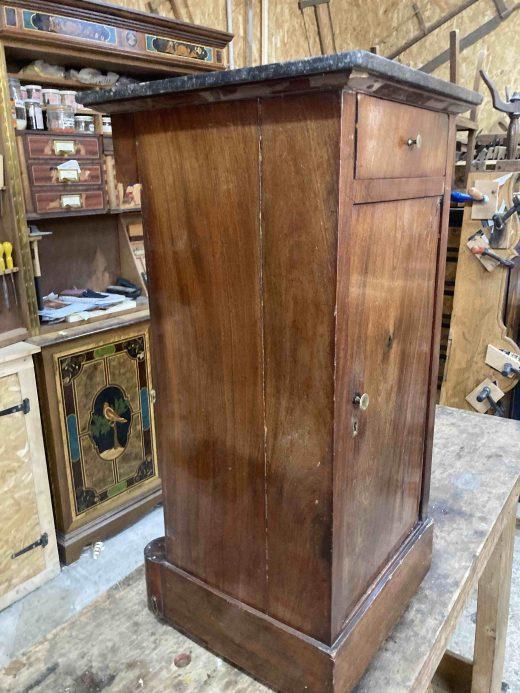
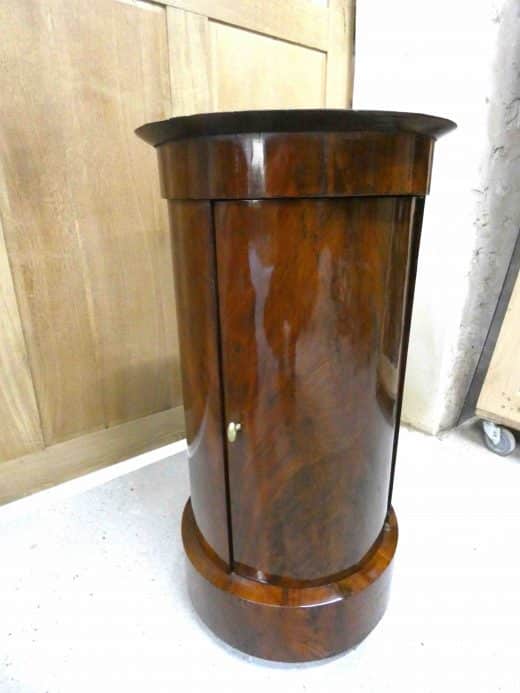
Restoration of an Empire-period somno in mahogany burl veneer. You might be wondering what a somno is? Created during the Consulate, in the early years of Napoleon I's reign, the somno, or somneau, is a small piece of furniture in the shape of a cylindrical or square table, with a closed section providing storage space. It is placed in the bedroom, often next to the bed to serve as a nightstand. It was during the Empire period that this table acquired the name "somno," from the Latin somnus […]

Louis XVI cooler

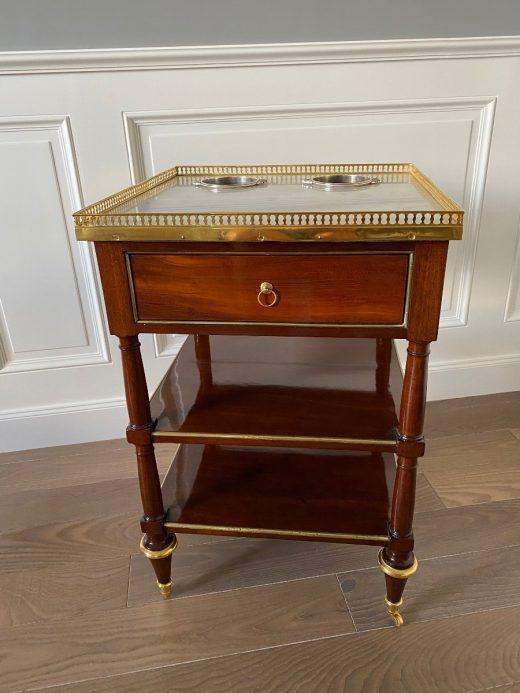
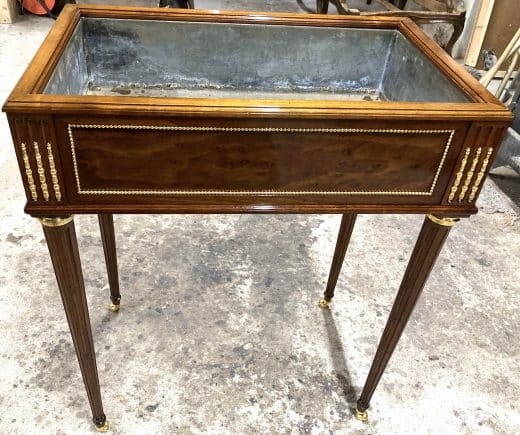
Restoration of a cooling table in solid mahogany for the legs and mahogany burl veneer with brass quarter-round moldings. The cooling table: It was in the 18th century, a century of thought, philosophy, and intimacy, that a fashion emerged among the wealthier classes of society: intimate dinners or suppers, without the intervention of household staff. Whether for romantic trysts or to plan the impending French Revolution, prying ears were not to be allowed. This trend influenced […]

Empire Chest of Drawers

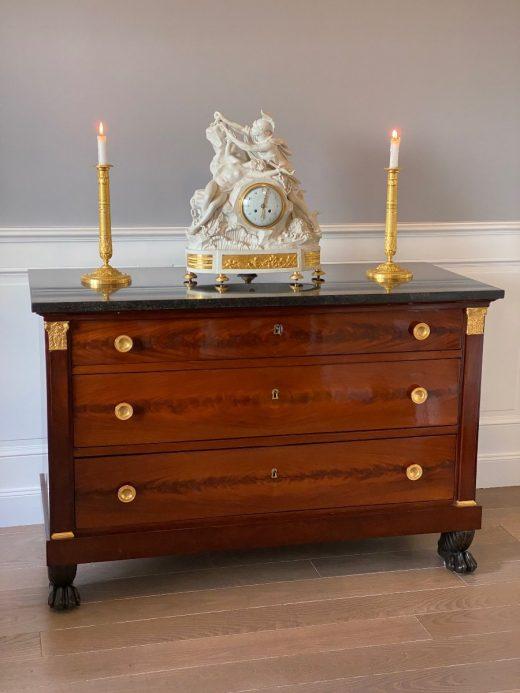
Restoration of a mahogany burl veneer commode with three drawers. The uprights are straight and Corinthian pilasters, the front feet are claw feet, and the rear feet have three decreasing balls, known as a beaded arrangement. It is topped with a Belgian black granite slab and has retained all its original gilt bronze mounts, as well as its trefoil locks and key. Regarding the gilt bronze mounts, the Corinthian capitals are decorated with projecting bird heads, palmettes, acanthus leaves, flowers, and scrolls with a beautiful alternation of […]

Louis XVI gueridon stamped JH RIESENER JME

Ebénisterie Mathieu Vath

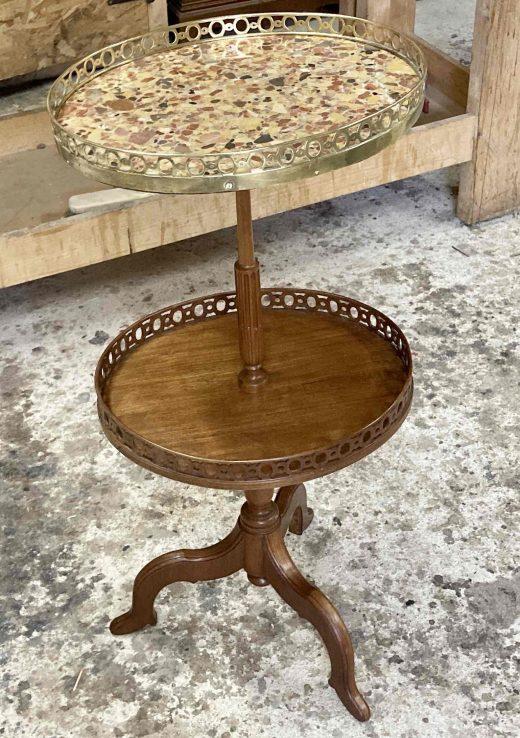
A minor restoration is needed for this "shelf-style" pedestal table, also known as a "dumb servant." It is made of solid mahogany, mahogany veneer, and Aleppo breccia marble. It bears the stamp of the lesser-known cabinetmaker to the Crown Furniture Collection, Jean-Henri Riesener. Does Jean-Henri Riesener (July 4, 1734 – January 6, 1806) really need an introduction? He is the undisputed master of the Louis XVI style, renowned for the breadth and diversity of his work, but above all for the exceptional quality of his furniture and the sumptuousness of the pieces commissioned by the court of […]

Louis XVI games table

Ebénisterie Mathieu Vath

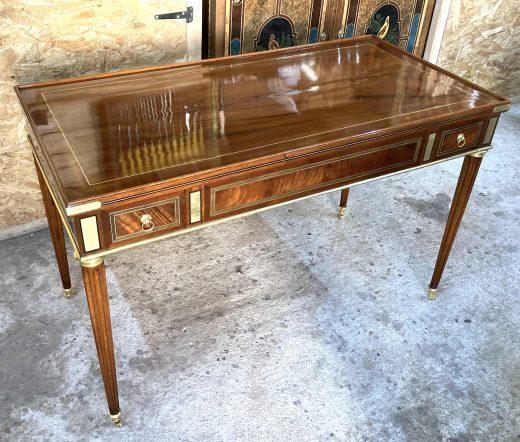
Restoration of a late 18th-century games table (circa 1785) veneered in mahogany burl and inlaid with brass stringing, ebony, and Ferréol (a South American wood named after a 17th-century governor of Guyana). The legs are solid mahogany, and the interior is veneered with ebony and bone dyed green and natural. The tabletop is partially covered in leather and partially veneered in mahogany burl. The interior features two niches, each with a drawer […]

Louis XVI planter

Ebénisterie Mathieu Vath

A little restoration for this Louis XVI jardinière in mottled mahogany veneer and solid mahogany for the feet. Simply regluing the joints, which had become slightly loose, restoring the varnish yellowed with age using a French polish, and re-gilding the bronze mounts were enough to give it a new lease on life. To see previous restorations: https://ebenisterie-mathieuvath.fr/en-ce-moment-a-latelier/

Secretary LXVI stamped Martin Carlin

Ebénisterie Mathieu Vath

Restoration of a Louis XVI period lady's writing desk stamped by Martin Carlin JME. The frame is solid oak, with the fall front and lower door made of softwood. The exterior is entirely veneered with Honduran mahogany, except for the upper edge, which is embellished with a thin strip of amaranth. The interiors are veneered with rosewood, amaranth, and stringing of boxwood and ebony. Of particular interest: the upper interior compartment has never been restored and retains its original finish, a magnificent polish that has preserved the […]

Empire Gueridon

Ebénisterie Mathieu Vath

Restoration of an Empire-style mahogany burl veneer pedestal table. It was in rather poor condition upon arrival at the workshop; the bronze mounts were heavily soiled, there was significant structural delamination, and veneer was missing. The restoration therefore consisted of re-gluing the structural elements and the veneer. This operation was carried out under vacuum with the injection of a penetrating adhesive for the upper apron and the central shaft. The few old grafts, which had been done with the grain running in the wrong direction, were removed and replaced with a matching veneer […]

Directoire cylinder desk

Ebénisterie Mathieu Vath

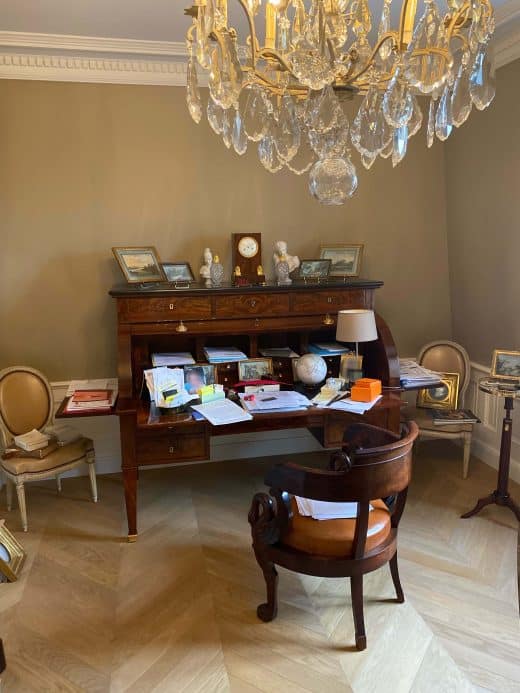
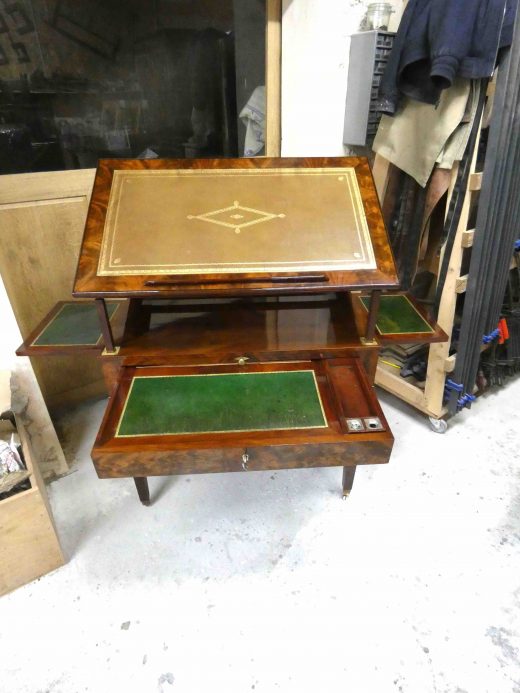
Restoration of a late 18th-century Directoire roll-top desk veneered in mahogany burl on all four sides. It bears the mark CD or GD, a mark unknown to me. Any information regarding it would be greatly appreciated! Constructed entirely of oak (not a single piece of poplar, not even for the drawer pulls or panels), the upper section opens with a cylinder, revealing four small drawers surmounted by a niche, as well as a sliding writing surface covered in gilt tooling and two side pull-outs also covered in gilt tooling […]

L Cueunieres Writing Desk

Ebénisterie Mathieu Vath

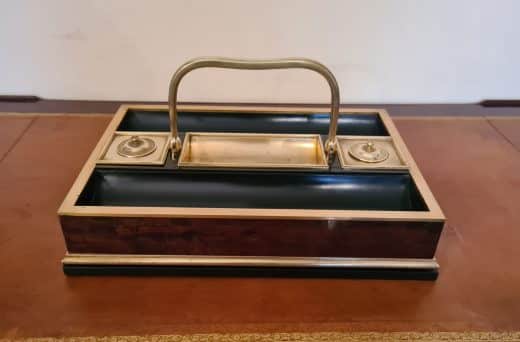
A small restoration for this very pretty Louis XVI style inkwell, stamped L.CUENIERES jne. Louis Cueunières jeune, established at 10 rue Villehardouin in Paris in 1870, specialized in the restoration of antique furniture and the reproduction of period pieces. This inkwell was in fairly good condition. Apart from a few small pieces of missing ebony, it was simply dirty. A few ebony grafts, a good cleaning, and a touch-up of the varnish with a French polish were enough to restore its former luster. To see previous restorations: https://ebenisterie-mathieuvath.fr/en-ce-moment-a-latelier/ You can find this piece at […]

Louis XV style flat desk

Ebénisterie Mathieu Vath

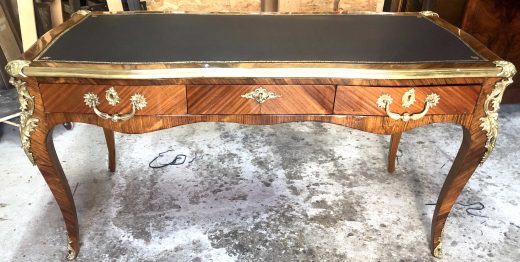
A second life for this Louis XV style desk veneered in Rio rosewood (Dabergia niera) and African mahogany (khaya). Besides the construction and visible tool marks, dating this desk is greatly facilitated by the presence of this African mahogany. Indeed, it was from the late 19th century that this type of mahogany began to arrive from the west coast of Africa and became prevalent in all furniture production at the beginning of the 20th century. The restoration consisted of re-gluing the structure […]

Louis XVI Powder Box/Writing Table

Ebénisterie Mathieu Vath

The dressing table, sometimes called a powder table, can be defined as a vanity unit in the form of a table or a small writing desk with drawers. Around 1730, shortly after the commode, this new type of furniture, often richly inlaid or veneered with precious woods, appeared in French furniture. This rather atypical powder table has the unique feature of also serving as a writing desk, or at least a desk for writing. Its four legs are made of solid mahogany, and the stretchers are also veneered in mahogany. The four surfaces are […]

Louis XVI commode stamped JA LECLERE

Ebénisterie Mathieu Vath

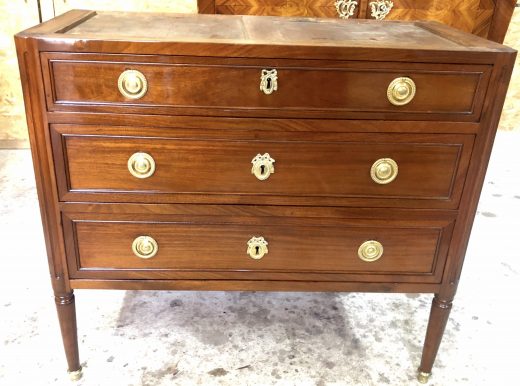
Jacques-Antoine Leclere (1744 – January 30, 1792) obtained his master craftsman's certificate in Paris on September 29, 1779. He worked on the rue du Faubourg-Saint-Antoine, then on the rue des Barres, and finally in the courtyard of the Jewish Quarter, a stone's throw from the Bastille. This cabinetmaker produced well-made Louis XV and Louis XVI pieces. He used rosewood, satinwood, mahogany, and also lacquer panels. His stamp can be found on secretaries, chests of drawers, and various small pieces of furniture. For example, a pair of Louis XVI half-moon commodes veneered […]

"Cabaret" pedestal table«

Ebénisterie Mathieu Vath

Very fashionable at the end of the 18th century, the cabaret table, or cabaret table, is characterized by a raised, basin-shaped top. Its slightly concave shape with a raised rim all around allows for the safe serving of various beverages such as teas, hot chocolates, and other drinks. This model, similar to those made by the cabinetmaker Canabas, is made of solid mahogany from Saint-Domingue with metal reinforcement under the legs. The biggest problem, in fact, was with the legs; they wobbled in all directions. The […]

Empire X-Leg Desk

Ebénisterie Mathieu Vath

Here are some images of the restoration of this desk, with a solid mahogany base and mahogany burl veneer for the rest. Note that the recessed top is made from a single 12mm thick plank of solid mahogany burl. Here is the desk before restoration. The bulk of the work is on the legs. They are broken at the middle joint. They have already been repaired and are held together only by additional screws. Two cracks can be seen at the […]

Louis XVI Molitor Console

Ebénisterie Mathieu Vath

Restoration of a Louis XVI console table (1790-1795) stamped by Bernard Molitor. The structure is made of oak and solid mahogany for the legs. The panels of the lower shelf are beech. It is veneered with mahogany burl and ebony and brass stringing. Originally from Luxembourg, Bernard Molitor (1755 – November 17, 1833) obtained his master craftsman's certificate in Paris on October 26, 1787. He arrived in Paris in 1776 and worked in a small workshop located in the Arsenal district. It was after obtaining his master's certificate that he established himself on the rue de Bourbon-Saint-Germain. The austerity […]

Restaurant Secretary

Ebénisterie Mathieu Vath

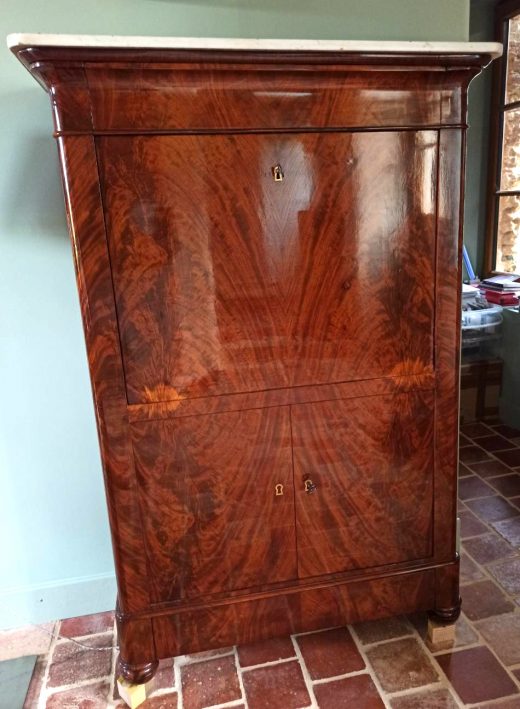
Restoration of a Restoration period (1815–1830) drop-front secretary veneered in burr mahogany and topped with Carrara white marble. The front legs are rounded and the rear legs are square. The frame is made of oak and softwood. An inventory mark (I91) is found inside the lower drawer on the right side. The Restoration style? After Napoleon's defeat at Waterloo on June 18, 1815, power in France was taken over by the two brothers of Louis XVI: the Count of Provence, who would reign under the […]

Empire Dressing Table

Ebénisterie Mathieu Vath

A beautiful restoration and, above all, conservation effort has been undertaken on this lovely Empire-period dressing table. Its frame is made of oak and poplar, veneered with mahogany burl. The drawer sides and bottoms are solid mahogany. It rests on four column legs ending in casters and joined by an H-shaped stretcher. The frieze opens with a drawer revealing a writing surface lined with blue morocco leather, a pen case, and two compartments for inkwells, as well as two large drawers on either side for essentials […]

Barber shop Louis XVI/Directory

Ebénisterie Mathieu Vath

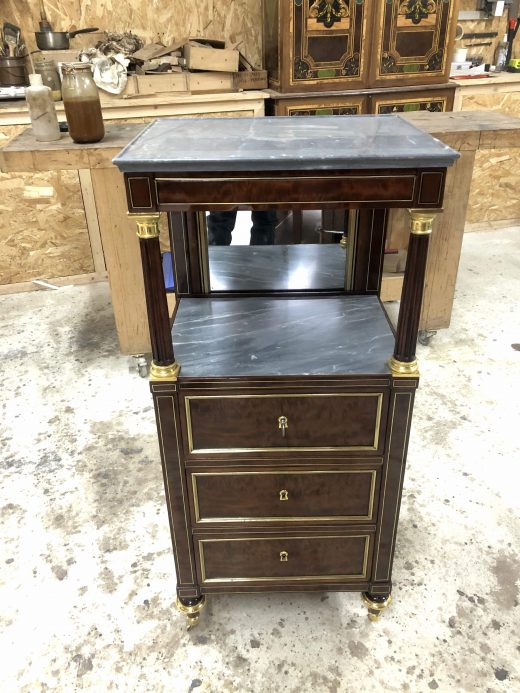
This elegant mahogany-veneered shaving cabinet from the late 18th century rests on four tapered legs with casters and opens with three drawers in the front. The niche, with its blue Turquin marble top framed by fluted columns, is surmounted by two side drawers and a sliding marble shelf with a recessed panel that reveals a sliding mirror on a rack and pinion mechanism, pivoting and framed with ebony and brass stringing. Appearing during the reign of Louis XVI, this style of shaving cabinet is a toilet unit designed to hold a porcelain pitcher and basin […]

Empire Console

Ebénisterie Mathieu Vath

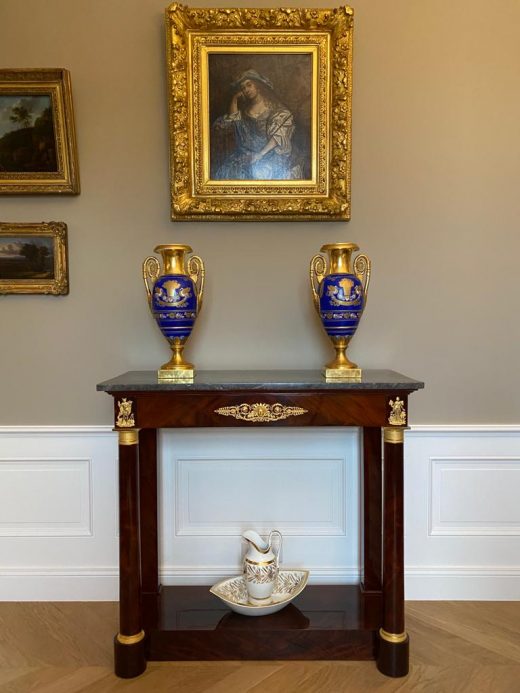
Here are some images of the restoration of this Empire-era console table. But first, a little history: do you know what a console table is and what its use was? Primarily a decorative piece of furniture placed in the entrance hall of apartments or between two windows, the "console table"—as it was called during the reign of Louis XV—consists of a marble top supported by two scrolled legs and placed against the wall. During the reign of Louis XV, console tables were often elaborately crafted and adorned with highly detailed motifs. Sculptures and reliefs, arched legs […]

Sleep

Ebénisterie Mathieu Vath

Restoration of an early 19th-century somno veneered in Cuban mahogany burl. It's fair to say it has already suffered considerably from previous restorations. The missing veneer and the dimensional shrinkage of the wood have been filled with wood filler and then disguised. The problem is, that's all you can see! You might be wondering what a somno is? Created during the Consulate, in the early years of Napoleon I's reign, the somno, or somneau, is a small piece of furniture made of […]

Table à la Tronchin

Ebénisterie Mathieu Vath

A little refresh for this lovely Tronchin-style table. Apart from a missing molding and a few small veneer chips on the legs, nothing too serious. A touch-up of the varnish was enough to give it a new lease on life. But do you know where this type of table comes from, and what it was used for? Although today attributed to Théodore Tronchin, a Genevan physician (1709-1781), who at the time published works on bone diseases linked to poor posture at one's desk, he cites the advantages that […]

Mahogany games table, late 18th - early 19th century

Ebénisterie Mathieu Vath

96 x W 47.5 x H 74 cm. Open: 96 x 95.5 cm. Restoration of a games table with a folding top veneered in burr mahogany, commonly known as Cuban mahogany. In fact, according to the recent book "L'essence du bois" (The Essence of Wood) by Patrick George, Emmanuel Maurin, and Marie-Christine Troujy-Jaquemet, it seems more accurate to call this type of mahogany Saint-Domingue mahogany. The base is veneered in solid oak, and the top in poplar. The moldings are solid mahogany. The table rests on legs […]

Secretary of the Board of Directors

Ebénisterie Mathieu VATH

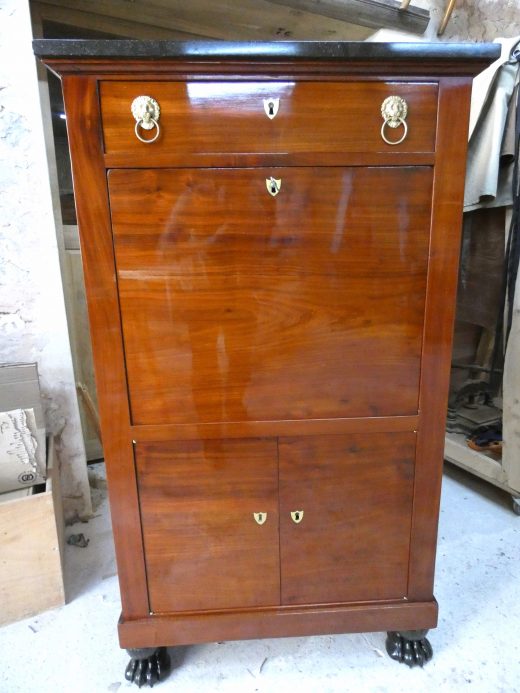
Here is a secretary desk in the most understated style of the Directoire period. Its frame is made of solid beech and conifer, and it is veneered with mahogany and mottled mahogany. It is very simply adorned with bronze handles in the form of a lion's head holding a ring in its mouth. The keyhole escutcheons are in the shape of a shield. The interior comprises seven drawers, the middle one of which opens with a key. The drop-front opens with a period three-point lock. The lower section consists of three drawers, or has been transferred […]

Empire Pedestal

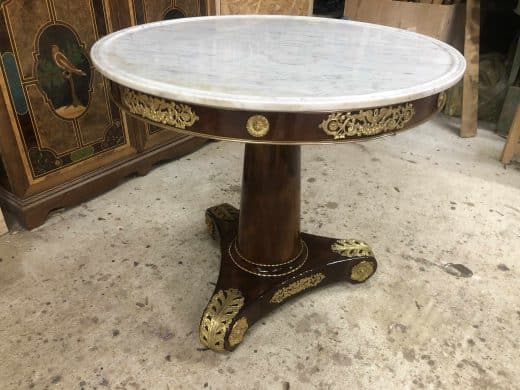
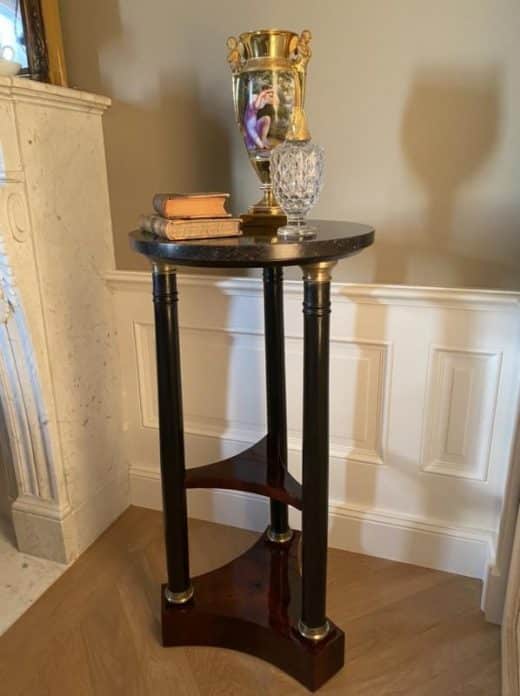
Restoration of a walnut (for the legs and frame) and flame mahogany veneer pedestal table. It rests on three column-shaped uprights, surmounted by a circular black veined marble top adorned with bronze rings. The restoration involved tightening the cracked base, re-gluing the edge veneers, and adding some veneer grafts. The columns, which were heavily infested with wood-boring insects, were stripped and then treated with static anoxia. Static anoxia is an insecticidal treatment that works by depriving the body of oxygen, having […]

Louis XVI/Directory Secretary

Antiquités Guin

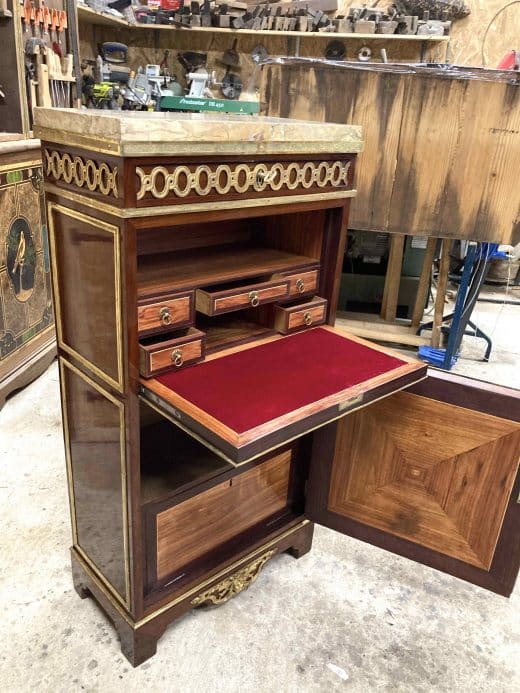
Restoration of a drop-front secretary desk built in oak and veneered with mottled mahogany and mahogany from Saint-Domingue. Its design dates from the late 18th century. Its white Carrara marble top is surrounded by a partially openwork brass gallery. It opens with a drawer at the top, a drop-front in the middle, and three drawers at the bottom; all the original locks are secured with a clover-shaped key. All the panels on the front and sides are framed with brass quarter-round moldings. The drop-front is veneered in mahogany […]

Empire secretary with quiver

Ebénisterie Mathieu VATH

You remember the Empire chest of drawers with the quivers. Well, here is the secretary desk with the quivers. It is built in exactly the same way as the chest: same construction, same solid woods used, and same mahogany veneers. As for the restoration, it is identical to that of the chest of drawers. The aim is to preserve as much as possible and restore the piece of furniture to its original function without altering its history. The work therefore consisted of reattaching the structure and the few detached veneer elements. And to […]

Jacob Frères bench and armchairs on rue Meslée

Ebénisterie Mathieu VATH

Extensive restoration and conservation work has been undertaken on this bench and its four armchairs from the Consulate period, stamped Jacob Frères, rue Meslée. The front and back legs are made of solid Cuban mahogany, while the crossbars are veneered. The armrests, supported by Egyptian heads, are made of light Saint-Domingue mahogany to create a contrast with the uprights. They are adorned with carved palmettes and rosettes in Cuban mahogany. They rest on tapered front legs ending in claw feet, and the rear legs are arched. […]

Empire Chest of Drawers with Quivers

Ebénisterie Mathieu VATH

This week, here are some photos of the restoration of this Empire-style chest of drawers veneered in mahogany burl. This chest is truly unique due to the quality and originality of its bronze mounts. Indeed, they form quivers along with the side columns. The keyhole escutcheons are composed of two crossed laurel branches held together by a ribbon. Originally, they were mercury-gilded, as can be seen from the gilding stains on the back. Unfortunately, only a few partial traces remain on the front […]

Louis XVI half-moon table

Ebénisterie Mathieu VATH

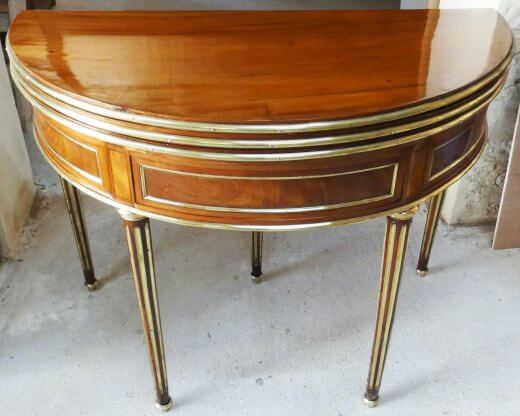
Here is a three-tiered half-moon table. This style of table, originating in England, is a classic of the Louis XVI style. It opens to reveal two circular tiers, one lined with felt, the other veneered in mahogany. The mahogany burl veneer apron is adorned with a brass frame. It rests on five tapered legs with brass-filled fluting and ending in sabots. The fifth leg is attached to a drawer that opens to serve as a support once the flap is unfolded. A very attractive piece, probably dating from the end of the […]

Louis XVI style desk stamped KRIEGER

Ebénisterie Mathieu VATH

Exquisitely crafted with its mahogany-veneered oak frame and solid mahogany legs, this desk is a perfect example of high-quality 19th-century furniture. The cabinetmaking is flawlessly executed, and the bronze mounts are in pristine condition. Everything is there; nothing is missing. The Krieger firm began its cabinetmaking business in the mid-19th century with Antoine Krieger (1804-1869) before adding a significant decorative department, which ensured the prestige of its business until around 1945. The Krieger firm produced all the […]

N. PETIT Roll-Top Desk

Ebénisterie Mathieu VATH

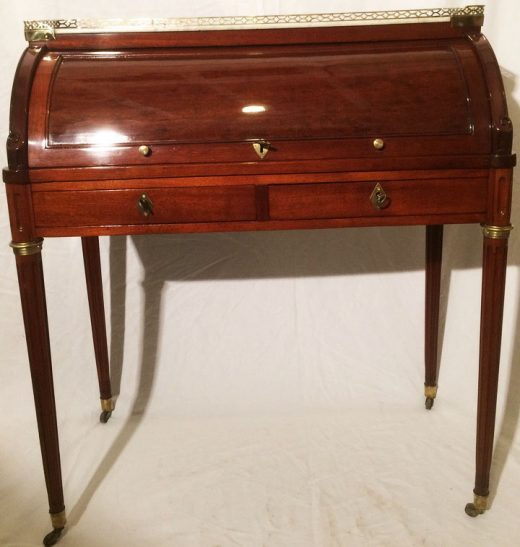
DIMENSIONS: H.71 W.104 D.52 This roll-top desk perfectly matches those made by Nicolas Petit's workshop between 1770 and 1791, the year of his death. Indeed, with a few exceptions, Nicolas Petit primarily produced this type of secretary in molded mahogany, resting on fluted legs and topped with white marble. Simple in style, they reflected the taste of the period. It comprises two drawers in the frieze, two side pull-out shelves, and a central pull-out shelf that locks when the drop-front is closed. The interior consists of […]

Napoleon III style Louis XVI work table

Ebénisterie Mathieu VATH

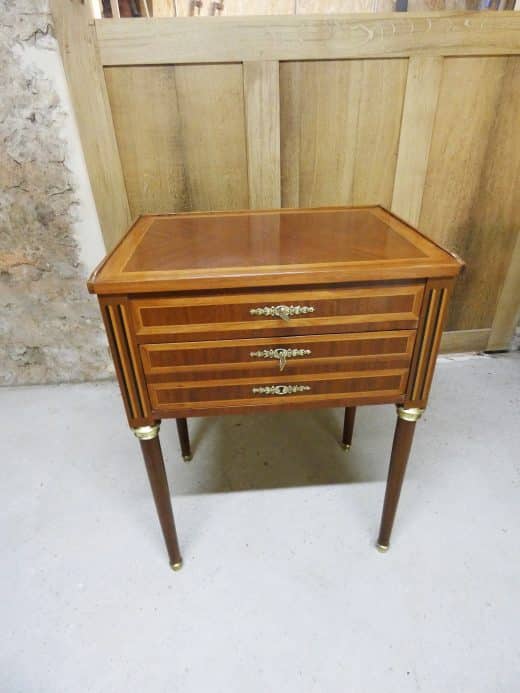
A few photos of the restoration of a small Louis XVI style work table from the late 19th century. The legs are solid mahogany, and it is veneered with rosewood, sapele, blackened pearwood, and boxwood for the fluting and stringing. Nothing too serious for this pretty little piece of furniture, which only had a few missing veneers and a small chip on the side of the oak drawer. A simple restoration: a few veneer grafts glued with hot glue, a light cleaning of […]

Louis XVI style sewing box

Ebénisterie Mathieu VATH

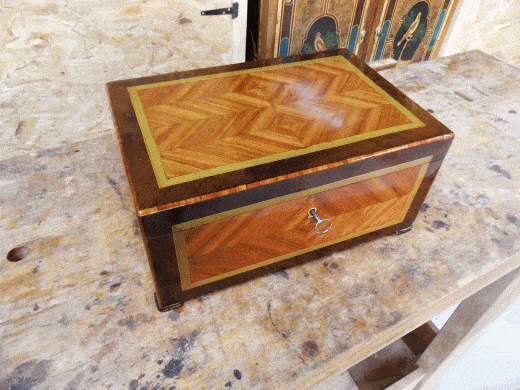
This sewing box dates from the Napoleon III period. The frame is made of softwood. The veneer is composed of Rio rosewood, mahogany for the interior, and a green-stained boxwood and maple inlay. The great quality of this box is that the lid hasn't warped. This is often the major problem with this type of furniture, as people forget to lock them, causing the wood to warp. It then becomes very difficult to find the "trick" to ensure the box stays closed.

Louis XVI style table

Ebénisterie Mathieu VATH

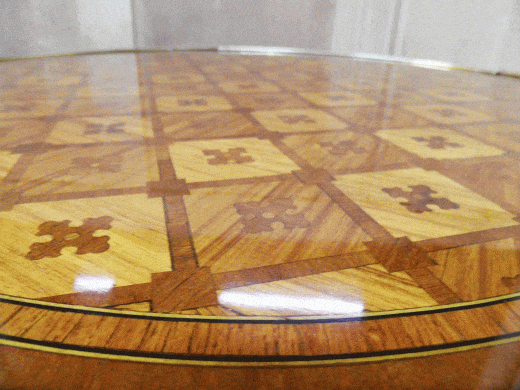
Here is a Louis XVI style table, which is probably an early 20th-century piece. It was likely made in the Faubourg Saint-Antoine, or perhaps at the École Boulle. I have seen apprentice furniture of this quality made by students during their training. Its frame is oak, while the veneer is rosewood and mahogany with a black inlay. The restoration was straightforward, apart from a lack of rosewood in the marquetry […]

Empire bed

Ebénisterie Mathieu VATH

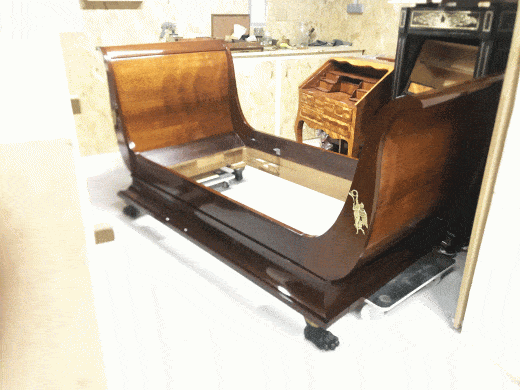
The "boat" bed, with its characteristic curve, is a French invention that appeared during the Directory and was very fashionable during the Empire and the Restoration. It is easily recognizable here by its lion's paw feet. The varnish on this bed had worn away, making it impossible to distinguish between the two mahogany pieces. The mahogany is known as Cuban mahogany (Swietenia mahogani), from Cuba, a Spanish colony. Evidence of its importation into Spain, specifically Seville, dates back to 1519-1520. It was used by Philip II between 1563 and 1584 during the construction of the Palace […]

Commode returning from Egypt

Ebénisterie Mathieu VATH

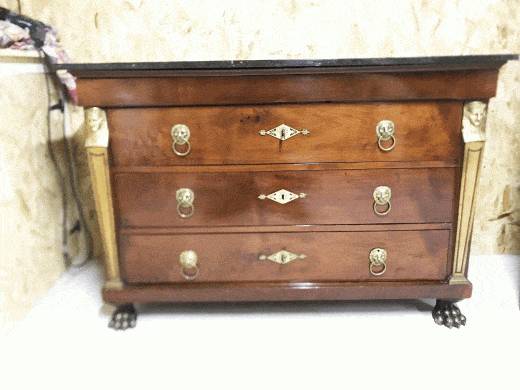
During the turbulent period of the French Revolution, furniture production was considerably diminished, and most artisans experienced very difficult times. Overall, from the Consulate to the Directory, furniture and seating had little time to evolve. However, even though some decorative motifs inspired by Egypt had already appeared, it was after the Egyptian expedition (1798-1801) that they evolved into a unique style. The so-called "Return from Egypt" style, however, lasted only a short time: a decade at most, as it would […]