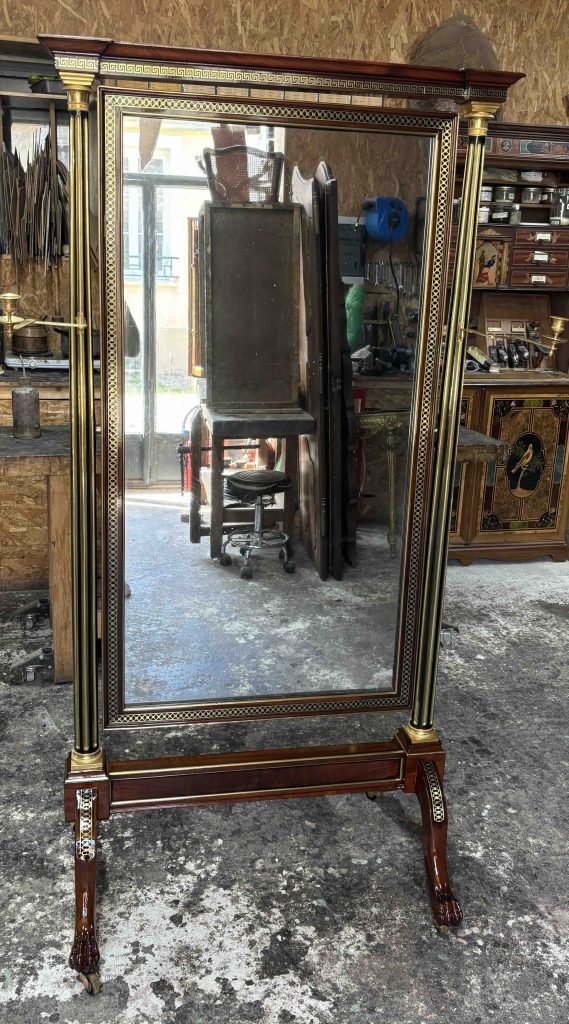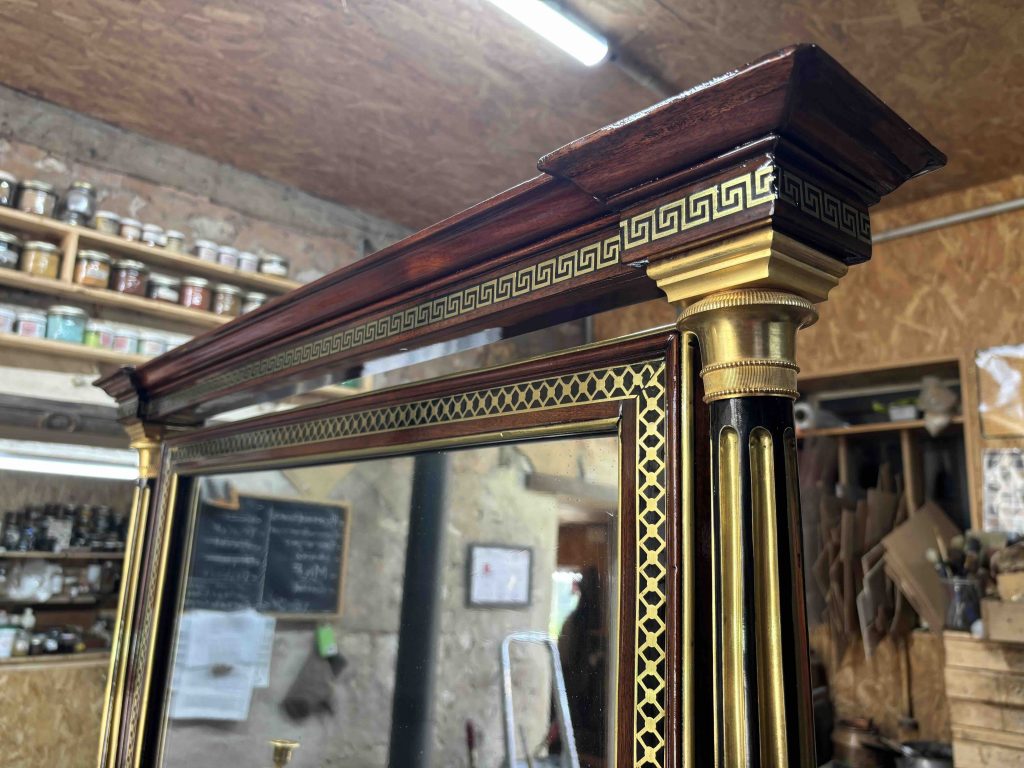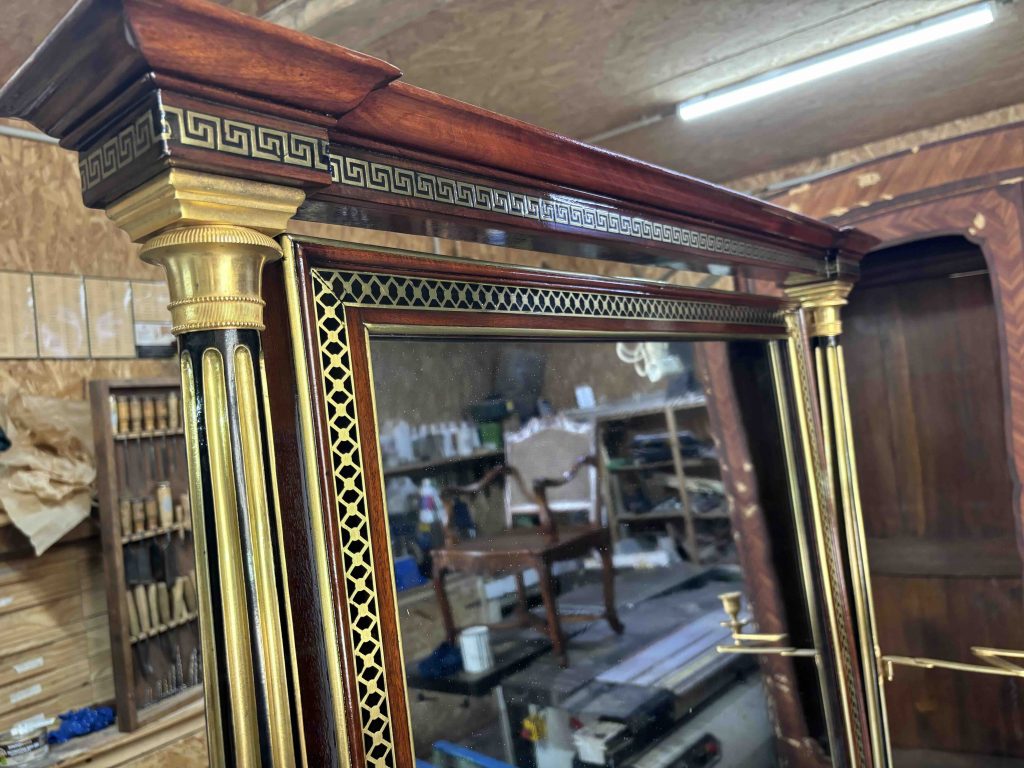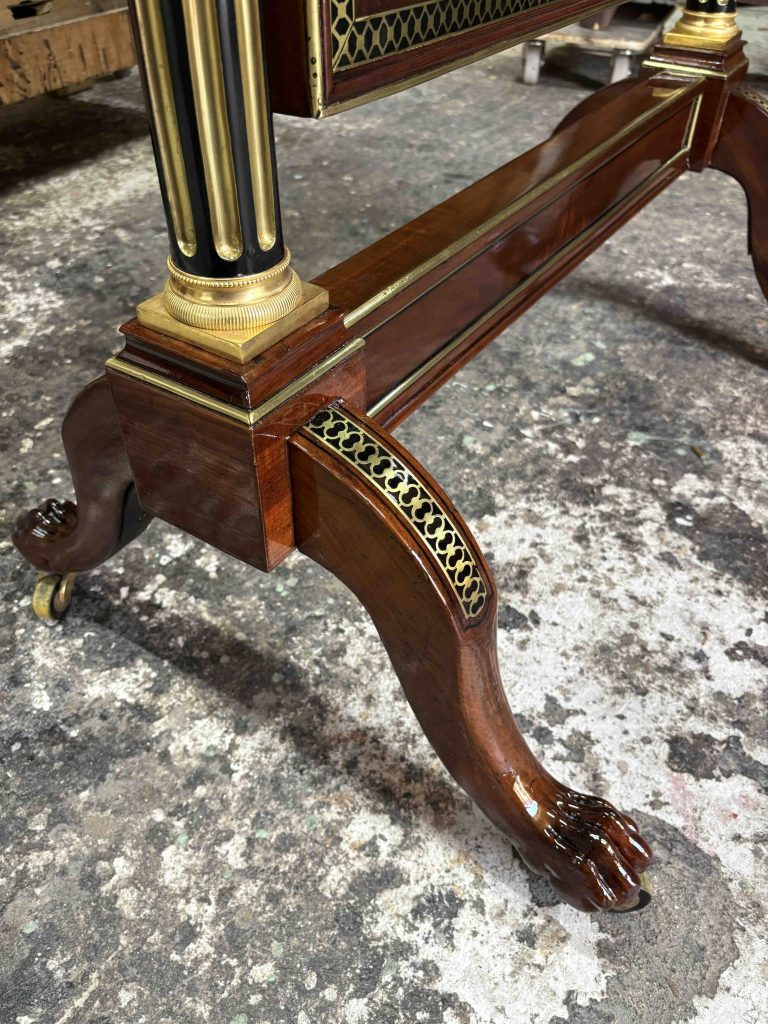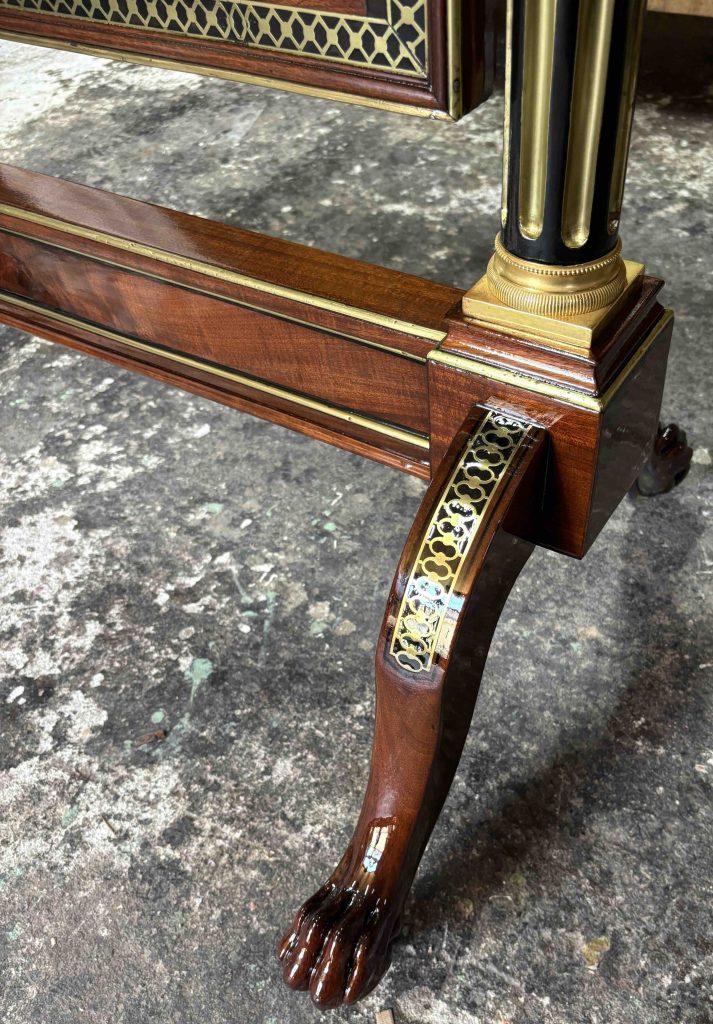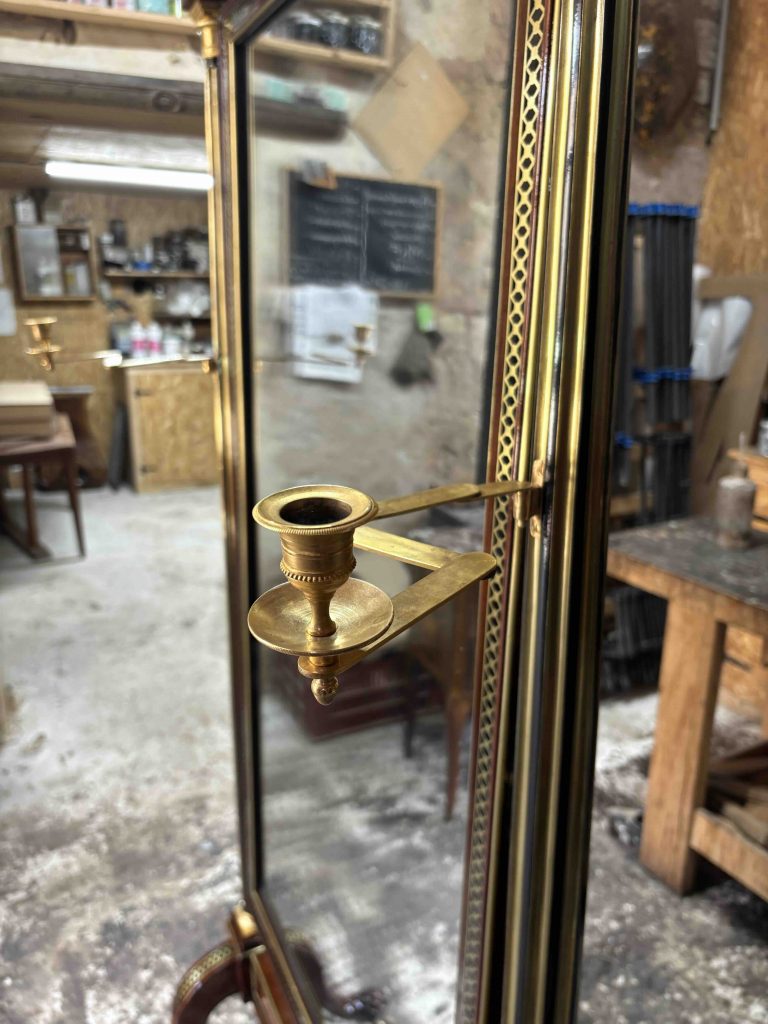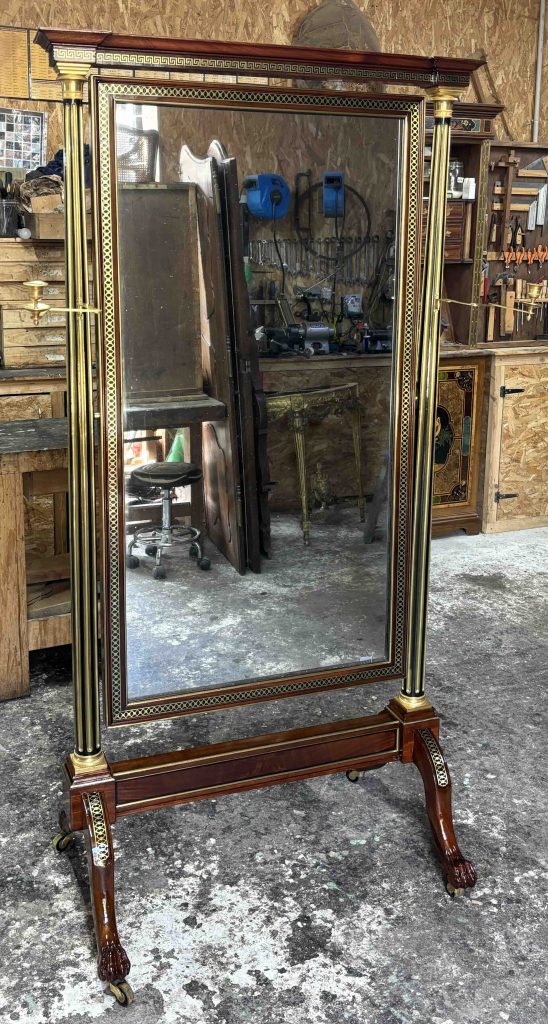
Restoration of a Louis XVI/Directoire period Psyche stamped by Adam Weisweiler.
This piece of furniture represents one of the innovations in late 18th-century furniture design. Far more than a simple dressing table accessory, it signifies a significant evolution in the design of furniture intended for private use. Its appearance coincided with changing lifestyles, the development of new domestic spaces, and evolving practices related to self-presentation. For both furniture historians and restorers, the mirrored cabinet is a particularly interesting object. It bears witness to the technical advancements in mirror making, the transformations in taste between the Louis XVI, Directory, and Empire periods, as well as the emergence of a new typology of independent furniture.
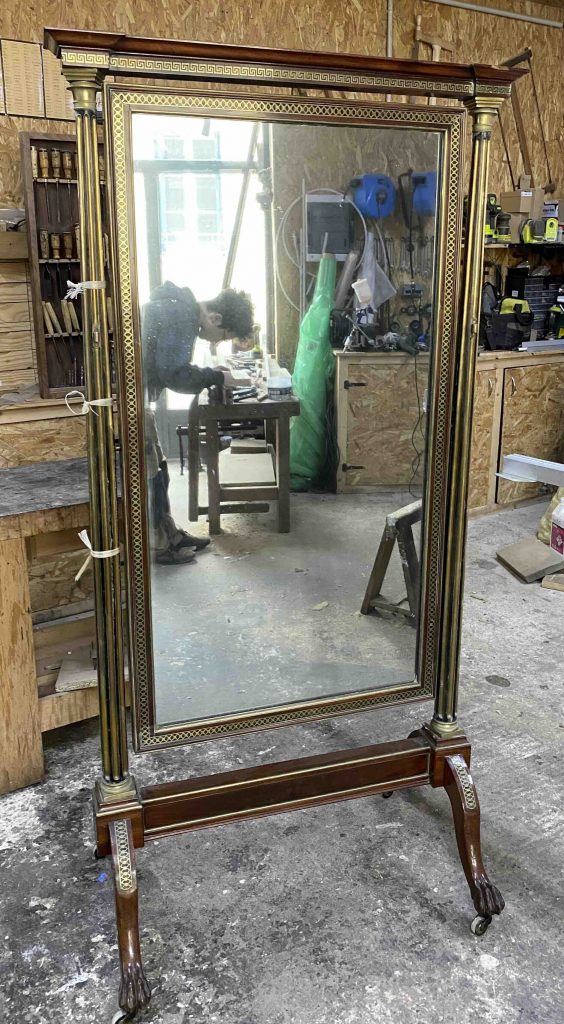
The first identified mirrors appeared in the last decades of the 18th century. Their development took place within a context of renewal in the forms of domestic furniture, marked by an increased search for functionality and adaptation to daily uses.
Unlike mirrors fixed to walls or integrated into woodwork, the cheval mirror stands as a freestanding piece of furniture. Its innovation lies in the mounting of the glass on a system of lateral pivots, allowing the mirror to be tilted. This technical feature offers the user the possibility of observing their entire silhouette, thus responding to the evolution of clothing practices and the growing importance placed on appearance in aristocratic and bourgeois circles.
Archival sources from the late 18th century still use various names such as "glass screen", "dressing mirror" or "mobile cheval glass", testifying to a period of typological transition during which the form was not yet fully codified.
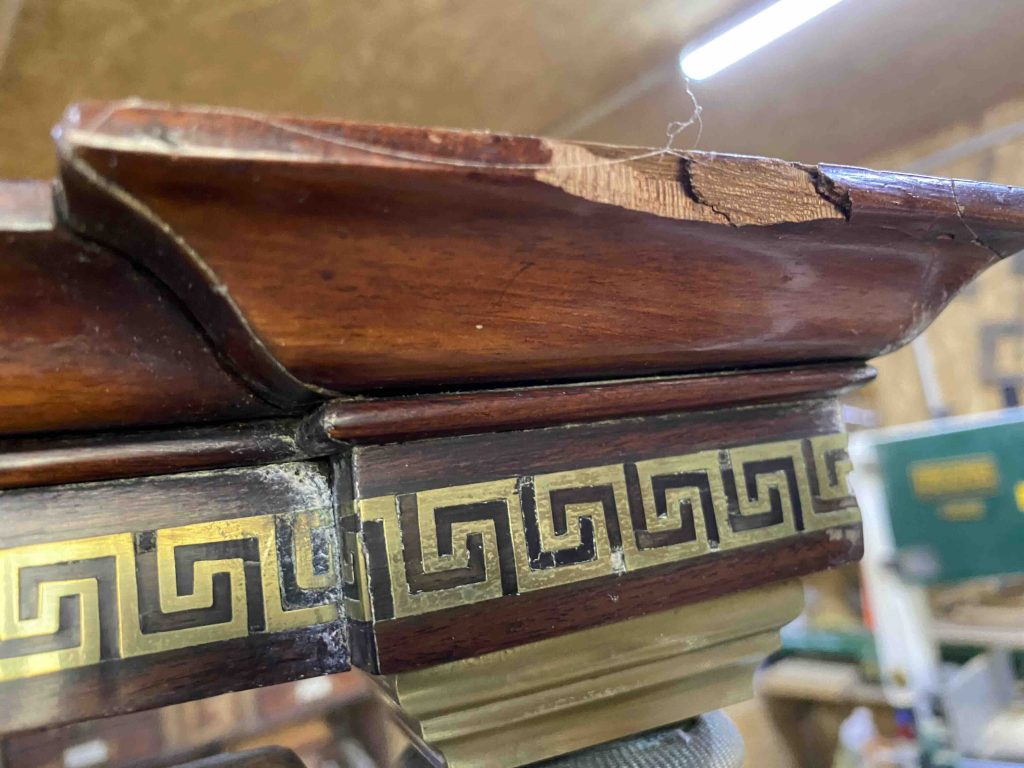
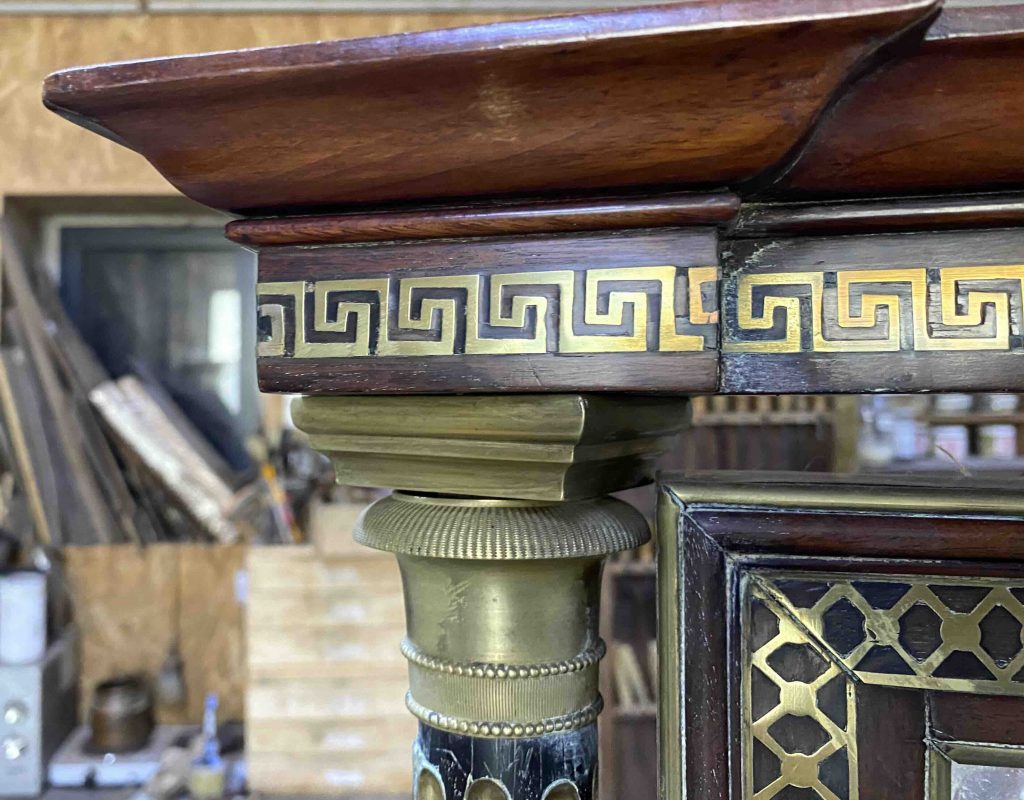
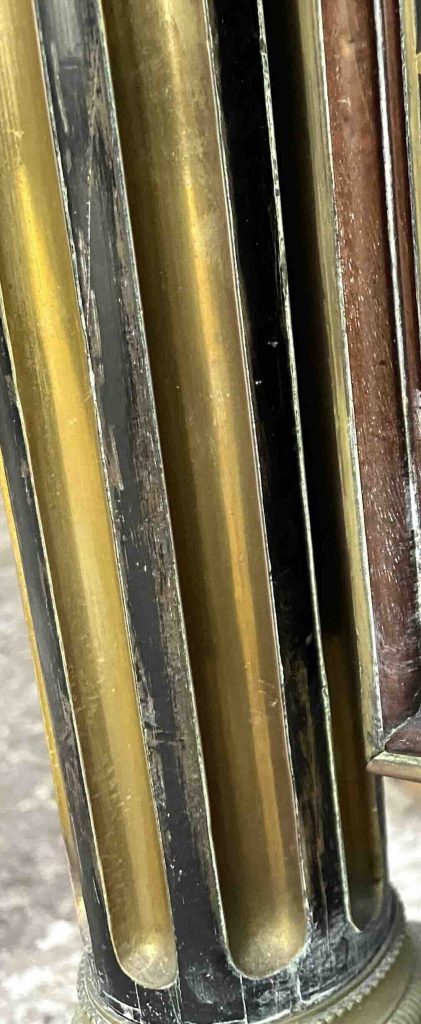
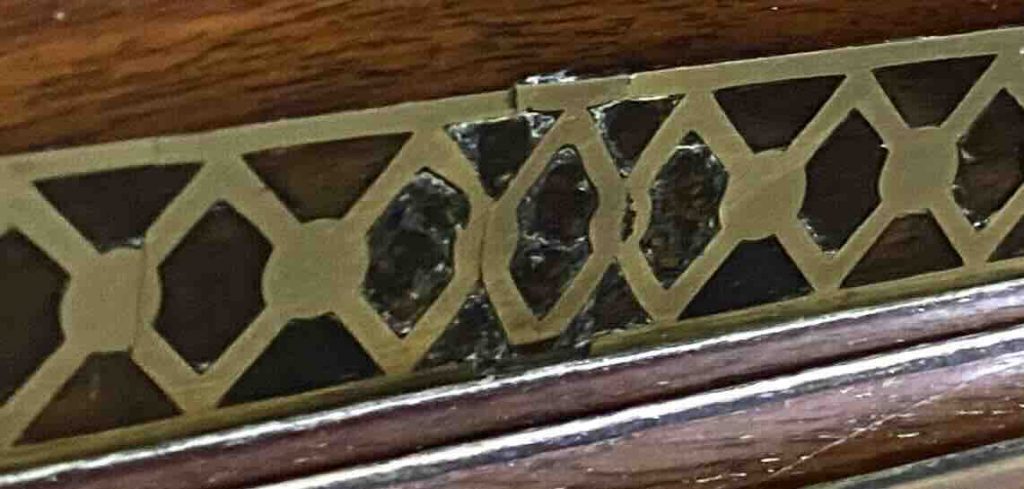
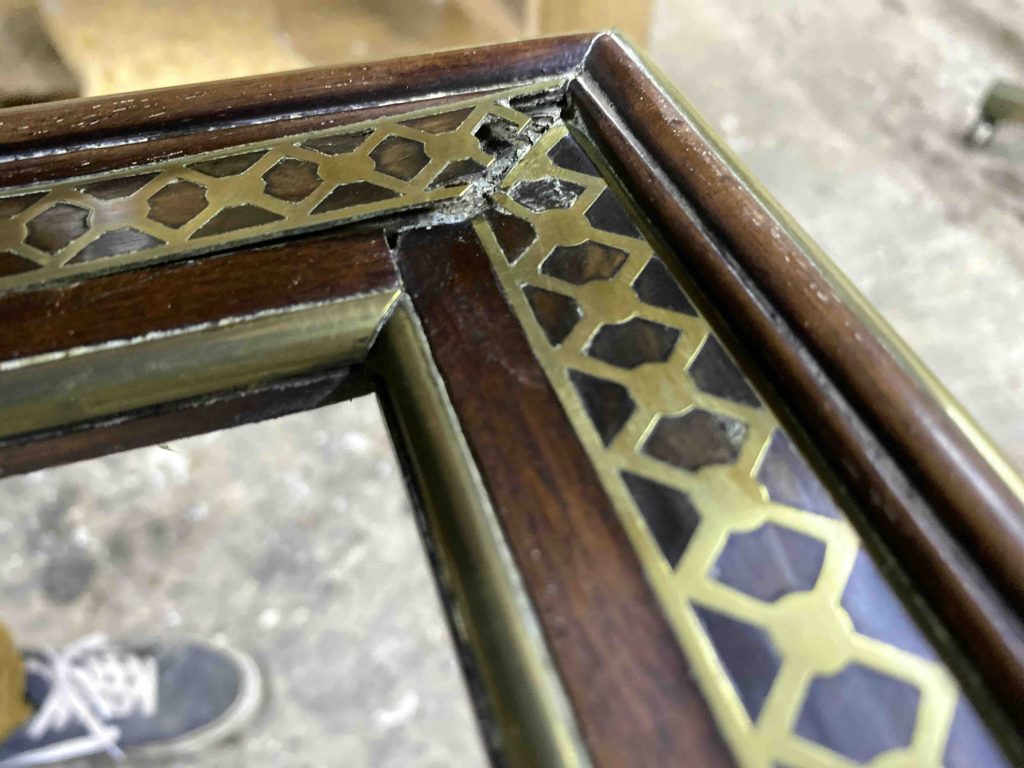
Psyche Before Restoration
Origins linked to fireplace screens
Morphological analysis of the earliest examples establishes a direct link with 18th-century fireplace screens. These screens consisted of a panel mounted on a movable support designed to protect occupants from the radiant heat of the hearth.
The gradual adaptation of this structure to accommodate a mirror appears as a logical evolution. The construction principle remains similar: two vertical uprights connected by a crossbar support a central, movable element. This similarity explains the relative simplicity of the first mirrors, whose design relies more on functional adaptation than on creation from scratch.
This typological continuity is a characteristic example of the evolution of furniture forms, where innovation often results from the progressive transformation of pre-existing objects.
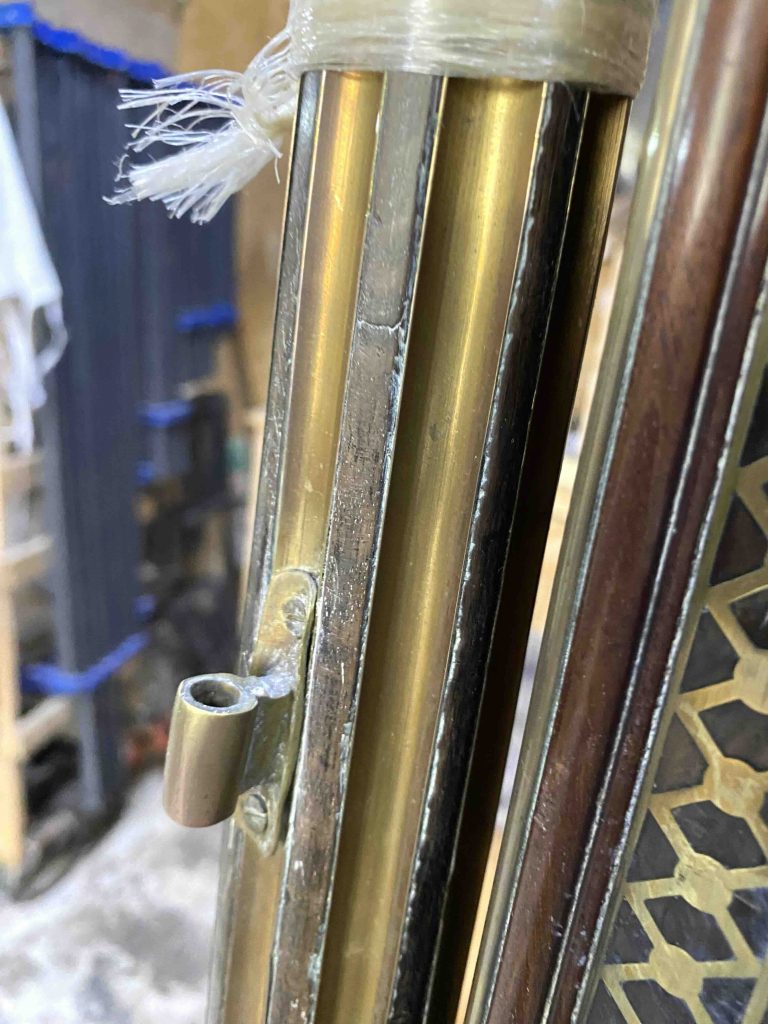
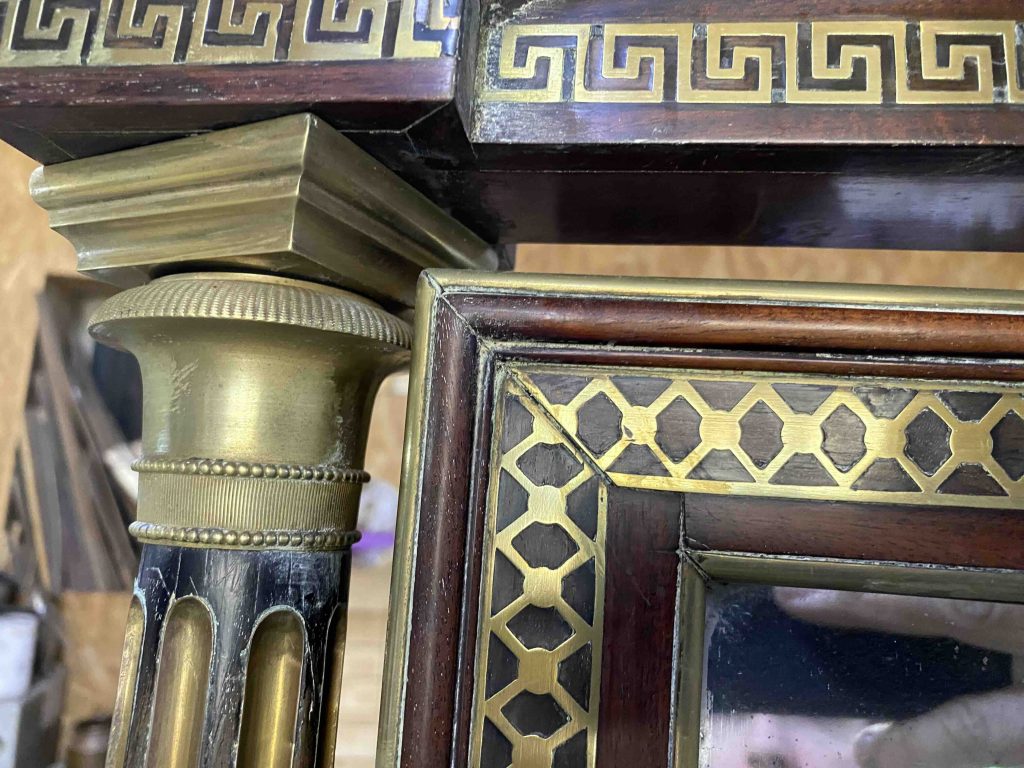
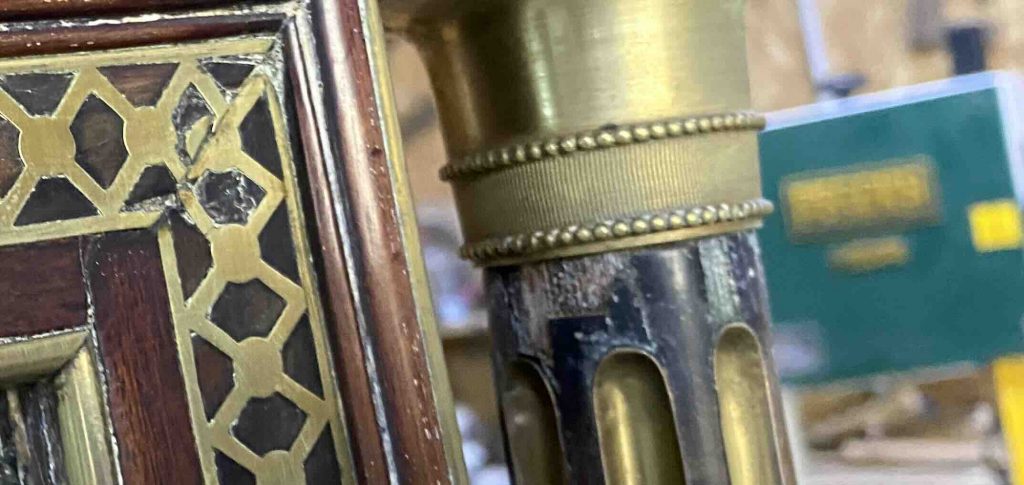
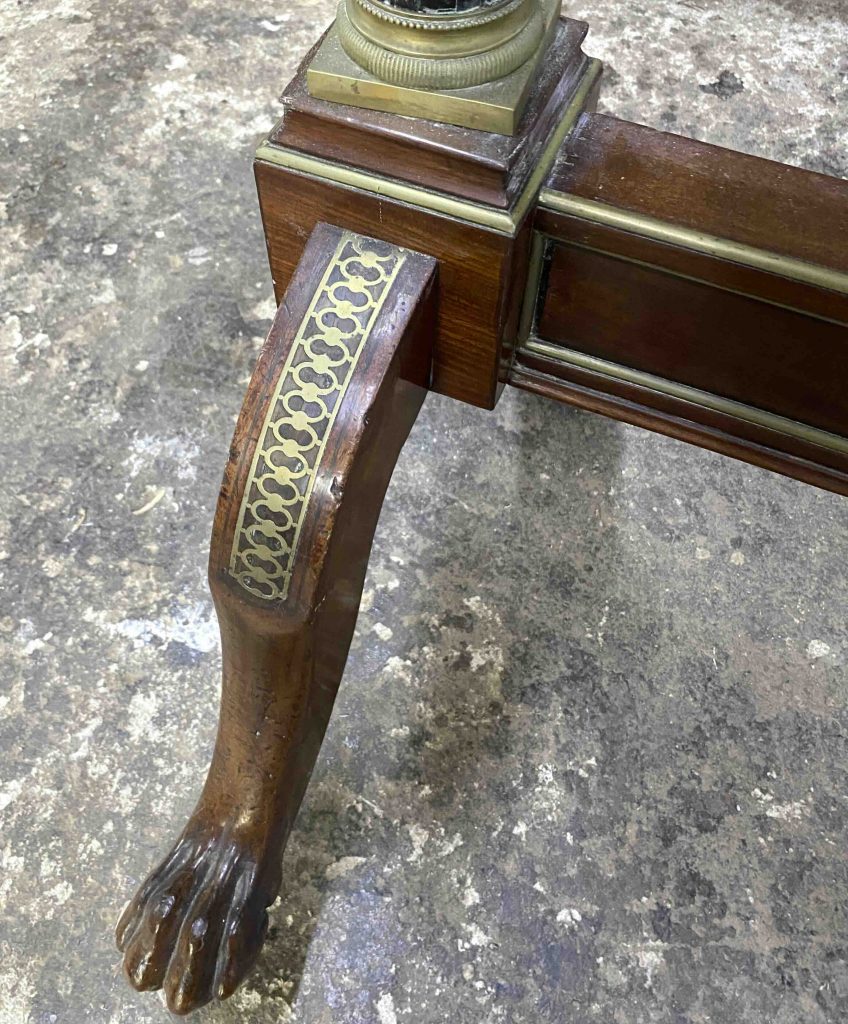
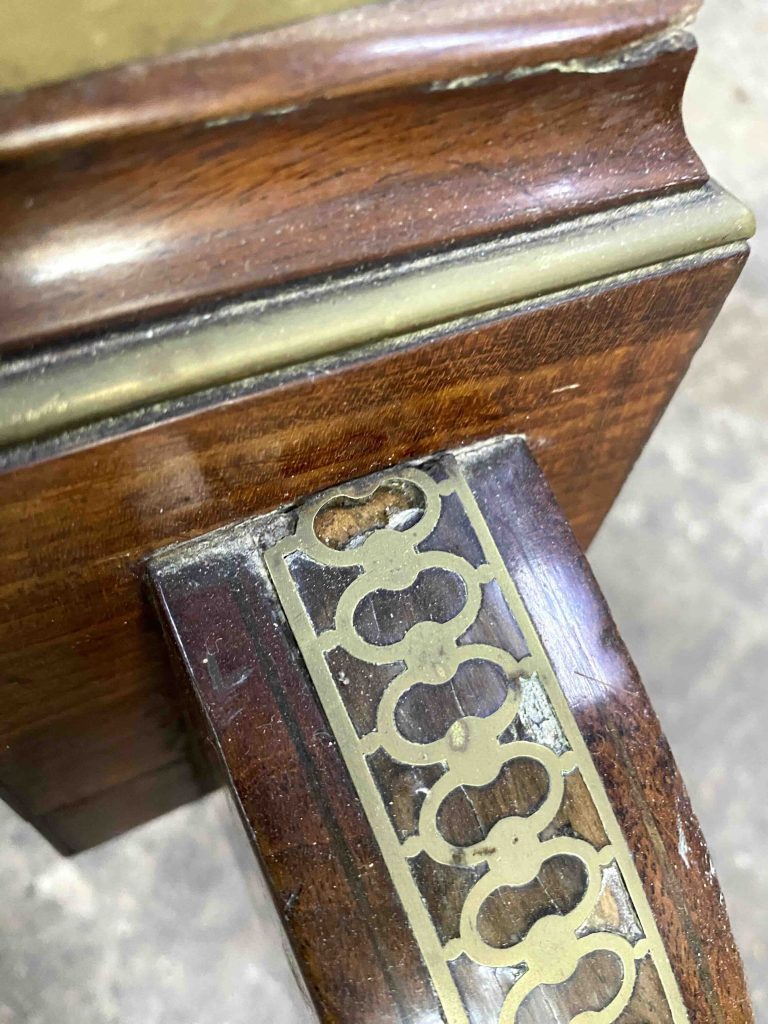
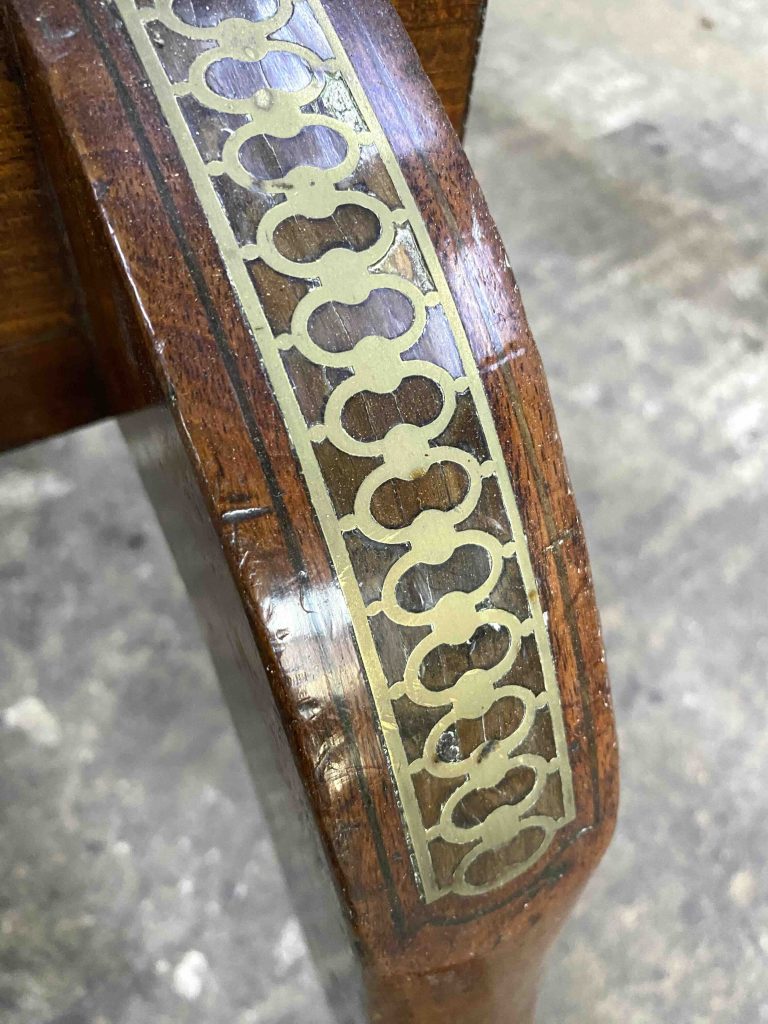
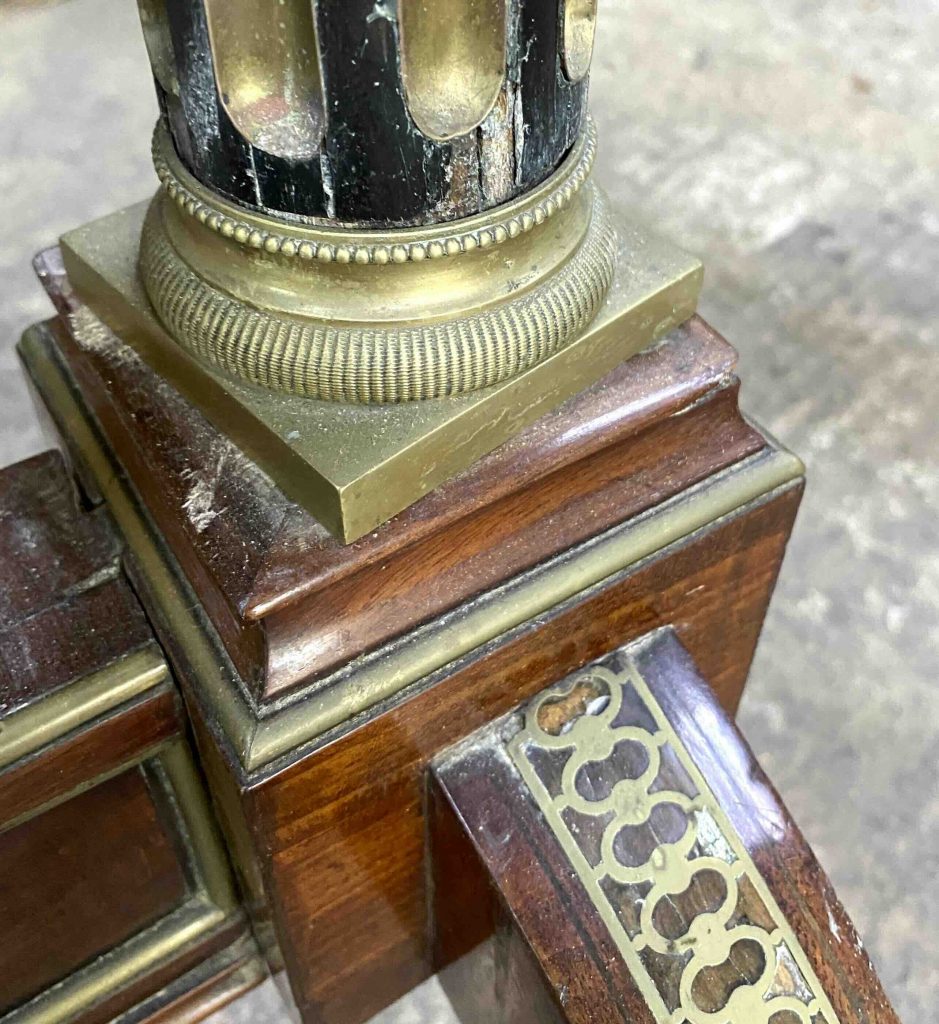
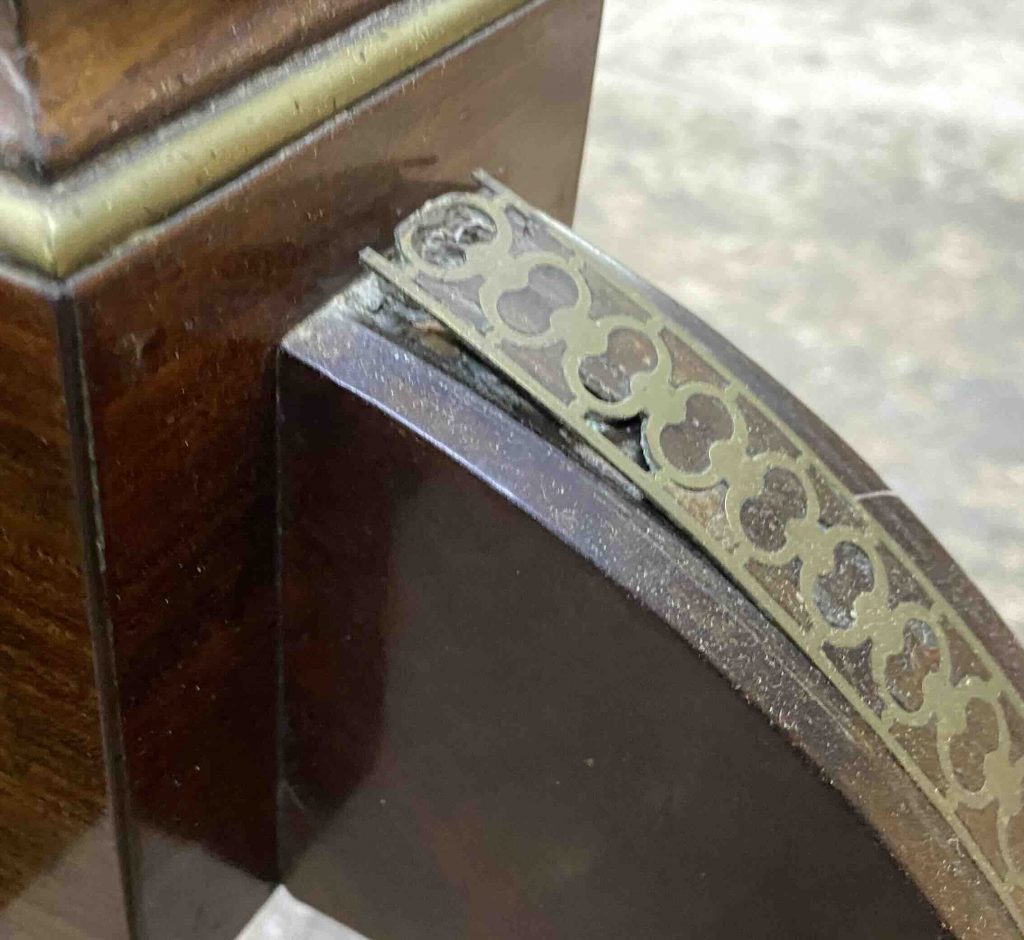
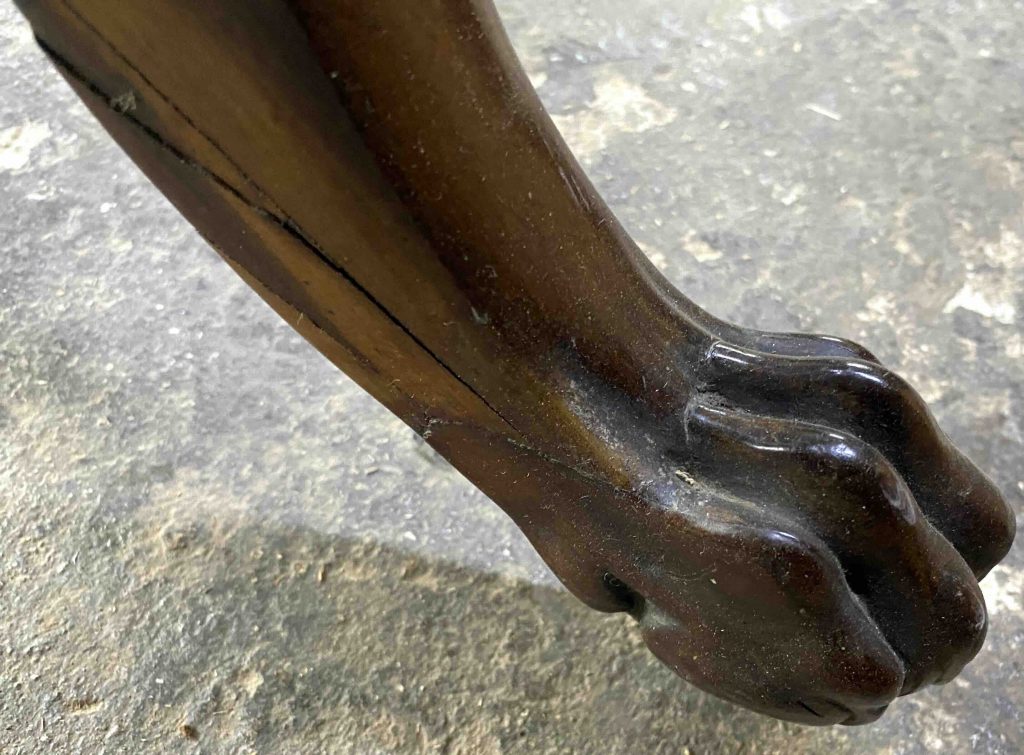
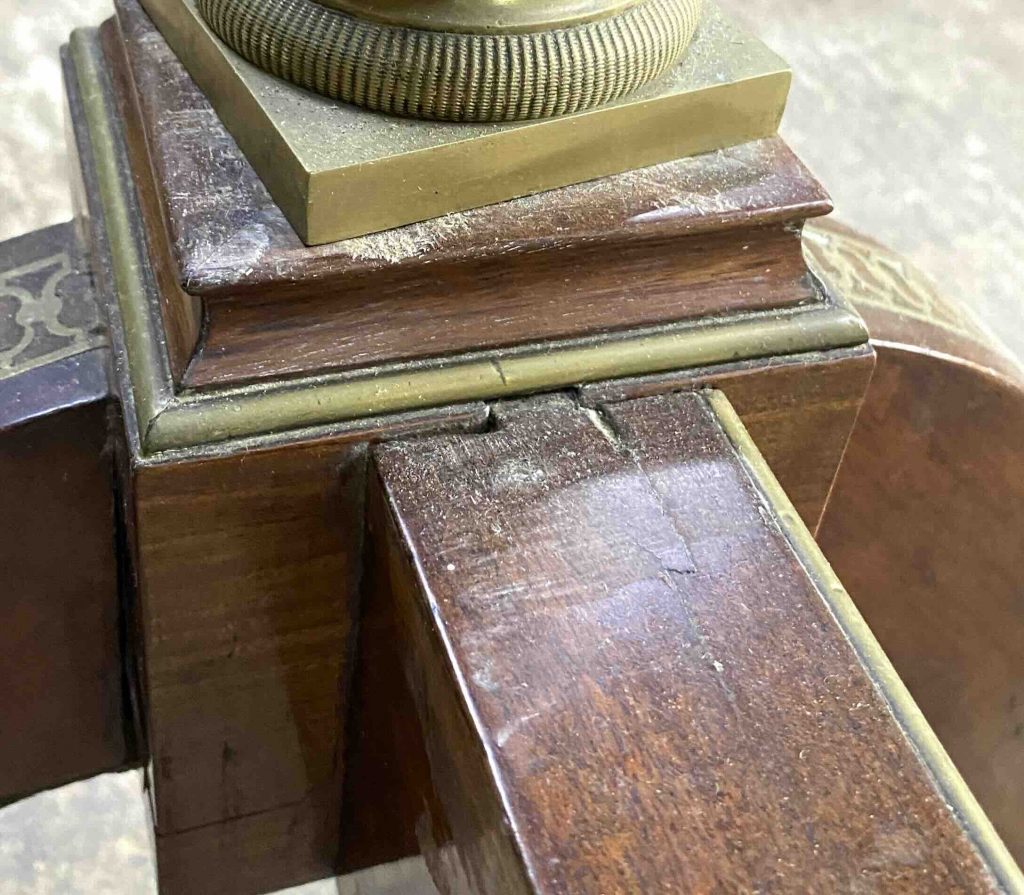
Before restoration
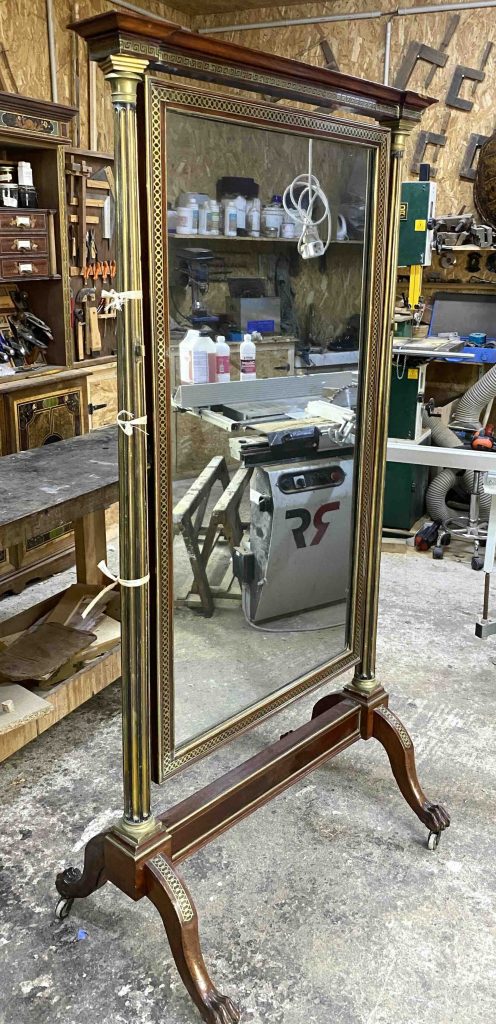
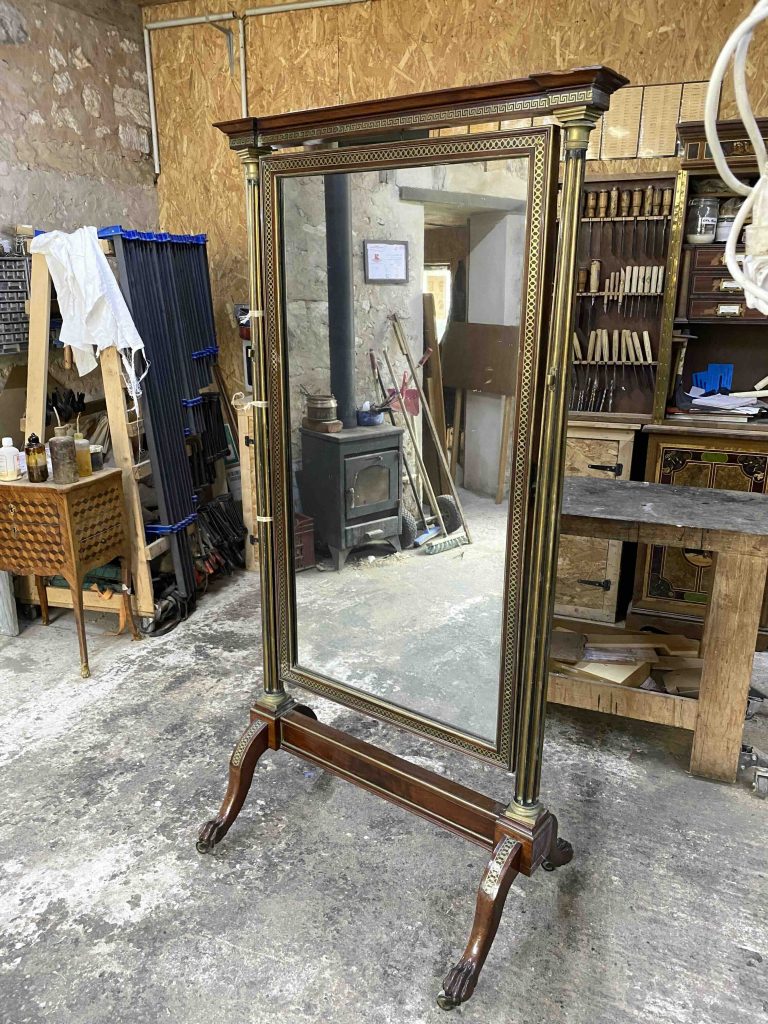
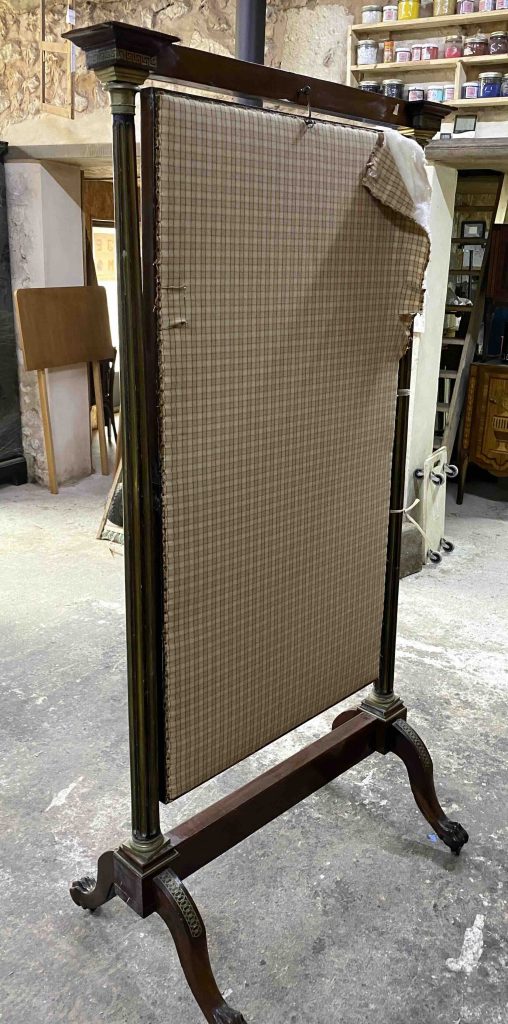
Broadcast during the Directory and the Empire
The spread of the psyche accelerated considerably under the Directory and then under the First Empire. This period saw the widespread adoption of furniture in aristocratic residences, private mansions and bourgeois homes.
Imperial furniture adopted a decorative vocabulary inspired by antiquity. The uprights could take the form of columns, while the crossbars were adorned with gilt-bronze appliqués depicting palmettes, swans, rosettes, or antique motifs. Mahogany remained the dominant wood, consistent with the tastes of imperial furniture.
This period also corresponds to an improvement in the techniques for manufacturing large-sized mirrors, an essential condition for the success of the full-length mirror.
During the 19th century, the cheval glass became a recurring element of European furniture. Its popularity continued under the Restoration, the July Monarchy, the Second Empire and then up to the Art Deco productions of the early 20th century.
The history of the cheval mirror perfectly illustrates the mechanisms of evolution of French furniture. Born from the adaptation of a pre-existing structure, perfected by the great Parisian workshops of the end of the Ancien Régime, then widely distributed under the Empire, it established itself as one of the first pieces of furniture specifically designed to offer a complete view of the body.
Its current heritage value rests as much on its aesthetic qualities as on the information it conveys concerning manufacturing techniques, domestic uses and cultural transformations of its time.
Bibliography
- The Furniture of the Louvre Museum, Volume II: Louis XVI Period, Paris, Réunion des Musées Nationaux.
- French Furniture Consulate and Empire, Paris, Les Éditions de l'Amateur.
- The Mirror: history, manufacture, techniques, Paris, Imago, 1994.
- The Cabinetmakers of the 18th century in France, Paris, Les Éditions d'Art et d'Histoire, reissued.
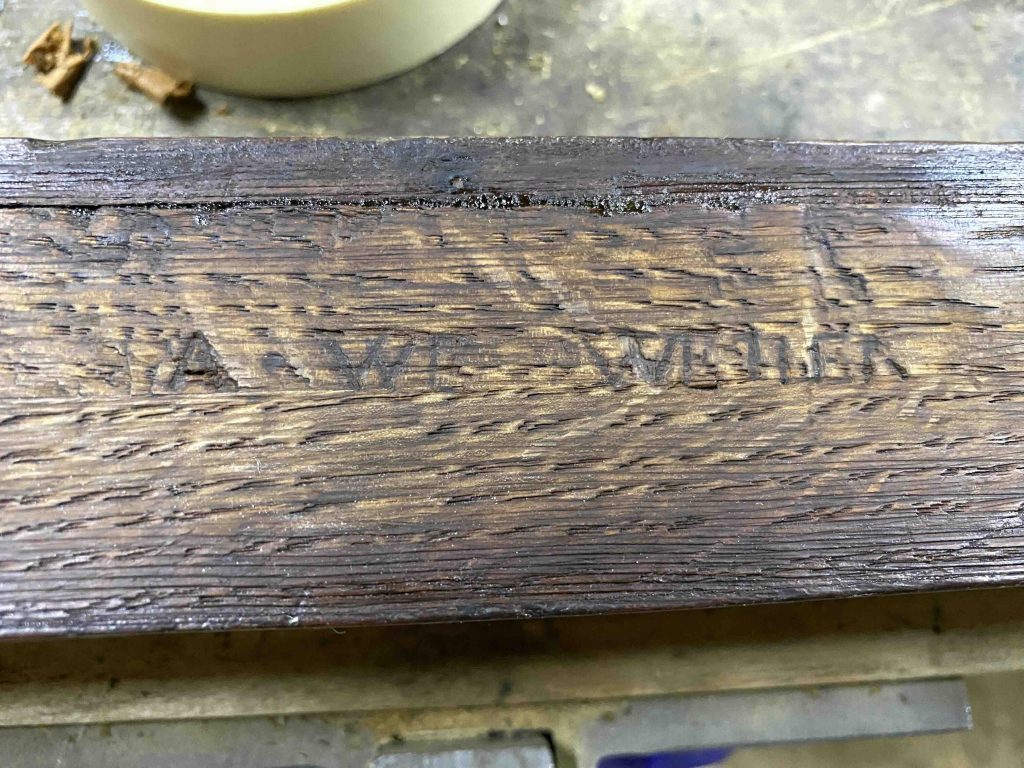
Adam Weisweiler (around 1744/1750 – 1820)
Adam Weisweiler is among the most important cabinetmakers active in Paris at the end of the 18th century. Originally from the Rhine region, he obtained his master's degree in 1778 and settled in the Faubourg Saint-Antoine, the main center of Parisian furniture production.
His work falls within the Neoclassical movement of the reigns of Louis XVI and the Directory. Weisweiler is particularly renowned for his furniture with its clean, elegant lines, combining mahogany veneers, Far Eastern lacquers, Sèvres porcelain, and gilt bronze mounts. He worked primarily for the leading Parisian merchants, notably Dominique Daguerre and Martin-Éloi Lignereux, who distributed his creations to an aristocratic clientele in France and across Europe.
His works demonstrate remarkable technical mastery and a pronounced taste for precious materials. His patrons included Marie Antoinette, the Prince of Wales (later George IV of England), and several European princely courts.
From the perspective of furniture history, Weisweiler occupies a pivotal place in the development of French Neoclassical furniture. His works are now considered major references for the study of cabinetmaking techniques from the late Ancien Régime. They are held in the collections of the Louvre, the Metropolitan Museum of Art, and the Victoria and Albert Museum.
Bibliography
- Pierre Verlet, French Furniture of the 18th Century.
- François de Salverte, French Cabinetmakers of the 18th Century.
- Alexandre Pradère, French Cabinetmakers from Louis XIV to the Revolution.
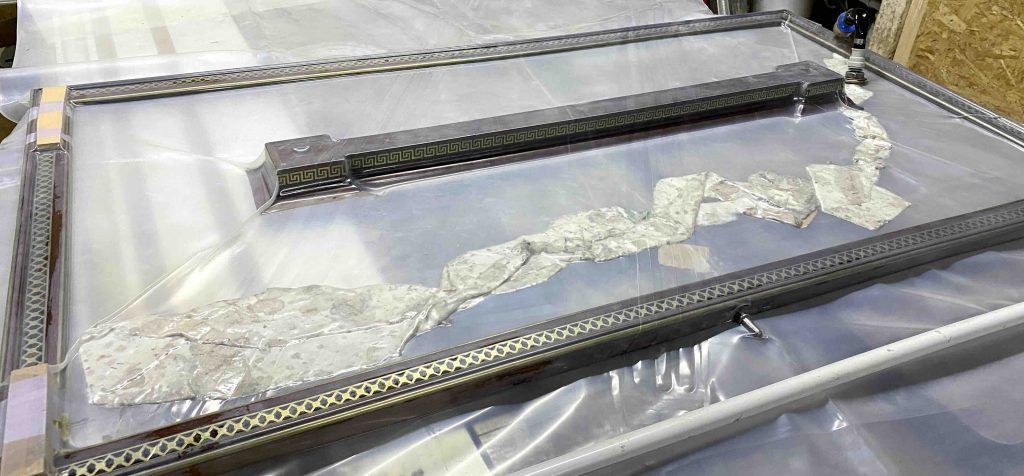
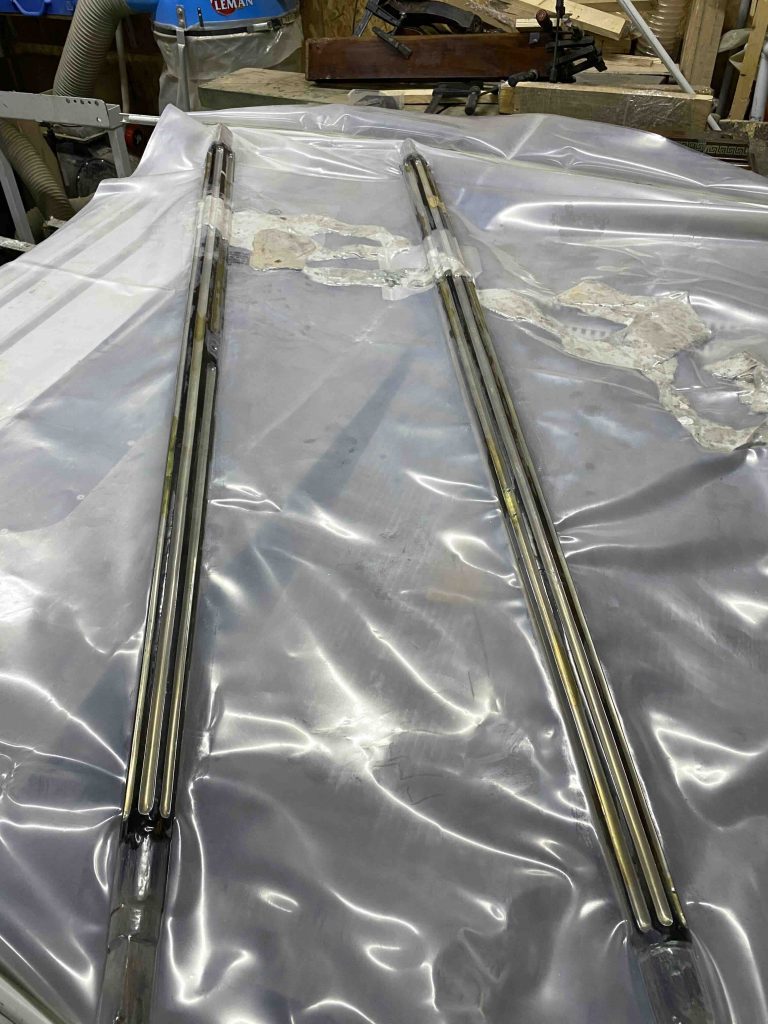
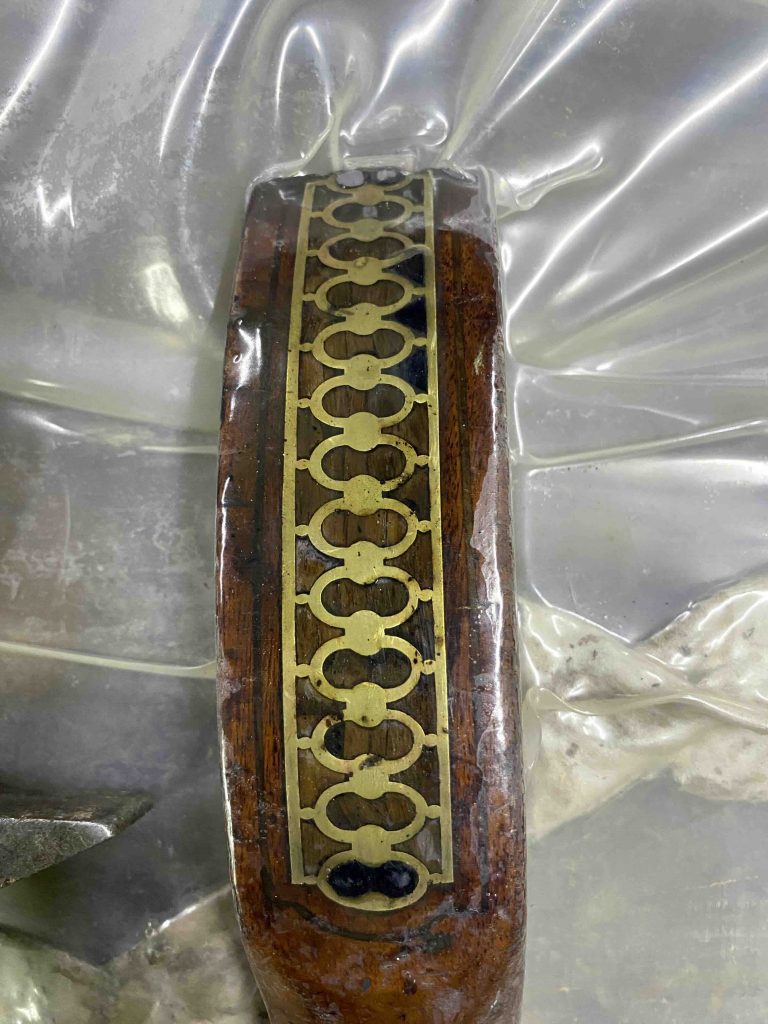
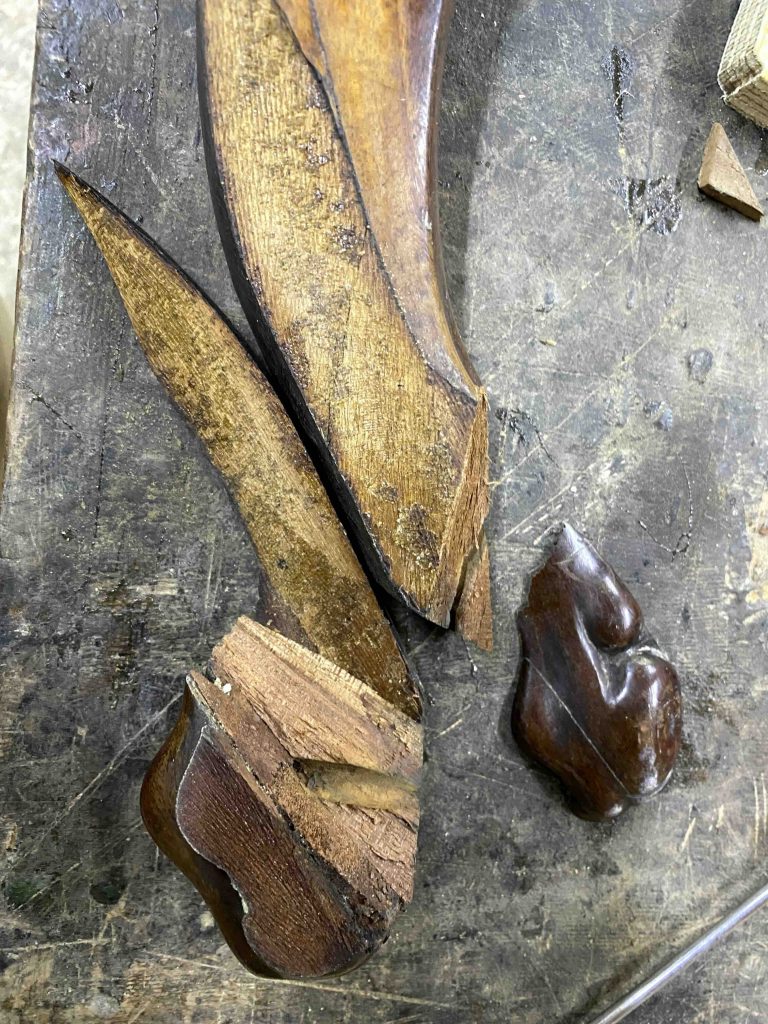
The Restoration
From a restoration point of view, this cheval mirror is a complex object combining several materials and know-how.
The structures are made of solid wood and veneer. The metal elements include pivots, fittings, and decorative bronze applications.
The mirror itself represents a major heritage element. This particular example retains its original mercury backing, a technique gradually abandoned during the 19th century due to its toxicity. Preserving these reflective surfaces is now a crucial challenge for restorers, as replacing them results in a significant loss of historical authenticity.
The pathologies observed were:
- structural deformations linked to hygrometric variations; ;
- the lifting and loss of veneer; ;
- wear and tear of pivoting systems; ;
- the oxidation of metallic elements; ;
- the alteration of the silvering and the corrosion of the reflective layers.
The intervention on this psyche therefore required a multidisciplinary approach combining knowledge of materials, understanding of manufacturing techniques and respect for the ethical principles of conservation.