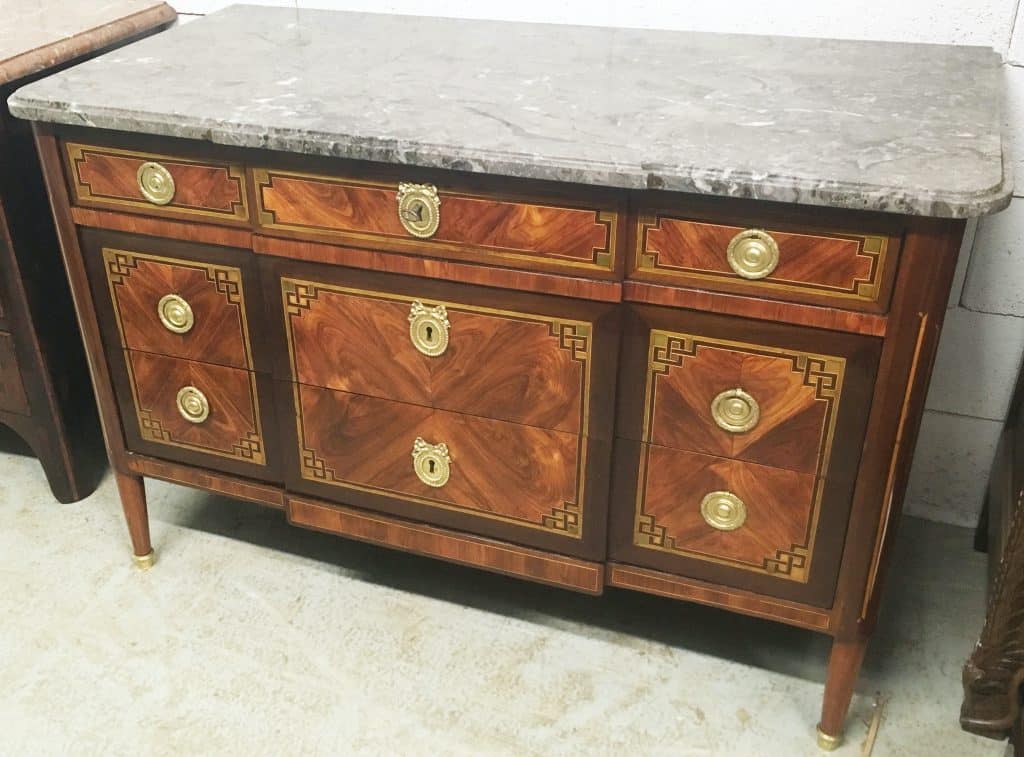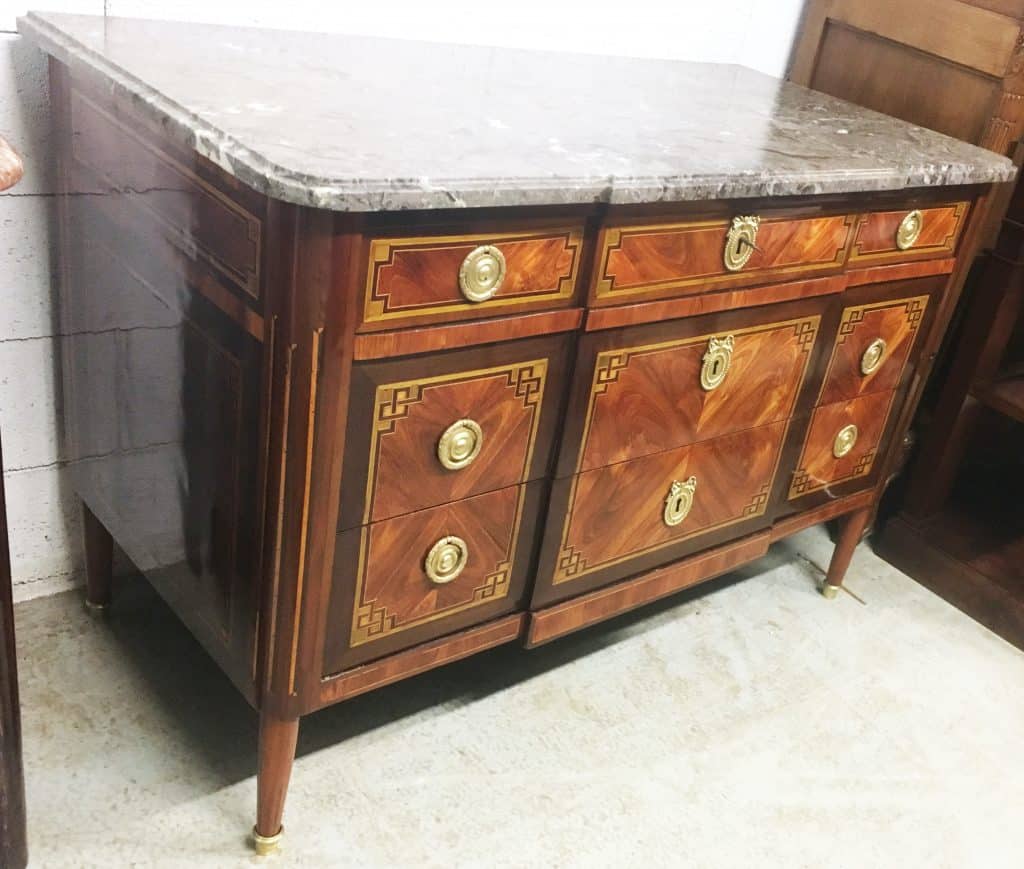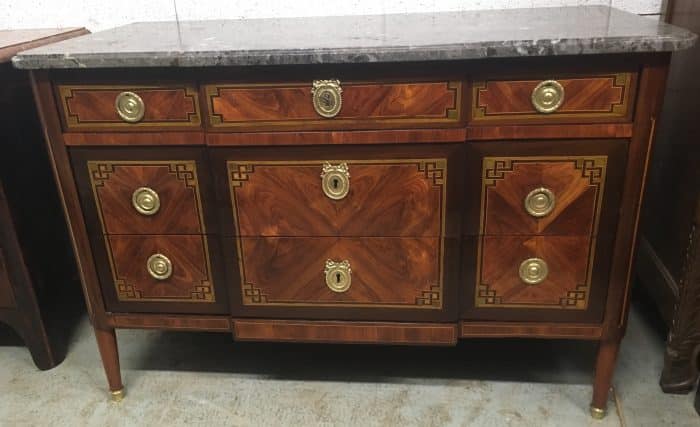
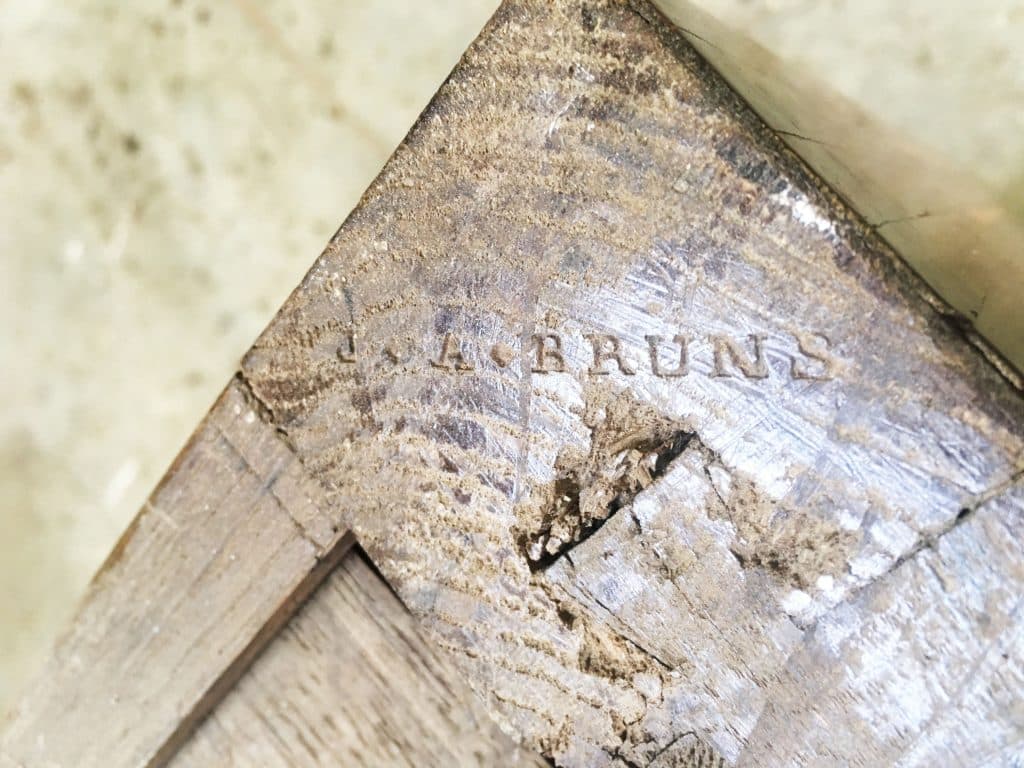
This week marks the completion of the restoration of a Louis XVI commode stamped JA BRUNS. It is made entirely of oak for the frame, except for the side panels, drawer backs, drawer fronts, and the two drawer bottoms, which are made of softwood. It is veneered with rosewood in a butterfly pattern and amaranth for the edges. The false fluting is in boxwood and ebony, and there is a green-stained maple stringing forming the Greek key corners. Some satinwood finishes from previous restorations are visible. The marble top is Saint Anne gray.
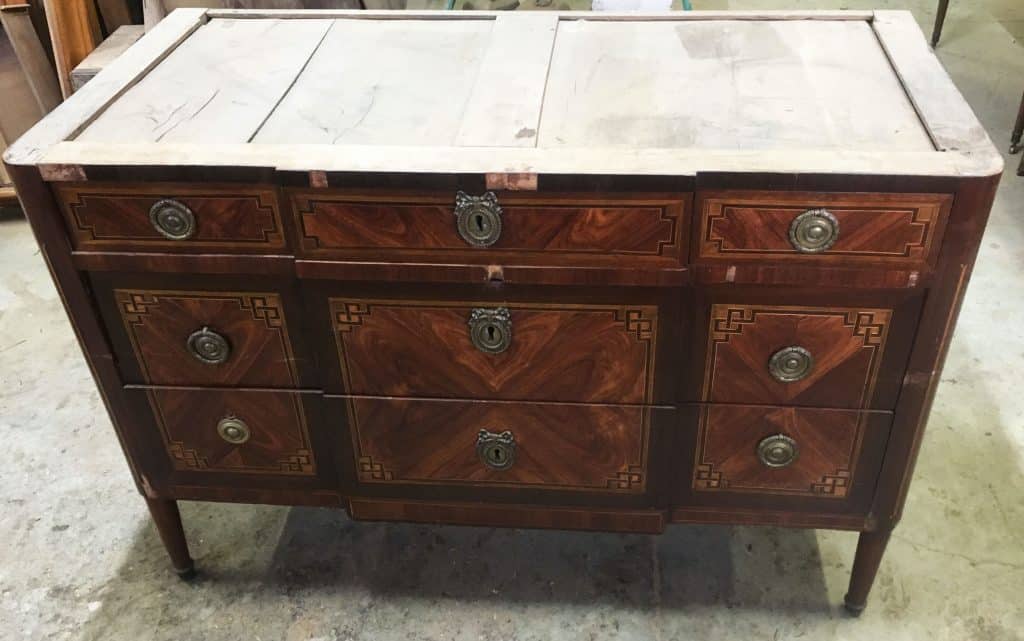

This chest of drawers is stamped on the front right and left uprights with a faint trace of JME on the left upright.
Jean-Antoine Bruns was admitted to the guild in 1782. He primarily developed his business at the beginning of the 19th century, supplying numerous dignitaries of the Empire and then the Restoration, during which time he became cabinetmaker to the Royal Furniture Repository. Before the Revolution, he began his career on Rue Saint-Nicolas, where he worked for the court in collaboration with Riesener. His furniture—half-moon commodes, large wardrobes, secretaries, chiffoniers—all in the Louis XVI style, elegant in form, were either covered with wood veneers featuring geometric designs or simply mahogany veneer, or adorned with Chinese lacquer depicting landscapes. He seems to have weathered the Revolutionary period unscathed and participated in the Exposition of Year VI (1798). Towards the end of the Imperial era, Bruns supplied large mahogany wardrobes, salon consoles, and gaming tables for the apartments of high-ranking officers. Louis XVIII placed his trust in him and even conferred upon him, in 1820, the title of Cabinetmaker to the King. He ceased his activity in 1824, leaving his workshop to his son Louis, who also received the warrant of supplier to the Crown: the Parisian Bazaar In 1825, it published its advertisement for "rich cabinetmaking in libraries, shop counters and generally all tasteful furniture".
BIBLIOGRAPHY
- French Furniture of the 18th Century – Pierre Kjellberg – Les Editions de l'Amateur – 2008
- Cabinetmakers of the 18th Century – Count François de Salverte – Art and History Publishers – 1934
- Parisian Cabinetmaking and Joinery Workshops – Guillaume Panneau – SERG Editions – 1975
Cstate report
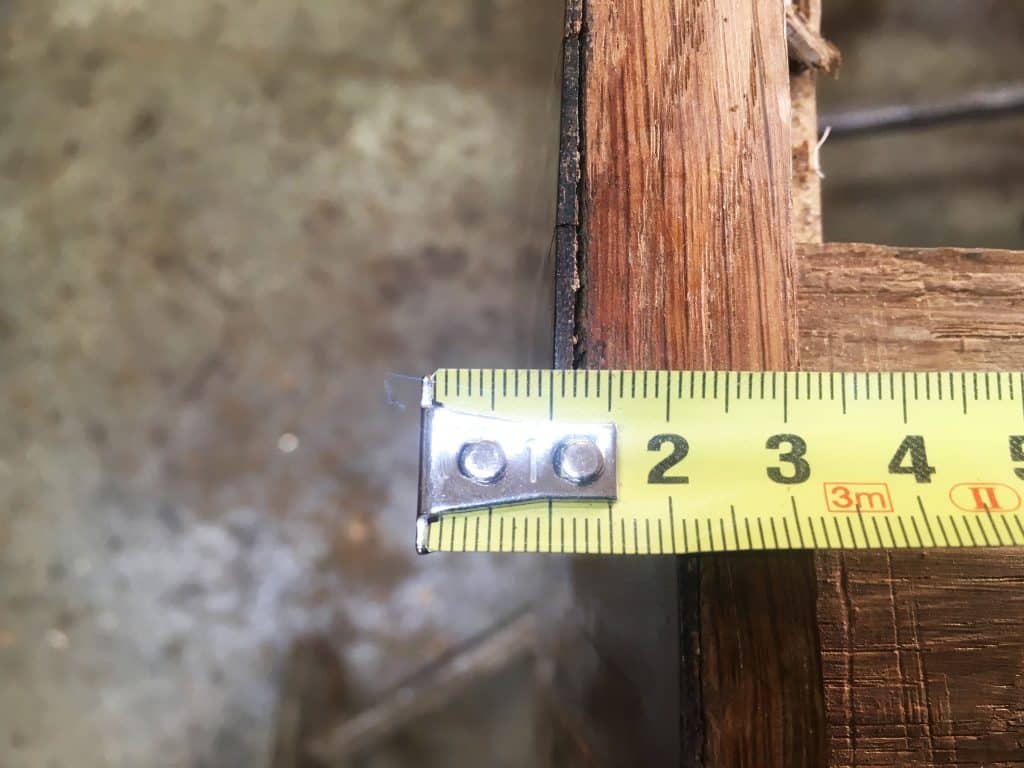
Regarding the furniture's structure, the most problematic damage was the separation of the side panels from the uprights and the top and bottom rails. This was due to dimensional shrinkage and the drying out of the glue. Some oak planks were missing from the back panel, and all the panels had undergone dimensional shrinkage, leaving gaps throughout. Aside from this, there was no rotten wood or missing material.
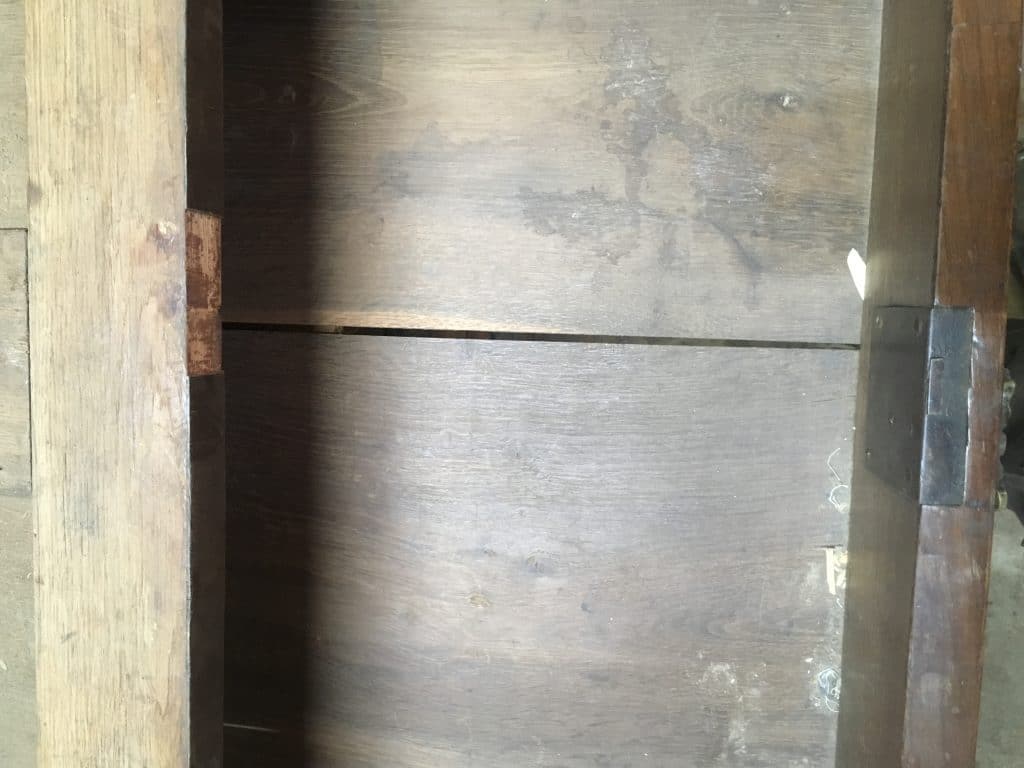
Removing the wood from the bottom of the drawers 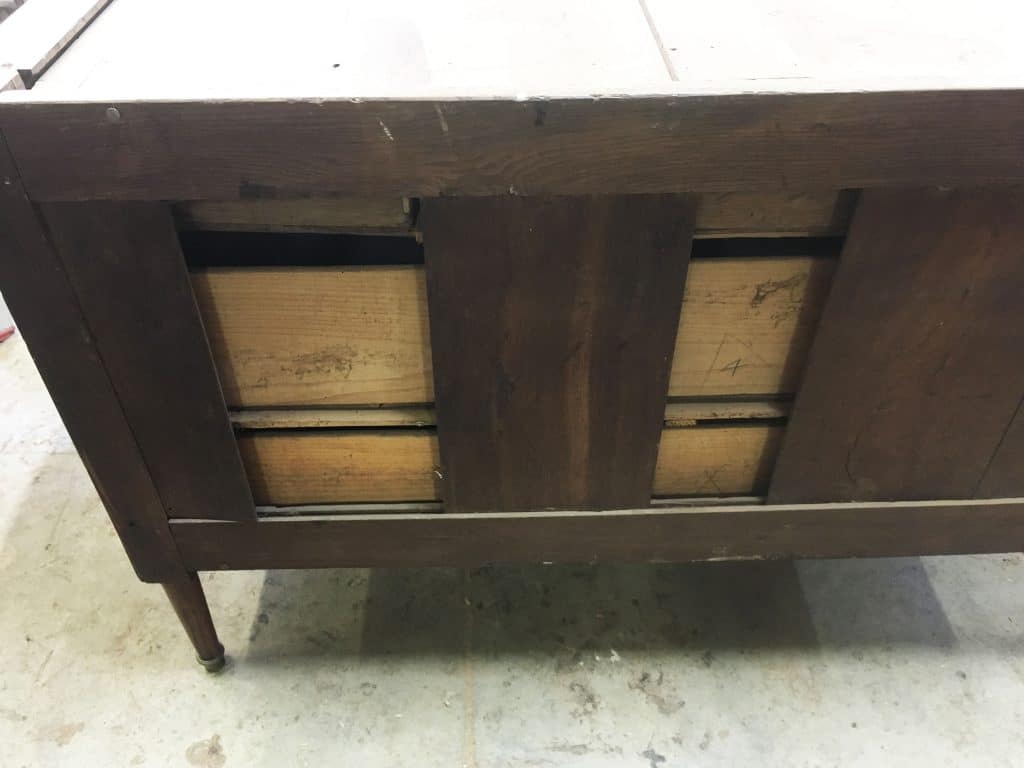
Some planks are missing from the back 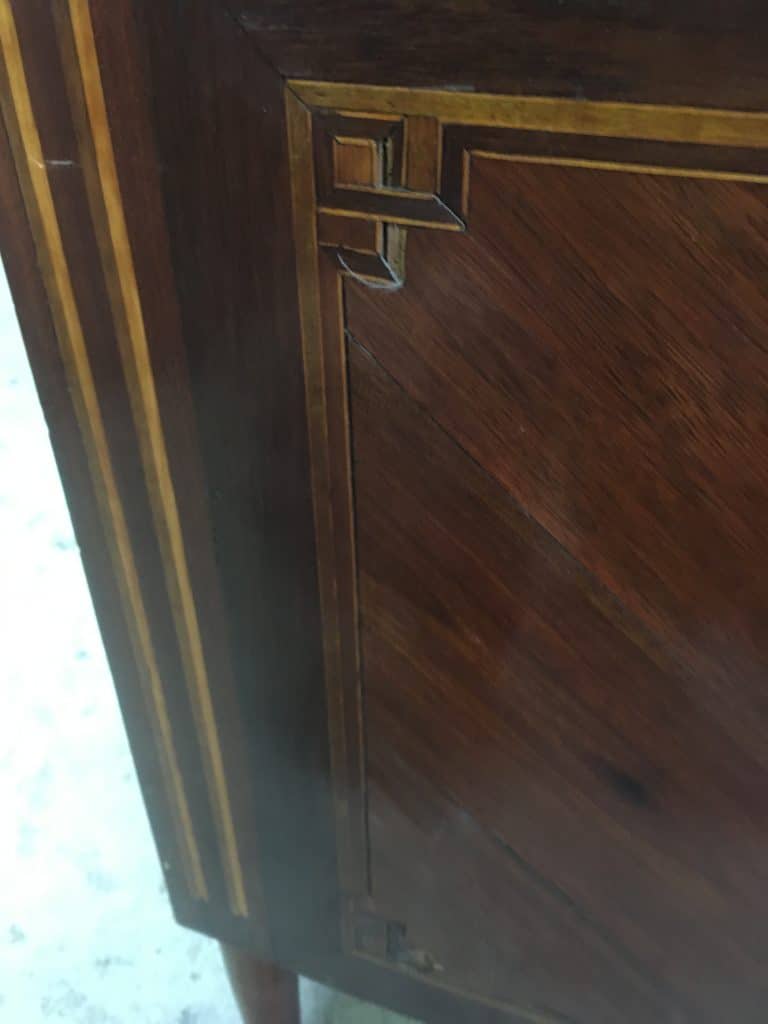
Dimensional shrinkage of side panels 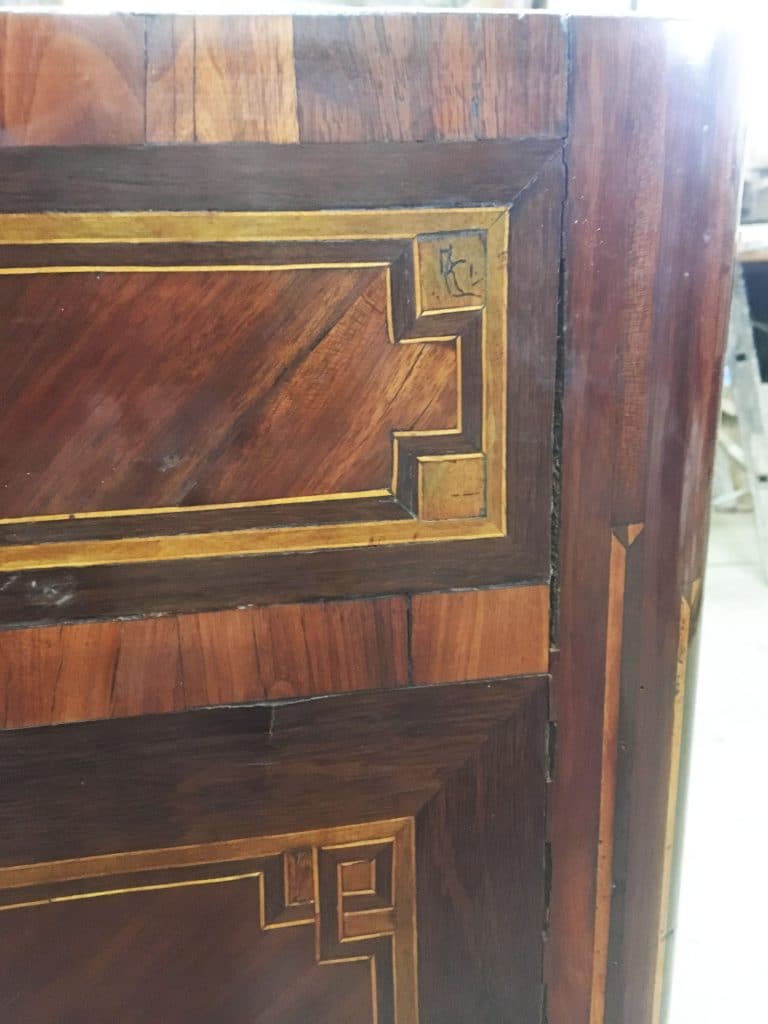
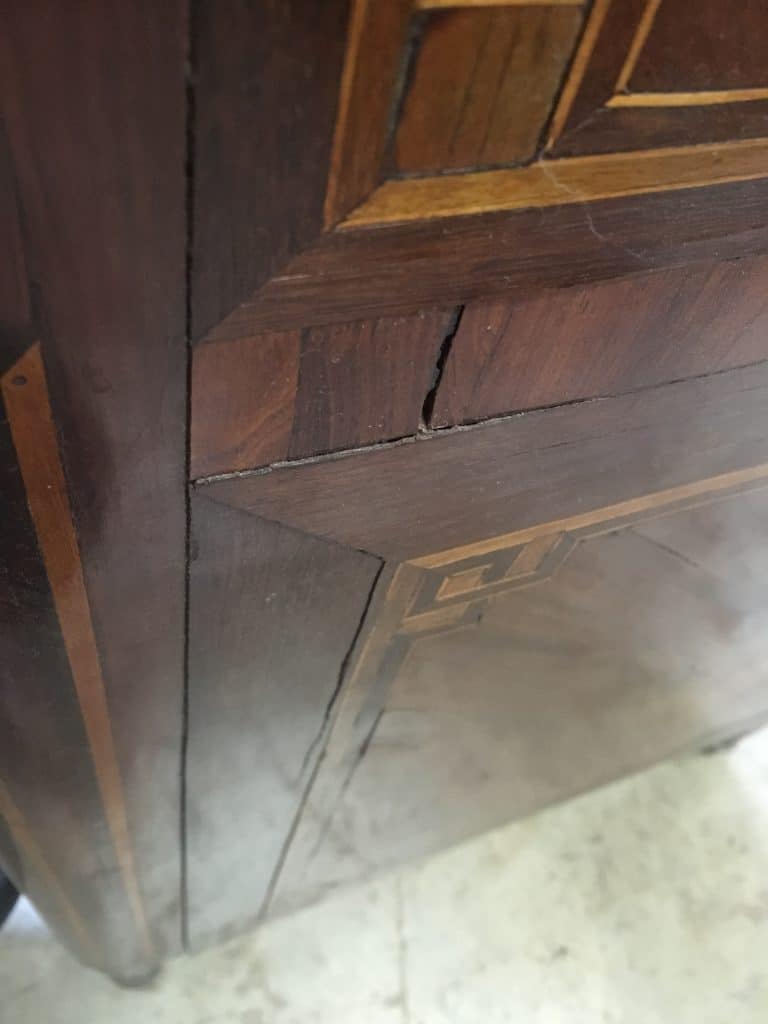
The panel structure is detached.
As for the veneer, which was still of a reasonable thickness, apart from some missing veneers and especially a general dehydration of the glues, nothing too serious.
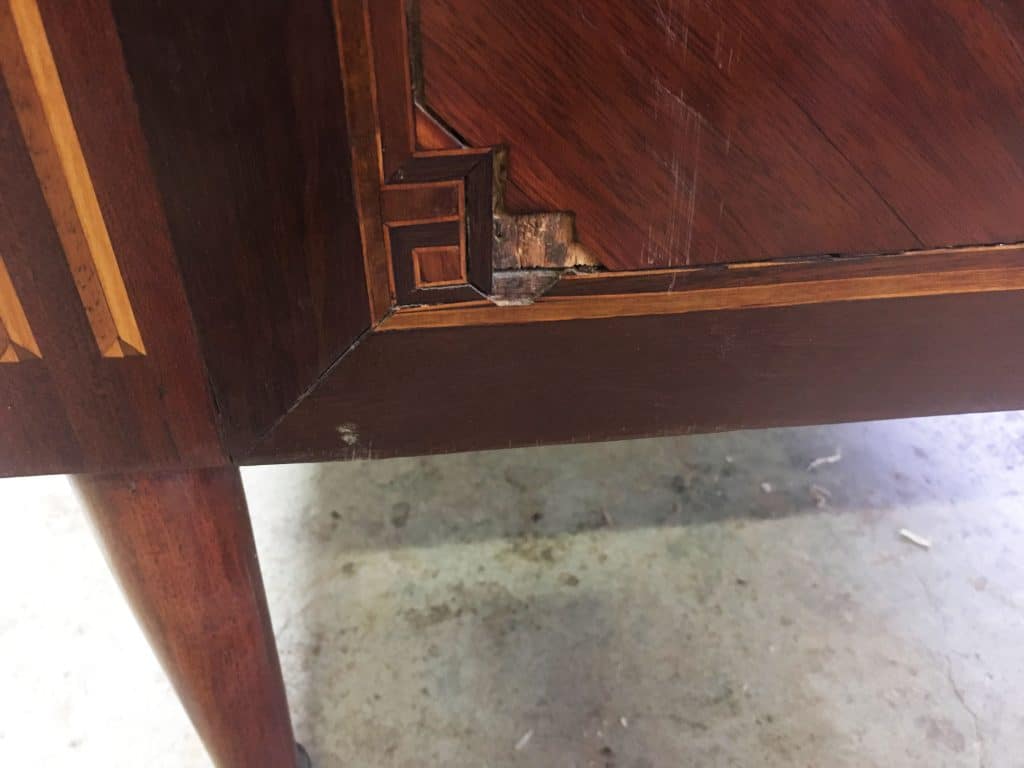
A small piece of netting is missing 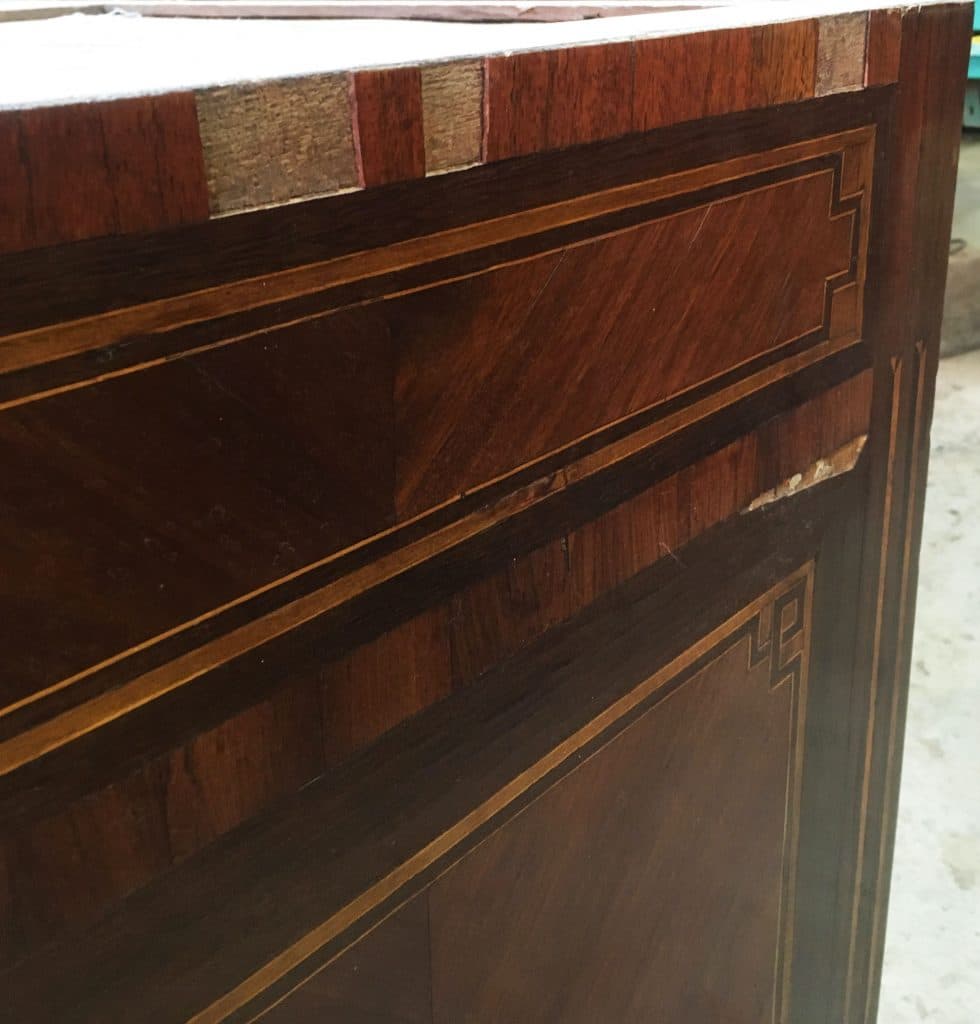
Missing satin and amaranth veneer 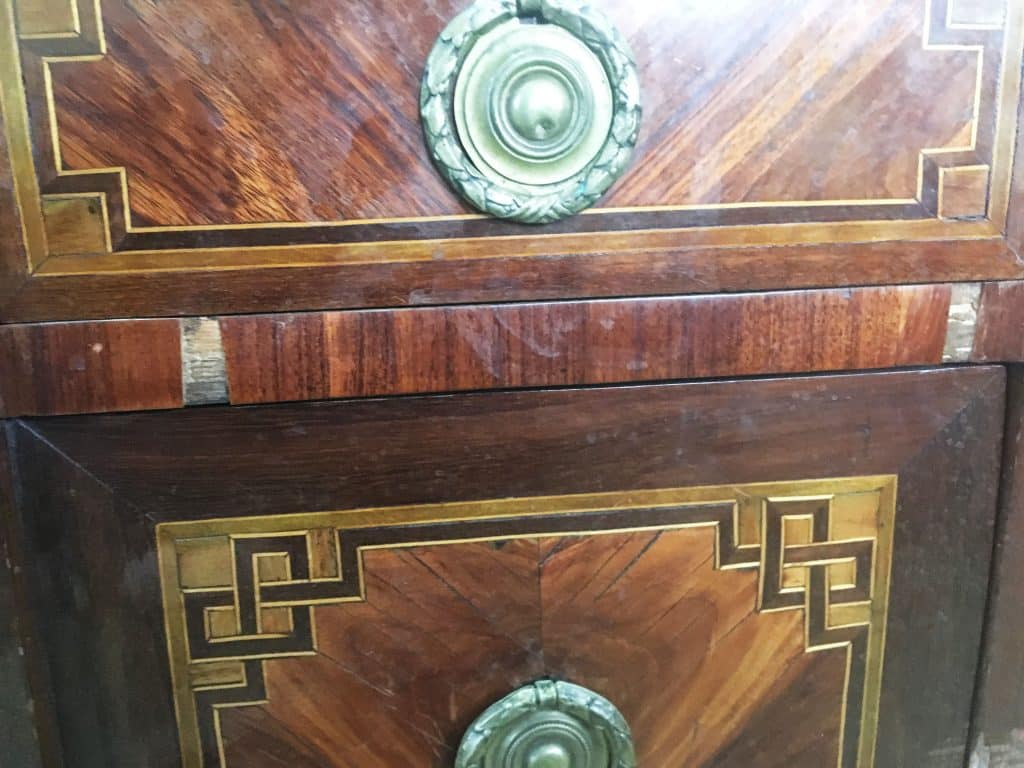
Rosewood shortages 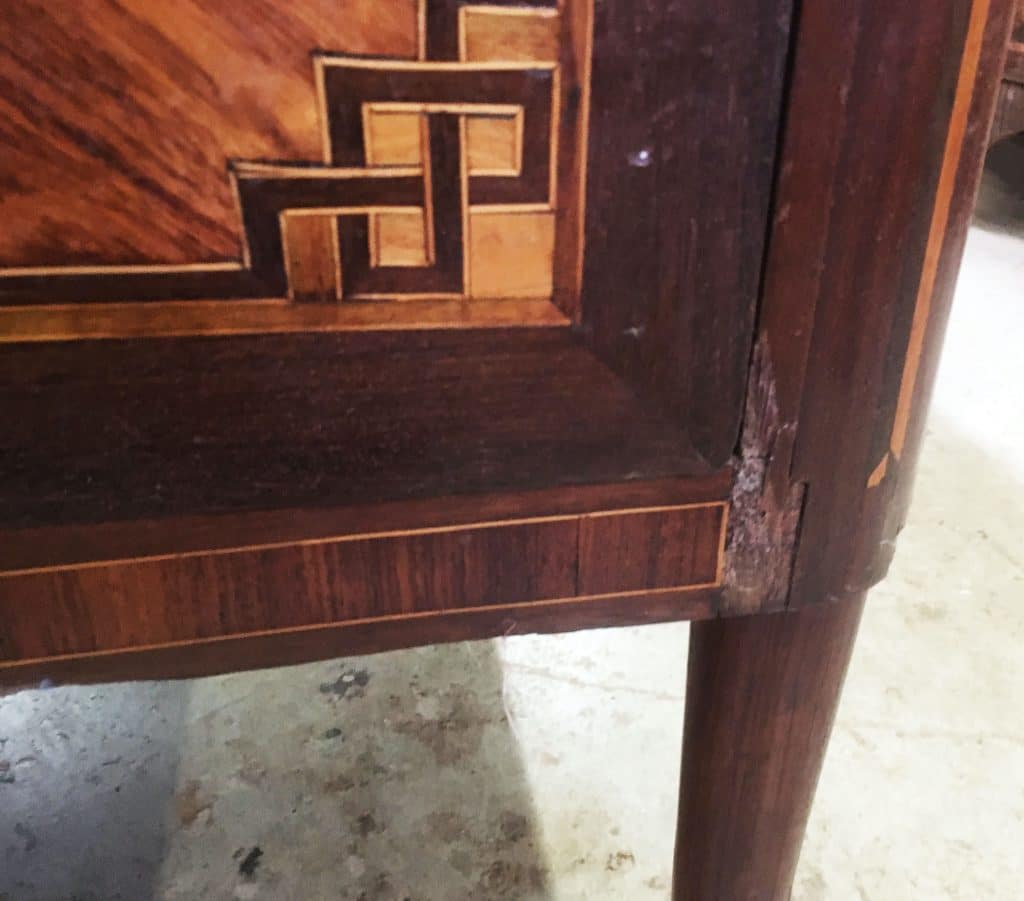
Missing veneer 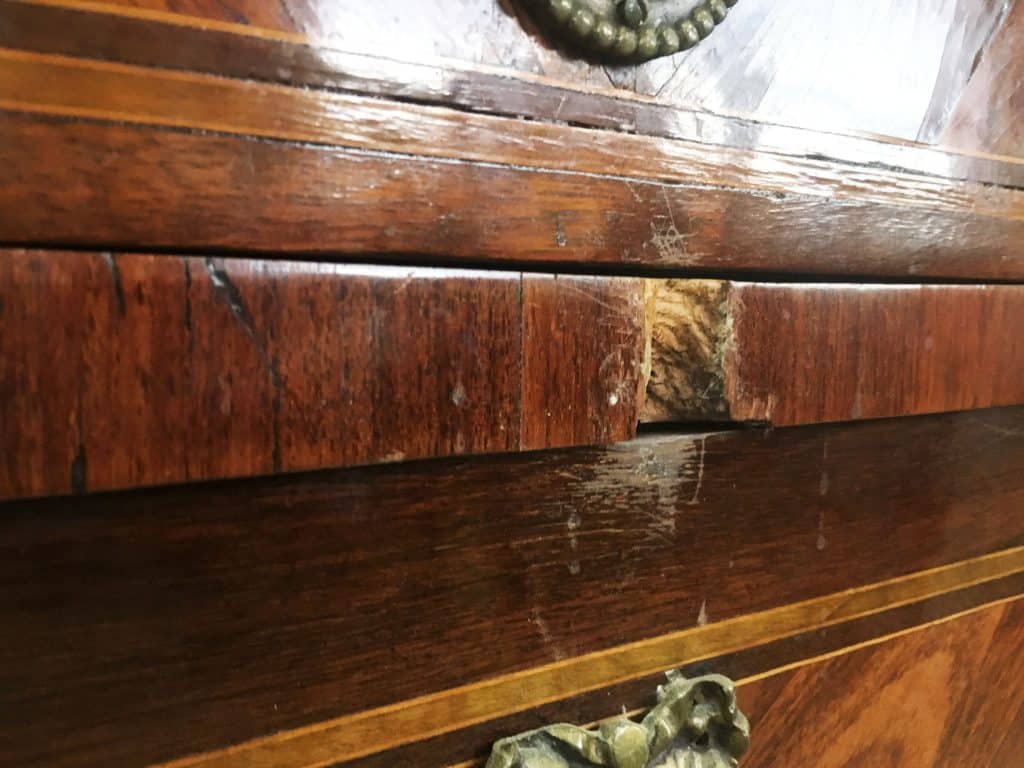
Torn-off lock cheek 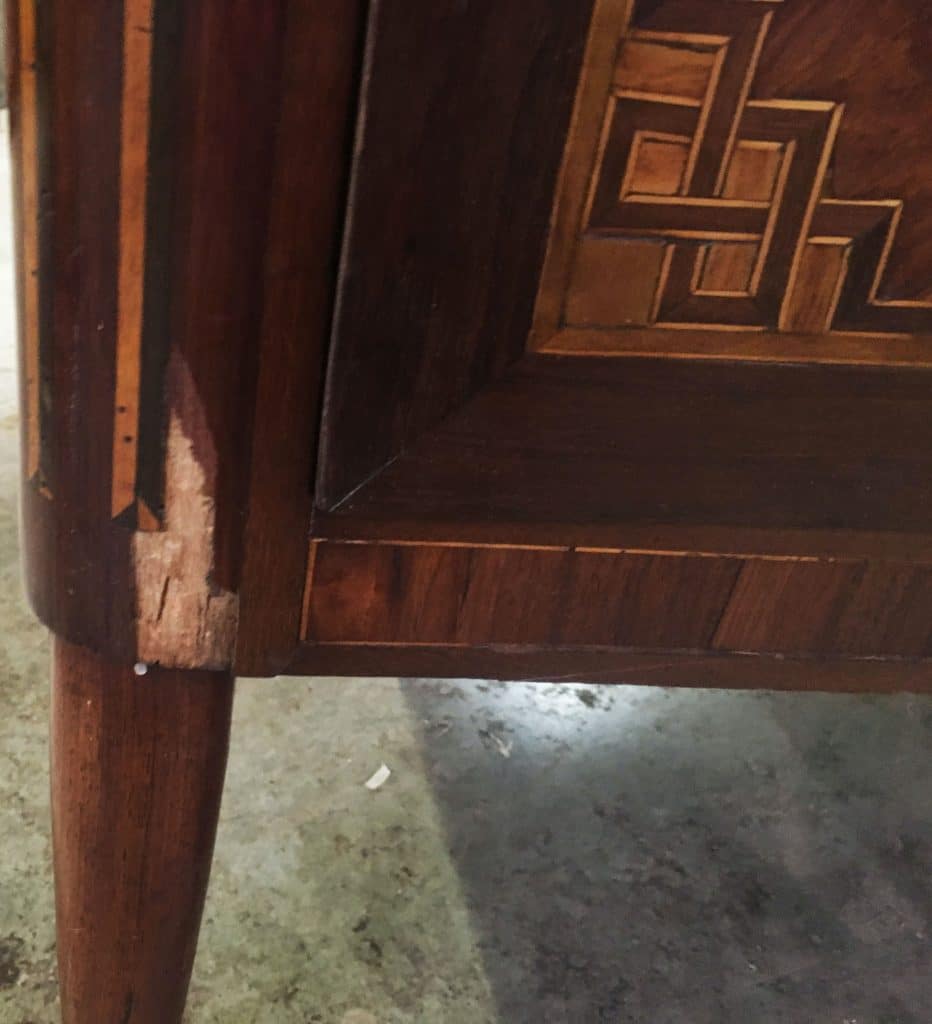
Veneer torn off 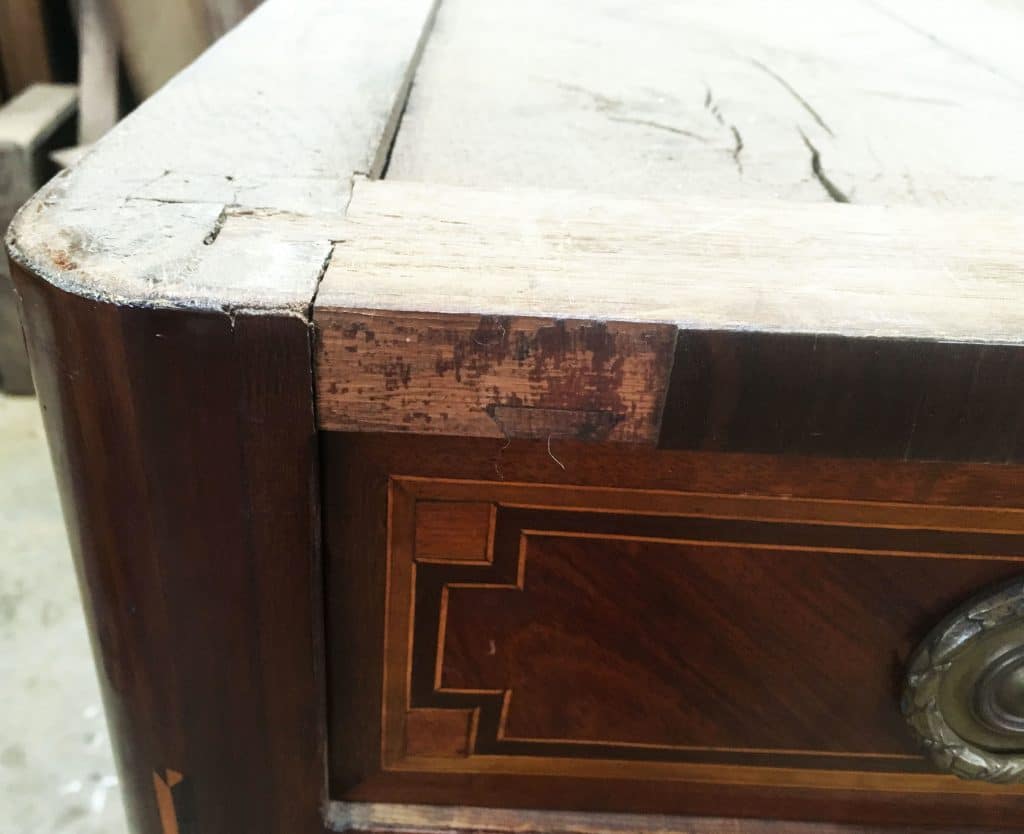
Lack of amaranth
The Restoration
In order to reattach and ream the sides, a complete disassembly was necessary. This type of chest of drawers is fairly easy to take apart, starting from the back. Once the chest was completely disassembled, I reattached the two sides with fish glue, filling the gaps caused by shrinkage with pine wood.
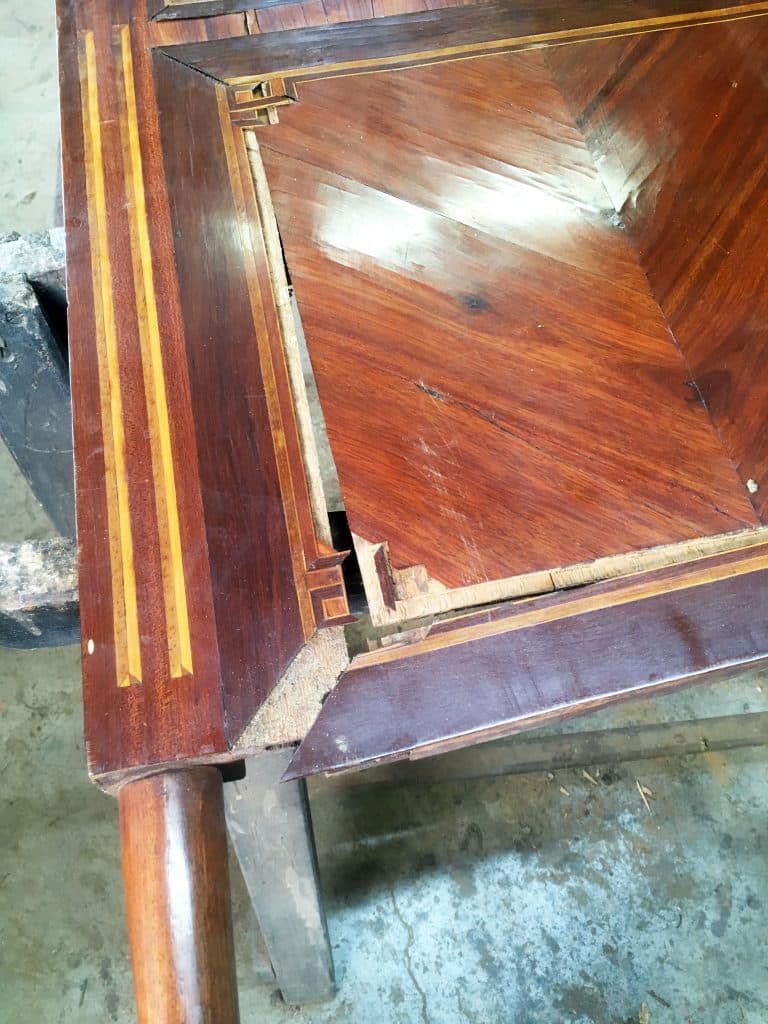
Disassembly of the side 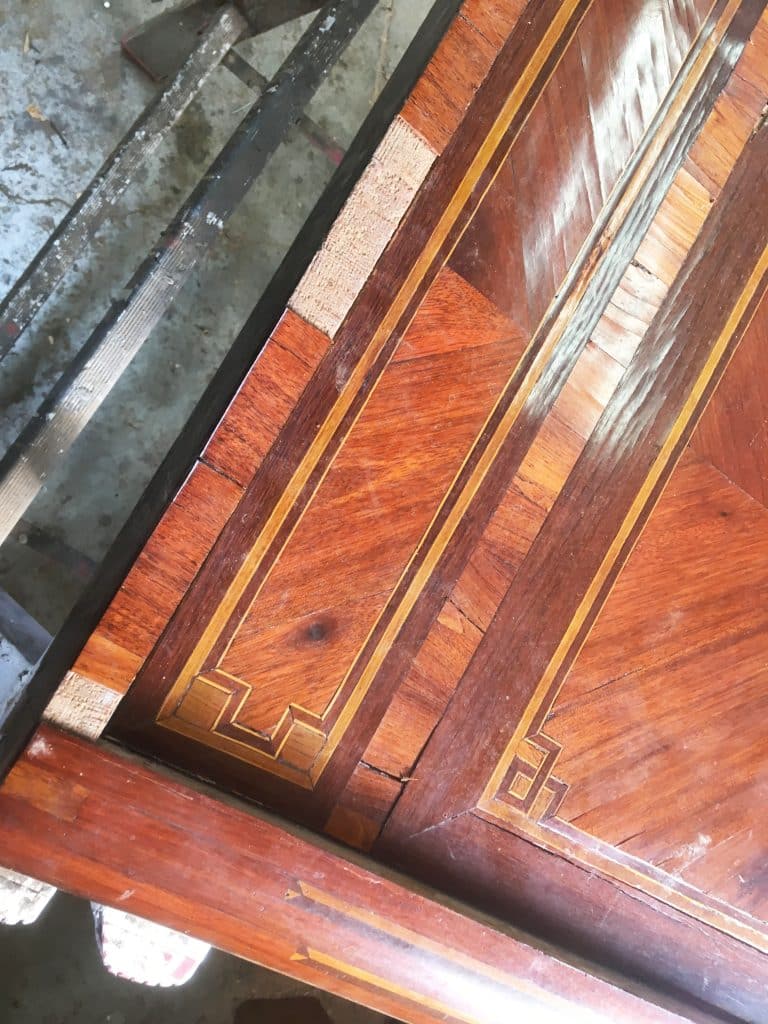
The side panels no longer stay in place 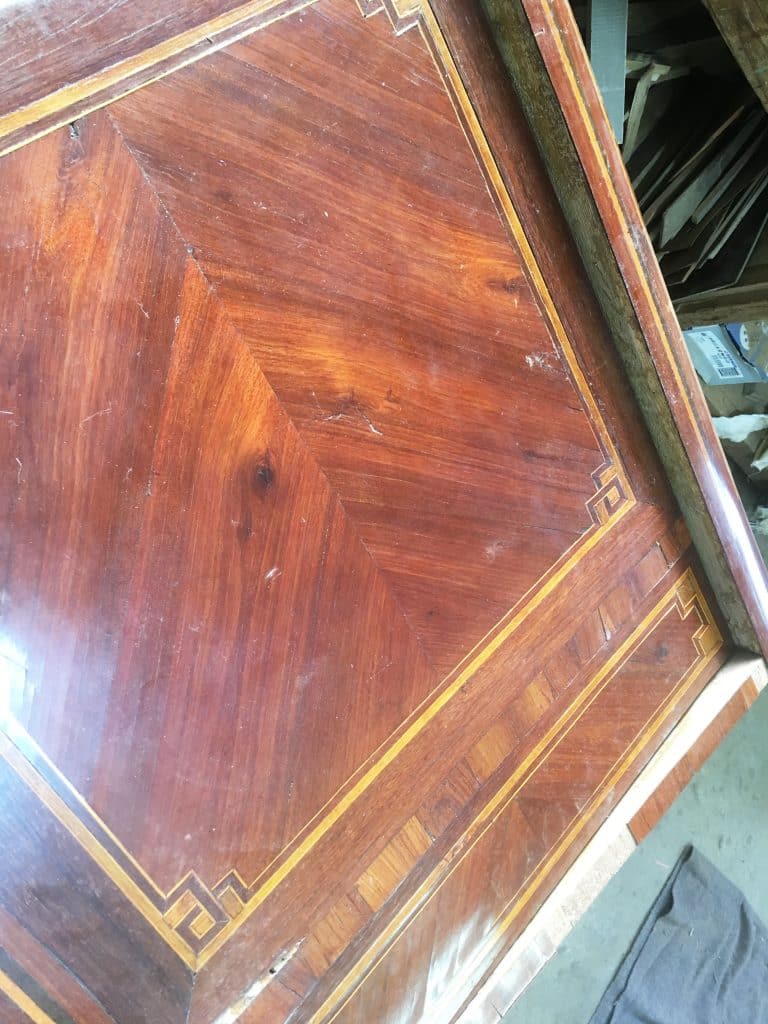
Disassembled side 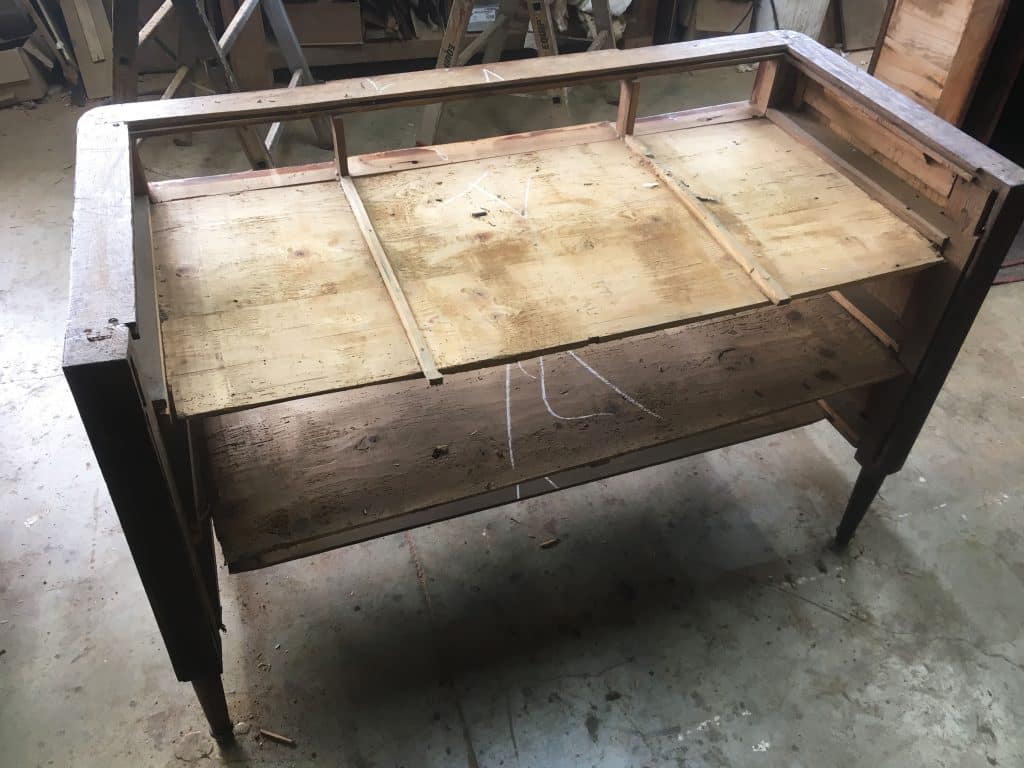
Disassembly from the rear
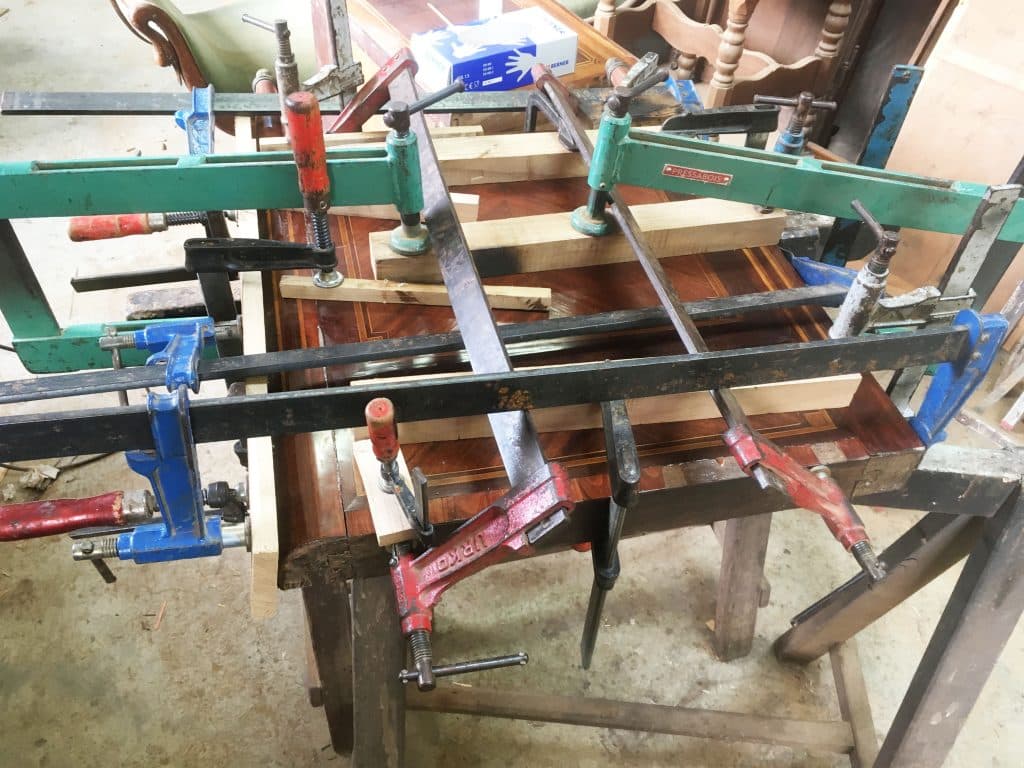
Bonding the structure 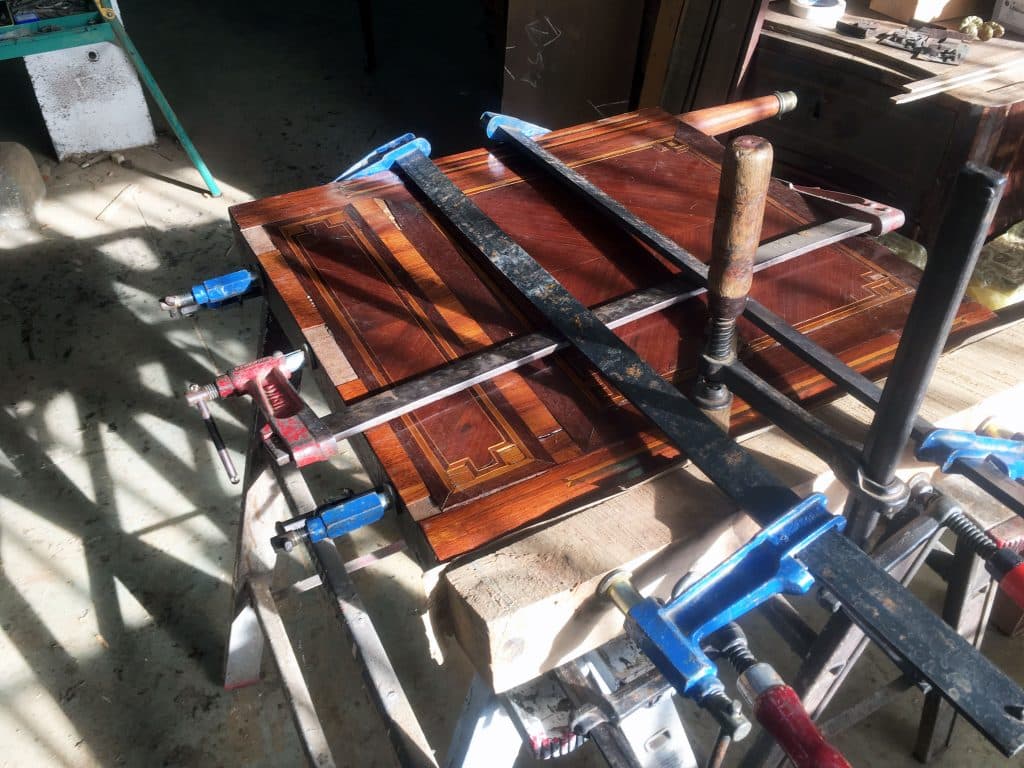
gluing the side panels
Next, I carried out the various restoration operations on the marquetry, working by vacuum-sealing glue infiltration on both sides as well as the drawer fronts. The missing veneers were filled with sawn rosewood and amanta veneer, which had been previously scraped, sanded, filled, oxidized, and cut to the correct thickness before being glued in place with hot glue.
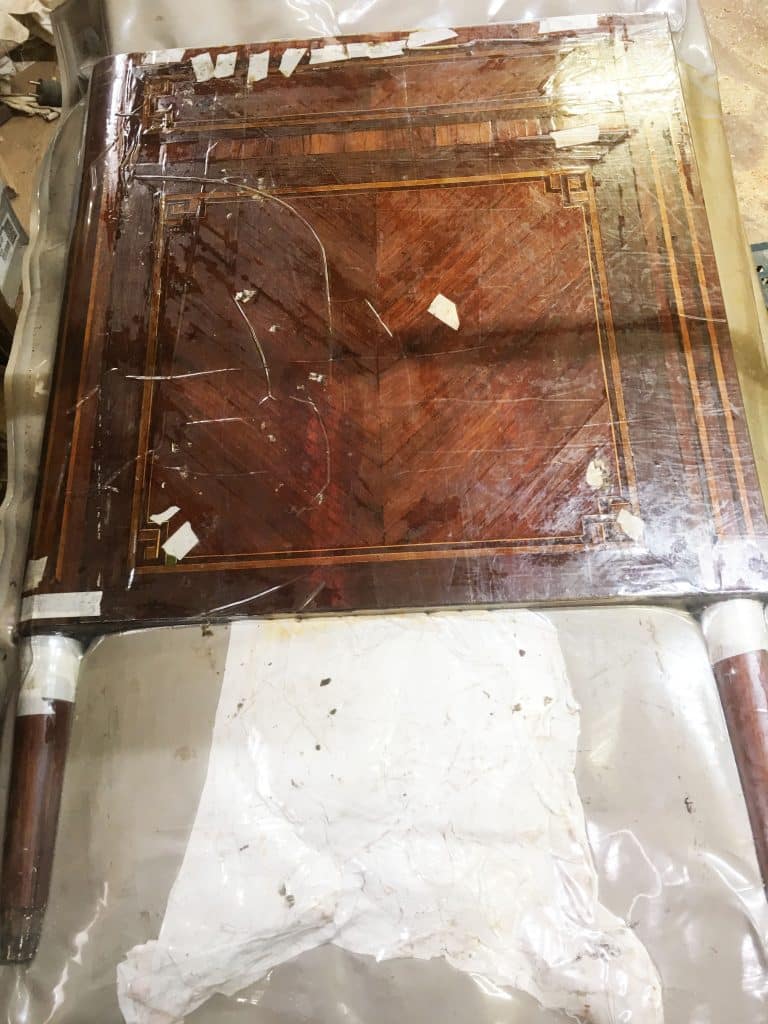
All the components were then reassembled and glued with fish glue or pegged at the back. The drawers, runners, and slides were readjusted and made to work properly, as were the locks.
The chest of drawers was stripped and cleaned, then very lightly sanded and filled with pumice. Finished with a colorless French polish.
The bronzes were cleaned and reattached with the original nails.