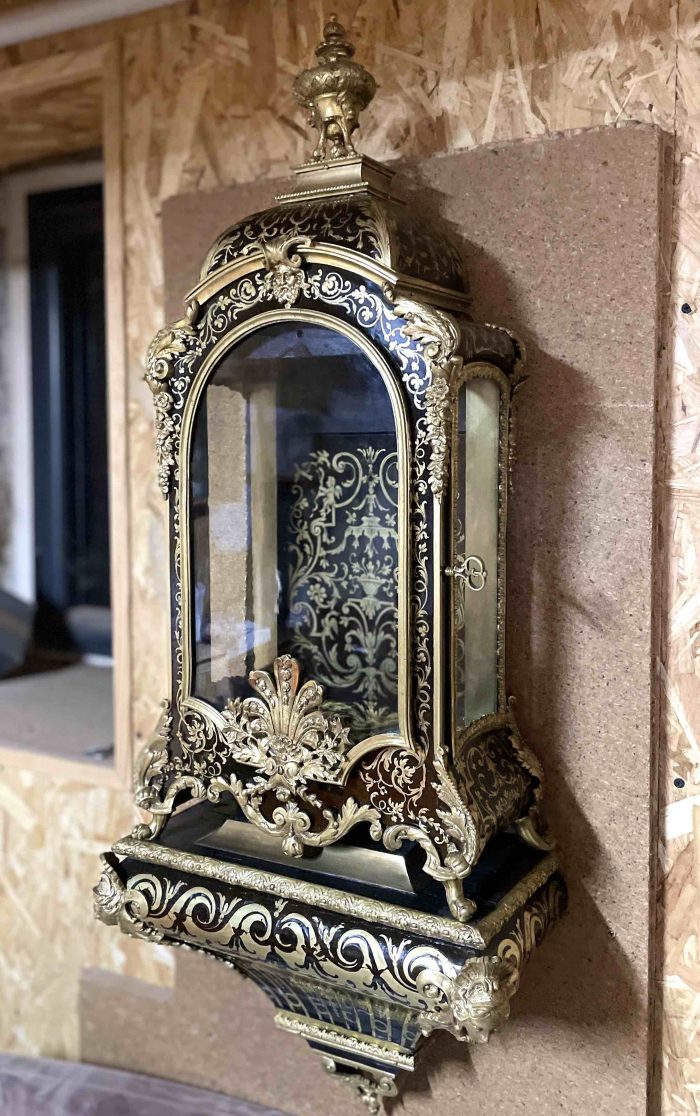
Restoration of a Regency cartel clock in Boulle marquetry on a brown tortoiseshell background.
Since antiquity, humankind has sought to master and create a "keeper of time." Egyptian obelisks, water clocks, sundials, hourglasses. But it was in the 15th century that the first mechanical clocks weighted, with a single hand, but generally equipped with chimes. Then in the 16th century, the counting of the days in two parts, 12 hours instead of 24 hours, was adopted almost everywhere, even if each city kept its meridian time until the advent of railways and universal time.

State of affairs report
Under heavy soiling that made the marquetry difficult to read, all the adhesives had dehydrated, causing the brass to detach. The frame itself was in good condition. There were a few missing pieces, mainly on the console.


After removing the bronze pieces, having carefully placed them on a storage board, the entire clock face was cleaned using micro-vacuuming. The brass elements that were completely detached or had already fallen off (and were placed in an envelope by their owner, thankfully) were immersed in a bath of demineralized water and a complexing agent to clean them and remove the oxidation.


The glue residue from the frame was cleaned by gel, and the old cyanoacrylate glue joints unfortunately had to be removed mechanically.
The missing brass and scale pieces were restored and then glued back on with hot fish glue under vacuum.
The bronzes were cleaned with steam.