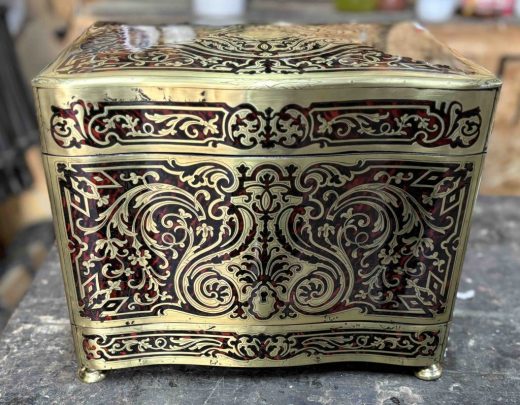
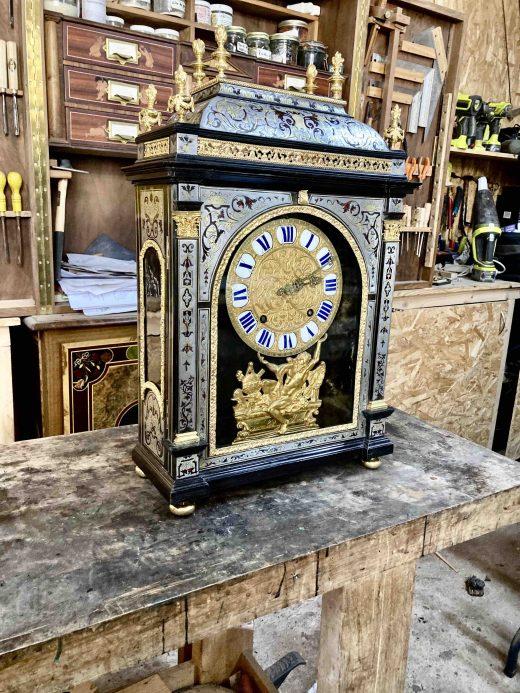
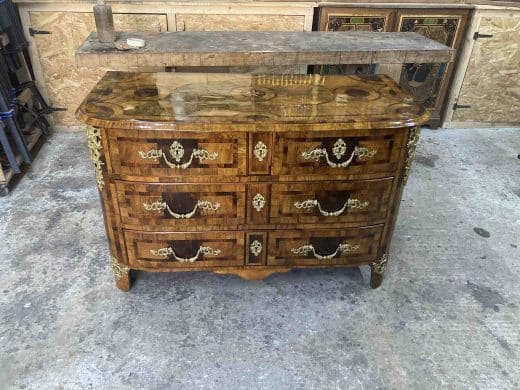
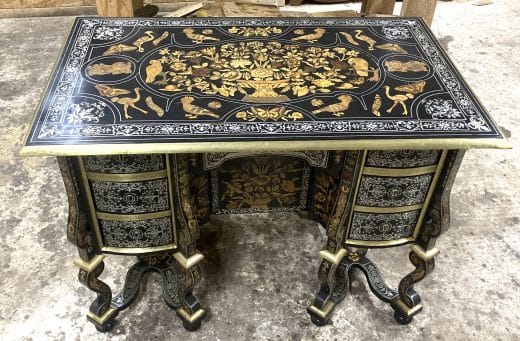
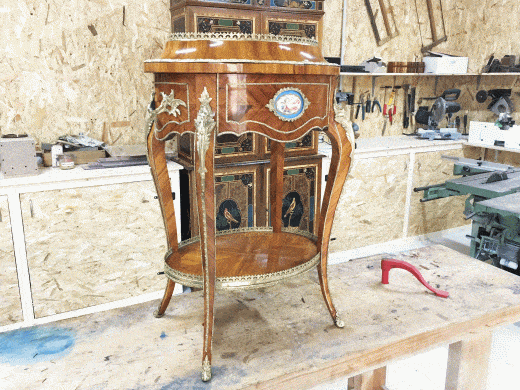
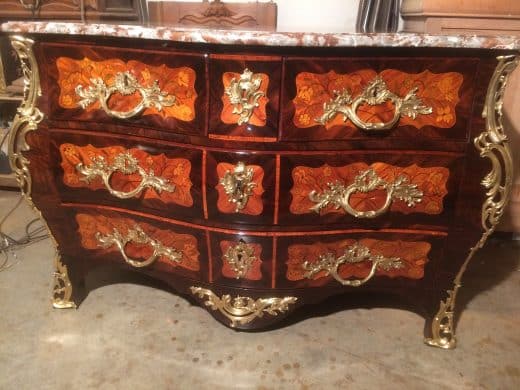
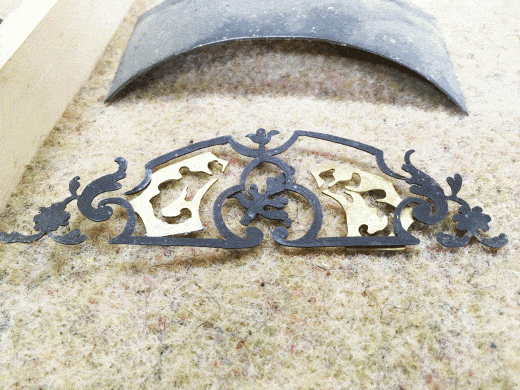
Boulle Napoleon III liquor cabinet

Ebénisterie Mathieu Vath

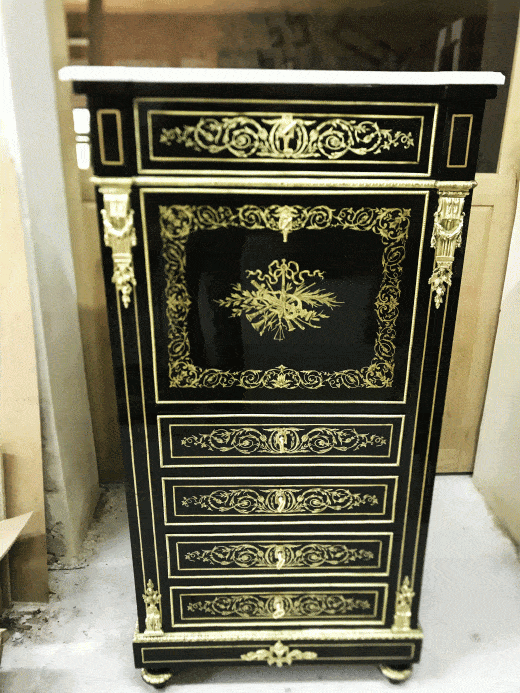
Restoration of a Napoleon III liquor cabinet in tortoiseshell and brass marquetry. The liquor cabinet, an elegant and ingenious piece of furniture, appeared at the end of the 18th century. Initially designed to accompany long carriage journeys, it allowed for the easy transport and consumption of liqueurs. Its true rise in popularity, however, occurred in the 19th century, a period during which it became a symbol of refinement and the French art of living. This piece of furniture takes the form of a box, called a "caisson," […]
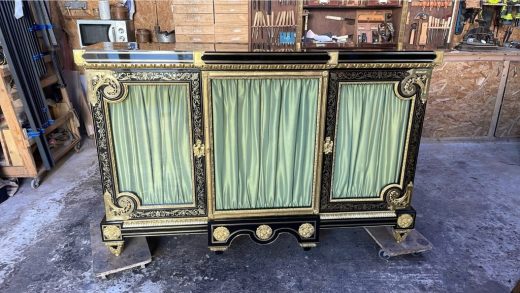
Louis XIV low bookcase

Ebénisterie Mathieu Vath

Restoration of a low Louis XIV style bookcase, in Boulle marquetry of brown tortoiseshell and brass, ebony, and chiseled and gilded bronze ornamentation. The central projecting front opens with three glazed doors decorated with scroll and foliage motifs, resting on tapered legs. This type of three-part low cabinet was one of Boulle's great successes, and he himself offered several variations. The Louvre Museum, in fact, owns no fewer than six examples. These pieces of furniture, particularly suited to the display […]
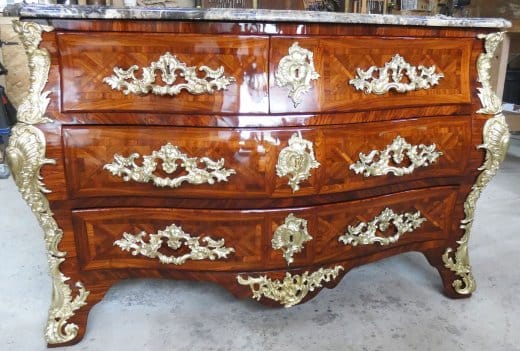
English Cabinet

Ebénisterie Mathieu Vath

Restoration of a late 17th/early 18th-century English cabinet, veneered in walnut and maple, featuring the distinctive free-flowing arabesque marquetry known as seaweed marquetry because it evokes the seaweed found on the seabed. English "seaweed" marquetry is traditionally associated with Dutch and Flemish cabinetmakers active in the second half of the 17th century, and particularly with Gerrit Jensen. Indeed, when Prince William III of Orange ascended the throne of England in 1689, he was accompanied by his cabinetmakers. Subsequently, religious persecutions on the […]
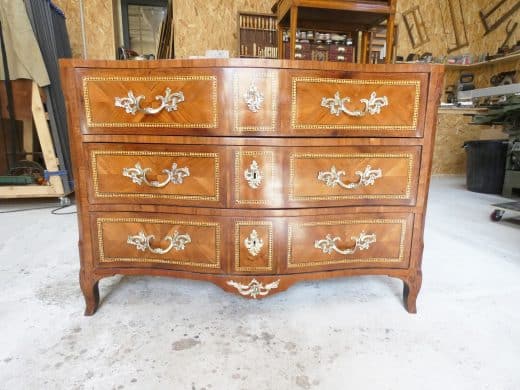
Transition Secretary

Ebénisterie Mathieu Vath

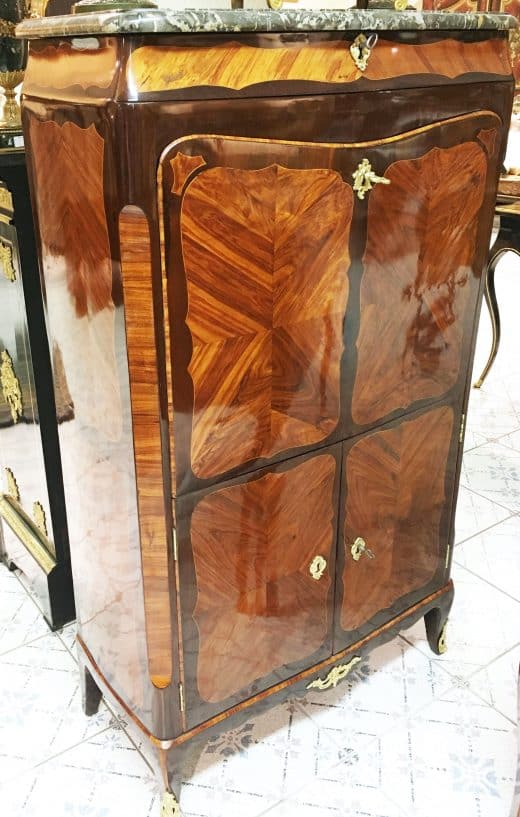
Restoration of a transitional rosewood and amaranth secretary desk with simulated fluting using boxwood and ebony. The frame is made of oak and softwood. As is often the case with secretaries, one of the main areas of damage is the hinges of the fall-front, which have cracked and damaged the frame and veneer. The work involved replacing the solid wood that provides support and proper alignment before replacing the missing amaranth veneer. The […]
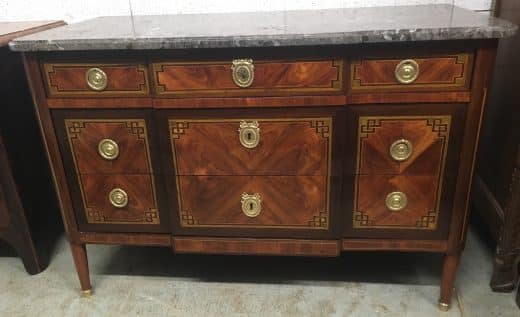
Louis XVI commode stamped J. LAPIE

Ebénisterie Mathieu Vath

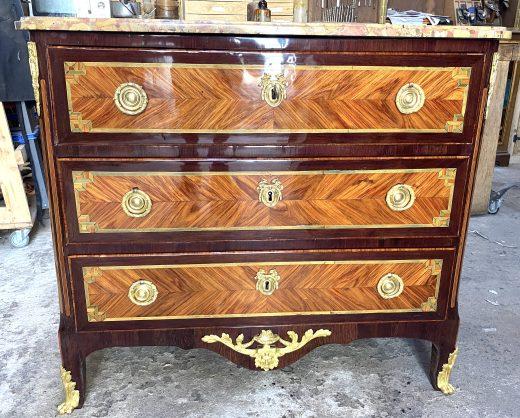
Restoration by Lise, during her internship at the workshop, of a Louis XVI commode stamped by Jean Lapie, constructed of oak, fir, and beech, veneered in rosewood with hornbeam and amaranth stringing, and adorned with gilt bronze mounts. And since Lise submitted an excellent internship report, I am publishing it almost in its entirety. Jean Lapie (known as "The Younger"), son of the potter Nicolas Lapie, was born around 1734. Brother of the cabinetmaker Nicolas-Alexandre Lapie (known as "The Elder") and cousin of Jean-François Lapie, he obtained his master's degree in Paris […]
Regency style commode stamped Hédouin

Ebénisterie Mathieu Vath

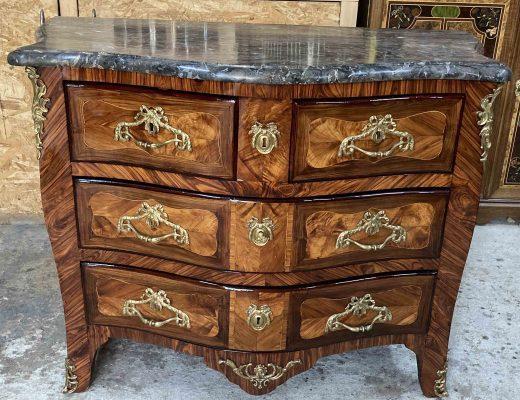
Here is the latest restoration by Raphaël, my apprentice. Although it possesses all the attributes of a Regency commode, it could only have been made much later, after this historical period (around 1715-1723). Indeed, since Hédouin obtained his master craftsman's certificate in 1738, during the height of the Louis XV era, it is more accurately described as a commode "in the Regency style" by cabinetmakers of the time. This commode is entirely constructed of oak, except for the interior panels, and is veneered with amaranth and satinwood. Jean-Baptiste HEDOUIN The life of Jean-Baptiste Hedouin is quite […]

Regency Cartel

Ebénisterie Mathieu Vath

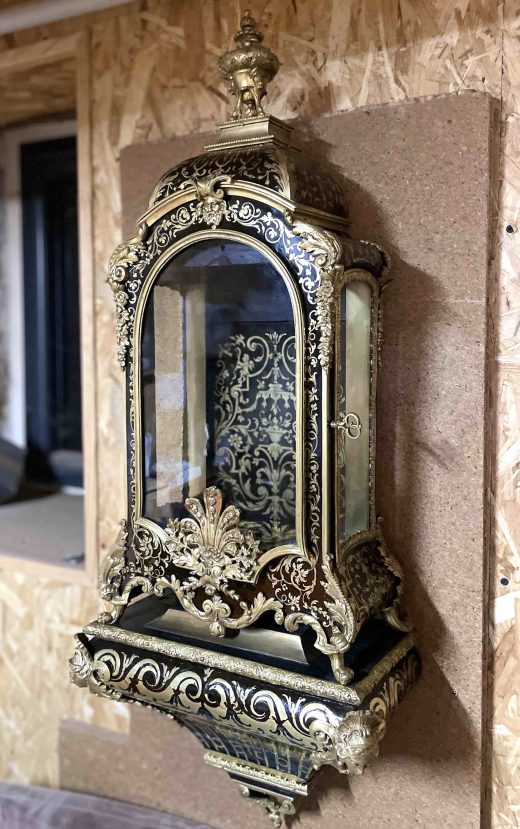
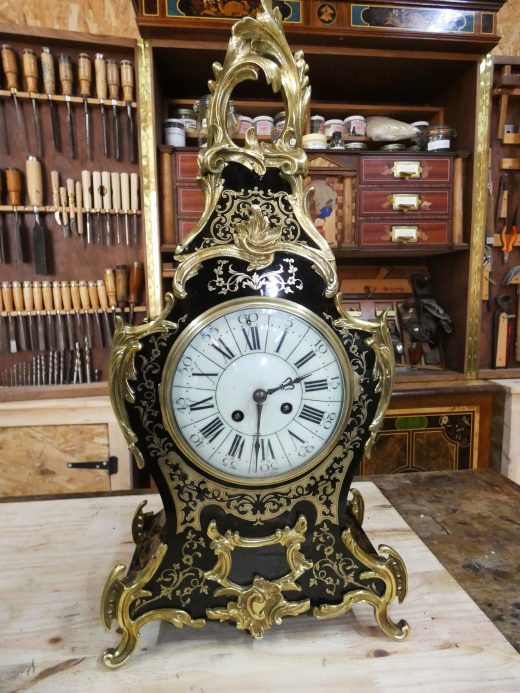
Restoration of a Regency clock case in Boulle marquetry on a brown tortoiseshell background. Since Antiquity, humankind has sought to master and create a "timekeeper." Egyptian obelisks, water clocks, sundials, hourglasses. But it was in the 15th century that the first mechanical weight-driven clocks were made, with a single hand, but generally equipped with chimes. Then, in the 16th century, the counting of the day in two parts, 12 hours instead of 24, was adopted almost everywhere, even though each city kept its own meridian time until the advent of railways and […]

Transition sauté pan with Boudin stamp

Ebénisterie Mathieu Vath

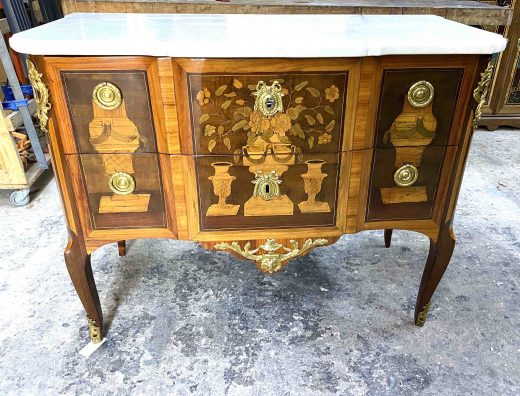
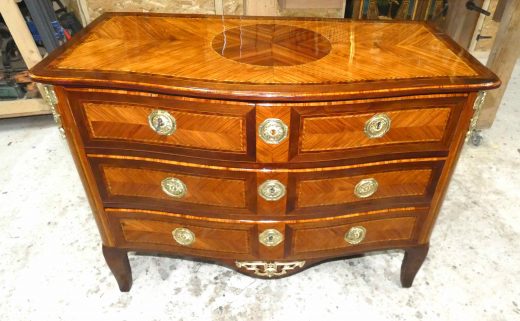
Restoration of a Transitional commode stamped by the master cabinetmaker Léonard Boudin (1735 in Paris – 20/12/1807). It is constructed of solid oak and veneered with amaranth, rosewood, tobacco-stained maple, and marquetry of boxwood, hornbeam, and holly, decorated with panels featuring floral vases and covered pots on the front and sides. With a slight central projection on the front, opening to reveal two drawers without a central divider, its rounded uprights rest on cabriole legs. Many Transitional commodes of this type have […]

Louis XV secretary stamped C.Chevallier

Ebénisterie Mathieu Vath

Restoration of a Louis XV period drop-front secretary, also known as a cabinet, stamped by Charles Chevalier, with curved sides and a front without an intermediate rail. Constructed of oak and softwood, it is veneered with marquetry of maple, boxwood, blue-stained maple, holly, hornbeam, and barberry on a rosewood ground framed by violet wood. The drop-front opens with its original three-point lock, revealing a compartment containing seven shelves in four rows and four drawers. The whole contains […]

Transitional chest of drawers stamped SAUNIER

Ebénisterie Mathieu Vath

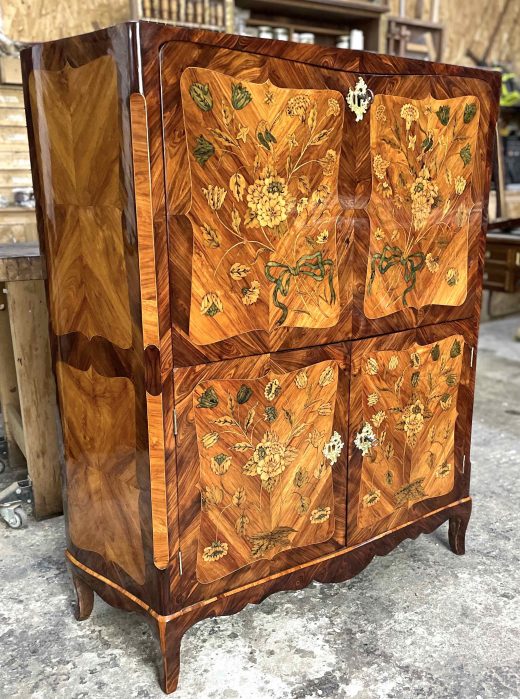
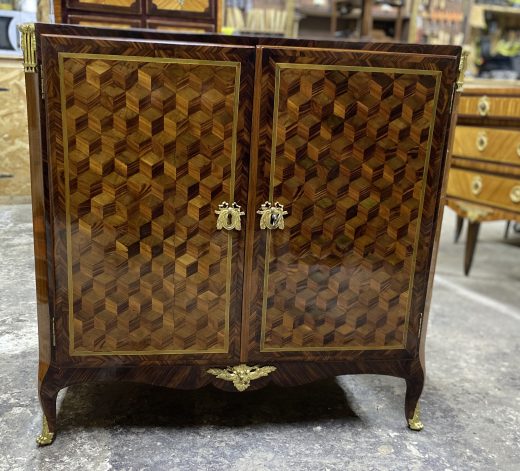
Restoration of a transitional two-door commode veneered with bottomless cube marquetry. The frame is oak for the uprights and rails, the side panels are softwood, and the two doors are walnut. The bottomless cubes are veneered with rosewood, violetwood, and tobacco-stained maple. The entire piece is framed with a stringing of green-stained maple and boxwood. The uprights and door frames are veneered with violetwood and rosewood. The sides […]

Louis XV commode stamped NA Lapie

Ebénisterie Mathieu Vath

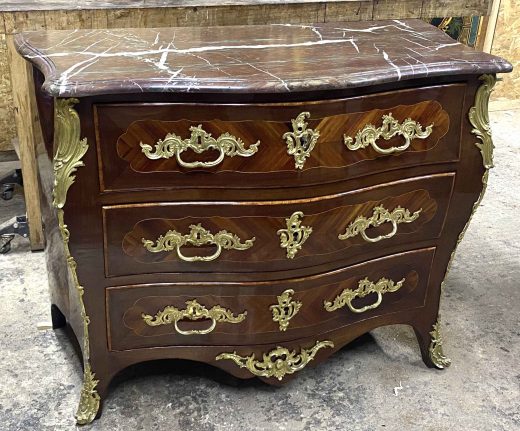
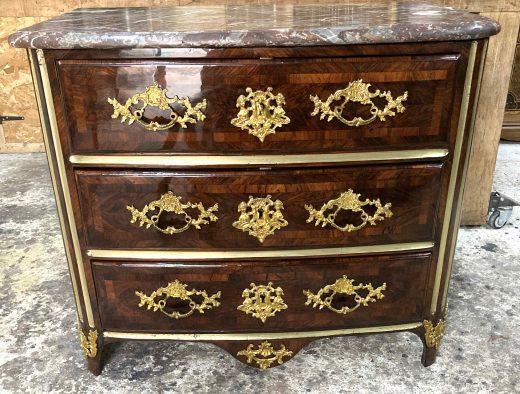
Restoration of a Louis XV commode, stamped by Nicolas Alexandre Lapie, veneered in amaranth and satinwood on a beautifully crafted oak frame. The sides and drawer fronts are made of softwood, and the marble top is Campan griotte marble. Nicolas Alexandre Lapie, son of Nicolas Lapie, a pottery merchant in the Faubourg Saint-Antoine, and brother of the master cabinetmaker Jean Lapie, Nicolas Alexandre (known as the Elder) appears to have been born around 1730. He registered his master's letters at the Châtelet in Paris on the 17th […]

Louis XV slant-front desk

Ebénisterie Mathieu Vath

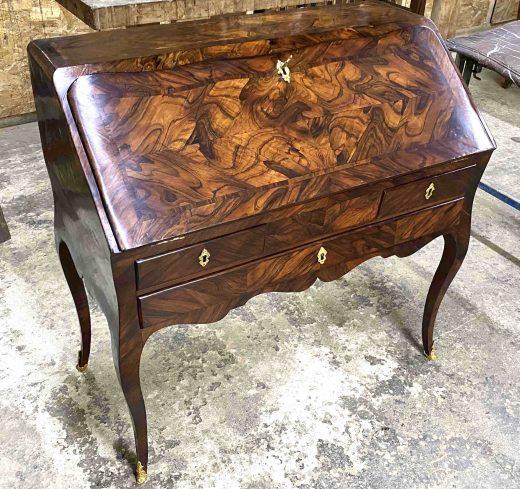
Raphaël's first restoration project was this Louis XV period rosewood veneer slant-front secretary. It was a complete restoration involving numerous veneer grafts and a waxed, filled finish. A delicate job, as rosewood is unforgiving. The slightest misstep with the chisel, or excessive sanding, and its beautiful blond patina disappears, revealing the original dark color and causing unsightly stains. Therefore, there was no choice but to scrape and sand the newly sawn veneer and cut it to the correct thickness before gluing it […]

Regency chest of drawers with Spanish-style drawers

Ebénisterie Mathieu Vath

Restoration of a Regency period commode with a serpentine front and espagnolettes, curved on all sides, veneered in violet wood on a walnut frame, opening with four drawers in three rows and topped with a Belgian Griotte Red marble slab with ears and a corbelled edge. The pinched uprights are dark, as are the front rails, with fluting and brass reeding. Its high-quality bronze ornamentation features superb chasing and includes very rare espagnolettes (seen on six commodes: four by Etienne Doirat, one by François Lieutaud […]

Louis XVI secretary stamped TOPINO

Ebénisterie Mathieu Vath

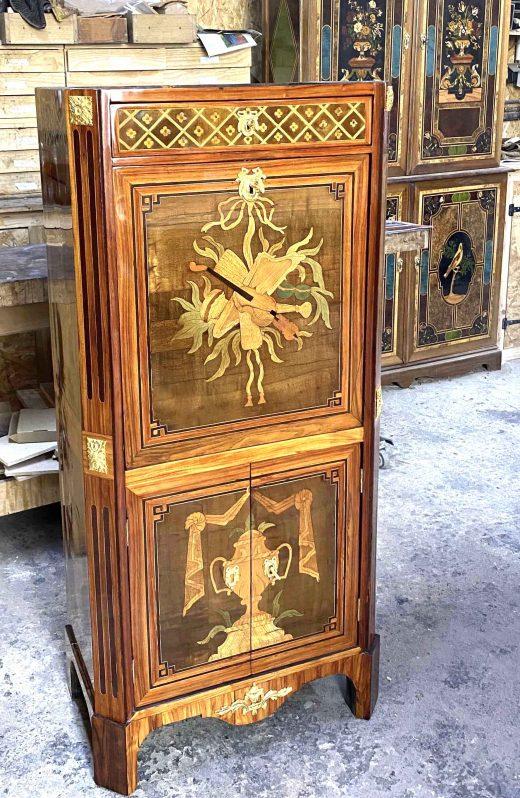
Restoration of a Louis XVI secretary desk stamped by Charles Topino. Typical of Topino's style, this secretary is constructed of oak and softwood. The front opens with a drawer and a drop-front covered in red leather tooled in gilt, revealing two compartments and four drawers veneered in rosewood. The lower section opens with two doors revealing a shelf. These are decorated with marquetry depicting a vase and drapery on a tobacco-colored ground, while the drop-front is inlaid with musical instruments, ribbons, and foliage on […]

Louis XV desk

Ebénisterie Mathieu Vath

Restoration of a Louis XV desk veneered in rosewood and violet wood on an oak and softwood frame. Replacement of missing veneer, cleaning, and refinishing with a French polish. Cleaning and conservation of the leather. Removal and steam cleaning of the gilt bronze mounts. To see previous restorations: https://ebenisterie-mathieuvath.fr/en-ce-moment-a-latelier/

Transitional chest of drawers stamped J.STUMPFF

Ebénisterie Mathieu Vath

Here are some images of the restoration of this commode stamped by Jean-Chrysostôme Stumpff. 1731 - January 17, 1806 – Received Master Craftsman status on August 27, 1766. Framed in oak and softwood, it is veneered with rosewood in a frieze of paillon, amaranth, and boxwood and green-stained maple. J. STUMPFF, originally from Schweigern, Swabia (Germany), married in 1760 in Paris, at the Swedish embassy, like most of his compatriots of the Reformed faith. His fellow cabinetmaker, Ferdinand Scherdfeger, was a witness. […]

Louis XIV commode

Ebénisterie Mathieu Vath

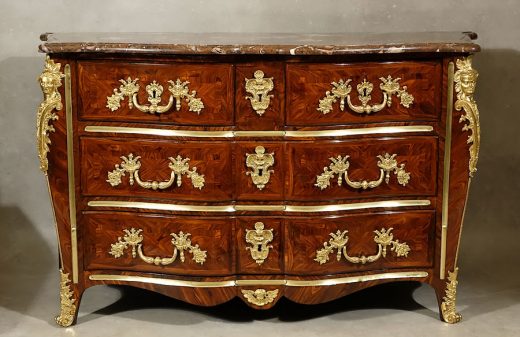
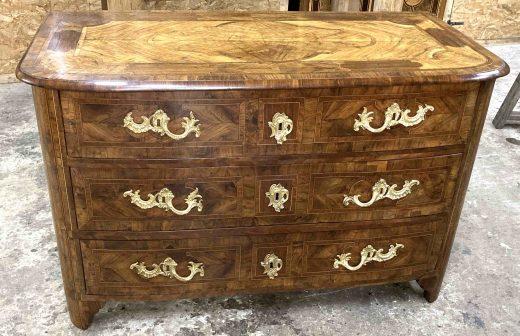
Restoration of a Louis XIV period commode veneered in olive burl, ash, and walnut, likely from the Dauphiné region. This type of commode (D-shaped), along with the Mazarine commode, was among the very first commodes popularized under Louis XIV. Indeed, the appearance of the earliest French furniture resembling the commode dates only from the 1700s; thus, the oldest known and datable Parisian commodes are those delivered by André-Charles Boulle to Versailles around 1708. Their very simple decorations are inspired by Dutch designs, often executed by […]

RELIGIOUS CLOCK, Sarrabat Paris

Ebénisterie Mathieu Vath

Restoration of a 'religious' clock with a striking mechanism on the half-hour, signed (dial and movement) 'Sarrabat à Paris', third quarter of the 17th century. Religious clocks were the earliest form of clocks during the reign of Louis XIV, the Sun King. Their popularity increased from 1660 onwards, thanks to Huygens' discovery of the regulator pendulum. This particular clock features Boulle marquetry of red tortoiseshell, brass, and pewter on a walnut frame, decorated with gilt bronze mounts and ebony moldings. The lower molding is also ebony and rests on […]

Louis XIV commode from the Dauphiné region

Ebénisterie Mathieu Vath

Restoration of a Louis XIV period commode in olive burl, rosewood, and boxwood, likely from the Dauphiné region. This type of commode (D-shaped), along with the Mazarine commode, was among the very first commodes popularized under Louis XIV. Indeed, the earliest French furniture resembling the commode only appeared in the 1700s; thus, the oldest known and datable Parisian commodes are those delivered by André-Charles Boulle to Versailles around 1708. Their very simple decorations are inspired by Dutch designs, often crafted by Protestant cabinetmakers […]

Regency Cartel

Ebénisterie Mathieu Vath

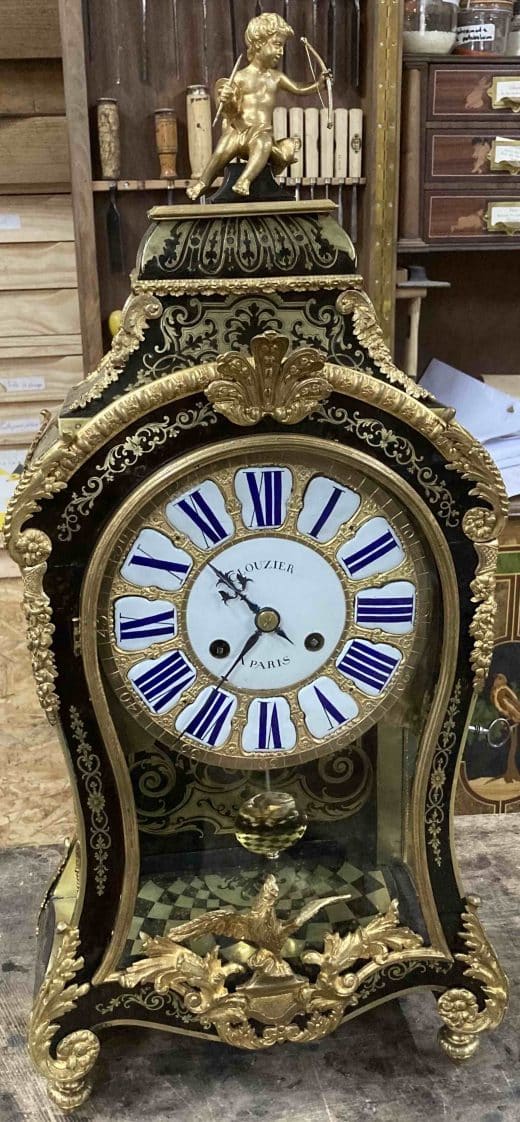
Here are some images of the restoration of a Regency period cartel clock in brown tortoiseshell and brass marquetry on an oak frame. The movement is signed CLOUZIER A PARIS. Jacques Clouzier (1692-1754) was received as a master clockmaker by awarding a masterpiece on July 5, 1692. He was one of the greatest Parisian clockmakers of the Louis XIV and Regency periods. He became a member of the clockmakers' guild in the 1700s, then worked on Rue Saint-Antoine until 1726 and later on Rue des Prêtres Saint-Paul. He remained active until his death […]

8-foot desk stamped Manet

Ebénisterie Mathieu Vath

Restoration of an eight-legged desk, commonly known as a "Mazarin" desk, from the Louis XIV period, late/early 17th century. Constructed of pear and solid softwood, the sides and drawer bottoms are also pearwood. It features two side cabinets, each opening with three drawers, a central drawer above a middle cabinet with rounded edges, and console-shaped uprights and eight legs joined by two X-shaped stretchers. The drawers are inlaid with pewter and blackened pearwood, depicting a late 17th-century design. […]

Louis XIV commode

Ebénisterie Mathieu Vath

Restoration of a Louis XIV commode constructed of fir and Rio rosewood veneer. The front is slightly convex, as are the uprights and rails. It features brass fluting. The remarkably crafted varnished bronze mounts have retained their original varnish. The restoration consisted of rehydrating all veneered surfaces by infiltrating glue. Missing areas were filled with rosewood veneers that were sawn, scraped, sanded, cut to the correct thickness as a backing, and UV-oxidized before being glued with hot glue. As you can see on […]

Louis XV Cartel

Ebénisterie Mathieu Vath

Restoration of a Louis XV period clock and its lamp base in pure Rococo style. It is constructed of solid oak and veneered with brass and tortoiseshell. Do you know what Rococo style is? Rococo style belongs to the early period of the Louis XV style (1723-1750) and reached its peak around 1730. It is characterized by rich naturalistic decoration. It drew inspiration from artificial grottoes and elements of rock recreated in asymmetrical compositions. This decoration, which marks the beginning of the Baroque, is complemented by seashells, elements […]

Louis XV/Transitional Commode

Ebénisterie Mathieu Vath

A true renaissance for this chest of drawers, which I call Louis XV/Transitional because its form and construction are entirely Louis XV. However, the handles and keyhole escutcheons are typically Louis XVI. And I can attest that these are indeed its original fittings. The nail holes match perfectly, and there are no other holes beneath the bronze mounts. So, even if this piece of furniture doesn't conform to what is commonly called the Transitional style, this chest of drawers is most certainly one of the first […]

Regency Cartel

Ebénisterie Mathieu Vath

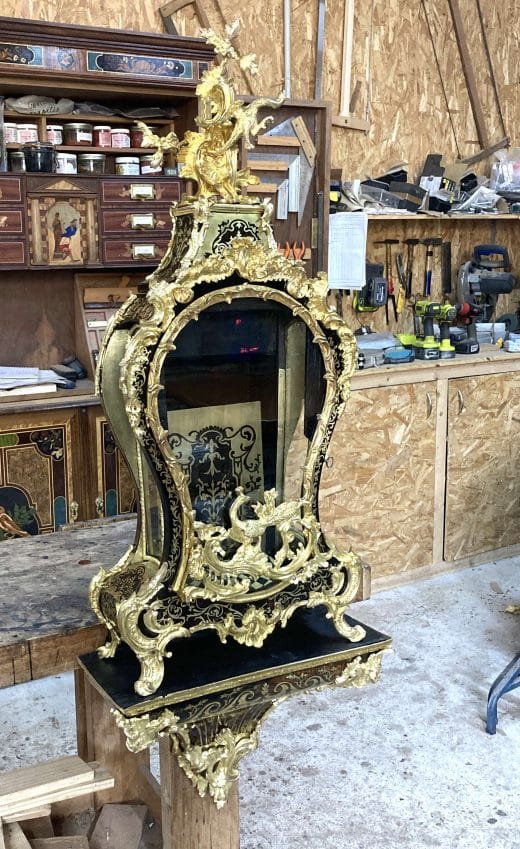
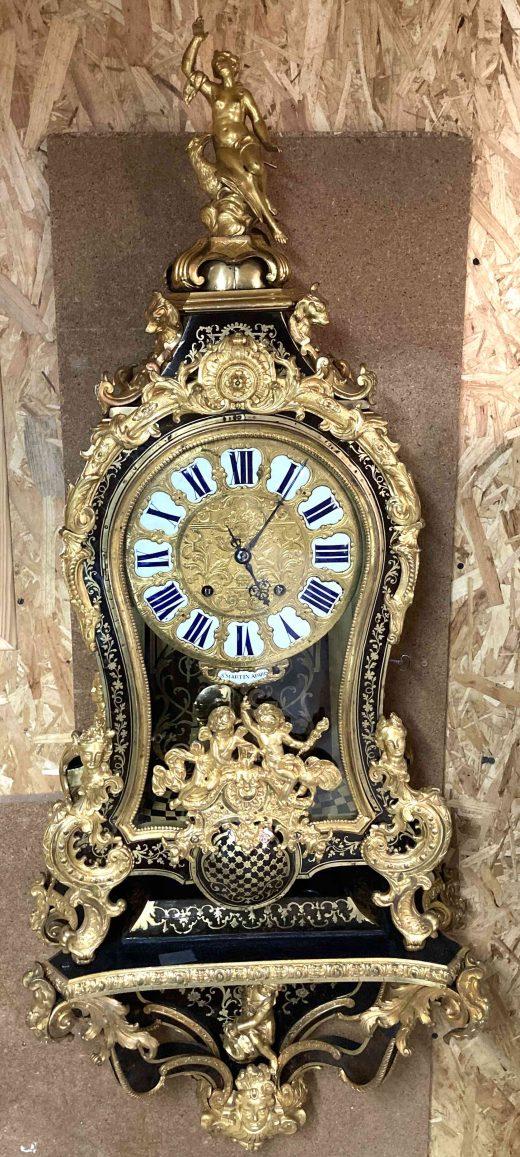
Restoration of a large cartel clock (137cm high) and its console-style bracket from the Regency period. It is made of solid oak veneered with Boulle marquetry of brown tortoiseshell and brass. It is decorated with floral garlands, crosshatching, and foliage. The dial is made of chased and gilded bronze with an interlacing design and birds; the Roman numerals are enameled, and the signature St Martin à Paris is inset. The plate is signed with the same name. It is adorned with chased and gilded bronze mounts depicting on its capital […]

Louis XVI commode stamped JB.Tuart

Ebénisterie Mathieu Vath

Here is a very pretty Louis XVI period commode veneered in rosewood and amaranth with marquetry of boxwood, pearwood, maple, hornbeam, walnut, blackened pearwood, lemonwood… It is built of oak and softwood. It is stamped twice with the mark of Jean-Baptiste II TUART. But its maker is probably Jean LAPIE. From a dynasty of Parisian cabinetmakers and merchants, whose father, Jean-Baptiste I, obtained his master's certificate in 1741 and was active until around 1760, Jean-Baptiste II, born around 1720, was not a master cabinetmaker but a master furniture maker and haberdasher […]

Regency chest of drawers

Ebénisterie Mathieu Vath

Restoration of a Regency commode veneered in rosewood and palisander. The commode arrived in very poor condition; the joints were completely detached, there was significant veneer loss, major structural deformations on the sides, and a patina heavily soiled by multiple layers of dark wax. The bronze mounts and locks had been added during a 19th-century restoration. A standard restoration for this type of furniture was carried out; the sides and joints were re-glued as best as possible, and the missing veneer was […]

Empire Gueridon

Ebénisterie Mathieu Vath

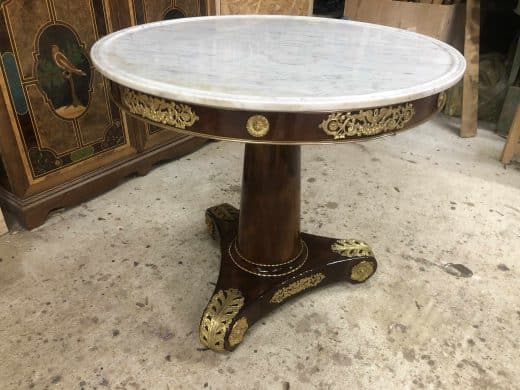
Restoration of an Empire-style mahogany burl veneer pedestal table. It was in rather poor condition upon arrival at the workshop; the bronze mounts were heavily soiled, there was significant structural delamination, and veneer was missing. The restoration therefore consisted of re-gluing the structural elements and the veneer. This operation was carried out under vacuum with the injection of a penetrating adhesive for the upper apron and the central shaft. The few old grafts, which had been done with the grain running in the wrong direction, were removed and replaced with a matching veneer […]

Louis XV/Transition Commode by Nicolas Abraham Couleru

Ebénisterie Mathieu Vath

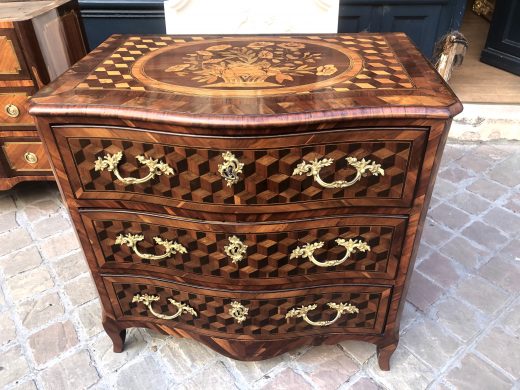
This slightly curved commode, composed of three drawers and veneered with bottomless cubes of walnut, plum, and cherry, has a marquetry top depicting a bouquet of flowers on an amaranth ground. Plum or Quetchier wood is easily recognizable by its sapwood markings, which create a lighter pattern and lend an irregularity to the decoration. The frame is made of fir and walnut. It is difficult to define a precise style for this commode. Although Louis XV, it clearly foreshadows the arrival of the style's more restrained appearance […]

Louis XVI Molitor Console

Ebénisterie Mathieu Vath

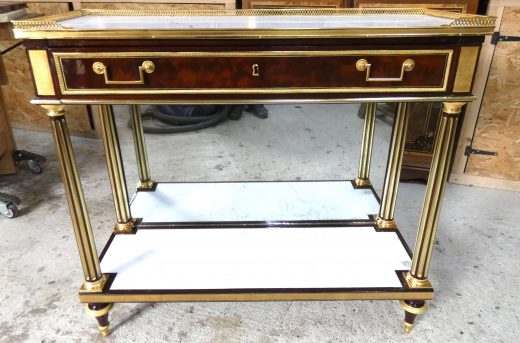
Restoration of a Louis XVI console table (1790-1795) stamped by Bernard Molitor. The structure is made of oak and solid mahogany for the legs. The panels of the lower shelf are beech. It is veneered with mahogany burl and ebony and brass stringing. Originally from Luxembourg, Bernard Molitor (1755 – November 17, 1833) obtained his master craftsman's certificate in Paris on October 26, 1787. He arrived in Paris in 1776 and worked in a small workshop located in the Arsenal district. It was after obtaining his master's certificate that he established himself on the rue de Bourbon-Saint-Germain. The austerity […]

Louis XV slant-front secretary

Ebénisterie Mathieu Vath

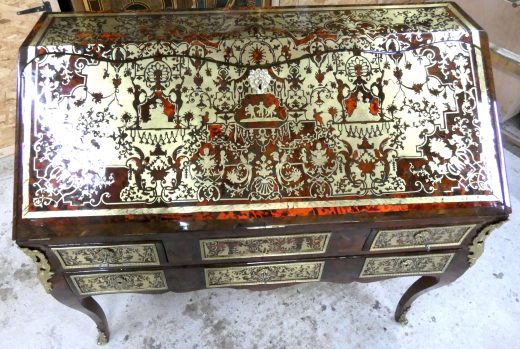
This week, a curious and very pretty Louis XV period slant-front secretary/desk in Boulle marquetry and rosewood. And yes, it wasn't only under Napoleon III that the reuse of Boulle marquetry was fashionable. In fact, Boulle marquetry continued to have admirers throughout the 18th century. It was from the 1750s onwards that the renewed interest was most pronounced. Prominent merchants, such as Lazare Duvaux, began selling them occasionally at considerable prices to prestigious clients, […]

Transition cylinder desk

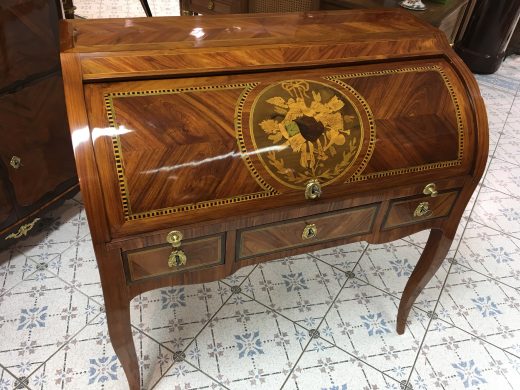
A few years ago, I had the opportunity to restore this magnificent Transition period (1780) roll-top desk. It is framed in oak and fir. The fall front is primarily veneered with rosewood laid in a paillon pattern, framed by a light stringing of boxwood and green-stained hornbeam, bordered by a thin band of amaranth. The back is veneered in satinwood. The central marquetry, on a tobacco-stained sycamore ground, depicts musical instruments and two doves taking flight, each carrying a musical score in its beak. This […]

Napoleon III Boulle marquetry side table

Ebénisterie Mathieu Vath

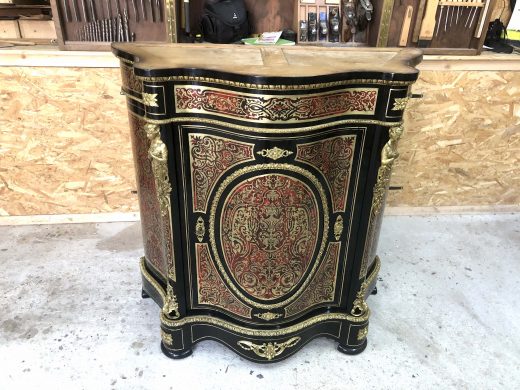
A console table veneered in ebonized pearwood and inlaid with Boulle marquetry of brass on tortoiseshell in arabesque designs. It opens with a door adorned with an oval medallion, revealing shelves in mahogany and mahogany veneer. Rich ornamentation of chased and gilded bronze: egg-and-dart friezes, caryatids in corner drops, interlaced friezes, acanthus leaf friezes, fruit, and florets. This Boulle piece requires extensive restoration. Some pieces of brass, stringing, and especially a great deal of tortoiseshell are missing. Given its value […]

Transitional chest of drawers stamped LARDIN

Ebénisterie Mathieu Vath

Restoration of a Transition period commode built of fir and oak and veneered with rosewood, framed with stringing of white hornbeam and green-stained wood, with a satinwood band surrounded by amaranth. The central medallion is satinwood veneer assembled in a herringbone pattern. The maker's mark and the JME (Journée des Métiers d'Étranger) are located at the base of the left rear leg. André-Antoine Lardin (1724 – August 10, 1790) obtained his master craftsman's certificate on July 1, 1750, and established himself on the rue de Charenton under the sign "Au Bois de Boulogne." He worked there until 1770, the date […]

Empire Dressing Table

Ebénisterie Mathieu Vath

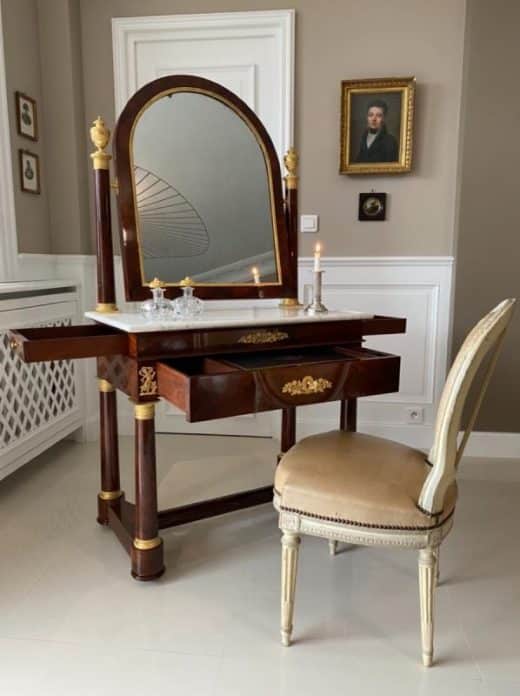
A beautiful restoration and, above all, conservation effort has been undertaken on this lovely Empire-period dressing table. Its frame is made of oak and poplar, veneered with mahogany burl. The drawer sides and bottoms are solid mahogany. It rests on four column legs ending in casters and joined by an H-shaped stretcher. The frieze opens with a drawer revealing a writing surface lined with blue morocco leather, a pen case, and two compartments for inkwells, as well as two large drawers on either side for essentials […]

Small Boulle marquetry cartel clock

Ebénisterie Mathieu VATH

Restoration of a Napoleon III period marquetry clock in brown tortoiseshell on a black ground and brass. Despite dust, oxidation, and years spent in the depths of an attic, this small clock is in very good condition. Except for a missing piece of brass on the right side of the capital, it is complete. The gilding is still clearly visible beneath the layer of grime, and the structure is in perfect condition. The restoration was therefore straightforward: re-gluing all the marquetry under vacuum, then a light cleaning, and a varnishing with […]

Hedouin commode with crowned C

Ebénisterie Mathieu VATH

Extensive restoration of this superb Louis XV period commode, stamped on all four uprights by Jean-Baptiste Hedouin. The frame and drawers are constructed of solid oak, fir, and walnut. The edges of the frieze and geometric marquetry in violet wood are veneered with satinwood. Two types of violet wood are visible: one with a very tight grain and veining for the lozenges, and a second, more intricate type for the marquetry edges, uprights, and rails. The […]

Transitional dresser

Ebénisterie Mathieu VATH

Here is a very simple chest of drawers from eastern France, probably dating from the late 18th century. The front is slightly curved and the uprights are chamfered. It should be noted that the bronze mounts are probably not original. The frame is made of solid softwood, and the uprights are oak. The drawer bottoms are set in rebates and slide on the drawer fronts, which is typical of provincial work. A small peculiarity: this chest of drawers does not have top panels, the […]

Louis XVI commode stamped JA BRUNS

Ebénisterie Mathieu VATH

This week marks the completion of the restoration of a Louis XVI commode stamped JA BRUNS. It is made of oak for all the structural elements, except for the side panels, drawer backs, drawer fronts, and the two drawer bottoms, which are made of softwood. It is veneered with rosewood in a butterfly pattern and amaranth for the edges. The false fluting is made of boxwood and ebony, and there is a green-stained maple stringing forming the corners at […]

Label signed "Louis David Carré in Paris"«

Ebénisterie Mathieu VATH

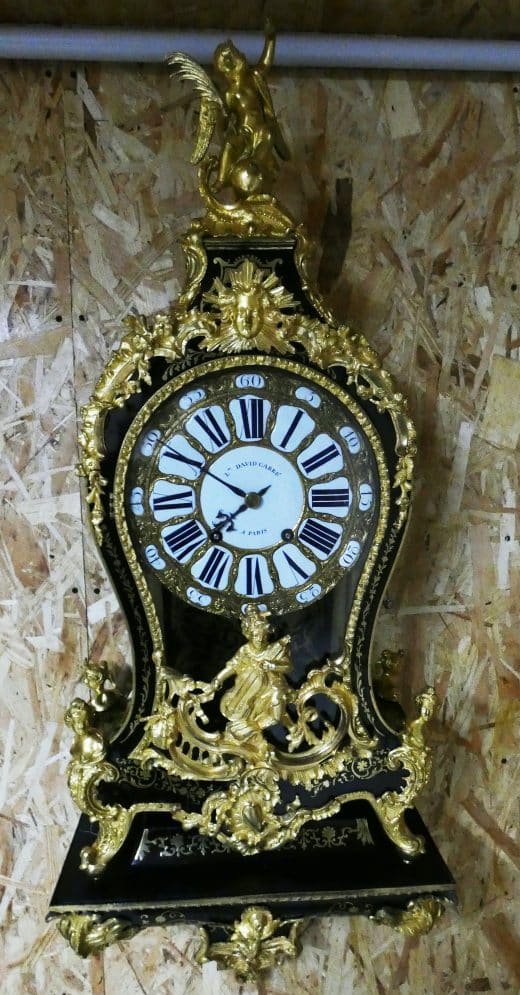
After several weeks of work, the restoration of this clock is finally complete. It is a Louis XV period clock in brown tortoiseshell and brass marquetry, with rosewood restorations. The dial is by Louis David Carré, nephew of Jullien le Roy, who became a master craftsman on December 31, 1748. Lodged at the Louvre from 1744, he was elected a juror in 1775. The greatest treasure of this clock lies in its bronze mounts. They are truly magnificent, and above all, they are in very good condition. There is only […]

Secretary stamped P.ROUSSEL JME

Ebénisterie Matheu VATH

Here are some images of the restoration of a secretary desk stamped by Pierre Roussel (1723-1782). Having become a Master Cabinetmaker in 1745, Pierre Roussel set up shop on Rue de Charonne, in the Faubourg Saint-Antoine, under the sign "L'Image de Saint Pierre" (The Image of Saint Peter). Thanks to his skills as a cabinetmaker and especially as an exceptional marquetry artist, he quickly gained a great reputation. In 1762, he became a sworn member of his guild. By 1767, he was considered one of the best cabinetmakers of his time. Highly regarded by his colleagues, he became a representative of the cabinetmakers' guild in 1777 and then syndic two […]

Secretary Napoleon III

Ebénisterie Mathieu VATH

On the restoration side, there wasn't much to do: the brass fittings were reattached with fish glue and by infiltration, then stripped and varnished. The most difficult part of this type of furniture is the black stain. Over time, pear wood darkens, loses its color, and turns gray. It then needs to be stained, without, of course, obscuring the brass. To do this, I fill and polish the piece until the brass becomes a true mirror. Then, I apply a hot logwood stain, and then […]

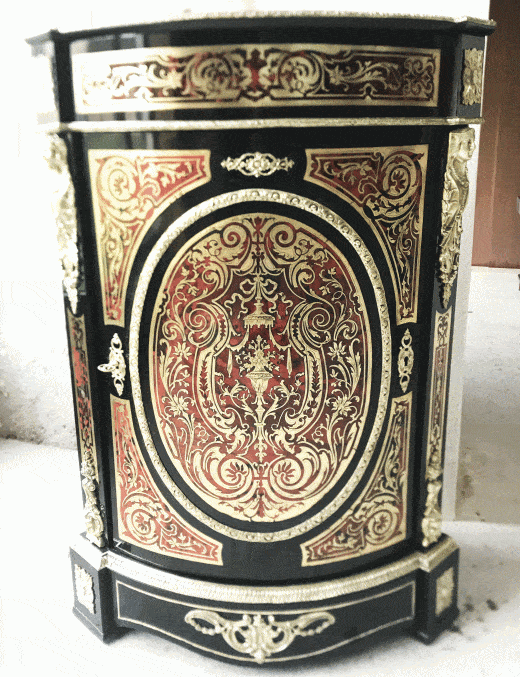
Corner cabinet in Boulle marquetry from the Napoleon III period

Ebénisterie Mathieu VATH

A classic restoration of Boulle marquetry. This involved rehydrating the old glue through infiltration, crafting and gluing the missing brass pieces, and reconstructing the base, which was in poor condition but not beyond repair. The bronze mounts were cleaned and finished with a clear French polish. Proof that appearances can be deceiving. Even a piece of furniture in a severely deteriorated state can regain its former beauty.

Louis XIII Cabinet

Ebénisterie Mathieu VATH

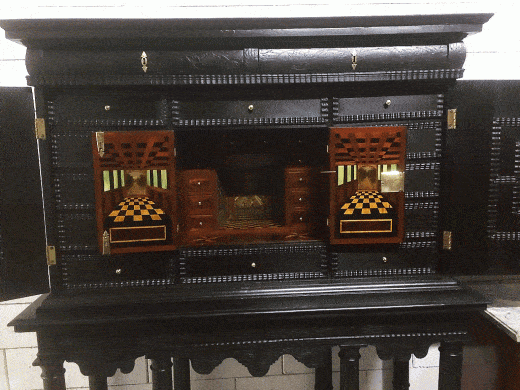
A look back at a fascinating restoration project (at least for me). So fascinating, in fact, that I forgot to take photos at the beginning! This cabinet dates from the 17th century and features two drawers in the cornice and two doors in the upper section. The base consists of two drawers in the frieze supported by eight turned feet and a top resting on ball feet. Inside are twelve drawers and two doors concealing an interior theater, as well as eleven more drawers. The feet, along with […]

Louis XV corner cabinet, stamped JM CHEVALLIER

Ebénisterie Mathieu VATH

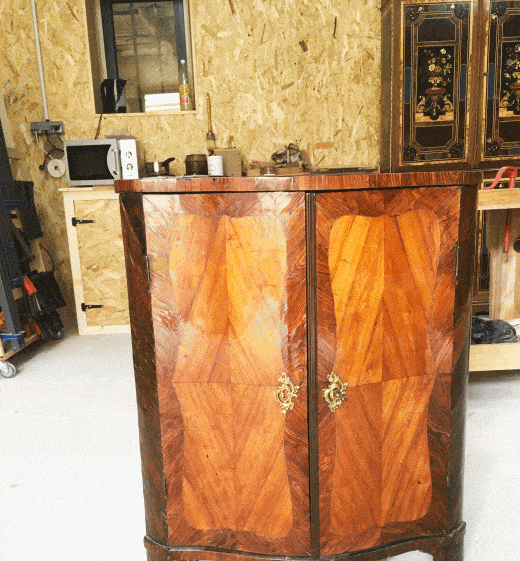
Here is a corner cabinet stamped by Jean-Mathieu Chevallier. It is made of solid oak and veneered with rosewood and violet wood with a boxwood inlay. Jean-Mathieu Chevallier was already established on the rue de Grenelle under the sign "à la Croix Chevallier" when he obtained his master craftsman's certificate in 1743. He subsequently expanded his business considerably, had business dealings with André-Charles Boulle, one of the sons of the famous cabinetmaker, and contributed to furnishing the Hôtel du Duc de Talmont, as well as the Château de Villegénis, which he had purchased […]

Napoleon III planter and Louis XVI chest of drawers

Ebénisterie Mathieu VATH

This week, two pieces of furniture left the workshop: a Napoleon III jardinière in rosewood veneer and a Louis XVI chiffonier in rosewood and violet wood veneer. If this piece had seven drawers, it would have been called a "semainier" (weekly chest of drawers). Here are some photos of their restoration.

Louis XV commode stamped JC Ellaume

restauration de mobilier

Restoration of a Louis XV period commode stamped JC Ellaume. This commode is veneered in rosewood and palisander with floral marquetry on the drawer fronts. The frame is made of oak and softwood. Jean-Charles Ellaume, also sometimes written as Allaume, received his master craftsmanship in Paris on November 6, 1754. Many pieces of furniture bearing his stamp are known. These are mostly Louis XV commodes. It was in his workshop on Rue Traversière that he produced numerous high-quality pieces of furniture for over thirty years, […]

Alexandre Morell's Boulle Cartel – Marquetry

Ebénisterie Mathieu VATH

After reattaching the structure, removing the brass, cleaning up any remaining animal glue, and removing any residue of superglue and neoprene adhesive, the next step is cutting out the new pieces of brass and tortoiseshell to fill the gaps. So, as usual, I take an impression of the missing piece. Then I glue this piece of paper onto a brass plate, which is itself glued with fish glue to a piece of 4mm plywood. This makes the brass plate easier to cut. To retrieve […]