Bonheur du jour Empire stamped by Antoine-Nicolas Lesage
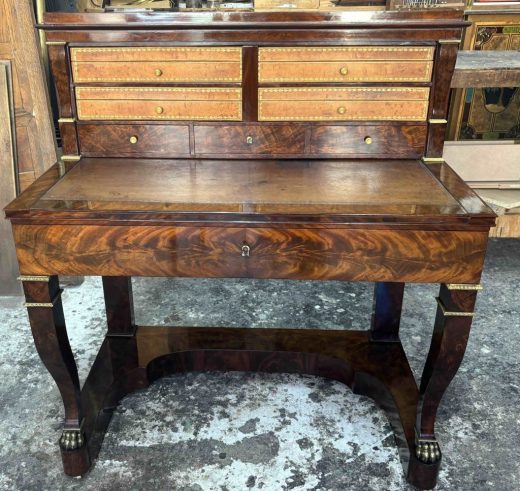
Restoration of an Empire bonheur du jour in mahogany veneer, stamped Antoine-Nicolas Lesage: top reattached, veneer missing, gilt bronzes cleaned and shellac finish redone.
Restoration. Conservation. Creation

Restoration of an Empire bonheur du jour in mahogany veneer, stamped Antoine-Nicolas Lesage: top reattached, veneer missing, gilt bronzes cleaned and shellac finish redone.

Here is a restoration carried out earlier this year by Raphaël. It was a long but successful undertaking. In fact, I recently revisited this desk: it has perfectly withstood significant variations in temperature and humidity. The rest of this report is in Raphaël's own handwriting. A "Mazarin" Desk This desk dates from the Louis XIV period. It is covered with Boulle marquetry of brass on a red tortoiseshell ground. Eight console legs support the case; they are connected in groups of four by an X-shaped stretcher. On the front, […]

One desk, one stamp, three cabinetmakers? This desk is a masterpiece of French cabinetmaking. It alone embodies the culmination of 18th-century Neoclassical taste. Yet, a question immediately arises: why three cabinetmakers for a single desk? In fact, the answer lies in a mixture of succession, talent, collaboration, and opportunism, typical of the craftsmanship of the period. This flat desk, known as a "Greek-style" desk, is a perfect example of the Louis XVI style. It combines marquetry of amaranth, satinwood, and other woods.

Restoration of a Regency period double-sided flat-fronted desk with a drawer unit, veneered entirely in kingwood. Its sides feature a diamond-point frieze, while the drawer fronts form an inverted slab pattern. Each side opens with four drawers in the frieze, with a central drawer on one side. Furthermore, a molding encircles the top, which is covered in gilt leather tooled in small pieces. The desk rests on eight cabriole legs ending in goat hooves. Most notably, it bears two emblematic bronzes from the oeuvre of André Charles Boulle: […]

Restoration of a desk veneered on all sides with yew burl and amaranth, decorated with geometric boxwood stringing. It opens with five drawers in the front and five simulated drawers in the back. Furthermore, the two lower drawers follow the contour of the edge and slide at a 45-degree angle. In addition, a bronze molding encircles the amaranth-veneered top. The desk rests on four cabriole legs, terminating in curious acanthus leaf bronzes. Finally, the frame is entirely oak, except for the drawers, which are walnut, with […]

Restoration of an Art Nouveau desk stamped by Louis Majorelle, made in Nancy around 1905. Crafted from solid walnut, it is decorated with primrose marquetry. The work involved replacing some missing veneer, cleaning the piece, and restoring its waxed finish. Louis Majorelle was born in September 1859 in Toul and died in January 1926 in Nancy, at the age of 66. Son of the renowned furniture maker Auguste Majorelle, he developed an early interest in craftsmanship and drawing. He then entered the École des Beaux-Arts in Nancy, […]

Minor maintenance restoration for this Transition-style bonheur-du-jour, veneered in rosewood. It also bears the stamp of Guillaume Cordié, the master of this type of desk. The work remained simple. First, we reattached a few veneer patches. Then, we addressed the oxidation and performed color restoration. Finally, we reapplied the French polish. Guillaume Cordié, born around 1733, initially worked as a freelance craftsman. He then obtained his master's certificate on June 18, 1766. He then established himself on the rue de Charonne, where he remained until […]
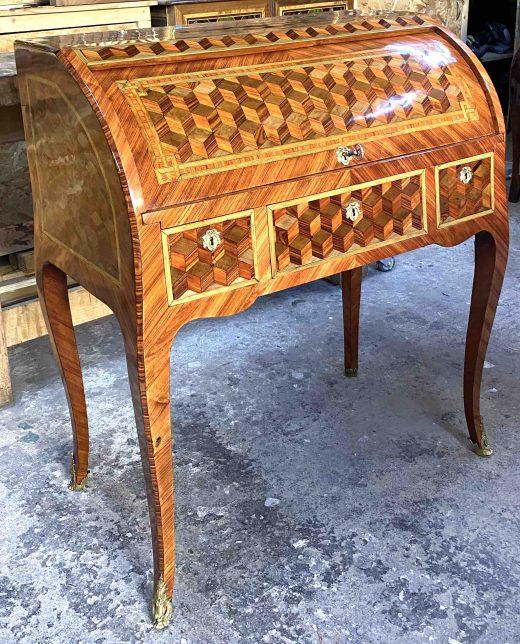
Restoration of a Transition period cylinder desk, stamped Jean-Georges Schlichtig. The legs and stretchers are oak. However, the panels and drop-front are softwood. It is rosewood veneered, with marquetry of bottomless cubes in rosewood and tobacco-stained sycamore. Furthermore, the Greek key stringing combines hornbeam and holly. The back and interior drawers are veneered in satinwood. Finally, this model is common in the work of this cabinetmaker, who produced several variations with bottomless cubes. The […]
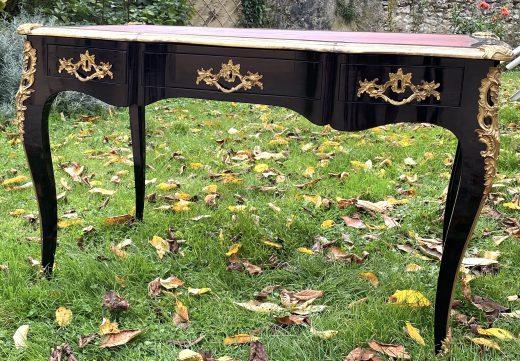
Restoration of a Louis XV desk stamped by Jean-Girard-Théodore SAR. It is a magnificent desk, of very high quality craftsmanship. Its legs, apron, and drawers are made of walnut. The top, however, is made of softwood. Finally, a beautiful Indian ebony covers the entire piece. Jean-Girard-Théodore SAR was born in 1724 and became a master craftsman on October 1, 1766. Established on Rue de Lappe, in the Faubourg Saint-Antoine, he worked primarily for fellow craftsmen. Among them were Migeon from 1755, Coulon in 1774, and Dubuisson. In addition, he supplied […]
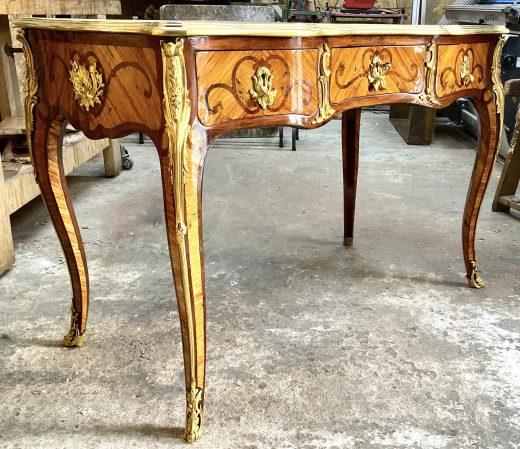
Restoration of a Louis XV desk veneered in rosewood and violet wood on an oak and softwood frame. Replacement of missing veneer, cleaning, and refinishing with a French polish. Cleaning and conservation of the leather. Removal and steam cleaning of the gilt bronze mounts. To see previous restorations: https://ebenisterie-mathieuvath.fr/en-ce-moment-a-latelier/
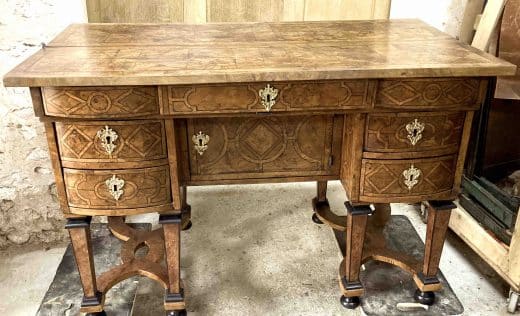
Restoration of an iconic piece of Louis XIV furniture, the Mazarin desk, named after the famous minister who served the king between 1642 and 1661, and who gave his name to this type of eight-legged desk. The stretchers and the narrow space between the two drawer units are a reminder that this type of desk required the user to sit at an angle: one knee below the writing surface and the other outside. This position was dictated by the wearing of the sword, always on the left. This […]
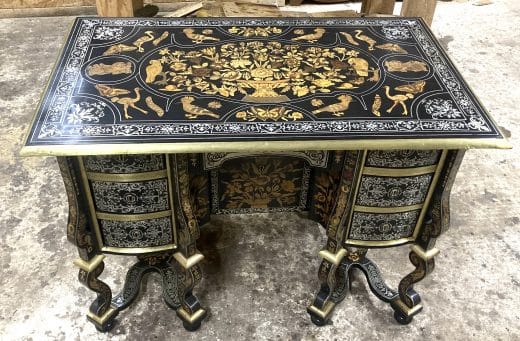
Restoration of an eight-legged desk, commonly known as a "Mazarin" desk, from the Louis XIV period, late/early 17th century. Its frame is made of solid pear and softwood, with pear wood sides and drawer bottoms. It features two side cabinets, each with three drawers, and a central drawer above a middle cabinet with rounded edges. Two X-shaped stretchers connect the uprights and the eight console-like legs. The drawers are inlaid with pewter and blackened pear wood, depicting a late 17th-century design. The sides, as well as […]
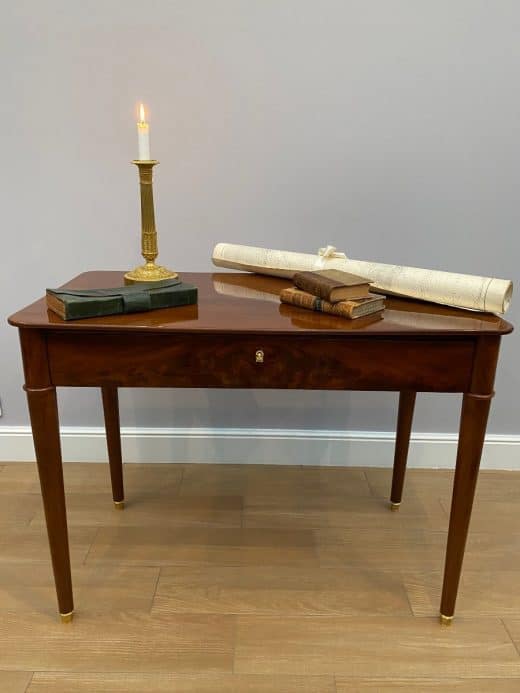
Restoration of a writing table built in oak, with a solid mahogany top and mahogany burl veneer. It features a large drawer in the frieze and rests on four tapered legs ending in gilt bronze sabots. Typical work of the late 18th century. To see previous restorations: https://ebenisterie-mathieuvath.fr/en-ce-moment-a-latelier/ This piece can be found at Antiquités Stéphane Guin.
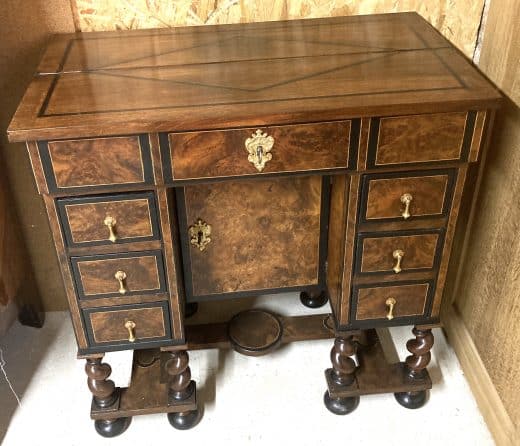
A few weeks ago, I introduced you to a money changer's table. Well, here's its successor: the money changer's desk. Inspired by the eight-legged desks more commonly known as "Mazarin desks," the money changer's desk is a smaller version. Often transported, it must protect the valuables it contains. Through its marquetry and more or less elaborate veneers, it also displays the prosperity of its owner. For those interested in the origins of these pieces of furniture and the money changer's profession, I […]
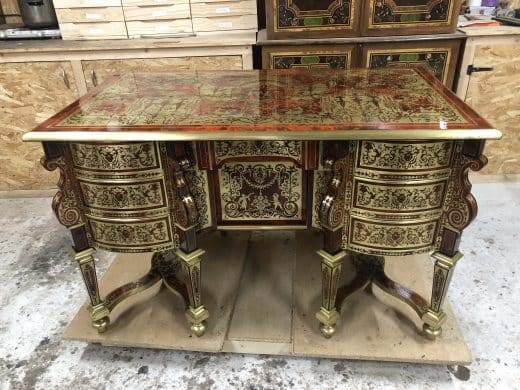
To end the year on a high note, here's a restoration that occupied a large part of my time this year and which reached its owner a few weeks ago. It's the restoration of an eight-legged writing desk, commonly known as a "Mazarin" desk. Constructed of solid oak and softwood, the sides and drawer bottoms are made of light walnut. The marquetry covering it consists of Caret tortoiseshell (Eretmochelys imbricata) on a vermilion red ground, and brass. All of this is framed by delicate ebony stringing. It is […]
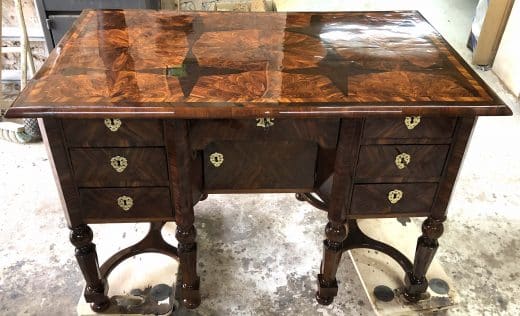
Extensive restoration work has been undertaken on this Mazarin desk, veneered in kingwood and rosewood. It is entirely veneered on fir, with a solid rosewood base. The top features a marquetry of rosewood stars, surrounded by kingwood butterfly wings arranged in circles. Why the name "Mazarin"? The eight-legged desk is one of the jewels of 17th-century furniture. Antique dealers only began calling it "Mazarin" in the 19th century, to lend it more "prestige." In reality, it only appeared around […]
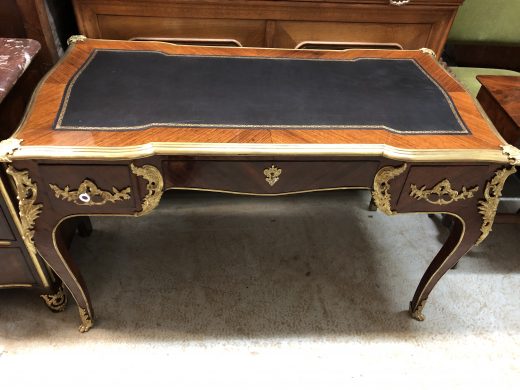
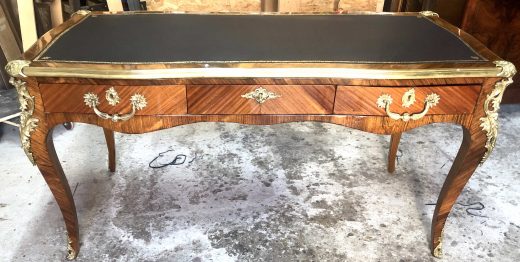
A major restoration was undertaken for this small Louis XV style desk, richly adorned with bronze mounts and veneered in rosewood. The restoration involved replacing the missing veneer while preserving as much of the remaining material as possible. This was achieved by using veneer that was sliced, scraped, sanded, oxidized, and varnished before being re-glued, thus avoiding the need to sand the piece before finishing. Rosewood is a very dark wood that lightens with age, developing a beautiful reddish patina that cannot be removed by any means.
A second life for this Louis XV style desk, veneered in Rio rosewood (Dalbergia nigra) and African mahogany (Khaya). Besides the construction and tool marks, the presence of this African mahogany greatly facilitates its dating. This type of mahogany began arriving from the west coast of Africa at the end of the 19th century. It became ubiquitous in furniture production at the beginning of the 20th century. I first re-glued the structure and the joints, then the veneer "bells." I filled in the missing sections with sliced veneer, […]
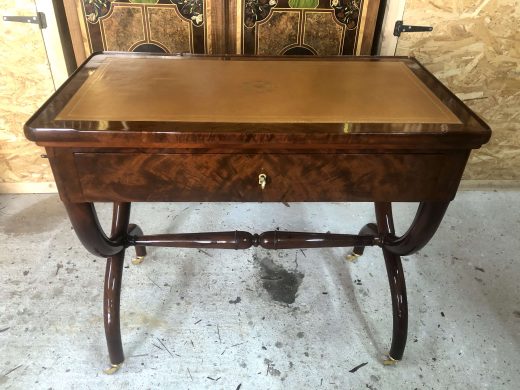
Here are some images of the restoration of this desk, with a solid mahogany base and mahogany burl veneer for the rest. Note that the recessed top is made from a single 12mm thick plank of solid mahogany burl. Here is the desk before restoration. The bulk of the work is on the legs. They are broken at the middle joint. They have already been repaired and are held together only by additional screws. Two cracks can be seen at the […]
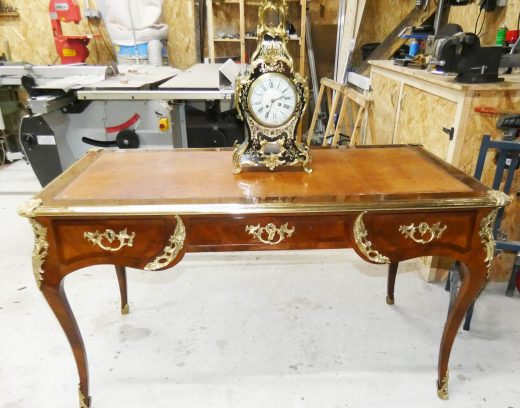
The restorer's trade holds many surprises. There are over 60,000 species of trees in the world. Suffice it to say that even though the same types of wood are often found in French furniture, sometimes you stumble upon something unfamiliar. I found this wood odd. Violet wood? No. Rosewood? Perhaps, but a variety I don't recognize. Okay, I'll strip a section to see the wood's true color. Hey, the varnish was very red: this veneer is made of […]
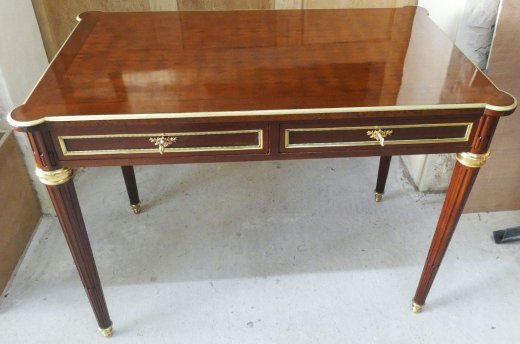
This desk is exquisitely crafted, with its oak frame veneered in mahogany and its solid mahogany legs. It is, in fact, a perfect example of high-quality 19th-century furniture. Indeed, the cabinetmaking is flawlessly executed, and the bronze mounts are in perfect condition. In short, everything is there; nothing is missing. The Krieger firm began its cabinetmaking business in the mid-19th century with Antoine Krieger (1804-1869). It then added a significant decorative department, which ensured its prestige until around 1945. Thus, it produced all […]
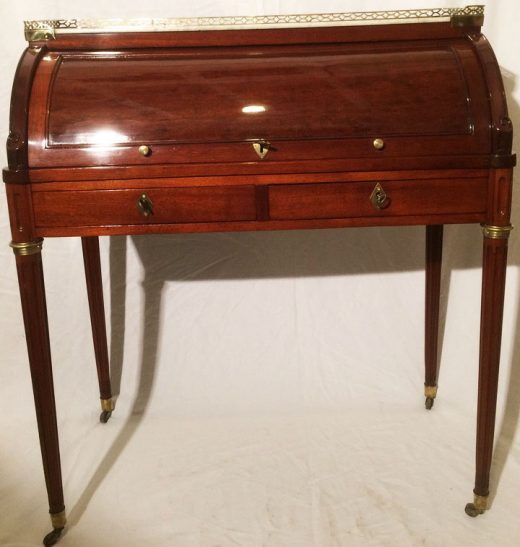
DIMENSIONS: H.71 W.104 D.52 This roll-top desk perfectly matches those produced by Nicolas Petit's workshop between 1770 and 1791, the year of his death. Indeed, with a few exceptions, Nicolas Petit primarily crafted this type of furniture in molded mahogany, on fluted legs and with white marble tops. Their understated elegance reflected the taste of the period. It features two drawers in the frieze, two pull-out side shelves, and a central shelf that locks when the drop-top is closed. Furthermore, the interior contains two drawers, the one on the right […]
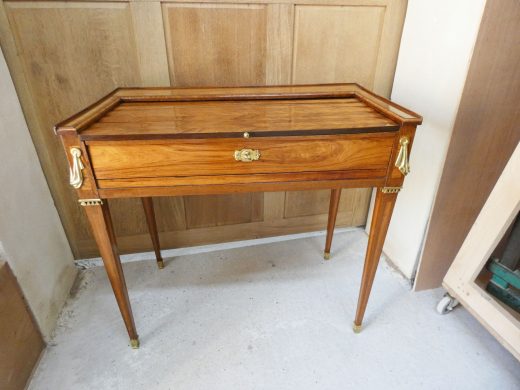
Restoration and conservation work on this rare Louis XVI period roll-top desk stamped by Jean-Chrysostôme Stumpff (1731 – January 17, 1806), who became a master craftsman on August 27, 1766. Originally from Schweigern, Swabia (Germany), he married in 1760 in Paris, at the Swedish embassy, like most of his compatriots of the Reformed faith. His witness was his fellow cabinetmaker Ferdinand Schwerdfeger. In his workshop on Rue Saint-Nicolas, he produced some Louis XV furniture, but primarily a large number of Transition and Louis XVI pieces. Stumpff's production […]
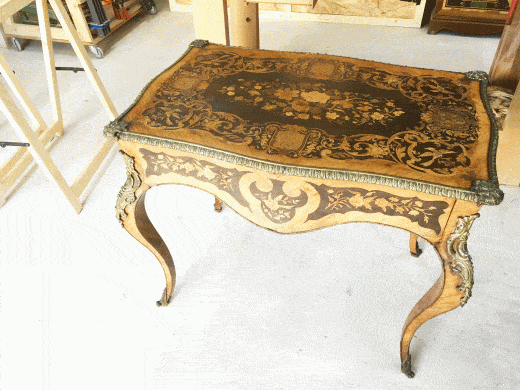
A classic restoration for this type of furniture. The legs are slightly damaged, and the varnish has yellowed and dulled. A few rosewood grafts, cleaning, stripping, and a beautiful French polish will be enough to give it a new lease on life. Not forgetting the cleaning of the bronze mounts.
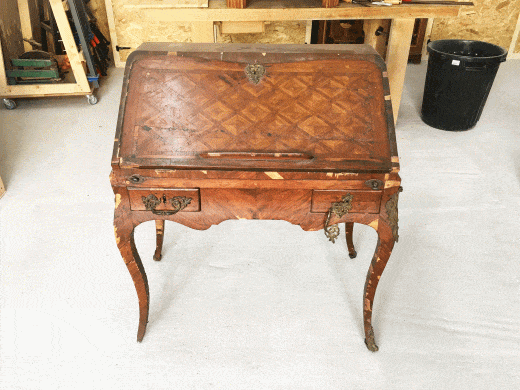
Thanks to its stamp, this slant-front desk can be dated between 1738 and 1783. Jean-Baptiste Hédouin's life remains relatively unknown. After completing his master craftsmanship, he set up his workshop on Rue Traversière-Saint-Antoine. All his furniture is of high quality. Primarily in the Regency and Louis XV styles, almost all veneered in sheets or with grid patterns, they are also quite varied: wardrobes, flat and slant-front desks, bookcases… But chests of drawers make up the largest part of his production. Most of them adopt the […]