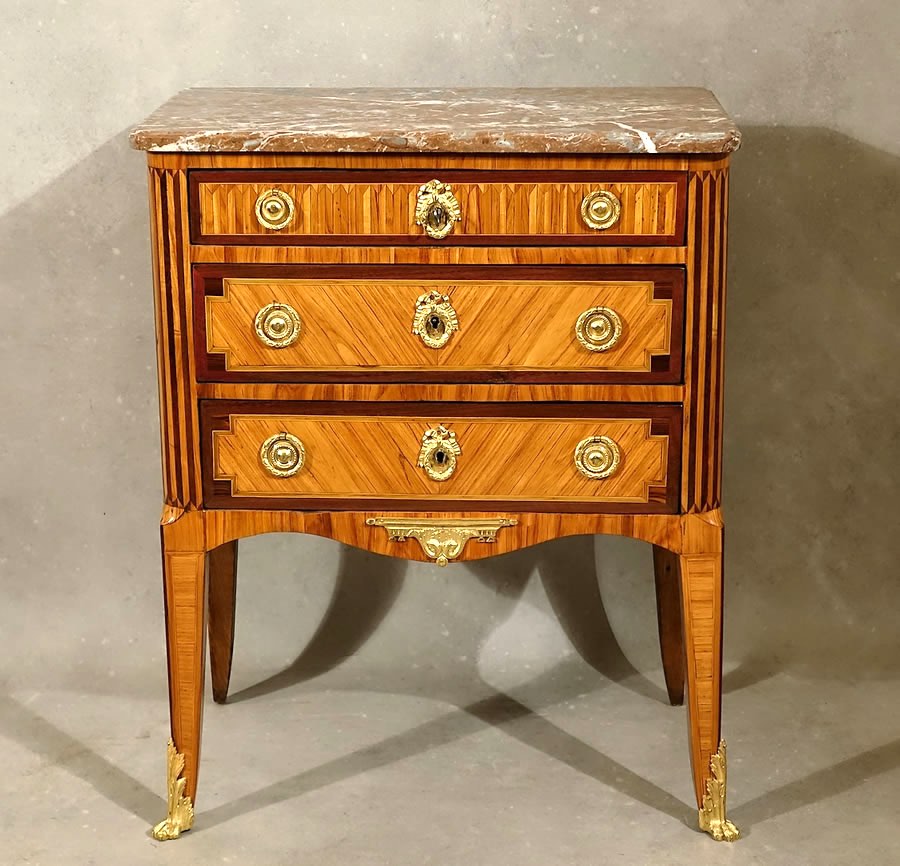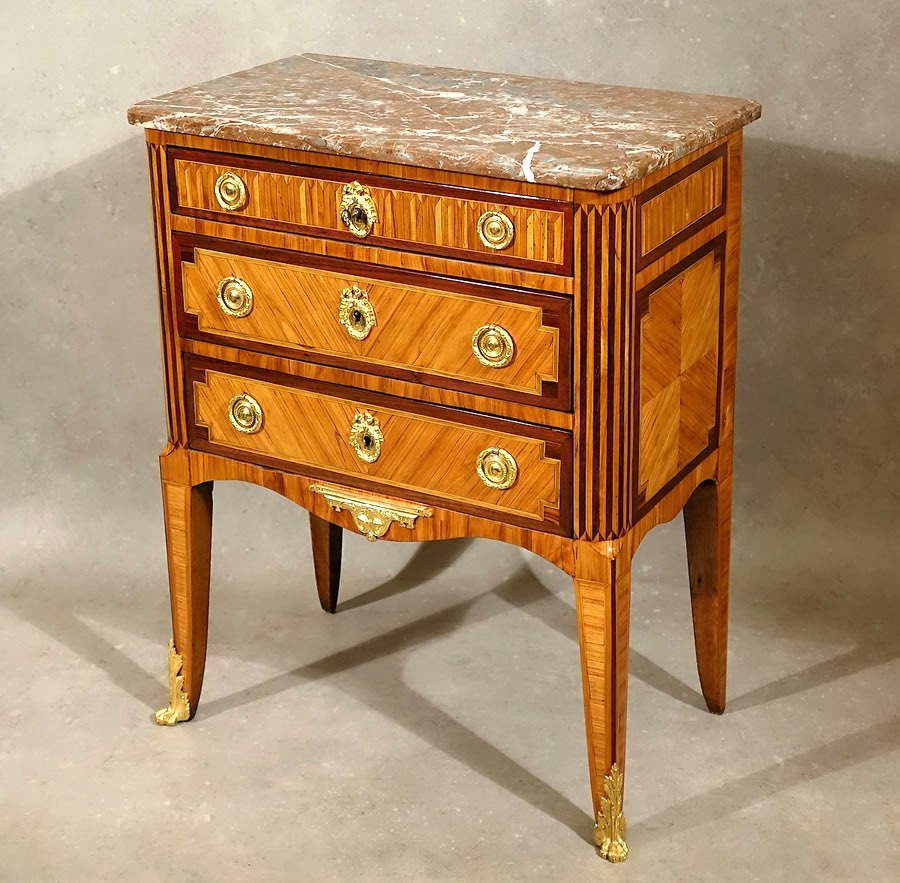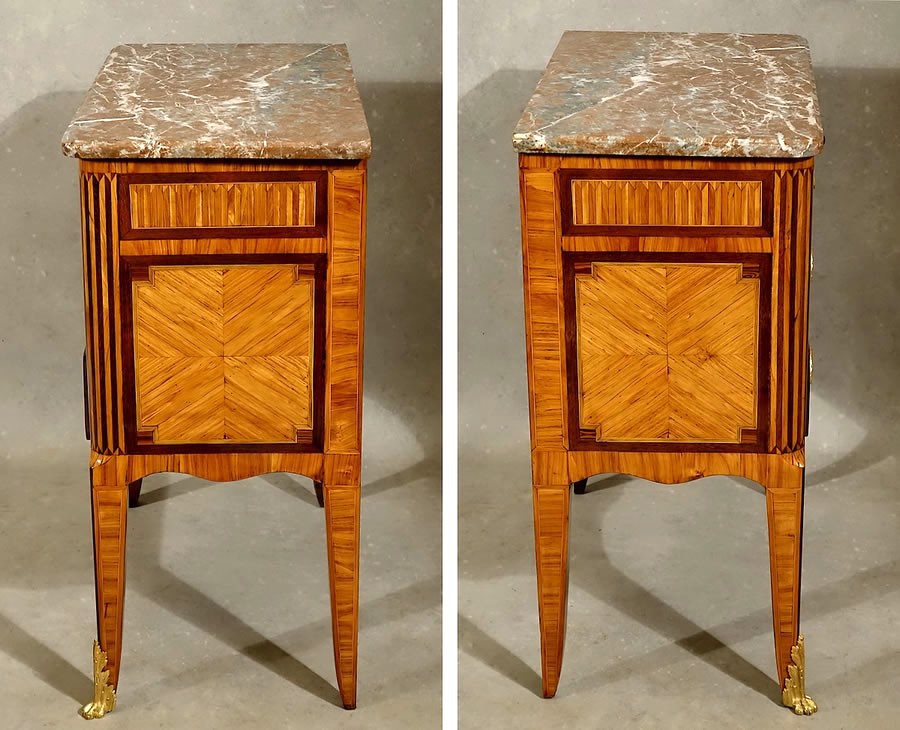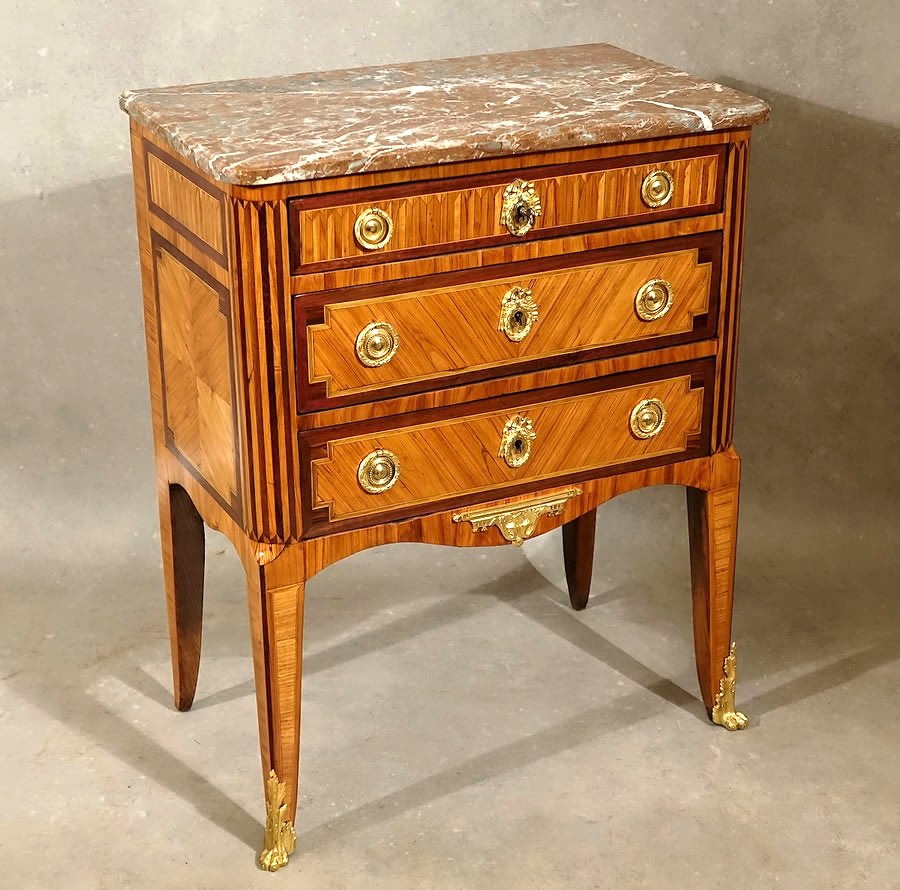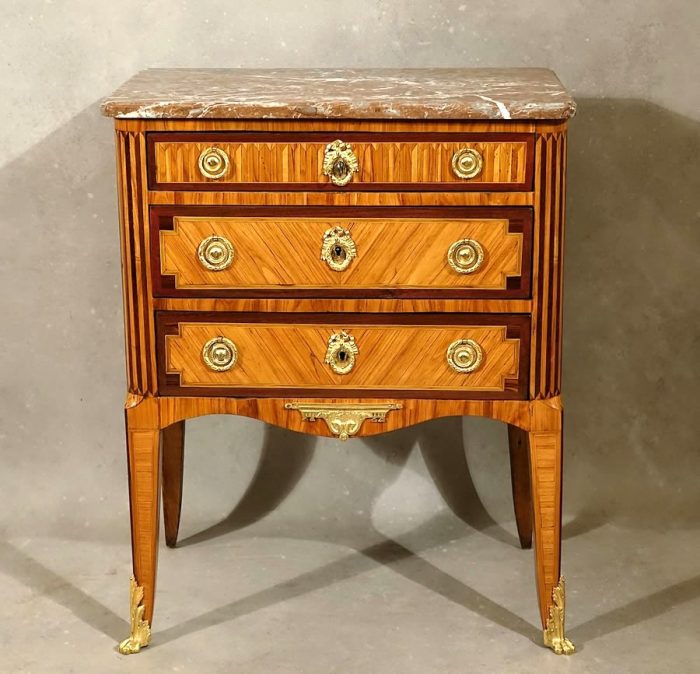
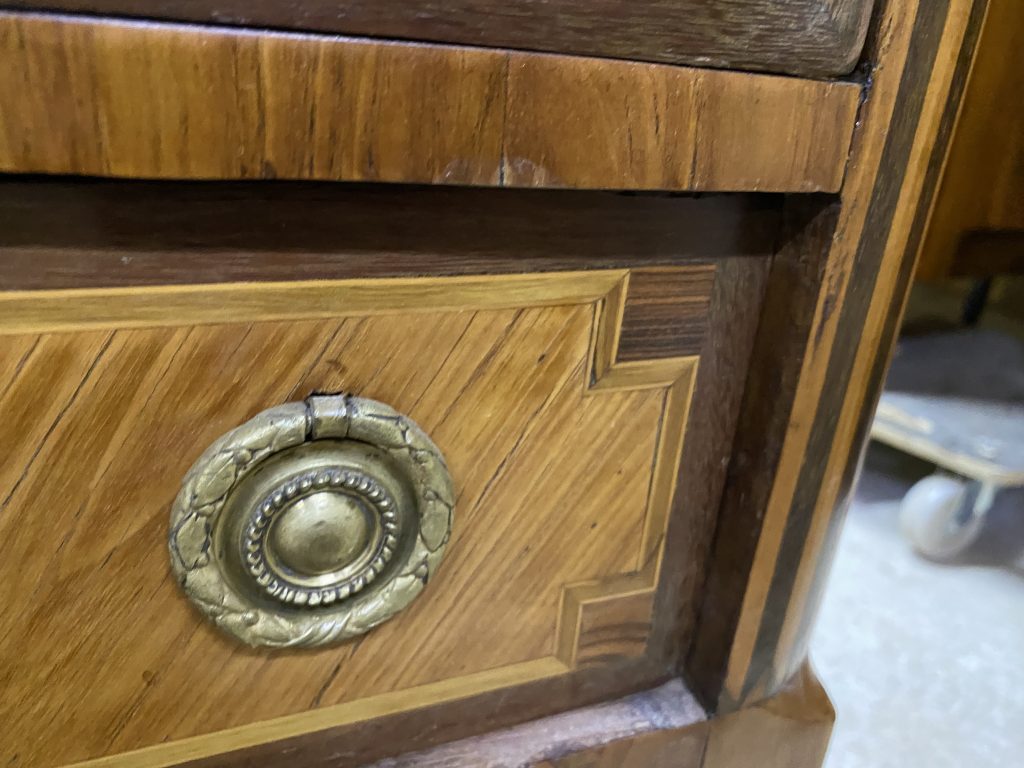
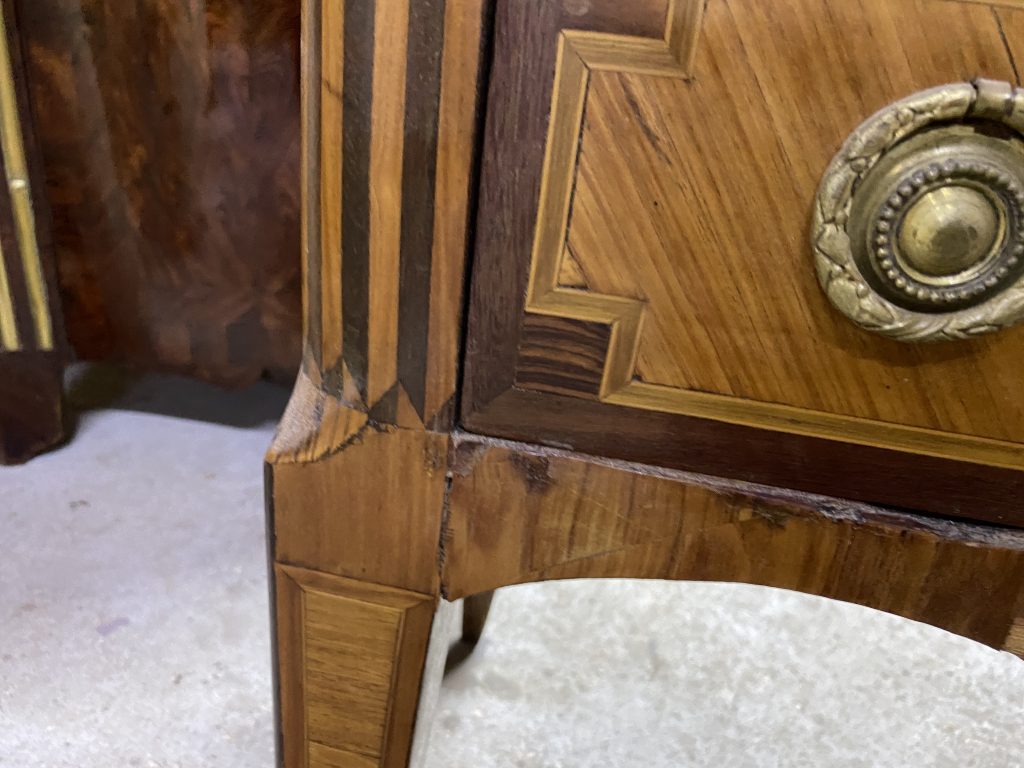
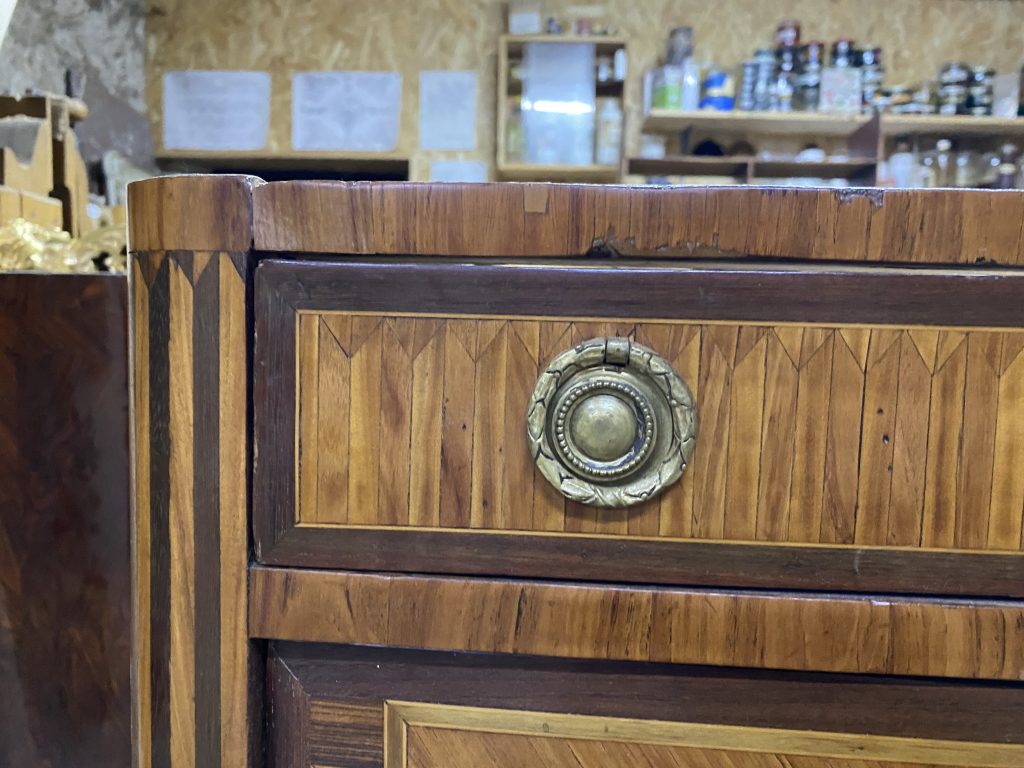
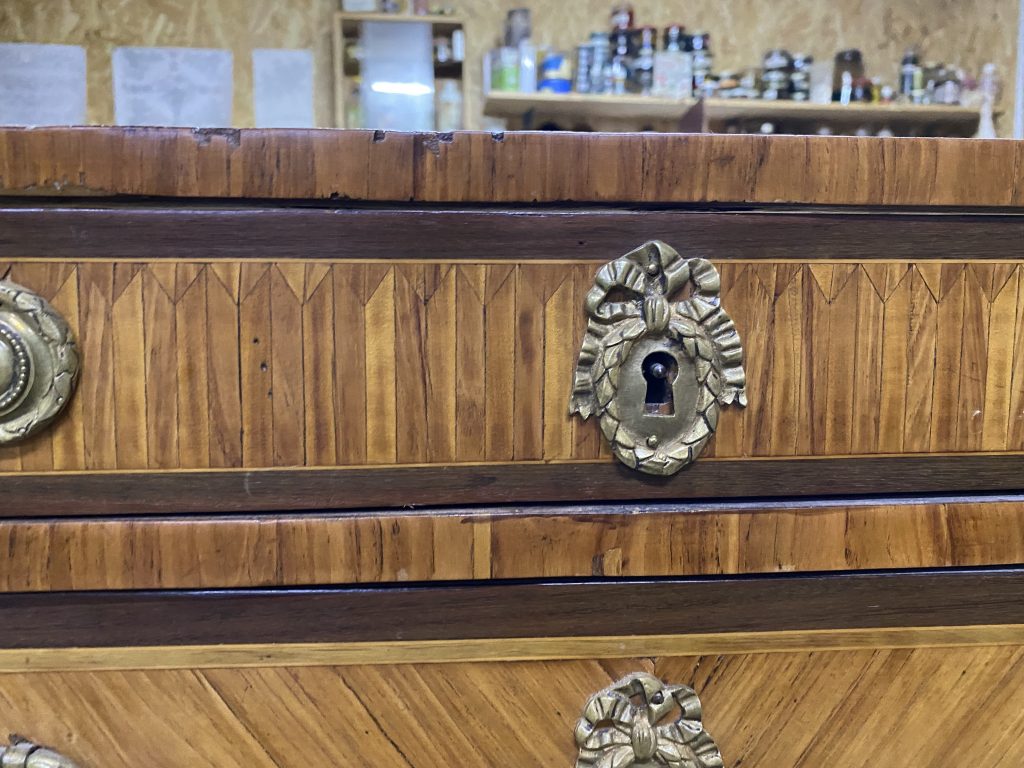
Restoration of a transitional-style commode, known as a "Greek-style" commode, stamped by Jean Baptiste Fromageau, veneered in rosewood with an amaranth frieze and faux fluting. It is topped with a Royal red marble slab and features three drawers: a narrower one at the top inlaid with a frieze of glyphs, while the two below are inlaid with Greek key patterns and have violet wood corners. The bronze mounts include ring pulls, keyhole escutcheons with knotted ribbons, drop-shaped finials, and exquisite "Etruscan-style" lion's paw feet. The entire frame of the commode is oak, including the back, the floors, and the drawer boxes, which are set in rebates.
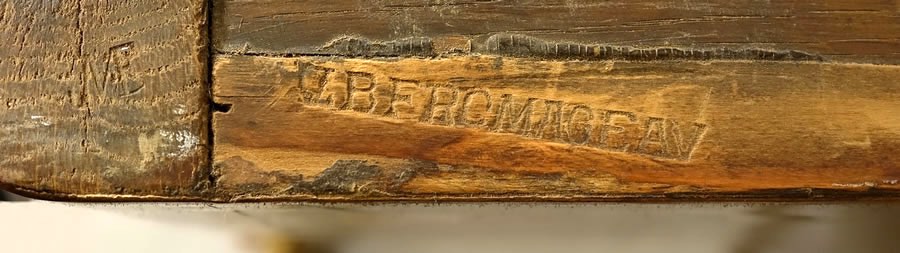
Jean-Baptiste Fromageau
Born around 1725, Jean-Baptiste Fromageau received his master craftsman's certificate on November 5, 1755. That same year, he established himself on Rue Traversière as a cabinetmaker, joiner, and haberdasher. About twelve years later, he moved his workshops to Rue du Faubourg-Saint-Antoine. The son of a master joiner, Jean-Baptiste Fromageau was an unusual figure during this era of strict regulations between the various guilds, because, unlike Georges Jacob, his prolific output was remarkably diverse. He specialized in both luxury cabinetmaking and simple joinery. He ceased his activity in 1777, retired for a time to Versailles, before returning to Paris where, in 1781, he ran the Hôtel de Russie on Rue de Richelieu.
BIBLIOGRAPHY
- French Furniture of the 18th Century – Pierre Kjellberg – Les Editions de l'Amateur – 1989
- The workshops Parisian cabinetmakers and joiners in the 17th and 18th centuries – Guillaume Janneau – Serg Editions – 1975
State of affairs report
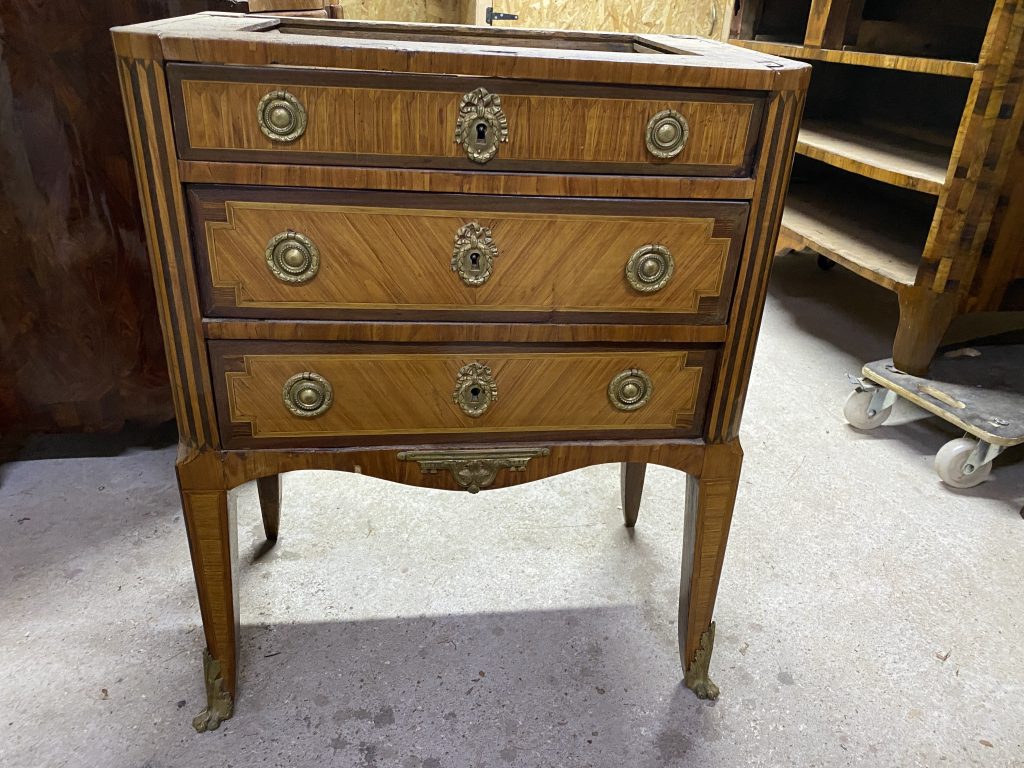
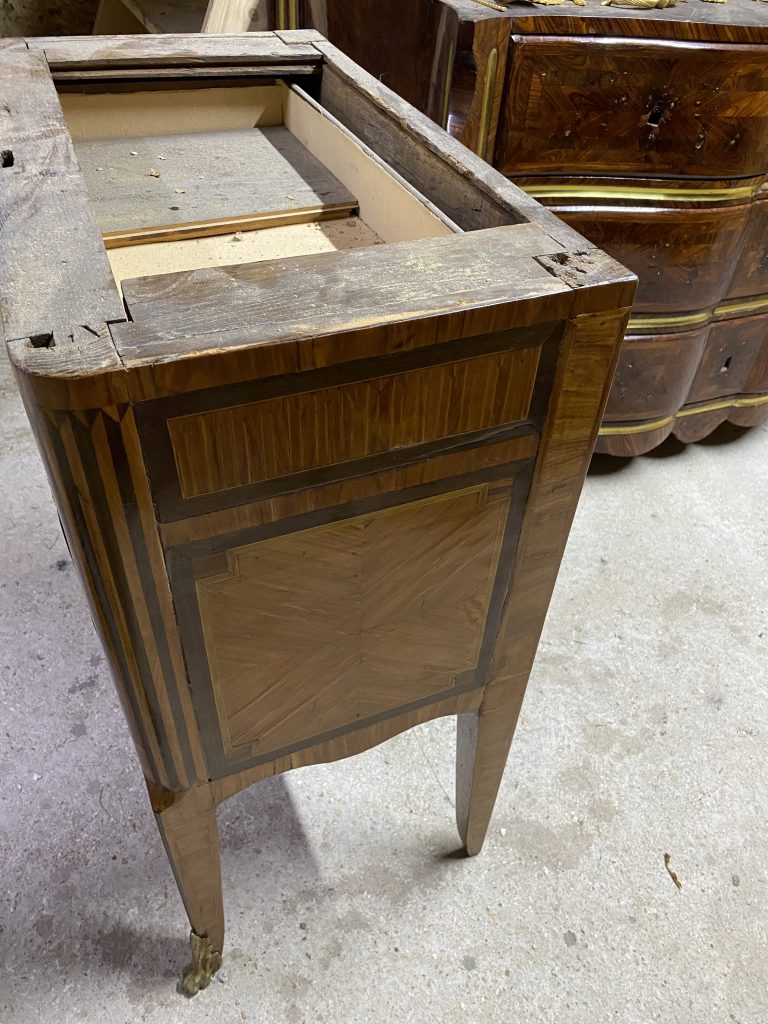
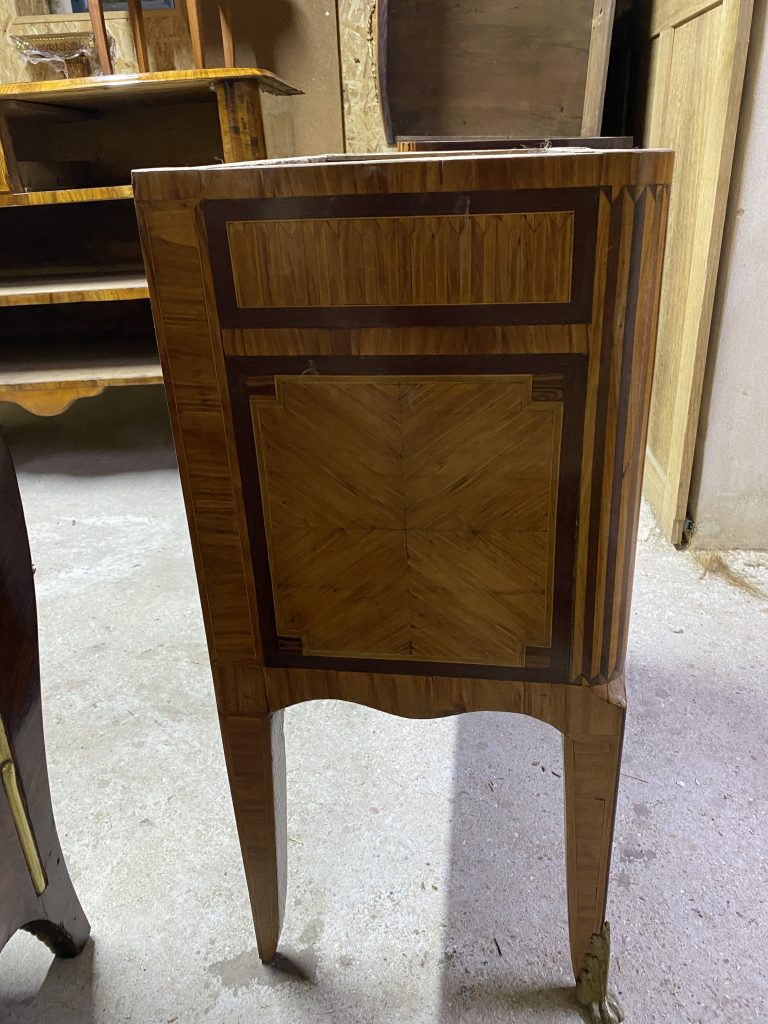
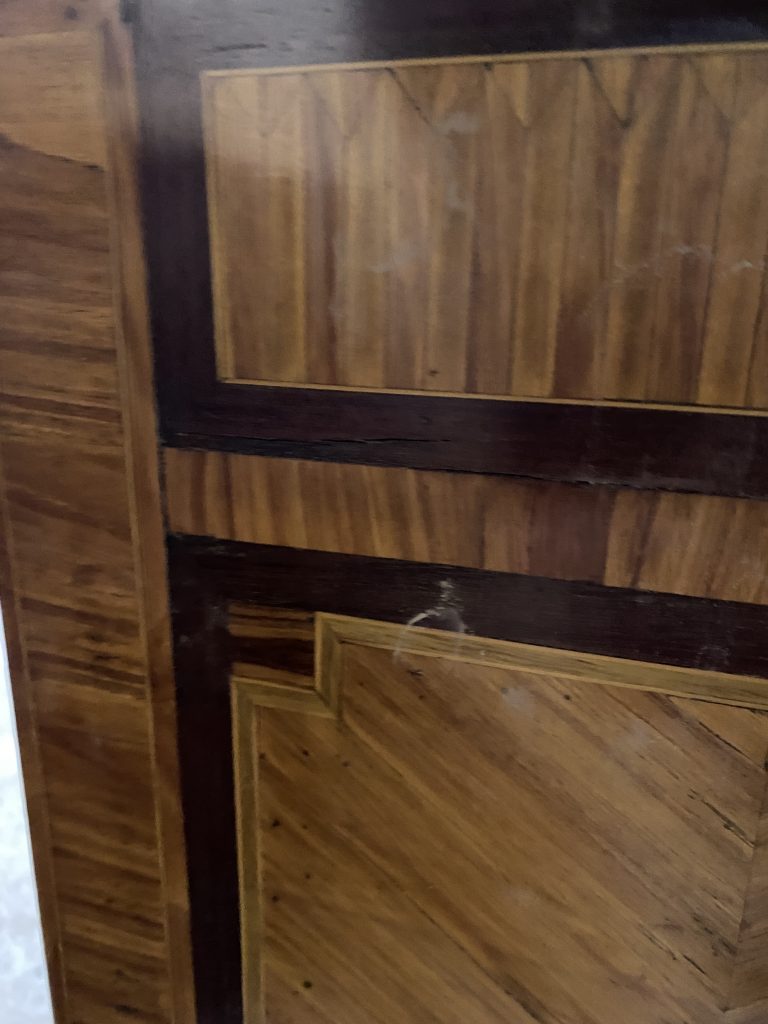
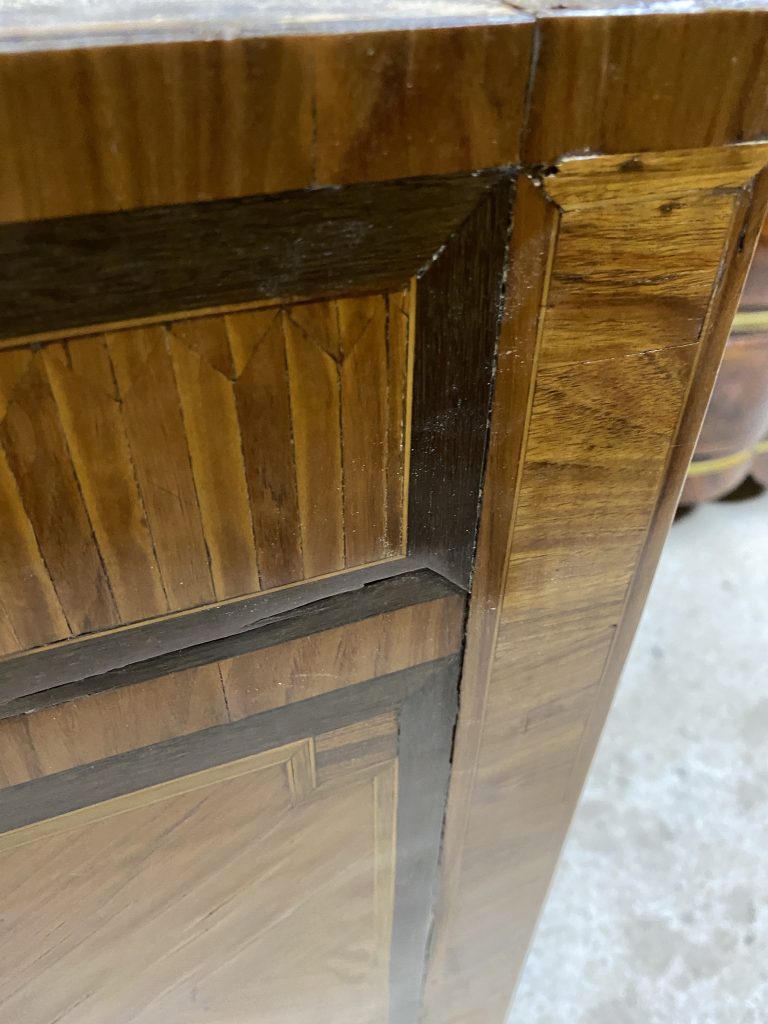
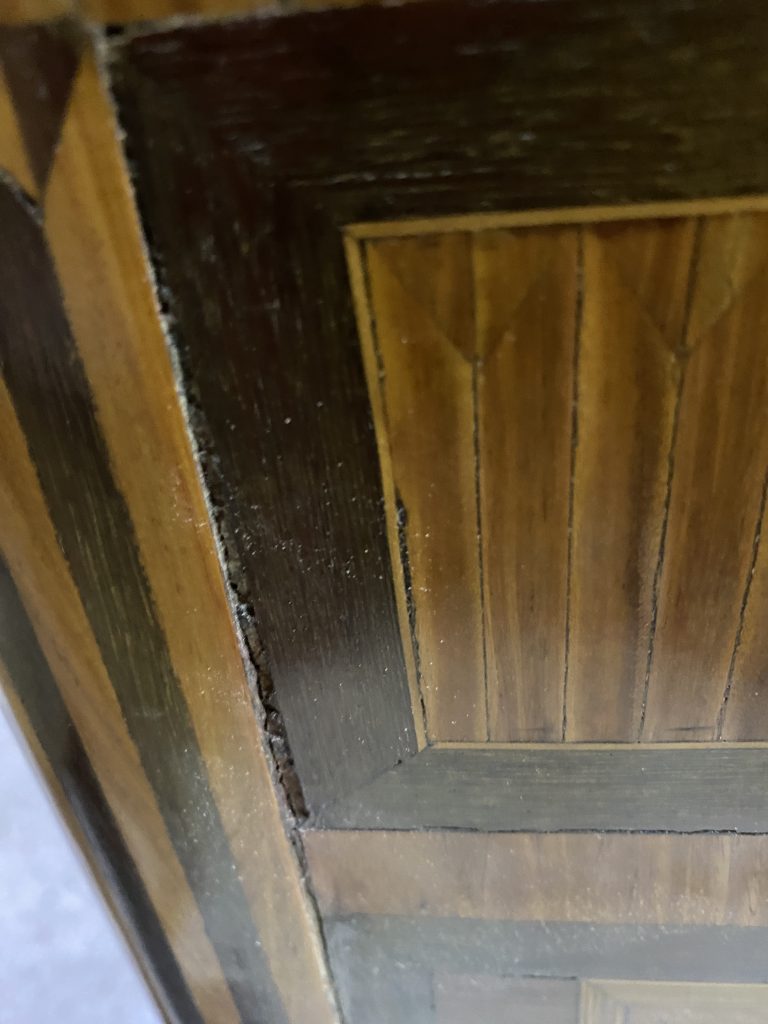
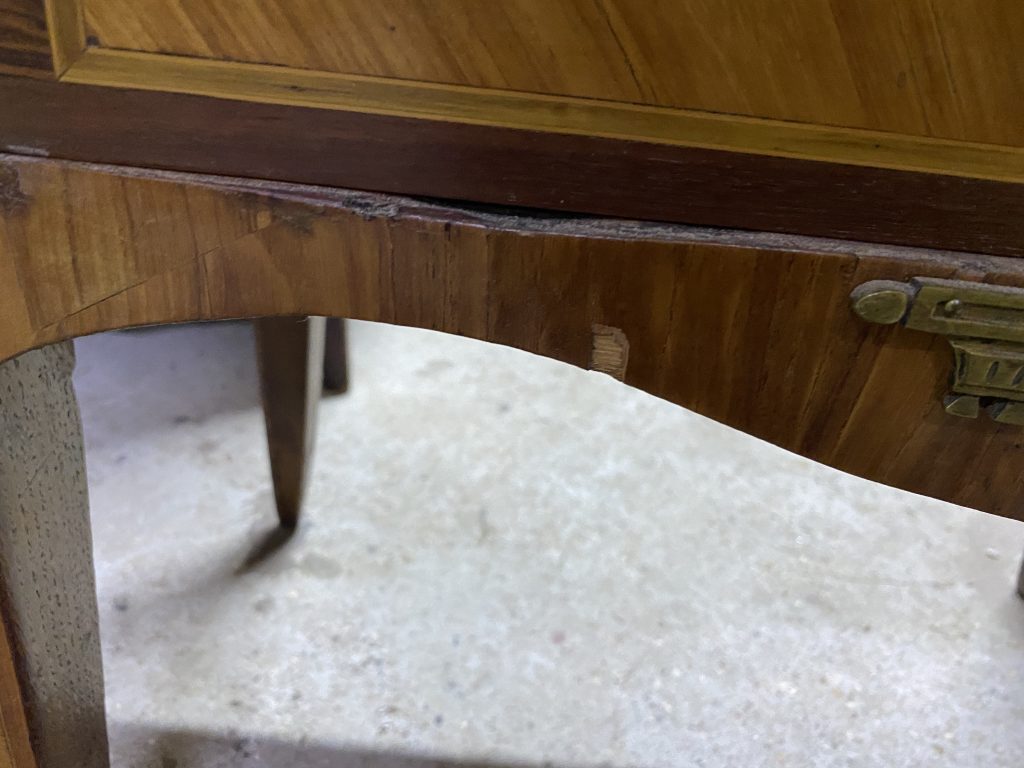
For once, there wasn't much work to be done on the veneers; they were certainly dehydrated, but there weren't many missing pieces. No, the main problem with this chest of drawers was the structure. The top, bottom, and back panels, as well as the back panels, were all detached. The sides were coming apart at the uprights, with warped panels.
The Restoration
The restoration involved the complete dismantling of this chest of drawers. All the panels were re-glued and resurfaced where necessary. The sides were re-glued and flattened under vacuum. All the adhesives on the veneered surfaces were regenerated under vacuum. The few missing veneers were replaced with new sawn veneer, scraped, sanded, and cut to the correct thickness as a backing before being glued with protein-based adhesive. After thinning the old finish, it was refinished with a clear French polish. The bronze mounts were regilded.