History of French polish
Materials, technique and chronology of appearance
Study based on ancient treatises (Roubo, Watin, Mellet, Dessaignes, Martin) and research work in conservation-restoration.
The 18the century: a varnishing done exclusively with a brush
The major treaties of the 18th centurye century describe a varnishing done solely with a brush. André-Jacob Roubo, in The Art of the Carpenter (1769-1774), like Jean-Félix Watin in The Art of the Painter, Gilder, Varnisher (1D (ed. 1772), depict oil or spirit-of-wine varnishes applied with a brush in successive layers. Neither mentions a pad for applying the varnish. On flat surfaces, a sponge could also be used for application; the final polishing was done with tripoli.
This observation aligns with research conducted in conservation-restoration on antique furniture finishes: French polishing, now perceived as the quintessential traditional method, actually only appeared in the first half of the 19th century.e century.
A late edition of Watin: the stamp, but for polishing
A posthumous re-edition by Watin, published in 1823, does introduce the word "tampon" — absent from the 1773 edition —, but in a role that remains that of polishing, not of applying varnish:
«"It is polished with a piece of serge held in the shape of a pad [...] Smooth with pumice stone, and polish with a serge pad soaked in water containing sieved pumice."»
The pad is therefore a serge cloth soaked in water and pumice stone, used afterwards to polish a varnish already applied with a brush.
Early 19th centurye century: the appearance of the varnishing pad
It's in The Art of the Furniture Maker and Cabinetmaker The oldest and most complete description of the stamp used for is found in François-Noël Mellet's work, published in 1825. apply the varnish itself. Mellet devotes an entire chapter to it, "On the Application of Varnishes," where he notes:
«"Cabinetmakers do not varnish with a brush or a paintbrush, but with a special type of pad."»
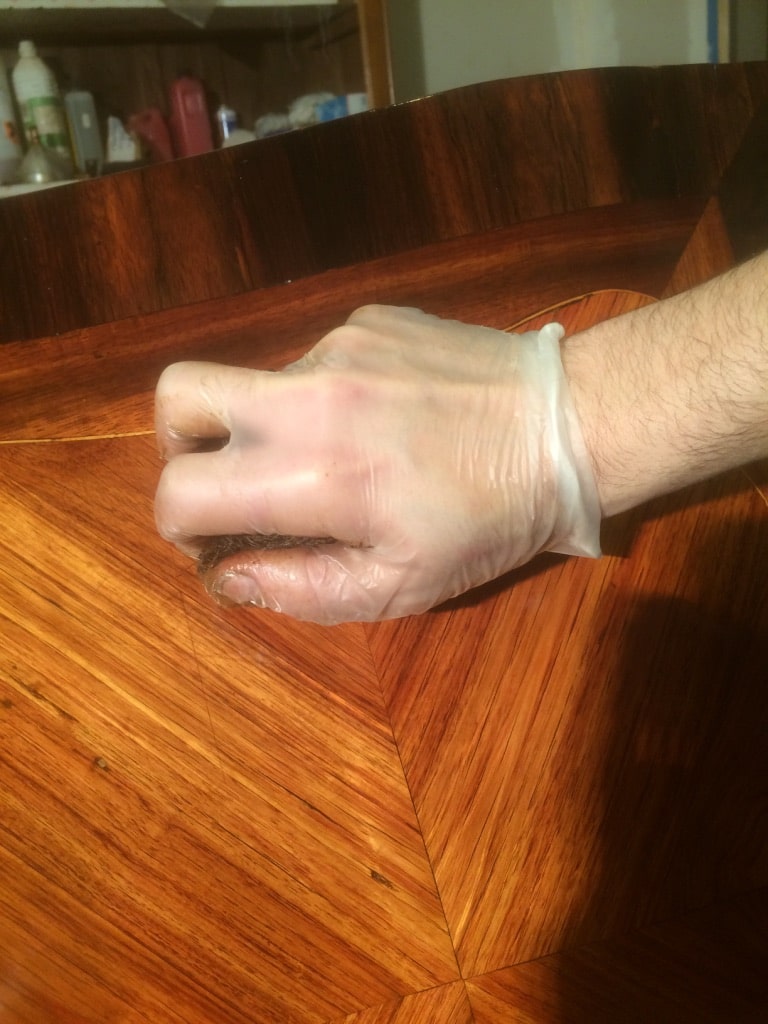
He details its manufacture — a rolled piece of woolen knit, soaked in varnish, wrapped in a fine cloth forming a pocket which is closed into a handle — then the gesture: the pad, moistened with a little oil, is moved in circles or ellipses on the wood, in successive layers, until the varnish forms a sufficient thickness; the operation ends with a pass with pure alcohol to "lighten" and give the final polish.
Mellet does not present this method as a novelty that he himself invented: in 1825, it was already "particular to cabinetmakers", that is to say, already identified as their own practice.
The technical mechanism of this appearance
This appearance is explained by a change in raw material, and not by a simple evolution of technique. Until the end of the 18th centurye In the 19th century, pure shellac dissolved in alcohol was not used significantly: when it appears in old recipes, it is always mixed with other resins (sandarac, mastic, amber, copal), which greatly limited its characteristic browning. It was only in the 19th century thate It was in the 18th century that shellac, used alone and in alcoholic solution, gradually supplanted these other resins for the manufacture of furniture varnishes. More fluid and faster-drying than the oleoresin varnishes of the 18th century, it was used in the manufacture of furniture varnishes.e In the 19th century, unlike their counterparts, it lent itself to direct application in thin layers using a pad. Its reddish tint also harmonized particularly well with mahogany, a wood that was very fashionable at the time.
An origin that remains difficult to date precisely
Should we look for an inventor, a place, a precise date? None of the sources consulted allow us to say for sure. Mellet's description, dating from 1825, places the emergence of the technique in the first two decades of the century, directly following the widespread adoption of shellac. But no text attributes the technique to a particular workshop, city, or individual: it seems to have spread gradually through Parisian cabinetmaking workshops, without any specific moment or inventor's name standing out.
One point deserves emphasis: the image of French polishing as an "immemorial" technique, practiced by cabinetmakers since time immemorial, is itself a rather recent construct. Recent research notes that this perception stems from a codification of know-how that occurred at the very end of the 19th century.e century, which eventually established shellac varnish applied with a pad as the sole archetype of furniture varnish — relegating to oblivion the real diversity of previous varnishing techniques (with a brush, with a sponge, with various resins).
Confirmation by later sources
Dessaignes' manual, The Secrets of the Cabinetmaker (1861) describes a pad application technique identical to Mellet's—same materials (shellac, alcohol, pumice stone, oil), same circular motion, same rule passed down by the old varnishers: "start thin and finish a little thick." Martin's manual (1892) confirms that the technique was by then fully established and taught as a standard of the trade. This continuity, from 1825 to the end of the century, confirms that the varnishing pad described by Mellet was not an isolated curiosity but rather the method already firmly established among cabinetmakers.
Summary timeline
| Period | Source | Varnishing technique |
|---|---|---|
| 1769-1774 | Roubo, The Art of the Carpenter | Brush-on varnish |
| 1772 | Watin, The Art of the Painter, Gilder, Varnisher | Brush-on varnish |
| 1823 | Watin (posthumous edition) | Serge stamp, but for polish a varnish already applied with a brush |
| 1825 | Mellet, The Art of the Furniture Maker and Cabinetmaker | French polish, already "specific to cabinetmakers"« |
| 1861 | Dessaignes, The Secrets of the Cabinetmaker | Same technique, fully codified |
| 1892 | Martin, Martin varnish processes | A stabilized technique taught as a standard |
| Late 19th centurye s. | — | The technique is established as a unique archetype, erasing the memory of previous techniques. |
In the 18the In the 19th century, furniture varnishing was done exclusively with a brush, using resins that were always mixed together. French polishing appeared in the first half of the 19th century.e century: as early as 1825, in Mellet, it is described in detail and presented as already specific to cabinetmakers. Its appearance is directly linked to the generalization of pure shellac in alcoholic solution and to the vogue for mahogany furniture, without it being possible to attribute to it an inventor or a precise place — its image of an immemorial tradition being itself the product of a later codification, at the end of the same century.
Sources
- A.-J. Roubo, The Art of the Carpenter, Paris, 1769-1774.
- J.-F. Watin, The Art of the Painter, Gilder, Varnisher, 2e ed., Paris, 1773; posthumous ed., Paris, 1823.
- F.-N. Mellet, The Art of the Furniture Maker and Cabinetmaker, Paris, 1825.
- Dessaignes, The Secrets of the Cabinetmaker, Paris, 1861.
- Martin varnish processes, Paris, 1892.
- Research work in conservation-restoration on old varnishes of furniture (consulted for comparison).