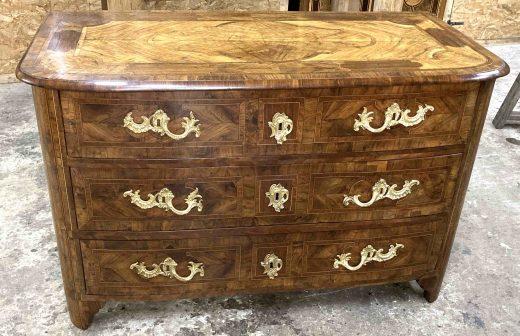
Louis XIV commode

Ebénisterie Mathieu Vath

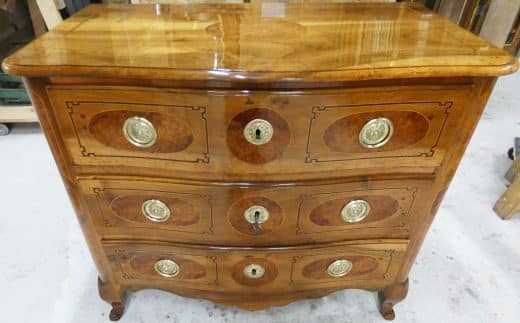
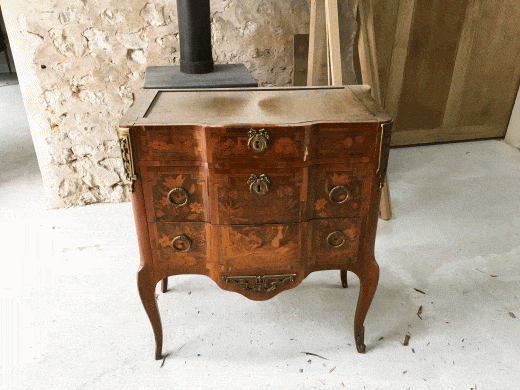
Restoration of a Louis XIV period commode veneered in olive burl, ash, and walnut, likely from the Dauphiné region. This type of commode (D-shaped), along with the Mazarine commode, was among the very first commodes popularized under Louis XIV. Indeed, the appearance of the earliest French furniture resembling the commode dates only from the 1700s; thus, the oldest known and datable Parisian commodes are those delivered by André-Charles Boulle to Versailles around 1708. Their very simple decorations are inspired by Dutch designs, often executed by […]
Transitional chest of drawers stamped LARDIN

Ebénisterie Mathieu Vath

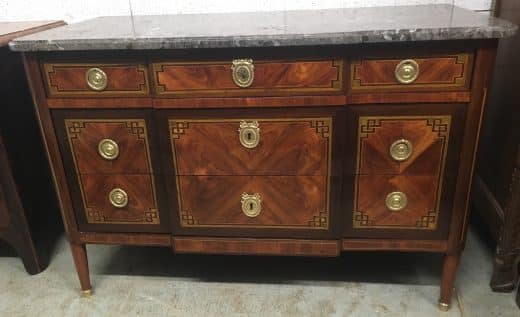
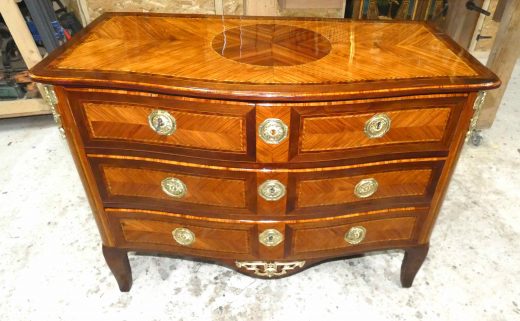
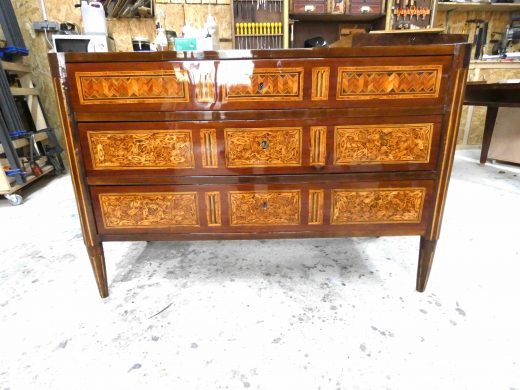
Restoration of a Transition period commode built of fir and oak and veneered with rosewood, framed with stringing of white hornbeam and green-stained wood, with a satinwood band surrounded by amaranth. The central medallion is satinwood veneer assembled in a herringbone pattern. The maker's mark and the JME (Journée des Métiers d'Étranger) are located at the base of the left rear leg. André-Antoine Lardin (1724 – August 10, 1790) obtained his master craftsman's certificate on July 1, 1750, and established himself on the rue de Charenton under the sign "Au Bois de Boulogne." He worked there until 1770, the date […]

Louis XVI commode

Ebénisterie Mathieu Vath

Restoration of a Louis XVI period commode from eastern France, made of solid oak and fir and veneered with end-grain laburnum, walnut, plum, amaranth, rosewood, palisander, boxwood, and green-stained hornbeam. The handles and keyholes were added at a later date. The original fittings are missing; only the holes for the handles remain. This is a piece of furniture that has never been restored. The veneer is almost 4 mm thick in some places, and […]

Napoleon III wall shelf

Ebénisterie Mathieu VATH

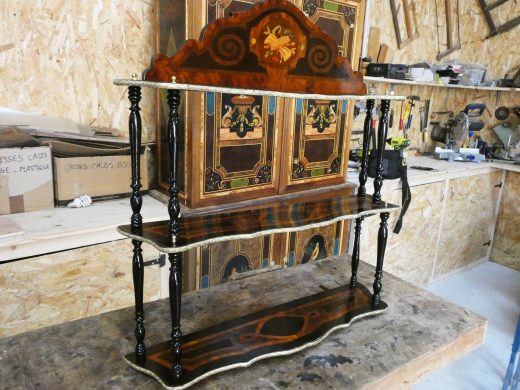
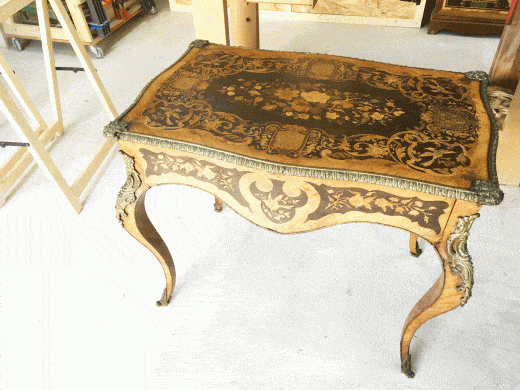
Restoration of a Napoleon III period wall shelf veneered in blackened pearwood, rosewood, amaranth, amboyna burl, and marquetry with a music theme. Underneath the dust, aside from small losses in the blackened pearwood and rosewood, and slight dehydration, there was nothing too serious. A few veneer grafts, a vacuum-sealed glue application, a thorough cleaning, a coat of clear French polish, and voilà! All this without using sandpaper. Except for lightly sanding the varnish […]

Napoleon III style Louis XVI work table

Ebénisterie Mathieu VATH

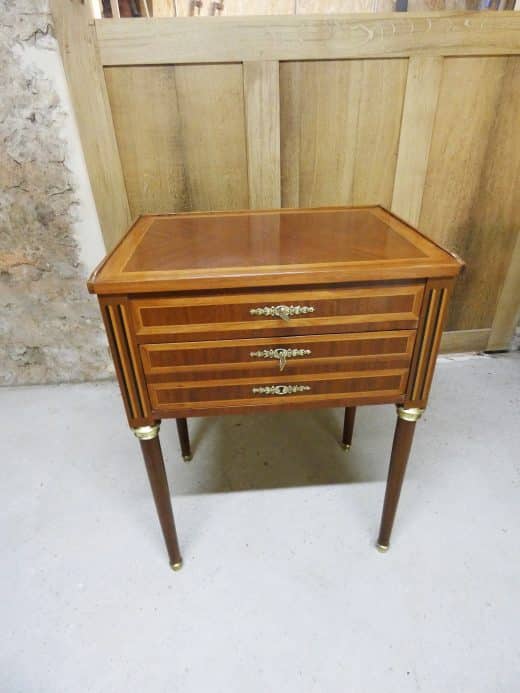
A few photos of the restoration of a small Louis XVI style work table from the late 19th century. The legs are solid mahogany, and it is veneered with rosewood, sapele, blackened pearwood, and boxwood for the fluting and stringing. Nothing too serious for this pretty little piece of furniture, which only had a few missing veneers and a small chip on the side of the oak drawer. A simple restoration: a few veneer grafts glued with hot glue, a light cleaning of […]

Chest of drawers in the style of the Axe

Ebénisterie Mathieu VATH

Here are some photos of the restoration of a solid walnut commode, veneered with thuya burl inlay and Greek key stringing in amaranth and boxwood. The drawers and the interior and back panels are made of fir. Despite the curved stretcher, its shape, and its feet, this commode is indeed in the transitional style but from the Louis XVI period. In the title, I wrote "in the style of the Hache family" because it is certain that this commode originated in the Dauphiné region. But whether it is a product of the famous […]

Louis XVI commode stamped JA BRUNS

Ebénisterie Mathieu VATH

This week marks the completion of the restoration of a Louis XVI commode stamped JA BRUNS. It is made of oak for all the structural elements, except for the side panels, drawer backs, drawer fronts, and the two drawer bottoms, which are made of softwood. It is veneered with rosewood in a butterfly pattern and amaranth for the edges. The false fluting is made of boxwood and ebony, and there is a green-stained maple stringing forming the corners at […]

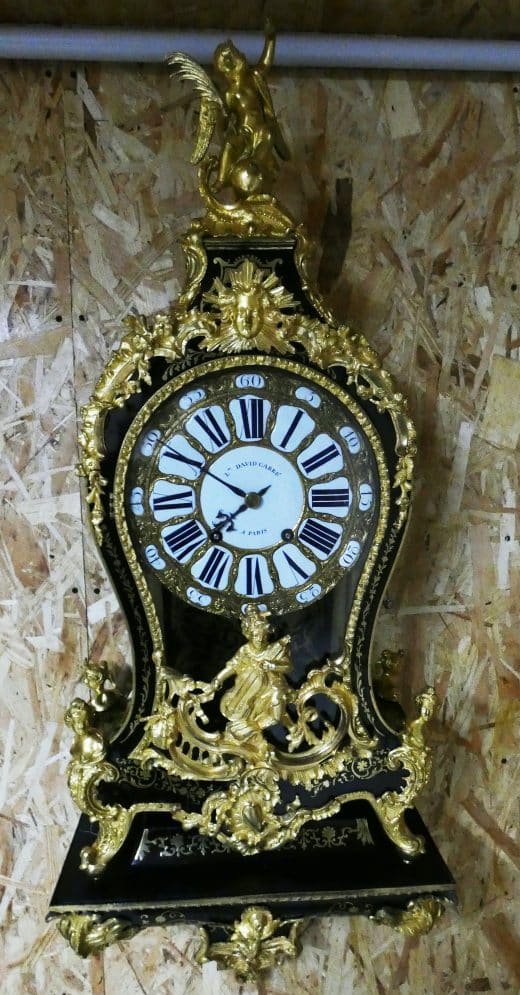
Label signed "Louis David Carré in Paris"«

Ebénisterie Mathieu VATH

After several weeks of work, the restoration of this clock is finally complete. It is a Louis XV period clock in brown tortoiseshell and brass marquetry, with rosewood restorations. The dial is by Louis David Carré, nephew of Jullien le Roy, who became a master craftsman on December 31, 1748. Lodged at the Louvre from 1744, he was elected a juror in 1775. The greatest treasure of this clock lies in its bronze mounts. They are truly magnificent, and above all, they are in very good condition. There is only […]

Louis XVI style sewing box

Ebénisterie Mathieu VATH

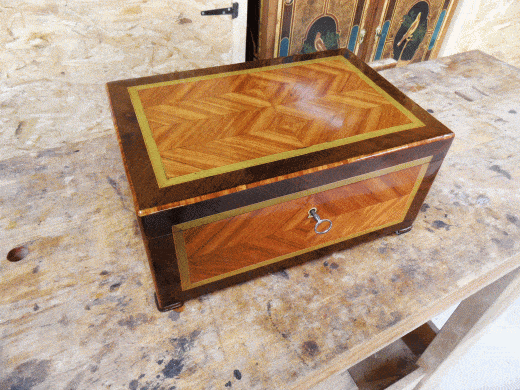
This sewing box dates from the Napoleon III period. The frame is made of softwood. The veneer is composed of Rio rosewood, mahogany for the interior, and a green-stained boxwood and maple inlay. The great quality of this box is that the lid hasn't warped. This is often the major problem with this type of furniture, as people forget to lock them, causing the wood to warp. It then becomes very difficult to find the "trick" to ensure the box stays closed.

Louis XVI style table

Ebénisterie Mathieu VATH

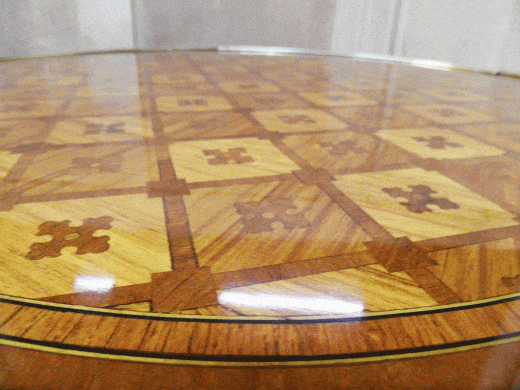
Here is a Louis XVI style table, which is probably an early 20th-century piece. It was likely made in the Faubourg Saint-Antoine, or perhaps at the École Boulle. I have seen apprentice furniture of this quality made by students during their training. Its frame is oak, while the veneer is rosewood and mahogany with a black inlay. The restoration was straightforward, apart from a lack of rosewood in the marquetry […]

Empire bed

Ebénisterie Mathieu VATH

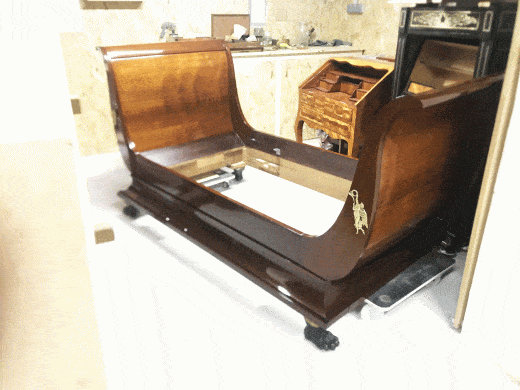
The "boat" bed, with its characteristic curve, is a French invention that appeared during the Directory and was very fashionable during the Empire and the Restoration. It is easily recognizable here by its lion's paw feet. The varnish on this bed had worn away, making it impossible to distinguish between the two mahogany pieces. The mahogany is known as Cuban mahogany (Swietenia mahogani), from Cuba, a Spanish colony. Evidence of its importation into Spain, specifically Seville, dates back to 1519-1520. It was used by Philip II between 1563 and 1584 during the construction of the Palace […]

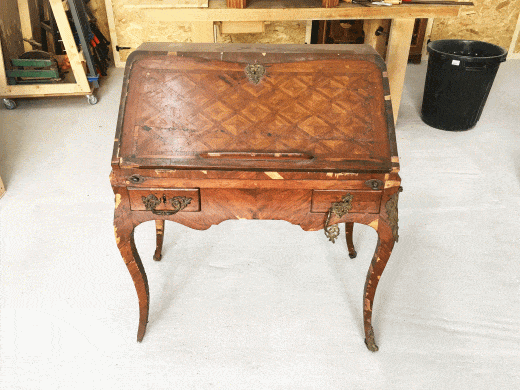
Louis XV slant-front desk

Ebénisterie Mathieu VATH

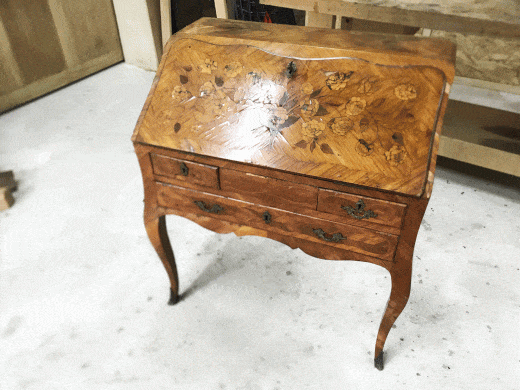
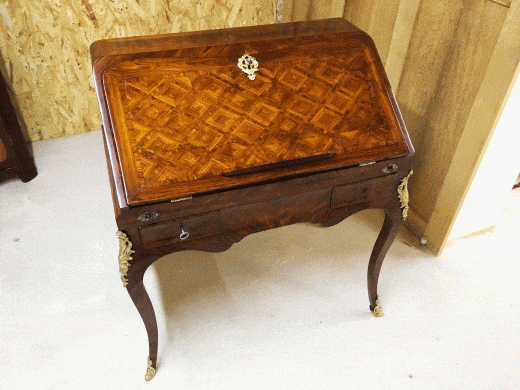
The restoration of a lovely slant-front desk, or as Riesener calls it in his memoirs, a "tomb-shaped secretary," began two weeks ago. With the restoration phase complete and the varnishing underway, I'm taking a moment to provide a brief summary of the project. The desk's frame is made of oak and fir, veneered with rosewood and violet wood, and the drop-front features floral marquetry of boxwood, natural and stained maple, and hornbeam. It includes a large drawer […]

Corner cabinet in Boulle marquetry from the Napoleon III period

Ebénisterie Mathieu VATH

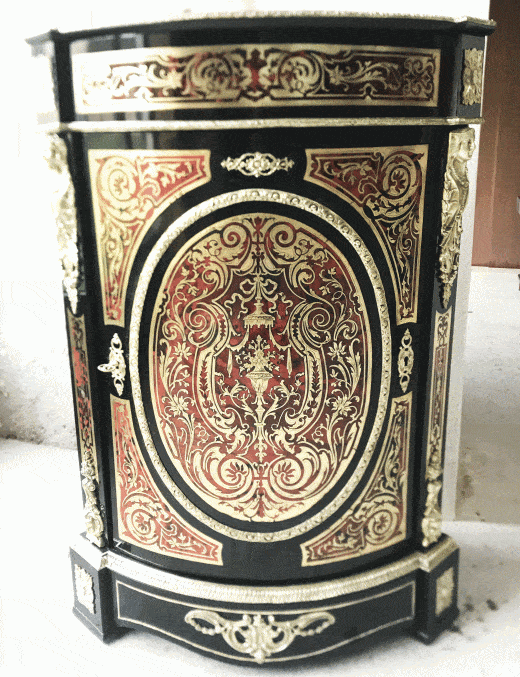
A classic restoration of Boulle marquetry. This involved rehydrating the old glue through infiltration, crafting and gluing the missing brass pieces, and reconstructing the base, which was in poor condition but not beyond repair. The bronze mounts were cleaned and finished with a clear French polish. Proof that appearances can be deceiving. Even a piece of furniture in a severely deteriorated state can regain its former beauty.

Commode returning from Egypt

Ebénisterie Mathieu VATH

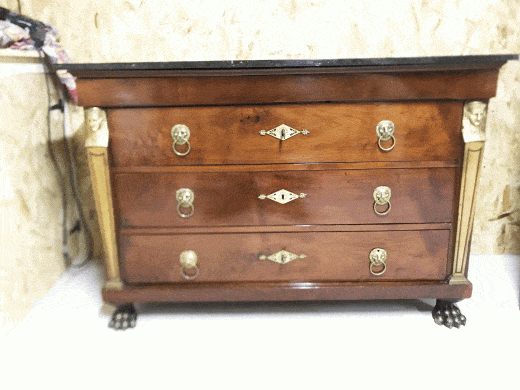
During the turbulent period of the French Revolution, furniture production was considerably diminished, and most artisans experienced very difficult times. Overall, from the Consulate to the Directory, furniture and seating had little time to evolve. However, even though some decorative motifs inspired by Egypt had already appeared, it was after the Egyptian expedition (1798-1801) that they evolved into a unique style. The so-called "Return from Egypt" style, however, lasted only a short time: a decade at most, as it would […]

Secretary stamped Martin Ohneberg

Ebénisterie Mathieu VATH

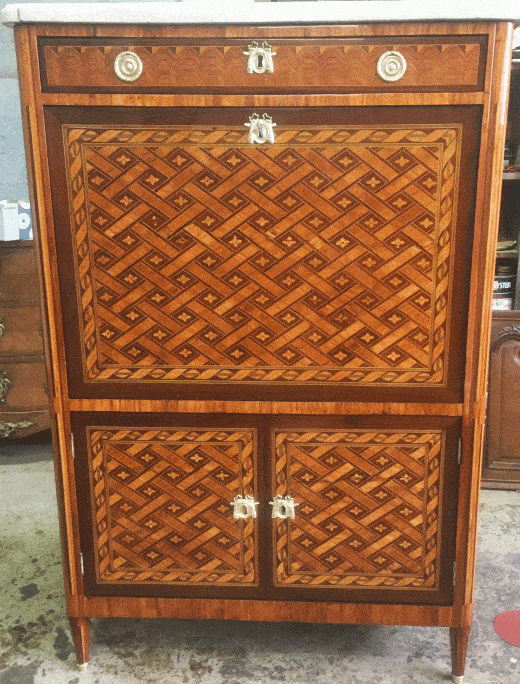
This week marks the completion of the restoration of a Louis XVI period secretary. Martin Ohneberg (Master in 1773), the cabinetmaker who crafted this piece, was an excellent marquetry artist and used very high-quality rosewood. He produced numerous pieces of furniture with very simple lines but exquisite marquetry, including an endless variety of drop-front secretaries. This particular one is veneered with rosewood and amaranth, and features a mosaic marquetry of maple blossoms on a red satinwood ground. The framing bands […]

Majorelle Table

Ebénisterie Mathieu VATH

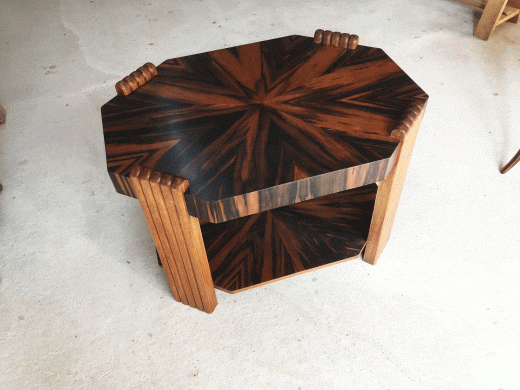
Here is a table in pure Art Deco style. It is veneered with Macassar ebony and the legs are mahogany. This table was probably created around the 1920s. Indeed, Louis Majorelle is best known as one of the great cabinetmakers of the Art Nouveau style, but it is too often forgotten that he was one of the forerunners of the Art Deco style, this table being a perfect example. In terms of restoration, as always, the veneer requires the most work; there […]

Transitional dresser in the style of Topino

Ebénisterie Mathieu VATH

A month ago, a lovely transitional commode arrived, which reminds me of the work of the cabinetmaker Charles Topino (circa 1742-1803) – he received his master craftsman's certificate on July 4, 1773. However, this commode does not bear his stamp, nor any stamp for that matter. This confirms that a stamp is not necessary to possess a piece of high-quality furniture. Furthermore, the marquetry could very well have come from Topino's workshop, as he sold panels of his marquetry to the haberdashers and his colleagues […]

Louis XV slant-front desk stamped HEDOUIN (Restoration complete)

Ebénisterie Mathieu VATH

Remember that slant-front desk? Well, it's finished. It was quite a task, but now it's regained its former glory. Only the drawer keyholes and the leather upholstery remain to be fitted before it's returned to its owner. A large part of the legs has been remade from sawn violet wood. This was cut to the correct thickness, scraped and sanded, then oxidized before being glued, so as not to have to sand the entire piece of furniture […]

Louis XV slant-front desk stamped HEDOUIN

Ebénisterie Mathieu VATH

Thanks to its stamp, it is possible to date this slant-front desk, or cantilevered desk, between 1738 and 1783. The life of Jean-Baptiste Hedouin is relatively unknown. After becoming a master craftsman, he set up his workshop on Rue Traversière-Saint-Antoine. All the furniture he produced was of high quality. His pieces, primarily in the Regency and Louis XV styles, almost all veneered in sheets or with grid patterns, were varied: wardrobes, flat and slant-front desks, bookcases… but it was the commodes that constituted the largest part of his output.

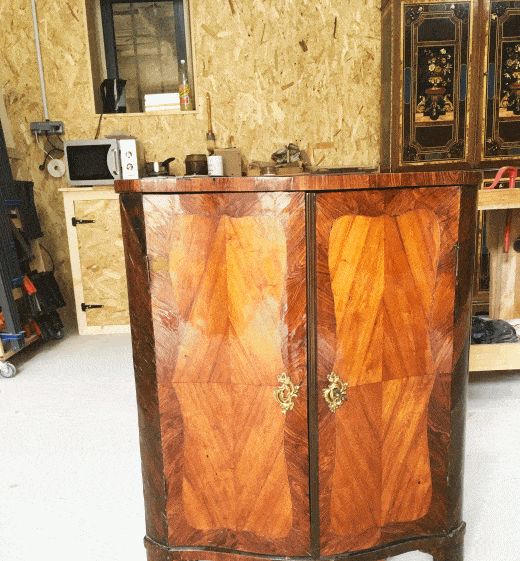
Louis XV corner cabinet, stamped JM CHEVALLIER

Ebénisterie Mathieu VATH

Here is a corner cabinet stamped by Jean-Mathieu Chevallier. It is made of solid oak and veneered with rosewood and violet wood with a boxwood inlay. Jean-Mathieu Chevallier was already established on the rue de Grenelle under the sign "à la Croix Chevallier" when he obtained his master craftsman's certificate in 1743. He subsequently expanded his business considerably, had business dealings with André-Charles Boulle, one of the sons of the famous cabinetmaker, and contributed to furnishing the Hôtel du Duc de Talmont, as well as the Château de Villegénis, which he had purchased […]