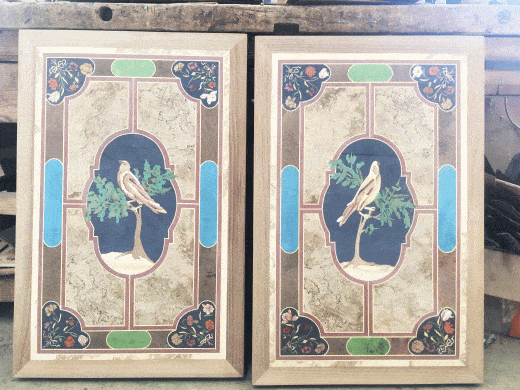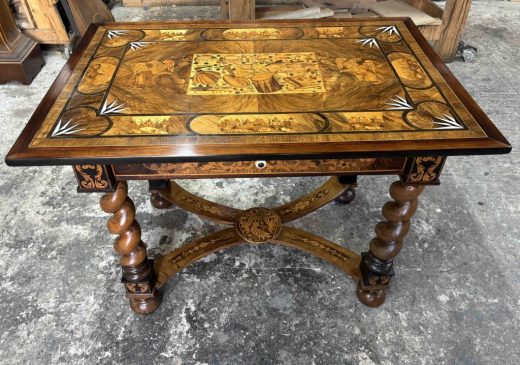
Wild herb table

Ebénisterie Mathieu Vath

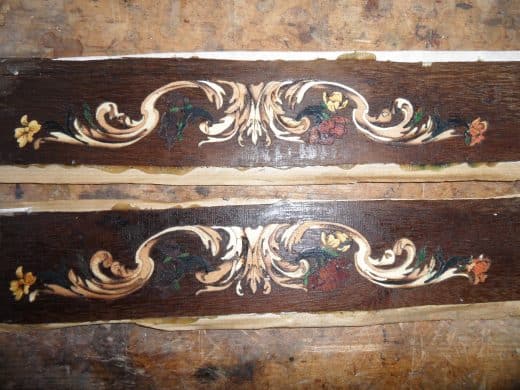
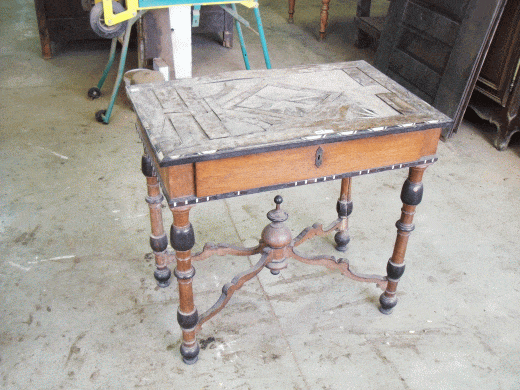
Restoration of a solid walnut marquetry table with "architectural whimsy" and "wild herbs" motifs, originating from the Austrian Tyrol in the mid-17th century. The piece rests on four twisted legs, adorned with flattened ball feet, connected by an X-shaped stretcher. It opens with a wide drawer in the front and is surmounted by a rectangular top. This top is decorated with a rosewood border, followed by bands delimited by wide bog oak fillets, themselves framed with boxwood. These elements […]
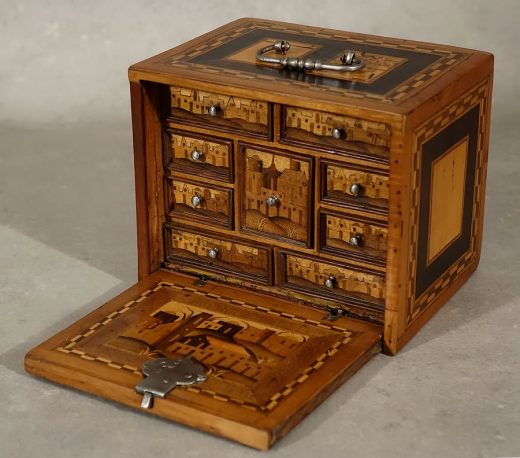
Augsburg Cabinet, 17th century

EEbénisterie Mathieu Vath

Restoration of a small table cabinet (Height: 14.3 cm – Width: 17.3 cm – Depth: 13 cm), likely a traveling model, made of solid wood with intarsia on all sides, opening with a drop-front concealing eight drawers (the bottom one simulating two drawers). Its composition is particularly rich, incorporating eight different wood species. The frame, made of fir and cherry for the visible parts, is inlaid with large central panels of sycamore maple. These are framed by bands of plum wood, themselves bordered by a double band […]

English Cabinet

Ebénisterie Mathieu Vath

Restoration of a late 17th/early 18th-century English cabinet, veneered in walnut and maple, featuring the distinctive free-flowing arabesque marquetry known as seaweed marquetry because it evokes the seaweed found on the seabed. English "seaweed" marquetry is traditionally associated with Dutch and Flemish cabinetmakers active in the second half of the 17th century, and particularly with Gerrit Jensen. Indeed, when Prince William III of Orange ascended the throne of England in 1689, he was accompanied by his cabinetmakers. Subsequently, religious persecutions on the […]

Louis XVI secretary stamped TOPINO

Ebénisterie Mathieu Vath

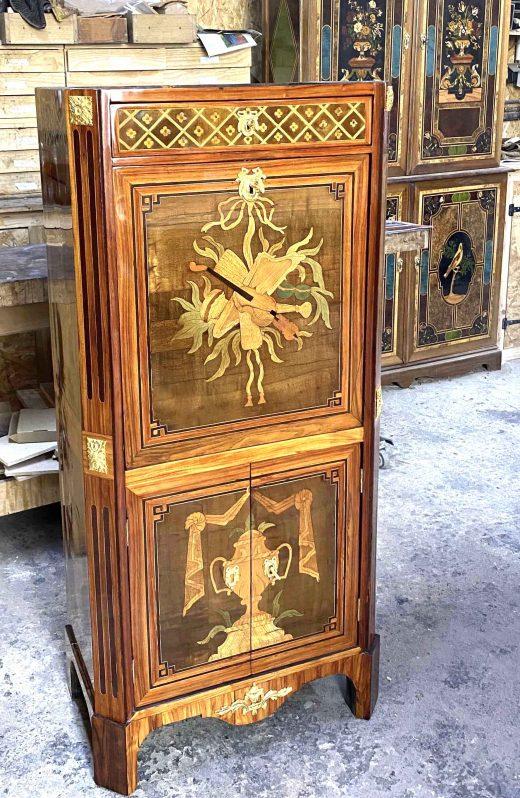
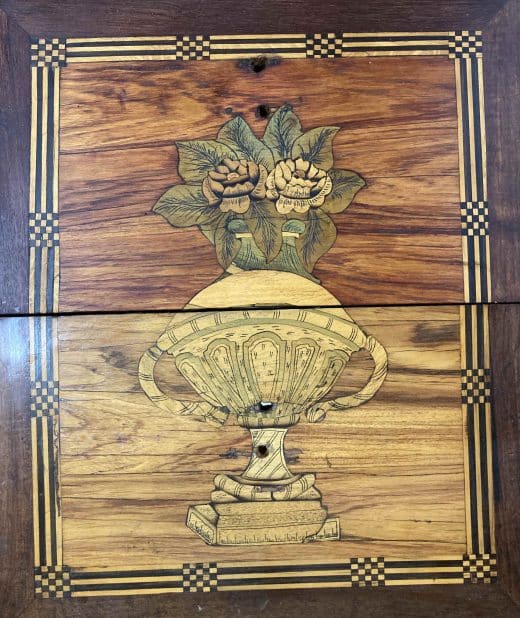
Restoration of a Louis XVI secretary desk stamped by Charles Topino. Typical of Topino's style, this secretary is constructed of oak and softwood. The front opens with a drawer and a drop-front covered in red leather tooled in gilt, revealing two compartments and four drawers veneered in rosewood. The lower section opens with two doors revealing a shelf. These are decorated with marquetry depicting a vase and drapery on a tobacco-colored ground, while the drop-front is inlaid with musical instruments, ribbons, and foliage on […]

8-foot desk stamped Manet

Ebénisterie Mathieu Vath

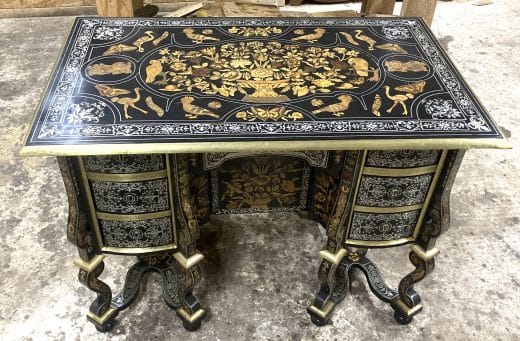
Restoration of an eight-legged desk, commonly known as a "Mazarin" desk, from the Louis XIV period, late/early 17th century. Constructed of pear and solid softwood, the sides and drawer bottoms are also pearwood. It features two side cabinets, each opening with three drawers, a central drawer above a middle cabinet with rounded edges, and console-shaped uprights and eight legs joined by two X-shaped stretchers. The drawers are inlaid with pewter and blackened pearwood, depicting a late 17th-century design. […]

Louis XV corner cabinet

Ebénisterie Mathieu Vath

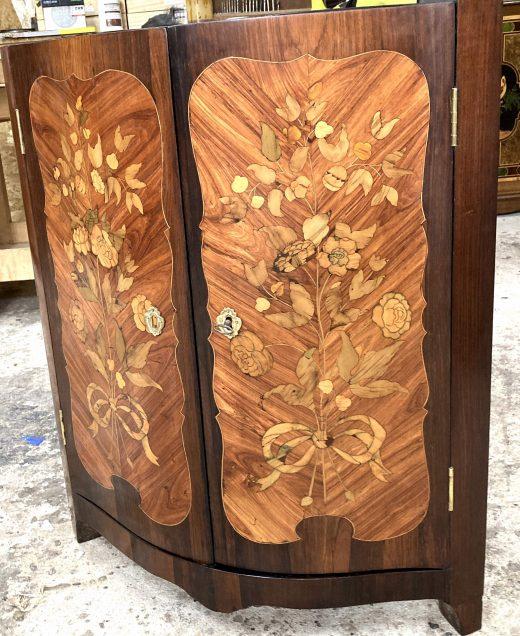
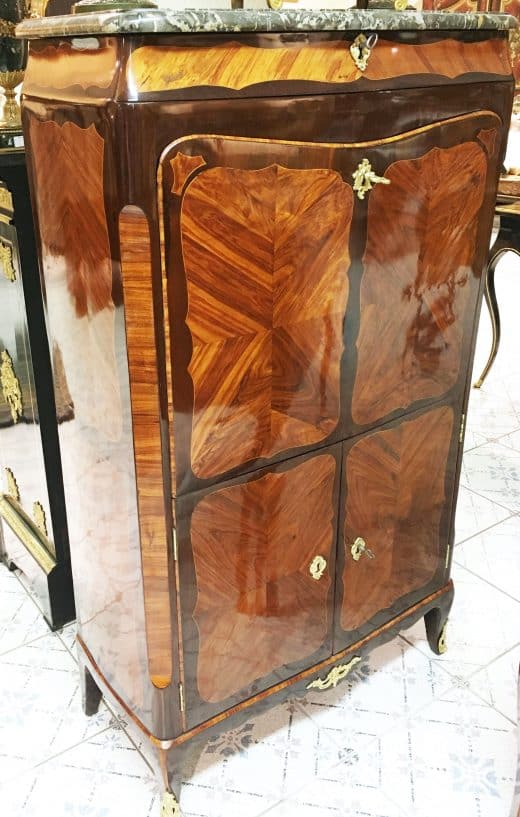
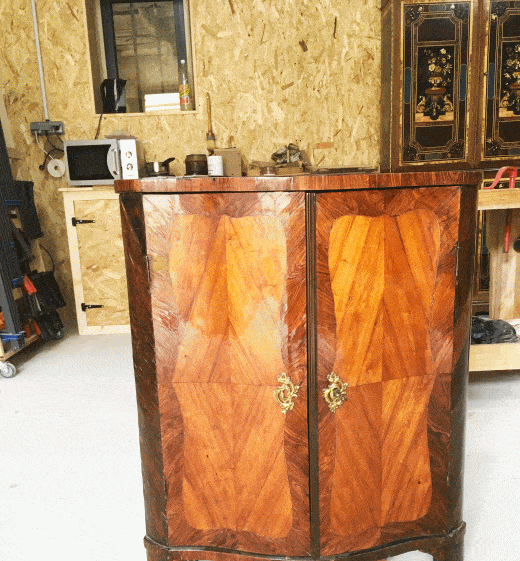
Restoration of a Louis XV corner cabinet in marquetry of various woods (maple, hornbeam, boxwood, and holly). Except for the green leaves, the colors of some flowers and ribbons have faded. This marquetry is executed on a rosewood background framed by a boxwood stringing and a rosewood frieze. The frame of this corner cabinet is made of solid oak assembled with dovetail joints. Condition report: As you can see in the following photos, the surface of the varnish was heavily sun-faded, the glues of the marquetry on the doors were in […]

Louis XVI commode stamped JB.Tuart

Ebénisterie Mathieu Vath

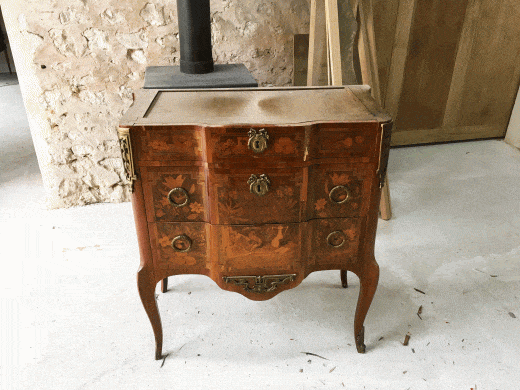
Here is a very pretty Louis XVI period commode veneered in rosewood and amaranth with marquetry of boxwood, pearwood, maple, hornbeam, walnut, blackened pearwood, lemonwood… It is built of oak and softwood. It is stamped twice with the mark of Jean-Baptiste II TUART. But its maker is probably Jean LAPIE. From a dynasty of Parisian cabinetmakers and merchants, whose father, Jean-Baptiste I, obtained his master's certificate in 1741 and was active until around 1760, Jean-Baptiste II, born around 1720, was not a master cabinetmaker but a master furniture maker and haberdasher […]

Transition cylinder desk

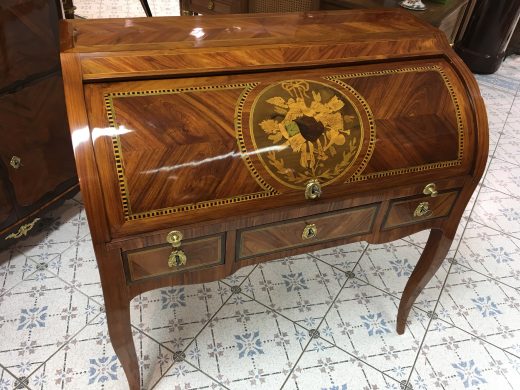
A few years ago, I had the opportunity to restore this magnificent Transition period (1780) roll-top desk. It is framed in oak and fir. The fall front is primarily veneered with rosewood laid in a paillon pattern, framed by a light stringing of boxwood and green-stained hornbeam, bordered by a thin band of amaranth. The back is veneered in satinwood. The central marquetry, on a tobacco-stained sycamore ground, depicts musical instruments and two doves taking flight, each carrying a musical score in its beak. This […]

Secret box

Ebénisterie Mathieu Vath

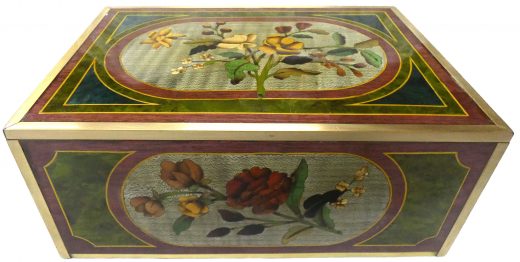
The brief was to create a multi-movement secret box inspired by Japanese boxes but with French-style marquetry. This box comprises three movements to access the secret drawer and a spring-loaded button concealed beneath the veneer that allows the drawer to be ejected. For the form and marquetry, I drew inspiration from the traveling secretary attributed to Jean-François Oeben. The geometric shapes and colors closely correspond to what this cabinetmaker […]

Louis XVI commode stamped JA BRUNS

Ebénisterie Mathieu VATH

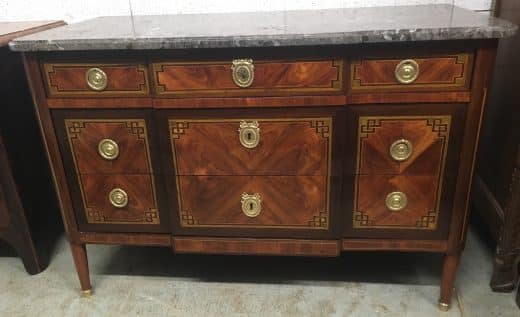
This week marks the completion of the restoration of a Louis XVI commode stamped JA BRUNS. It is made of oak for all the structural elements, except for the side panels, drawer backs, drawer fronts, and the two drawer bottoms, which are made of softwood. It is veneered with rosewood in a butterfly pattern and amaranth for the edges. The false fluting is made of boxwood and ebony, and there is a green-stained maple stringing forming the corners at […]

Secretary stamped P.ROUSSEL JME

Ebénisterie Matheu VATH

Here are some images of the restoration of a secretary desk stamped by Pierre Roussel (1723-1782). Having become a Master Cabinetmaker in 1745, Pierre Roussel set up shop on Rue de Charonne, in the Faubourg Saint-Antoine, under the sign "L'Image de Saint Pierre" (The Image of Saint Peter). Thanks to his skills as a cabinetmaker and especially as an exceptional marquetry artist, he quickly gained a great reputation. In 1762, he became a sworn member of his guild. By 1767, he was considered one of the best cabinetmakers of his time. Highly regarded by his colleagues, he became a representative of the cabinetmakers' guild in 1777 and then syndic two […]

Boulle box

Ebénisterie Mathieu VATH

To kick off the new year, I'm excited to present my latest project. I'm embarking on a replica of this box attributed to André Charles Boulle. You'll be able to follow its progress and even come see it in person, as it will be my main subject for marquetry work at various exhibitions and events over the next few years. And yes, I'm talking about several years, as it's an extremely time-consuming project. But first, I had to find and select the different types of wood that make up the […]

Louis XVI style table

Ebénisterie Mathieu VATH

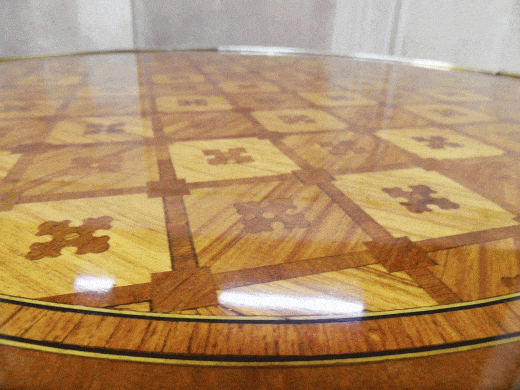
Here is a Louis XVI style table, which is probably an early 20th-century piece. It was likely made in the Faubourg Saint-Antoine, or perhaps at the École Boulle. I have seen apprentice furniture of this quality made by students during their training. Its frame is oak, while the veneer is rosewood and mahogany with a black inlay. The restoration was straightforward, apart from a lack of rosewood in the marquetry […]

Louis XIII style desk

Ebénisterie Mathieu VATH

A look back at the restoration of a 17th-century Louis XIII table. It is made of solid walnut and veneered with walnut, ebony, ivory, and boxwood. This table had spent a long time in an attic, and unfortunately, the tabletop suffered considerably. Many sections of veneer were missing. The restoration therefore began by removing what little veneer remained. It was very easy; it was completely detached. I simply had to lift it with a thin blade, and it came right off. After having […]

Transitional dresser in the style of Topino

Ebénisterie Mathieu VATH

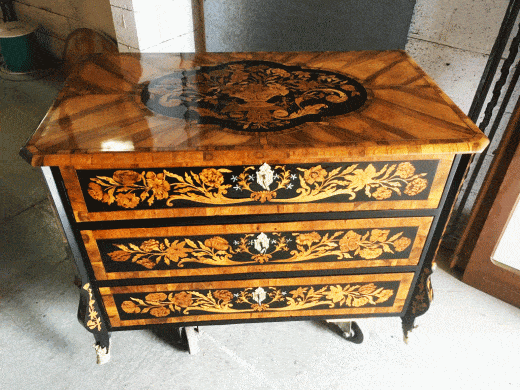
A month ago, a lovely transitional commode arrived, which reminds me of the work of the cabinetmaker Charles Topino (circa 1742-1803) – he received his master craftsman's certificate on July 4, 1773. However, this commode does not bear his stamp, nor any stamp for that matter. This confirms that a stamp is not necessary to possess a piece of high-quality furniture. Furthermore, the marquetry could very well have come from Topino's workshop, as he sold panels of his marquetry to the haberdashers and his colleagues […]

Louis XV corner cabinet, stamped JM CHEVALLIER

Ebénisterie Mathieu VATH

Here is a corner cabinet stamped by Jean-Mathieu Chevallier. It is made of solid oak and veneered with rosewood and violet wood with a boxwood inlay. Jean-Mathieu Chevallier was already established on the rue de Grenelle under the sign "à la Croix Chevallier" when he obtained his master craftsman's certificate in 1743. He subsequently expanded his business considerably, had business dealings with André-Charles Boulle, one of the sons of the famous cabinetmaker, and contributed to furnishing the Hôtel du Duc de Talmont, as well as the Château de Villegénis, which he had purchased […]

Napoleon III planter and Louis XVI chest of drawers

Ebénisterie Mathieu VATH

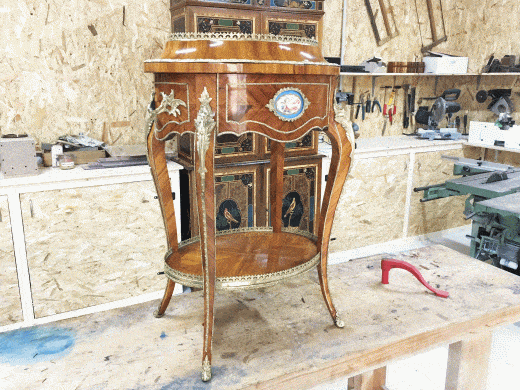
This week, two pieces of furniture left the workshop: a Napoleon III jardinière in rosewood veneer and a Louis XVI chiffonier in rosewood and violet wood veneer. If this piece had seven drawers, it would have been called a "semainier" (weekly chest of drawers). Here are some photos of their restoration.

Louis XV commode stamped JC Ellaume

restauration de mobilier

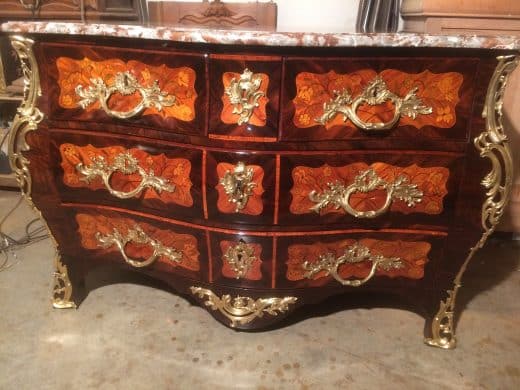
Restoration of a Louis XV period commode stamped JC Ellaume. This commode is veneered in rosewood and palisander with floral marquetry on the drawer fronts. The frame is made of oak and softwood. Jean-Charles Ellaume, also sometimes written as Allaume, received his master craftsmanship in Paris on November 6, 1754. Many pieces of furniture bearing his stamp are known. These are mostly Louis XV commodes. It was in his workshop on Rue Traversière that he produced numerous high-quality pieces of furniture for over thirty years, […]

Mazarine Chest of Drawers

Ebénisterie Mathieu VATH

This week, we're revisiting the restoration of a Louis XIV period commode, a commode known as a Mazarine commode. But where does the name "Mazarine" come from? Well, it seems that the first example was made for the famous Mazarine Library, quite simply. Moreover, the illustrious creator of the commode was none other than André Charles Boulle himself. For Louis XIV's bedroom at Trianon, he revolutionized a type of furniture in 1708: the commode, which takes its name from its "practical" aspect compared to the chests that were widely used at the time. Today, we're presenting […]

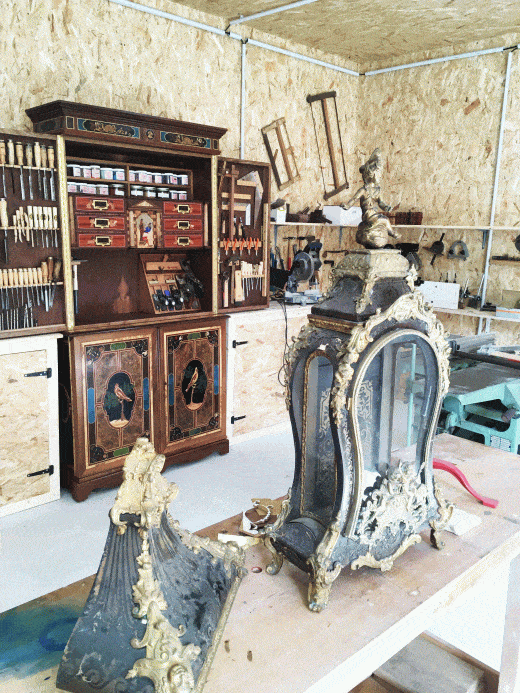
Alexandre Morell's Cartel Boulle – The End

Ebénisterie Mathieu VATH

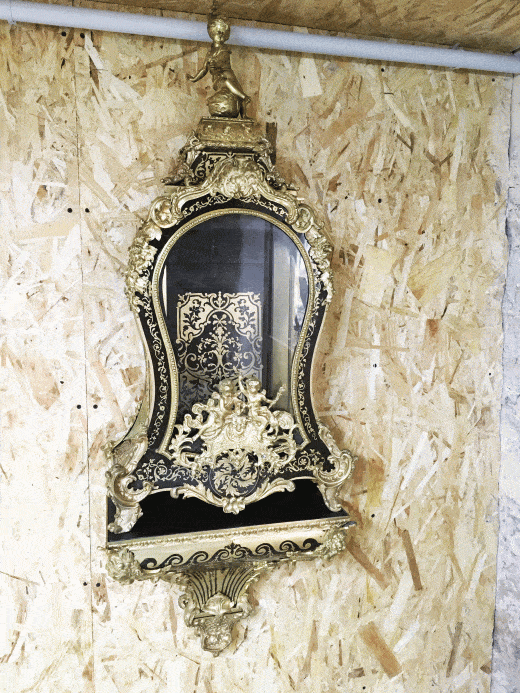
After a few hours of cutting, gluing, re-gluing, and cleaning the surfaces, we finally reach the finishing stage. For this cartel clock, we chose to French polish it because it's a finish that highlights the marquetry, protects it, and is easily reversible (like all my work). I always use a clear shellac varnish, whether on wood or other materials. The varnishing process is difficult to explain; it simply takes hours and hours […]

Alexandre Morell's Boulle Cartel – Marquetry

Ebénisterie Mathieu VATH

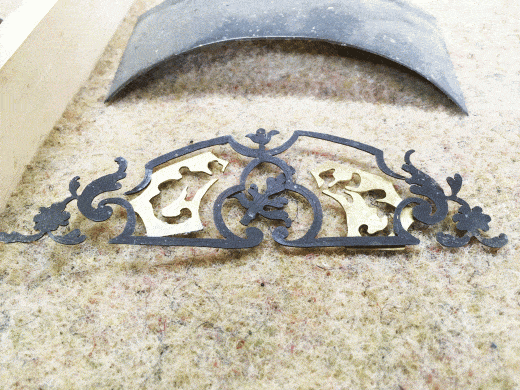
After reattaching the structure, removing the brass, cleaning up any remaining animal glue, and removing any residue of superglue and neoprene adhesive, the next step is cutting out the new pieces of brass and tortoiseshell to fill the gaps. So, as usual, I take an impression of the missing piece. Then I glue this piece of paper onto a brass plate, which is itself glued with fish glue to a piece of 4mm plywood. This makes the brass plate easier to cut. To retrieve […]

Alexandre Morell's Cartel Boulle – Continued

Ebénisterie Mathieu VATH

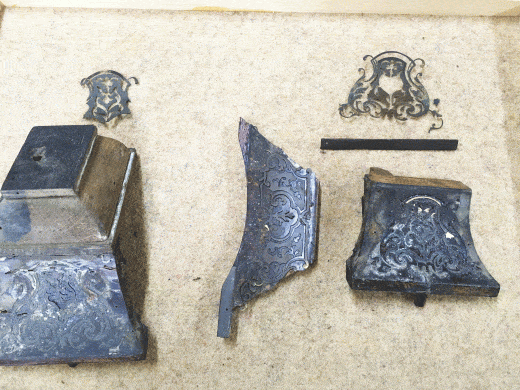
Once the various structural elements were glued back together, I tackled the tortoiseshell and brass marquetry. As you'll see, on this clock it's in very, very bad condition; practically nothing is holding. So, all the brass has to be removed. The tortoiseshell, however, is holding well; it's only partially detached. The first step in restoring this marquetry is therefore to remove and set aside each brass element. The second is to clean off the old glue, […]

Alexandre Morell's Boulle Cartel

Ebénisterie Mathieu VATH

Here is my first client, patient… well, whatever you want to call him. It's a Boulle marquetry cartel clock in brown tortoiseshell, ebony, and brass. As you can see in the following photos, it's not in very good condition. There are many missing brass pieces, and the remaining brass is peeling off everywhere. At first glance, it's always difficult to precisely date a Boulle cartel clock: this one doesn't have a maker's mark. However, it does have corkscrew screws (typical of the 18th century […]

Tool cabinet – End

Ebénisterie Mathieu Vath

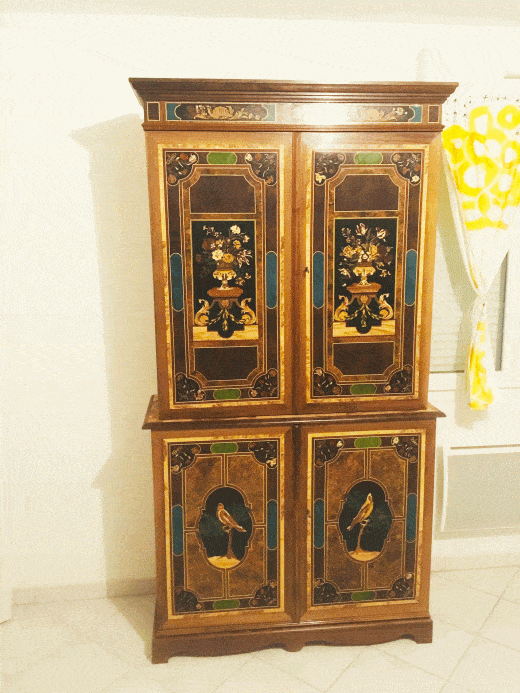
And there you have it, it's finished and ready to use. All the tools are in their proper place. All that's left is to find bronze fittings for the handles and keyhole escutcheons. For the finishing technique, I used the same one applied to furniture of that period: polishing. I first scraped the surface, then sanded it with 150-grit sandpaper. Next, I applied Venetian tripoli mixed with olive oil using a piece […]

Tool cabinet – The top doors

Ebénisterie Mathieu Vath

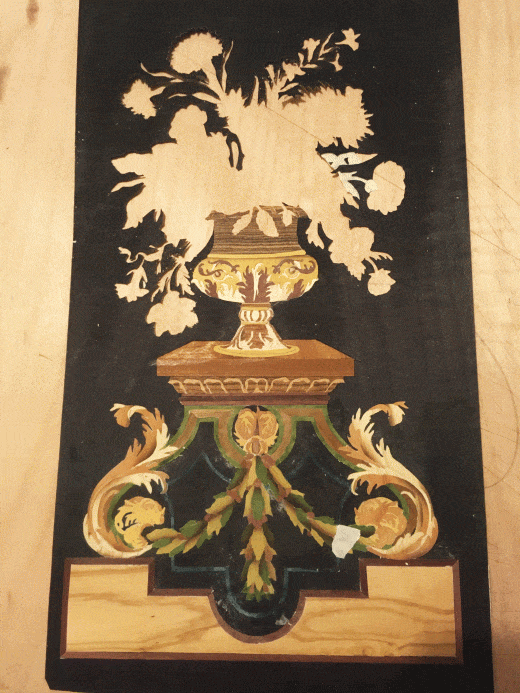
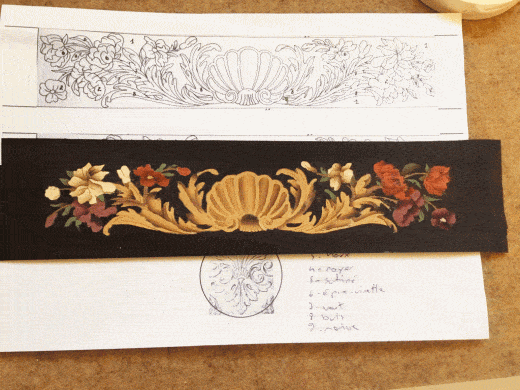
For these marquetry designs, I drew inspiration from Pierre Ramond's book, "André-Charles Boulle, Cabinetmaker, Chaser, and Marquetry Maker to the King." I used the marquetry drawings from the Boulle workshop cabinet (circa 1715–1720). I simply modified them by removing the birds and the butterfly to simplify the design. Then, I partially employed the "Boulle" method for the acanthus leaves and the vase. Finally, I used the wood painting technique for the flower bouquets.

Tool cabinet – Continued

Ebénisterie Mathieu Vath

Here are some photos of the marquetry on the tool cabinet. For the corner pieces, I was inspired by those on a table by Pierre Gole, a predecessor and major influence of André-Charles Boulle. For this cabinet, I needed to make 16 corner pieces. So, to save time, I decided to use the Boulle marquetry technique. I made four bundles of different colored woods to obtain four different marquetry designs from a single cut. Therefore, there are four identical designs, but with different flower colors. Then, […]

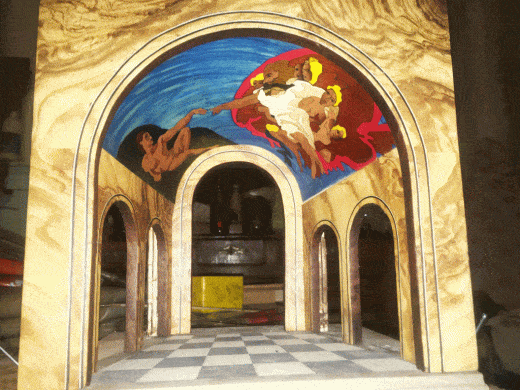
Tool cabinet – Michelangelo's The Creation of Adam

Ebénisterie Mathieu Vath

I indulged myself with this marquetry project; I had always wanted to recreate this famous marquetry fresco. This allowed me to revisit David Roentgen's "mosaic marquetry" technique. I created a pack with a hornbeam leaf, a sycamore maple leaf, and a pear leaf to make the figures, as pear wood is the best for reproducing skin tones. To tint the background, I dipped it in different baths to produce this effect of […]

Tool cabinet – The sculptor

Mathieu Vath

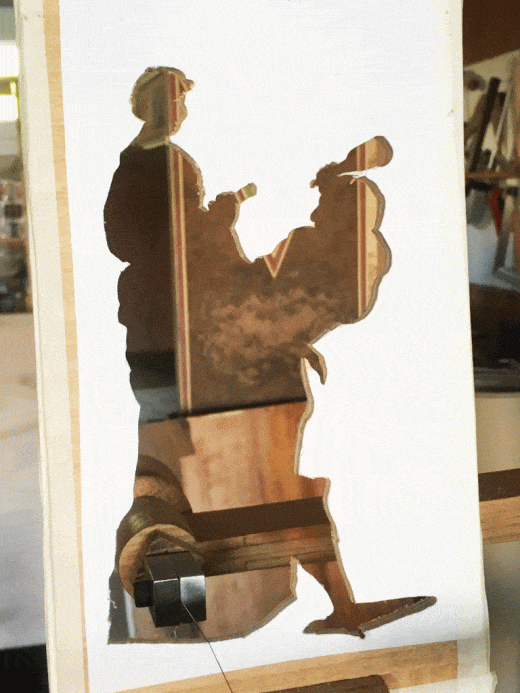
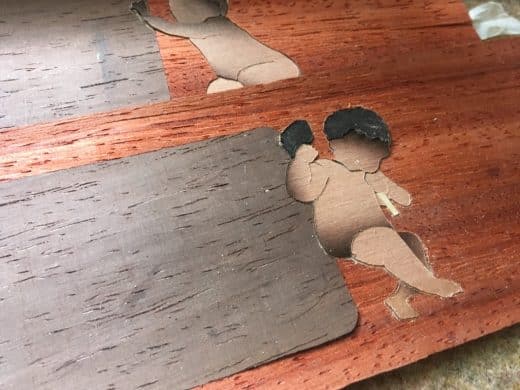
The idea behind this tool cabinet was to explore and implement the various projects I was researching. One of these ideas was to tackle the marquetry technique of a famous 18th-century cabinetmaker, David Roentgen. This technique, known as "mosaic marquetry," involves cutting a single sheet of veneer using a conical saw and then coloring it by dipping each piece in a pre-defined dye. However, there were two problems to overcome: Conical sawing, which is difficult to […]

Tool cabinet

Armoire à outils par Mathieu Vath

Since the workshop is under renovation, today I'll begin describing the various stages involved in making this tool cabinet. The idea came to me while looking for a way to store all my tools in a single piece of furniture. For the style, I had recently restored a Masarine commode in the style of the HACHE family in Grenoble. When I embark on a personal furniture project, I like to explore new techniques. And I had never before tackled the Louis XIV/Regency style.