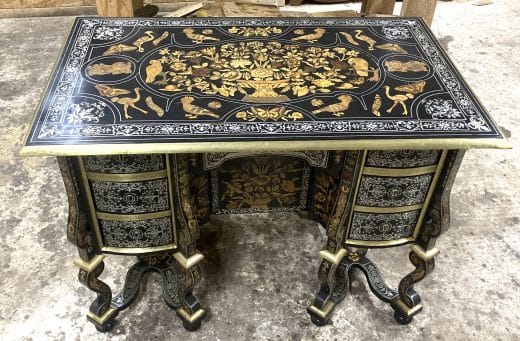
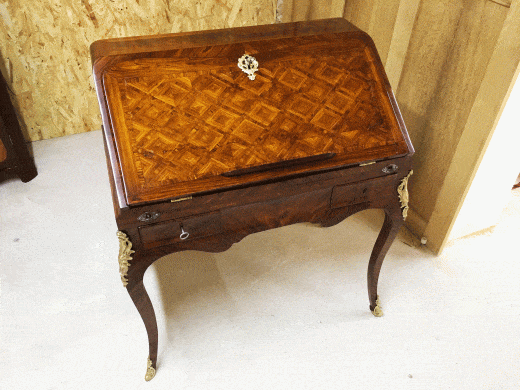
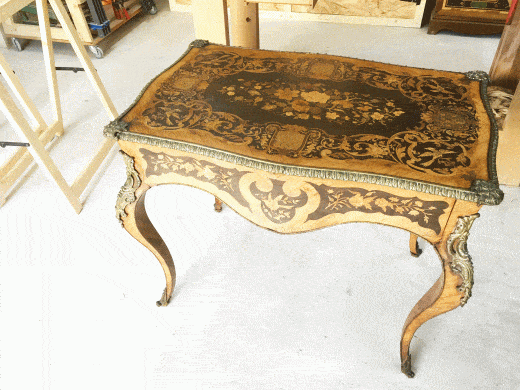
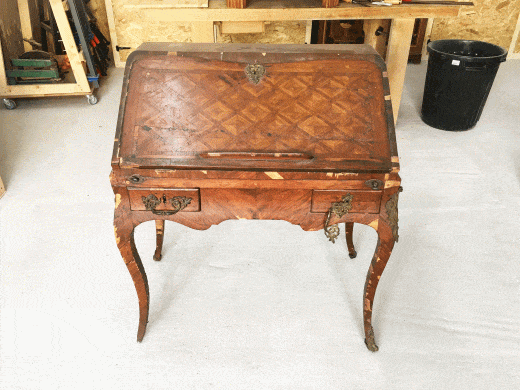
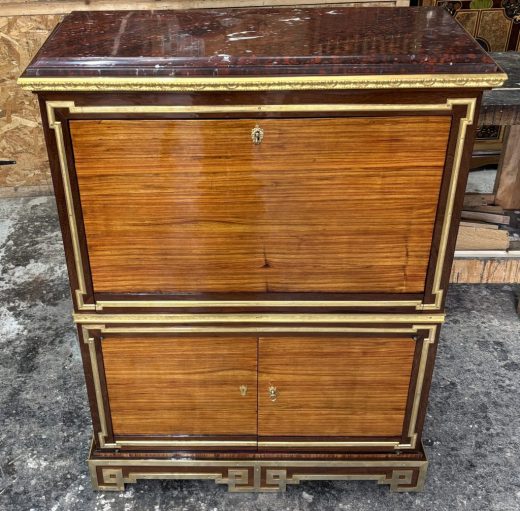
Transition secretary desk in the style of Montigny
Ebénisterie Mathieu Vath

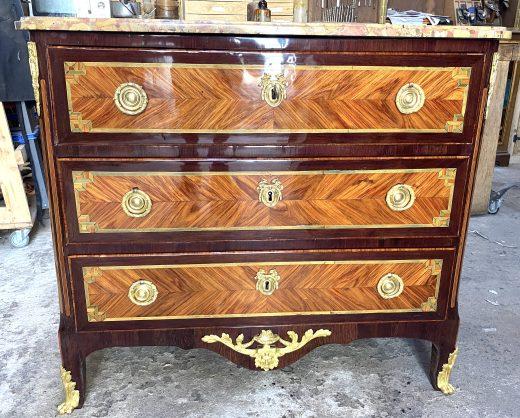
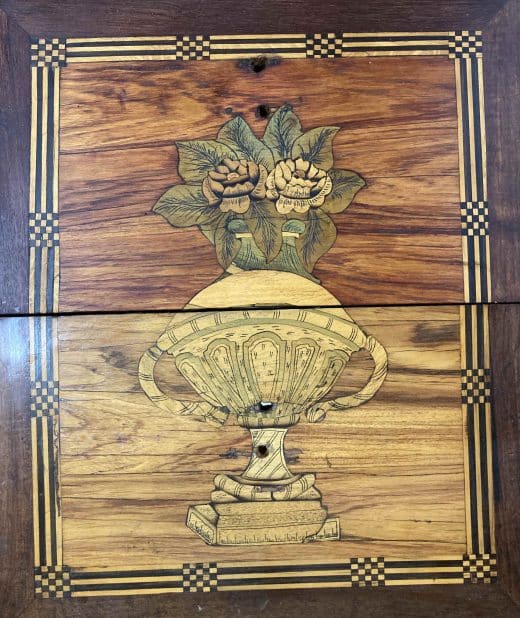
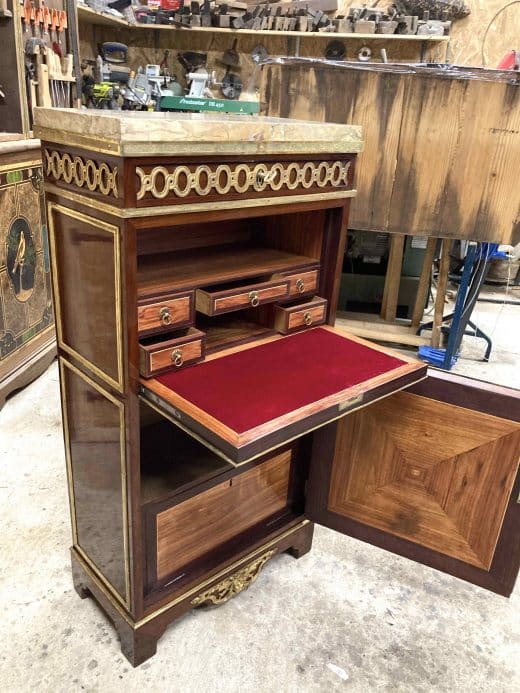
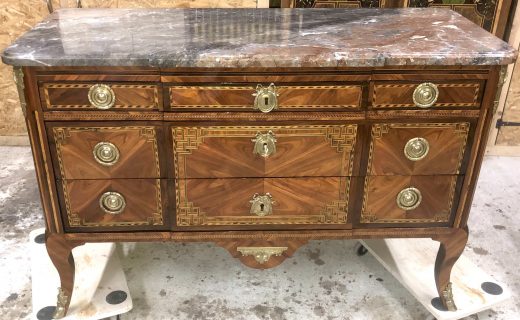
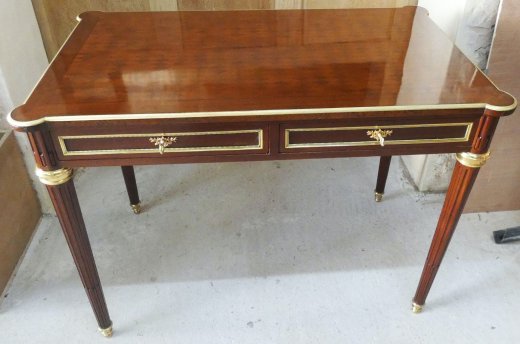
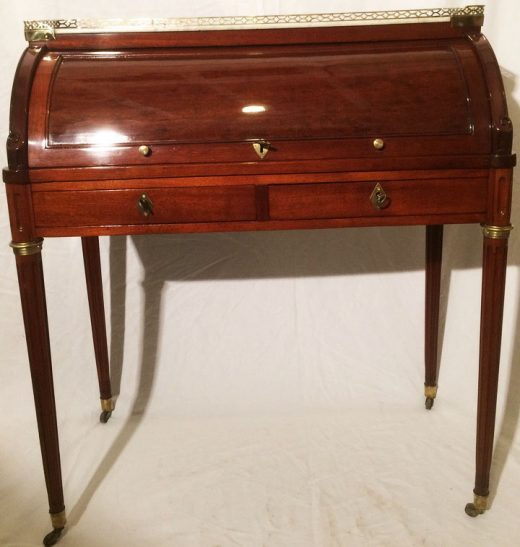
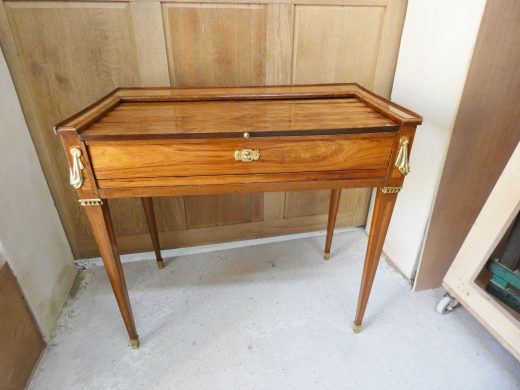
Restoration of a 19th-century Transition-style drop-front secretary, veneered in rosewood and amaranth on an oak frame. This secretary is a learned interpretation of Parisian models from 1765-1775 and is directly inspired by the famous secretary attributed to the cabinetmaker Philippe-Claude Montigny, now in the Musée des Arts Décoratifs. The stylistic similarities with the museum model are immediately apparent in the architectural design of the piece, the treatment of the stepped legs, and the use of bronze ornamentation inspired by the Greek style. The piece adopts […]
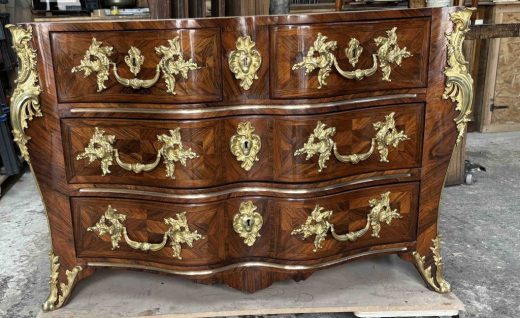
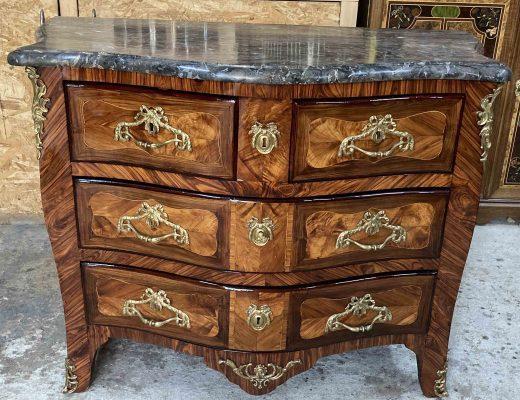
Regency chest of drawers Crossbow

Ebénisterie Mathieu Vath

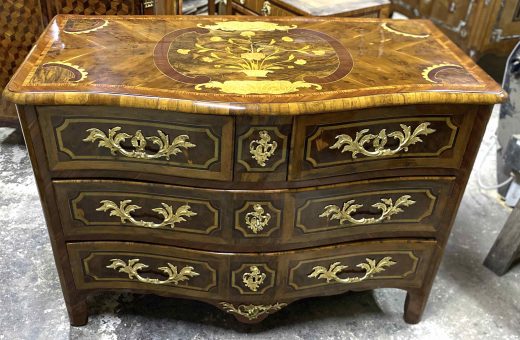
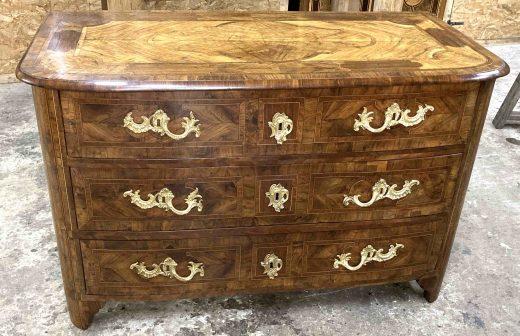
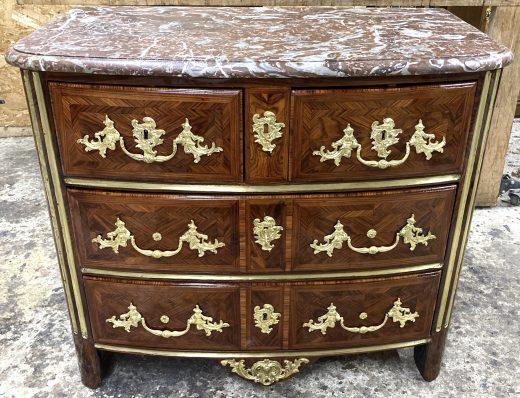
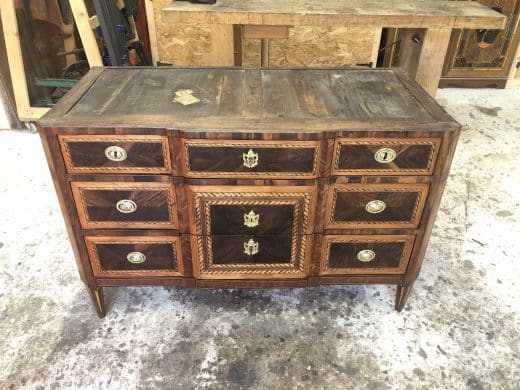
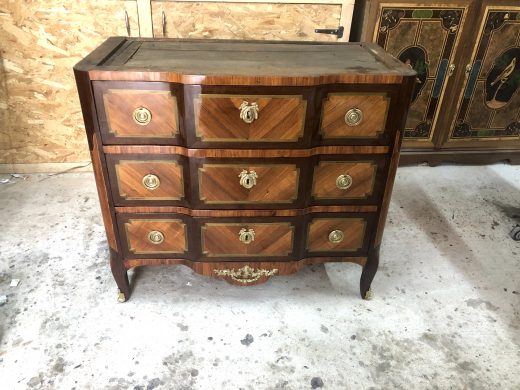
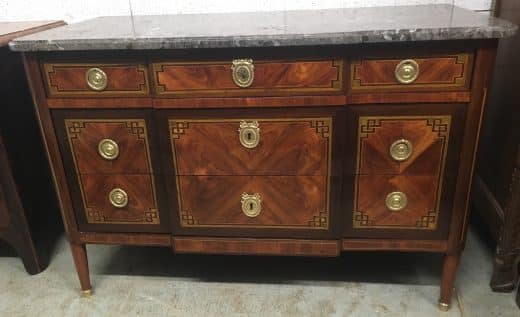
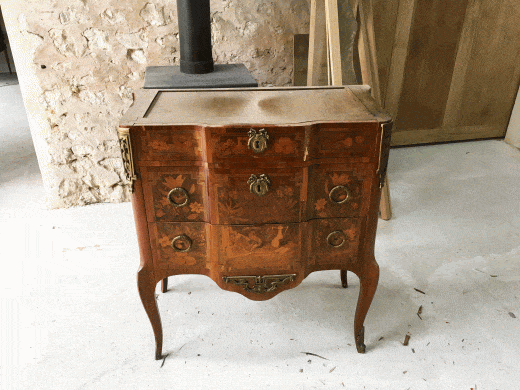
Conservation work on this Regency period commode, characterized by its serpentine shape, rosewood veneer, and gilt bronze mounts, resting on an oak and softwood frame. Our task was to stabilize the veneered surfaces by injecting protein-based adhesive. Veneer gaps were filled with grafts of new rosewood veneer, previously sawn, scraped, and sanded. These grafts were then French polished, naturally oxidized with ultraviolet light, and then applied to the appropriate thickness as a backing before being glued in place with […]

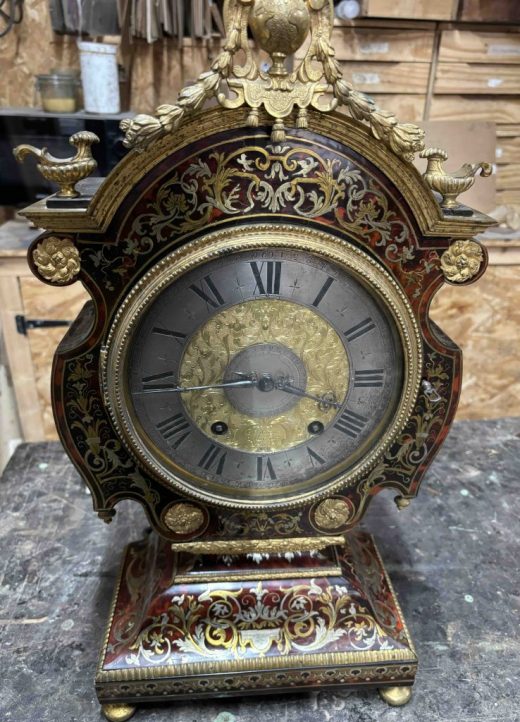
Doll's Head Clock by Baltazard Martinot

Ebénisterie Mathieu Vath

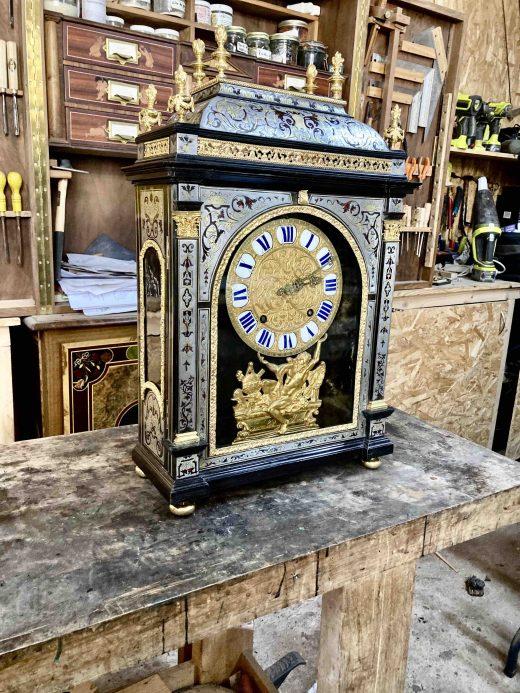
The first project of the year involved stabilizing, consolidating, restoring, preserving the finish, and harmonizing the elements. The main objective was to preserve the history and identity of the project as much as possible without dismantling anything. A masterpiece of Parisian clockmaking from the Grand Siècle, this remarkable clock, known as a "doll's head" clock, is emblematic of Parisian clockmaking at the end of the 17th century, during the reign of Louis XIV. Its architectural form, dominated by a circular body flanked by lateral projections and surmounted by a rich crowning element […]

Louis XIV style commode – Grenoble, first third of the 18th century

Ebénisterie Mathieu Vath

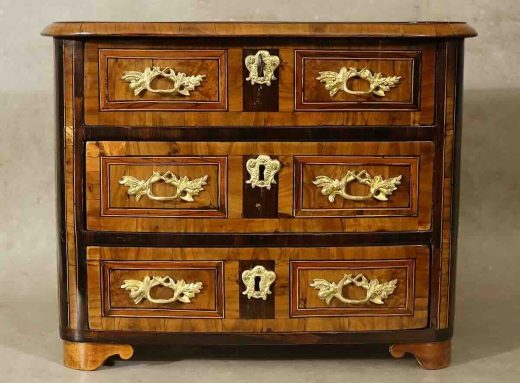
Restoration of a Louis XIV Dauphiné commode, veneered in geometric Alpine wood, with a bombé front and three drawers in three rows. The model's proportions and construction are similar to those of a full-size commode (dovetail joints, intermediate shelves, etc.). The cabinetmaker skillfully played with contrasts through the juxtaposition of wood species, and the quality and variety of the woods used on this small piece of furniture are remarkable: primarily olive and olive burl, walnut, and rosewood for the framing bands highlighted with […]

Louis XVI chest of drawers by Jean-Francois Leleu

Ebénisterie Mathieu Vath

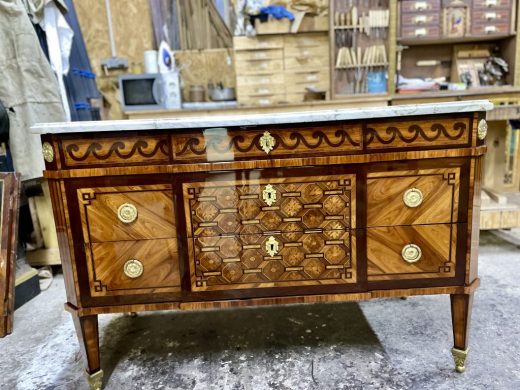
Restoration of a Louis XVI period commode with a projecting central front, stamped JF LELEU. Made entirely of oak, it is veneered with amaranth, rosewood, boxwood, stained maple burl, and tobacco-grey maple. It is decorated with marquetry featuring a frieze of posts on the top drawer, Greek key motifs, and fleurons within a mosaic of hexagons known as "marquetry à la reine" on the central projection. It has three drawers, two of which conceal drawers with crossbars. The front uprights are […]

Flat Greek-style desk stamped DUBOIS

Ebénisterie Mathieu Vath

One desk, one stamp, three cabinetmakers? The desk we are about to discover, a masterpiece of French cabinetmaking, embodies the culmination of 18th-century Neoclassical taste. The question that immediately arises upon contemplating this exceptional piece is: why three cabinetmakers for a single desk? The answer lies in the complex interplay of succession, talent, collaboration, and opportunism that characterized the craftsmanship of the period. This flat desk, known as a "Greek-style" desk, is a perfect example of the Louis XVI style. Made from a blend of […]

Louis XVI commode stamped J. LAPIE

Ebénisterie Mathieu Vath

Restoration by Lise, during her internship at the workshop, of a Louis XVI commode stamped by Jean Lapie, constructed of oak, fir, and beech, veneered in rosewood with hornbeam and amaranth stringing, and adorned with gilt bronze mounts. And since Lise submitted an excellent internship report, I am publishing it almost in its entirety. Jean Lapie (known as "The Younger"), son of the potter Nicolas Lapie, was born around 1734. Brother of the cabinetmaker Nicolas-Alexandre Lapie (known as "The Elder") and cousin of Jean-François Lapie, he obtained his master's degree in Paris […]
Regency table lamp

Ebénisterie Mathieu Vath

Restoration of a Regency mantel clock in brown tortoiseshell and brass marquetry on an oak frame. Without its bronze mounts, this type of furniture loses its splendor. But when it regains its bronze fittings, knowing that the function of this type of furniture is to tell the time, the symbols that compose them take on their full meaning. Fame on the escapement and the eagle on the door are perfect examples. Fame is originally an allegorical Greek deity personifying public recognition […]
La Rochelle chest of drawers in "Isles wood"«

Ebénisterie Mathieu Vath

A look back at the restoration of this rare port chest of drawers, crafted from solid woods brought back from both the Orient and the West Indies, combining four precious woods: mahogany, satinwood, Palo Santo, ebony, and, most notably, a fifth wood, Royal ebony. This chest of drawers opens with three wide drawers in three rows of Palo Santo, interspersed with Ceylon ebony crossbars, and is topped with a solid framed top composed of parquet flooring, primarily enlivened by Royal ebony crossbars against a mahogany background (some sections are mottled or […]
Regency commode with faun and lion masks

Ebénisterie Mathieu Vath

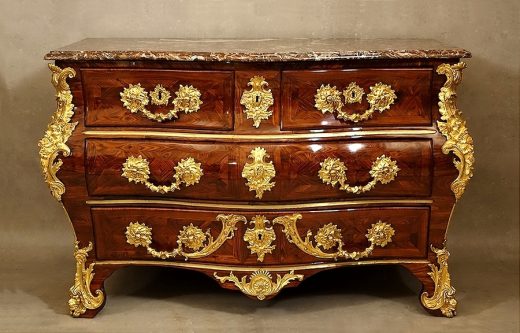
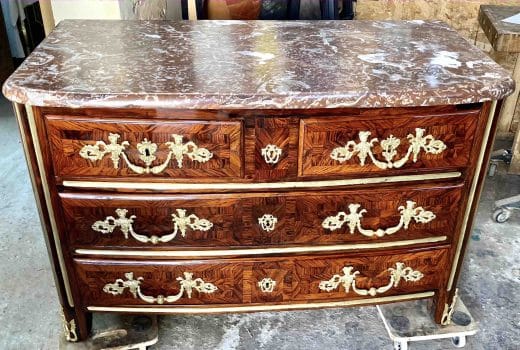
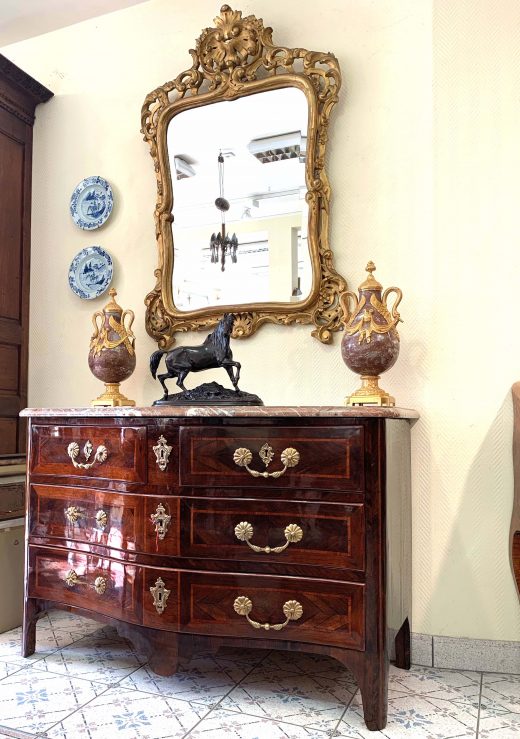
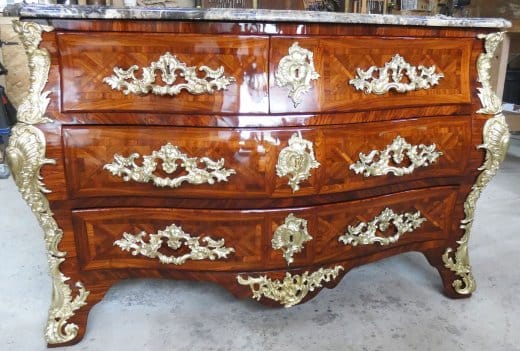
Restoration completes this important and rare commode, known as a "tomb-shaped" or "Regency" commode, also called a "moustache" commode, dating from the Regency period. Curved on all sides, it opens with four drawers in three rows. Topped with a Belgian Vieux Rance marble slab (it's worth noting that Rance was a French village at the beginning of the 18th century), molded with a corbel-like profile following its contours, this wide commode, veneered in a single layer of kingwood, boasts powerful curves, is adorned with brass fluting on the front and sides, and is covered with exceptional finely chased bronze mounts.

Louis XV cartel clock with crowned C

Ebénisterie Mathieu Vath

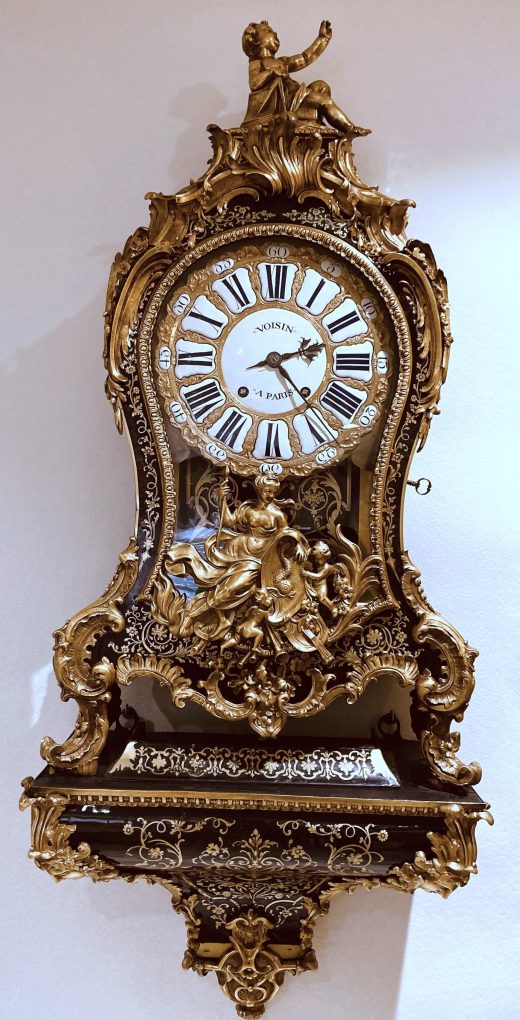
Restoration of a Louis XV cartel clock in tortoiseshell and brass marquetry, the movement of which is signed by Charles Voisin (born 1686-1760), Master Clockmaker in 1710. The distinctive feature of this clock is that the bronze mounts are stamped with the crowned C mark. The crowned C was established by an edict of 1745, which required bronze workers to mark their pieces with a small, distinctive letter, a C surmounted by a crown, thus subjecting them to a tax. This tax applied to both objects and furniture adorned with it. It is a […]
Regency commode with crowned R

Ebénisterie Mathieu Vath

Restoration of a Regency commode, probably from southeastern France, veneered with yew, plum, rosewood, walnut, cherry, amaranth, violet wood, boxwood, and green-stained maple on a softwood frame. Besides its highly unusual marquetry decoration, the commode's distinctive feature is its crowned R bronze mounts. The crowned R hallmark should not be confused with the crowned C hallmark, which corresponds to a tax levied from 1745 to 1749 on copper objects and is found on many […]
Transition work table

Ebénisterie Mathieu Vath

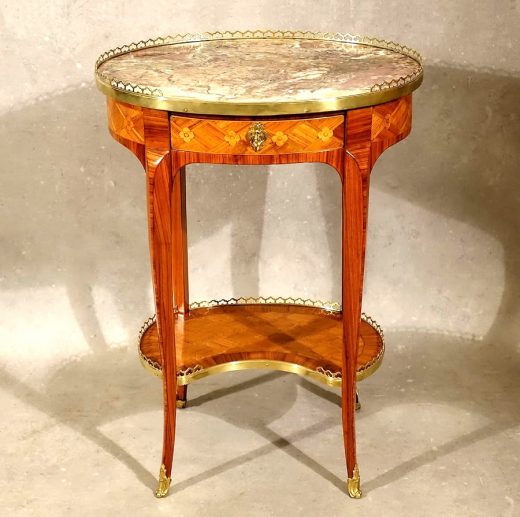
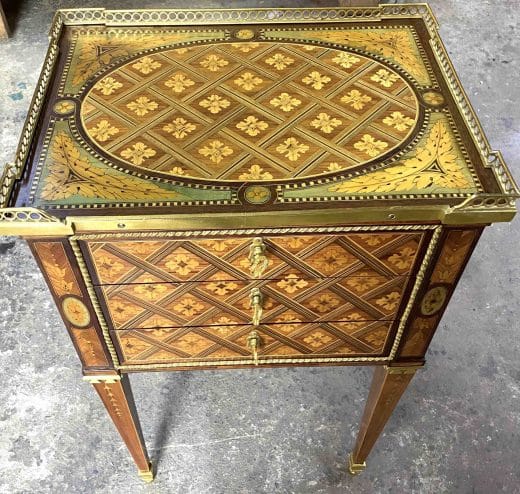
Restoration of a work table with cabriole legs and a stretcher in marquetry of trellis and quatrefoils, known as "à la Reine," veneered in rosewood, inlaid with boxwood, green-stained hornbeam, and boxwood stringing on an oak frame. It opens in the frieze with a drawer forming a writing surface with a leather-lined drop-front and compartments on the sides. The Escallettes marble top is bordered by an openwork brass gallery similar to the one that frames the kidney-shaped stretcher. A minor restoration including some veneer repairs and […]

Transitional chest of drawers stamped SAUNIER

Ebénisterie Mathieu Vath

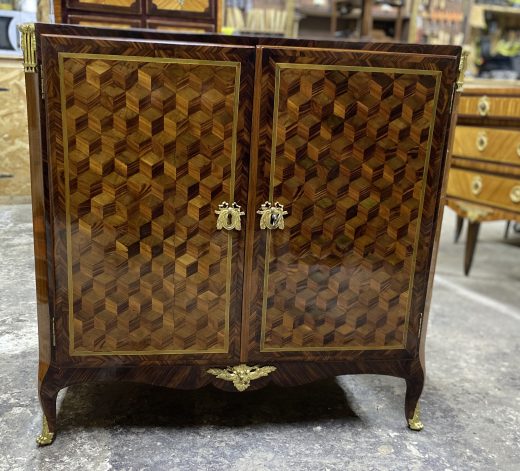
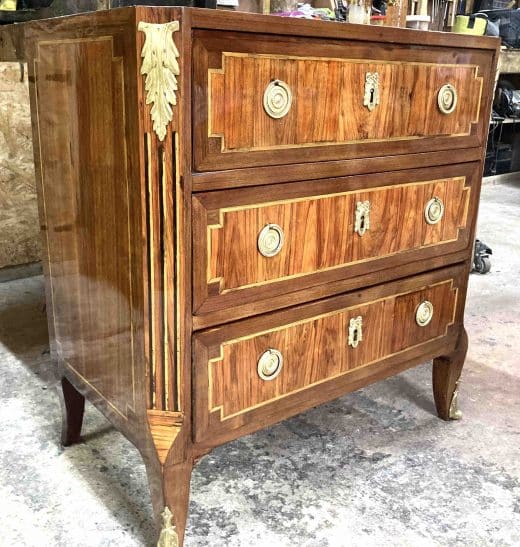
Restoration of a transitional two-door commode veneered with bottomless cube marquetry. The frame is oak for the uprights and rails, the side panels are softwood, and the two doors are walnut. The bottomless cubes are veneered with rosewood, violetwood, and tobacco-stained maple. The entire piece is framed with a stringing of green-stained maple and boxwood. The uprights and door frames are veneered with violetwood and rosewood. The sides […]

Louis XVI secretary stamped TOPINO

Ebénisterie Mathieu Vath

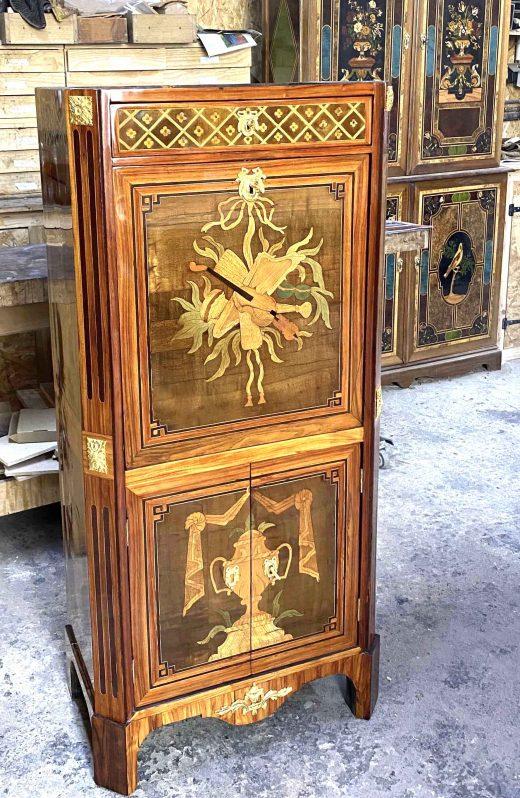
Restoration of a Louis XVI secretary desk stamped by Charles Topino. Typical of Topino's style, this secretary is constructed of oak and softwood. The front opens with a drawer and a drop-front covered in red leather tooled in gilt, revealing two compartments and four drawers veneered in rosewood. The lower section opens with two doors revealing a shelf. These are decorated with marquetry depicting a vase and drapery on a tobacco-colored ground, while the drop-front is inlaid with musical instruments, ribbons, and foliage on […]

Transitional chest of drawers stamped J.STUMPFF

Ebénisterie Mathieu Vath

Here are some images of the restoration of this commode stamped by Jean-Chrysostôme Stumpff. 1731 - January 17, 1806 – Received Master Craftsman status on August 27, 1766. Framed in oak and softwood, it is veneered with rosewood in a frieze of paillon, amaranth, and boxwood and green-stained maple. J. STUMPFF, originally from Schweigern, Swabia (Germany), married in 1760 in Paris, at the Swedish embassy, like most of his compatriots of the Reformed faith. His fellow cabinetmaker, Ferdinand Scherdfeger, was a witness. […]

Louis XIV commode

Ebénisterie Mathieu Vath

Restoration of a Louis XIV period commode veneered in olive burl, ash, and walnut, likely from the Dauphiné region. This type of commode (D-shaped), along with the Mazarine commode, was among the very first commodes popularized under Louis XIV. Indeed, the appearance of the earliest French furniture resembling the commode dates only from the 1700s; thus, the oldest known and datable Parisian commodes are those delivered by André-Charles Boulle to Versailles around 1708. Their very simple decorations are inspired by Dutch designs, often executed by […]

RELIGIOUS CLOCK, Sarrabat Paris

Ebénisterie Mathieu Vath

Restoration of a 'religious' clock with a striking mechanism on the half-hour, signed (dial and movement) 'Sarrabat à Paris', third quarter of the 17th century. Religious clocks were the earliest form of clocks during the reign of Louis XIV, the Sun King. Their popularity increased from 1660 onwards, thanks to Huygens' discovery of the regulator pendulum. This particular clock features Boulle marquetry of red tortoiseshell, brass, and pewter on a walnut frame, decorated with gilt bronze mounts and ebony moldings. The lower molding is also ebony and rests on […]

Writing table stamped JF LELEU

Ebénisterie Mathieu Vath

Restoration of a Louis XVI writing table stamped by Jean François Leleu. It is entirely constructed of oak and veneered on all sides with gray-stained maple latticework inlaid with amaranth, boxwood, ebonized wood, and boxwood finials on a rosewood ground. The four legs are adorned with an acanthus leaf medallion on a green-stained sycamore ground. Bell-shaped finials embellish the top and bottom of the finial as well as the tops of the legs. On the writing surface, the latticework is concentrated in […]

Regency chest of drawers stamped ID

Ebénisterie Mathieu Vath

Restoration of a Regency commode veneered in rosewood on a conifer frame. It was only after three weeks of work on this commode that I noticed a strange mark. It had been there from the beginning, right in front of me, and I hadn't noticed it. Indeed, it's quite rare to see a stamped Regency commode. But yes, the mark was definitely there. And it's not a modest mark, since this ID stamp is attributed to Jacques Denizot. Jacques Denizot (1684–1760) is […]

Transition chest of drawers stamped Etienne AVRIL

Ebénisterie Mathieu Vath

Restoration of a transitional commode stamped three times E.AVRIL, veneered in amaranth, rosewood, satinwood, and green-stained stringing on an oak and softwood frame. Etienne Avril (1748-1791), admitted as a Master Joiner-Cabinetmaker on November 23, 1774, died prematurely in 1791. Étienne Avril, known as Avril the Elder to avoid confusion with his brother Pierre, would witness the agony of the Ancien Régime and the abolition of the centuries-old guild system. Born in 1748 to a cab driver, Étienne Avril was not destined for […]

Regency Cartel

Ebénisterie Mathieu Vath

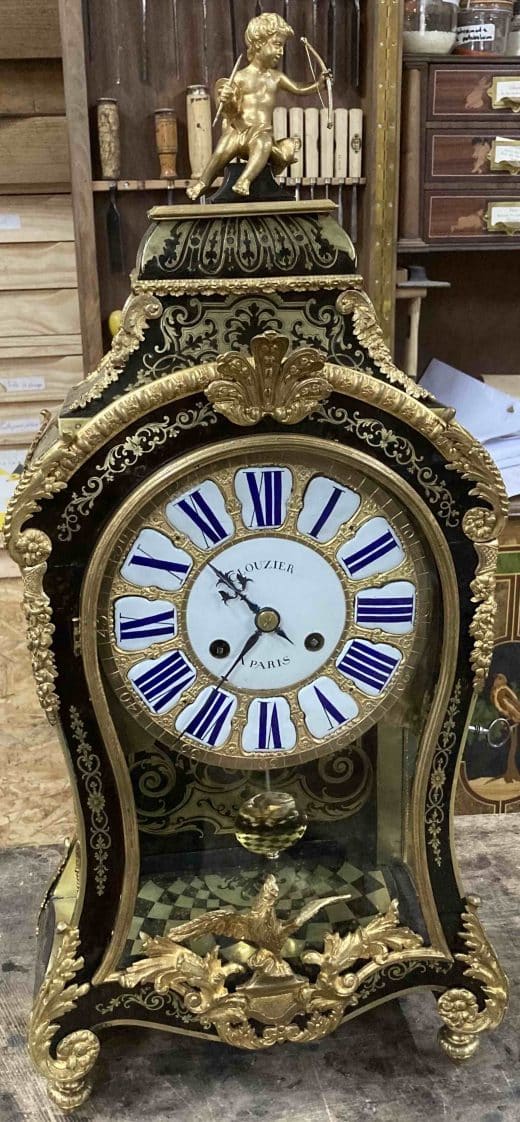
Here are some images of the restoration of a Regency period cartel clock in brown tortoiseshell and brass marquetry on an oak frame. The movement is signed CLOUZIER A PARIS. Jacques Clouzier (1692-1754) was received as a master clockmaker by awarding a masterpiece on July 5, 1692. He was one of the greatest Parisian clockmakers of the Louis XIV and Regency periods. He became a member of the clockmakers' guild in the 1700s, then worked on Rue Saint-Antoine until 1726 and later on Rue des Prêtres Saint-Paul. He remained active until his death […]

Regency chest of drawers

Ebénisterie Mathieu Vath

To start the year, here are some photos of the restoration of this Regency commode. It is built entirely of conifer and veneered with kingwood. The uprights and rails are inlaid with brass fluting. The bronze handles, influenced by Asia and the East India Company trade, are known as "Chinese" or "Chinese." The keyhole escutcheons, meanwhile, herald the arrival of the Louis XV style in the first half of the 18th century. Regarding its condition upon arrival, besides […]

8-foot desk stamped Manet

Ebénisterie Mathieu Vath

Restoration of an eight-legged desk, commonly known as a "Mazarin" desk, from the Louis XIV period, late/early 17th century. Constructed of pear and solid softwood, the sides and drawer bottoms are also pearwood. It features two side cabinets, each opening with three drawers, a central drawer above a middle cabinet with rounded edges, and console-shaped uprights and eight legs joined by two X-shaped stretchers. The drawers are inlaid with pewter and blackened pearwood, depicting a late 17th-century design. […]

Louis XV/Transitional Commode

Ebénisterie Mathieu Vath

A true renaissance for this chest of drawers, which I call Louis XV/Transitional because its form and construction are entirely Louis XV. However, the handles and keyhole escutcheons are typically Louis XVI. And I can attest that these are indeed its original fittings. The nail holes match perfectly, and there are no other holes beneath the bronze mounts. So, even if this piece of furniture doesn't conform to what is commonly called the Transitional style, this chest of drawers is most certainly one of the first […]

P. ROUSSEL Games Table

Ebénisterie Mathieu Vath

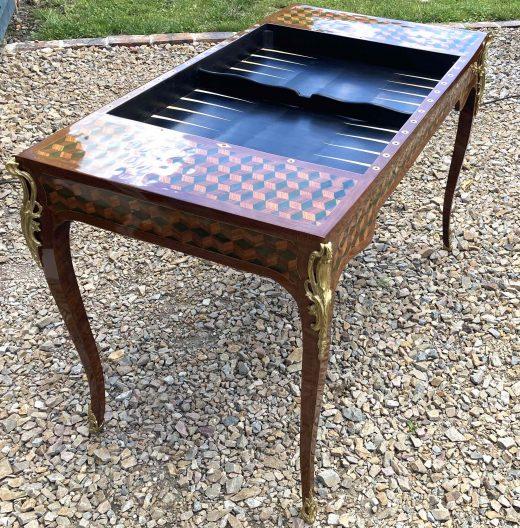
Restoration of a Louis XV period marquetry game table (or backgammon table) with dice (or cubes) veneered in amaranth, rosewood, violet wood, palisander, ebony, and ivory. This table is stamped by the Parisian cabinetmaker Pierre Roussel (September 28, 1723 – June 7, 1782). The Roussel family, sons of Michel Roussel, a journeyman cabinetmaker originally from the Cotentin peninsula, were the only ones to choose cabinetmaking rather than joinery, unlike his younger brothers Jacques, Michel, and Louis. Pierre Roussel obtained his master craftsman's certificate on August 21, 1745, and established himself in the Faubourg Saint-Germain-des-Prés.

Louis XVI games table

Ebénisterie Mathieu Vath

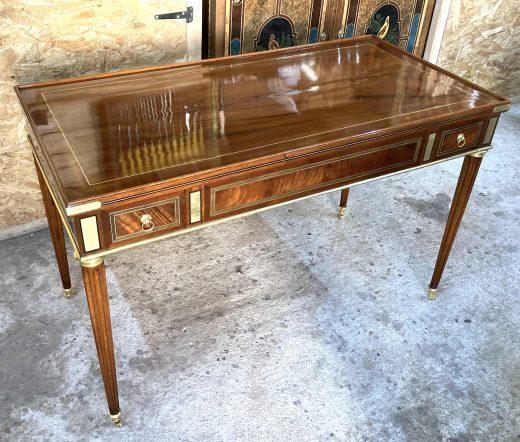
Restoration of a late 18th-century games table (circa 1785) veneered in mahogany burl and inlaid with brass stringing, ebony, and Ferréol (a South American wood named after a 17th-century governor of Guyana). The legs are solid mahogany, and the interior is veneered with ebony and bone dyed green and natural. The tabletop is partially covered in leather and partially veneered in mahogany burl. The interior features two niches, each with a drawer […]

Louis XVI commode stamped JB.Tuart

Ebénisterie Mathieu Vath

Here is a very pretty Louis XVI period commode veneered in rosewood and amaranth with marquetry of boxwood, pearwood, maple, hornbeam, walnut, blackened pearwood, lemonwood… It is built of oak and softwood. It is stamped twice with the mark of Jean-Baptiste II TUART. But its maker is probably Jean LAPIE. From a dynasty of Parisian cabinetmakers and merchants, whose father, Jean-Baptiste I, obtained his master's certificate in 1741 and was active until around 1760, Jean-Baptiste II, born around 1720, was not a master cabinetmaker but a master furniture maker and haberdasher […]

Secretary LXVI stamped Martin Carlin

Ebénisterie Mathieu Vath

Restoration of a Louis XVI period lady's writing desk stamped by Martin Carlin JME. The frame is solid oak, with the fall front and lower door made of softwood. The exterior is entirely veneered with Honduran mahogany, except for the upper edge, which is embellished with a thin strip of amaranth. The interiors are veneered with rosewood, amaranth, and stringing of boxwood and ebony. Of particular interest: the upper interior compartment has never been restored and retains its original finish, a magnificent polish that has preserved the […]

Mazarin Boulle Office

Ebénisterie Mathieu Vath

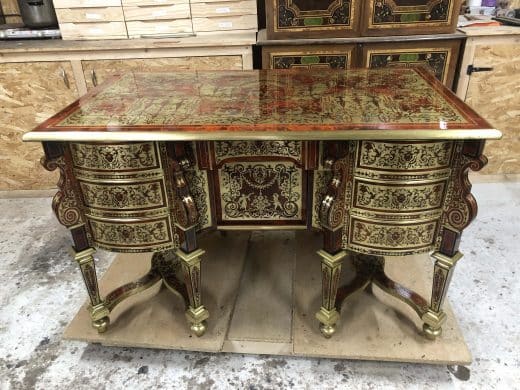
To end the year on a high note, here's a restoration that occupied a large part of my time this year and which reached its owner a few weeks ago. It's the restoration of an eight-legged writing desk, commonly known as a "Mazarin" desk. Constructed of solid oak and softwood, the sides and drawer bottoms are made of light walnut. The marquetry covering it consists of Caret tortoiseshell (Eretmochelys imbricata) on a vermilion red ground, and brass. All of this is framed by delicate ebony stringing. It is […]

Louis XVI commode

Ebénisterie Mathieu Vath

This week, we're restoring a Louis XVI commode with a projecting front, veneered in Rio rosewood, amaranth, and violet wood, with marquetry stringing in boxwood and ebony forming a ribbon wrapped around the wood, the background of the engravings filled with red wax. The tapered legs and canted uprights have faux fluting in ebony and boxwood. There's no maker's mark to attribute this beautiful piece and the high quality of wood chosen for its construction. Regarding the restoration, the work isn't very […]

Transitional dresser

Ebénisterie Mathieu Vath

Restoration of a transitional period commode with a projecting front, veneered in rosewood and palisander. The Greek key-patterned moldings, stained green, are made of hornbeam, and the front features a butterfly wing design. It opens with two large drawers with concealed crossbars, and three drawers in an upper row. The uprights, with simulated fluting, are veneered in ebony and boxwood. It rests on four cabriole legs adorned with hoof-shaped feet. Although it has undergone some alterations […]

Transitional chest of drawers stamped A. HERICOURT

Ebénisterie Mathieu Vath

Congratulations to Arnaud for the restoration of this Transition period commode veneered in rosewood, amaranth, and satinwood for the sides, and green-stained maple for the stringing. The frame is made of oak and softwood. Antoine Héricourt (c. 1730–1792) obtained his master craftsman's certificate on October 20, 1773, after working for several years as a journeyman in the Faubourg Saint-Antoine. After obtaining his certificate, he settled on the rue du Faubourg Saint-Honoré and became a representative of his guild, then a syndic. His extensive production was highly prized by a French clientele and […]

Louis XVI Molitor Console

Ebénisterie Mathieu Vath

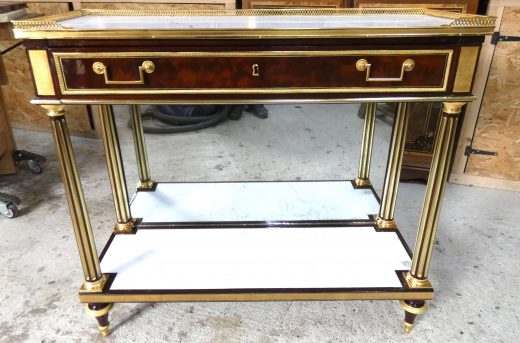
Restoration of a Louis XVI console table (1790-1795) stamped by Bernard Molitor. The structure is made of oak and solid mahogany for the legs. The panels of the lower shelf are beech. It is veneered with mahogany burl and ebony and brass stringing. Originally from Luxembourg, Bernard Molitor (1755 – November 17, 1833) obtained his master craftsman's certificate in Paris on October 26, 1787. He arrived in Paris in 1776 and worked in a small workshop located in the Arsenal district. It was after obtaining his master's certificate that he established himself on the rue de Bourbon-Saint-Germain. The austerity […]

Napoleon III Boulle marquetry side table

Ebénisterie Mathieu Vath

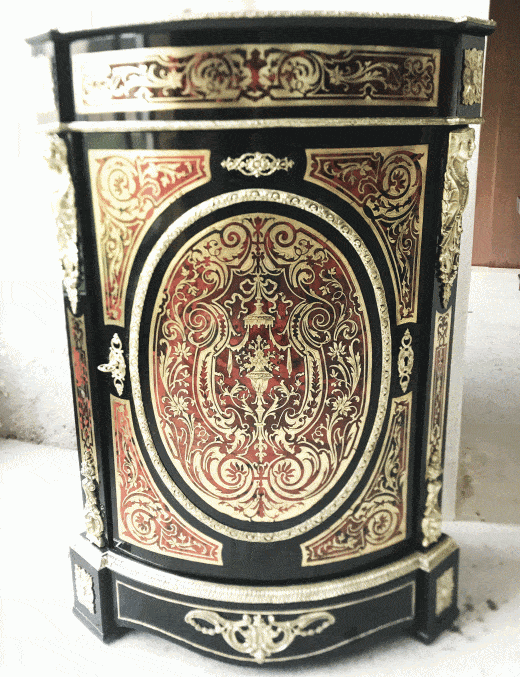
A console table veneered in ebonized pearwood and inlaid with Boulle marquetry of brass on tortoiseshell in arabesque designs. It opens with a door adorned with an oval medallion, revealing shelves in mahogany and mahogany veneer. Rich ornamentation of chased and gilded bronze: egg-and-dart friezes, caryatids in corner drops, interlaced friezes, acanthus leaf friezes, fruit, and florets. This Boulle piece requires extensive restoration. Some pieces of brass, stringing, and especially a great deal of tortoiseshell are missing. Given its value […]

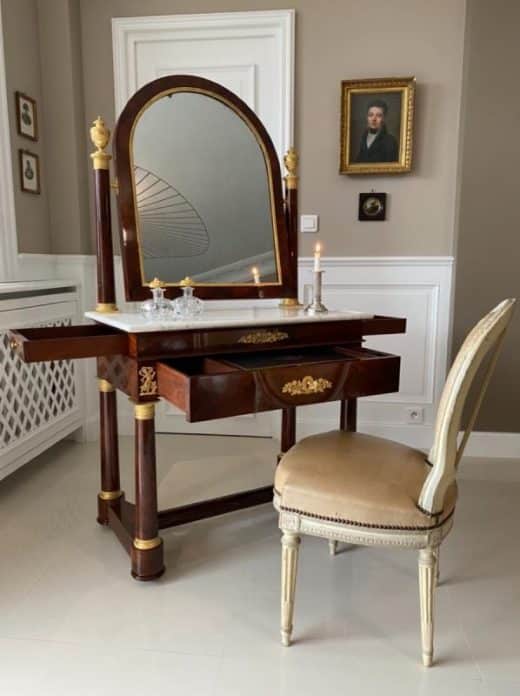
Empire Dressing Table

Ebénisterie Mathieu Vath

A beautiful restoration and, above all, conservation effort has been undertaken on this lovely Empire-period dressing table. Its frame is made of oak and poplar, veneered with mahogany burl. The drawer sides and bottoms are solid mahogany. It rests on four column legs ending in casters and joined by an H-shaped stretcher. The frieze opens with a drawer revealing a writing surface lined with blue morocco leather, a pen case, and two compartments for inkwells, as well as two large drawers on either side for essentials […]

Secretary of the Board of Directors

Ebénisterie Mathieu VATH

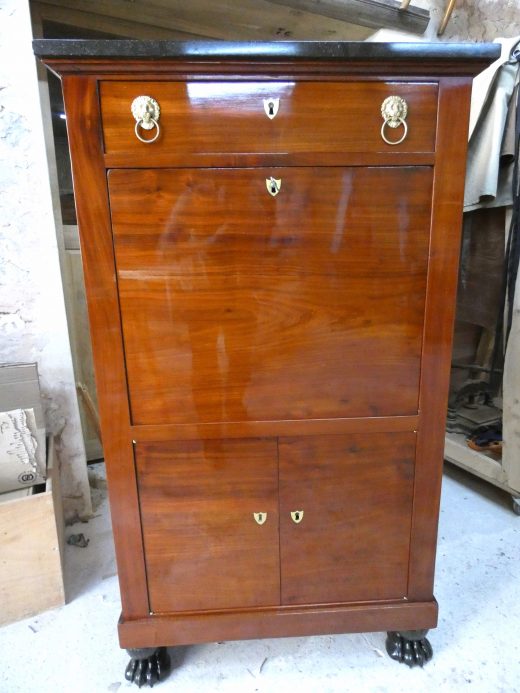
Here is a secretary desk in the most understated style of the Directoire period. Its frame is made of solid beech and conifer, and it is veneered with mahogany and mottled mahogany. It is very simply adorned with bronze handles in the form of a lion's head holding a ring in its mouth. The keyhole escutcheons are in the shape of a shield. The interior comprises seven drawers, the middle one of which opens with a key. The drop-front opens with a period three-point lock. The lower section consists of three drawers, or has been transferred […]

Regency commode stamped J.BIRCKLE

Ebénisterie Mathieu VATH

Restoration of a chest of drawers veneered in Rio rosewood and satinwood stringing. It has two large drawers and two small ones in the upper section. Its frame is made of oak and fir. It is stamped J.BIRKLE on the left upright and also bears the mark JME. It shows some signs of restoration and an ink mark on one side of a drawer. Jacques Bircklé (1734-1803) – Cabinetmaker – master craftsman obtained on July 30, 1764. One of the suppliers to the Royal Furniture Repository under Louis XVI. Freelance craftsman before […]

Empire Chest of Drawers with Quivers

Ebénisterie Mathieu VATH

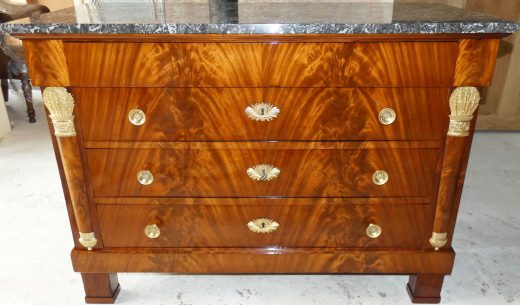
This week, here are some photos of the restoration of this Empire-style chest of drawers veneered in mahogany burl. This chest is truly unique due to the quality and originality of its bronze mounts. Indeed, they form quivers along with the side columns. The keyhole escutcheons are composed of two crossed laurel branches held together by a ribbon. Originally, they were mercury-gilded, as can be seen from the gilding stains on the back. Unfortunately, only a few partial traces remain on the front […]

Hedouin commode with crowned C

Ebénisterie Mathieu VATH

Extensive restoration of this superb Louis XV period commode, stamped on all four uprights by Jean-Baptiste Hedouin. The frame and drawers are constructed of solid oak, fir, and walnut. The edges of the frieze and geometric marquetry in violet wood are veneered with satinwood. Two types of violet wood are visible: one with a very tight grain and veining for the lozenges, and a second, more intricate type for the marquetry edges, uprights, and rails. The […]

Louis XVI style desk stamped KRIEGER

Ebénisterie Mathieu VATH

Exquisitely crafted with its mahogany-veneered oak frame and solid mahogany legs, this desk is a perfect example of high-quality 19th-century furniture. The cabinetmaking is flawlessly executed, and the bronze mounts are in pristine condition. Everything is there; nothing is missing. The Krieger firm began its cabinetmaking business in the mid-19th century with Antoine Krieger (1804-1869) before adding a significant decorative department, which ensured the prestige of its business until around 1945. The Krieger firm produced all the […]

N. PETIT Roll-Top Desk

Ebénisterie Mathieu VATH

DIMENSIONS: H.71 W.104 D.52 This roll-top desk perfectly matches those made by Nicolas Petit's workshop between 1770 and 1791, the year of his death. Indeed, with a few exceptions, Nicolas Petit primarily produced this type of secretary in molded mahogany, resting on fluted legs and topped with white marble. Simple in style, they reflected the taste of the period. It comprises two drawers in the frieze, two side pull-out shelves, and a central pull-out shelf that locks when the drop-front is closed. The interior consists of […]

J.STUMPFF Roll-Top Desk

Ebénisterie Mathieu VATH

Restoration and conservation work on this rare Louis XVI period roll-top desk stamped by Jean-Chrysostôme Stumpff. 1731 - January 17, 1806 – Master craftsman on August 27, 1766. Originally from Schweigern, Swabia (Germany), he married in 1760 in Paris, at the Swedish embassy, like most of his compatriots of the Reformed faith. His fellow cabinetmaker Ferdinand Scherdfeger was a witness at the wedding. It was in his workshop on Rue Saint-Nicolas that he produced some Louis XV style furniture, but primarily a large number of transitional and Louis XVI pieces. The large […]

Louis XVI commode stamped JA BRUNS

Ebénisterie Mathieu VATH

This week marks the completion of the restoration of a Louis XVI commode stamped JA BRUNS. It is made of oak for all the structural elements, except for the side panels, drawer backs, drawer fronts, and the two drawer bottoms, which are made of softwood. It is veneered with rosewood in a butterfly pattern and amaranth for the edges. The false fluting is made of boxwood and ebony, and there is a green-stained maple stringing forming the corners at […]

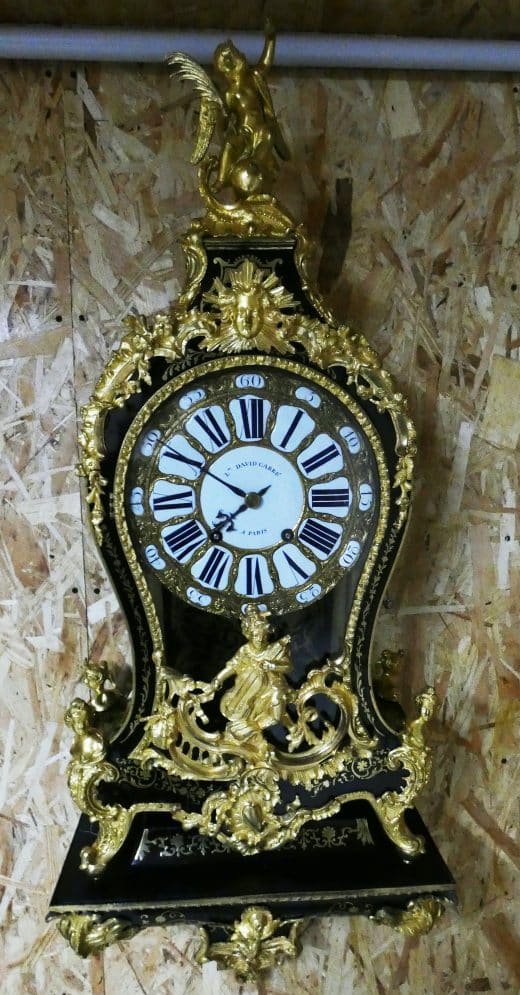
Label signed "Louis David Carré in Paris"«

Ebénisterie Mathieu VATH

After several weeks of work, the restoration of this clock is finally complete. It is a Louis XV period clock in brown tortoiseshell and brass marquetry, with rosewood restorations. The dial is by Louis David Carré, nephew of Jullien le Roy, who became a master craftsman on December 31, 1748. Lodged at the Louvre from 1744, he was elected a juror in 1775. The greatest treasure of this clock lies in its bronze mounts. They are truly magnificent, and above all, they are in very good condition. There is only […]

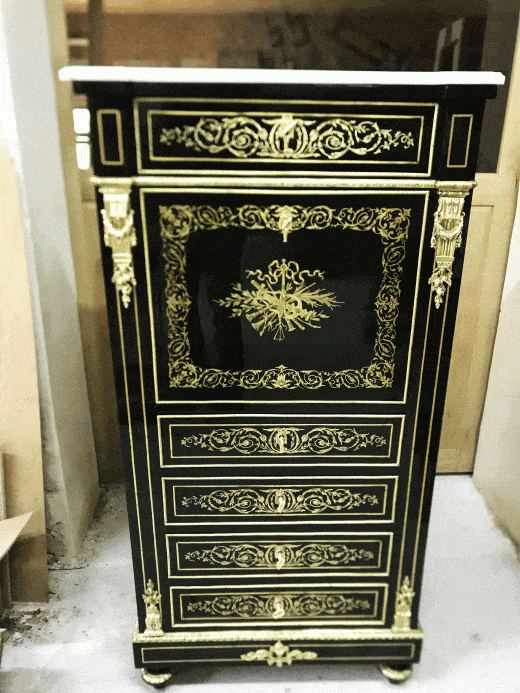
Secretary Napoleon III

Ebénisterie Mathieu VATH

On the restoration side, there wasn't much to do: the brass fittings were reattached with fish glue and by infiltration, then stripped and varnished. The most difficult part of this type of furniture is the black stain. Over time, pear wood darkens, loses its color, and turns gray. It then needs to be stained, without, of course, obscuring the brass. To do this, I fill and polish the piece until the brass becomes a true mirror. Then, I apply a hot logwood stain, and then […]

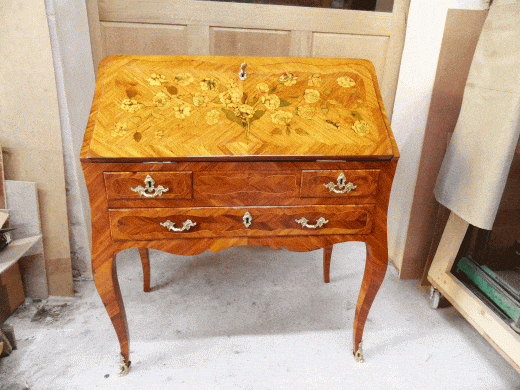
Louis XV slant-front desk (After restoration)

Ebénisterie Mathieu VATH

A while ago I told you about this desk that was being restored. Well, here it is finished. The varnishing process took three weeks. This allowed enough time for the varnish to set properly, in order to achieve the best possible result. https://ebenisterie-mathieuvath.fr/en-ce-moment-a-latelier/ So here are some before and after photos.

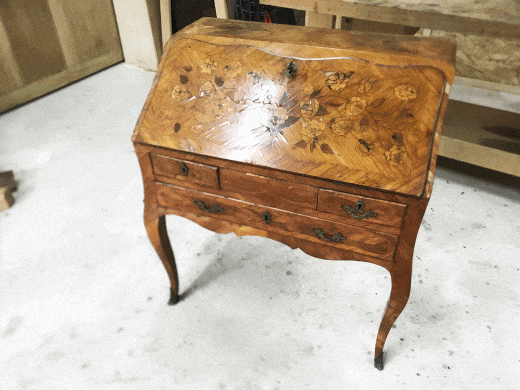
Louis XV slant-front desk

Ebénisterie Mathieu VATH

The restoration of a lovely slant-front desk, or as Riesener calls it in his memoirs, a "tomb-shaped secretary," began two weeks ago. With the restoration phase complete and the varnishing underway, I'm taking a moment to provide a brief summary of the project. The desk's frame is made of oak and fir, veneered with rosewood and violet wood, and the drop-front features floral marquetry of boxwood, natural and stained maple, and hornbeam. It includes a large drawer […]

Corner cabinet in Boulle marquetry from the Napoleon III period

Ebénisterie Mathieu VATH

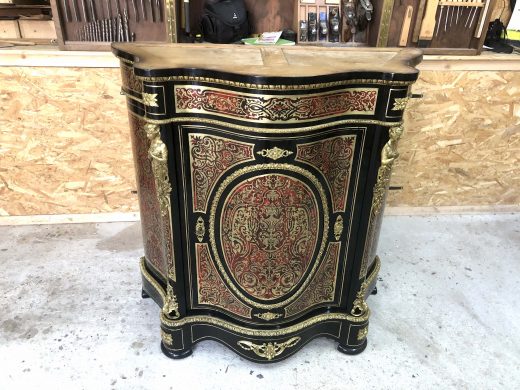
A classic restoration of Boulle marquetry. This involved rehydrating the old glue through infiltration, crafting and gluing the missing brass pieces, and reconstructing the base, which was in poor condition but not beyond repair. The bronze mounts were cleaned and finished with a clear French polish. Proof that appearances can be deceiving. Even a piece of furniture in a severely deteriorated state can regain its former beauty.

Commode returning from Egypt

Ebénisterie Mathieu VATH

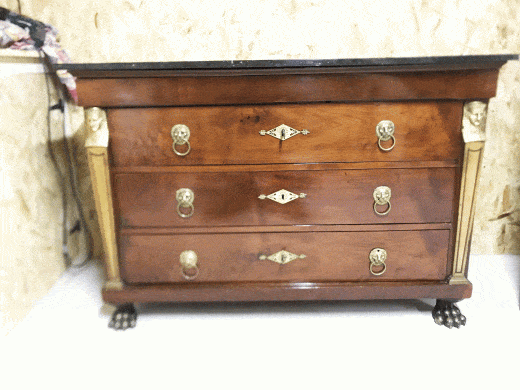
During the turbulent period of the French Revolution, furniture production was considerably diminished, and most artisans experienced very difficult times. Overall, from the Consulate to the Directory, furniture and seating had little time to evolve. However, even though some decorative motifs inspired by Egypt had already appeared, it was after the Egyptian expedition (1798-1801) that they evolved into a unique style. The so-called "Return from Egypt" style, however, lasted only a short time: a decade at most, as it would […]

Transitional dresser in the style of Topino

Ebénisterie Mathieu VATH

A month ago, a lovely transitional commode arrived, which reminds me of the work of the cabinetmaker Charles Topino (circa 1742-1803) – he received his master craftsman's certificate on July 4, 1773. However, this commode does not bear his stamp, nor any stamp for that matter. This confirms that a stamp is not necessary to possess a piece of high-quality furniture. Furthermore, the marquetry could very well have come from Topino's workshop, as he sold panels of his marquetry to the haberdashers and his colleagues […]

Louis XV slant-front desk stamped HEDOUIN (Restoration complete)

Ebénisterie Mathieu VATH

Remember that slant-front desk? Well, it's finished. It was quite a task, but now it's regained its former glory. Only the drawer keyholes and the leather upholstery remain to be fitted before it's returned to its owner. A large part of the legs has been remade from sawn violet wood. This was cut to the correct thickness, scraped and sanded, then oxidized before being glued, so as not to have to sand the entire piece of furniture […]

Louis XV slant-front desk stamped HEDOUIN

Ebénisterie Mathieu VATH

Thanks to its stamp, it is possible to date this slant-front desk, or cantilevered desk, between 1738 and 1783. The life of Jean-Baptiste Hedouin is relatively unknown. After becoming a master craftsman, he set up his workshop on Rue Traversière-Saint-Antoine. All the furniture he produced was of high quality. His pieces, primarily in the Regency and Louis XV styles, almost all veneered in sheets or with grid patterns, were varied: wardrobes, flat and slant-front desks, bookcases… but it was the commodes that constituted the largest part of his output.