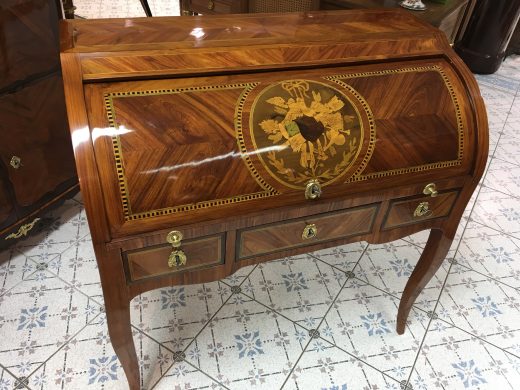
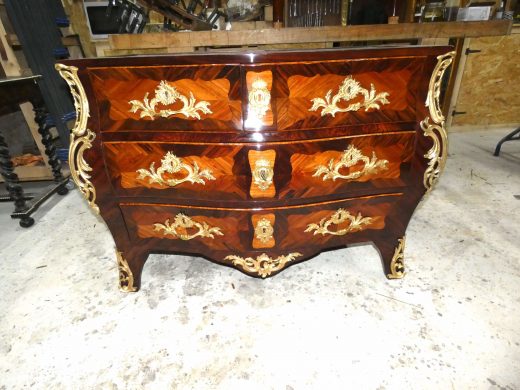
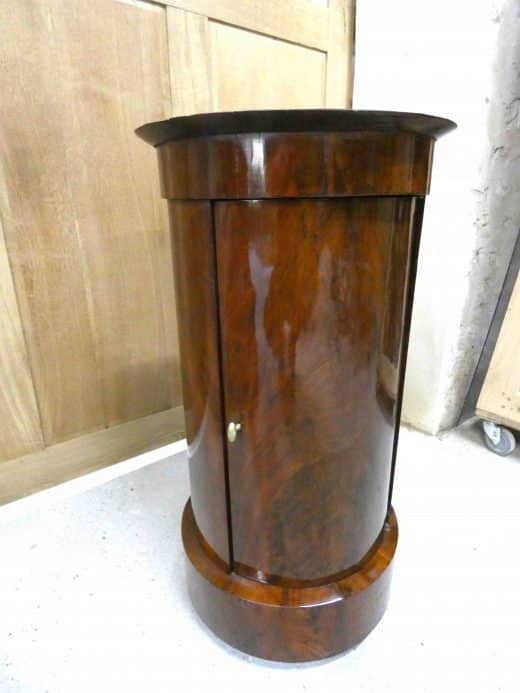
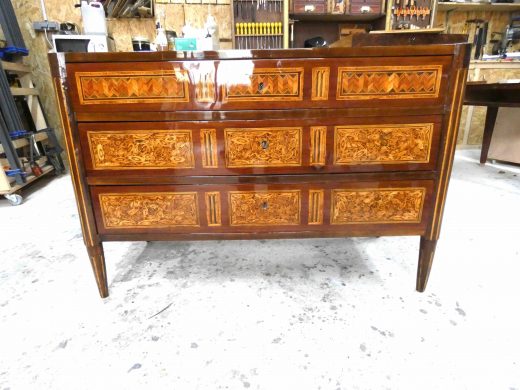
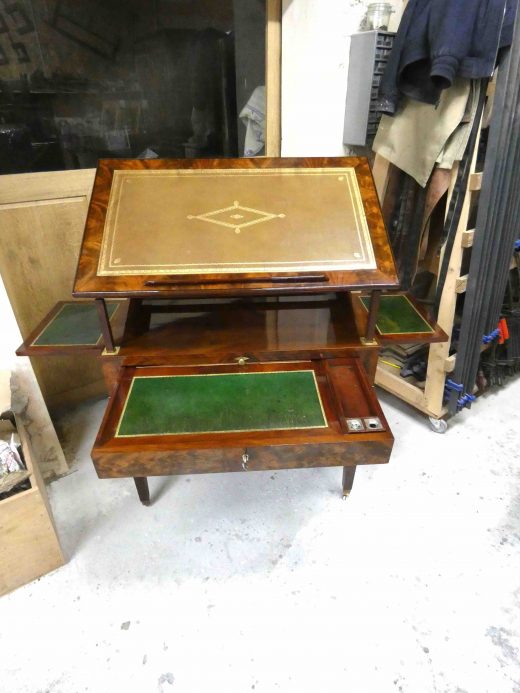
Louis XV writing table

Ebénisterie Mathieu Vath

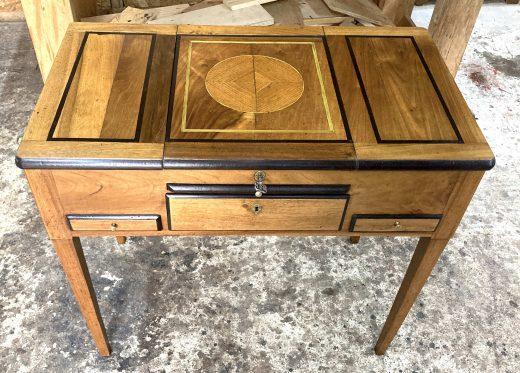
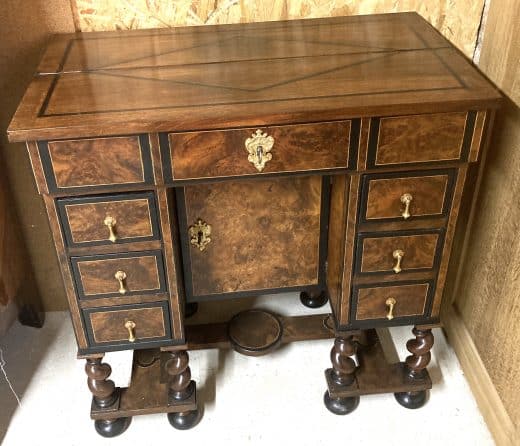
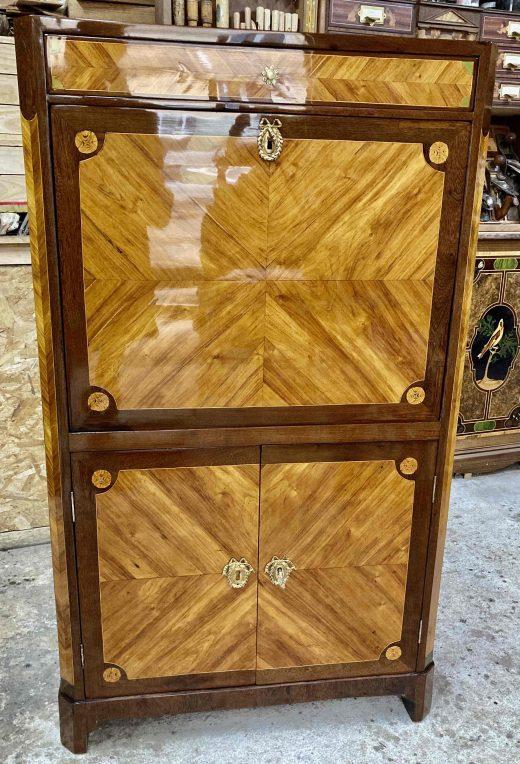
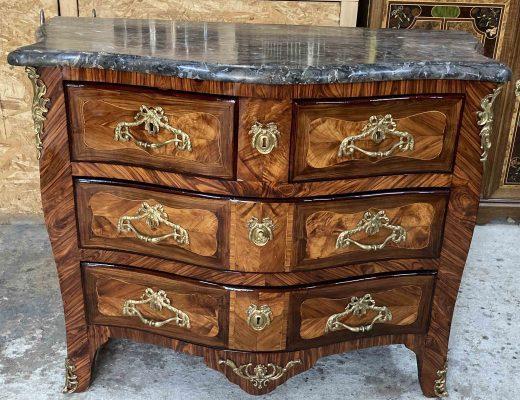
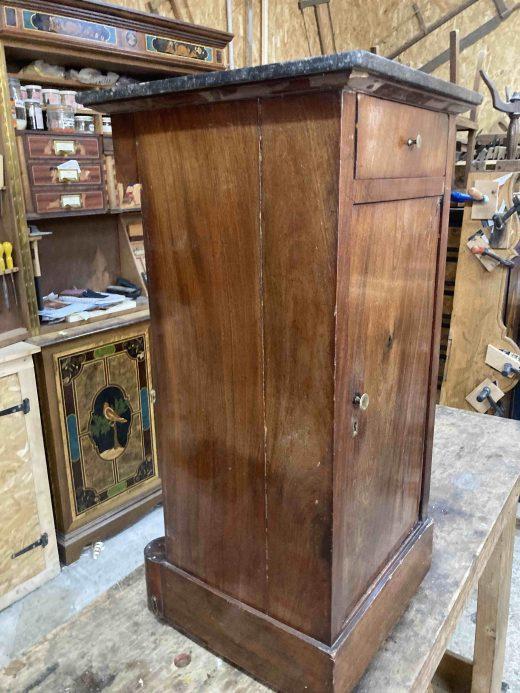
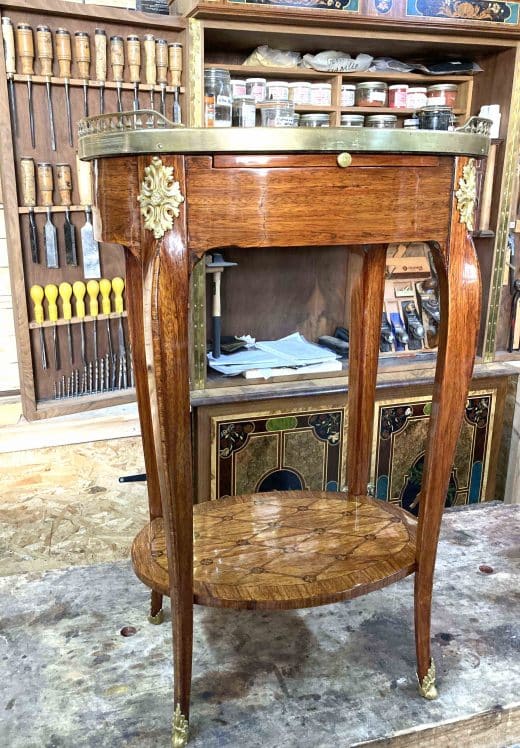
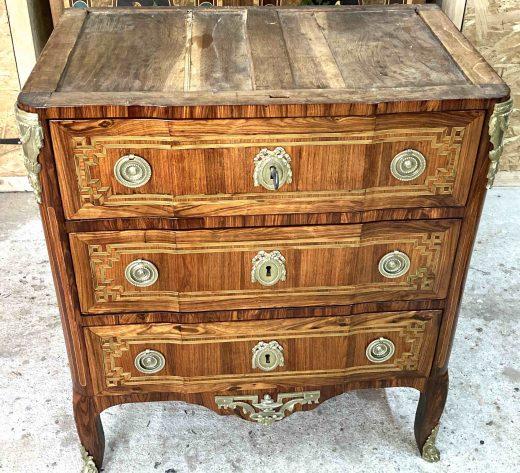
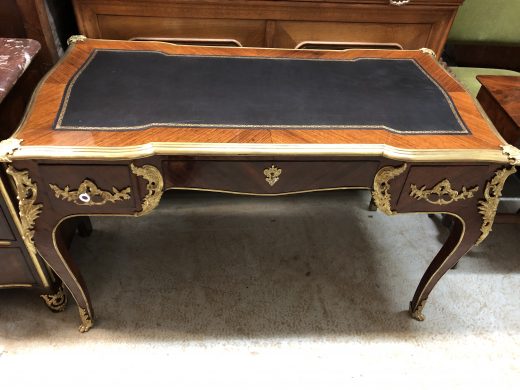
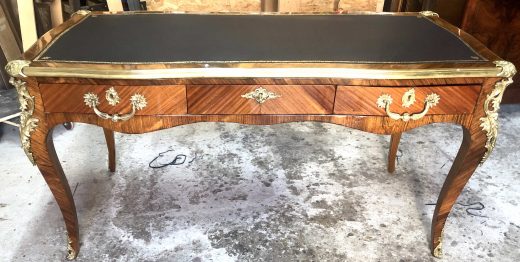
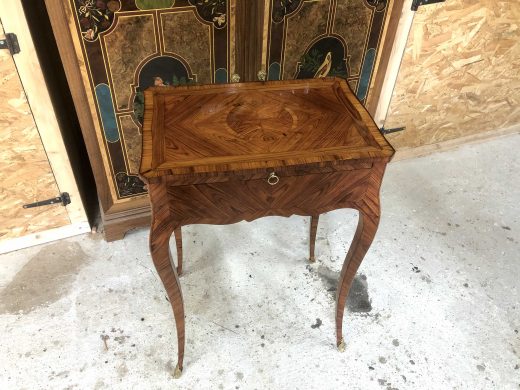
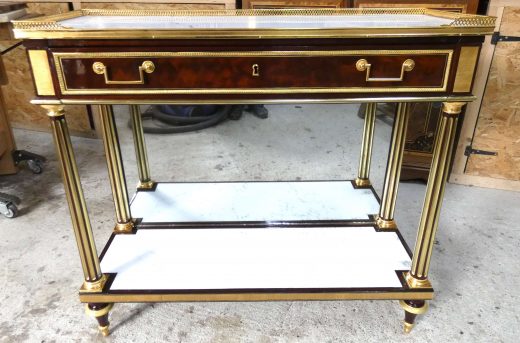
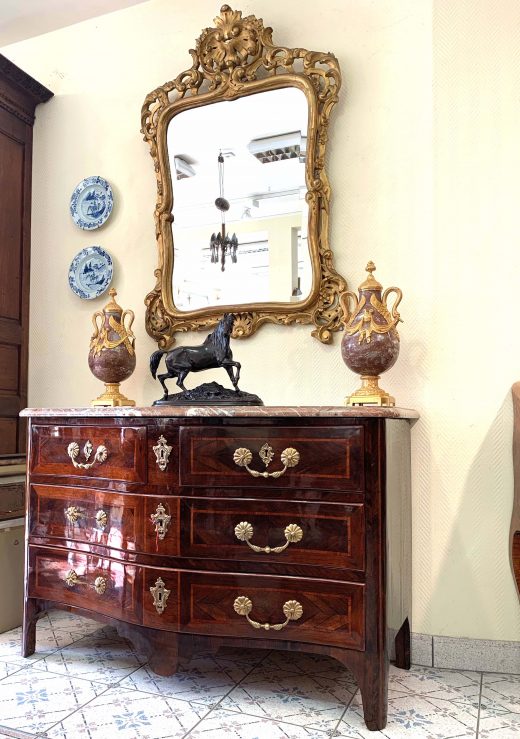
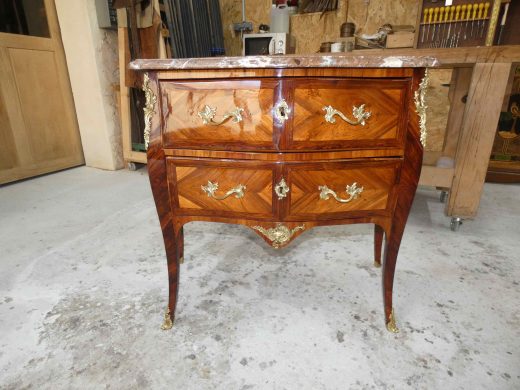
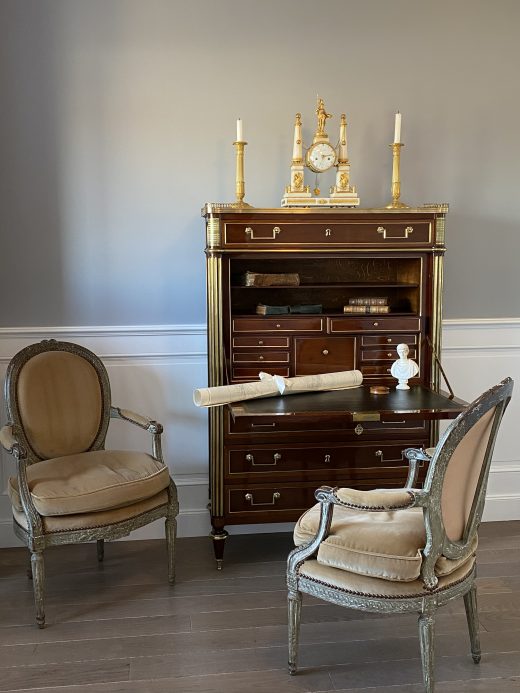
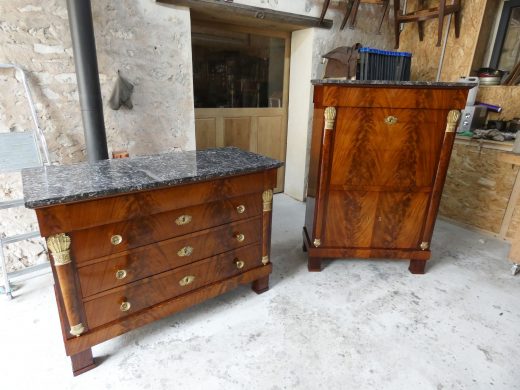
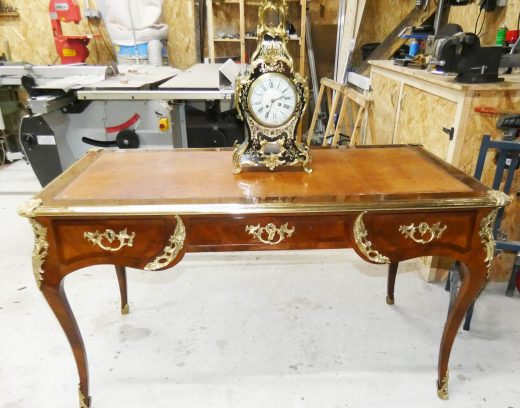
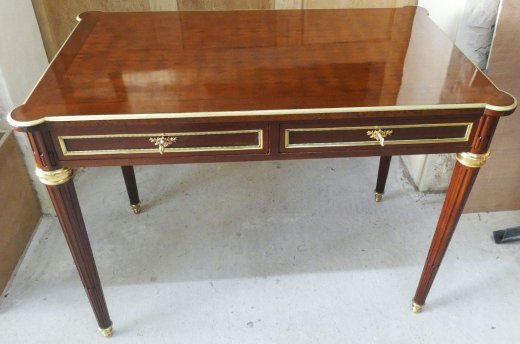
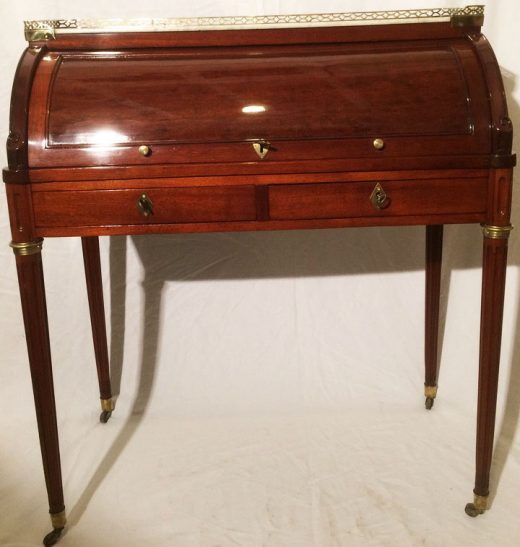
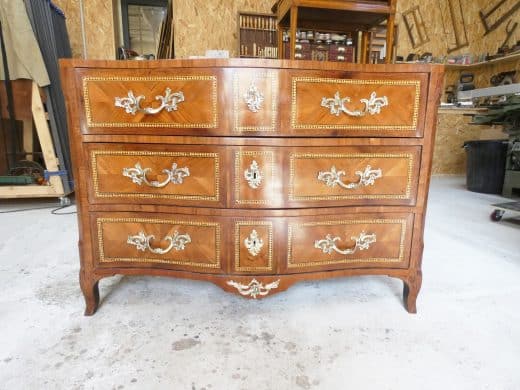
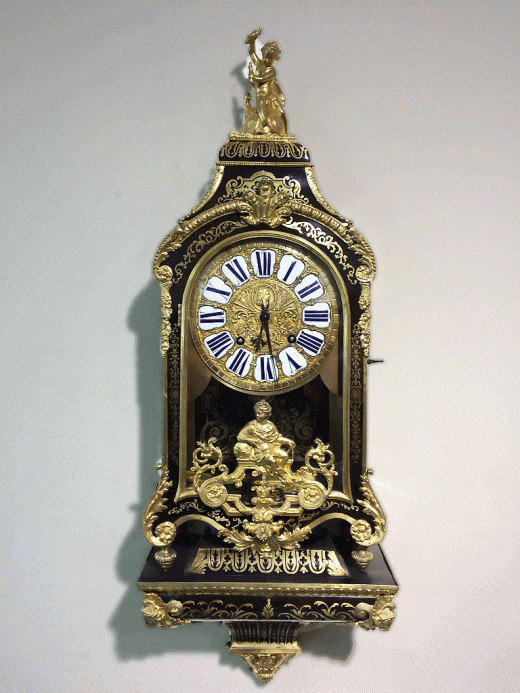
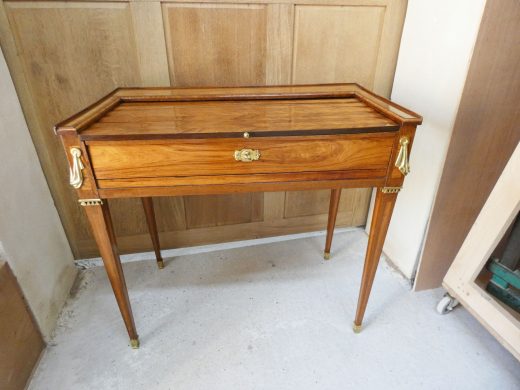
Restoration of a Louis XV period drawing table, or more precisely, a writing table. It is veneered in rosewood and kingwood, with satinwood on the back. Born from the passion for correspondence in the 18th century, fashionable merchants displayed all their ingenuity. They created numerous models of utilitarian tables, designed to be placed in the center of a room. These differed from ordinary tables: they generally included a writing surface and drawers for ink and quills. The term […]

Wardrobe of Bretteville the Proud

Ebénisterie Mathieu Vath

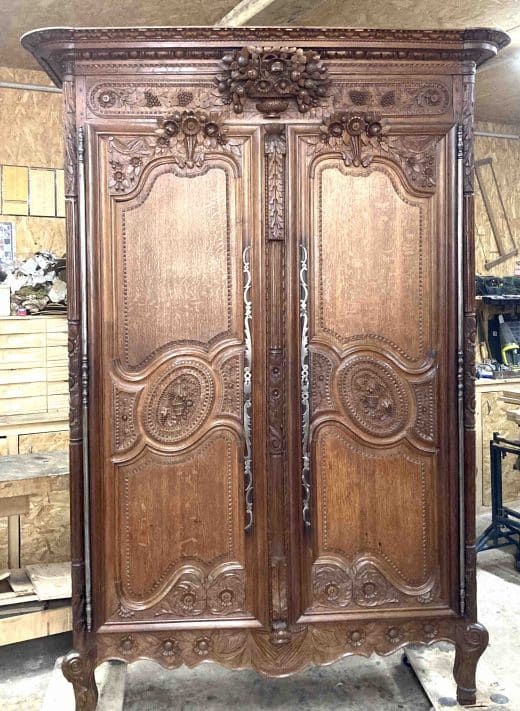
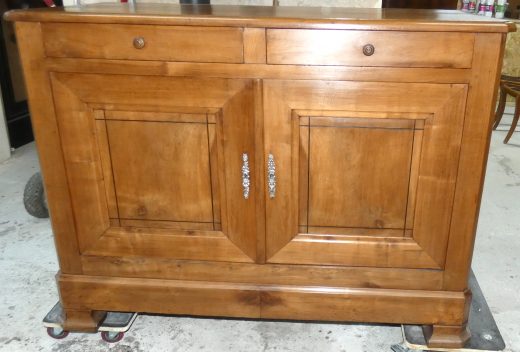
It was in the mid-17th century that what we now call the Norman wardrobe originated. But it was in the 18th century that it took on the characteristic form we know today. With its two doors, cabriole legs, and wide cornice with broad sculpted decoration, it combines Louis XV structure and style with Louis XVI motifs. At that time, economic and social stability allowed for a certain improvement in living standards. The wardrobe then found its way into bourgeois and peasant homes. The 19th century would be the golden age of the Norman wardrobe. Destined […]

Louis XIV commode from the Dauphiné region

Ebénisterie Mathieu Vath

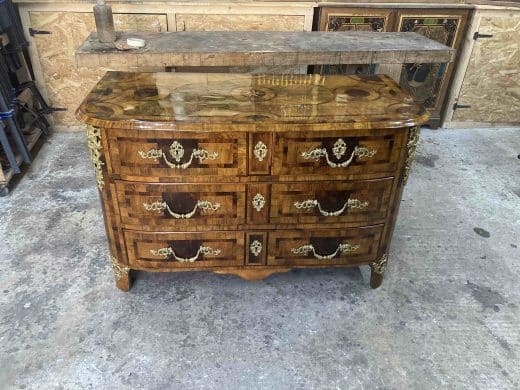
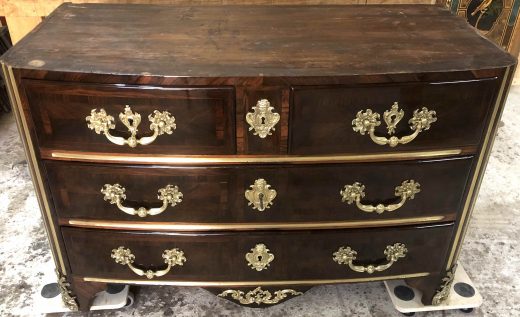
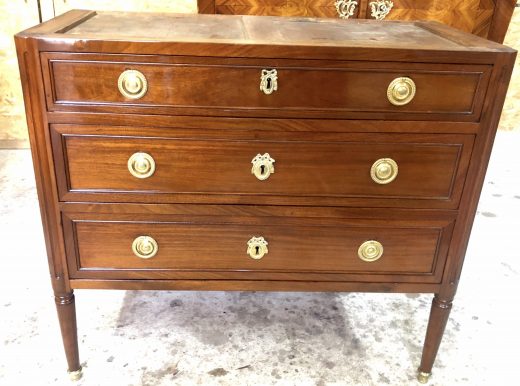
Restoration of a Louis XIV period commode in olive burl, rosewood, and boxwood, likely from the Dauphiné region. Along with Mazarine commodes, this type of D-shaped commode is among the very first commodes produced during the reign of Louis XIV. Indeed, the first French furniture resembling the commode only appeared around 1700. Thus, the oldest known Parisian commodes are those delivered by André-Charles Boulle to Versailles around 1708. Their very simple decorations are inspired by Dutch models. They are, moreover, often the work of Protestant cabinetmakers, who favored native woods according to the precepts of […]

Regency commode stamped by Michel Mallerot

Ebénisterie Mathieu Vath

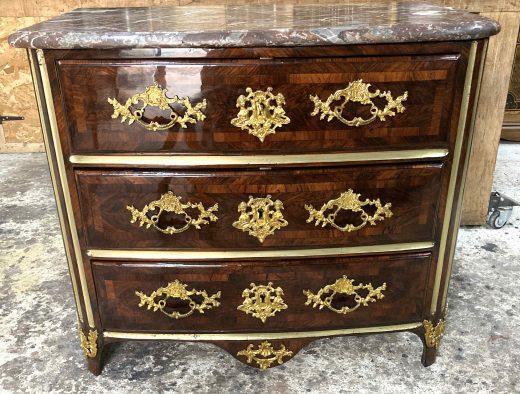
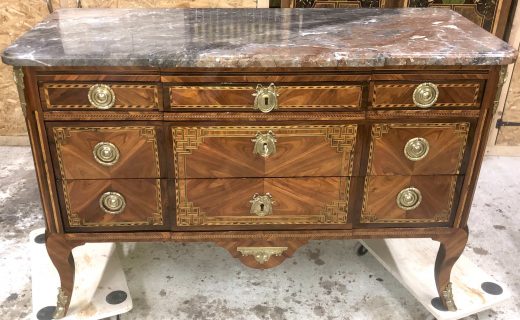
Restoration of a commode stamped Michel Mallerot. With its serpentine front, it is entirely veneered in kingwood. Its frame is made of fir. As for the drawers, their sides are beech and their bottoms are walnut. You don't know Michel Mallerot? That's understandable! Indeed, Michel Mallerot (1675-1753) remains little known, like many Parisian cabinetmakers of the early 18th century. He was identified thanks to a pencil inscription, "M. Mallerot," on a Regency commode bearing this abbreviated stamp (formerly in the Philippe Glédel collection). The […]

Regency Cartel

Ebénisterie Mathieu Vath

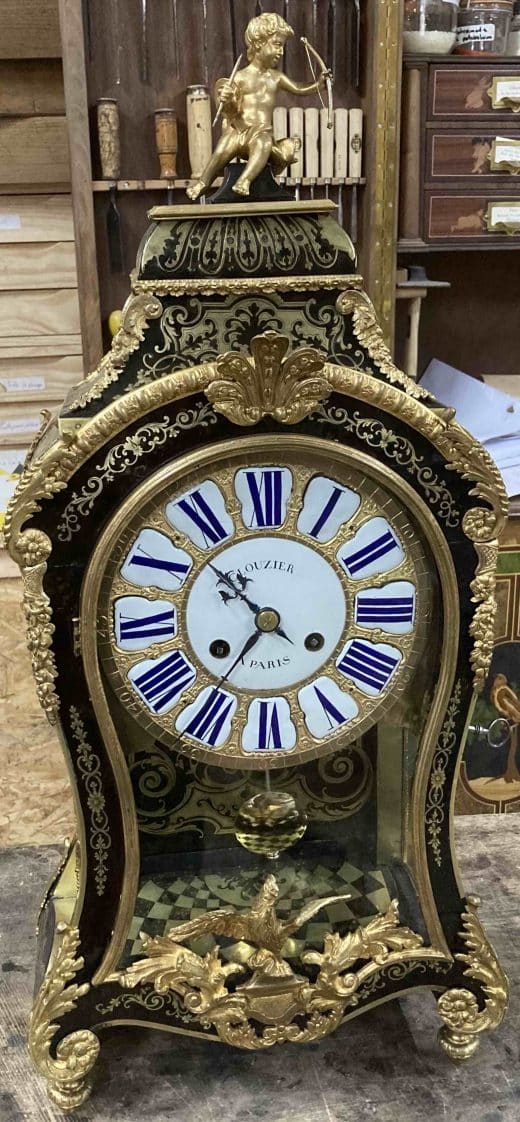
Here are some images of the restoration of a Regency period cartel clock in brown tortoiseshell and brass marquetry on an oak frame. The movement is signed CLOUZIER A PARIS. Jacques Clouzier (1692-1754) was admitted as a master watchmaker by presentation of his masterpiece on July 5, 1692. He is among the greatest Parisian watchmakers of the Louis XIV and Regency periods. He became a member of the watchmakers' guild in the 1700s. He worked on Rue Saint-Antoine until 1726, then on Rue des Prêtres-Saint-Paul. Active until his death in 1754, he collaborated with the greatest cabinetmakers and bronze workers, such as […]

Regency chest of drawers

Ebénisterie Mathieu Vath

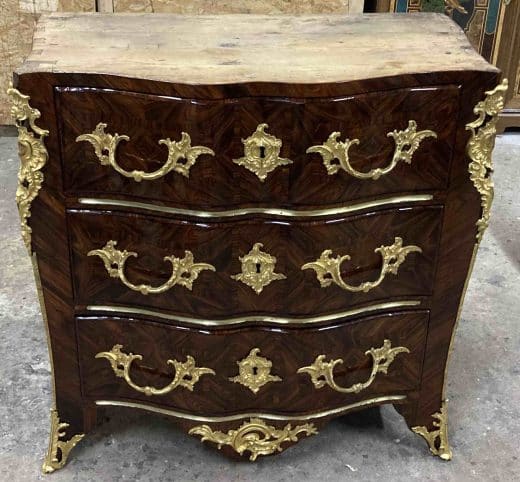
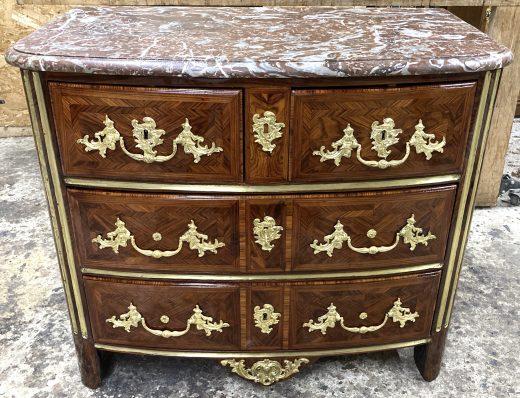
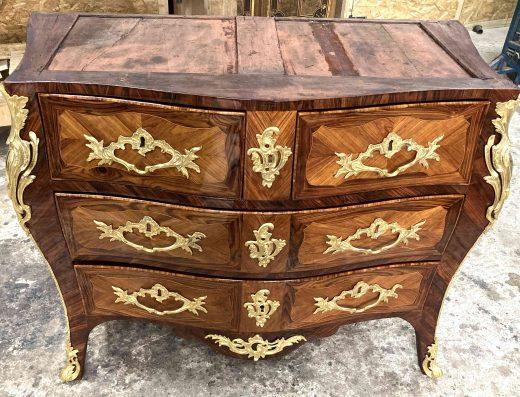
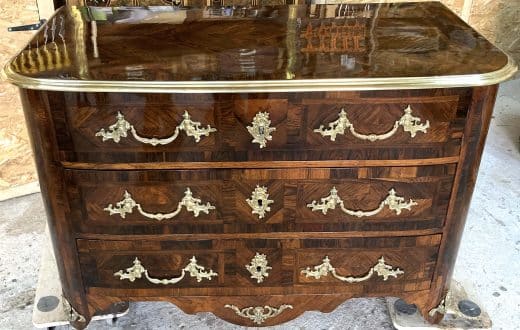
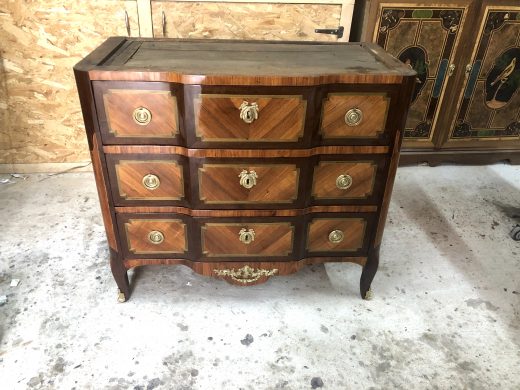
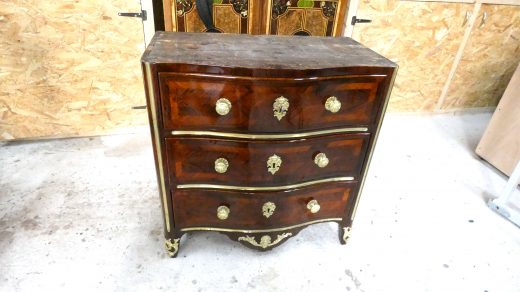
To start the year, here are some photos of the restoration of this Regency commode. Made entirely of softwood, it is veneered with kingwood. Its uprights and rails are adorned with brass fluting. The bronze handles, influenced by Asia and the East India Company trade, are commonly referred to as "Chinese." The keyhole escutcheons, meanwhile, herald the arrival of the Louis XV style in the first half of the 18th century. Upon its arrival, in addition to some missing and peeling veneer, the commode presented a problem […]

8-foot desk stamped Manet

Ebénisterie Mathieu Vath

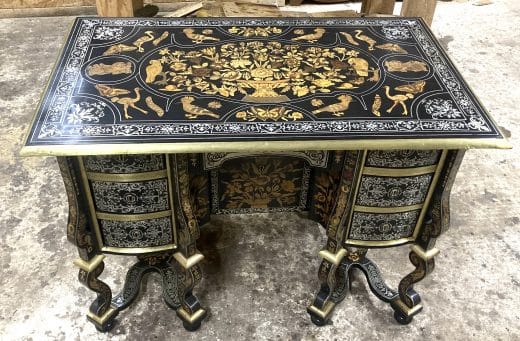
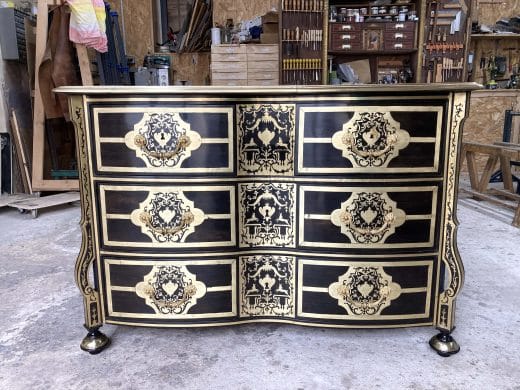
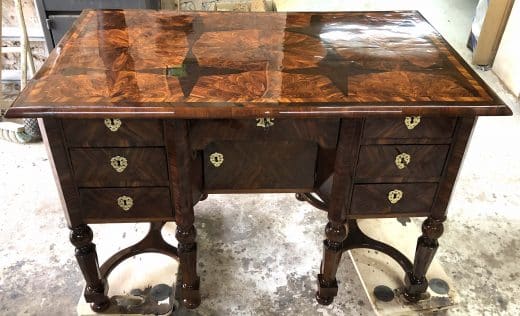
Restoration of an eight-legged desk, commonly known as a "Mazarin" desk, from the Louis XIV period, late/early 17th century. Its frame is made of solid pear and softwood, with pear wood sides and drawer bottoms. It features two side cabinets, each with three drawers, and a central drawer above a middle cabinet with rounded edges. Two X-shaped stretchers connect the uprights and the eight console-like legs. The drawers are inlaid with pewter and blackened pear wood, depicting a late 17th-century design. The sides, as well as […]

Louis XIV commode

Ebénisterie Mathieu Vath

Restoration of a Louis XIV commode constructed of fir and Rio rosewood veneer. The front is slightly convex, as are the uprights and rails. It features brass fluting. The remarkably crafted varnished bronze mounts have retained their original varnish. The restoration consisted of rehydrating all veneered surfaces by infiltrating glue. Missing areas were filled with rosewood veneers that were sawn, scraped, sanded, cut to the correct thickness as a backing, and UV-oxidized before being glued with hot glue. As you can see on […]

Small chest of drawers from La Rochelle

Ebénisterie Mathieu Vath

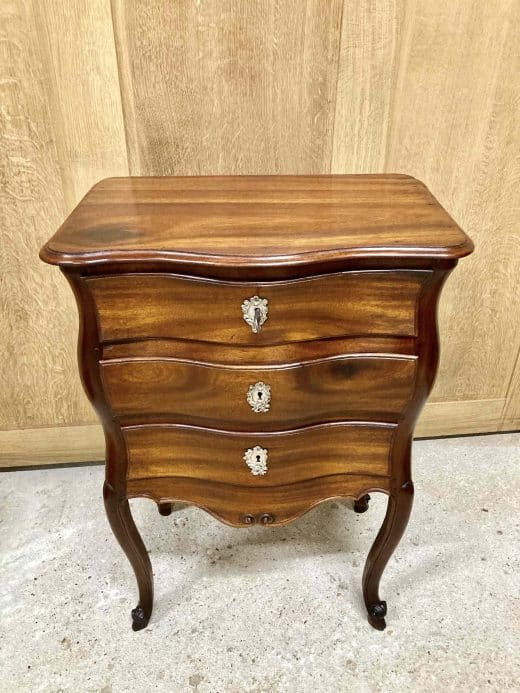
Here is the restoration of a small Louis XV commode, made of solid satinwood and ribboned satinwood. Curved on all sides, including the back, it opens with three drawers. In addition, a pull-out candle holder opens at the back. It comes from La Rochelle and dates from the 18th century. Its top, molded with a corbel-shaped edge highlighted by a cavetto molding, is made of ribboned satinwood. This wood is also used on the front and sides. In contrast, the base is made of straight-grain satinwood, with "snail" feet ending in split goat's hoof feet. [… ]

Louis XVI writing table

Ebénisterie Mathieu Vath

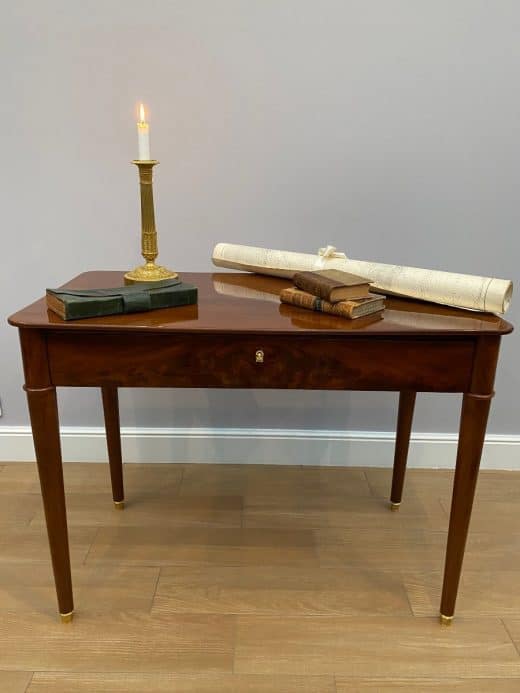
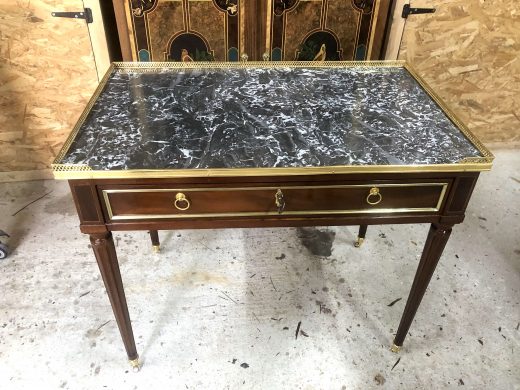
Restoration of a writing table built in oak, with a solid mahogany top and mahogany burl veneer. It features a large drawer in the frieze and rests on four tapered legs ending in gilt bronze sabots. Typical work of the late 18th century. To see previous restorations: https://ebenisterie-mathieuvath.fr/en-ce-moment-a-latelier/ This piece can be found at Antiquités Stéphane Guin.

Roussel Stamped Chest of Drawers

Ebénisterie Mathieu Vath

Restoration of a Louis XV commode stamped by the Parisian cabinetmaker Pierre Roussel. It is constructed of oak, with conifer panels. It is veneered with rosewood arranged in a herringbone pattern, framed by violet wood. The stringing is boxwood. Pierre Roussel was the son of Michel Roussel, a journeyman cabinetmaker originally from the Cotentin peninsula. His younger brothers, Jacques, Michel, and Louis, chose joinery; he was the only one to opt for cabinetmaking. He obtained his master craftsman's certificate on August 21, 1745. He settled in the Faubourg Saint-Antoine, […]

Louis XV Cartel

Ebénisterie Mathieu Vath

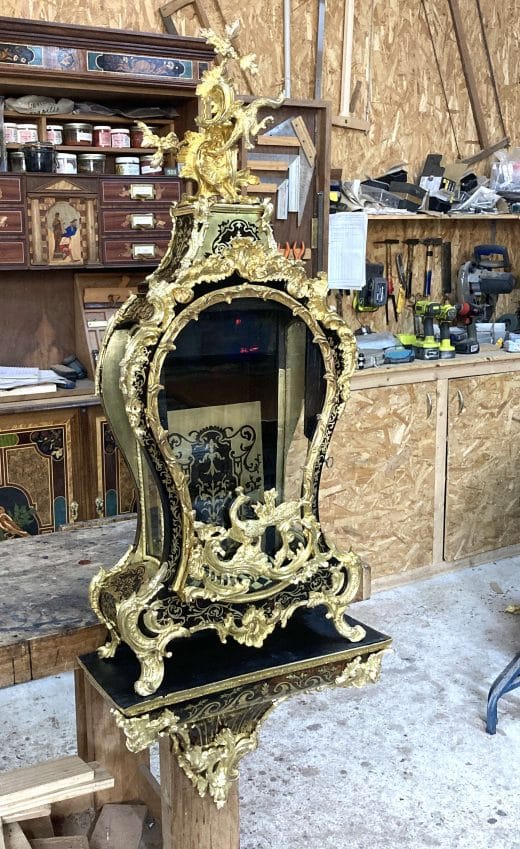
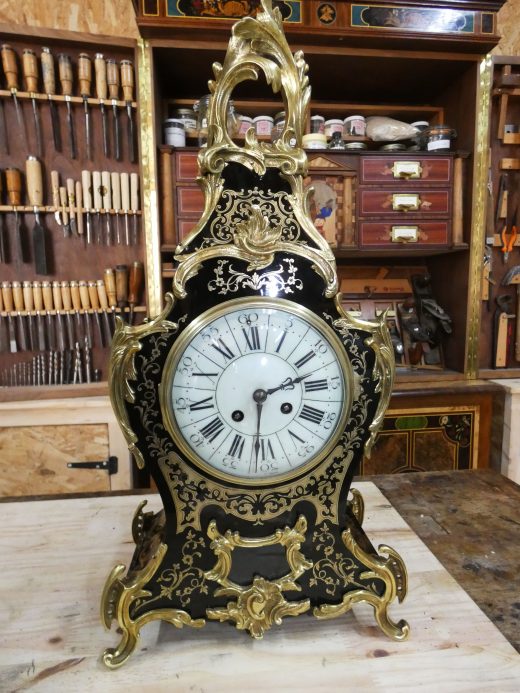
Restoration of a Louis XV period clock case and its corbel, in pure Rococo style. It is made of solid oak and veneered with brass and tortoiseshell. Do you know what Rococo style is? Rococo style belongs to the early period of the Louis XV style (1723-1750) and reached its peak around 1730. It is distinguished by its rich naturalistic decoration. It draws inspiration from artificial grottoes and reconstructed rocks in asymmetrical compositions. A late heir to the Baroque, this decoration is complemented by seashells, mineral elements, cascading foliage, […]

Money changer's office

Ebénisterie Mathieu Vath

Il y a quelques semaines, je vous présentais une table de changeur.  Eh bien, voici son successeur : le bureau de changeur.  Inspiré des bureaux à 8 pieds que l’on appelle plus communément « bureau Mazarin », le bureau de changeur en est une version plus petite. Souvent transporté, il doit protéger les biens qu’il renferme. Par ses décors de marqueterie et ses placages plus ou moins riches, il affiche aussi la prospérité de son propriétaire. Pour ceux qui seraient intéressés par l’origine de ces meubles et le métier de changeur, je […]

Louis XVI secretary stamped Montigny

Ebénisterie Mathieu Vath

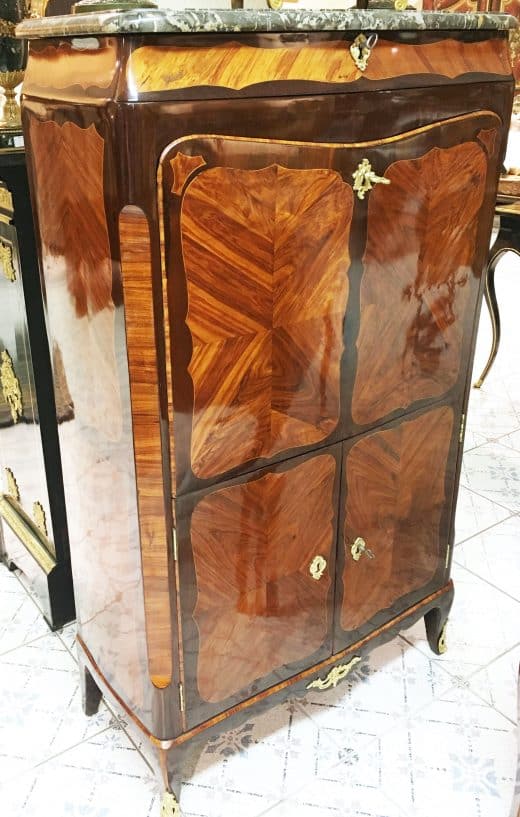
A little restoration for this Louis XV period secretary desk stamped by Philippe-Claude Montigny. It is constructed of oak and softwood, and veneered with rosewood, amaranth, and boxwood. It consists of a top drawer, a drop-front, and two doors. The interior compartments contain six drawers. Philippe Claude Montigny (1734-1800) became a master craftsman on January 29, 1766. Son of Louis Montigny, a privileged craftsman of the King, he owned a workshop in the Contrescarpe district of Paris. He was also the brother-in-law of Fidelis Schey, a cabinetmaker […]

Louis XV/Transitional Commode

Ebénisterie Mathieu Vath

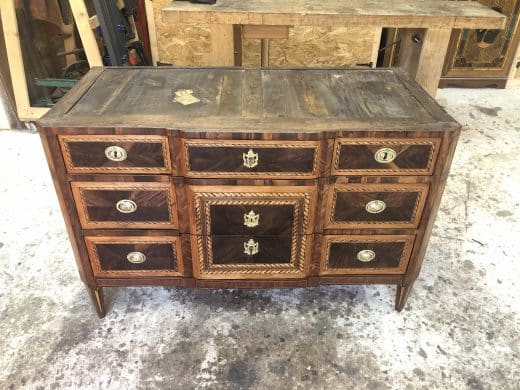
A true renaissance for this chest of drawers, which I call Louis XV/Transitional because its form and construction are entirely Louis XV. However, the handles and keyhole escutcheons are typically Louis XVI. And I can attest that these are indeed its original fittings. The nail holes match perfectly, and there are no other holes beneath the bronze mounts. So, even if this piece of furniture doesn't conform to what is commonly called the Transitional style, this chest of drawers is most certainly one of the first […]

Somno Empire

Ebénisterie Mathieu Vath

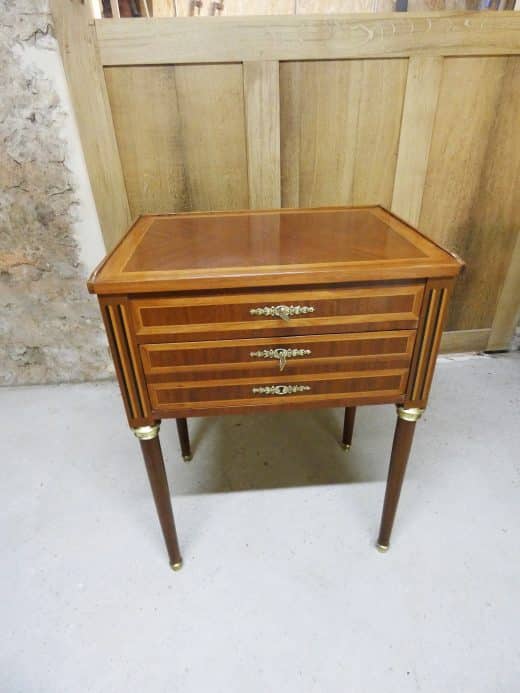
Restoration of an Empire-period somno, veneered in mahogany burl. You might be wondering what a somno is? The somno, or somneau, appeared during the Consulate, at the beginning of the Napoleonic era. It is a small, table-shaped piece of furniture, cylindrical or square. Its closed section serves as storage. It is therefore placed in the bedroom, often near the bed, as a nightstand. Finally, it was during the Empire that it acquired the name "somno," from the Latin somnus, meaning sleep. The somno under the Empire. Under the First Empire, the somno […]

Louis XVI cooler

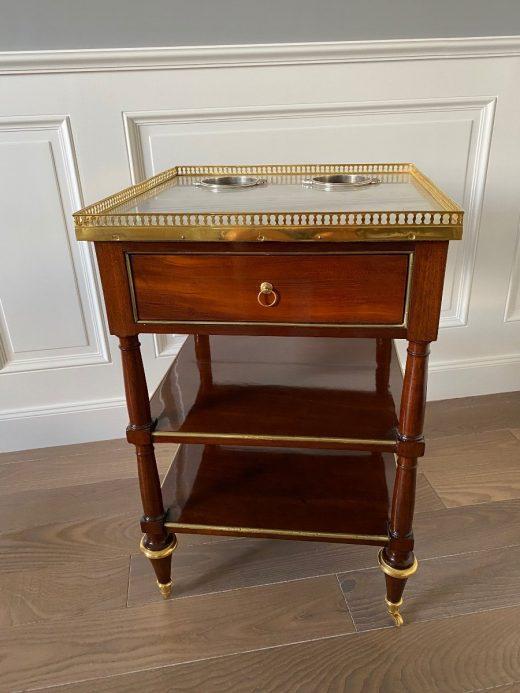
Restauration d’une table rafraîchissoir. Ses pieds sont en acajou massif, le reste en placage de ronce d’acajou, avec des moulures en quart-de-rond de laiton. La table rafraîchissoir Le XVIIIe siècle est le siècle de la pensée, de la philosophie et de l’intimité. Une mode émerge alors dans les couches les plus aisées de la société : le dîner ou le souper intime, sans personnel de maison. Que ce soit pour des rendez-vous galants ou pour organiser la révolution française toute proche, il ne fallait pas d’oreilles indiscrètes. Cette mouvance influence […]

Empire Chest of Drawers

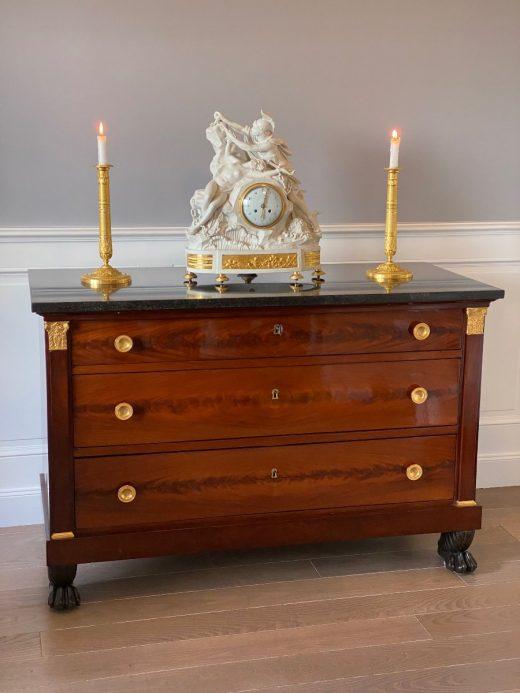
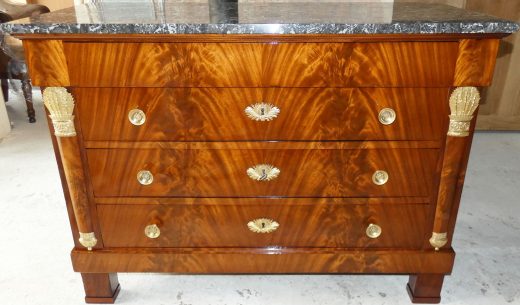
Restoration of a mahogany burl veneer commode with three drawers. Its straight uprights form Corinthian pilasters. The front feet are claw feet, while the rear feet feature three decreasing balls, known as a rosary. It is topped with a black Belgian granite slab. Finally, it has retained all its original gilt bronze mounts, as well as its trefoil locks and key. The gilt bronze mounts feature Corinthian capitals with projecting bird heads, palmettes, acanthus leaves, flowers, and scrolls. They also play on […]

Louis XVI commode

Ebénisterie Mathieu Vath

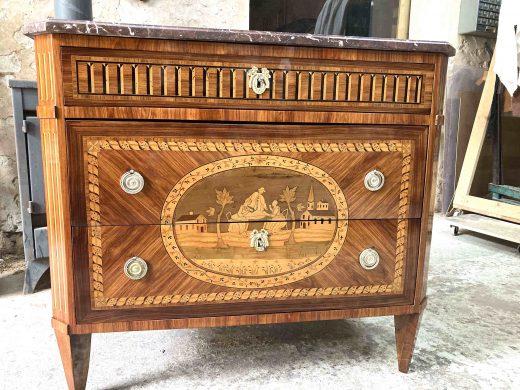
Restoration of a Louis XVI period provincial commode. It is constructed of softwood and oak, and veneered with violet wood, rosewood, sycamore maple, boxwood, ebony, and stained maple. At its center, a bucolic scene depicts two women playing cards between two trees, watched by a man. In the background, a house and a church are visible. The entire scene is framed by a medallion of flowers engraved and colored with black and red wax. The two lower drawers are framed by a frieze depicting a […]

Money changer table

Ebénisterie Mathieu Vath

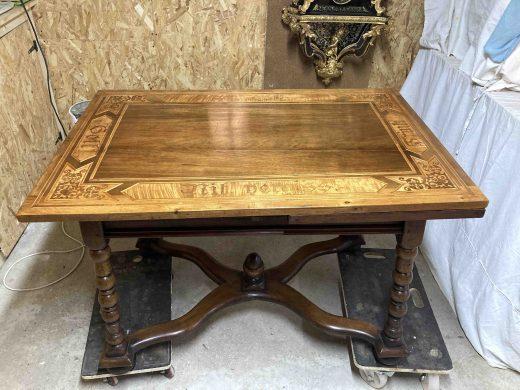
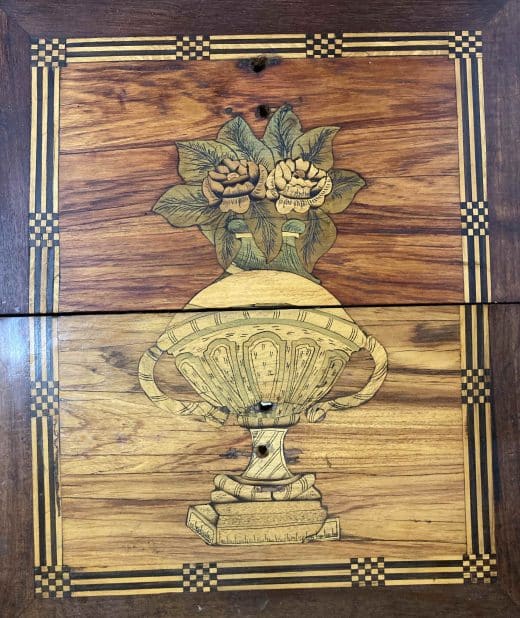
Restoration of a 17th-century money changer's table in solid walnut and walnut and sycamore maple veneer. The marquetry inscription on its top indicates that it comes from Germany: "Trink und iss Gott nit wergiss," meaning "Eat and drink, but do not forget God." It has two drawers, a top, and a sliding extension. An X-shaped stretcher connects its legs. What is a money changer's table? The profession of money changer appeared in the 13th century with the expansion of trade. To keep safe the money exchanged for clients, a piece of furniture was created […]

Coffee table stamped P.GARNIER JME

Ebénisterie Mathieu Vath

Restauration d’une table de salon d’époque Transition (1750-1774), plaquée de satiné et estampillée de Pierre Garnier (vers 1726-1800). D’origine parisienne, fils du maître ébéniste François Garnier, Pierre Garnier obtient sa maîtrise le 31 décembre 1742. Contrairement à son père, il quitte le faubourg Saint-Antoine pour la rue Neuve-des-Petits-Champs, près de la place Vendôme. Sa clientèle compte des marchands, comme Léonard Boudin et Pierre Migeon. Mais elle compte surtout de grandes fortunes du royaume. Ainsi, il livre de nombreuses commandes à Louis Georges Érasme, maréchal de France, à la duchesse de […]

P.ROUSSEL Games Table

Ebénisterie Mathieu Vath

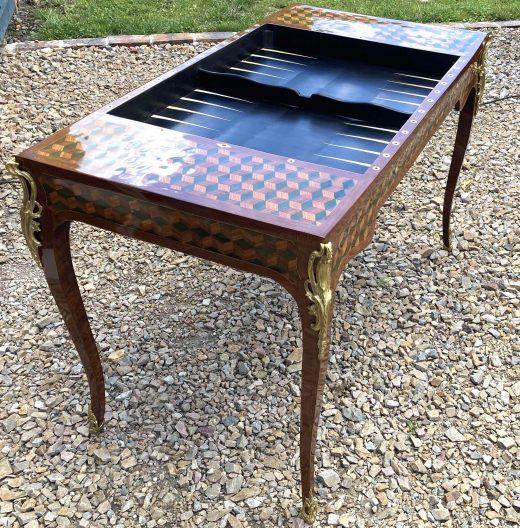
Restoration of a Louis XV period marquetry game table (or backgammon table) with dice (or cubes) veneered in amaranth, rosewood, violet wood, palisander, ebony, and ivory. This table is stamped by the Parisian cabinetmaker Pierre Roussel (September 28, 1723 – June 7, 1782). Pierre Roussel was the son of Michel Roussel, a journeyman cabinetmaker from the Cotentin peninsula. His younger brothers, Jacques, Michel, and Louis, chose carpentry; he alone opted for cabinetmaking. He became a master on August 21, 1745. He then set up shop in the Faubourg Saint-Antoine, on rue […]

Regency Cartel

Ebénisterie Mathieu Vath

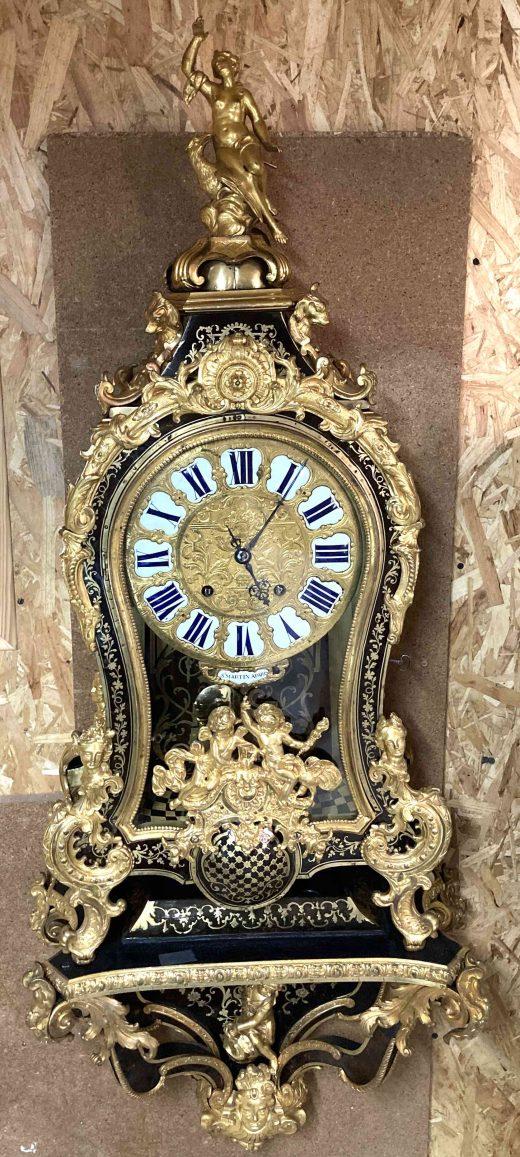
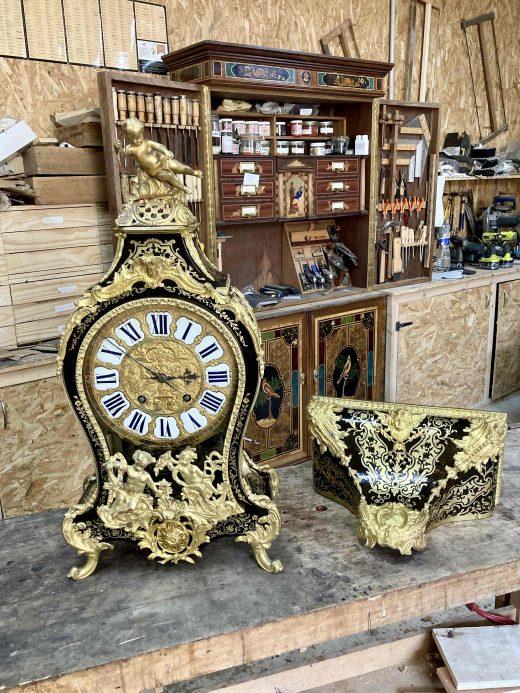
Restoration of a large cartel clock (137 cm high) and its bracketed base, from the Regency period. Made of solid oak, it is veneered with Boulle marquetry of brown tortoiseshell and brass. It is further adorned with floral garlands, crosshatching, and foliage. Its chased and gilded bronze dial features interlacing patterns and birds. The Roman numerals are enameled, and a reserve bears the signature St Martin à Paris. The clock plate also bears the same name. Finally, on the capital, chased and gilded bronzes depict […]

Louis XVI gueridon stamped JH RIESENER JME

Ebénisterie Mathieu Vath

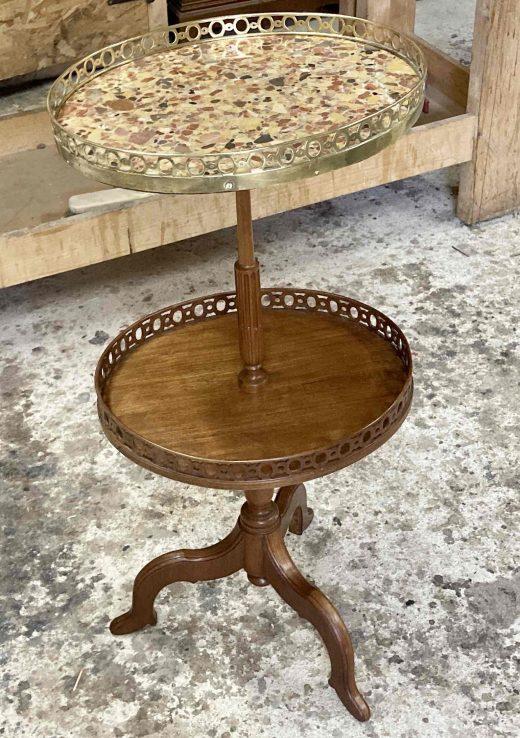
A minor restoration for this "shelf-sized" pedestal table, also known as a "dumb servant." It is made of solid and veneered mahogany, with an Aleppo breccia marble top. Furthermore, it bears the stamp of the equally renowned cabinetmaker to the Crown Furniture Repository, Jean-Henri Riesener. Jean-Henri Riesener: Does Jean-Henri Riesener (July 4, 1734 – January 6, 1806) even need an introduction? Indeed, he is the undisputed master of the Louis XVI style, due to the breadth and variety of his work. Above all, he is renowned for the quality and splendor of his furniture […]

Louis XV cartel clock with crowned C

Ebénisterie Mathieu Vath

Here are some images of the restoration of a clock case that some may have glimpsed during the work at the Mans'Art fair this year. Dating from the Louis XV period, it is inlaid with tortoiseshell and brass on an oak frame. The bronze pieces bear the hallmark of the Crowned C. The Crowned C is a reference to an edict of 1745 that required bronze workers to mark their pieces with a small distinctive letter, a C surmounted by a crown, thus subjecting them to a tax. This tax applied to both objects and furniture that […]

Louis XV corner cabinet

Ebénisterie Mathieu Vath

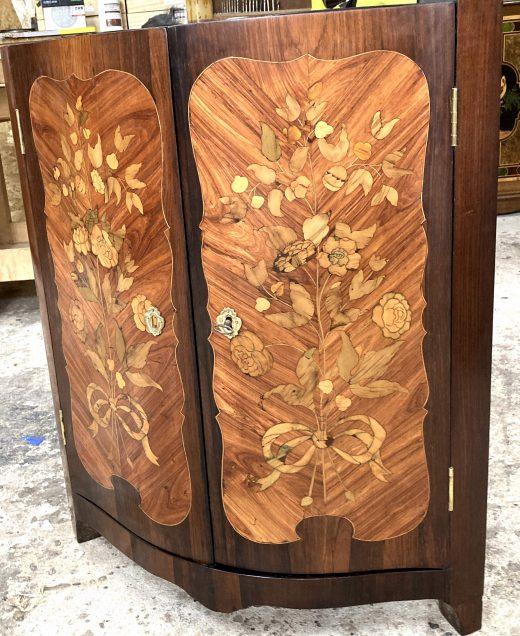
Restoration of a Louis XV corner cabinet in marquetry of various woods: maple, hornbeam, boxwood, and holly. Apart from the green of the leaves, the colors of some of the flowers and ribbons have faded. The marquetry stands out against a rosewood background, framed by a boxwood border and a rosewood frieze. Finally, the solid oak frame is assembled with dovetail joints. Condition report: As the photos show, the varnish was heavily sun-faded. Furthermore, the glues used for the marquetry on the doors were severely dehydrated, and one piece was missing.

Louis XVI games table

Ebénisterie Mathieu Vath

Restoration of a late 18th-century games table (circa 1785). It is veneered in mahogany burl, with inlaid stringing of brass, ebony, and ferreol. This South American wood is named after a 17th-century governor of Guyana. The legs are solid mahogany, and the interior is veneered with ebony and bone dyed green and natural. Its reversible top is leather-covered on one side and mahogany burl veneer on the other. The interior has two niches, a drawer on each side, and […]

LARDIN transitional chest of drawers

Ebénisterie Mathieu Vath

Restoration of a Transition period commode. Constructed of fir and oak, it is veneered with rosewood and violet wood, with a Greek key frieze of green-stained hornbeam stringing. The sides are veneered with satinwood and violet wood. André-Antoine Lardin (1724 – August 10, 1790) obtained his master craftsman's certificate on July 1, 1750. He set up shop on rue de Charenton, under the sign "Au Bois de Boulogne." He worked there until 1770, then moved to rue Saint-Nicolas. His output was considerable. His furniture, in all styles (Louis […]

Mazarine Chest of Drawers

Ebénisterie Mathieu Vath

Restoration of a Louis XIV period commode, known as a Mazarine commode, veneered in brass and ebony on a softwood frame. Its drawers are serpentine: two full-length drawers surmounted by two half-drawers separated by an intermediate stile. Their fronts are made of softwood, their sides and bottoms of walnut. The brass decoration supporting the pendant handles features fine marquetry of scrolls, foliage, foliage, and arabesques. A geometric brass cartouche frames it and simulates keyhole escutcheons. The commode rests on four supports with […]

Chinese chest of drawers

Ebénisterie Mathieu Vath

This week, I'm presenting a Louis XIV commode from the first half of the 18th century. It's veneered in Rio rosewood and adorned with Chinese-style bronze mounts. Height: 85.7 cm, Width: 125 cm, Depth: 60.5 cm. The frame is made of softwood, with planks joined edge-to-edge. The sides, top, and bottom are dovetailed. The back is composed of several planks nailed into the rebates of the sides. The drawer bottoms and sides are made of […]

Louis XVI commode stamped JB.Tuart

Ebénisterie Mathieu Vath

Here is a very pretty Louis XVI period commode, veneered in rosewood and amaranth, with marquetry of boxwood, pearwood, maple, hornbeam, walnut, blackened pearwood, lemonwood… It is built of oak and softwood. It is stamped twice with the mark of Jean-Baptiste II TUART. But its maker is probably Jean LAPIE. Jean-Baptiste II Tuart came from a dynasty of Parisian cabinetmakers and merchants. His father, Jean-Baptiste I, obtained his master craftsman's certificate in 1741 and remained active until around 1760. Born around 1720, Jean-Baptiste II was not a master cabinetmaker, but a master woodworker […]

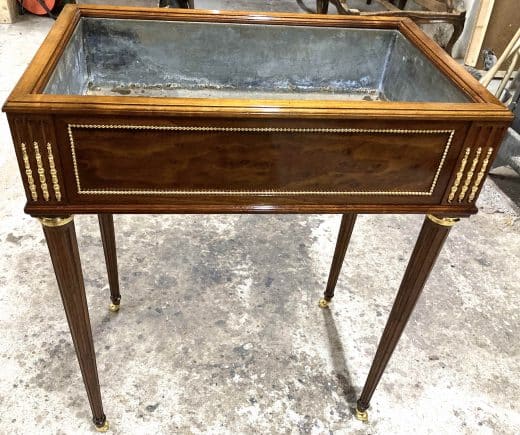
Louis XVI planter

Ebénisterie Mathieu Vath

A little restoration for this Louis XVI jardinière in mottled mahogany veneer and solid mahogany for the feet. Simply regluing the joints, which had become slightly loose, restoring the varnish yellowed with age using a French polish, and re-gilding the bronze mounts were enough to give it a new lease on life. To see previous restorations: https://ebenisterie-mathieuvath.fr/en-ce-moment-a-latelier/

Secretary LXVI stamped Martin Carlin

Ebénisterie Mathieu Vath

Restoration of a Louis XVI period lady's writing desk stamped by Martin Carlin JME. The frame is solid oak, with softwood for the drop-front and lower door. The exterior is entirely veneered in Honduran mahogany, except for the upper edge, which is embellished with a thin strip of amaranth. The interiors are veneered with rosewood, amaranth, and stringing of boxwood and ebony. Of particular interest: the upper interior compartment has never been restored and retains its original finish, a magnificent polish that has preserved its colors and luster […]

Marquises stamped C.SENE

Ebénisterie Mathieu Vath

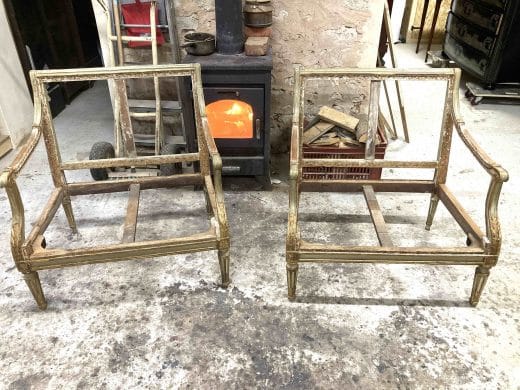
Conservation work on these two marquise chairs stamped by Claude I Sené. Claude I Sené (1724-1792), son of Jean Sené, obtained his master craftsman's certificate in Paris in 1743. He worked in the same workshop as his brother-in-law, the cabinetmaker Jean-Étienne Saint-Georges, on the rue de Cléry, under the sign "du Grand Saint-Georges." His output included numerous Louis XV chairs, but very few Louis XVI pieces. He ceased working in 1780. He was the father of two other illustrious chair makers: Jean-Baptiste Claude and Claude II. BIBLIOGRAPHY: Le Mobilier Français […]

Regency chest of drawers

Ebénisterie Mathieu Vath

Restoration of a Regency commode veneered in rosewood and palisander. It arrived in very poor condition: the joints were completely detached, there were numerous missing veneers, and significant structural deformations on the sides. Its patina was also heavily soiled by multiple layers of dark wax. The bronze mounts and locks had been added in the 19th century during a restoration—a typical restoration for this type of furniture. We re-glued the sides and joints as best we could, replaced the missing veneer, and reattached the brass fluting. Above all, […]

Esterházy Chest of Drawers

Ebénisterie Mathieu Vath

Restoration of this unusual piece of furniture from Austria/Hungary. I had some difficulty placing it geographically. It clearly didn't come from France, but rather from Eastern Europe. But from where? Fortunately, the engravings provide valuable clues. The clothing corresponds to the late 17th or early 18th century. The landscapes show mountains and villages, deciduous and coniferous trees, and several ruins of medieval castles. So it's not northeastern Europe, but rather Bavaria or Austria/Hungary. […]

Napoleon III worker

Ebénisterie Mathieu Vath

Restoration of a Napoleon III period sewing table inlaid with mother-of-pearl, brass, and ebony. As you can see from the photos, this sewing table was in very poor condition. Only the dedication of its owner saved it. Indeed, the restoration time would have been far too long considering the object's value. First, almost all the brass inlay on the base was missing. In addition, there was a significant amount of veneer missing. Finally, the passage of a chair and a dog bite had caused damage. But the […]

Empire side table

Ebénisterie Mathieu Vath

Restoration of an Empire period pedestal table, veneered in mahogany burl. It arrived at the workshop in rather poor condition. The bronze mounts were heavily soiled. There were also many structural separations and missing veneers. The restoration therefore consisted of re-gluing the structure and veneers under vacuum, with the injection of a penetrating adhesive for the upper apron and the central column. I removed the few old grafts that had been applied against the grain and replaced them with a better-matching veneer. I then reapplied the old varnish using a French polish and […]

Directoire cylinder desk

Ebénisterie Mathieu Vath

Restauration d’un bureau à cylindre Directoire de la fin du XVIIIe siècle, plaqué de ronce d’acajou sur ses quatre faces. Il porte la marque CD ou GD, qui m’est inconnue. Toute information la concernant est la bienvenue ! Le meuble est entièrement bâti en chêne, sans un seul morceau de peuplier, même pour les tirettes ou les panneaux. En partie haute, un cylindre découvre quatre petits tiroirs surmontés d’une niche. Il découvre aussi une tablette écritoire coulissante et deux tirettes latérales, toutes garnies d’un cuir doré aux petits fers.  La […]

Mazarin Boulle Office

Ebénisterie Mathieu Vath

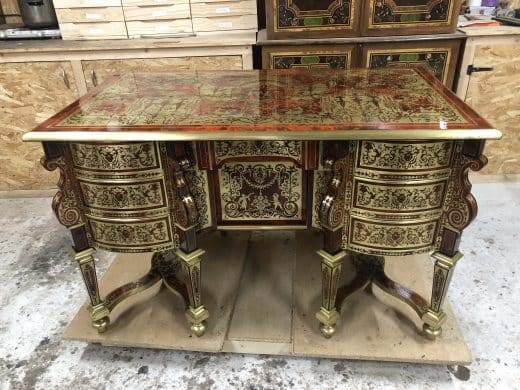
To end the year on a high note, here's a restoration that occupied a large part of my time this year and which reached its owner a few weeks ago. It's the restoration of an eight-legged writing desk, commonly known as a "Mazarin" desk. Constructed of solid oak and softwood, the sides and drawer bottoms are made of light walnut. The marquetry covering it consists of Caret tortoiseshell (Eretmochelys imbricata) on a vermilion red ground, and brass. All of this is framed by delicate ebony stringing. It is […]

Louis XVI commode

Ebénisterie Mathieu Vath

This week, we restored a Louis XVI commode with a projecting front, veneered in Rio rosewood, amaranth, rosewood, and violet wood. Boxwood and ebony stringing forms a coiled ribbon, with engravings filled in red wax. Finally, the tapered feet and canted uprights feature faux fluting in ebony and boxwood. However, no stamp allows us to attribute this very fine piece, crafted from high-quality wood. The restoration required little work. In fact, a colleague was already […]

Eight-foot desk known as the "Mazarin" desk«

Ebénisterie Mathieu Vath

Extensive restoration work has been undertaken on this Mazarin desk, veneered in kingwood and rosewood. It is entirely veneered on fir, with a solid rosewood base. The top features a marquetry of rosewood stars, surrounded by kingwood butterfly wings arranged in circles. Why the name "Mazarin"? The eight-legged desk is one of the jewels of 17th-century furniture. Antique dealers only began calling it "Mazarin" in the 19th century, to lend it more "prestige." In reality, it only appeared around […]

L. Cueunières Writing Desk

Ebénisterie Mathieu Vath

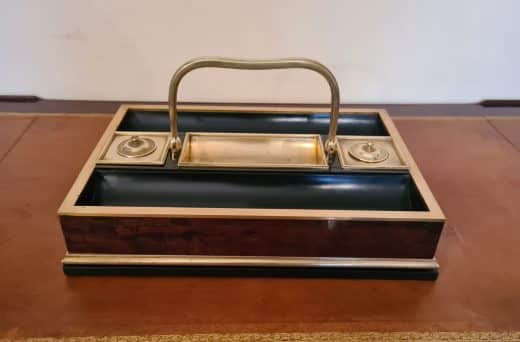
A small restoration for this very pretty Louis XVI style inkwell, stamped L.CUEUNIERES jne. Louis Cueunières the Younger established himself in 1870 at 10 rue Villehardouin, in Paris. He specialized in the restoration of antique furniture and the reproduction of period pieces. This inkwell was in fairly good condition. Apart from a few missing pieces of ebony, it was only dirty. A few ebony grafts, a good cleaning, and a touch-up of the varnish with a French polish were enough to restore its former luster. To see previous restorations: https://ebenisterie-mathieuvath.fr/en-ce-moment-a-latelier/ You can find this piece of furniture […]

Louis XV style desk

Ebénisterie Mathieu Vath

A major restoration was undertaken for this small Louis XV style desk, richly adorned with bronze mounts and veneered in rosewood. The restoration involved replacing the missing veneer while preserving as much of the remaining material as possible. This was achieved by using veneer that was sliced, scraped, sanded, oxidized, and varnished before being re-glued, thus avoiding the need to sand the piece before finishing. Rosewood is a very dark wood that lightens with age, developing a beautiful reddish patina that cannot be removed by any means.

Regency chest of drawers

Ebénisterie Mathieu Vath

Originating in the late 17th century but only acquiring its name in the early 18th century, this is the first classic model of a commode. Although typically Louis XIV in style, it may not have existed before the Regency period. With rounded corner pilasters with slightly convex faces, deep copper fluting, veneer, and geometric bronze mounts, it features three rows of drawers. It perpetuates the spirit of Louis XIV furniture throughout much of the 18th century. Bibliography: Furniture […]

Transitional dresser

Ebénisterie Mathieu Vath

Restoration of a transitional period commode with a projecting front, veneered in rosewood and palisander. The Greek key-patterned moldings, stained green, are made of hornbeam, and the front features a butterfly wing design. It opens with two large drawers with concealed crossbars, and three drawers in an upper row. The uprights, with simulated fluting, are veneered in ebony and boxwood. It rests on four cabriole legs adorned with hoof-shaped feet. Over the centuries, its structure has […]

Louis XV style flat desk

Ebénisterie Mathieu Vath

A second life for this Louis XV style desk, veneered in Rio rosewood (Dalbergia nigra) and African mahogany (Khaya). Besides the construction and tool marks, the presence of this African mahogany greatly facilitates its dating. This type of mahogany began arriving from the west coast of Africa at the end of the 19th century. It became ubiquitous in furniture production at the beginning of the 20th century. I first re-glued the structure and the joints, then the veneer "bells." I filled in the missing sections with sliced veneer, […]

Louis Philippe Buffet

Ebénisterie Mathieu Vath

For a change of pace this week, a bit of what's called "rustic" furniture. It's a welcome change from veneer, and to be honest, it's not unpleasant. I'm even quite pleased to have this kind of piece to restore because, unfortunately, many of these pieces, having lost their market value, end up in the landfill or are simply burned. Moreover, these aren't pieces that require a huge amount of work. For this Louis Philippe two-part sideboard, the restoration consisted of replacing the chestnut planks […]

Louis XVI Powder Box/Writing Table

Ebénisterie Mathieu Vath

The dressing table, sometimes called a powder table, can be defined as a vanity unit in the form of a table or a small writing desk with drawers. This new type of furniture appeared around 1730, shortly after the commode. Moreover, it is often richly inlaid or veneered with precious woods. A powder table that also serves as a desk: This rather unusual powder table also serves as a desk, or at least a writing table. Its four legs are made of solid mahogany, and the crossbars are veneered with mahogany. In addition, it features wood and brass moldings […]

Louis XVI commode stamped JA LECLERE

Ebénisterie Mathieu Vath

Jacques-Antoine Leclere (1744 – January 30, 1792) obtained his master craftsman's certificate in Paris on September 29, 1779. He worked on the rue du Faubourg-Saint-Antoine, then on the rue des Barres, and finally in the courtyard of the Jewish Quarter, a stone's throw from the Bastille. This cabinetmaker produced well-made Louis XV and Louis XVI pieces. He used rosewood, satinwood, mahogany, and also lacquer panels. His stamp can be found on secretaries, chests of drawers, and various small pieces of furniture. For example, a pair of Louis XVI half-moon commodes veneered […]

"Cabaret" pedestal table«

Ebénisterie Mathieu Vath

Très à la mode à la fin du XVIIIe siècle, la table-cabaret, ou table en cabaret, se caractérise par un plateau à bord relevé, en bassine. Légèrement évidé et bordé d’un rebord sur tout son contour, il reçoit sans risque thé, chocolat et autres breuvages.Ce modèle, proche de ceux de l’ébéniste Canabas, est en acajou massif de Saint-Domingue, avec un renfort métallique sous les pieds. Le plus gros souci venait du pied, qui bougeait dans tous les sens. J’ai donc surtout retiré les vis ajoutées lors d’une précédente restauration, reconstitué […]

Transitional chest of drawers stamped A. HERICOURT

Ebénisterie Mathieu Vath

Félicitations à Arnaud pour la restauration de cette commode d’époque Transition plaquée de bois de rose, d’amarante, de satiné pour les côtés et d’érable teinté vert pour les filets. Le bâti est en chêne et conifère. Antoine Héricourt (vers 1730 – 1792) obtient sa maîtrise le 20 octobre 1773, après avoir travaillé plusieurs années comme ouvrier libre au faubourg Saint-Antoine. Ensuite, il s’installe rue du Faubourg-Saint-Honoré, puis devient député de sa corporation et syndic. Sa production importante, très prisée d’une clientèle française et étrangère, compte d’ailleurs des meubles classiques et […]

Empire X-Leg Desk

Ebénisterie Mathieu Vath

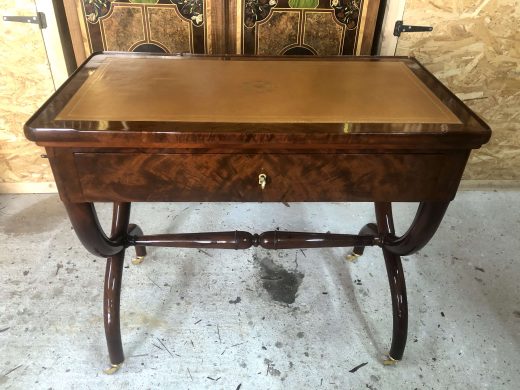
Here are some images of the restoration of this desk, with a solid mahogany base and mahogany burl veneer for the rest. Note that the recessed top is made from a single 12mm thick plank of solid mahogany burl. Here is the desk before restoration. The bulk of the work is on the legs. They are broken at the middle joint. They have already been repaired and are held together only by additional screws. Two cracks can be seen at the […]

Louis XV writing table
Ebénisterie Mathieu Vath

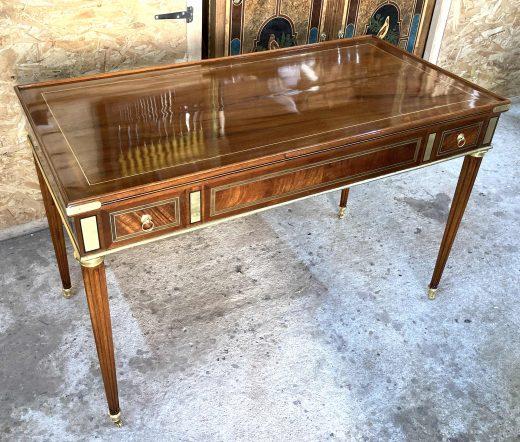
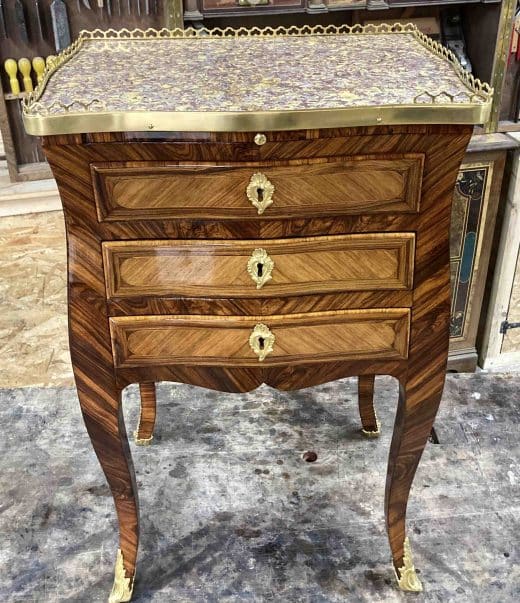
Before/after the restoration of a Louis XV writing table veneered in kingwood on solid oak. It has two side drawers and a central pull-out shelf beneath the leather-covered top. Besides the significant discoloration of the varnish, there were some small areas of peeling and missing veneer. The missing pieces were replaced with new veneer, which was sawn, scraped, and sanded, then cut to the correct thickness before gluing in order to avoid disturbing the patina beneath the bleached varnish. The […]
Louis XVI Molitor Console

Ebénisterie Mathieu Vath

Restoration of a Louis XVI console table (1790-1795) stamped by Bernard Molitor. The frame is oak, and the legs are solid mahogany. The panels of the lower shelf are beech. It is veneered with mahogany burl and ebony and brass stringing. Originally from Luxembourg, Bernard Molitor (1755 – November 17, 1833) obtained his master craftsman's certificate in Paris on October 26, 1787. Arriving in Paris in 1776, he initially worked in a small workshop in the Arsenal district. After completing his master's degree, he established himself on the rue de Bourbon-Saint-Germain. The austerity of his work, […]
Prie-Dieu

Ebénisterie Mathieu Vath

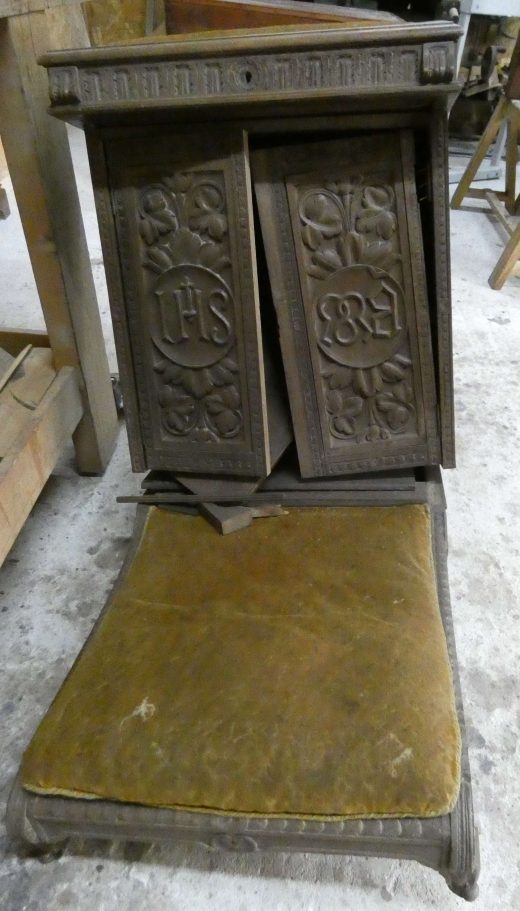
A first experience and a beautiful piece of work by Rachèle, who restored this late 19th-century walnut prie-dieu. The project was quite daunting. The piece had been neglected for years, and wood-boring insects had had a field day. We first treated it with anoxic agents for 21 days. As nothing was holding together anymore, we disassembled each element, without much difficulty, and then glued it back together with fish glue. We replaced the back legs with new walnut, a top plate […]
Louis XV slant-front secretary

Ebénisterie Mathieu Vath

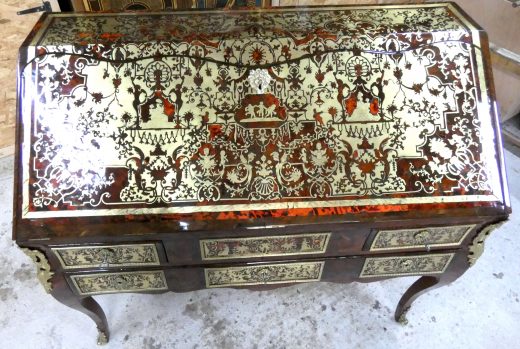
This week, a curious and very pretty Louis XV period secretary/desk with a slanted front in Boulle marquetry and rosewood. Yes, the reuse of Boulle marquetry wasn't only fashionable under Napoleon III! In fact, Boulle marquetry never ceased to have admirers in the 18th century. The renewed interest was particularly noticeable from the 1750s onwards. Prominent furniture merchants, such as Lazare Duvaux, resold them at exorbitant prices to prestigious clients. Madame de Pompadour herself bought a commode as a gift for her […]

Regency chest of drawers

Ebénisterie Mathieu Vath

This small chest of drawers has a classic form typical of the Regency period. It still retains the rigor of the Louis XIV style: the front is curved, the front uprights are rounded, and the sides remain straight. It opens with three drawers. Its uprights and intermediate rails are decorated with brass fluting. The frame is entirely made of fir. The intermediate panels are dovetailed into the sides. The back is made of horizontal planks, nailed with rebates. The drawers are walnut, except for their wooden fronts […]
Transition cylinder desk

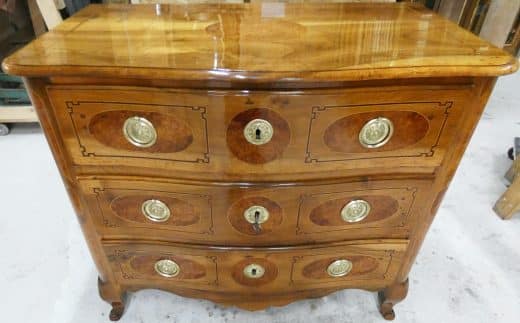
A few years ago, I had the pleasure of restoring this magnificent Transition period (1780) roll-top desk. Its frame is made of oak and fir. Most notably, it is veneered with rosewood, arranged in a butterfly pattern on the fall front. Around this, a delicate border of boxwood and green-stained hornbeam stringing is edged with a narrow band of amaranth. The back is veneered in satinwood. Finally, the central marquetry, on a tobacco-stained sycamore background, depicts musical instruments. Two doves are flying above, a musical score within […]
Napoleon III side table

Ebénisterie Mathieu Vath

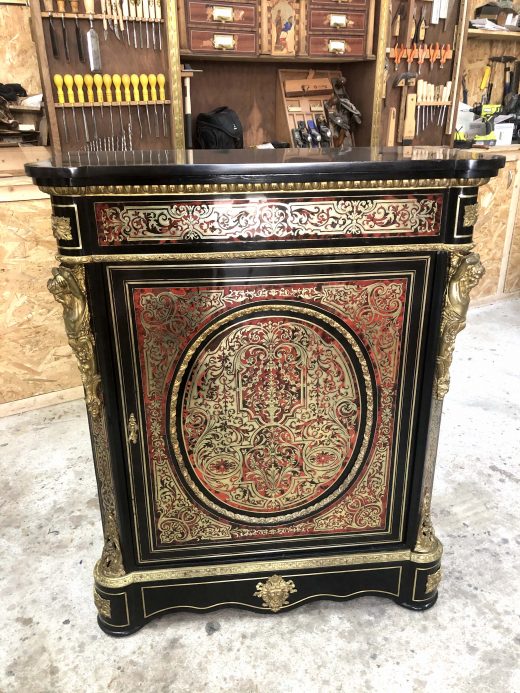
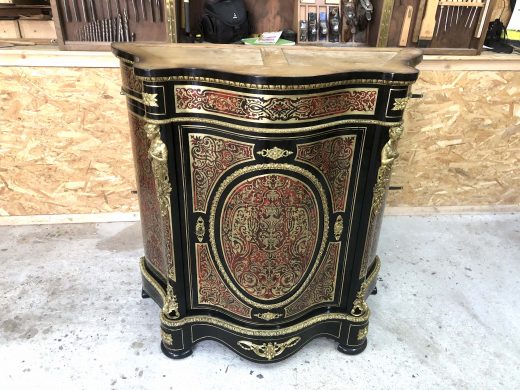
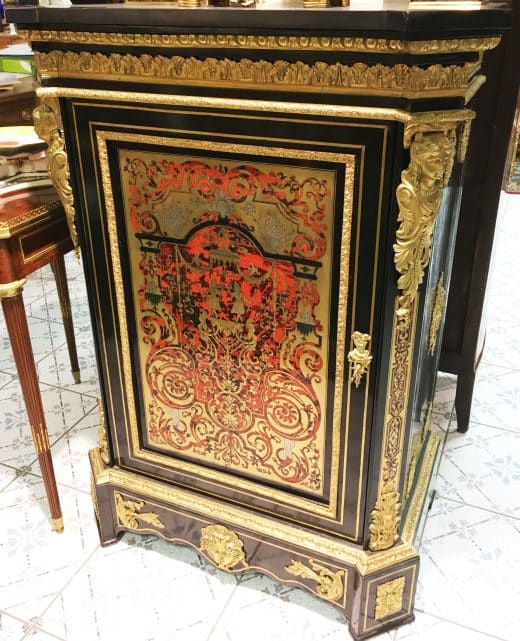
This Napoleon III period sideboard, quadrangular in shape, is veneered in ebonized pearwood. It is further enlivened by rich Boulle marquetry in brass and red tortoiseshell, forming a decoration of arabesques, foliate scrolls, rocaille motifs, and small flowers. In addition, beautiful gilt-bronze mounts add rhythm to the piece: atlantes with clasped hands on the uprights, acanthus leaves, and an apron. A gadrooned molding also highlights the top, which is slabbed with a black marble top with a rounded edge. Finally, the piece opens with a door, […]
Napoleon III Boulle marquetry side table

Ebénisterie Mathieu Vath

A console table veneered in ebonized pearwood, with Boulle marquetry of brass on tortoiseshell depicting arabesques. It opens with a door adorned with an oval medallion. This reveals shelves in mahogany and mahogany veneer. Finally, it is richly ornamented with chased and gilded bronze: egg-and-dart friezes, caryatids in corner drops, interlaced friezes, acanthus leaf friezes, fruit, and florets. This Boulle cabinet required extensive restoration! Indeed, some pieces of brass, fillets, and especially a great deal of tortoiseshell were missing.

Restaurant Secretary

Ebénisterie Mathieu Vath

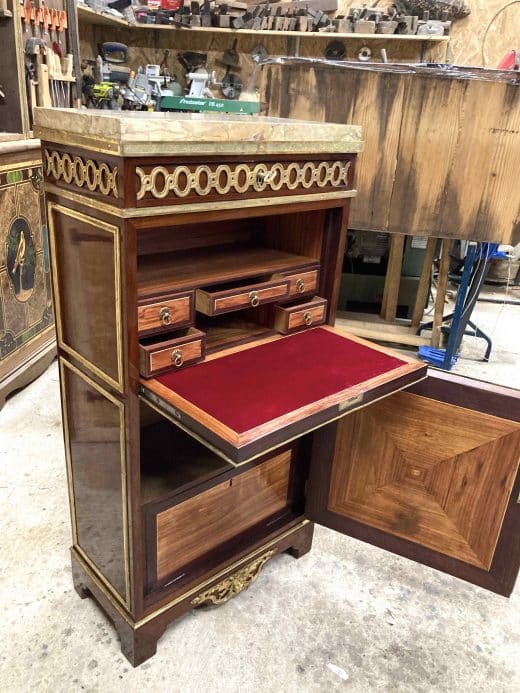
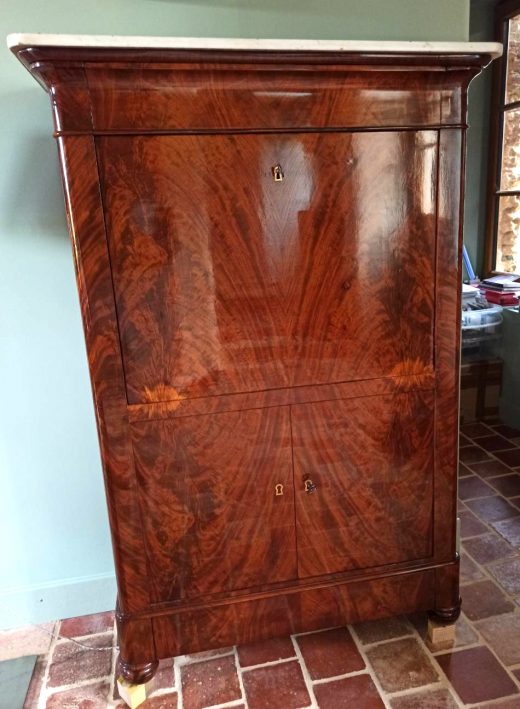
Restoration of a drop-front secretary desk from the Restoration period (1815–1830), veneered in burr mahogany and topped with Carrara white marble. The front legs are rounded and the rear legs are square. The frame is made of oak and softwood. An inventory mark (I91) is found inside the lower drawer on the right side. The Restoration style? After Napoleon's defeat at Waterloo on June 18, 1815, Louis XVI's two brothers regained power. The Count of Provence initially reigned as Louis XVIII (1815–1824). […]
Transitional chest of drawers stamped LARDIN

Ebénisterie Mathieu Vath

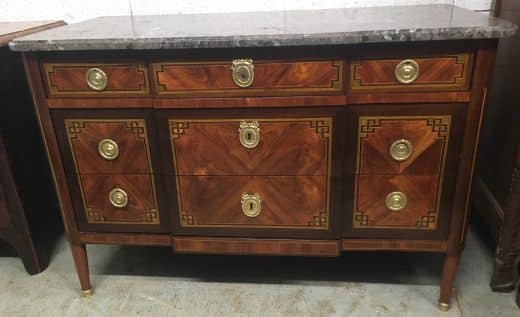
Restoration of a Transition period commode, constructed of fir and oak and veneered with rosewood. It is framed by hornbeam stringing, white and green-stained, with a satinwood band edged in amaranth. The central medallion is made of satinwood veneer assembled in a herringbone pattern. The maker's mark and the JME (Journée des Métiers d'Art) are located at the base of the left rear leg. André-Antoine Lardin (1724 – August 10, 1790) obtained his master craftsman's certificate on July 1, 1750. He established himself on the rue de Charenton, at the sign "Au Bois de Boulogne," and worked there until 1770. He then moved […]

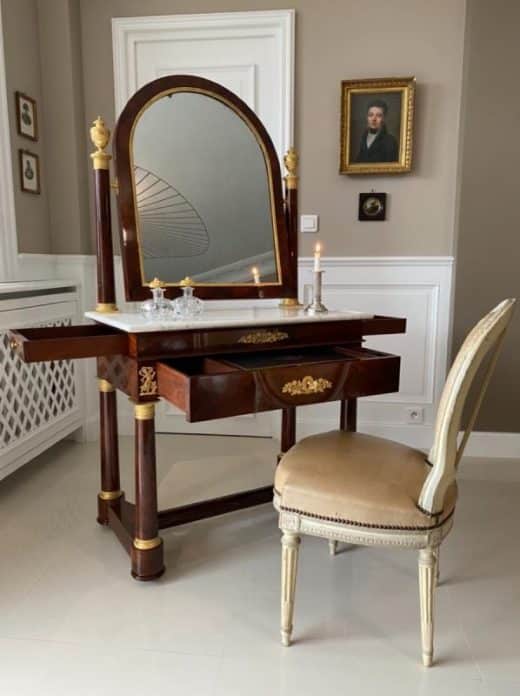
Empire Dressing Table

Ebénisterie Mathieu Vath

A beautiful restoration and, above all, conservation effort has been undertaken on this lovely Empire-period dressing table. Its frame is made of oak and poplar, veneered with mahogany burl. The drawer sides and bottoms are solid mahogany. It rests on four column legs ending in casters and joined by an H-shaped stretcher. The frieze opens with a central drawer, revealing a writing surface lined with blue morocco leather, a pen case, and two compartments for inkwells. Two large drawers on either side hold toiletries. […]

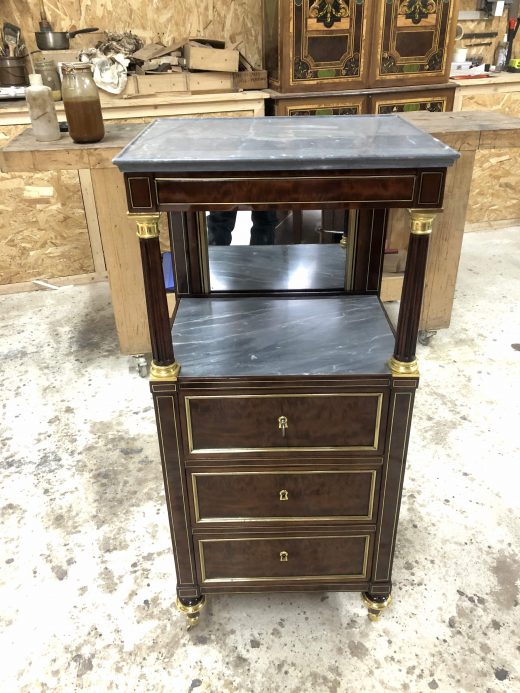
Barber shop Louis XVI/Directory

Ebénisterie Mathieu Vath

This elegant barber's cabinet in solid and veneered mahogany dates from the late 18th century. It rests on four tapered legs with casters and opens with three drawers in the front. Above, a niche with a blue Turquin marble top is framed by fluted columns. Next come two side drawers and a sliding marble top with a recessed base. Finally, this reveals a mirror that pivots on a rack and pinion mechanism, framed with ebony and brass stringing. Appearing during the reign of Louis XVI, the barber's cabinet is a piece of men's grooming furniture. Indeed, it holds the pitcher and […]

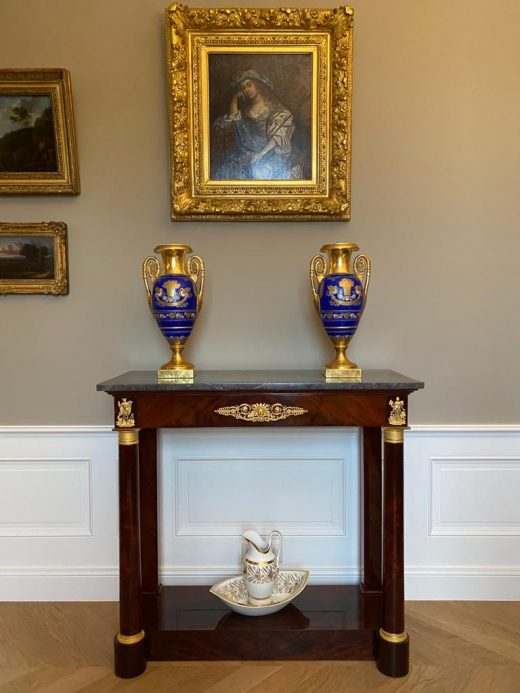
Empire Console

Ebénisterie Mathieu Vath

Here are some images of the restoration of this Empire-style console table. But first, a little history: do you know what a console table is and what its use was? Primarily a decorative piece of furniture, the console table was placed in the entrance hall of apartments or between two windows. The "console table," as it was called during the reign of Louis XV, was placed against the wall. Its marble top rested on two scrolled legs. During the reign of Louis XV, console tables were often elaborately crafted and adorned with highly elaborate motifs. Sculptures and reliefs, arched legs and curved fronts… Louis XV console tables […]

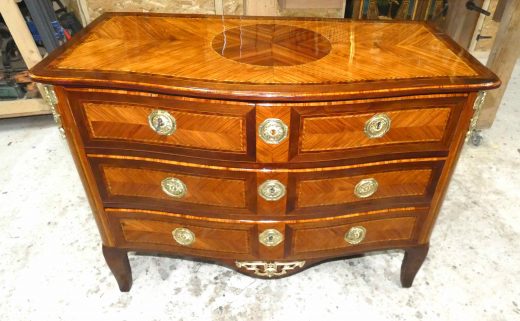
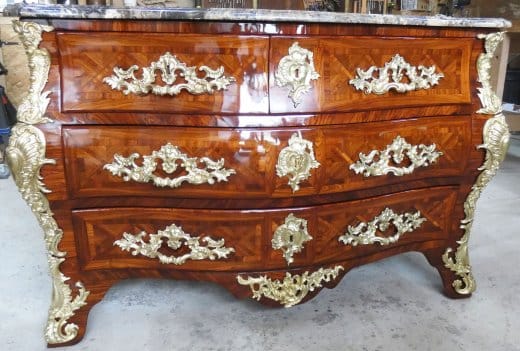
Louis XV commode

Ebénisterie Mathieu Vath

This is a significant restoration project for this Louis XV commode, originally veneered in rosewood and violet wood. It took me some time to confirm that it was indeed violet wood. This commode has undergone so many restorations that it now contains almost as much rosewood as violet wood. Fortunately, the drawers are still in fairly good condition, and they are definitely violet wood. I therefore conclude that the commode was originally veneered with these two woods. [… ]

Sleep

Ebénisterie Mathieu Vath

Restoration of an early 19th-century somno, veneered in Cuban mahogany burl. Let's be honest, previous restorations had done it a disservice. Indeed, the gaps and shrinkage in the wood had been filled with wood filler, then everything was disguised. The result: it was all you could see! But first, a little history. What is a somno? The somno appeared during the Consulate period. It's a small bedside table, round or square, with a closed compartment. Its name comes from the Latin word somnus, meaning sleep. Under the Empire, it […]

Louis XVI commode

Ebénisterie Mathieu Vath

Restoration of a Louis XVI period commode from eastern France. It is made of solid oak and fir, veneered with end-grain laburnum, walnut, plum, amaranth, rosewood, palisander, boxwood, and green-stained hornbeam. The handles and keyhole escutcheons were added later. Indeed, the original fittings have disappeared: only the handle holes remain. This is a piece of furniture that has never been restored. Moreover, the veneer is almost 4 mm thick in places. Furthermore, one can see […]

Table à la Tronchin

Ebénisterie Mathieu Vath

A little refresh for this lovely Tronchin-style table. Apart from a missing molding and a few small areas of missing veneer on the legs, nothing serious. A fresh coat of varnish was all it took to give it a new lease on life. But do you know where this type of table comes from, and what it was used for? This table owes its name to Théodore Tronchin (1709-1781), a Genevan physician. At the time, he published works on bone diseases caused by poor posture at the desk. He praised […]

Mahogany games table, late 18th – early 19th century

Ebénisterie Mathieu Vath

96 x D 47.5 x H 74 cm. Open: 96 x 95.5 cm. Restoration of a folding games table, veneered in burr mahogany commonly known as Cuban mahogany. According to the recent book "L'essence du bois" (The Essence of Wood) by Patrick George, Emmanuel Maurin, and Marie-Christine Trouy-Jacquemet, it would be more accurate to call it Saint-Domingue mahogany. The base is veneered in solid oak, and the top in poplar. The moldings are solid mahogany. The table rests on tapered legs ending in bronze casters. Under the […]

Majorelle table and rosewood

Ebénisterie Mathieu Vath

This is the second time I've worked on this type of table, which came from Louis Majorelle's workshop in the 1920s or 30s. You can find all the information about this type of table at the following link: https://ebenisterie-mathieuvath.fr/2019/08/29/table-majorelle/ It's primarily a preventative restoration. In fact, there wasn't any major damage. So, a few grafts and re-gluing a large part of the edge veneer were enough to restore this lovely Rio rosewood table. This is therefore an opportunity to tell you about this wood, which is so […]

Secretary of the Board of Directors

Ebénisterie Mathieu VATH

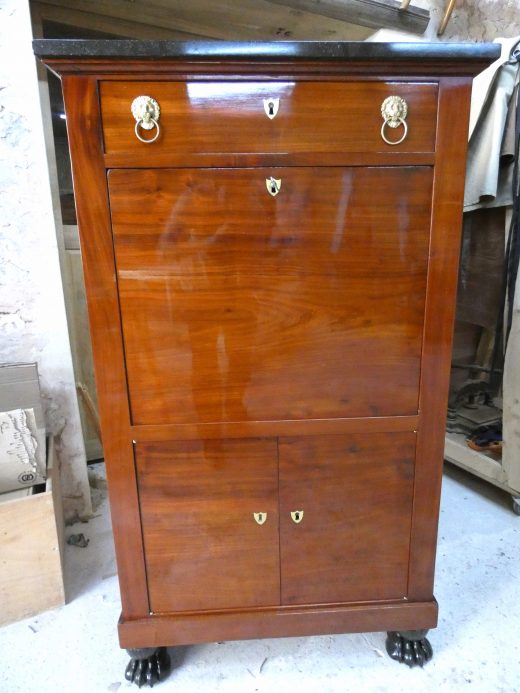
Here is a secretary desk in the most understated style of the Directoire period. Its frame is made of solid beech and conifer, and it is veneered with mahogany and mottled mahogany. It is very simply adorned with bronze handles in the form of a lion's head holding a ring in its mouth. The keyhole escutcheons are in the form of a shield. The interior has seven drawers, the middle one of which locks. The drop-front closes with a period three-point lock. The lower section has three drawers, onto which Louis XV style pull rings have been added.

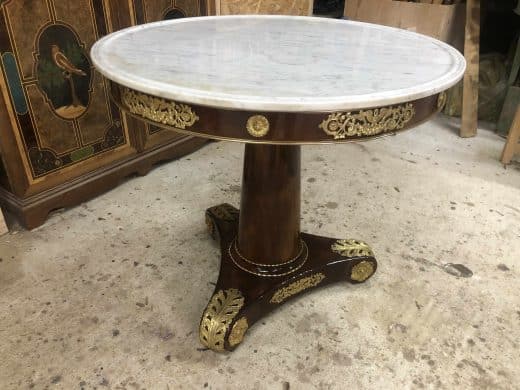
Empire Pedestal

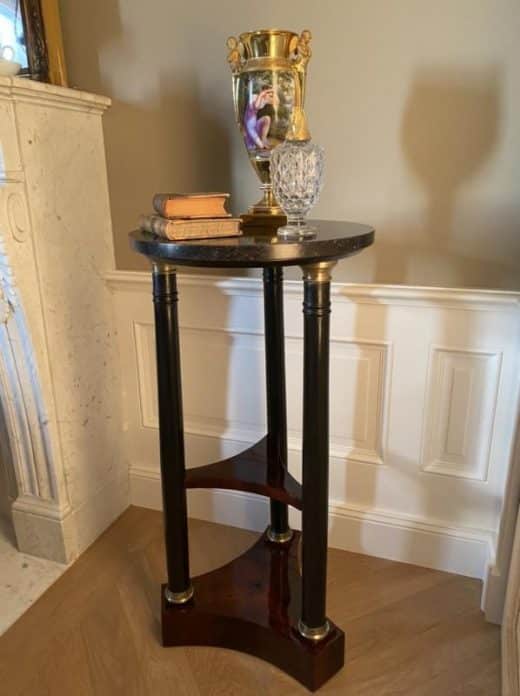
Restoration of a side table with walnut legs and frame, veneered in flame mahogany. It rests on three slender columns, adorned with bronze rings and surmounted by a circular top of veined black marble. The restoration consisted of tightening the cracked base, re-gluing the edge veneers, and applying some grafts. I stripped the columns, which were heavily infested with wood-boring insects, and then treated them with static anoxia. Static anoxia is an insecticidal treatment that works by depriving the wood of oxygen and also has an effect on […]

Regency chest of drawers stamped J.BIRCKLE

Ebénisterie Mathieu VATH

Restoration of a chest of drawers veneered in Rio rosewood, with satinwood stringing. It opens with two large drawers and, in the upper section, two smaller ones. Its frame is made of oak and fir. It also bears the stamp J.BIRCKLE and the JME hallmark on the left upright. Finally, there are some traces of restoration and an ink mark on one side of a drawer. Jacques Bircklé (1734-1803) – Cabinetmaker – master craftsman obtained on July 30, 1764. One of the suppliers to the Royal Furniture Repository under Louis XVI. Free craftsman […]

Louis XV commode

Ebénisterie Mathieu VATH

The commode with a jumping top appears to have been invented during the Regency period, between 1705 and 1730, by the cabinetmaker Charles Cressent. It then became widespread under Louis XV. It has only two drawers, or two rows of drawers. Its body is raised on cabriole legs of medium height: the body occupies half the height of the piece, the legs the other half. The observer thus has the impression that the piece has legs allowing it to jump like a frog. The width offers straight, curved, or crossbow-shaped forms. The marble top follows the […]

Louis XVI/Directory Secretary

Antiquités Guin

Restoration of a drop-front secretary desk with an oak frame, veneered in mottled mahogany and Santo Domingo mahogany. It likely dates from the late 18th century. Its white Carrara marble top is surrounded by a partially openwork brass gallery. It opens with a drawer at the top, a drop-front in the middle, and three drawers at the bottom. All the original locks are secured with a cloverleaf key. Furthermore, brass quarter-round moldings frame all the panels, both on the front and sides. The drop-front is veneered in mottled mahogany […]

Empire secretary with quiver

Ebénisterie Mathieu VATH

Do you remember the Empire chest of drawers with the quivers? Well, here is the secretary desk with the quivers. It is built in exactly the same way as the chest: same construction, same solid woods used, and same mahogany veneers. The restoration is identical to that of the chest of drawers. The goal: to preserve as much as possible and restore the piece to its function without altering its history. So I re-glued the structure and the few detached veneers, then added some mahogany burl grafts. Finally, the hinges of the drop-front had to be reinforced […]

Louis XV style desk in yellow Saint-Martin veneer

Ebénisterie Mathieu VATH

The restorer's trade holds many surprises. There are over 60,000 species of trees in the world. Suffice it to say that even though the same types of wood are often found in French furniture, sometimes you stumble upon something unfamiliar. I found this wood odd. Violet wood? No. Rosewood? Perhaps, but a variety I don't recognize. Okay, I'll strip a section to see the wood's true color. Hey, the varnish was very red: this veneer is made of […]

Jacob Frères bench and armchairs on rue Meslée

Ebénisterie Mathieu VATH

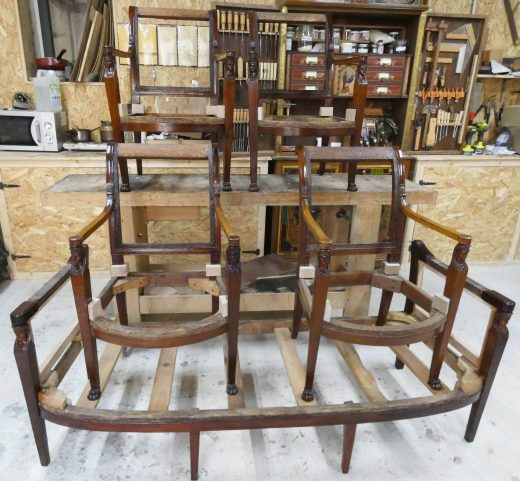
Extensive restoration and conservation work has been undertaken on this bench and its four armchairs from the Consulate period, stamped Jacob Frères, rue Meslée. Their front and rear legs are made of solid Cuban mahogany, with veneered crossbars. The armrests, supported by Egyptian heads, are made of light mahogany from Santo Domingo, contrasting with the uprights. They are adorned with carved palmettes and rosettes in Cuban mahogany. The front legs are tapered and end in claw feet, while the rear legs are arched. The bench is a converted sofa. Due to reupholstering […]

Empire Chest of Drawers with Quivers

Ebénisterie Mathieu VATH

This week, here are some photos of the restoration of this Empire-style chest of drawers veneered in mahogany burl. Its originality lies primarily in the quality of its bronze mounts. Indeed, together with the side columns, they form quivers. Furthermore, the keyhole escutcheons feature two crossed laurel branches tied with a ribbon. Originally, the bronze mounts were mercury-gilded, as evidenced by the gilding stains on the back. Unfortunately, only a few traces remain on the visible surface. Moreover, it is all the more unique because I must […]

Small Boulle marquetry cartel clock

Ebénisterie Mathieu VATH

Restoration of a Napoleon III period marquetry clock in brown tortoiseshell on a black ground and brass. Despite dust, oxidation, and years spent in the depths of an attic, this small clock is in very good condition. Except for a missing piece of brass on the right side of the capital, it is complete. The gilding is still clearly visible beneath the layer of grime, and the structure is in perfect condition. The restoration was therefore straightforward: re-gluing all the marquetry under vacuum, then a light cleaning, and a varnishing with […]

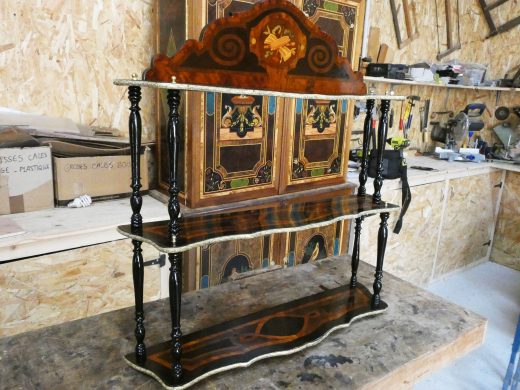
Napoleon III wall shelf

Ebénisterie Mathieu VATH

Restoration of a Napoleon III period wall shelf veneered in blackened pearwood, rosewood, amaranth, amboyna burl, and marquetry with a music theme. Underneath the dust, aside from small losses in the blackened pearwood and rosewood, and slight dehydration, there was nothing too serious. A few veneer grafts, a vacuum-sealed glue application, a thorough cleaning, a coat of clear French polish, and voilà! All this without using sandpaper. Except for lightly sanding the varnish […]

Hedouin commode with crowned C

Ebénisterie Mathieu VATH

Extensive restoration of this superb Louis XV period commode, stamped on all four uprights by Jean-Baptiste Hedouin. The frame and drawers are made of solid oak, fir, and walnut. It is veneered with satinwood for the frieze edges and features geometric marquetry in violet wood. Two types of violet wood are used: one with a very tight grain and veining for the lozenges, the other more intricate for the borders, uprights, and rails. The gray Ardennes marble is molded and shaped into the forms […]

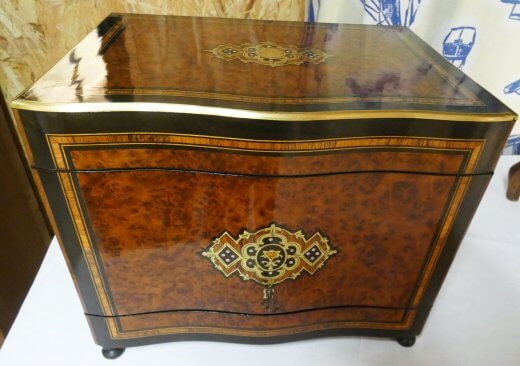
Napoleon III liquor cabinet

Ebénisterie Mathieu VATH

It would seem that the first liquor cellars appeared at the very end of the 18th century. But it was in the 19th century that the fashion for liquor cellars truly took off. The revolution transformed social classes and ways of socializing, leading to increased consumption of liquor, which contributed to the rise of this new social object. The emergence of liquor cellars is, of course, directly linked to the evolution of alcohol consumption in France, such as sweet Mediterranean wines, brandies, cognac, liqueurs, and more.

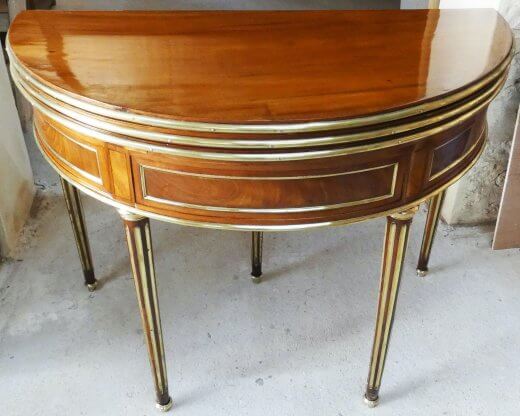
Louis XVI half-moon table

Ebénisterie Mathieu VATH

Here is a three-tiered half-moon table. This style of table, originating in England, is a classic of the Louis XVI style. It opens to reveal two circular tiers, one lined with felt, the other veneered in mahogany. Its apron, veneered in mahogany burl, is adorned with brass frames. It rests on five tapered legs, fluted and trimmed in brass, ending in sabots. The fifth leg is attached to a drawer: it is pulled out to support the drop leaf when unfolded. A very attractive piece, probably dating from the late 18th century. […]

Louis XVI style desk stamped KRIEGER

Ebénisterie Mathieu VATH

This desk is exquisitely crafted, with its oak frame veneered in mahogany and its solid mahogany legs. It is, in fact, a perfect example of high-quality 19th-century furniture. Indeed, the cabinetmaking is flawlessly executed, and the bronze mounts are in perfect condition. In short, everything is there; nothing is missing. The Krieger firm began its cabinetmaking business in the mid-19th century with Antoine Krieger (1804-1869). It then added a significant decorative department, which ensured its prestige until around 1945. Thus, it produced all […]

N. PETIT Roll-Top Desk

Ebénisterie Mathieu VATH

DIMENSIONS: H.71 W.104 D.52 This roll-top desk perfectly matches those produced by Nicolas Petit's workshop between 1770 and 1791, the year of his death. Indeed, with a few exceptions, Nicolas Petit primarily crafted this type of furniture in molded mahogany, on fluted legs and with white marble tops. Their understated elegance reflected the taste of the period. It features two drawers in the frieze, two pull-out side shelves, and a central shelf that locks when the drop-top is closed. Furthermore, the interior contains two drawers, the one on the right […]

Transitional dresser

Ebénisterie Mathieu VATH

Here is a very simple commode from eastern France, probably dating from the late 18th century. Its front is slightly curved and its uprights are chamfered. The bronze mounts are probably not original. The frame is made of solid softwood, the uprights of oak. The drawer bottoms are set in a rebate and slide on the drawer fronts, which is typical of provincial work. A small unusual feature: the commode has no top panel; the marble slab rests directly on the frame. At the level of […]

J.STUMPFF Roll-Top Desk

Ebénisterie Mathieu VATH

Restoration and conservation work on this rare Louis XVI period roll-top desk stamped by Jean-Chrysostôme Stumpff (1731 – January 17, 1806), who became a master craftsman on August 27, 1766. Originally from Schweigern, Swabia (Germany), he married in 1760 in Paris, at the Swedish embassy, like most of his compatriots of the Reformed faith. His witness was his fellow cabinetmaker Ferdinand Schwerdfeger. In his workshop on Rue Saint-Nicolas, he produced some Louis XV furniture, but primarily a large number of Transition and Louis XVI pieces. Stumpff's production […]

Napoleon III style Louis XVI work table

Ebénisterie Mathieu VATH

Here are some photos of the restoration of a small Louis XVI style work table from the late 19th century. Its legs are made of solid mahogany. Furthermore, its veneer combines rosewood and sapele, with blackened pearwood and boxwood for the fluting and stringing. Nothing too serious for this pretty little piece of furniture: just a few missing veneer patches and a small chip on the oak side of the drawer. A simple restoration: a few veneer grafts glued in place […]

Napoleon III Boulle marquetry side table

Ebénisterie Mathieu VATH

Restoring this piece of furniture is a classic case: a warped door with almost no brass inlay left. Fortunately, the marquetry on the door was fairly well preserved. Only a small piece of brass and a few pieces of dyed horn were missing. Nothing too serious. I first removed the bronze mounts. Then I recreated and glued all the missing inlays, reattaching any remaining pieces in the process. Next, I tackled the door. I removed the amaranth veneer from the back panel, straightened the door, and then reinstalled […]

Chest of drawers in the style of the Axe

Ebénisterie Mathieu VATH

Here are some photos of the restoration of a solid walnut commode, veneered with thuya burl inlay, with Greek key stringing in amaranth and boxwood. The drawers and the interior and back panels are made of fir. Despite the curved stretcher, its shape, and its feet, this commode is indeed in the Transition style, but from the Louis XVI period. In the title, I wrote "in the style of the Hache family": this commode certainly comes from the Dauphiné region. But that it came from the workshop of the famous family of cabinetmakers […]

Louis XVI commode stamped JA BRUNS

Ebénisterie Mathieu VATH

This week marks the completion of the restoration of a Louis XVI commode stamped JA BRUNS. Its frame is oak, except for the side panels, backs, drawer fronts, and two drawer bottoms, which are made of softwood. It is veneered with rosewood in a butterfly pattern and amaranth for the edges. The false fluting is in boxwood and ebony. A green-stained maple fillet outlines the Greek key corners. A few satinwood additions from previous restorations are visible. The marble top is Sainte-Anne gray. This commode […]

Label signed "Louis David Carré in Paris"«

Ebénisterie Mathieu VATH

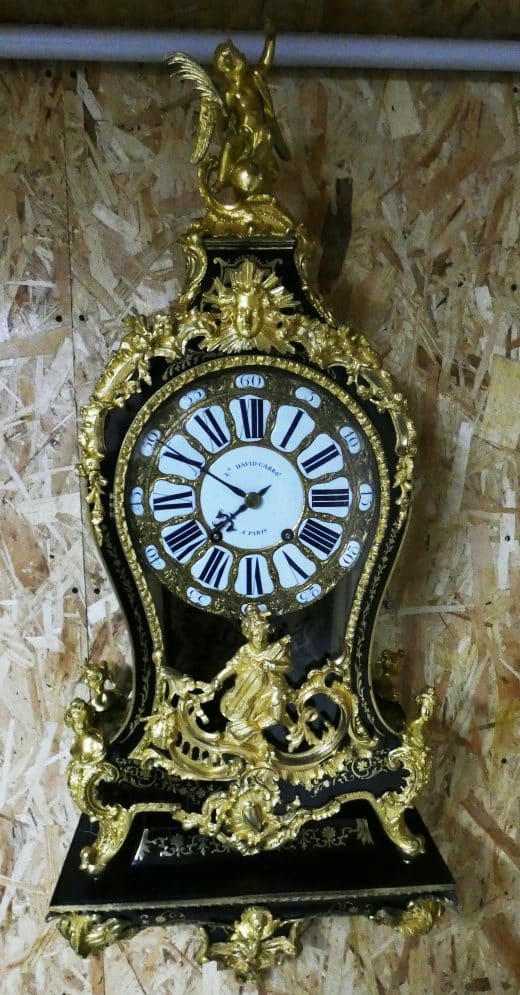
After several weeks of work, the restoration of this clock is finally complete. It is a Louis XV period clock in brown tortoiseshell and brass marquetry, with rosewood restorations. The dial is by Louis David Carré, nephew of Julien Le Roy, who became a master craftsman on December 31, 1748. Lodged at the Louvre from 1744, he was elected a juror in 1775. The greatest treasure of this clock lies in its bronze mounts. They are truly magnificent, and above all, they are in very good condition. There is only […]

Secretary stamped P.ROUSSEL JME

Ebénisterie Matheu VATH

Here are some images of the restoration of a secretary desk stamped by Pierre Roussel (1723-1782). Having become a master cabinetmaker in 1745, Pierre Roussel set up shop on Rue de Charenton, in the Faubourg Saint-Antoine, under the sign "L'Image de Saint Pierre" (The Image of Saint Peter). Thanks to his skills as a cabinetmaker and especially as an exceptional marquetry artist, he quickly gained a great reputation. In 1762, he became a sworn member of his guild. By 1767, he was considered one of the best cabinetmakers of his time. Highly regarded by his colleagues, he became a representative of the cabinetmakers' guild in 1777 and then syndic two […]