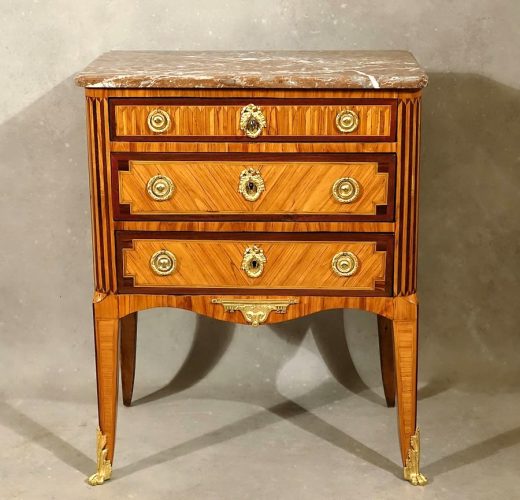
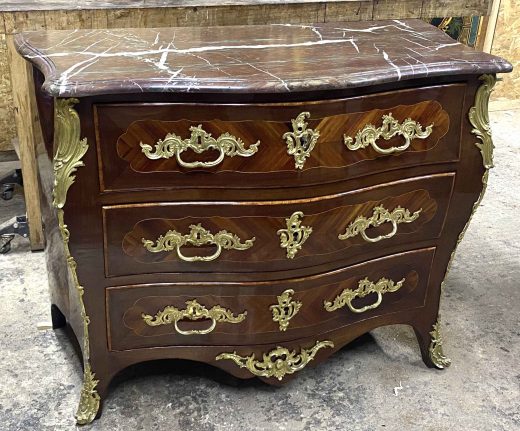
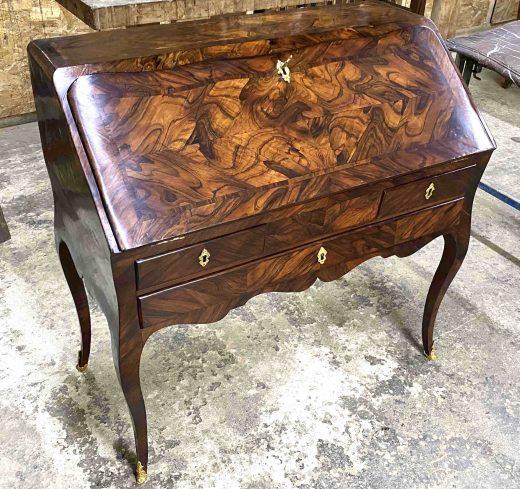
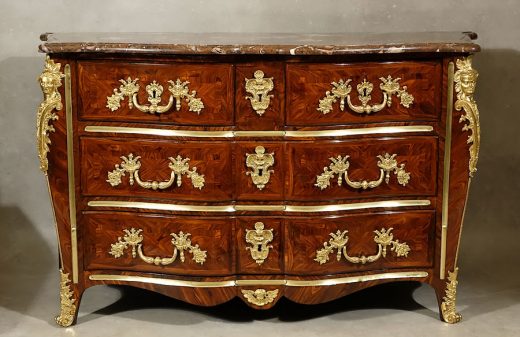
Louis XVI secretary stamped Schlichtig

Ebénisterie Mathieu Vath

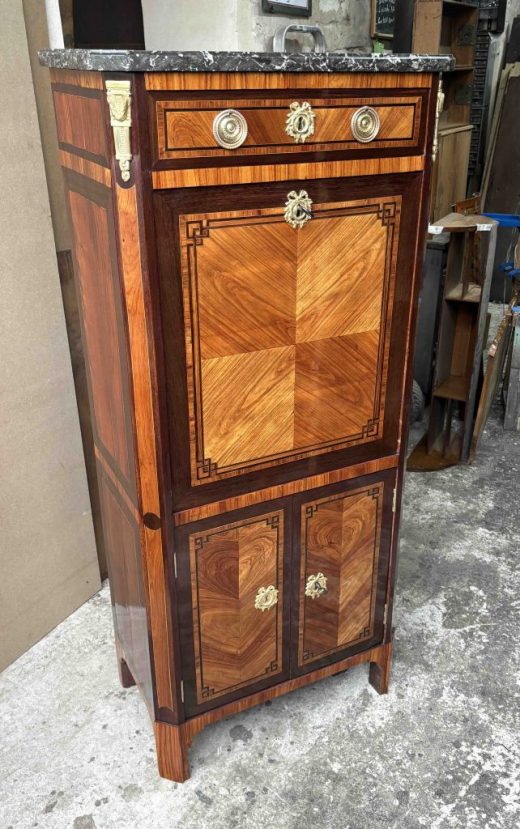
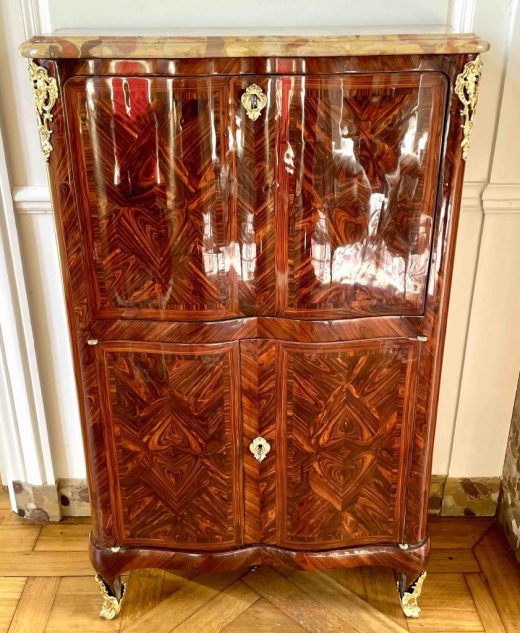
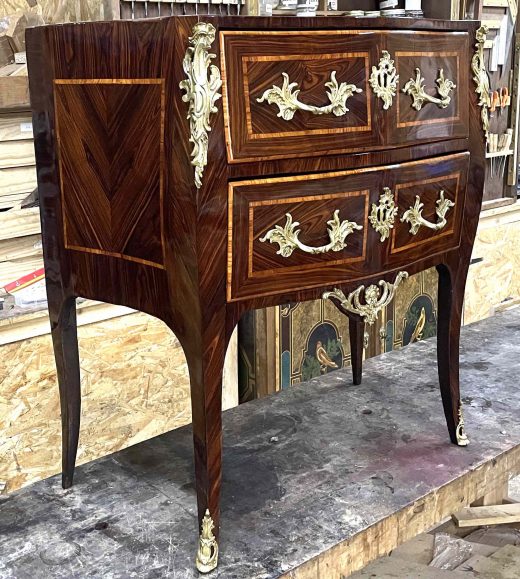
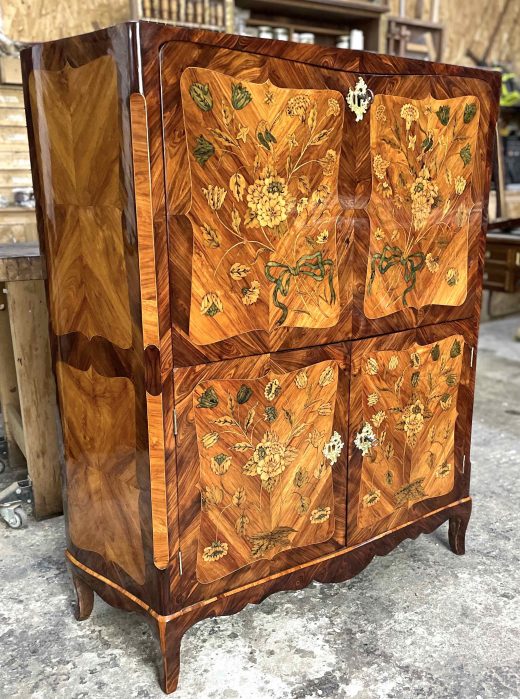
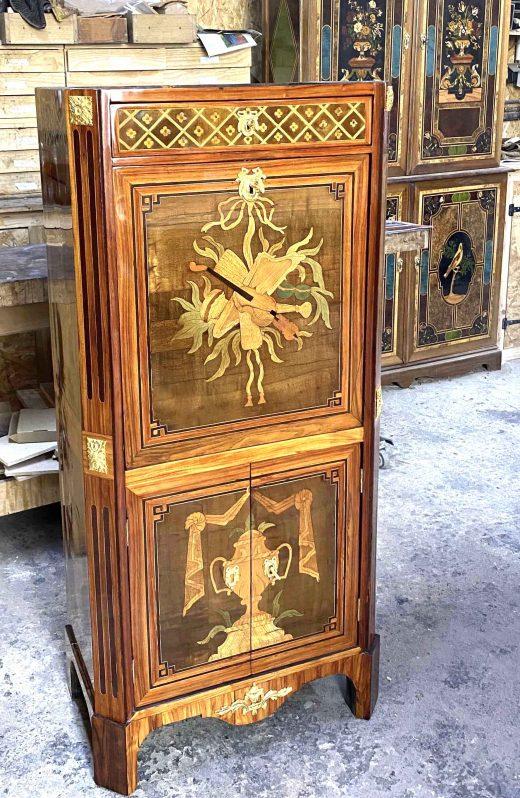
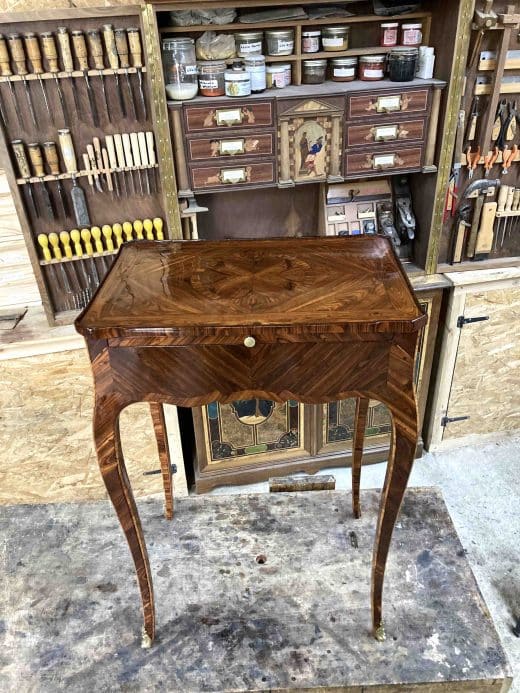
This Louis XVI style secretary desk, stamped JG Schlichtig, is made of rosewood veneer, satinwood (on the sides) and amaranth, on an oak and softwood frame. It opens with two lower doors, a central drop-front, and a top drawer. The interior of the piece includes six drawers and three niches. Given its small size, 1.20 meters, it can be described as a lady's secretary desk. Jean-Georges Schlichtig († February 1782) was a Parisian cabinetmaker of German origin, admitted as a master on October 2, 1765. He established himself successively […]
Louis XV style bookcase

Ebénisterie Mathieu Vath

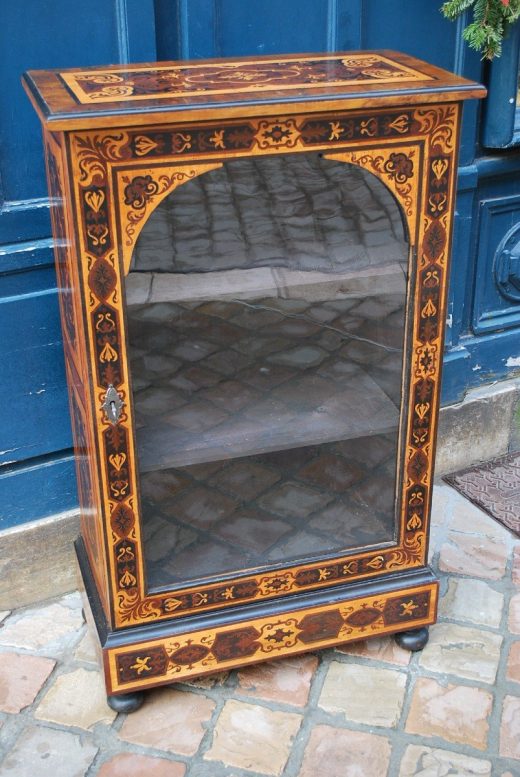
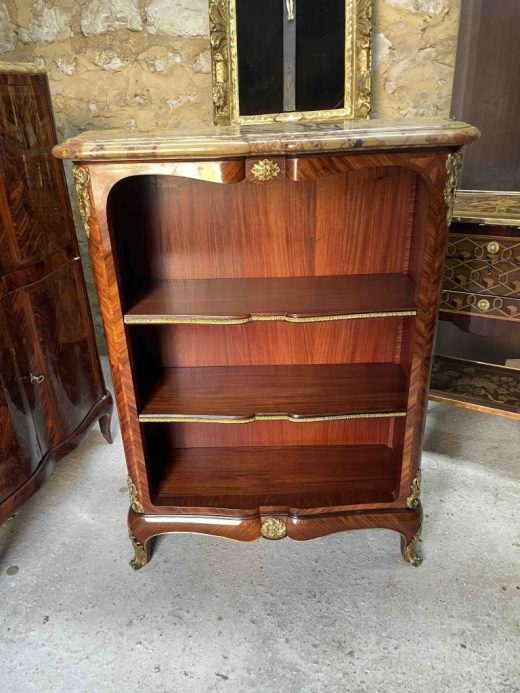
The restoration of this Louis XV style bookcase, dating from the Napoleon III era and stamped by Léon Dromard, is now complete. Its structure is made of oak, covered with a kingwood veneer, displaying a style very close to that produced by the cabinetmaker Pierre IV Migeon in the 18th century. But do you know what a bookcase is? A bookcase is a small, open storage unit that appeared in the 18th century, designed to hold books and decorative objects. Appreciated for its lightness and elegance, it quickly became a staple in refined interiors, […]

Louis XVI psyche mirror Weisweiler

Ebénisterie Mathieu Vath

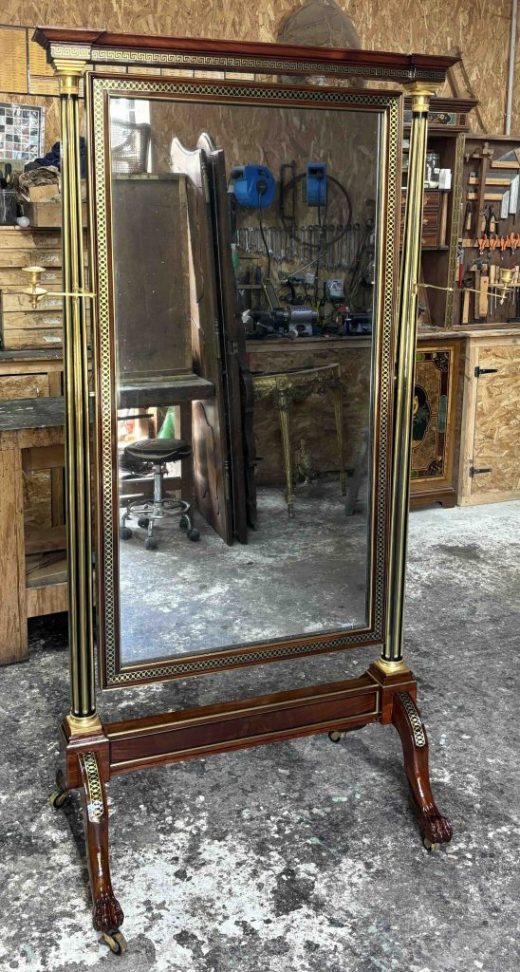
Restoration of a Louis XVI/Directoire period cheval glass stamped by Adam Weisweiler. This piece of furniture represents one of the innovations in late 18th-century furniture design. Far more than a simple dressing table accessory, it represents a significant evolution in the design of furniture intended for private use. Its appearance coincided with changing lifestyles, the development of new domestic spaces, and evolving practices related to self-presentation. For both the furniture historian and the restorer, the cheval glass is a particularly interesting object. It bears witness to both […]

Transition secretary desk in the style of Montigny

Ebénisterie Mathieu Vath

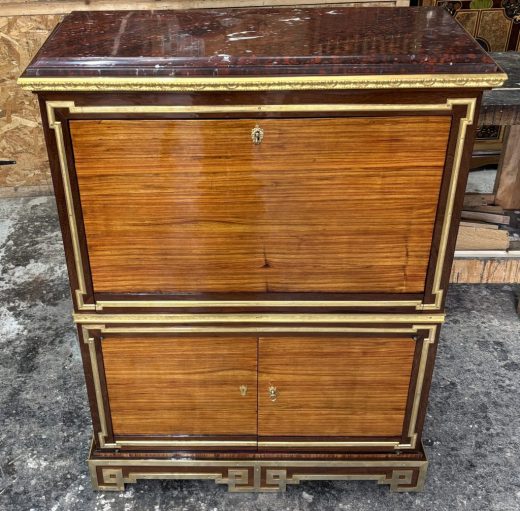
Restoration of a 19th-century Transition-style drop-front secretary, veneered in rosewood and amaranth on an oak frame. This secretary is a learned interpretation of Parisian models from 1765-1775 and is directly inspired by the famous secretary attributed to the cabinetmaker Philippe-Claude Montigny, now in the Musée des Arts Décoratifs. The stylistic similarities with the museum model are immediately apparent in the architectural design of the piece, the treatment of the stepped legs, and the use of bronze ornamentation inspired by the Greek style. The piece adopts […]

Wild herb table

Ebénisterie Mathieu Vath

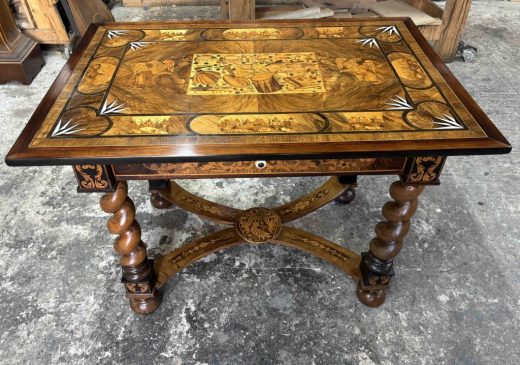
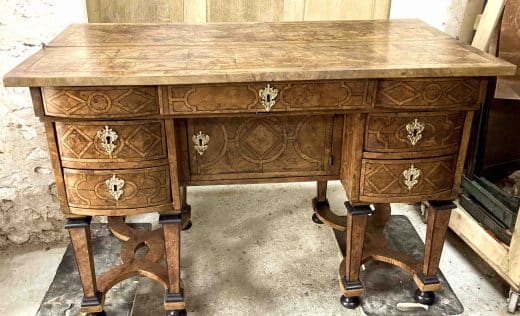
Restoration of a solid walnut marquetry table with "architectural whimsy" and "wild herbs" motifs, originating from the Austrian Tyrol in the mid-17th century. The piece rests on four twisted legs, adorned with flattened ball feet, connected by an X-shaped stretcher. It opens with a wide drawer in the front and is surmounted by a rectangular top. This top is decorated with a rosewood border, followed by bands delimited by wide bog oak fillets, themselves framed with boxwood. These elements […]

Boulle Napoleon III liquor cabinet

Ebénisterie Mathieu Vath

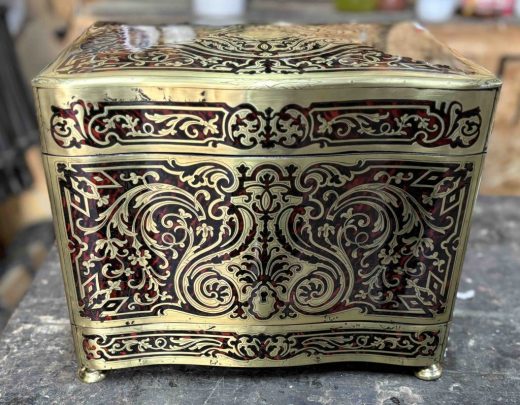
Restoration of a Napoleon III liquor cabinet in tortoiseshell and brass marquetry. The liquor cabinet, an elegant and ingenious piece of furniture, appeared at the end of the 18th century. Initially designed to accompany long carriage journeys, it allowed for the easy transport and consumption of liqueurs. Its true rise in popularity, however, occurred in the 19th century, a period during which it became a symbol of refinement and the French art of living. This piece of furniture takes the form of a box, called a "caisson," […]

Majorelle's Love Letter

Ebénisterie Mathieu Vath

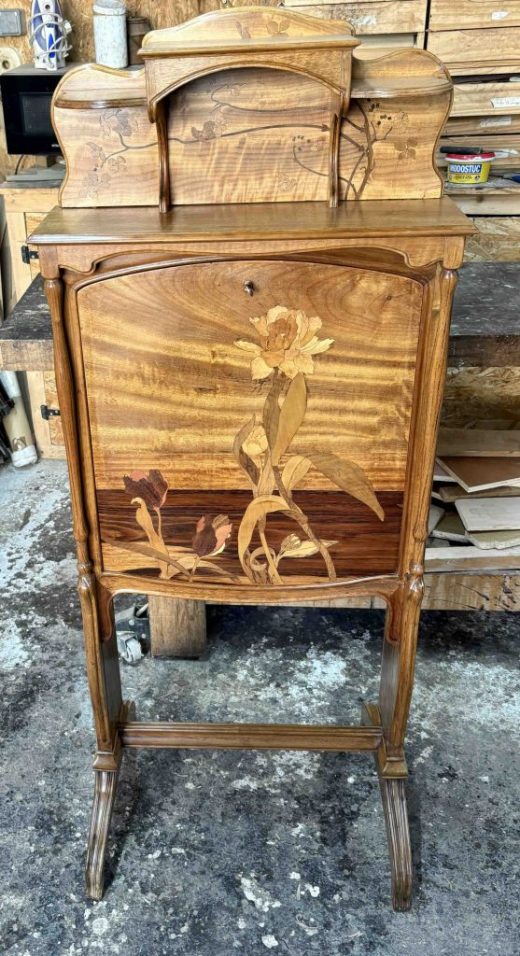
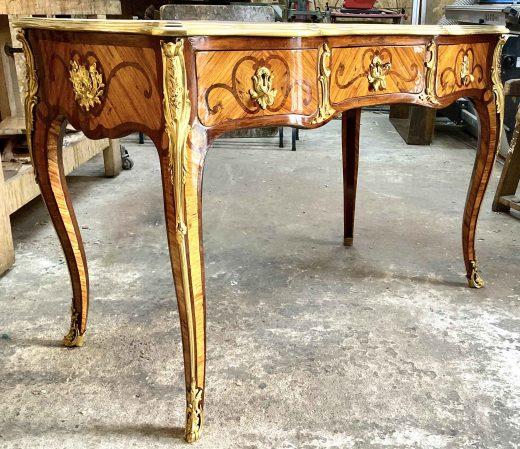
Congratulations to Léo, an intern in our workshop, who completed his first restoration on a lady's writing desk, also known as a "billet doux" (love letter), adorned with the stamps of Louis Majorelle. The "billet doux" originated in France at the end of the 18th century, developing particularly during the reign of Louis XVI and the Restoration period (late 18th – early 19th century). It is an intimate and refined piece of furniture, designed specifically for correspondence, often intended for boudoirs or bedrooms. Louis […]

Rochelaise table in rosewood and ebony

Ebénisterie Mathieu Vath

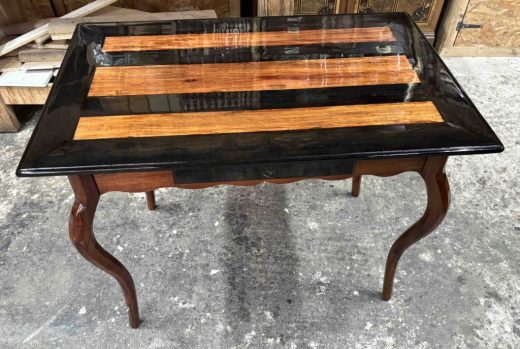
Restoration of a Louis XV salon table, made in La Rochelle in the mid-18th century. This piece is distinguished by its parquet top, alternating rosewood and ebony. It opens with a drawer integrated into the front apron, whose shaped moldings and cabriole legs with octagonal sides testify to exceptional craftsmanship. The table is made exclusively of solid rosewood for the base, the parquet top, and the drawer boxes, while solid ebony is used for the […]

Regency chest of drawers Crossbow

Ebénisterie Mathieu Vath

Conservation work on this Regency period commode, characterized by its serpentine shape, rosewood veneer, and gilt bronze mounts, resting on an oak and softwood frame. Our task was to stabilize the veneered surfaces by injecting protein-based adhesive. Veneer gaps were filled with grafts of new rosewood veneer, previously sawn, scraped, and sanded. These grafts were then French polished, naturally oxidized with ultraviolet light, and then applied to the appropriate thickness as a backing before being glued in place with […]

Regency chest of drawers stamped Merchant

Ebénisterie Mathieu Vath

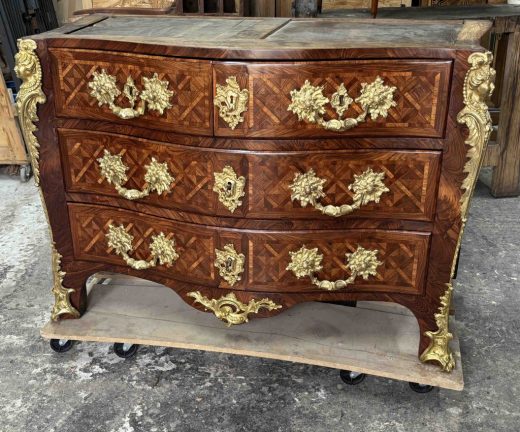
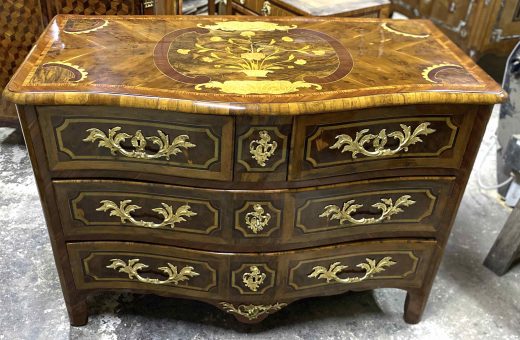
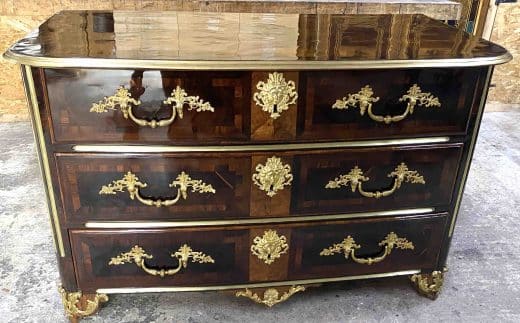
Restoration of a Regency period commode, stamped with the name Nicolas Jean Marchand, veneered in violet wood with a diamond-point pattern on an oak frame. It opens with four drawers. The whole is adorned with chased bronze mounts bearing the crowned C, including thick drop handles, large gadrooned rosettes, cartel-shaped keyhole escutcheons, and espagnolette drops ending in eagle-claw feet. The crowned C: The royal edict of 1745 required bronze workers to affix a distinctive mark, a […]

Pair of Louis XV commodes

Ebénisterie Mathieu Vath

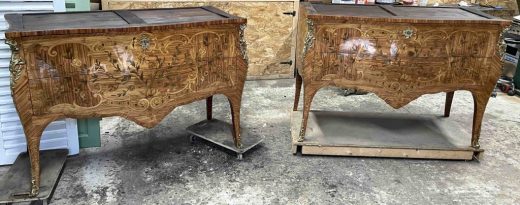
Here is the latest major restoration project undertaken by Raphaël, our apprentice. It involves a pair of Louis XV style commodes bearing an unknown stamp, CCS, which could be attributed to Charles Claude Saunier, an early work by the latter. Please find below the detailed account of the work carried out by Raphaël. Enjoy your reading. Restoration of a Pair of Louis XV Commodes This restoration project was carried out on a set of two commodes, designed according to the aesthetic and technical principles of the Louis XV style. This style […]

Louis XIV low bookcase

Ebénisterie Mathieu Vath

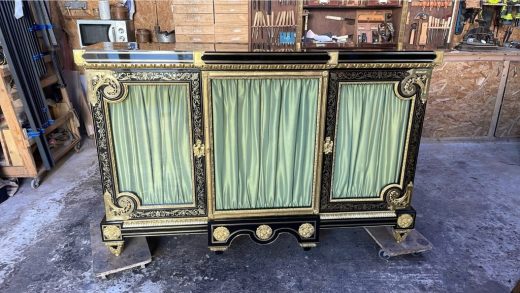
Restoration of a low Louis XIV style bookcase, in Boulle marquetry of brown tortoiseshell and brass, ebony, and chiseled and gilded bronze ornamentation. The central projecting front opens with three glazed doors decorated with scroll and foliage motifs, resting on tapered legs. This type of three-part low cabinet was one of Boulle's great successes, and he himself offered several variations. The Louvre Museum, in fact, owns no fewer than six examples. These pieces of furniture, particularly suited to the display […]

Doll's Head Clock by Baltazard Martinot

Ebénisterie Mathieu Vath

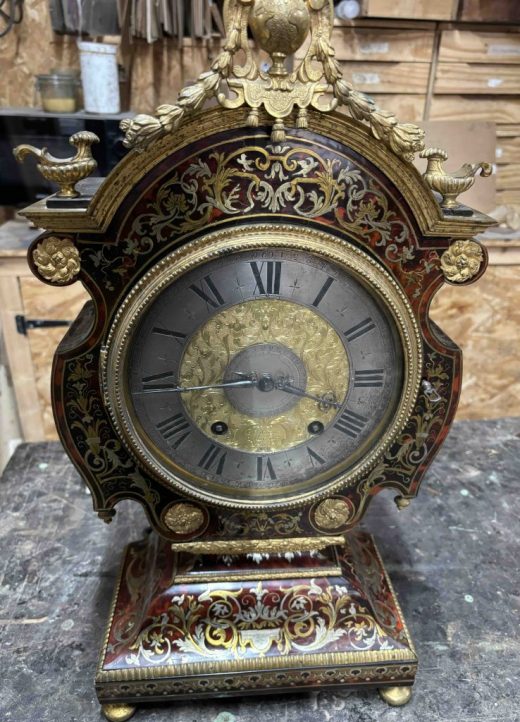
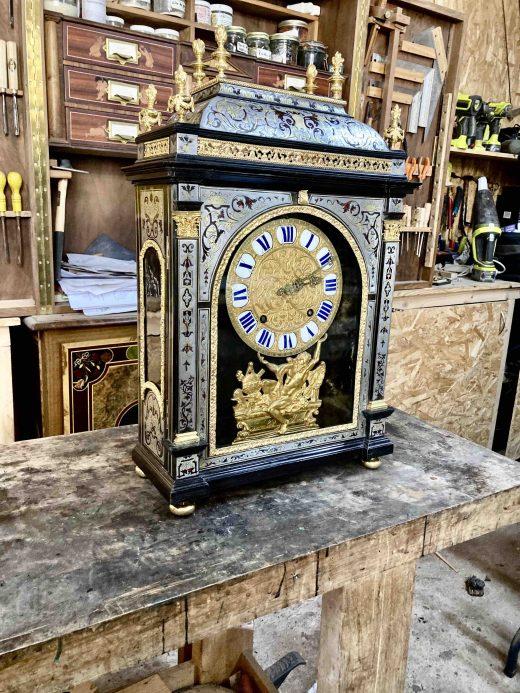
The first project of the year involved stabilizing, consolidating, restoring, preserving the finish, and harmonizing the elements. The main objective was to preserve the history and identity of the project as much as possible without dismantling anything. A masterpiece of Parisian clockmaking from the Grand Siècle, this remarkable clock, known as a "doll's head" clock, is emblematic of Parisian clockmaking at the end of the 17th century, during the reign of Louis XIV. Its architectural form, dominated by a circular body flanked by lateral projections and surmounted by a rich crowning element […]

Louis XVI commode stamped JL Cosson

Ebénisterie Mathieu Vath

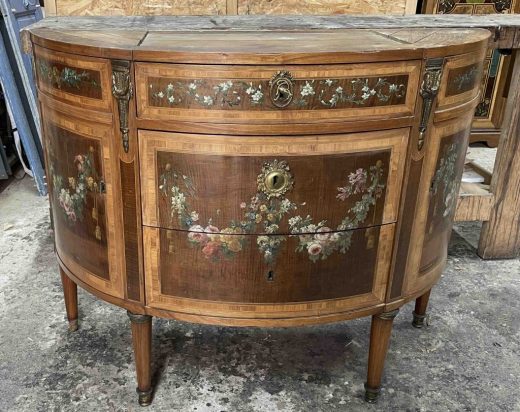
This Louis XVI period half-moon commode, stamped by the cabinetmaker Jacques Laurent Cosson, likely dates from a production between 1780 and 1790. It is an exceptional example of painted furniture from the end of the Ancien Régime, belonging to a very small group of which only seven examples are currently known. This small and highly sought-after group of 18th-century French painted furniture is now recognized as one of the most inventive areas of Parisian cabinetmaking on the eve of the Revolution. This commode, with its curved, half-moon shape, rests […]

Louis XV secretary desk, stamped MIGEON

Ebénisterie Mathieu Vath

Restoration of a secretary desk, commonly called a "drop-front secretary" or "cabinet secretary," bearing the MIGEON stamp. This piece is distinguished by its serpentine front, opening with a pivoting drop-front that reveals nine small, curved drawers. The inside of the drop-front is lined with leather. The "cabinet" itself opens with two doors. The entire front is veneered with four panels of kingwood veneer, obliquely cut into butterfly wings. Each compartment is decorated with a quatrefoil motif of butterfly wings, set within a […]

Louis XIV style commode – Grenoble, first third of the 18th century

Ebénisterie Mathieu Vath

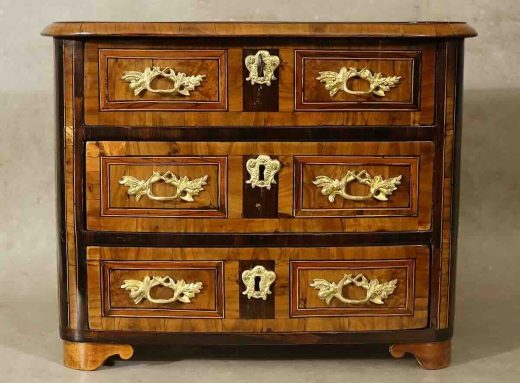
Restoration of a Louis XIV Dauphiné commode, veneered in geometric Alpine wood, with a bombé front and three drawers in three rows. The model's proportions and construction are similar to those of a full-size commode (dovetail joints, intermediate shelves, etc.). The cabinetmaker skillfully played with contrasts through the juxtaposition of wood species, and the quality and variety of the woods used on this small piece of furniture are remarkable: primarily olive and olive burl, walnut, and rosewood for the framing bands highlighted with […]

Directoire armchairs

Ebénisterie Mathieu Vath

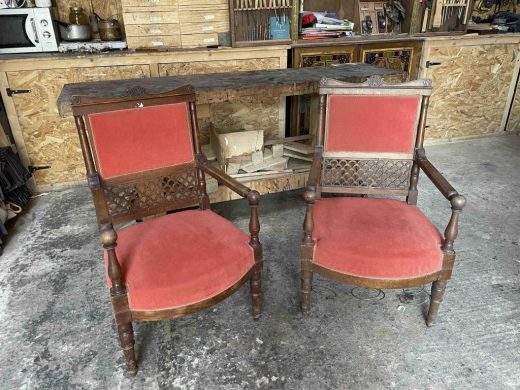
Restoration of a pair of Directoire period armchairs (circa 1795–1805), made of solid mahogany, except for the veneered stretchers. These chairs display the clean, balanced lines characteristic of the Directoire style, a transitional period between the strictures of the Louis XVI style and the codes of the Consulate. Assembled using mortise and tenon joints, they are made of solid mahogany. The straight armrests are extended by turned supports, typical of the late Directoire. The legs are turned in a baluster shape and slightly tapered at the bottom. The rectangular backs are framed with simple molding, […]

Louis XV Cartel

Ebénisterie Mathieu Vath

This is the first cartel clock restoration undertaken by Raphael, focusing on this Louis XV cartel clock in Boulle marquetry of brown tortoiseshell and brass. Restoring a cartel clock is a complex task requiring considerable time and meticulous attention to detail. The curved shapes make gluing delicate operations, and it is generally necessary to reattach large sections of the brass elements. Condition report: This cartel clock presented widespread soiling, an oxidized and tarnished varnish, as well as several lifting and missing pieces in the brass and tortoiseshell marquetry. […]

Empire Table

Ebénisterie Mathieu Vath

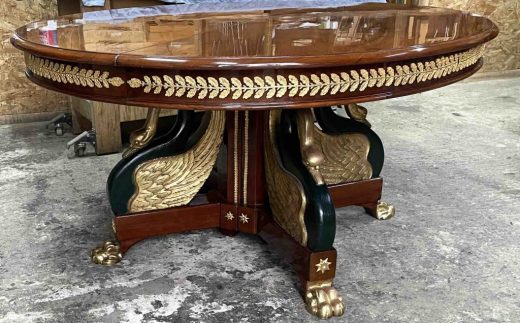
The restoration of this Empire dining table is now complete. The work focused primarily on the finishing touches. We removed the previously applied polyurethane varnish and applied a French polish to the solid mahogany top and its four-legged base decorated with swan neck motifs and lion's paw feet. The apron features an oak frieze. Length x Width = 162 x 140 cm. Length x Width with extensions = 252 cm.

Wedding wardrobe from Bayeux with swans

Ebénisterie Mathieu Vath

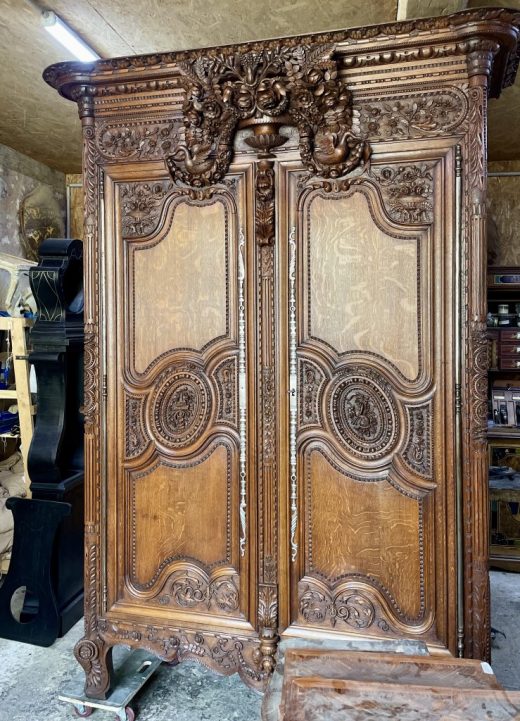
A lightening of the finish was carried out on a Bayeux wedding armoire, distinguished by its motifs of swans, figures, and hunting and musical attributes. The piece is made of quarter-sawn oak, also known as "merrain," and is attributed to the Caen plain, dating from the first half of the 19th century. The restoration work consisted of lightening the waxed finish to remove the multiple layers of tinted wax that darkened the entire piece. This process revealed the beautiful honey-blond hue of the oak […]

Louis XVI chest of drawers by Jean-Francois Leleu

Ebénisterie Mathieu Vath

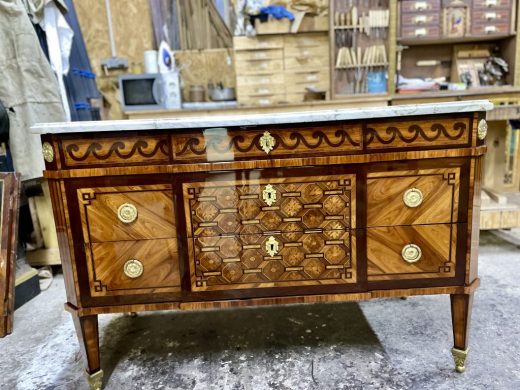
Restoration of a Louis XVI period commode with a projecting central front, stamped JF LELEU. Made entirely of oak, it is veneered with amaranth, rosewood, boxwood, stained maple burl, and tobacco-grey maple. It is decorated with marquetry featuring a frieze of posts on the top drawer, Greek key motifs, and fleurons within a mosaic of hexagons known as "marquetry à la reine" on the central projection. It has three drawers, two of which conceal drawers with crossbars. The front uprights are […]

Regency-style wardrobe stamped MIGEON

Ebénisterie Mathieu Vath

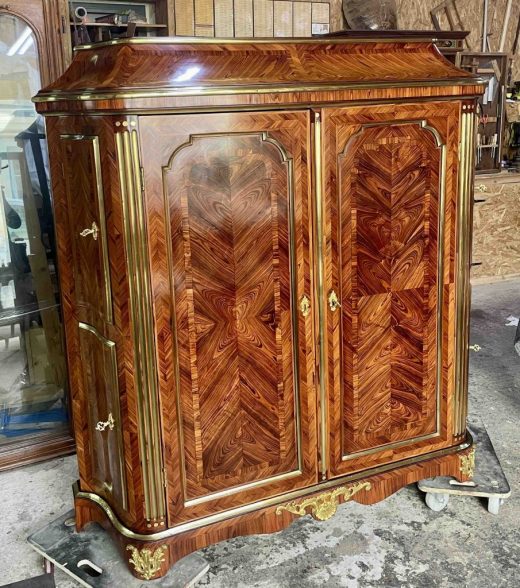
Restoration of a Regency-style cabinet, probably dating from the 1740s, stamped by Pierre IV Migeon. Constructed of oak and softwood, this cabinet, which could also be considered a bookcase, is entirely veneered in kingwood, rosewood for the top, and walnut for the interiors. The doors are veneered with a butterfly-wing pattern, while the side doors feature a square motif, typical of Migeon's decorative vocabulary. The ogee cornice is edged with a half-round brass molding. The uprights […]

Louis XVI powder compact stamped Jacob

Ebénisterie Mathieu Vath

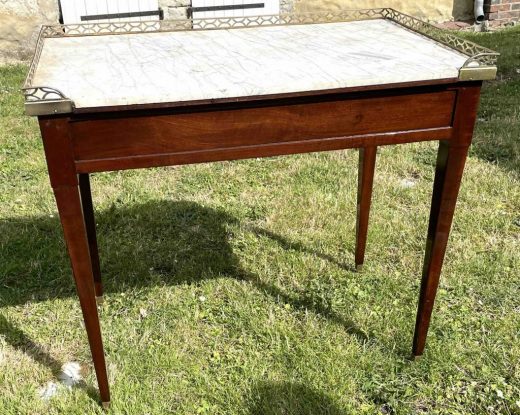
Restoration of a powder table, also called a dressing table, from the last quarter of the 18th century and stamped G.JACOB and JME. Opening with two drawers in the frieze, it is surmounted by a white Carrara marble top surrounded by an openwork brass gallery. The whole rests on four tapered legs of solid mahogany ending in sabots with integrated casters. The solid oak stretchers are veneered in mahogany. Georges Jacob (1739-1814) Georges Jacob, born on July 6, 1739, in Cheny, Yonne, came from a family of peasants. From a very young age, […]

Empire Desk

Ebénisterie Mathieu Vath

Restoration of an Empire period desk veneered in mahogany burl on an oak frame. The four "chimera thigh" legs are connected by intermediate stretchers and rest on lion's paw feet. The Empire style, which emerged in the early 19th century during the reign of Napoleon I, is an artistic and decorative expression closely linked to the Emperor's desire to create a new, grandiose, and imperial aesthetic, befitting his power. Heir to the Neoclassical movement that began in the 18th century, […]

Augsburg Cabinet, 17th century

EEbénisterie Mathieu Vath

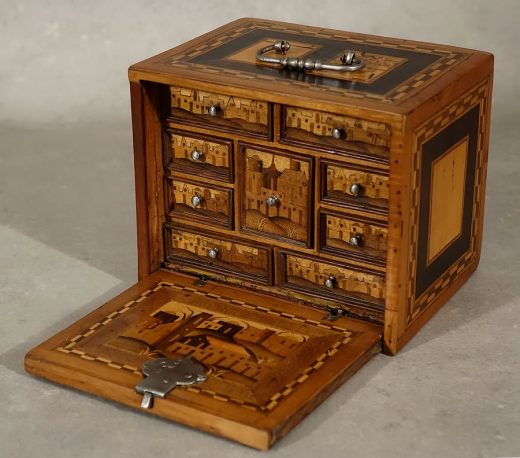
Restoration of a small table cabinet (Height: 14.3 cm – Width: 17.3 cm – Depth: 13 cm), likely a traveling model, made of solid wood with intarsia on all sides, opening with a drop-front concealing eight drawers (the bottom one simulating two drawers). Its composition is particularly rich, incorporating eight different wood species. The frame, made of fir and cherry for the visible parts, is inlaid with large central panels of sycamore maple. These are framed by bands of plum wood, themselves bordered by a double band […]

Regency commode with bridge "with dragons"«

Ebénisterie Mathieu Vath

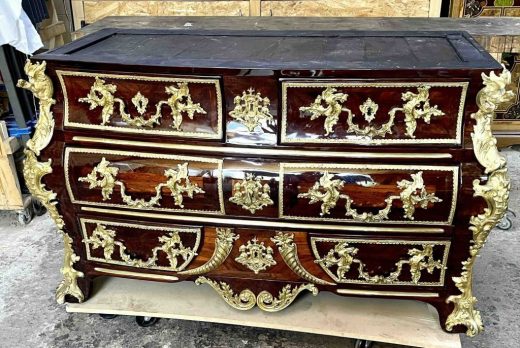
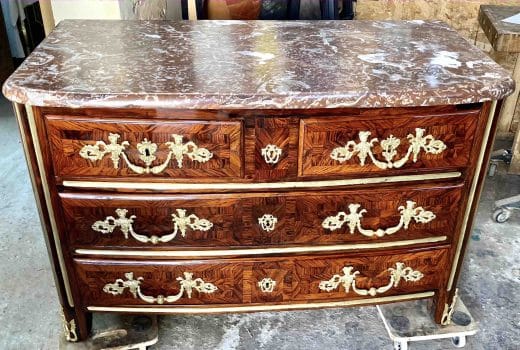
Restoration of a Regency period commode, topped with a 30 mm thick Rance marble slab, molded with a corbelled edge following its contours. This commode, curved in plan and elevation on the front and sides, is veneered with snakewood and satinwood. It has four drawers (simulating six) arranged in three rows. Its voluminous feet evoke the clawed paws of a dragon. The commode is adorned with brass fluting and chased and gilded bronze mounts: chased waterleaf frames framing the drawers, thick drop handles with shell motifs, wide plates […]

8-foot Boulle desk

Ebénisterie Mathieu Vath

Here is a restoration carried out earlier this year by Raphaël. A long but successful undertaking. I had the opportunity to revisit this desk recently, and it has responded perfectly to the significant variations in temperature and humidity. The remainder of this restoration report was written by Raphaël. A "Mazarin" Desk. This desk dates from the Louis XIV period and is covered with Boulle marquetry composed of brass on a red tortoiseshell ground. The case is supported by eight console legs, each paired by an X-shaped stretcher. It opens […]

Regency Cartel

Ebénisterie Mathieu Vath

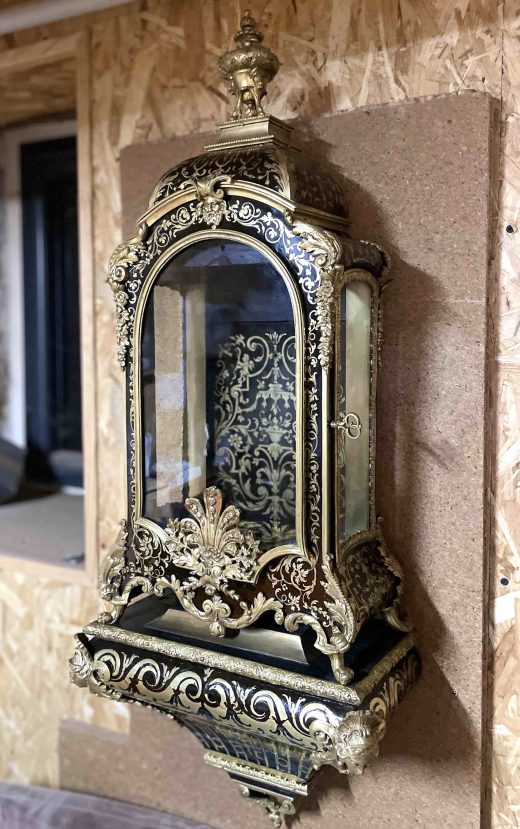
The restoration of five Boulle marquetry clocks, begun a few months ago, is now complete. Here is a Regency clock and its console, inlaid with tortoiseshell and brass on an oak frame. Measuring Time: Since the dawn of time, humankind has strived to measure time. From the gnomon, a simple stick planted in the ground—a precursor to the sundial—to the flow of water in the clepsydra, and then to the hourglass using the same principle, all these methods have allowed people to organize their social lives, […]

Nesting tables by Emilie Gallé

Ebénisterie Mathieu Vath

Restoration of a set of four Art Nouveau nesting tables, crafted and stamped with marquetry on each tabletop by the Gallé workshops. The beechwood bases are adorned with a naturalistic decoration of tree branches, and feature marquetry of daffodils, seascapes, and lapping catkins. The woods used for this marquetry are ash, walnut, sycamore maple, rosewood, mahogany, walnut burl, and elm. Émile Gallé (1846-1904) Émile Gallé is an emblematic figure of Art Nouveau, renowned for his contributions […]

Louis XV Cartel

Ebénisterie Mathieu Vath

We are continuing our series on cartel clocks, which began a few months ago. Here are some images of the restoration of this Louis XV cartel clock in brown tortoiseshell and brass marquetry on an oak frame. Condition report: The structure is in a state of significant deterioration, and re-gluing the joints appears necessary. All the marquetry is detached or shows signs of glue dehydration. Furthermore, the clock has been heavily sanded, which has resulted in the disappearance of all traces of engraving on the brass elements. […]

English Cabinet

Ebénisterie Mathieu Vath

Restoration of a late 17th/early 18th-century English cabinet, veneered in walnut and maple, featuring the distinctive free-flowing arabesque marquetry known as seaweed marquetry because it evokes the seaweed found on the seabed. English "seaweed" marquetry is traditionally associated with Dutch and Flemish cabinetmakers active in the second half of the 17th century, and particularly with Gerrit Jensen. Indeed, when Prince William III of Orange ascended the throne of England in 1689, he was accompanied by his cabinetmakers. Subsequently, religious persecutions on the […]

Regency tabletop sign

Ebénisterie Mathieu Vath

Restoration of a Boulle marquetry mantel clock, composed of brown tortoiseshell and brass, adorned with chased and gilded bronze mounts. The clock features a monumental rooster (royal emblem), a central mascaron with a satyr's head, caryatids, and two doves beneath a draped dome. The movement is signed GRIBELIN. Nicolas Gribelin, son of Abraham Gribelin, Valet de Chambre-Clockmaker to the King, was born in Blois on November 27, 1637. By the end of the 17th century, he had established himself as one of the most renowned clockmakers of his time.

Louis XVI secretary stamped Ohneberg

Ebénisterie Mathieu Vath

This Louis XVI period secretary, stamped by Martin Ohneberg, a masterpiece of sobriety and refinement, features a solid wood frame veneered in rosewood and a sumptuous ribboned satinwood veneer, whose sinuous, golden veins lend brilliance and depth. The ornamentation is understated yet exquisite: delicately floral, chased bronze mounts accentuate the clean lines of the piece, typical of the Neoclassical style. Martin Ohneberg, of German origin, was active in Paris during the last decades of the 18th century, notably during the reign of […]

Regency Cartel

Ebénisterie Mathieu Vath

Restoration of a Regency clock case in brown tortoiseshell and brass marquetry, featuring a bronze Atlas and a clock face. The piece exhibited significant structural and decorative alterations requiring complete intervention according to the principles of conservation-restoration. Condition report: This clock case, probably dating from the early 18th century, showed the marks of time: lifting of the marquetry, detachment of the tortoiseshell, oxidation of the brass, and numerous losses. The bronze depicting Atlas, bent under the weight of the celestial vault, was blackened, its expression frozen by decades of dust […]

Flat Greek-style desk stamped DUBOIS

Ebénisterie Mathieu Vath

One desk, one stamp, three cabinetmakers? The desk we are about to discover, a masterpiece of French cabinetmaking, embodies the culmination of 18th-century Neoclassical taste. The question that immediately arises upon contemplating this exceptional piece is: why three cabinetmakers for a single desk? The answer lies in the complex interplay of succession, talent, collaboration, and opportunism that characterized the craftsmanship of the period. This flat desk, known as a "Greek-style" desk, is a perfect example of the Louis XVI style. Made from a blend of […]

8-foot Regency style pedestal desk with Democritus masks

Ebénisterie Mathieu Vath

Restoration of a Regency period double-sided flat-fronted desk with a drawer unit, veneered entirely in kingwood. The sides feature a diamond-point frieze, and the drawer fronts have an inverted slab pattern. Each side opens with four drawers in the frieze, and a central drawer on one side. The top is edged with a molding and gilt leather tooled in small pieces, resting on eight cabriole legs ending in goat hooves. Most notably, it features two bronze mounts emblematic of the period […]

Regency chest of drawers

Ebénisterie Mathieu Vath

Restoration of a bombé commode with a front veneered in satinwood with double boxwood stringing within amaranth borders, mounted on a fir frame with walnut drawer boxes. It opens with four drawers in three rows and is adorned with finely chased bronze mounts, silvered rather than gilded as is customary. The uprights are veneered with a facsimile of brass fluting, and the sides, decorated with a lozenge within a rectangle, echo the decorative motif of the front veneer. It is […]

Louis XIV double-bodied display case

Ebénisterie Mathieu Vath

Restoration of a Louis XIV period two-part display cabinet veneered in cedar, ferreol, and cherry. The moldings are made of blackened fruitwood. With a flat front and sides, it opens with two doors in the lower section and two grilled doors in the upper section, with a straight cornice, resting on ball feet. This type of marquetry is found on furniture from the second half of the 17th century. Condition report: This piece of furniture showed multiple alterations. Regarding the frame, the nailed back panels, which were intended to maintain proper squareness, and […]

Transition Secretary

Ebénisterie Mathieu Vath

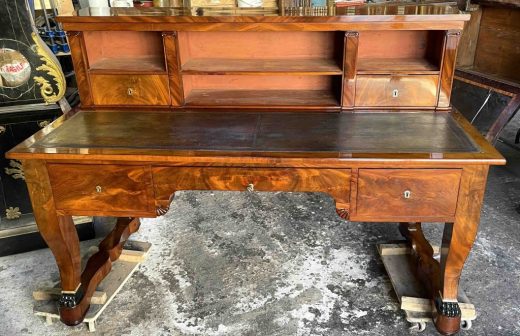
Restoration of a transitional rosewood and amaranth secretary desk with simulated fluting using boxwood and ebony. The frame is made of oak and softwood. As is often the case with secretaries, one of the main areas of damage is the hinges of the fall-front, which have cracked and damaged the frame and veneer. The work involved replacing the solid wood that provides support and proper alignment before replacing the missing amaranth veneer. The […]

Regency corner

Ebénisterie Mathieu Vath

Restoration of a Regency period corner cabinet veneered in Rio rosewood on a softwood frame. The piece had little damage apart from missing fluting and mahogany grafts on the top and bottom rails. The work therefore consisted of replacing the mahogany grafts with rosewood veneer that was sawn, scraped, and sanded before being glued with hot glue. The brass fluting was recreated and adjusted to fit perfectly into its original positions. A French polish finish was applied […]

Small Antwerp cabinet in ebony and tortoiseshell

Ebénisterie Mathieu Vath

Restoration of a cabinet opening with nine drawers arranged in five rows (six small drawers in the top row, one small central drawer, and two wide drawers in the lower section, each simulating two drawers) with turned ivory knobs. It is set into a base, itself opening with a wide drawer in the frieze, with four faceted legs connected by a flat, frame-like stretcher and ending in ball feet. This octagonal base allows us to date this cabinet to around 1660, at the very end of the Louis XIII period or the very beginning […]

Louis XIV clock

Ebénisterie Mathieu Vath

Restoration of a rare late 17th-century clock case in four-color marquetry, also known as "wood painting" or "jasmine painting." It is composed of maple, pear, boxwood, and green-stained maple on an ebony ground. Note that the base was likely added later. Several graphic styles are incorporated into this piece, including scrolling foliage and acanthus leaves, bouquets of flowers, and a bird on the pediment. The frame and moldings are made of walnut and are stained black. A […]

Louis XV cartel clock stamped by Duhamel and Lamy, clockmakers to Monseigneur the Dauphin

Ebénisterie Mathieu Vath

Restoration of an 18th-century Louis XV period clock case made of Martin varnish, with a red lacquer background and polychrome oil-painted decoration. The case of this clock was made by François Duhamel, and the movement is signed by Michel Lamy, clockmaker to Monseigneur the Dauphin. François Duhamel, a Parisian cabinetmaker, born in 1723, became a master on February 3, 1750, and lived until February 2, 1801. He resided on the rue du Faubourg Saint-Antoine and specialized in the manufacture of clock cases. In 1775, he was commissioned to appraise […]

Louis XV commode by JB Fromageau

Ebénisterie Mathieu Vath

Restoration of a Louis XV commode stamped by Jean-Baptiste Fromageau. Constructed of oak and conifer, this commode is inlaid with rosewood within violet wood frames. Curved at the front and flared at the sides, it features four drawers in three rows and is topped with a grey Saint Anne marble slab. Jean-Baptiste Fromageau, son of a master cabinetmaker, was born around 1725. After obtaining his master craftsman's certificate on November 5, 1755, he set up his workshop on Rue Traversière before establishing himself on Rue du Faubourg Saint-Antoine. The Dauphiné Almanac […]

Empire Inkwell

Ebénisterie Mathieu Vath

Restoration of a late Empire inkwell, rectangular in shape, surmounted by a central dish with a lid pierced with palmettes and handles in the form of flowering tassels, held by two winged putti with quivers on their backs and volute tails, flanked by two inkwells decorated with trellis patterns and surmounted by a pierced lid with acorn-shaped knob, the body with an inset pen niche, the frieze centered by a mask of Apollo emitting stylized foliate trails, on a molded plinth, on feet. Simply veneered with a […]

Regency style pedestal desk

Ebénisterie Mathieu Vath

Restoration of a desk veneered on all sides with yew burl and amaranth, decorated with geometric boxwood stringing. It opens with five drawers in the front and five simulated drawers in the back. The two lower drawers follow the contour of the front and slide down at a 45-degree angle. The top is veneered in amaranth and edged with a bronze molding. It rests on four cabriole legs and terminates in curious acanthus leaf bronze mounts. The frame is entirely oak, except for the drawers, which are made of […]

Regency-style chest of drawers stamped by Michel Mallerot

Ebénisterie Mathieu Vath

The restoration of a commode from the first half of the 18th century, curved in height and bombé in plan, opening with four drawers in three rows, known as a "tomb-shaped" or "Regency" commode, belongs to a much smaller group of commodes called "bridge" and "moustache" commodes. The frame of this commode is typical of Regency models, with oak uprights, high-quality softwood for the majority of the structure, and walnut for the inset drawers. The veneer consists of only two types: kingwood and satinwood. The […]

Louis XVI Weekly Planner

Ebénisterie Mathieu Vath

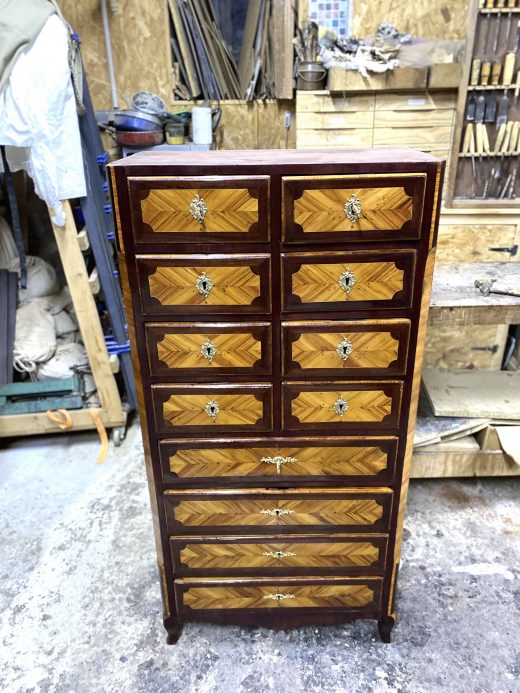
Restoration of a Louis XVI chest of drawers veneered in rosewood, satinwood, and amaranth. It opens with a series of seven drawers framed by rounded uprights with simulated fluting made of boxwood and blackened pearwood. A chest of drawers? The chest of drawers is a piece of furniture that appeared in the mid-18th century, primarily intended for women. It is a chiffonier (which appeared during the Regency period, between 1715 and 1723) with seven drawers, one for each day of the week, designed to store the day's clean undergarments. The restoration...

Louis XVI commode stamped J. LAPIE

Ebénisterie Mathieu Vath

Restoration by Lise, during her internship at the workshop, of a Louis XVI commode stamped by Jean Lapie, constructed of oak, fir, and beech, veneered in rosewood with hornbeam and amaranth stringing, and adorned with gilt bronze mounts. And since Lise submitted an excellent internship report, I am publishing it almost in its entirety. Jean Lapie (known as "The Younger"), son of the potter Nicolas Lapie, was born around 1734. Brother of the cabinetmaker Nicolas-Alexandre Lapie (known as "The Elder") and cousin of Jean-François Lapie, he obtained his master's degree in Paris […]

Louis XVI wardrobe

Ebénisterie Mathieu Vath

Restoration by Raphaël of a rosewood veneered cabinet with diamond-pointed doors, framed in amaranth and Greek key stringing. It opens with two large softwood doors veneered with oak. Some regluing and repairs of missing veneer, along with a good coat of clear French polish, have restored this piece of furniture to its former glory.

Regency commode in sarcophagus form

Ebénisterie Mathieu Vath

Minor restoration was required for this Regency commode, known as a sarcophagus commode. A few veneer repairs and a refinishing of the varnish were all it took to restore its former glory. The sarcophagus commode? It was only a few years after the first examples were completed by André Charles Boulle, during the Regent period, that the curved commodes, both in plan and elevation, appeared. These commodes would be called "Regency-style" commodes throughout the 18th century (and similarly, it would be necessary to wait until 1720 to see commodes with two rows of drawers again, often […]

Regency table lamp

Ebénisterie Mathieu Vath

Restoration of a Regency mantel clock in brown tortoiseshell and brass marquetry on an oak frame. Without its bronze mounts, this type of furniture loses its splendor. But when it regains its bronze fittings, knowing that the function of this type of furniture is to tell the time, the symbols that compose them take on their full meaning. Fame on the escapement and the eagle on the door are perfect examples. Fame is originally an allegorical Greek deity personifying public recognition […]

Art Nouveau desk with Primroses by Louis Majorelle

Ebénisterie Mathieu Vath

Restoration of an Art Nouveau desk stamped by Louis Majorelle in Nancy around 1905. It is made of solid walnut and veneered with primrose flower marquetry. The work consisted of replacing missing veneer, cleaning, and restoring the waxed finish. Louis Majorelle was born in September 1859 in Toul and died in January 1926 in Nancy at the age of 66. Son of the renowned furniture designer Auguste Majorelle, he demonstrated a particular interest in craftsmanship and drawing from a very young age. […]

Louis XVI console table stamped Louis Noël Malle

Ebénisterie Mathieu Vath

Restoration of a Louis XVI console table stamped by Louis-Noël Malle, with solid mahogany legs and mottled mahogany veneer on oak frames. Louis-Noël Malle, born in 1734, became a master craftsman on November 18, 1765. He established his shop and workshop on Grande-Rue-du-Faubourg-Saint-Antoine, in collaboration with his wife, Marie-France Le Maître. He was recognized as one of the greatest marquetry craftsmen of his time, as we can see in this entry from the General Almanac of Merchants in 1771 and 1772, where his name was misspelled as "Le […]

Regency style commode stamped Hédouin

Ebénisterie Mathieu Vath

Here is the latest restoration by Raphaël, my apprentice. Although it possesses all the attributes of a Regency commode, it could only have been made much later, after this historical period (around 1715-1723). Indeed, since Hédouin obtained his master craftsman's certificate in 1738, during the height of the Louis XV era, it is more accurately described as a commode "in the Regency style" by cabinetmakers of the time. This commode is entirely constructed of oak, except for the interior panels, and is veneered with amaranth and satinwood. Jean-Baptiste HEDOUIN The life of Jean-Baptiste Hedouin is quite […]

Happiness of the day by Guillaume Cordié

Ebénisterie Mathieu Vath

Minor maintenance restoration for this transitional rosewood veneer bonheur du jour, stamped by the master of this type of desk, Guillaume Cordié. A simple maintenance restoration for this desk. Re-gluing of a few veneer patches, repair of oxidation, color restoration, and reapplication of the French polish. Guillaume Cordié, born around 1733, worked as a freelance craftsman before receiving his master's certificate on June 18, 1766. He established himself on the rue de Charonne and remained there until his death. His works, of fine quality and harmonious proportions, are […]

La Rochelle chest of drawers in "Isles wood"«

Ebénisterie Mathieu Vath

A look back at the restoration of this rare port chest of drawers, crafted from solid woods brought back from both the Orient and the West Indies, combining four precious woods: mahogany, satinwood, Palo Santo, ebony, and, most notably, a fifth wood, Royal ebony. This chest of drawers opens with three wide drawers in three rows of Palo Santo, interspersed with Ceylon ebony crossbars, and is topped with a solid framed top composed of parquet flooring, primarily enlivened by Royal ebony crossbars against a mahogany background (some sections are mottled or […]

Regency commode with faun and lion masks

Ebénisterie Mathieu Vath

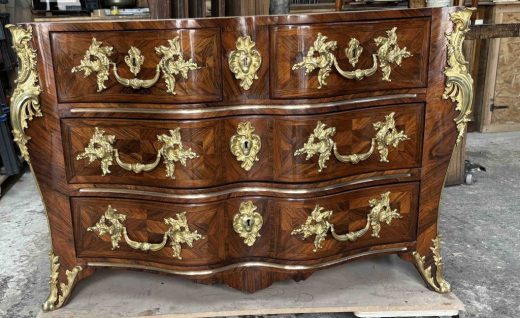
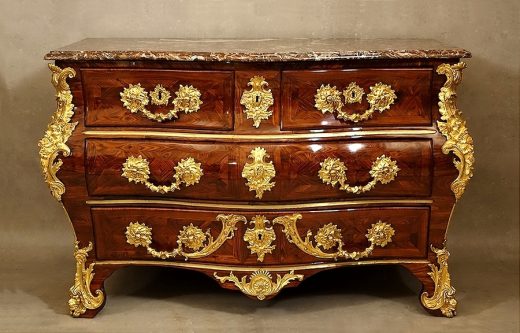
Restoration completes this important and rare commode, known as a "tomb-shaped" or "Regency" commode, also called a "moustache" commode, dating from the Regency period. Curved on all sides, it opens with four drawers in three rows. Topped with a Belgian Vieux Rance marble slab (it's worth noting that Rance was a French village at the beginning of the 18th century), molded with a corbel-like profile following its contours, this wide commode, veneered in a single layer of kingwood, boasts powerful curves, is adorned with brass fluting on the front and sides, and is covered with exceptional finely chased bronze mounts.

Regency Cartel signed Clément Fiacre Paris

Ebénisterie Mathieu Vath

Restoration of a cartel clock in red tortoiseshell and brass marquetry. The movement is stamped by Clément Fiacre in Paris. Clément Fiacre, one of the most important clockmakers of his time, received his master's certificate on January 16, 1714. He settled in Paris and quickly gained renown. Established on Rue Saint-Denis around the mid-1740s, he created his work in the Regency style, where wood was richly worked, notably through tortoiseshell and brass marquetry. He also produced veneers in rosewood, amaranth, and other woods.

Transitional dresser

Ebénisterie Mathieu Vath

Restoration of a transitional commode veneered in rosewood, amaranth, and green-stained Greek key pattern, on an oak frame. Congratulations to Lisa for this first restoration during her internship at the workshop. The work mainly involved the front rails, with the missing amaranth veneer being replaced by sawn, scraped, sanded, and applied to the back of the veneer before being glued with hot glue. The varnish was regenerated using Labovert's GAMMA polar solvent before […]

VASSOU stamped chest of drawers

Ebénisterie Mathieu Vath

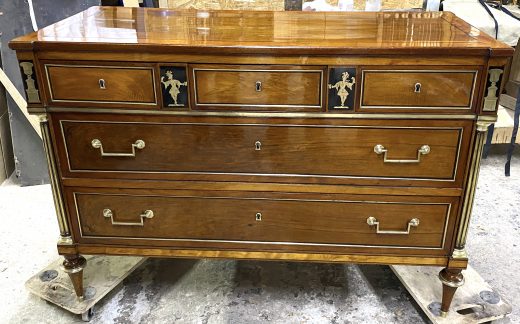
Restoration of a Louis XVI period chiffonier table in mahogany veneer and solid mahogany on oak and softwood frames, stamped by Jean-Baptiste VASSOU (1739-1807). A beautifully crafted piece with fine veneer and a lovely blue Turquin marble top. What exactly is a chiffonier table? The first mention of a "chiffonniere table" appears in 1755 in the journal of the haberdasher Lazare Duvaux (1703-1758). Then, in 1763, in the post-December inventory of Jean-François Oeben, we find mention of a "frame of a […]

Small Louis XV style commode

Ebénisterie Mathieu Vath

And here is the latest restoration by Raphaël, my apprentice. It's a Louis XV period commode. It's veneered in rosewood and violet wood on an oak and softwood frame. Condition report: A perfect project for tackling structural and veneer restoration. Almost all the panels are detached and too short, the joints are loose, both sides are detached from the uprights and split right down the middle, and of course there's a lot of detachment and […]

Regency Games Table

Ebénisterie Mathieu Vath

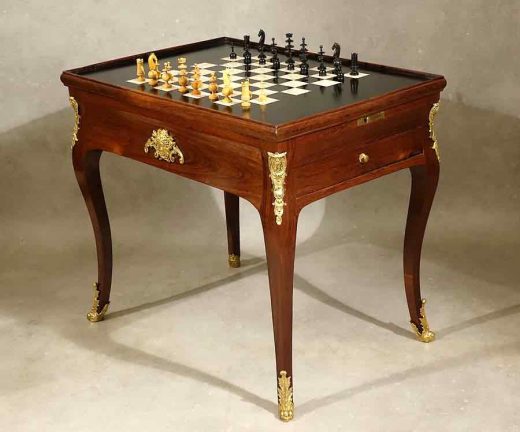
Restoration of a Regency period games table converted into a desk, resting on four cabriole legs. It is veneered with thick amaranth leaves and opens with two drawers (called "chétrons") on the sides and a removable top (locked by a push-button mechanism) covered in dark leather on its facing and a checkerboard veneered in ebony and inlaid with ivory on the reverse. When the top is removed, it reveals a backgammon set in ebony and ivory. The molded astragal surrounding the top is made of solid amaranth wood. The legs and stretchers are made of beech, the […]

Regency Cartel

Ebénisterie Mathieu Vath

Restoration of a Regency clock case in Boulle marquetry on a brown tortoiseshell background. Since Antiquity, humankind has sought to master and create a "timekeeper." Egyptian obelisks, water clocks, sundials, hourglasses. But it was in the 15th century that the first mechanical weight-driven clocks were made, with a single hand, but generally equipped with chimes. Then, in the 16th century, the counting of the day in two parts, 12 hours instead of 24, was adopted almost everywhere, even though each city kept its own meridian time until the advent of railways and […]

Transition sauté pan with Boudin stamp

Ebénisterie Mathieu Vath

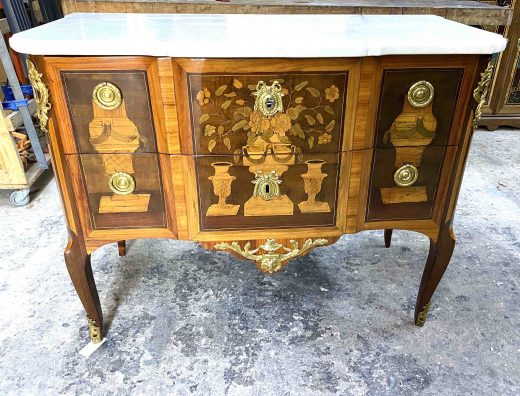
Restoration of a Transitional commode stamped by the master cabinetmaker Léonard Boudin (1735 in Paris – 20/12/1807). It is constructed of solid oak and veneered with amaranth, rosewood, tobacco-stained maple, and marquetry of boxwood, hornbeam, and holly, decorated with panels featuring floral vases and covered pots on the front and sides. With a slight central projection on the front, opening to reveal two drawers without a central divider, its rounded uprights rest on cabriole legs. Many Transitional commodes of this type have […]

Louis XV cartel clock with crowned C

Ebénisterie Mathieu Vath

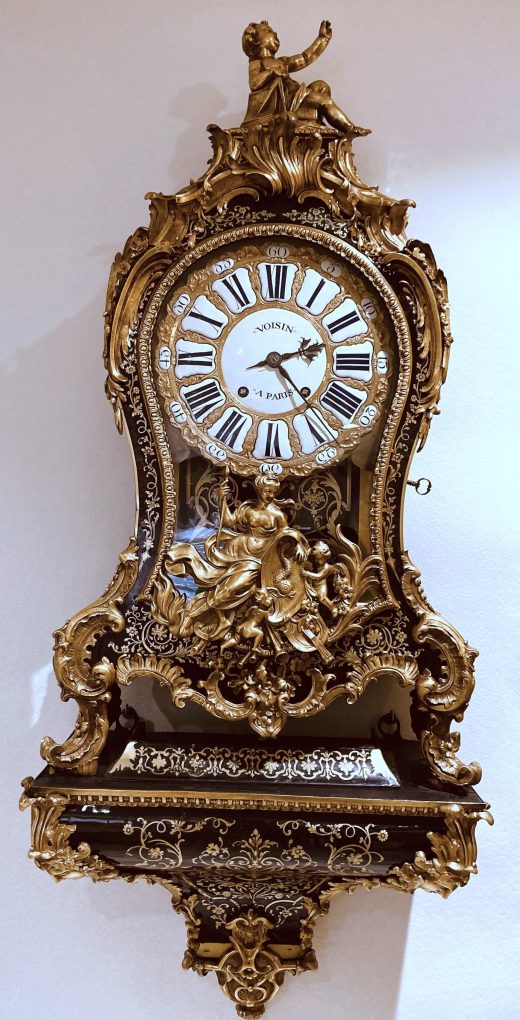
Restoration of a Louis XV cartel clock in tortoiseshell and brass marquetry, the movement of which is signed by Charles Voisin (born 1686-1760), Master Clockmaker in 1710. The distinctive feature of this clock is that the bronze mounts are stamped with the crowned C mark. The crowned C was established by an edict of 1745, which required bronze workers to mark their pieces with a small, distinctive letter, a C surmounted by a crown, thus subjecting them to a tax. This tax applied to both objects and furniture adorned with it. It is a […]

Louis XV secretary stamped C.Chevallier

Ebénisterie Mathieu Vath

Restoration of a Louis XV period drop-front secretary, also known as a cabinet, stamped by Charles Chevalier, with curved sides and a front without an intermediate rail. Constructed of oak and softwood, it is veneered with marquetry of maple, boxwood, blue-stained maple, holly, hornbeam, and barberry on a rosewood ground framed by violet wood. The drop-front opens with its original three-point lock, revealing a compartment containing seven shelves in four rows and four drawers. The whole contains […]

Louis XIV Library Display Case

Ebénisterie Mathieu Vath

Restoration of a small Louis XIV period display cabinet inlaid with foliate scrolls in amaranth, ebony, and maple, framed in olive and cherry wood. The marquetry on this piece is known as the Boulle technique, or superimposed marquetry. The cabinet had a significant number of missing veneers. The restoration work therefore consisted of replacing all these missing veneers with scraped and sanded veneer, prepared to the correct thickness before being glued with hot glue. The most interesting task was the reconstruction of one missing piece […]

Regency commode with crowned R

Ebénisterie Mathieu Vath

Restoration of a Regency commode, probably from southeastern France, veneered with yew, plum, rosewood, walnut, cherry, amaranth, violet wood, boxwood, and green-stained maple on a softwood frame. Besides its highly unusual marquetry decoration, the commode's distinctive feature is its crowned R bronze mounts. The crowned R hallmark should not be confused with the crowned C hallmark, which corresponds to a tax levied from 1745 to 1749 on copper objects and is found on many […]
Cordié Transition-branded chest of drawers

Ebénisterie Mathieu Vath

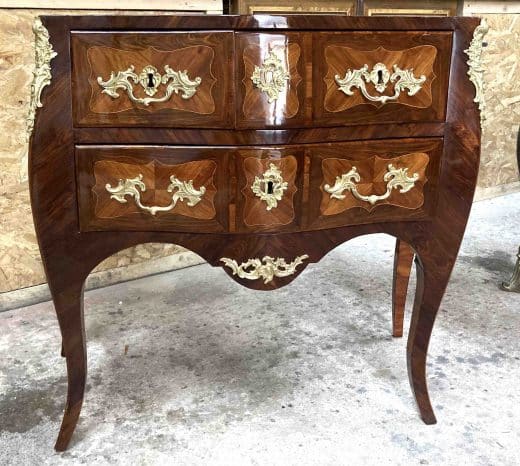
Restoration of a Transitional period chiffonier stamped by Guillaume Cordié and bearing the guild mark. It is veneered in rosewood and amaranth and framed in oak and softwood. The bronze fittings were added later. Guillaume Cordié, born around 1725, worked as a freelance craftsman before receiving his master's certificate on June 18, 1766. He established himself on the rue de Charonne and remained there until his death. His works, of fine quality and harmonious proportions, are mostly in the Transitional and Louis XV styles. It seems that he […]
Directoire Commode

Ebénisterie Mathieu Vath

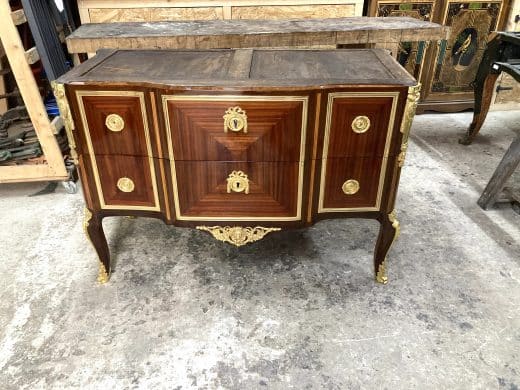
Restoration of a curious Directoire commode in solid walnut and walnut, mahogany, and maple veneer, featuring marquetry of a Medici vase and a Louis XIV-inspired ballet dancer, in brass on an ebony ground. The drawers have walnut bottoms with an ebony stringing surmounted by a quarter-round brass and wood molding, surrounded by a mahogany molding. The uprights are three-quarter-fluted columns terminating in toupie feet. The locks are in the shape of trefoils. A conservation project for this […]
Transition work table

Ebénisterie Mathieu Vath

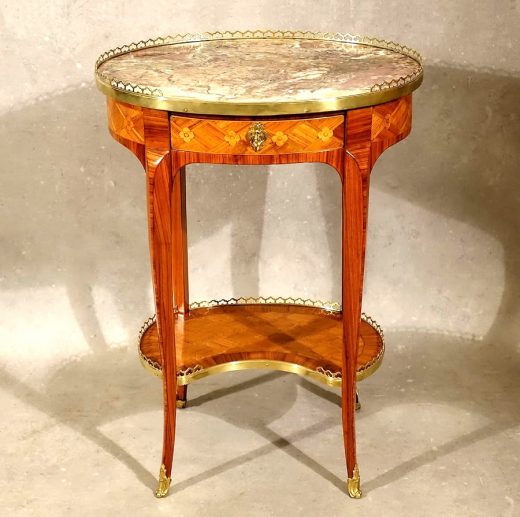
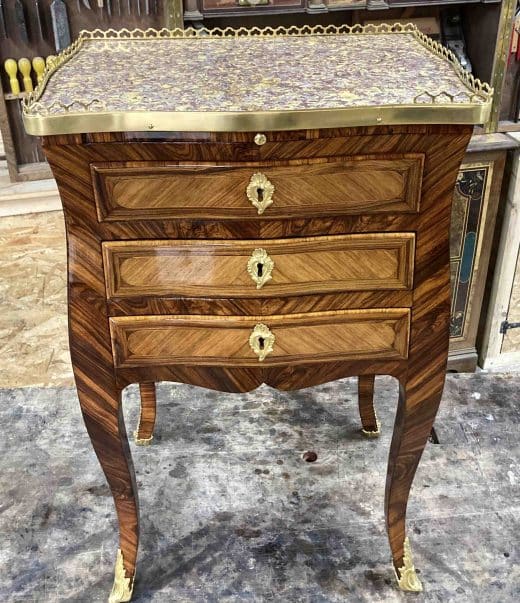
Restoration of a work table with cabriole legs and a stretcher in marquetry of trellis and quatrefoils, known as "à la Reine," veneered in rosewood, inlaid with boxwood, green-stained hornbeam, and boxwood stringing on an oak frame. It opens in the frieze with a drawer forming a writing surface with a leather-lined drop-front and compartments on the sides. The Escallettes marble top is bordered by an openwork brass gallery similar to the one that frames the kidney-shaped stretcher. A minor restoration including some veneer repairs and […]
Transitional chest of drawers stamped SAUNIER

Ebénisterie Mathieu Vath

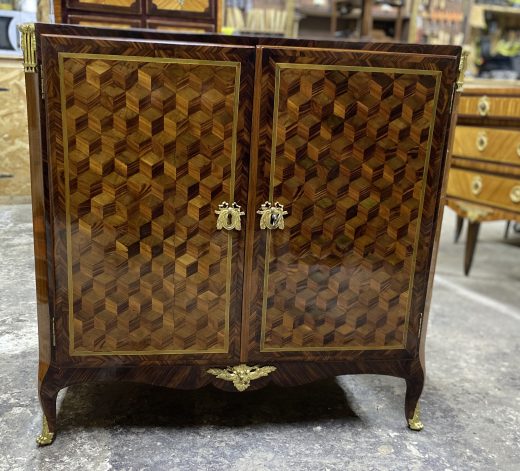
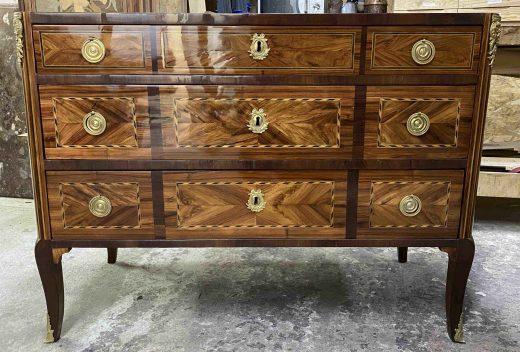
Restoration of a transitional two-door commode veneered with bottomless cube marquetry. The frame is oak for the uprights and rails, the side panels are softwood, and the two doors are walnut. The bottomless cubes are veneered with rosewood, violetwood, and tobacco-stained maple. The entire piece is framed with a stringing of green-stained maple and boxwood. The uprights and door frames are veneered with violetwood and rosewood. The sides […]
Transition chest of drawers stamped Fromageau

Ebénisterie Mathieu Vath

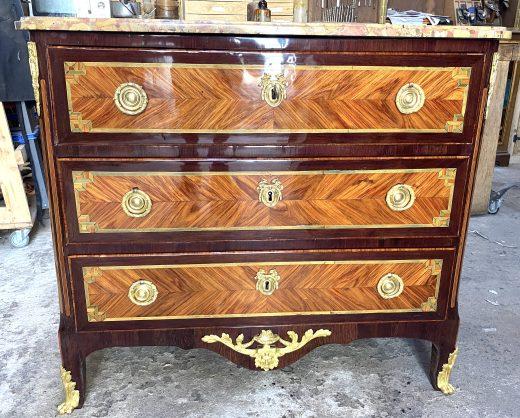
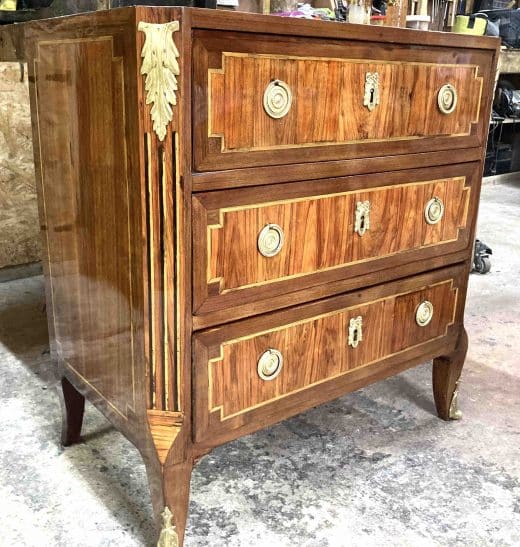
Restoration of a Transitional style commode, stamped by Jean Baptiste Fromageau, veneered in rosewood with an amaranth frieze and faux fluting. It is topped with a Royal red marble slab and features three drawers, one narrower at the top inlaid with a frieze of glyphs, while the two below are inlaid with Greek key patterns and have violet wood corners. The bronze mounts include ring pulls, keyhole escutcheons with knotted ribbons, and a drop-shaped finial.

Louis XV commode stamped NA Lapie

Ebénisterie Mathieu Vath

Restoration of a Louis XV commode, stamped by Nicolas Alexandre Lapie, veneered in amaranth and satinwood on a beautifully crafted oak frame. The sides and drawer fronts are made of softwood, and the marble top is Campan griotte marble. Nicolas Alexandre Lapie, son of Nicolas Lapie, a pottery merchant in the Faubourg Saint-Antoine, and brother of the master cabinetmaker Jean Lapie, Nicolas Alexandre (known as the Elder) appears to have been born around 1730. He registered his master's letters at the Châtelet in Paris on the 17th […]

Louis XV slant-front desk

Ebénisterie Mathieu Vath

Raphaël's first restoration project was this Louis XV period rosewood veneer slant-front secretary. It was a complete restoration involving numerous veneer grafts and a waxed, filled finish. A delicate job, as rosewood is unforgiving. The slightest misstep with the chisel, or excessive sanding, and its beautiful blond patina disappears, revealing the original dark color and causing unsightly stains. Therefore, there was no choice but to scrape and sand the newly sawn veneer and cut it to the correct thickness before gluing it […]

Regency chest of drawers with Spanish-style drawers

Ebénisterie Mathieu Vath

Restoration of a Regency period commode with a serpentine front and espagnolettes, curved on all sides, veneered in violet wood on a walnut frame, opening with four drawers in three rows and topped with a Belgian Griotte Red marble slab with ears and a corbelled edge. The pinched uprights are dark, as are the front rails, with fluting and brass reeding. Its high-quality bronze ornamentation features superb chasing and includes very rare espagnolettes (seen on six commodes: four by Etienne Doirat, one by François Lieutaud […]

Louis XVI secretary stamped TOPINO

Ebénisterie Mathieu Vath

Restoration of a Louis XVI secretary desk stamped by Charles Topino. Typical of Topino's style, this secretary is constructed of oak and softwood. The front opens with a drawer and a drop-front covered in red leather tooled in gilt, revealing two compartments and four drawers veneered in rosewood. The lower section opens with two doors revealing a shelf. These are decorated with marquetry depicting a vase and drapery on a tobacco-colored ground, while the drop-front is inlaid with musical instruments, ribbons, and foliage on […]

Transition chest of drawers stamped LEGRY

Ebénisterie Mathieu Vath

Restoration of a transitional commode stamped by Jean-Louis-François Legry. Its frame is made of oak and softwood, and it is veneered with amaranth, rosewood, satinwood for the sides, and ebony and boxwood stringing. This commode exemplifies the very end of the transition between the Louis XV and Louis XVI styles. The legs remain the only vestige of the Louis XV curves; they would soon give way to the straight legs of the Louis XVI style. Jean-Louis-François Legry, born in 1745, obtained his master's degree in Paris on […]

Transitional cylinder secretary, stamped SCHLICHTIG

Ebénisterie Mathieu Vath

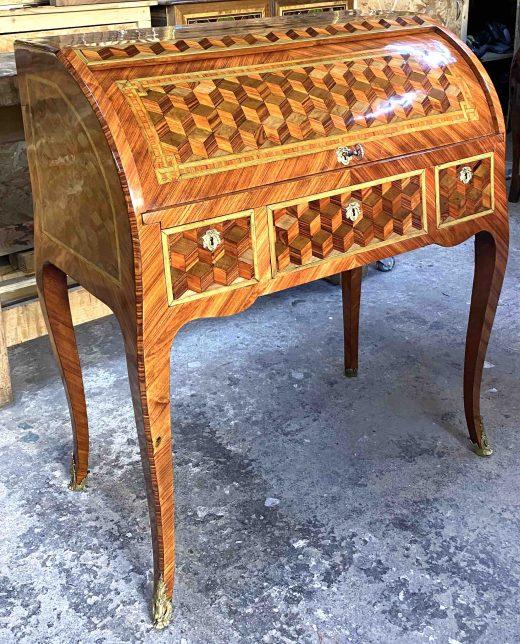
Restoration of a Transitional period roll-top desk stamped by Jean-Georges Schlichtig. The frame is oak for the legs and rails, while the panels and drop-front are softwood. It is veneered in rosewood with marquetry of bottomless cubes in rosewood and tobacco-stained sycamore; the Greek key stringing is composed of hornbeam and holly. The back and interior drawers are veneered in satinwood. This type of roll-top desk was a common production for this cabinetmaker, who produced […]

Louis XV desk stamped SAR

Ebénisterie Mathieu Vath

Restoration of a Louis XV desk stamped by Jean-Girard-Théodore SAR. A magnificent desk of exceptional craftsmanship. The legs, apron, and drawers are made of walnut. The top is softwood. The entire piece is veneered with beautiful Indian ebony. Jean-Girard-Théodore SAR was born in 1724 and became a master craftsman on October 1, 1766. Established on Rue de Lappe in the Faubourg Saint-Antoine, he worked primarily for several colleagues, including Migeon from 1755, Coulon in 1774, and Dubuisson, among others.

Louis XV desk

Ebénisterie Mathieu Vath

Restoration of a Louis XV desk veneered in rosewood and violet wood on an oak and softwood frame. Replacement of missing veneer, cleaning, and refinishing with a French polish. Cleaning and conservation of the leather. Removal and steam cleaning of the gilt bronze mounts. To see previous restorations: https://ebenisterie-mathieuvath.fr/en-ce-moment-a-latelier/

Transitional chest of drawers stamped J.STUMPFF

Ebénisterie Mathieu Vath

Here are some images of the restoration of this commode stamped by Jean-Chrysostôme Stumpff. 1731 - January 17, 1806 – Received Master Craftsman status on August 27, 1766. Framed in oak and softwood, it is veneered with rosewood in a frieze of paillon, amaranth, and boxwood and green-stained maple. J. STUMPFF, originally from Schweigern, Swabia (Germany), married in 1760 in Paris, at the Swedish embassy, like most of his compatriots of the Reformed faith. His fellow cabinetmaker, Ferdinand Scherdfeger, was a witness. […]

Regency commode by François LIEUTAUD

Ebénisterie Mathieu Vath

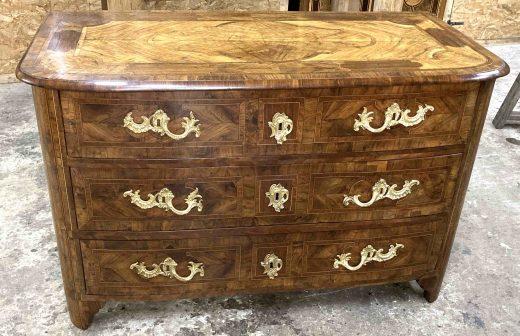
Restoration of a Louis XIV period commode in rosewood and walnut, inlaid with alternating marquetry in friezes and fillets. The slightly curved front opens with three wide drawers in three rows. The top, encircled by a brass molding, features a geometric design of circles framing a central polylobed motif with figurative designs. The uprights and intermediate rails are inlaid with polished brass fluting. The sides are veneered in walnut with diamond frieze patterns. The legs are tapered with claw feet. The piece is adorned with finely chased and gilded bronze mounts.

Hairdresser E.GOMME G-Plan

Ebénisterie Mathieu Vath

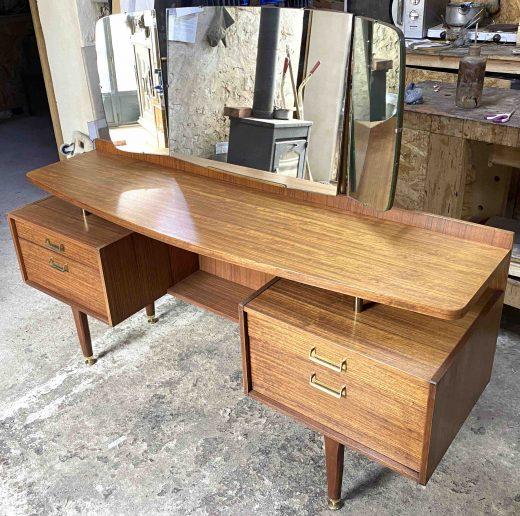
Restoration of a 1960s teak veneer dressing table from the G-Plan company. Ebenezer Gomme. In 1898, Ebenezer Gomme (1858-1931) founded the E. Gomme Ltd. precision joinery workshop in High Wycombe, England. It quickly became one of the most important centers of English furniture manufacturing until 1940. During the Second World War, Great Britain faced a timber shortage, forcing all wood-dependent industries to offer products with a more utilitarian than design focus. In […]

Louis XIV commode

Ebénisterie Mathieu Vath

Restoration of a Louis XIV period commode veneered in olive burl, ash, and walnut, likely from the Dauphiné region. This type of commode (D-shaped), along with the Mazarine commode, was among the very first commodes popularized under Louis XIV. Indeed, the appearance of the earliest French furniture resembling the commode dates only from the 1700s; thus, the oldest known and datable Parisian commodes are those delivered by André-Charles Boulle to Versailles around 1708. Their very simple decorations are inspired by Dutch designs, often executed by […]

RELIGIOUS CLOCK, Sarrabat Paris

Ebénisterie Mathieu Vath

Restoration of a 'religious' clock with a striking mechanism on the half-hour, signed (dial and movement) 'Sarrabat à Paris', third quarter of the 17th century. Religious clocks were the earliest form of clocks during the reign of Louis XIV, the Sun King. Their popularity increased from 1660 onwards, thanks to Huygens' discovery of the regulator pendulum. This particular clock features Boulle marquetry of red tortoiseshell, brass, and pewter on a walnut frame, decorated with gilt bronze mounts and ebony moldings. The lower molding is also ebony and rests on […]

Regency chest of drawers stamped ID

Ebénisterie Mathieu Vath

Restoration of a Regency commode veneered in rosewood on a conifer frame. It was only after three weeks of work on this commode that I noticed a strange mark. It had been there from the beginning, right in front of me, and I hadn't noticed it. Indeed, it's quite rare to see a stamped Regency commode. But yes, the mark was definitely there. And it's not a modest mark, since this ID stamp is attributed to Jacques Denizot. Jacques Denizot (1684–1760) is […]

Transition chest of drawers stamped Etienne AVRIL

Ebénisterie Mathieu Vath

Restoration of a transitional commode stamped three times E.AVRIL, veneered in amaranth, rosewood, satinwood, and green-stained stringing on an oak and softwood frame. Etienne Avril (1748-1791), admitted as a Master Joiner-Cabinetmaker on November 23, 1774, died prematurely in 1791. Étienne Avril, known as Avril the Elder to avoid confusion with his brother Pierre, would witness the agony of the Ancien Régime and the abolition of the centuries-old guild system. Born in 1748 to a cab driver, Étienne Avril was not destined for […]

Cartel LXV signed Levêque in Paris

Ebénisterie Mathieu Vath

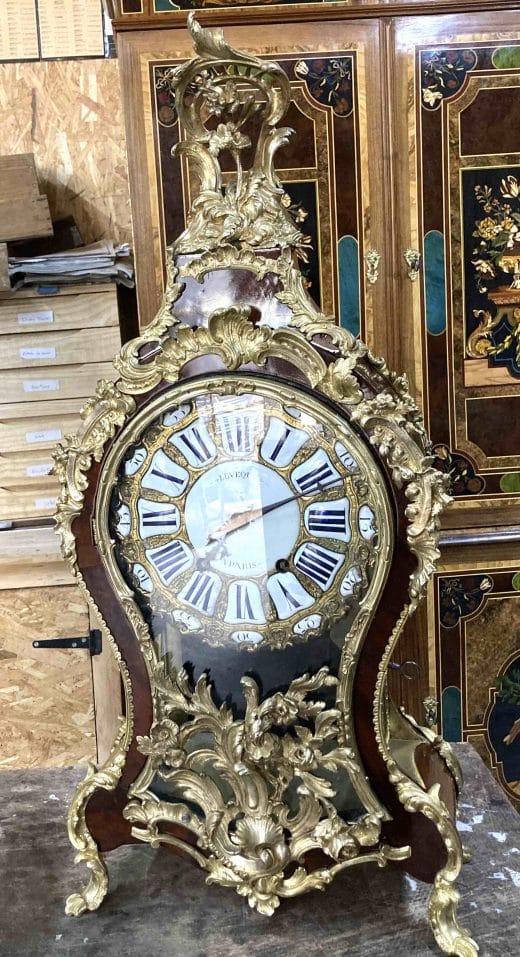
Restoration of a Louis XV period cartel clock signed LEVEQUE A PARIS with its original movement. The surprising thing about this clock is that it is made of mahogany. And as curious as it may seem, despite the tool marks, the quality of the workmanship and the wood appear entirely authentic. With its shape and rocaille bronze mounts typical of the Louis XV style, it could therefore be a clock made from the second half of the 18th century. A precursor, then, to the appearance of mahogany in French furniture. The restoration has […]

Eight-foot desk known as the "Mazarin" desk«

Ebénisterie Mathieu Vath

Restoration of an iconic piece of Louis XIV furniture, the Mazarin desk, named after the famous minister who served the king between 1642 and 1661, and who gave his name to this type of eight-legged desk. The stretchers and the narrow space between the two drawer units are a reminder that this type of desk required the user to sit at an angle: one knee below the writing surface and the other outside. This position was dictated by the wearing of the sword, always on the left. This […]

Art Deco games table and pedestal table

Restoration of a 1930s pedestal table and games table veneered in Macassar ebony and maple. A few veneer grafts and a touch-up of the French polish finish were all it took to restore the luster to this beautiful set. Did you know: Macassar ebony (Dyospyros celebica) is a tree endemic to the island of Sulawesi in Indonesia. Macassar ebony is also called golden ebony or Coromandel. It is also found in Malaysia, where it is known as Kajol marte. It belongs to the Ebenaceae family. It takes its name from the main port […]

Louis XV commode

Ebénisterie Mathieu Vath

Restoration of a Louis XV period commode veneered in rosewood and violet wood. The commode, also known as the commode sauteuse, appeared during the Regency period, between 1705 and 1730, and is attributed to the cabinetmaker Charles Cressent. It consists of two drawers or two rows of drawers. The body is raised on half-height supports, with the body occupying half the height of the piece and the other half the legs. Intended to distinguish itself from the heavy and massive Louis XIV style, it is slender and graceful, almost ethereal. After restoration […]

Transitional chest of drawers stamped Léonard Boudin

Ebénisterie Mathieu Vath

Restoration of a Transition period commode stamped by the master cabinetmaker Léonard Boudin (1735 in Paris – 20/12/1807). It is constructed of solid oak and veneered with amaranth, rosewood, and ribbon satinwood (Brosimum rubescens), which provides a highly decorative appearance due to the pronounced interlocked grain of this South American wood. It should be noted that it belongs to the same family as snakewood (Brosimum guianense). As Boudin was primarily a merchant during the Transition period, it is likely that this commode is actually by his hand (before […]

Louis XV writing table

Ebénisterie Mathieu Vath

Restoration of a Louis XV period drawing table, or more precisely, a writing table, veneered in rosewood, with a satinwood back. Born from the passion for correspondence in the 18th century, fashionable merchants deployed all their ingenuity to create numerous models of utilitarian tables to be placed in the center of a room. These table models differed from ordinary tables; they were generally equipped with a writing surface and drawers for storing ink and quills. It is in […]

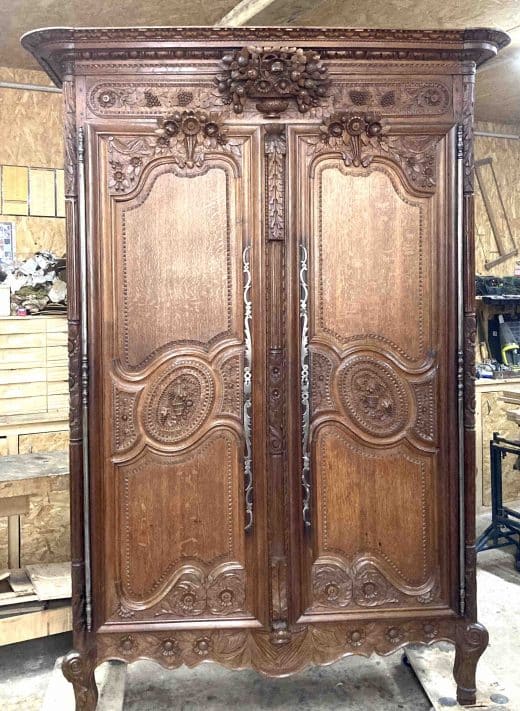
Wardrobe of Bretteville the Proud

Ebénisterie Mathieu Vath

It was in the mid-17th century that what we now call the Norman armoire originated. However, it was from the 18th century onward that it acquired the characteristic form we know today: with its two doors, resting on cabriole legs and featuring a wide, sculpted cornice, it combines Louis XV structure and style with Louis XVI motifs. It was during this same period of economic and social stability, allowing for a certain improvement in living standards, that it entered the homes of both the bourgeoisie and the peasantry. The 19th century would be […]