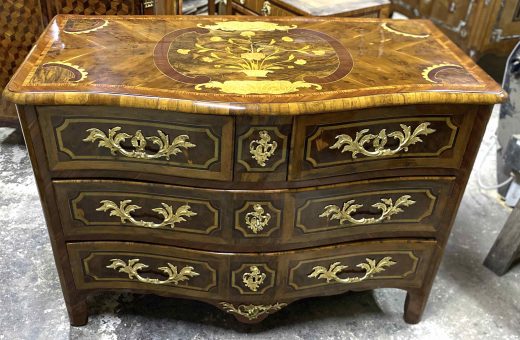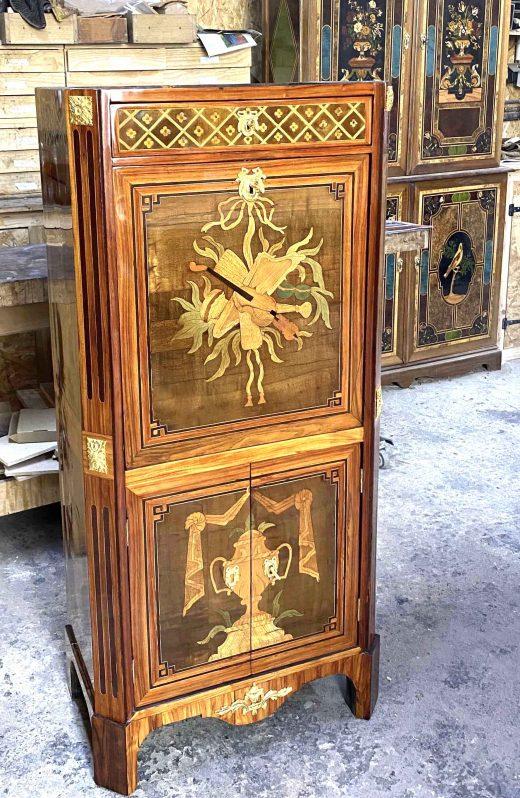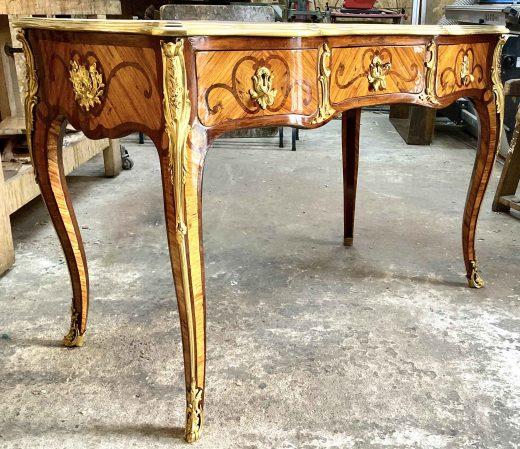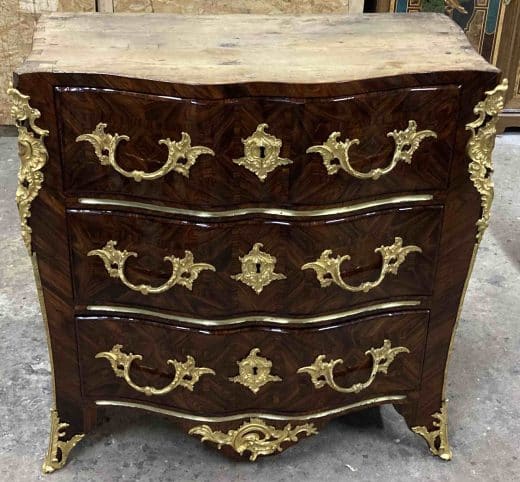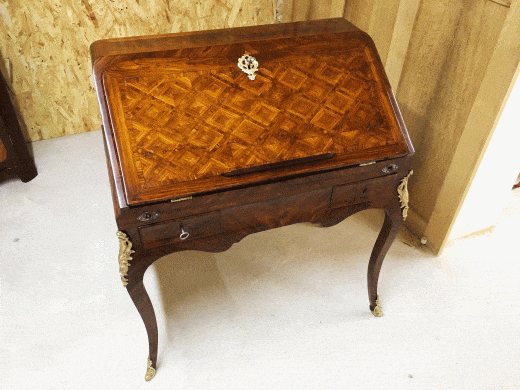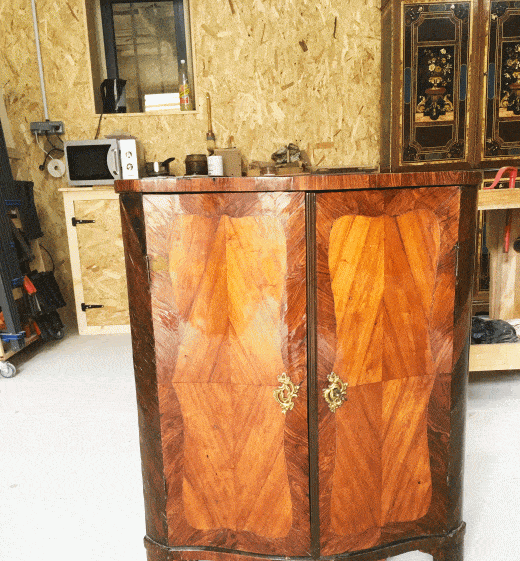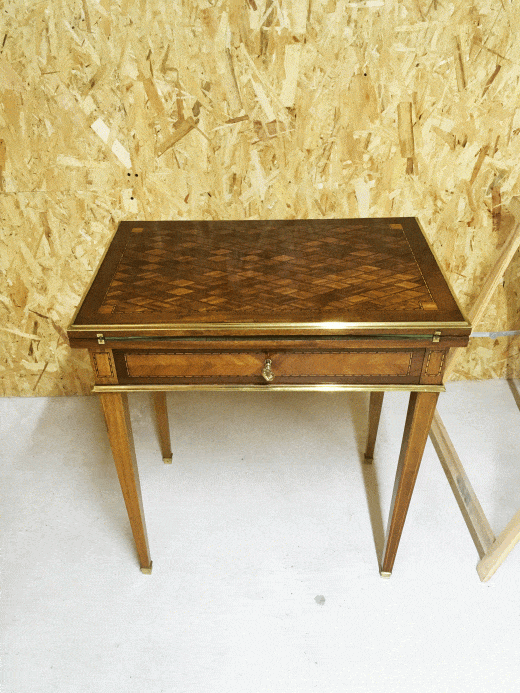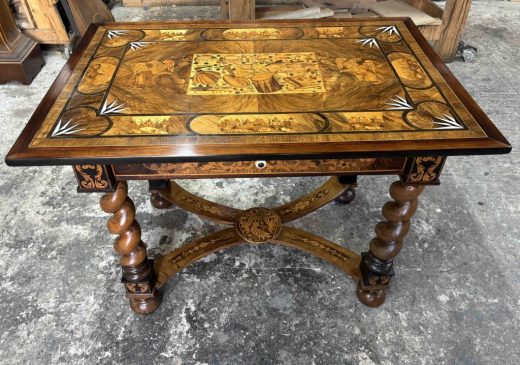
Wild herb table

Ebénisterie Mathieu Vath

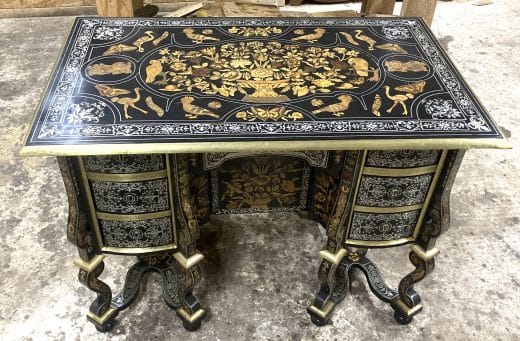
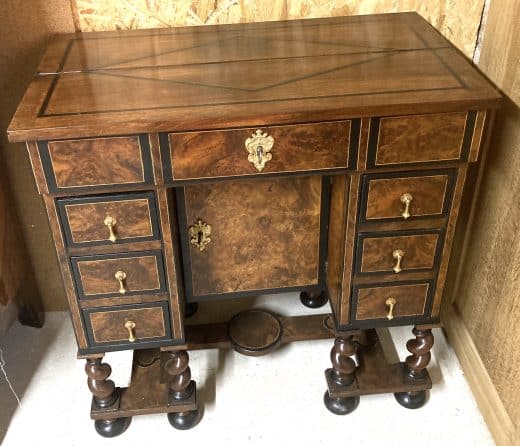
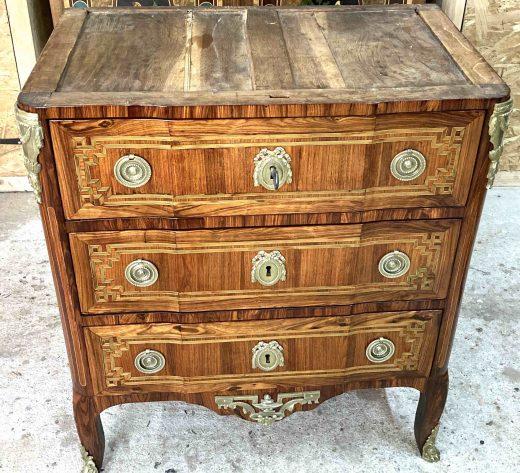
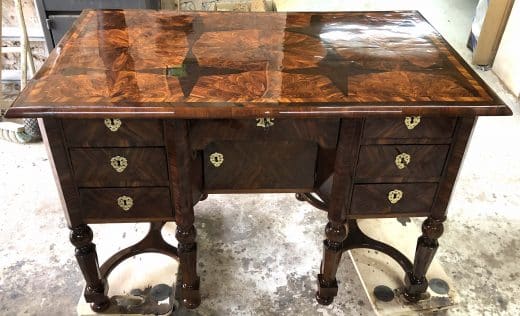
Restoration of a solid walnut marquetry table with "architectural whimsy" and "wild herbs" motifs, originating from the Austrian Tyrol in the mid-17th century. The piece rests on four twisted legs, adorned with flattened ball feet, connected by an X-shaped stretcher. It opens with a wide drawer in the front and is surmounted by a rectangular top. This top is decorated with a rosewood border, followed by bands delimited by wide bog oak fillets, themselves framed with boxwood. These elements […]
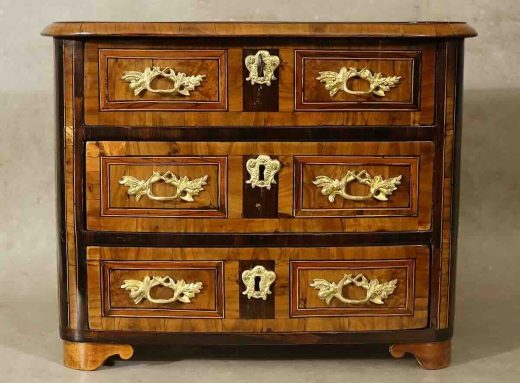
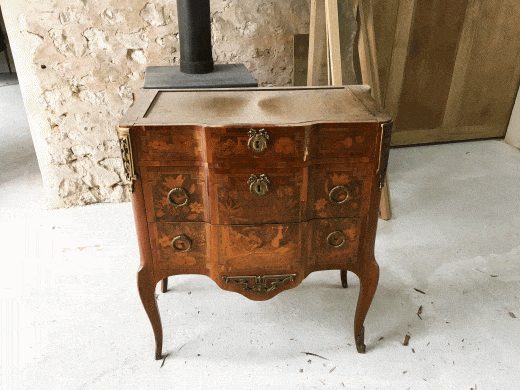
Louis XIV style commode – Grenoble, first third of the 18th century

Ebénisterie Mathieu Vath

Restoration of a Louis XIV Dauphiné commode, veneered in geometric Alpine wood, with a bombé front and three drawers in three rows. The model's proportions and construction are similar to those of a full-size commode (dovetail joints, intermediate shelves, etc.). The cabinetmaker skillfully played with contrasts through the juxtaposition of wood species, and the quality and variety of the woods used on this small piece of furniture are remarkable: primarily olive and olive burl, walnut, and rosewood for the framing bands highlighted with […]

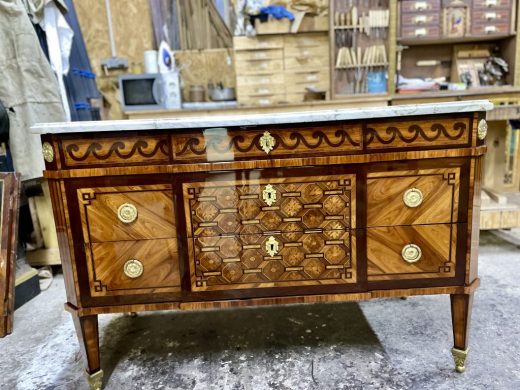
Louis XVI chest of drawers by Jean-Francois Leleu

Ebénisterie Mathieu Vath

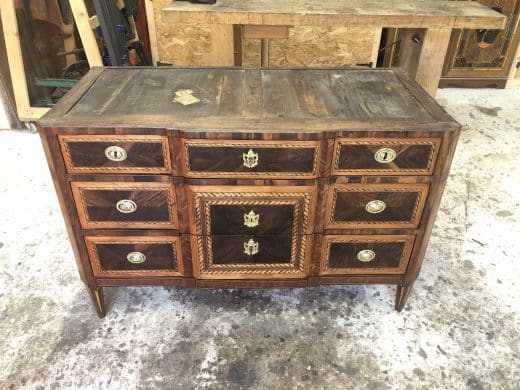
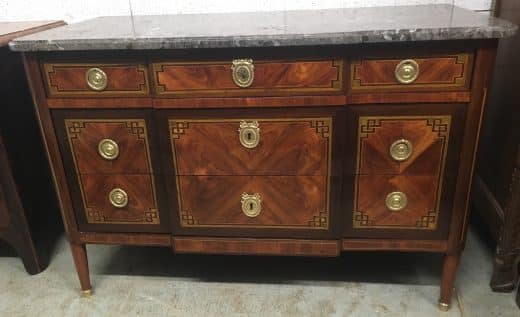
Restoration of a Louis XVI period commode with a projecting central front, stamped JF LELEU. Made entirely of oak, it is veneered with amaranth, rosewood, boxwood, stained maple burl, and tobacco-grey maple. It is decorated with marquetry featuring a frieze of posts on the top drawer, Greek key motifs, and fleurons within a mosaic of hexagons known as "marquetry à la reine" on the central projection. It has three drawers, two of which conceal drawers with crossbars. The front uprights are […]

Augsburg Cabinet, 17th century

EEbénisterie Mathieu Vath

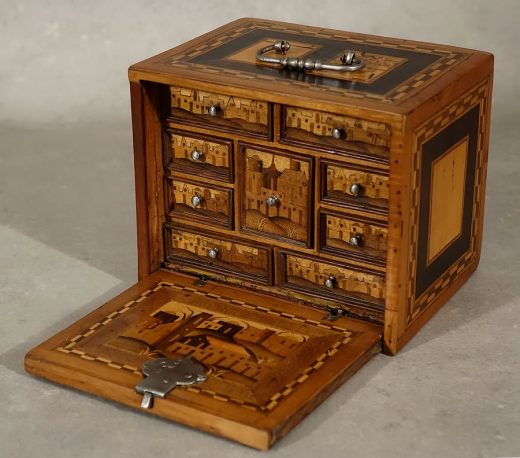
Restoration of a small table cabinet (Height: 14.3 cm – Width: 17.3 cm – Depth: 13 cm), likely a traveling model, made of solid wood with intarsia on all sides, opening with a drop-front concealing eight drawers (the bottom one simulating two drawers). Its composition is particularly rich, incorporating eight different wood species. The frame, made of fir and cherry for the visible parts, is inlaid with large central panels of sycamore maple. These are framed by bands of plum wood, themselves bordered by a double band […]

Regency Cartel

Ebénisterie Mathieu Vath

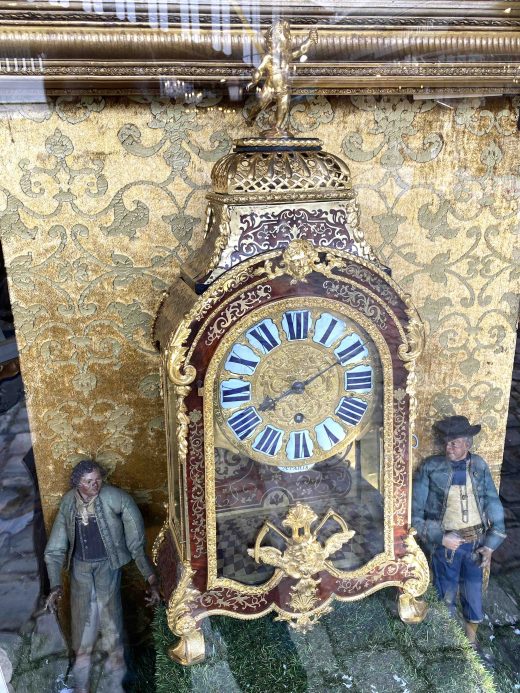
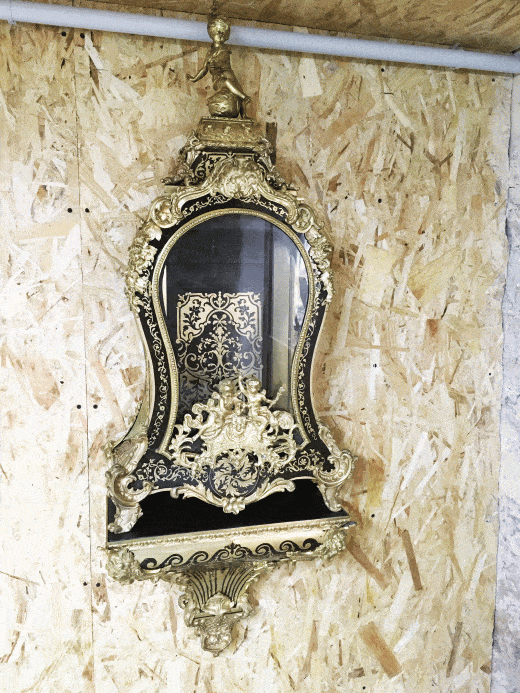
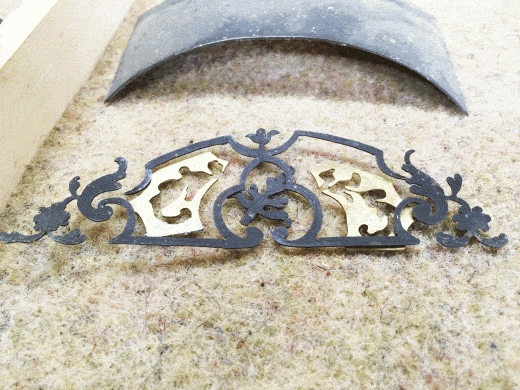
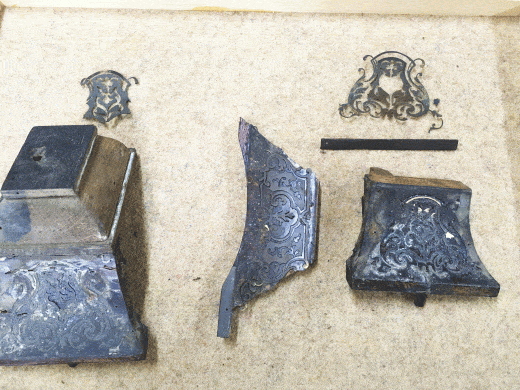
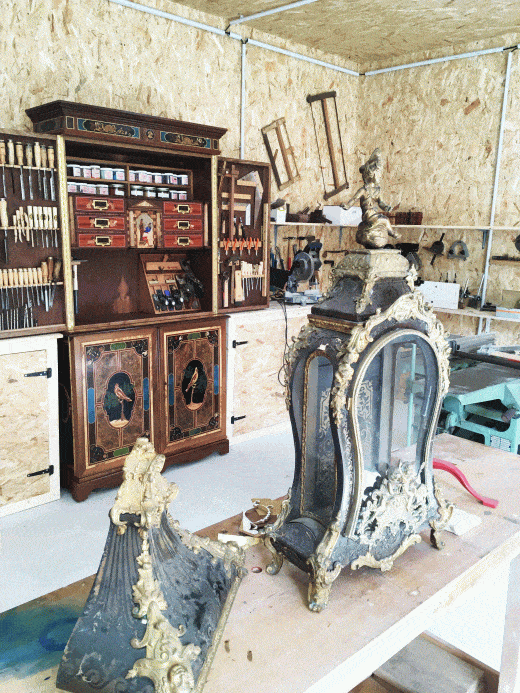
The restoration of five Boulle marquetry clocks, begun a few months ago, is now complete. Here is a Regency clock and its console, inlaid with tortoiseshell and brass on an oak frame. Measuring Time: Since the dawn of time, humankind has strived to measure time. From the gnomon, a simple stick planted in the ground—a precursor to the sundial—to the flow of water in the clepsydra, and then to the hourglass using the same principle, all these methods have allowed people to organize their social lives, […]

Nesting tables by Emilie Gallé

Ebénisterie Mathieu Vath

Restoration of a set of four Art Nouveau nesting tables, crafted and stamped with marquetry on each tabletop by the Gallé workshops. The beechwood bases are adorned with a naturalistic decoration of tree branches, and feature marquetry of daffodils, seascapes, and lapping catkins. The woods used for this marquetry are ash, walnut, sycamore maple, rosewood, mahogany, walnut burl, and elm. Émile Gallé (1846-1904) Émile Gallé is an emblematic figure of Art Nouveau, renowned for his contributions […]
English Cabinet

Ebénisterie Mathieu Vath

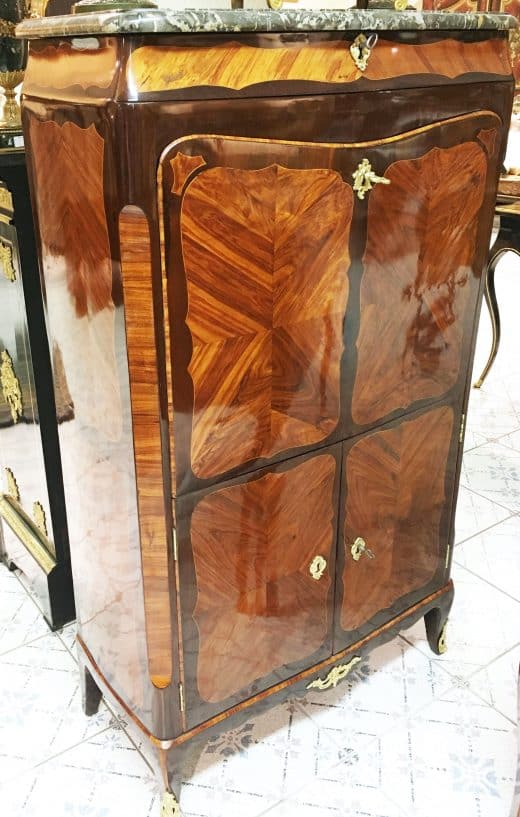
Restoration of a late 17th/early 18th-century English cabinet, veneered in walnut and maple, featuring the distinctive free-flowing arabesque marquetry known as seaweed marquetry because it evokes the seaweed found on the seabed. English "seaweed" marquetry is traditionally associated with Dutch and Flemish cabinetmakers active in the second half of the 17th century, and particularly with Gerrit Jensen. Indeed, when Prince William III of Orange ascended the throne of England in 1689, he was accompanied by his cabinetmakers. Subsequently, religious persecutions on the […]
Louis XIV double-bodied display case

Ebénisterie Mathieu Vath

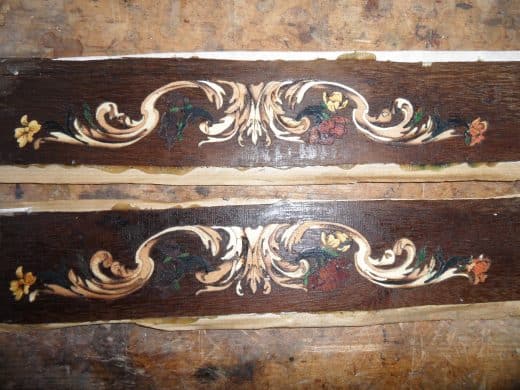
Restoration of a Louis XIV period two-part display cabinet veneered in cedar, ferreol, and cherry. The moldings are made of blackened fruitwood. With a flat front and sides, it opens with two doors in the lower section and two grilled doors in the upper section, with a straight cornice, resting on ball feet. This type of marquetry is found on furniture from the second half of the 17th century. Condition report: This piece of furniture showed multiple alterations. Regarding the frame, the nailed back panels, which were intended to maintain proper squareness, and […]
Louis XIV clock

Ebénisterie Mathieu Vath

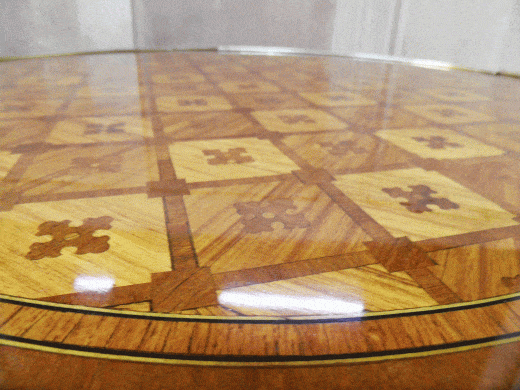
Restoration of a rare late 17th-century clock case in four-color marquetry, also known as "wood painting" or "jasmine painting." It is composed of maple, pear, boxwood, and green-stained maple on an ebony ground. Note that the base was likely added later. Several graphic styles are incorporated into this piece, including scrolling foliage and acanthus leaves, bouquets of flowers, and a bird on the pediment. The frame and moldings are made of walnut and are stained black. A […]
Regency table lamp

Ebénisterie Mathieu Vath

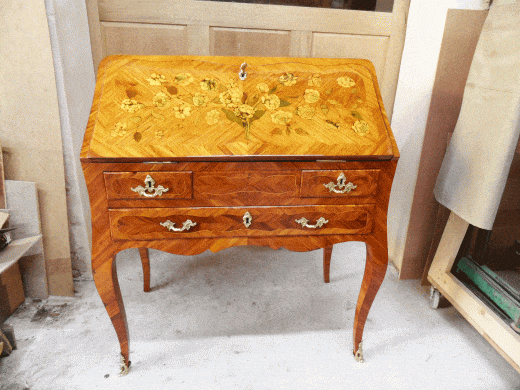
Restoration of a Regency mantel clock in brown tortoiseshell and brass marquetry on an oak frame. Without its bronze mounts, this type of furniture loses its splendor. But when it regains its bronze fittings, knowing that the function of this type of furniture is to tell the time, the symbols that compose them take on their full meaning. Fame on the escapement and the eagle on the door are perfect examples. Fame is originally an allegorical Greek deity personifying public recognition […]
Art Nouveau desk with Primroses by Louis Majorelle

Ebénisterie Mathieu Vath

Restoration of an Art Nouveau desk stamped by Louis Majorelle in Nancy around 1905. It is made of solid walnut and veneered with primrose flower marquetry. The work consisted of replacing missing veneer, cleaning, and restoring the waxed finish. Louis Majorelle was born in September 1859 in Toul and died in January 1926 in Nancy at the age of 66. Son of the renowned furniture designer Auguste Majorelle, he demonstrated a particular interest in craftsmanship and drawing from a very young age. […]

Regency Cartel signed Clément Fiacre Paris

Ebénisterie Mathieu Vath

Restoration of a cartel clock in red tortoiseshell and brass marquetry. The movement is stamped by Clément Fiacre in Paris. Clément Fiacre, one of the most important clockmakers of his time, received his master's certificate on January 16, 1714. He settled in Paris and quickly gained renown. Established on Rue Saint-Denis around the mid-1740s, he created his work in the Regency style, where wood was richly worked, notably through tortoiseshell and brass marquetry. He also produced veneers in rosewood, amaranth, and other woods.

Transition sauté pan with Boudin stamp

Ebénisterie Mathieu Vath

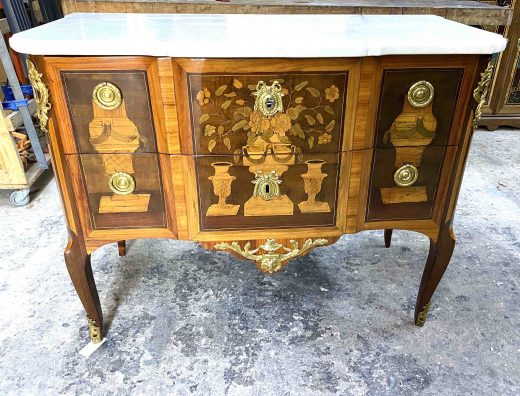
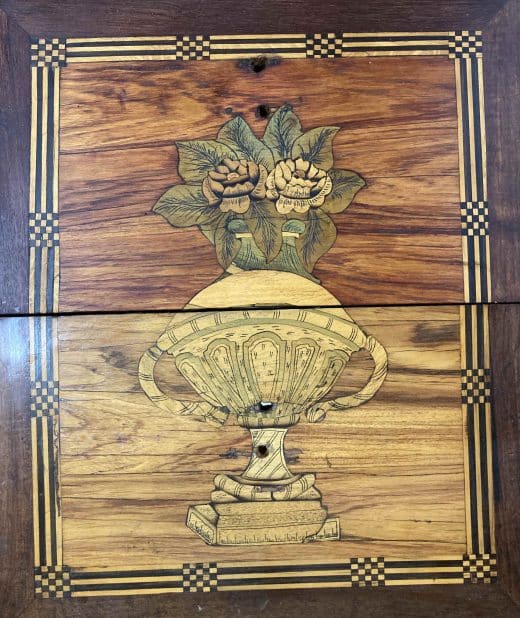
Restoration of a Transitional commode stamped by the master cabinetmaker Léonard Boudin (1735 in Paris – 20/12/1807). It is constructed of solid oak and veneered with amaranth, rosewood, tobacco-stained maple, and marquetry of boxwood, hornbeam, and holly, decorated with panels featuring floral vases and covered pots on the front and sides. With a slight central projection on the front, opening to reveal two drawers without a central divider, its rounded uprights rest on cabriole legs. Many Transitional commodes of this type have […]

Louis XV secretary stamped C.Chevallier

Ebénisterie Mathieu Vath

Restoration of a Louis XV period drop-front secretary, also known as a cabinet, stamped by Charles Chevalier, with curved sides and a front without an intermediate rail. Constructed of oak and softwood, it is veneered with marquetry of maple, boxwood, blue-stained maple, holly, hornbeam, and barberry on a rosewood ground framed by violet wood. The drop-front opens with its original three-point lock, revealing a compartment containing seven shelves in four rows and four drawers. The whole contains […]

Regency commode with crowned R

Ebénisterie Mathieu Vath

Restoration of a Regency commode, probably from southeastern France, veneered with yew, plum, rosewood, walnut, cherry, amaranth, violet wood, boxwood, and green-stained maple on a softwood frame. Besides its highly unusual marquetry decoration, the commode's distinctive feature is its crowned R bronze mounts. The crowned R hallmark should not be confused with the crowned C hallmark, which corresponds to a tax levied from 1745 to 1749 on copper objects and is found on many […]

Louis XVI secretary stamped TOPINO

Ebénisterie Mathieu Vath

Restoration of a Louis XVI secretary desk stamped by Charles Topino. Typical of Topino's style, this secretary is constructed of oak and softwood. The front opens with a drawer and a drop-front covered in red leather tooled in gilt, revealing two compartments and four drawers veneered in rosewood. The lower section opens with two doors revealing a shelf. These are decorated with marquetry depicting a vase and drapery on a tobacco-colored ground, while the drop-front is inlaid with musical instruments, ribbons, and foliage on […]

Louis XV desk

Ebénisterie Mathieu Vath

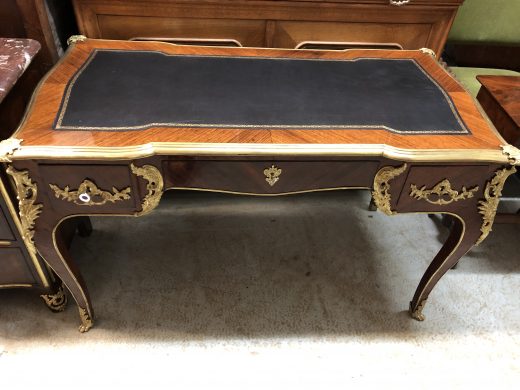
Restoration of a Louis XV desk veneered in rosewood and violet wood on an oak and softwood frame. Replacement of missing veneer, cleaning, and refinishing with a French polish. Cleaning and conservation of the leather. Removal and steam cleaning of the gilt bronze mounts. To see previous restorations: https://ebenisterie-mathieuvath.fr/en-ce-moment-a-latelier/

Regency commode stamped by Michel Mallerot

Ebénisterie Mathieu Vath

Restoration of a commode stamped by Michel Mallerot. With its serpentine front, it is entirely veneered in violet wood. It is built of fir with beech drawer bottoms and walnut drawer fronts. You don't know Michel Mallerot? That's understandable, as Michel Mallerot (1675–1753) is a Parisian cabinetmaker who remains relatively unknown, much like many cabinetmakers of the early 18th century. We owe his identification to the discovery of a handwritten pencil inscription "M. Mallerot" on a commode dating from the Regency period (formerly […]

Regency Cartel

Ebénisterie Mathieu Vath

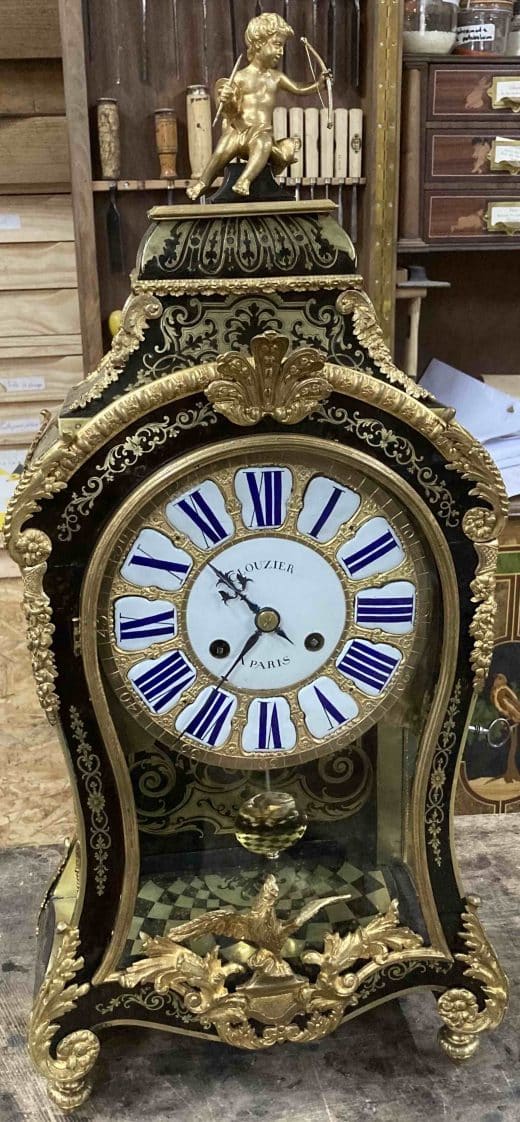
Here are some images of the restoration of a Regency period cartel clock in brown tortoiseshell and brass marquetry on an oak frame. The movement is signed CLOUZIER A PARIS. Jacques Clouzier (1692-1754) was received as a master clockmaker by awarding a masterpiece on July 5, 1692. He was one of the greatest Parisian clockmakers of the Louis XIV and Regency periods. He became a member of the clockmakers' guild in the 1700s, then worked on Rue Saint-Antoine until 1726 and later on Rue des Prêtres Saint-Paul. He remained active until his death […]

8-foot desk stamped Manet

Ebénisterie Mathieu Vath

Restoration of an eight-legged desk, commonly known as a "Mazarin" desk, from the Louis XIV period, late/early 17th century. Constructed of pear and solid softwood, the sides and drawer bottoms are also pearwood. It features two side cabinets, each opening with three drawers, a central drawer above a middle cabinet with rounded edges, and console-shaped uprights and eight legs joined by two X-shaped stretchers. The drawers are inlaid with pewter and blackened pearwood, depicting a late 17th-century design. […]

Money changer's office

Ebénisterie Mathieu Vath

A few weeks ago, I presented you with a money changer's table. Well, here is its successor, the money changer's desk. Inspired by the eight-legged desks more commonly known as "Mazarin desks," the money changer's desk is a smaller version. Designed to be frequently transported, it must ensure the security of the valuables it contains and showcase the prosperity of its owner through its marquetry and veneer decorations, which vary in richness. For those interested in the origins of these pieces of furniture and the money changer's trade…

Louis XVI commode

Ebénisterie Mathieu Vath

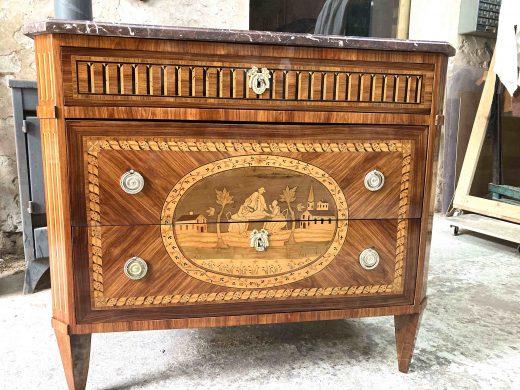
Restoration of a Louis XVI period provincial commode. Constructed of softwood and oak, and veneered with violet wood, rosewood, sycamore maple, boxwood, ebony, and stained maple. At its center is a bucolic scene depicting, between two trees, a card game between two women and a man watching. In the background, a house and a church are visible. The whole is framed by a medallion of flowers engraved and colored with black and red wax. The two lower drawers are framed by a frieze […]

Coffee table stamped P.GARNIER JME

Ebénisterie Mathieu Vath

Restoration of a Transitional Period (1750-1774) satinwood veneer salon table stamped by Pierre Garnier (circa 1726-1800). Originally from Paris, and the son of master cabinetmaker François Garnier, Pierre Garnier obtained his master's certificate on December 31, 1742. In contrast to his father, François left the Faubourg Saint-Antoine for the rue Neuve-des-Petits-Champs, near the Place Vendôme. His clientele consisted of merchants such as Léonard Boudin and Pierre Migeon, but above all of the kingdom's wealthiest figures, such as Louis Georges Erasme, Marshal of France, the Duchess of Mazarin, and the Marquis de Marigny, […]

P. ROUSSEL Games Table

Ebénisterie Mathieu Vath

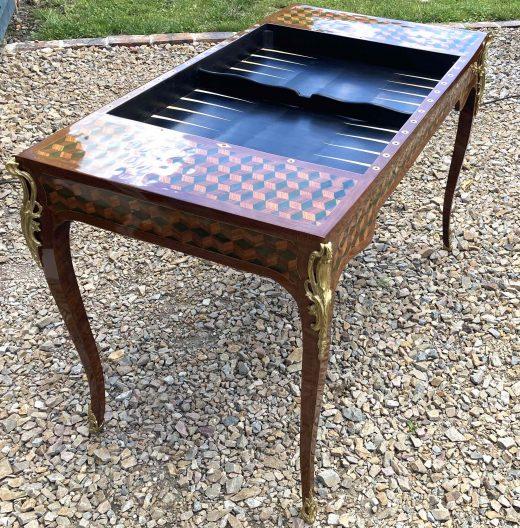
Restoration of a Louis XV period marquetry game table (or backgammon table) with dice (or cubes) veneered in amaranth, rosewood, violet wood, palisander, ebony, and ivory. This table is stamped by the Parisian cabinetmaker Pierre Roussel (September 28, 1723 – June 7, 1782). The Roussel family, sons of Michel Roussel, a journeyman cabinetmaker originally from the Cotentin peninsula, were the only ones to choose cabinetmaking rather than joinery, unlike his younger brothers Jacques, Michel, and Louis. Pierre Roussel obtained his master craftsman's certificate on August 21, 1745, and established himself in the Faubourg Saint-Germain-des-Prés.

Regency Cartel

Ebénisterie Mathieu Vath

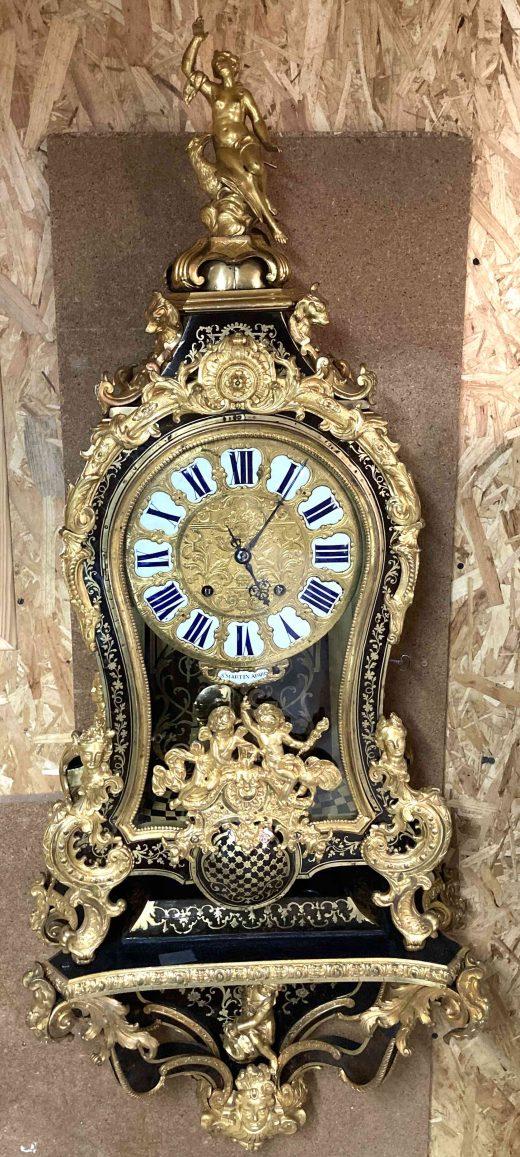
Restoration of a large cartel clock (137cm high) and its console-style bracket from the Regency period. It is made of solid oak veneered with Boulle marquetry of brown tortoiseshell and brass. It is decorated with floral garlands, crosshatching, and foliage. The dial is made of chased and gilded bronze with an interlacing design and birds; the Roman numerals are enameled, and the signature St Martin à Paris is inset. The plate is signed with the same name. It is adorned with chased and gilded bronze mounts depicting on its capital […]

LARDIN transitional chest of drawers

Ebénisterie Mathieu Vath

Restoration of a Transitional period commode constructed of fir and oak and veneered with rosewood, violet wood, and a frieze of hornbeam stringing stained green in the Greek key pattern. The sides are veneered with satinwood and violet wood. André-Antoine Lardin (1724 – August 10, 1790) obtained his master craftsman's certificate on July 1, 1750, and established himself on rue de Charenton under the sign "Au Bois de Boulogne." He worked there until 1770, when he moved to rue Saint Nicolas. His production is […]

Louis XVI commode stamped JB.Tuart

Ebénisterie Mathieu Vath

Here is a very pretty Louis XVI period commode veneered in rosewood and amaranth with marquetry of boxwood, pearwood, maple, hornbeam, walnut, blackened pearwood, lemonwood… It is built of oak and softwood. It is stamped twice with the mark of Jean-Baptiste II TUART. But its maker is probably Jean LAPIE. From a dynasty of Parisian cabinetmakers and merchants, whose father, Jean-Baptiste I, obtained his master's certificate in 1741 and was active until around 1760, Jean-Baptiste II, born around 1720, was not a master cabinetmaker but a master furniture maker and haberdasher […]

Napoleon III worker

Ebénisterie Mathieu Vath

Restoration of a Napoleon III period sewing table inlaid with mother-of-pearl, brass, and ebony. As you can see from the photos, this sewing table was in very poor condition. Only the affection and sentimental value of its owner saved it. Indeed, the time required for the restoration of this table was far too great compared to the object's value. Almost all of the brass inlay on the base was missing, there was a lot of missing veneer, and there was a […]

Mazarin Boulle Office

Ebénisterie Mathieu Vath

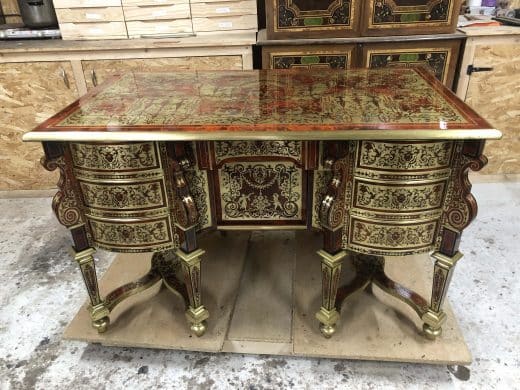
To end the year on a high note, here's a restoration that occupied a large part of my time this year and which reached its owner a few weeks ago. It's the restoration of an eight-legged writing desk, commonly known as a "Mazarin" desk. Constructed of solid oak and softwood, the sides and drawer bottoms are made of light walnut. The marquetry covering it consists of Caret tortoiseshell (Eretmochelys imbricata) on a vermilion red ground, and brass. All of this is framed by delicate ebony stringing. It is […]

Louis XVI commode

Ebénisterie Mathieu Vath

This week, we're restoring a Louis XVI commode with a projecting front, veneered in Rio rosewood, amaranth, and violet wood, with marquetry stringing in boxwood and ebony forming a ribbon wrapped around the wood, the background of the engravings filled with red wax. The tapered legs and canted uprights have faux fluting in ebony and boxwood. There's no maker's mark to attribute this beautiful piece and the high quality of wood chosen for its construction. Regarding the restoration, the work isn't very […]

Eight-foot desk known as the "Mazarin" desk«

Ebénisterie Mathieu Vath

Extensive restoration work has been undertaken on this Mazarin desk, veneered in kingwood and rosewood. It is entirely veneered on fir with a solid rosewood base. The top features a marquetry of rosewood stars surrounded by kingwood butterfly wings in circular patterns. Why the name "Mazarin"? The eight-legged desk is one of the jewels of 17th-century furniture. It only acquired the name "Mazarin" from antique dealers in the 19th century to give it a more prestigious name.

Louis XV style desk

Ebénisterie Mathieu Vath

A major restoration was undertaken for this small Louis XV style desk, richly adorned with bronze mounts and veneered in rosewood. The restoration involved replacing the missing veneer while preserving as much of the remaining material as possible. This was achieved by using veneer that was sliced, scraped, sanded, oxidized, and varnished before being re-glued, thus avoiding the need to sand the piece before finishing. Rosewood is a very dark wood that lightens with age, developing a beautiful reddish patina that cannot be removed by any means.

Napoleon III wall shelf

Ebénisterie Mathieu VATH

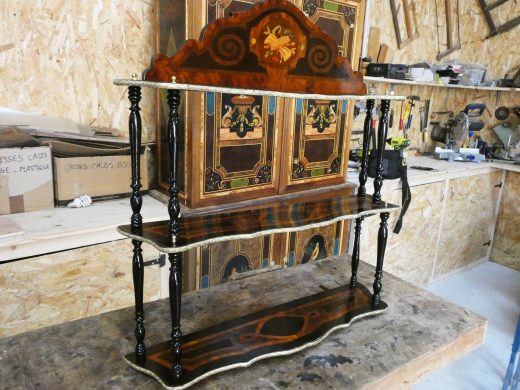
Restoration of a Napoleon III period wall shelf veneered in blackened pearwood, rosewood, amaranth, amboyna burl, and marquetry with a music theme. Underneath the dust, aside from small losses in the blackened pearwood and rosewood, and slight dehydration, there was nothing too serious. A few veneer grafts, a vacuum-sealed glue application, a thorough cleaning, a coat of clear French polish, and voilà! All this without using sandpaper. Except for lightly sanding the varnish […]

Louis XVI commode stamped JA BRUNS

Ebénisterie Mathieu VATH

This week marks the completion of the restoration of a Louis XVI commode stamped JA BRUNS. It is made of oak for all the structural elements, except for the side panels, drawer backs, drawer fronts, and the two drawer bottoms, which are made of softwood. It is veneered with rosewood in a butterfly pattern and amaranth for the edges. The false fluting is made of boxwood and ebony, and there is a green-stained maple stringing forming the corners at […]

Secretary stamped P.ROUSSEL JME

Ebénisterie Matheu VATH

Here are some images of the restoration of a secretary desk stamped by Pierre Roussel (1723-1782). Having become a Master Cabinetmaker in 1745, Pierre Roussel set up shop on Rue de Charonne, in the Faubourg Saint-Antoine, under the sign "L'Image de Saint Pierre" (The Image of Saint Peter). Thanks to his skills as a cabinetmaker and especially as an exceptional marquetry artist, he quickly gained a great reputation. In 1762, he became a sworn member of his guild. By 1767, he was considered one of the best cabinetmakers of his time. Highly regarded by his colleagues, he became a representative of the cabinetmakers' guild in 1777 and then syndic two […]

Boulle box

Ebénisterie Mathieu VATH

To kick off the new year, I'm excited to present my latest project. I'm embarking on a replica of this box attributed to André Charles Boulle. You'll be able to follow its progress and even come see it in person, as it will be my main subject for marquetry work at various exhibitions and events over the next few years. And yes, I'm talking about several years, as it's an extremely time-consuming project. But first, I had to find and select the different types of wood that make up the […]

Louis XVI style table

Ebénisterie Mathieu VATH

Here is a Louis XVI style table, which is probably an early 20th-century piece. It was likely made in the Faubourg Saint-Antoine, or perhaps at the École Boulle. I have seen apprentice furniture of this quality made by students during their training. Its frame is oak, while the veneer is rosewood and mahogany with a black inlay. The restoration was straightforward, apart from a lack of rosewood in the marquetry […]

Louis XV slant-front desk (After restoration)

Ebénisterie Mathieu VATH

A while ago I told you about this desk that was being restored. Well, here it is finished. The varnishing process took three weeks. This allowed enough time for the varnish to set properly, in order to achieve the best possible result. https://ebenisterie-mathieuvath.fr/en-ce-moment-a-latelier/ So here are some before and after photos.

Corner cabinet in Boulle marquetry from the Napoleon III period

Ebénisterie Mathieu VATH

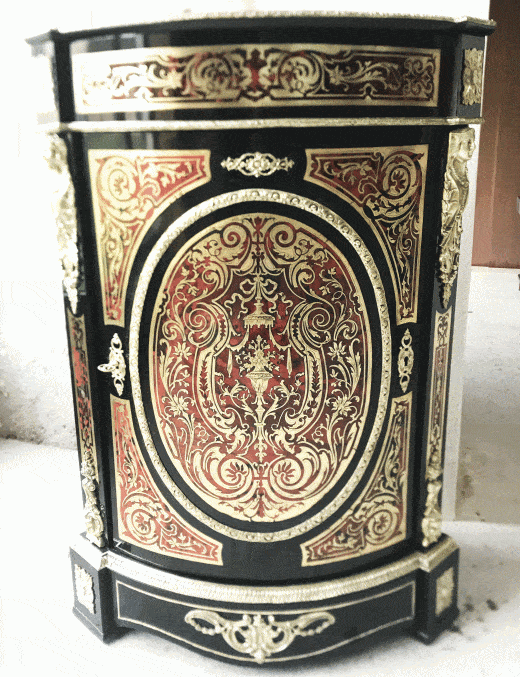
A classic restoration of Boulle marquetry. This involved rehydrating the old glue through infiltration, crafting and gluing the missing brass pieces, and reconstructing the base, which was in poor condition but not beyond repair. The bronze mounts were cleaned and finished with a clear French polish. Proof that appearances can be deceiving. Even a piece of furniture in a severely deteriorated state can regain its former beauty.

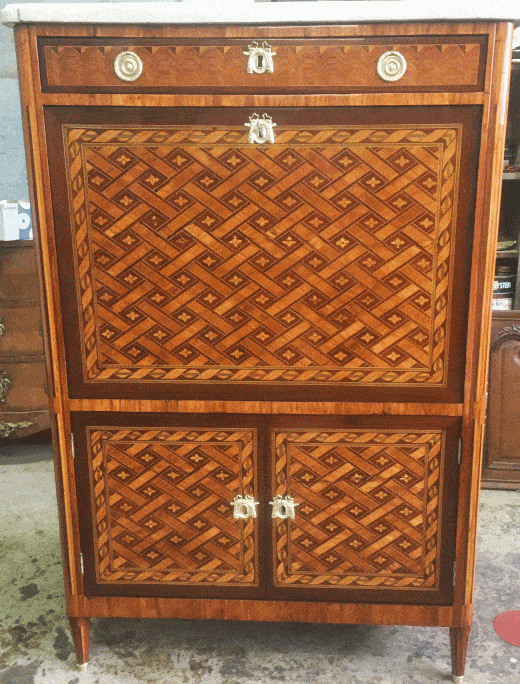
Secretary stamped Martin Ohneberg

Ebénisterie Mathieu VATH

This week marks the completion of the restoration of a Louis XVI period secretary. Martin Ohneberg (Master in 1773), the cabinetmaker who crafted this piece, was an excellent marquetry artist and used very high-quality rosewood. He produced numerous pieces of furniture with very simple lines but exquisite marquetry, including an endless variety of drop-front secretaries. This particular one is veneered with rosewood and amaranth, and features a mosaic marquetry of maple blossoms on a red satinwood ground. The framing bands […]

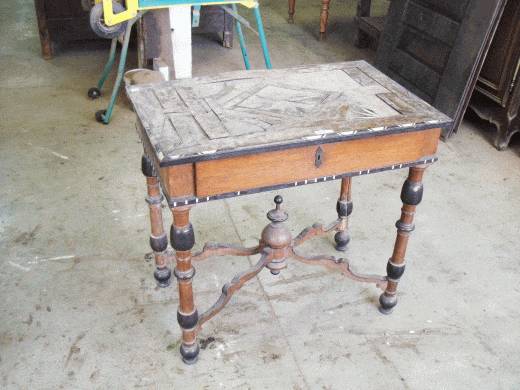
Louis XIII style desk

Ebénisterie Mathieu VATH

A look back at the restoration of a 17th-century Louis XIII table. It is made of solid walnut and veneered with walnut, ebony, ivory, and boxwood. This table had spent a long time in an attic, and unfortunately, the tabletop suffered considerably. Many sections of veneer were missing. The restoration therefore began by removing what little veneer remained. It was very easy; it was completely detached. I simply had to lift it with a thin blade, and it came right off. After having […]

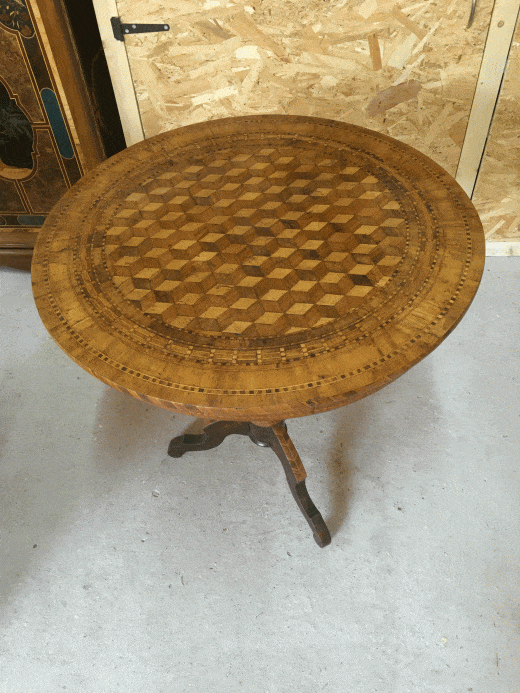
Pedestal table with cube marquetry

Ebénisterie Mathieu VATH

This week, I restored a lovely pedestal table, made locally with a solid ash base and marquetry of maple, walnut, and plum wood for the bottomless cubes. The restoration wasn't too difficult: I re-glued the loose marquetry pieces, stripped the old finish, and applied a French polish. I used a very interesting new recipe that I'll share in a future post. It's a recipe from 1861 by Dessaignes.

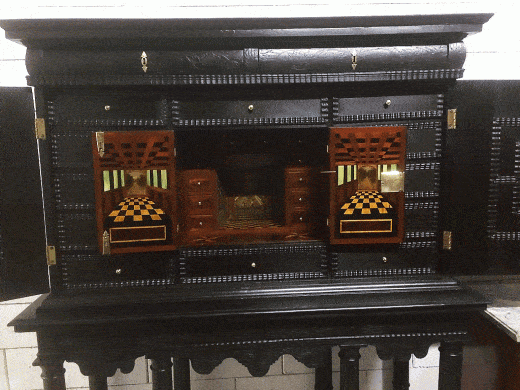
Louis XIII Cabinet

Ebénisterie Mathieu VATH

A look back at a fascinating restoration project (at least for me). So fascinating, in fact, that I forgot to take photos at the beginning! This cabinet dates from the 17th century and features two drawers in the cornice and two doors in the upper section. The base consists of two drawers in the frieze supported by eight turned feet and a top resting on ball feet. Inside are twelve drawers and two doors concealing an interior theater, as well as eleven more drawers. The feet, along with […]

Transitional dresser in the style of Topino

Ebénisterie Mathieu VATH

A month ago, a lovely transitional commode arrived, which reminds me of the work of the cabinetmaker Charles Topino (circa 1742-1803) – he received his master craftsman's certificate on July 4, 1773. However, this commode does not bear his stamp, nor any stamp for that matter. This confirms that a stamp is not necessary to possess a piece of high-quality furniture. Furthermore, the marquetry could very well have come from Topino's workshop, as he sold panels of his marquetry to the haberdashers and his colleagues […]

Louis XV slant-front desk stamped HEDOUIN (Restoration complete)

Ebénisterie Mathieu VATH

Remember that slant-front desk? Well, it's finished. It was quite a task, but now it's regained its former glory. Only the drawer keyholes and the leather upholstery remain to be fitted before it's returned to its owner. A large part of the legs has been remade from sawn violet wood. This was cut to the correct thickness, scraped and sanded, then oxidized before being glued, so as not to have to sand the entire piece of furniture […]

Louis XV corner cabinet, stamped JM CHEVALLIER

Ebénisterie Mathieu VATH

Here is a corner cabinet stamped by Jean-Mathieu Chevallier. It is made of solid oak and veneered with rosewood and violet wood with a boxwood inlay. Jean-Mathieu Chevallier was already established on the rue de Grenelle under the sign "à la Croix Chevallier" when he obtained his master craftsman's certificate in 1743. He subsequently expanded his business considerably, had business dealings with André-Charles Boulle, one of the sons of the famous cabinetmaker, and contributed to furnishing the Hôtel du Duc de Talmont, as well as the Château de Villegénis, which he had purchased […]

Alexandre Morell's Cartel Boulle – The End

Ebénisterie Mathieu VATH

After a few hours of cutting, gluing, re-gluing, and cleaning the surfaces, we finally reach the finishing stage. For this cartel clock, we chose to French polish it because it's a finish that highlights the marquetry, protects it, and is easily reversible (like all my work). I always use a clear shellac varnish, whether on wood or other materials. The varnishing process is difficult to explain; it simply takes hours and hours […]

Alexandre Morell's Boulle Cartel – Marquetry

Ebénisterie Mathieu VATH

After reattaching the structure, removing the brass, cleaning up any remaining animal glue, and removing any residue of superglue and neoprene adhesive, the next step is cutting out the new pieces of brass and tortoiseshell to fill the gaps. So, as usual, I take an impression of the missing piece. Then I glue this piece of paper onto a brass plate, which is itself glued with fish glue to a piece of 4mm plywood. This makes the brass plate easier to cut. To retrieve […]

Alexandre Morell's Cartel Boulle – Continued

Ebénisterie Mathieu VATH

Once the various structural elements were glued back together, I tackled the tortoiseshell and brass marquetry. As you'll see, on this clock it's in very, very bad condition; practically nothing is holding. So, all the brass has to be removed. The tortoiseshell, however, is holding well; it's only partially detached. The first step in restoring this marquetry is therefore to remove and set aside each brass element. The second is to clean off the old glue, […]

Alexandre Morell's Boulle Cartel

Ebénisterie Mathieu VATH

Here is my first client, patient… well, whatever you want to call him. It's a Boulle marquetry cartel clock in brown tortoiseshell, ebony, and brass. As you can see in the following photos, it's not in very good condition. There are many missing brass pieces, and the remaining brass is peeling off everywhere. At first glance, it's always difficult to precisely date a Boulle cartel clock: this one doesn't have a maker's mark. However, it does have corkscrew screws (typical of the 18th century […]

Tool cabinet – End

Ebénisterie Mathieu Vath

And there you have it, it's finished and ready to use. All the tools are in their proper place. All that's left is to find bronze fittings for the handles and keyhole escutcheons. For the finishing technique, I used the same one applied to furniture of that period: polishing. I first scraped the surface, then sanded it with 150-grit sandpaper. Next, I applied Venetian tripoli mixed with olive oil using a piece […]

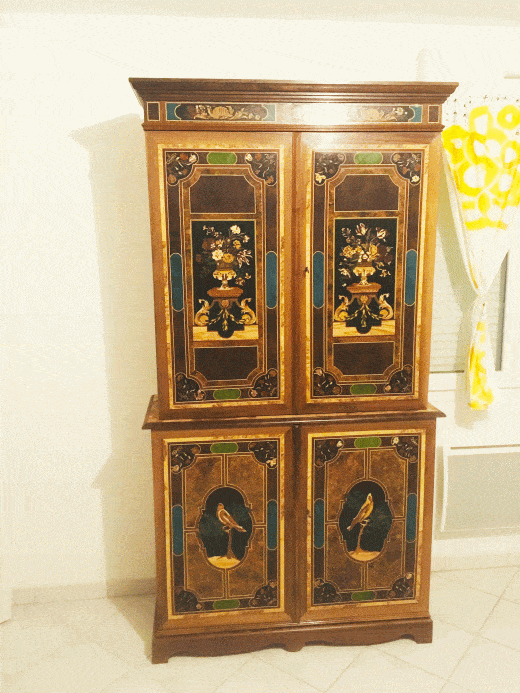
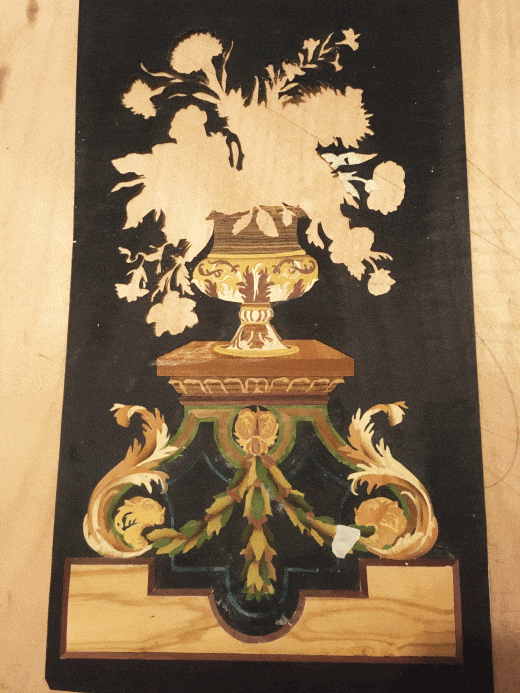
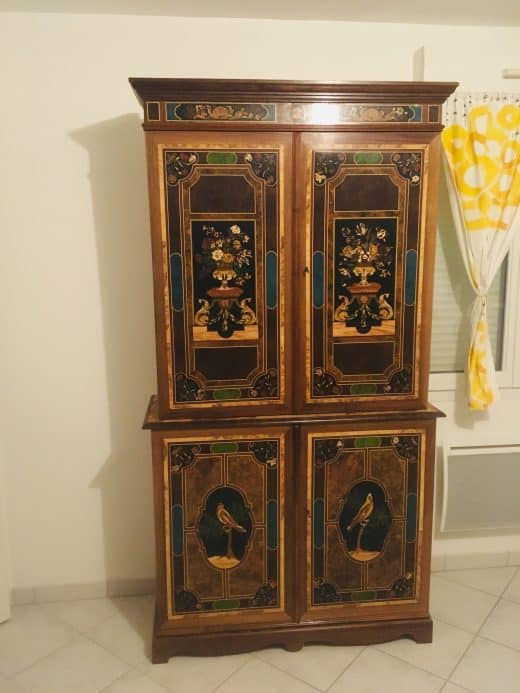
Tool cabinet – The top doors

Ebénisterie Mathieu Vath

For these marquetry designs, I drew inspiration from Pierre Ramond's book, "André-Charles Boulle, Cabinetmaker, Chaser, and Marquetry Maker to the King." I used the marquetry drawings from the Boulle workshop cabinet (circa 1715–1720). I simply modified them by removing the birds and the butterfly to simplify the design. Then, I partially employed the "Boulle" method for the acanthus leaves and the vase. Finally, I used the wood painting technique for the flower bouquets.

Tool cabinet – Continued

Ebénisterie Mathieu Vath

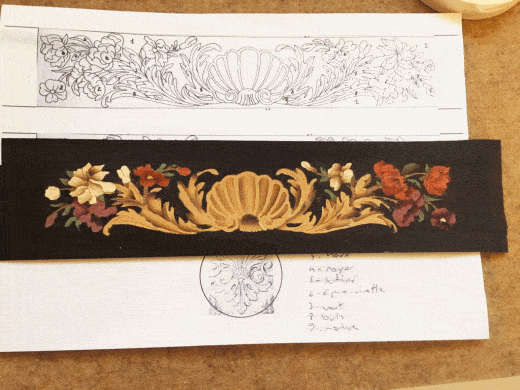
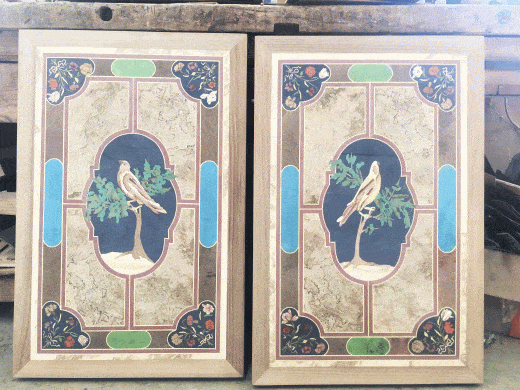
Here are some photos of the marquetry on the tool cabinet. For the corner pieces, I was inspired by those on a table by Pierre Gole, a predecessor and major influence of André-Charles Boulle. For this cabinet, I needed to make 16 corner pieces. So, to save time, I decided to use the Boulle marquetry technique. I made four bundles of different colored woods to obtain four different marquetry designs from a single cut. Therefore, there are four identical designs, but with different flower colors. Then, […]

Tool cabinet – Michelangelo's The Creation of Adam

Ebénisterie Mathieu Vath

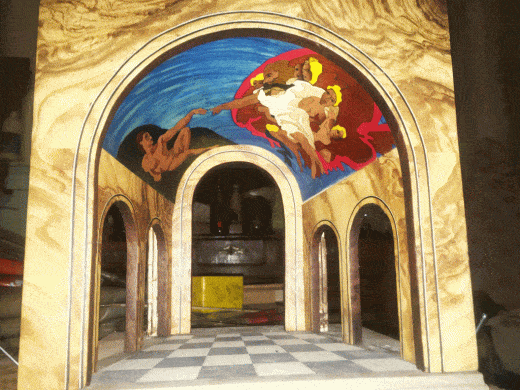
I indulged myself with this marquetry project; I had always wanted to recreate this famous marquetry fresco. This allowed me to revisit David Roentgen's "mosaic marquetry" technique. I created a pack with a hornbeam leaf, a sycamore maple leaf, and a pear leaf to make the figures, as pear wood is the best for reproducing skin tones. To tint the background, I dipped it in different baths to produce this effect of […]

Tool cabinet – The sculptor

Mathieu Vath

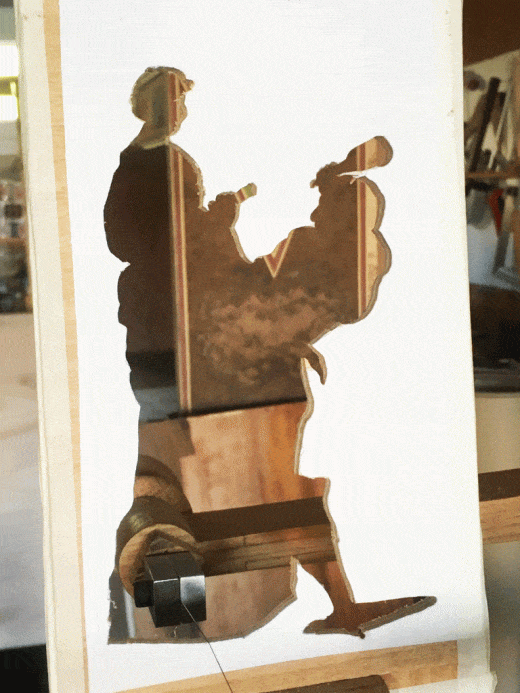
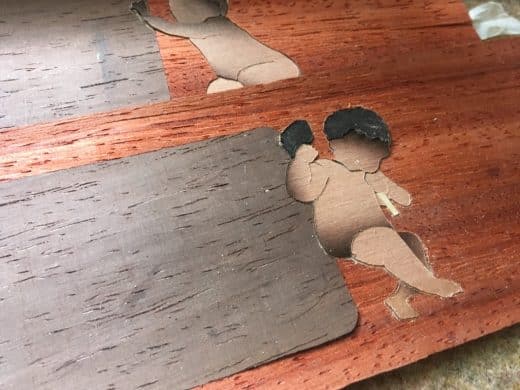
The idea behind this tool cabinet was to explore and implement the various projects I was researching. One of these ideas was to tackle the marquetry technique of a famous 18th-century cabinetmaker, David Roentgen. This technique, known as "mosaic marquetry," involves cutting a single sheet of veneer using a conical saw and then coloring it by dipping each piece in a pre-defined dye. However, there were two problems to overcome: Conical sawing, which is difficult to […]

Tool cabinet

Armoire à outils par Mathieu Vath

Since the workshop is under renovation, today I'll begin describing the various stages involved in making this tool cabinet. The idea came to me while looking for a way to store all my tools in a single piece of furniture. For the style, I had recently restored a Masarine commode in the style of the HACHE family in Grenoble. When I embark on a personal furniture project, I like to explore new techniques. And I had never before tackled the Louis XIV/Regency style.