Bonheur du jour Empire stamped by Antoine-Nicolas Lesage
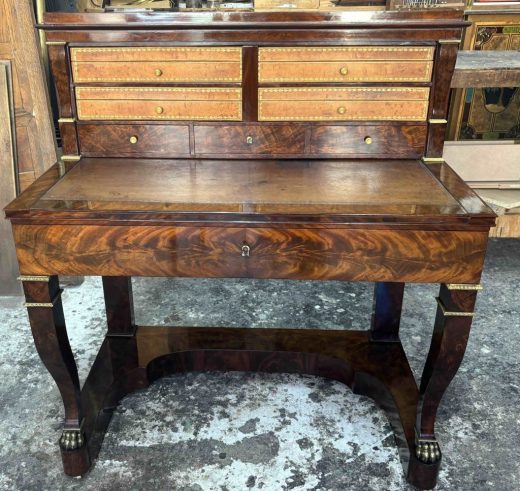
Restoration of an Empire bonheur du jour in mahogany veneer, stamped Antoine-Nicolas Lesage: top reattached, veneer missing, gilt bronzes cleaned and shellac finish redone.
Restoration. Conservation. Creation

Restoration of an Empire bonheur du jour in mahogany veneer, stamped Antoine-Nicolas Lesage: top reattached, veneer missing, gilt bronzes cleaned and shellac finish redone.
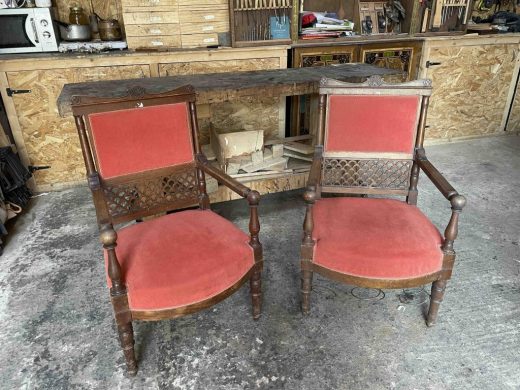
Restoration of a pair of Directoire period armchairs (circa 1795-1805), made of solid mahogany, except for the stretchers, which are veneered. These chairs have the clean, balanced lines characteristic of the Directoire style. Indeed, this style marks the transition between the austerity of Louis XVI and the more formal style of the Consulate. The joinery is mortise and tenon. Furthermore, turned supports extend the straight armrests, as was common at the end of the Directoire period. The legs are turned in a baluster shape and taper towards the bottom. A simple molding frames the rectangular backs. […]
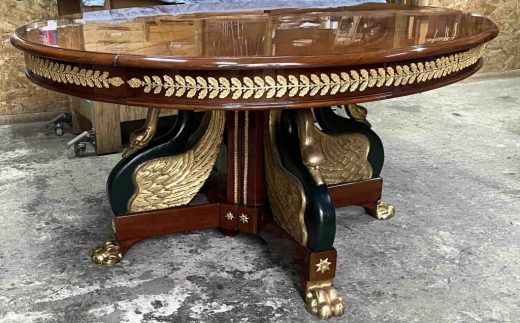
The restoration of this Empire dining table is now complete. The work focused primarily on the finishing touches. We removed the previously applied polyurethane varnish and applied a French polish to the solid mahogany top and its four-legged base decorated with swan neck motifs and lion's paw feet. The apron features an oak frieze. Length x Width = 162 x 140 cm. Length x Width with extensions = 252 cm.
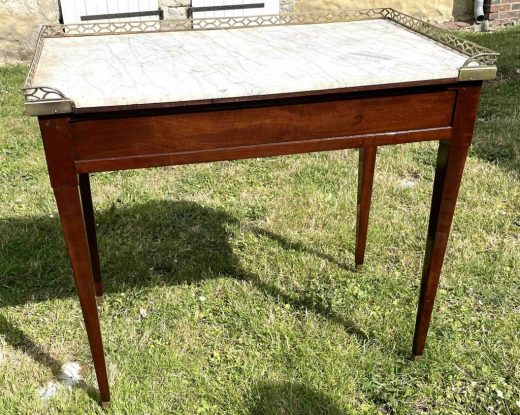
Restoration of a powder table, or dressing table, from the last quarter of the 18th century, stamped G.JACOB and JME. It opens with two drawers in the frieze. On the top, a white Carrara marble slab is surrounded by an openwork brass gallery. It rests on four tapered legs of solid mahogany, ending in casters. Finally, the solid oak stretchers are veneered with mahogany. Georges Jacob (1739-1814) Georges Jacob was born on July 6, 1739, in Cheny, Yonne, into a family of farmers. At a very young age, he left for Paris. There he […]
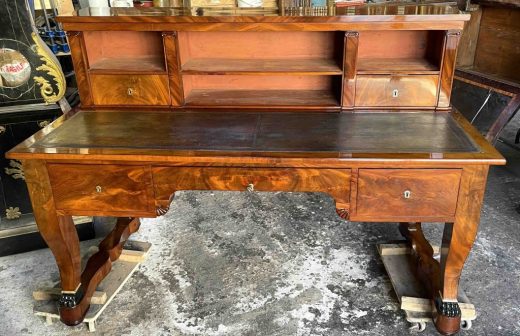
Restoration of an Empire period desk, veneered in mahogany burl on an oak frame. Its four "chimera thigh" legs are connected by stretchers. They terminate in lion's paw feet. The Empire style emerged at the beginning of the 19th century, under Napoleon I. Indeed, the Emperor desired a new, grandiose aesthetic, befitting his power. Heir to Neoclassicism, this style drew inspiration from Greek, Roman, and Egyptian antiquity. The excavations of Pompeii and Herculaneum inspired it, as did the Egyptian campaign. This […]

Restoration of a Louis XVI console table stamped by Louis-Noël Malle, with solid mahogany legs and mottled mahogany veneer on an oak frame. Louis-Noël Malle, born in 1734, became a master craftsman on November 18, 1765. With his wife, Marie-France Le Maître, he established his shop and workshop on the Grande-Rue-du-Faubourg-Saint-Antoine. He is recognized as one of the greatest marquetry craftsmen of his time. The 1771 and 1772 editions of the Almanach Général des Marchands mention him, misspelling his name as "Le Mille." His "works related to […]" are particularly praised.

A look back at the restoration of this rare port chest of drawers. It is made of solid woods brought back from the Orient and the West Indies. Indeed, it combines four precious woods: mahogany, satinwood, palo santo, and ebony. Most notably, it features a fifth: royal ebony. This chest of drawers opens with three wide palo santo drawers, arranged in three rows, separated by Ceylon ebony crossbars. A solid, framed top covers it. Its parquet flooring combines royal ebony crossbars and a mahogany back, partly mottled or pommeled. […]
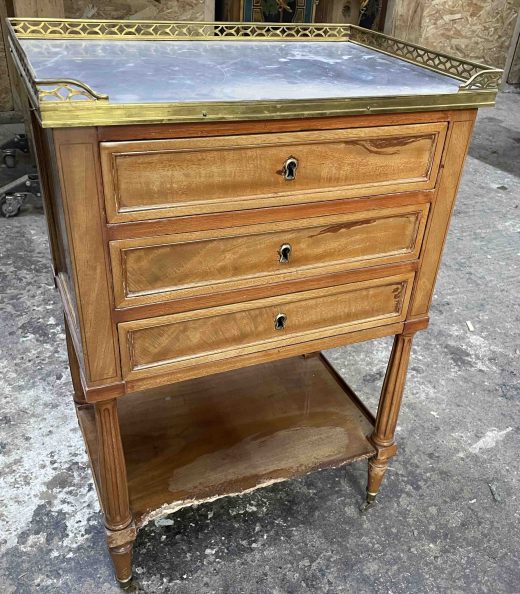
Restoration of a Louis XVI period chiffonier table, stamped by Jean-Baptiste VASSOU (1739-1807). It is made of solid mahogany and mahogany veneer, on oak and softwood frames. It is, moreover, a very finely crafted piece of furniture, with beautiful veneer and a lovely blue Turquin marble top. What exactly is a chiffonier table? The first mention of a "chiffonniere table" appears in 1755 in the journal of the haberdasher Lazare Duvaux (1703-1758). In 1763, the post-mortem inventory of Jean-François Oeben mentions a "frame of a chiffonier table […]
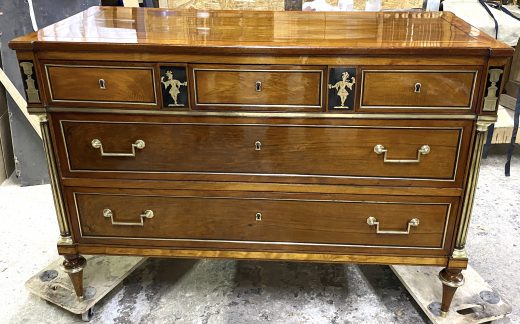
Restoration of a curious Directoire commode in solid walnut and walnut, mahogany, and maple veneer, featuring marquetry of a Medici vase and a Louis XIV-inspired ballet dancer, in brass on an ebony ground. The drawers have walnut bottoms with an ebony stringing surmounted by a quarter-round brass and wood molding, surrounded by a mahogany molding. The uprights are three-quarter-fluted columns terminating in toupie feet. The locks are in the shape of trefoils. A conservation project for this […]
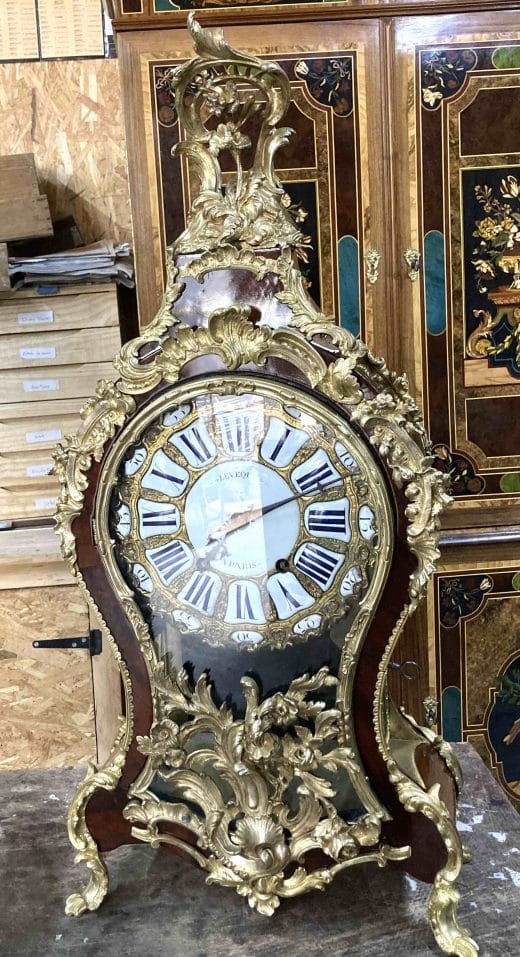
Restoration of a Louis XV period cartel clock signed LEVEQUE A PARIS with its original movement. The surprise: this cartel clock is made of mahogany. As curious as it may seem, the tool marks, the quality of the workmanship, and the wood appear entirely authentic. With its shape and rocaille bronze mounts typical of the Louis XV style, it would therefore date from the second half of the 18th century. It would thus be a precursor to the arrival of mahogany in French furniture. The restoration consisted of removing the bronze mounts and […]
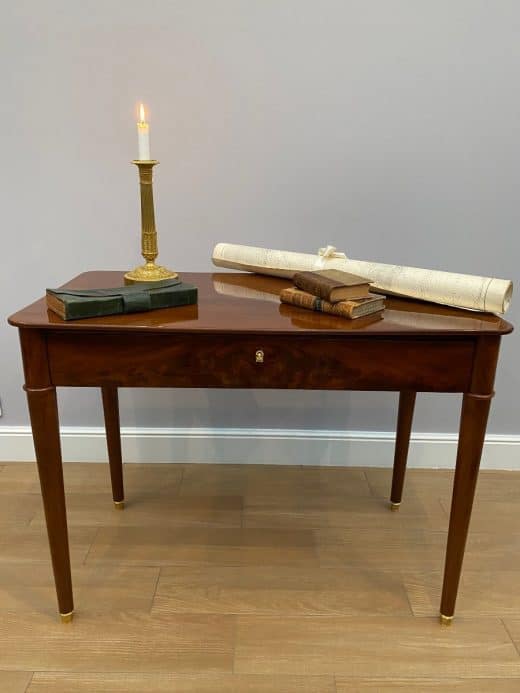
Restoration of a writing table built in oak, with a solid mahogany top and mahogany burl veneer. It features a large drawer in the frieze and rests on four tapered legs ending in gilt bronze sabots. Typical work of the late 18th century. To see previous restorations: https://ebenisterie-mathieuvath.fr/en-ce-moment-a-latelier/ This piece can be found at Antiquités Stéphane Guin.
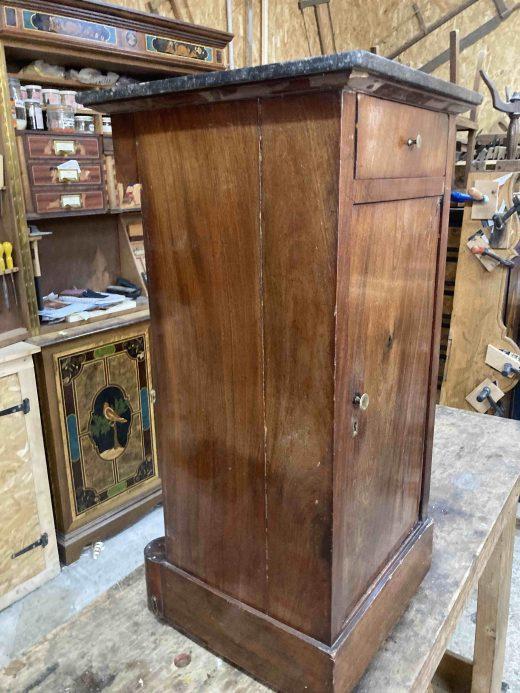
Restoration of an Empire-period somno, veneered in mahogany burl. You might be wondering what a somno is? The somno, or somneau, appeared during the Consulate, at the beginning of the Napoleonic era. It is a small, table-shaped piece of furniture, cylindrical or square. Its closed section serves as storage. It is therefore placed in the bedroom, often near the bed, as a nightstand. Finally, it was during the Empire that it acquired the name "somno," from the Latin somnus, meaning sleep. The somno under the Empire. Under the First Empire, the somno […]
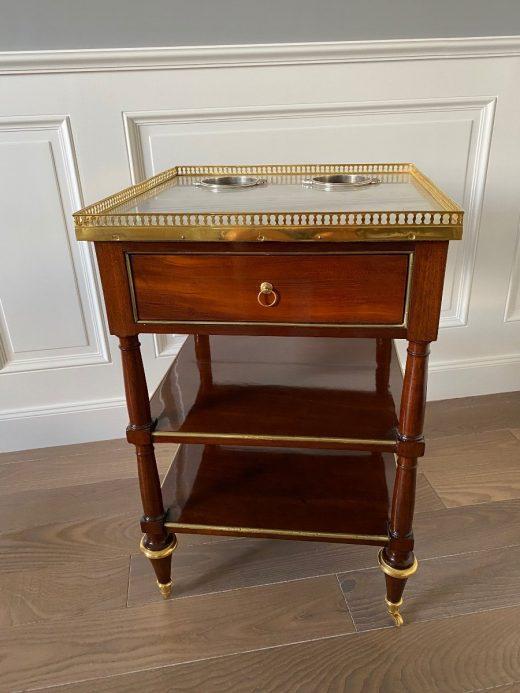
Restoration of a refreshment table. Its legs are solid mahogany, the rest is mahogany burl veneer, with brass quarter-round moldings. The refreshment table. The 18th century was the century of thought, philosophy, and intimacy. A fashion emerged among the wealthier classes: intimate dinners or suppers, without household staff. Whether for romantic trysts or to plan the impending French Revolution, prying ears were not to be missed. This trend influenced […]
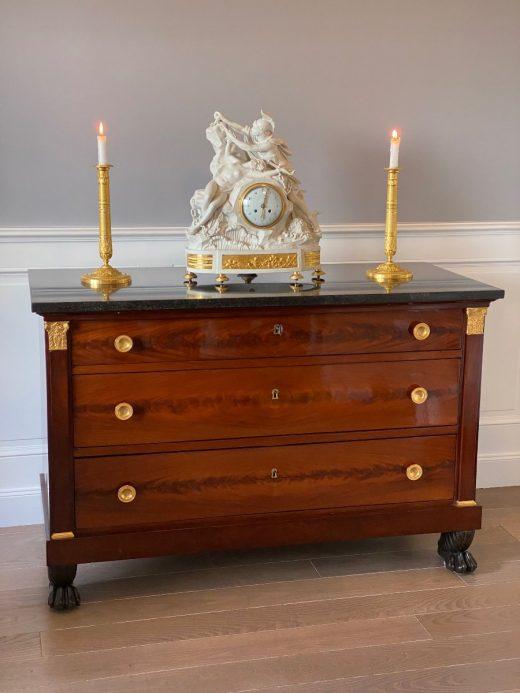
Restoration of a mahogany burl veneer commode with three drawers. Its straight uprights form Corinthian pilasters. The front feet are claw feet, while the rear feet feature three decreasing balls, known as a rosary. It is topped with a black Belgian granite slab. Finally, it has retained all its original gilt bronze mounts, as well as its trefoil locks and key. The gilt bronze mounts feature Corinthian capitals with projecting bird heads, palmettes, acanthus leaves, flowers, and scrolls. They also play on […]
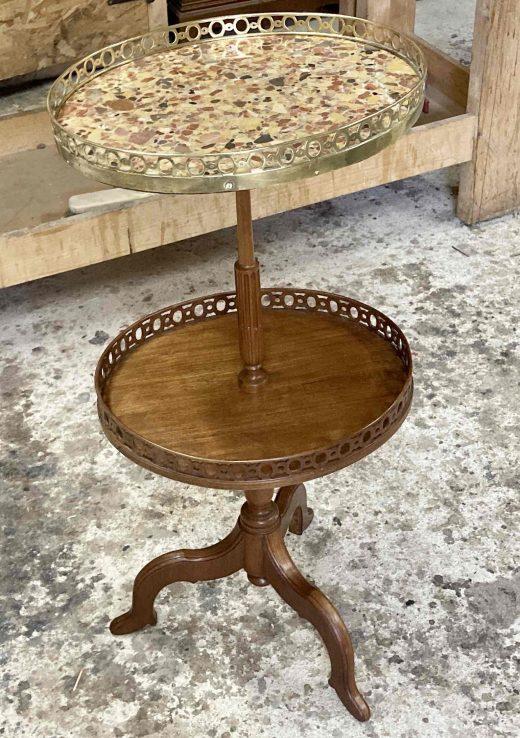
A minor restoration for this "shelf-sized" pedestal table, also known as a "dumb servant." It is made of solid and veneered mahogany, with an Aleppo breccia marble top. Furthermore, it bears the stamp of the equally renowned cabinetmaker to the Crown Furniture Repository, Jean-Henri Riesener. Jean-Henri Riesener: Does Jean-Henri Riesener (July 4, 1734 – January 6, 1806) even need an introduction? Indeed, he is the undisputed master of the Louis XVI style, due to the breadth and variety of his work. Above all, he is renowned for the quality and splendor of his furniture […]
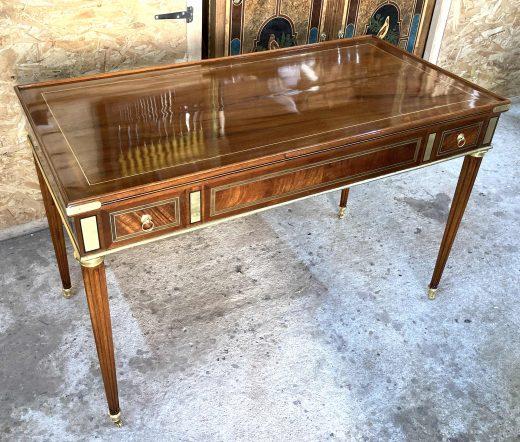
Restoration of a late 18th-century games table (circa 1785). It is veneered in mahogany burl, with inlaid stringing of brass, ebony, and ferreol. This South American wood is named after a 17th-century governor of Guyana. The legs are solid mahogany, and the interior is veneered with ebony and bone dyed green and natural. Its reversible top is leather-covered on one side and mahogany burl veneer on the other. The interior has two niches, a drawer on each side, and […]
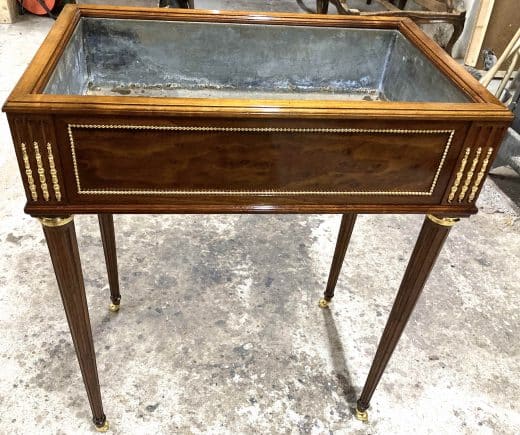
A little restoration for this Louis XVI jardinière in mottled mahogany veneer and solid mahogany for the feet. Simply regluing the joints, which had become slightly loose, restoring the varnish yellowed with age using a French polish, and re-gilding the bronze mounts were enough to give it a new lease on life. To see previous restorations: https://ebenisterie-mathieuvath.fr/en-ce-moment-a-latelier/
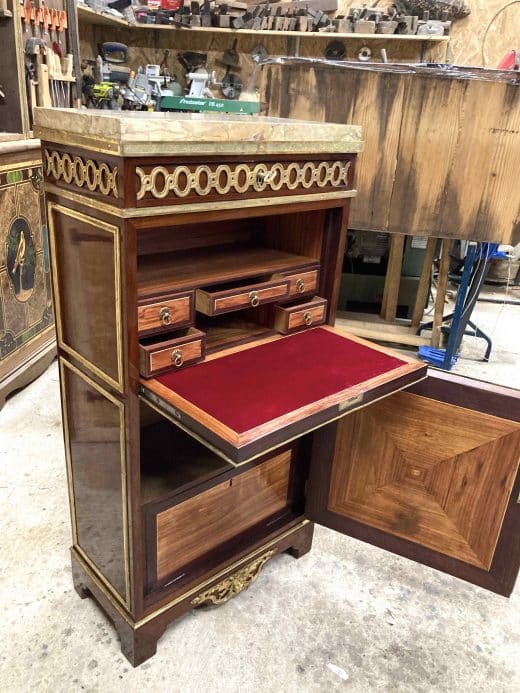
Restoration of a Louis XVI period lady's writing desk stamped by Martin Carlin JME. The frame is solid oak, with softwood for the drop-front and lower door. The exterior is entirely veneered in Honduran mahogany, except for the upper edge, which is embellished with a thin strip of amaranth. The interiors are veneered with rosewood, amaranth, and stringing of boxwood and ebony. Of particular interest: the upper interior compartment has never been restored and retains its original finish, a magnificent polish that has preserved its colors and luster […]
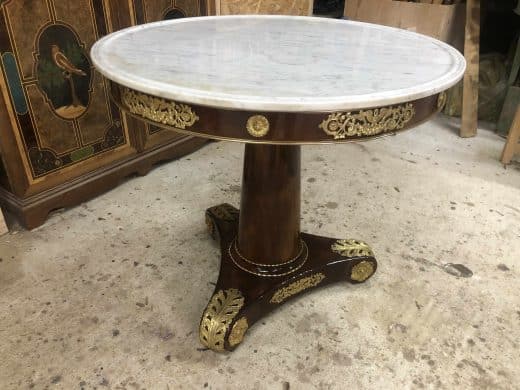
Restoration of an Empire period pedestal table, veneered in mahogany burl. It arrived at the workshop in rather poor condition. The bronze mounts were heavily soiled. There were also many structural separations and missing veneers. The restoration therefore consisted of re-gluing the structure and veneers under vacuum, with the injection of a penetrating adhesive for the upper apron and the central column. I removed the few old grafts that had been applied against the grain and replaced them with a better-matching veneer. I then reapplied the old varnish using a French polish and […]
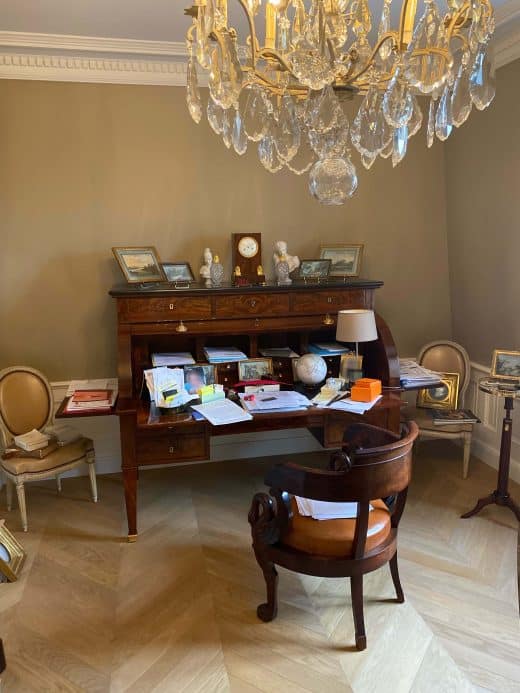
Restoration of a late 18th-century Directoire roll-top desk, veneered in mahogany burl on all four sides. It bears the mark CD or GD, which is unknown to me. Any information regarding it would be greatly appreciated! The piece is entirely constructed of oak, without a single piece of poplar, not even for the drawer pulls or panels. In the upper section, a cylinder reveals four small drawers surmounted by a niche. It also reveals a sliding writing surface and two side pull-outs, all lined with gilt leather tooled in small pieces. The […]
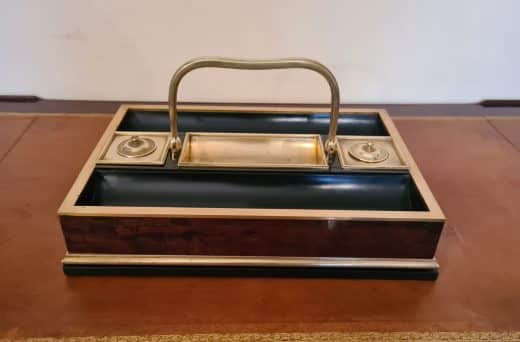
A small restoration for this very pretty Louis XVI style inkwell, stamped L.CUEUNIERES jne. Louis Cueunières the Younger established himself in 1870 at 10 rue Villehardouin, in Paris. He specialized in the restoration of antique furniture and the reproduction of period pieces. This inkwell was in fairly good condition. Apart from a few missing pieces of ebony, it was only dirty. A few ebony grafts, a good cleaning, and a touch-up of the varnish with a French polish were enough to restore its former luster. To see previous restorations: https://ebenisterie-mathieuvath.fr/en-ce-moment-a-latelier/ You can find this piece of furniture […]
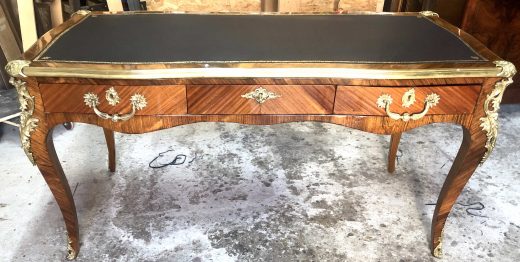
A second life for this Louis XV style desk, veneered in Rio rosewood (Dalbergia nigra) and African mahogany (Khaya). Besides the construction and tool marks, the presence of this African mahogany greatly facilitates its dating. This type of mahogany began arriving from the west coast of Africa at the end of the 19th century. It became ubiquitous in furniture production at the beginning of the 20th century. I first re-glued the structure and the joints, then the veneer "bells." I filled in the missing sections with sliced veneer, […]
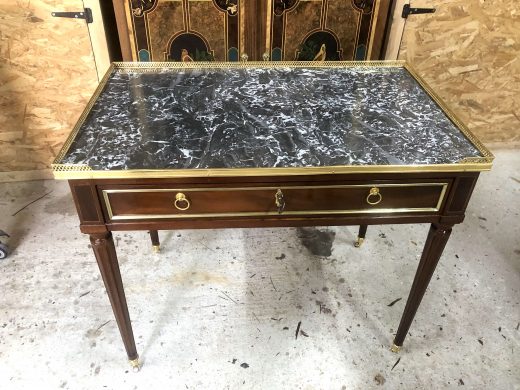
The dressing table, sometimes called a powder table, can be defined as a vanity unit in the form of a table or a small writing desk with drawers. This new type of furniture appeared around 1730, shortly after the commode. Moreover, it is often richly inlaid or veneered with precious woods. A powder table that also serves as a desk: This rather unusual powder table also serves as a desk, or at least a writing table. Its four legs are made of solid mahogany, and the crossbars are veneered with mahogany. In addition, it features wood and brass moldings […]
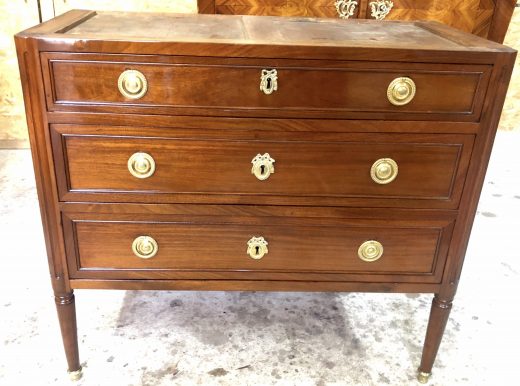
Jacques-Antoine Leclere (1744 – January 30, 1792) obtained his master craftsman's certificate in Paris on September 29, 1779. He worked on the rue du Faubourg-Saint-Antoine, then on the rue des Barres, and finally in the courtyard of the Jewish Quarter, a stone's throw from the Bastille. This cabinetmaker produced well-made Louis XV and Louis XVI pieces. He used rosewood, satinwood, mahogany, and also lacquer panels. His stamp can be found on secretaries, chests of drawers, and various small pieces of furniture. For example, a pair of Louis XVI half-moon commodes veneered […]
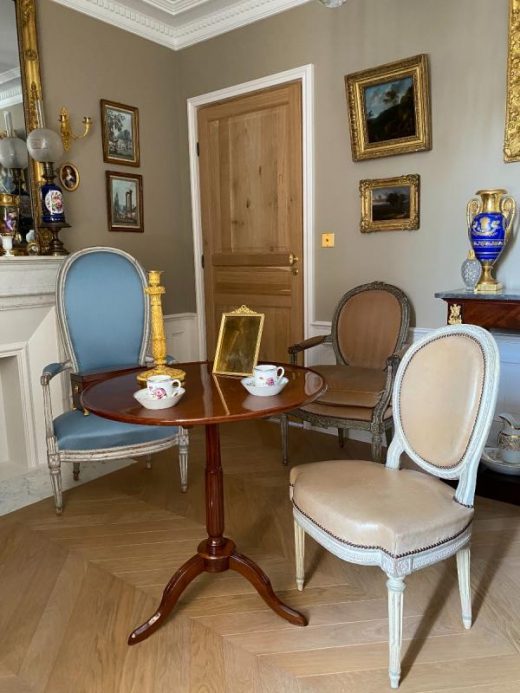
Very fashionable at the end of the 18th century, the cabaret table, or cabaret table, is characterized by a raised, basin-shaped top. Slightly hollowed out and edged with a rim all around, it safely holds tea, chocolate, and other beverages. This model, similar to those by the cabinetmaker Canabas, is made of solid mahogany from Saint-Domingue, with metal reinforcement under the legs. The biggest problem was the leg, which wobbled in all directions. So I mainly removed the screws added during a previous restoration, reconstructed […]
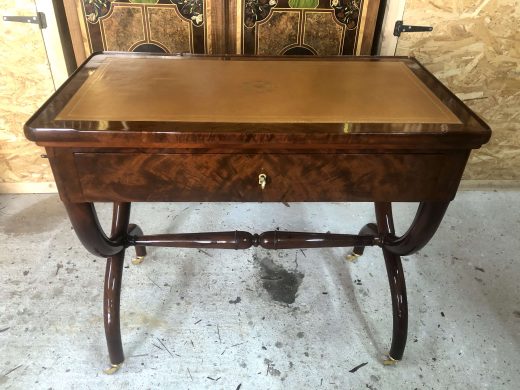
Here are some images of the restoration of this desk, with a solid mahogany base and mahogany burl veneer for the rest. Note that the recessed top is made from a single 12mm thick plank of solid mahogany burl. Here is the desk before restoration. The bulk of the work is on the legs. They are broken at the middle joint. They have already been repaired and are held together only by additional screws. Two cracks can be seen at the […]
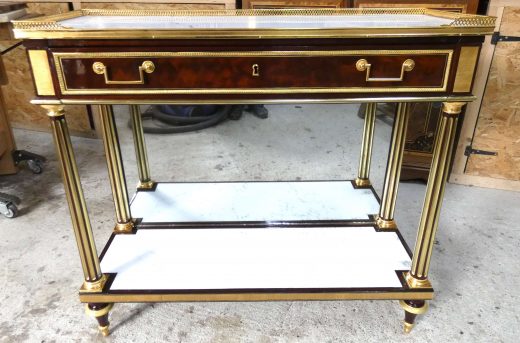
Restoration of a Louis XVI console table (1790-1795) stamped by Bernard Molitor. The frame is oak, and the legs are solid mahogany. The panels of the lower shelf are beech. It is veneered with mahogany burl and ebony and brass stringing. Originally from Luxembourg, Bernard Molitor (1755 – November 17, 1833) obtained his master craftsman's certificate in Paris on October 26, 1787. Arriving in Paris in 1776, he initially worked in a small workshop in the Arsenal district. After completing his master's degree, he established himself on the rue de Bourbon-Saint-Germain. The austerity of his work, […]
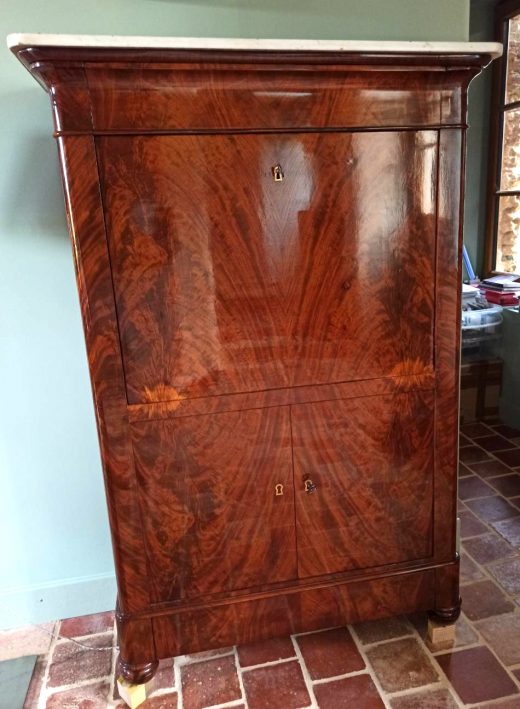
Restoration of a drop-front secretary desk from the Restoration period (1815–1830), veneered in burr mahogany and topped with Carrara white marble. The front legs are rounded and the rear legs are square. The frame is made of oak and softwood. An inventory mark (I91) is found inside the lower drawer on the right side. The Restoration style? After Napoleon's defeat at Waterloo on June 18, 1815, Louis XVI's two brothers regained power. The Count of Provence initially reigned as Louis XVIII (1815–1824). […]
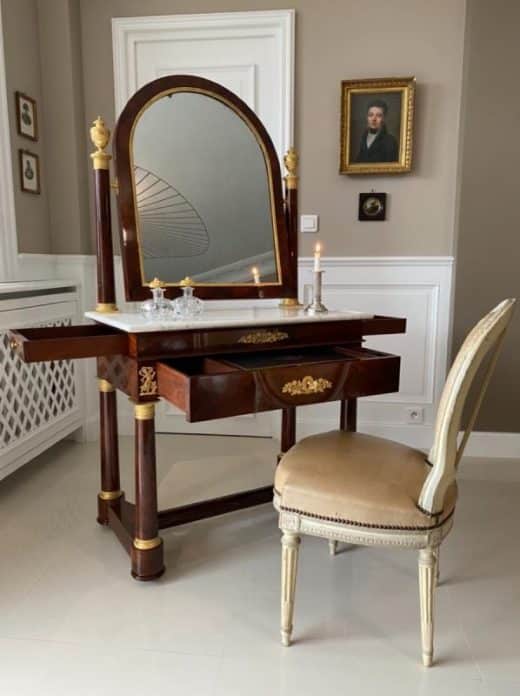
A beautiful restoration and, above all, conservation effort has been undertaken on this lovely Empire-period dressing table. Its frame is made of oak and poplar, veneered with mahogany burl. The drawer sides and bottoms are solid mahogany. It rests on four column legs ending in casters and joined by an H-shaped stretcher. The frieze opens with a central drawer, revealing a writing surface lined with blue morocco leather, a pen case, and two compartments for inkwells. Two large drawers on either side hold toiletries. […]
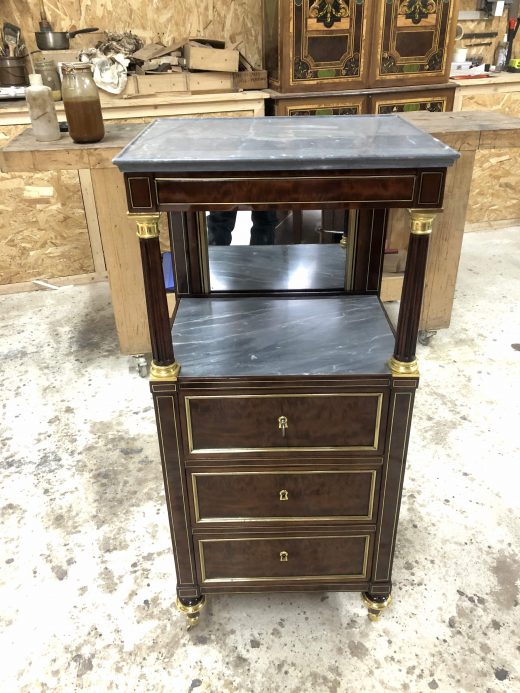
This elegant barber's cabinet in solid and veneered mahogany dates from the late 18th century. It rests on four tapered legs with casters and opens with three drawers in the front. Above, a niche with a blue Turquin marble top is framed by fluted columns. Next come two side drawers and a sliding marble top with a recessed base. Finally, this reveals a mirror that pivots on a rack and pinion mechanism, framed with ebony and brass stringing. Appearing during the reign of Louis XVI, the barber's cabinet is a piece of men's grooming furniture. Indeed, it holds the pitcher and […]
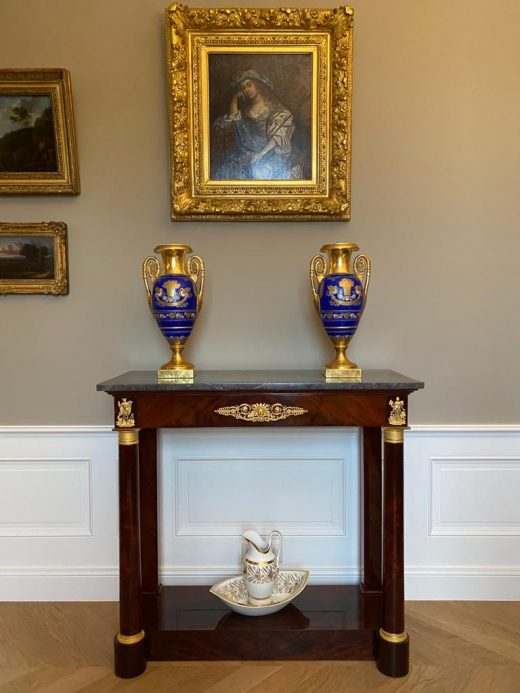
Here are some images of the restoration of this Empire-style console table. But first, a little history: do you know what a console table is and what its use was? Primarily a decorative piece of furniture, the console table was placed in the entrance hall of apartments or between two windows. The "console table," as it was called during the reign of Louis XV, was placed against the wall. Its marble top rested on two scrolled legs. During the reign of Louis XV, console tables were often elaborately crafted and adorned with highly elaborate motifs. Sculptures and reliefs, arched legs and curved fronts… Louis XV console tables […]
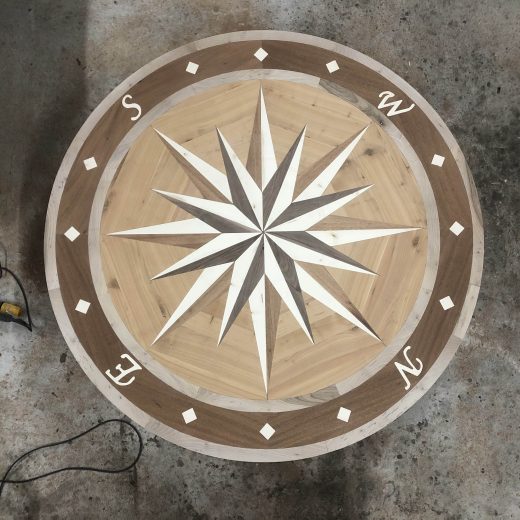
I'm creating a compass rose from 8mm solid wood, veneered onto 8mm plywood. The rose itself is made of maple, dark walnut, and sipo, while the background is cherry. The frieze and cardinal points are made of sapele, light walnut, and maple. It will be set into a solid walnut parquet floor. Unfortunately, I'm not doing the installation myself… I hope to see the final result and show it to you soon.
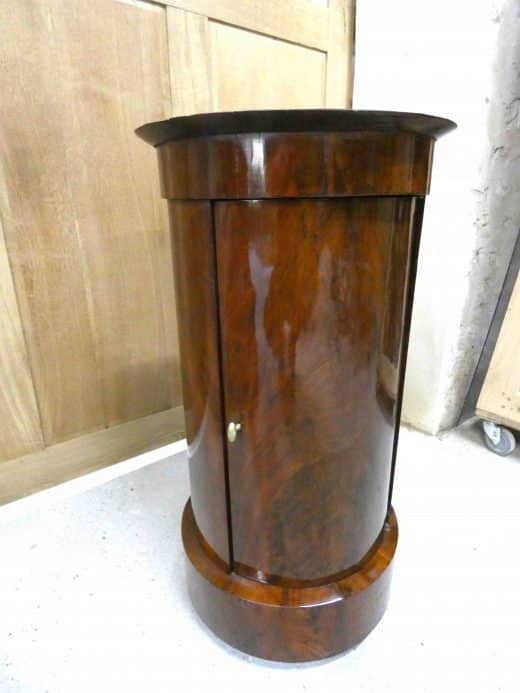
Restoration of an early 19th-century somno, veneered in Cuban mahogany burl. Let's be honest, previous restorations had done it a disservice. Indeed, the gaps and shrinkage in the wood had been filled with wood filler, then everything was disguised. The result: it was all you could see! But first, a little history. What is a somno? The somno appeared during the Consulate period. It's a small bedside table, round or square, with a closed compartment. Its name comes from the Latin word somnus, meaning sleep. Under the Empire, it […]
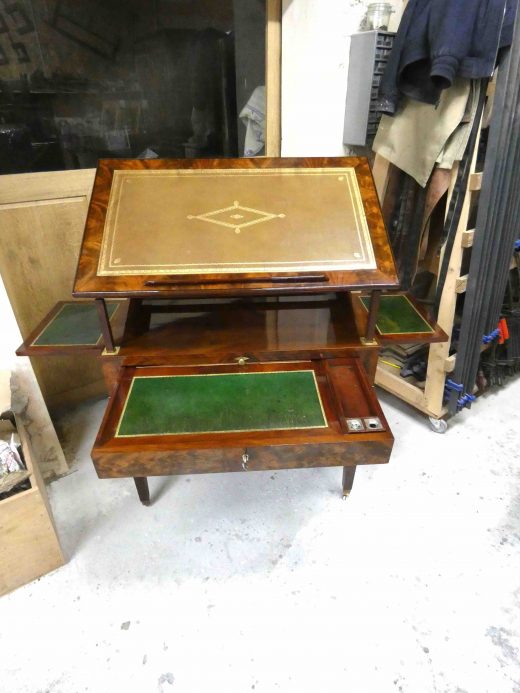
A little refresh for this lovely Tronchin-style table. Apart from a missing molding and a few small areas of missing veneer on the legs, nothing serious. A fresh coat of varnish was all it took to give it a new lease on life. But do you know where this type of table comes from, and what it was used for? This table owes its name to Théodore Tronchin (1709-1781), a Genevan physician. At the time, he published works on bone diseases caused by poor posture at the desk. He praised […]
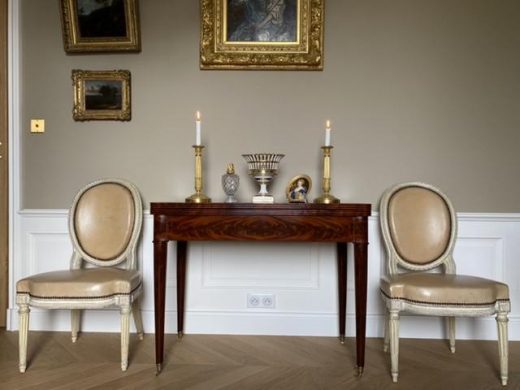
96 x D 47.5 x H 74 cm. Open: 96 x 95.5 cm. Restoration of a folding games table, veneered in burr mahogany commonly known as Cuban mahogany. According to the recent book "L'essence du bois" (The Essence of Wood) by Patrick George, Emmanuel Maurin, and Marie-Christine Trouy-Jacquemet, it would be more accurate to call it Saint-Domingue mahogany. The base is veneered in solid oak, and the top in poplar. The moldings are solid mahogany. The table rests on tapered legs ending in bronze casters. Under the […]
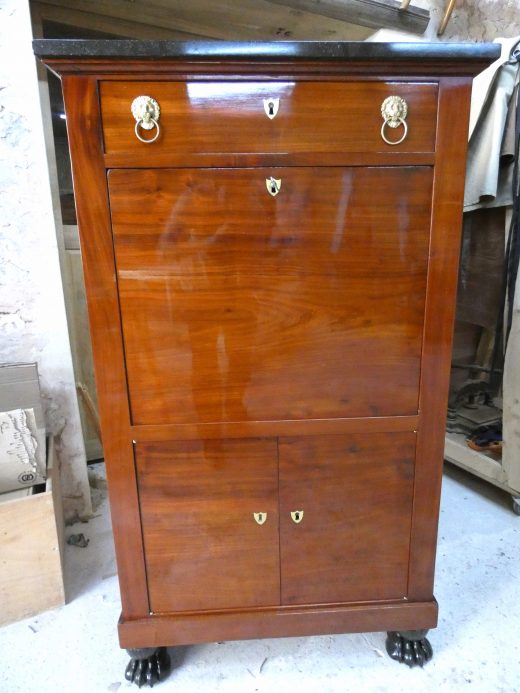
Here is a secretary desk in the most understated style of the Directoire period. Its frame is made of solid beech and conifer, and it is veneered with mahogany and mottled mahogany. It is very simply adorned with bronze handles in the form of a lion's head holding a ring in its mouth. The keyhole escutcheons are in the form of a shield. The interior has seven drawers, the middle one of which locks. The drop-front closes with a period three-point lock. The lower section has three drawers, onto which Louis XV style pull rings have been added.
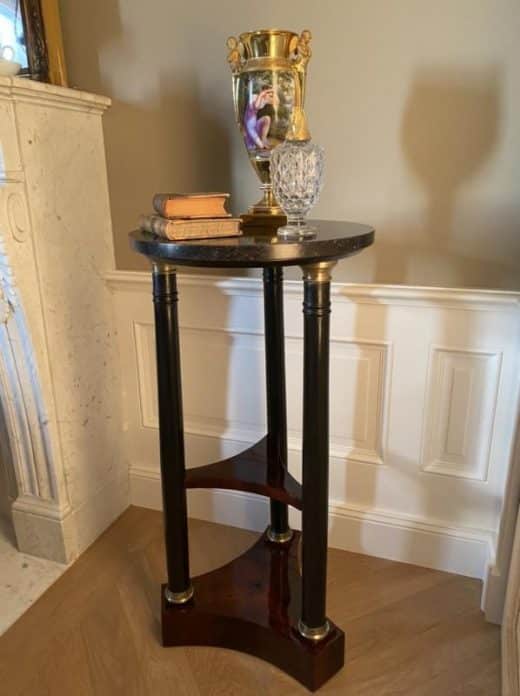
Restoration of a side table with walnut legs and frame, veneered in flame mahogany. It rests on three slender columns, adorned with bronze rings and surmounted by a circular top of veined black marble. The restoration consisted of tightening the cracked base, re-gluing the edge veneers, and applying some grafts. I stripped the columns, which were heavily infested with wood-boring insects, and then treated them with static anoxia. Static anoxia is an insecticidal treatment that works by depriving the wood of oxygen and also has an effect on […]
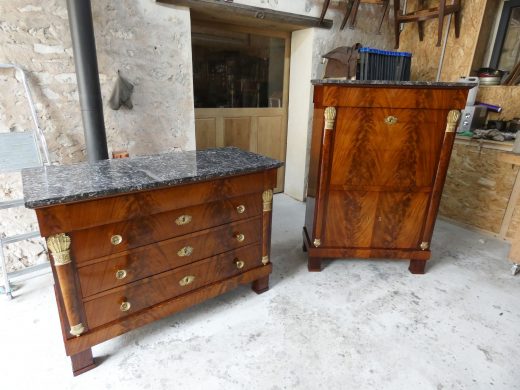
Do you remember the Empire chest of drawers with the quivers? Well, here is the secretary desk with the quivers. It is built in exactly the same way as the chest: same construction, same solid woods used, and same mahogany veneers. The restoration is identical to that of the chest of drawers. The goal: to preserve as much as possible and restore the piece to its function without altering its history. So I re-glued the structure and the few detached veneers, then added some mahogany burl grafts. Finally, the hinges of the drop-front had to be reinforced […]
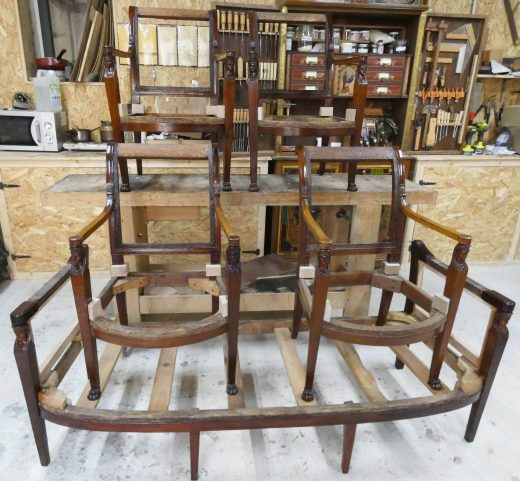
Extensive restoration and conservation work has been undertaken on this bench and its four armchairs from the Consulate period, stamped Jacob Frères, rue Meslée. Their front and rear legs are made of solid Cuban mahogany, with veneered crossbars. The armrests, supported by Egyptian heads, are made of light mahogany from Santo Domingo, contrasting with the uprights. They are adorned with carved palmettes and rosettes in Cuban mahogany. The front legs are tapered and end in claw feet, while the rear legs are arched. The bench is a converted sofa. Due to reupholstering […]
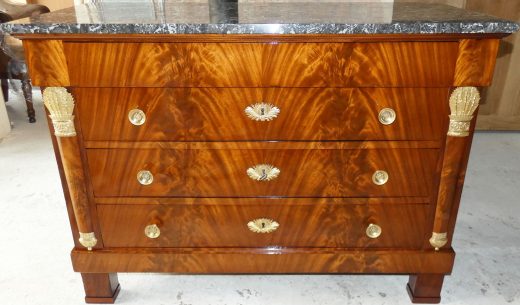
This week, here are some photos of the restoration of this Empire-style chest of drawers veneered in mahogany burl. Its originality lies primarily in the quality of its bronze mounts. Indeed, together with the side columns, they form quivers. Furthermore, the keyhole escutcheons feature two crossed laurel branches tied with a ribbon. Originally, the bronze mounts were mercury-gilded, as evidenced by the gilding stains on the back. Unfortunately, only a few traces remain on the visible surface. Moreover, it is all the more unique because I must […]
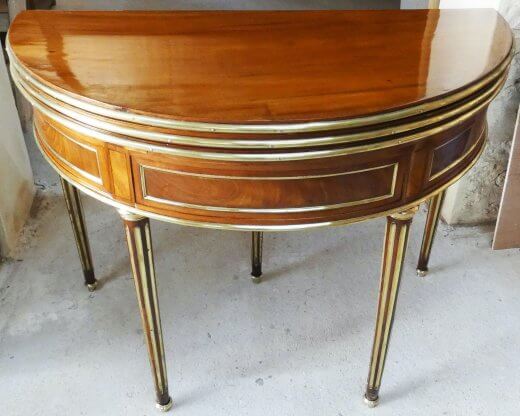
Here is a three-tiered half-moon table. This style of table, originating in England, is a classic of the Louis XVI style. It opens to reveal two circular tiers, one lined with felt, the other veneered in mahogany. Its apron, veneered in mahogany burl, is adorned with brass frames. It rests on five tapered legs, fluted and trimmed in brass, ending in sabots. The fifth leg is attached to a drawer: it is pulled out to support the drop leaf when unfolded. A very attractive piece, probably dating from the late 18th century. […]
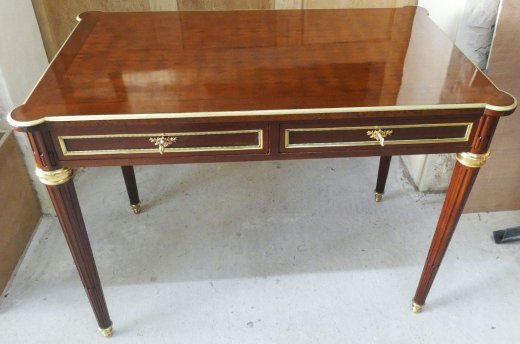
This desk is exquisitely crafted, with its oak frame veneered in mahogany and its solid mahogany legs. It is, in fact, a perfect example of high-quality 19th-century furniture. Indeed, the cabinetmaking is flawlessly executed, and the bronze mounts are in perfect condition. In short, everything is there; nothing is missing. The Krieger firm began its cabinetmaking business in the mid-19th century with Antoine Krieger (1804-1869). It then added a significant decorative department, which ensured its prestige until around 1945. Thus, it produced all […]
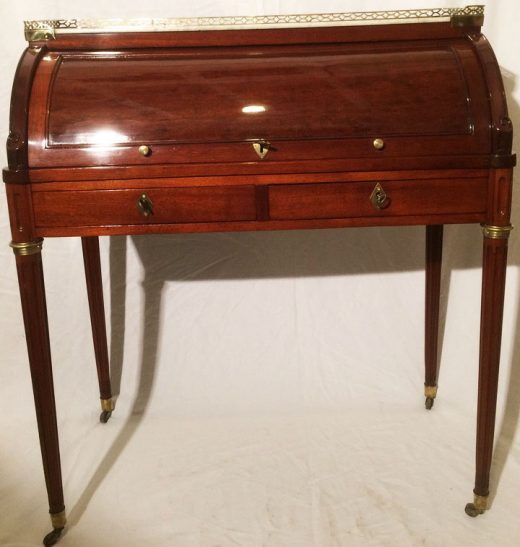
DIMENSIONS: H.71 W.104 D.52 This roll-top desk perfectly matches those produced by Nicolas Petit's workshop between 1770 and 1791, the year of his death. Indeed, with a few exceptions, Nicolas Petit primarily crafted this type of furniture in molded mahogany, on fluted legs and with white marble tops. Their understated elegance reflected the taste of the period. It features two drawers in the frieze, two pull-out side shelves, and a central shelf that locks when the drop-top is closed. Furthermore, the interior contains two drawers, the one on the right […]
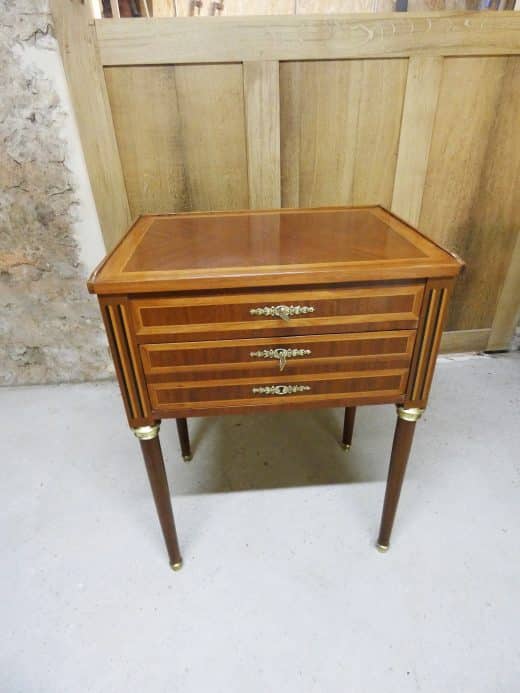
Here are some photos of the restoration of a small Louis XVI style work table from the late 19th century. Its legs are made of solid mahogany. Furthermore, its veneer combines rosewood and sapele, with blackened pearwood and boxwood for the fluting and stringing. Nothing too serious for this pretty little piece of furniture: just a few missing veneer patches and a small chip on the oak side of the drawer. A simple restoration: a few veneer grafts glued in place […]
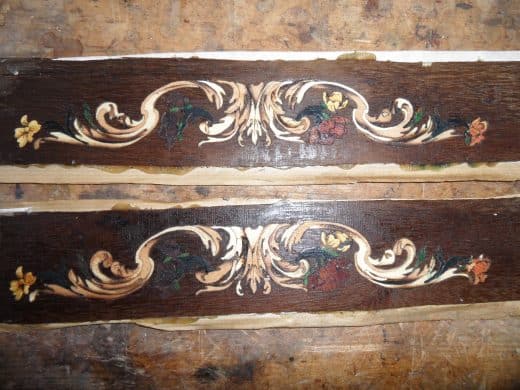
To kick off the new year, I'm excited to present my new project. I'm embarking on a replica of this box attributed to André Charles Boulle. You'll be able to follow the progress, and even come see it in person: it will be my main subject for marquetry work at shows and events in the coming years. Yes, I'm talking about several years, because it's an extremely lengthy process. Choosing the Woods: First, I had to find and select the woods for the marquetry. The background […]
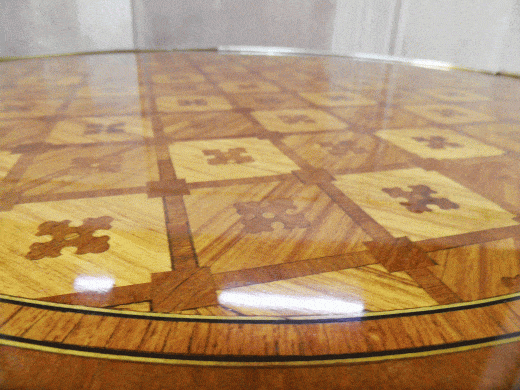
Here is a Louis XVI style table, which is probably an early 20th-century piece. It was likely made in the Faubourg Saint-Antoine, or perhaps at the École Boulle. I have seen apprentice furniture of this quality made by students during their training. Its frame is oak, while the veneer is rosewood and mahogany with a black inlay. The restoration was straightforward, apart from a lack of rosewood in the marquetry […]
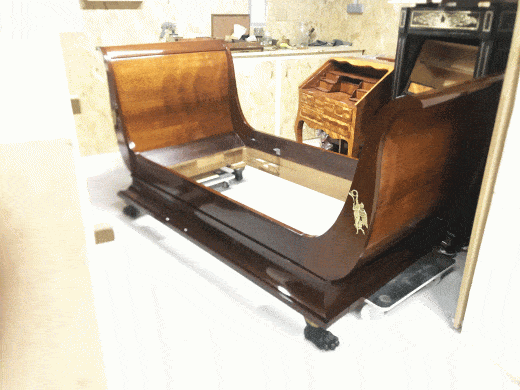
The "boat" bed, with its characteristic curve, is a French invention that appeared during the Directory period. It then became very fashionable during the Empire and the Restoration. Here, the Empire style is recognizable by its lion's paw feet. Two mahogany pieces. However, the varnish on this bed had worn away, so that the two pieces of mahogany that make it up were no longer distinguishable. The restoration. The biggest task was therefore to revarnish the bed: a major undertaking, given the surface area to cover. But it was necessary […]
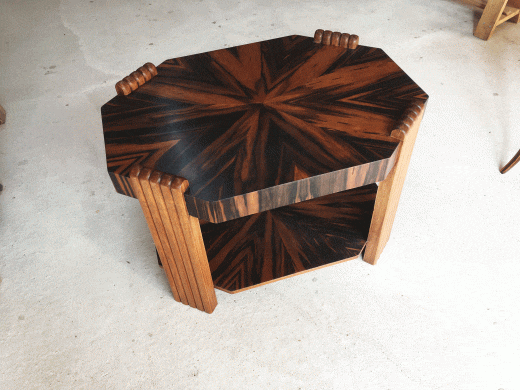
Here is a table in pure Art Deco style. It is veneered with Macassar ebony, and its legs are mahogany. It probably dates from the 1920s. Louis Majorelle is best known as one of the great cabinetmakers of Art Nouveau. It is too often forgotten that he was also one of the forerunners of Art Deco, as this table perfectly demonstrates. As for restoration, as always, the veneer requires the most work: there are gaps, it is peeling… But the most difficult thing on this table is the […]
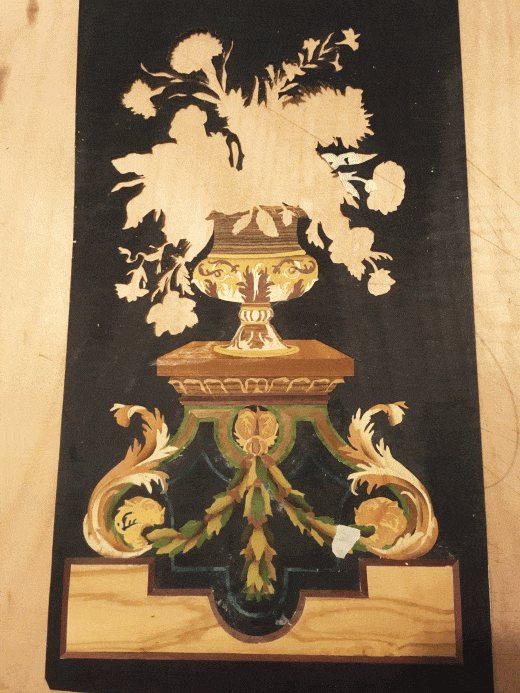
For these marquetry designs, I consulted Pierre Ramond's book, "André-Charles Boulle, Cabinetmaker, Chaser, and Marquetry Maker to the King." I used the marquetry drawings from the Boulle workshop's cabinet (circa 1715-1720). However, I removed the birds and the butterfly to simplify the design. Furthermore, I partially used the "Boulle" method for the acanthus leaves and the vase. Finally, for the flower bouquets, I chose the technique of painting on wood.