Regency Cartel

cartel boulle

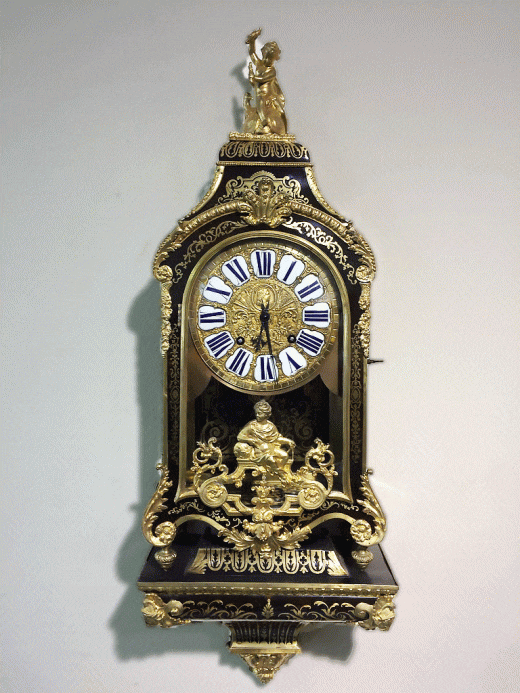
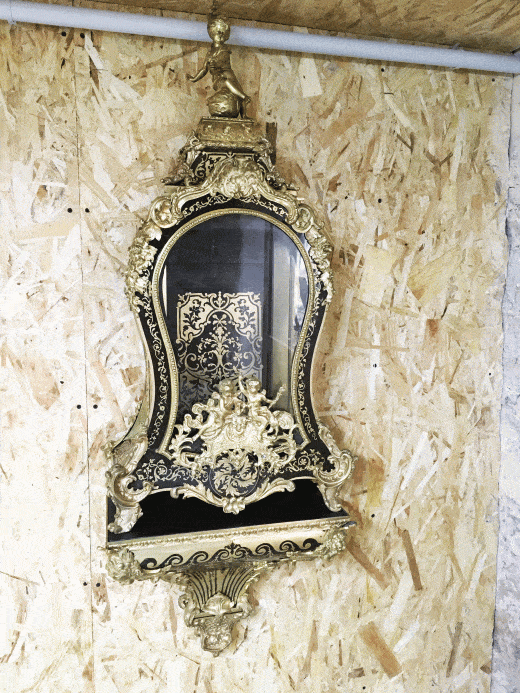
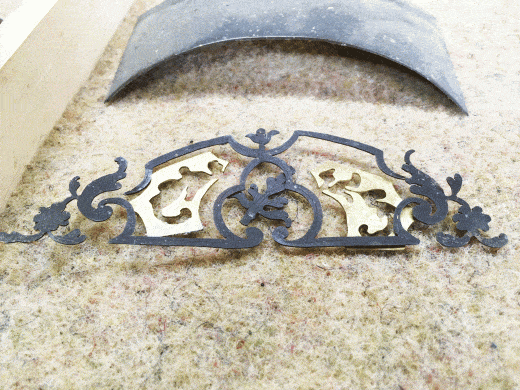
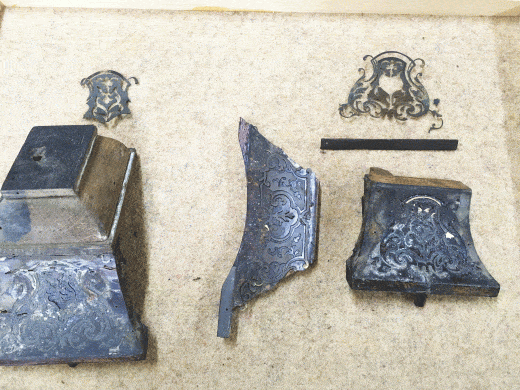
A classic restoration was carried out on this Regency-era Boulle marquetry cartel clock in tortoiseshell. The missing brass pieces were replaced, and all the marquetry was re-glued using fish glue and vacuum infiltration. The entire piece was then varnished with a clear French polish, and the bronze mounts were cleaned with Panama wood.

J.STUMPFF Roll-Top Desk

Ebénisterie Mathieu VATH

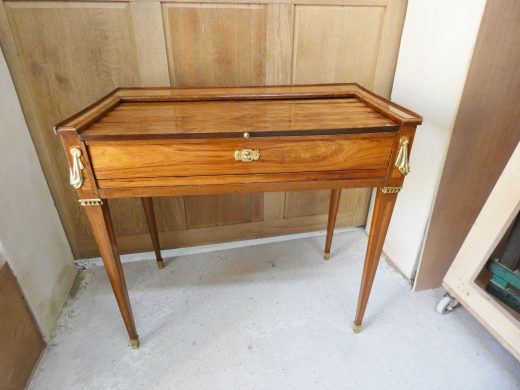
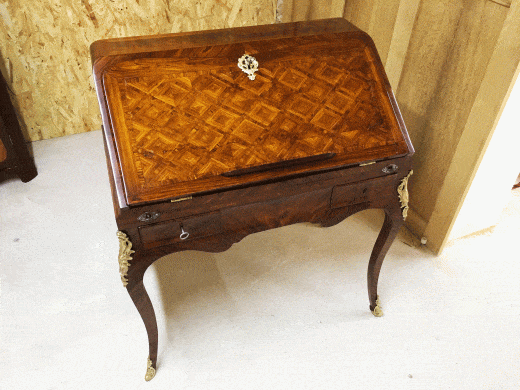
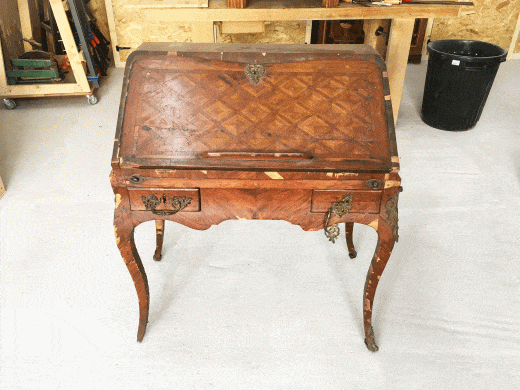
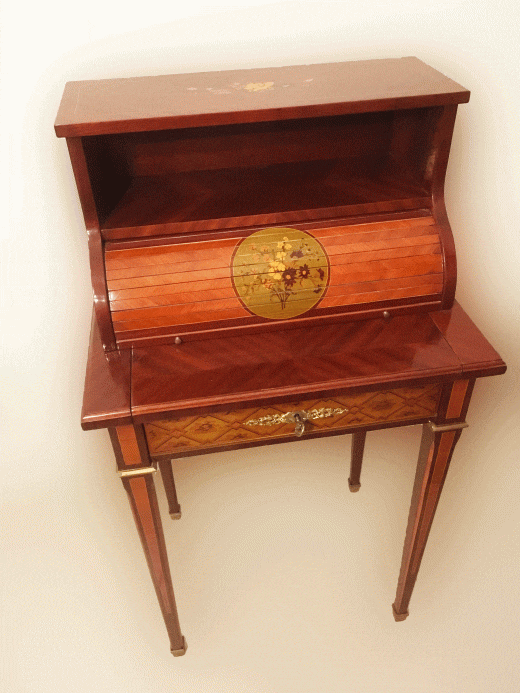
Restoration and conservation work on this rare Louis XVI period roll-top desk stamped by Jean-Chrysostôme Stumpff. 1731 - January 17, 1806 – Master craftsman on August 27, 1766. Originally from Schweigern, Swabia (Germany), he married in 1760 in Paris, at the Swedish embassy, like most of his compatriots of the Reformed faith. His fellow cabinetmaker Ferdinand Scherdfeger was a witness at the wedding. It was in his workshop on Rue Saint-Nicolas that he produced some Louis XV style furniture, but primarily a large number of transitional and Louis XVI pieces. The large […]

Secrétaire Pendjari

Ebénisterie Mathieu Vath

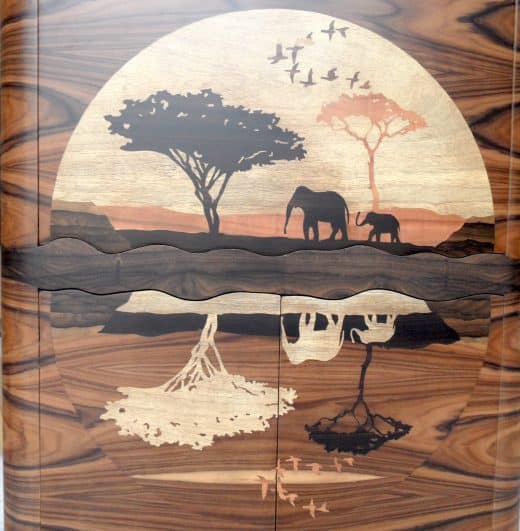
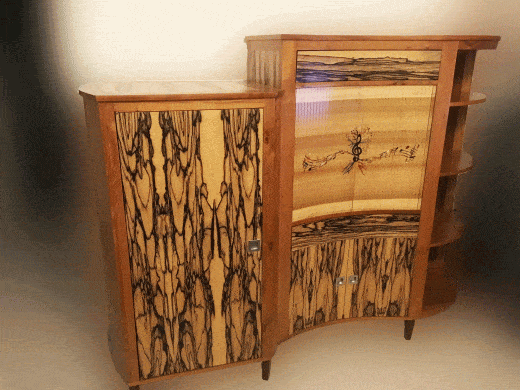
Sur le thème de l’Afrique, ce secrétaire explore les paysages du parc national de Pendjari au Bénin. Sa structure est en chêne et en orme du Perche. La marqueterie extérieure composée de placage de palissandre, de koto bleutée, de satinée red gum, de ziricotte et d’ébène de Macassar évoque des reflets aquatiques et la faune sauvage africaine. Avec un système unique de verrouillage magnétique, grâce à sa clé en forme de tête d’éléphant, aucune entrée de serrure ne vient  perturber le tableau de marqueterie qui compose ce meuble. A l’opposé […]

Napoleon III style Louis XVI work table

Ebénisterie Mathieu VATH

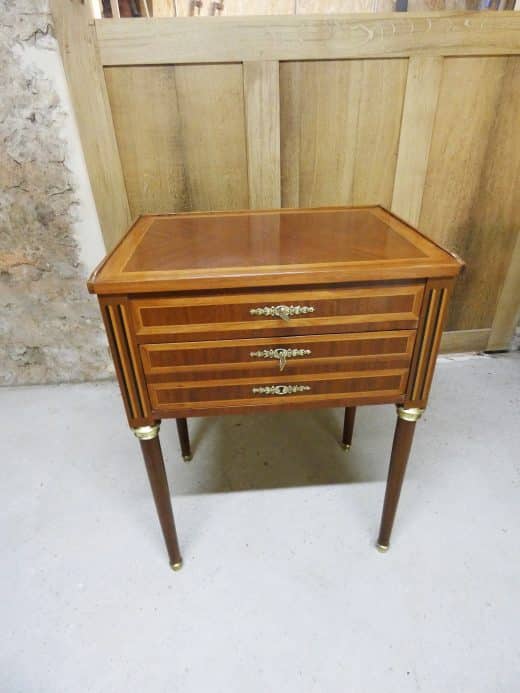
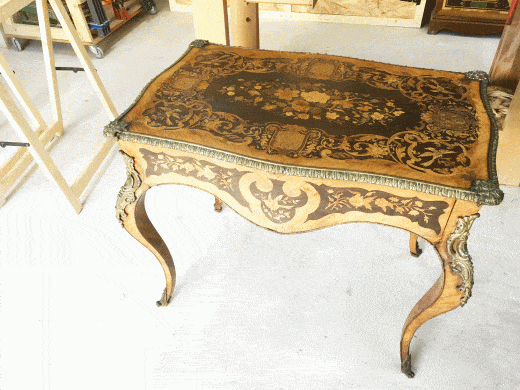
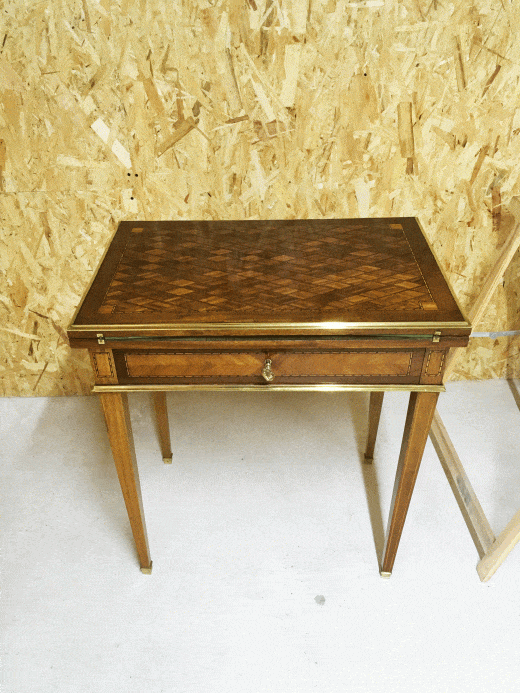
A few photos of the restoration of a small Louis XVI style work table from the late 19th century. The legs are solid mahogany, and it is veneered with rosewood, sapele, blackened pearwood, and boxwood for the fluting and stringing. Nothing too serious for this pretty little piece of furniture, which only had a few missing veneers and a small chip on the side of the oak drawer. A simple restoration: a few veneer grafts glued with hot glue, a light cleaning of […]

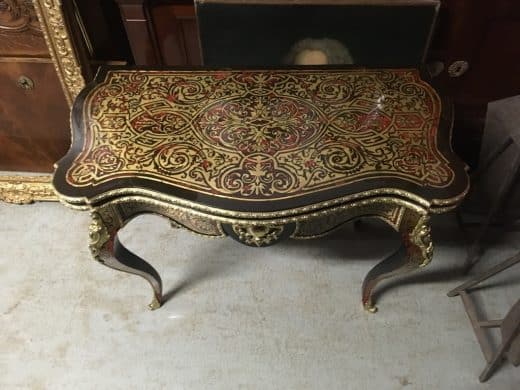
Napoleon III Boulle marquetry side table

Ebénisterie Mathieu VATH

Restoring this piece of furniture is a classic. The door was warped and almost all the brass inlay was missing. Its main advantage was that the marquetry on the door was fairly well preserved, apart from a small amount of missing brass and a few pieces of dyed horn. Nothing too serious. So I started by removing the bronze mounts, then I remade and glued all the missing inlays, reattaching those that were still there in the process. Next, I tackled the door. After removing the veneer […]

Cabinet from the late 17th century

Ebénisterie Mathieu VATH

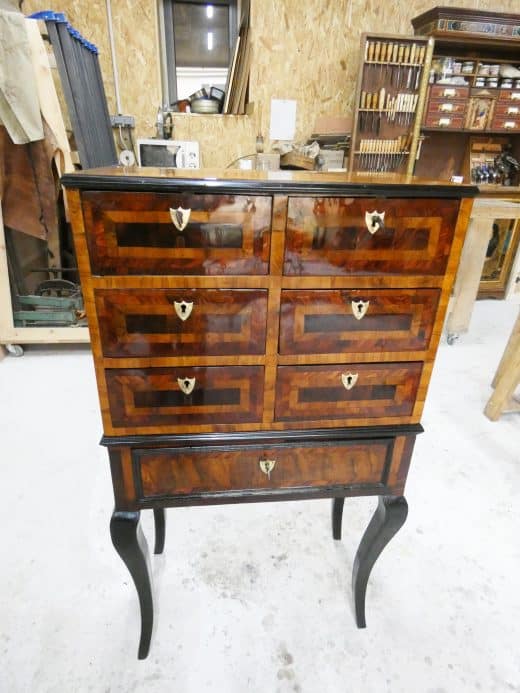
Don't be fooled by the Directoire-style keyhole escutcheons on this cabinet, as it dates from the late 17th or early 18th century. The keyhole escutcheons are clearly not original. In fact, very few elements remain original to this piece of furniture apart from the drawers, the frame, and the base. The veneer on the front, sides, and top has been altered. It's quite clear that the locks have been changed and the escutcheons filled in. This piece is entirely made of […]

Chest of drawers in the style of the Axe

Ebénisterie Mathieu VATH

Here are some photos of the restoration of a solid walnut commode, veneered with thuya burl inlay and Greek key stringing in amaranth and boxwood. The drawers and the interior and back panels are made of fir. Despite the curved stretcher, its shape, and its feet, this commode is indeed in the transitional style but from the Louis XVI period. In the title, I wrote "in the style of the Hache family" because it is certain that this commode originated in the Dauphiné region. But whether it is a product of the famous […]

Louis XVI commode stamped JA BRUNS

Ebénisterie Mathieu VATH

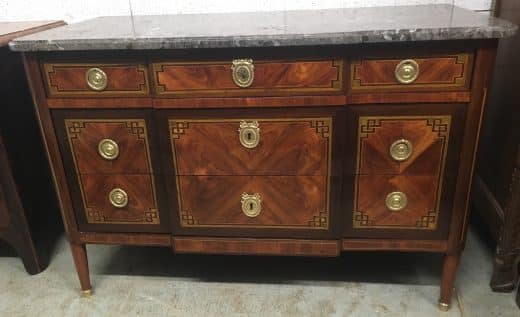
This week marks the completion of the restoration of a Louis XVI commode stamped JA BRUNS. It is made of oak for all the structural elements, except for the side panels, drawer backs, drawer fronts, and the two drawer bottoms, which are made of softwood. It is veneered with rosewood in a butterfly pattern and amaranth for the edges. The false fluting is made of boxwood and ebony, and there is a green-stained maple stringing forming the corners at […]

Label signed "Louis David Carré in Paris"«

Ebénisterie Mathieu VATH

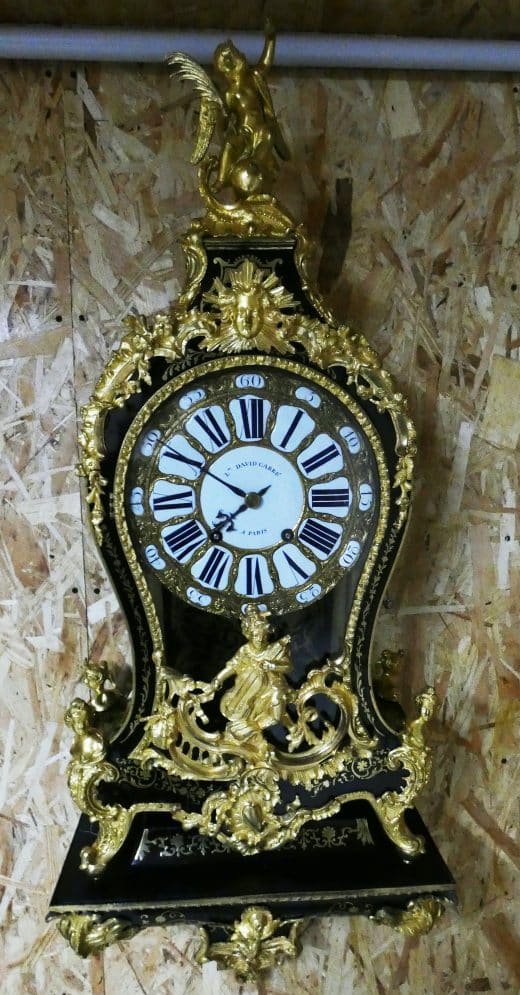
After several weeks of work, the restoration of this clock is finally complete. It is a Louis XV period clock in brown tortoiseshell and brass marquetry, with rosewood restorations. The dial is by Louis David Carré, nephew of Jullien le Roy, who became a master craftsman on December 31, 1748. Lodged at the Louvre from 1744, he was elected a juror in 1775. The greatest treasure of this clock lies in its bronze mounts. They are truly magnificent, and above all, they are in very good condition. There is only […]

Secretary stamped P.ROUSSEL JME

Ebénisterie Matheu VATH

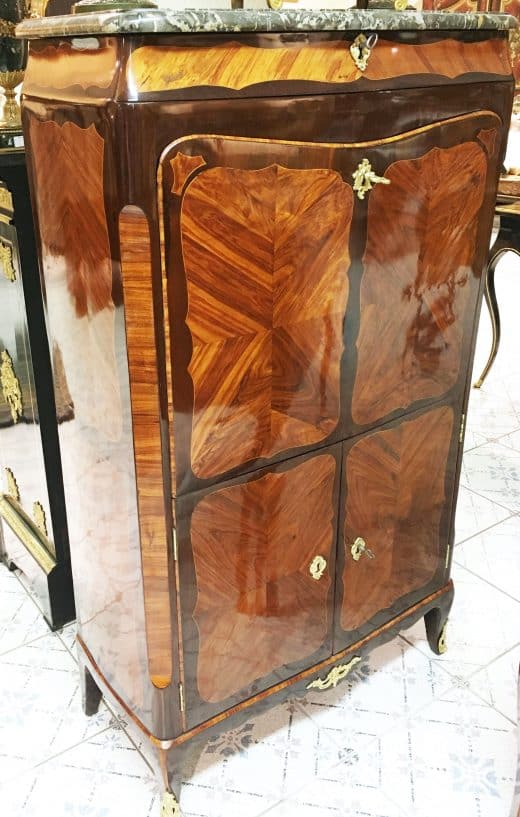
Here are some images of the restoration of a secretary desk stamped by Pierre Roussel (1723-1782). Having become a Master Cabinetmaker in 1745, Pierre Roussel set up shop on Rue de Charonne, in the Faubourg Saint-Antoine, under the sign "L'Image de Saint Pierre" (The Image of Saint Peter). Thanks to his skills as a cabinetmaker and especially as an exceptional marquetry artist, he quickly gained a great reputation. In 1762, he became a sworn member of his guild. By 1767, he was considered one of the best cabinetmakers of his time. Highly regarded by his colleagues, he became a representative of the cabinetmakers' guild in 1777 and then syndic two […]

Mazarine Chest of Drawers

Ebénisterie Mathieu VATH

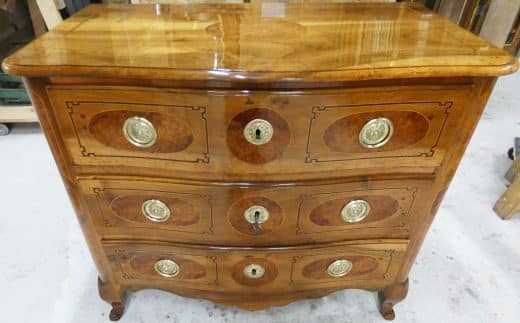
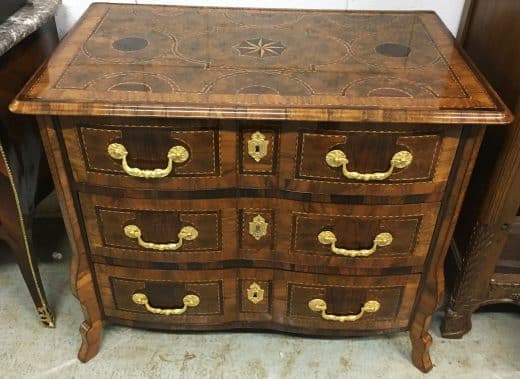
Here is a charming Mazarine commode from the Louis XIV period. With a serpentine front and three drawers in three rows, it is topped with a marquetry top featuring a compass rose on an end-grain wood background. Constructed on a fir frame, it is covered with a beautiful olive veneer, with both end-grain and grain-grained veneer, rosewood, ash on the sides, and boxwood for the stringing and compass rose. The crossbeams are joined with straight dovetail joints on the sides, which has caused some minor imperfections.

Louis XVI style sewing box

Ebénisterie Mathieu VATH

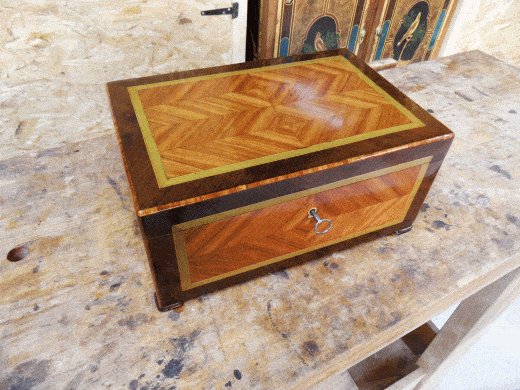
This sewing box dates from the Napoleon III period. The frame is made of softwood. The veneer is composed of Rio rosewood, mahogany for the interior, and a green-stained boxwood and maple inlay. The great quality of this box is that the lid hasn't warped. This is often the major problem with this type of furniture, as people forget to lock them, causing the wood to warp. It then becomes very difficult to find the "trick" to ensure the box stays closed.

Boulle box

Ebénisterie Mathieu VATH

To kick off the new year, I'm excited to present my latest project. I'm embarking on a replica of this box attributed to André Charles Boulle. You'll be able to follow its progress and even come see it in person, as it will be my main subject for marquetry work at various exhibitions and events over the next few years. And yes, I'm talking about several years, as it's an extremely time-consuming project. But first, I had to find and select the different types of wood that make up the […]

Louis XVI style table

Ebénisterie Mathieu VATH

Here is a Louis XVI style table, which is probably an early 20th-century piece. It was likely made in the Faubourg Saint-Antoine, or perhaps at the École Boulle. I have seen apprentice furniture of this quality made by students during their training. Its frame is oak, while the veneer is rosewood and mahogany with a black inlay. The restoration was straightforward, apart from a lack of rosewood in the marquetry […]

Empire bed

Ebénisterie Mathieu VATH

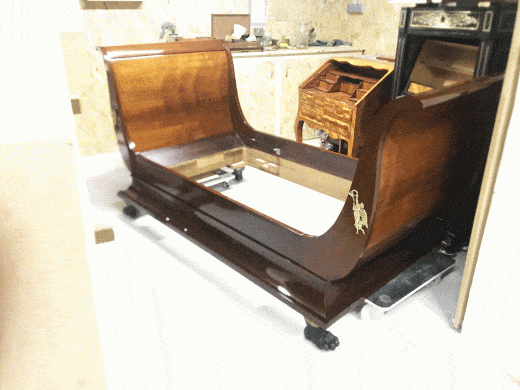
The "boat" bed, with its characteristic curve, is a French invention that appeared during the Directory and was very fashionable during the Empire and the Restoration. It is easily recognizable here by its lion's paw feet. The varnish on this bed had worn away, making it impossible to distinguish between the two mahogany pieces. The mahogany is known as Cuban mahogany (Swietenia mahogani), from Cuba, a Spanish colony. Evidence of its importation into Spain, specifically Seville, dates back to 1519-1520. It was used by Philip II between 1563 and 1584 during the construction of the Palace […]

Secretary Napoleon III

Ebénisterie Mathieu VATH

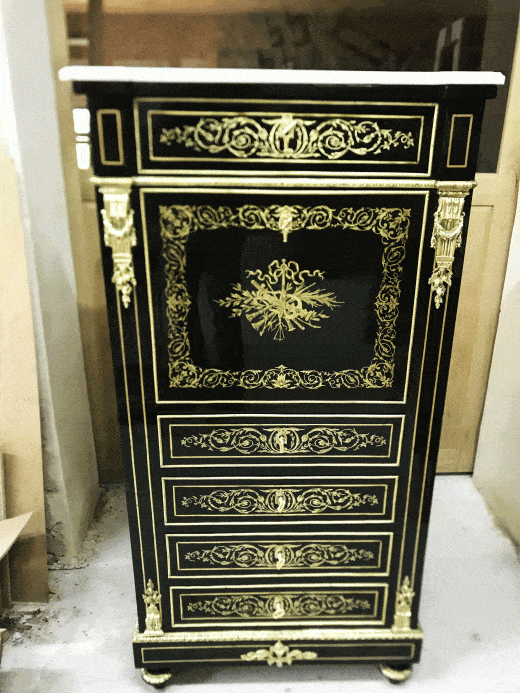
On the restoration side, there wasn't much to do: the brass fittings were reattached with fish glue and by infiltration, then stripped and varnished. The most difficult part of this type of furniture is the black stain. Over time, pear wood darkens, loses its color, and turns gray. It then needs to be stained, without, of course, obscuring the brass. To do this, I fill and polish the piece until the brass becomes a true mirror. Then, I apply a hot logwood stain, and then […]

Louis XV slant-front desk (After restoration)

Ebénisterie Mathieu VATH

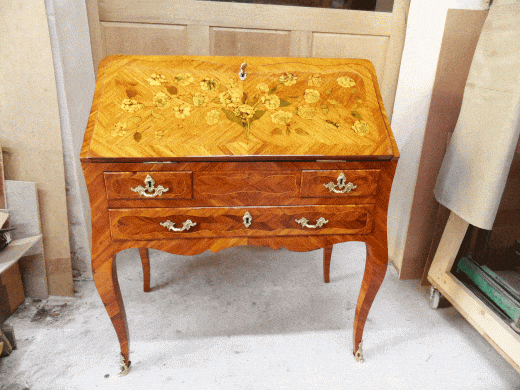
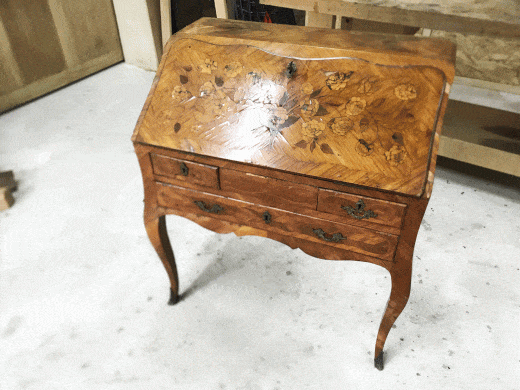
A while ago I told you about this desk that was being restored. Well, here it is finished. The varnishing process took three weeks. This allowed enough time for the varnish to set properly, in order to achieve the best possible result. https://ebenisterie-mathieuvath.fr/en-ce-moment-a-latelier/ So here are some before and after photos.

Louis XV slant-front desk

Ebénisterie Mathieu VATH

The restoration of a lovely slant-front desk, or as Riesener calls it in his memoirs, a "tomb-shaped secretary," began two weeks ago. With the restoration phase complete and the varnishing underway, I'm taking a moment to provide a brief summary of the project. The desk's frame is made of oak and fir, veneered with rosewood and violet wood, and the drop-front features floral marquetry of boxwood, natural and stained maple, and hornbeam. It includes a large drawer […]

Corner cabinet in Boulle marquetry from the Napoleon III period

Ebénisterie Mathieu VATH

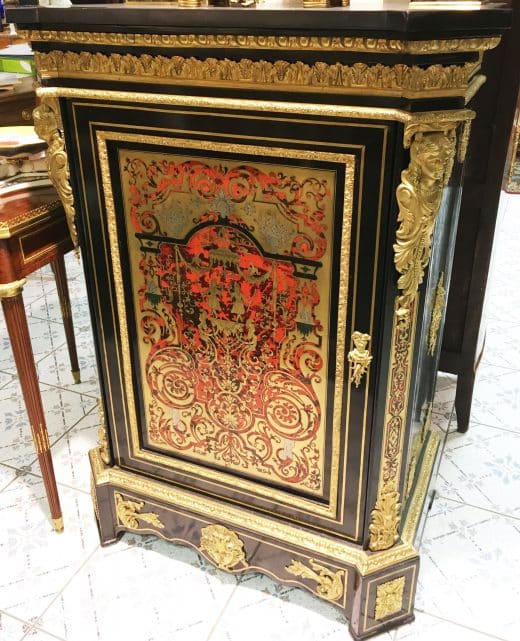
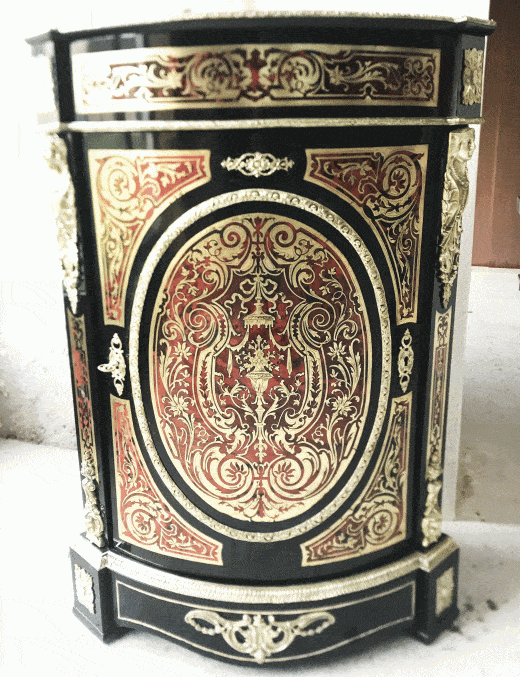
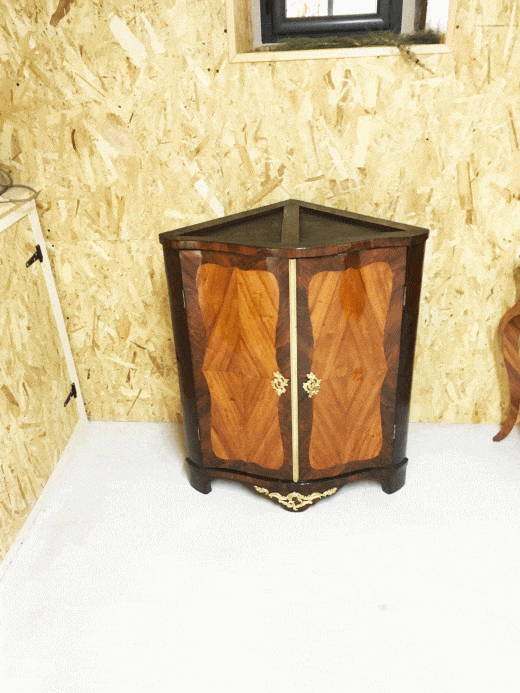
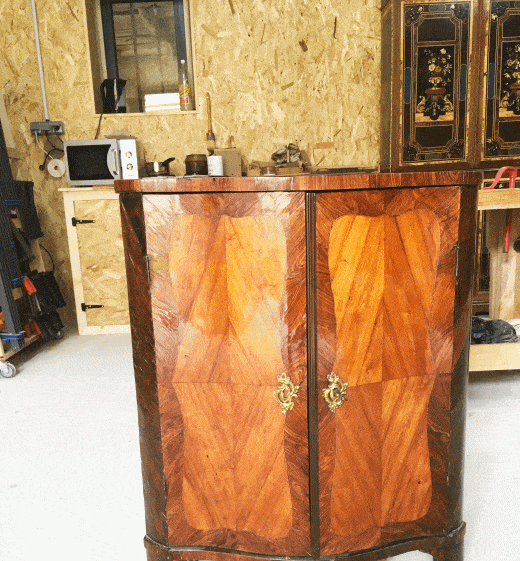
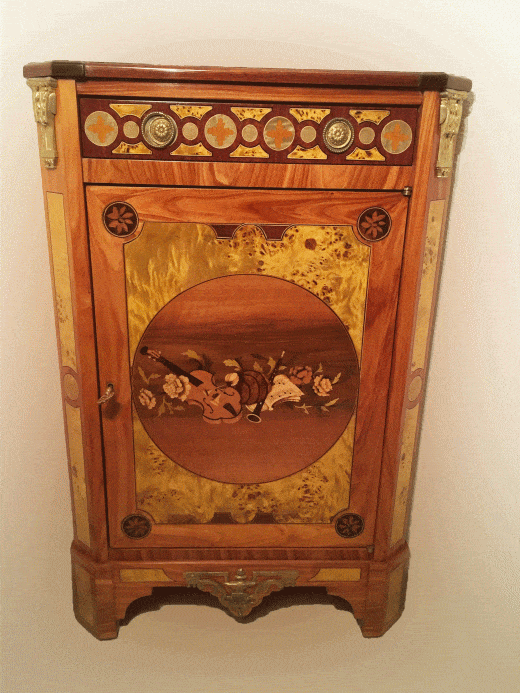
A classic restoration of Boulle marquetry. This involved rehydrating the old glue through infiltration, crafting and gluing the missing brass pieces, and reconstructing the base, which was in poor condition but not beyond repair. The bronze mounts were cleaned and finished with a clear French polish. Proof that appearances can be deceiving. Even a piece of furniture in a severely deteriorated state can regain its former beauty.

Commode returning from Egypt

Ebénisterie Mathieu VATH

During the turbulent period of the French Revolution, furniture production was considerably diminished, and most artisans experienced very difficult times. Overall, from the Consulate to the Directory, furniture and seating had little time to evolve. However, even though some decorative motifs inspired by Egypt had already appeared, it was after the Egyptian expedition (1798-1801) that they evolved into a unique style. The so-called "Return from Egypt" style, however, lasted only a short time: a decade at most, as it would […]

Secretary stamped Martin Ohneberg

Ebénisterie Mathieu VATH

This week marks the completion of the restoration of a Louis XVI period secretary. Martin Ohneberg (Master in 1773), the cabinetmaker who crafted this piece, was an excellent marquetry artist and used very high-quality rosewood. He produced numerous pieces of furniture with very simple lines but exquisite marquetry, including an endless variety of drop-front secretaries. This particular one is veneered with rosewood and amaranth, and features a mosaic marquetry of maple blossoms on a red satinwood ground. The framing bands […]

Louis XIII style desk

Ebénisterie Mathieu VATH

A look back at the restoration of a 17th-century Louis XIII table. It is made of solid walnut and veneered with walnut, ebony, ivory, and boxwood. This table had spent a long time in an attic, and unfortunately, the tabletop suffered considerably. Many sections of veneer were missing. The restoration therefore began by removing what little veneer remained. It was very easy; it was completely detached. I simply had to lift it with a thin blade, and it came right off. After having […]

The chest of drawers of ingratitude

Ebénisterie Mathieu VATH

This year, during Heritage Days, it was possible, for the second year in a row, to visit part of the reserves and the restoration workshops of the national furniture collection. For this 2019 edition, the commode known as "The Ingratitude Commode" was on display. This commode has a very particular history: commissioned for the crown, it was delivered on July 13, 1789, the day before the storming of the Bastille. Its creator, the cabinetmaker Pierre François Guignard, who became a master on January 21, 1767, received payment from the furniture repository on the 13th […]

Pedestal table with cube marquetry

Ebénisterie Mathieu VATH

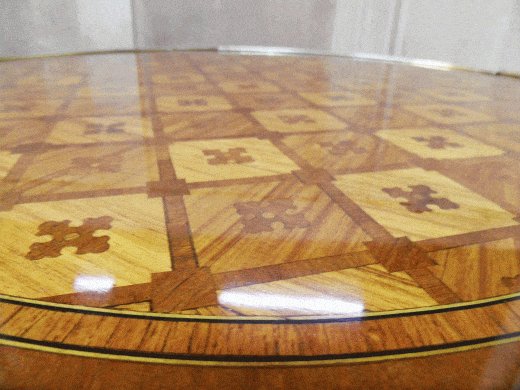
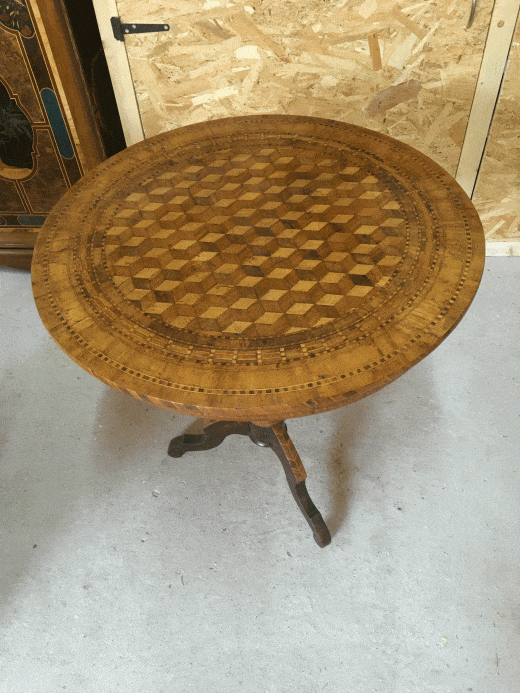
This week, I restored a lovely pedestal table, made locally with a solid ash base and marquetry of maple, walnut, and plum wood for the bottomless cubes. The restoration wasn't too difficult: I re-glued the loose marquetry pieces, stripped the old finish, and applied a French polish. I used a very interesting new recipe that I'll share in a future post. It's a recipe from 1861 by Dessaignes.

Louis XIII Cabinet

Ebénisterie Mathieu VATH

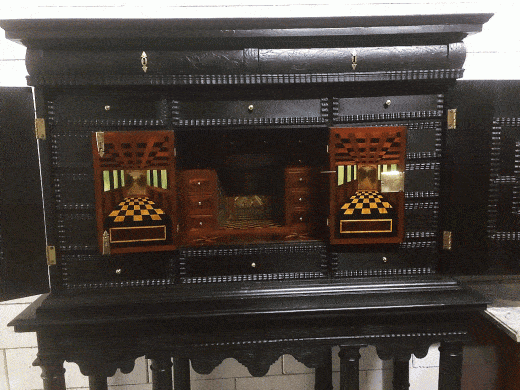
A look back at a fascinating restoration project (at least for me). So fascinating, in fact, that I forgot to take photos at the beginning! This cabinet dates from the 17th century and features two drawers in the cornice and two doors in the upper section. The base consists of two drawers in the frieze supported by eight turned feet and a top resting on ball feet. Inside are twelve drawers and two doors concealing an interior theater, as well as eleven more drawers. The feet, along with […]

Majorelle Table

Ebénisterie Mathieu VATH

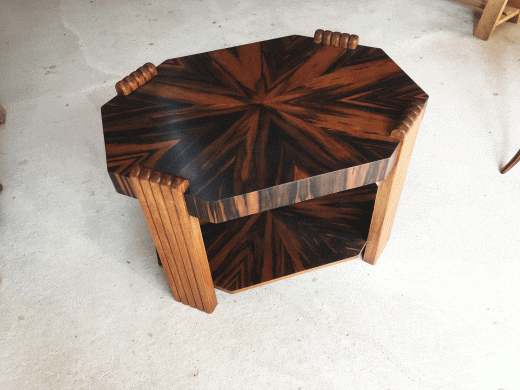
Here is a table in pure Art Deco style. It is veneered with Macassar ebony and the legs are mahogany. This table was probably created around the 1920s. Indeed, Louis Majorelle is best known as one of the great cabinetmakers of the Art Nouveau style, but it is too often forgotten that he was one of the forerunners of the Art Deco style, this table being a perfect example. In terms of restoration, as always, the veneer requires the most work; there […]

Transitional dresser in the style of Topino
Ebénisterie Mathieu VATH

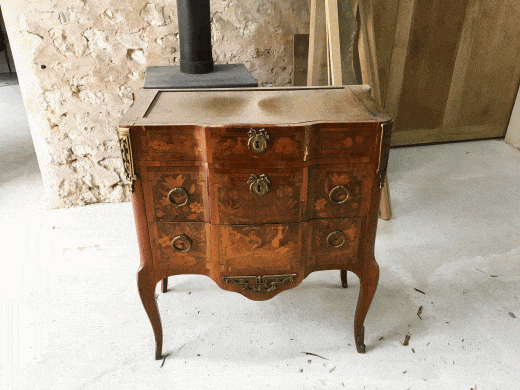
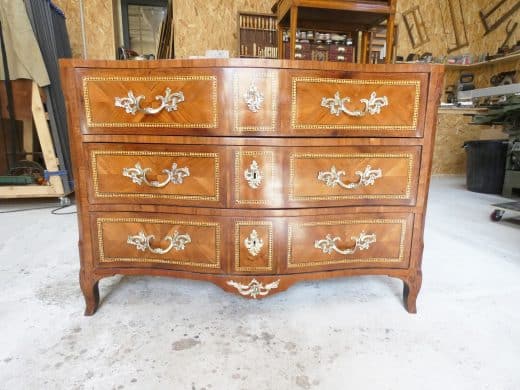
A month ago, a lovely transitional commode arrived, which reminds me of the work of the cabinetmaker Charles Topino (circa 1742-1803) – he received his master craftsman's certificate on July 4, 1773. However, this commode does not bear his stamp, nor any stamp for that matter. This confirms that a stamp is not necessary to possess a piece of high-quality furniture. Furthermore, the marquetry could very well have come from Topino's workshop, as he sold panels of his marquetry to the haberdashers and his colleagues […]

Louis XV slant-front desk stamped HEDOUIN (Restoration complete)

Ebénisterie Mathieu VATH

Remember that slant-front desk? Well, it's finished. It was quite a task, but now it's regained its former glory. Only the drawer keyholes and the leather upholstery remain to be fitted before it's returned to its owner. A large part of the legs has been remade from sawn violet wood. This was cut to the correct thickness, scraped and sanded, then oxidized before being glued, so as not to have to sand the entire piece of furniture […]
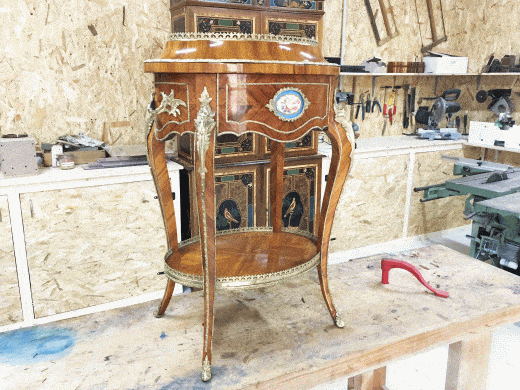
Louis XV slant-front desk stamped HEDOUIN

Ebénisterie Mathieu VATH

Thanks to its stamp, it is possible to date this slant-front desk, or cantilevered desk, between 1738 and 1783. The life of Jean-Baptiste Hedouin is relatively unknown. After becoming a master craftsman, he set up his workshop on Rue Traversière-Saint-Antoine. All the furniture he produced was of high quality. His pieces, primarily in the Regency and Louis XV styles, almost all veneered in sheets or with grid patterns, were varied: wardrobes, flat and slant-front desks, bookcases… but it was the commodes that constituted the largest part of his output.

Louis XV corner cabinet, stamped JM CHEVALLIER

Ebénisterie Mathieu VATH

Here is a corner cabinet stamped by Jean-Mathieu Chevallier. It is made of solid oak and veneered with rosewood and violet wood with a boxwood inlay. Jean-Mathieu Chevallier was already established on the rue de Grenelle under the sign "à la Croix Chevallier" when he obtained his master craftsman's certificate in 1743. He subsequently expanded his business considerably, had business dealings with André-Charles Boulle, one of the sons of the famous cabinetmaker, and contributed to furnishing the Hôtel du Duc de Talmont, as well as the Château de Villegénis, which he had purchased […]
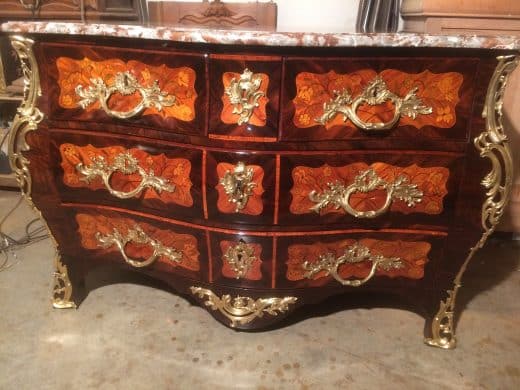
Napoleon III planter and Louis XVI chest of drawers

Ebénisterie Mathieu VATH

This week, two pieces of furniture left the workshop: a Napoleon III jardinière in rosewood veneer and a Louis XVI chiffonier in rosewood and violet wood veneer. If this piece had seven drawers, it would have been called a "semainier" (weekly chest of drawers). Here are some photos of their restoration.

Louis XV commode stamped JC Ellaume

restauration de mobilier

Restoration of a Louis XV period commode stamped JC Ellaume. This commode is veneered in rosewood and palisander with floral marquetry on the drawer fronts. The frame is made of oak and softwood. Jean-Charles Ellaume, also sometimes written as Allaume, received his master craftsmanship in Paris on November 6, 1754. Many pieces of furniture bearing his stamp are known. These are mostly Louis XV commodes. It was in his workshop on Rue Traversière that he produced numerous high-quality pieces of furniture for over thirty years, […]
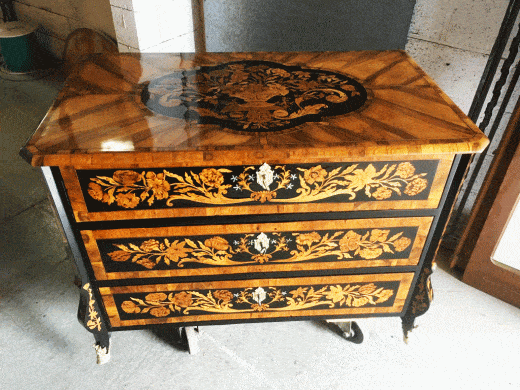
Mazarine Chest of Drawers

Ebénisterie Mathieu VATH

This week, we're revisiting the restoration of a Louis XIV period commode, a commode known as a Mazarine commode. But where does the name "Mazarine" come from? Well, it seems that the first example was made for the famous Mazarine Library, quite simply. Moreover, the illustrious creator of the commode was none other than André Charles Boulle himself. For Louis XIV's bedroom at Trianon, he revolutionized a type of furniture in 1708: the commode, which takes its name from its "practical" aspect compared to the chests that were widely used at the time. Today, we're presenting […]
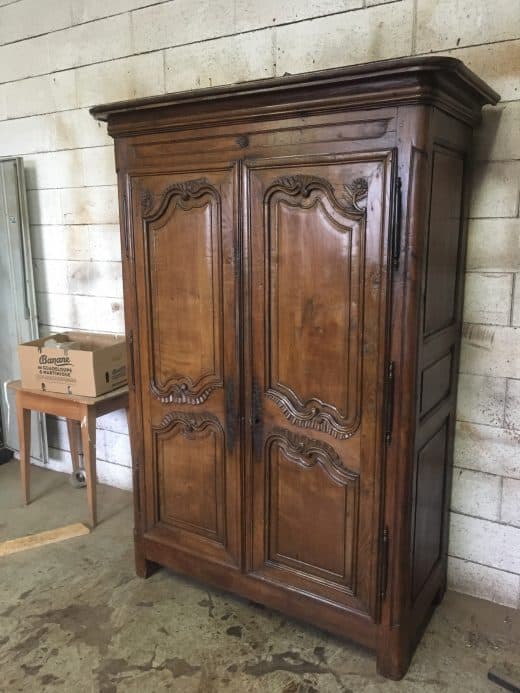
Regional cabinet

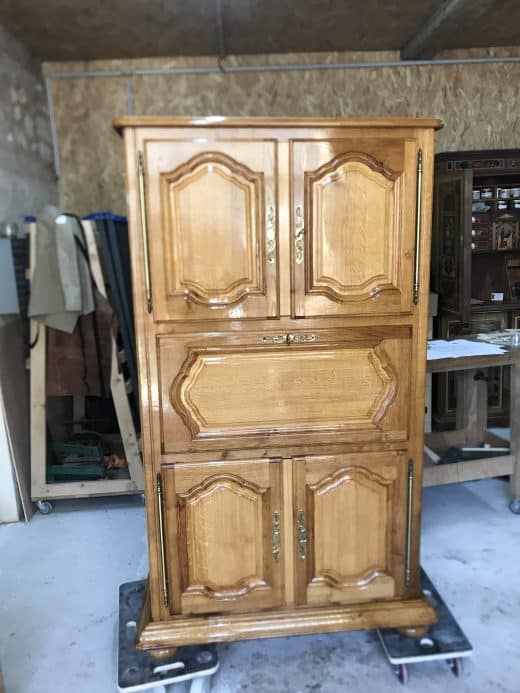
Restoration of a regional solid oak wardrobe. This wardrobe was completely disassembled and overhauled. Every joint was re-engineered to ensure easy disassembly and reassembly. All panels were reamed to their original dimensions. Holes, missing pieces, and chips were filled with new solid oak. The grafts were then treated with an antiquing agent. The doors were adjusted for perfect operation. The piece was then cleaned, stripped, and finished with beeswax.

Alexandre Morell's Cartel Boulle – The End

Ebénisterie Mathieu VATH

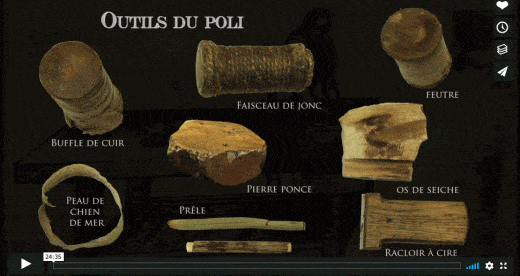
After a few hours of cutting, gluing, re-gluing, and cleaning the surfaces, we finally reach the finishing stage. For this cartel clock, we chose to French polish it because it's a finish that highlights the marquetry, protects it, and is easily reversible (like all my work). I always use a clear shellac varnish, whether on wood or other materials. The varnishing process is difficult to explain; it simply takes hours and hours […]
Alexandre Morell's Boulle Cartel – Marquetry

Ebénisterie Mathieu VATH

After reattaching the structure, removing the brass, cleaning up any remaining animal glue, and removing any residue of superglue and neoprene adhesive, the next step is cutting out the new pieces of brass and tortoiseshell to fill the gaps. So, as usual, I take an impression of the missing piece. Then I glue this piece of paper onto a brass plate, which is itself glued with fish glue to a piece of 4mm plywood. This makes the brass plate easier to cut. To retrieve […]

Alexandre Morell's Cartel Boulle – Continued

Ebénisterie Mathieu VATH

Once the various structural elements were glued back together, I tackled the tortoiseshell and brass marquetry. As you'll see, on this clock it's in very, very bad condition; practically nothing is holding. So, all the brass has to be removed. The tortoiseshell, however, is holding well; it's only partially detached. The first step in restoring this marquetry is therefore to remove and set aside each brass element. The second is to clean off the old glue, […]

Alexandre Morell's Boulle Cartel

Ebénisterie Mathieu VATH

Here is my first client, patient… well, whatever you want to call him. It's a Boulle marquetry cartel clock in brown tortoiseshell, ebony, and brass. As you can see in the following photos, it's not in very good condition. There are many missing brass pieces, and the remaining brass is peeling off everywhere. At first glance, it's always difficult to precisely date a Boulle cartel clock: this one doesn't have a maker's mark. However, it does have corkscrew screws (typical of the 18th century […]

The carpenter's household

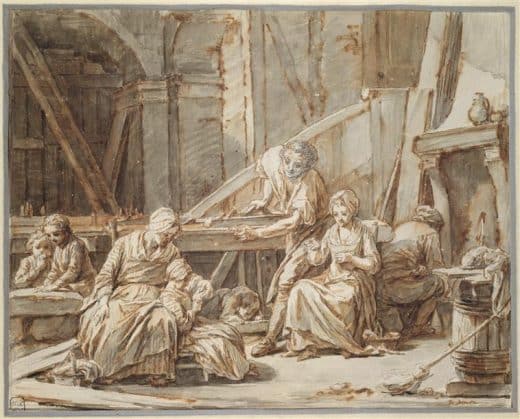
A drawing by Nicolas Bernard Lépicié, which you can admire at the Museum of Fine Arts in Orléans. Surely a future marquetry project. One can sense the living and working conditions of the men who created these pieces, imbuing them with their expertise and a part of themselves. In this way, they inscribed their lives and their stories within the larger narrative of history. This is the very essence of the restorer's craft. The furniture restorer is merely a custodian of memory. They ensure that the soul of the piece is preserved […]

Tool cabinet – End

Ebénisterie Mathieu Vath

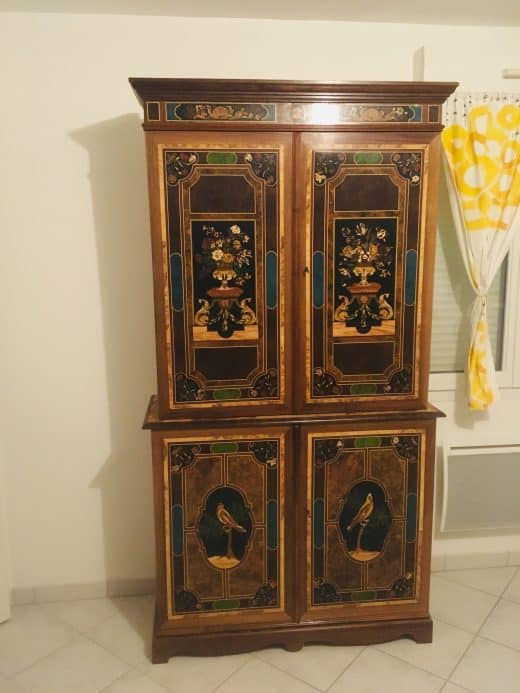
And there you have it, it's finished and ready to use. All the tools are in their proper place. All that's left is to find bronze fittings for the handles and keyhole escutcheons. For the finishing technique, I used the same one applied to furniture of that period: polishing. I first scraped the surface, then sanded it with 150-grit sandpaper. Next, I applied Venetian tripoli mixed with olive oil using a piece […]

Tool cabinet – The top doors

Ebénisterie Mathieu Vath

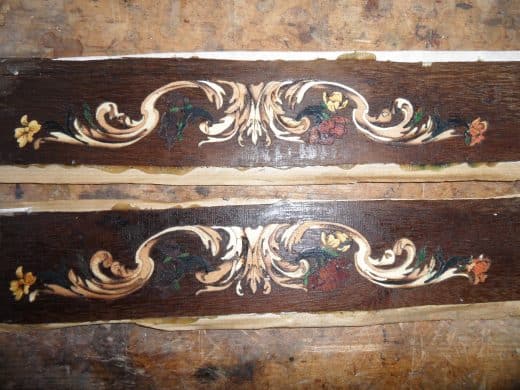
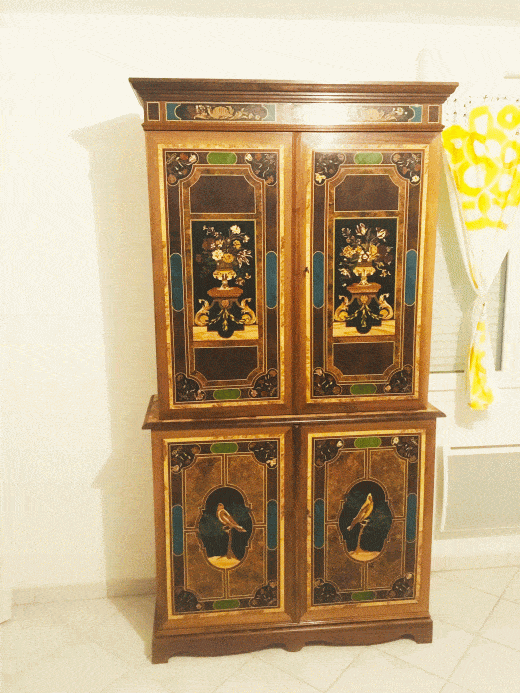
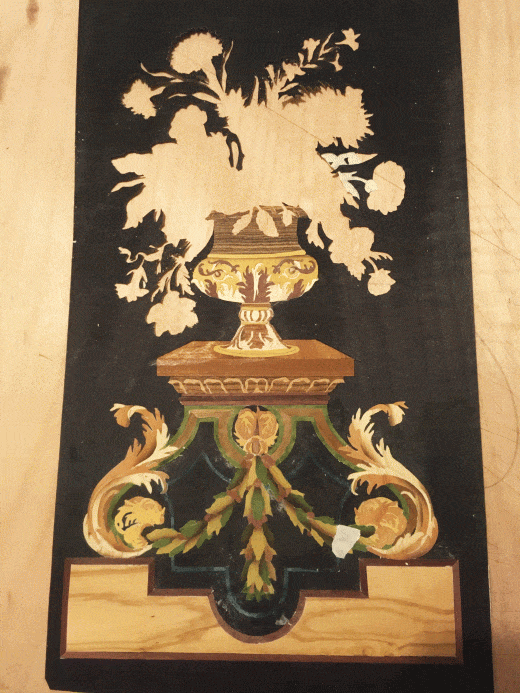
For these marquetry designs, I drew inspiration from Pierre Ramond's book, "André-Charles Boulle, Cabinetmaker, Chaser, and Marquetry Maker to the King." I used the marquetry drawings from the Boulle workshop cabinet (circa 1715–1720). I simply modified them by removing the birds and the butterfly to simplify the design. Then, I partially employed the "Boulle" method for the acanthus leaves and the vase. Finally, I used the wood painting technique for the flower bouquets.

Tool cabinet – Continued

Ebénisterie Mathieu Vath

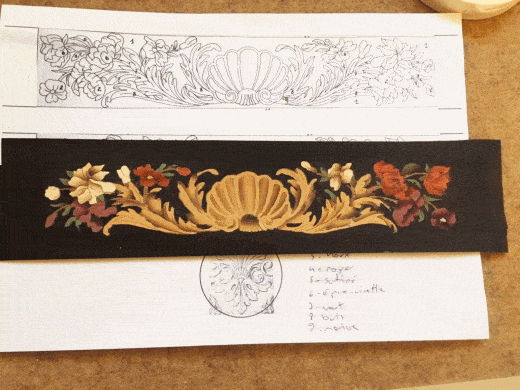
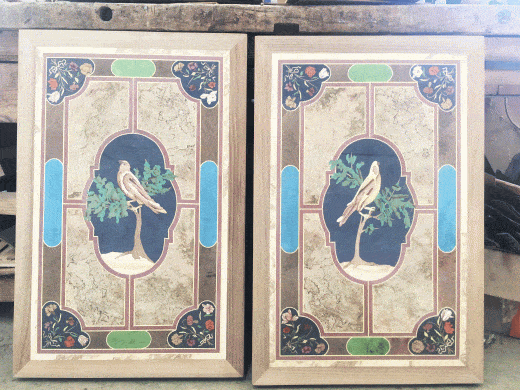
Here are some photos of the marquetry on the tool cabinet. For the corner pieces, I was inspired by those on a table by Pierre Gole, a predecessor and major influence of André-Charles Boulle. For this cabinet, I needed to make 16 corner pieces. So, to save time, I decided to use the Boulle marquetry technique. I made four bundles of different colored woods to obtain four different marquetry designs from a single cut. Therefore, there are four identical designs, but with different flower colors. Then, […]

Tool cabinet – Michelangelo's The Creation of Adam

Ebénisterie Mathieu Vath

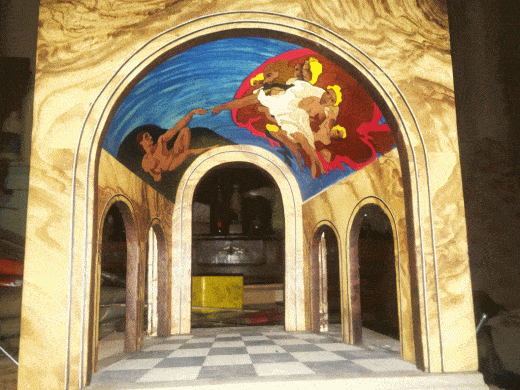
I indulged myself with this marquetry project; I had always wanted to recreate this famous marquetry fresco. This allowed me to revisit David Roentgen's "mosaic marquetry" technique. I created a pack with a hornbeam leaf, a sycamore maple leaf, and a pear leaf to make the figures, as pear wood is the best for reproducing skin tones. To tint the background, I dipped it in different baths to produce this effect of […]

Tool cabinet – The sculptor

Mathieu Vath

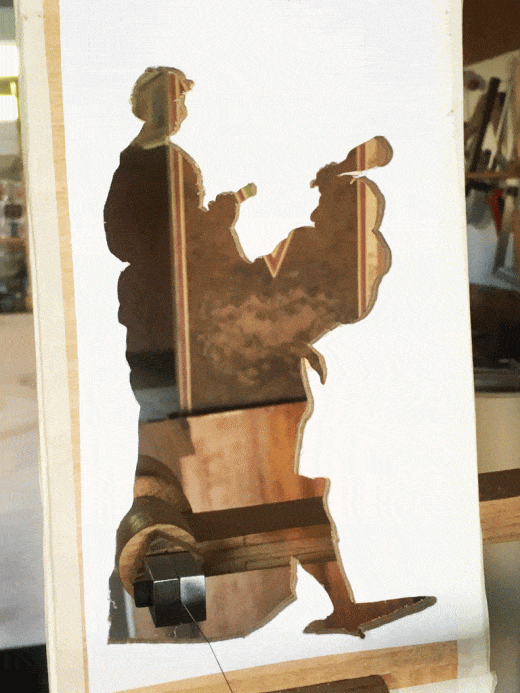
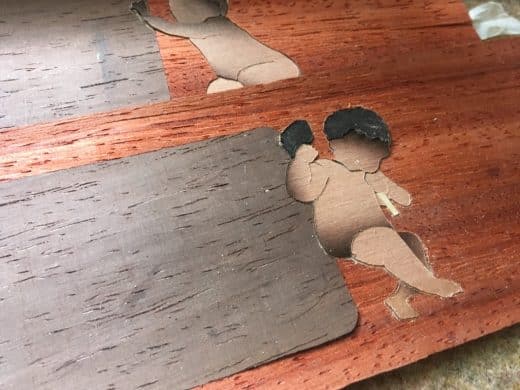
The idea behind this tool cabinet was to explore and implement the various projects I was researching. One of these ideas was to tackle the marquetry technique of a famous 18th-century cabinetmaker, David Roentgen. This technique, known as "mosaic marquetry," involves cutting a single sheet of veneer using a conical saw and then coloring it by dipping each piece in a pre-defined dye. However, there were two problems to overcome: Conical sawing, which is difficult to […]

Tool cabinet

Armoire à outils par Mathieu Vath

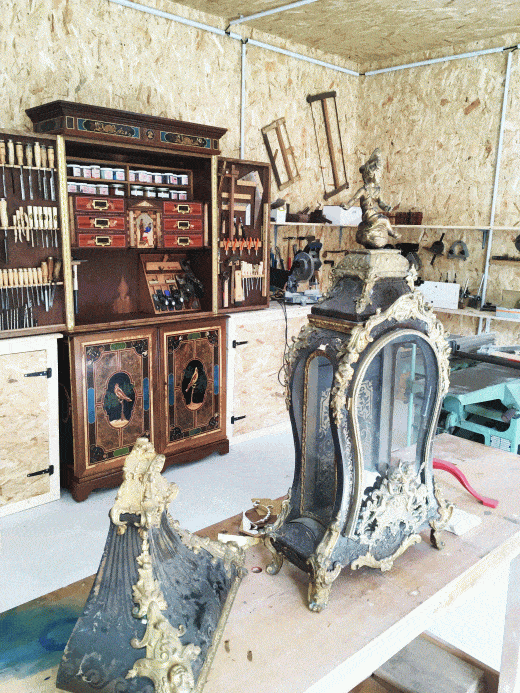
Since the workshop is under renovation, today I'll begin describing the various stages involved in making this tool cabinet. The idea came to me while looking for a way to store all my tools in a single piece of furniture. For the style, I had recently restored a Masarine commode in the style of the HACHE family in Grenoble. When I embark on a personal furniture project, I like to explore new techniques. And I had never before tackled the Louis XIV/Regency style.