Regency chest of drawers Crossbow

Ebénisterie Mathieu Vath

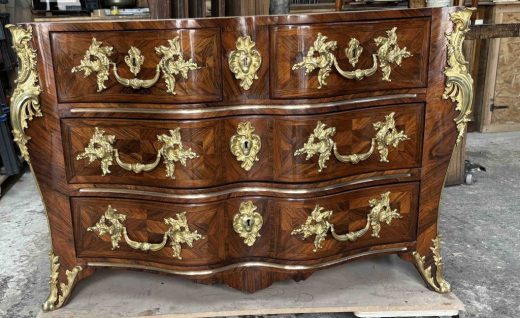
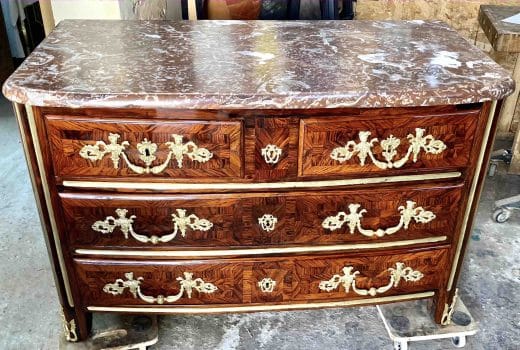
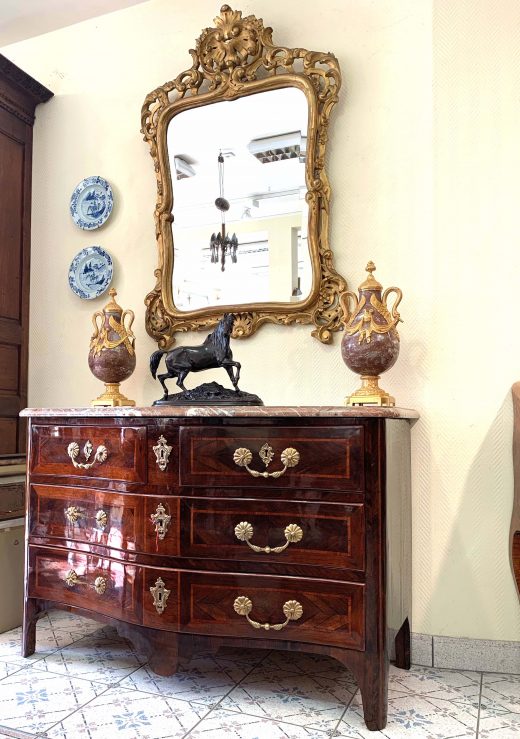
Conservation work on this Regency period commode, characterized by its serpentine shape, rosewood veneer, and gilt bronze mounts, resting on an oak and softwood frame. Our task was to stabilize the veneered surfaces by injecting protein-based adhesive. Veneer gaps were filled with grafts of new rosewood veneer, previously sawn, scraped, and sanded. These grafts were then French polished, naturally oxidized with ultraviolet light, and then applied to the appropriate thickness as a backing before being glued in place with […]
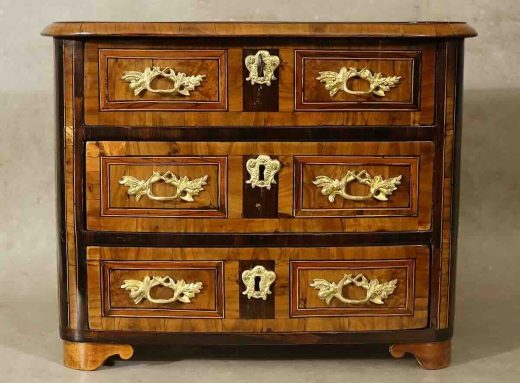
Louis XIV style commode – Grenoble, first third of the 18th century

Ebénisterie Mathieu Vath

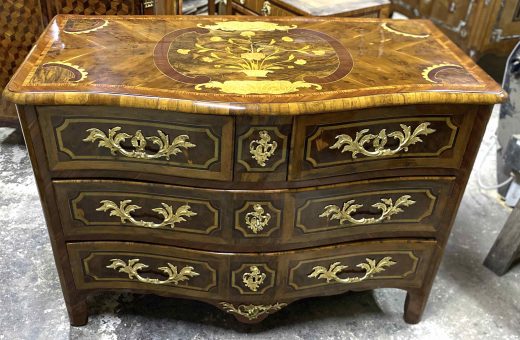
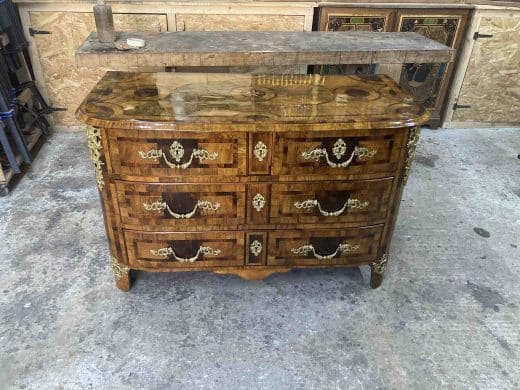
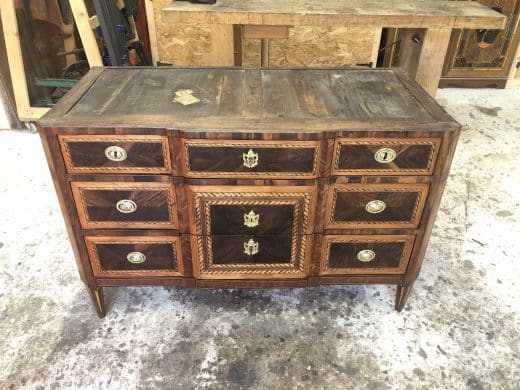
Restoration of a Louis XIV Dauphiné commode, veneered in geometric Alpine wood, with a bombé front and three drawers in three rows. The model's proportions and construction are similar to those of a full-size commode (dovetail joints, intermediate shelves, etc.). The cabinetmaker skillfully played with contrasts through the juxtaposition of wood species, and the quality and variety of the woods used on this small piece of furniture are remarkable: primarily olive and olive burl, walnut, and rosewood for the framing bands highlighted with […]

Regency chest of drawers

Ebénisterie Mathieu Vath

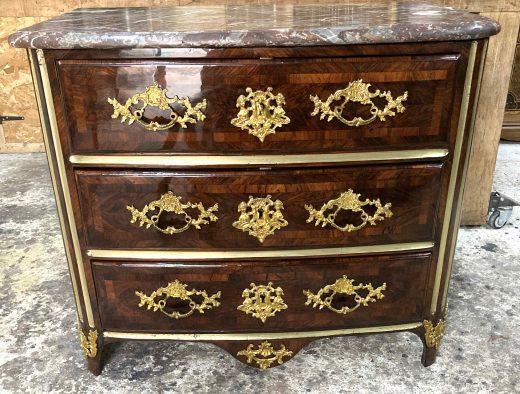
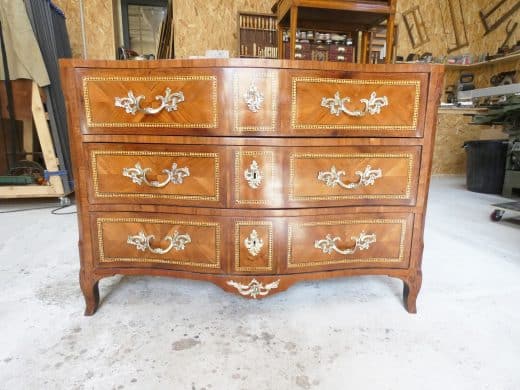
Restoration of a bombé commode with a front veneered in satinwood with double boxwood stringing within amaranth borders, mounted on a fir frame with walnut drawer boxes. It opens with four drawers in three rows and is adorned with finely chased bronze mounts, silvered rather than gilded as is customary. The uprights are veneered with a facsimile of brass fluting, and the sides, decorated with a lozenge within a rectangle, echo the decorative motif of the front veneer. It is […]

Regency corner

Ebénisterie Mathieu Vath

Restoration of a Regency period corner cabinet veneered in Rio rosewood on a softwood frame. The piece had little damage apart from missing fluting and mahogany grafts on the top and bottom rails. The work therefore consisted of replacing the mahogany grafts with rosewood veneer that was sawn, scraped, and sanded before being glued with hot glue. The brass fluting was recreated and adjusted to fit perfectly into its original positions. A French polish finish was applied […]

Regency commode with crowned R

Ebénisterie Mathieu Vath

Restoration of a Regency commode, probably from southeastern France, veneered with yew, plum, rosewood, walnut, cherry, amaranth, violet wood, boxwood, and green-stained maple on a softwood frame. Besides its highly unusual marquetry decoration, the commode's distinctive feature is its crowned R bronze mounts. The crowned R hallmark should not be confused with the crowned C hallmark, which corresponds to a tax levied from 1745 to 1749 on copper objects and is found on many […]

Louis XV slant-front desk

Ebénisterie Mathieu Vath

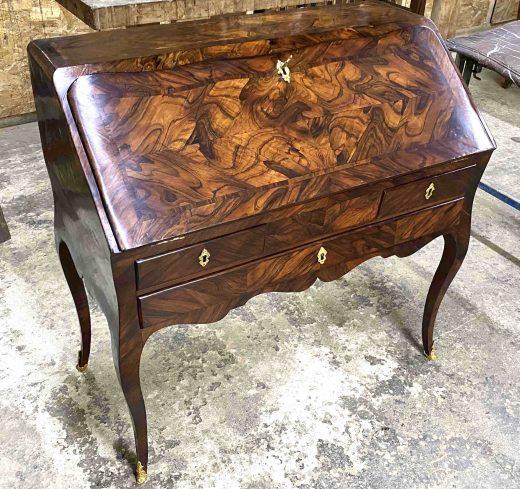
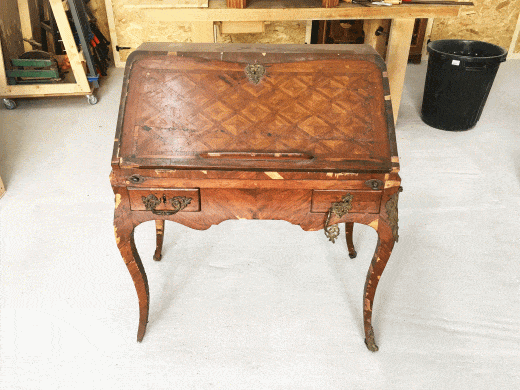
Raphaël's first restoration project was this Louis XV period rosewood veneer slant-front secretary. It was a complete restoration involving numerous veneer grafts and a waxed, filled finish. A delicate job, as rosewood is unforgiving. The slightest misstep with the chisel, or excessive sanding, and its beautiful blond patina disappears, revealing the original dark color and causing unsightly stains. Therefore, there was no choice but to scrape and sand the newly sawn veneer and cut it to the correct thickness before gluing it […]

Regency commode by François LIEUTAUD

Ebénisterie Mathieu Vath

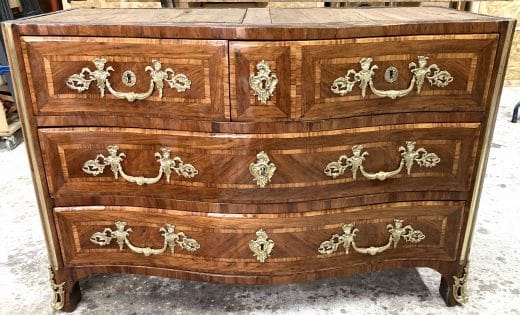
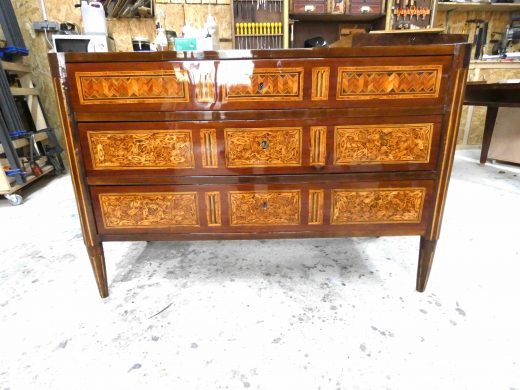
Restoration of a Louis XIV period commode in rosewood and walnut, inlaid with alternating marquetry in friezes and fillets. The slightly curved front opens with three wide drawers in three rows. The top, encircled by a brass molding, features a geometric design of circles framing a central polylobed motif with figurative designs. The uprights and intermediate rails are inlaid with polished brass fluting. The sides are veneered in walnut with diamond frieze patterns. The legs are tapered with claw feet. The piece is adorned with finely chased and gilded bronze mounts.

Regency chest of drawers stamped ID

Ebénisterie Mathieu Vath

Restoration of a Regency commode veneered in rosewood on a conifer frame. It was only after three weeks of work on this commode that I noticed a strange mark. It had been there from the beginning, right in front of me, and I hadn't noticed it. Indeed, it's quite rare to see a stamped Regency commode. But yes, the mark was definitely there. And it's not a modest mark, since this ID stamp is attributed to Jacques Denizot. Jacques Denizot (1684–1760) is […]

Louis XIV commode from the Dauphiné region

Ebénisterie Mathieu Vath

Restoration of a Louis XIV period commode in olive burl, rosewood, and boxwood, likely from the Dauphiné region. This type of commode (D-shaped), along with the Mazarine commode, was among the very first commodes popularized under Louis XIV. Indeed, the earliest French furniture resembling the commode only appeared in the 1700s; thus, the oldest known and datable Parisian commodes are those delivered by André-Charles Boulle to Versailles around 1708. Their very simple decorations are inspired by Dutch designs, often crafted by Protestant cabinetmakers […]

Louis XIV commode

Ebénisterie Mathieu Vath

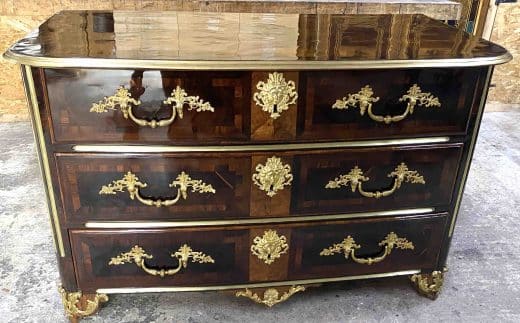
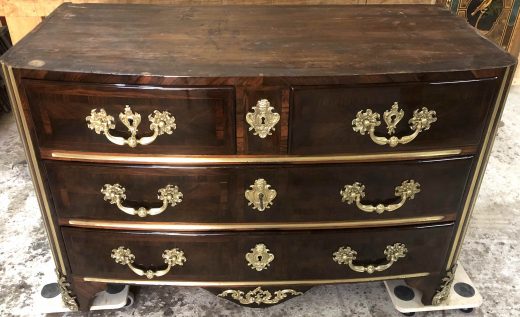
Restoration of a Louis XIV commode constructed of fir and Rio rosewood veneer. The front is slightly convex, as are the uprights and rails. It features brass fluting. The remarkably crafted varnished bronze mounts have retained their original varnish. The restoration consisted of rehydrating all veneered surfaces by infiltrating glue. Missing areas were filled with rosewood veneers that were sawn, scraped, sanded, cut to the correct thickness as a backing, and UV-oxidized before being glued with hot glue. As you can see on […]

Regency chest of drawers

Ebénisterie Mathieu Vath

Restoration of a Regency commode veneered in rosewood and palisander. The commode arrived in very poor condition; the joints were completely detached, there was significant veneer loss, major structural deformations on the sides, and a patina heavily soiled by multiple layers of dark wax. The bronze mounts and locks had been added during a 19th-century restoration. A standard restoration for this type of furniture was carried out; the sides and joints were re-glued as best as possible, and the missing veneer was […]

Louis XVI commode

Ebénisterie Mathieu Vath

This week, we're restoring a Louis XVI commode with a projecting front, veneered in Rio rosewood, amaranth, and violet wood, with marquetry stringing in boxwood and ebony forming a ribbon wrapped around the wood, the background of the engravings filled with red wax. The tapered legs and canted uprights have faux fluting in ebony and boxwood. There's no maker's mark to attribute this beautiful piece and the high quality of wood chosen for its construction. Regarding the restoration, the work isn't very […]

Eight-foot desk known as the "Mazarin" desk«

Ebénisterie Mathieu Vath

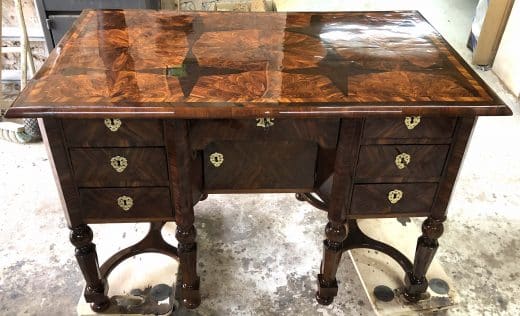
Extensive restoration work has been undertaken on this Mazarin desk, veneered in kingwood and rosewood. It is entirely veneered on fir with a solid rosewood base. The top features a marquetry of rosewood stars surrounded by kingwood butterfly wings in circular patterns. Why the name "Mazarin"? The eight-legged desk is one of the jewels of 17th-century furniture. It only acquired the name "Mazarin" from antique dealers in the 19th century to give it a more prestigious name.

Louis XV style desk

Ebénisterie Mathieu Vath

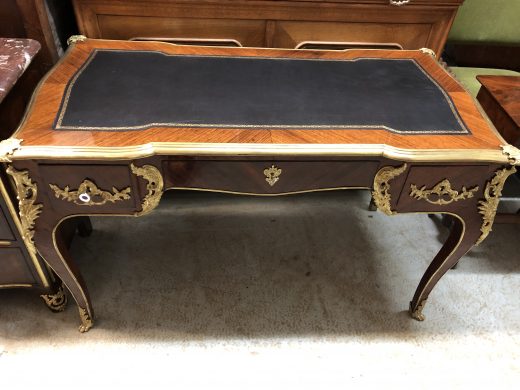
A major restoration was undertaken for this small Louis XV style desk, richly adorned with bronze mounts and veneered in rosewood. The restoration involved replacing the missing veneer while preserving as much of the remaining material as possible. This was achieved by using veneer that was sliced, scraped, sanded, oxidized, and varnished before being re-glued, thus avoiding the need to sand the piece before finishing. Rosewood is a very dark wood that lightens with age, developing a beautiful reddish patina that cannot be removed by any means.

Regency chest of drawers

Ebénisterie Mathieu Vath

Originating in the late 17th century but only acquiring its name in the early 18th century, this is the first classic model of a commode. Although typically Louis XIV in style, it may not have existed before the Regency period. With rounded corner pilasters with slightly convex faces, deep copper fluting, veneer, and geometric bronze mounts, it features three rows of drawers. It perpetuates the spirit of Louis XIV furniture throughout much of the 18th century. Bibliography: Furniture […]

Transitional dresser

Ebénisterie Mathieu Vath

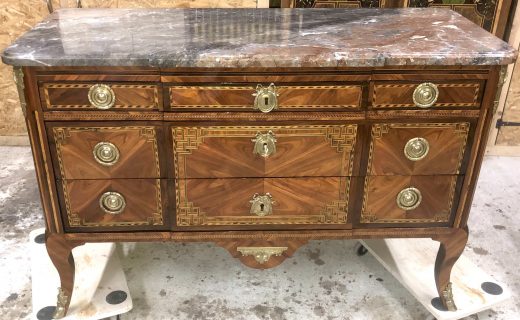
Restoration of a transitional period commode with a projecting front, veneered in rosewood and palisander. The Greek key-patterned moldings, stained green, are made of hornbeam, and the front features a butterfly wing design. It opens with two large drawers with concealed crossbars, and three drawers in an upper row. The uprights, with simulated fluting, are veneered in ebony and boxwood. It rests on four cabriole legs adorned with hoof-shaped feet. Although it has undergone some alterations […]

Louis XV style flat desk

Ebénisterie Mathieu Vath

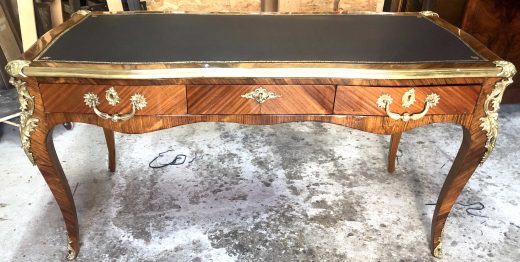
A second life for this Louis XV style desk veneered in Rio rosewood (Dabergia niera) and African mahogany (khaya). Besides the construction and visible tool marks, dating this desk is greatly facilitated by the presence of this African mahogany. Indeed, it was from the late 19th century that this type of mahogany began to arrive from the west coast of Africa and became prevalent in all furniture production at the beginning of the 20th century. The restoration consisted of re-gluing the structure […]

Regency chest of drawers

Ebénisterie Mathieu Vath

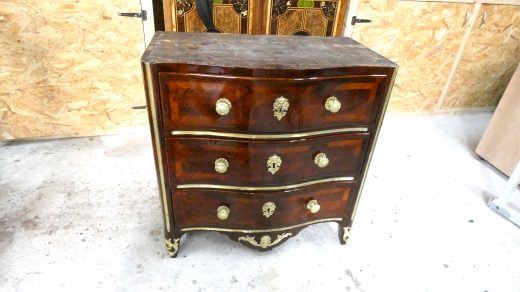
This small chest of drawers has a classic form typical of the Regency period. Still bearing the hallmarks of Louis XIV, the front is curved, the front uprights are rounded, and the sides remain straight. It opens with three drawers. Its uprights and the intermediate rails are decorated with brass fluting. The frame is entirely made of fir; the intermediate panels are dovetailed into the sides, and the back is composed of horizontal planks held in place by rabbeted nails. The drawers are constructed of walnut […]

Louis XVI commode

Ebénisterie Mathieu Vath

Restoration of a Louis XVI period commode from eastern France, made of solid oak and fir and veneered with end-grain laburnum, walnut, plum, amaranth, rosewood, palisander, boxwood, and green-stained hornbeam. The handles and keyholes were added at a later date. The original fittings are missing; only the holes for the handles remain. This is a piece of furniture that has never been restored. The veneer is almost 4 mm thick in some places, and […]

Majorelle table and rosewood

Ebénisterie Mathieu Vath

This is the second time I've had the opportunity to work on this type of table, made by Louis Majorelle's workshop in the 1920s and 30s. You can find all the information about this type of table at the following link: https://ebenisterie-mathieuvath.fr/2019/08/29/table-majorelle/ As for the restoration, it's more of a preventative measure. Indeed, there's no major damage; a few veneer grafts and re-gluing a large portion of the edge veneer were enough to restore this lovely Rio rosewood-veneered table. An opportunity for me […]

Regency commode stamped J.BIRCKLE

Ebénisterie Mathieu VATH

Restoration of a chest of drawers veneered in Rio rosewood and satinwood stringing. It has two large drawers and two small ones in the upper section. Its frame is made of oak and fir. It is stamped J.BIRKLE on the left upright and also bears the mark JME. It shows some signs of restoration and an ink mark on one side of a drawer. Jacques Bircklé (1734-1803) – Cabinetmaker – master craftsman obtained on July 30, 1764. One of the suppliers to the Royal Furniture Repository under Louis XVI. Freelance craftsman before […]

Transitional dresser

Ebénisterie Mathieu VATH

Here is a very simple chest of drawers from eastern France, probably dating from the late 18th century. The front is slightly curved and the uprights are chamfered. It should be noted that the bronze mounts are probably not original. The frame is made of solid softwood, and the uprights are oak. The drawer bottoms are set in rebates and slide on the drawer fronts, which is typical of provincial work. A small peculiarity: this chest of drawers does not have top panels, the […]

Label signed "Louis David Carré in Paris"«

Ebénisterie Mathieu VATH

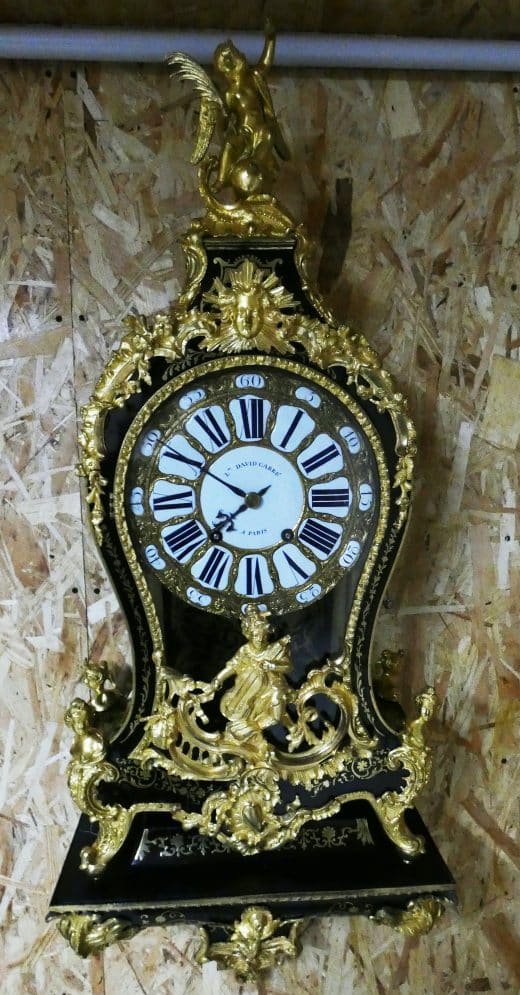
After several weeks of work, the restoration of this clock is finally complete. It is a Louis XV period clock in brown tortoiseshell and brass marquetry, with rosewood restorations. The dial is by Louis David Carré, nephew of Jullien le Roy, who became a master craftsman on December 31, 1748. Lodged at the Louvre from 1744, he was elected a juror in 1775. The greatest treasure of this clock lies in its bronze mounts. They are truly magnificent, and above all, they are in very good condition. There is only […]

Louis XVI style sewing box

Ebénisterie Mathieu VATH

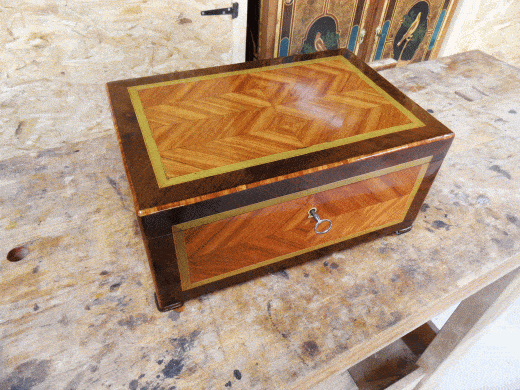
This sewing box dates from the Napoleon III period. The frame is made of softwood. The veneer is composed of Rio rosewood, mahogany for the interior, and a green-stained boxwood and maple inlay. The great quality of this box is that the lid hasn't warped. This is often the major problem with this type of furniture, as people forget to lock them, causing the wood to warp. It then becomes very difficult to find the "trick" to ensure the box stays closed.

Louis XV slant-front desk stamped HEDOUIN

Ebénisterie Mathieu VATH

Thanks to its stamp, it is possible to date this slant-front desk, or cantilevered desk, between 1738 and 1783. The life of Jean-Baptiste Hedouin is relatively unknown. After becoming a master craftsman, he set up his workshop on Rue Traversière-Saint-Antoine. All the furniture he produced was of high quality. His pieces, primarily in the Regency and Louis XV styles, almost all veneered in sheets or with grid patterns, were varied: wardrobes, flat and slant-front desks, bookcases… but it was the commodes that constituted the largest part of his output.

Tool cabinet – The top doors

Ebénisterie Mathieu Vath

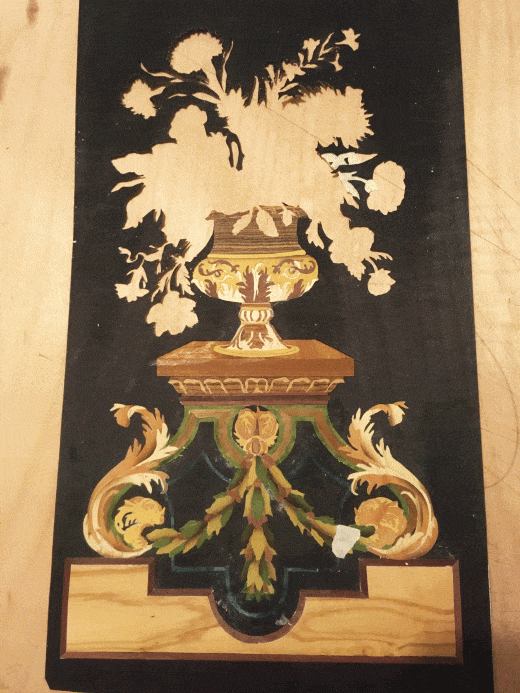
For these marquetry designs, I drew inspiration from Pierre Ramond's book, "André-Charles Boulle, Cabinetmaker, Chaser, and Marquetry Maker to the King." I used the marquetry drawings from the Boulle workshop cabinet (circa 1715–1720). I simply modified them by removing the birds and the butterfly to simplify the design. Then, I partially employed the "Boulle" method for the acanthus leaves and the vase. Finally, I used the wood painting technique for the flower bouquets.