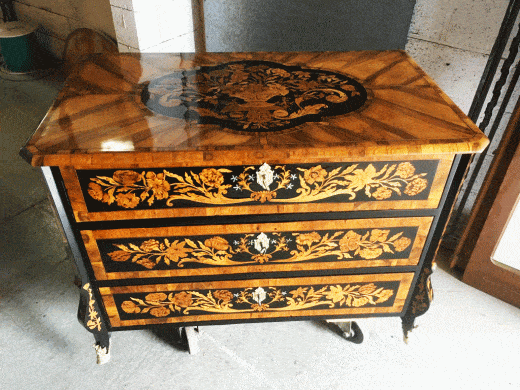
Regency chest of drawers stamped Merchant
Ebénisterie Mathieu Vath

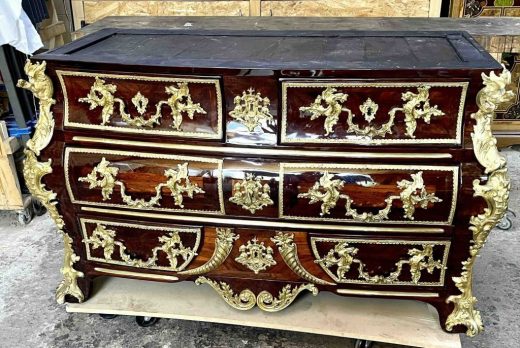
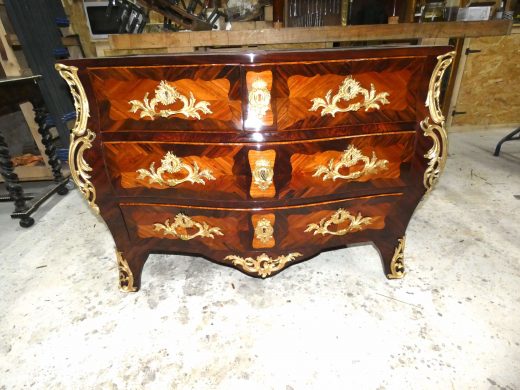
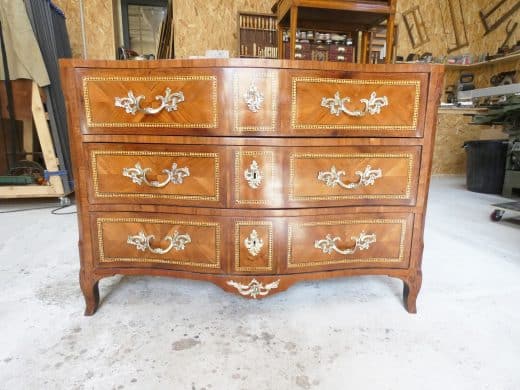
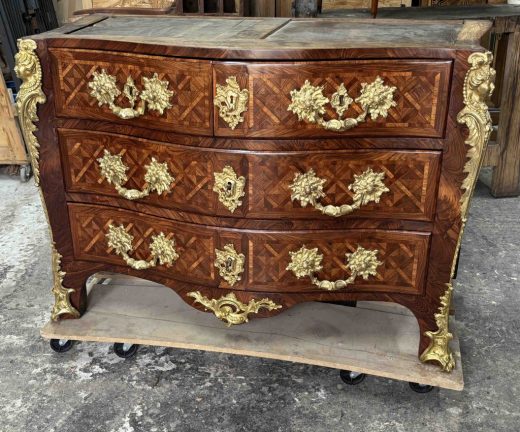
Restoration of a Regency period commode, stamped with the name Nicolas Jean Marchand, veneered in violet wood with a diamond-point pattern on an oak frame. It opens with four drawers. The whole is adorned with chased bronze mounts bearing the crowned C, including thick drop handles, large gadrooned rosettes, cartel-shaped keyhole escutcheons, and espagnolette drops ending in eagle-claw feet. The crowned C: The royal edict of 1745 required bronze workers to affix a distinctive mark, a […]
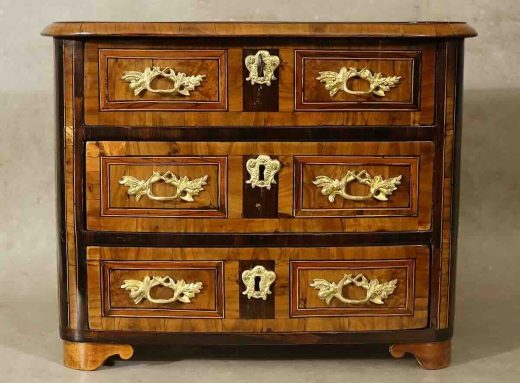
Louis XIV style commode – Grenoble, first third of the 18th century

Ebénisterie Mathieu Vath

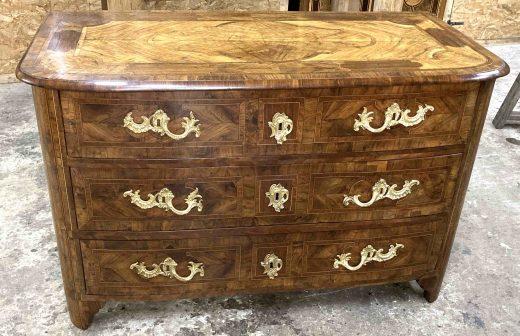
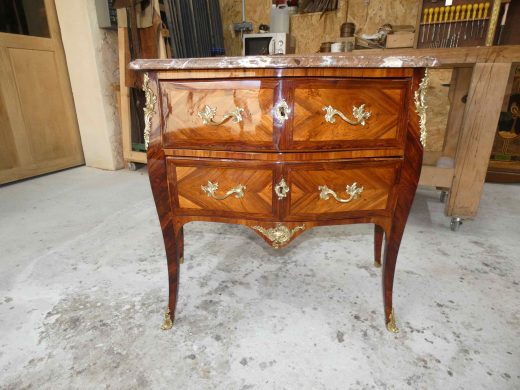
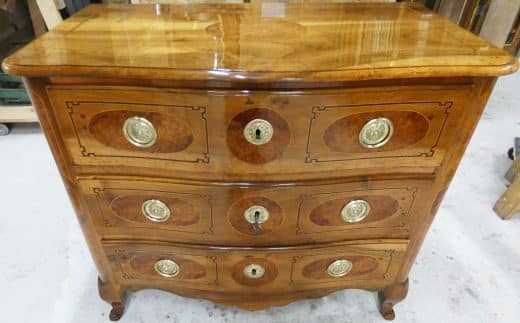
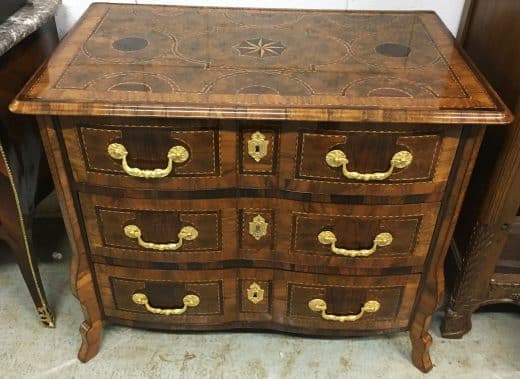
Restoration of a Louis XIV Dauphiné commode, veneered in geometric Alpine wood, with a bombé front and three drawers in three rows. The model's proportions and construction are similar to those of a full-size commode (dovetail joints, intermediate shelves, etc.). The cabinetmaker skillfully played with contrasts through the juxtaposition of wood species, and the quality and variety of the woods used on this small piece of furniture are remarkable: primarily olive and olive burl, walnut, and rosewood for the framing bands highlighted with […]

Louis XVI chest of drawers by Jean-Francois Leleu

Ebénisterie Mathieu Vath

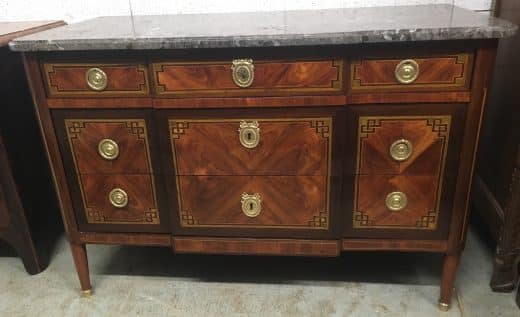
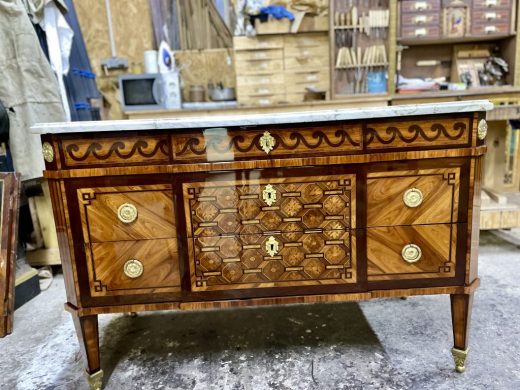
Restoration of a Louis XVI period commode with a projecting central front, stamped JF LELEU. Made entirely of oak, it is veneered with amaranth, rosewood, boxwood, stained maple burl, and tobacco-grey maple. It is decorated with marquetry featuring a frieze of posts on the top drawer, Greek key motifs, and fleurons within a mosaic of hexagons known as "marquetry à la reine" on the central projection. It has three drawers, two of which conceal drawers with crossbars. The front uprights are […]

Regency commode with bridge "with dragons"«

Ebénisterie Mathieu Vath

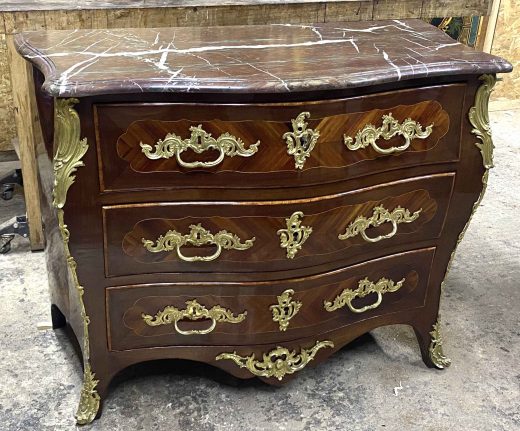
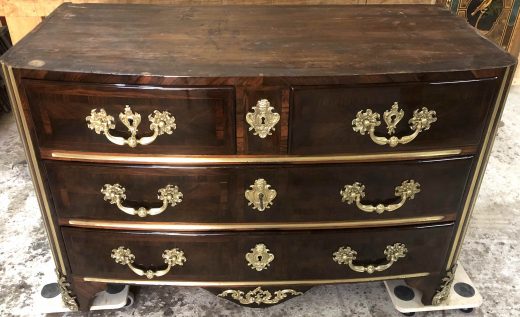
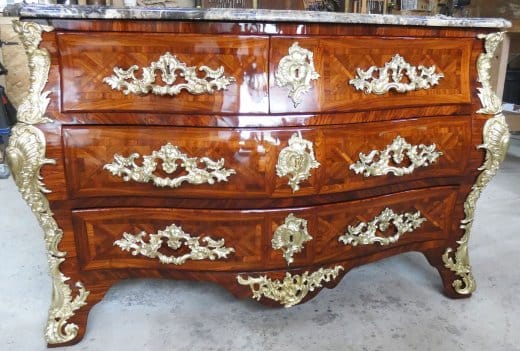
Restoration of a Regency period commode, topped with a 30 mm thick Rance marble slab, molded with a corbelled edge following its contours. This commode, curved in plan and elevation on the front and sides, is veneered with snakewood and satinwood. It has four drawers (simulating six) arranged in three rows. Its voluminous feet evoke the clawed paws of a dragon. The commode is adorned with brass fluting and chased and gilded bronze mounts: chased waterleaf frames framing the drawers, thick drop handles with shell motifs, wide plates […]

Regency chest of drawers

Ebénisterie Mathieu Vath

Restoration of a bombé commode with a front veneered in satinwood with double boxwood stringing within amaranth borders, mounted on a fir frame with walnut drawer boxes. It opens with four drawers in three rows and is adorned with finely chased bronze mounts, silvered rather than gilded as is customary. The uprights are veneered with a facsimile of brass fluting, and the sides, decorated with a lozenge within a rectangle, echo the decorative motif of the front veneer. It is […]

Louis XV commode by JB Fromageau

Ebénisterie Mathieu Vath

Restoration of a Louis XV commode stamped by Jean-Baptiste Fromageau. Constructed of oak and conifer, this commode is inlaid with rosewood within violet wood frames. Curved at the front and flared at the sides, it features four drawers in three rows and is topped with a grey Sainte-Anne marble slab. Jean-Baptiste Fromageau, son of a master cabinetmaker, was born around 1725. After obtaining his master craftsman's certificate on November 5, 1755, he set up his workshop on Rue Traversière before establishing himself on Rue du Faubourg Saint-Antoine. The Dauphin almanac mentions […]

Regency-style chest of drawers stamped by Michel Mallerot

Ebénisterie Mathieu Vath

The restoration of a commode from the first half of the 18th century, curved in height and bombé in plan, opening with four drawers in three rows, known as a "tomb-shaped" or "Regency" commode, belongs to a much smaller group of commodes called "bridge" and "moustache" commodes. The frame of this commode is typical of Regency models, with oak uprights, high-quality softwood for the majority of the structure, and walnut for the inset drawers. The veneer consists of only two types: kingwood and satinwood. The […]

Regency commode in sarcophagus form

Ebénisterie Mathieu Vath

Minor restoration was required for this Regency commode, known as a sarcophagus commode. A few veneer repairs and a refinishing of the varnish were all it took to restore its former glory. The sarcophagus commode? It was only a few years after the first examples were completed by André Charles Boulle, during the Regent period, that the curved commodes, both in plan and elevation, appeared. These commodes would be called "Regency-style" commodes throughout the 18th century (and similarly, it would be necessary to wait until 1720 to see commodes with two rows of drawers again, often […]

Louis XV commode stamped NA Lapie

Ebénisterie Mathieu Vath

Restoration of a Louis XV commode, stamped by Nicolas Alexandre Lapie, veneered in amaranth and satinwood on a beautifully crafted oak frame. The sides and drawer fronts are made of softwood, and the marble top is Campan griotte marble. Nicolas Alexandre Lapie, son of Nicolas Lapie, a pottery merchant in the Faubourg Saint-Antoine, and brother of the master cabinetmaker Jean Lapie, Nicolas Alexandre (known as the Elder) appears to have been born around 1730. He registered his master's letters at the Châtelet in Paris on the 17th […]

Regency chest of drawers with Spanish-style drawers

Ebénisterie Mathieu Vath

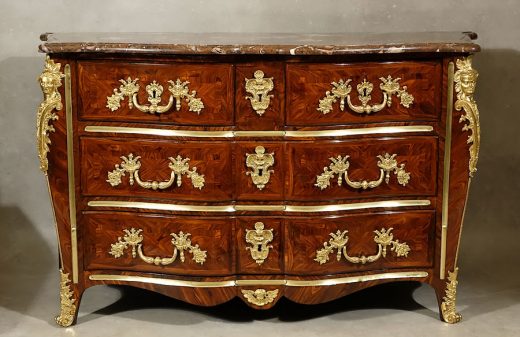
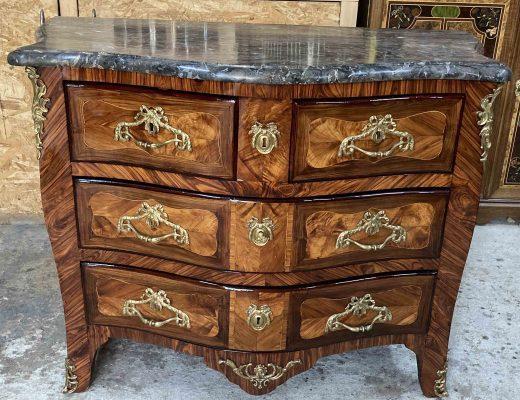
Restoration of a Regency period commode with a serpentine front and espagnolettes, curved on all sides, veneered in violet wood on a walnut frame, opening with four drawers in three rows and topped with a Belgian Griotte Red marble slab with ears and a corbelled edge. The pinched uprights are dark, as are the front rails, with fluting and brass reeding. Its high-quality bronze ornamentation features superb chasing and includes very rare espagnolettes (seen on six commodes: four by Etienne Doirat, one by François Lieutaud […]

Louis XIV commode

Ebénisterie Mathieu Vath

Restoration of a Louis XIV period commode veneered in olive burl, ash, and walnut, likely from the Dauphiné region. This type of commode (D-shaped), along with the Mazarine commode, was among the very first commodes popularized under Louis XIV. Indeed, the appearance of the earliest French furniture resembling the commode dates only from the 1700s; thus, the oldest known and datable Parisian commodes are those delivered by André-Charles Boulle to Versailles around 1708. Their very simple decorations are inspired by Dutch designs, often executed by […]

Louis XV/Transitional Commode

Ebénisterie Mathieu Vath

A true renaissance for this chest of drawers, which I call Louis XV/Transitional because its form and construction are entirely Louis XV. However, the handles and keyhole escutcheons are typically Louis XVI. And I can attest that these are indeed its original fittings. The nail holes match perfectly, and there are no other holes beneath the bronze mounts. So, even if this piece of furniture doesn't conform to what is commonly called the Transitional style, this chest of drawers is most certainly one of the first […]

Louis XVI commode stamped JB.Tuart

Ebénisterie Mathieu Vath

Here is a very pretty Louis XVI period commode veneered in rosewood and amaranth with marquetry of boxwood, pearwood, maple, hornbeam, walnut, blackened pearwood, lemonwood… It is built of oak and softwood. It is stamped twice with the mark of Jean-Baptiste II TUART. But its maker is probably Jean LAPIE. From a dynasty of Parisian cabinetmakers and merchants, whose father, Jean-Baptiste I, obtained his master's certificate in 1741 and was active until around 1760, Jean-Baptiste II, born around 1720, was not a master cabinetmaker but a master furniture maker and haberdasher […]

Regency chest of drawers

Ebénisterie Mathieu Vath

Originating in the late 17th century but only acquiring its name in the early 18th century, this is the first classic model of a commode. Although typically Louis XIV in style, it may not have existed before the Regency period. With rounded corner pilasters with slightly convex faces, deep copper fluting, veneer, and geometric bronze mounts, it features three rows of drawers. It perpetuates the spirit of Louis XIV furniture throughout much of the 18th century. Bibliography: Furniture […]

Louis XV/Transition Commode by Nicolas Abraham Couleru

Ebénisterie Mathieu Vath

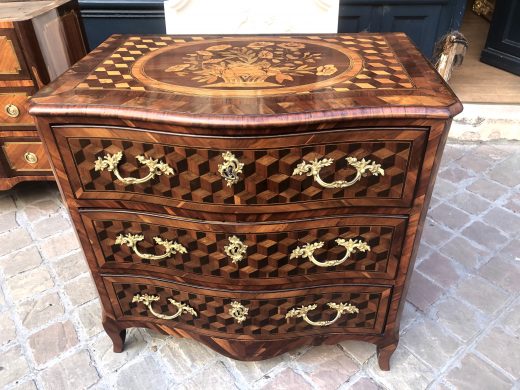
This slightly curved commode, composed of three drawers and veneered with bottomless cubes of walnut, plum, and cherry, has a marquetry top depicting a bouquet of flowers on an amaranth ground. Plum or Quetchier wood is easily recognizable by its sapwood markings, which create a lighter pattern and lend an irregularity to the decoration. The frame is made of fir and walnut. It is difficult to define a precise style for this commode. Although Louis XV, it clearly foreshadows the arrival of the style's more restrained appearance […]

Louis XV commode

Ebénisterie Mathieu Vath

This is a significant restoration project for this Louis XV commode, originally veneered in rosewood and violet wood. It took me some time to determine if it was indeed violet wood, as the commode had undergone so much restoration that there was almost as much rosewood as violet wood. Fortunately, the drawers are still in fairly good condition and are indeed made of violet wood, so I conclude that the commode was […]

Louis XV commode

Ebénisterie Mathieu VATH

The commode with a jumping habit seems to have been invented during the Regency period, between 1705 and 1730, by the cabinetmaker Charles Cressent, and subsequently became widespread in the Louis XV style. It consists of only two drawers or two rows of drawers. The body must be raised on cabriole legs of about half height, with the body occupying half the height of the piece and the other half the legs. The observer thus has the impression that the piece has legs allowing it to jump like a frog. The width offers straight, curved, or […]

Empire Chest of Drawers with Quivers

Ebénisterie Mathieu VATH

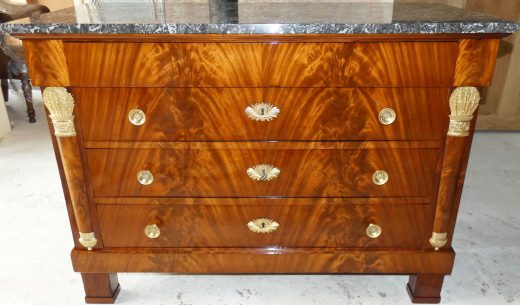
This week, here are some photos of the restoration of this Empire-style chest of drawers veneered in mahogany burl. This chest is truly unique due to the quality and originality of its bronze mounts. Indeed, they form quivers along with the side columns. The keyhole escutcheons are composed of two crossed laurel branches held together by a ribbon. Originally, they were mercury-gilded, as can be seen from the gilding stains on the back. Unfortunately, only a few partial traces remain on the front […]

Hedouin commode with crowned C

Ebénisterie Mathieu VATH

Extensive restoration of this superb Louis XV period commode, stamped on all four uprights by Jean-Baptiste Hedouin. The frame and drawers are constructed of solid oak, fir, and walnut. The edges of the frieze and geometric marquetry in violet wood are veneered with satinwood. Two types of violet wood are visible: one with a very tight grain and veining for the lozenges, and a second, more intricate type for the marquetry edges, uprights, and rails. The […]

Transitional dresser

Ebénisterie Mathieu VATH

Here is a very simple chest of drawers from eastern France, probably dating from the late 18th century. The front is slightly curved and the uprights are chamfered. It should be noted that the bronze mounts are probably not original. The frame is made of solid softwood, and the uprights are oak. The drawer bottoms are set in rebates and slide on the drawer fronts, which is typical of provincial work. A small peculiarity: this chest of drawers does not have top panels, the […]

Chest of drawers in the style of the Axe

Ebénisterie Mathieu VATH

Here are some photos of the restoration of a solid walnut commode, veneered with thuya burl inlay and Greek key stringing in amaranth and boxwood. The drawers and the interior and back panels are made of fir. Despite the curved stretcher, its shape, and its feet, this commode is indeed in the transitional style but from the Louis XVI period. In the title, I wrote "in the style of the Hache family" because it is certain that this commode originated in the Dauphiné region. But whether it is a product of the famous […]

Louis XVI commode stamped JA BRUNS

Ebénisterie Mathieu VATH

This week marks the completion of the restoration of a Louis XVI commode stamped JA BRUNS. It is made of oak for all the structural elements, except for the side panels, drawer backs, drawer fronts, and the two drawer bottoms, which are made of softwood. It is veneered with rosewood in a butterfly pattern and amaranth for the edges. The false fluting is made of boxwood and ebony, and there is a green-stained maple stringing forming the corners at […]

Mazarine Chest of Drawers

Ebénisterie Mathieu VATH

Here is a charming Mazarine commode from the Louis XIV period. With a serpentine front and three drawers in three rows, it is topped with a marquetry top featuring a compass rose on an end-grain wood background. Constructed on a fir frame, it is covered with a beautiful olive veneer, with both end-grain and grain-grained veneer, rosewood, ash on the sides, and boxwood for the stringing and compass rose. The crossbeams are joined with straight dovetail joints on the sides, which has caused some minor imperfections.

Mazarine Chest of Drawers

Ebénisterie Mathieu VATH

This week, we're revisiting the restoration of a Louis XIV period commode, a commode known as a Mazarine commode. But where does the name "Mazarine" come from? Well, it seems that the first example was made for the famous Mazarine Library, quite simply. Moreover, the illustrious creator of the commode was none other than André Charles Boulle himself. For Louis XIV's bedroom at Trianon, he revolutionized a type of furniture in 1708: the commode, which takes its name from its "practical" aspect compared to the chests that were widely used at the time. Today, we're presenting […]