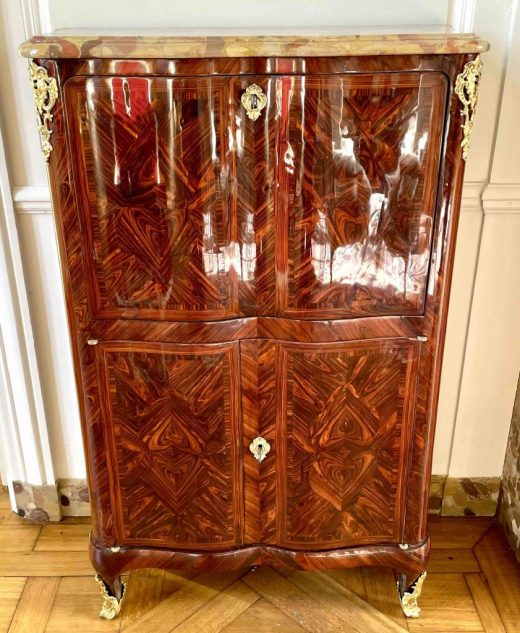
Louis XVI secretary stamped Schlichtig

Ebénisterie Mathieu Vath

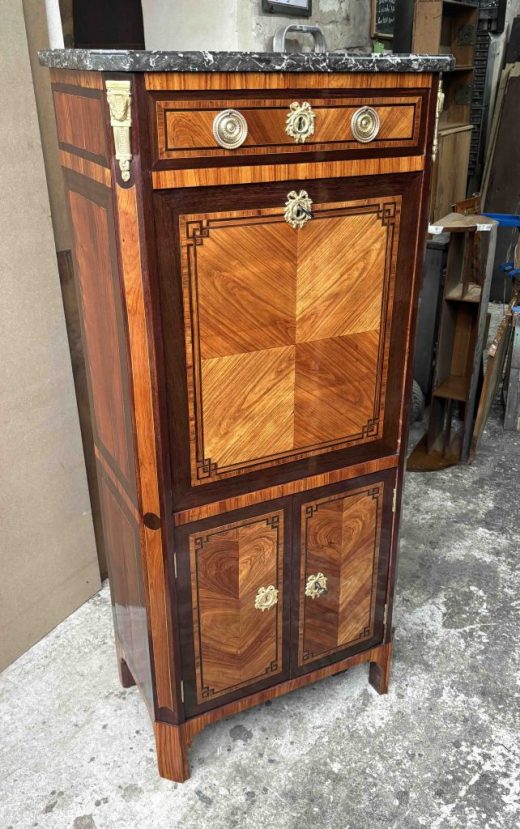
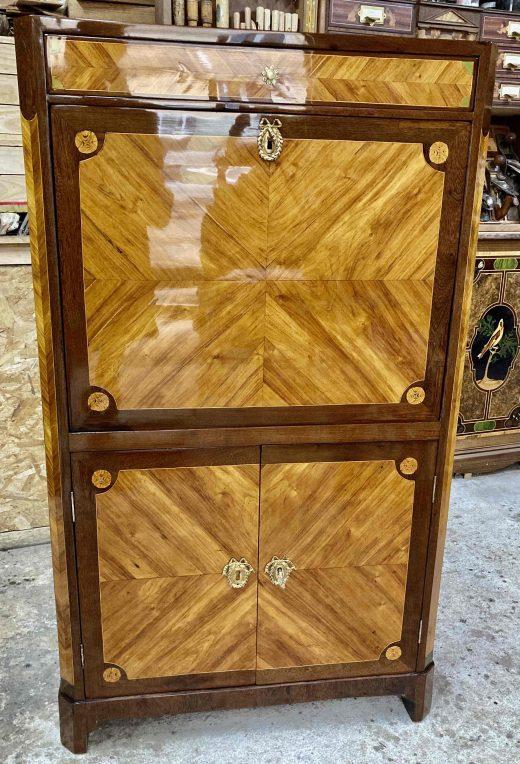
This Louis XVI style secretary desk bears the stamp of JG Schlichtig. It combines rosewood, satinwood (on the sides), and amaranth veneers on an oak and softwood frame. It opens with two lower doors, a central drop-front, and a top drawer. The interior includes six drawers and three niches. At 1.20 meters long, it is a lady's secretary desk. Jean-Georges Schlichtig († February 1782) was a Parisian cabinetmaker of German origin, admitted as a master on October 2, 1765. He initially established himself […]
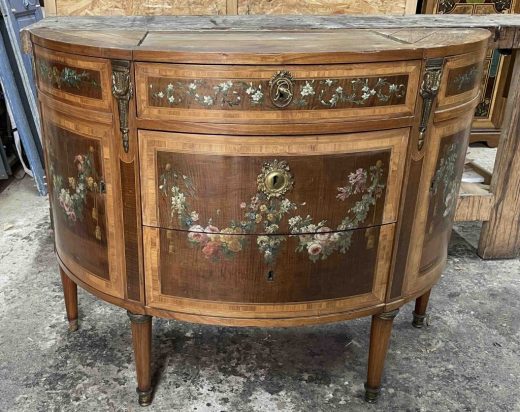
Louis XVI commode stamped JL Cosson

Ebénisterie Mathieu Vath

This Louis XVI period half-moon commode is stamped by the cabinetmaker Jacques Laurent Cosson. It belongs to a production probably dating from 1780 to 1790. It is an exceptional example of painted furniture from the end of the Ancien Régime. It belongs to a very small group, of which only seven examples are currently known. Highly sought-after 18th-century French painted furniture represents one of the most inventive areas of Parisian cabinetmaking on the eve of the Revolution. This commode, with its curved, half-moon shape, rests on four tapered legs […]

Louis XV secretary desk, stamped MIGEON

Ebénisterie Mathieu Vath

Restoration of a secretary desk, commonly called a "drop-front secretary" or "cabinet secretary," bearing the MIGEON stamp. This piece is distinguished by its serpentine front, opening with a pivoting drop-front that reveals nine small, curved drawers. The inside of the drop-front is lined with leather. The "cabinet" itself opens with two doors. The entire front is veneered with four panels of kingwood veneer, obliquely cut into butterfly wings. Each compartment is decorated with a quatrefoil motif of butterfly wings, set within a […]

Regency-style wardrobe stamped MIGEON

Ebénisterie Mathieu Vath

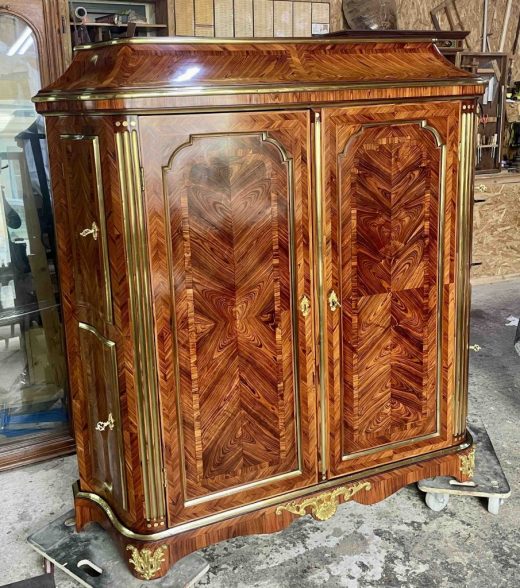
Restoration of a Regency-style cabinet, likely from the 1740s, stamped Pierre IV Migeon. It can also be used as a bookcase. Its frame is made of oak and softwood. It is entirely veneered with kingwood, rosewood on the top, and walnut on the interior. The doors feature butterfly-wing friezes. In contrast, the sides display a square pattern, typical of Migeon. A semi-circular brass molding borders the ogee cornice. Finally, brass fluting, ending in discs, adorns […]

Louis XVI secretary stamped Ohneberg

Ebénisterie Mathieu Vath

This Louis XVI period secretary bears the stamp of Martin Ohneberg. A masterpiece of sobriety and refinement, it combines a solid wood frame with rosewood and a sumptuous satinwood veneer. Its sinuous, golden veins lend brilliance and depth. Furthermore, the ornamentation remains understated yet exquisite. Indeed, delicately floral, chased bronze frames accentuate the clean lines of the piece, typical of the Neoclassical style. Martin Ohneberg, of German origin, was active in Paris during the last decades of the […]

Flat Greek-style desk stamped DUBOIS

Ebénisterie Mathieu Vath

One desk, one stamp, three cabinetmakers? This desk is a masterpiece of French cabinetmaking. It alone embodies the culmination of 18th-century Neoclassical taste. Yet, a question immediately arises: why three cabinetmakers for a single desk? In fact, the answer lies in a mixture of succession, talent, collaboration, and opportunism, typical of the craftsmanship of the period. This flat desk, known as a "Greek-style" desk, is a perfect example of the Louis XVI style. It combines marquetry of amaranth, satinwood, and other woods.

Louis XV commode by JB Fromageau

Ebénisterie Mathieu Vath

Restoration of a Louis XV commode stamped Jean-Baptiste Fromageau. Its frame is made of oak and softwood. It is inlaid with rosewood within violet wood borders. Curved at the front and flared at the sides, it opens with four drawers in three rows. Finally, a gray Sainte-Anne marble top crowns it. Jean-Baptiste Fromageau, son of a master cabinetmaker, was born around 1725. Admitted as a master on November 5, 1755, he first established himself on Rue Traversière, then on Rue du Faubourg-Saint-Antoine. Moreover, the Dauphin almanac lists his workshop among the most important in Paris. Cabinetmaker, […]

Louis XVI console table stamped Louis Noël Malle

Ebénisterie Mathieu Vath

Restoration of a Louis XVI console table stamped by Louis-Noël Malle, with solid mahogany legs and mottled mahogany veneer on an oak frame. Louis-Noël Malle, born in 1734, became a master craftsman on November 18, 1765. With his wife, Marie-France Le Maître, he established his shop and workshop on the Grande-Rue-du-Faubourg-Saint-Antoine. He is recognized as one of the greatest marquetry craftsmen of his time. The 1771 and 1772 editions of the Almanach Général des Marchands mention him, misspelling his name as "Le Mille." His "works related to […]" are particularly praised.

Happiness of the day by Guillaume Cordié

Ebénisterie Mathieu Vath

Minor maintenance restoration for this Transition-style bonheur-du-jour, veneered in rosewood. It also bears the stamp of Guillaume Cordié, the master of this type of desk. The work remained simple. First, we reattached a few veneer patches. Then, we addressed the oxidation and performed color restoration. Finally, we reapplied the French polish. Guillaume Cordié, born around 1733, initially worked as a freelance craftsman. He then obtained his master's certificate on June 18, 1766. He then established himself on the rue de Charonne, where he remained until […]

Cordié Transition-branded chest of drawers

Ebénisterie Mathieu Vath

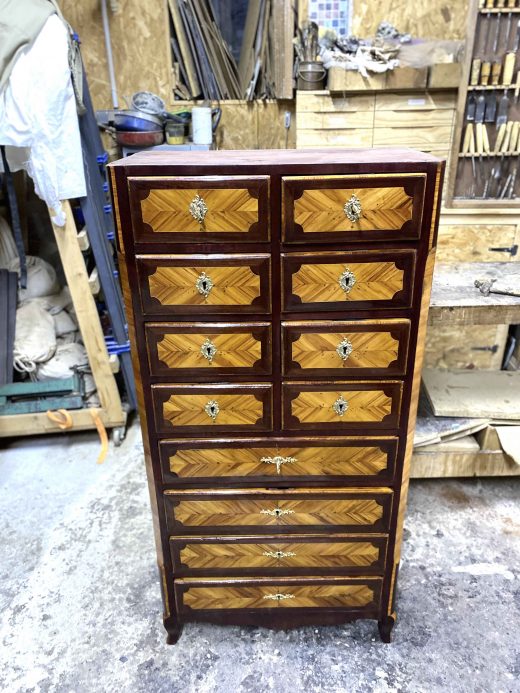
Restoration of a Transition period chiffonier, stamped by Guillaume Cordié and bearing the guild mark. It is veneered in rosewood and amaranth, on a frame of oak and softwood. However, its bronze fittings were added later. Guillaume Cordié, born around 1725, initially worked as a freelance craftsman before obtaining his master's certificate on June 18, 1766. He then established himself on the rue de Charonne, where he remained until his death. His works, of fine quality and harmonious proportions, are primarily in the Transition style […]

Transitional chest of drawers stamped SAUNIER

Ebénisterie Mathieu Vath

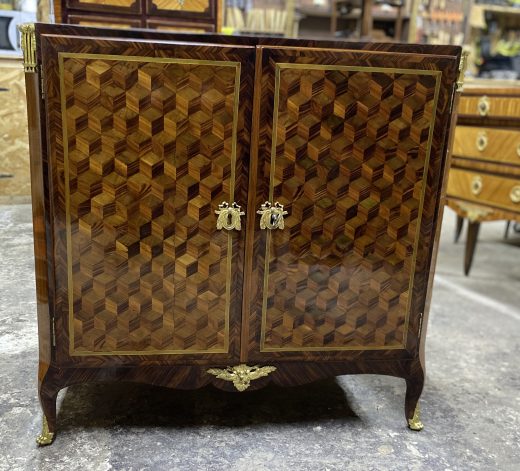
Restoration of a Transition-style two-door commode, inlaid with bottomless cube marquetry. Its frame combines oak for the uprights and rails, softwood for the side panels, and walnut for the two doors. The bottomless cubes themselves blend rosewood, violet wood, and tobacco-stained maple. Furthermore, a green-stained maple and boxwood inset borders the entire piece. In addition, the uprights and door frames are veneered with violet wood and rosewood. The […]

Transition chest of drawers stamped Fromageau

Ebénisterie Mathieu Vath

Restoration of a Transition-style commode, known as a "Greek-style" commode, stamped by Jean-Baptiste Fromageau. It is rosewood veneered, with an amaranth frieze and faux fluting. Topped with a Royal red marble slab, it opens with three drawers. The first, narrower drawer features a frieze of glyphs. The two following drawers, however, are inlaid with Greek key patterns at the corners in violet wood. The bronze mounts include ring handles, keyhole escutcheons with knotted ribbons, and a tailpiece with droplets. It also features […]

Louis XV commode stamped NA Lapie

Ebénisterie Mathieu Vath

Restoration of a Louis XV commode stamped Nicolas Alexandre Lapie, veneered in amaranth and satinwood. Its oak frame is of exceptionally high quality. However, the sides and drawer fronts are made of softwood. Finally, the top is a griotte marble from Campan. Nicolas Alexandre Lapie, son of Nicolas Lapie, a pottery merchant in the Faubourg Saint-Antoine, and brother of the master cabinetmaker Jean Lapie, Nicolas Alexandre (known as the Elder) appears to have been born around 1730. He registered his master's letters at the Châtelet in Paris on August 17, 1764. […]

Transition chest of drawers stamped LEGRY

Ebénisterie Mathieu Vath

Restoration of a transitional commode stamped by Jean-Louis-François Legry. Its frame is made of oak and softwood. It is veneered with amaranth, rosewood, and satinwood on the sides, with ebony and boxwood stringing. This commode exemplifies the very end of the transition between the Louis XV and Louis XVI styles. The legs remain the only vestige of the Louis XV curves; they would soon give way to the straight legs of the Louis XVI style. Jean-Louis-François Legry, born in 1745, obtained his master's degree in Paris on […]

Louis XVI secretary stamped Montigny

Ebénisterie Mathieu Vath

A little restoration for this Louis XV period secretary desk stamped by Philippe-Claude Montigny. It is constructed of oak and softwood, and veneered with rosewood, amaranth, and boxwood. It consists of a top drawer, a drop-front, and two doors. The interior compartments contain six drawers. Philippe Claude Montigny (1734-1800) became a master craftsman on January 29, 1766. Son of Louis Montigny, a privileged craftsman of the King, he owned a workshop in the Contrescarpe district of Paris. He was also the brother-in-law of Fidelis Schey, a cabinetmaker […]

Marquises stamped C.SENE

Ebénisterie Mathieu Vath

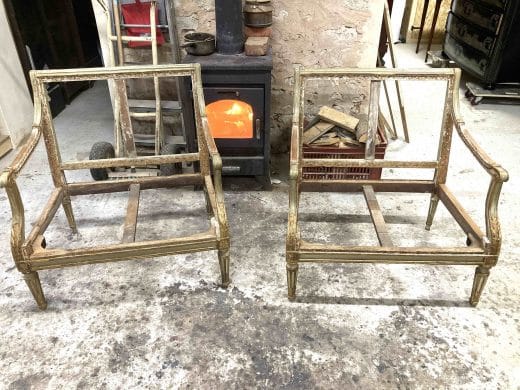
Conservation work on these two marquise chairs stamped by Claude I Sené. Claude I Sené (1724-1792), son of Jean Sené, obtained his master craftsman's certificate in Paris in 1743. He worked in the same workshop as his brother-in-law, the cabinetmaker Jean-Étienne Saint-Georges, on the rue de Cléry, under the sign "du Grand Saint-Georges." His output included numerous Louis XV chairs, but very few Louis XVI pieces. He ceased working in 1780. He was the father of two other illustrious chair makers: Jean-Baptiste Claude and Claude II. BIBLIOGRAPHY: Le Mobilier Français […]

L. Cueunières Writing Desk

Ebénisterie Mathieu Vath

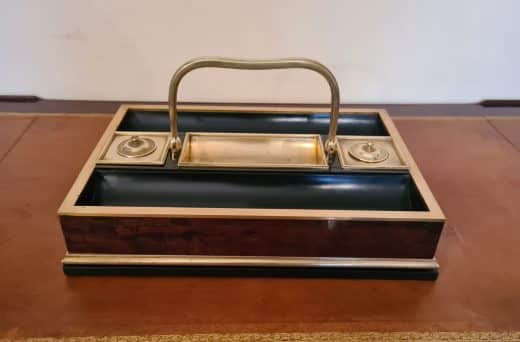
A small restoration for this very pretty Louis XVI style inkwell, stamped L.CUEUNIERES jne. Louis Cueunières the Younger established himself in 1870 at 10 rue Villehardouin, in Paris. He specialized in the restoration of antique furniture and the reproduction of period pieces. This inkwell was in fairly good condition. Apart from a few missing pieces of ebony, it was only dirty. A few ebony grafts, a good cleaning, and a touch-up of the varnish with a French polish were enough to restore its former luster. To see previous restorations: https://ebenisterie-mathieuvath.fr/en-ce-moment-a-latelier/ You can find this piece of furniture […]

Louis XVI Molitor Console

Ebénisterie Mathieu Vath

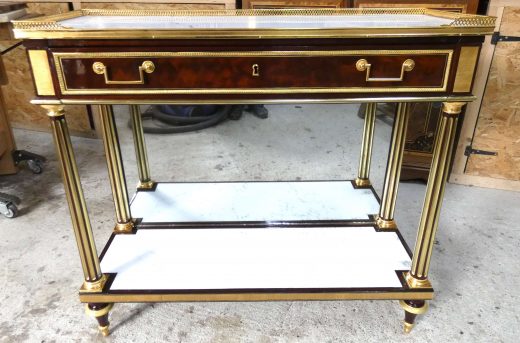
Restoration of a Louis XVI console table (1790-1795) stamped by Bernard Molitor. The frame is oak, and the legs are solid mahogany. The panels of the lower shelf are beech. It is veneered with mahogany burl and ebony and brass stringing. Originally from Luxembourg, Bernard Molitor (1755 – November 17, 1833) obtained his master craftsman's certificate in Paris on October 26, 1787. Arriving in Paris in 1776, he initially worked in a small workshop in the Arsenal district. After completing his master's degree, he established himself on the rue de Bourbon-Saint-Germain. The austerity of his work, […]

Majorelle table and rosewood

Ebénisterie Mathieu Vath

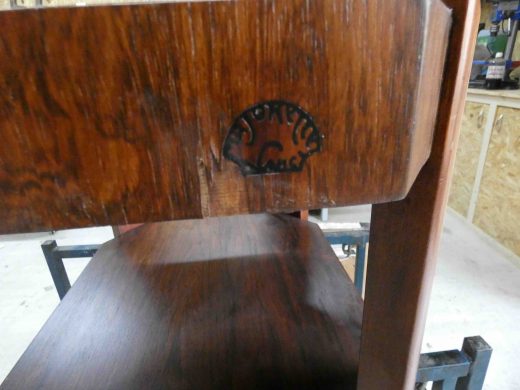
This is the second time I've worked on this type of table, which came from Louis Majorelle's workshop in the 1920s or 30s. You can find all the information about this type of table at the following link: https://ebenisterie-mathieuvath.fr/2019/08/29/table-majorelle/ It's primarily a preventative restoration. In fact, there wasn't any major damage. So, a few grafts and re-gluing a large part of the edge veneer were enough to restore this lovely Rio rosewood table. This is therefore an opportunity to tell you about this wood, which is so […]

Jacob Frères bench and armchairs on rue Meslée

Ebénisterie Mathieu VATH

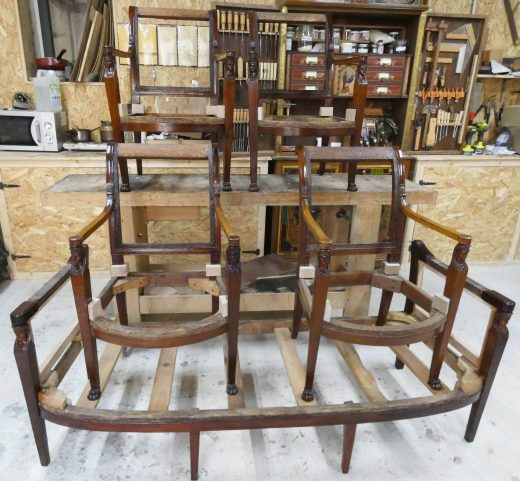
Extensive restoration and conservation work has been undertaken on this bench and its four armchairs from the Consulate period, stamped Jacob Frères, rue Meslée. Their front and rear legs are made of solid Cuban mahogany, with veneered crossbars. The armrests, supported by Egyptian heads, are made of light mahogany from Santo Domingo, contrasting with the uprights. They are adorned with carved palmettes and rosettes in Cuban mahogany. The front legs are tapered and end in claw feet, while the rear legs are arched. The bench is a converted sofa. Due to reupholstering […]

Hedouin commode with crowned C

Ebénisterie Mathieu VATH

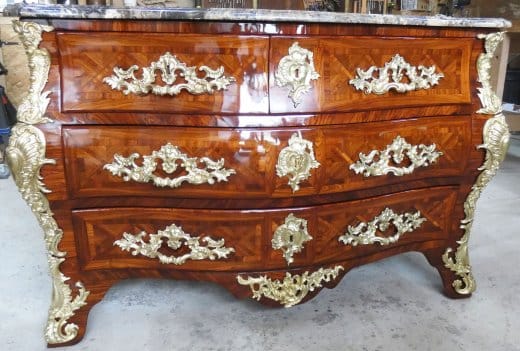
Extensive restoration of this superb Louis XV period commode, stamped on all four uprights by Jean-Baptiste Hedouin. The frame and drawers are made of solid oak, fir, and walnut. It is veneered with satinwood for the frieze edges and features geometric marquetry in violet wood. Two types of violet wood are used: one with a very tight grain and veining for the lozenges, the other more intricate for the borders, uprights, and rails. The gray Ardennes marble is molded and shaped into the forms […]

Louis XVI style desk stamped KRIEGER

Ebénisterie Mathieu VATH

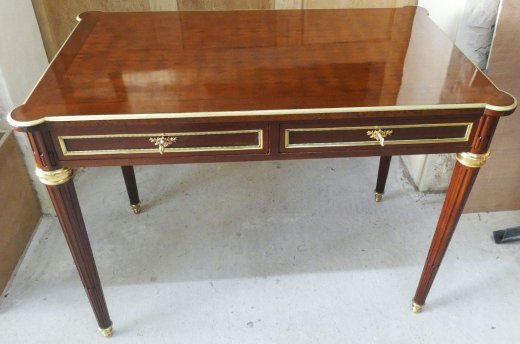
This desk is exquisitely crafted, with its oak frame veneered in mahogany and its solid mahogany legs. It is, in fact, a perfect example of high-quality 19th-century furniture. Indeed, the cabinetmaking is flawlessly executed, and the bronze mounts are in perfect condition. In short, everything is there; nothing is missing. The Krieger firm began its cabinetmaking business in the mid-19th century with Antoine Krieger (1804-1869). It then added a significant decorative department, which ensured its prestige until around 1945. Thus, it produced all […]

Napoleon III planter and Louis XVI chest of drawers

Ebénisterie Mathieu VATH

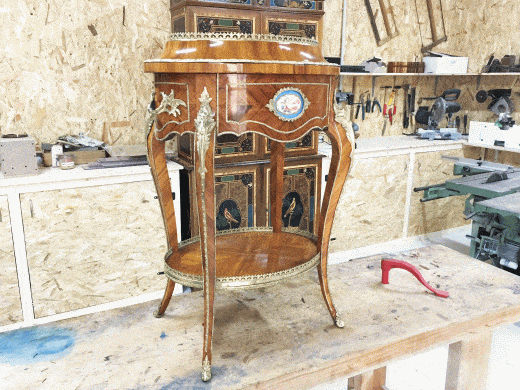
This week, two pieces of furniture left the workshop: a Napoleon III jardinière in rosewood veneer and a Louis XVI chiffonier in rosewood and violet wood veneer. If this piece had seven drawers, it would have been called a "semainier" (weekly chest of drawers). Here are some photos of their restoration.

Alexandre Morell's Boulle Cartel

Ebénisterie Mathieu VATH

Here is my first client, or patient… whichever you prefer. It's a Boulle marquetry cartel clock in brown tortoiseshell, ebony, and brass. As the photos show, it's not in very good condition. A lot of the brass is missing, and what remains is peeling off everywhere. At first glance, it's always difficult to precisely date a Boulle cartel clock. Moreover, this one doesn't bear a maker's mark. On the other hand, it has corkscrew screws, typical of the 18th century, and few visible tool marks. Yet, I had a hunch it was a copy […]