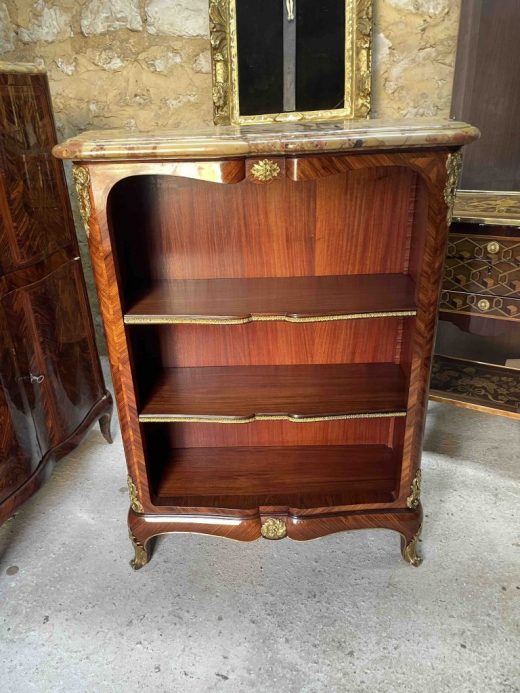
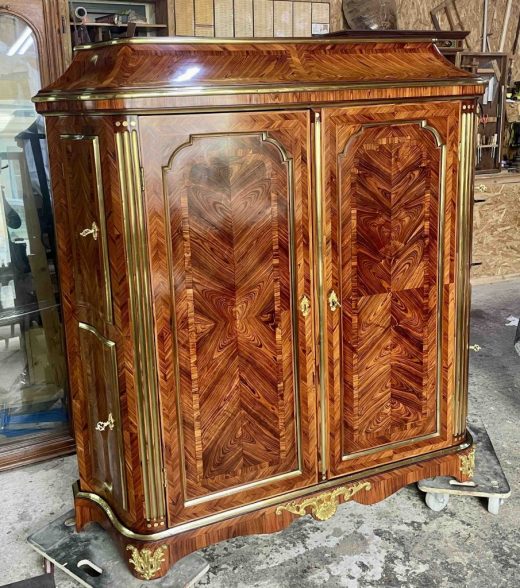
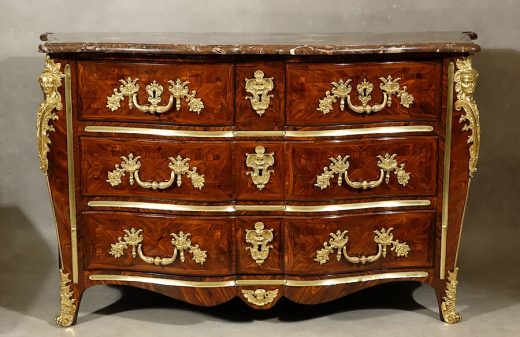
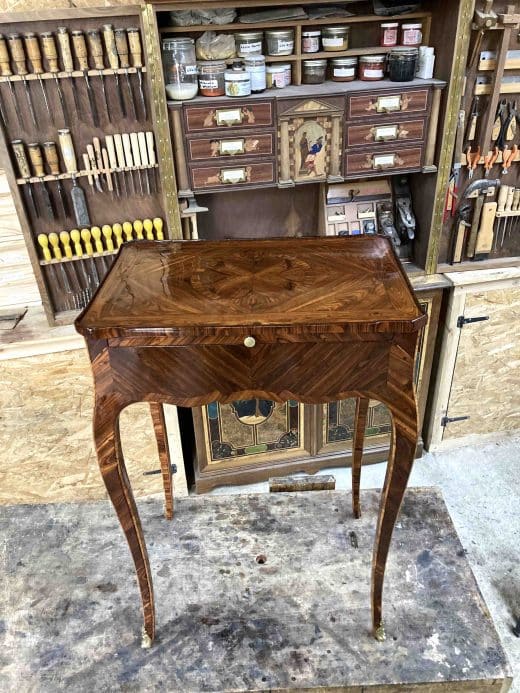
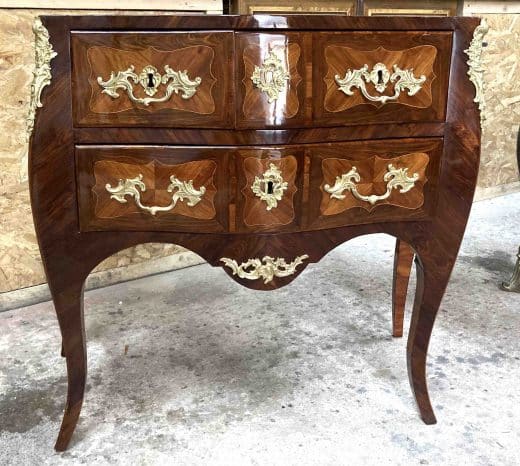
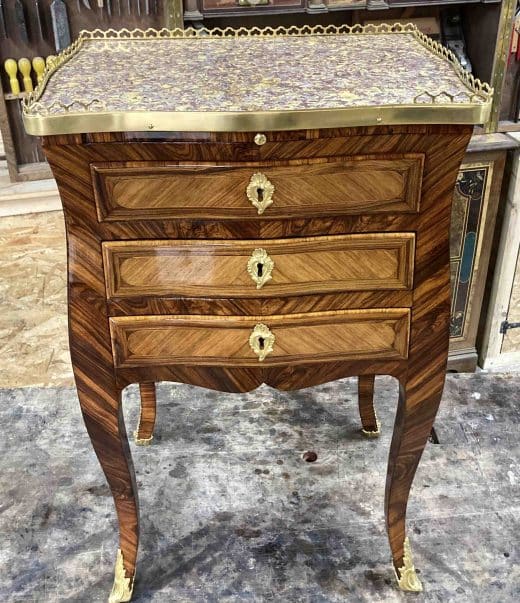
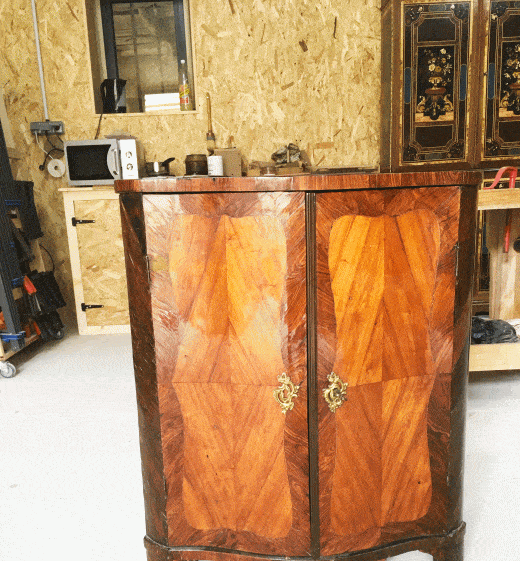
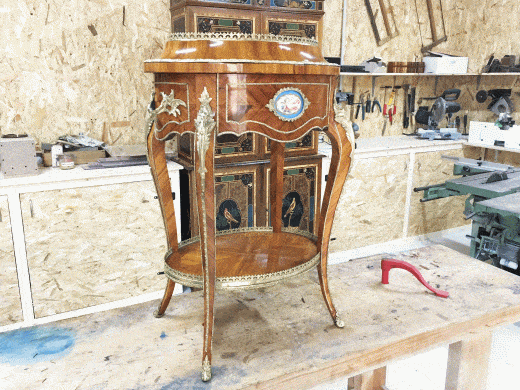
Louis XV style bookcase

Ebénisterie Mathieu Vath

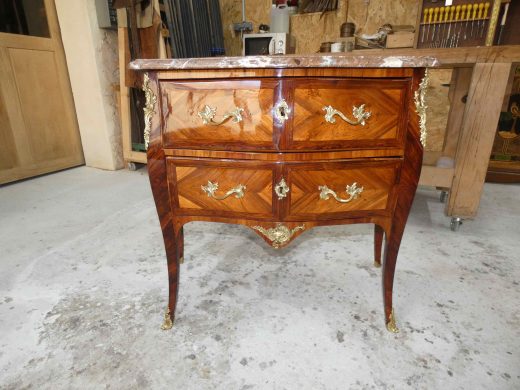
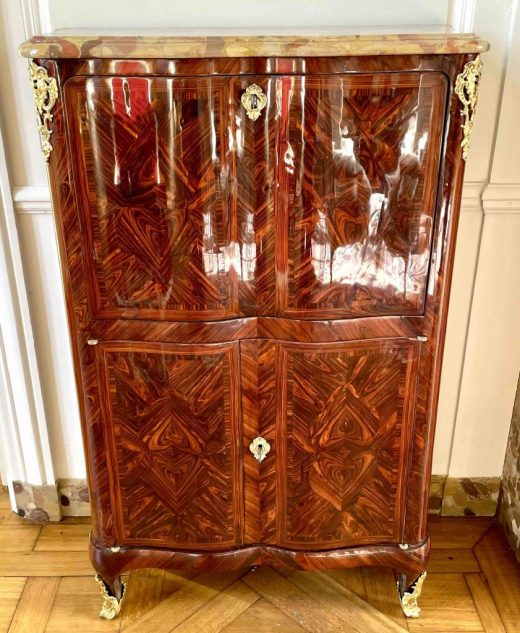
We have completed the restoration of this Louis XV style bookcase, from the Napoleon III period, stamped Léon Dromard. Its oak frame is veneered with violet wood. Moreover, its style is very reminiscent of the furniture of Pierre IV Migeon in the 18th century. But do you know what a bookcase is? It's a small, open storage unit, which appeared in the 18th century, designed to hold books and decorative objects. Appreciated for its lightness and elegance, it quickly became a staple in refined interiors. Then, in the 19th century, the taste for […]
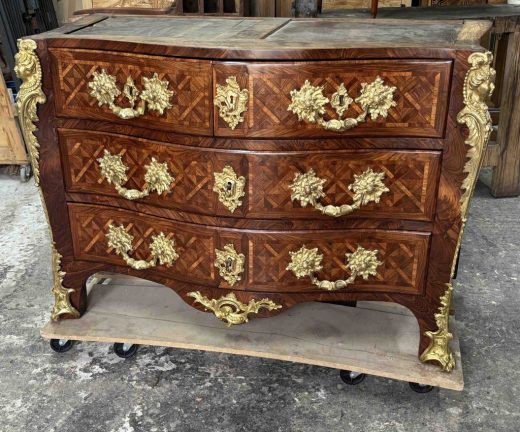
Regency chest of drawers stamped Merchant

Ebénisterie Mathieu Vath

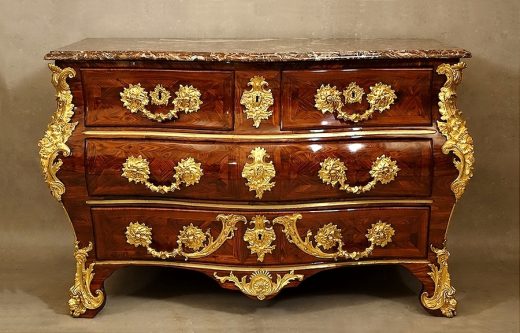
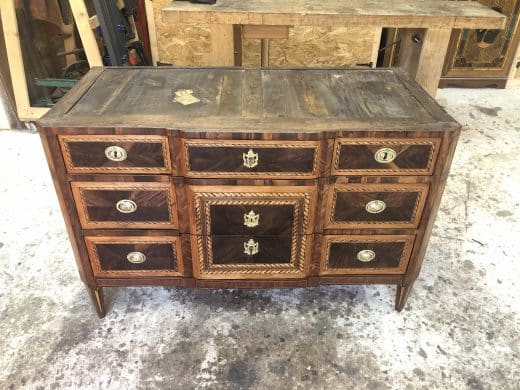
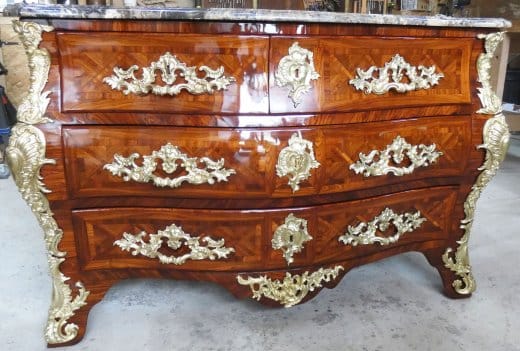
Restoration of a Regency period commode, stamped Nicolas-Jean Marchand. It is veneered in kingwood with a diamond-point pattern, on an oak frame. It opens with four drawers. Furthermore, a set of chased bronze mounts bearing the crowned C adorns the whole. These include thick drop handles and large gadrooned rosettes. In addition, there are cartel-shaped keyhole escutcheons and espagnolette drops, terminating in eagle-claw feet. The crowned C: The royal edict of 1745 imposed a distinctive mark on bronze workers: a "C" […]

Louis XV secretary desk, stamped MIGEON

Ebénisterie Mathieu Vath

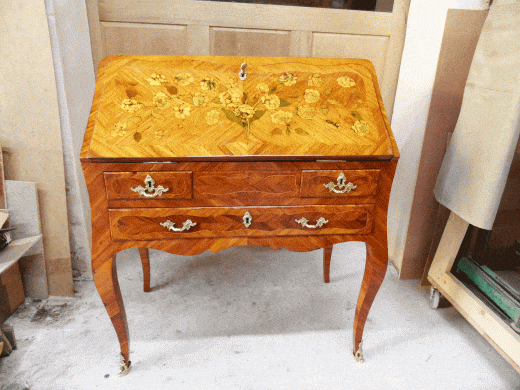
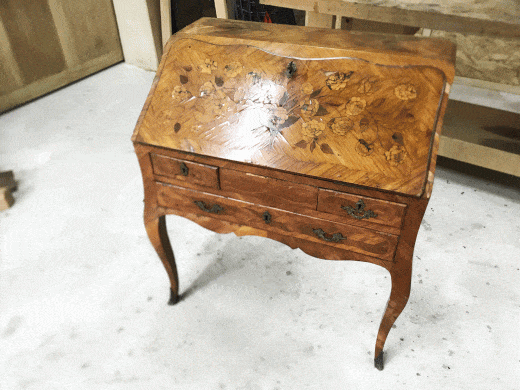
Restoration of a secretary desk, commonly called a "drop-front secretary" or "cabinet secretary," bearing the MIGEON stamp. This piece is distinguished by its serpentine front, opening with a pivoting drop-front that reveals nine small, curved drawers. The inside of the drop-front is lined with leather. The "cabinet" itself opens with two doors. The entire front is veneered with four panels of kingwood veneer, obliquely cut into butterfly wings. Each compartment is decorated with a quatrefoil motif of butterfly wings, set within a […]

Regency-style wardrobe stamped MIGEON

Ebénisterie Mathieu Vath

Restoration of a Regency-style cabinet, likely from the 1740s, stamped Pierre IV Migeon. It can also be used as a bookcase. Its frame is made of oak and softwood. It is entirely veneered with kingwood, rosewood on the top, and walnut on the interior. The doors feature butterfly-wing friezes. In contrast, the sides display a square pattern, typical of Migeon. A semi-circular brass molding borders the ogee cornice. Finally, brass fluting, ending in discs, adorns […]

Flat Greek-style desk stamped DUBOIS

Ebénisterie Mathieu Vath

One desk, one stamp, three cabinetmakers? This desk is a masterpiece of French cabinetmaking. It alone embodies the culmination of 18th-century Neoclassical taste. Yet, a question immediately arises: why three cabinetmakers for a single desk? In fact, the answer lies in a mixture of succession, talent, collaboration, and opportunism, typical of the craftsmanship of the period. This flat desk, known as a "Greek-style" desk, is a perfect example of the Louis XVI style. It combines marquetry of amaranth, satinwood, and other woods.

8-foot Regency style pedestal desk with Democritus masks

Ebénisterie Mathieu Vath

Restoration of a Regency period double-sided flat-fronted desk with a drawer unit, veneered entirely in kingwood. Its sides feature a diamond-point frieze, while the drawer fronts form an inverted slab pattern. Each side opens with four drawers in the frieze, with a central drawer on one side. Furthermore, a molding encircles the top, which is covered in gilt leather tooled in small pieces. The desk rests on eight cabriole legs ending in goat hooves. Most notably, it bears two emblematic bronzes from the oeuvre of André Charles Boulle: […]

Louis XV commode by JB Fromageau

Ebénisterie Mathieu Vath

Restoration of a Louis XV commode stamped Jean-Baptiste Fromageau. Its frame is made of oak and softwood. It is inlaid with rosewood within violet wood borders. Curved at the front and flared at the sides, it opens with four drawers in three rows. Finally, a gray Sainte-Anne marble top crowns it. Jean-Baptiste Fromageau, son of a master cabinetmaker, was born around 1725. Admitted as a master on November 5, 1755, he first established himself on Rue Traversière, then on Rue du Faubourg-Saint-Antoine. Moreover, the Dauphin almanac lists his workshop among the most important in Paris. Cabinetmaker, […]

Regency-style chest of drawers stamped by Michel Mallerot

Ebénisterie Mathieu Vath

Restoration of a commode from the first half of the 18th century, curved in height and bombé in plan. It opens with four drawers in three rows. Known as a tomb-shaped or Regency commode, it belongs to a much smaller group: that of commodes with a bridge and mustache-shaped finials. Its frame is typical of the Regency period. The uprights are made of oak, and the rest is primarily a high-quality softwood. The drawers, fitted with mortise and tenon joints, are made of walnut. The veneer uses only two types of wood, […]

Regency commode in sarcophagus form

Ebénisterie Mathieu Vath

Minor restoration was required for this Regency commode, known as a "sarcophagus commode." Indeed, a few veneer repairs and a refinishing of the varnish were enough to restore its former glory. The sarcophagus commode? The first commodes were designed by André-Charles Boulle. Then, a few years later, during the Regency period, commodes with curved sides and tops appeared. Throughout the 18th century, they were known as "Regency-style" commodes. Similarly, it wasn't until 1720 that commodes with two rows of drawers reappeared.

Regency commode with faun and lion masks

Ebénisterie Mathieu Vath

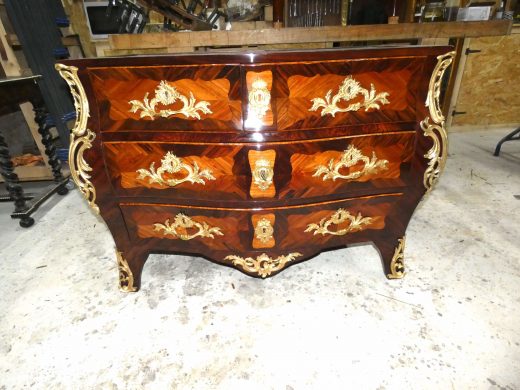
Restoration is complete for this important and rare Regency period commode, known as a "tomb-shaped" commode, a "Regency-style" commode, or a "moustache" commode. Curved on all sides, it features four drawers in three rows. It is topped with Vieux Rance marble from Belgium. It's worth noting that at the beginning of the 18th century, Rance was a French village. Molded in a corbel shape, the marble follows its contours. Veneered entirely in kingwood, this wide commode is enlivened by its powerful curves. Furthermore, brass fluting adorns the front and sides. Most notably, it bears […]

Small Louis XV style commode

Ebénisterie Mathieu Vath

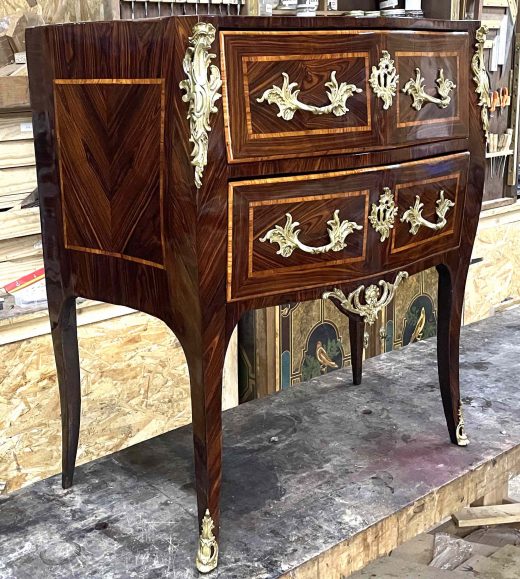
Here is the latest restoration by Raphaël, my apprentice. It's a Louis XV period commode. It's veneered in rosewood and violet wood, on a frame of oak and softwood. Condition report: This was an ideal project for tackling the restoration of the structure and veneer. Indeed, almost all the panels were detached and too short. Furthermore, the joints were loose. In addition, both sides had separated from the uprights and were split in the middle. Finally, of course, the […]

Regency chest of drawers with Spanish-style drawers

Ebénisterie Mathieu Vath

Restoration of a Regency period serpentine commode, known as a "spanielette" commode. Curved on all sides, it is veneered in violet wood over a walnut frame. It opens with four drawers in three rows. A Belgian griotte red marble top, with ears and a corbel edge, crowns it. Like the front rails, its pinched uprights feature brass fluting. Its high-quality bronze mounts are superbly chased. Indeed, it features very rare espagnolettes, seen on only six commodes. Four […]

Louis XV commode

Ebénisterie Mathieu Vath

Restoration of a Louis XV period commode veneered in rosewood and violet wood. The commode, also known as the commode sauteuse, appeared during the Regency period, between 1705 and 1730, and is attributed to the cabinetmaker Charles Cressent. It consists of two drawers or two rows of drawers. The body is raised on half-height supports, with the body occupying half the height of the piece and the other half the legs. Intended to distinguish itself from the heavy and massive Louis XIV style, it is slender and graceful, almost ethereal. After restoration […]

Louis XV writing table

Ebénisterie Mathieu Vath

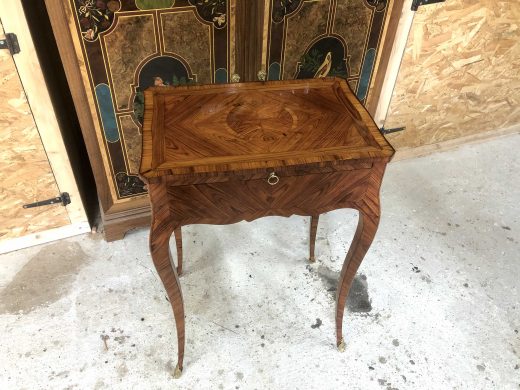
Restoration of a Louis XV period drawing table, or more precisely, a writing table. It is veneered in rosewood and kingwood, with satinwood on the back. Born from the passion for correspondence in the 18th century, fashionable merchants displayed all their ingenuity. They created numerous models of utilitarian tables, designed to be placed in the center of a room. These differed from ordinary tables: they generally included a writing surface and drawers for ink and quills. The term […]

Regency commode stamped by Michel Mallerot

Ebénisterie Mathieu Vath

Restoration of a commode stamped Michel Mallerot. With its serpentine front, it is entirely veneered in kingwood. Its frame is made of fir. As for the drawers, their sides are beech and their bottoms are walnut. You don't know Michel Mallerot? That's understandable! Indeed, Michel Mallerot (1675-1753) remains little known, like many Parisian cabinetmakers of the early 18th century. He was identified thanks to a pencil inscription, "M. Mallerot," on a Regency commode bearing this abbreviated stamp (formerly in the Philippe Glédel collection). The […]

Regency chest of drawers

Ebénisterie Mathieu Vath

To start the year, here are some photos of the restoration of this Regency commode. Made entirely of softwood, it is veneered with kingwood. Its uprights and rails are adorned with brass fluting. The bronze handles, influenced by Asia and the East India Company trade, are commonly referred to as "Chinese." The keyhole escutcheons, meanwhile, herald the arrival of the Louis XV style in the first half of the 18th century. Upon its arrival, in addition to some missing and peeling veneer, the commode presented a problem […]

Roussel Stamped Chest of Drawers

Ebénisterie Mathieu Vath

Restoration of a Louis XV commode stamped by the Parisian cabinetmaker Pierre Roussel. It is constructed of oak, with conifer panels. It is veneered with rosewood arranged in a herringbone pattern, framed by violet wood. The stringing is boxwood. Pierre Roussel was the son of Michel Roussel, a journeyman cabinetmaker originally from the Cotentin peninsula. His younger brothers, Jacques, Michel, and Louis, chose joinery; he was the only one to opt for cabinetmaking. He obtained his master craftsman's certificate on August 21, 1745. He settled in the Faubourg Saint-Antoine, […]

LARDIN transitional chest of drawers

Ebénisterie Mathieu Vath

Restoration of a Transition period commode. Constructed of fir and oak, it is veneered with rosewood and violet wood, with a Greek key frieze of green-stained hornbeam stringing. The sides are veneered with satinwood and violet wood. André-Antoine Lardin (1724 – August 10, 1790) obtained his master craftsman's certificate on July 1, 1750. He set up shop on rue de Charenton, under the sign "Au Bois de Boulogne." He worked there until 1770, then moved to rue Saint-Nicolas. His output was considerable. His furniture, in all styles (Louis […]

Louis XVI commode

Ebénisterie Mathieu Vath

This week, we restored a Louis XVI commode with a projecting front, veneered in Rio rosewood, amaranth, rosewood, and violet wood. Boxwood and ebony stringing forms a coiled ribbon, with engravings filled in red wax. Finally, the tapered feet and canted uprights feature faux fluting in ebony and boxwood. However, no stamp allows us to attribute this very fine piece, crafted from high-quality wood. The restoration required little work. In fact, a colleague was already […]

Eight-foot desk known as the "Mazarin" desk«

Ebénisterie Mathieu Vath

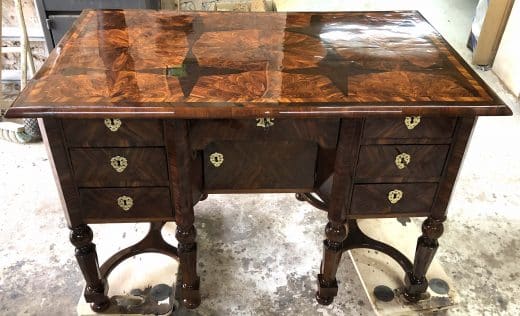
Extensive restoration work has been undertaken on this Mazarin desk, veneered in kingwood and rosewood. It is entirely veneered on fir, with a solid rosewood base. The top features a marquetry of rosewood stars, surrounded by kingwood butterfly wings arranged in circles. Why the name "Mazarin"? The eight-legged desk is one of the jewels of 17th-century furniture. Antique dealers only began calling it "Mazarin" in the 19th century, to lend it more "prestige." In reality, it only appeared around […]

Louis XV writing table

Ebénisterie Mathieu Vath

Before/after the restoration of a Louis XV writing table veneered in kingwood on solid oak. It has two side drawers and a central pull-out shelf beneath the leather-covered top. Besides the significant discoloration of the varnish, there were some small areas of peeling and missing veneer. The missing pieces were replaced with new veneer, which was sawn, scraped, and sanded, then cut to the correct thickness before gluing in order to avoid disturbing the patina beneath the bleached varnish. The […]

Louis XV commode

Ebénisterie Mathieu Vath

This is a significant restoration project for this Louis XV commode, originally veneered in rosewood and violet wood. It took me some time to confirm that it was indeed violet wood. This commode has undergone so many restorations that it now contains almost as much rosewood as violet wood. Fortunately, the drawers are still in fairly good condition, and they are definitely violet wood. I therefore conclude that the commode was originally veneered with these two woods. [… ]

Louis XV commode

Ebénisterie Mathieu VATH

The commode with a jumping top appears to have been invented during the Regency period, between 1705 and 1730, by the cabinetmaker Charles Cressent. It then became widespread under Louis XV. It has only two drawers, or two rows of drawers. Its body is raised on cabriole legs of medium height: the body occupies half the height of the piece, the legs the other half. The observer thus has the impression that the piece has legs allowing it to jump like a frog. The width offers straight, curved, or crossbow-shaped forms. The marble top follows the […]

Hedouin commode with crowned C

Ebénisterie Mathieu VATH

Extensive restoration of this superb Louis XV period commode, stamped on all four uprights by Jean-Baptiste Hedouin. The frame and drawers are made of solid oak, fir, and walnut. It is veneered with satinwood for the frieze edges and features geometric marquetry in violet wood. Two types of violet wood are used: one with a very tight grain and veining for the lozenges, the other more intricate for the borders, uprights, and rails. The gray Ardennes marble is molded and shaped into the forms […]

Louis XV slant-front desk (After restoration)

Ebénisterie Mathieu VATH

Some time ago, I told you about this desk that was being restored. Well, here it is finished. The varnishing took three weeks, allowing enough time for the varnish to dry properly and achieve the best possible result. To review the restoration process: Louis XV slant-front desk. Here are some before and after photos.

Louis XV slant-front desk

Ebénisterie Mathieu VATH

The restoration of a lovely slant-front desk, or as Riesener calls it in his memoirs, a "tomb-shaped secretary," began two weeks ago. Now that the restoration phase is complete and the varnishing has begun, I'm taking a moment to provide a brief summary. Description of the desk: Its frame is made of oak and fir, veneered with rosewood and violet wood. Furthermore, the drop-front features floral marquetry in boxwood, natural and stained maple, and hornbeam. In addition, the desk has a large drawer made of […]

Louis XV corner cabinet, stamped JM CHEVALLIER

Ebénisterie Mathieu VATH

Here is a corner cabinet stamped by Jean-Mathieu Chevallier. It is made of solid oak, veneered with rosewood and violet wood, with a boxwood inlay. Jean-Mathieu Chevallier was already established on Rue de Grenelle, under the sign of "La Croix Chevallier," when he received his master craftsman's certificate in 1743. He subsequently expanded his business considerably. He was notably in business with André-Charles Boulle, one of the sons of the famous cabinetmaker. Furthermore, he participated in furnishing the Hôtel du Duc de Talmont and the Château de […]

Napoleon III planter and Louis XVI chest of drawers

Ebénisterie Mathieu VATH

This week, two pieces of furniture left the workshop: a Napoleon III jardinière in rosewood veneer and a Louis XVI chiffonier in rosewood and violet wood veneer. If this piece had seven drawers, it would have been called a "semainier" (weekly chest of drawers). Here are some photos of their restoration.